This is a repository copy of
Joint Graphical Models for Date Selection in Timeline
Summarization
.
White Rose Research Online URL for this paper:
http://eprints.whiterose.ac.uk/91931/
Version: Accepted Version
Proceedings Paper:
Tran, G, Herder, E and Markert, K (2015) Joint Graphical Models for Date Selection in
Timeline Summarization. In: Proceedings of the 53rd Annual Meeting of the Association for
Computational Linguistics. ACL-IJCNLP 2015, 26-31 Jul 2015, Beijing, China. Association
for Computational Linguistics , 1598 - 1607. ISBN 978-1-941643-72-3
[email protected] https://eprints.whiterose.ac.uk/
Reuse
Unless indicated otherwise, fulltext items are protected by copyright with all rights reserved. The copyright exception in section 29 of the Copyright, Designs and Patents Act 1988 allows the making of a single copy solely for the purpose of non-commercial research or private study within the limits of fair dealing. The publisher or other rights-holder may allow further reproduction and re-use of this version - refer to the White Rose Research Online record for this item. Where records identify the publisher as the copyright holder, users can verify any specific terms of use on the publisher’s website.
Takedown
If you consider content in White Rose Research Online to be in breach of UK law, please notify us by
Joint Graphical Models for Date Selection in Timeline Summarization
Giang Tran L3S Research Center Leibniz-University Hannover
Eelco Herder L3S Research Center Leibniz-University Hannover
Katja Markert L3S Research Center Leibniz-University Hannover
and School of Computing University of Leeds
Abstract
Automatic timeline summarization (TLS) generates precise, dated overviews over (often prolonged) events, such as wars or economic crises. One subtask of TLS se-lects the most important dates for an event within a certain time frame. Date selec-tion has up to now been handled via su-pervised machine learning approaches that estimate the importance of each date sepa-rately, using features such as the frequency of date mentions in news corpora. This ap-proach neglects interactions between dif-ferent dates that occur due to connections between subevents. We therefore suggest a joint graphical model for date selection. Even unsupervised versions of this model perform as well as supervised state-of-the-art approaches. With parameter tuning on training data, it outperforms prior super-vised models by a considerable margin.
1 Introduction
Major events (such as the Egypt revolution starting in 2011) often last over a long period of time and have impact for a considerable time afterwards. In order to find out what happened when during such an event, time-related queries to search engines are often insufficient as traditional IR does not handle time-related queries well (Foley and Allan, 2015). To provide readers with comprehensive overviews of long events, many news outlets employ time-line summaries: a timeline summary is a list of selected dates with a few sentences describing the most important events on each date. An example can be seen in Table 1. Timelines allow the reader to gain a quick overview over a complex event and to answer questions such as: How and when did the event start? What were the main consequences of the initial events? What happened to the main
protagonists in the event? In addition, timelines are frequent means in education (such as history teaching) so that their generation is relevant for education as well as journalism.
(a1) 2011-01-25
Egyptians hold nationwide demonstrations against the au-thoritarian rule of Hosni Mubarak, who has led the country for nearly three decades.
(a2) 2011-01-26
A large security force moves into Cairo’s Tahrir Square (a3) 2011-01-28
Protesters burn down the ruling party’s headquarters, and the military is deployed.
(a4) 2011-02-11
Mubarak steps down and turns power over to the military. (a5) 2011-03-19
In the first post Mubarak vote, Egyptians cast ballots on constitutional amendments . . . , including scheduling the first parliamentary and presidential elections
(a8) 2012-04-20
The presidential campaign officially begins. (a10) 2012-06-24
Election officials declare Morsi the winner (a26) 2013-07-03
Egypt’s military chief says Morsi has been replaced by Adly Mansour, the chief justice of constitutional court.
Table 1:A timeline about the Egypt revolution published by the Associated Press (AP). We leave out intermediate dates due to space constraints. The whole timeline includes 30 dates between 2011-01-25 and 2013-07-07.
Though convenient for the reader, the manual creation of a timeline can take a long time even for experts. For example, the creator of the start-up Timeline says that it initially took a multi-person team a full work day to create a single timeline.1 Therefore, automatic timeline summa-rization (TLS) has emerged as an NLP task in the past few years (Tran et al., 2013a; Kessler et al., 2012; Nguyen et al., 2014; Yan et al., 2011b; Yan et al., 2011a; Wang et al., 2012; Tran et al., 2013b; Tran et al., 2015). TLS has been divided into two subtasks: (i) ranking the dates between beginning
1http://www.niemanlab.org/2015/02/
and end of the timeline in order of importance, to achieve date selection and (ii) generating a good daily summary for each of the selected dates. In this paper, we tackle the first task. Date selection is challenging, as normally only a small set of the available dates is chosen for inclusion in the time-line (see Table 1). Date selection may be partially subjective: different journalists might include dif-ferent dates.2
Existing approaches to date selection (Kessler et al., 2012; Tran et al., 2013a) use supervised ma-chine learning, where each date receives a score for ranking the dates. Features used (such as fre-quency of date mention) are extracted from a cor-pus of event-related newspaper articles. Though the features are well-explored, the models score each date independently of other dates.
In contrast, we argue that interaction between dates should be taken into account. Timeline summaries tend to include “substories” in which the majority of selected dates are part of a chain of events that share major actors or demonstrate cause-effect. Table 1 shows at least two such chains: the (a1-4-5) chain of protests leading to Mubarak’s resignation and the necessity of new elections, as well as the similar (a8-10-26) chain on Mursi. These chains can also be observed in the corresponding news articles. For example, some background articles on Mubarak’s step-down will likely explain the reasons behind it. However, ex-tracting such causal information can be difficult, as demonstrated by the still low results for dis-course relation extraction (Lin et al., 2014; Braud and Denis, 2014). Instead, we usedate reference graphs, which model which date refers to which other date. In our example, articles published on Mubarak’s resignation date might refer to the date when the protest started. Although weaker than direct causal links, these links are easy to extract and we will show that they are very useful. In ad-dition, references from important dates (such as Mubarak’s resignation date) should be weighted higher than other references. This is akin to IR models such as PageRank, which weigh links from popular pages higher than links from less popular pages.
The main contributions of this work are: (i) we leverage interaction between dates via date ref-erence graphs as a basis for date selection in TLS
2Note that the date selection task uses dates as proxies for
important events on that date.
(ii) we provide a novel random walk model on this graph that incorporates both topical importance of referring sentences as well as frequency and tem-poral distance of references. We propose both un-supervised as well as un-supervised versions of this model.
We show that the proposed date selection approach outperforms previous approaches with evaluations on four real-life, long-term news events. We also discuss variations in timeline con-struction over different events, as well as by dif-ferent journalists.
2 Related Work
Timeline summarization is a special case of multi-document summarization (MDS). As TLS orga-nizes events by date, timelines can be generated by MDS systems (such as (Radev et al., 2004b; Radev et al., 2004a; McKeown et al., 2003; Erkan and Radev, 2004; Metzler and Kanungo, 2008; Hong and Nenkova, 2014) by applying their sum-marization techniques on news articles for every individual date to create corresponding daily sum-maries. However, manually written timelines nor-mally only include a small number of dates; in addition, the temporal component imposes con-straints on sentence selection for timeline sum-marization, such as the preference for little over-lap between sentences selected for different dates (Yan et al., 2011b).
Many studies specific to timeline summariza-tion, such as (Swan and Allan, 2000; Allan et al., 2001; Chieu and Lee, 2004; Yan et al., 2011b; Tran et al., 2015), focus on the extraction of salient sentences or headlines for generating the textual content of timelines. They assume either that the dates are given in advance or they use simple mea-sures such as burstiness (Chieu and Lee, 2004; Yan et al., 2011b) for date selection, where bursti-ness relies on the number of date mentions.
Prior approaches dedicated specifically to date selection are Tran et al. (2013a) and Kessler et al. (2012).3 They use supervised machine learn-ing methods that score dates independently of each other. Features are extracted from a cor-pus of event-related newspaper articles, including frequency-based features (such as how often the date is referred to in the corpus), temporal distance features (such as how long into the future a date
3Kessler et al. (2012) is also used in Nguyen et al. (2014)’s
keeps being referred to) and topical features (such as whether the date mention is associated with the most significant keywords of the event). We, how-ever, score dates jointly, making use of interac-tions between dates in a graphical model. This improves substantially over prior approaches. We also propose unsupervised variations that perform competitively to prior supervised models.
3 Problem Definition and Approach Similar to Kessler et al. (2012) and Tran et al. (2013a), we use the day as the timeline time unit (so, for example, we exclude hourly timelines).
3.1 Problem Definition
Given a main event and a time window [t1, t2]
within the event duration, our task is to select the top k dates (d1, d2, ..., dk) ∈ [t1, t2], when the
most important (sub)events occurred. Therefore, timelines of variable length can be constructed. Like (Kessler et al., 2012; Tran et al., 2013a), we also assume that we have a corpus C, consisting of news articles about the main event. This corpus gives evidence about the dates in[t1, t2].
3.2 Proposed Approach
We build adate reference graph, which is afully directed graphG = (V,E), whereV is the set of
dates mentioned in any text in corpusC, including publication dates. The edgesE = {e(di, dj)}
in-dicate that at least one text published ondi refers
to the datedj.
We represent each such link as a multi-value tuple e(di, dj) =
(Mij, f req(di, dj), Itemporal(di, dj), Itopical(di, dj))
to integrate different measures of date importance. The first value, Mij = N1 expresses the prior
stochastic transitional probability between 2 dates where N = |V|. The others express the strength of the connection between di and dj
modelled by the following aspects: frequency (f req), temporal influence (Itemporal) and topical
influence (Itopical). We also suggest different
combinations of these parameters.
Then we introduce a random walk model that uses these perspectives to rank the collection of dates.
Frequency of References. When a datedjis
re-ferred to from either a past or future news article (published ondi), it is likely involved in the events
that are reported in that article. An example
pub-lished on Mubarak’s resignation date and referring back to the protest start can be seen below:
(1) On January 25, an uprising of Egyptians erupted calling for Mubaraks resignation as president. Protests contin-ued to grow . . . (CBS Detroit, 2011-02-11)
We hypothesize that the more frequent such references are, the stronger this involvement is. Hence, we compute f req(di, dj) as the number
of references to dj from news articles published
on di. While prior work (Kessler et al., 2012)
uses aggregate frequency of references todj over
the whole corpus as a feature, they do not handle the interaction between dates and can therefore not score dates jointly.
Topical Influence. In Example 1 above, the ref-erence sentence mentions only major actors in the Egypt crisis (Mubarak, Egyptians) as well as only major subevents (uprising, protests). This makes for a link between 2011-02-11 (publication date) and 2011-01-25 (referred date) that is relevant to the main event and emphasises the importance of the referred date. In contrast, Example 2 also talks about less salient entities in context of the Egypt revolution and makes for a less topical link be-tween 2011-02-02 (publication date) and 2011-01-25 (referred date).
(2) Mr Ghonim is Google’s head of marketing for Mid-dle East and North Africa and was in Egypt when the protests started on Jan 25 (DailyMail, 2011-02-02).
We quantify the topical influence between dates as follows: LetSi→j = {sij} be the set of
sen-tences that are published indiand refer todj. We
are interested in how relevant this connection is to the overall news event, looking at the content in Si→j. To do so, we represent the overall content
of the news collection by a set of keywordsQ = {q1, q2, ..., qn}, which are computed via TextRank
(Mihalcea and Tarau, 2004).4 We compute a rel-evance score for each sentencesij inSi→j by the
famous Okapi BM25 function (Robertson et al., 1994), which ranks a sentence more topical if it contains more as well as more of the most salient collection keywordsQ.5 We compute topical in-fluence (Itopical) as either the maximum value or
the sum value of the relevance scores of allsij.
Imaxtopical(di, dj) = max sij∈Si→j
BM25(sij, Q) (3)
If req∗topical(di, dj) =
X
sij∈Si→j
BM25(sij, Q) (4)
4
We set n=20 in practice.
5We use the standard BM25 parameter settingsk
Intuitively, If req∗topical(di, dj) is proportional
to the size of Si→j as well as to the relevance
scores of its sentences whereasImaxtopical(di, dj)
does not consider reference frequency at all. Whendj is not mentioned by any articles
pub-lished on di, the value of the topical influence is
equal to zero.
Temporal Influence. The longer ago an event happened the more likely it is to have been for-gotten. Only very important events are referred to over long time frames. We therefore hypothesise that a datedj is more influential (for another date
di) if di mentions dj and the temporal distance
between the two dates is high. Overall, dj
gath-ers importance with several long-term references. Ex. 5 showcases an example:
(5) Military generals took over power from Mubarak when he stepped down onFebruary 11 last year. (Daily Mail, 2012-01-25).
We define the temporal influence of an existing edgeItemporal(di, dj)as either the absolute value
of temporal distance between the two dates or by the product of the temporal distance with the num-ber of referencesf req(di, dj). In the second
com-putation, the temporal influence between two dates increases whendireferencesdj more than once.
I|temporal|(di, dj) = ∆t=|di−dj| (6)
If req∗temporal(di, dj) =f req(di, dj)· |di−dj| (7)
When dj is not mentioned by any articles
pub-lished ondi, the temporal influence is set as zero.
Random Walk Model for Date Ranking. A random walk on a given graph is a Markov pro-cess, where each node represents a state and a walk transiting from one state to another state is based on a transition probability matrix. One well-known random walk algorithm is PageRank (Page et al., 1999), which models web surfer behavior to determine the importance of web pages with the following formula:
xt(j) =α
X
i∈L−j
Mijxt−1(i) + (1−α)vj, (8)
whereMij is the stochastic transition probability
from pagepi topj,xt(j)is the importance score
of page pj at step t, α is a damping factor that
controls how often the walker jumps to an arbi-trary node, vj is the initial probabilistic
impor-tance score (generally set to1/N, whereN is the number of nodes in the graph), andL−i is the set of incoming links of pagepi. When tis iterated
enough, the importance score vector reaches a sta-tionary distribution that can be used for ranking pages.
The traditional PageRank process in Eq. 8 cap-tures only the observed linking characteristics of nodes but ignores other sources of information which can be indicators for their importance.
We extend the model by introducing an influence-based random walk model (IRW) that allows the random walker to take into account multiple sources of information and perform vot-ing more effectively. The random walk process we propose can be defined by the following formula:
xt(j) =α
X
i∈L−j
I(i, j)·Mij·xt−1(i) + (1−α)vj (9)
where I(i, j) is the normalized influence factor that indicates how influential the edgedi → dj is
in the global context of the event. The normaliza-tion is done by scaling the range of value from [0, 1]. M is the stochastic transitional matrix. In our case,I(i, j)can be just the value off req(di, dj),
Itopical(di, dj) , Itemporal(di, dj) alone or a
xt(j) =αω
X
i∈L−j
W1(i, j)·Mij·xt−1(i)
+α(1−ω) X
i∈L−j
W2(i, j)·Mij·xt−1(i)
+ (1−α)vj
(10)
where W1(i, j) = maxIuvtopicalItopical(di,d(dju),dv) is
the normalized value for topical influence, and W2(i, j) =maxIuvtemporalI (di,dj)
temporal(du,dv)is the normalized
value for temporal influence.6
Here, the hyper-parameter0 ≤ ω ≤ 1controls the proportion of the topical influence fromdi to
dj. When ω = 0, no topical influence is taken
into account. No temporal influence is considered whenω = 1. Intuitively, at every step, the random walker can follow the outgoing nodes and either carry topical influence (the first part) or temporal influence (the second part) to contribute to the rank of the outgoing nodes. Otherwise, it teleports to an arbitrary node with probability(1−α).
Convergence Property. Starting from Eq. 10, we now show that theIRW model converges to a stationary distribution.
Let Λ and Λ′ be the matrix with elements W1(i, j) andW2(ij) respectively, with any edge
(di, dj),Ibe then×nidentity matrix, andvbe
the transpose of1×nuniform stochastic vector.
Mdenotes the transitional matrix forG.
Proposition 1. (I−α(wMTΛ + (1−ω)MTΛ′))
is invertible for allM,Λ,Λ′, α, ω.
Proof. LetP=wMTΛ + (1−ω)MTΛ′, we need to prove thatI−αPis invertible. Equivalently, we prove its transpose
I−αPTis invertible, which can be proved by showing that
(I−αPT)y= 0only has the trivial solutiony= 0.
(I−αPT)y= 0
y=αPTy
yi=α
X
j
Pjiyj
=αX
j
((ωW1(i, j) + (1−ω)W2(i, j))Mijyj).
(11)
Letu= arg maxjyj. Wheni==u, Eq. 11 infers,
yu≤α
X
j
((ωW1(u, j) + (1−ω)W2(u, j))Mujyu).
yu≤αyu
X
j
((ωW1(u, j) + (1−ω)W2(u, j))Muj
yu(1−αFu)≤0.
(12)
whereFu=Pj((ωW1(u, j) + (1−ω)W2(u, j))Muj. Clearly,Fu ≤1becauseW1(u, j)≤1andW2(u, j) ≤1
6In the case of linear combinations we incorporate
fre-quency into topical or temporal influence as described above.
andPjMuj= 1. Sinceα <1andFu≤1,(1−αFu)>0. Thereforeyu ≤0. Similarly, letv = arg minjyjwe have thatyv≥0. Asyv≤yu, this impliesyu=yv= 0to satisfy all inequalities. Consequently,yi = 0for alli, ory = 0. Thus,I−αPT invertible. Equivalently,(I−α(ωMTΛ + (1−ω)MTΛ′))is invertible.
Proposition 2. The iteration in Eq. 9 converges to
(1−α)(I−α(ωMTΛ + (1−ω)MTΛ′))−1v.
Proof. We can re-write Eq. 9 in matrix form:
xt=αPxt−1+ (1−α)v
= (αP)tx0+ (1−α)(
t
X
i=1
(αP)i−1)v (13)
We will show that lim
t→∞xt= (1−α)(I−αP) −1
v.
X
i
(αP)tij=
X
i
X
k
(αP)ik(αP)t−
1
kj
=X
k
(αP)t−1
kj
X
i
(αP)ik
=X
k
(αP)t−1
kj α(Fk)
≤X
k
(αP)t−1
kj α
≤(α)t
(14)
Here,Fk=Pi((ωW1(k, i)+(1−ω)W2(k, i))Mki≤1 (proof similarly to Proposition 1
Becauseα <1, this column sum converges to zero when t→ ∞. We then derive lim
t→∞(αP) tx
0 = 0. Whent→ ∞, given Proposition 1 and Neumann series, Eq. 13 becomes:
xt= (αP)tx0+ (1−α)(I−αP)− 1
v
hence, lim
t→∞xt= (1−α)(I−αP) −1
v. Convergence proved.
4 Experiments
4.1 Ground Truth and Data Preprocessing
Kessler et al. (2012) use 91 timelines from AFP as ground truth along with the AFP news corpus for feature extraction. However, their dataset is not publically available. In addition, although they consider a wide spread of events, each event is only represented by a single timeline from a sin-gle source, making that method somewhat vul-nerable to journalism bias (as discussed by them-selves in their paper). The data collected by us previously (Tran et al., 2013a) is publically avail-able at http://l3s.de/˜gtran/timeline/ and
by more than one timeline; (2) it covers long-term stories that have been happening since 2011, mak-ing the date selection problem non trivial for any system.
Timelines. The groundtruth contains 21 time-lines for 4 main events (Egypt Revolution, Libya War, Syria War, Yemen Crisis), created by profes-sional journalists. Table 2 shows statistics about the timelines. Only a small number of all pos-sible dates in a time range is included in at least one timeline (for example, only 122 dates among a possible 918 dates for the Egypt Revolution).
News Corpus. The news articles have been col-lected from 24 well-known news outlets by query-ing Google with the event name together with the outlets’ sitename and time range specification. The crawl time range starts from the first of the month of the earliest event in any timeline (for ex-ample, 2011-01-01 for the Egypt revolution) and ends at crawl date. The top-ranked 300 news ar-ticles from each news site were collected, if still available. The article creation date is parsed from the answers returned by Google. The corpus con-tains 15,534 news articles. Its statistics are sum-marised in Table 3. The overlap between time-line date ranges and news corpus date ranges is only partial: on the one hand, the corpora have many articles published after the timelines end; on the other hand, sometimes the corpus has no ar-ticles published near the beginning of the time-line (Syria War). The distribution of document frequency leans towards the end date of the news collection. The reason could be that most search engines rank recent documents higher than those published longer ago.
Story Time Range #News
[image:7.595.90.268.561.617.2]Egypt 2011/01/11 - 2013/11/10 3869 Libya 2011/02/16 - 2013/07/18 3994 Syria 2011/11/17 - 2013/07/26 4071 Yemen 2011/01/15 - 2013/07/25 3600
Table 3: Overview of the news corpus
Preprocessing. Accurate date extraction includ-ing both implicit (like last Friday) and explicit (like 11 Feb ) temporal expressions is vital to our approach as well as for competitor systems. We use the Heideltime state-of-the art toolkit (Str¨otgen and Gertz, 2010) for this task.
4.2 Experimental settings
As can be seen from Table 2, different timelines for the same event can contain varying dates, due
to different ranges timelines might cover but also due to selection preferences by individual writers. Therefore, we consider the union of all timelines for an event. The set of input dates for ranking are all dates from the startt1 and endt2 of the union
of timelines.7 We call that input time rangeT Re,
depending on main evente.
We consider two evaluation settings:
relaxed setting: A date from T Re selected by
an algorithm is counted as correct if it is included in the union of timelines, therefore in at least one individual timeline.
strict setting: A date fromT Reselected by an
algorithm is counted as correct if it is included in at least two individual timelines.
The first setting is the one used in previous work such as (Kessler et al., 2012; Tran et al., 2013a). It is also the only one that can be used if only one timeline per event is considered as in Kessler et al. (2012). We therefore include it for compari-son purposes. However, we think it is better to consider several timelines as it allows us to con-sider agreement between timeline writers. If more than one writer agrees on a date being important we have more evidence that a system should find that date. Finding dates that only a single writer includes is less important and could even be due to bias or system overfitting. Therefore, our sec-ond setting is preferable as it emphasizes highly important dates selected by multiple journalists.
Each system selects the top kdates during the input time range. We evaluate the systems by Mean Average Precision at k (MAP@k) for k = 5, 10, 15, 20 over all four events.
4.3 Systems.
Baseline. We use three unsupervised baselines. The baselineDocument Frequencyranks dates ac-cording to the number of news articles published on that date. Our assumption is that on a date where one or more important events happened, there would be a spread of information over dif-ferent news agencies in the world. Therefore, this date has more news articles published. This base-line is related to the burstiness date selection used by Yan et al. (2011b).
The baseline MaxLength ranks dates by the maximum article length of all articles published on that date. Our hypothesis is that important events
7Prior work also uses start and end date of timelines for
Story #TL #atLeastOnce #atLeastTwice avgL maxL minL Time Range #dates
Egypt 4 122 18 36 57 24 2011/01/01 - 2013/07/07 918
Libya 7 118 56 34 62 22 2011/02/14 - 2011/11/22 281
Syria 5 106 17 60 26 13 2011/03/15 - 2013/07/06 844
Yemen 5 81 26 24 42 10 2011/01/22 - 2012/02/27 401
[image:8.595.86.507.34.85.2]Number of timelines (#TL), number of dates occurring in at least one timeline (#atLeastOnce), number of dates that appear in at least 2 timelines, average (avgL), max (maxL) and min (minL) length of timelines; the Time Range of the union of timelines and all potential dates (#dates) within the time range.
Table 2: Overview of groundtruth timelines
often receive more attention from writers, leading to longer articles.
Date Frequencyranks a datedby the total num-ber of sentences referring to d that are not pub-lished ond. This is a simple measure ofd’s influ-ence without joint scoring of dates or integration of temporal distance or topic.
Competitors. We reimplement Kessler et al. (2012)’s model. It first detects all sentences with date references and filters out certain types of sen-tences according to linguistic features (such as presence of modality as this can put the factual-ity of the event into question). Then, the impor-tance score of a date is determined by the prod-uct of the Lucene score of referring sentences and an ML-predicted score that takes into account date reference frequencies, temporal distance of date references and topical importance of referring sen-tences. To use the same setting as for our systems, we use the list of keywords extracted by TextRank (Mihalcea and Tarau, 2004) to formulate a topic query for the Lucene index.
We reimplementTran et al. (2013a)who use a supervised ML approach based on a more detailed consideration of date reference frequencies.
Both Kessler et al. (2012) and Tran et al. (2013a)are retrained and tested via 4-fold cross-validation on events. In addition, we noted that the two supervised systems could profit from the fact that for certain dates in T Re no published
news articles exist in the news collection and that they are therefore a priori unlikely to be relevant. We therefore also run those systems with a stricter input time range, which intersectsT Re with the
dates that are the publication date of at least one article in the news collection. We indicate these systems asKessler et al. (2012) (Pub)andTran et al. (2013a) (Pub).
Our Approach. Our system builds graphs with all dates referenced in the news corpus for an event as nodes. We select the topkhighest ranked nodes that also fall withinT Re. We measure the
perfor-mance with different strategies for the Influence
factorI. We use the following five unsupervised strategies, where we just set the damping factorα
to0.85as suggested by Page et al. (1999).8 IRWf req only uses the frequency aspect. This
corresponds to a joint modelling version of the
Date Frequencybaseline.
IRWmaxtopical uses topical influence,
disre-garding frequency aspect in its computation. IRWf req∗topical uses topical influence,
incor-porating the frequency aspect in its computation. IRW|temporal| uses temporal influence, disre-garding the frequency aspect.
IRWf req∗temporal uses temporal influence
in-corporating the frequency aspect.
Furthermore, we are interested in combining topical and temporal influence (with or without frequency aspects). Here, our model is parame-terized by ω which controls the impact of topi-cal influencevs.temporal influence. This param-eter is tuned on the training set via 4-fold cross-validation and, therefore, the next two models have a small element of supervision.
IRWmaxtopical+f req∗temporal combines topical
and temporal influence, integrating the frequency aspect into temporal influence.
IRWf req∗topical+|temporal| combines topical and temporal influence, integrating the frequency aspect into topical influence.
4.4 Analysis of date reference graphs
Table 4 shows an analysis of the four date refer-ence graphs. In this Table, #sent provides the total number of sentences from all news articles while #hasRef shows the number of sentences that re-fer to a date (around 15%), suggesting a sustain-able part of data can be helpful for the interaction-based approach. The number of nodes shows the unique dates that are involved in a date reference link. The number of edges is equivalent to the number of date reference links (di, dj) that
in-dicate that there exist sentences published on di
but referring todj. toStrict andtoRelaxed is the
8
#sent #hasRef(%) #nodes #Edges toStrict reachStrict toRelaxed reachRelaxed Egypt 143,096 26,428 (18.5) 939 2784 15.55% 100.00% 35.99% 89.34% Libya 140,753 22,166 (15.7) 971 1797 33.78% 98.21% 56.98% 99.15% Syria 162,305 26,992 (16.6) 812 1555 7.14% 88.24% 31.00% 73.58% Yemen 140,156 21,606 (15.4) 1106 1608 18.28% 100.00% 37.00% 100.00%
Table 4: Interaction-based analysis on experimental news collections
proportion of the edges that link to groundtruth dates in the strict setting and relaxed setting. Those edges cover almost all the groundtruth dates (i.e, reachStrictandreachRelaxed), i.e almost all groundtruth dates are indeed referenced at least once in our corpus.
4.5 Results
Table 5 shows the average performance of differ-ent systems over our four evdiffer-ents. Several general observations stand out. First, we notice that the scores wrt.relaxed settingof all systems are higher than those wrt.strict setting. That is expected, as inrelaxed setting, a selected date has a higher like-lihood to be one of the milestones in the timeline of at least one expert. Second, simple baselines such asDocument FrequencyandMaxLength per-form reasonably well in the relaxed-setting. That confirms our assumptions that important dates of-ten possess more published news articles and are likely to have at least one article of substantial length. However, these baselines are not enough to distinguish highly important dates (which are selected by more than one journalist) as shown by their performance in thestrict setting(around 0.3 MAP@k only).
Using Date Frequency leads to a substan-tial performance improvement in the strict set-ting comapred to the publication-based baselines. Therefore, highly important dates are more likely to be kept mentioning in the future and that sup-ports our research direction to better leverage date interaction for ranking date importance. This is further confirmed by the performance of the IRWf reqsystem which is the joint modelling
ver-sion of the DateFrequency baseline and outper-foms the baseline without inclusion of any further information such as topical salience. It can even compete with prior supervised competitors when their input time range is not modified.
Our supervised competitors (Kessler et al., 2012; Tran et al., 2013a) perform overall well and both profit from modifying their input time range as suggested in thePubversions. However, the un-supervised versions of our systemIRWmaxtopical
andIRWf req∗topical perform very comparably to
the supervised competitors in the strict and relaxed setting, respectively.
The last two lines of Table 5 show the re-sults of our proposed method when using a lin-ear combination of the different influence fac-tors, and the hyperparameterωhaving been tuned on the training set. IRWmaxtopical+f req∗temporal
shows the result of our system withω = 0.2 and IRWf req∗topical+|temporal| with ω = 0.1 These systems outperform the state-of-the-art systems clearly in the strict setting and for most measures in the relaxed setting.
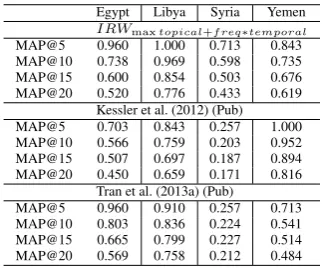
Stability. We also investigated the stability of the performance of different systems by look-ing into their results on each event. Table 6 presents the performance of our best system IRWmaxtopical+f req∗temporal and its best
super-vised competitors Tran et al. (2013a) (Pub) and Kessler et al. (2012) (Pub). All systems perform worse on the Syria story although our dropoff is less than the one of prior systems.
We speculate that the competitor systems are more sensitive to the amount of available pub-lished content on a target date than ours. In partic-ular, Tran et al. (2013a) use the frequency of pub-lished dates and sentences as one of their features, and Kessler et al. (2012) rely on the returned re-sults from Lucene index which tends towards sub-stories from the publication periods. Different to others, the time range for theSyrianews collection does not include the time range for the Syria time-lines fully or almost fully (see Tables 2 and 3). We therefore are not as dependent on an exact match between timeline dates and news collection dates and can use news articles from later dates more effectively.
5 Conclusion and Future Work
This paper addresses the problem of date selec-tion for timeline summarizaselec-tion. Our approach leverages the interactions between dates via a joint model based on a date reference graph, improving on individual scoring of dates.
System strict setting relaxed-setting
MAP@5 MAP@10 MAP@15 MAP@20 MAP@5 MAP@10 MAP@15 MAP@20 Document Frequency 0.312 0.303 0.299 0.299 0.509 0.550 0.564 0.560 MaxLength 0.349 0.335 0.311 0.287 0.647 0.594 0.566 0.533 Date Frequency 0.555 0.498 0.457 0.427 0.597 0.626 0.625 0.613 (Kessler et al., 2012) 0.567 0.546 0.519 0.491 0.790 0.740 0.723 0.704 (Kessler et al., 2012) (Pub) 0.701 0.620 0.571 0.524 0.912 0.807 0.759 0.731 (Tran et al., 2013a) 0.668 0.565 0.522 0.488 0.740 0.717 0.700 0.673 (Tran et al., 2013a) (Pub) 0.710 0.601 0.551 0.506 0.792 0.771 0.746 0.716
IRWf req 0.646 0.535 0.471 0.431 0.861 0.770 0.711 0.687
IRWmaxtopical 0.763 0.647 0.564 0.510 0.887 0.794 0.724 0.685
IRWf req∗topical 0.737 0.576 0.498 0.448 0.945 0.836 0.762 0.709
IRW|temporal| 0.724 0.587 0.522 0.484 0.699 0.597 0.570 0.564
IRWf req∗temporal 0.724 0.588 0.527 0.486 0.712 0.622 0.581 0.559
IRWmaxtopical+f req∗temporal 0.879 0.760 0.658 0.587 0.897 0.842 0.775 0.730
[image:10.595.73.512.62.197.2]IRWf req∗topical+|temporal| 0.818 0.677 0.596 0.536 0.928 0.866 0.801 0.745
Table 5: Average MAP@k scores of different systems on 4 news collections
Egypt Libya Syria Yemen
IRWmaxtopical+f req∗temporal MAP@5 0.960 1.000 0.713 0.843 MAP@10 0.738 0.969 0.598 0.735 MAP@15 0.600 0.854 0.503 0.676 MAP@20 0.520 0.776 0.433 0.619
Kessler et al. (2012) (Pub) MAP@5 0.703 0.843 0.257 1.000 MAP@10 0.566 0.759 0.203 0.952 MAP@15 0.507 0.697 0.187 0.894 MAP@20 0.450 0.659 0.171 0.816
Tran et al. (2013a) (Pub)
MAP@5 0.960 0.910 0.257 0.713 MAP@10 0.803 0.836 0.224 0.541 MAP@15 0.665 0.799 0.227 0.514 MAP@20 0.569 0.758 0.212 0.484
Table 6: Stability of our systems vs. competitors
their temporal and topical influences. We present a novel random walk model that incorporates these perspectives into connectivity-based computation. Experimental results on four news events that span a long time period show that the proposed models outperform state-of-the art approaches. Even un-supervised versions of the model perform on a par with previous supervised methods. We also draw attention to the necessity to take personal bias into account, which leads to differences between man-ually created timelines for the same event — we encourage future work to always consider several timelines per event in the way that other NLP work uses several annotators to create ground truth.
In future work, we will consider a wider range of events and event types. This will also lead to considering timelines where the day as unit of granularity might not be appropriate or where the unit of granularity might be varying across the timeline. We will also explore in depth the effect of size and type of news corpus on resulting time-lines, research further into the issue of human dis-agreement in timeline creation and explore human evaluation of timeline summarization.
References
James Allan, Rahul Gupta, and Vikas Khandelwal. 2001. Temporal summaries of new topics. In Pro-ceedings of SIGIR’01, pages 10–18.
Chlo´e Braud and Pascal Denis. 2014. Combin-ing natural and artificial examples to improve im-plicit discourse relation identification. In COL-ING 2014: Technical Papers. Dublin, Ireland, pages 1694–1705.
Hai Leong Chieu and Yoong Keok Lee. 2004. Query based event extraction along a timeline. In Proceed-ings of SIGIR’04, pages 425–432.
G¨unes Erkan and Dragomir R. Radev. 2004. Lexrank: graph-based lexical centrality as salience in text summarization.J. Artif. Int. Res., 22(1):457–479.
John Foley and James Allan. 2015. Retrieving time from scanned books. In Advances in Information Retrieval, pages 221–232. Springer.
Taher H. Haveliwala. 2002. Topic-sensitive pagerank. InWWW, pages 517–526.
Kai Hong and Ani Nenkova. 2014. Improving the estimation of word importance for news multi-document summarization. InProceedings of EACL 2014, pages 712–721.
Remy Kessler, Xavier Tannier, Caroline Hag`ege, V´eronique Moriceau, and Andr´e Bittar. 2012. Find-ing salient dates for buildFind-ing thematic timelines. In
Proceedings of ACL.
Ziheng Lin, Hwee Tou Ng, and Min-Yen Kan. 2014. A pdtb-styled end-to-end discourse parser. Natural
Language Engineering, 20(2):151–184.
Kathleen McKeown, Regina Barzilay, John Chen, David K. Elson, David Kirk Evans, Judith Klavans, Ani Nenkova, Barry Schiffman, and Sergey Sigel-man. 2003. Columbia’s newsblaster: New features and future directions. InHLT-NAACL.
Donald Metzler and Tapas Kanungo. 2008. Ma-chine learned sentence selection strategies for query-biased summarization. In Proceedings of the 2008
[image:10.595.100.262.236.370.2]Rada Mihalcea and Paul Tarau. 2004. Textrank: Bringing order into text. In EMNLP, pages 404– 411.
Kiem-Hieu Nguyen, Xavier Tannier, and V´eronique Moriceau. 2014. Ranking multidocument event de-scriptions for building thematic timelines. In
COL-ING 2014, pages 1208–1217.
Lawrence Page, Sergey Brin, Rajeev Motwani, and Terry Winograd. 1999. The pagerank citation rank-ing: Bringing order to the web. Technical report, Stanford InfoLab, November. Previous number = SIDL-WP-1999-0120.
Dragomir R. Radev, Timothy Allison, Sasha Blair-Goldensohn, John Blitzer, Arda Celebi, Stanko Dimitrov, Elliott Drbek, Ali Hakim, Wai Lam, Danyu Liu, Jahna Otterbacher, Hong Qi, Horacio Saggion, Simone Teufel, Michael Topper, Adam Winkel, and Zhu Zhang. 2004a. Mead - a platform for multidocument multilingual text summarization.
InProceedings of LREC’04.
Dragomir R. Radev, Hongyan Jing, Magorzata Sty, and Daniel Tam. 2004b. Centroid-based summarization of multiple documents. pages 919–938.
Stephen E. Robertson, Steve Walker, Susan Jones, Micheline Hancock-Beaulieu, and Mike Gatford. 1994. Okapi at trec-3. InTREC.
Jannik Str¨otgen and Michael Gertz. 2010. Heideltime: High quality rule-based extraction and normaliza-tion of temporal expressions. InProceedings of the
SemEval ’10 Workshop, pages 321–324.
Russell C. Swan and James Allan. 2000. Timemine: visualizing automatically constructed timelines. In
SIGIR, page 393.
Binh Giang Tran, Mohammad Alrifai, and Dat Quoc Nguyen. 2013a. Predicting relevant news events for timeline summaries. InWWW’2013.
Giang Binh Tran, Tuan A. Tran, Nam-Khanh Tran, Mohammad Alrifai, and Nattiya Kanhabua. 2013b. Leveraging learning to rank in an optimization framework for timeline summarization. In SIGIR
2013 Workshop TAIA.
Giang Tran, Mohammad Alrifai, and Eelco Herder. 2015. Timeline summarization from relevent head-lines. InProceedings of ECIR’2015.
Dingding Wang, Tao Li, and Mitsunori Ogihara. 2012. Generating pictorial storylines via minimum-weight connected dominating set approximation in multi-view graphs. InProceedings of AAAI’2012.
Wenpu Xing and Ali A. Ghorbani. 2004. Weighted pagerank algorithm. InCNSR, pages 305–314.
Rui Yan, Jian-Yun Nie, and Xiaoming Li. 2011a. Sum-marize what you are interested in: An optimization framework for interactive personalized summariza-tion. InProceedings of EMNLP’11.
Rui Yan, Xiaojun Wan, Jahna Otterbacher, Liang Kong, Xiaoming Li, and Yan Zhang. 2011b. Evolution-ary timeline summarization: a balanced optimiza-tion framework via iterative substituoptimiza-tion. In