THESES SIS/LIBRARY TELEPHONE: +61 2 6125 4631
R.G. MENZIES LIBRARY BUILDING NO:2 FACSIMILE: +61 2 6125 4063
THE AUSTRALIAN NATIONAL UNIVERSITY EMAIL: [email protected]
CANBERRA ACT 0200 AUSTRALIA
USE OF THESES
This copy is supplied for purposes
of private study and research only.
Passages from the thesis may not be
copied or closely paraphrased without the
UNDERSTANDING THE ROLE AND
VALUE OF EXPERIENCE FOR
ENVIRONMENTAL CONSERVATION
loan
Fazey
A thesis submitted for
the degree
ofDoctor
ofPhilosophy
The Australian National University
January 2005
THE AUSTRALIAN NATIONAL UNIVERSITY
Centre for Resource and Environmental Studies
To Della and John Fazey
Understanding the role and value of experience for environmental conservation
STATEMENT OF ORIGINALITY
This thesis is presented as a collection of linked papers with the aim of informing
environmental conservation research and practice about the role and value of experience.
The thesis relies on information from a number of non-biological disciplines including
clinical medicine, philosophy, systems science, phenomenography, and cognitive
psychology. Data collection, analysis, and write-up for the main chapters and Appendix 1
were for the most part conducted by myself, and the contribution of collaborators did not
extend beyond a normal supervisory role. However, the breadth of the thesis would not have
been possible without discussion, ideas, feedback on earlier drafts, and guidance from a
number of individuals. To acknowledge such assistance, individuals have been listed at the
beginning of each chapter as co-authors in the order of the magnitude of their contribution.
(See acknowledgements for a more detailed account of their assistance).
This thesis 1s my own work except where otherwise acknowledged (see
Acknowledgements).
loan Fazey
Understanding the role and value of experience for environmental conservation
ACKNOWLEDGEMENTS
First, I would like to thank my supervisory panel who all provided advice, support and
guidance. In particular, I thank David Lindenmayer for believing in me and for providing
support during some difficult times at the beginning of the PhD, Steve Dovers for always
having his door open, Barry Newell for his interest, time and support for the work on the
Macquarie Marshes, and Janet Salisbury for her ideas and discussions about evidence-based
practice.
David Lindenmayer provided discussion and comments on numerous drafts, particularly for
Chapters 2, 3 and Appendix I. Barry Newell provided essential guidance for understanding
the nature of conservation theory and provided some paragraphs for Chapter 4. He expertly
facilitated the workshop held on the Macquarie Marshes and contributed to Chapter 6
through discussion and guidance on the analysis. He also provided comments on drafts for
Chapter 7. The work on evidence-based practice (Chapter 3) would not have been possible
without ideas and input from Janet Salisbury, who was a co-organiser and facilitator of the
workshop. I thank Joern Fischer for detailed discussion and providing comments on drafts of
Chapter 2 and Appendix 1, and for proof reading the entire thesis. John Maindonald and
Robert Douglas contributed important ideas and perspectives and gave valuable comments
on draft versions of Chapter 3. Andy McQuie provided support and intellectual contributions
to Chapter 5. For Chapter 6, Bill Johnson provided discussion and technical advice, while
Katrina Proust spent considerable amounts of time assisting with the development of the
causal loop diagrams. Chapter 7 was a collaborative effort with my parents, John and Della
Fazey, who acted as supervisors of Chapter 7 and guided my understanding of how people
learn. They contributed by providing some of the paragraphs used in the paper. Chapter 8 is
entirely my own work, but a number of people provided comments on the drafts (see
Acknowledgements section in the Chapter). The majority of the work for appendices II and
III was conducted by Joern Fischer, with my contributions consisting of discussion, writing a
few paragraphs, and providing comments on multiple versions of the papers.
I am grateful to everyone at the Centre for Resource and Environmental Studies. It was a
friendly, collaborative and relaxed place to work, and provided an outstanding environment
for study and discussion. I would particularly like to thank the general staff for their hard
work and dedication, and Robert Wasson for his support and understanding in the initial
Understanding the role and value of experience for environmental conservation
stages of my thesis. In addition, I thank Adam and Annika Felton, foern Fischer, Frank
Jotzo, Leah Gibbs, Sandy Gilmore, Donna Hazell, Phil Pagan, Glenn Sanecki, Kate Sherren,
Jeanette Stanley, and Adrian Wayne, for stimulating discussion of many different topics.
The PhD would not have been possible without financial support, which was provided by the
Australian National University's Endowment for Excellence. Research funds were provided
by CRES and David Lindenmayer. The Coonabarabran Area Office of the New South Wales
National Parks and Wildlife Service (NPWS) gave considerable in-kind support, including
office space and a pleasant working environment.
I am indebted to the hospitality of all the staff in the Coonabarabran, Narrabri and Dubbo
Offices of the NPWS. In particular, I would like to thank Andy McQuie, Mark Fosdick and
Scott Filmer. Caroline Blackmore and Denver also made my stay in Coonabarabran an
enjoyable one.
On the Macquarie Marshes, many people were extremely hospitable and helpful. Their
support and willingness to participate was essential. In particular, I would like to extend my
gratitude to all of the research participants who often fed and housed me, and gave their
valuable time to explain the conservation issues of the Macquarie Marshes.
A number of people provided significant support in less direct ways, but without which the
thesis would not have been completed. In particular, I would like to thank Robyn and Paul
Barraclough, Jenny Burmester, Pattie Collins, Kerry Fieldhouse, Joern Fischer, Bernadette
Hince, Margot Napier, Deborah Peereboom, Rob Reid, Truly Santika, Rosie Smith, Jeanette
Stanley, Ana Peiia-Tufias, Adrian Wayne, Roslyn Woodward. I would also like to thank my
many other friends for their laughter and good times.
Last, but not least, I would like to express my deepest gratitude to all of my family. In
particular, I would like to thank my parents and my sister for their encouragement and
solicitude. Despite being a long way from home, the whole of my family always gave their
unconditional love, care, and support.
Understanding the role and value of e>.perience for enviromnentai conservation
PREFACE
This thesis is an exploration of the nature of environmental conservation and how more
effective conservation practice can be achieved. Much of the context of the thesis stems from
a desire to develop a personal understanding of the relative contributions of science and
experience for informing conservation management. This desire grew from my own previous
experience of conservation work where there were always difficulties obtaining relevant
information and translating it into a form in which it could be applied effectively. In many
cases, significant gaps in information meant that relying on experience and good judgement
was often the only possible way forward.
While the thesis concentrates on developing understanding about the nature, role and value
of experience, an additional personal aim was to broaden my understanding about
conservation issues generally, and of other disciplines and research methods. To represent
the personal development of understanding about conservation and experience, chapters are
presented in the order in which they were written or data collected. The thesis is therefore
not intended to be a linear progression through theory, data collection, analysis and
interpretation of results. Instead, chapters have been written as stand-alone pieces of work,
and were generally completed before beginning the next chapter. Later chapters would not
have been conducted without insights from previous ones, and diagrams in some of the
sections are used to clarify interconnections between chapters. Because the thesis relies on
insights from a wide range of disciplines, it does not conform to the traditional biological
scientific study.
All of the main chapters, including the synthesis, have been written with publication in mind:
Chapters 2-3 are in press; Chapters 5 and 7 have been submitted to journals; and Chapters 4,
6 and 8 are in preparation and will be submitted by April 2005. In addition, Appendices I-III
are publications that have been written during the course of the PhD. These papers do not
relate directly to the central theme of the thesis, but they have contributed to my
understanding about environmental conservation and the development of appropriate
conservation theory. Becanse the main chapters are intended to be stand-alone pieces of
work which were written with particular journals in mind, the chapters have minor stylistic
Understanding the role and value qf experience for environmental conservation
chapters may use either the tenn "environmental conservation" or "conservation biology".
Because the chapters stand-alone, some repetition between chapters was unavoidable.
Understanding the role and value of experience for environmental conservation
SUMMARY
To facilitate the implementation of research, recent studies have suggested that
environmental conservation should adopt an evidence-based approach from clinical medicine
and public health (Pullin and Knight 2001, Pullin et al. 2004). In this approach, scientific research is systematically reviewed and disseminated through organisations dedicated to the
process. Strong emphasis is placed on the integration of experimental research. While the
proponents of the evidence-based approach acknowledge the importance of experience for
decision-making, there has been limited discussion about how experience should be
incorporated into the decision-making process. To achieve greater integration, an important
first step is to determine the nature, role and value of experience for environmental
conservation. To achieve this step, a broad range of topics has been explored in this thesis.
This has involved drawing insights and understanding from a wide range of non-biological
disciplines, including clinical medicine, philosophy, systems science, phenomenography and
cognitive psychology.
The nature of environmental conservation was examined through a review of publications in
three prominent conservation journals (Chapter 2), and by comparing conservation with
clinical medicine to ask if an evidence-based approach could assist the review and
dissemination of conservation research (Chapter 3). These first two studies in the thesis
suggest that while experimental evidence is important, to take into account the complexity of
environmental systems, environmental conservation also often needs: (1) greater
acknowledgement of uncertainty; (2) a holistic and inter-disciplinary approach; and (3)
stronger links between research and practice. The evidence-based approach could have many
significant benefits for conservation, but would need to be complemented by other
approaches, such as adaptive management or the appropriate application of experiential
knowledge.
Another key issue for conservation is how people theorise and build understanding of
environmental systems. Therefore, the nature of formal conservation theories (Chapter 4)
and how practitioners apply them (Chapter 5) was explored. These two studies suggest that:
(!)theories, by necessity, are summaries ofa complex world and therefore all theories have
limitations; (2) multiple concepts are necessary to guide conservation action; (3) the human
mind significantly affects the theories we accept (Chapter 4); and ( 4) when practitioners
Understanding the role and value of experience for environmental conservation
make decisions, formal theory is combined with the rest of an individual's educational,
research, work and environmental experience (Chapter 5).
Taking into account issues raised in preceding studies (Chapters 2-5), a case study elicited
the extensive implicit knowledge of seven on-ground managers of the large and complex
Macquarie Marshes wetland system in south-eastern Australia (Chapter 6). Detailed
scientific research and data for the wetland were lacking, yet there was extensive on-ground
experiential knowledge about the impediments to achieving effective conservation of the
wetland. In addition, an experimental approach would have been unable to capture the
complexities of the conservation issues (Chapter 6).
The on-ground managers were interested in finding ways to articulate their deep
understanding of conservation issues to ensure that adequate attention was given to the
ultimate causes of the conservation problems, and not just to dealing with the symptoms of
the problems. A series of semi-structured interviews and a workshop informed the
development of a conceptual model to communicate the impediments to achieving effective
conservation of the wetland to a wide audience. The wetland is undergoing dramatic changes
as a result of water extraction for irrigation. The conceptual model highlighted the strong and
complex positive feedback that was continually reinforcing the potential for policy and/or
management by water agencies to favour the interests of the irrigation industry. While action
on many levels and scales was required, without major governmental intervention and a shift
in the prevailing worldviews of the water agencies and the public, the health of the
Macquarie River and the wetland was likely to continue to decline.
The case study (Chapter 6) highlighted the notion that extensive research and/or
management experience of an environmental system has considerable value for informing
conservation practice, and that finding ways to articulate such knowledge was important.
Given that many practitioners rely on their experience when making decisions, a next step
was to determine how practitioners could learn better from their experiences and apply
experiential knowledge more appropriately. By reviewing some of the literature from
cognitive psychology and phenomenography on how people learn, a way of thinking was
presented to help researchers and practitioners develop expert understanding of
environmental systems in an adaptive and flexible way (Chapter 7). To do this, individuals
need to: (I) vary and reflect on their experiences and become adept at seeking out and taking
different perspectives; and (2) become proficient at making balanced judgements about how
or if an experience will change their current working representation of the environmental
system by applying principles of "good thinking". Such principles include those that assist
Understanding the role and value of experience for environmental con..r:;ervation
adventurous) and those that reduce the likelihood of making en-oneous interpretations (e.g.
the disposition to be intellectually careful). A key finding was that while experiential
knowledge is different to knowledge derived from experiments, they are complementary, and
both are important.
Finally, the studies in the thesis were integrated in a discussion about the role and value of
experience in relation to evidence-based conservation (Chapter 8). A conceptual model was
used to demonstrate how expertise in learning from experience, defined by a person's
capacity to seek out and take different p~'fspectives and to be open to how an experience
might change their current way of thinking, influences the development of understanding
about environmental systems. An evidence-based approach provides an important
springboard for increasing emphasis on reviewing, planning and reflecting on conservation
actions. Therefore, in addition to making research more accessible to the wider conservation
community, the approach could also facilitate the development of a practitioner's personal
understanding of environmental systems.
There are five general conclusions arising from the thesis about the role and value of
experience for environmental conservation:
( 1} Because personal experience will often play a dominant role in decision-making,
developing our capacity to learn from our experiences - including the experience of
research • will have a significant influence on the effectiveness of conservation
decisions;
(2) \Vhile an expert's implicit knowledge is qualitatively very different from explicit
knowledge, both are important and complementary;
(3} Some experiential knowledge can be expressed quantitatively, but making implicit
knowledge explicit changes its nature because it is no longer linked to the rest of an
expert's personal knowledge;
(4) Synthesizing and communicating research is essential to help prevent people from
heading down potentially erroneous ways of thinking;
(5) There is no single definition of expertise. It is difficult to compare one expert with
another as their knowledge is built from a unique set of experiences. However, it takes
considerable time to develop the form of expertise that is typically discussed in the
education literature. When referring to "expert knowledge", it is therefore important to
be clear about the basis and extent of this knowledge, and the degree to which the
Understanding the role and value of experience.for enviroronental conservation
TABLE OF CONTENTS
INTRODUCTION ... 1
1.1BACKGROUND ... 1
1.2 OBJECTIVES A'ID AIMS ... 2
1.3 APPROACH ... , ... , 7
1.4 DEFINITIONS ... , ... 8
UNDERSTANDL"'IG ENVIRONMENTAL CONSERVATION ... 9
WHAT DO CONSERVATION BIOLOGISTS PUBLISH? ... 10
2.0 SUMMARY ... 10
2.1 INTRODUCTION ... l 0 2.2 METHODS ... 12
2.2.I Choice a/journals ... 12
2.2.2 Data collection ... I 3 2.3 RES UL TS ... 15
2.3.1Overview ... " .. , ... 15
2.3.1. l General ... 15
2.3.1.2 Topics studied ... 16
2.3.1.3 Threatening processes ., .... , .... , ... 16
2.3.1.4 Cross-disciplinary research ... 16
2. 3.2 Habitats ... , .. , . , . , .. , ... , , ... 18
2.3.2.1 Climatic zone and habitat type ... 18
2.3.2.2 Degree of habitat modification ... 18
2.3.2.3 Landscape structure ... 18
2.3.3 Taxonomic groups, number of species, and their status ... 19
2.3.3.l Number of h-pecies and species status ... , ... , ... 19
2.3.3.2 Ta'<l! ... 20
2.3.4 Ecological, spatial and temporal scale ... 20
2.3.4.l Organisational level ... , ... "" ... , .. ,.,, .. ,, ... 20
2.3.4.2 Largest spatial scale considered ... 21
2.3.4.3 Temporal scale ... 21
2.3.5 Policy and management ... 21
2.3.5.1 Relevance to policy and management ... 21
2.3.5.2 Differences between studies with HRP and HRM ... 22
2.3.5.3 Testing conservation actions ... ., ... ., ... ,, .... ., ... ,. ... , ... 22
2.4 DISCUSSION ... 24
2.4.l Publication type ... 24
2. 4.2 Habitat ... 25
2.4.3 Taxonomic group ... 25
2.4.4 Ecological, temporal and spatial scale ... 25
2.4.5 Relevance to policy and management ... 26
2.4.5.1 Is research accessible to practitioners? .... ,. ... ,. ... ,, ... 26
2.4.5.2 Is the research rele\'ant? ... ,. ... ,..,. ... 27
2.5 CAVEATS ... 29
2.6 CONCWS!ON ... 29
2.7 ACKNOWLEDGMENTS ... 29
CAN METIIODS APPLIED IN MEDICINE BE USED TO SUMMARISE AN'D DISSEMINATE CONSERVATION RESEARCH? ... 31
3 .0 SUMMARY ... 31
3.1 INTRODGCTION ... 32
Understanding the role and value of experience for environmental conservation
3.2 Ql: CAN WE SYSTilMA TlCALLY REVIEW EVIDENCE FOR CONSERVA110N MANAGEMENT? ... 34
3.2.1 Systematic reviews in medicine ... 34
3.2.2 Types and quantity of evidence in conservation ... 35
3.2.3 Are the types of questions about conservation interventions amenable to systematic review? ... 37
3.3 Q2: Is AN EVIDENCE· BASED APPROACH APPROPRIATE FOR CONSERVATION MANAGEMENT? ... 39
3.4 Q3: How CAN WE MAKE RESULTS FROM SYSTEMATIC REVIEWS WIDELY ACCESSIBLE? ... 41
3.4.1 The Cochrane Collaboration ... 41
3.4.2 Why is an independent organization devoted to disseminating reviews important? ... 41
3.4.3 Are there existing organizations like the CC in conservation? ... 43
3.5 ACHIEVING BETTER COMMUNICATION BETWEEN RESEARCHERS AND PRACTITIONERS ... 45
3.6 ACKNOWLEDGEMENTS ... 46
DEVELOPING AND APPLYING FORMAL CONSERVATION THEORY ... 47
COMPARATIVE USEFULNESS OF CONSERVATION THEORY ... 49
4.0 SUMMARY ... 49
4.1 INTRODUCTION ... 50
4.2 DEFINING CONSERVATION THEORY ... 51
4.2.l Theory ... 51
4.2.2 Conservation theory ... 52
4 .3 ASSESSING THEORY ... 56
4.3.1 Assessing the validity of conservation theories ... 56
4.3.2 Comparative usefelness of conservation theory ... 59
4.3.3 The Usefulness of Simple Theory ... 64
4.4 SUGGESTIONS ... 65
4.5 ACIO.OWLEDGEMENTS ... 67
APPLYING ECOLOGICAL THEORY FOR CONSERVATION MANAGEMENT ... 69
5.0 OUTLINE ... 69
5.1 ]NTRODUCTION ... 69
5.2 METHODS ... 70
5.3 RESULTS AND DISCUSSION ... 70
5.3.J Work activities. education and experiential backgraund ... 70
5.3.2 Explicit and implicit use of ecological theory ... 71
5.3.3 Top down flow of ecological theory through the institution ... 7 J 5.3.4 Constraints to the application of ecological theory ... 73
5 .4 ACKNOWLEDGMENTS ... 7 4 ELICITING IMPLICIT K"IOWLEDGE ... ; ... 75
ELICITING THE IMPLICIT KNOWLEDGE OF ON-GROUND MANAGERS: A CASE STUDY OF THE MACQUARIE MARSHES ... 78
6.0 SUJv!MARY ... 78
6.1 INTRODUCTION ... 79
6.2 APPROACH ... 80
6.2.1 Study area: The Macquarie Marshes ... 80
6.2.2 Participants ... 81
6.2.3 Method ... 81
6.3 RESULTS ... 83
6.3.1 Underlying convictions ... 83
6.3.2 Impediments to effective water delivery ... 83
6.3.3 Suggestions for immediate action ... 88
6.3.4 lf'liy is it so dij]'icult lo achieve effective conservation outcomes? ... 88
6.3.4.1 Belief in economic growth ... 89
6,3_4_2 Conflict atn0ng water users ... ,, ... ., ... ,..,,,,,<>,, ... 89
6.3.4.3 Wor!dviC\Vs of water agencies ... ., ... ,, ... ,,,. .. ,,,, ... 92
6.3.4.4 Community, politics and environment ... ,. . .,,. ... 92
6.3.4.5 Linking current feedback loops ... 94
6.4 DISCUSSION ... 98
Understanding the role and value o.f experience for environmental conservation
6A.l The implicit knowledge of the managers ... JOO 6.4. 2 Limits to the conceptual model... ... JOO
6.5 CONCLUDJNG REMARKS ... 101
6.6 ACKNOWLEDGEMENTS ... 101
6. 7 APPENDICES ... 102
6.7.1Appendix1: The Research Process- the 'Marshes Approach' ... 102
6. 7.2 Appendix 2: Basis of the underlying convictions of the managers ... 103
6.7.2.1 The Marshes are important eco!ogically ... 103
6.7.2.2 The Marshes are important ro the local community ... 104
6. 7.2.3 The Marshes are undergoing major ecological change and are seriously threatened ... 104
6.7.2.4 The main cause of the threat to the l\.iarshes is lack of water ... 107
6. 7.3 Appendix 3: Historical basis of current pressures on water resources ... 108
LEARNING MORE EFFECTIVELY FROM EXPERIENCES TO DEVELOP UNDERSTANDING ABOUT ENVIRONMENTAL SYSTEMS ... 111
LEARI>lING MORE EFFECTIVELY FROM EXPERIENCES ... 115
7.0SUMMARY ... 115
7.1INTRODUCTJON ... 116
7.2 LEARNING AND EXPERTISE ... l l 7 7.2.1 What is learning? ... I 17 7.2.2 What is expertise? ... .,.,_ I 18 7.2.3 Expert understanding of environmental systems ... 120
7.3 FACTORS AFFECTING INDIV!DUAI. LEARNING ... 120
73-1 Practice .... _ ... -... -... -... 120
7.3.2 Variation in practice ... -... _., ... _ ... _ ... ,_ 121 7.3.3. Reflection and thinking ... -... _ .. ., ... _ ... __ , ___ ... _ ... I 22 7.4 APPLYING THE IDEAS OF VARIABLE AND REFLECTIVE PRACTICE AND GOOD THINKING ... , 127
7.4.1 Developing understanding about complex systems ... 12 7 7.4.l.2 Whenever we use any technique, display skill or demonstrate ability: ... 127
7.4.1.2 Reflecting on :natural variation in the real ecological world: ... ,, ... , ... 127
7.4.l.2 Developing expertise in exploring the feedback in systems: ... 128
7.4.2 An example of applying the learning ideas ... _ ... _ ... -... 129
Research stages for eliciting the implicit knov.'iedge of the on~grotmd managers to which ideas of variable and reflective pnictice have been applied ... ,, .... ,, ... ,..,.,.,,,, . .,.,,.,"' ... 129
7.4.2.2 Reflecting on applying the ideas about learning and on the expert knowledge of the participants ... 133
7.5 IMPLICATIONS OF MORE EFFECTlVE INDIVIDUAL LEARNING ... 135
7.5.1 Individual to group and organisational learning ... : ... 135
7.5.2 The complementary role of experiential and experimental knowledge ... 137
7.6 CONCLUDING REMARKS ... 139
7.7 ACKNOWLEDGEMENTS ... 140
SYNTHESIS ... 141
THE ROLE AND VALUE OF EXPERIENCE FOR ENVIRONMENTAL CONSERVATION ... 145
8.0 SUMMARY ... , ... _ ... , ... ,, .. ,, .. ,,,.,, .. , ... ,, ... 145
8.1]NTRODUCTION ... , ... _ ... 146
8.2 EXPERIENTIAL AND EXPERT KNOWLEDGE ... _ ... 147
8.3 How DO WE LEARN FROM EXPERIENCES TO DEVEWP EXPERTISE ABOUT ENVIRONMENTAL SYSTEMS? ... 149
8.4 WHYDOWENOTVALUEEXPERIBNCE? ... 154
8.5 WHY EVIDENCE-BASED CONSERVATION AND EXPERT IC'lOWLEOOE ARE BOTI! JMPORTANT ... 156
8.6 CONCLUDING REMARKS ... 157
8.7 ACKNOWLEDGEMENTS ... 158
EPILOGUE ... 161
Understanding the role and value of experience for environmental conservation
APPENDICES .•.•• ,.,._. •• _. ... H••O••H••HH••H•••••••H•Hn•n.,•••••o.oo••••••o•••o•u..,ou•h••••••H••H••••••••ouo••••• }85
WHO DOES ALL TIIE RESEARCH IJS CONSERVATION BIOLOGY? ... 187
Al .0 SUMMARY ... 187
Al.I INTRODUCTION ... 188
Al.2 METHODS ... : ... 191
Al.2.l Selection of publications for the survey ... 191
Al.2.2 Data collection and analysis ... 192
Al .3 RESULTS ... 193
Al.3.1 Where were the studies from and who conducted them? ... 193
A 1.3.2 Did fonding comefrom international or local sources? ... 194
A 1. 3. 3 Did research from lower income countries have a more applied focus? ... 19 7 Al.3.4 Do the journals d!ffer in the degree to which they represent lower income countries? .. 198
A 1.4 DISCUSSION ... 200
Al.4.1 Why so little research.from lower income countries? ... 200
Al.4.2 Are we missing out on research from lower income nations because it is less· accessible internationally? ... 201
Al.4.3 Does it matter that international primary authors conduct so much of the research from lott•er income countries? ... , ... ,.,,.., ... 205
Al.5 ACKNOWLEDGEMENTS ... 207
Al.6 REFERENCES ... 207
APPRECIATING ECOLOGICAL COMPLEXITY: HABITAT CONTOURS AS A CONCEPTUAL LAJ'<'])SCAPE MODEL ... 211
A2.0 ABSTRACT ... 211
A2.l INTRODUCT!O'I ... 212
A2.2 THE FRAGMENTATION AND V ARIEGAT!ON MODELS ... 213
A2.3 A CONTOUR-BASED LANDSCAPE MODEL ... 217
A2.3. l Four potential uses of habitat contours as a conceptual model.. ... 220
A2.3. l.l Facilitating change in the way we think about landscapes ... 220
A2.3.1.2 Realistic experimental design and interpretation of field studies ... ""····,,220
A2.3. l.3 Communication between different strands of ecoiogy ... 221
A2.3 .1.4 Communication \\<ith land managers and land-use planning ... 222
A2.3.2 Making the link to quantitative ecological modeling ... 223
A2.3.2. l Tne greater glider in the Victorian Centtal Highlands ... 223
A2.3.2.2 Potential future appUcations of empirical modeling ... 225
A2.4 CONCLUSlONS ... 225
A2.5 ACKNOWLEDGMENTS ... 226
A2.6 REFERENCES ... : ... 226
MAKING THE MATRIX MATTER: CHALLENGES IN AUSTRALIAN GRAZING LANDSCAPES ... 233
A3.0 ABSTRACT.. ... 233
A3. I !NTRODUCTlON ... 234
A3 .2 REPTILES AND BIRDS IN THE NANANGROE GRAZING LANDSCAPE ... 234
A3 .3 ECOLOGICAL FUNCTIONS OF THE MATRIX ... 241
A3.3.1 A soft matrix can provide habitat ... 241
A3.3.2 A soft matrix can enhance connectivity ... 242
A3.3.3 A soft matrix can link multiple habitats/or a given species ... 243
A3.3.4 The matrix samples the most productive parts of the environment ... 244
A3 .4 CURRENT CONSERV A TJON PRACTICES AND TilE FUTURE OF THE MA TRIX ... 245
A3.5 BARRIERS TO MATRIX MANAGEMENT ... 246
A3.5.J Economic and historical constraints ... 246
AJ.5.2 Legal constraint<.. ... 247
A3.5.3 Scientific constraints ... 248
A3.6 WAYS FORWARD ... 249
A3.6.I Opportunities for change: understanding the legal.framework ... 249
A3.6.2 Communicating complexity and urgency ... 250
Linders tan.ding the role and value of experience for environmental conservation
Understanding the role and value of experience for environmental conservation
LIST
OFT ABLES
TABLE 2.1: KEY ASPECTS DEFINING CONSERVATION BIOLOGY (FROM SOULE 1985). ... J 2
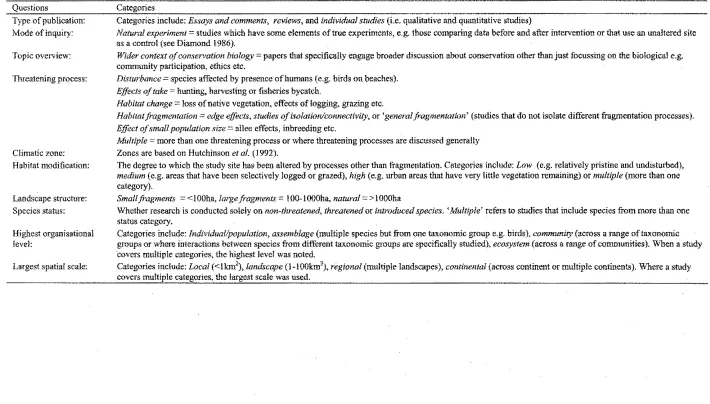
TABLE 2.2: QUESTIONS AND CATEGORIES REQUIRING DETAILED DEFrNrTlON ... 14
TABLE 2.3: SPA T!AL AND TEMPORAL SCALE OF STIJDIES ... 21
TABLE 3.1 SIMILARITIES BETWEEN MEDICINE AND CONSERVATION MANAGEMENT ... 36
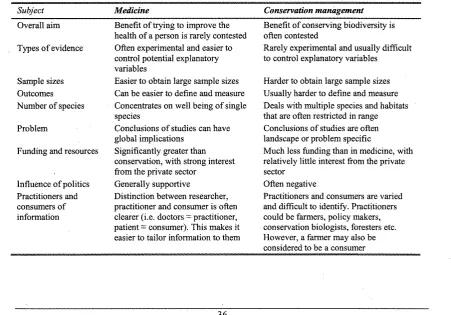
TABLE 3.2 DIFFERENCES BETWEEN MEDICINE AND CONSERVATION MANAGEMENT ...•..•...•. 36
TABLE 3 .3 DEGREES OF DNCERTAINTY (MODIFIED FROM DOVERS 200 l ) ... 40
TABLE 3.4 SUMMARY OF THE BENEFITS OF THE CC FOR MEDICINE THAT COULD ALSO APPLY TO CONSERVATION MANAGEMENT ... 43
TABLE 3.5 EXA,\1PLES OF CONSERVATION ORGANIZATlONS AND PROGRAMMES THAT AIM TO ACHIEVE SL'V!ILAR OUTCOMES OR ARE BASED ON SIMILAR PRrNCIPLES TO THE CC ... 44
TABLE4.l: DIFFERENT USES OF CONSERVATION THEORY ... 54
TABLB4.2: ATTR1BUTBSOFUSEFULNESSOFTI1EORY ... 61
TABLE 6. J: THE MAIN REQUIREMENTS FOR ACHlEVING AN APPROPRIATE FLOW REGIME FOR THE MARSHES. 0NL Y SOME OF MANY EXAMPLES ARE PRESENTED (SEE APPENDIX 6. 7.2 FOR MORE DETAIL) ... 85
TABLE 6.2: IMPEDIMENTS TO ACHIEVING EFFECTrvE DELIVERY OF WATER TO THE MARSHF.S ( CONT!Nl.JED ON NEXT PAGE) ... 86
TABLE 6.2: IMPEDIMENTS TO ACHlEVING EFFECTIVE WATER DELIVERY TO THE MARSHES (CONTINUED) . ... 87
TABLE 7. I: SlJll,!MARY OF SOME OF THE IMPORTANT FACTORS INFLUENCING HOW INDIVIDUALS LEARN. Norn THAT Tiffi POINTS DISCUSSED APPLY EQUALLY TO BOTH LEARNING A PARTICULAR SKILt OR ABILITY AND TO LEARNING HOW TO LEARN ... 124
TABLE 7.2: DEVELOPING AN APPROPRIATE LEARNING ATTITUDE IS INFLUENCED BY HOW WE THINK. GOOD THINKING HAS SEVEN BROAD DISPOS!TIONS, EACH WITH THREE COMPONENTS (FROM Pl:KJNS ET AL. UNPUBLlSHED) ... 125
TABLE 7.3: WAYS IN WHICH !DEAS OF LEARNING WERE APPLlED TO HELP RESEARCH PARTICIPANTS DEVELOP THEIR PERSONAL DNDERSTANDING OF THE MARSHES ENVIRONMENTAL SYSTEM ... 132
TABLE 7.4 HYPOTHETICAL CHARACTERISTICS OF A HlGH QUALITY LEARNJNG ORGANIZATION (FROM LIPSHJTZ ET AL. 2002, NAOT ETAL. 2004) ... 137
TABLE 7.5: SOME OF THE DIFFERENCES BETWEEN EXPERT AND EXPERIMENTAL KNOWLEDGE HIGHLIGHTED BY THE CHARACTERISTICS OF EXPERTISE AND INDIVIDUAL LEARNING ... 138
TABLE Al.I. (A) HIGH AND LOWER rNCOME MEGAD!VERSE COUNTRIES AND (B) BIOD!VERSITY HOTSPOTS. ''HIGH-INCOME COUNTRIES' ARE DEFINED AS THOSE WITH A GROSS NATIONAL INCOME PER CAPITA EQUAL TO OR GREATER TH.;\,,'l US$9,266 {WORLD BANK DATA, 2001). WE CLASS ALL OTHER CODNTRIBS AS 'LOWER !!\COME' ... 189
TABLE A 1.2: IMPRESSIONS OF CONSERV A T!ONiECOLOGICAL SCIENTISTS FROM D!FFERENT COUNTRIES ABOUT PUBLISHrNG IN CONSERVATION RELATED JOURNALS ... 203
TABLE A 1.3: SUGGESTIONS AS TO HOW JOURNALS MIGHT ENCOURAGE GREATER rNCLUSION OF SCIENTISTS FROM LOWER INCOME COUNTRIES ... 206
TABLE A2. l: COMPARISON OF KEY CHARACTl.\R!ST!CS OF THE FRAGMENTATION, VARIEGAT!O); AND CONTOUR-BASED LANDSCAPE MODELS (BASED ON FORMAN AND GOORON 1986; MCINTYRE AND BARRETT 1992; FORMAN l995B; WIENS 1995; MCINTYRE AND HOBBS 1999; THIS PAPER) ... 215
TABLE A3.l SYNTHESIS OF RECENT RESEARCH ON BIRDS IN THE NANANGROE AREA THAT DEMONSTRATED THE BENEFITS OF A SOFT MATRIX FOR BIRDS ... 237
Understanding the role and value of experieru.e for environmental COfLW!rvation
Understanding the role and value of experience for environmental conservation
LIST
OF
FIGURES
FIG. 2.1: PROPORTION OF ALL PUBLICATIONS (N = 547) AND JOURNALS FOR: A) DIFFERENT
CONSERVATION TOPICS, B) DIFFERENT THREATENING PROCESSES CONSIDERED IN A STUDY. THE CATEGORIES FOR PAPERS WHERE THE THREATENING PROCESS COULD NOT BE IDENTIFIED ARE NOT SHOWN ...•... 17 FIG. 2.2: PROPORTION OF PUBLICATIONS CONDUCTED IN DIFFERENT LANDSCAPE STRUCTURE CLASSES
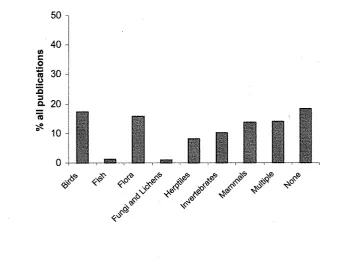
(N = 341 ). PUBLICATIONS WHERE LANDSCAPE STRUCTURE WAS NOT POSSIBLE TO DETERMINE WERE EXCLUDED ... 19 FIG. 2.3: PROPORTION OF ALL PUBLICATIONS (N = 547) AND THE PROPORTION OF PUBLICATIONS IN
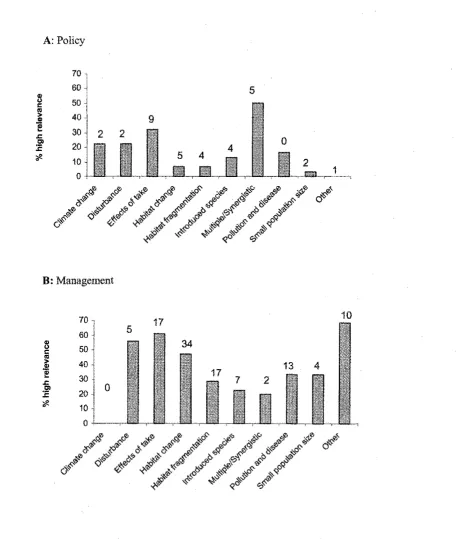
DIFFERENT JOURNALS FOR THE TAXONOMIC GROUP STUDIED ... 20 FIG. 2.4: PROPORTION OF PAPERS FOR EACH THREATENING PROCESS WITH: A) HIGH RELEVANCE TO
POLICY AND B) HIGH RELEVANCE TO MANAGEMENT. THE TOTAL NUMBER OF PAPERS WHERE THREATENING PROCESS AND POLICY /MANAGEMENT RELEVANCE COULD BE DETERMINED WAS 279. NUMBERS ABOVE EACH BAR GIVE THE ACTUAL NUMBER OF PUBLICATIONS WITH HIGH
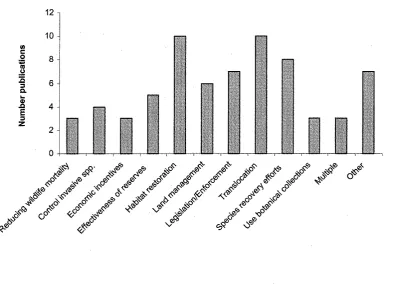
POLICY/MANAGEMENT RELEVANCE ... 23 FIG. 2.5: NUMBER OF PUBLICATIONS THAT TESTED OR REVIEWED A SPECIFIC CONSERVATION ACTION.
TOTAL N= 69 ... 24 FIG. 4.1: DIFFERENT COMPONENTS OF CONSERVATION THEORY ... 53 FIG. 4.2: THE TYPES OF PAPERS EXPLICITLY ADDRESSING THEORY (TOTAL N = 77) FROM A SURVEY OF
54 7 PUBLICATIONS IN 2001 ... 55 FIG. 4.3: THE PROPORTION OF THEORETICAL PAPERS FOR DIFFERENT TYPES OF THEORY AND THE
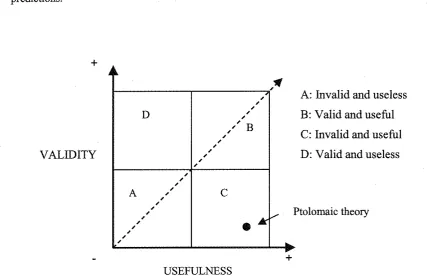
PROPORTION OF THEORETICAL PAPERS FOR DIFFERENT TYPES OF THEORY TESTED OR REVIEWED USING EMPIRICAL DATA (TOTAL N = 77) ... 56 FIG. 4.4: THE RELATIONSHIP BETWEEN VALIDITY AND USEFULNESS OF THEORY. THERE ARE FOUR
DOMAINS OF: A: !NV ALID AND USELESS; B: VALID AND USEFUL; C: !NV ALID AND USEFUL; D: V AUD AND USELESS. THE DOTTED LINE REPRESENTS A COMMONLY HELD VIEW THAT USEFULNESS IS POSITIVELY CORRELATED WITH VALIDITY. AS AN EXAMPLE, PTOLOMAIC THEORY PROVED TO BE AN INCORRECT EXPLANATION OF THE WORKINGS OF THE SOLAR SYSTEM (I.E. INVALID), BUT STILL PROVIDED EQUALLY ACCURATE PREDICTIONS OF PLANETARY MOTION TO COPERNICAN'S THEORY FOR ALMOST THREE CENTURIES (I.E. IT WAS USEFUL) ... 58 FIG. 4.5: THE RANGE OF CONVENIENCE OF TWO DIFFERENT THEORIES. THE GREY DOTS REPRESENT
DIFFERENT CASES IN WHICH A PREDICTION OR INSIGHT FROM A THEORY IS REQUIRED. THE LARGER CIRCLES REPRESENT THE RANGE OF CIRCUMSTANCES OF THE THEORY A AND B. A HAS A LARGER RANGE OF CONVENIENCE THAN B. ... 63 FIG. 5.1: FACTORS DETECTED THAT INFLUENCE THE APPLICATION OF ECOLOGICAL THEORY. PLANNERS
HAVE A MUCH STRONGER EFFECT ON THE APPLICATION OF ECOLOGICAL THEORY BECAUSE THEY HAVE A GREATER ROLE IN CONSERVATION RELATED DECISIONS, AND HAVE A STRONGER ECOLOGICAL EDUCATION/BACKGROUND AND GREATER EXPOSURE TO ECOLOGICAL RESEARCH. PRACTICAL CONSTRAINTS AFFECTING PLANNERS WILL THEREFORE HA VE THE GREATEST OVERALL IMPACT. CONSTRAINTS ARE ONLY LISTED IF AT LEAST HALF OF THE SUBJECTS IN EACH JOB TYPE CONSIDERED THEM TO BE IMPORTANT ... 72
FIGURE 6.1: LOCATION MAP OF THE MACQUARIE MARSHES ... 80 FIGURE 6.2: LABELLING CONVENTIONS FOR CAUSAL LINKS. THE ARROWS INDICATE THAT A CHANGE
INVARIABLE A CAUSES A CHANGE IN VARIABLE B. EACH LINK IS ASSIGNED A POLARITY. THE POLARITY OF THE CAUSAL LINK BETWEEN A AND B IS SAID TO BE POSITIVE WHEN AN
INCREASE/DECREASE IN A CAUSES B TO INCREASE/DECREASE ABOVE/BELOW WHAT IT OTHERWISE WOULD HAVE BEEN. A CAUSAL LINK IS NEGATIVE WHEN AN INCREASE/DECREASE IN A CAUSES B TO DECREASE/INCREASE BELOW/ABOVE WHAT IT OTHERWISE WOULD HAVE BEEN. A SHORT LINE INDICATES THAT THERE IS A DELAY BETWEEN A CHANGE IN A AND THE CORRESPONDING CHANGE IN B. 82
FIGURE6.3. ECONOMIC GROWTH. THE REINFORCING CAUSAL LOOP (R) ILLUSTRATES SOME OF THE SOCIAL FACTORS CONTRIBUTING TO, AND ARISING FROM, A BELIEF IN THE ADVANTAGES OF
Understanding the role and value of e..VJerience for environmental conservation
ECONOMIC GROWTII. AS TIIE TENDENCY IN TIIE COMMUNITY TO FOCUS ON THE SHORT-TERM ECONOMIC RETUR:.!S FROM IRRIGATIOI\ INCREASES, TT REDUCES THE TENDENCY TO FOCUS ON WNO-TERM St:STAINABIL!TY. SEE TEXT FOR DETAILS ... 90 FIGURE 6.4. CONFLICT AMONG WATER USERS. THE REINFORCING CAUSAL LOOP (R) ILLUSTRATES
SOME OF THE SOCIAL FACTORS TIIAT RESULT FROM INCREASED PRESSURE ON WATER RESOURCES. AS CONFLICT OVER WATER INCREASES, THE PRESSURE ON POLITICIANS TO FIND SOLUTIONS INCREASES. THIS INCREASES THE TENDENCY FOR POLITICIANS TO SEARCH FOR QUICK SOLUTIONS, RESULTING IN INCREASED PRESSURE ON WATER AGENCIES TO PROVIDE THE SAME. SEE TEXT FOR DETAILS. 91
FIGURE 6.5. WORLDVIEWS OF WATER AGENCIES. THE REINFORCING CAUSAL LOOP (R) ILLUSTRATES SOME OF TilE EFFECTS OF THE TRADITIONAL ENGINEERING VIEW AND THE TRADITIONAL RESOURCE-USE VIEW PREVALENT IN WATER AGENCIES. COMBINED WITH THE LOBBYING POWER OF THE IRRIGATION INDUSTRY, TifE WORLD VIEWS OF THE WATER AGENCY INCREASE THE POTENTIAL FOR POLICY AND/OR MANAGEMENT TO FAVOUR IRRIGATION OVER OTHER INTERESTS. SEE TEXT FOR DETAILS ... 93 FIGURE 6.6. COMMUNITY, POLITICS AND ENVIRONMh'NT. THE REINFORCING CAUSAL LOOP (RI)
ILLUSTRATES THE SOCIAL EFFECTS TIIAT MAY RE-SULT WHEN THE COMMUNITY TAKES AN INTEREST IN THE ENVIRONMENT. THE REINFORCING CAUSAL LOOP(R2) ILLUSTRATES THE EFFF.CTS THAT IBIS INTEREST MAY PRODUCE IN TIIE POLillCAL DOMAIN. AS ACTIONS JN FAVOUR OF THE ENVIRONMENT INCREASE, SO DOES TIIE CAPACITY OF THE MACQUARIE RIVER TO WITHSTAND EXTREME EVENTS OR THREAT FROM DETRJMENTAL HUMAN ACTIVmES. SEE TEXT FOR DETAJLS. 94 FIGURE 6.7 (NEXT PAGE). THE MARSHES SYSTEM. KEY VARIABLES IN THE INDlV!DUAL CLDS
DESCRIBED IN FIGURES 6.3-6.6 COLLECTIVELY ILLUSTRATE IMPORTANT CONNECTIONS BETWEEN THE SUB-SYSTEMS. WITH Tll!S WIDER VIEW OF THE SYSTEM, ADDITIONAL FEEDBACK DYNAMICS BECOME VISIBLE. THE LOOP LABELLED ECONOMIC GROW'TH (RI) IS LINKED TO PRESSURE FOR SOLUTIONS (R3) VIA THE POWER OF THE IRRIGATION INDUSTRY TO LOBBY POLITICIANS OR WATER AGENCIES. THE LOOP LABELLED WORLDVIEWS OF WATER AGENCIES (R2) JS LINKED TO PRESSURE FOR SOLUTIONS (R3) VIA THE POTT,'NT!AL FOR POLicYi MANAGEMENT TO FAVOUR IRR!GATJON OVER OTHER INTERESTS. THE LOOP L-'.BELLED CONFLICT AMONG WATER USERS (R4) IS LINKED TO PRESSURE FOR SOLUTIONS (R3) VIA CONFLICT BETWEEN WATER USER GROUPS. THESE LINKS FORM PART OF THE POSITIVE FEEDBACK BEHAVIOUR DRIVING TIIE SYSTEM. ]NCREASING POTENTIAL FOR POLICY AND MANAGEMENT TO FAVOUR IRRIGATION DECREASES ACTIONS JN FAVOUR OF THE ENVIRONMENT (R5), WHILE A DECREASING TENDENCY TO FOCUS ON LONG-TERJvl SUSTAINABILITY DECREASES AWARENESS OF TilE SERJOUSNESS OF ENVIRONMENTAL ISSUES (R5). Tll!S ULTIMATELY LEADS TO A DECREASE IN THE CAP A CITY OF THE MACQUARIE RNER TO
WffilSTAND EXTREME NATURAL EVENTS OR THREATS FROM DETRIMENTAL HUMAN ACTIVITIES .. 95 FIGURE 6.8. IRRIGATION DEVELOPMENT IN NEW SOUTH WALES. THE REINFORCING CAUSAL LOOP
(R) ILLl!STRA TES SOME OF THE HISTORICAL FACTORS IN IRRIGATION DEVELOPMENT. WHEN CONTEMPORARY FACTORS ARE TAKEN INTO ACCOUNT, THE COMBINED EFFECTS INCREASE TIIE DEMAND ON WATER RESOURCES IN THE CATCHMENT. NOTE THE DELAYS. SEil TEXT FOR DETAILS.
109
FIG. 7.1: DoUBLE-LOOP LllARNING (FROM STERMAI\ 2000). FEEDBACK FROM TllE REAL WORLD CAN INDUCE CHANGE IN MENTAL MODELS. CHA>'lGE IN THE MENTAL MODEL LEADS TO NEW GOALS AND DECISION RULES, NOT JUST NEW DECISIONS ... 123 FIG. 7 .2: RESEARCH METHOD USED TO ELICIT THE EXPERTISE OF SEVEN ON-GROUND MANAGERS OF TllE
MARSHES. NOTE THAT STAGES 5 AND 7 ALLOWED REFLECTION OF THE PROCESS, INCLUDING ASSESSMENTS THAT ENSURED THE RESEARCHER WAS ADEQUATELY REPORTING THE EXPERT UNDERSTANDING OF THE ON·GROUND MANAGERS ... 131 Fro. 7.3: EXPERJMENTS AND (Yf!IER EXPERIENCES MAY STIMULATE CHANGE IN OUR MENTAL MODEL AS
WE DEVllLOP UNDERSTANDING, BUT OUR UNDERSTANDING AND MENTAL MODELS ALSO INFLUENCE THE QUESTIONS WE ASK, HOW WE CONDUCT THE EXPERIMENT, AND HOW WE ANALYSE AND PERCEIVE THE RESULTS ... 139 FIGURE 8.1: DIFFERENT FORMS OF EXPERIENTIAL KNOWLEDGE. EXPERIENTIAL KNOWLEDGE CAN BE
EXPLICIT, IMPLICIT AND/OR TACIT. SUCH KNOWLEDGE CAN ALSO BE CONSIDERED TO HE 'NON· EXPERT' OR 'EXPERT'. EXPERT EXPERIENTIAL KNOWLEDGE REPRESENTS A DEEP LEVEL OF UNDERSTANDING OF AN ENVIRONMENTAL SYSTEM THAT HAS EI11!ER BEEN MADE EXPLICIT
(QUALITATIVELY OR QUANT!TA T!VELY), OR IS IMPLICIT AND/OR TACIT ... 148 FIGURE 8.2: A CONCEPTUAL MODEL OF HOW THE LEVEL OF EXPERTISE IN LEARNING FROM AN
Understanding the role and value of experience for environmental conservation
THE MODEL IS A CAUSAL LOOP DIAGRAM. THE POLARITY OF EACH ARROW INDICATES WHETHER A VARIABLE INCREASES OR DECREASES WHEN THE PREVIOUS VARIABLE INCREASES. FOR EXAMPLE, IF THE ABILITY TO CHANGE A MENTAL MODEL INCREASES, THEN THE POTENTIAL TO CHANGE UNDERSTANDING ABOUT AN ENVIRONMENTAL SYSTEM ALSO INCREASES (SEE STERMAN 2000 FOR A FULL ACCOUNT OF CAUSAL LOOPS). IN THIS DIAGRAM, ALL THE ARROWS ARE POSITIVE
CREATING A REINFORCING LOOP(SEE TEXT) ... 152 FIGURE 8.3: MENTAL MODELS, WHICH ARE BUILT FROM OBSERVATION AND EXPERIENCES, INFLUENCE
THE WAY WE PERCEIVE NEW EXPERIENCES. THIS INCLUDES INFLUENCES ON HOW WE PERCENE THE EXPERIENCE OF CONDUCTING RESEARCH, SUCH AS BY AFFECTING THE QUESTIONS WE PURSUE, THE METHODS WE USE TO DESIGN STUDIES, THE WAY WE COLLECT DATA, AND HOW WE PERCENE THE RESULTS OF RESEARCH ...•... 153 FIG. Al. I: GLOBAL DISTRIBUTION OF PRIMARY AUTHORS AND COUNTRY OF STUDY. AN ASTERISK(*)
INDICATES HIGH-INCOME COUNTRIES. NOTE THAT WHERE THE PUBLICATION DID NOT APPLY TO A PARTICULAR COUNTRY, A PUBLICATION WAS GNEN THE SAME COUNTRY OF STUDY AS THE PRIMARY AUTHOR. TOTALN= 547 ...•... 195 FIG. Al .2: (A) THE PERCENTAGE OF PUBLICATIONS FROM DIFFERENT COUNTRY CLASSES. 'NO
COUNTRY' REFERS TO PUBLICATIONS THAT DID NOT RELATE DIRECTLY TO ANY PARTICULAR COUNTRY SUCH AS SOME ESSAYS, COMMENTS OR REVIEWS. (B) THE PERCENTAGE OF STUDIES FROM HIGH-INCOME AND LOWER INCOME COUNTRIES THAT HAD PRIMARY OR SECONDARY
AUTHORS FROM THOSE COUNTRIES (N = 547) ... 195 FIG. Al.3: THE PERCENTAGE OF PUBLICATIONS FROM HIGH AND LOWER INCOME COUNTRIES WHERE
THE PRIMARY AUTHOR OR AT LEASTONE AUTHOR WAS FROM THE SAME COUNTRY WHERE THE STUDY WAS CONDUCTED ... 196 FIG. Al.4: PERCENTAGE OF THE DIFFERENT SOURCES OF FUNDING FOR STUDIES CONDUCTED IN HIGH
AND LOWER INCOME COUNTRIES (N = 307 AND 158 FOR HIGH AND LOWER INCOME COUNTRIES RESPECTNELY) ... 196 FIG. Al .5: PERCENTAGE OF PUBLICATIONS WITH A STRONG APPLIED FOCUS, I.E. THAT AIMED TO
INFORM POLICY, GUIDE MANAGEMENT; OR CONDUCT BIODIVERSITY SURVEYS: (A) FOR HIGH AND LOWER INCOME COUNTRIES (TOTAL N = 307 AND 158 RESPECTNEL Y). (B) FOR PRIMARY AUTHORS FROM HIGH AND LOWER INCOME COUNTRIES (TOTAL N = 465 AND 82 RESPECTNELY) . ... 197 FIG. Al .6: (A) PROPORTION OF PUBLICATIONS IN EACH COUNTRY CLASS FOR EACH OF THE JOURNALS
THAT WERE SURVEYED. 'NO COUNTRY' REFERS TO PUBLICATIONS THAT DID NOT RELATE
DIRECTLY TO ANY PARTICULAR COUNTRY SUCH AS SOME ESSAYS, COMMENTS OR REVIEWS. TOTAL PUBLICATIONS WERE 123, 210, AND 213 FOR BIODIVERSITY & CONSERVATION, BIOLOGICAL CONSERVATION AND CONSERVATION BIOLOGYRESPECTNELY ... 198
FIG. Al. 7: THE PERCENTAGE OF PUBLICATIONS WITH AUTHORS FROM HIGH-INCOME AND LOWER INCOME COUNTRIES THAT WERE FROM THE SAME COUNTRY WHERE THE STUDY WAS CONDUCTED FOR EACH OF THE THREE JOURNALS: (A) PRIMARY AUTHORS AND (B) AT LEAST ONE AUTHOR. TOTAL N FOR HIGH-INCOME COUNTRIES IN BIODIVERSITY & CONSERVATION, BIOLOGICAL
CONSERVATION AND CONSERVATION BIOLOGY WERE 51, 158, AND 98 RESPECTIVELY. TOTAL N FOR
LOWER INCOME COUNTRIES FROM THE THREE JOURNALS WERE65, 42 AND 51RESPECTNELY .. 199 FIG. A2. l: GRAPHICAL PRESENTATION OF A CONCEPTUAL LANDSCAPE MODEL BASED ON HABITAT
CONTOURS. KEY MODEL FEATURES ARE THAT IT (A) ALLOWS FOR SPECIES TO DIFFER IN WHAT CONSTITUTES SUITABLE HABITAT, (B) RECOGNISES DIFFERENCES IN THE SPATIAL GRAIN OF SPECIES, ( C) CONTAINS THE FRAGMENTATION MODEL, AND (D) CONTAINS THE VARIEGATION MODEL. FURTHER CHARACTERISTICS AND LIMITATIONS ARE OUTLINED IN THE TEXT ... 219 FIG. A2.2: GRAPHICAL REPRESENTATION OF HOW A CONCEPTUAL MODEL OF HABITAT CONTOURS MAY
ASSIST COMMUNICATION BETWEEN TRADITIONAL REDUCTIONIST SCIENCE AND PATTERN-BASED LANDSCAPE ECOLOGY ... 222 FIG. A2.3: THE PREDICTED PROBABILITY OF DETECTING THE GREATER GLIDER IN THE ADA FOREST
BLOCK (6700 HA) IN THE CENTRAL HIGHLANDS OF VICTORIA, AUSTRALIA ... 225 FIG. A3.l RESULTS OF BIRD SURVEYS CONDUCTED AT SIXTEEN LANDSCAPE UNITS IN THE NANANGROE
AREA IN 2001/2002 (FISCHER ET AL. UNPUBLISHED DATA - SEE TEXT FOR DETAILS). THE DATA
ILLUSTRATE THAT BIRD SPECIES RICHNESS TENDED TO BE HIGHER IN MORE PRODUCTNE VALLEY ENVIRONMENTS THAN ON RIDGE TOPS ...•... 245
Chapter 1: Introduction
Chapter 1
INTRODUCTION
1.1 Background
"Conservation" can be considered to be the "management of human use of the biosphere that
provides the greatest sustainable benefit to current generations while maintaining its
potential to meet the needs of future generations" (UNEP 1992). This definition embraces
"preservation, maintenance, sustainable use, restoration and enhancement of the natural
environment" (UNEP 1992). Thus, the academic discipline of environmental conservation
primarily aims to inform society about threats to the natural environment and biodiversity,
and how to alleviate those threats and manage environmental systems appropriately.
Given the extent of the global environmental crisis, there have been suggestions that
environmental conservation is failing in its duty to inform practitioners about the
conservation of biota. Whitten et al. (2001) argued that enough is often known about conservation problems to take immediate action, such as to halt illegal logging or large-scale
loss of native vegetation. Instead of more priority setting, planning, and assessment
exercises, they suggested that greater emphasis should be placed on on-ground action
(\\lhitten et al. 2001 ).
Determining what makes research useful depends on personal opinion and values.
Nevertheless, irrespective of whether it is considered to be relevant, environmental
conservation has serious problems disseminating and implementing research (Pullin and
Knight 2001). It takes longer for conservation journals to publish their results than other
biological journals (Kareiva et al. 2002), and practitioners rarely apply the research when compiling management plans (Pullin el al. 2004).
The problem stems, in part, from the inaccessibility ofresearch. With substantial amounts of
conservation and environmental publications "hidden" in the grey literature or in obscure
Chapter 1: Introduction
Yet, even if it were accessible, practitioners working in a real world of time and resource
constraints are unlikely to use it unless it is presented in a form where its relevance can be
easily judged (see Ely et al. 1999). As a solution, it has been suggested that environmental
conservation adopt the "evidence-based approach" from clinical medicine and public health,
where research is systematically reviewed and disseminated through organisations dedicated
to the process (Pullin and Knight 2001 ). Such processes are important because they also
provide mechanisms where researchers can be informed about the relevance of the research
to practice (Waddell 2001).
Appropriate research is necessary to prevent "superstitious learning" by individuals and
organisations, where erroneous connections between cause and effect can occur (Levitt and
March 1988). However, environmental systems are often dynamic, complex and
context-specific, and data are usually lacking. In such situations, it is often the degree of personal
experience that counts most when making conservation decisions (Woodwell 1989). While
the proponents of an evidence-based approach acknowledge personal experience is important
(Pullin and Knight 2001, Pullin et al. 2004), there has, so far, been limited discussion about
how experience should be incorporated into the decision-making process. To achieve greater
integration, an important first step is to determine the nature, role and value of experience for
environmental conservation.
1.2 Objectives and Aims
This thesis aims to develop a better understanding of the role and value of experience for
environmental conservation. To do this, five main topics are addressed:
• Section A: Understanding environmental conservation (Chapters 2 & 3);
• Section B: Developing and applying formal conservation theories (Chapters 4 & 5);
• Section C: Capturing implicit knowledge (Chapter 6);
• Section D: Learning better from experiences to develop expert understanding of
environmental systems (Chapter 7);
• Section E: Synthesis: Understanding the role and value of experience for conservation
research and practice (Chapter 8).
Fig. 1.1 provides a schema for the links between chapters. The process is not a traditional
linear progression through theory, data collection, and interpretation of results. Instead, to
avoid making prior assumptions about the role and value of experience, each chapter was
largely conducted one step at a time. The chapters are presented in the order in which data
Chap1er 1: Introduction
were collected or in which they have been \Vritten to represent the development of
understanding about the research topic. In recognition of the need for accessible research,
chapters have been written as independent pieces of work, each with a clear contribution to
the discipline of environmental conservation. Nevertheless, chapters later in the thesis would
not have been conducted without the direction from previous ones,
In Section A, the nature of environmental conservation and issues surrounding the
dissemination and applicatio11 of research are explored to provide the context within which
the role and value of experiential knowledge can be examined. Chapter 2 reviews the
research published in three conservation journals, and discusses the relevance of the
published research to policy and management Chapter 3 explores whet11er conservation
practice could be improved by applying the evidence-based approach characteristic of
clinical medicine and public health to facilitate the review and dissemination of conservation
· research. By comparing . clinical medicine and environmental conservation, the role of
different types of evidence for informing practice is considered.
Given the complexity and uncertainty of conservation issues, another key issue is how we
think about, theorise and build understanding of environmental systems. Because formal
theories are primarily built from our personal nnderstanding, they are strongly influenced by
our experiences (e.g. Lakoff and Johnson 1999). Section B therefore explores the nature of
theory, how our cognitive capacities influence our acceptance of certain theories, and how
practitioners apply formal theory. Chapter 4 considers the challenge of developing theories
that have a practical focus, but which do not mislead scientists and practitioners. Chapter 5
then explores how practitioners apply conservation theory in real world settings, based on an
exploratory stndy of planners and implementers of conservation programs of the New South
SECTION A: UNDERSTANDING THE NATURE OF ENVIRONMENTAL
CONSERVATION
~
\
.~
Chapter 2: What do Chapter 3: Can we use methods Chapter4:
Comparative~
usefulness ofSECTION B: HOW WE THEOR1SE ABOUT ENVIRONMENTAL SYSTEMS AND APPLY FORMAL
CONSERVATION THEORY
conservation biologists from medicine to disseminate
lbliBh?
~
conservlation research? conservrontheory~:,:pply
.Need to acknowledge ' Chapter 5: Applymg
uncertainty of Need stronger links To develop "usefal" theory, it is ecologtcal theory
environmental systems between
res~arch
and important to consider what the \\
practice theory is supposed to be usefalfor ~
Require combination of difficult to separate them from
I
When applying formal theories, it isapproaches in addition to personal theories which are derived
experiments and hard
---_.~
. . . - - - from experiencesscience to inform decisions SECTION C: ELICITING How do we capture the e.g. using IMPLICIT KNOWLEDGE "whole" of an expert's
experiential understanding?
knowledge Chapter 6: Eliciting the implicit
Fig, 1.1: The main links between chapters,
representing the development of understanding
about the role and value of experience for
environmental conservation, Chapters stand alone
as research papers, but are linked by section
statements
knowledge of on-ground tmnagers
'
Experiential knowledge has an important role
•
SECTION D: HOW CAN WE LEARN MORE EFFECTIVELY
FROM OUR EXPERIENCES?
Chapter 7: Learning more effectively from experiences
'
SECTIONE: SYNTHESISChapter 1: Introduction
Many practitioners have considerable experience of particular environmental systems, and in
the absence of appropriate research, experiential knowledge can be valuable for informing
conservation practice (e.g. Robertson and McGee 2003, Martin et al. in press). However, the
nature of experiential knowledge means that it can often be difficult to articulate (Polanyi
1958). Thus, finding ways to capture and present such knowledge is an important issue for
environmental conservation. In Section C, Chapter 6 applies a method specifically designed
to elicit the experiential knowledge of on-ground conservation managers working in a
complex and dynamic wetland system in south-eastern Australia. To articulate the
understanding of the managers, a conceptual model of the dynamics of the system is
developed and presented, taking into consideration insights about conservation theory from
Chapters 4 and 5.
Because practitioners rely heavily on experiential knowledge (Pullin el al. 2004), Section D
explores how we can find more effective ways to learn from our experiences. Chapter 7
examined how we can learn better from, and make the most of our personal experiences, and
learn how to apply experiential knowledge more appropriately. Research from
phenomenography (studies of what expert teachers and learners can tell us about learning)
and cognitive psychology is reviewed and discussed within the context of developing expert
understanding of environmental systems.
Finally, Section E (Chapter 8) presents a conceptual model that explains how expertise in
learning influences our capacity to learn from experiences to develop expert underntanding
about environmental systems. The model is a synthesis of understanding derived from
previous chapters. Its implications for understanding the role and value of experience for
environmental conservation are discussed in relation to evidence-based conservation.
1.3 Approach
This thesis is an exploration of a number of different issues and topics, which lead to a better
understanding of the nature, role and value of experience for environmental conservation.
While no single or specific research method has been applied throughout the thesis, each
chapter is influenced by three main considerations:
I) In recognition of the inter-disciplinary nature of conservation biology (Soule 1985,
Hunter 2002), where possible and appropriate, chapters should: (a) draw on knowledge
from outside the biological disciplines; (b) engender collaboration with researchers or
Chapter 1: Introduction
2) Chapters should have an underlying practical focus, and thus should: (a) be an
independent piece of work; (b) provide a clear message to conservation researchers and
practitioners who may not be familiar with material from other disciplines; and ( c) be
accessible to a wide audience (i.e. written in a format amenable for publication).
3) Bearing in mind considerations (1) and (2) above, chapters should make use of the most
appropriate method for the research task. Methods employed include quantitative
methods, theoretical research, and qualitative methods (including interviews, grounded
theory, causal loop diagrams and workshops).
1.4 Definitions
Definitions of key terms are provided within each chapter. However, the term
"environmental system" is used throughout the thesis. We take Newell and Wasson's (2002)
definition that a "system" is "something composed of discernible parts that interact to
constrain each others behaviour", where the "characteristic behaviour of that system arises
from the internally generated forces imposed on parts of the system by (other) parts of the
system".
By "environmental system" we are referring generally to the social, biological and physical
components that drive a system's dynamics.
Section A: Understanding environmental conservation
SECTION A:
UNDERSTANDING ENVIRONMENTAL
CONSERVATION
To understand the nature, role and value of experience, it is first necessary to gain an
understanding of the nature of the discipline of environmental conservation, and how
research and other types of information are used in environmental management. Chapter 2
reviews an extensive body of literature from three conservation journals, and discusses the
relevance of the research published in the journals to policy and management. Chapter 3
asks whether the application of some of the mechanisms adopted in medicine and public
health would benefit conservation practice. The chapter compares the types of evidence
available in conservation and medicine, and points to some of the difficulties when
integrating scientific studies with other, more qualitative, types of evidence.
Chapter 2: What do conservation biologists publish?
Chapter 2
WHAT DO CONSERVATION BIOLOGISTS
PUBLISH?
Citation: loan Fazey, Joern Fischer, David B. Lindenmayer, D.B. (2005). What do
conservation biologists publish? Biological Conservation.
2.0 Summary
We provide an overview of publications from three prominent conservation journals
(Biodiversity & Conservation, Biological Conservation and Conservation Biology)
published in 2001 (n
=
547 papers). We found a wide breadth of studies of different topics from different climates and habitats and across a range of spatial scales. Most studies werequantitative (89%) and used inferential statistics (63%). Research was biased towards
vertebrates, forests, relatively pristine landscapes, and towards studies of single species and
assemblages rather than communities or ecosystems. Despite assertions in the literature that
conservation is synthetic, eclectic and multi-disciplinary, few studies were truly
cross-disciplinary (13%). In addition, few studies investigated the loss of native vegetation (2%),
or specifically studied introduced (4%) or non-threatened species (4%). 20% and 37% of
studies had high relevance to policy and management respectively. However, only 12.6% of
studies actively went out to test or review conservation actions. Although many topics are
covered in the literature, improvements are possible. We suggest 1) broadening the number
of habitats, taxonomic groups and scales studied and 2) providing closer and clearer links
with other disciplines and research approaches, and with policy and management.
2.1 Introduction
People have been engaged in conservation activities for centuries, i.e. ever since human
reasoning began to extend the idea of deferred gratification ("save this fruit to eat tomorrow
rather than now") (Hunter 2002). Over the last 150 years there have been significant changes
Chapter 2: »'hat do conservation biologists publish?
in western conservation ethics and values. During the 19th century and first half of the 20th
century, the careful use of natural resources was advocated mainly for the need for spiritual
satisfaction or for the conservation oflimited resources for future human use (Calicott 1990).
More recently, there has been increasing recognition of the need to care for the function and
integrity of natural processes and systems, and that all components of nature have intrinsic
value (Callicott 1990).
With changing values there have been dramatic increases in organisations, institutions and
programs interested in serving a conservation ethic. Some of the earlier prominent ones
include the International Union for the Protection of Nature established in 1948 (now the
IUCN World Conservation Union), the International Biological Program (1968-1974), and
journals like this one (first published in 1968). Such organisations greatly assisted the
development of an academic discipline specifically devoted to the conservation of biota and
contributed to early definitions of what constituted the study of biological conservation (e.g.
Polunin 1968).
Research in numerous disciplines, including biology, ecology and wildlife management
greatly contributed to increased understanding about nature conservation. However, many
felt that a new discipline was required to bring different components of research together
(Jacobson 1990). In 1978, the First International Conference on Conservation Biology was
held at the University of San Diego, followed by the ensuing publication of the book
Conservation Biology (Soule & Wilcox 1980).
In 1985, the landmark paper "What is Conservation Biology?" was published (Soule 1985).
This paper was significant because it attempted to define a new field of inquiry characterised
by few disciplinary boundaries. Soule ( 1985) argued that the eclectic, synthetic and
multi-disciplinary nature of conservation biology resulted because all components of human
activity (law, economics, sociology etc.) are ultimately linked to the state of Earth's
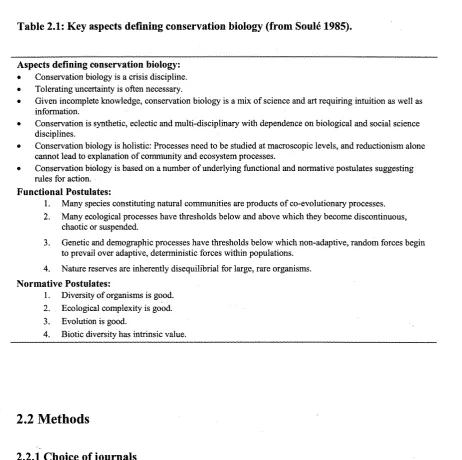
biological diversity. Some of the most important points from Soules paper are summarised
in Table 2.1.
In this paper we provide a snapshot overview of conservation research. To do this we
investigate four main themes: an overview of topics, habitats, taxa, and the ecological,
temporal and spatial scales of the research. We also investigate these four themes with
regard to the relevance of the research for informing policy and management. Our aim is not
to make major comparisons between journals, as most people will already be familiar with
the biases or preferences of a particular journal.
Chapter 2: What do conservation biologists publish?
Table 2.1: Key aspects defining conservation biology (from Soule 1985).
Aspects defining conservation biology: • Conservation biology is a crisis discipline. • Tolerating uncertainty is often necessary.
• Given incomplete knowledge, conservation biology is a mix of science and art requiring intuition as wen as information.
• Conservation is synthetic, eclectic and multi-disciplinary with dependence on biological and social science disciplines.
• Conservation biology is holistic: Processes need to be studied at macroscopic levels, and reductionism alone cannot lead to explanation of community and ecosystem processes.
• Conservation biology is based on a number of underlying functional and normative postulates suggesting rules for action.
Functional Postulates:
L Many species constituting natural communities are products of co-evolutionary processes. 2. Many ecological processes have thresholds below and above which they become discontinuous,
chaotic or suspended.
3. Genetic and demographic processes have thresholds below which non-adaptive, random forces begin to prevail over adaptive, deterministic forces vfithin populations.
4. Nature reserves are inherently disequilibrial for large, rare organisms. Normative Postulates:
1. Diversity of organisms is good. 2. Ecological complexity is good. 3. Evolution is good.
4. Biotic diversity has intrinsic value.
2.2 Methods
2.2.1 Choice of journals
Our survey covers three international conservation biology journals: Biodiversity &
Conservation (B&C), Biological Conservation (BC) and Conservation Biology (CB). The
journals were selected on the basis that they were the highest impact biological journals with
'conservation' in their title. These are some of the longest standing journals publishing
conservation research. They have all been heavily involved in the promotion of conservation
biology and together provide a good representation of the global scientific literature in
conservation biology. While the review of only three of many journals that are fully or
partially devoted to conservation will influence the results of this study, sampling a larger
number of journals with fewer papers from each is problematic. This is partly because in
some of the more ecologically-oriented journals (e.g. Journal of Animal Ecology) it can be
difficult to decide if a publication should be included as a paper that is devoted to