Q U A N T U M O PTICS
A Dissertation
by
XIPING ZHENG
Submitted to the Office of Graduate Studies of Australian National University
in partial fulfillment of the requirements for the degree of
M ASTER OF SCIENCES
December 1994
1
This thesis is an account of research undertaken in the Department of Physics
and Theoretical Physics within the Faculty of Sciences at the Australian National
University
The material presented herein is my own, unless stated otherwise.
None of the work presented here has ever been submitted for any other degrees
at this or any other institution.
patience made this thesis possible.
I would also like to thank Drs. M. Andrew and Y. Mu for useful discussions
when I did this work.
I would further like to thank all of the members of the Department, they give
lots of help in their own way. And in particular, I would like to thank Andrew White,
he read the thesis and corrected the English for me.
Finally, thanks to Xiaoping Yang - my husband, he gave me so much help from
ABSTRACT
F undam ental A sp ects of Q uantum O p tics
. (December 1994)
Xiping Zheng,
B.S., Zhengzhou University and M.S., Shanxi University
Chair of Advisory Committee: Dr.Craig Savage
The objective of this thesis is to investigate two fundamental problems of quan
tum optics: macroscopically distinguishable quantum superposition states and quan
tum chaos. After a brief introduction, Chapter II and Chapter III investigate the
problem of superposition states. A method for generating the macroscopically distin
guishable superposition states via single two-level atom dispersion was proposed by
Savage et a/.[Opt.Lett. 15, 628(1990)]. In chapter II, an extension of this model to a
three-level atom is investigated and the result shows that the superposition state can
be obtained from the three-level model sytem in the dispersive limit. In chapter III,
S ’
the effect of the atomic linewidth is considered. If the atomic linewidth is included,
there will be two contradictory conditions for the generation of distinguishable su-
perpositon states. This shows that the atomic linewidth prevents the formation of
macroscopically distinguishable superpositon states by the proposed method. From
chapter IV to chapter VI, we investigate the transition from a dissipative quantum
system to a classically chaotic system. Specifically, wre apply the method of quantum
trajectories to the case of optical second harmonic generation. In chapter V, the Q
function is obtained numerically by this method and found to agree with the results
the classical strange attractor is approached as the field strength is increased. This is
because the mean values of operator products factorize into products of mean values
TABLE OF C O N T E N T S
CHAPTER Page
I INTRODUCTION... 1
II QUANTUM SUPERPOSITION STATES IN A THREE LEVEL
SYSTEM... 5 A. Macroscopic quantum superposition state generation
using a two-level J-C m o d e l ... 6 B. Three-level atoms and superposition s t a t e s ... 11 C. The semiclassical analysis of the three-level J-C model system 18
III ATOMIC LINEWIDTH PREVENTS MACROSCOPIC SU
PERPOSITION GENERATION... 22
IV THE CLASSICAL CHAOTIC BEHAVIOR OF SECOND HAR
MONIC G E N ER A TIO N ... 30 A. Chaos ... 30 B. Classical dynamics of second harmonic g en eratio n ... 33
V QUANTUM CHAOS AND QUANTUM TRAJECTORY METHOD 39 A. Quantum trajectories method... 42 B. Master equation of second harmonic generation ... 46 C. Quantum trajectories in second harmonic generation . . . 48 D. Q-function in second harmonic s y s te m ... 52
VI INDIVIDUAL QUANTUM TRAJECTORIES AND CLAS SICAL ATTRACTORS IN SECOND HARMONIC GENER
ATION... 58 A. The classical lim it... 59 B. Single quantum trajectories in second harmonic generation 61 C. Numerical results and discussion... 64 D. Conclusion... 73
CHAPTER Page
APPENDIX B ... 81
1
CHAPTER I
IN T R O D U C T IO N
Quantum mechanics has been a great success in all practical applications. No exam
ple of conflict between its predictions and experiment is known. But some mysteries
still exist in quantum mechanics. Since the inception of quantum mechanics, due to
the probability interpretation of quantum mechanics, over half a century ago, there
has been debate about the completeness of the quantum theory. The open question,
“does quantum mechanics obey the correspondence principle", always exist. One of
the important enigmas is the superposition state, another is quantum chaos. The
superposition principle is the source of much of the strangeness in one-particle quan
tum theory, and has proved to contain even more mysteries when several particles
are involved, this includes the famous question pointed out by Albert Einstein, Boris
Podolsky and Nathan Rosen in 1935[ 1 ]. The linear superposition principle is consid
ered one of the most fundamental features of quantum mechanics and is at the very
heart of quantum theory [2, 3] and so attracts a lot of attention. From the latter half
of nonclassical states of light because of potential uses in optical communication and
gravity wave detection. Several important nonclassical properties have been shown
that can be obtained from the superposition of coherent states [5, 6, 7, 8, 9]. For
example, squeezed state [6, 7], higher-order squeezing [8, 9] sub-Poissonian photon
statistics [6, 10, 11], and oscillations of the photon-number distribution [13] emerge
from a superposition of coherent states. These results highlight the importance of
superposition state problem. To achieve a macroscopically distinguishable quantum
superposition state, a number of schemes have been proposed. One scheme is generat
ing the macroscopically distinguishable superposition state via single two level atom
dispersion[52]. It is not difficult to ask how about three level J-C model: Can we get
the superposition state in three-level atomic system? In the first part of the thesis,
after reviewing the scheme of Savage et al.[52], we extended it to the three level J-C
model in chapter II, and in chapter III we analyze the effect of atomic linewidthfld]1.
Further on another fundamental aspect of quantum mechanics is investigated:
quantum chaos. Chaos theory is an exciting field of modern physics. Over the past
ten years, chaotic phenomena have been extensively observed in mathematics, physics,
biology, fluid dynamics,chemistry, economics , and other fields [4]. The number of
papers about chaotic phenomena have mushroomed since the first international
3
ference on chaos in classical dynamical systems took place in Como, 1977. However
the two words “quantum” and “chaos” do not happily sit together. In spite of the
fact that quantum mechanics should have the same possibility to exhibit chaos only
a few isolated examples [16] of chaos have been discovered for quantum mechanical
time evolution in phase space. The problem is that the classical chaos and strange
attractors come from the concept of the orbit of a particle moving, while in quantum
mechanics motion is characterized by Schrodinger’s wave equation and hence has an
‘averaged nature'. Because of the breakdown of the concept of trajectories brought
about by the probability interpretation of quantum mechanics, that probabilities arise
from the ensemble average of many measurement results, the smearing out in quan
tum phase space, makes chaotic attractors disappear in quantized systems. Chaos is
often considered as a strictly classical concept [29, 30, 4]. Usually “quantum chaos” is
interpreted to mean the study of those particular features of the quantum mechanical
behavior of a system that occur when the corresponding classical motion is chaotic.
Much work has been done in this field [31, 65, 66, 32, 70, 42]. However people believe
that quantum mechanics is more fundamental, and that classical physics is an approx
imation valid only in the macroscopic limit. Accordingly chaos must emerge from the
classical limit of quantum mechanics. The classical chaos should be predicted from
The recent development of the quantum trajectories method [33, 34] provides us
with a new approach to the problem. In this thesis, the second harmonic generation
system is investigated by the quantum trajectories method[15]. Our result, achieved
by numerical simulation of the quantum trajectories, shows that the time evolution
behavior of single trajectories in quantum mechanics is similar to the classical result
in the large optical field limit. The strange attractor that comes from the classical
theory appears in the quantum theory. The quantum jumping tends to smaller values
and the quantum trajectory becomes similar to the classical trajectory as the photon
5
CHAPTER II
QUANTUM SUPERPOSITION STATES IN A
THREE LEVEL SYSTEM
As mentioned in Chapter I, recent results have aroused much interest in the gener
ation of macroscopically distinguishable superposition states. A number of optical
schemes have been proposed to generate quantum superposition states. Yurke and
Stoler suggest propagating a coherent state through a Kerr nonlinear medium: at
particular times the initial coherent state evolves into a superposition of two coherent
states 180° out of phase [17]. Mecozzi and Tombesi show that in a nonlinear birefrin-
gent optical medium, in the absence of loss, an initial coherent state evolves into a
superposition of macroscopically distinguishable quantum states [43]. The superposi
tion states can be obtained also using an optical back-action-evading device, or using
quantum nondemolition measurements [18, 19, 20, 44, 45], or using the micromaser
[21, 22]. However, damping of superpositions due to losses or dissipation is one the
fastest processes in quantum mechanics. It rapidly changes macroscopic quantum su
to preserve the superposition [43, 49]. This has meant that quantum superpositions
of macroscopic states are effectively unobservable [48]. Although the micromaser can
generate superpositions in the face of cavity losses, the phases of successively injected
atoms must be precisely controlled [21, 50]. A scheme which attempted to overcome
the dissipation problem was presented by C. Savage et al. using a two-level Jaynes-
Cummings model [51] in ref. [52]. In this chapter, we review the method used by
Savage et a/., then we extend the scheme to a three level system.
A. Macroscopic quantum superposition state generation using a two-level J-C model
To overcome the problem of dissipation, the optical J-C model system was proposed in
ref.[52]. In this scheme, the light is in free space rather than in an optical cavity. This
eliminates the dissipation associated with the cavity mirrors. The medium is a single
atom in a vacuum, which eliminates loss mechanisms associated with extended media,
such as Raleigh scattering in optical fibers. Furthermore, the atom is strongly detuned
from resonance with the field; this was assumed to eliminate atomic spontaneous
emission.
The Jaynes-Cummings (J-C) model describes the interaction of a two-level atom
with a single field mode [53, 52]. The Hamiltonian of the J-C model system is:
In the rotating-wave approximation[52], the eq.(2.1) is replaced by:
(2.2)
where ljj is the angular frequency of the field mode and lja is the angular frequency of
the atomic transition, a and a' are the field annihilation and creation operators, and
between the field and the atom, and is dependent on the pulse mode function and the
atomic transition. In the following the time dependence of the atom-field interaction
is modeled by assuming that g is nonzero during some interaction time T and zero
otherwise: g(t) = 0 for t < 0, g(t) = g for 0 < t < T , g(t) = 0 for t > T. The
rotating wave approximation is valid for interaction times much longer than t . The
eigenstates of the Hamiltonian are
<r+ and a are the atomic raising and lowering operators, g is the coupling strength
n, +) = cos(<£n)|n - l)| + > + i sin(</>n)|n)| —) (2.3)
n, - ) = - sin(</>n)|rc - 1)| + ) + i cos(0B)|n )|-) (2.4)
(2.5)
— ü ü j — W 4 (2.6)
where |n) is the n-photon number state of the field, and | + ) and | —) are the excited
are
E ( n, ± ) = (n - ^)hujf ± h ( ^ ~ + ng2)* (2.7)
If initially the atom is in the ground state | —) and the field is in the coherent state
|q), th e initial state of the system is \ ^ ( t = 0)) = | — )|q) , and the tim e evolution of
th e system is:
W O ) = exP ( - 5 ) exP Q < w ) f y c - | n ) | —) + - i) |+ ) ) I ^ E L ^ W L (2.8)
c_ = sin2(</>n) exp ( ~ i g nt) + cos2(<^n) e x p ( ^ nt) (2.9)
c+ = - sin(2</>„) s i n( g j ) (2.10)
gn = ( t A 2 + nff2)" (2.11)
where t is the interaction tim e of the atom and field, g is assumed to be tim e
independent.
In the scheme of ref. [52], the superposition of macroscopically different coherent
states is generated by one atom interacting with a single mode field using the standard
two-level J-C model. The basic atom ic state scheme is shown in F ig .l, where the
exam ple of a J = 1/2 to J = 1/2 state is presented. The details of the scheme are
as follows. It includes four steps. Firstly, to prepare the atom ic superposition of the
two levels \ — )g and |+ ) 5, a resonant radio-frequency pulse (A = 0, (f>n = tt/ 4) is used.
9
Fig. 1. Atomic state scheme for the J = l / 2 t o J = 1/2 system proposed in ref. [52]. In this scheme, a radio-frequency field is used to prepare superpositions of the states | — )g and | + )5. The optical field interacts dispersively with the transition
I — )g <-> | + )e- The state | —)e does not interact.
over the coherent state distribution, and Eq.(2.8) can be written as :
l*(*i)) =
exp( ^ R p t i )
V2
( |q exp( i^RFt \ )) rF I ) (r / _ 1 i i2\ v ' [o exp( )]n"^ I x l l l X
- {exp(T N ) E
[(„ + !);]./,
\ n ) R F } \ (2.12)where subscript RF denotes the radio-frequency pulse mode: is the interaction
time of the atom and the resonant radio-frequency pulses. The field state correlated
with \ — ) g is the coherent state of amplitude oexp(-iwt;/?/r/i). For large |q| the field
state correlated with | + )5 is the same coherent state times a phase factor. The atom
[image:16.560.134.453.134.274.2]phase-factors multiplying states have been suppressed):
W *l)) = W exP{-^RFt\)}RF-^(\~)g - | + )s) (2.13)
M > 1 (2.14)
The field state is disentangled from the atomic states and can be ignored in the
subsequent analysis.
Secondly, having prepared the atomic superposition state Eq.(2.13), let the atom
interact with an optical field, with frequency loof- The atomic state \+)g does not
couple to the field and so evolves freely. The atomic state \ — )g couples via the optical
field to a third state |+ )e (see Fig.l). In the dispersive limit |Ao f| > > 2 |a|goF , the
time evolution of Eq.(2.8) reduces to:
|T(£2)) = \aexp{-iipt2))oF\-)g (2.15)
A o f = wo f —u>a > > 2|a| g o F (2.16)
(p = UJ O F — 9o f!Ao f (2.17)
where t2 is the interaction time, goF is the J —C coupling strength to the optical
pulse, and the subscript OF denotes the optical frequency pulse mode. After the
interaction, the optical field has two parts, one correlated with the atom state |+ )5,
11
4^(| — )g — | + )5) , evolves into the superposition state:
W * 2 ) > - ^ [ |a e x p ( - z ^ 2))o F |-)ff + \a exp(-zu>0F*2))oF|+)<;] (2.18)
Thirdly, using another radio-frequency 7t/2 pulse identical to that used in the
first step, the state described by Eq.(2.18) can be transformed to the state:
WCO)
= - ^ [ | “ exp(-iV«2) ) o F -^ (|-> j-|+ )» )+ l“ exp(-tw oF t2) > o F ^ ( |- ) j + |+ > 9)](2.19)
Finally an atomic-state measurement projects the field into the state:
|tf(*2)) = -^=[±\aexp(-i<f>t2))oF + \oiexp(-iujoFt2))oF] (2.20)
This is a superposition state of the two coherent states \aexp(—1^2))of and
I a exp {—i<jJoF^2))oF- The plus applies if the atomic state was measured to be | — )g
and the minus applies if the state \-\-)g was measured.
B. Three-level atoms and superposition states
In the above scheme, a superposition state of two coherent states in the large dis
persive limit was obtained. The phase difference of the two coherent states is in
proportion to gQFt / Aof- Due 1° the fact that A of > > 2| a | g o F , the phase differ
ence, g2QFH Aofi is very small, making it difficult to observe experimentally. Scully
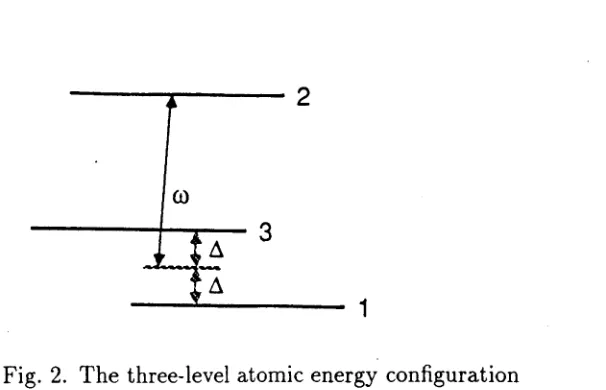
su-Fig. 2. The three-level atomic energy configuration
perposition of its ground states |1) and |3) (Fig.2) , using multi-atom injection to
the cavity and interacting with a single field mode, a large index of refraction with
vanishing absorption can be obtained [54]. This means that a large phase shift can
be obtained in their system. Can we improve the phase shift , and hence get a better
superposition state if we extend the two-level J-C system of the previous section to a
three-level system?
The dynamics of the atom and statistical properties of the field in this system
have been discussed in detail in the well known review of Yoo and Eberly [57]. where
the two-photon resonance condition is imposed and three different types of three-level
atom (A type, type and V type) are considered. Here, we only consider one of the
three types - A type three-level atom (Fig.2). The system is one A type three—level
atom interacting with a single quantized field mode. We first treat our system as
closed, i.e. no coupling of the atom with the radiation field modes of free space. The
[image:19.560.147.450.59.254.2]13
rotating wave approximation is:
H = Ha + Hf + H (2.21)
where Ha and Hp are the free parts of the atom and the field respectively:
Ha = (2.22)
t = l
and
A A { A
Hp — ua' a (2.23)
we have taken h = 1 for simplicity and u;,(z — 1,2,3) is the ith atomic level transi
tion frequency, uj is the mode frequency, 6/" and 6, are the creation and annihilation
operators of an electron at level i , while a1 and a are those of a photon in the mode.
{ M ,+ }=<$,,; (2.24)
[a, a^] = 1 (2.25)
we assume that direct dipole transitions are allowed between atomic levels 1 and 2 ,
and between 2 and 3, and forbidden between levels 1 and 3. After the RWA the dipole
interaction part, H ,is given by
H = gab^b\ + #<2^6362 -f h.c. (2.26)
same for each transition (see Fig. 2 ). Similar to the two-level J-C model, we separate
H into two parts Hi and ////, in which Hi consists of two obvious constant operators
of motion: total electron number operator Pe — bfb\ + b^b^ + 6 3 6 3 and excitation
number operator N = a^a -f 6^6 2. Both Hi and Hu are constants of the motion:
H = Hi + Hn (2.27)
and
[Hu Hn \ = 0 (2.28)
The eq.(2.28) implies that the time translation operator U(t) = exp(—iHt) factors to
Ui • Uh with
Ü , ( t )= e -" '* , U = e_iÄ" ‘ (2.29)
In the interaction picture, the Hamiltonian take the form:
H\ = loN + (u2 — ^)Pe (2.30)
Hu = - A b + k + Abfb3 + H' (2.31)
where the detuning parameters A are:
A = |cc?i21 — to = |^ 2 3 — (2.32)
15
exist three bare states :
|1><,1) = |l)|n>; |3)(n> = |3>|n); |2)<"> = |2>|n - 1) (2.33)
Using th e states |j ) n(j — l,2 ,3 ;n = 1,2...) as the basis, the m atrix representation of
H i and H u are:
Hi = (um + const.) • I
Hu
- A g \ f n 0
9 \ f i 0 9\[™
0 g\Jn A
where I is a 3 unit m atrix. The U[(t) is just a phase factor:
(2.34)
(2.35)
ü l ( t ) = e ~Hun+cox j (2.36)
T he eigenvalues of Hu in eq.(2.35) are:
E, = A2 + 2 ff2n, E 2 = -A + 2S2" . 2 ^3 = 0 (2.37)
T he eigenstates are:
m V - A + ^ / A 2 + 2g'2n g^/n loUn) A + y/2g2n + A 2
w = 2 ^/a'2 + 2g2n 1 + +
i ^ r r l3> (2-38)
i ^ ) = ~ t : ^ + ,2 g - n ) w +
1^3) —
2V/A 2 + 2p2n
-Qy/n
|2)(") + i U A 2g2” -+ f 2 |3)(n) (2.39)
>/A2 + 2g2n|! ) (n)
-yj2g2n -f A 2
A
\j'2g2n -f A 2|2) (n) +
2y/2g2n + A 2
gs/n
From these equations, we obtain:
|2>‘-> = + - M ^ \ M +
A
\J A 2 + 2g2n. \ / A 2 + 2g2n >/A2 -f 2g2n1^3)
I D « “ ) =
9v/n2 V A 2 + 2<)2n 2V A 2 + 292n t/ A 2 + 2<?2n
(2.41)
l& ) (2.42)
iWn) A + y/A2 + 2g2n | M , A - y ^ A 2 + 2ff2n , j v , g y ^ , JV ^
^ 2v/A2 + 2 g2n + 2\/A 2 + 2#2n ^ + x/A2 + 292n ^ 3^ *
As th e first step, using the same m ethod as the ref.[52], a superposition of atom ic
states |1) and |3) can be obtained:
1 ^ ( 0 ) ) — ci 11) + C313) (2.44)
In the second step , a coherent state field interacting with the atom, the initial state
of the system is :
l'I'(O)) = |q) ® (ci11) + c313))
°° a n
= e x p ( - |o |2) + c313 )177)) n— 0 Vnl
OO f y T l
= e x p ( - H 2) ^ (Cl|P » ) + c 3|3 ) h „=0 v n !
|* « ) ) = t / |* ( 0 ))
(2.45)
(2.46)
17
If we take c\ = C3 = c in the initial state, then from eq(2.47),we get :
o 1 I^W> = c e x p ( - | o | 2) J 2 ~ / = {
n=o vn !
\ / A 2 + 2g2n — A
2 \ / A 2 + 2g2n exp( — + 2g2n t)
+ ^ v /n
\ / A 2 + 2g2n exp(—i ^ A 2 -f 2g2n t) — e x p ( i ^ A 2 + 2g2n t) |2)|ra — 1)
+
|3)|n)} (2.48)
In the dispersive limit, A > > 21 ,
yjA 2 + 2g2n « A +
A (2.49)
the time-evolved state Eq.(2.48) becomes:
W O ) = c e x p ( - | o | 2) ] T ^ = { e x p ( Z(A + I1)!71) + ^9 ^ exp(—z(A + ^ - ) 0
— exp(z( A + — )0 12)177 - 1) + exp z(A + ^ - ) t j |3)|n)} (2.50)
this is an entangled superposition of the atomic and field state. A radio-frequency
7t/2 pulse, identical to th at used in the preparation of the initial atomic superposition
transforms the state of Eq.(2.50) into the state:
wo>
= c e x p ( - | o | 2) ] T - ^ { e x p ^ ’(A + (I1) + |3))|n)+9 \ ß
(2.51)
A n a to m ic state m easurem ent on the state 11) or |3) th e n p ro je c ts th e fie ld in to the
state:
T h is is a su p e rp o s itio n o f tw o coherent states. W here the p lu s applies i f the a to m ic
state was m easured to be j l ) and the m inus applies if sta te |3) was m easured. T hus
s im ila rly to th e tw o level J-C m o d el scheme the su pe rp o s itio n state can be o b ta in e d
in a three level J-C m odel system in the large dispersive li m i t i f we do n ot consider
th e a to m ic lin e w id th .
C. T h e sem iclassical analysis o f the three-level J-C m o d el system
F rom the above, we can get th e su pe rp o sition state o f the fie ld in a th re e level system
b u t o n ly in the large dispersion lim it w ith a sm all phase s h ift. T h is is d iffe re n t fro m
th e m u lti-a to m in je c tio n scheme proposed by Scully. To get m ore in fo rm a tio n abo u t
one a to m case, we proceed sem iclassically, and consider th e A c o n fig u ra tio n (F ig .2).
T h e p o la riz a tio n P associated w ith the atom ic tra n s itio n s 3 —► 2 and 1 — > 2 is given
!*(<)) = c{e,AV ' £ ‘) ± e " AV - * ' ) } (2.52)
by [54, 55, 56]
19
where p23 and p2l are the transition matrix elements and p23 and p2\ the correspond
ing density matrix elements. If, initially, the atom is in a coherent superposition state
of two ground-states, the initial density matrix for the atom is:
P =
p°22 0 0
0 P33 P 3 1
0 P ? 3 1
(2.54)
The atomic evolution equations are[54]:
I l
P23 = —{iw23 + 723)^23 — jTp23{p33 — P22)E — ~p2\p\3E (2.55)
l l
P21 = ~(^21 + 72l)/I * 321 — Tp2l(/hl — P22)E ~ ~p23P3\E (2.56)
h h
l
p31 = —( ^ ’31 + ')3l)p3\ ~ ~jr[P23p2l ~ p2\p32)E (2.57)
l
P\3 = —(^13 -f 713)^13 — j{p\2p23 ~~ P23P\2)E (2.58)
I
P22 = —12P22 — j [{P23P32 + P2l/>12)77 — C. C. ] (2.59)
I
P33 = ~l3P33 — J^(P*23P23 ~ C.C.)E (2.60)
I
P11 = - h P n ~ ji {Pnp2\ ~ c.c.)E (2.61)
where c.c. is the complex conjugate term, E is the field of the light with the frequency
v , 7i(i = 1,2,3) are the diagonal decay rates, 7 = 1,2, 3) are off-diagonal decay
rates and 7 = (7, + 7; )/2.
and p2i :
P 7 \ i£ o e -" " { P 2 .-— --
---n i A 2i + 721 - 7 2
i T f p - ^ * _ e - t A 2 i < - 7 2 l < l
P22 [e
P21T Pi 1 * A 2i + 721 - 7 i
1 P23/>31 “
zA 2 1 T 721 ~ 731 — ^ 3 1
e ~ 7 l < _ e i A 2 i < - 7 2 i < j
Jg —(‘>31+«*'3i)Z _ g-(721+IW21 )Zj I (2.62)
P 23 • ■ “" { P 2 3 - T ---A I « ' 72' - e - A23‘ - ™ ‘ ] Z A 23 + 7 2 3 — 7 2
P33
‘23 + 7 2 3 — 7 3
1
-73* _ g*A23Z-723n
(2.63)
where E = Eoe~lut, E0 is the electric field amplitude of the light. If all of the
damping terms in these equations are put equal to zero, 7, = 0, then the equations
are equivalent to a Hamiltonian system, with J —C coupling between the levels. So
we can compare with the result of the previous section.
From Eqs(2.53),(2.62), and (2.63), we get Fig.(3). It shows us that, if one three-
level atom interacts with a single mode field, only at some special times is the dis
persion of the atom nonzero while the absorption of the atom is zero ( Points A and
B in Fig.3 ). It is impossible to get a atomic state which has stable zero absorption
and nonzero dispersion over a long time in the case of single atom interacting with
21
J 0.0
20.0 40.0 60.0
INTERACTION TIME gt
Fig. 3. Dispersive (R e P) and absorptive (I m P) parts of polarization vs the scaled in teraction time gt in the system of one three-level atom interacting with one field mode. The values of parameters are u>3i = 0.05, A 2i = 0 . 1 , p33 = pQu = 0.5,
= 72 = 73 = 0. Dashed line: absorption , Solid line: dispersion
dispersion and zero absorption were obtained because of the accumulational effect of
m ulti-atom interacting with the optical field. Because the phase shift is in proportion
to the dispersion and the interaction time, the semiclassical result we obtained here
means th a t the optical field cannot get a large phase shift after one three-level atom
interacting with the optical field. Hence the refractive index enhancement scheme of
Scully and Zhu [54] does not appear to be applicable to the superposition generating
[image:28.560.93.499.57.293.2]CHAPTER III
A TO M IC L IN E W ID T H P R E V E N T S
M A C R O SC O P IC S U P E R P O S IT IO N
G E N E R A T IO N
In chapter II, a scheme for generation of macroscopic quantum superposition states
using a three-level J-C model system was suggested. The result is similar to the
two-level J-C model system. In these schemes, the effect of atomic linewidth was not
considered and the coupling coefficient g was assumed to be time independent. In
this chapter, we show that the scheme does not work when the atomic linewidth is
included[14].
From Eq.(2.7), we know that the eigenvalues of these dressed states are
£ ( n ,± ) = (n - ^)hu>j ± + ng2)? (3.1)
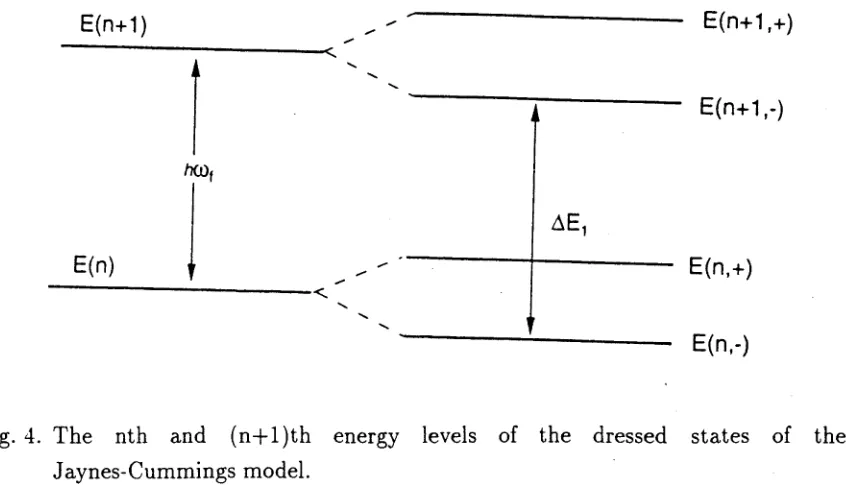
This means that in the dressed state basis the equal-spaced energy ladder of the
harmonic oscillator is split into two “ladders”. The “plus" and “minus" ladders
E(n+1) E(n+1,+)
AtCO,
E(n)
E(n+1,-)
E(n,+)
E(n,-)
F ig . 4. T he n th and ( n - f l ) t h energy levels o f the dressed states o f the
Jaynes-C um m ings m odel.
N e ith e r ladder is e q u a lly spaced. As described in re f [52], the a to m is in it ia lly prepared
in a state | 4 (0)),
W ( 0 ) ) = l ~ ) , ~ l + )!’ (3.2)
and the fie ld is in the coherent state \ a ) . Because | + )5 (refer F ig .2) is not in te ra c tin g
w ith the field, we are interested in the e v o lu tio n o f the coherent sta te o n ly when
in te ra c tin g w ith the levels | — ) g and | T) e. T he in itia l a to m -fie ld s ta te is the n
W O » = e x p (—^ - ) A = j | n ) | - ) 3 n = 0 v n .
[image:30.560.71.494.164.411.2]In terms of the dressed states , this becomes
From Equation (2.5), In the dispersive limit A —* oo this approaches
(3.5)
So only the lower ladder dressed states are present. From Eq(3.1), the spacing of
adjacent minus ladder states is
Since this is a function of n, they are not equally spaced. However, for a large-
amplitude coherent state field , the energy spacing is approximately constant:
From the harmonic oscillator we know that if the energy spectrum of a system is an
infinite equally-spaced ladder, then there exist coherent states for that system whose
complex amplitudes evolves like aexp(zu^), where Tiw is the spacing between adjacent
energy levels. Moreover if the energy spectrum of a system is given by two ladders
of different spacing there will exist states which are effectively superpositions of two AJSi(n) = huj j - + (n + l)s 2)j - ( ^ - + n$2)!] (3.6)
AEl
«
I»,,
-
A + w v ) - i
1 4 (3.7)
25
the spacing of that ladder. This is the sort of dynamics proposed in ref. [52] to gen
erate macroscopic superpositions of coherent states. The coherent states associated
with the different ladders will rotate at different frequencies and can eventually be
come macroscopically separated in phase. So the equal spacing of the energy levels,
Eq.(3.7), makes the initial state Eq.(3.5) evolve as a coherent state of the lower ladder,
rotating at the frequency :
(3.8)
It has a frequency lower than that of the free field by the detuning:
In the dispersive limit |A| 2|a|g, Eq.(3.8) becomes:
<i> = u f - g 2/ A (3.9)
As was found by a different method in Chapter II, a superposition of two coherent
states is obtained:
I«'(<)) = I a e - “' 1) + |ae- "*<) (3.10)
with t the field-atom interaction time. This is equivalent to the result of equation(2.20).
Now, we assume the atomic transition has a linewidth, 7. The standard J-C
E(n+1)
0
,
E(n) v
. . . • •
SS> ' .k' ^ v • ? * § h 5 f c v * ‘
^ m a x ( E | + 1 .*)
Fig. 5. The dressed state energy levels are “spread" when the atomic linewidth is considered.
when the linewidth is included. However the the effect of the linewidth can be u n d e r
stood from physical considerations. The linewidth will produce a similar linewidth of
the dressed state energy levels (Fig.5). The mechanism giving rise to the superposi
tions relies on the spacings of the dressed state ladder being different to the spacing
of the free oscillator ladder. For the free field and interacting coherent states to be
come separated, it is necessary that the linewidth induced range of detunings does
not extend to zero. For then there would be an overlap with the free coherent state,
[image:33.560.58.529.89.360.2]27
Fig.5, the maximum of the broadened energy level E(n -f 1, —) is approximately
Emax{n + 1 ,- ) = (n + ^)hujf - + (n + 1)^2)]= (3.11)
and the minimum of the broadened energy level E ( n, —) is
Emin(n, - ) = (n - ^)hcoj - ^ [ 1 ^ - i- lL + ng2)]* (3.12)
An estimate of the largest frequency difference between the dressed states is then
A E2 = hujf — ft([— —— h {n + 1)</2]2 — [~ ~ f n92]2) (3.13)
4 4
Hence for the interacting state to become well separated from the free field coherent
state will require that the following strong inequality be fulfilled:
[{S- +; ' ~2- + ng2]i « [(A ~ 7)2 + (n + l ) g ^ (3.14)
4 4
This requires, g2 >> 7A. Assuming A > 7, then
92 » 72. (3.15)
At the same time we require the two coherent states \ae~lu,ft) and |ae~lcpt) in Eq.(3.10)
to be separated. Hence the scalar product of these coherent states should satisfy:
\{aelu>t\ae~l<t>t)|2 = exp( — \a — ae*52^ A|2) < - . (3.16) e
a to m and th e fie ld is T ( 0 < t < T ), th is requires
g T > 1 (3.17)
So to get a m a cro sco p ica lly d is tin g u is h a b le q u a n tu m su p e rp o s itio n state, the c o n d i
tio n s (3.15) and (3.17) m ust b o th be satisfied. H ow ever, th e co u p lin g coefficient g
and lin e w id th ,7, are re la ted . T he co u p lin g c o efficie n t is given by [59]:
9 2 = ( ^ T " ) l w|2’ (3-18)
w here u is th e n orm a liz e d mode fu n c tio n . W e assume th a t th e fie ld is a single-m ode
pla ne wave. Its le n g th c T is d e te rm ine d by th e to ta l in te ra c tio n tim e and its m in im u m
cross section by th e lig h t ’s w avelength / . T h e n th e m ode fu n c tio n is :
u = (c T A2) - h (3.19)
So fro m E q.(3.1S ) we fin d th a t the m a g n itu d e o f th e c o u p lin g coefficient g is d e te r
m in e d by the to ta l in te ra c tio n tim e T ,
2 _ _§7_
9 8jtT
S u b s titu tin g E q.(3 .2 0) in to E q.(3.15) and (3.17), we o b ta in ,
7T < < 3_
$7T
(3.20)
29
7T > (3.22)
These are contradictory conditions that cannot be simultaneously satisfied by the
system. Thus the linewidth of the atomic transitions will always wash out any sepa
ration of coherent states for free-space modes. The underlying reason that the atomic
linewidth prevents the formation of well separated superposed coherent states is the
inverse dependence of the atom-field coupling strength on the interaction time. This
is because we have used free space modes whose mode volume increases with the
interaction time. To prevent smearing out of the coherent state frequencies the cou
pling strength must exceed the linewidth, as in inequality (3.15). This requires a
sufficiently short interaction time. This is incompatible with the interaction time
being sufficiently long to separate the interacting and non-interacting coherent states
by more than the phase uncertainty of the coherent state.
In conclusion, we note that a scheme for preparing a macroscopic quantum su
perposition state has recently been proposed by Brune et al. [22]. This scheme is
related to that of ref.[52], however it uses a high Q microwave cavity to overcome the
linewidth problem discussed in this paper. It is remarkable that sufficiently high Qs
CHAPTER IV
T H E CLASSICAL C H AO TIC B E H A V IO R OF
SE C O N D H A R M O N IC G E N E R A T IO N
A. Chaos
Since the first international conference on chaos in classical dynamical systems took
place in 1977, chaos has been studied extensively. Great progress has been made in
understanding the qualitative behavior of classical dynamical systems, and chaotic
phenomena have been found in many classical systems [4]. Chaotic behavior is in
herent in most nonlinear mechanical systems since many orbits have a “sensitive de
pendence on their initial conditions’*. Physically, this means that (arbitrarily) small
changes in the initial conditions can rapidly cause very large changes in the ensuing or
bit. This implies that no matter how much past behavior we experimentally observe,
we can not predict much of the future behavior of such orbits, due to the inherent
experimental error in that observation. Mathematically, chaos is a phenomenon that
31
and can be easily (although numerically) found in some equations. We now review
the mathematics of chaos, following ref. [60]. Let us consider a system described by
first-order differential equations:
Where i = 1,2 -•• , N and x(t) is the N-dimensional vector with components x,-. F,
are nonlinear functions. For any initial state x(0) of the system, we can solve the
equations to obtained the future state x(t) of the system for t > 0. And because these
equations are first order in the time derivative, they describe unique trajectories given
the initial conditions. Chaos is defined as a sensitive dependence of the trajectory x(t)
on the initial conditions. This sensitive dependence can be quantitatively described
by introducing the concept of a Lyapunov exponent [61]. It is a measure of the rate of
divergence ( or convergence ) of initially infinitesimally separated trajectories. First
consider the instantaneous, local linearization around the trajectory x(t) at time t.
For a short time, Ax evolves according to
J X ;(<) = F,(x(t)) (4.1)
— Ax, = Jj,tA (4.2)
where Jo, is the Jacobi matrix defined by
As the trajectory evolves in time, the matrix elements J also evolve. At each
instant of time, the eigenvalues of J can be calculated. If at least one eigenvalue has
a positive real part, the local magnitude of Ax grows. Such a tendency is averaged
over the course of the trajectory and this leads to the definition of the Lyapunov
exponent[61]:
A = lim A l n ^ j
t-+oo,d(Xo,0)—>0 \yt a(xo, 0 ) /
d(x0) = ||Ax(x(0), t)\\ (4.5)
where d(x0) is the length of the deviation vector at time t that started at t = 0 from
x = X o - The notation || || means the Euclidean metric in an N-dimensional space.
Any trajectory of a dissipative system will approach a bounded region of phase
space called an attractor, as t —> oo. Attractors include points, limit cycles, and
chaotic cycles. If A > 0, the nonlinear system exhibits chaos, initial trajectories
moving apart with an initial exponential rate A. This is referred to as sensitive
dependence on initial conditions. For dissipative systems, a stretching in one direction
has to be accompanied by a more-than-compensating contraction in other directions.
The phase space trajectories for a chaotic system asymptotically approach a strange
attractor, an attractor with a fractional dimension. If A < 0, the trajectories approach
33
T
¥ //////,
V/////A
Nonlinear
crystal
T
l
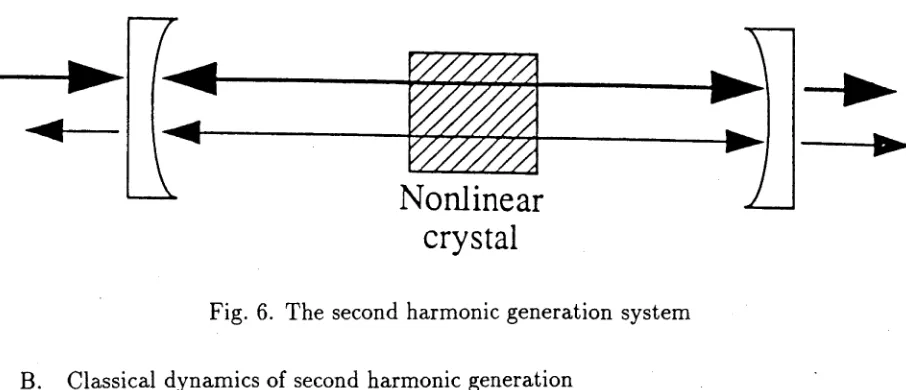
Fig. 6. The second harmonic generation system
B. Classical dynamics of second harmonic generation
Second harmonic generation is a well-studied problem in both classical and quantum
theory [64, 70, 75]. In this system, the nonlinear crystal is placed inside a dissipative
driven optical cavity, and light at the fundamental frequency u j interacts with the
crystal and is frequency doubled to its second harmonic 2uj (Fig.6). The system is
dissipative because light is lost through the cavity's partially transmitting mirrors.
This loss is modeled by the coupling through the mirrors of the cavity modes to
the reservoirs of field modes outside the cavity. The classical dynamical equations
can obtained by applying Maxwell's classical theory to second harmonic generation.
These equations are [75]:
oil — — i Aioi — kioti \ Qio 2 T E (4.6)
[image:40.560.53.506.88.283.2]where a i and a 2 are the complex amplitudes of the fundamental mode and the sec
ond harmonic mode respectively, and E is the pumping field. These equations are
nonlinear, have four real variables (since cq and a 2 are complex), and are known to
have a range of attractors: fixed points, limit cycles and chaotic [64, 75]. Hence this
system is an interesting one in which to investigate how classical attractors arise from
the underlying quantum mechanical description of second harmonic generation. To
simplify, let us introduce dimensionless scaling, denoted by tildes. The above classical
equations become:
= E -f (“ iAi - l) Qi + a \a 2 (4.8)
^ = (-t'Ä 2 - fc) q2 - (4.9)
Here d, = ( x /^ i)<*,-, E = E ( x / kJ), k = k2/k\, A, = A t//q , r = tk\. These scaled
equations depend only on the scaled parameters E, A, , and k . So varying the ratio
x/k\
does not affect the dynamics of the scaled variables as long as E, A,, and k arefixed. We call the ratio x/^'i the scaling parameter and denote it by S:
s = x / h
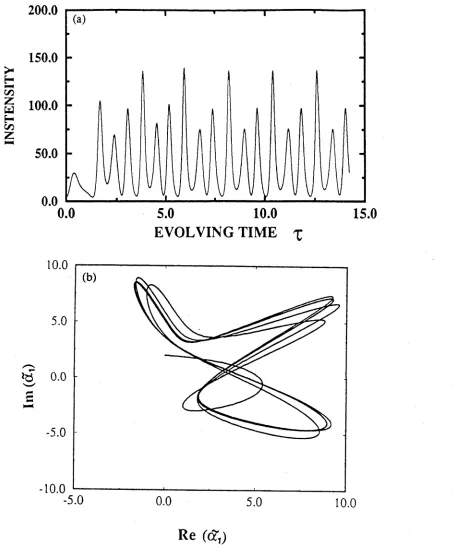
(4.10)The mean photon numbers and phase space orbits in the classical chaotic region,
limit cycle and fixed point are shown in Fig.7, Fig.8 and Fig.9 that we got by solving
35
systems from classical dynamical theory. In Chapter VI, we will investigate the cor
responding behaviors using the quantum trajectory method and study the transition
from quantum chaos to classical chaos. The driving field amplitude is E = E K \ / S , so
the classical limit of strong driving is obtained by decreasing the scaling parameter S
with fixed E, A, and K . Taking the limit S —► 0 does not change the scaled classical
equations (4.8),(4.9). Hence scaling allows quantum solutions for arbitrary S to be
5.0
10.0
EVOLVING TIME
ReCd,)
Fig. 7. The classical chaotic cycle of the fundamental mode, (a) The scaled mean photon number |d ] | 2 as a function of time, (b) The scaled field amplitude
[image:43.560.74.518.79.647.2]INS
TE
NSI
TY
37
100.0
-5.0 10.0
EVOLVING TIM E x
Re (<?7)
[image:44.560.64.519.65.610.2]Im
(a
,)
IN
TEN
SI
TY
EVOLVING TIME
x
Re (a,)
[image:45.560.71.505.67.613.2]39
CHAPTER V
Q U A N T U M CHAOS A N D Q U A N T U M
T R A JE C T O R Y M E TH O D
Quantum mechanics has been very successful. However, the quantum mechanical
origin of chaos in classical physical systems remains to be fully understood. A con
spicuous puzzle has been how to reconcile this nonlinear, classical phenomenon with
the underlying linear quantum theory. If we believe that all of physics is funda
mentally quantum mechanical in nature, the classical chaos must emerge from the
quantum theory.
In classical statistical physics there are two ways of approaching the dynamical
evolution of a system. In the first the system is described by a probability distribution,
and a Fokker—Planck equation, or its equivalent, generates the evolution in time. In
the second the system is described by an ensemble of noisy trajectories, and a set of
stochastic differential equations are used to generate the trajectories.
The standard quantum mechanical method is solving the master equation of
version of a probability distribution. Because the master equation is difficult to solve
analytically, it is often solved numerically. If the relevant Hilbert space of the quantum
system has a dimension N, the number of the elements of the density matrices we
need to calculate is N 2. If the system consists of two modes, the number of density
matrix elements, will increase to (Ah x N2)2. If N >> 1 then the later numbers are
too large to realistically calculate. Thus many problems cannot be investigated well.
To settle this problem, a quantum mechanical version of the classical stochastic
trajectories has been developed in the past couple of years. It is known as the quantum
trajectory method or the Monte Carlo wave-function method[33, 34, 35, 36]. This new
method for solving the master equation is based on a stochastic Schrödinger equation
and has been interpreted as providing realizations of individual quantum trajectories
[33, 73]. It is mathematically equivalent to the quantum state diffusion approach
of Gisin and Percival[37]. The method consists of two elements: evolution with a
nonhermitian Hamiltonian and randomly decided quantum jumps. It solves a wave-
function equation instead of a density operator equation; the number of variables
involved in a wave function treatment (~ N) being much smaller than the number
required for calculations with density matrices (~ N 2). In this method, each of the
trajectories describes one possible path that the system may take through the Hilbert
41
When a quantum field tends to the classical limit, the effect of quantum jumping
is much smaller than the strength of the field so that the configuration of the time
evolution behavior of every single trajectory of the ensemble is like the classical tra
jectory. However, every trajectory is different from other trajectories due to the effect
of quantum jumping. An ensemble average or time average is equivalent to the result
of a standard master equation calculation in quantum theory [33, 34, 35, 72, 74].
Classical chaos encompasses two major types of behavior: Hamiltonian chaos in
which energy is conserved, and dissipative chaos. Much work has been concerned
with conservative systems in which the semiclassical method has proved particularly
fruitful [31, 63]. However classical physical systems are often dissipative and so dissi
pative quantum systems have also been studied [67, 68, 69]. For example it has been
shown for a laser with a classical Lorenz attractor, that the quantum mechanical
Wigner distribution reduces to the classical invariant measure on the attractor in the
classical limit of large photon number [42].
Previous work on second harmonic generation has analyzed the dynamics of
the Q-function, a quantum mechanical quasi-probability distribution, for the case of
classical limit cycles [25]. In the classically chaotic regime the steady state solutions of
the master equation have been numerically determined and compared to the classical
towards the classical limit was quite limited due to the computational demands of
the problem. Nevertheless some correspondence between the classical and quantum
mechanical solutions has been reported [70].
A. Quantum trajectories method.
In the method of quantum trajectories, the dynamical object is a wave function
rather than a density operator. The wavefunction is generated stochastically and it is
ensembles of these wavefunction that are equivalent to the master equation solution.
It can be shown that averages of operator mean values over wavefunction ensembles
reproduce the mean values generated by the master equation [33]. In order to make
the thesis reasonably self-contained, we briefly introduce the method of quantum
trajectories closely following the reference [33].
The quantum trajectory approach is built around the theory of photoelectric
detection and the master equation of photoemission source. Using the two theories one
can relate the statistics of photoelectron emissions to a dynamical process involving
photon emissions taking place at the source. Now let us consider the general source
master equation of dissipative systems. It describes the quantum mechanical evolution
of a system interacting with a reservoir and the master equation is:
43
The formal solution of the master equation is:
p(t ) = 0) (5.2)
The physical process of the source described by equations (5.1) and (5.2) includes both
evolving and photoemission of the source. The operator L also includes two parts —
evolving operator and photoemission operator. If the photoemission is described by
a superoperator i?, adding and subtracting the superoperator R to T, the equation
(5.2) becomes :
p(t) = e[(l-B)+«]‘p(o) (5.3)
By means of the equation:
p[(L + h. R)x\ = T a k r d x k R dxk-i---r R e U '
(5.4)
the equation (5.3) can be expanded in terms of the superoperators ( L — R) and R:
~ f t R m
p{t) — 'y ) / d t m / d tm—] n ^ O J o J o
t • • ■ k e (L- k ) hp(0)
Jo
(5.5)
Now the quantity inside the integrals is the unnormalized conditioned density operator
p c{t) for an initial state pc(0) = p(0), where the over-bar denotes unnormalized.
Eq.(5.5) can be interpreted as a generalized sum over all the photon emission pathways
may involve any number of photon emissions, from m = 0 to m — oo, and the times
of the emissions can be any ordered sequence of m times in the interval [0,t]. The
quantum trajectory method is a simulation of the physical process. The basic method
is to define a conditioned density operator pc(t) , let it be equivalent to the inside the
integrals on the right-hand side of Eq.(5.5), take it out and normalize it, then give
it a physical interpretation in term of evolution without photon emission interrupted
by collapses at the time of the photon emission. At time t, for an initial state /5(0)
and a particular sequence of photon emission times, the conditioned source density
operator is given by
JcW
T
with
J c(t) = o) (5.7)
This procedure decomposes the quantum master equation into an infinity of quantum
paths, or quantum trajectories. The trajectories include two processes — evolution
without photon emission governed by the superoperator (L — R), and collapses with
the emission of a photon as described by R.
The conditioned density operator pc{t) usually can be factorized as a pure state:
45
we also write
U t ) = |T«(0X*«(0l (5.9)
then the propagator for the density operator pc(t) is replaced by a propagator
for the state |'PC(£)). Propagation without photon emission over a time At is given
by
I^c(< + AO) = e-Wfi>"A‘|$ c(<)) (5.10)
where H is a nonhermitean Hamiltonian. When a photon emission occur, the unnor
malized state undergoes a collapse:
l*c(0) - <?|T«(0> (5 .ii)
where C is the annihilation operator of the source field and its relationship with the
superoperator R is Rp = CpC^.
When a weak light is observed by a photodetector, a series of individual photo-
electron is emitted at random point of time. We cannot predict that a photoelectron
will definitely be emitted at this particular time or that particular time. So the emis
sion times of the photons of the source are random too. If the conditioned density
operator at time t is pc(<), the probability that an emission occurs in the interval
[ t , t-f At] is [33] :
('M f)|C 't C|'I'c(0}A< (5.12)
where pc(t) is the conditioned density operator at time £, and |T C(£)) is the wavefunc-
tion corresponding to the conditioned density operator. The numerical simulation
uses discrete time, with a time step At and follows a three step wavefunction evolu
tion algorithm: (i) Evolution for a small time A t of the wave function governed by
Eq.(5.10). (ii) Calculate the collapse probability of the wavefunction and generate
a random number rn distributed uniformly on the interval [0,1]. (iii) Compare the
collapse probability with r n and calculate the wavefunction according to the rule:
B. Master equation of second harmonic generation
Investigation of the second harmonic generation system is quite well established by
many authors in both the quantum and the classical region. A well known approxi
mation scheme results in a quantum optical master equation [23, 24]. Denoting the
fundamental cavity mode quantities by a subscript 1 and the second harmonic cavity
I'MWi)} = (5.13)
(5.14)
47
second harmonic generation is [25, 26]
-Jj = —[HD + HI + HE, p ] - \ - k i ( 2 ä i p ä \ - ä \ ä i ß - p ä \ ä i
+ k 2 (^2a2p a \ — a \ a 2p - p a \ a ^ j (5.15)
He = h A i ä \ ä i -f h A 2a \ a 2 (5.16)
H i = i ^ X ( a + 2a2 - ä j ä | ) (5.17)
He — ihE faj — j (5.18)
where h\ and a2are the boson operators for the fundamental mode and the second
harmonic mode respectively, and \ is the nonlinear interaction strength. E is the
driving field strength and is proportional to the amplitude of the coherent state
assumed to be driving the fundamental cavity mode [27]. Without any nonlinear
interaction, \ = 0 , mode 1 is driven into a coherent state of amplitude E /k . p is the
reduced density operator of the cavity modes obtained by tracing over the reservoirs.
Ai = lji — itje , A2 = lo2 — 2u>£, where Ai and A2 are the detuning of the cavity modes
from the driving field ( with frequency uje ) and its second harmonic respectively. k\
C. Quantum trajectories in second harmonic generation
The quantum trajectory theory is built around the theory of photoelectric detection
and the master equation theory of photoemissive sources. According to the master
equation (5.15) and following the general quantum trajectory theory presented in
Section A [33], we deal with the second harmonic system by the quantum trajectory
method. Taking R\ = 2Aqdi/5dJ, R2 = 2k2a2pa'2 to be the collapse superoperators for
the Lüi and cc2 modes respectively, the superoperators L — R\ — R 2, R\ and R 2 that
govern the evolution and collapse, respectively, are defined by:
CMc)(4'c
icj ,
(5.19)= C 2 \ l p c ) { ' p c
\c\
, (5.20)(5.21)
where pc is the unnormalized conditioned density operator. |
ipc
) is an unnormalized49
harmonic mode, and
Pe=He)Hc\
, (5.22)C\
=\j2k\ ä\
, (5.23)C2
— \J2k2
a2 . (5.24)The conditioned density operator may be written in terms of a pure state wavefunc-
tion:
Pc(t)
=
He )HcI
, (5.25)and
[He He
)]2 ’Between photon emissions, the unnormalized wavefunction H e ) is governed by the
nonunitary Schrödinger Eq:
j t
\JC) = ^H\A)
(5.27)with the nonhermitean Hamiltonian:
H = Hd+ Hi + He
—
ihkiä\ä\ — ikk2a\ä2 (5.28)the unnormalized wavefunction H c H ) ) can written as:
Hc(t) ) = Cn,mW,m) n , m
Substitute Eq.(5.28) and Eq.(5.29) into Eq.(5.27) to find:
n , m
^ ^ C 'n ,m TTl) — h(Aidffii + A 2ä\ä2) + y x ( a l2ö2 - o.\a\)
+ ihE(ä\ — ä j ) — ihk\ä\ä\ — ihk2ä\a2 ^ C„iTn|n, m) J n , m
= ~ ki)n+ { -iA 2 - k2)m\Cn,m\n,m) n ,m
+ ^ Z l ( \ / ( n + 1)Cn+i,m\n,m) - y /nCn-i,m\n,m)) n ,m
+ H o W (n ~ 1)n (m + l ) C n- 2,m+\\n,m) n ,m
- y j { n + 2)(n + l ) m C n+2,m- i |n, m>) (5.30)
So we get:
(-'n ,m — E T 1 ^ n + l , m V ^ " ^ n — l , m j T [( 2 ^ 1 ^ 1 4 ( ? - ^ 2 ^2) ^ ^ ] ^ n , m
(5.31) \/(rc ~ 1 )n(m + 1) Cn_2,m+i ~ \J(n + 2)(n + l)m Cn + 2 , m — 1
The evolution is interrupted by instantaneous collapse at the times of the photon
emission:
I<M0) — * Ci\ipc{t)) , (5.32)
I*Pc{t)) — > C2\^c(t)) > (5.33)
51
(5.34)
n, m
C ^ c M ) = >/5feÄ2|0e(t))
= > / % E C » . m +i v O T | n , m ) . (5.35)
n, m
The probability of a collapse occurring in the interval [£, 2 T At] is given by:
f t( l) Tr[Ripc(t)]At
(^c(f)|abl|V ’e(0) (^c(t)l^c(<))
a ( 2 ) 7>[fi2pc(<)]At
9( (V’ctOlabzI’/’ct*)) - 2 ^ .(0 l^ c(0 >
(5.36)
(5.37)
( ^ ( * ) I W i ) > = E I C - . m l2 V (5.38) n, m
(^ c( t) |a |a i|^ c(<)) = n|Cn,m|2 , (5.39)
n, m
( ^ c ( < ) | a j a2| ^ c (0> = 5I m l^ . ^ | 2 • (5.40) n, m
The equations (5.27) — (5.40) define a single quantum trajectory of the second har
monic generation system. An ensemble average over infinite quantum trajectories,
taken with respect to this conditioned wave function, reproduces the results of a
D. Q-function in second harmonic system
The Q function, also known as the Husimi distribution, is a function of coherent state
complex amplitudes of the fundamental mode au and the second harmonic mode a 2 :
Q(<xi , a 2) = ( ( a 2| 0 (q i|)/3(|q i) ® | a 2)) (h.41)
It may be interpreted as the probability distribution for the fields to have the complex
amplitudes and a 2 [5, 77]. In the classical limit oq and a 2 can be interpreted as the
classical complex field amplitudes [76], and the Q function is expected to approach the
classical phase space probability distribution. To present the steady-states graphically
each mode is considered separately. Tracing over one mode generates a reduced
density operator for the other mode:
P\ — T r 2(p), p2 = Tr l (p) (5.42)
The Q function for each mode is:
Qi = (ai\pi\ai), i = 1,2 (5.43)
The equations (5.27) — (5.40) define a single quantum trajectory of the second
53
I'J'i) = J 2 C ( n , m ) \ n , m ) n ,m
(5.44)
( ^ i| = C * ( n , m ) ( n , m \ (5.45)
n,ra
T he density operator for each trajecto ry can be obtained by.
p i = | 4 ' i ) { ^ . l
= ^ 2 C (n , m ) C ' ( n \ m')\n, m ) ( n \ m'\ (5.46) n,m n \ m '
The elem ent of the system density m atrix is
p n ,n ',m ,m ' = C(n, m)C*(n'm') (5.47)
Here n and m stand for mode one and mode two respectively. Using eqs. (5.4‘2)and
(5.46), we can find the reduced density operators for mode one and m ode two,
P i = C ( n , m ) C m(n '1m)\n)(n'\
n,n' ,m
(5.48)
p2 = C ( n , m ) C * ( n , m ' ) \ m ) ( m ' \ (5.49)
the elem ent of the m atrix is:
p i ( n , n ' ) = y C ( n , m)C*(n', m) m
(5.50)
p2(mi m') = Y l ^ ( n 5 m)C*(n, m') (5.51)
![Fig. 1. Atomic state scheme for the J = l / 2 t o J = 1/2 system proposed in ref. [52]](https://thumb-us.123doks.com/thumbv2/123dok_us/7915800.190791/16.560.134.453.134.274/fig-atomic-state-scheme-j-j-proposed-ref.webp)


![Fig. 7. The classical chaotic cycle of the fundamental mode, (a) The scaled mean photon number |d]|2 as a function of time, (b) The scaled field amplitude trajectory in phase space](https://thumb-us.123doks.com/thumbv2/123dok_us/7915800.190791/43.560.74.518.79.647/classical-chaotic-fundamental-scaled-function-scaled-amplitude-trajectory.webp)