INTRA-FAMILIAL TIME ALLCX::ATION
-- A Micro Study in Bangladesh
By
MANoroSH RANJAN CHAKRAVARTY
A thesis submitted in partial fulfilment of the requirements for the degree of Master of Arts in Demography at the Australian National University
DECLARATION
Except where otherwise indicated, this thesis is my own work.
iii
ACKNOWLEDGEMENTS
I must acknowledge the debt I owe my supervisor, Dr Paul A. Meyer, who has been my teacher, critic, counselor and friend throughout my thesis work.
A special expression of gratitude is extended to Professor J.C. Caldwell and Mrs Pat Caldwell who served as my thesis advisors. Their positive attitude and constant encouragement were helpful when most needed.
For continued and enthusiastic encouragement I am indebted to Dr D.W. Lucas. I benefited greatly from suggestions and criticism from Mrs Chris McMurray and the importance of her assistance cannot be overestimated.
I thank Wendy Cosford and Jenny Widdowson for their assistance in editing and processing the data and also for their suggestions.
My wife Dipa and a few of her colleagues helped me in coding the data. The patience and impatience of my daughter Indrani and son Aritra at the appropriate times were a great help to me.
I would like to acknowledge my gratitude to Professors Mosharraf Hossain, S.K. Saha and Ashraf Chowdhury whose advice helped me to come here to undertake this study.
ABSTRACT
Intra-familial Time Allocation - A Micro Study in Bangladesh
by
M.R. Chakravarty
The subject of this study is the allocation of time by individuals to different activities. The objective is to help explain stabilisation and destabilisation in human fertility in terms of inter-generational and sex differentials in allocation of time. The production utility of children is measured by children's work contribution compared to that of adults. Time allocation issues are examined basically within two modes of production - familial and non-familial. It is found that with a transition in the mode of production from familial to non-familial the amount of children's time spent on work decreases. It is also found that education has an impact on reducing children's contributions, especially in the non-familial mode of production.
V
families do not provide opportunities for more work. Children contributed least work in service workers' families. Sex segregation in activity is very great for all families except those of service workers. Parental time costs for child care are low for all the families, again excepting service workers' families.
The study concludes that a transition in the mode of production initiates a change in the time allocation of household members. Education, as a concomitant of the transition in the mode of production, reduces the production utility of children, increases the parental time cost of child care and minimises sex segregation in the household . . . division of labour. The findings suggest directions for further research on intra-familial goods distribution, especially food distribution, as a parallel
allocation study.
Acknowledgements Abstract
List of tables List of figures
CONTENTS Page iii iv ix X Bangladesh map showing the location of study areas
Chapter 1 Introduction
Xi 1
1.1 Objectives of the study 1
1.2 The study - a micro as well as an
interdisci-plinary approach 1
1.3 The basic proposition and a few conceptual issues 1.3.1 1.3.2 1.3.3 1.3.4 1.3.5
Inter-generational gains Position and power relations The traditional economy
Modes of production Cultural superstructure 1.4 A Schematic model
1.5 Research implications Chapter 2 Review of Literature
2.1 Production Utility of children in relation to
2 3 4 5 5 7 8 10 11
the theory of fertility 11
2.1.1 Concept and importance of production
utility of children 11
2.1.2 The economic theory of fertility 14
2.1.3 Fertility decline 16
2.2 Time allocation - relevant issues 18 2.2.1 Time - a scarce resource 18 2.2.2 Familial constraints on time allocation 18
2.2.3 Activity 18
2.2.4 Dimension of time units 19 2.2.5 Measurement of activities in terms of
time 19
2.2.6 Time budget - a process of measuring
activity 20
Acknowledgements Abstract
List of tables List of figures
Vi CONTENTS Page iii iv ix X Bangladesh map showing the location of study areas
Chapter 1 Introduction
Xi 1
1.1 Objectives of the study 1
1.2 The study - a micro as well as an
interdisci-plinary approach 1
1.3 The basic proposition and a few conceptual issues 1.3.1 1.3.2 1.3.3 1.3.4 1.3.5
Inter-generational gains Position and power relations The traditional economy
Modes of production cultural superstructure 1.4 A Schematic model
1.5 Research implications Chapter 2 Review of Literature
2.1 Production Utility of children in relation to
2 3 4 5 5 7 8 10 11
the theory of fertility 11
2.1.1 Concept and importance of production
utility of children 11
2.1.2 The economic theory of fertility 14
2.1.3 Fertility decline 16
2.2 Time allocation - relevant issues 18 2.2.1 Time - a scarce resource 18 2.2.2 Familial constraints on time allocation 18
2.2.3 Activity 18
2.2.4 Dimension of time units 19 2.2.5 Measurement of activities in terms of
time 19
2.2.6 Time budget - a process of measuring
activity 20
Chapter 3 Methodology 25
3.1 The Survey 25
3.2 Selected Site 25
3.3 Household Selection 26
3.4 Data collection 27
3.5 Concepts for Sample Characteristics 29
3.5.1 Family and household 29
3.5.2 Children and adults 29
3.5.3 Generational behavioural group (GBG) 31
3.5.4 Economic categories 33
3.5.5 Household categories by mode of
production 35
3.5.6 Family structure - nuclear and
non-nuclear 36
3.6 Rural and urban ways of life - a swnmary note
from the observers' written reports 36 3.7 The individual as the unit of analysis 39
3.8 Limitations of the study 39
Chapter 4 The Sample Population and Overall Time Allocation
Patterns 42
4.1 Introduction 42
4.2 The Sample Population 43
4.2.1 Deleted cases 43
4.2.2 Characteristics of the sample 44
4.3 Patterns of time allocation 53
4.3.l Children's time allocation pattern 53 4.3.2 Time allocation pattern of adults 60 4.3.3 Time allocation of children and adults
by various classifications - a swnmary 63 Chapter 5 Differentials in Time Allocation 66 5.1 Sex differences in time allocation 66 5.2 Generational differences in time allocation 72
5.2.1 Differences in time allocation by
children and adults 72
5.2.2 Time allocation by generational
behavioural group 75
5.3 The Farmer's everyday life - working day
viii
Page 5.4 Size of landholdings and patterns of time
allocation 81
5.5 Education and time allocation 85 5.5.l Time allocation by student and
non-student children 86
5.5.2 Students' time allocation on School days
and Fridays 86
5.5.3 Differences in time allocation by
families according to School attendance
of children 89
5.5.4 Level of education and differentials in
time allocation 91
5.6 Swnrnary of results and discussion 93 5.6.l Sex differences in time allocation 93 5.6.2 Generational differences in time
allocation 94
5.6.3 Size of landholdings and time
allocation 95
5.6.4 Education and time allocation 96 5.6.5 Comparison with similar studies 97
Chapter 6 Conclusion 100
105 REFERENCES
APPENDICES Appendix
A B
C D
E
F
G
Population and Vital Rates, Bangladesh, 1972-1974. Schematic comparison of traditional and new theories of household behaviour.
Details of activities.
A Swmnary review of methodologies adopted in some time budget studies.
Questionnaire for basic information in the 1978 Bangladesh Control of Activity Survey.
Activity Schedule for the 1978 Bangladesh Control of Activity survey.
Some possible structures of generational behavioural groups (GBG).
Page
114
115 116
122
123
127
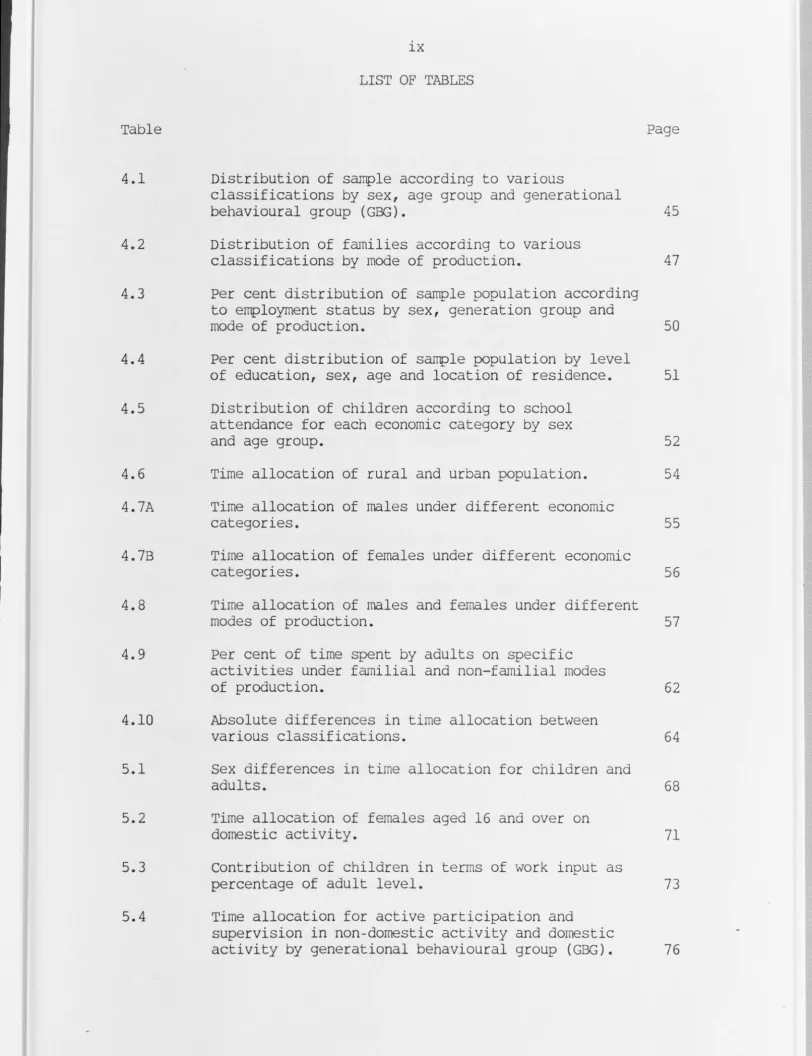
Table 4.1 4.2 4.3 4.4 4.5 4.6 4.7A 4.7B 4.8 4.9 4.10 5.1 5.2 5.3 5.4
LIST OF TABLES
Distribution of sample according to various
classifications by sex, age group and generational behavioural group (GBG).
Distribution of families according to various classifications by mode of production.
Per cent distribution of sample population according to employment status by sex, generation group and mode of production.
Per cent distribution of sample population by level of education, sex, age and location of residence. Distribution of children according to school
attendance for each economic category by sex and age group.
Time allocation of rural and urban population. Time allocation of males under different economic categories.
Time allocation of females under different economic categories.
Time allocation of males and females under different modes of production.
Per cent of time spent by adults on specific activities under familial and non-familial modes of production.
Absolute differences in time allocation between various classifications.
Sex differences in time allocation for children and adults.
Time allocation of females aged 16 and over on domestic activity.
Contribution of children in terms of work input as percentage of adult level.
Time allocation for active participation and
supervision in non-domestic activity and domestic activity by generational behavioural group (GBG).
[image:10.840.6.818.25.1081.2]5.5
5.6
5.7
5.8
5.9
5.10
5.11
5.12
5.13
Figure 1.1
2.1
X
Differences in time allocation by GBG in active participation in work.
Time allocation pattern of farmers - weekdays and Friday.
Time allocation of children and adults for non-domestic activity of the famili~ categorised by size of land holdings.
Time allocation per person (irrespective of age and sex) and per family according to size of holdings. Time allocation by students and non-students
according to sex and mode of production.
Differences in time allocation by the students between school days (Saturday - Thursday) and Fridays.
Differences in time allocation by families according to school attendance of children.
Time allocation by males and females of ages 10 and over by level of education.
Comparison between similar studies as regards work input for children and adults of respective sex.
LIST OF FIGURES
A schematic model of time allocation in Bangladeshi families
A schema of activities for this study
Page
78
80
83
84
87
88
90
92
98
8
< E
I I \ \
WEST BENGAL
II 14 1, RAJSHAHI WEST BENGAL (INDIA) '
.,
I.. ' \WEST BENGAL
(INDIA)
'· \
-
-,-' 'BOGRA
V \ r
\ (-J r J \
/ r--\ ( ) I PABNA 'J
JAMALPUR I ) I
'T (' V '
/ ) \
' \
TANGAIL I
90'
BANGLADESH
:n~1 ~ o "r·t1e
ASSAM (INDIA)
I )
MYMENSINGH
Bay of Bengal
91 / / ' KHAGRACHHARI \. \ I \ /
\, CHITTAGONG
1 _ HILL TRACTS
\ ~
\) \ )
\.--~
CHITTAGONG\ ,
\ \
,)
(~
,8ANDARBA1'\ '-~
r
\
)
DHAKA DISTRICT
ADMINISTRATIVE UNITS {THANAS)
TANGAIL
,·
j
SREEPUR
MYMENSINGH
DHAKA CITY:
1. Mohammadpur 2. Dhanmondi
3. Cantonment
'-·
4. Tejgaon 5. Lalbagh
6. Mot1jheel
FARIDPUR
0 7. Sutrapur (Urban Study Area/
l
CHAPTER l
INTRODUCTION
1.1 Objectives of the Study
This study is concerned with the use of time within the family, measured by duration of activities. The study of human use of time or life-styles revealed through the time use of an individual is called a time budget study (see Section 2.2.6). What people do during the day and how time is distributed between various activities will be assessed from two questions with the objective of identifying inter-generational and sex differences in time allocation. From the differences in time allocation an assessment of the economic contributions of children and adults will be made. Epstein (1967:155) and Nag (1976:10) were of the opinion that time would be the crude but important criterion for comparative analyses of economic contributions of household members. The time allocation analysis in this study is intended to help explain stable high fertility in a less developed country (LDC) like Bangladesh. Stable high fertility in Bangladesh is illustrated in Appendix A.
1.2 The Study - A Micro as well as an Interdisciplinary Approach
using a micro analytic approach (Rodgers, 1962:2). Although the macro analytic approach claims to have adequacy of sampling, its generalisations concerning the behaviour of a particular group within a society are often faulty because they are too broad. A micro study, on the other hand, "can help produce an adequate and largely correct picture instead of a thin, partial and often erroneous one" (Caldwell et al., 1984b:24). Micro studies are especially important in reliably describing intra-familial economic relations, which are a new area of investigation in the study of demographic change. The micro approach to demographic change (differing from the micro economic approach) is basically anthropological (Caldwell et al., l984b:ll).
This study is interdisciplinary in the sense that the inferences to be drawn from it are demographic, while the framework is mostly anthropological, although a few concepts and methods are derived from economics and sociology. It is believed that the study of fertility cannot be disassociated from socio economic studies and there is a great need for integration of the approaches related to socio economic and demographic changes (Caldwell, 1982:300). Moreover, the boundaries between different disciplines are becoming blurred. A school of thought can now be distinguished by the 'model of human behaviour to which it refers' rather than by 'the domain which it investigates' (Garboua, 1979:1).
1.3 The Basic Proposition and a Few Conceptual Issues
The basic proposition of the study is derived theory of fertility decline' (Caldwell, 1982).
3
by a set of rules in conformity with the existing power structure,
direct the inter-generational gains by which fertility stabilisation or
destabilisation can be understood.
1.3.l Inter-generational Gains
'Inter-generational gains' will be used to signify 'inter-generational
wealth flows.' 'Wealth flows' are defined as all the money, goods~
services and guarantees that one person provides to another (Caldwell,
1982:333).
Not all intra-familial transactions are monetary or material, and
therefore Caldwell (1982:333) used 'wealth' instead of 'income' to
describe these flows. The wealth flows from children to parents may be
called a 'positive' or 'upward flow', while the wealth flows from
parents to children will be termed a 'reverse flow'. In this study an
upward flow of wealth is assumed and an objective of the study is to
make an assessment of this flow.
'Inter-generation' refers to the generations within the family. (An
operational definition of family is given in Section 3.5.1.) Basically
two generations - children and adults are observed. To further
understand the inter-generational flow of wealth,
'generational-behavioural groups' (GBG) will be used (see Section 3.5.3). 'Gains'
refers to the derivation of economic advantages, often referred to as
utilities or satisfactions. Intra-familial flows of economic advantages
comprise flows of all goods and services and also the obligations of the
This study will look at the inter-generational gains by assessing 'children's productive contributions' measured by services to the family. In this study 'production contributions' will specifically mean allocation of time for 'work' by the children compared to that of the adults. Economic advantages or production contributions will be considered in this study in a 'situational' context, the related hypothesis being "those who gain most are at the apex of an age-sex pyramid" (Caldwell, 1982:356).
1.3.2 Position and Power Relations
'Situation', as mentioned above, implies a 'position' of family members with reference to 'power relations'. A 'position' refers to a certain
'location' or 'status' in relation to a group and in this study it is the generational-behavioural group which is assigned certain rights and duties. These in turn are governed by 'power relations' (Linton, 1936:113-131). The power relations arise from the ownership of land, animals, and other movable or immovable property. The power relations also arise out of the obligations claimed by the parents (especially fathers) from their children for giving life to them. Therefore power
relations are to be viewed through the 'authority' which is defined by the right to control others. It is assumed in this study that authority lies with the senior generation.
5
1968:70). If ascribed status and achieved status (i.e. authority) are
held by different persons, conflicts may not be unusual. But in this
study it is assumed that harmony between ascribed status and authority
exists within the family.
1.3.3 The Traditional Economy
Chayanov (1966) and Sahlins (1972) postulated that household production
determines the type of economy or mode of production. In this study the
traditional economy will be treated in the familial sense to contrast
with an emerging non-familial economy. The economy under peasantry,
with its subsistence nature, 1s called 'traditional' (Arthur and
McNicoll, 1978:67). 'Subsistence' sometimes is used as a synonym for
'minimal diet' (Clark and Haswell, 1970:xi; Schneider, 1974:252). In
this study 'subsistence' will be considered from the production side by
the usage of products for familial purposes and by the familial
management of labour. One of the fundamental characteristics of the
peasant economy is that it is a 'family economy' (Wolf, 1966:4; Deere
and Janvry, 1979:602). Crops are grown primarily by the physical
efforts of the members of the peasant family (Shanin, 1971:205).
1.3.4 Modes of Production
Two aspects of the production process must be considered: productive
forces, and relations of production. 'Productive forces' refers to the
tools and techniques of production and their uses. 'Relations of
production' refers to the human relations arising out of the labour
process. Productive forces and relations of production are mutually
production' (Wesolowski, 1979:11). Rodgers and Standing (198lb:13) define a mode of production as "a specific set of social relations of production and distribution combined with the related development of the forces of production". The mode of production apparently changes with changes in the productive forces, but in reality the stability of the prevalent mode of production lies within the nature of production relations. It is assumed in this study that stable production relations are bounded by the prevalent cultural superstructure of the country.
(see Section 1.3.5.)
The relations of production may be embedded within the family relations (Hedley, 1981:71). On the basis of production relations the mode of
production can be divided into familial and non-familial, which are related to traditional and modern economies respectively. Hence the family as a socio-economic unit may be caught between tradition and modernity (Silverrran, 1979:65). In the familial mode of production, employment is determined by family relationships and morality, governed by the cultural superstructure that sustains the relations (Caldwell, 1982:353).
The non-familial mode 1s synonymous with the labour market mode of production. The labour market mode of production 1s governed by employer-employee relationships based on wage payments. In the familial mode transactions outside the family boundary are conducted by the family as a whole and are usually controlled by the patriarch. On the other hand, in the labour market mode of operation the transactions are carried out by individual members (Devanandan and Thomas, 1966:3).
7
1976:470-506; Mukhia, 1981:273). But this study does not go further
regarding modes of production under different economic systems.
A complete absence of the familial mode in any economic system is rarely
found. The familial mode still survives in the household production of
industrialised countries (Caldwell, 1982:354). Some activities are not
measured by monetary units in those countries, and a price-based
morality has not been established in every sphere of life. Similarly,
the familial mode in its purest form does not exist in the LDC's as
production is not carried out wholly for subsistence. Therefore the
familial/non-familial dichotomy is to be defined according to the
predominance of a certain mode of production. In LDCs the dominant mode
of production is familial, and the labour market mode is more recent.
In Bangladesh farming families still produce food largely for their own
consumption (Caldwell, 1982:356,360) and the operational management of
the farms is predominantly governed by the employment of family
members. The process of categorisation of sample households under
different modes of production is discussed in Section 3.5.5.
1.3.5 cultural Superstructure
The cultural superstructure is built on beliefs and ideologies at the
family level which are governed by the society's customs, religion and
economy. According to Redfield (1956:19-20) peasants cultivate their
land as part of a traditional way of life. So tradition has a cultural
aspect underlying the familial economic institution (Silverman,
1979:56). The present Bangladeshi cultural superstructure is built on
the foundation of a "---hunting and gathering economy, followed by
1976:470-506; Mukhia, 1981:273). But this study does not go further regarding modes of production under different economic systems.
A complete absence of the familial mode in any economic system is rarely found. The familial mode still survives in the household production of industrialised countries (Caldwell, 1982:354). Some activities are not measured by monetary units in those countries, and a price-based morality has not been established in every sphere of life. Similarly, the familial mode in its purest form does not exist in the LDC's as production is not carried out wholly for subsistence. Therefore the familial/non-familial dichotomy is to be defined according to the predominance of a certain mode of production. In LDCs the dominant mode of production is familial, and the labour market mode is more recent. In Bangladesh farming families still produce food largely for their own consumption (Caldwell, 1982:356,360) and the operational management of the farms is predominantly governed by the employment of family members. The process of categorisation of sample households under different modes of production is discussed in Section 3.5.5.
1.3.5 cultural Superstructure
8
growing peasant culture in terms of environment and resources--- This
way of life can support perhaps 1500 people per square mile, n
(Maloney et al., 1981:2-3). The behavioural aspects of household
members and the relation of subordination and superordination are
governed by the cultural superstructure. The behavioural aspects
explain familial 'custom' and 'morality' (Caldwell, 1982:310). These
aspects are apparent in the actions of family members observed in the
following way: with whom the activity was done, who caused the activity
to be done, and what would be the consequences if the activity was not
done (Caldwell et al., 1980).
1.4 A Schematic Model
The objectives of this study can be modelled as follows:
Quantitative Assessment
-
....Intergenerational
aspects
..
Resource base lntrafamilial differences and
and mode of .... ,,.. time
-.
sex differencesproduction allocation in economic
Behavioural
..
contribution-
,,..aspects Stabilising
Fig. 1.1 A Schematic Model of time allocation in Bangladeshi families
The resource base and mode of production in the model may be called the
'infrastructural component' of the familial economic institution, as the
viability of the family depends on its resource base and mode of
production. 'Resource base' is dichotomised into (1) ownership of land
or business, and (2) wage employee having no land or business. Mode of
[image:21.834.17.828.21.1007.2]according to the two categories of resource base. It is hypothesised
that intra-familial economic relations will vary according to the
resource base and mode of production.
Intra-familial economic relations will be viewed according to the
allocation of individual family members' time to different activities.
Time budgets provide solid behavioural and quantitative evidence on an
individual's life style (Zuzanek, 1980:1). Hence there are two aspects
of time allocation - quantitative aspects and behavioural aspects.
Quantitative aspects of time allocation may be identified by measuring
the duration of different activities of each member of the household for
a specific period of time.
relations governed by
Behavioural aspects may be seen in the power
the cultural superstructure. Finally,
inter-generational and sex differences in economic contributions may be
assessed by the quantitative aspects of time allocation, and their
stabilisation is evident in the behavioural aspects of time allocation
(Caldwell, 1981:9). Some behavioural aspects of time allocation were
examined by Caldwell et al. (1980).
In the present study the cultural superstructure (and thus the
behavioural aspects) will be assumed to be constant. Only the
quantitative aspects of time allocation will be examined in an attempt
to assess inter-generational and sex differences in economic
contributions. It is hypothesised that children work more in families
in the familial mode of production than in families in the labour market
mode of production. It is further hypothesised that education reduces
children's productive contributions and minimises sex segregation in
10
1.5 Research Implications
This study explores the interpersonal economic relationships under both familial and non-familial modes of production and their implications for fertility transition. A few socio-economic and anthropological studies have tried to estimate children's economic contributions relative to those of adults, but most have had a narrow scope, either concentrating on rural areas of LDCs or urban areas of a developed country. The present study covers both rural and urban areas of an LDC. A few other studies have concentrated only on women's time allocation. The present study includes inter-generational as well as sex differences in time use. Finally, even in an LIX: the time-use pattern is expected to differ between weekdays and days off, and this study will examine that differential. However, this study is descriptive rather than prescriptive, and no policy suggestions should be attempted from such a
CHAPTER 2
REVIEW OF LITERATURE
This chapter has two Sections the first Section will review the
'production utility' or 'economic advantages' of children in relation to
the theory of fertility. The second Section will be concerned with a
few issues on time allocation. Definitional problems on time allocation
will be examined with a review of relevant literature. Finally a
classification of activities will be derived on the basis of this
review.
2.1 Production Utility of Children in Relation to the Theory of
Fertility
2.1.1 Concept and Importance of Production Utility of Children
The concept of the value of children, more specifically the economic
value of children, may be usefully reduced to the production utility of
children. Several terms such as benefits, satisfactions, utilities,
rewards, advantages, gains and so on are used for value of children to
parents (Hull, 1975:19; Nag, 1978:2). Hoffman (1972:27) defined the
value of children as the functions they serve for parents or the needs
they fulfil. Leibenstein (1957:161-162) introduced the concepts of
utilities derived from children by the parents - consumption utility,
production utility and investment utility. Consumption utility is the
12
and services provided by the children through their employment in and outside the home. Investment utility arises out of the economic security provided by the children for parents in their old age. Caldwell (1982:334) used 'economic advantage' to mean all satisfactions derived from children. He disliked the idea of separating economic contributions and pleasures derived from children as it might lead to double counting due to the inextricable link between them. The three types of utility might be interlinked but that does not, however, prevent them from being treated independently (Patrick, 1971:19).
From the concept of production utility it appears that children provide utility in their role as contributors to the real resources of the household by their work-activity (Spengler, 1966:14; Blake, 1965:1184). The real resources consist of income and time. Children can contribute income by working in the labour market, can spend their time working on the family lands or in the family business and can release their parents for work by performing household tasks such as cleaning, washing dishes, preparing meals, caring for younger siblings and so on.
The importance of the production utility of children was stated in Adam Smith's "The Wealth of Nations". Smith (1937) wrote that in the American Colonies "labour is there so well rewarded that a numerous family of children, instead of being a burthen is a source of opulence and prosperity to the parents" (cited in
(1968:134-44) also found that the work
Patrick, 1971:2). Branson
In peasant economies children's production contributions are high and
Caldwell's contention of the "rationality of high fertility" (1976,
1977) in such societies was supported by Cain (1977b), and Nag, White
and Peet (1978). Cain (1977b) found that male children in Bangladesh
may become net producers at age 12. Their contributions compensate
their own cumulative consumption by age 15. Furthermore, by age 22
their contributions increase to the extent of compensating for the
cumulative consumption of one sister. Caldwell et al. (1980:45) had
the same opinion that children's production contributions rise steadily
from about 5 years of age and reach the adult-working level by 14 or 15
years of age. Mamdani's (1972:43) findings also coincided with
Caldwell's thinking. Mamdani states that a majority of people of
Manupur (India) desire "a large number of children not because they
overestimate their infant mortality rates, but because they want larger
families." This was due to the "value of labour which determines the
attitude towards having children" (Macfarlane, 1978:101). Rosenzweig
and Evenson (1977:1077) found that " .•. one of the basic conditions
motivating Indian families to bear relatively large numbers of children
in the late 1950s was the high return to the use of raw labour power of
children ••• "
A different opinion was stated in Mueller's study (1976) of a number of
developing countries including India. By a calculation of consumption
and production profiles, Mueller tried to show that the asset value of a
child at birth in an agrarian economy would probably be negative.
Vlassoff (1979) in a village study in India found that the level of
participation of children in the poorest families was low, even though
it was expected that the demand for labour would be greatest in those
families. Caldwell (1977:5-7) criticised Mueller's findings, saying
14
questions about the costs of children ... More seriously, they often tend to accept the rationality of their own economic analysis by assuming that simple peasants do not understand the economic realities of their
1, n
own ives •.• Ware (1978:17) said that the researchers should be cautious when quantifying the dis-utility of children by saying
"parental behaviour is obviously influenced by perceptions of the costs and benefits of children, rather than by economists' calculations, but the question remains whether there is any real evidence that parents are wrong in their perceptions and acting against their own interests."
2.1.2 The Economic Theory of Fertility
There are differences of opinion regarding higher or lower production utility of children and higher or lower parental outlays for children in a peasant economy, but it is accepted that these are the important
elements of an economic theory of fertility (Patrick, 1971:13-85).
The theory of consumer choice (Schultz, 1974:6-8) was the basis of the
economic theory of fertility in which children were considered as
"commodities" from which utility could be derived (Leibenstein,
1957:161; Spengler, 1966:14; Sauvy, 1969:363). Assuming that households behave in a rational way, the number of children will be determined to achieve an optimum combination of .cormnodities the variant being the maximisation of utility (Okun, 1958:174).
A theory of household behaviour was introduced by the 'Chicago School'
of the 'New Horne Economics' founded basically on the seminal works of Becker (1960, 1965). According to Becker's model 'household
utility. Becker's model of household production stresses that couples
satisfy (maximise utility) their own demand for children and other goods
by allocating their time and market purchases to the home production,
processing, and/or consumption of these goods (Felder, 1979:5). So
household commodities are market goods combined with time, not simply
the market goods alone (Michael and Becker, 1976:134). But in the
traditional theory of household behaviour only market goods are
considered (Hawrylyshyn, 1976). (For a comparison of traditional and
new theories of household behaviour see Appendix B.)
In the case of the demand theory of fertility, 'utility' of children
must be related to 'price' and 'income' to have an effective demand.
Becker (1960:213) defines the price ('full price' or 'full cost') of a
child as "the present value of expected outlays plus the imputed value
of the parents' services minus the present value of the expected money
return plus the imputed value of the child's service". Therefore the
price of a child is the net balance between expected value of the
parents' resources of time and money to be spent for the child and the
expected value of the child's resources contributed to the parents.
'Full income' is used as a variant of the household resources of time
and money (Evenson, 1978:3). 'Full income' consists of "value of
non-wage income derived from asset ownership plus the value of wages (or
income) earned in the market sector plus the value of member's time used
in producing household commodities .•• " (Happel, 1984:4). Therefore
demand for children will be determined by consideration of the 'full
price' of a child or 'full income' of the household. The declining
production utility of children (and possibly the declining investment
utility of children) and increasing outlays of parents are the important
16
evaluation of the demand for children in the economic theory of
fertility, see Jones, 1977:3-39; Pollack and Watcher, 1975:255-277;
Turchi, 1975:107-125).
2.1.3 Fertility decline
As regards fertility decline, economists give greater attention to the
costs of parents time, but this has mainly been in the context of
developed countries (Becker, 1965). Goldberg (1975:89) stated that the
time costs of children can be assessed by placing all activities of
parents in competition with child rearing demands within a time frame.
The value of mother's time and services for the child is considered more
important compared to father's time and services.
Along with the increased parental time costs economists recognise that
the production utility of children decreases as the level of income of
the family increases (Leibenstein, 1957:162). Upper income families do
not want their children to work in the labour market at an early age but
prefer them to give attention to their studies. Moreover, they do not
expect children to work in the household because of the availability of
modern appliances and servants. By the same argument, it can be said
that the production utility of children will be lower in Western
societies compared to LDCs (Caldwell, 1977:22).
The number of children can affect the production utility through
diseconomies in familial management. Beyond a certain point, where
additional children can no longer be employed in the home, production
utility will decrease (Patrick, 1971:36), and even consumption
production utility of children decreases over time (Sauvy, 1969:263; Leibenstein, 1957:167; Okun, 1958:166; Blake 1965:1184) due to increased mechanisation of agriculture, compulsory school attendance and legislation prohibiting child employment. But production utility is hypothesised as being high in an LDC like Bangladesh where agriculture is largely stationary as mechanisation is proceeding only slowly (Chowdhury, 1967:237), compulsory school attendance and labour legislation are not enforced (Rodgers and Standing, 198la:vi) and the familial mode predominates (Caldwell, 1982:356-380).
Thus it is hypothesised that with a decline in the economic value of children in peasant societies, a decline in fertility will occur. There are differences of opinion regarding the process of the decline in the economic value of children. According to Caldwell (1976:346) the reversal of the flow of inter-generational wealth, i.e., the decline in economic value of children and the increased outlays of parents for the children, is the stimulus for fertility decline. The emotional and economic involvement within the nuclear family, which is incompatible with the extended family, would lead to that reversal of the wealth flow. Thadani (1978:490-491) disagreed, saying that "a reversal in wealth flow ••.
Caldwell (1981:6)
is not contingent upon replied that Thadani
economic nucleation perhaps misunderstood
"
• • • the conditions irmnediately before the onset of sustained fertility decline. The demand for children would decline at a higher rate "if greater egalitarianism in emotional relationships and
possibly production) decisions had developed children and between husbands and wives •.• ".
in conswnption between parents
18
2.2 TIME ALLCX::ATION - RELEVANT ISSUES
2.2.1 Time - a Scarce Resource
A simple, narrow definition of time is used in this study: human or economic time, that is, time at a person's disposal. Time allocation refers to the manner in which individuals use their time, and is synonymous with resource allocation, as time is considered to be a resource, like money or a cormnodity (Berk and Berk, 1979:11, De Serpa,
1971:843). From the individual's viewpoint time becomes a scarce resource (Sharp, 1981:2, Robbins 1945:15).
2.2.2 Familial Constraints on Time Allocation
Individuals appear to be free to allocate their time at will, but in reality there are important familial, social, economic, political and ecological constraints (Sharp, 1981:18-22). This study will emphasise the familial constraints which are undergirded by deep rooted traditions and culture, while the other constraints are assumed to be constant. Familial constraints are evident in the control of activities by a particular generation. This dominance and control of activities by one generation over the other may be expressed by a refined concept of 'reciprocity' of activities. Reciprocity implies here the time or activity contribution of the younger generation to the older generation in exchange for food, protection, shelter and wisdom.
2.2.3 Activity
intellectual energy with the passage of time. In this sense there is no
such thing as a time allocation category of 'doing nothing'. Sharp
(1981:33) commented that only during a state of unconsciousness might
the term be applicable in some sense. Therefore each 'time-unit' of the
observation period of the study will be considered as being allocated to
some specific activity (see Appendix C).
2.2.4 Dimension of Time Units
The dimension of time units is a complex issue, and the nature of the
empirical enquiry is influenced by it (Winston, 1982:12-33). Accepting
the proposition that all activities are identified with time units which
have explicit clock times, a starting point and an ending point, the
dimension of time units can be considered. Foster (1973), working in a
Mexican village, recorded measured work schedules in half-day units, but
half-day units are considered to be too large (Nag, 1976:13). In the
present study information was collected each hour.
2.2.5 Measurement of Activities in terms of Time
In a predominantly agrarian economy most of the activities of the people
are carried
lie beyond
(Birdsall,
on in the non-monetised sector and, as a consequence, most
the prevailing measurement system of national accounts
1980:157). Any study based only on the market sector is
bound to be faulty. Soule (1955:89) was in doubt whether the market
system could be relied on to allocate time to the uses best fitted to
satisfy human needs. The categories of activity based on such a
measurement also misrepresent the true picture, and thereby theories and
20
ineffective. Therefore it 1s imperative to have an alternative
measurement system to prices, such as 'time measurement', so that all
activities, irrespective of the market and non-market sectors, have
adequate coverage. Moreover, time represents a universal measurement
little affected by external factors and unlike money, time expenditure
need not be converted into constant currency value by constructing
complicated price indexes (Zuzanek, 1980:1).
In the Western system of national accounts, goods including farm
products (such as grains, animal products and fruits) are included, but,
as Birdsall and McGreevey (1983:4) have noted, the imputed values for
time spent preparing food, watching children, and cleaning are excluded
from the system. They found no logic in that the values of growing and
processing rice are estimated, but not the activity of cooking it, even
if the same person is engaged in growing, processing and cooking.
Therefore WSNA cannot be an effective measurement of the value of
activities. For an assessment of the economic contributions of
household members in an LDC, 'time-measurement' seems to be a justified
substitute for price-measurement of activity.
2.2.6 Time Budget - A Process of Measuring Activity
The term 'time budget' may be defined as 'logs of activities' kept by
individuals themselves, or observers on behalf of them, over a specific
period, usually a full 24-hour day. The term 'budget' is not intended
to imply that daily lives are "fully planned in advance" (Robinson,
1977:6). The terms 'time budget', 'time use' and 'time allocation' will
ineffective. Therefore it is imperative to have an alternative
measurement system to prices, such as 'time measurement', so that all
activities, irrespective of the market and non-market sectors, have
adequate coverage. Moreover, time represents a universal measurement
little affected by external factors and unlike money, time expenditure
need not be converted into constant currency value by constructing
complicated price indexes (Zuzanek, 1980:1).
In the Western system of national accounts, goods including farm
products (such as grains, animal products and fruits) are included, but,
as Birdsall and McGreevey (1983:4) have noted, the imputed values for
time spent preparing food, watching children, and cleaning are excluded
from the system. They found no logic in that the values of growing and
processing rice are estimated, but not the activity of cooking it, even
if the same person is engaged in growing, processing and cooking.
Therefore WSNA cannot be an effective measurement of the value of
activities. For an assessment of the economic contributions of
household members in an LDC, 'time-measurement' seems to be a justified
substitute for price-measurement of activity.
2.2.6 Time Budget - A Process of Measuring Activity
The term 'time budget' may be defined as 'logs of activities' kept by
individuals themselves, or observers on behalf of them, over a specific
period, usually a full 24-hour day. The term 'budget' is not intended
to imply that daily lives are "fully planned in advance" (Robinson,
1977:6). The terms 'time budget', 'time use' and 'time allocation' will
21
Diversity of time budget studies
Sociologists, economists, home economists and anthropologists have
contributed to time budget studies. The notion of time budget was first
used by F. Giddings at the end of the nineteenth century (Zuzanek,
1980:2). Strumilin (1923) in USSR and Sorokin and Berger (1939) in USA
undertook time budget studies regarding everyday human behaviour. Home
economists made several time use studies of women in household work;
with the most important by Walker and Woods (1976). An extensive list
of other similar studies in home economics in USA was also provided by
Walker and Woods (1976:314-320). The most important national study of
time budgets was that of Robinson (1977) entitled "How Americans Use
Time". A variety of national and comparative studies have been compiled
by Szalai (1972).
Time budget study is often used 1n ethnographic · discussions (Sahlins,
1972:41-99). Ethnographers usually describe the broad outlines of time
allocation in the community. A. Johnson (1975) collected time use data
on activities of members of a community of Machiguenga Indians in the
Upper Amazon of South Eastern Peru. Time budget studies concerned
specifically with women's activity
Mcsweeny (1979), Da Vanzo and Lee
were undertaken by Gillespie (1979),
(1983), and Deere (1983). Berio
(1984) tried to extend the application of time allocation analysis to
nutrition and economic development with an emphasis on women's role in
food related activities. Differences 1n labour utilisation patterns
between Asia and Africa were reviewed through time budget studies by Das
Gupta et al. (1977:18-23).
A few time budget studies on the basis of an anthropological approach
undertaken in the 1970's. These studies were by Cain (1977b), Khuda
(1978) and Nag, White and Peet (1978). These will be briefly compared
with the present study in Section 5.6.5 and in Appendix D.
2.2.7 Classification of Activities
The broad division of economic/non-economic activities is unsatisfactory
for the analysis of child activity patterns (Rodgers and Standing
198lb:l). The division between economic and non-economic activities is
usually based on 'utility creation'. The time spent on reading, for
example, yields utility in the same way as time spent on paid
activities. Therefore it seems illogical to put reading in the category
of non-economic activity. Again the division of economic and
non-economic activities might be based on the requirement of input of
market goods but this is equally unsatisfactory. Some tasks may not
require any input of market goods at all, which is very common in an
UX::. Therefore the division of activities into economic and
non-economic is not used here.
The economic theories of time allocation aimed at understanding the
division of time between work and leisure (Winston, 1963; CMen, 1970;
Vickerman, 1975) are also not useful for this study. Economists have
tried to define work as the activities for which some form of monetary
payment or reward is received by the workers. But by this definition
most activities undertaken in a subsistence economy would lie beyond the
category of 'work', and subsistence work would wrongly be included
within the definition of non-work or leisure (Beneria, 1981:10-11).
r
23
Economics (Gronau, 1977; King and Evenson, 1983; Boulier, 1977). They used a basic classification of activity into market production, home production and leisure, although sometimes the differences between home production and leisure were blurred. Moreover, if market production is viewed in a narrow sense by considering only wage payment, it would be difficult to use this classification of activities in an LDC. Different time budget studies using the anthropological approach (Cain, 1977b; Nag, white and Peet, 1978; Khuda, 1978) used two categories: directly productive activities and home maintenance activities. But Caldwell (1980:47) felt the concept of directly productive activity was a misleading term. In the familial mode of production, the majority of activities are aimed at food consumption. Activities starting in the fields and ending in the kitchen are on the same continuum (Caldwell, 1980:9). Therefore income generating or directly productive activities should not be placed at a higher rank than household activities. Moreover, women's and children's activities should not be classified as of less 'effort or intensity' because all the tasks are complementary in the household (Rodgers and Standing, 1981:13).
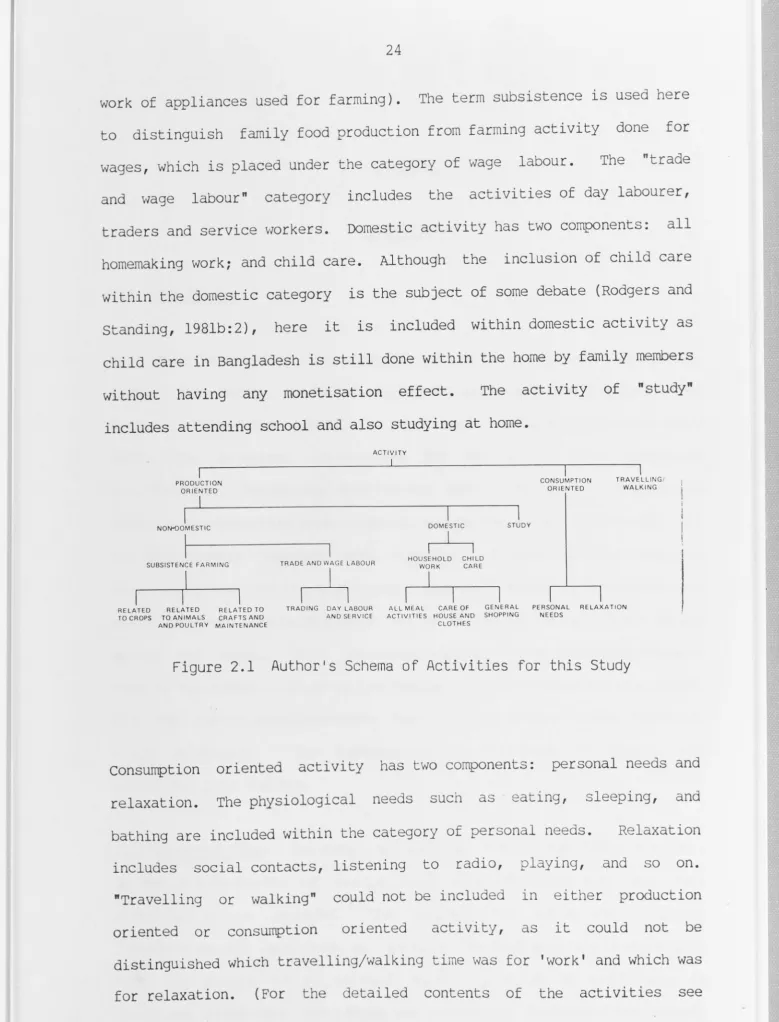
The present study classifies activity into production oriented and consumption oriented (see Figure 2.1). Production oriented activity is concerned with 'postponed utility' and consumption oriented activity is related to derivation of 'immediate utility' (Berk, 1980:22; Sharp, 1981:15). Production oriented activity has three components: non-domestic activity, domestic activity and study. Non-domestic activity may be subsistence farming, trading and wage labour. Subsistence farming is used in a broader sense to include activities related to crops and vegetables, activities related to poultry and livestock, and activities related to craft and maintenance (i.e. repair
' I ' I , l l ' I , l ' , I
' I
I I I ' I l I I I I ' ' : ' I I '
work of appliances used for farming). The term subsistence is used here to distinguish family food production from farming activity done for wages, which is placed under the category of wage labour. The "trade and wage labour" category includes the activities of day labourer,
traders and service workers. Domestic activity has two components: all homemaking work; and child care. Although the inclusion of child care within the domestic category is the subject of some debate (Rodgers and standing, 198lb:2), here it is included within domestic activity as child care in Bangladesh is still done within the home by family members
without having any monetisation effect. The activity of "study" includes attending school and also studying at home.
PRODUCTION ORIENTED
NON-OOMESTIC
SUBSISTENCE FARMING
I
ACTIVITY
TRADE AND WAGE LABOUR
~
DOMESTIC STUDY
I
HOUSEHOLD CHILD WORK CARE
I
CONSUMPTION ORIENTED
TRAVELLING/
WALKING
RELATED RELATED RELATED TO TRADING DAY LABOUR ALL MEAL CARE OF GENERAL PERSONAL RELAXATION
TO CROPS TD ANIMALS CRAFTS AND ANO SERVICE ACTIVITIES HOUSE ANO SHOPPING NEEDS
AND POULTRY MAINTENANCE CLOTHES
Figure 2.1 Author's Schema of Activities for this Study
conswnption oriented activity has two components: personal needs and relaxation. The physiological needs such as eating, sleeping, and bathing are included within the category of personal needs. Relaxation includes social contacts, listening to radio, playing, and so on.
"Travelling or walking" could not be included 1n either production
oriented or consumption oriented activity, as it could not be distinguished which travelling/walking time was for 'work' and which was for relaxation. (For the detailed contents of the activities see
[image:38.815.20.799.22.1043.2]-24
work of appliances used for farming). The term subsistence is used here to distinguish family food production from farming activity done for wages, which is placed under the category of wage labour. The "trade and wage labour" category includes the activities of day labourer, traders and service workers. Domestic activity has two components: all homemaking work: and child care. Although the inclusion of child care within the domestic category is the subject of some debate (Rodgers and standing, 198lb:2), here it is included within domestic activity as child care in Bangladesh is still done within the home by family members
without having any monetisation effect. The activity of "study" includes attending school and also studying at home.
I PRODUCTION ORIENTED I r NON-DOMESTIC I [
SUBSISTENCE FARMING
I
I
RELATED RELATED RELATED TO TO CROPS TO ANIMALS CRAFTS AND AND POUL TRY MAINTENANCE
ACTIVITY I
I
DOMESTIC II
STUDYTRADE AND WAGE LABOUR HOUSEHOLD WORK CHILD CARE
~
TRADING DAY LABOURAND SERVICE
I
ALL MEAL CARE OF GENERAL ACTIVITIES HOUSE AND SHOPPING
CLOTHES
I
CONSUMPTION ORIENTED
I
l
I
TRAVELLING/
WALKING
PERSONAL NEEDS
RELAXATION
Figure 2.1 Author's Schema of Activities for this Study
consumption oriented activity has two components: personal needs and relaxation. The physiological needs such as eating, sleeping, and
bathing are included within the category of personal needs. Relaxation includes social contacts, listening to radio, playing, and so on. "Travelling or walking" could not be included 1n either production
oriented or consumption oriented activity, as it could not be distinguished which travelling/walking time was for 'work' and which was for relaxation. (For the detailed contents of the activities see
Appendix C.)
[image:39.815.20.793.15.1146.2]CHAPTER 3
METHODOLCX;Y
3.1 The survey
This study is based on the Control of Activity Survey, Bangladesh,
1978. The survey, funded by the Population council and the Australian
National University (ANU), was conducted
1978. The principal investigator for the
J.C. Caldwell, Demography Department, ANU.
during May, June and July,
survey was
Forty-six
Professor
Bangladeshi
interviewers/observers were selected, all having a Master's degree. All
the interviewers/observers were residents of Dhaka District and were
well acquainted with the study areas selected. Female interviewers were
mostly used to observe the activities of the household members in and
around the house. Male observers concentrated on household members
outside the house, such as in the fields or at any other working place.
All the interviewers/observers were trained by the field director,
A.K.M. Jalaluddin. The information was collected in Bengali and
translated into English.
3.2 Selected Site: The survey was carried out in the Dhaka district.
To obtain a diversity of occupational categories both rural and urban
areas had to be included. The selection of sites was basically
dependent on the
from the people
objective of getting
to be studied, so the
the best possible co-operation
question of randomness in
26
conducted a household census in the Dhaka district, and as the people of
his project areas were accustomed to interviews and data collection, it
was thought it would not be hard to earn their confidence. The village
of Joyra, a typical Bangladeshi village about 50 kilometres south-west
of Dhaka city, was selected as the rural area.
The urban area selected was mostly in an old part of Dhaka city, in
sutrapur Thana. The population of selected localities, Babupura,
Shibbari, Aga Sadeq Road, and Bakshi Bazar, was characterised by
different occupational categories. Babupura and Shibbari were 'slwn'
areas inhabited by day labourers. The people in the Aga Sadeq Road area
were predominantly in the traditional business class. Bakshi Bazar was
inhabited by the modern elite, mainly service-workers.
3.3 Household Selection: Households enwnerated in Jalaluddin's 1976
census were stratified according to landownership and occupational
categories of the household head, for rural and urban areas
respectively. In Joyra, households were grouped into 3 categories
--large landowners (3 or more acres), small landowners (1 acre to less
than 3 acres), and marginal landowners (less than one acre) and the
landless. Each of these three categories was divided into two groups,
those with most of the children attending school and those not sending
most of the children to school. From these six sub-groups of
households, four households were selected at random. Thus 24 households
were selected, although later on one had to be dropped.
In the urban area the households were grouped into three categories on
the basis of the occupation of the household head: poor and day
definitions see Section 3.5.4). The first two categories were further
sub-divided into households with most of the children attending school
and those with most not attending school. The service worker group was
assumed to send most of their children to school and so was kept as a
single group. From each of the five groups five households were
selected randomly. Of the twenty-five selected households three were
not available for the survey and the final urban sample consisted of
twenty two households.
3.4 Data Collection
Basic information: The head of each household was asked to identify the
'family members' and the relationship of each person to the head was
recorded. The relationship was stated in terms of 'kinship', which
included affinity, that is, relationships by blood, marriage, or
adoption. Information on age, sex, marital status, education,
occupation and so on of the household members was also collected. Basic
information was collected for each member of the household and cross
checked with other persons such as the oldest son or the nearest
relative in the household, a neighbour, a local administrative member or
the school authorities. (See questionnaire for basic information in
Appendix E.)
Time-Use Data: Time-use data were collected using the direct
observation technique (see Nag, 1976; Birdsall, 1980; Khuda, 1982). In
two other similar time-use studies in Bangladesh (Cain, 1977a; Khuda,
1978), data collection methods were 'recall' (sequential) and
observation, supplemented by interview. Cain's study consisted of 30
28
hours for seven months (see Appendix D). For the present study the
activities of each person aged 5 and over were recorded for seven days,
including Friday, the day of prayer and the day off from school and
shopping. Activities were not prelisted and the schedule (see
Appendix F) was designed to cater for a variety of detailed activities.
Each day of
5 am to 10 pm.
data collection consisted of a seventeen-hour span, from
Again for each hour of that seventeen-hour span, three
activities,--primary, secondary and tertiary--were recorded, based on
the proportion of time spent for each. For example, if within one hour
there were more than three activities, observers had to group them under
broad categories such as household work, farm work, or time for personal
needs and relaxation. Then the proportion of time spent in each
activity was recorded and ranked as primary, secondary or tertiary
activity. If during the performance of a task one or two minute's
talking with other persons took place, that time was not deducted from
the main job. If a woman spent an hour cooking and at the same time
looking after a child, this type of joint activity was shared equally,
i.e. 30 minutes cooking and 30 child care.
Caldwell et al. (1980), in an earlier examination of these data,
concentrated on the analysis of primary activities. The present study
augments this earlier paper by analysing all categories of activities.
Secondary and tertiary activities were coded in 1984 under the
supervision of the present author. Other information regarding location
and causal and consequential aspects of time allocation (see Activity
Schedule of the Survey in Appendix F) will not be dealt with in this
study. As well as the original questionnaires the present study has
made use of supplementary refX)rts about each family and each community