This is a repository copy of Cold ablation driven by localized forces in alkali halides
.
White Rose Research Online URL for this paper:
http://eprints.whiterose.ac.uk/93804/
Version: Accepted Version
Article:
Hada, Masaki, Zhang, Dongfang, Pichugin, Kostyantyn et al. (12 more authors) (2014)
Cold ablation driven by localized forces in alkali halides. Nature Communications. 3863.
ISSN 2041-1723
https://doi.org/10.1038/ncomms4863
[email protected] https://eprints.whiterose.ac.uk/ Reuse
Items deposited in White Rose Research Online are protected by copyright, with all rights reserved unless indicated otherwise. They may be downloaded and/or printed for private study, or other acts as permitted by national copyright laws. The publisher or other rights holders may allow further reproduction and re-use of the full text version. This is indicated by the licence information on the White Rose Research Online record for the item.
Takedown
If you consider content in White Rose Research Online to be in breach of UK law, please notify us by
1
Cold ablation driven by localised forces in alkali halides
Masaki Hada1*†, Dongfang Zhang1*, Kostyantyn Pichugin1‡, Julian Hirscht1, Michał A.
Kochman1,2, Stuart A. Hayes1, Stephanie Manz1, Regis Y. N. Gengler1, Derek A. Wann2§,
Toshio Seki3, Gustavo Moriena1,4, Carole A. Morrison2, Jiro Matsuo3, Germán Sciaini1‡ & R. J.
Dwayne Miller1,4¶
1The Max Planck Institute for the Structure and Dynamics of Matter and The Hamburg Centre
for Ultrafast Imaging, Luruper Chaussee 149, 22761 Hamburg, Germany.
2School of Chemistry, University of Edinburgh, West Mains Road, Edinburgh, EH9 3JJ,
Scotland.
3Quantum Science and Engineering Center, Kyoto University, Gokasho Uji, 611-0011 Kyoto,
Japan
4Department of Chemistry and Physics, University of Toronto, 80 St. George st., Toronto,
Ontario M5S3H6, Canada
*
These authors contributed equally to this work.
Present addresses: †Materials & Structures Laboratory, Tokyo Institute of Technology,
Yokohama 226-8503, Japan & JST-PRESTO, Kawaguchi 332-0012, Japan. ‡Department of
Chemistry, University of Waterloo, Waterloo, Ontario N2L 3G1, Canada. §Department of
Chemistry, University of York, Heslington, York, UK YO10 5DD.
2
Abstract
Laser ablation has been widely used for a variety of applications. Since the mechanisms
for ablation are strongly dependent on the photoexcitation level, so called cold material
processing has relied on the use of high peak power laser fluences for which nonthermal
processes become dominant; often reaching the universal threshold for plasma formation of ~ 1 J
cm-2 in most solids. Here we show single-shot time-resolved femtosecond (fs) electron
diffraction, fs optical reflectivity, and ion detection experiments to study the evolution of the
ablation process that follows fs-ultraviolet laser excitation in crystalline NaCl, CsI, and KI. The
phenomenon in this class of materials occurs well below the threshold for plasma formation and
even below the melting point of the salts. The results reveal fast electronic and localised
structural changes that lead to the ejection of particulates and the formation of micron-deep
3
Introduction
Laser ablation involves many-body interactions which, in a collective response to
optical excitation, lead to material removal. The ablation processes in metals, semiconductors,
and dielectrics are different owing to the nature of their electronic and structural properties. In
the case of semiconductors and metals exposed to femtosecond (fs) laser irradiation, different
absorption energy regimens have been observed1–4. At relatively low incident laser fluence (F <
100 mJ cm-2) the solid surface is heated up and the material thermally evaporates or sublimes on
the nanosecond to microsecond timescale. At higher laser peak powers, providing F is in the
range of 300–500 mJ cm-2, the system is often pushed into a metastable liquid phase as the result
of rapid heating and melting. In such a metastable state, homogeneous bubble nucleation leads to
the removal of large fragments of the material through processes known as spallation, phase
explosion, and fragmentation5,6. With even higher F (> 1 J cm-2), the solid surface changes
directly into a gaseous plasma via multiphoton ionization. This often leads to the ejection of
charged fragments due to strong space-charge effects7. This latter process, which involves states
that are unreachable by any possible thermal pathway, is commonly referred to as "cold ablation"
and relies on effective potential energy channelling into translational degrees of freedom.
Due to their much wider band-gap (Eg), fs laser interaction with dielectrics often
involves multiphoton absorption processes. If Eg largely exceeds the photon energy (h ),
absorption is frequently dominated by highly nonlinear processes that lead to ionization and
avalanche effects8–10. The investigation of elementary electron-hole pairs (excitons) in ionic
dielectric materials, such as alkali halides, has therefore required the use of hv in the ultraviolet
(UV) range to mitigate the aforementioned competing channels. The effects of UV light on the
4
were found to gain colour upon irradiation11. Since then, several studies have been performed to
understand the formation of such long-lived colour centres12. By analogy to gas phase studies13,
the observed absorption band in alkali halides was initially attributed to the electron back
transfer from the anion to a neighbouring cation. In this case the cation would gain neutral
character and thus absorb light in the visible range of the spectrum. The scenario in the
crystalline phase was found to be considerably more complicated than that for contact ion pairs
in vacuum, with different species originating from a highly unstable primary exciton.
Nevertheless, the highly localised nature of the excited state in alkali halides made these
materials an ideal target for the investigation of self-trapped excitons, self-trapped holes, and
different transient precursors of long-lived lattice defects and vacancies responsible for the
chromatic effect14–21. Moreover, several experiments involving time-resolved ion detection have
been performed to investigate the stability of alkali halide surfaces following fs laser
irradiation22–25 at moderate F ~ 1–10 mJ cm-2 or low-energy electron irradiation26. These results
have connected the states of alkali halides irradiated by fs laser pulses or electron beams with
surface desorption mechanisms. In these studies, surface metallization25 and nonthermal
layer-by-layer26 desorption processes, driven by the formation of excitons, have been proposed.
On the other extreme, the ablation process due to Columbic explosion induced by multiphoton
ionization of the sample’s surface has also been discussed for dielectric materials at very high
photoexcitation levels27,28, F > 1 J cm-2. In this report, we investigate the mechanism and driving
force of the ablation process that follows fs UV laser irradiation of alkali halides under the
intermediate range of photoexcitation F ~100 mJ cm-2. This range has not been fully explored
and it is critical to separating novel electronic factors related to Pauli repulsion forces from
multiphoton ionization effects. We performed single-shot fs electron diffraction (FED)29 to track
5
regime. This information is complemented by fs optical reflectivity to fully resolve the dynamics,
and ion detection studies to link bulk structural and electronic changes to the nature of the
ablation process.
Methods
Single-shot fs electron diffraction measurements
Time-resolved electron diffraction measurements have been performed in transmission
mode in order to minimise the effects of surface charging, which can dominate the behaviour of
the electron diffraction signal if reflection mode is used instead29–36. The schematic layout of our
compact DC-accelerated electron diffraction setup is shown in Fig. 1. A part of the fundamental
(800 nm, 50 fs) output beam from a commercial Ti:Sapphire laser system (Coherent Inc.) was
split into two arms by a beam splitter (BS). Infrared optical pulses were converted to 400 nm
pump and 266 nm probe radiation through the second and third harmonic generation nonlinear
processes respectively. The pump light was focused down to a 450 µm spot size at the KI sample,
while the 266 nm probe was directed onto a gold photocathode generating ultrashort electron
bunches. Photoelectrons were finally accelerated to 90 keV by a DC-electric field between the
photocathode and anode plates. Thus photoinduced structural changes inside the material were
followed with about 1 ps pulses containing ~105 electrons confined to a 120 m spot in diameter
at the ultrathin KI film (vide-infra sample preparation section below). Diffracted and directly
transmitted electrons were focused with the magnetic lens onto a 1:1 fibre-coupled CCD camera
(Quad-RO 4320, Princeton Instruments) coated with a P20 phosphor scintillator. The time delay
between the photoexcitation and electron pulses was adjusted by changing the optical
pump-probe path difference using a motorized translational stage. For single-shot measurements,
6
In contrast to previous studies37,38 on alkali halide materials using high energy (500–600 keV)
and high fluence electrons, no structural changes in KI samples were observed during electron
beam irradiation with more than 200 consecutive 90 keV electron pulses.
Single-shot fs optical reflectivity measurements
Single-shot optical pump-probe experiments were performed in reflection mode on
single-crystalline Si, NaCl, CsI, and polycrystalline KI films. All samples were photoexcited
with 400 nm (3.1 eV), 70 fs optical pump pulses focused on the target at an incident angle of 30°
from the surface normal. Different degrees of photoexcitation conditions were achieved by
varying the pump incident laser fluence in the 35–1100 mJ/cm2 range. The probe infrared (800
nm, 50 fs) or white-light pulses (see Supplementary Fig. 2) were focused within the photoexcited
area of the sample at a near-Brewster's incident angle of 60°. In the course of this experiment,
pump and probe laser beams were p- and s-polarized, respectively. The reflected signal
intensities were registered with a slow photodiode (~100 µs response time) for the infrared probe
or using an optical spectrometer (Avantes) when the dynamics were studied with the white light
probe.
Single-shot ion detection measurements
A simple ion detection system was built to determine the relative ion yield as a function
of the incident laser fluence. The system is composed of an extraction electrode aperture with
either negative or positive polarity at 2.5 kV with respect to ground potential, a drift tube of 200
mm, and a Faraday cup; inside a vacuum chamber. The ions are generated by incident
p-polarized 400-nm optical pulses, extracted by the electrode, and detected by the Faraday cup.
The reflection of the incident 400-nm pulses from the samples is used as trigger for the ion
7
The sample is translated within laser shots to make sure that a fresh sample area is exposed to
each laser excitation pulse; i.e. single shot photoexcitation conditions were used.
Sample preparation
Polycrystalline 50-nm and 100-nm thick KI films were prepared by thermal deposition
on freestanding silicon nitride windows (30 nm thick), and coated with a very thin (< 5 nm)
carbon layer to protect the KI films from moisture. Thicker and uncoated, 2.5- m thick KI films
were also prepared and used for time-resolved optical reflectivity and crater depth measurements.
The deposition rate and film thickness were monitored in-situ with a quartz oscillator.
Freestanding silicon nitride windows were produced using conventional anisotropic chemical
etching methods. The sample crystallinity of KI films was characterized with static X-ray
diffraction (XRD) and electron diffraction. Figure 2a shows the XRD spectrum from the KI
sample. The diffraction lines from KI (200) and (400) lattice planes are observed, suggesting that
crystallites are longitudinally oriented in the <100> direction. This conclusion is also supported
by the rocking curve measurement shown in Fig. 2b. The single crystalline Si, NaCl, and CsI
samples were used for the experiments as purchased. Out of numerous attempts to prepare thin
crystalline samples from different alkali halides under various deposition conditions, films from
KI were the only ones with good crystallinity for single-shot FED experiments. To the best of
our knowledge, there are also no commercial suppliers providing single crystalline KI samples.
Results
We present our results alongside time-dependent-reflectivity changes and ion detection
measurements obtained for Si, chosen as a reference system because its fs laser melting and
8 Fs optical reflectivity and ion detection in silicon
Thermal melting for Si is expected to occur for F in the range of 35–70 mJ cm-2, which
shows up as an increase in reflectivity during the first ~5 ps (black traces in Fig. 3a) owing to the
onset of metallic character caused by the formation of liquid Si39. Laser fluences of 70–100 mJ
cm-2 correspond to about 9% of valence carrier excitation and are known to trigger a much faster
nonthermal disordering process that takes place on a timescale of 200–400 fs46–51. This effect
correlates with a very sharp increase in reflectivity observed in the sub-500 fs temporal span (red
trace in Fig. 3a). The decrease in reflectivity occurring on the 100 ps timescale is due to surface
removal caused by ablation processes that correspond to the spallation, phase explosion, and
fragmentation of the material. A similar response, which is more pronounced in terms of
reflectivity changes, is observed52–54 for F higher than 200 mJ cm-2 (see blue and magenta traces
in Fig. 3a). This latter observation correlates with the first ablation threshold, Fabl, determined in
our ion detection measurements (see Fig. 4a). For F > Fabl ≈ 200 mJ cm-2 the detection of
positively charged fragments from Si is evident. There is in general good agreement between our
time-resolved reflectivity and ion detection measurements, and previous studies40 on
laser-induced surface disordering of Si. As shown in Fig. 4a, increasing the incident fluence
above 800 mJ cm-2 results in a dramatic enhancement of the ion yield. This new threshold
fluence, Fplasma, was attributed to the formation of gaseous plasma. According to the literature54,
this process becomes dominant at F > 1 J cm-2. In summary, we have found, through ion
detection measurements, two ablation thresholds (Fabl≈ 200 mJ cm-2 and Fplasma≈ 800 mJ cm-2)
for Si that concur with previous findings44,45,52.
9
Owing to the wide band-gaps of CsI (6.1 eV), NaCl (7.6 eV), and KI (6.0 eV) crystals,
photoexcitation with 400-nm wavelength light (3.1 eV) requires two or three photons for above
band-gap excitation and the creation of electron-hole pairs. The time-dependent changes in
reflectivity for CsI and NaCl single crystals, and poly-crystalline KI films, presented as black
and red curves in the Figs. 3b–d for the range of modest F, exhibit a sharp sub-ps decay in
amplitude, followed by a partial recovery with several picosecond rise times. This trend is
clearly different from the rapid enhancement in reflectivity followed by its subsequent decay
within 100–200 ps observed for the Si (Fig. 3a) under similar photoexcitation conditions. At F≈
140, 700 and 180 mJ cm-2, for Figs. 3b–d, a small bump appears at the end of the well in the
green traces shown for CsI, NaCl and KI, respectively. Going to even higher fluences makes this
feature grow (blue traces in Figs. 3b–d) into a large peak closely resembling that observed during
the formation of liquid Si. Based on the fact that the reflectivity of ionic and glass materials
increases as they melt54, the latter result provides strong evidence for melting occurring at the
crystal’s surface. Therefore we can consider those values of F, 140, 700, and 180 mJ cm-2 as an
estimate for the onset of thermal melting, Fmelt, for CsI, NaCl, and KI samples, respectively. On
the other hand, it is safe to assume by inspecting the red traces in Figs. 3b–d that no melting
happens for the corresponding alkali halides at and below the 70, 420, and 120 mJ cm-2 fluences.
The ion detection measurements for NaCl and CsI samples are summarized in the Figs.
4b & c. Through careful examination of the CsI data, we also found a two-threshold behaviour
with F values of ≈ 250 mJ cm-2 and ≈ 1 J cm-2 for ion detection, which are higher than Fmelt. In
direct comparison to the Si data, the former threshold can be related to spallation, phase
explosion and fragmentation processes. The latter threshold is assigned to gaseous plasma
10
1.7 J cm-2, suggesting that both processes might occur near-simultaneously or that ionization
effects leading to plasma formation are simply dominant due to its relatively higher Eh g ratio.
Crater depth measurements
Figures 5a & b show typical crater shapes observed via optical interferometry after
exposing CsI and Si samples to single excitation pulses with F = 140 and 350 mJ cm-2,
respectively. The crater profiles in KI (Fig. 5c) and NaCl samples were measured with a stylus
contact profilometer and confocal laser microscopy. A brief summary of the crater depths
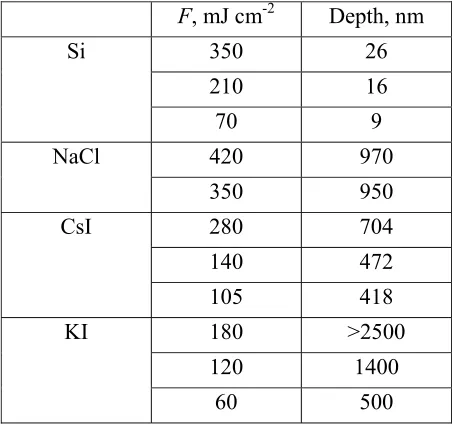
obtained for each sample with various laser fluences is presented in Table 1. Overall, KI samples
retain the highest crater depth among all studied alkali halides, with its value being nearly 100
times larger than that in Si owing to the fundamental difference between fs-laser ablation of
semiconductors and dielectric materials9. We would like to emphasize here that the result of
producing larger craters in KI when compared to CsI and NaCl is readily anticipated.
Polycrystalline samples are composed of small crystallites with weaker inter-crystallite forces,
and therefore are softer than the single crystalline counterpart. What is interesting though are the
unusually deep (≈ 0.5 µm) craters created in alkali halides using single laser pulses with F < Fmelt
< Fabl < Fplasma. For comparison, making a similar size crater in Al2O3 with a single laser shot
requires nearly two orders of magnitude higher flux with F = 11.3 J cm-2 for 395 nm light56.
Another important point is the mechanism responsible for the material expulsion. It is definitely
nonthermal in nature, since according to our results no sample melting should happen.
It has been proposed that nonthermal fs-laser ablation in dielectric materials proceeds
through surface charging, followed by impulsive Coulomb explosion28. However, the
experimental conditions in this work are significantly different from those in the aforementioned
11
findings for large crater formation in alkali halides with this mechanism, as the low laser
fluences used in the current experiments are far insufficient ( plasma) to generate the
required charge density for Coulomb explosion to take off.
Fs electron diffraction measurements
To further elaborate on the nonthermal mechanism of the ablation process we performed
single-shot FED experiments providing direct structural information on the evolution of
crystalline order following fs-UV photoexcitation. Figure 6 shows the time-dependent diffraction
intensities for the (020)- and (022)-Bragg reflections from 50 nm thick <100>-oriented KI films
photoexcited with 400 nm light. The red and blue traces (F = 140 mJ cm-2) in Fig. 6 reveal the
decrease in the crystalline order during the first few tens of ps, which then recovers gradually on
the nanosecond timescale. The electron diffraction data can be used to estimate the lattice
temperature of the KI sample after its irradiation with the UV light. Accordingly, the recorded
intensity signal from diffracted electrons ( ) can be expressed by the following equations:
(Eq. 1),
and
exp (Eq. 2),
where is the scattering vector, is the structure factor, is the Laue function,
is the atomic scattering factor, is the Debye-Waller factor, and is the average
position of the j-th atom in the unit cell. The Debye-Waller factor can be written in terms of
temperature dependent B-factors ( ) or through the mean square displacement ( ) as
12
where is the scattering angle and is the de Broglie wavelength of the electrons. We
performed a temperature analysis based on values of B-factors obtained from the
parameterization in reference 57 derived from the experimental phonon density of states data
(see Section 3 in Supplementary Information for more details about these calculations).
Assuming the largest intensity change of 25% and 45% for the (020)- and (022)-Bragg
reflections from 140 mJ cm-2 data in Fig. 6, the predicted lattice temperature is ≈ 1200 K
(kinematic diffraction theory) or ≈ 1800 K (with corrections from dynamical diffraction theory58).
These lattice temperatures are certainly above the melting point, and therefore fall off the
validity range of the Debye-Waller model, which is only applicable if the unit cell structure of
the crystalline material remains intact. After the slow recovery of the signal (time delays of ≈
1–2 ns), Debye-Waller analysis predicts a l = 725 ± 110 K that is below the melting point of
the salt, 954 K. It is worth mentioning that by comparison (see Supplementary Figs. 4 & 5), 100
nm thick KI films show a much stronger intensity decay than those observed for 50 nm thick
films. A similar attenuation effect on the electron diffraction intensity for all diffraction orders
was found to be dependent on the material thickness59. Therefore, the observed drop in intensity
for the (000)-order electron beam implies that our predicted increases in lattice temperature are
indeed upper estimates. Regardless of the model employed to calculate the time-dependent
lattice temperature, the above findings support the fact that sample heating is insufficient by
itself to explain the observed changes in the diffraction, and therefore there are other processes
related to the loss and recovery of crystallinity that is occurring in parallel.
Discussion
One of the possible mechanisms leading to the lattice damage is the formation of point
13
diffraction signal from nanocrystalline materials was previously investigated60. Based on those
predictions, it would require more than 20% (≈ 2 × 1021 cm-3) of lattice point defects to decrease
the (020)-diffraction intensity by 25%. Such high concentration of point defects is not reachable
in our study, which is evident from the optical measurements showing that there are less than
10% photoexcited halide centres at F = 140 mJ cm-2. The other viable causes for the loss of
crystallinity are partial local disordering or melting. Referring to the optical reflectivity
measurements in KI, F = 140 mJ cm-2 falls into the 120–180 mJ/cm2 interval that loosely defines
the melting threshold. As the result, when the incidence laser fluence is in close proximity to that
of Fmelt, there is a high probability that a fraction of the sample becomes, locally, either
significantly disordered or turns into a liquid. Most likely, in addition to the sample heating,
local disordering is the key factor responsible for the reduction in diffraction signal. As the
temperature of the sample starts equilibrating within the photoexcited volume, these highly
disordered regions attempt to recrystallize, thus contributing to the slow recovery in the
diffraction intensity observed in a nanosecond time interval. The latter conclusions are also
supported by time-resolved diffraction data at F = 1 J cm-2 (shown in Fig. 6). No signal recovery
is detected for the plasma driven damage in KI at this level of fluence.
Following energy conservation, the increase in lattice temperature after photoexcitation
can also be estimated as
l eff t (Eq. 4),
where eff is the effective absorbed fluence fraction, t is the film thickness ~ 50 nm, and
are the material’s density 3.12 g cm-3 and specific heat capacity 313 J kg-1 K-1 for KI,
respectively. In a very conservative scenario that considers eff (see Supplementary Fig.
14
lattice temperature after thermal equilibration therefore results in leq (F = 140 mJ cm-2) ≤ 1440
K. Despite the fact the calculated value of leq is an upper estimate, crater formation in KI was
found to occur at F as low as 60 mJ cm-2 (see table 1 and Fig. 5c) for which Eq. 4 would predict
leq (F = 60 mJ cm-2) < 780 K, which is below the melting point. A similar conclusion can be
drawn for NaCl modifying Eq. 4 by replacing t by c (the crater depth), and eff by the
absorbed fraction measured across the 2 mm thick bulk single crystal. Hence a simple
thermodynamic calculation based on upper estimates for the absorbed energy, which is in
agreement with the values of Fmelt determined via fs optical reflectivity measurements, provides
strong evidence for nonthermal pathways to be the dominant driving force for the ejection of
particulates.
The forces involved can be understood through a simple analogy with contact ion pairs
in the gas phase (Fig. 7a). Optical excitation induces localised changes in the electronic
distribution, i.e. strong electronic stress61–65 that provides the initial kick for the consequent
material ejection. This latter explanation is consistent with the observation of strain waves66 in
the GHz range (see oscillatory behaviour in fs optical reflectivity data shown in Supplementary
Fig. 1). The very localised nature of the excited state is also supported by the FED data (red and
blue traces in Fig. 6), which give evidence for the creation of disordered regions that release their
energy to the surrounding unexcited crystal (recovery of diffraction signal on sub-ns timescale).
At systematically higher fluences necessary to invoke substantial ablation, ion detection
thresholds indicate that the sample is likely ejected in the form of large clusters and/or
particulates provided the yield of relatively high (up to 4000) ions being emitted from the
irradiated alkali halide crystals. Such behaviour is common for the fs-laser ablation of dielectrics
and has been extensively used in industry for pulsed-laser deposition of thin films9. The
15
of the nano-sized particles. However, the assumption about plume composition has to be verified
by future experiments.
In summary, we found evidence for a cold laser ablation process that takes place in
alkali halides upon UV light photoexcitation of an extremely small fraction of halide centres.
The observed dynamics illustrate the very nature of highly localised repulsive forces involved in
the ejection of material. As computing power grows and different simulation tools are
developed67, ab-initio molecular dynamics will be able to provide a more detailed microscopic
understanding of this cold ablation process.
References
1. Chichkov, B. N., Momma, C., Nolte, S., Von Alvensleben, F. & Tünnermann, A. Femtosecond, picosecond and nanosecond laser ablation of solids. Appl. Phys. A 63, 109–115 (1996).
2. Liu, X., Du, D. & Mourou, G. Laser ablation and micromachining with ultrashort laser pulses. J. Quant. Electron., IEEE33, 1706–1716 (1997).
3. Jeschke, H. O., Garcia, M. E. & Bennemann, K. H. Theory for the Ultrafast Ablation of Graphite Films. Phys. Rev. Lett.87, 015003 (2001).
4. Miller, J. C. & Haglund Jr., R. F. Laser ablation and desorption, 1st edition. (Academic Press, 1998)
5. Lorazo, P., Lewis, L. J. & Meunier M. Short-Pulse Laser Ablation of Solids: From Phase Explosion to Fragmentation. Phys. Rev. Lett.91, 225502 (2003).
6. Demaske, B. J., Zhakhovsky, V. V., Inogamov, N. A., & Oleynik I. I. Ablation and spallation of gold films irradiated by ultrashort laser pulses. Phys. Rev. B 82, 064113 (2010).
16
8. Stuart, B. C., Feit, M. D., Rubenchik, A. M., Shore, B. W. & Perry, M. D. Laser-induced damage in dielectrics with nanosecond to subpicosecond pulses. Phys. Rev. Lett.74, 2248 (1995).
9. Mao, S.S., Quéré, F., Guizard, S., Mao, X., Russo, R.E., Petite, G. & Martin, P. Dynamics of femtosecond laser interactions with dielectrics. Appl. Phys. A79, 1695 (2004).
10. Balling, P. & Schou, J., Femtosecond-laser ablation dynamics of dielectrics: basics and applications for thin films. Rep. Prog. Phys.76, 036502 (2013).
11. Goldstein, E. IV. Arbeiten der wissenschaftlichen Gäste der Abtheilung I. Professor Goldstein’s Untersuchungen über Kathodenstrahlen. Zeits. f. Instrumentenk. 16, 211 (1896).
12. Hersh, H. N. Proposed Excitonic Mechanism of Color-Center Formation in Alkali Halides.
Phys. Rev.148, 928–932 (1966).
13. Rabinowitch, E. Electron Transfer Spectra and Their Photochemical Effects. Rev. Mod. Phys.14, 112–131 (1942).
14. Song, K. S., Leung, C. H. & Williams, R. T. A theoretical basis for the Rabin-Klick
criterion in terms of off-centre self-trapped-exciton relaxation. J. Phys.: Condens. Matter1, 683 (1989).
15. Tokizaki, T. et al. Femtosecond cascade-excitation spectroscopy for nonradiative deexcitation and lattice relaxation of the self-trapped exciton in NaCl. Phys. Rev. Lett.67, 2701–2704 (1991).
16. Edamatsu, K., Sumita, M., Hirota, S. & Hirai, M. Transient absorption due to self-trapped excitons in NaBr and NaI. Phys. Rev. B47, 6747–6750 (1993).
17. Iwai, S. et al. One-Center Small Polarons as Short-Lived Precursors in Self-Trapping Processes of Holes and Electron-Hole Pairs in Alkali Iodides. Phys. Rev. Lett. 76, 1691–1694 (1996).
18. Shluger, A. L. & Tanimura, K. Laser-induced reactions in crystals: Femtosecond pump-probe spectroscopy and ab initio calculations of self-trapped excitons and holes in KBr. Phys. Rev. B61, 5392–5402 (2000).
19. Tanimura, K. & Hess, W. P. Temperature-dependent yield of Frenkel pairs generated by valence excitation in NaCl. Phys. Rev. B69, 155102 (2004).
17
21. Dickinson, J. T., Orlando, S., Avanesyan, S. M. & Langford, S. C. Color center formation in soda lime glass and NaCl single crystals with femtosecond laser pulses. Appl. Phys. A79, 859 (2004).
22. Henyk, M., Costache, F. & Reif J. Appl. Femtosecond laser ablation from sodium chloride and barium fluoride. Appl. Surf. Sci.186, 381 (2002).
23. Joly, A. G., Hess, W. P., Beck, K. M. & Dickinson J. T. Femtosecond time-resolved photo-stimulated desorption from ionic crystals. Appl. Surf. Sci.186, 339 (2002).
24. Hess, W. P., Joly, A. G., Beck, K. M., Williams, R. M. & Dickinson J. T. Femtosecond time-resolved laser-induced desorption of positive ions from MgO. Appl. Phys. A69, S389, (1999).
25. Hess, W. P., Joly, A. G., Beck, K. M., Henyk, M. & Sushko, P. V., Trevisanutto, P. E., Shluger, A. L. Laser control of desorption through selective surface excitation. J. Phys. Chem. B109, 19563 (2005).
26. Kolodziej, J. J. et al. Frenkel defect interactions at surfaces of irradiated alkali halides studies by non-contact atomic-force microscopy. Surf. Sci. 482–485, 903–909 (2001).
27. Stoian, R. et al. Surface Charging and Impulsive Ion Ejection during Ultrashort Pulsed Laser Ablation. Phys. Rev. Lett.88, 097603 (2002).
28. Stoian, R., Ashkenasi, D., Rosenfeld, A., Campbell, E. E. B., Coulomb explosion in ultrashort pulsed laser ablation of Al2O3. Phys. Rev. B62, 13167 (2000).
29. Sciaini, G. & Miller, R. J. D. Femtosecond electron diffraction: heralding the era of atomically resolved dynamics. Rep. Prog. Phys.74, 096101 (2011).
30. Park, H., & Zuo, J. M. Direct measurement of transient electric fields induced by ultrafast pulsed laser irradiation of silicon. Appl. Phys. Lett.94, 251103 (2009).
31. Okano, Y., Hironaka, Y., Kondo, K-I., & Nakamura, K. G, Electron imaging of charge-separated field on a copper film induced by femtosecond laser irradiation. Appl. Phys. Lett.86, 141501 (2005).
32. Hebeisen, C. T. et al. Direct visualization of charge distributions during femtosecond laser ablation of a Si(100) surface. Phys. Rev. B78, 081403 (2008).
33. Raman, R. K., Tao, Z., Han, T-R., & Ruan, C-Y., Ultrafast imaging of photoelectron packets generated from graphite surface. Appl. Phys. Lett.95, 181108 (2009).
18
35. Carbone, F., Baum, P., Rudolf, P., & Zewail, A. H. Carbone et al. Reply. Phys. Rev. Lett. 105, 059604 (2010).
36. Raman, R. K. et al. Direct observation of optically induced transient structures in graphite using ultrafast electron crystallography. Phys. Rev. Lett.101, 077401 (2008).
37. Williams, R. T. & Kabler, M. N. Excited-state absorption spectroscopy of self-trapped excitons in alkali halides. Phys. Rev. B9, 1897–1907 (1974).
38. Karasawa, T. & Hirai, M. Color Center Formation in KI and NaCl Crystals by Pulsed Electron Beam. J. Phys. Soc. Jpn.39, 999–1003 (1975).
39. Shank, C. V., Yen, R. & Hirlimann, C. Time-Resolved Reflectivity Measurements of Femtosecond-Optical-Pulse-Induced Phase Transitions in Silicon. Phys. Rev. Lett. 50, 454–457 (1983).
40. Tom, H. W. K., Aumiller, G. D. & Brito-Cruz, C. H. Time-resolved study of laser-induced disorder of Si surfaces. Phys. Rev. Lett.60, 1438–1441 (1988).
41. Sokolowski-Tinten, K., Bialkowski, J. & Von der Linde, D. Ultrafast laser-induced order-disorder transitions in semiconductors. Phys. Rev. B51, 14186–14198 (1995).
42. Sokolowski-Tinten, K. et al. Transient States of Matter during Short Pulse Laser Ablation.
Phys. Rev. Lett.81, 224–227 (1998).
43. Sokolowski-Tinten, K. & Von der Linde, D. Generation of dense electron-hole plasmas in silicon. Phys. Rev. B61, 2643–2650 (2000).
44. Choi, T. Y. & Grigoropoulos, C. P. Plasma and ablation dynamics in ultrafast laser processing of crystalline silicon. J. Appl. Phys.92, 4918–4925 (2002).
45. Dachraoui, H. & Husinsky, W. Thresholds of Plasma Formation in Silicon Identified by Optimizing the Ablation Laser Pulse Form. Phys. Rev. Lett.97, 107601 (2006).
46. Stampfli, P. & Bennemann, K. H. Time dependence of the laser-induced femtosecond lattice instability of Si and GaAs: Role of longitudinal optical distortions. Phys. Rev. B49, 7299–7305 (1994).
47. Siders, C. W. et al. Detection of Nonthermal Melting by Ultrafast X-ray Diffraction.
19
48. Rousse, A. et al. Nonthermal melting in semiconductors measured at femtosecond resolution. Nature (London)410, 65–68 (2001).
49. Lindenberg, A. M. et al. Atomic-Scale Visualization of Inertial Dynamics. Science 308, 392–395 (2005).
50. Harb, M. et al. Electronically Driven Structure Changes of Si Captured by Femtosecond Electron Diffraction. Phys. Rev. Lett.100, 155504 (2008).
51. Zijlstra, E. S., Walkenhorst, J. & Garcia, M. E. Anharmonic Noninertial Lattice Dynamics during Ultrafast Nonthermal Melting of InSb. Phys. Rev. Lett.101, 135701 (2008).
52. Cavalleri, A., Sokolowski-Tinten, K., Bialkowski, J., Schreiner, M., & Von der Linde, D. Femtosecond melting and ablation of semiconductors studied with time of flight mass spectroscopy. J. Appl. Phys.85, 3301-3309 (1999).
53. Kruer, W. L. Laser plasma interactions with intensities from 1012–1021W/cm2. Phys. Plasmas10, 2087 (2003).
54. Favre, C. et al. White-Light Nanosource with Directional Emission. Phys. Rev. Lett. 89, 035002 (2002).
55. Von der Linde, D. & Schüler, H. Breakdown threshold and plasma formation in femtosecond laser–solid interaction. J. Opt. Soc. Am. B 13, 216 (1996).
56. Ashkenasi, D., Rosenfeld, A., Varel, H., Wähmer, M. & Campbell E. E. B. Laser processing of sapphire with picosecond and sub-picosecond pulses. Appl. Surf. Sci. 120, 65–80 (1997).
57. Gao, H. X., Peng, L.-M. & Zuo, J. M. Lattice dynamics and Debye-Waller factors of some compounds with the sodium chloride structure. Acta. Cryst. A55, 1014 (1999).
58. Peng, L.-M. Quasi-dynamical electron diffraction - a kinematictype of expression for the dynamical diffracted-beam amplitudes. Acta. Crys. A56, 511–518 (2000).
59. Ligges, M. et al. Transient (000)-order attenuation effects in ultrafast transmission electron diffraction. J. Appl. Phys.109, 063519 (2011).
60. Makinson, J. D. et al. X-ray diffraction signatures of defects in nanocrystalline materials.
Adv. X-ray Anal.42, 407– 411 (1998).
20
62. Hudert F. et al. Confined longitudinal acoustic phonon modes in free-standing Si membranes coherently excited by femtosecond laser pulses. Phys. Rev. B 79, 201307(R) (2009).
63. Hayashi, Y. et al. T. Acoustic pulse echoes probed with time-resolved X-ray triple-crystal diffractometry. Phys. Rev. Lett.96, 115505 (2006).
64. Tang, J., Coherent phonon excitation and linear thermal expansion in structural dynamics and ultrafast electron diffraction of laser-heated metals. J. Chem. Phys. 128, 164702 (2008).
65. Harb, M. et al. Excitation of longitudinal and transverse coherent acoustic phonons in nanometer free-standing films of (001) Si. Phys. Rev. B,79, 094301 (2009).
66. Moriena, G., Hada, M., Sciaini, G., Matsuo, J. & Miller, R. J. D., Femtosecond electron diffraction: Preparation and characterization of (110)-oriented bismuth films. J. Appl. Phys. 111, 043504 (2012).
67. Zijlstra, E. S., Kalitov, A., Zier, T. & Garcia, M. E., Fraction Diffusion in Silicon. Adv. Mat.25, 5605–5608 (2013).
21 Acknowledgements
The authors would like to thank Dr. K. Sokolowski-Tinten at the University of Duisburg-Essen
for helpful discussions, Dr. D. Mazurenko and S. Jangam at the University of Hamburg and A.
Fox at the University of Toronto for the initial design of the FED setup, A. Casandruc at the
University of Hamburg for his help during the electron diffraction experiments, and M. Urano at
Kyoto University for his help in the determination of the crater depths. This work was funded by
the Max Planck Society. M.A.K. acknowledges the Centre for Numerical Algorithms and
Intelligent Software (NAIS) for the award of a Principal's Career Development Scholarship.
Edinburgh researchers (M.A.K, D.A.W. and C.A.M.) acknowledge the resources of the EPSRC
UK National Service for Computational Chemistry Software (NSCCS).
Author contributions
R.J.D.M. is principle investigator for this project. R.J.D.M., M.H. and G.S. conceived and
coordinated this project. D.Z. developed the optical experimental setup. J.H., S.H., S.M.,
R.Y.N.G., D.Z., M.H., G.M. and G.S. developed the electron diffraction system. M.H., D.Z. and
R.Y.N.G. developed the ion detection experimental setup. D.Z. and K.P. automated the setups.
M.H. and D.Z. performed the optical, ion detection and FED experiments. M.H. made the thin
alkali halide samples. J.M. and T.S. performed the interferometric measurements. M.A.K.,
D.A.W. and C.A.M. calculated the potential surface energy of alkali halide molecules. M.H.,
D.Z., K.P, G.S. and R.J.D.M. interpreted the data. M.H., D.Z., K.P, G.S. and R.J.D.M. wrote this
22 Figure captions
Fig. 1: Layout of the femtosecond electron diffraction setup.
Fig. 2: (a) XRD spectrum from KI samples. (b) X-ray rocking curve for the reflection from KI
(200) plane. (c) Electron diffraction pattern from a 50 nm thick KI film.
Fig. 3: Relative reflectivity changes as a function of the time delay. (a) for Si, (b) for CsI, (c) for
NaCl, and (d) for KI.The incident laser fluences corresponding to the each plot are indicated in
the figures.
Fig. 4: Laser fluence dependent yields of positive (black trace) and negative (red trace) ions
measured using a simple homemade ion detection system. (a) Si, (b) NaCl, and (c) CsI single
crystalline samples. Insets show magnified views near the first detected ablation threshold, Fabl,
for each sample. The second threshold, Fplasma, is determined as the intersection of the blue
and/or green lines with the abscissa. The difference in the yield of negative and positive ions
reflects the fact that, in general, cations are more stable than their corresponding anions.
Fig. 5: Micrographs of the craters produced by single pump pulses with their respective
2-dimensional sectional profiles. (a) single crystalline CsI (F ≈ 140 mJ cm-2), (b) single
crystalline Si (F ≈ 350 mJ cm-2), and (c) 2.5 µm thick polycrystalline KI film (F ≈ 60–180 mJ
cm-2).
Fig. 6: Time-dependent changes in electron diffraction intensity for KI under non-reversible,
single shot photoexcitation conditions. Red and blue traces correspond to the relative changes
observed for (020) and (022) Bragg reflections, respectively, at F ≈ 140 mJ cm-2. Black trace
23
Fig. 7: (a) Calculated potential energy curves for the NaCl molecule. The ionic ground and
neutral excited states are plotted as black and red curves, respectively (for more details see
Supplementary Information section 4). Vertical excitation brings the system right to the onset of
the Pauli repulsion well where short-range core-core repulsion forces are dominant. The
core-core repulsion forces are also expected to be one of the key factors responsible for the
material expulsion in alkali halide crystals68. (b) Summary of the cold ablation process. Similar
to the NaCl molecule, the UV excitation in alkali halide crystals causes a local change in the
electronic density around the excited halide anions and their neighbouring alkali cations thus
unleashing repulsive forces between partially neutralized atoms. To release the stress, pertinent
atoms move from their ground state equilibrium positions and form disordered regions within
several picoseconds after the photoexcitation. Further relaxation of the lattice, subject to the
amount of generated strain, might involve cracking and ejection of the material on the
24
Table 1: Summary of crater depth measurements
F, mJ cm-2 Depth, nm
Si 350 26
210 16
70 9
NaCl 420 970
350 950
CsI 280 704
140 472
105 418
KI 180 >2500
120 1400
60 500
Crater depths were determined using the following techniques: interferometry for CsI and Si,