This is a repository copy of The Effect of Vision on Discrimination of Compliance Using a Tool.
White Rose Research Online URL for this paper: http://eprints.whiterose.ac.uk/86273/
Version: Accepted Version
Article:
Fakhoury, E, Culmer, P and Henson, B (2014) The Effect of Vision on Discrimination of Compliance Using a Tool. International Journal of Human-Computer Interaction, 30 (11). 882 - 890. ISSN 1044-7318
https://doi.org/10.1080/10447318.2014.941274
[email protected] https://eprints.whiterose.ac.uk/ Reuse
Unless indicated otherwise, fulltext items are protected by copyright with all rights reserved. The copyright exception in section 29 of the Copyright, Designs and Patents Act 1988 allows the making of a single copy solely for the purpose of non-commercial research or private study within the limits of fair dealing. The publisher or other rights-holder may allow further reproduction and re-use of this version - refer to the White Rose Research Online record for this item. Where records identify the publisher as the copyright holder, users can verify any specific terms of use on the publisher’s website.
Takedown
If you consider content in White Rose Research Online to be in breach of UK law, please notify us by
- -
The Effect of Vision on Discrimination of Compliance
Using a Tool
E. Fakhoury
1, P. Culmer
1, B. Henson
11
School of Mechanical Engineering, University of Leeds, Leeds, UK
Running Head:The effect of visual sources on the perception of compliance using a tool
Authors’ full contact information:
Evan Fakhoury
PhD Research Student
School of Mechanical Engineering University of Leeds
Phone: +44 (784) 88 60247 Email: [email protected] Dr Peter Culmer
Senior Translational Research Fellow in Surgical Technologies School of Mechanical Engineering
University of Leeds
Phone: +44 (113) 34 32141 Email:[email protected] Dr Brian Henson
School of Mechanical Engineering University of Leeds
- -
ABSTRACT
This paper describes a psychophysical experiment which investigates the effect of the source of vision on the perception of compliance with a specific focus on palpation; a basic surgical task. Twelve participants were asked to complete four forced-choice compliance
discrimination tasks representing different modes of surgery when assessing soft human tissue. These tasks were compliance discrimination using direct vision; indirect vision on a computer monitor; only haptic information; and only indirect visual information. In the first 3 tasks, the subjects actively indented pairs of silicone stimuli covering a range of compliances simulating soft human tissue using a tool and were asked to choose which stimulus within each pair felt harder. In the fourth task, participants watched video recordings of the stimuli being indented on a monitor without touching the stimuli themselves. As a control task, participants performed discriminations using their index finger without any visual cues present. The results were used to determine psychometric functions of group behaviour for all conditions. These functions suggest that participants performed best during the control task followed by that involving a combination of touch using tool and direct vision. The latter task presented higher compliance discriminability than the three remaining tasks. Moreover, the task using only indirect vision without any haptic information presented similar compliance discriminability to that using only touch through a tool without any visual information. We conclude that while compliance discrimination via a tool is achievable under direct visual conditions, it remains significantly more challenging than through direct cutaneous information. The research shows the importance of visual cues for the discrimination of compliance as well as a cross-modal integration of visual and haptic sensory information in
- -
CONTENTS
1. INTRODUCTION ... 4
2. PREVIOUS WORK ... 5
L S ... P P ... C ... C ... C - ... E ... 3. METHODS ... 9
P ... S ... S ... C ... V ... E S ... E D ... P ... 4. RESULTS ... 15
5. DISCUSSION & FUTURE WORK ... 17
6. CONCLUSIONS ... 18
- -
1.
INTRODUCTION
The research described in this paper is concerned with how well surgeons are able to discriminate the compliance of human tissue during minimally invasive surgery. Laparoscopic surgery (LS) is a form of minimally invasive surgery (MIS) wherein entire surgical procedures are performed through small incisions in the abdomen using long slender tools and cameras with light sources. LS is being implemented in more and more procedures that were once only possible via traditional open surgery. While laparoscopy has proved to be an efficient and viable substitute for open surgery in many procedures, it still poses some concerns that need to be addressed.
Laparoscopic surgeons must compensate for reduced kinaesthetic, and cutaneous tactile feedback by relying largely on visual information provided by a two
-dimensional (2D) monitor as well as limited haptic feedback transmitted through the laparoscopic tools (Culmer et al., 2012). Real world three-dimensional tissue
structures are hence reduced to two-dimensional images and video projected on a
screen (Kashihara, 2011). Robotically assisted laparoscopic surgery (RALS) builds on the benefits of MIS, with systems such as the da Vinci (Intuitive Surgical Inc.,
Sunnyvale, California) (Ballantyne & Moll, 2003) providing increased precision, dexterity and enhanced stereoscopic vision (Najaria, Fallahnezhad, & Afshari, 2011). However, these devices completely lack haptic feedback, forcing the surgeons to rely solely on the stereoscopic vision provided (Van der Meijden & Schijven, 2009). Virtual reality surgical simulators are a recent technology allowing surgeons to train through a virtual environment using haptic and visual feedback systems. The virtual reality field for surgical training is growing at a rapid rate, driven by needs for increased efficiency, cost-effectiveness (Leddy, Lendvay, & Satava, 2010), and
reliability (Lanfranco, Castellanos, Desai, & Meyers, 2004). Today, medical simulators are being increasingly used in surgical training processes. With the
increasing difficulty of RALS techniques, training is now a necessity (Coles, Meglan, & John, 2011). Similar to RALS, these training haptic feedback systems still need further development and refinement.
One of the most critical tools in any kind of surgery or diagnostic is palpation. Palpation is a very powerful surgical tool used by clinicians to detect irregularities and tumours (Langrana, Burdea, Ladeji, & Dinsmore, 1997). Surgeons assess tissue health, for example to locate potentially cancerous tumours (Bholat, Haluck, Kutz, Gorman, & Krummel, 1999), by palpating (pressing or tapping) the tissue surface using both haptic and visual information (Culmer et al., 2012). Abnormal tissue typically has distinct mechanical characteristics (such as compliance) from healthy tissue (Carter, Frank, Davies, McLean, & Cuschieri, 2001), thus allowing the surgeon to discriminate by evaluating these changes. The compliance of an object is an
- -
Perception is the acquisition and processing of sensory data in order to feel, see, hear, taste, or smell objects in the world around us (Sekuler & Blake, 1994). Haptic
perception is the recognition of an object through touch. Although this type of perception is based on the sense of touch, be it cutaneous (related to pressure, vibrations, temperature), kinaesthetic (related to limb movement), or proprioceptive (related to the position of the body), it is found to be greatly influenced by visual information (Lederman & Klatzky, 2009). This paper aims to investigate the effect of vision on the discrimination of compliance. The research focuses on how well people are able to discriminate compliance under different conditions relevant to MIS. Understanding the effect direct and indirect vision have on the ability to discriminate compliance as well as how they differ from one another is essential for improving and developing visual and haptic feedback systems that can be used in surgical training systems and RALS procedures. The outcomes of the research are relevant to
researchers in LS, RALS, tactile displays and human computer-interaction as it links
current computer interfaces in LS and state of the art surgical robotic systems (such as the da Vinci) to the psychophysics behind compliance discrimination specifically in surgical palpation tasks.
2.
PREVIOUS WORK
Research pertinent to this area can be divided into five categories: Introduction to LS, significance of probing, compliance, perception of compliance using the finger pad, perception of compliance using a tool, and the role of vision in the perception of compliance (Lederman & Klatzky, 2009). Section 1 offers a concise review of LS
along with its advantages and weaknesses. Section 2 introduces the significance of palpation and probing for our research. In section 3, compliance is introduced, explained, and linked to this research. Section 4 analyses the discrimination of compliance through cutaneous information such as in open surgery. With the
introduction and advancement of LS today, section 5 addresses the issue of perception of compliance using a tool. Finally, knowing that vision is redirected, modified, or distorted in LS as well as in RALS, section 6 examines previous research regarding the role of vision during the discrimination of compliance.
2.1.
Laparoscopic Surgery
Today, laparoscopic surgery is used as standard across the world in several previously invasive procedures such as splenectomy and cholecystectomy (Xin, Zelek &
Carnahan, 2006). This minimally invasive type of surgery has several advantages over open surgery such as shorter hospital stay, quicker recovery, higher cost-effectiveness,
and reduced post-operative pain. However, LS presents several limitations and
- -
A surgeon’s perception of depth is severely reduced due to reliance on a two
-dimensional screen. The location of the screen and the nature of this surgical procedure affect the surgeon’s hand-eye coordination. Operating solely one-inch
incisions via long slender tools reduces the degrees of freedom from six, which is required for completely free motion, to four (Xin, Zelek & Carnahan, 2006).
Perhaps the biggest limitation in LS is reduced haptic feedback (Brydges, Carnahan & Dubrowski, 2005). In open surgery, surgeons rely on their hands and fingers to make important decisions during an operation. Using their sense of touch, experienced surgeons are capable of discriminating between healthy tissue and abnormal tissue. Haptic feedback is also crucial for optimal motor control as well as organ
identification and quick decision making (Bholat, Haluck, Murray, Gorman & Krummel, 1999). Laparoscopic surgeons, however, must use long laparoscopic instruments to probe, grasp, cut and suture. Studies have shown that certain laparoscopic procedures carry double the risk of tissue scarring compared to open surgeries (Fletcher et al., 1999). A possible cause of these risks is the excessive use of force. Without any force feedback to assist a surgeon, higher forces are used (Wagner et al., 2002). Kazi (2001) conducted experiments to study the effect of force feedback in LS. Results suggest that when force feedback is present, the maximum force exerted is reduced by up to 40%. Tavakoli et al. (2005) showed that force feedback can be substituted by visual feedback in order to reduce the force peaks and averages. By presenting on-screen visual representations of the force levels during teleoperated
mock surgeries via the Zeus robot, findings suggest that visual feedback could assist in reducing the high forces used during surgery.
2.2.
Palpation and Probing
In any given laparoscopic surgical environment, a surgeon performs tasks such as palpating, probing, grasping, cutting and suturing (Konofagou et al., 1997). A key task is palpation. Surgeons palpate an organ or area in the body by exploration using their hands, usually looking for abnormalities or tumours (Bholat et al., 1999). In LS, surgeons are forced to use tools to perform all their tasks. In this case, surgeons probe the organs using those tools. Probing is a simple yet vital task which also requires minimal training. Probing provides the surgeon with haptic information necessary to assess tissue health. Konofagou et al. (1997) found that a cancerous breast tissue had a stiffness of 456±208 KPa while healthy breast tissue had a stiffness of 66±17KPa, emphasising the value of probing and palpating tissue.
2.3.
Compliance
A compliant object is one that deforms in an elastic, viscoelastic, or non-elastic
- -
materials, compliance is an instrumental factor when analysing the properties of an object. Linear compliance can be expressed as the stiffness (K) of an object or as its Young’s modulus of Elasticity (E) (Bergmann Tiest & Kappers, 2009). The stiffness of an object (Equation 1) is a ratio of the force applied onto the object and the displacement of the object. The Young’s modulus (E) of a material is a ratio between the stress and the strain exerted on the material (Equation 2).
K = F / (1)
E = / = (2)
2.4.
Compliance discrimination using cutaneous feedback
Researchers have made a distinction between the sensation caused by the
displacement of the finger because of the stiffness of the material (kinaesthetic cues), and the sensations of the fingertip when touching the deformed surface of a compliant material (cutaneous cues). In an experiment by Friedman, Hester, Green, & LaMotte (2008), subjects labelled objects as soft if the objects’ compliance exceeded that of the human finger. Friedman et al. (2008) inferred that cutaneous information is both necessary and sufficient when discriminating between two objects. Moreover, cutaneous information is essential, but without kinaesthetic information, discrimination is impaired compared to situations where both cues are present. Srinivasan & LaMotte (1995) investigated the influence of an object’s surface feel on perception. Several experiments were conducted on compliant objects having rigid surfaces as well as deformable surfaces. In an experiment using the fingertip as the sensing tool onto a compliant object with a deformable surface, it was deduced that the pressure distribution and force applied on the specimen and the fingertip skin deformation are directly linked to the compliance of the object, its material properties, and its tactile information. They observed that the skin plays a role in perceptual abilities. Skin deformation is influenced by the material property of the surface of the object first and foremost. For compliant objects with rigid surfaces, however, pressure distribution and skin deformation are independent of object compliance, showing that tactile information alone is insufficient to encode compliance. Bergmann Tiest & Kappers (2009) found that the high importance of surface deformation for perception of compliance has implications for the way compliance should be rendered. After a series of experiments, they observed that 90% of the information cues come from surface deformation cues, whereas only 10% comes from force-displacement cues.
- -
2.5.
Compliance discrimination using tool
-
operated feedback
While some focused on perception of compliance via the fingertips, other researchers have focused on that using a tool (LaMotte, 2010). Haptic perception using a tool is especially important in laparoscopic procedures as surgeons perform entire operations using laparoscopic tools inserted through small incisions (Van der Meijden &
Schijven, 2009). The previous research investigating the differences between the perception of touch when using kinaesthetic and cutaneous information is directly relevant to laparoscopic surgery, because any haptic feedback obtained is sensed through the tools. Graspers; widely used to manipulate tissue, are thought to greatly diminish the surgeons’ abilities to properly discriminate softness or hardness of internal organs and tissue (Ottermo et al., 2006).
2.6.
Effect of vision on compliance perception
Typically, when undertaking laparoscopic surgical procedures, the surgeon is able to see the tools, via a camera attached to the laparoscopic probe, on a video monitor. Srinivasan, Beauregard, & Brock (1996) showed that visual information plays a significant role when perceiving compliance of an object. They found that the perception of stiffness is greatly influenced by visual information and consequently proposed the idea that visual information can be used (augmented or modified) to overcome haptic interface limitations, and ultimately enhance the virtual haptic
experience. This proposition seemed promising; however, little work has continued on this issue. Lecuyer, Coquillart, Kheddar, Richard, & Coiffet (2000) conducted a series of experiments where participants reported varying stiffness levels when the visual stiffness was varied but the actual stiffness of the haptic feedback device was not. Couroussé, Jansson, Florens, & Luciana (2006) speculated that perceptual judgement is the same in haptic only and in visual-haptic conditions. Several researchers have
- -
information, however, is not always reliable. Research needs to be conducted to fully comprehend the integrity of vision and its relationship with touch in LS and RALS.
3.
METHODS
An experiment was designed and conducted to investigate the effect of varying visual cues on the discrimination of compliance. It comprised 5 compliance discrimination tasks performed under different visual and haptic conditions. The 12 participants performed two-alternative forced choice compliance discrimination tasks for each of the conditions
across the range of compliances.
3.1.
Participants
Twelve participants (9 male and 3 female) took part in this study. None of them had any known hand or eyesight impairments according to a completed questionnaire. All participants were postgraduate students with ages ranging from 23 to 34. Participants were surgically naïve, without any medical background. Ethical approval was obtained before commencing the experiment.
3.2.
Stimuli
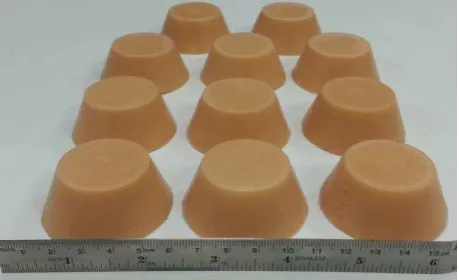
Over the different visual conditions, the twelve participants explored the surface compliance of silicone stimuli using a tool. The stimuli differed in compliance but were identical in shape, each measuring 5 cm wide by 2 cm deep (Figure 1). The stimulus size was selected for the experiments due to their convenient size, depth, and width to depth ratio. The stimuli stiffness values ranged from 40 to 80 mN/µm. This range is representative of biological
[image:10.595.74.304.563.703.2]tissues typically involved in surgical palpation tasks (Holzapfel, 2001).
- -
Stimuli fabrication
The stimuli were fabricated using a two-part silicone-based gel polymer (Plastil,
Mouldlife), with a deadener in different ratios to obtain a desired compliance. This ranged from 1:1:2.6 (hardest) to 1:1:4 (softest) to create a range containing 11 stimuli. A skin coloured pigment was also added without affecting the material properties to mask visual cues from slightly different colour of each stimulus. A mould was used to cast each stimulus. The stimuli were encapsulated with a thin polyurethane coating so that they had the same adhesion and friction properties.
Compliance testing
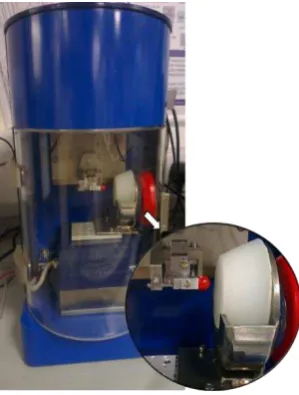
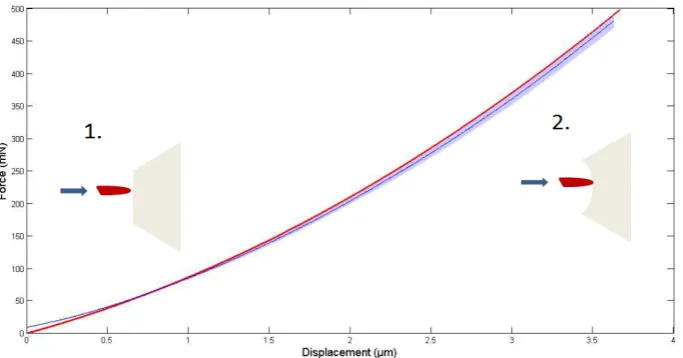
The compliance of each of the fabricated stimuli was characterised using a Modular Universal Surface Tester (MUST) (Compass Instruments) (Figure 2). A hemispherical hard plastic tip with an 8 mm diameter indented the stimuli at a rate of 0.2mm/s until reaching a force of 500 mN. The force-displacement profile of the indentation was
recorded at 100 Hz. Each stimulus was tested 5 times. Figure 3 shows the force
-displacement data of a sample stimulus. Plotting the data revealed nonlinear force
-displacement curves showing that the stimuli behave in a viscoelastic manner under loading (as shown in figure 5) in a similar manner to biological tissue (Williams II, Howell, & Conatser Jr, 2007). Nonlinear viscoelasticity is only applicable when the deformations are large or if the material properties change during loading (Wineman, 2009). Our stimuli are subjected to small loadings (< 5N); experiencing some
[image:11.595.180.330.511.709.2]compliance, but do not change material properties throughout the experiment. Hence, within this operating range, our stimuli can be considered as linear.
- -
Viscoelastic model fitting
The data obtained from the MUST was fitted to a linear Maxwell model. The linear Maxwell model is often used to describe the viscoelastic response of materials such as soft tissue (Leeman & Peyman, 2000).
Taking the generalized Maxwell differential equation (Equation 3) and solving for the total strain in the whole model, the Maxwell model during loading became as follows:
t
[image:12.595.113.455.524.703.2]
where , is the instantaneous strain in the spring, E is the modulus of elasticity of the linear spring, µ is the viscosity coefficient, and t is the instantaneous recorded time.
Figure 3 shows a typical viscoelastic force-displacement data plot with
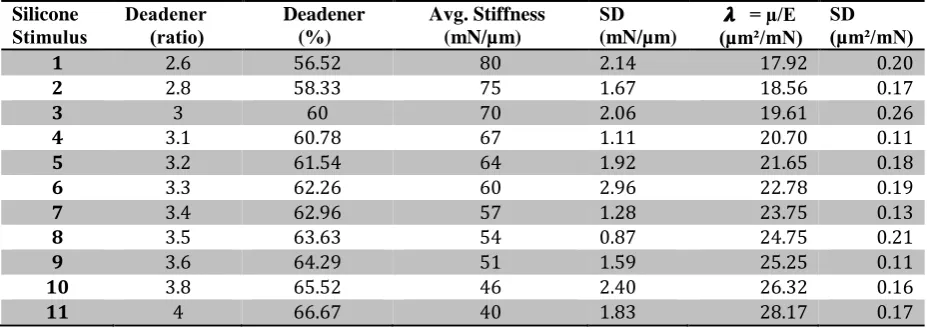
the Maxwell fit represented by the red curve. The Maxwell model was fit to the MUST data for all 11 stimuli and it proved to be a good approximation for our viscoelastic silicone stimuli. By extracting coefficients from the Maxwell model, it is possible to estimate material properties of all our stimuli such as stiffness and viscosity coefficient. Table 1 shows the estimated stiffness and viscosity coefficient values for all 11 samples obtained using the Maxwell model fit.
- - Silicone
Stimulus Deadener (ratio) Deadener (%)
Avg. Stiffness (mN/µm)
SD
(mN/µm)
= µ/E (µm²/mN)
SD (µm²/mN)
1 56.52 80
2 58.33 75
3 60 70
4 60.78 67
5 61.54 64
6 62.26 60
7 62.96 57
8 63.63 54
9 64.29 51
10 65.52 46
[image:13.595.66.530.72.237.2]11 66.67 40
Table 1: Mean Stiffness and Lambda values along with their standard deviations across over five repeats obtained after fitting MUST data to Maxwell models for all eleven stimuli
3.3.
Experimental Setup
The experiment utilized 11 different stimulus intensities starting with a minimum hardness of 40 mN/µm progressively increasing to a maximum of
80 mN/µm (Figure 4). Participants were randomly presented with 10 test
stimuli each presented 10 times along with a reference stimulus. The reference stimulus chosen was that located in the centre of the stimulus range (stimulus 6). The positions of the test and reference stimuli were randomly switched and the order of the trials was selected for each participant according to a 4x4 Latin Square Design (Field & Hole, 2003). Randomization was used to prevent extraneous factors from affecting our experiment unknowingly.
A control task was performed prior to the 4 tasks investigating the effect of cutaneous information on perception of compliance without any visual aid present. Two participants performed 2AFC tasks on the same stimuli using their dominant index finger instead of the provided tool to judge compliance. The participants were asked to judge the compliance of pairs of stimuli subjectively using their dominant index finger instead of the provided tool stating which stimulus feels less compliant. There was no specified time limit on each discrimination task.
3.4.
Experimental Design
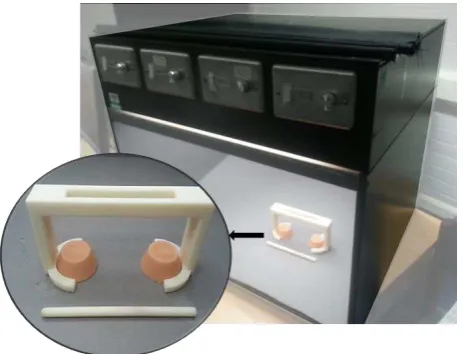
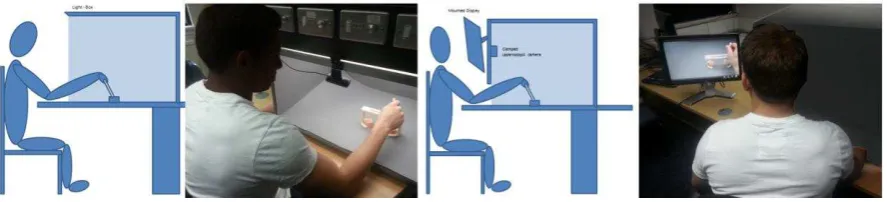
Direct vision + touch via tool: Participants were seated in a comfortable setting in front of a D65 daylight simulator. According to the International Commission on Illumination, the daylight simulator (Figure 4) provides standard illuminant D65 which imitates standard illumination conditions at open-air. Participants were allowed
- -
side inside daylight simulator. The stimuli pairs were placed inside a frame with centres 10 cm apart to guide the participants and reduce location errors. The frame, the stimuli and the tool used can be seen in Figure 4. Using the provided tool, the participants were asked to judge the compliance of both stimuli, subjectively stating which stimulus felt less compliant. Since discrimination with a tool is unaffected by the number of fingers the tool was controlled by (LaMotte, 2000), participants were asked to hold the tool using 3 fingers, similar to how to they would hold a pen, keeping the tool in a vertical position. This represents a common, simple and
[image:14.595.118.350.271.448.2]consistent grip that novice participants are familiar with. Participants were given the freedom to go back and forth between test and reference stimulus as often as needed until a certain decision had been made. There was no specified time limit on each discrimination task. This task is illustrated in Figure 5.
Figure 4: D65 daylight simulator with the stimuli placed in the holder and the tool used, as presented to each participant
Indirect vision + touch via tool: Participants did not have direct visual access into the daylight simulator but could view the stimuli inside the daylight simulator through a 19 inch high definition compatible display monitor (Dell) positioned 15 degrees below eye level which is a standard laparoscopic screen setting (Rogers, Heath, Uy, Suresh, & Kaber, 2011). The screen displayed a live feed of a high definition webcam (Microsoft Lifecam Cinema) shooting at 30 fps at which no obvious video latency was observed positioned. The
- -
Figure 5: Direct vision + tool task Figure 6: Indirect vision + tool task
Only touch via tool: In the third task (Figure 7), participants had no visual information during discrimination. Using a tool, participants were asked to judge the compliance of both stimuli subjectively stating which stimulus felt less compliant, relying solely on haptic feedback from the tool.
[image:15.595.75.513.465.580.2]Only indirect vision: In the final task, participants passively judged the softness of the stimuli without touching any stimuli themselves but rather observing stimuli being indented using a tool on a 2D display. Seated in front of a screen, participants were played 30 second recordings of stimuli pairs being indented. All clips were recorded using the same discrimination techniques such that they provided the participants with the necessary information to discriminate compliance. This experiment is illustrated in Figure 8. Participants were once again asked to judge the compliance of both stimuli, subjectively stating which stimulus feels less compliant. Each recording was repeated as many times as needed until a decision had been made.
Figure 7: Only tool task Figure 8: Only indirect vision task
3.5.
Psychometric function fitting:
- -
P
x
-
Where is the probability of being correct by chance, is the steepness of the function, and is the stimulus intensity at the halfway point.
For each task, a psychometric function was constructed using the modified logistic equation. Each task, therefore, had unique values of , , and with a total of twelve free parameters across the four tasks (4 , 4 , 4 ’s). Participants judged ten stimuli pairs, ten random repetitions per pair, for a total of 120 discriminations per task. By reducing the number of free parameters, we could improve the accuracy of our functions. Provided justifiable, reducing the number of parameters is a common statistical technique
(Kingdom & Prins, 2010). Coefficient , which is the stimulus at the halfway point was fixed at a value of 6, reducing the total number of free parameters to eight (4 s, 4 ’s). Initial fits to the group data found the optimal coefficient to be 11 with low inter-task
variation. This was fixed to facilitate comparison in subsequent fits, reducing the total number of free parameters to four (4 s). The slope of a psychometric function is an indication of its ‘steepness’. A steeper psychometric function resembling the form of a step function represents a higher slope, and consequently more accurate discriminability. Hence, a higher implies that participants were better able to discriminate compliance correctly.
4.
RESULTS
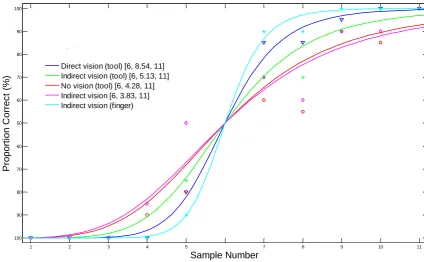
A two-alternative forced choice (2AFC) experimental paradigm was implemented. The
percentage of correct responses by the participants is plotted on the y-axis against the
stimulus number on the x-axis. The percentage values represent the subjective responses
of the participants, while the stimulus number represents the stiffness intensity of the stimuli. Since the reference stimulus falls in the middle of the stimuli range, the edges of the physical intensity spectrum represent stimuli with maximum (stimulus 1, 80mN/µm)
and minimum stiffness (stimulus 11, 40mN/µm). The y-axis is a subjective measure
starting at 100% moving to the minimum possible probability of success, i.e. chance (50%). This is based on random ordered stimuli.
- -
Figure 9: Psychometric functions across all five tasks. Points represent averaged participant responses. Curves represent logistic fits to the data points. Data in brackets represent the coefficients , and respectively for each task.
Table 2: values with the standard deviations for the four tasks. Task 1 is direct vision + tool touch. Task 2 is indirect vision + tool touch. Task 3 is only tool touch. Task 4 is only indirect vision.
Table 2 shows the slope values ( ) across all four tasks. The standard deviation presented for each task is a measure of how widely the values of are dispersed from the average of all 12 participants’ fits. It is observed that the direct vision with touch using a tool task holds the highest value, indicating better compliance discriminability than the
remaining tasks. A two way ANOVA showed that Task 1 proved more accurate at discriminating compliance than Task 2 (p=0.035), Task 3 (p=0.0024), and Task 4 (p=0.0016). Moreover, Task 2 showed better compliance discriminability than Task 4 (p=0.027). An analysis between tasks 3and 4 revealed a p-value of 0.26, implying that we
cannot explicitly judge which task has performed better, indicating that the two tasks demonstrate similar performance.
1 2 3 4 5 7 8 9 10 11
100 90 80 70 60 50 60 70 80 90 100 Sample Number Propo rt ion C orrec t (%)
Direct vision (tool) Indirect vision (tool) No vision (tool) Indirect vision No vision (Finger)
Direct vision (tool) [6, 8.54, 11] Indirect vision (tool) [6, 5.13, 11] No vision (tool) [6, 4.28, 11] Indirect vision [6, 3.83, 11] Indirect vision (finger)
Task 1 Task 2 Task 3 Task 4
Average 8.54 5.13 4.28 3.83
[image:17.595.69.384.461.501.2]- -
5.
DISCUSSION & FUTURE WORK
The results show that direct cutaneous feedback provides the most reliable information during compliance discrimination. The task requiring only visual discrimination and that requiring only haptic information using a tool presented similar compliance
discriminability. Moreover, the task involving a combination of 2D vision and tool touch allowed the participants to discriminate more accurately than vision only and the touch only tasks. This emphasizes the influence of vision and exhibits a sensory cross-modality
between vision and touch indicating a necessity to modify or augment both haptic and visual information in order to substitute for insufficient or distorted haptic feedback in LS or RALS.
With the reference stimulus located at the centre of the compliance range of our stimuli, each pair presented different levels of discriminatory difficultness. In the pair having Stimulus 1 and Stimulus 6 for instance, it was easy to find the less compliant stimulus. For the pair having Stimulus 5 and Stimulus 6, however, it was much more challenging for the participants to detect the less compliant stimulus.
The highest performing discrimination task was for the condition of cutaneous touch without vision. Results show a high rate of accuracy in discriminating compliance (98%). These results agree with previous literature suggesting that direct cutaneous feedback provides the most reliable information during compliance discrimination (Friedman et al., 2008). This indicates a need to translate cutaneous information into haptic feedback devices in order to achieve more accurate compliance discriminability. A haptic feedback system designed to simulate cutaneous as well as kinaesthetic feedback could be
beneficial for the surgical and medical training community.
The task requiring only visual discrimination presented the weakest compliance discriminability. However, it did so mostly when the stimulus pair presented contained stimuli marginally harder than the reference stimulus; Stimuli 4 and 5. Pairs involving stimuli 1,2,3,7,8,9,10 and 11 presented similar and often superior compliance
discrimination abilities compared to the task requiring only haptic information via tool. This new finding emphasizes the domination of visual feedback when attempting to discriminate compliance of soft materials using a tool. The results from this task did not conform to our expectations as they showed that performance with vision alone can be similar to touch with a tool alone when attempting to discriminate compliance of soft objects. These two tasks suggest that while both vision and touch with a tool provide some information regarding the compliance of objects, a combination of both is far superior. The task involving a combination of 2D vision and touch with a tool allowed the participants to discriminate more accurately than either of them separately. This
emphasizes the influence of vision and indicates a cross-modal integration of information
between the two sensory modes present; vision and touch. Consequently, with the
- -
haptic and visual information substituting for insufficient or distorted haptic feedback in applications like LS or RALS.
A haptic feedback system that is capable of optimising this cross-modality between
vision and touch could be used by surgeons and physicians to detect tumours and improve performance in laparoscopic operations as well as accelerate learning in virtual laparoscopic training surgeries. Its applications, however, could extend to other domains such as online shopping where customers could virtually sample the texture and
compliance of products before purchasing these products (Jeong et al., 2008).
6.
CONCLUSIONS
In this study, we investigated the effect of differing visual sources and conditions on discrimination of compliance. With the introduction of LS and the emersion of RALS, it is now crucial to have a visual and haptic feedback system capable of realistically translating compliance. Our results suggest that cutaneous information remains the dominant source of information contributing to the discrimination of compliance. Moreover, the psychometric plots show a large influence of vision on perception of compliance as well as a cross-modal integration of visual and haptic sensory information
in compliance discrimination tasks.
REFERENCES
Ballantyne, G. H., & Moll, F. (2003). The da Vinci telerobotic surgical system: the virtual operative field and telepresence surgery. The Surgical clinics of North America, 83(6), 1293.
Bergmann Tiest, W. M., & Kappers, A. (2009). Cues for haptic perception of compliance. Haptics, IEEE Transactions on, 2(4), 189–199.
Berkson, J. (1953). A statistically precise and relatively simple method of estimating the bio-assay with quantal response, based on the logistic function. Journal of the American Statistical Association, 48(263), 565–599.
Bholat, O. S., Haluck, R. S., Kutz, R. H., Gorman, P. J., & Krummel, T. M. (1999). Defining the role of haptic feedback in minimally invasive surgery. Studies in health technology and informatics, 62–66.
Brydges, R., Carnahan, H., & Dubrowski, A. (2005). Surface exploration using laparoscopic surgical instruments: The perception of surface roughness. Ergonomics, 48(7), 874–894.
- -
Coles, T. R., Meglan, D., & John, N. W. (2011). The role of haptics in medical training simulators: a survey of the state of the art. Haptics, IEEE Transactions on, 4(1), 51–66.
Couroussé, D., Jansson, G., Florens, J.-L., & Luciani, A. (2006). Visual and Haptic perception of object elasticity in a virtual squeezing event. EuroHaptics 2006.
Culmer, P., Barrie, J., Hewson, R., Levesley, M., Mon-Williams, M., Jayne, D., & Neville, A. (2012). Reviewing the technological challenges associated with the development of a
laparoscopic palpation device. The International Journal of Medical Robotics and Computer Assisted Surgery, 8(2), 146–159.
Ernst, M. O., & Banks, M. S. (2002). Humans integrate visual and haptic information in a statistically optimal fashion. Nature, 415(6870), 429–433.
Field, A. P., & Hole, G. (2003). How to design and report experiments. Sage publications London.
Fjeld, M. (2003). Introduction: Augmented reality-usability and collaborative aspects. International Journal of Human-Computer Interaction, 16(3), 387–393.
Friedman, R. M., Hester, K. D., Green, B. G., & LaMotte, R. H. (2008). Magnitude estimation of softness. Experimental brain research, 191(2), 133–142.
Holzapfel, G. A. (2001). Biomechanics of soft tissue. The handbook of materials behavior models, 3, 1049–1063.
Jeong, K., Jang, S., Chae, J., Cho, G., & Salvendy, G. (2008). Use of decision support for clothing products on the web results in no difference in perception of tactile sensation than actually touching the material. Intl. Journal of Human–Computer Interaction, 24(8), 794–808.
Johnson, R. M., Burton, P. C., & Ro, T. (2006). Visually induced feelings of touch. Brain research, 1073, 398–406.
Kashihara, K. (2011). Optimal view angles in three-dimensional objects constructed from plane figures as mental images. Intl. Journal of Human–Computer Interaction, 27(7), 606–619.
Konofagou, E. E., Alam, S. K., Ophir, J., Krouskop, T. (1997). Methods for dynamic range expansion and enhancement of the signal-to-noise ratio in elastography.
Proceedings of the 1997 Ultrasonics Symposium, vol. 2, 1157 – 1160. New York: Institute of Electrical and Electronic Engineers.
Kuschel, M., Buss, M., Freyberger, F., Farber, B., & Klatzky, R. L. (2008). Visual-haptic perception of compliance: fusion of visual and haptic information. In Haptic Interfaces for Virtual Environment and Teleoperator Systems, 2008. Haptics 2008. Symposium On (pp. 79– 86).
LaMotte, R. H. (2000). Softness discrimination with a tool. Journal of Neurophysiology, 83(4), 1777–1786.
- -
current perspective. Annals of Surgery, 239(1), 14.
Langrana, N., Burdea, G., Ladeji, J., & Dinsmore, M. (1997). Human performance using virtual reality tumor palpation simulation. Computers & Graphics, 21(4), 451–458.
Lecuyer, A., Coquillart, S., Kheddar, A., Richard, P., & Coiffet, P. (2000). Pseudo-haptic feedback: Can isometric input devices simulate force feedback? In Virtual Reality, 2000. Proceedings. IEEE (pp. 83–90).
Leddy, L. S., Lendvay, T. S., & Satava, R. M. (2010). Robotic surgery: applications and cost effectiveness. Open Access Surgery, 3, 99–107.
Lederman, S. J., & Klatzky, R. L. (2009). Haptic perception: A tutorial. Attention, Perception, & Psychophysics, 71(7), 1439–1459.
Leeman, S., & Peyman, A. (2002). The Maxwell Model as a Soft Tissue Descriptor. In M. Halliwell & P. N. T. Wells (Eds.), Acoustical Imaging (pp. 357–361). Springer US.
Najarian, S., Fallahnezhad, M., & Afshari, E. (2011). Advances in medical robotic systems with specific applications in surgery-a review. Journal of Medical Engineering & Technology, 35(1), 19–33.
Ottermo, M. V., Øvstedal, M., Langø, T., Stavdahl, Ø., Yavuz, Y., Johansen, T. A., &
Maarvik, R. (2006). The role of tactile feedback in laparoscopic surgery. Surgical Laparoscopy Endoscopy & Percutaneous Techniques, 16(6), 390–400.
Rogers, M. L., Heath, W. B., Uy, C. C., Suresh, S., & Kaber, D. B. (2012). Effect of visual displays and locations on laparoscopic surgical training task. Applied ergonomics.
Sekuler, R. & Blake, R. (1994)Perception(3rd edition), New York: McGraw Hill.
Srinivasan, M. A., & LaMotte, R. H. (1995). Tactual discrimination of softness. Journal of Neurophysiology, 73(1), 88–101.
Srinivasan, M. A., Beauregard, G. L., & Brock, D. L. (1996). The impact of visual information on the haptic perception of stiffness in virtual environments. In ASME Winter Annual Meeting (Vol. 165).
Stevens, S. S. (1975). Psychophysics: Introduction to its perceptual, neural, and social prospects. Transaction Publishers.
Van der Meijden, O. A., & Schijven, M. P. (2009). The value of haptic feedback in
conventional and robot-assisted minimal invasive surgery and virtual reality training: a current review. Surgical endoscopy, 23(6), 1180–1190.
Wineman, A. (2009). Nonlinear viscoelastic solids—a review. Mathematics and Mechanics of Solids, 14(3), 300–366.
- -
WA.
- -
Brief Authors’ Biographies:
Evan Fakhoury is a PhD research student at the University of Leeds where he received an MSc in Advanced Mechanical Engineering in 2011. His research is focused on optimising haptic feedback systems for surgical procedures and training. His interests include
investigating the impact of multimodal sensory perception on robotic surgery.
Dr. Peter Culmerreceived a 1stclass MEng degree in mechatronics (2001) and PhD (2007)
from the University of Leeds, U.K. He is now a Senior Translational Research Fellow, in the School of Mechanical Engineering, University of Leeds and his research interests focus on developing surgical and healthcare technologies.
Dr. Brian Hensonreceived a BEng in Electronic and Electrical Engineering from Kings College, University of London, in 1990. He achieved his PhD from the University of Leeds in 1999, and became a Senior Lecturer 2007. His research interests include affective