Proceedings of the ACL-2012 Special Workshop on Rediscovering 50 Years of Discoveries, pages 88–97, Jeju, Republic of Korea, 10 July 2012. c2012 Association for Computational Linguistics
Towards an ACL Anthology Corpus with Logical Document Structure
An Overview of the ACL 2012 Contributed TaskUlrich Schäfer
DFKI Language Technology Lab Campus D 31
D-66123 Saarbrücken, Germany
Jonathon Read, Stephan Oepen Department of Informatics
Universitetet i Oslo 0316 Oslo, Norway {jread|oe}@ifi.uio.no
Abstract
The ACL 2012 Contributed Task is a com-munity effort aiming to provide the full ACL Anthology as a high-quality corpus with rich markup, following the TEI P5 guidelines— a new resource dubbed the ACL Anthology Corpus (AAC). The goal of the task is three-fold: (a) to provide a shared resource for ex-perimentation on scientific text; (b) to serve as a basis for advanced search over the ACL Anthology, based on textual content and cita-tions; and, by combining the aforementioned goals, (c) to present a showcase of the benefits of natural language processing to a broader au-dience. The Contributed Task extends the cur-rent Anthology Reference Corpus (ARC) both in size, quality, and by aiming to provide tools that allow the corpus to be automatically ex-tended with new content—be they scanned or born-digital.
1 Introduction—Motivation
The collection of the Association for Computational Linguistics (ACL) Anthology began in 2002, with 3,100 scanned and born-digital1PDF papers. Since then, the ACL Anthology has becometheopen ac-cess collection2 of scientific papers in the area of
Computational Linguistics and Language Technol-ogy. It contains conference and workshop proceed-ings and the journalComputational Linguistics (for-merly theAmerican Journal of Computational Lin-guistics). As of Spring 2012, the ACL
Anthol-1The term born-digital means natively digital, i.e. prepared
electronically using typesetting systems like LATEX, OpenOffice,
and the like—as opposed to digitized (or scanned) documents.
2http://aclweb.org/anthology
ogy comprises approximately 23,000 papers from 46 years.
Bird et al. (2008) started collecting not only the PDF documents, but also providing the textual con-tent of the Anthology as a corpus, theACL Anthol-ogy Reference Corpus3 (ACL-ARC). This text ver-sion was generated fully automatically and in differ-ent formats (see Section 2.2 below), using off-the-shelf tools and yielding somewhat variable quality.
The main goal was to provide a reference cor-pus with fixed releases that researchers could use and refer to for comparison. In addition, the vision was formulated that manually corrected ground-truth subsets could be compiled. This is accom-plished so far for citation links from paper to paper inside the Anthology for a controlled subset. The focus thus was laid on bibliographic and bibliomet-ric research and resulted in the ACL Anthology Net-work (Radev et al., 2009) as a public, manually cor-rected citation database.
What is currently missing is an easy-to-process XML variant that contains high-quality running text and logical markup from the layout, such as section headings, captions, footnotes, italics etc. In prin-ciple this could be derived from LATEX source files,
but unfortunately, these are not available, and fur-thermore a considerable amount of papers have been typeset with various other word processing software. Here is where the ACL 2012 Contributed Task starts: The idea is to combine OCR and PDFBox-like born-digital text extraction methods and re-assign font and logical structure information as part of a rich XML format. The method would rely on OCR exclusively only in cases where no born-digital
3http://acl-arc.comp.nus.edu.sg
PDFs are available—in case of the ACL Anthology mostly papers published before the year 2000. Cur-rent results and status updates will always be acces-sible through the following address:
http://www.delph-in.net/aac/
We note that manually annotating the ACL An-thology is not viable. In a feasibility study we took a set of five eight-page papers. After extracting the text using PDFBox4 we manually corrected the output and annotated it with basic document struc-ture and cross-references; this took 16 person-hours, which would suggest a rough estimate of some 25 person-years to manually correct and annotate the current ACL Anthology. Furthermore, the ACL An-thology grows substantially every year, requiring a sustained effort.
2 State of Affairs to Date
In the following, we briefly review the current status of the ACL Anthology and some of its derivatives.
2.1 ACL Anthology
Papers in the current Anthology are in PDF format, either as scanned bitmaps or digitally typeset with LATEX or word processing software. Older scanned
papers were often created using type writers, and sometimes even contained hand-drawn graphics.
2.2 Anthology Reference Corpus (ACL-ARC)
In addition to the PDF documents, the ACL-ARC also contains (per page and per paper)
• bitmap files (in the PNG file format)
• plain text in ‘normal’ reading order
• formatted text (in two columns for most of the papers)
• XML raw layout format containing position in-formation for each word, grouped in lines, with font information, but no running text variant.
The latter three have been generated using OCR software (OmniPage) operating on the bitmap files.
4http://pdfbox.apache.org
However, OCR methods tend to introduce charac-ter and layout recognition errors, from both scanned and born-digital documents.
The born-digital subset of the ACL-ARC (mostly papers that appeared in 2000 or later) also contains PDFBox plain text output. However, this is not available for approximately 4% of the born-digital PDFs due to unusual font encodings. Note though, that extracting text from PDFs in normal reading order is not a trivial task (Berg et al., 2012), and many errors exist. Furthermore, the plain text is not dehyphenated, necessitating a language model or lexicon-based lookup for post-processing.
2.3 ACL Anthology Network
The ACL Anthology Network (Radev et al., 2009) is based on the ACL-ARC text outputs. It addition-ally contains manuaddition-ally-corrected citation graphs, au-thor and affiliation data for most of the Anthology (papers until 2009).
2.4 Publications with the ACL Anthology as a Corpus
We did a little survey in the ACL Anthology of pa-pers reporting on having used the ACL Anthology as corpus/dataset. The aim here is to get an overview and distribution of the different NLP research tasks that have been pursued using the ACL Anthology as dataset. There are probably other papers outside the Anthology itself, but these have not been looked at.
The pioneers working with the Anthology as cor-pus are Ritchie et al. (2006a, 2006b). They did work related to citations which also forms the largest topic cluster of papers applying or using Anthology data.
Later papers on citation analysis, summarization, classification, etc. are Qazvinian et al. (2010), Abu-Jbara & Radev (2011), Qazvinian & Radev (2010), Qazvinian & Radev (2008), Mohammad et al. (2009), Athar (2011), Schäfer & Kasterka (2010), and Dong & Schäfer (2011).
Text summarization research is performed in Qazvinian & Radev (2011) and Agarwal et al. (2011a, 2011b).
assist authors, e.g. non-native speakers of English, in writing (better) scientific publications.
Classification/Clustering related publications are Muthukrishnan et al. (2011) and Mao et al. (2010). Keyword extraction and topic models based on Anthology data are addressed in Johri et al. (2011), Johri et al. (2010), Gupta & Manning (2011), Hall et al. (2008), Tu et al. (2010) and Daudaraviˇcius (2012). Reiplinger et al. (2012) use the ACL An-thology to acquire and refine extraction patterns for the identification of glossary sentences.
In this workshop several authors have used the ACL Anthology to analyze the history of compu-tational linguistics. Radev & Abu-Jbara (2012) ex-amine research trends through the citing sentences in the ACL Anthology Network. Anderson et al. (2012) use the ACL Anthology to perform a people-centered analysis of the history of computational linguistics, tracking authors over topical subfields, identifying epochs and analyzing the evolution of subfields. Sim et al. (2012) use a citation analysis to identify the changing factions within the field. Vo-gel & Jurafsky (2012) use topic models to explore the research topics of men and women in the ACL Anthology Network. Gupta & Rosso (2012) look for evidence of text reuse in the ACL Anthology.
Most of these and related works would benefit from section (heading) information, and partly the approaches already usedad hocsolutions to gather this information from the existing plain text ver-sions. Rich text markup (e.g. italics, tables) could also be used for linguistic, multilingual example ex-traction in the spirit of the ODIN project (Xia & Lewis, 2008; Xia et al., 2009).
3 Target Text Encoding
To select encoding elements we adopt the TEI P5 Guidelines (TEI Consortium, 2012). The TEI en-coding scheme was developed with the intention of being applicable to all types of natural language, and facilitating the exchange of textual data among re-searchers across discipline. The guidelines are im-plemented in XML; we currently use inline markup, but stand-off annotations have also been applied (Ba´nski & Przepiórkowski, 2009).
We use a subset of the TEI P5 Guidelines as not all elements were deemed necessary. This
pro-cess was made easier through Roma5, an online tool that assists in the development of TEI valida-tors. We note that, while we initially use a simpli-fied version, the schemas are readily extensible. For instance, Przepiórkowski (2009) demonstrates how constituent and dependency information can be en-coded following the guidelines, in a manner which is similar to other prominent standards.
A TEI corpus is typically encoded as a sin-gle XML document, with several text elements, which in turn contain front (for abstracts), body andbackelements (for acknowledgements and bib-liographies). Then, sections are encoded usingdiv elements (with xml:ids), which contain a heading (head) and are divided into paragraphs (p). We aim for accountability when translating between for-mats; for example, thedelelement records deletions (such as dehyphenation at line breaks).
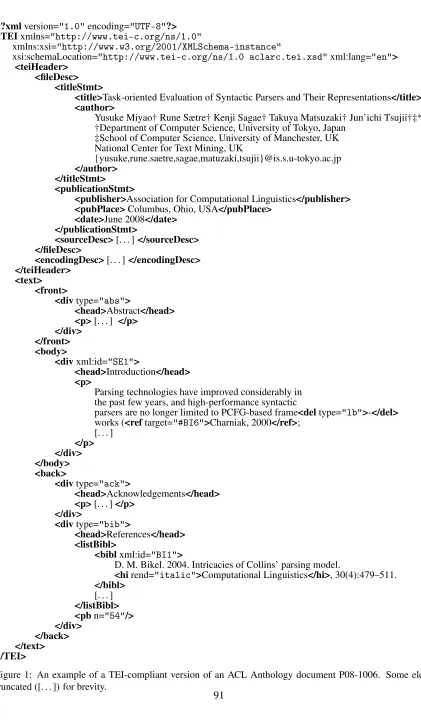
An example of a TEI version of an ACL Anthol-ogy paper is depicted in Figure 1 on the next page.
4 An Overview of the Contributed Task
The goal of the ACL 2012 Contributed Task is to provide a high-quality version of the textual content of the ACL Anthology as a corpus. Its rich text XML markup will contain information on logical document structure such as section headings, foot-notes, table and figure captions, bibliographic ref-erences, italics/emphasized text portions, non-latin scripts, etc.
The initial source are the PDF documents of the Anthology, processed with different text extraction methods and tools that output XML/HTML. The in-put to the task itself then consists of two XML for-mats:
• PaperXML from the ACL Anthology Search-bench6 (Schäfer et al., 2011) provided by DFKI Saarbrücken, of all approximately 22,500 papers currently in the Anthology (ex-cept ROCLING which are mostly in Chi-nese). These were obtained by running a com-mercial OCR program and applying logical markup postprocessing and conversion to XML (Schäfer & Weitz, 2012).
5http://www.tei-c.org/Roma/ 6http://aclasb.dfki.de
<?xmlversion="1.0"encoding="UTF-8"?> <TEIxmlns="http://www.tei-c.org/ns/1.0"
xmlns:xsi="http://www.w3.org/2001/XMLSchema-instance"
xsi:schemaLocation="http://www.tei-c.org/ns/1.0 aclarc.tei.xsd"xml:lang="en"> <teiHeader>
<fileDesc> <titleStmt>
<title>Task-oriented Evaluation of Syntactic Parsers and Their Representations</title> <author>
Yusuke Miyao† Rune Sætre† Kenji Sagae† Takuya Matsuzaki† Jun’ichi Tsujii†‡* †Department of Computer Science, University of Tokyo, Japan
‡School of Computer Science, University of Manchester, UK National Center for Text Mining, UK
{yusuke,rune.saetre,sagae,matuzaki,tsujii}@is.s.u-tokyo.ac.jp </author>
</titleStmt> <publicationStmt>
<publisher>Association for Computational Linguistics</publisher> <pubPlace>Columbus, Ohio, USA</pubPlace>
<date>June 2008</date> </publicationStmt>
<sourceDesc>[. . . ]</sourceDesc> </fileDesc>
<encodingDesc>[. . . ]</encodingDesc> </teiHeader>
<text> <front>
<divtype="abs">
<head>Abstract</head> <p>[. . . ] </p>
</div> </front> <body>
<divxml:id="SE1">
<head>Introduction</head> <p>
Parsing technologies have improved considerably in the past few years, and high-performance syntactic
[image:4.612.77.498.36.760.2]parsers are no longer limited to PCFG-based frame<deltype="lb">-</del> works (<reftarget="#BI6">Charniak, 2000</ref>;
[. . . ] </p> </div> </body> <back>
<divtype="ack">
<head>Acknowledgements</head> <p>[. . . ]</p>
</div>
<divtype="bib">
<head>References</head> <listBibl>
<biblxml:id="BI1">
D. M. Bikel. 2004. Intricacies of Collins’ parsing model.
<hirend="italic">Computational Linguistics</hi>, 30(4):479–511. </bibl>
[. . . ] </listBibl> <pbn="54"/> </div>
</back> </text> </TEI>
• TEI P5 XML generated byPDFExtract. For pa-pers from after 1999, an additional high-quality extraction step took place, applying state-of the art word boundary and layout recognition methods directly to the native, logical PDF structure (Berg et al., 2012). As no charac-ter recognition errors occur, this will form the master format for textual content if available.
Because both versions are not perfect, a large, ini-tial part of the Contributed Task requires automat-ically adding missing or correcting markup, using information from OCR where necessary (e.g. for ta-bles). Hence, for most papers from after 1999 (cur-rently approx. 70% of the papers), the Contributed Task can make use of both representations simulta-neously.
The role ofpaperXMLin the Contributed Task is to serve as fall-back source (1) for older, scanned papers (mostly published before the year 2000), for which born-digital PDF sources are not available, or (2) for born-digital PDF papers on which the
PDFExtractmethod failed, or (3) for document parts where PDFExtract does not output useful markup such as currently for tables, cf. Section 4.2 below.
A big advantage ofPDFExtractis its ability to ex-tract the full Unicode character range without char-acter recognition errors, while the OCR-based ex-traction methods in our setup are basically limited to Latin1 characters to avoid higher recognition er-ror rates.
We proposed the following eight areas as possible subtasks towards our goal.
4.1 Subtask 1: Footnotes
The first task addresses identification of footnotes, assigning footnote numbers and text, and generating markup for them in TEI P5 style. For example: We first determine lexical heads of nonterminal nodes by using Bikel's implementation of Collins' head detection algorithm <note place="foot" n="9">
<hi rend="monospace">http://www.cis.upenn.edu/ ~dbikel/software.html</hi>
</note>
(<ref target="#BI1">Bikel, 2004</ref>; <ref target="#BI11">Collins, 1997</ref>).
Footnotes are handled to some extent in PDFEx-tract andpaperXML, but the results require refine-ment.
4.2 Subtask 2: Tables
Task 2 identifies figure/table references in running text and links them to their captions. The latter will also have to be distinguished from running text. Furthermore, tables will have to be identified and transformed into HTML style table markup. This is currently not generated by PDFExtract, but the OCR tool used forpaperXML generation quite re-liably recognizes tables and transforms tables into HTML. Thus, a preliminary solution would be to in-sert missing table content inPDFExtractoutput from the OCR results. In the long run, implementing table handling inPDFExtractwould be desirable.
<ref target="#TA3">Table 3</ref> shows the time for parsing the entire AImed corpus,... <figure xml:id="TA3">
<head>Table 3: Parsing time (sec.)</head> <!-- TEI table content markup here --> </figure>
4.3 Subtask 3: Bibliographic Markup
The purpose of this task is to identify citations in text and link them to the bibliographic references listed at the end of each paper. In TEI markup, bibli-ographies are contained inlistBiblelements. The contents oflistBiblcan range from formatted text to moderately-structured entries (biblStruct) and fully-structured entries (biblFull). For example:
We follow the PPI extraction method of
<ref target="#BI39">Sætre et al. (2007)</ref>, which is based on SVMs ...
<div type="bib">
<head>References</head> <listBibl>
<bibl xml:id="BI39">
R. Sætre, K. Sagae, and J. Tsujii. 2007. Syntactic features for protein-protein interaction extraction. In
<hi rend="italic">LBM 2007 short papers</hi>. </bibl>
</listBibl> </div>
A citation extraction and linking tool that is known to deliver good results on ACL Anthology papers (and even comes with CRF models trained on this corpus) is ParsCit (Councill et al., 2008). In this volume, Nhat & Bysani (2012) provide an im-plementation for this task using ParsCit and discuss possible further improvements.
4.4 Subtask 4: De-hyphenation
BothpaperXMLandPDFExtractoutput contain soft hyphenation indicators at places where the original paper contained a line break with hyphenation. In
paperXML, they are represented by the Unicode soft hyphen character (in contrast to normal dashes that also occur). PDFExtract marks hyphenation from the original text using a special element. How-ever, both tools make errors: In some cases, the hy-phens are in fact hard hyhy-phens. The idea of this task is to combine both sources and possibly ad-ditional information, as in general the OCR pro-gram used for paperXML more aggressively pro-poses de-hyphenation than PDFExtract. Hyphen-ation in names often persists in paperXML and therefore remains a problem that will have to be ad-dressed as well. For example:
In this paper, we present a comparative eval<del type="lb">-</del>uation of syntactic parsers and their output
represen<del type="lb">-</del>tations based on different frameworks:
4.5 Subtask 5: Remove Garbage such as Leftovers from Figures
In both paperXML and PDFExtract output, text remains from figures, illustrations and diagrams. This occurs more frequently in paperXML than in
PDFExtract output because text in bitmap figures undergoes OCR as well. The goal of this subtask is to recognize and remove such text.
Bitmaps in born-digital PDFs are embedded ob-jects for PDFExtractand thus can be detected and encoded within TEI P5 markup and ignored in the text extraction process:
<figure xml:id="FI3">
<graphic url="P08-1006/FI3.png" /> <head>
Figure 3: Predicate argument structure </head>
</figure>
4.6 Subtask 6: Generate TEI P5 Markup for Scanned Papers frompaperXML
Due to the nature of the extraction process, PDFEx-tract output is not available for older, scanned pa-pers. These are mostly papers from before 2000, but also e.g. EACL 2003 papers. On the other hand, pa-perXMLversions exist for almost all papers of the
ACL Anthology, generated from OCR output. They still need to be transformed to TEI P5, e.g. using XSLT. ThepaperXMLformat and transformation to TEI P5 is discussed in Schäfer & Weitz (2012) in this volume.
4.7 Subtask 7: Add Sentence Splitting Markup
Having a standard for sentence splitting with unique sentence IDs per paper to which everyone can refer to later could be important. The aim of this task is to add sentence segmentation to the target markup. It should be based on an open source tokenizer such as JTok, a customizable open source tool7that was also used for the ACL Anthology Searchbench semantic index pre-processing, or the Stanford Tokenizer8. <p><s>PPI extraction is an NLP task to identify protein pairs that are mentioned as interacting in biomedical papers.</s> <s>Because the number of biomedical papers is growing rapidly, it is impossible for biomedical researchers to read all papers relevant to their research; thus, there is an emerging need for reliable IE technologies, such as PPI identification. </s></p>
4.8 Subtask 8: Math Formulae
Many papers in the Computational Linguistics area, especially those dealing with statistical natural lan-guage processing, contain mathematical formulae. Neither paperXML nor PDFExtract currently pro-vide a means to deal with these.
A math formula recognition is a complex task, in-serting MathML9formula markup from an external tool (formula OCR, e.g. from InftyReader10) could be a viable solution.
For example, the following could become the tar-get format of MathML embedded in TEI P5, for ∃δ>03 f(x)<1:
<mrow>
<mo> there exists </mo> <mrow>
<mrow>
<mi> Δ <!--GREEK SMALL DELTA--></mi> <mo> > </mo>
<mn> 0 </mn>
7http://heartofgold.opendfki.de/repos/trunk/
jtok; LPGL license
8http://nlp.stanford.edu/software/tokenizer.
shtml; GPL V2 license
9http://www.w3.org/TR/MathML/
</mrow>
<mo> such that </mo> <mrow>
<mrow>
<mi> f </mi>
<mo> ࠍ <!--FUNCTION APPL.--></mo> <mrow>
<mo> ( </mo> <mi> x </mi> <mo> ) </mo> </mrow> </mrow>
<mo> < </mo> <mn> 1 </mn> </mrow> </mrow> </mrow>
An alternative way would be to implement math formula recognition directly in PDFExtract using methods known from math OCR, similar to the page layout recognition approach.
5 Discussion—Outlook
Through the ACL 2012 Contributed Task, we have taken a (small, some might say) step further towards the goal of a high-quality, rich-text version of the ACL Anthology as a corpus—making available both the original text and logical document structure.
Although many of the subtasks sketched above did not find volunteers in this round, the Contributed Task, in our view, is an on-going, long-term com-munity endeavor. Results to date, if nothing else, confirm the general suitability of (a) using TEI P5 markup as a shared target representation and (b) ex-ploiting the complementarity of OCR-based tech-niques (Schäfer & Weitz, 2012), on the one hand, and direct interpretation of born-digital PDF files (Berg et al., 2012), on the other hand. Combin-ing these approaches has the potential to solve the venerable challenges that stem from inhomogeneous sources in the ACL Anthology—e.g. scanned, older papers and digital newer papers, generated from a broad variety of typesetting tools.
However, as of mid-2012 there still is no ready-to-use, high-quality corpus that could serve as a shared starting point for the range of Anthology-based NLP activities sketched in Section 1 above. In fact, we remain slightly ambivalent about our recommenda-tions for utilizing the current state of affairs and ex-pected next steps—as we would like to avoid much
work getting underway with a version of the corpus that we know is unsatisfactory. Further, obviously, versioning and well-defined release cycles will be a prerequisite to making the corpus useful for compa-rable research, as discussed by Bird et al. (2008).
In a nutshell, we see two possible avenues for-ward. For the ACL 2012 Contributed Task, we col-lected various views on the corpus data (as well as some of the source code used in its production) in a unified SVN repository. Following the open-source, crowd-sourcing philosophy, one option would be to make this repository openly available to all inter-ested parties for future development, possibly aug-menting it with support infrastructure like, for ex-ample, a mailing list and shared wiki.
At the same time, our experience from the past months suggests that it is hard to reach sufficient momentum and critical mass to make substantial progress towards our long-term goals, while con-tributions are limited to loosely organized volun-teer work. A possibility we believe might overcome these limitations would be an attempt at formaliz-ing work in this spirit further, for example through a funded project (with endorsement and maybe finan-cial support from organizations like the ACL, ICCL, AFNLP, ELRA, or LDC).
A potential, but not seriously contemplated ‘busi-ness model’ for the ACL Anthology Corpus could be that only groups providing also improved versions of the corpus would get access to it. This would contradict the community spirit and other demands, viz. that all code should be made publicly available (as open source) that is used to produce the rich-text XML for new papers added to the Anthology. To de-cide on the way forward, we will solicit comments and expressions of interest during ACL 2012, in-cluding of course from the R50 workshop audience and participants in the Contributed Task. Current results and status updates will always be accessible through the following address:
http://www.delph-in.net/aac/
The ACL publication process for conferences and workshops already today supports automated collec-tion of metadata and uniform layout/branding. For future high-quality collections of papers in the area of Computational Linguistics, the ACL could think
about providing extended macro packages for con-ferences and journals that generate rich text and doc-ument structure preserving (TEI P5) XML versions as a side effect, in addition to PDF generation. Tech-nically, it should be possible in both LATEX and (for
sure) in word processors such as OpenOffice or MS Word. It would help reducing errors induced by the tedious PDF-to-XML extraction this Contributed Task dealt with.
Finally, we do think that it will well be possible to apply the Contributed Task ideas and machinery to scientific publications in other areas, including the envisaged NLP research and existing NLP applica-tions for search, terminology extraction, summariza-tion, citation analysis, and more.
6 Acknowledgments
The authors would like to thank the ACL, the work-shop organizer Rafael Banchs, the task contributors for their pioneering work, and the NUS group for their support. We are indebted to Rebecca Dridan for helpful feedback on this work.
The work of the first author has been funded by the German Federal Ministry of Education and Research, projects TAKE (FKZ 01IW08003) and Deependance (FKZ 01IW11003). The second and third authors are supported by the Norwegian Re-search Council through the VerdIKT programme.
References
Abu-Jbara, A., & Radev, D. (2011). Coherent citation-based summarization of scientific papers. InProceedings of the 49th annual meeting of the association for computational linguistics: Human language techologies (pp. 500–509). Portland, OR.
Agarwal, N., Reddy, R. S., Gvr, K., & Rosé, C. P. (2011a). Scisumm: A multi-document summa-rization system for scientific articles. In Proceed-ings of the ACL-HLT 2011 system demonstrations
(pp. 115–120). Portland, OR.
Agarwal, N., Reddy, R. S., Gvr, K., & Rosé, C. P. (2011b). Towards multi-document summarization of scientific articles: Making interesting compar-isons with SciSumm. InProceedings of the work-shop on automatic summarization for different
genres, media, and languages (pp. 8–15). Port-land, OR.
Anderson, A., McFarland, D., & Jurafsky, D. (2012). Towards a computational history of the ACL:1980–2008. In Proceedings of the ACL-2012 main conference workshop: Rediscovering 50 years of discoveries. Jeju, Republic of Korea.
Athar, A. (2011). Sentiment analysis of citations us-ing sentence structure-based features. In Proceed-ings of the ACL 2011 student session(pp. 81–87). Portland, OR.
Ba´nski, P., & Przepiórkowski, A. (2009). Stand-off TEI annotation: the case of the National Corpus of Polish. In Proceedings of the third linguistic annotation workshop(pp. 64–67). Suntec, Singa-pore.
Berg, Ø. R., Oepen, S., & Read, J. (2012). To-wards high-quality text stream extraction from PDF. Technical background to the ACL 2012 Contributed Task. In Proceedings of the ACL-2012 main conference workshop on Rediscover-ing 50 Years of Discoveries. Jeju, Republic of Korea.
Bird, S., Dale, R., Dorr, B., Gibson, B., Joseph, M., Kan, M.-Y., Lee, D., Powley, B., Radev, D., & Tan, Y. F. (2008). The ACL Anthology Reference Corpus: A reference dataset for bibliographic re-search in computational linguistics. In Proceed-ings of the sixth international conference on lan-guage resources and evaluation (LREC-08). Mar-rakech, Morocco.
Councill, I. G., Giles, C. L., & Kan, M.-Y. (2008). ParsCit: An open-source CRF reference string parsing package. In Proceedings of LREC-2008
(pp. 661–667). Marrakesh, Morocco.
Dahlmeier, D., Ng, H. T., & Tran, T. P. (2011). NUS at the HOO 2011 pilot shared task. InProceedings of the generation challenges session at the 13th european workshop on natural language genera-tion(pp. 257–259). Nancy, France.
Dale, R., & Kilgarriff, A. (2010). Helping Our Own: Text massaging for computational linguistics as a new shared task. InProceedings of the 6th inter-national natural language generation conference.
Daudaraviˇcius, V. (2012). Applying collocation seg-mentation to the ACL Anthology Reference Cor-pus. InProceedings of the ACL-2012 main con-ference workshop: Rediscovering 50 years of dis-coveries. Jeju, Republic of Korea.
Dong, C., & Schäfer, U. (2011). Ensemble-style self-training on citation classification. In Pro-ceedings of 5th international joint conference on natural language processing(pp. 623–631). Chi-ang Mai, Thailand.
Gupta, P., & Rosso, P. (2012). Text reuse with ACL: (upward) trends. In Proceedings of the ACL-2012 main conference workshop: Rediscov-ering 50 years of discoveries. Jeju, Republic of Korea.
Gupta, S., & Manning, C. (2011). Analyzing the dynamics of research by extracting key aspects of scientific papers. InProceedings of 5th interna-tional joint conference on natural language pro-cessing(pp. 1–9). Chiang Mai, Thailand.
Hall, D., Jurafsky, D., & Manning, C. D. (2008). Studying the history of ideas using topic models. InProceedings of the 2008 conference on empir-ical methods in natural language processing(pp. 363–371). Honolulu, Hawaii.
Johri, N., Ramage, D., McFarland, D., & Jurafsky, D. (2011). A study of academic collaborations in computational linguistics using a latent mix-ture of authors model. InProceedings of the 5th ACL-HLT workshop on language technology for cultural heritage, social sciences, and humanities
(pp. 124–132). Portland, OR.
Johri, N., Roth, D., & Tu, Y. (2010). Experts’ retrieval with multiword-enhanced author topic model. InProceedings of the NAACL HLT 2010 workshop on semantic search (pp. 10–18). Los Angeles, California.
Mao, Y., Balasubramanian, K., & Lebanon, G. (2010). Dimensionality reduction for text using domain knowledge. In COLING 2010: Posters
(pp. 801–809). Beijing, China.
Mohammad, S., Dorr, B., Egan, M., Hassan, A., Muthukrishan, P., Qazvinian, V., Radev, D., & Za-jic, D. (2009). Using citations to generate surveys
of scientific paradigms. InProceedings of human language technologies: The 2009 annual confer-ence of the north american chapter of the associa-tion for computaassocia-tional linguistics(pp. 584–592). Boulder, Colorado.
Muthukrishnan, P., Radev, D., & Mei, Q. (2011). Si-multaneous similarity learning and feature-weight learning for document clustering. InProceedings of textgraphs-6: Graph-based methods for natu-ral language processing (pp. 42–50). Portland, OR.
Nhat, H. D. H., & Bysani, P. (2012). Linking ci-tations to their bibliographic references. In Pro-ceedings of the ACL-2012 main conference work-shop: Rediscovering 50 years of discoveries.Jeju, Republic of Korea.
Przepiórkowski, A. (2009). TEI P5 as an XML stan-dard for treebank encoding. InProceedings of the eighth international workshop on treebanks and linguistic theories(pp. 149–160). Milano, Italy.
Qazvinian, V., & Radev, D. R. (2008). Scientific paper summarization using citation summary net-works. InProceedings of the 22nd international conference on computational linguistics (COL-ING 2008)(pp. 689–696). Manchester, UK.
Qazvinian, V., & Radev, D. R. (2010). Identi-fying non-explicit citing sentences for citation-based summarization. InProceedings of the 48th annual meeting of the association for computa-tional linguistics (pp. 555–564). Uppsala, Swe-den.
Qazvinian, V., & Radev, D. R. (2011). Learning from collective human behavior to introduce di-versity in lexical choice. In Proceedings of the 49th annual meeting of the association for com-putational linguistics: Human language techolo-gies(pp. 1098–1108). Portland, OR.
Qazvinian, V., Radev, D. R., & Ozgur, A. (2010). Citation summarization through keyphrase ex-traction. InProceedings of the 23rd international conference on computational linguistics (COL-ING 2010)(pp. 895–903). Beijing, China.
Radev, D., & Abu-Jbara, A. (2012). Rediscovering ACL discoveries through the lens of ACL Anthol-ogy Network citing sentences. InProceedings of
the ACL-2012 main conference workshop: Redis-covering 50 years of discoveries. Jeju, Republic of Korea.
Radev, D., Muthukrishnan, P., & Qazvinian, V. (2009). The ACL Anthology Network corpus. In
Proceedings of the 2009 workshop on text and citation analysis for scholarly digital libraries.
Morristown, NJ, USA.
Radev, D. R., Muthukrishnan, P., & Qazvinian, V. (2009). The ACL Anthology Network. In Pro-ceedings of the 2009 workshop on text and cita-tion analysis for scholarly digital libraries (pp. 54–61). Suntec City, Singapore.
Reiplinger, M., Schäfer, U., & Wolska, M. (2012). Extracting glossary sentences from scholarly ar-ticles: A comparative evaluation of pattern boot-strapping and deep analysis. InProceedings of the ACL-2012 main conference workshop: Rediscov-ering 50 years of discoveries. Jeju, Republic of Korea.
Ritchie, A., Teufel, S., & Robertson, S. (2006a). Creating a test collection for citation-based IR ex-periments. InProceedings of the human language technology conference of the NAACL, main con-ference(pp. 391–398). New York City.
Ritchie, A., Teufel, S., & Robertson, S. (2006b). How to find better index terms through cita-tions. InProceedings of the workshop on how can computational linguistics improve information re-trieval?(pp. 25–32). Sydney, Australia.
Rozovskaya, A., Sammons, M., Gioja, J., & Roth, D. (2011). University of illinois system in HOO text correction shared task. InProceedings of the generation challenges session at the 13th euro-pean workshop on natural language generation
(pp. 263–266). Nancy, France.
Schäfer, U., & Kasterka, U. (2010). Scientific au-thoring support: A tool to navigate in typed cita-tion graphs. InProceedings of the NAACL HLT 2010 workshop on computational linguistics and writing: Writing processes and authoring aids
(pp. 7–14). Los Angeles, CA.
Schäfer, U., Kiefer, B., Spurk, C., Steffen, J., & Wang, R. (2011). The ACL Anthology
Search-bench. InProceedings of the ACL-HLT 2011 sys-tem demonstrations(pp. 7–13). Portland, OR.
Schäfer, U., & Weitz, B. (2012). Combining OCR outputs for logical document structure markup. Technical background to the ACL 2012 Con-tributed Task. In Proceedings of the ACL-2012 main conference workshop on Rediscovering 50 Years of Discoveries. Jeju, Republic of Korea.
Sim, Y., Smith, N. A., & Smith, D. A. (2012). Discovering factions in the computational linguis-tics community. In Proceedings of the ACL-2012 main conference workshop: Rediscovering 50 years of discoveries. Jeju, Republic of Korea.
TEI Consortium. (2012, February).TEI P5: Guide-lines for electronic text encoding and interchange.
(http://www.tei-c.org/Guidelines/P5)
Tu, Y., Johri, N., Roth, D., & Hockenmaier, J. (2010). Citation author topic model in expert search. In COLING 2010: Posters (pp. 1265– 1273). Beijing, China.
Vogel, A., & Jurafsky, D. (2012). He said, she said: Gender in the ACL anthology. InProceedings of the ACL-2012 main conference workshop: Redis-covering 50 years of discoveries. Jeju, Republic of Korea.
Xia, F., Lewis, W., & Poon, H. (2009). Language ID in the context of harvesting language data off the web. In Proceedings of the 12th conference of the european chapter of the ACL (EACL 2009)
(pp. 870–878). Athens, Greece.
Xia, F., & Lewis, W. D. (2008). Repurposing the-oretical linguistic data for tool development and search. InProceedings of the third international joint conference on natural language processing: Volume-i(pp. 529–536). Hyderabad, India.
Zesch, T. (2011). Helping Our Own 2011: UKP lab system description. In Proceedings of the generation challenges session at the 13th euro-pean workshop on natural language generation