This is a repository copy of
Entropic barriers for two-dimensional quantum memories
.
White Rose Research Online URL for this paper:
http://eprints.whiterose.ac.uk/99997/
Version: Accepted Version
Article:
Brown, BJ, Al-Shimary, A and Pachos, JK (2014) Entropic barriers for two-dimensional
quantum memories. Physical Review Letters, 112 (12). 120503. ISSN 0031-9007
https://doi.org/10.1103/PhysRevLett.112.120503
[email protected] https://eprints.whiterose.ac.uk/
Reuse
Unless indicated otherwise, fulltext items are protected by copyright with all rights reserved. The copyright exception in section 29 of the Copyright, Designs and Patents Act 1988 allows the making of a single copy solely for the purpose of non-commercial research or private study within the limits of fair dealing. The publisher or other rights-holder may allow further reproduction and re-use of this version - refer to the White Rose Research Online record for this item. Where records identify the publisher as the copyright holder, users can verify any specific terms of use on the publisher’s website.
Takedown
If you consider content in White Rose Research Online to be in breach of UK law, please notify us by
Benjamin J. Brown,1, 2,∗ Abbas Al-Shimary,2 and Jiannis K. Pachos2 1
Quantum Optics and Laser Science, Blackett Laboratory, Imperial College London, Prince Consort Road, London, SW7 2AZ, United Kingdom
2
School of Physics and Astronomy, University of Leeds, Leeds, LS2 9JT, United Kingdom
Comprehensive no-go theorems show that information encoded over local two-dimensional topo-logically ordered systems cannot support macroscopic energy barriers, and hence will not maintain stable quantum information at finite temperatures for macroscopic timescales. However, it is still well motivated to study low-dimensional quantum memories due to their experimental amenability. Here we introduce a grid of defect lines to Kitaev’s quantum double model where different any-onic excitations carry different masses. This setting produces a complex energy landscape which entropically suppresses the diffusion of excitations that cause logical errors. We show numerically that entropically suppressed errors give rise to super-exponential inverse temperature scaling and polynomial system size scaling for small system sizes over a low-temperature regime. Curiously, these entropic effects are not present below a certain low temperature. We show that we can vary the system to modify this bound and potentially extend the described effects to zero temperature.
PACS numbers: 03.67.Pp,05.30.-d,61.43.Fs,03.67.Lx
It is not well understood what properties a locally in-teracting system needs to possess to maintain encoded quantum information at finite temperatures [1, 2]. In the presence of a finite temperature information encoded in the ground space of a gapped system will eventually decohere. This occurs when logical errors happen with high probability. Assuming that the thermal generation of errors follows Arrhenius’ law the corresponding coher-ence time is of the order of
τ ∼eβǫ, (1)
where ǫ is the energy cost of typically occurring errors that decohere information and β = 1/T is the inverse temperature.
Topological systems [3, 4] are popular platforms for quantum memories. They are resilient against local per-turbations that can cause coherent errors [5, 6]. They can also be easily modified to improve their resilience against probabilistic errors [7, 8]. Ideally, we would like the co-herence time of such systems to grow efficiently as we in-crease their linear sizeLat non-zero temperature. No-go theorems [9–11] show that two-dimensional topologically ordered Hamiltonians with local interactions must have a constant energy gap, ∆, between two ground states. For such systems we expectǫ∝∆ and from (1) we obtain a coherence time that is independent ofL[12, 13].
Pioneering work with three-dimensional models has shown the realisation of fragile glassy quantum sys-tems [14, 15]. These syssys-tems have local error excita-tions created with energy penalty ∆, while they can ther-mally increase their sizeξwith a logarithmic energy cost
ǫ∼κ∆ lnξ for some constantκ >0 [14, 16, 17]. Given the density of local excitations scales exponentially with inverse temperature,eβ∆, typical excitations incident to
the lattice have an average separationR ∼eβ∆/d, where
dis the dimensionality of the system. Assuming that the
memory decoheres when the sizeξof the errors becomes comparable toR, we find that the logical errors have an energy cost that grows linearly with inverse temperature,
ǫ ∼ β∆κ/d. From (1) we find that such systems have coherence times which scale super-exponentially with in-verse temperature
τ ∼eβ2κ∆2/d
. (2)
This also gives rise to polynomial system-size scaling in the limit of small system sizes. Indeed, at low tempera-tures whereR ∼Lwe obtain
τ ∼Lβκ∆, (3)
whereLis smaller than a critical sizeL∗which increases exponentially with β [15]. Such behaviour was coined
partial self correctionin Ref. [15].
Here we take an alternative approach to two-dimensional topological memories. We consider sys-tems where excitations areentropically steeredinto high-energy configurations. In particular, we introduce agrid of defects[18–20] to a topologically ordered model. For such a model we take Kitaev’sZN quantum double with
N > 2 [21], designed so that its anyonic excitations have differing masses. This imbalance, together with the presence of the grid, and the splitting structure of the anyon model, creates a complex energy landscape for errors diffusing across the lattice. We numerically demonstrate that this system exhibits super-exponential coherence scaling (2) withβin a low temperature regime, as well as coherence time scaling of the form of (3) in the limit of small system sizes. We observe that the super-exponential behaviour is witnessed only for a finite range of temperatures that is tuneable by the grid spac-ing. This is because the entropic effect is thermally acti-vated. Our model is a first step for combating tempera-ture errors with two-dimensional topological models that
2 λ X X† X† X Z Z Z† Z† XM X†
X† XM
ZM Z Z† Z† (b) (a) (c) (d) (h) (f) (g) (e) (i)
X X X2 X2
[image:3.612.57.297.50.247.2]Z† Z Z† Z Z Z2 Z2 X2 X X X X X2 X X X X X† X X X X†
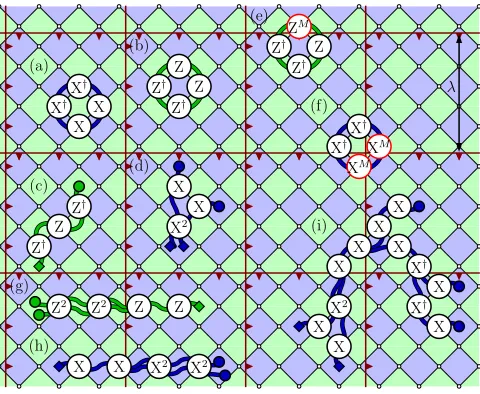
FIG. 1: Kitaev’sZN model on anL×Lperiodic lattice
mod-ified by an oriented defect grid. N-dimensional spins reside at the vertices of the lattice. (a) The primalAv and (b) the
dualBpoperators of the Hamiltonian. (c,d) String-like
oper-ators with anyonic excitations at their end-points. Modified dual (e) and primal (f) operators placed along the defect lines. (g,h) The charge of anyonic excitation crossing a defect line is multiplied byM. (i) A possible string operator with mul-tiple end-points. The energy or “mass” of such an operator increases with the number of anyons it creates, i.e. with the number of its end-points.
are experimentally amenable using existing technologies [22].
We begin the discussion by reviewing Kitaev’s ZN
quantum double model [21]. Consider N-level spins on the vertices of a diamond lattice, as shown in Fig. 1. The faces of the lattice are bicolored as primal (green) faces, v, and dual (blue) faces, p. We define the sys-tem size by arranging primal faces on an L×L peri-odic square lattice. The spins interact by mutually com-muting local projectors Pa
v and Qap for each v and p
respectively, where a ∈ 1,2, . . . , N −1. These projec-tors are given by Pa
v = N1 PN
k=1e2akπi/NAkv and Qap = 1
N PN
k=1e2akπi/NBpk, where Av(Bp) are known as
pri-mal (dual) operators, shown in Fig. 1(a) and (b), respec-tively. OperatorsXandZare generalised Pauli matrices withX|ki=|k+ 1(modN)iandZ|ki=e2πki/N|ki. We
then write the Hamiltonian
H =X
v
J·Pv+X
p
J·Qp, (4)
where J = (J1, J2, . . . , JN−1) are interaction strengths,
Pv= (Pv1, Pv2, . . . , PvN−1) andQp= (Q1p, Q2p, . . . , QNp−1).
The model has a N2-fold degeneracy, which we use for
the logical encoding space of the memory.
The excitations of Hamiltonian (4) are anyonic [4]. There are two anyonic flavours: electric anyons, ek, and
magnetic anyons,mk, which carry chargek= 1, . . . , N−
1. The ek and mk excitations live exclusively on the
primal and dual faces, respectively. In general, these anyons have different masses depending on the choice of
J. In fact, experimental architectures that may realise such a Hamiltonian are likely to have such an imbalance in masses [23]. In this work we consider particular mass imbalances which embellish the effects we demonstrate. The eigenvaluesE=Pk(nmk+nek)Jk of the
Hamilto-nian increase with the number of anyonsnaof typeathat
emerge as localised excitations. Examples of string op-erators that create anyons at their end points are shown in Fig. 1(c) and (d). String operators in this model for
N > 2 can split, as shown in Fig. 1(d). The allowed splitting channels are governed by the fusion rules that preserve the total charge moduloN [21].
We next consider the time evolution of the a lattice subject to an Ohmic heat bath. We model the bath by the spin-boson noise model in the Davies weak coupling limit. The thermal evolution of the lattice is determined by the rate equation [12, 24]
γ(ω) =ω/(1−e−βω), (5)
whereβ = 1/T is the inverse temperature of the model andωis the energy change due to the error operation. As this rate satisfies the detailed balance equation, it even-tually leads to a thermal stateρ∼e−βH. The induced phase-flip and bit-flip errors have equivalent effects on the lattice. As they can be considered independently of one another we model onlyXa
k type errors.
We simulate theekexcitations of theZ5-quantum
dou-ble model in a thermal environment using classical ran-dom walks. We define the coherence timeτto be the time where the probabilitypof recovering the encoded ground state falls below 0.99. We evaluatepusing 4·104 Monte
Carlo samples. For a single sample we encode the lattice in a specific ground state, and then simulate the lattice dynamics with respect to rate Eqn. (5) with inverse tem-perature β. We then attempt to recover the encoded information using a decoding algorithm. A decoder uses the positions of excitations on the lattice to predict the most likely error configuration consistent with the given anyonic configuration to attempt to recover the initially encoded ground state. We use the HDRG decoder de-scribed in Ref. [25]. We do not attempt to decode errors larger than L/3, as this reduces finite size effects when considering small lattices [15].
We identify the diffusive nature of excitations in two-dimensional systems in the low-temperature limit by evaluating coherence times for Hamiltonian (4) where
J1 = J4 ≡ JL = 0.38 and J2 = J3 ≡ JH = 1.0. We
examine the low temperature regime 6 <∼ β <∼ 9 where excitationse1ande4are created most commonly in pairs
with ∆ = 0.76. In this temperature regime we find
τ ∼e0.53β−2.5. We observe ǫ = 0.53 where remarkably
created at a rate exponentially suppressed by the Hamil-tonian gapγcrtn.∼e−β∆, the initially created excitations
can generate logical errors by thermal propagation, which occurs with rateγprgtn.∼1/β. Asγprgtn./γcrtn.diverges
withβ, the effect of errors caused by propagation become more appreciable as we decrease the temperature, thus resulting to an effective energy ǫ, which is smaller than the local error generation cost ∆.
To reduce the long range propagation of excitations at low temperatures we introduce charge M-modifying defect lines to the topological model. These lines map crossing excitations to excitations with different anyonic charge ek →el and ml →mk. The defect lines are
in-troduced in Hamiltonian (4) by modifying only the Pa v
andQa
pterms that lie along the red lines shown in Fig. 1.
We frame one side of the line which we mark with tri-angles. Along these lines we replace the primal and dual operators of projectorsPa
v andQap with newAv andBp
operators which are changed as follows: if a defect line lies on primal (dual) face v(p), then we raise the sup-port of theAv(Bp) operator the framed (unframed) side
of the defect line to the power M. We show explicit examples of modified Av and Bp operators in Fig. 1(e)
and (f). TheM-modifying defect lines affect theek (mk)
anyons crossing the line in the negative (positive) direc-tion by multiplying their charge by M modN, as shown in Fig. 1(g) and (h), respectively, forM = 2. The inverse operation occurs if an anyon crosses in the opposite di-rection. Here we take a regular defect grid of separation
λ, as shown in Fig. 1.
For concreteness we consider a grid ofM = 2 defects to the simulatedZ5model. In this case propagating low
mass excitations, e1 and e4, across the defect lines will
morph into excitations of higher mass,e2ande3, and are
thus energetically penalised by JH−JL. To see how a
defect grid encourages excitations to grow in mass with sizeξwe analyse the following common process. Consider the single high-mass excitation which has arisen from a low-mass excitation hopping a defect line. This excita-tion can continue to propagate across a subsequent defect line unimpeded. However, we chooseJL/JH andλsuch
that the high mass excitations decay rapidly into two low mass excitations via the fusion channels of the anyon model. This decay process is mediated by the heat bath. The propagation of the new pair of low mass excitations is further impeded by their enclosing defect lines. If these excitations further propagate through the grid then their mass is expected to further increase byJH−JL. Hence,
the total energy will increase as a function of ξ by the above mechanism. An example of a typical evolution is shown in Fig. 1(i). Nevertheless, it is possible, though unlikely, that the high mass excitation propagates with-out decay and crosses defect lines withwith-out any energy penalty. This process can be suppressed by choosing the distance between defect lines,λ, large.
To identify the new dynamics introduced by the
de-0 10 20 30 40 50 0.8
0.9 1 1.1 1.2 1.3
0.7 0.9 1.1 1.3 1.5
t
M
a
s
s
S
p
re
a
d
Τgr id
[image:4.612.322.561.57.201.2]Τno gr id Spr ead, gr id Spr ead, no gr id Mass, gr id Mass, no gr id
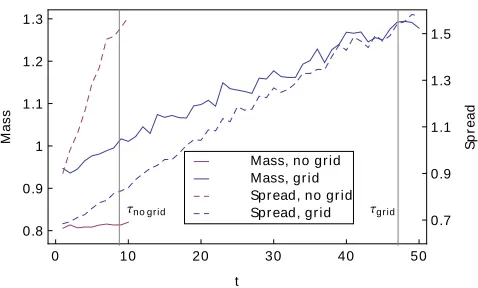
FIG. 2: The time evolution of an initial single pair of ex-citations subject to a thermal environment. We modify the environment so that excitations may only propagate, split and fuse. No new excitations can be created. The average total mass (solid lines) and average spread (dashed lines) of the evolution are depicted without (purple) and with (blue) a de-fect grid until thermalisation. In the absence of the grid the number of excitations remains constant, while they spread rapidly. In the presence of the grid the propagation of excita-tions is accompanied by a continuous increase in mass. At the same time the excitations spread with a slower velocity. The depicted thermalisation times, τno grid and τgrid, correspond
to the complete thermal evolution of the system. The evolu-tions are obtained forλ= 2, β= 8,JL= 0.4 on an L= 48
lattice. We average over one thousand samples.
fect line, we first study a single excitation on a lattice in Fig. 2. This is well motivated in the low tempera-ture regime where excitations are sparsely created. We study the mass of a single error which initially generates a pair of low mass excitations for a lattice withJL= 0.4,
JH= 1.0,λ= 2 andβ= 8.0. We monitor the increase in
mass due to the propagation of these excitations through the defect grid until the coherence time, τ, of the sys-tem. The solid blue line in Fig. 2 shows that the mass of the error grows as it diffuses over time. This contrasts from a single excitation on a lattice with no defects which does not appreciably increase in mass, shown by the solid purple line in Fig. 2. We consider also the rate at which errors diffuse over the lattice. We measure diffusion, by measuring average distance the excitation mass has trav-elled from the centre of mass of all the excitations on the lattice. We see that the energy barriers we introduce substantially slow the rate that excitations spread across the lattice, shown by the dotted blue and purple lines of Fig. 2. Hence, the presence of the defect grid signifi-cantly alters the dynamics involved in the propagation of excitations causing a dependence of the total energy on their spreadξ.
We now evaluate coherence times of a lattice with de-fect lines whereJL = 0.38 and JH = 1.0. We consider a
lattice where we alternate defect line separation between
4 æ æ æ æ æ æ æ æ æ æ æ æ æ æ æ æ æ æ æ æ æ æ æ æ æ æ æ æ æ æ æ
6 6.5 7 7.5 8 8.5 9
10 15 20 30 50 70 100 Β Τ 6 6.5 7 7.5 8 8.5 9
[image:5.612.322.564.48.213.2]-0.02 -0.01 0. 0.01 0.02 0.03 Β Residual Log Plot
FIG. 3: The coherence time, τ, of the system with defect grid as a function ofβ. We takeL= 72 and JL/JH = 0.38.
λalternates between 1 and 2 along the lattice in both direc-tions so that a variety of system sizes can be probed. Inset depicts the residual logarithmic plot ofτ. The purple points correspond to the linear fitting and the blue to the quadratic fitting. A super-exponential behaviour is obtained with fit-tingτ∼exp(0.028β2+ 0.54β−2.5) to be compared with (2).
The linear fit givesτ ∼exp(0.96β−4.0).
optimal results, but it enables us to probe small system sizes without affecting the ground state degeneracy of the lattice. The resulting coherence time as a function ofβ
is shown in Fig. 3 where L = 72. The data are well fit by the function τ ∼ e0.028β2+O(β)
. Hence, we identify weak super-exponential inverse temperature scaling. We also find polynomial system size scaling for small system sizes, where the degree of the polynomial scales linearly withβ, such thatτ ∼L0.11β+O(1), shown in Fig. 4. We
can compare these fittings with equation (2) and (3), re-spectively, to find ∆∼0.5 andκ∼0.2. The small value of κcompared with the cubic code values [15] is due to the small rate at which new excitations are created with
ξin our model.
Curiously, we do not experience super-exponential inverse-temperature scaling in the β → ∞ limit. If the temperature becomes too low, low-mass excitations will typically propagate by recombining with one another and move across defect lines as high mass excitations with no energy penalty. For fixed λ this process occurs expo-nentially more frequently than single low mass excita-tions propagating over defect lines as inverse tempera-ture increases. This is because recombination occurs at a lower energy cost,JH−2JL, than the process of a
low-mass excitation propagating across a defect line, which costsJH−JL. If this occurs readily we loose the
super-exponential inverse temperature scaling. We therefore require a suitably warm low-temperature environment to observe the effects we describe. To compensate this ef-fect we increaseλin order to reduce the rate of excitation recombination. We find for λ = 6 on L = 96 lattice a coherence time τ = exp(0.044β2−0.29β + 2.2) in the
12 18 24 30 10 15 20 30 50 L Τ æ æ æ æ æ æ æ æ
7.6 7.8 8 8.2 8.4 8.6 8.8 9 0.7 0.75 0.8 0.85 Β G
FIG. 4: The coherence time as a function ofL, using the same parameters as in Fig. 3. Fitting lines are displayed forβ= 7.6,7.8, . . . ,9.0 ordered from bottom to top. Inset depicts the gradientsGof the fitting for different temperatures, showing a polynomial degree that increases linearly withβ. Fitting givesτ ∼L0.11β−0.15to be compared with (3).
significantly lower temperature regime 13<∼β <∼16. Ide-ally we would like to simulate very low temperatures with large grid spacing, 1≪λ≪ R, where high-mass excita-tions decay with near certainty and thus optimiseκ. In the present case we see that forβ∼16 we haveǫ∼1.13, which is greater than the studiedλ = 1,2 case, where we find an optimalǫ∼1.04 at β∼9. This is suggestive that we may extend the described effects to lower tem-peratures by exploring a wider parameter space. It will be interesting if we can amplify the entropic effects we present here to find a parameter regime where ǫ ≫ ∆. We leave a comprehensive study of varyingλfor future work.
In this letter we have presented a two-dimensional topologically ordered memory that shows weak super-exponential inverse temperature scaling, and polynomial system size scaling for small system sizes in a low tem-perature regime. Remarkably, we achieve these effects by introducing charge modifying defect lines to the consid-ered model which entropically steer excitation dynamics into high energy configurations. We notice also that, due to recombination events, we do not observe these prop-erties at very low temperatures. We have presented pre-liminary results showing that we can overcome this by separating the defect grid as we lower the temperature.
[image:5.612.57.301.51.207.2]∗ Electronic address: [email protected] [1] E. Dennis, A. Kitaev, A. Landahl, and J. Preskill, J.
Math. Phys.43, 4452 (2002).
[2] D. Bacon, Phys. Rev. A73, 012340 (2006).
[3] X.-G. Wen, Quantum Field Theory of Many-Body Sys-tems (Oxford Graduate Texts, 2004).
[4] J. K. Pachos,Introduction to Topological Quantum Com-putation (Cambridge University Press, 2012).
[5] X.-G. Wen and Q. Niu, Phys. Rev. B41, 9377 (1990).
[6] S. Bravyi, M. B. Hastings, and S. Michalakis, J. Math. Phys.51, 093512 (2010).
[7] J. R. Wootton and J. K. Pachos, Phys. Rev. Lett.107,
030503 (2011).
[8] C. Stark, L. Pollet, A. Imamoˇglu, and R. Renner, Phys. Rev. Lett. 107, 030504 (2011).
[9] Z. Nussinov and G. Ortiz, Phys. Rev. B 77, 064302
(2008).
[10] S. Bravyi and B. Terhal, New J. Phys.11, 043029 (2009).
[11] O. Landon-Cardinal and D. Poulin, Phys. Rev. Lett.110,
090502 (2013).
[12] R. Alicki, M. Fannes, and M. Horodecki, J. Phys. A: Math. Theor.42, 065303 (2009).
[13] O. Viyuela, A. Rivas, and M. A. Martin-Delagado, New
J. Phys.14, 033044 (2012).
[14] C. Castelnovo and C. Chamon, Phil. Mag.92, 1 (2011).
[15] S. Bravyi and J. Haah, Phys. Rev. Lett. 111, 200501
(2013).
[16] J. P. Garrahan and M. E. J. Newman, Phys. Rev. E62,
7670 (2000).
[17] S. Bravyi and J. Haah, Phys. Rev. Lett. 107, 150504
(2011).
[18] S. Beigi, P. Shor, and D. Whalen, Commun. Math. Phys.
313, 351 (2012).
[19] A. Kitaev and L. Kong, Commun. Math. Phys.313, 351
(2012).
[20] M. Barkeshli, C.-M. Jian, and X.-L. Qi, arXiv:1305.7203 (2013).
[21] A. Y. Kitaev, Ann. Phys.303, 2 (2003).
[22] S. Gladchenko, D. Olaya, E. Dupont-Ferrier, B. Dou¸cot, L. B. Ioffe, and M. E. Gershenson, Nat. Phys. 5, 48
(2009).
[23] J. R. Wootton, V. Lahtinen, B. Dou¸cot, and J. K. Pachos, Ann. Phys.326, 2307 (2011).
[24] S. Chesi, B. R¨othlisberger, and D. Loss, Phys. Rev. A
82, 022305 (2010).