This is a repository copy of Transaction costs, power, and multi-level forest governance in Indonesia..
White Rose Research Online URL for this paper: http://eprints.whiterose.ac.uk/86165/
Version: Accepted Version
Article:
Gallemore, C, Di Gregorio, M, Moeliono, M et al. (2 more authors) (2015) Transaction costs, power, and multi-level forest governance in Indonesia. Ecological Economics, 114. 168 - 179. ISSN 0921-8009
https://doi.org/10.1016/j.ecolecon.2015.03.024
(c) 2015, Elsevier. Licensed under the Creative Commons Attribution-NonCommercial-NoDerivatives 4.0 International http://creativecommons.org/licenses/by-nc-nd/4.0/
[email protected] https://eprints.whiterose.ac.uk/ Reuse
Unless indicated otherwise, fulltext items are protected by copyright with all rights reserved. The copyright exception in section 29 of the Copyright, Designs and Patents Act 1988 allows the making of a single copy solely for the purpose of non-commercial research or private study within the limits of fair dealing. The publisher or other rights-holder may allow further reproduction and re-use of this version - refer to the White Rose Research Online record for this item. Where records identify the publisher as the copyright holder, users can verify any specific terms of use on the publisher’s website.
Takedown
If you consider content in White Rose Research Online to be in breach of UK law, please notify us by
Transaction Costs, Power, and Multi-Level Forest Governance in Indonesia
Caleb Gallemorea, Monica Di Gregoriob,c, Moira Moelionoc, Maria Brockhausc, Rut Dini Prasti H.d
Abstract:
Since 2005, there has been considerable international interest in Reducing Emissions from Deforestation and Forest Degradation (REDD+), a program intended to finance protection of tropical forests through the sale of carbon offsets or from donor funding. Requiring the collaboration of local and international civil society stakeholders, firms, and donor and host governments, REDD+ is inherently a mutli-level governance project, but to date participation in REDD+ and coordination across governmental levels has been weak. Combining literature on multi-level and polycentric governance of socioecological systems with transaction-cost economics, we argue that transaction costs structure cross-level information-sharing and collaboration relationships among organizations engaged in REDD+ policy development at the national and provincial levels in Indonesia. Using an exponential random graph modelling approach with data collected from interviews with over 80 organizations between 2010 and 2012, we find that powerful organizations tend to dominate cross-level connections, through this effect is somewhat mediated by organizational similarity, which reduces transaction costs. We suggest that explicit efforts to help local organizations overcome the transaction costs of building cross-level relationships will be a central component of building an effective and equitable multi-level governance system for REDD+ in Indonesia.
1. Introduction
During fieldwork for this article in 2010-2012, we asked about the future of Reducing Emissions from Deforestation and Forest Degradation (REDD+) in Indonesia. National government actors often pointed at Central Kalimantan, selected as a pilot province for REDD+ policy as part of a $1 billion forest protection agreement between the governments of Indonesia and Norway. Provincial officials, on the other hand, often looked to Jakarta. Despite nearly constant
conferences and workshops in both Jakarta and the provincial capital of Palangkaraya, attended by representatives of dozens and in some cases hundreds of interested organizations, REDD+
policy suffered from a “failure to communicate” across governmental levels (see Bache, et al.,
2014, for another example).
a
DepartmentofGeographyandEnvironmentalStudies,NortheasternIllinoisUniversity,UnitedStates b
SchoolofEarthandEnvironment,UniversityofLeeds,UnitedKingdom c
CenterforInternationalForestryResearch,Indonesia d
How can we account for this sub-optimal process? Following Leifeld and Schneider (2012), we suspect that transaction costs result in an underproduction of interaction in multi-level
governance systems. Working with other organizations requires dedication of staff time, material
resources, and – most importantly – building trust and gaining recognition as a reliable, even
necessary, partner. Organizational leaders constantly must weigh these costs and benefits of
networking. When costs are significant – as we expect them to be in the multi-level case – we
expect the most influential organizations will tend to dominate governance networks. Influence is important for a variety of reasons. First, it provides a proxy for institutional resources but, more importantly, influential organizations have the luxury of letting others come to them (Moeliono, et al., 2014; Leifeld and Schneider, 2012). We further expect organizations to take advantage of lower transaction costs afforded by institutional similarities, which should ease the challenges of building trust and regularizing exchanges.
Assessing the promises and pitfalls of multi-level relationships is a key area of inquiry in research on the governance of socioecological systems (Ostrom, 1990, 2005; Holling, et al., 2002; Berkes, 2002; Young, 2002; Armitage, 2008; Kok and Veldkamp, 2011; Gibson, 2000; Cash, et al., 2006; Vervoort, et al., 2012; Poteete, 2012), and the problem-solving potential of institutional systems integrating multiple governmental levels has been noted in the context of forest governance (Andersson and Ostrom, 2008; Nagendra and Ostrom, 2012), climate change mitigation (Ostrom, 2010, 2012), biodiversity (Galaz, et al., 2012; Gatzweiler, 2005), and water management (Huitema, et al., 2009).
Requiring effective integration of both local and national forest policies and institutions, REDD+ is inherently a multi-level enterprise (Korhonen-Kurki, et al., 2012), in which weak cross-level relationships can impose significant limitations on policy. A recent and salient political issue, REDD+ policy development in Indonesia provides an opportunity to study multi-level
governance systems as they emerge. Our research allows us to contribute to debates on multi-level governance by developing a theoretical account of the role of transaction costs in the evolution of multi-level governance systems, focusing specifically on the factors leading to the formation of cross-level relationships.
We also contribute to the debate on REDD+ by elucidating the barriers to cross-level information-sharing and cooperation in more detail than previous studies, relying upon
quantitative data from interviews with 81 organizations involved in REDD+ policy development in Indonesia at both the national level and in the REDD+ pilot province of Central Kalimantan. Like other recent studies of organizational relationships in multi-level governance systems (Leifeld & Schneider, 2012; Lee and van de Meene, 2012; Gerber, et al., 2013), we utilize an exponential random graph model (ERGM) framework to test our hypotheses that powerful organizations will dominate cross-level relationships and that organizational similarities will lead to more frequent cross-level connections. To our knowledge our approach is unique, however, in focusing specifically on cross-level connections, whereas previous studies have focused on a
a strong predictor of propensity to engage in cross-level information-sharing and collaboration, suggestive of transaction cost effects. In addition, we find a tendency for organizations to engage in cross-level relationships with organizations of the same type, though we find mixed support for the idea that differences in organizations’ policy perspectives impede collaboration.
Overall, the results suggest transaction costs are an important factor in multi-level governance, potentially inhibiting the development of effective and equitable multi-level governance systems. Mitigating transaction costs, we argue, should be a central component of efforts to build robust multi-level governance for REDD+.
We begin our discussion with an overview of our theoretical framework. Utilizing recent expansions of the concept of transaction costs to include cases of non-market interactions in areas like governance and policy development, we identify multiple costs involved in engaging with REDD+ policymaking and governance. After outlining our theoretical position, we examine the history of REDD+ policy development in Indonesia, with a particular focus on the
importance of cross-level connections. We then explain our data collection process and the exponential random graph model (ERGM) framework used to test the hypotheses developed in our theoretical section before presenting our results and discussing broader implications.
2. Multi-level Governance and Transaction Costs
As has been frequently noted, REDD+ is an inherently multi-level governance project (Skutsch & Van Laake, 2009; Forsyth, 2009; Schroeder, 2010; Doherty and Schroeder, 2011; Korhonen-Kurki, et al., 2012). Intended to protect forests through a transnational payment for ecosystem services scheme focused on carbon sequestration, REDD+ would ideally involve donor
government agencies, firms, host country governments, international organizations, civil society, and forest landholders, many of whom will have different interests in and knowledge about forest policy (Skutsch & Van Laake, 2009; Forsyth, 2009). Negotiating these multiple governance levels can be a challenge for some actors, who may have agency only in specific contexts (Schroeder, 2010). Conflicts of interest between agencies governing different sectors or operating at different governmental levels, policy stakeholders, and status quo interests, coupled with a lack of coordinated information between levels, provides an opportunity for powerful actors to control information and resource flows, directing institutional development according to their interests (Korhonen-Kurki, et al., 2012). As Korhonen-Kurki, et al., (2012) argue,
developing a robust multi-level governance framework for REDD+ would be one way to improve participation and potentially limit the ability of powerful groups to monopolize the policy process.
systems. A careful consideration of the role of transaction costs in impeding participation and providing opportunities for powerful groups can contribute significantly to our understanding of the challenges involved in developing robust multi-level governance systems for REDD+.
Literature on polycentric and multi-level governance highlights the importance of connections across governmental levels for the management of complex socio-ecological systems (Gupta, 2007, Bulkeley and Newell, 2010; Agrawal et al., 2013, Carlsson and Sandström, 2007, Crona and Hubacek, 2010, Prell et al., 2010, Cleaver, 2000; Rhodes, 1997; Poteete, 2013). Work on polycentric governance, associated most closely with the work of Elinor and Vincent Ostrom and their collaborators (Ostrom, et al., 1961; Ostrom, 1990, 2005), highlights the potential of semi-autonomous organizations engaged in regular communication and collaboration to address complex, multiscalar challenges. These benefits, however, obtain only to the extent that effective communication and information exchange occurs between the various groups involved in
governance projects (Ostrom, 2010; McGinnis, 2011, Galaz, et al., 2012; Baland and Platteau, 1996, Crona and Hubacek, 2010; Ostrom, 1990, Pinkerton, 1989, Andersson and Ostrom, 2008).
The closely related multi-level governance perspective (Hooghe & Marks, 2003) builds on the polycentricity literature’s images of flexible governance arrangements by including explicit considerations of governmental levels and multiscalar policy problems. Like the literature on polycentric governance, the multi-level governance literature emphasizes the importance of robust relationships of information exchange and collaboration across governmental levels. From this perspective, a central question is under what conditions these important cross-level relationships will form, but the causal mechanisms behind these connections have only recently
begun to be theorized, and, as Bache, et al. (2014) characterize it, multi-level governance “is
perhaps best understood as “a 'proto-theory' awaiting further theoretical refinement.”
Galaz, et al. (2012) provide a starting point for theorizing multi-level governance as a process. They suggest governance systems can evolve from “weak” polycentricity characterized by
limited communication networks to a “strong” polycentricity characterized by formalized
relationships and common projects. On this account, the increasing institutionalization of relationships resulting from routinizing interactions, developing common knowledge, and building trust can lead to more strongly institutionalized, but still flexible, governance systems.
As Galaz, et al. (2012) point out, the presence of institutional diversity does not necessarily translate into multi-level governance (see also Andersson and Ostrom, 2008; Huitema, et al., 2009; Gatzweiler, 2005). The case of the emergence of adapative governance of illegal, unreported, and unregulated fishing in the Southern Ocean reported by Österblom and Folke (2013) provides a positive example. In this case, an individual working with a small Norwegian NGO was able to use existing social connections to build interest in the issue, leading to
progressive institutionalization paralleling Galaz, et al.’s (2012) account. These initial contacts –
and the trust they embodied – were essential to later stages of organizational and institutional
climate change, ocean acidification, and marine biodiversity. The authors note that following the disappointment of the Copenhagen conference in 2009 the emerging network experienced a phase of fatigue. Lacking resources to support joint projects, the formation of a robust polycentric governance order stalled.
The two cases provide several important lessons. First, they highlight the cost-benefit analysis on the parts of organizations engaged in polycentic governance approaches. While the Southern Ocean case saw impressive success, the disappointing outcome of the Copenhagen conference led to some reconsideration on the part of organizations engaged in collaboration around climate change, ocean acidification, and marine biodiversity. Second, as Galaz, et al. (2012)
hypothesize, “internal tensions” limit actors’ ability to sustain polycentric governance. They note, in particular, that the differing mandates of scientific and political members of the climate change, ocean acidification, and marine biodiversity network led to trepidation on the part of some members. Finally, the cases highlight the importance of a strong base of trust. Both the Southern Ocean and the climate change, ocean acidification, and marine biodiversity efforts were initially launched as a result of repeated interactions of individuals working in similar sectors who we well acquainted with one another.
We believe it is possible to build on and generalize these observations by engaging with the
literature on transaction costs – the costs associated with engaging in a relationship (Coase,
1937; Williamson, 1975, 1979). As Williamson (1975, 1979) points out, investments in common knowledge, common language, trust, and, in some cases, infrastructure, can be necessary for certain exchanges to take place, creating demands for institutionalization to ensure investments in particular relationships are not wasted. While, as Paavola and Adger (2006) contend,
interdependence of any kind can generate demands for institutionalization to reduce transaction costs (see also Paavola, 2007), institutional solutions themselves entail transaction costs such as information search, monitoring, and trust building (Thompson, et al., 2013; Boulding, 2012; Murdie, 2013), producing a chicken-and-egg problem for emerging governance systems (Coggan, et al., 2010; Marshall, 2013). Especially early in the institutionalization process, transaction costs associated with the risk of cheating and uncertainty about future outcomes can be significant (Coggan, et al., 2010), requiring groups either to invest considerable time and effort in building relationships or else to accept the risk of working with a potentially unreliable partner (Boulding, 2012; Bob, 2005).
with technical and specialist language, or even modifying organizational missions, adding additional costs and potentially alienating supporters (Bob, 2005; Boulding, 2012), less
influential actors are likely to face an uphill struggle if they are to become important players in emerging networks.
These observations on transaction costs contextualize the Southern Ocean and climate change, ocean acidification, and biodiversity cases discussed above. Appearances notwithstanding, the cases began in favorable conditions: among a group of individuals with social connections to crucial organizations who knew one another and experienced low transaction costs by virtue of trust built in previous encounters. Additionally, these individuals for the most part shared common expertise and problem definitions, aside from the notable exception of scientific actors in the climate change, ocean acidification, and marine biodiversity case. Despite these
advantages, maintaining the relationships required time and effort and, when results were limited, the climate change, ocean acidification, and marine biodiversity network saw participation wane.
What happens when conditions are not so favorable? We have several reasons to expect the transaction costs involved in maintaining cross-level connections in Indonesia to be relatively high. First, as argued below, the history of forest policy in Indonesia has placed central actors like the Ministry of Forestry (MoF) at odds with more local actors, a situation likely to produce mistrust and reputational risk. Second, the information requirements for effectively engaging in
REDD+ policy are quite high – and much of the necessary information still does not exist. The
standardization of maps of forest areas and traditional territories has been an ongoing process for some time but remains incomplete, and the technical skills and language required to engage effectively in REDD+ debates can be quite demanding to acquire. Third, the fragmentation of organizational responsibilities due to differing legal frameworks means that information tends to be scattered across agencies at multiple levels. Fourth, continued corruption and patronage impose additional costs on relationships that can limit participation. Finally, REDD+ is a politically controversial issue, divisive even among groups favoring forest protection.
We should be clear why we focus more on mistrust and power than organizational resources in our hypotheses. While, as we noted, money and (particularly) time are crucial for maintaining collaborative relationships, we have reason to doubt that the lack of information-sharing and collaboration observed in our case results from resource constraints. As we discussed above, there has been considerable funding for meetings and workshops related to REDD+ in Central Kalimantan and Jakarta, and there have been numerous public opportunities for representatives of organizations engaged in REDD+ to interact.
relationships. We contend that influential organizations will be most active, while organizational differences will inhibit the formation of collaborative relationships.
At first, the idea that influential organizations are likely to be the most active might seem counterintuitive, given that such organizations can be selective about their partners.
Nevertheless, another advantage of power is that influential organizations can allow others to come to them, effectively pushing the costs of collaboration onto less influential actors. This leads us to our primary hypothesis:
H1: Controlling for organizational disagreement, more powerful organizations will be more
likely to engage in cross-level information sharing and collaboration.
The key term in this claim is “powerful.” We utilize organizations’ perceived influence over REDD+ policy as a holistic measure of power, opting for this measure because the resources an organization may have available to bring to bear on REDD+ policy issues are unlikely to be simply encompassed by ready cash or staff numbers and will also include legal, as well as less visible, informal forms of social power. In studies of policy networks, this measure is usually referred to as “reputational power” (Brass, 1984; Krackhardt, 1990) and has been found to be significant in similar work (Leifeld & Schneider, 2012). Using reputational power allows us to refine our first hypothesis:
H1A: Controlling for organizations’ positions on REDD+, organizations with higher reputational power will be more likely to engage in cross-level information sharing and collaboration.
Reputational risk or a lack of trust can lead organizations that disagree on important issues to choose to avoid contact altogether (Gallemore, et al., 2014; for a different perspective, see Leifeld & Schneider, 2012). Additionally, we expect these effects to be mitigated when
organizations are of the same type (i.e. both non-governmental organizations), as organizations of the same type will likely share more common interests and operating procedures and may have worked together on prior projects, as in the cases reported by Galaz, et al. (2012), Österblom and Bodin (2012), and Österblom and Folke (2013). Similar measures of organizational homophily have been found to be significant in other studies (Leifeld & Schneider, 2012; Gerber, et al., 2013; Gallemore, et al., 2014). By the same logic, we might expect organizations based in Indonesia to be more likely to work with Indonesian organizations, while transnational groups might be more apt to form relationships with other transnational groups. These considerations lead to three further hypotheses:
H2: Disagreement between organizations will be associated with a lower probability of
information sharing and collaboration.
H3: Organizations of the same type will be more likely to engage in cross-scale relationships
H4: Organizations based in Indonesia will be more likely to engage in cross-scale relationships
with one another than with organizations based abroad, and organizations based abroad will be more likely to engage in cross-scale relationships with one another than organizations based in Indonesia.
3. REDD+ Policy in Indonesia and Central Kalimantan
Reducing Emissions from Deforestation and Forest Degradation (REDD+) in Indonesia is a daunting task. In the face of contested claims to forest resources, only some of which have historically been recognized by the Indonesian government, forest policy is contentious. Since 2008, a variety of actors have been engaged in national REDD+ policy formulation and implementation across different levels in the country, work within a formally decentralized administrative governance structure (Colfer et al., 2008, Barr et al., 2006; Moeliono, et al., 2009). Not only is this structure being tested by REDD+, it is also being renegotiated to
accommodate the government’s to reduce carbon emissions by 26% (or up to 41% with
international assistance) by 2020 (Murdiyarso et al., 2011).
REDD+ in Indonesia is emerging in an already complex and conflict-prone governance
landscape, characterized by a legacy of struggles rooted in the Basic Forestry Law of 1967 (Barr, 2006). A promising source of state revenue (Barr, 2006) and patronage-based political power (Ross, 2001), timber was a logical target for government control, and the Basic Forestry Law declared approximately 75% of Indonesia's land national property, sweeping away traditional claims to forests. Struggle around decentralization and recentralization of forest resources renewed in earnest with democratization (Wollenberg, et al., 2009) is ongoing. Recent Indonesian Supreme Court decisions partially supporting district (Wells, et al., 2012) and indigenous (Agence France-Presse, 2013) control over forested areas raise new questions about the respective roles of different governmental levels in forested zones (Wells, et al., 2012). These developments, however, seem minor in comparison to the ongoing institutional crisis resulting from a bill passed by the Indonesian Parliament to end direct elections for key district officials (Parlina, 2014). As a result of ongoing tensions, district leaders continue to resent instructions from higher levels of government (Mulyani and Jepson, 2013), especially concerning the allocation of land.
At the time of our research, authority over REDD+ at the national level rested primarily with the Ministry of Forestry (MoF), whose leaders acted early to seize the field as REDD+ emerged as an international policy issue (Mulyani and Jepson, 2013; Scheyvens and Setyarso, 2010). Alongside the MoF, key national REDD+ actors include the Ministry of Environment, the National Planning Agency, the National Climate Change Council, established in 2008, and the National REDD+ Taskforce, replaced in 2013 by a formal ministerial-level REDD+
The REDD+ Management Agency is tasked with the implementation of the National REDD+
Strategy, based on the idea of a “nested” REDD+ system (Pedroni, et al., 2009) in which local
projects would be integrated within a national framework (Indonesian REDD+ Task Force, 2012). Coordinating diverse agencies across multiple levels will certainly be a challenge. In wide-reaching interviews of actors involved in REDD+ policy development in the country, Mulyani and Jepson (2013) found almost universal agreement that a lack of coordination and outright conflict between different sectoral agencies and governmental levels contributed to the slow process of REDD+ policy development (see also Indrarto, et al., 2012; Moeliono, et al., 2014; Gallemore, et al., 2014).
The best available evidence of how these challenges might play out is found in Central Kalimantan, a province on the island of Borneo selected to pilot jurisdiction-wide REDD+ initatives under a $1 billion agreement with the government of Norway (Butler, 2010). As REDD+ policy was developed, it became clear that, challenging as building effective
relationships with national actors might be, building similar relationships across level within the province itself could be difficult. Beginning around 2008, and almost independently of the national and provincial programs, Central Kalimantan played host to several REDD+ pilot projects and numerous other REDD-related activities undertaken by an assortment of NGOs, private firms, and donor country agencies. Feeling somewhat left behind, the provincial government engaged in concerted efforts to assess these initiatives in order to bring them together under the provincial REDD+ strategy required as part of the agreement with Norway (Gallemore, et al., 2014) REDD+ has brought Central Kalimantan considerable international attention, most recently from the World Bank, which has expressed interest in facilitating donor funding for REDD+ activities in the province (Dewan Perwakilan Rakyat Daerah Kalimantan Tengah, 2014). At the same time, the provincial government has stepped up outreach to local actors, working to support and monitor the nearly forty REDD-related projects that were underway in various parts of the province by 2013 (Migo, 2013). Confusion and coordination problems continue at the project level. Even when approved by the provincial government, district approval of sub-national pilot projects has in some cases taken years (Mulyani and Jepson, 2013).
4. Material and methods
to the provincial level. Ultimately, data from 81 organizations were usable for the purposes of the study, including provincial offices of national organizations, which were treated as separate entities. Representatives of these organizations selected by organizational leadership as resident experts on REDD+ policy were given a list of organizations active in REDD+ and asked to name those organizations with whom they regularly and routinely exchanged information.
Respondents also were asked to name those organizations with whom they collaborated on REDD+ policy, and whom they saw as being influential on REDD+ policy. These items were used to derive networks of collaboration and information sharing, as well as our measure of reputational power. In addition, representatives responded to a series of 35 five-point Likert-scale opinion items on various aspects of REDD+ policy, which were used to estimate
disagreement between organizations on REDD+ policy. Finally, we include data from 13 Likert-scale items eliciting organizations’ involvement in particular areas of REDD+ policy, which is used to control for an organization’s overall level of interest in REDD+ (see Appendix I for all items analyzed in the current study). In the vast majority of cases, surveys were administered via face-to-face interviews, generally 90 to 120 minutes in length. Seven interviews were conducted via telephone or videoconferencing. Where respondents agreed (in all but one case), interviews were recorded and transcribed to ensure data quality.
Adopting a social network analysis (SNA) approach (Wasserman and Faust, 1994), we model the relationships from our surveys as networks of nodes representing organizations, connected by edges or links representing the relationships in question. Because our two surveys were not originally designed to be combined, social network analysis measures conducted on the network that would result from combining these two surveys would likely be misleading. Instead of combining the networks, therefore, we create bipartite networks consisting only of cross-level relationships reported by respondents to the Central Kalimantan survey. After deleting
organizations for which data were missing, we have 29 provincial and 52 national organizations. This allows us to model the processes generating patterns of cross-level relationships without violating key assumptions of SNA.
We construct two cross-level networks using our survey data based on Central Kalimantan respondents’ reports of cross-level collaboration and information-sharing. The two SNA measures we utilize are reputational power (Brass, 1984; Krackhardt, 1990), and degree (Freeman, 1978). The reputational power of an organization, A, is the number of other organizations at their scale that name organization A as particularly influential on REDD+ policy, while degree is simply the number of times an organization reports engaging in a given relationship.
To test our hypotheses regarding multi-level relationships, we utilize a series of ERGMs. ERGM estimation is designed to correct a significant drawback in using regression models to analyze the structure of networks. The presence of an edge in a network cannot be assumed to be
between organizations A and B is correlated to the probability of observing an edge between organizations B and C. Logistic and probit regression, often used for binary outcomes, require observations to be independent, so in the presence of non-independence, which is almost always the case with network data, coefficient estimates can be biased and hypothesis tests unreliable. ERGMs address this challenge by treating the entire network as a single observation, which is understood to be drawn from the distribution of all possible networks with the same number of nodes (Cranmer and Desmarais, 2011; Hunter, et al., 2008a; Robins, et al., 2007). This avoids assuming observational independence. We estimate our models using the ergm package (Hunter, et al., 2008a; Handcock, et al., 2003) in R 3.0.1 (R Development Core Team, 2013).
Measures of model fit using ERGMs are still under development, but a common approach is to simulate a population of networks using the fitted model and then compare selected network statistics measured on the observed network to the distribution of those statistics in the simulated networks (Robins, et al, 2007). If most of the statistics for the observed network are not
statistically significantly different from the population of simulated networks (where the cutoff used is generally 0.05), the model is judged to be a good fit for the data (Hunter, et al., 2008b).
Utilizing ERGMs allow us to test the hypotheses outlined above while controlling for other factors driving network formation. Most importantly, the approach allows us to study the effects of reputational power while controlling for organizational differences, including disagreement on policy issues. Additionally, we can use our items regarding organizations’ REDD-related
activities to control for organizational interest in REDD+. This control should increase our confidence that we are capturing the effects of transaction costs limiting organizations’
networking activities, rather than factors affecting organizations’ level of activity in the issue
area.
Our modelling approach is broadly similar to Leifeld and Schneider’s (2012) study of the
German toxic chemicals policy network. Like these authors, we expect transaction costs to be an important determinant of interorganizational relationships. We depart from their work, however,
in a few key ways. First, we test the role of multiple forms of organizational homophily – in
reducing transaction costs, whereas Leifeld and Schneider (2012) consider this measure for only one organizational type. Second, we do not utilize information about collaboration relations in estimating our information-sharing model or vice-versa, as the two relationships are likely both endogenous and generated by common processes, meaning that the inclusion of one in a model of the other would likely mask the true variables of importance.
measured by the number of organizations in each network reporting the organization in question as influential on REDD+ policy, also in standard deviations (National Rep. Power and Provincial Rep. Power). Finally, to test the hypothesis that organizations of the same type will be more likely to share information and collaborate, we include indicators that both organizations in a relationship are of the same type (Academic/Research, Government, International Organization, Non-governmental Organization, or Private Sector; Type Homophily) or are both headquartered within or outside Indonesia (Abroad Homophily).
We also include several control variables. To account for organizations’ divergent levels of interest and involvement in REDD+, we include the mean value of organizations' responses to the 13 Likert-scale REDD-related activity items, in standard deviations (Prov. REDD+ Activity; Nat. REDD+ Activity). As additional controls, we add in a binary variable indicating an
organization's type, with Academic/Research organizations the reference category (Government
Agency – including donor government agencies, International Organization, Non-governmental
Organization, and Private Sector), as well as a binary variable indicating an organization is headquartered outside Indonesia (Abroad).
Finally, we include a series of variables to control for network effects. These include a geometrically weighted degree term (Hunter, 2007) for provincial and national organizations, which helps us control for unexplained variance in the number of edges incident on each national node (Prov. Geo. Degree; Nat. Geo. Degree). Due to issues with model degeneracy, the national version of this variable is included only in the information-sharing network models. We also include a control for the large numbers of isolates in each network (Prov. Isolates; Nat. Isolates).
5. Results
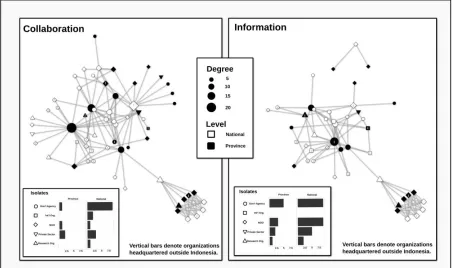
Our networks are presented in Figure 1. We can clearly see that cross-level connections are generally quite sparse, in keeping with our expectations of high transaction costs. In the collaboration network, only 7.5% of possible cross-level connections are present, while only 5.4% of possible connections are present in the information-sharing network. Many active provincial and national organizations report no cross-level connections. While this finding is
perhaps not surprising in the case of the national network – where many organizations simply
have little stake in events in Central Kalimantan – we find a relatively large number of isolated
provincial organizations, as well, particularly in the information-sharing network. In the collaboration network, 86% of provincial organizations report at least one cross-level
relationship, while 69% of national organizations have at least one reported relationship. In the sparser information-sharing network, 62% of provincial organizations report a cross-level relationship, while 52% of national organizations are involved in at least one such relationship.
government agency operating in the province that appears to be the most connected. With the exception of the clusters of cross-level connections between nongovernmental organizations found in the lower right-hand corner, few provincial organizations outside the government report
more than one or two cross-level relationships – again not surprising given the challenges of
building and maintaining such connections and the history of distrust between local and national actors. Interestingly, the cluster of nongovernmental organizations shares very few partners with government organizations in either the information-sharing or collaboration networks, indicative of a homophily effect.
Comparing the two networks is a bit puzzling. Given that collaboration implies a strong working
relationship, it was expected that the collaboration network – rather than the information-sharing
network – would require the most resources to maintain and hence would be more sparse. We
find the opposite. Much of the difference comes from a relatively large number of NGOs, academic organizations, and private sector organizations with low degrees in the collaboration network appearing as isolates in the information network. Because collaboration provides an opportunity to share resources or borrow prestige, these relationships could represent strategic collaborations despite that these organizations are not trusted sources of information, perhaps reflecting the cost-benefit calculations about relationships that we previously argued all organizations must make, a pattern similar to one noted by Leifeld and Schneider (2012). This interpretation becomes more plausible when we consider that the provincial government has
undertaken considerable outreach efforts – particularly to national NGOs – as part of the process
of developing policy and securing funding. While these organizations may not be important sources of information, they can be important sources of support. In any case, the finding is startling, given that and flows of information across levels are crucial to effective multilevel governance, and information asymmetries can create opportunities for powerful groups to structure emerging governance systems (Andersson, 2004; Young, 2006).
Figure 1: Collaboration and information-sharing networks, organizations sized by degree, organization types by shape, and governance level by color. Organizations based outside
Indonesia denoted by vertical gray bar. Visualized using ggplot2 (Wickham, 2009) in R 3.0.1 (R Development Core Team, 2013). Organizations are in the same position in both network
graphics.
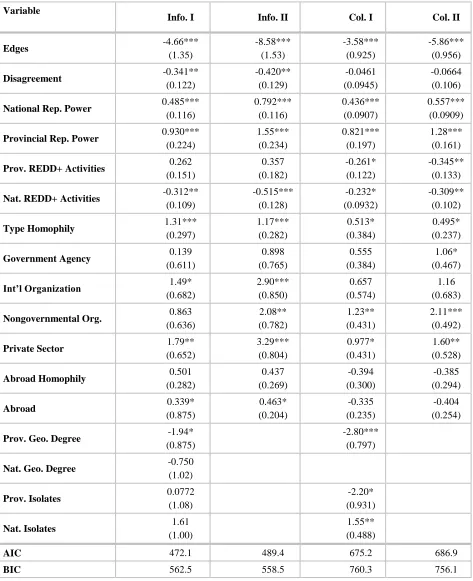
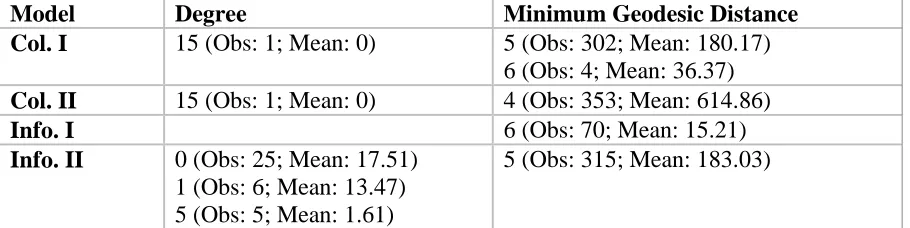
We estimate four models of the networks, two for each, allowing for comparisons of models with and without network controls (see Table 1). Goodness of fit measures for degree distribution and minimum geodesic distance (the length of the shortest path between pairs of nodes in the
network) are acceptable, only differing from the observed networks in a few instances (see Table 2). Model selection is a bit challenging, as the Aikaike Information Criteria (AIC) and the
[TABLE 1 ABOUT HERE]
Table 1: Exponential random graph model estimates of cross-level collaboration and information-sharing networks . * = sig. at 0.05, ** = sig. at 0.01, *** = sig. at 0.001.
[TABLE 2 ABOUT HERE]
Table 2: Goodness of fit indicators for estimated models for degree and minimum geodesic distance. Entries indicate values of each measure for which the observed network is significantly different from the simulated networks at the 0.05 level. Observed values and simulated means in parentheses. Goodness of fit was also checked with edgewise shared partners, but there were not statistically significant differences between the observed and the simulated networks on this measure.
We find national and provincial organizations’ reputational power to be statistically significant in
both networks, regardless of network controls, in keeping with what would be expected from a transaction cost perspective and consistent with other research (Leifeld &Schneider, 2012; Gallemore, et al., 2014). In other words, Hypothesis H1A, which claimed that organizations with greater reputational power would also be more likely to engage in multi-level relationships, performs well, and we find evidence that powerful organizations in both the national and the provincial levels tend to have more cross-level relationships.
Hypothesis H2, which suggested disagreement would be negatively related to cross-level connections, performs well in the information-sharing network, but not in the collaboration network. This is a relatively surprising finding, as collaboration seems to imply a strong
relationship, and we would not expect organizations to collaborate with groups with whom they disagree on policy issues. As noted above, however, it is possible that collaboration is
undertaken for strategic reasons and the potential exchange of resources outweighs the effect of disagreement. From a cost-benefit perspective, organizations might be more willing to accept resources and support from organizations with slightly different interests than to trust
information from organizations without shared values. There could be some interesting questions
about power relations here – as noted above, organizations may sometimes have to alter their
positions on issues in order to access support or resources from others (Bob, 2005; Boulding, 2012).
Type Homophily is positive and statistically significant in the information-sharing and
collaboration models, but Abroad Homophily is never statistically significant. This means that hypothesis H3, regarding the tendency of organizations to form relationships with organizations of the same type, also performs well, but this is not the case for hypothesis H4. Looking at the network maps in Figure 1, it is possible that this finding is in part due to the relatively low number of organizations headquartered outside Indonesia active at the provincial level. As there is considerable overlap between the Abroad variable and some of the types (especially
Homophily term. Then again, as most organizations headquartered abroad nevertheless employ primarily local staff, this variable might not be identifying particularly significant sources of mistrust or uncertainty.
Beyond our hypotheses, we have some interesting surprises. First, organizations that report involvement in a large variety of REDD+ activities are estimated to be significantly less likely to engage in cross-level relationships. This surprising finding holds for national organizations in both networks, as well as provincial organizations in the collaboration network, though the effect
is weak. This could be a measure of opportunity cost. As organizations’ activities diversify and
focus on on-the-ground efforts, this may make it harder to devote staff time and resources to maintaining relationships with other organizations. As we argued above, however, there are good reasons to think resource limitations are unlikely to explain limited information-sharing and collaboration, as meeting and workshop opportunities were heavily subsidized at the time of our research. It is possible that these more specialized organizations are simply less attractive as partners then generalists, which may have access to multiple sources of information or provide greater potential resources.
There are also some interesting results regarding organizational types. Transnational
organizations – particularly international organizations – have a very strong role in the
information-sharing network, while NGOs are particularly important actors in the collaboration network. One possible interpretation of this finding is that transnational actors can act as brokers and translators of international aspects of REDD+ policy, meaning their access to information may make them valuable information partners. The measure could also reflect that such organizations often have stakeholder outreach as an important mandate (Boulding, 2012).
Finally, we find that in both networks private sector organizations exhibit unexpectedly high cross-level engagement. This could be the result of several factors. First, private sector actors must engage with national, provincial, and district government agencies for permitting purposes. This is perhaps the strongest example of transaction costs being pushed to weaker actors.
Second, several private sector organizations active in Central Kalimantan are not headquartered in the province, and for these organizations the costs of working with organizations based in Jakarta may be smaller than the costs of working with provincial organizations.
6. Discussion and Policy Implications
Our results indicate the importance of the transaction costs involved in reducing uncertainty and mistrust in the evolution of multi-level governance. Powerful actors appear to be particularly important in controlling cross-level flows of information, as well as anchoring cross-level
in governance. We then examine emerging approaches that might be tuned to address some of these challenges.
Patterns of transaction costs are not neutral but are produced by and in turn reproduce power relations (Adger, et al., 2006). As we have argued, powerful organizations, in addition to their considerable resources, benefit from being able to push transaction costs onto others. At the same time, as organizations are pushed into the periphery of emerging governance networks, existing power relations may be reified. This can be particularly problematic when the most powerful organizations have historically supported business as usual.
The relatively weak cross-level relations between powerful actors and civil society are seen particularly strongly in our network maps, where we see very few cases of provincial
non-governmental organizations sharing information or collaborating with national actors that are not also non-governmental organizations. These visual findings, which stand up to statistical tests, are indicative of the lack of coordination and trust across governmental levels identified by other students of REDD+ policy development (Korhonen-Kurki, et al., 2012; Mulyani & Jepson, 2013).
In addition to the role of power in structuring cross-level relationships, we find evidence that other kinds of transaction costs impede the formation of relationships that might form a core like those that characterized the Southern Ocean and climate change, ocean acidification, and marine biodiversity cases (Galaz, et al., 2012; Österblom and Bodin, 2012; Österblom and Folke, 2013). While this might be expected in the case of organizational disagreement, homophily by
organizational type is somewhat more problematic, as cross-sector relationships are key to the development of robust multi-level governance.
There is an old joke in which someone gets lost on the way to an unfamiliar town. Upon asking for directions, the wayward traveler is told, “well, I wouldn’t start from here.” The formation of multi-level governance for REDD+ in Indonesia is in a similar state. Unlike the cases of the Southern Ocean and the climate change, ocean acidification, and marine biodiversity cases discussed in our theoretical section, the field of forest policy in Indonesia is characterized by mistrust, uncertainty, and powerful entrenched interests. Unlike in the two comparison cases, strong networks among organizations favoring significant change are not well placed to support further organization- and institution-building.
The chicken-and-egg problem is that REDD+ is starting from here in many cases, as are many other efforts to build multi-level environmental governance. Despite considerable resources devoted to workshops, conferences, and meetings, new cross-level relationships do not appear to have emerged. As one of us mentioned in discussing the issue, there are plenty of information highways, but there are not enough people on the road.
(McDermott, et al., 2012; Visseren-Hamakers, et al., 2012; Chhatre, et al., 2012). While robust participation is enshrined as a core value in existing REDD+ safeguard frameworks (REDD+ SES, 2012), our research suggests that rights to participation must be coupled with efforts to explicitly reduce transaction costs.
One possible model comes from Central Kalimantan itself. Since the time of our fieldwork, there has been considerable institutional development, at both the provincial and the national level, aimed at directly incorporating civil society representatives into the REDD+ governance process. Examples include the Environmental Stakeholder Forum, an institutionalized
coordination body established by the government of Central Kalimantan (United Nations Office for REDD+ Coordination in Indonesia, 2014) and the working groups within the REDD+ Agency (Badan Pengelola REDD+ Republic Indonesia, 2014). Similar institutional structures have been established in other REDD+ countries.
While the impact of these institutional structures remains to be assessed, they are promising. In addition to providing a forum for regularized interaction, these efforts could be seen as examples of “experimentalist governance” that potentially increase the stakes and rewards of collaboration and provide opportunities for peer review, learning, and building social trust (de Búrca,
Keohane, and Sabel, 2014). They have the added benefit of utilizing formalized rights of participation to place responsibility for overcoming transaction costs on the central actor
responsible for convening the forum. Still, such institutions remain within the shadow of existing institutional structures, which often support business-as-usual practices. Leveraging these nascent nodes of stakeholder engagement is likely to be an important objective for building multi-level environmental governance efforts, while counteracting exclusion of less powerful actors due to high transaction costs.
7. Conclusion
Multi-level governance systems have been advocated as an effective governance arrangement for socio-ecological systems. Given that such systems must evolve rather than springing from
design, the process leading to their formation should be of crucial importance for students of environmental governance. We have argued that the transaction costs involved in building robust cross-level relationships may impede the development of participatory multi-level governance precisely where it is most needed, as powerful actors are enabled to shape governance structures according to their own interests. Analyzing a survey of organizations engaged in REDD+ policy development at both the national and the sub-national scale in Indonesia, we find that powerful organizations dominate cross-level connections, though organizational similarities can mitigate transaction costs and increase opportunities for cross-level relationships.
Our results provide some insight into potential paths for building robust multi-level
relationships between different organizational types. This may point to the reason why the workshops and conferences noted at the outset of this article seem relatively ineffective: they are generally supporting relationship-building between organizations that already have strong
relationships. Second, collaborative relationships – in which organizations work on common
projects – seem to be more common in the cross-level context. Such relationships could provide
a context for building trust that could lead to more effective information sharing and
participation on the part of weaker parties. Of course, these initiatives on their own will not be able to address all the challenges transaction costs pose for the construction of multi-level governance. Even if transaction costs can be overcome, there is no guarantee that this effort alone will ensure that powerful actors will in fact listen. This leads to our third observation. Emerging institutions that incorporate civil society stakeholders directly into environmental governance could have transformative effects as such initiatives provide opportunities for collaboration and building trust while potentially increasing the returns to these relationships, encouraging further investment in collaboration. The assessment of these initiatives should be a priority for future studies of multi-level environmental governance in the context of mistrust, uncertainty, and unequal power relations.
REFERENCES
ADGER, W. N., BROWN, K., AND TOMPKINS, E. L. 2006. The political economy of cross-scale networks in resource co-management. Ecology and Society, 10(2): 9. [online] URL: http://www.ecologyandsociety.org/vol10/iss2/art9/.
AGENCE FRANCE-PRESSE. 2013. Indonesia court ruling boosts indigenous land rights. Jakarta Globe, 17 May. [online] URL: http://www.thejakartaglobe.com/news/indonesia-court-ruling-boosts-indigenous-land-rights/.
AGRAWAL, A., BROWN, D. G., RAO, G., RIOLO, R., ROBINSON, D. T. & BOMMARITO, M. 2013. Interactions between organizations and networks in common-pool resource
governance. Environmental Science & Policy, 25, 138-146.
ANDERSSON, K. P. 2004. Who talks with whom? The role of repeated interactions in decentralized forest governance. World Development, 32(2): 233-249.
ANDERSSON, K. P. & OSTROM, E. 2008. Analyzing decentralized resource regimes from a polycentric perspective. Policy Sciences, 41, 71-93.
ARMITAGE, D. 2008. Governance and the commons in a multi-level world. International Journal of the Commons, 2(1): 7-32.
BADAN PENGELOLA REDD+ REPUBLIK INDONESIA. 2014. Mengenai BP REDD+. REDD+ Agency Website. [online] URL: http://www.reddplus.go.id/tentang-redd/mengenai-bp-redd.
BALAND, J.-M. & PLATTEAU, J.-P. 1996. Halting degradation of natural resources: Is there a role for rural communities?, Oxford, Clarendon Press.
BARR, C. 2006. Forest administration and forestry sector development prior to 1998. In Decentralization of forest administration in Indonesia: implications for forest sustainability, economic development and community livelihoods. Barr, C., Resosudarmo, I. A. P., Dermawa, A., Mccarthy, J. F., Moeliono, M., and Setiono, B., eds. Bogor: Center for International Forestry Research, pp. 18-30.
BARR, C., RESOSUDARMO, I. A. P., DERMAWAN, A., MCCARTHY, J. F., MOELIONO, M. & SETIONO, B. (eds.) 2006. Decentralization of forest administration in Indonesia:
Implications for forest sustainability, economic development and community livelihoods, Bogor: Center for International Forestry Research.
BERKES, F. 2002. Cross-scale institutional linkages: perspectives from the bottom up. In Ostrom, E., Dietz, T., Dolšak, N., Stern, P. C., Stovich, S., and Weber, E. U., eds. The Drama of the Commons. Washington, DC: National Academy Press. Pp. 293-321.
BOB, C. 2005. The marketing of rebellion: insurgents, media, and transnational activism. New York: Cambridge University Press.
BOULDING, C. 2012. Dilemmas of information and accountability: foreign aid donors and local development NGOs. In The credibility of international NGOs: when virtue is not enough.
Gourevitch, P. A., Lake, D. A., and Stein, J. G., eds. New York: Cambridge University Press. Pp. 115-136.
BRASS, D. J. 1984. Being in the right place: a structural analysis of individual influence in an organization. Administrative Science Quarterly, 29(4): 518-539.
BROCKHAUS, M., & ANGELSEN, A. 2012. Seeing REDD+ through 4Is: apolitical economy framework. In Angelsen, 1 A., Brockhaus, M., Sunderlin, W. D., and Verchot, L. V., eds. Analysing REDD+ : challenges and choices. Bogor: Center for International Forestry Research, pp. 31-49.
BULKELEY, H. & NEWELL, P. 2010. Governing climate change, London, Routledge.
BUTLER, R A. 2010. Borneo province selected for Indonesia's first pilot under REDD program. Mongabay.com, 30 December. [online] URL:
CASH, D. W., ADGER, W. N., BERKES, F., GARDEN, P. , LEBEL, L., OLSSON, P., PRITCHARD, L., AND YOUNG, O. 2006. Scale and cross-scale dynamics: governance and information in a multi-level world. Ecology and Society, 11(2): 8. [online] URL:
http://www.ecologyandsociety.org/vol11/iss2/art8/.
CARLSSON, L. & SANDSTRÖM, A. 2007. Network governance of the commons. International Journal of the Commons, 2.
CHHATRE, A., LAKHANPAL, S., LARSON, A. M., NELSON, F., OJHA, H., RAO, J. 2012. Social safeguards and co-benefits in REDD+: a review of the adjacent possible. Current Opinion in Environmental Sustainability, 4(6): 654-660.
CLEAVER, F. 2000. Moral ecological rationality, institutions and management of common property resources. Development and Change, 31, 361-383.
COGGAN, A., WHITTEN, S. M., AND BENNETT, J. 2010. Influences of transaction costs on environmental policy. Ecological Economics, 69: 1777-1784.
COLFER, C. J. P., DAHAL, G. R. & CAPISTRANO, D. 2008. Lessons from forest
decentralization: Money, justice and the quest for good governance in Asia-Pacific, London, Earthscan.
CRONA, B. & HUBACEK, K. 2010. The right connections: How do social networks lubricate the machinery of natural resource governance? Ecology and Society, 15. [online] URL:
http://www.ecologyandsociety.org/vol15/iss4/art18/.
DE BÚRCA, G., KEOHANE, R. O., & SABEL, C. 2014. Global experimentalist governance. British Journal of Political Science, 44(3): 477-486.
DEWAN PERWAKILAN RAKYAT DAERAH KALIMANTAN TENGAH. 2014. Kalteng jadi provinsi perintis REDD+. Dewan Perwakilan Rakyat Daerah Kalimantan Tengah Website. 12 May. [online] URL: http://www.dprd-kaltengprov.go.id/index/content/id/1226.
DOHERTY, E., & SCHROEDER, H. 2011. Forest tenure and multi-level governance in avoiding deforestation under REDD+. Global Environmental Politics, 11(4): 66-88.
FORSYTH, T. 2009. Multilevel, multiactor governance in REDD+: participation, integration and coordination. In Angelsen, A., ed. Realising REDD+ : national strategy and policy options. Bogor, Indonesia: Center for International Forestry Research. Pp. 113-122.
FREEMAN, L. C. 1978. Centrality in social networks: a conceptual clarification. Social
GALAZ, V., CRONA, B., ÖSTERBLOM, H., OLSSON, P. & FOLKE, C. 2012. Polycentric systems and interacting planetary boundaries: Emerging governance of climate change-ocean acidification-marine biodiversity. Ecological Economics, 81, 21-32.
GALLEMORE, C. & 1 MUNROE, D. K. 2013. Centralization in the global avoided deforestation collaboration network. Global Environmental Change, 23(5): 1199-1210.
GALLEMORE, C., PRASTI H., R. D., & MOELIONO, M. 2014. Discursive barriers and cross-scale forest governance in Central Kalimantan, Indonesia. Ecology and Society, 19(2): 18. [on-line] URL: http://www.ecologyandsociety.org/vol19/iss2/art18/.
GATZWEILER, F. W. 2005. Institutionalizing biodiversity conservation - the case of Ethiopian coffee forests. Conservation and Society, 3(1): 201-223.
GERBER, E. R., HENRY, A. D., & LUBELL, M. 2013. Political homophily and collaboration in regional planning networks. American Journal of Political Science, 57(3): 598-610.
GIBSON, C. C., OSTROM, E., & AHN, T. K.. 2000. The concept of scale and the human dimensions of global change: a survey. Ecological Economics, 32(2): 219-239.
GUPTA, J. 2007. The multi-level governance challenge of climate change. Environmental Sciences, 4, 131-137.
HANDCOCK, M. S., D. R. HUNTER, C. T. BUTTS, S. M. GOODREAU, & M. MORRIS. 2003. Statnet: software tools for the statistical modeling of network data. University of Washington Center for Studies in Demography and Ecology, Seattle, WA.
HOLLING, C. S., GUNDERSON, L., & PETERSON, G. D. 2002. Sustainability and panarchies. In Panarchy. Gunderson, L. H. and Holling, C. S., eds. Washington, DC: Island Press. Pp. 63-102.
HOOGHE, L., & MARKS, G. 2003. Unraveling the central state, but now? Types of multi-level governance. American Political Science Review, 97(2): 233-243.
HUITEMA, D., MOSTERT, E., EGAS, W., MOELLENKAMP, S., PAHL-WOSTL, C., YALCIN, R. 2009. Adaptive water governance: assessing the institutional prescriptions of adaptive (co-)management from a governance perspective and defining a research agenda. Ecology and Society 14(1): 26. [online] URL:
http://www.ecologyandsociety.org/vol14/iss1/art26.
HUNTER, D. R., HANDCOCK, M. S., BUTTS, C. T., GOODREAU, S. M., & MORRIS, M. 2008a. ergm: a package to fit, simulate and diagnose exponential-family models for networks. Journal of Statistical Software, 24 (3).
HUNTER, D. R., GOODREAU, S. M., & HANDCOCK, M. S.. 2008b. Goodness of fit in social network models. Journal of the American Statistical Association, 103(481):248-258.
INDONESIAN REDD+ TASK FORCE. 2012. REDD+ National Strategy. Jakarta: Indonesian REDD+ Task Force.
KOK, K. & VELDKAMP, T. A. 2011. Scale and governance: conceptual considerations and practical implications. Ecology and Society, 16(2): 23. [online] URL:
http://www.ecologyandsociety.org/vol16/iss2/art23/.
KORHONEN-KURKI, K., BROCKHAUS, M., DUCHELLE, A. E., ATMADJA, S., & THUY, P. T. 2012. Multiple levels and multiple challenges for REDD+. In: Angelsen, A., Brockhaus, M., Kanninen, M., Sills, E., Sunderlin, W. D. & Wertz-Kanounnikoff, S., eds., Realising REDD+ : National strategy and policy options. Bogor, Indonesia: Center for International Forestry Research, pp. 91-110.
KRACKHARDT, D. 1990. Assessing the political landscape: structure, cognition, and power in organizations. Administrative Science Quarterly, 35(2): 342-369.
LEE, T. & VAN DE MEENE, S. 2012. Who teaches and who learns? Policy learning through the C40 cities climate network. Policy Sciences, 45(3): 199-220.
LEIFELD, P., & SCHNEIDER, V. 2012. Information exchange in policy networks. American Journal of Political Science, 56(3): 731-744.
MARSHALL, G. R. 2013. Transaction costs, collective action and adaptation in managing complex social-ecological systems. Ecological Economics, 88: 185-194.
MCDERMOTT, C., COAD, L., HELFGOTT, A., SCHROEDER, H. 2012. Operationalizing social safeguards in REDD+: actors, interests, and ideas. Environmental Science and Policy, 21: 63-72.
MCGINNIS, M. D. 2011. Networks of adjacent action situations in polycentric governance. The Policy Studies Journal, 39(1): 51-78.
MOELIONO, M., WOLLENBERG, E. & LIMBERG, G. 2009. The decentralization of forest governance: Politics, economics and the fight for control of forests in Indonesian Borneo, London, Earthscan.
MURDIYARSO, D., DEWI, S., LAWRENCE, D. & SEYMOUR, F. 2011. Indonesia's forest moratorium: A stepping stone for better forest governance? Working Paper. Bogor, Indonesia: Center for International Forestry Research.
MULYANI, M. AND JEPSON, P. 2013. REDD+ and Forest Governance in Indonesia: A Multistakeholder Study of Perceived Challenges and Opportunities. The Journal of Environment and Development, 22: 261-283.
MURDIE, A. 2013. Scrambling for contact: the determinants of inter-NGO cooperation in non-Western countries. The Review of Itnernational Organizations, Online early access.
NAGENDRA, H. & OSTROM, E. 2012. Polycentric governance of multifunctional forested landscapes. International Journal of the Commons, 6, 104-133.
ÖSTERBLOM, H., & FOLKE, C. 2013. Emergence of global adaptive governance for stewardship of regional marine resources. Ecology & Society, 18(2): 4. [online] URL: http://www.ecologyandsociety.org/vol18/iss2/art4/.
ÖSTERBLOM, H. & BODIN, Ö. 2012. Global cooperation among diverse organizations to reduce illegal fishing in the Southern Ocean. Conservation Biology, 26(4): 638-648.
OSTROM, E. 1990. Governing the commons: the evolution of institutions for collective action, Cambridge, Cambridge University Press.
OSTROM, E. 2005. Understanding institutional diversity, Princeton University Press.
OSTROM, E. 2010. Polycentric systems for coping with collective action and global environmental change. Global Environmental Change, 20, 550-557.
OSTROM, E. 2012. Nested externalities and polycentric institutions: Must we wait for global solutions to climate change before taking actions at other scales? Economic Theory, 49, 353-369.
OSTROM, V., TIEBOUT, C. M., & WARREN, R. 1961. The organization of government in metropolitan areas: a theoretical inquiry. American Political Science Review, 55(4): 831-842.
PAAVOLA, J. 2007. Institutions and environmental governance: a reconceptualization. Ecological Economics, 63: 93-103.
PARLINA, I. 2014. Court begins review on local-election Perppu. Jakarta Post, 13 November 2014. [online] URL: http://www.thejakartapost.com/news/2014/11/13/court-begins-review-local-election-perppu.html.
PEDRONI, L., DUTSCHKE, M., STRECK, C. & PORRÚA, M. E. 2009. Creating incentives for avoiding further deforestation: the nested approach. Climate Policy, 9, 207-220.
PINKERTON, E. E. 1989. Co-operative management of local fisheries: new directions for improved management and communiy development, University of British Columbia Press.
POTEETE, A. 2012. Levels, scales, linkages, and other 'multiples' affecting natural resources. International Journal of the Commons, 6(2). [online] URL:
http://www.thecommonsjournal.org/index.php/ijc/article/view/318/269.
PRELL, C., REED, M., RACIN, L. & HUBACEK, K. 2010. Competing structure, competing views: the role of formal and informal social structures in shaping stakeholder perceptions. Ecology and Society, 15. [online] URL: http://www.ecologyandsociety.org/vol15/iss4/art34/.
R DEVELOPMENT CORE TEAM. 2013. R: A language and environment for statistical computing. R Foundation for Statistical Computing, Vienna, Austria.
REDD+ SES. 2012. REDD+ social and environmental standards – version 2. Washington, DC:
Climate, Community, and Biodiversity Alliance. [online] URL:
http://www.redd-standards.org/files/REDDSES_Version_2/REDDSES_Version_2_-_10_September_2012.pdf.
RHODES, R. A. W. 1997. Understanding governance : policy networks, governance, reflexivity and accountability, Buckingham, Open University Press.
ROBINS, G. L., PATTISON, P., KALISH, Y., & LUSHER, D.. 2007. An introduction to
exponential random graph (p *) models for social networks. Social Networks, 29: 173–191.
ROSS, M. L. 2001. Timber booms and institutional breakdown in Southeast Asia. New York: Cambridge University Press.
SCHEYVENS, H., & SETYARSO, A. 2010. Development of a national REDD-plus system in Indonesia. In Developing national REDD-plus systems: progress, challenges, and ways forward. Scheyvens, H, ed. Kanagawa, Japan: Institute for Global Environmental Strategies. Pp. 15-52.
SCHROEDER, H. 2010. Agency in international climate negotiations: the case of indigenous peoples and avoided deforestation. International Environmental Agreements, 10: 317-332.
THOMPSON, O. R. R., PAAVOLA, J., HEALEY, J. R., JONES, J. P. G., BAKER, T. R.; & TORRES, J. 2013. Reducing emissions from deforestation and forest degradation (REDD+): transaction costs of six Peruvian projects. Ecology and Society, 18(1): 17. [online] URL: http://dx.doi.org/10.5751/ES-05239-180117.
UNITED NATIONS OFFICE FOR REDD+ COORDINATION IN INDONESIA. 2014. Central Kalimantan Environmental Stakeholder Forum meets for the first time in Palangkaraya. 14 February. United Nations Office for REDD+ Coordination in Indonesia Website. [online] URL: http://www.unorcid.org/index.php/redd-in-the-news/redd-indonesia/266-central-kalimantan-environmental-stakeholder-forum-meets-for-the-first-time-in-palangkaraya.
VERVOORT, J. M., RUTTING, L., KOK, K., HERMANS, F. L. P., VELDKAMP, T., BREGT, A. K., & VAN LAMMEREN, R. 2012. Exploring dimensions, scales, and cross-scale dynamics from the perspectives of change agents in social-ecological systems. Ecology and Society, 17(4): 24. [online] URL: http://www.ecologyandsociety.org/vol17/iss4/art24/.
VISSEREN-HAMAKERS, I. J., MCDERMOTT, C., VIJGE, M. J., CASHORE, B. 2012. Trade-offs, co-benefits, and safeguards: current debates on the breadth of REDD+. Current Opinion in Environmental Sustainability, 4(6): 646-653.
WELLS, P., FRANKLIN, N., GUNARSO, P., PAOLI, G., MAFIRA, T., KUSUMO, D. R., & CLANCHY, B. 2012. Indonesian Constitutional Court Ruling 45/PUU-IX/2011 in relation to forest lands. Jakarta: Daemeter Consulting, Tropenbos International, and Makarim and Taira S.
WILLIAMSON, O. 1975. Markets and hierarchies: analysis and antitrust implications. New York: Free Press.
WILLIAMSON, O. 1979. Transaction-cost economics: the governance of contractual relations. Journal of Law and Economics, 22(2): 233-261.
WOLLENBERG, E., MOELIONO, M., AND LIMBERG, G. 2008. Between state and society: decentralization in Indonesia. In Moeliono, M., Wollenberg, E. & Limberg, G., eds. The
decentralization of forest governance: Politics, economics and the fight for control of forests in Indonesian Borneo, London, Earthscan, pp. 3-24.
YOUNG, O. R. 2002. Institutional interplay: the environmental consequences of cross-scale
interactions. In Ostrom, E., Dietz, T., Dolšak, N., Stern, P. C., Stovich, S., and Weber, E. U., eds.
The Drama of the Commons. Washington, DC: National Academy Press. Pp. 263-292.
YOUNG, O. R. 2006. Vertical interplay among scale-dependent environmental and resource regimes. Ecology and Society, 11(1): 27. [online] URL:
Table 1: Exponential random graph model estimates of cross-level collaboration and information-sharing networks.
Variable
Info. I Info. II Col. I Col. II
Edges -4.66***
(1.35) -8.58*** (1.53) -3.58*** (0.925) -5.86*** (0.956)
Disagreement -0.341**
(0.122) -0.420** (0.129) -0.0461 (0.0945) -0.0664 (0.106)
National Rep. Power 0.485***
(0.116) 0.792*** (0.116) 0.436*** (0.0907) 0.557*** (0.0909)
Provincial Rep. Power 0.930***
(0.224) 1.55*** (0.234) 0.821*** (0.197) 1.28*** (0.161)
Prov. REDD+ Activities 0.262
(0.151) 0.357 (0.182) -0.261* (0.122) -0.345** (0.133)
Nat. REDD+ Activities -0.312**
(0.109) -0.515*** (0.128) -0.232* (0.0932) -0.309** (0.102)
Type Homophily 1.31***
(0.297) 1.17*** (0.282) 0.513* (0.384) 0.495* (0.237)
Government Agency 0.139
(0.611) 0.898 (0.765) 0.555 (0.384) 1.06* (0.467)
Int’l Organization 1.49*
(0.682) 2.90*** (0.850) 0.657 (0.574) 1.16 (0.683)
Nongovernmental Org. 0.863
(0.636) 2.08** (0.782) 1.23** (0.431) 2.11*** (0.492)
Private Sector 1.79**
(0.652) 3.29*** (0.804) 0.977* (0.431) 1.60** (0.528)
Abroad Homophily 0.501
(0.282) 0.437 (0.269) -0.394 (0.300) -0.385 (0.294)
Abroad 0.339*
(0.875) 0.463* (0.204) -0.335 (0.235) -0.404 (0.254)
Prov. Geo. Degree -1.94*
(0.875)
-2.80*** (0.797)
Nat. Geo. Degree -0.750
(1.02)
Prov. Isolates 0.0772
(1.08)
-2.20* (0.931)
Nat. Isolates 1.61
(1.00)
1.55** (0.488)
AIC 472.1 489.4 675.2 686.9
Table 2: Goodness of fit indicators for estimated models for degree and minimum geodesic distance. Entries indicate values of each measure for which the observed network is signif- icantly different from the simulated networks at the 0.05 level. Observed values and sim- ulated means in parentheses. Goodness of fit was also checked with edgewise shared partners, but there were not statistically significant differences between the observed and the simulated networks on this measure.
Model Degree Minimum Geodesic Distance
Col. I 15 (Obs: 1; Mean: 0) 5 (Obs: 302; Mean: 180.17) 6 (Obs: 4; Mean: 36.37)
Col. II 15 (Obs: 1; Mean: 0) 4 (Obs: 353; Mean: 614.86)
Info. I 6 (Obs: 70; Mean: 15.21)
Info. II 0 (Obs: 25; Mean: 17.51) 1 (Obs: 6; Mean: 13.47) 5 (Obs: 5; Mean: 1.61)
5 (Obs: 315; Mean: 183.03)