Energy efficiency optimization of superhydrophobic surfaces for enhanced
condensation heat transfer
K.J. Kubiak
a*, Z. Khatir
b, P.K. Jimack
b, T.G. Mathia
ca University of Liverpool, School of Engineering, Liverpool L69 3GH, United Kingdom b University of Leeds, School of Computing, Leeds LS2 9JT, United Kingdom
c Ecole Centrale de Lyon (LTDS), CNRS UMR 5513, 69134 Ecully, France
* Corresponding author. Email: [email protected] / [email protected]; Tel.: +44 (0)148 447 1840
Abstract
The process of droplets jumping, against adhesive forces, from a solid surface upon coalescence has been studied in detail using experimentally-validated CFD modelling. Both Lattice Boltzmann and Volume of Fluid methods have been used to evaluate different kinematic conditions of coalescence inducing a jump velocity. Design of experiment techniques were used to establish near-optimal initial process parameters around which to focus the study. This multidisciplinary approach allows us to evaluate the jumping phenomenon for super-hydrophobic surfaces for which several input parameters may be varied, so as to improve the heat transfer exchange rate on the surface during condensation. Reliable conditions were found to occur for droplets within initial radius range of r=20-40 μm and static contact angle θs~160º. Moreover, the jumping phenomenon was observed for droplets with initial radius of up to 500 μm. Our study also shows that a critical contact angle for droplets to jump upon coalescence is θc~140º.
Keywords Energy Efficiency; Heat Transfer Enhancement; Drop-wise Condensation; Super-hydrophobic Functional Surfaces; Multi-Design Optimisation.
1 Introduction
Drop-wise condensation processes, where condensation occurs through small droplets on a solid surface, has been demonstrated to significantly improve heat transfer rates in comparison to film-wise condensation (where a whole surface is covered by a thin film of liquid) [1]. Drop-wise condensation usually takes place on hydrophobic or super-hydrophobic surfaces as demonstrated by Boreyko and Chen [2]. One of the main technological challenges is to create such a surface, to allow condensation and evacuation of the droplets to take place in a continuous manner. Droplet coalescence is a complex physical phenomenon and optimisation of kinematic conditions leading to surface dewetting and jumping of droplets is of paramount importance for processes like heat transfer, atmospheric water harvesting or dehumidification [1]. Coalescence-induced jumping phenomena occur on superhydrophobic surfaces and within a small range of initial droplet radii. Recent interest in these phenomena has led to the influence of the droplets radii on the resulting jumping velocity to be explored [2, 3, 4]. In this study we investigate experimentally such jumping phenomena for larger droplets, in the range of 400μm and 500μm, and we develop numerical models to explore the effects of variation in initial droplet radius and the static contact angle of surface. We establish also a range of conditions where jumping upon coalescence can take place.
2 Experimental analysis and numerical modelling
Boltzmann simulations described in this work: G= -6, ρL=0.0734 ρH=0.0734, τ=0.54, δx=2.5x10⁻⁶m,
δt=2.86x10⁻⁷s. These parameters correspond to water with surface tension σ=0.0727 N/m and dynamic
viscosity μ=4.3x10⁻³ Pa.s. A detailed description of this lattice Boltzmann solver may be found in [7]. The VoF solver uses similar physical parameters, and is based upon the OpenFOAM multiphase solver InterFoam [8], which is an interface-tracking technique. The VoF domain consists of the [0, 2600μm]3 block discretised with 1M cuboid elements with: (i) no-slip imposed on the bottom, left and right walls for velocity, (ii) zero dynamic pressure and (iii) zero gradient on left and right walls with constant static angle equals to 157o on the bottom wall for phase fraction.
0ms 0.8ms 1.6ms 2.4ms 3.2ms
500 μm
157
[image:2.595.87.509.189.260.2]a)
b)
Figure 1: Experimental validation of jumping phenomenon on superhydrophobic surface, a) contact angle
analysis, b) droplet with initial radius 515 µm jumping upon coalescence, droplet velocity U=0.039 m/s.
For the physical experiments, the superhydrophobic surface has been prepared on copper alloy UNS C17000 by covering the surface with a thin layer of a paraffin film and subsequently by a layer of hydrophobic fumed silica. The prepared specimen was then heated to 50ºC to create a bond between the silica and paraffin films. Any excess silica powder was cleaned from the surface by a pressurised air jet. Such a prepared surface is superhydrophobic with a measured static contact angle of θs=157±2º (Figure 1a).
To extend the range of experimentally explored conditions two droplets sizes were used which experience a jumping phenomenon upon coalescence: the initial radii being 405μm and 515μm. For each condition two droplets of the same size were carefully deposited on the superhydrophobic surface using a micro-pipette (0.2-2μl). Droplets were initially deposited in very close proximity so that even small vibrations can cause droplet movement and coalescence. The process was recorded with a high speed camera, with frame rate of 1200 fps. Examples of recorded droplets with initial radius of 515 μm are presented in Figure 1b. The initial droplet velocities were measured by tracing the droplets’ vertical position as a function of a time, and the slope of the resulting curve at the point when a droplet leaves the surface is taken as the initial jump velocity of that droplet. However, due to droplet oscillations, the vertical position of the droplet is calculated as the midpoint between the top and bottom droplet interface. This methodology was also used to calculate the initial droplet velocity in LB simulation. For VoF simulations, which were 3D in nature, using the lower interface position was found to give more reliable estimates of the coalescence-induced jump velocities however.
3 Results and discussion
As described above, the droplets’ coalescence and jumping phenomena have been modelled numerically using both 2D LB (Figure 2) and 3D VoF (Figure 3) methods. Analysing the results of this numerical modelling, we believe that the primary jumping phenomenon can be explained as a dynamic process where the diameter of resulting droplet, following coalescence, is larger than the diameters of the initial droplets.
2.7ms 6.1ms 13.6ms
0.9ms 0.4ms
0.0ms
Figure 2: Results of 2D LB modelling of droplet coalescence and jumping phenomenon, initial droplet radius
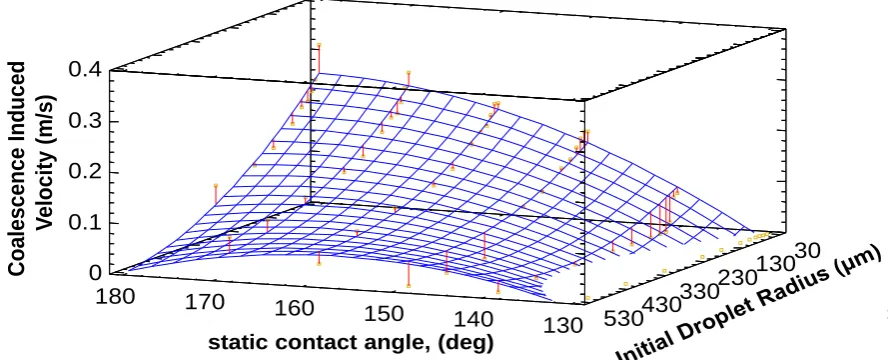
[image:2.595.76.522.646.727.2]Kinetic momentum created initially by the coalescing droplets acts in horizontal direction, and deforms the interface, but the droplet can only escape upwards due to the close proximity of the solid wall (see the change of shape between 2.7ms and 6.1ms in Figure 2, and the change of shape between 0.8ms and 1.6ms in Figure 3 – note that the different time-scales is explained by the difference between 2D and 3D droplets). If the resulting vertical force, acting on the combined drop, is sufficient to overcome the adhesion forces between the surface and the droplet, the droplet will jump away from the surface. Viscous dissipation of the fluid will also take place. Further analysis concentrated on establishing necessary kinematic conditions for this jumping phenomenon to occur. A Design of Experiment approach was followed, with the initial droplet radius (r) and the static contact angle (θs) of the surface being analysed through 2D numerical simulations. The estimated surface response obtained from this analysis is presented in Figure 4.
8.0ms
1.6ms
0.8ms
0.0ms
Figure 3: Results of 3D VoF modelling of droplet coalescence and jumping phenomenon, initial droplet radius
405 µm and droplet velocity U=0.005 m/s.
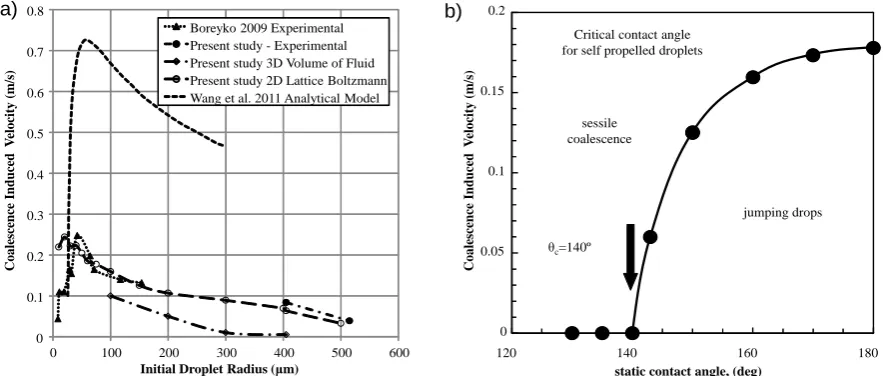
It may be noted that the jumping velocity is higher for more hydrophobic surfaces. This may be explained by the fact that the contact area between the merged droplet and the surface is smaller; therefore less energy is required to dewet the surface. Despite the expected advantage of more superhydrophobic surfaces, it is difficult to fabricate a long-lasting surface with static contact angle significantly above 160º. Hence, due to our desire for experimental validation, we focused our remaining simulations on surface with θs=160º. Analysing the initial droplet radius we conclude that the jumping velocity increases for smaller droplets with initial radius of about 30μm (Figure 4), however for smaller droplets (<20μm) the jump velocity follows experimental observations and
decreases (see Figure 5a, LB curve). Estimated Response Surface
130 140
150 160
170 180
Factor_A_Cang
30 130 230 330 430
530 Factor_B_Radius
0 0.1 0.2 0.3 0.4
Va
r_
1
_
D
ro
p
le
t_
Ve
lo
c
ity
Coalescence
Ind
uced
V
elocity
(m
/s)
[image:3.595.84.521.236.332.2] [image:3.595.76.523.521.701.2]static contact angle, (deg)
Figure 4: Results of undertaking a surface response analysis of the jumping droplet velocity (m/s) as a
function of static contact angle θs (º) and initial droplets radius R (µm).
Figure 5b shows the influence of the static contact angle on the jumping velocity, and a critical value of the static contact angle has been obtained (θc=140º) for droplets with initial 2D radius of 100 μm. Jumping occurs for all values of θs between 140º and 180º. However, for a surface with static contact angle θs=160º, the jumping velocity is already 90% of the jumping velocity for θs=180º. A wider selection of numerical results are presented in Fig. 5a, which shows very good agreement with experimental values across a wide range of initial droplet radii, from 20μm up to 500μm. Overall, the numerical methods developed in this study appear to show much more realistic predictions than the analytical model presented by Wang et al. [3] (Figure 5a). Note that we have fewer computation results for the 3D simulations undertaken by the VoF method [8]. These results are considerable more computationally demanding and are rather conservative in their estimates. This may be due to the difference in the point at which the jump velocity is computed for the 3D simulations. Further analysis will be required to understand the best way in which to compute this jump velocity, as well as any possible influence of surface morphology in 3D versus 2D simulations.
0 0.1 0.2 0.3 0.4 0.5 0.6 0.7 0.8
0 100 200 300 400 500 600
Initial Droplet Radius (μm) Boreyko 2009 Experimental Present study - Experimental Present study 3D Volume of Fluid Present study 2D Lattice Boltzmann Wang et al. 2011 Analytical Model
Coale sc en ce In d u ce d V elocit y (m /s) 0 0.05 0.1 0.15 0.2
120 140 160 180
Critical contact angle for self propelled droplets
sessile coalescence
jumping drops
static contact angle, (deg) θc=140º
Coale sc en ce In d u ce d V elocit y (m /s) a) b)
Figure 5: a) Comparison of experimental and numerical results for the initial jumping velocity of droplets
during coalescence on a superhydrophobic surface (θs=160º), b) Influence of the static contact angle on the
droplet jumping velocity, and determination of critical contact angle for jumping phenomenon (θc=140º) [Fig.
b) after Khatir & Kubiak [9]].
4 Conclusions
The process of droplet coalescence, and resulting jumping phenomena, have been successfully modelled numerically with both 2D lattice Boltzmann and 3D Volume of Fluid techniques. The coalescence-induced velocity of jumping droplets has been explored, and optimal kinematic conditions for jumping droplets have been established to be in a range of initial droplet radii from r=20μm to 40μm, for a static contact angle in the proximity of θs~160º. A critical contact angle for droplets to jump upon coalescence was estimated to be θc=140º. Further analysis, and additional full 3D modelling, will be required to complete the exploration of the range of fluid properties where jumping phenomena can occur. Furthermore, it would be desirable to include heat transfer optimization within the modelling capability. Nevertheless, even without optimization, it is clear that the development of functional surfaces to obtain continuous drop-wise condensation can be a good strategy to enhance the heat transfer rate in condensation processes.
5 References
[2] J.B. Boreyko, C.H. Chen, Self-Propelled Dropwise Condensate on Superhydrophobic Surfaces, Phys. Rev. Lett., 103, 2009, 184501.
[3] F.C. Wang, F. Yang, Y.P. Zhao, Size effect on the coalescence-induced self-propelled droplet, App. Phys. Lett. 98, 2011, 053112.
[4] B. Peng, S. Wang, Z. Lan, W. Xu, R. Wen, X. Ma, Analysis of droplet jumping phenomenon with lattice Boltzmann simulation of droplet coalescence, App. Phys. Lett. 102, 2013, 151601. [5] X. Shan and H. Chen, Lattice Boltzmann model for simulating flows with multiple phases and
components, Phys. Rev. E 47, 1993, 1815.
[6] M.C. Sukop, D.T. Thorne, Lattice Boltzmann modeling: an introduction for geoscientists and engineers, 2005, Springer Berlin.
[7] J.R. Castrejon-Pita, K.J. Kubiak, A.A. Castrejon-Pita, M.C.T. Wilson, I.M. Hutchings, Mixing and internal dynamics of droplets impacting and coalescing on a solid surface, Phys. Rev. E 88, 2013, 023023.
[8] S.S. Deshpande, L. Anumolu and M. F. Trujillo, Evaluating the performance of the two-phase flow solver InterFoam, Comput. Sci. Disc. 5, 2012, 014016.