Angewandte
Chemie
German Edition: DOI: 10.1002/ange.201506944
Lead Generation
International Edition: DOI: 10.1002/anie.201506944Activity-Directed Synthesis with Intermolecular
Reactions: Development of a Fragment into a Range of
Androgen Receptor Agonists
T
he discovery of biologically active molecules typically involves the synthesis and testing of many compounds, each individually crafted to optimize the arrangement of function-ality. Such workflows tend to induce scientists to exploita limited palette[1–3]of reliable chemical transformations. As
a direct consequence, designed arrays comprise compounds that are readily prepared, tending to limit diversity and, potentially, to focus on unproductive areas of chemical space. We recently introduced activity-directed synthesis
(ADS),[4] a novel discovery approach in which bioactive
small molecules emerge together with associated syntheses. ADS is iterative, borrowing concepts from biosynthetic
pathway evolution.[5] In each round, the components of
diverse reaction arrays are widely varied; by exploiting reactions with many possible outcomes, diverse chemical space is explored. After catalyst removal, the crude product mixtures are screened, and reactions that yield active products inform subsequent reaction array design. Only reactions that yield bioactive product mixtures are ever scaled up to enable the characterization and identification of
the responsible products. ADS is function-driven,[6]focusing
resources on reactions that yield bioactive products.
We recently harnessed intramolecular metal-catalyzed carbenoid reactions in the ADS of androgen receptor (AR) agonists. ADS drove the discovery of both novel ligands— based on scaffolds with no annotated activity against the receptor—and associated high-yielding syntheses
(Fig-ure 1A). However, in this validation work, reliance on intramolecular reactions meant that the structural diversity of possible products was largely encoded by the substrates used. We envisaged that ADS would be enhanced by exploiting intermolecular reactions as the range of possible
reaction outcomes—and thus the chemical space explored— would be dramatically increased. It was proposed to exploit ADS to drive the productive elaboration of the 4-cyano-3-trifluoromethylphenylacetamide fragment found in many
modulators of AR.[7] Although the core motif displayed
only modest agonism (1; EC50=9213mm; EC50=
concen-tration of ligand needed to induce the half-maximal observed effect), we reasoned that intermolecular reactions of related diazo acetamides could help identify productive strategies for
fragment growth (Figure 1C).[8–10]
The a-diazo amides 2–5 incorporate the
4-cyano-3-tri-fluoromethylphenyl fragment and bear a group (N-methyl or
N-cyclopropyl) expected to suppress intramolecular
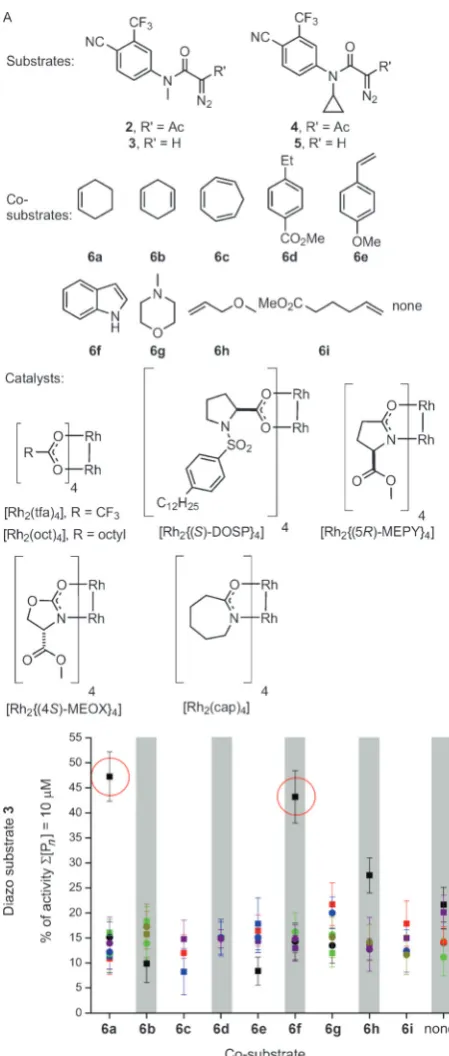
reac-tions.[11]In round one, we performed an array of 192 reactions
randomly chosen from 480 possible combinations of four
substrates (2–5), ten co-substrates (6a–6ior no co-substrate),
six catalysts, and two solvents (CH2Cl2 or toluene;
Fig-ure 2A). The co-substrates were selected on the basis of diversity of possible intermolecular reactions with metal
carbenoids[12–14]and the catalysts on the basis of their diverse
[image:2.595.311.536.136.415.2]reactivity. We initially showed that the diazo substrates and
Figure 1. Discovery of novel androgen receptor agonists by ADS. A) Discovery of novel chemotypes enabled by intramolecular
metal-catalyzed carbenoid reactions.[4]B) Core fragment for elaboration.
C) Envisaged exploitation of intermolecular metal-catalyzed reactions to drive productive fragment elaboration.
[*] Dr. G. Karageorgis, Dr. M. Dow, Dr. A. Aimon, Dr. S. Warriner, Prof. A. Nelson
School of Chemistry and Astbury Centre for Structural Molecular Biology, University of Leeds
Leeds, LS2 9JT (UK)
E-mail: [email protected] [email protected]
Supporting information for this article is available on the WWW under http://dx.doi.org/10.1002/anie.201506944.
Ó 2015 The Authors. Published by Wiley-VCH Verlag GmbH&Co.
KGaA. This is an open access article under the terms of the Creative Commons Attribution License, which permits use, distribution and reproduction in any medium, provided the original work is properly cited.
co-substrates were all inactive in our assay (see the Support-ing Information). The array was performed in 96-well plates
with reactions involving a diazo substrate (100 mm), a
co-substrate (1.0m), and a catalyst (1 mm). To demonstrate
significant exploration of chemical space, we showed that a random selection of reactions yielded several products, including, in general, those of both inter- and intramolecular reactions (see the Supporting Information). After 48 h, the crude reaction mixtures were scavenged to remove metal contaminants, evaporated, and assayed for agonism of AR
(total concentration of products: 10mm in 1% DMSO in
pH 7.5 aqueous buffer) using an established assay.[15]
Remarkably, only two of the 192 reactions yielded products that were significantly active (Figure 2B; see also the Supporting Information): both reactions involved diazo
substrate 3, [Rh2{(S)-DOSP}4], and CH2Cl2, together with
either cyclohexene (6a) or indole (6 f) as the co-substrate.
These data suggest that the fate of3—both with6aand6 f—
depends critically on the specific catalyst and solvent used, which determine whether the substrate is steered towards active products. The lack of activity without a co-substrate strongly suggests that the active products are derived from intermolecular reactions. At this stage, no products were isolated or identified; instead, the most promising reactions informed subsequent reaction array design.
Round two focused onN-methyl diazo substrate3and its
closely-related N-cyclopropyl variant 5, the co-substrates
cyclohexene (6a) and indole (6 f) as well as structurally
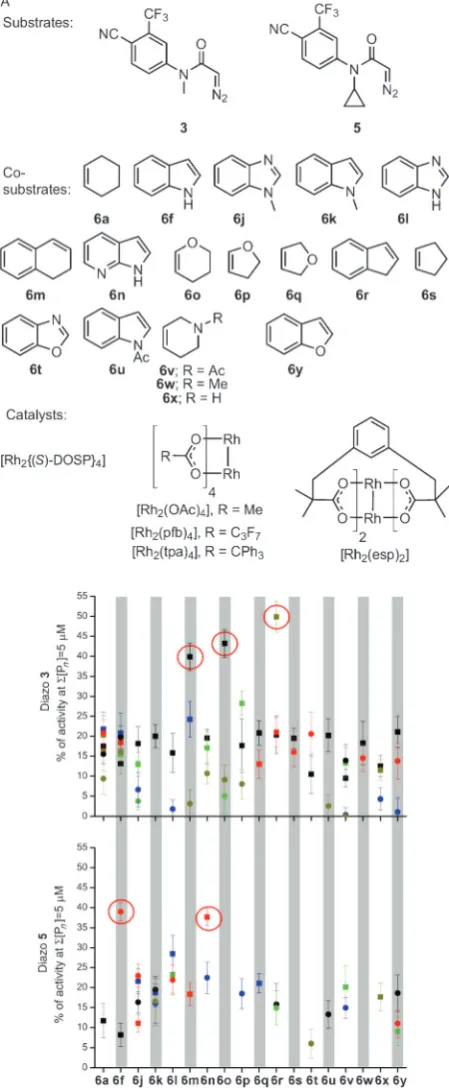
related compounds, and rhodium carboxylate catalysts. The 86 reactions were randomly chosen from 360 possible combinations of the two substrates, 18 co-substrates, five
catalysts, and two solvents (CH2Cl2or toluene; Figure 3A).
To drive the development of efficient activity-directed syntheses, the crude product mixtures were assayed at
two-fold lower total product concentration (5mm). Five promising
combinations of substrate and co-substrate were identified:
N-methyl diazo substrate 3with dihydronaphthalene (6m),
dihydropyran (6o), or indene (6r), andN-cyclopropyl diazo
substrate5with indole (6 f) or 7-azaindole (6n; see Figure 3B
and the Supporting Information). All of these combinations were superior to the most promising combinations from round one.
In round three, substrate3was combined with all possible
combinations of 12 co-substrates (6a, 6 f,6m,6n,6o,6r, and
six structurally related compounds) and four catalysts in
CH2Cl2(Figure 4A). After scavenging and evaporating, the
crude product mixtures were assayed at five-fold lower total
product concentration (1mm) to increase the selection
pressure (Figure 4B). With co-substrate 6e’’, the substrate
yielded active product mixtures with all four catalysts, with
the highest activity for [Rh2(OAc)4]. However, with
dihydro-pyran 6 f’’, significant activity was only observed when
[Rh2{(R)-DOSP}4] had been used; remarkably, no significant
activity was observed with the enantiomeric catalyst, suggest-ing that the most active product is chiral and that
[Rh2{(R)-DOSP}4] catalyzes the formation of the more
active enantiomer.
[image:3.595.55.280.54.583.2]To understand the basis for the emergence of bioactive structures and associated synthetic routes, prioritized reac-tions were scaled up from all three rounds of ADS. The reactions were performed on fifty-fold larger scale; the products were purified by column chromatography and their dose-dependent activities determined (Table 1). In all but one
Figure 2. Round one of ADS. A) Substrates, co-substrates, and
cata-lysts used. B) Activities of product mixtures derived from substrate3
relative to 5mmtestosterone. Reactions involved combinations of
substrates, co-substrates, catalysts (represented by different colors;
[Rh2{(S)-DOSP}4] black), and solvents (CH2Cl2squares; toluene
cir-cles). Experiments were performed in duplicate. See the Supporting Information for the activities of product mixtures derived from
case, a product whose activity accounted for that observed in the original array was obtained in good (71–82%) yield.
However, the combination of5,6n, and [Rh2(OAc)4] (from
round two) gave thea,b-unsaturatedg-lactam9in low (18%)
yield together with recovered starting material5(67%): here,
the observed activity must have stemmed from g-lactam 9
(EC50=79060 nm) rather than the recovered starting
material5(EC50>500mm). Crucially, in each case, we were
confident that the product that was responsible for the observed activity had been identified.
In round one, two reactions had yielded product mixtures with significant activity (Figure 5). In each case, the bioactive
product was formed in an intermolecular reaction. Amide7
was the product of C¢H insertion into the 3-position of indole
(6 f), whereas amide 8 was formed by cyclopropanation of
cyclohexene (6a). In the other 190 reactions, the product
[image:4.595.59.284.62.608.2]mixtures did not have biological activity that was detectable in the assay. Analysis of a selection of reactions in round one
Figure 3. Round two of ADS. A) Substrates, co-substrates, and
cata-lysts used. B) Activities of product mixtures derived from substrates3
(top) and5(bottom) relative to 5mmtestosterone for combinations of
co-substrates, catalysts (represented by different colors: [Rh2
{(S)-DOSP}4] black; [Rh2(esp)2] dark yellow; [Rh2(OAc)4] red), and solvents
(CH2Cl2squares; toluene circles). Experiments were performed in
[image:4.595.316.531.293.452.2]duplicate.
Figure 4. Round three of ADS. A) Substrate, co-substrates, and
cata-lysts used. B) Activities of product mixtures relative to 5mm
testoster-one for combinations of co-substrates and catalysts (represented by
different colors: [Rh2{(R)-DOSP}4] green; [Rh2{(S)-DOSP}4] black;
[Rh2(OAc)4] red; [Rh2(esp)2] dark yellow). The blue diamond highlights
the activity obtained with the enantiomer of the most promising
catalyst with co-substrate6 f’’. Experiments were performed in
had revealed that a wide range of products had been produced: thus, significant chemical space had been explored—yet discarded—in the search for bioactive prod-ucts.
In round two, the reaction array had been informed by the
reactions that yielded amides 7 and 8. Thus, success with
cyclohexene (6a) led to the inclusion of dihydronaphthalene
(6m), dihydropyran (6o), and indene (6r) as alternative
co-substrates. In each case, screening at lower total product
concentrations (5mm) had enabled the identification of
alternative cyclopropanation products (10–12) with
signifi-cantly higher biological activities than 8. Interestingly, with
substrate 5, the introduction of indole (6 f) or 7-azaindole
(6n) changed the outcome of the reaction. Rather than acting
as co-substrates, these additives steered the reaction towards
the rearranged product (9)[16,17] of an intramolecular C¢H
insertion: These reactions were discovered because product9
is a potent partial agonist.
In round three, dihydropyran6 f’’and benzopyran6e’’had
been included as co-substrates on the basis of their similarity
to dihydropyran (6o) and dihydronaphthalene (6m). The
additional functional groups in both 6e’’ and 6 f’’ offer
opportunities for different types of intermolecular reactions. In both cases, these new possibilities were exploited in the
formation of more bioactive products: amide13, which is the
product of an O¢H insertion,[18, 19]and oxazole14, which is
formed by reaction with the nitrile moiety of6e’’.[20]
Our retrospective analysis revealed two mechanisms by which activity-directed syntheses can develop. First, by varying the specific catalyst and solvent used, the yield of the bioactive products may be optimized. As an example, in round three, the activity of the product mixtures derived from
substrate 3 and co-substrate 6e’’ varied widely. With
[Rh2(OAc)4] as the catalyst, oxazole14(EC50=73030 nm)
was formed in 75% yield; however, with other catalysts, the
observed activity was lower, presumably as a result of 14
being produced in a lower yield. The choice of total product concentration in the assay is crucial as, to optimize the yield of a bioactive product, it is important to screen at concentrations that do not saturate the target protein.
Second, ADS can be used to optimize the structure of
bioactive products. For example, the cyclopropanes 10, 11,
and12, which were formed in round two, all had significantly
higher activities than cyclopropane 8, which was formed in
round one. Furthermore, introducing reactants with new functional groups can offer new opportunities for forming
more active products. For example, amide13and oxazole14
were both formed in types of reaction that were not possible in round two. Such possibilities can expand the chemical space that is explored during the optimization process, enabling the emergence of new synthetically accessible bioactive
chemo-types. The emergence of oxazole14was particularly
interest-ing: Such heterocycles are widely exploited as
peptidomi-metics in medicinal chemistry.[21–24]In future ADS campaigns,
the inclusion of more functionalized substrates in round one may increase the diversity of the explored chemical space from the outset. It remains to be seen whether other promiscuous reaction classes can be configured to support the discovery of novel bioactive chemotypes using ADS.
were scaled up.
Round[a] Reaction conditions[b] Product
(yield)[c] EC50
[d]
1 3, 6 f, [Rh2{(S)-DOSP}4] 7
(80%)[e] 8.80.7mm
1 3, 6a, [Rh2{(S)-DOSP}4] 8
(71%)[e] 7.30.2mm
2[f] 5,6n, [Rh
2(OAc)4] 9
(18%)[g] 79060 nm
[h]
2 3, 6o, [Rh2{(S)-DOSP}4] 10
(82%)[e] 4.70.1mm
2 3,6m, [Rh2{(S)-DOSP}4] 11
(76%)[e] 4.90.1mm
2 3, 6r, [Rh2(esp)2] 12
(73%)[e] 3.80.2mm
3 3, 6 f’’, [Rh2{(R)-DOSP}4] (S)-13
(73%; 56%ee)[e] 1.10.1mm
[i]
3 3, 6e’’, Rh2(OAc)4 14
(75%)[e] 73030 nm
[a] Round of ADS. [b] Co-substrate6(10 equiv), catalyst (1 mol%),
CH2Cl2. [c] Yield of purified product (see Figure 5 for the structures).
[d] Dose-dependent activity of the purified product. [e] Additional products were also isolated whose activity was not significant (see the Supporting Information). [f] See the Supporting Information for the
products obtained with6 fin place of6n. [g] Substrate5was recovered
in 67% yield. [h] Partial agonist (see the Supporting Information).
[image:5.595.51.290.80.290.2][i] Activity of the purified reaction product that had 56%ee.
Figure 5. Evolution of bioactive structures driven by ADS. The arrows indicate the relationship between the bioactive compounds formed in
prioritized reactions in consecutive rounds. Ar=
[image:5.595.57.284.412.688.2]In round three, the activity of the product mixture derived
from substrate3and racemic dihydropyran6 f’’was dependent
upon the enantiomer of the [Rh2(DOSP)4] catalyst used.
HPLC analysis on a chiral stationary phase showed that kinetic resolution of the dihydropyran had occurred to give
product 13 in 56% ee. To determine the absolute
config-uration and activity of both enantiomers, we prepared[25,26]
samples of both enantiomers of6 f’’and hence13: It was found
that (S)-13was approximately five-fold more active than (R
)-13[(S)-13: EC50=86040 nm; (R)-13: EC50=4.50.2mm]
and had indeed been selectively formed in the kinetic
resolution of dihydropyran 6 f’’ catalyzed by [Rh2{(R
)-DOSP}4]. To the best of our knowledge, enantioselective
O¢H insertion reactions of rhodium carbenoids have not
previously been described:[27] Hence, ADS has enabled
a novel asymmetric transformation to be identified for the first time solely on the basis of the biological activity of a product.
To demonstrate the value of ADS in lead generation, we
performed a limited SAR study inspired by amide 13and
oxazole14. A range of 17 analogues was prepared by
Rh-catalyzed reactions ofa-diazo amide3with either alcohols or
nitriles. The activity of the analogues spanned well over two orders of magnitude in both series, allowing key structural features to be identified (Figure 6; see also the Supporting Information, Table S2). Therefore, ADS can enable the discovery of bioactive chemotypes that provide options for subsequent lead optimization.
In conclusion, intermolecular reactions add significant value to ADS by dramatically expanding the range of reaction outcomes. By exploiting intermolecular reactions of diazo acetamides, ADS enabled the rapid elaboration of a fragment
(1) to produce sub-micromolar agonists, all based on
chemo-types with no previously reported activity against AR. In total, just four substrates were prepared, yet exploited in a total of 326 reactions to explore diverse chemical space; however, the products of just nine reactions were purified to reveal a range of novel bioactive ligands. In just three rounds of ADS, the activity of the fragment was improved by up to a factor of 125. Retrospective analysis showed that ADS had enabled the efficient exploration of chemical space and facilitated the identification of increasingly active AR ago-nists, together with associated syntheses. Remarkably, the
approach also led to the discovery of a novel asymmetric transformation on the basis of the biological activity of the product alone. Overall, ADS is a significant addition to the lead generation toolkit, enabling the rapid discovery of novel, yet synthetically accessible, bioactive small molecules.
Acknowledgements
We acknowledge the University of Leeds and the EPSRC (EP/K039292/1) for funding, and Dr. Richard Foster for useful discussions.
Keywords: activity-directed synthesis · agonists ·
bioactive molecules · carbenoids · reaction discovery
How to cite:Angew. Chem. Int. Ed.2015,54, 13538–13544
Angew. Chem.2015,127, 13742–13748
[1] S. D. Roughley, A. M. Jordan,J. Med. Chem.2011,54, 3451 – 3479.
[2] W. P. Walters, J. Green, J. R. Weiss, M. A. Murcko,J. Med. Chem.
2011,54, 6405 – 6416.
[3] T. W. J. Cooper, I. B. Campbell, S. J. F. Macdonald, Angew. Chem. Int. Ed.2010,49, 8082 – 8091;Angew. Chem.2010,122, 8258 – 8267.
[4] G. Karageorgis, S. Warriner, A. Nelson,Nat. Chem.2014,6, 872 – 876.
[5] R. A. Maplestone, M. J. Stone, D. H. Williams,Gene1992,115, 151 – 157.
[6] For another recent function-driven approach, see: Y.-L. Huang, J. W. Bode,Nat. Chem.2014,6, 877 – 884.
[7] a) W. Gao, C. E. Bohl, J. T. Dalton,Chem. Rev.2005,105, 3352 – 3370; b) H. Fang, W. Tong, W. S. Branham, C. L. Moland, S. L. Dial, H. Hong, Q. Xie, R. Perkins, W. Owens, D. M. Sheehan,
Chem. Res. Toxicol.2003,16, 1338 – 1358.
[8] M. Congreve, G. Chessari, D. Tisi, A. J. Woodhead, J. Med. Chem.2008,51, 3661 – 3680.
[9] R. A. E. Carr, M. Congreve, C. W. Murray, D. C. Rees,Drug Discovery Today2005,10, 987 – 992.
[10] C. W. Murray, M. L. Verdonk, D. C. Rees, Trends Pharmacol. Sci.2012,33, 224 – 232.
[11] H. M. L. Davies, R. E. J. Beckwith,Chem. Rev.2003,103, 2861 – 2904.
[12] H. M. L. Davies, D. Morton,Chem. Soc. Rev.2011,40, 1857 – 1869.
[13] M. P. Doyle, R. Duffy, M. Ratnikov, L. Zhou,Chem. Rev.2010,
110, 704 – 724.
[14] A. Padwa, D. J. Austin,J. Org. Chem.1996,61, 63 – 72. [15] M. S. Ozers, B. D. Marks, K. Gowda, K. R. Kupcho, K. M. Ervin,
T. De Rosier, N. Qadir, H. C. Eliason, S. M. Riddle, M. S. Shekhani,Biochemistry2007,46, 683 – 695.
[16] E. Carlson, J. Haner, M. McKee, W. Tam,Org. Lett.2014,16, 1776 – 1779.
[17] The rearrangement is reminescent of those of some substituted bicyclo[3.1.0]hexan-3-ones; see: H. E. Zimmerman, R. J. Paste-ris,J. Org. Chem.1980,45, 4876 – 4891.
[18] E. Aller, D. S. Brown, G. G. Cox, D. J. Miller, C. J. Moody,J. Org. Chem.1995,60, 4449 – 4460.
[19] G. G. Cox, C. J. Moody, D. J. Austin, A. Padwa, Tetrahedron
1993,49, 5109 – 5126.
[20] C. J. Moody, K. J. Doyle,Prog. Heterocycl. Chem.1997,9, 1 – 16. [21] M. Falorni, G. Giacomelli, A. Porcheddu, G. Dettori,Eur. J. Org.
Chem.2000, 3217 – 3222.
[image:6.595.57.289.407.497.2][22] R. M. J. Liskamp,Recl. Trav. Chim. Pays-Bas1994,113, 1 – 19.
Figure 6.Structures of the most active analogues and summary of the limited SAR study. See the Supporting Information for information on
2420.
[24] A. Plant, F. Stieber, J. Scherkenbeck, P. Lçsel, H. Dyker,Org. Lett.2001,3, 3427 – 3430.
[25] P. G. Jagtap, Z. Chen, K. Koppetsch, E. Piro, P. Fronce, G. J. Southan, K.-N. Klotz,Tetrahedron Lett.2009,50, 2693 – 2696. [26] S.-K. Kang, J.-H. Jeon, T. Yamaguchi, R.-K. Hong, B.-S. Ko,
Tetrahedron: Asymmetry1995,6, 97 – 100.
by other metals, see: A. Ford, H. Miel, A. Ring, C. N. Slattery, A. R. Maguire, M. A. McKervey,Chem. Rev.2015,115, DOI: 10.1021/acs.chemrev.5b00121.
Received: July 27, 2015
![Figure 1. Discovery of novel androgen receptor agonists by ADS.A) Discovery of novel chemotypes enabled by intramolecular metal-catalyzed carbenoid reactions.[4] B) Core fragment for elaboration.C) Envisaged exploitation of intermolecular metal-catalyzed reactionsto drive productive fragment elaboration.](https://thumb-us.123doks.com/thumbv2/123dok_us/7889104.185720/2.595.311.536.136.415/intramolecular-elaboration-envisaged-exploitation-intermolecular-reactionsto-productive-elaboration.webp)