This is a repository copy of
A model for the reflection of shear ultrasonic waves at a thin
liquid film and its application to viscometry in a journal bearing
.
White Rose Research Online URL for this paper:
http://eprints.whiterose.ac.uk/112756/
Version: Accepted Version
Article:
Schirru, M.M. and Dwyer-Joyce, R.S. orcid.org/0000-0001-8481-2708 (2015) A model for
the reflection of shear ultrasonic waves at a thin liquid film and its application to viscometry
in a journal bearing. Proceedings of the Institution of Mechanical Engineers, Part J:
Journal of Engineering Tribology, 230 (6). pp. 667-679. ISSN 1350-6501
https://doi.org/10.1177/1350650115610357
Reuse
Unless indicated otherwise, fulltext items are protected by copyright with all rights reserved. The copyright exception in section 29 of the Copyright, Designs and Patents Act 1988 allows the making of a single copy solely for the purpose of non-commercial research or private study within the limits of fair dealing. The publisher or other rights-holder may allow further reproduction and re-use of this version - refer to the White Rose Research Online record for this item. Where records identify the publisher as the copyright holder, users can verify any specific terms of use on the publisher’s website.
Takedown
If you consider content in White Rose Research Online to be in breach of UK law, please notify us by
A model for the reflection of shear ultrasonic waves at a thin liquid film
and its application to viscometry in a journal bearing.
Michele M. Schirru1 and Rob S. Dwyer‐Joyce1
1
The Leonardo Centre for Tribology, The University of Sheffield, Sir Frederick Mappin Building, Mappin Street, Sheffield, UK, S13JD
Abstract
The apparent viscosity of oils in the thin layers that exist in machine elements such as gears and bearings is very different to that in the bulk. In addition oils in lubricating layers are characterized by Non‐Newtonian behaviour due to the severe thermodynamic conditions that arise. It is this viscosity that determines the film thickness in lubricated mechanical components. This paper describes a novel methodology based on an ultrasonic approach to determine viscosity in‐situ in a lubricated contact. The methodology considers the lubricant at the solid boundary as a Maxwell viscoelastic fluid and determines its response to an ultrasonic wave. This approach is then compared with existing methodologies in both a static contact and in a rotating journal bearing. The obtained results have shown that the algorithm proposed in this study is most suitable to study lubricants in the range 0.3 to 3 Pas and the measurement error has been found to be less than 10%. This viscosity range is common in components such as cam‐follower, CVT transmissions and highly loaded journal bearings. At lower viscosities the measurement method suffers from excessive error caused by the acoustic mismatch between the bearing component and the oil film and the resulting difficulty in obtaining a high enough signal to noise ratio.
1.
Introduction
The ability to perform real time and in‐situ monitoring of lubricant viscosity in thin layers such as oil films would assist in the design and testing of lubricated systems. The apparent viscosity in a thin oil film is different to that in the bulk because fluid particles are not distributed homogeneously though the layer. The response of the fluid to a shear stress will then be different compared to that in a bulk fluid. This effect is accentuated as the fluid molecular composition becomes complex. Further, conventional viscometers require oil to be extracted once it has exited the contact. The conditions of such a viscometry test can only be a simulation of the real contact parameters.
In this paper ultrasound harmonic waves are employed as a suitable technique to overcome this limitation as it is non‐invasive and can therefore be applied to the real bearing component in operation. In ultrasonic engineering a thin layer is defined as a “situation where two successive echoes cannot be distinguished in the time domain” [1]. In that case it is not possible to measure properties such as speed of sound and fluid impedance by simple time of flight measurements [2]. Then a model that does not rely on fluid layer thickness is necessary. Harmonic horizontally polarized shear waves can propagate through solid layers, but only minimally into fluid layers and the reflected energy from solid‐liquid interface is a function of the shear viscosity. Early work dedicated to the study of viscosity by means of interaction of ultrasonic shear waves was performed by Mason [3], who correlated the reflected echo wave from a torsional quartz crystal to the viscosity of a liquid layer deposited on the transducer. Since then, several other authors have used reflectance methods to study viscosity in a bulk fluid [4] and in industrial processes where the fluid involved could be considered Newtonian: for example diagnostic analysis of coal combustion processes, industrial clean up processes, and characterization of resins in an autoclave [5, 6]. A number of studies [7‐10] have taken into account relaxation effects in Non‐ Newtonian lubricants to measure the rheological parameters involved in elastohydrodynamic lubrication (EHL). These researchers explored what happens to a fluid when subjected to high pressures and temperature typical in EHL. Continuous and oscillatory shear were compared in a wide range of frequencies, from a few kHz to hundreds of MHz. The results showed that it is necessary to incorporate relaxation time into a model, especially under EHL conditions where normally Newtonian oils can show Non‐Newtonian behaviour.
The aim of this work is to determine the response of a thin oil film to shear polarized ultrasonic waves, where the oil is modelled as a generic viscoelastic fluid capable of representing both Newtonian and Non‐Newtonian behaviour. The model is then used to determine the oil viscosity from that response to shear ultrasound. The model is firstly validated by testing on a bench oil film and then used to measure viscosity in‐situ and in real time in a journal bearing apparatus.
2.
Theoretical models
2.1 The reflection of ultrasonic shear waves from a solid‐liquid boundary
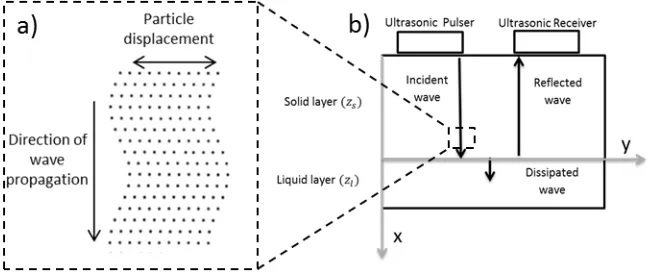
transmitted and dissipated in the fluid, while part is reflected back to the ultrasonic source, as shown in Figure 1 (b).
Figure 1. a) Representation of shear wave propagation (b) Simplified model describing propagation and reflection of an ultrasonic shear wave at solid‐liquid contact interface
The ratio of the amplitude of the reflected wave to the amplitude if the incident wave, is known as the reflection coefficient and can be determined by [11]:
!!!!!! !!
!!! !!
(1)
Where !! and !! are the acoustic impedances of the solid layer and the liquid layer respectively. The shear acoustic impedance of the solid is a real quantity defined by:
!!! !!! (2)
Where !! is the density of the solid medium, and ! is the shear speed of sound in the solid. On the other hand, the shear acoustic impedance of the liquid is a complex quantity defined by [12]:
!!! !!! (3)
Where !! is the density of the fluid layer, and ! is the complex shear modulus defined as:
! ! !!! !!!! (4)
Where !! is the storage modulus and !!! is the loss modulus. As !! is an imaginary quantity then !!!from equation (1) can be written in terms of its modulus, R and phase,!! as:
!!! !!!!∀#
(5)
Substituting equation (5) in equation (1) it is possible to obtain a definition of the liquid acoustic impedance in terms of reflection coefficient modulus and phase:
!!! !!
! ! !!! !!�����
! ! !!!!�����
(6)
[image:4.595.137.462.177.316.2]2.2 Newtonian reflection model
The simplest model considers the liquid as being Newtonian and the relation between viscosity and ultrasound reflection is derived after the method of Franco et al. [13]. With reference to Figure 1, the propagation of an ultrasonic wave at an interface is described by: !!! ��! ! ! !!! �� (7)
Where ! represents the displacement, ! ! ! !!
is the shear velocity where !! is the liquid density, !! is
the applied shear stress and x is the wave propagation direction. Here the subscript y is used to identify shear stresses, where the particle motion is normal to the direction of propagation. In the case of a sinusoidal perturbation the wave equation (7) has the following solution:
! ! !!! !∀ !!!
! (8)
Where ! is the angular frequency and !! is the initial particle displacement. The Newtonian state law correlating the shear stress !! and strain rate ! is:
!!! !! (9)
Where ! is the dynamic viscosity. Combining equations (7), (8) and (9) leads to:
! !��� (10)
The shear modulus is defined as the stress over the strain: ! ! !! ! (11) Substituting equations (10) and (11) in equation (9) gives: ! ! ! !! (12)
In case of a perfectly viscous liquid the term !! from equation (4) is zero and equation (12) reduces to:
! ! !! ! !!! !!!! ! !!!���� ! ! !!!!����� ! (15)
Equation (15) relates viscosity and the ultrasonic reflection coefficient when the liquid can be considered to be Newtonian.
2.3 The Greenwood model
Another useful equation to correlate viscosity of a fluid layer and ultrasonic reflection coefficient is derived by Greenwood [14] starting from the most general definition of acoustic impedance for a viscoelastic fluid: !!! !! ! ! !! �� �� (16) From the definition of viscosity the shear stress is proportional to the shear strain rate and so: !! !! ��! !! (17) Combining equation (17) and (7) and if equation (7) is solved with the limitation that the displacement is sinusoidal a solution for u is obtained in the form: ! ! !!! !∀#!!!!! (18)
Where ! is the angular frequency and k’ is defined by Greenwood and al. [14] and it is solution of
equation (7) only if it is equal to:
!!! ��
!!
!!!
!! ! !! (19)
Finally substituting equation (19) in equations (17) and (16) gives the definition of acoustic impedance:
!!!
!!!!
! !! ! !!
(20)
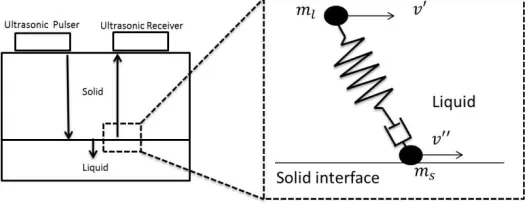
enhanced by using a Maxwell fluid analogy. This model describes, with a spring and a dashpot in series, the interaction between solid and liquid particles excited at an interface by an ultrasonic shear wave.
[image:7.595.167.433.180.282.2]Figure 2. Maxwell analogy to describe contact interface particle interaction due to applied shear ultrasonic stress
In Figure 2 the damper element models the relaxation effects of a viscoelastic system as ultrasonic shear occurs at the solid‐liquid boundary. The interaction between a solid particle !! and the liquid particle
!!, both subjected to ultrasonic displacements v’ and v’’, is described by a mechanical analogy. The total
stress and strain in the system are given by:
!!! !
! !! !! ! and ! ! !!! !! (22)
Where !! is the total stress, ! the total strain, the subscript s refers to the spring element while the subscript d to the dashpot. From Hooke law and from the dashpot theory:
!
! !! !!! and !! ! ! !!! (23)
Differentiating equations (22) and substituting in equations (23) gives: ! ! !!! !!! !! ! ! !! ! (24)
Where k is the stiffness of the spring defined as ! ! , and
! is the relaxation time. In case of sinusoidal
varying stress, the stress and strain are:
!!! !!!!∀# and ! ! !!!∀#
(25) Substituting equations (25) in equation (24) gives: ! �� !!!∀#! ��!! ! !!! !∀# (26) Now by substituting equation (26) into the definition of shear modulus stated in equation (11): ! ! ! ! ! ! ! ��� ! !���! ��!!! ! ! !!!!! ! ��� ! ! !!!! ! (27)
Substituting the stiffness ! !!! into equation (27) gives:
Separating the real and imaginary part gives: !!! !!�� ! ! !!!! !!! ! �� ! ! !!!! (29)
The system of equations (29) is a system of two equations in two unknowns, ! and !. Solving the two equations simultaneously leads to the solution for the viscosity in case the relaxation effects are taken into account. It is possible to compare the Maxwell model expressed in (29) with the Newtonian solutions reported in section 2.2 as follows. Expressing the second equation of (29) with respect to ! gives:
! !
!!! ! ! !!!!
!
(30)
The storage and loss moduli !!and !!! are related to the ultrasonic reflection coefficient by equations (4) and (6). Combining these equations with the (30) leads to: !! ! �� !!! !! ! ! ! !!! ! (31) Substituting the definition of shear acoustic impedance, equation (6), into equation (31) it is possible to directly correlate the reflection coefficient to the shear viscosity: ! !!! ! !! !!! ! !!!����� !! ! !!!!�����!! ! ! !!!! ! (32)
It can be noticed that equation (32) is equivalent to equation (14) except for the term!!!!!. When
!!!!!!!then equation (32) reduces to the Newtonian solution of the wave equation (14). In case of the Newtonian solution only the expression (14) exists because viscosity is a function of the loss modulus only.
2.5 Comparison of Models
[image:9.595.86.505.409.525.2]
Figure 3. Electrical analogy to describe the incident ultrasonic wave to (a) Newtonian and (b) Viscoelastic fluids
Figure 4 shows the amplitude of G versus frequency as the relaxation time of the lubricant is changed, from equations (15) and (32). For low values of the relaxation time (so for!!!!!!) the Newtonian and the Maxwell models are identical. For high values of the relaxation time the value G’ is of the same order as G’’ and the Newtonian model fails in describing the real oil behaviour.
Figure 4. Comparison shear storage modulus (a) and loss modulus (b) from Newtonian and Maxwell models as the relaxation time changes
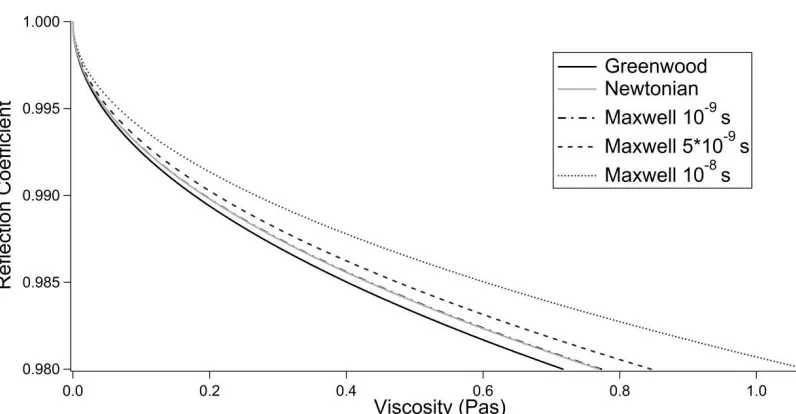
In Figure 5 the three different models equations (15), (21) and (32) are compared for different liquid relaxation times. For low relaxation times the three algorithms give a similar response, while for higher values of relaxation time only the Maxwell model is sensitive to the fluid structure changes. In all cases, for the viscosities considered, the reflection coefficient is close to one. This is a serious limitation when it comes to practical implementation of these methods on a lubricant viscometer, as will be observed later.
Figure 5. Application of Newtonian and Maxwell model for different relaxation times at an aluminium‐liquid boundary
2.6 Application to thin films
All these models consider the ultrasonic reflection at the boundary between a solid and liquid where the two bodies are treated as semi‐infinite spaces. The penetration depth of an ultrasonic shear wave at MHz frequencies is such that is completely attenuated within few microns. Therefore it is postulated that the reflection at a semi‐infinite half space is equivalent to that for a thin oil film, as shown schematically in Figure 6. To validate this assumption the reflection coefficient was acquired from a thin film of fluid (50 micron) and from a thick fluid layer (20 mm). The acquisition has been performed at room temperature with three repetitions and following the experimental method reported in section 3.
Table 1. Ultrasonic reflection coefficient and resulting calculated viscosity, from a thin liquid film compared to a thick layer.
Sample Average reflection coefficient (thin layer)
Average reflection coefficient (thick layer)
Viscosity (mPas) Thin layer
Viscosity (mPas) Thick layer
S20 0.9978 0.9980 19.0 15.7
S60 0.9946 0.9947 114.5 114.5
S200 0.9871 0.9869 655.1 675.7
[image:10.595.76.555.543.610.2]
because !! would be close to!!!, from equation (1). However, at the current state of the art it is not convenient to implement high frequency instrumentation for engine applications due to the complexity of the amplification system, the costs involved and because the transducers would so thin to be a fragile quartz coating layer.
[image:11.595.96.425.204.317.2]Figure 6. Thin layer Maxwell model representation
3. Experiments
3.1 Apparatus
Figure 7. Schematic diagram of the measurement apparatus
3.2 Signal processing
The ultrasonic viscosity models depend on the mechanical‐acoustic properties of the solid and the density of the fluid. If these properties are known the only parameter to be determined experimentally is the reflection coefficient.
A five cycle sine wave from the waveform generator was used to excite the PZTs. The modulus and the phase of the reflection coefficient were calculated experimentally by comparing the ultrasonic amplitude reflected at a solid‐liquid interface against the reference amplitude obtained by removing the fluid sample from the upper aluminium block, and thus measuring a solid‐air contact:
! !!! !!
(33)
! ! ! !!! !!
(34)
Where !! is the amplitude, calculated with the fast Fourier transform at the centre frequency of 10 MHz, of the reflected signal from the solid liquid interface, !! is the amplitude of the reflected signal from the solid‐air interface (reference measurement) as shown in Figure 8a, !! the phase of the
reflected signal from the solid liquid interface, and !
! is the phase of the reflected signal from the solid‐ air interface. As the phase is sensitive to temperature changes (±0.1 °C leads to ± 10 degrees of error) the following relation defining the phase is obtained by manipulating equation (12) [15]:
! ! !!!!acos!!! ! ! ! ! ! !
! ! !! !
(35)
resonance frequency of the shear crystal (10 MHz) was considered. The reflection coefficient value obtained with this procedure was then used in equations (15), (21) and (32) to obtain oil sample viscosity.
[image:13.595.96.539.196.337.2]
Figure 8. Example of reference and measurement signals acquired in (a) the time domain and (b) converted to the frequency domain.
3.3 Test lubricants
The reflection coefficient was acquired from an aluminium‐oil interface for six different Cannon viscosity standard calibrated lubricants (information about the test lubricants viscosities is reported in Table 2). The apparatus was heated up and then cooled down from 60°C down to 25 °C. Ultrasonic signals were continuously acquired in the cooling down process and converted in reflection coefficients.
Table 2. Cannon viscosity standard mineral oils tested
Mineral oil !@20°C (mPas) !@40°C (mPas) !@50°C (mPas)
S20 37.32 15.27 10.65
S60 139.1 53.83 34.69
S200 587.4 177.5 155.8
N350 1114 270.3 151.1
S600 2008 446.2 240.4
S2000 9256 1662 808.2
[image:13.595.59.541.501.594.2]4 Results and Discussion
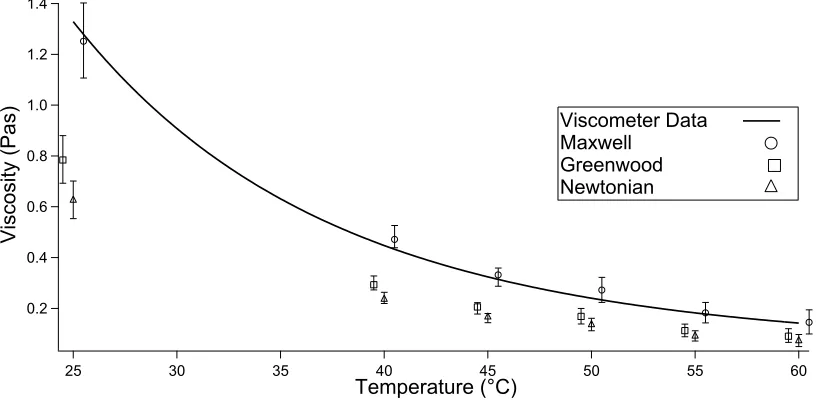
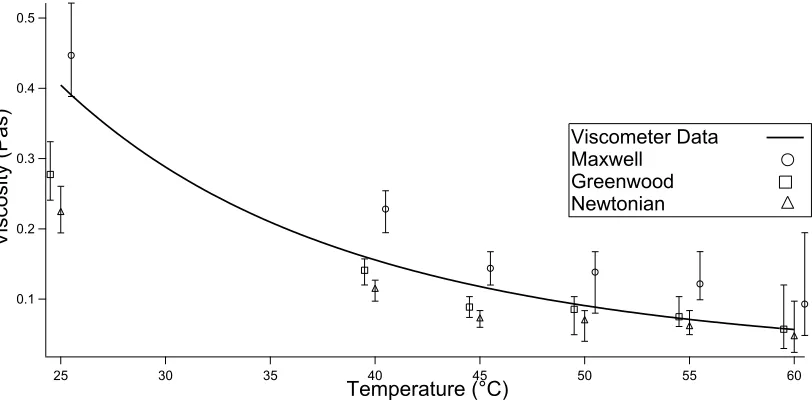
Figure 9 shows a set of the results obtained for the oil S600. The results are an average of 20 measurements executed at a given temperature range for a single fluid sample. The measured reflection coefficient was converted to viscosity using each of the three models (equations (15), (21) and (32)) and compared with the data expected from the Cannon oil data sheet. It is noticeable that the Maxwell model is close to the expected results at high viscosity, while the models give a similar answer at low viscosities.
Figure 9. Variation of viscosity with temperature determined from ultrasonic reflection for a Cannon S600 mineral oil. Three models have been used to convert reflection coefficient to viscosity, the Newtonian, Greenwood, and Maxwell models
Figure 10 reports the results obtained for all the oils analysed. In this graph the line represents exact agreement. It can be seen that for low viscosity lubricants the Greenwood Model results tends to be the more effective, while as viscosity increases the Maxwell model better describes the fluid behaviour.
1.4 1.2 1.0 0.8 0.6 0.4 0.2
Vi
sco
si
ty
(Pa
s)
60 55
50 45
40 35
30 25
Temperature (¡C)
Figure 10. Comparison of measured viscosity against expected data sheet values for all fluid samples tested.
Using the data of Figure 10, Figure 11 shows the error between the ultrasonic measured viscosity and the data sheet value. Three distinct regions can be identified.
Figure 11. Error associated with each reflection model. Three regions are shown: 1) R tends to 1 and all models are subject to scatter, (2) the optimum region for the Greenwood, (3) the optimum region for the Maxwell model
In region 1 it is difficult to obtain accurate measurements of lubricant viscosity using any of the models. This is because the reflection coefficient is very close to one and equations (15), (21) and (32) all become unstable. For low viscosity lubricants and for a metal‐liquid interface the reflection coefficient modulus is very close to the unity so that any electrical noise or disturbance in the measurement chain has a significant effect on the result. For example a variation of ±1% in the reflection coefficient can lead to a deviation of ±25mPas from the theoretical viscosity value. So for the low viscosity oil S20 the viscosity is
100
90
80
70
60
50
40
30
20
10
Erro
r
%
8 9
0.01 2 3 4 5 6 7 8 90.1 2 3 4 5 6 7 8 9 1
Log Viscosity (Pas)
1 2 3 Maxwell model fit
[image:15.595.87.508.381.573.2]5 Application to a journal bearing
[image:17.595.139.467.404.610.2]5.1 Apparatus and method
Figure 13a and Figure 14 show the experimental journal bearing apparatus. Two ultrasonic transducers pulsing at a centre frequency of 1.8 MHz were bonded to a brass delay line in contact with the bush, as shown in Figure 13b. A lower frequency was used for this experiment to allow a better sound transmission across the longer solid line. An electric motor and pulley system allowed rotation of the steel journal shaft between 0‐500 rpm. The rotational speed range was chosen so that the contact surface temperature did not reach a value such that the oil viscosity was too low to be within the sensitivity measurement region, as described in section 4. The oil was continuously pumped into the bearing from a reservoir thus allowing the separation of the bush and journal with a lubricating oil layer. The clearance thickness at the top film position in static condition was 100±10 !! [17]. This was measured differentiating the diameter measurements of the shaft and the bush made with a micrometer at different locations. The tests were run with a constant load of 200 N concentrated at the centre top of the rig. The load takes into account of the bush and rig frame weight plus a minimum hydraulic ram load to allow proper film formation. The increment in the speed caused the lubricant to heat up and consequently to change its viscosity throughout the test. To allow an accurate measurement of the oil film temperature the ultrasonic response from the first brass reflection was used because it was not possible to put a thermocouple in direct contact with the interface of interest.
Figure 14: Journal bearing test rig
5.2 Thermal Compensation
Figure 15. Typical amplitude vs time reflection signal acquired from the journal bearing rig.
Figure 16. (a) Brass‐Bush ultrasonic amplitude‐ temperature calibration curve, (b) Bush‐air ultrasonic amplitude‐ temperature reference curve
5.3 Results
[image:19.595.93.537.428.549.2]interface. The measurement signal is acquired continuously from the oil film with the shaft spinning and every measurement has been repeated three times.
Figure 17 shows the reflection coefficient acquired for the three different samples as the temperature varies due to shaft rotational speed increase. As the brass acoustic impedance is 35MRayl (approximately double aluminium that was used in the previous case tests), the reflection coefficient also approaches the unity for a lubricant viscosity of around 0.2 Pas. The insensitivity region (region 1 in Figure 11) shifts from 0.01 Pas to 0.2 Pas thus eliminating the Greenwood model optimum region. For this reason only thick oils have been tested in this apparatus.
Figure 17. Variation of the reflection coefficient for a journal bearing oil film as the oil temperature changes due to speed increase.
Figure 18. Measured viscosity compared with data sheet values for three cannon standard viscosity mineral oils.
6 Conclusions
In this paper three models relating shear ultrasonic reflection to fluid viscosity were implemented for measuring viscosity in thin lubricant layers. The models treated the fluid as Newtonian and as a Maxwell fluid. Each model was used to process reflection results from a static captive oil film and from a rotating journal bearing. In all cases the reflected ultrasonic signals are close to one because there is a large acoustic mismatch between the bearing material and the oil film. This is acerbated at low oil viscosities.
The Maxwell model has been developed for application when the lubricant is non‐Newtonian. It has been successfully applied to fluids of shear viscosity greater than 0.15 Pas with resulting accuracies of between 0.5% and 12% in a rotating journal bearing. The Newtonian fluid models failed (errors higher than 100%) due to the increase in the relaxation time that invalidates the approach. This demonstrates that it is possible to measure viscosity in‐situ in an oil film, provided the viscosity is relatively high and that a Maxwell treatment of the fluid is applied.
References
1. Kinra VK and Iyer VR. Ultrasonic measurement of the thickness, phase velocity and density or attenuation of a thin‐viscoelastic plate. Part I: the forward problem. Ultrasonics Vol 33 No 2 01/1995.
3. Mason WP. Measurement of shear elasticity and viscosity of liquids at ultrasonic frequencies. Physical Review, Volume 7S, Number 6, March I5 1949, pp 936‐946.
4. Roth W. A New Method for Continuous Viscosity Measurement. General Theory of the Ultra‐Viscoson. Journal of Applied Physics, vol.24, No.7, July 1953, pp 940‐950.
5. Sheen SH, Lawrence WP, Chien HT et al. Method for measuring liquid viscosity and ultrasonic viscometer. Patent No: 5,365,778, USA Nov. 22 1994.
6. Cohen‐Tenoudji F, Ahlberg LA, Tittmann BR et al. High temperature ultrasonic viscometer. Patent No.: 4,779,452, USA Oct. 25 1988.
7. Barlow AJ and Lamb J. The Visco‐elastic behaviour of Lubricating oils under cyclic shearing stress. Proceedings of The Royal Society A Mathematical Physical and Engineering Sciences . 01/1959; 253(1272):52‐69.
8. Lamb J. Physical properties of fluid lubricants: rheological and viscoelastic behaviour. Proceedings of the Institution of Mechanical Engineers, Conference Proceedings 1967 182:293
9. Oldroyd JG. Non‐Newtonian effects in steady motion of some idealised elastic‐viscous liquids Proceedings of The Royal Society A Mathematical Physical and Engineering Sciences. 01/1958; 245(1241):278‐297.
10. Dowson D, Higginson GR and Whitaker AV. Elasto‐hydrodynamic lubrication: a survey of isothermal solutions. Journal of Mechanical Engineering Science June 1962 vol. 4 no. 2 121‐126
11. Kinsler L and Frey AR. Fundamental of acoustics. Wiley, 4th edition
12. Worlow RW. Rheological Techniques. Horwood Ltd, 1980
13. Franco EE, Adamowski JC, Higuti RT et al. Viscosity measurement of Newtonian liquids using the complex reflection coefficient. IEEE Transactions on Ultrasonics, Ferroelectrics, And Frequency Control, Vol. 55, No. 10, Oct. 2008.
14. Greenwood MS and Bamberger JA. Measurement of viscosity and shear wave velocity of a liquid or slurry for on‐line process control. Ultrasonics 39 (2002) 623‐630.
15. Franco EE, Adamowski JC and Buiochi F. Ultrasonic viscosity measurement using the shear wave reflection coefficient with a novel signal processing technique. IEEE transactions on ultrasonics, ferroelectrics, and frequency control 05/2010; 57(5):1133‐9.
17. Kasolang S, Ahmad MA, Dwyer‐Joyce RS. Measurement of circumferential viscosity profile in stationary journal bearing by shear ultrasonic reflection. J. Tribol. 133(3), 031501, June 17, 2011.