This thesis contains no material which has been accepted for the award of
any other higher degree or graduate diploma in any university. To the best of my
knowledge and belief, this thesis contains no material previously published or
written by another person, except when due reference is made in the text of the
thesis.
hyte
,
01011
.
1
tice.J14.rel Pcsia,revvr.1 (Cfe.4(;q6
(%
6
C7
-
ra-0
4
-1-I would sincerely like to thank my parents, Les and Bernadette, and twin sister, Jacqui, for their loving support. I would also like to thank Dave
Chadderton, Vlasti Broucek, John Wanless, and Allison Bowling for organising
my equipment and for their technical assistance. I would like to thank my
supervisors Dr Montgomery and Dr Slaghuis for all of their help. Lastly I would
like to thank all the participants in this study, especially those with PTSD who
-
By
Jilli Maree Fraser (BA, Hons in Psychology)
submitted in partial fulfilment of the requirements for the degree of
Masters of Clinical Psychology
Post Traumatic Stress Disorder (PTSD) is treated psychologically with
exposure and cognitive restructuring techniques. Shapiro's (1995) Eye Movement
Desensitisation and Reprocessing (EMDR) treatment for PTSD involves imaginal
exposure, cognitive restructuring,
and rapid eye movements(EMs). EMDR has
Page No. Title
1.
Introduction
1.
Definition of PTSD
2.
The promise of EMDR
3.
EMDR procedures for the treatment of PTSD
(1) history taking and planning
(2) preparation phase
(3) assessment phase
4.
(4) desensitisation phase
5.
(5) installation phase
(6) body scan phase
(7) closure phase
(8) evaluation
6.
The treatment components of EMDR, and the role of
EMs
7.
Shapiro's theories regarding the necessity of EMs in EMDR
8.
The Accelerated Information Processing (AIP) Model10.
Criticisms of Shapiro's theories
11. A critique of the theory that EMs induce relaxation
• 13.
A comparison of the treatment effects of exposure, cognitive
restructuring, and EMs
16.
EMs make EMDR a user-friendly exposure therapy
18.
Evidence for and against EMD/EMDR treatment for PTSD
19. Case Reports
20. Empirical evidence supporting the use of EMD/EMDR in treating PTSD
23. Empirical evidence opposing the use of EMD/EMDR in treating PTSD
24.
The current status of EMDR compared to traditional
PTSD treatments
25.
Conclusion
imaginal exposure to traumatic memories, cognitive restructuring of negative self
assessments, and the performance of rapid back-and-forth horizontal eye
movements (EMs). Psychological treatments for PTSD are traditionally long term
and involve exposure, anxiety management, and cognitive restructuring
techniques. The eye movements in EMDR, however, are proposed to provide
immediate relief of PTSD symptoms and long term benefits. These claims,
coupled with mixed findings from empirical investigations of the efficacy of
EMDR, have placed EMDR at the centre of much controversy. This investigation
will address research into EMDR and Eye Movement Desensitisation (EMD),
which was the original, less refined version of Shapiro's treatment (Shapiro,
1989).
Definition of PTSD
PTSD is a disorder resulting from the experience of an extreme stressor.
According to the American Psychological Association criteria for PTSD (APA,
and/or having persistently increased arousal. These symptoms must cause
clinically significant distress and impairment in social, occupational, or other
important areas of functioning, and must be present for more than one month.
The promise of EMDR
EMDR treats PTSD because clients are asked to examine and alter any
irrational beliefs they may have in a safe environment where the clinician's
presence and the eye movements are cues or reminders of the client's present day
reality - that the trauma is over. Clients become desensitised to their traumatic
memories by combining imaginal exposure of the memories with rapid eye
movements. EMDR is proposed to result in a lasting reduction of anxiety,
changes in the cognitive assessment of the memory, and cessation of flashbacks,
intrusive thoughts, and sleep disturbances (Shapiro, 1989). During an EMDR
session the client may recall memories, experience new emotions, and gain
insights into his or her negative beliefs which are causing distress. The client may
experience an abreaction, in which he or she becomes very disturbed and
re-experiences the emotional intensity of the trauma. Shapiro suggests that this will
lead to new insights and may reveal more pertinent negative beliefs.- Finally, the
trauma image may change to a neutral image or memory, with the client no longer
being able to retrieve the original image, and anxiety may change to calm.
When first testing EMD with trauma victims, Shapiro (1995, p 4)
reported that 'Doug', a Vietnam war veteran, found that his most traumatic war
image was transformed to look like "a paint chip under water" and that his anxiety
'Doug' could only retrieve his 'paint chip' image, and when asked to think of
Vietnam he now remembered it as a "garden paradise".
EMDR procedures for the treatment of PTSD
Shapiro outlines eight stages of EMDR therapy as follows:
1) History taking and treatment planning procedures in EMDR involve the therapist's assessment of the client's current mental and physical ability to
withstand intense emotion. Pregnant clients and those with respiratory or cardiac
conditions are excluded. Caution is required with epileptic clients, and safety
factors must be instituted for clients with suicidal ideation, impoverished support
networks, eye problems, and substance abuse problems. The therapist then
assesses the clinical picture and establishes the treatment goals.
2) In the preparation phase a therapeutic alliance is established. The therapist explains EMDR, enhances the client's expectancy of success, and discusses the
possibility of emotional disturbance. The client is then taught relaxation
techniques to deal with emotional disturbance during and after imaginal exposure
to the trauma.
3) During the assessment phase the client identifies an image of the target trauma memory, as the whole incident or its most disturbing aspect. In EMDR
every detail of the trauma and response must be targeted, via imagination, during a
visual tracking task. The client must identify the negative beliefs which are causing inappropriate, dysfunctional behaviour and affect. Negative beliefs are
generally current self-assessments held by the client, such as the belief 'I am
seven 'completely true' (Validity of Cognition scale, Shapiro, 1989), which
reflects the client's 'gut response' to the statement. Effective positive beliefs are
T
statements that incorporate an internal locus of control, such as 'I am lovable'rather than 'he will love me', and which can generalise over the broadest range of
dysfunctional material. The client also focuses on his or her
current emotions,
which are elicited when picturing the image and rehearsing the negative belief,
and then rates his or her level of disturbance from zero 'neutral intensity' to ten
'highest possible anxiety', on a Subjective Units of Distress (SUDs) scale (Wolpe,
1982).
4) During the
desensitisation phase
the client's negative trauma-related affectand beliefs are 'reprocessed', which involves concentration on the target affect or
belief whilst performing sets of eye movements (EMs). A typical EMs set
involves the clinician holding two fingers upright, palm facing the client,
approximately 12 to 14 inches from the client's face. Full bilateral eye movement
is elicited by asking the client to track the therapist's horizontally moving fingers
at the maximum comfortable sustainable speed (Shapiro, 1995). The finger
sweeps are generally one left to right, and back to left, movement per second,
across a horizontal distance of at least 12 inches (Shapiro, 1989). This elicits a
combination of smooth pursuit EMs (continuous visual tracking of a moving
object) and saccadic EMs (very brief, high velocity EMs up to 600 ° /second),
when the therapist's hand is moving faster than the eye is able to accurately track
(Armstrong & Vaughan, 1996). EMs sets are 12-to-24, or 24-to-36, bilateral
movements and are continued until the client's Subjective Units of Distress score
finger movements can be varied for client comfort, and to facilitate a change in the
client's response.
As an alternative to EMs, the clinician may tap each of the client's
upturned palms, with his fingers, rapidly alternating left and right taps. Also the
clinician can snap his fingers next to each ear of the client alternately, at a
comparable speed to that used with the EMs sets (Shapiro, 1995).
5) The negative belief is considered to be replaced by the positive belief in the
installation phase.
The EMs sets are repeated while the client focuses on thepositive belief and the target memory. This continues until the client's 'gut
response' to the positive belief is a rating of six or seven on the Validity of
Cognition scale. The aim is to empower the client, and to permanently link the
trauma memory with a positive self interpretation.
6) In the
body scan phase
of EMDR the client focuses on the fully installedpositive belief and the target memory, and scans his or her body for
physical
sensations
associated with the trauma memory. These physical sensations arethen reprocessed with EMs.
7) In the
closure phase
of EMDR the client is debriefed. The therapist instructsthe client to keep a journal of negative thoughts and to continue using relaxation
techniques.
8) Finally,
re-evaluation
refers to the process of assessing the maintenance ofpositive effects at the beginning of each new session. The client's journal is
reviewed for new target material, or, alternatively, previously treated trauma
The treatment components of EMDR, and the role of EMs
Shapiro (1995) proposes that the following procedural components of
EMDR, in addition to the EMs, account for its therapeutic effectiveness (Shapiro,
1995):
1) Clients are helped to repeatedly create and dismiss their traumatic imagery.
They are also asked to 'just notice' the physical sensations, emotions and
thoughts, which are induced when imagining their trauma. This objectivity,
combined with the safety cues of the clinical context, may increase the client's
sense of mastery over the trauma memories, and reduce the client's anxiety.
2) The client's verbal identification of his or her negative self assessments may
highlight their irrationality to the client. Likewise, the cognitive restructuring
inherent in formulating positive beliefs may facilitate recovery. The procedural
reconnection of the trauma material may help the client to make sense of the
experience, facilitating its storage in narrative memory where it can be used for
personal growth.
3) After thorough preparation, the client is repeatedly exposed to the image,
which opposes the avoidance reaction that maintains PTSD.
It has been alternatively concluded that the EMs component is not
necessary, because the procedural components that Shapiro describes are simply
good exposure therapy and cognitive therapy (Andrade, Kavanagh, & Baddely,
1997; Allen & Lewis, 1996). Likewise, it has been suggested that the component
parts of EMDR, minus the eye movements, equal good psychotherapy (Hyer &
Brandsma, 1997). The non EMs components of EMDR are good psychotherapy
individual, to protect the self from trauma. Also the therapist remains
non-directive, allowing the client to be inwardly focussed, the specifier of therapy
targets, and to feel self empowered. Moreover, the therapist takes on the principle
that the client will naturally move toward positive growth given the right
environment, and enhances the client's treatment expectations (Hyer & Brandsma,
1997). Shapiro argues, however, that the EMs are necessary for the rapid effects
of EMDR (Shapiro, 1998), because the EMs facilitate
accelerated informationprocessing.
Shapiro's theories regarding the necessity of EMs in EMDR
Shapiro (1989) has formulated a physiological based theory of EMDR, in
which EMs are considered to activate an innate, self healing, information
The Accelerated Information Processing (AIP) Model
In the Accelerated Information Processing model, a memory is
conceptualised as a target node with connected neurophysiological network
channels, which contain associated beliefs, emotions and physical sensations. The
EMs in EMDR are proposed to result in the connection of neuro-network channels
containing positive information to trauma memory nodes. Once adaptive
information is incorporated into the associated network channels of trauma
memory nodes, which Shapiro calls 'reprocessing', the trauma memory shifts
from non-declarative to declarative (narrative) memory storage. At this stage the
reprocessed memory can be used for personal growth. Shapiro (1995) states that
the dysfunctional material connected to a trauma memory node can be reprocessed
at an accelerated rate, because EMDR has a generalised positive influence
throughout the neurophysiological network, and memories can be targeted in
clusters. Thus Shapiro proposes that pathologies can be cured in a limited period
of time, making EMDR an advance in PTSD treatment.
unable to link with positive content networks. However, it is hypothesised that
the progressive lowering of receptor resistances results in linkages between
negative and positive content networks. Thus traumatic memories are reprocessed
because they are linked to self enhancing knowledge. This explains reported
observations of clients' progressive discharge of negative affect, the evolution of
more adaptive beliefs, and the recall of positive memories, across EMs sets
(Shapiro, 1995). Finally, Shapiro considers that the EMs may induce a relaxation
response, which may in turn facilitate information processing. EMs may cause
changes in the reticular formation of the brain stem or mechanisms that activate
the parasympathetic nervous system, inducing relaxation (Shapiro, 1995). The
parasympathetic nervous system is activated during tasks that demand visual
convergence (Monnier, 1968), perhaps explaining EMDR treatment effects in
studies which have substituted EMs with eye fixation (Dunn, Schwartz, Hatfield,
& Wiegele, 1996; Pitman et al., 1993; Renfrey & Spates, 1994).
To explain the effects of EMs to clients, Shapiro (1989) compares the
EMs in EMDR to rapid eye movement (REM) sleep (Shapiro, 1995, p 121). REM
sleep is postulated to be involved in memory and stress-related information
processing, and people with PTSD have altered REM sleep (Gabel, 1987; Winson,
1993). These reports have lead to Shapiro's hypotheses that eye movements are
associated with information processing and anxiety.
the rapid eye movements during REM sleep may represent only an
epiphenomenon of dreaming. Thus, these rapid eye movements may result from,
rather than induce, information processing (Pitman, et al., 1996a).
The above theories suggest that the EMs are an essential PTSD treatment
component. However, the speculation that the positive treatment effects
ofEMDR are due to the exposure and cognitive restructuring components of EMDR,
and are not, as Shapiro suggests, due to the EMs, is fuelled by
1)criticisms of
Shapiro's theories, and 2) evidence for the effectiveness of exposure and cognitive
restructuring techniques in treating PTSD.
Criticisms of Shapiro's theories
Shapiro's acknowledgment of the therapeutic effects of EMDR
procedural components, other than the EMs, is arguably her only straightforward
theorising and the credibility of EMDR is claimed to be undermined by Shapiro's
"sketchy neurobiological theorising" (Allen & Lewis, 1996, p 250). Shapiro
credits EMDR with amazingly rapid effects, which she explains by stating that
conventional therapies use verbal procedures to process information; whereas
EMDR involves physiological based procedures (Shapiro, 1995, p 46). However,
it is argued that performing EMs is no more inherently "physiological" or
& Lewis, 1996, p 251). Moreover, the language Shapiro (1995) uses, such as
saying that it is necessary to "clean out" (p 33) the channels of traumatic memory
networks, and that positive beliefs are incorporated into memory networks via the
"installation" process (p 157), promotes the misconception that the client is
passive while his or her neurophysiology is being mysteriously altered by EMs
(Allen & Lewis, 1996, p 251). Also, the explanation of the Accelerated
Information Processing model in terms of "neural balance" and "neural
pathology" ambiguously refers to "unidentified effects of unidentified processes
on unidentified neural substrates" (Page & Crino, 1993, p 292). Finally, there is
limited evidence to support Shapiro's theories that eye movements facilitate
information processing via physiological mechanisms.
A critique of the theory that EMs induce relaxation
The theory that eye movements induce relaxation and are an essential
component of EMDR has had limited support (Hedstrom, 1991, Wilson, Silver,
Covi, & Foster, 1996). The EMs are compared to hatha yoga eye exercises
(Hedstrom, 1991), which are proposed to distract attention from personal
problems, decrease muscular tension, and increase relaxation and concentration
(Dechanet, 1965; Satchidananda, 1970). Increased relaxation is explained in
terms of an increased production of alpha waves when the eyes are closed or
defocused, even if the participant is engaged in mental activity and attention
(Hedstrom, 1991). This explanation can be applied to EMDR because 1) the
alpha wave state would decrease clients' arousal when thinking about their
may be triggered by EMs, and 3) EMDR clients' eyes are likely to defocus trying
to maintain the rapid tracking motion (Sharpley, Montgomery, & Scalzo, 1996).
However, it has been shown that relaxation and alpha wave activity is not elicited
by EMs (Sharpley, et al., 1996). This finding is explained by the contention that
the original comparison between Shapiro's EMs and hatha yoga eye exercises is
superficial (Page & Crino, 1993).
Alternatively it has been demonstrated that psychophysiological measures
of relaxation indicate that EMDR clients experience a 'compelled relaxation
response' (Wilson, et al., 1996). A study of six participants with PTSD found that
EMD caused a consistent, but not significant, reduction in heart rate and blood
pressure (Montgomery & Ayllon, 1994a). Moreover, heart rate and systolic blood
pressure were significantly decreased during EMD in a single PTSD case study
(Montgomery & Ayllon, 1994b). Also, EMDR treatment of PTSD has been
shown to significantly decrease participants' between session electromyogram
levels (Forbes, Creamer, & Rycroft, 1994). However, other researchers have been
unable to replicate reduction of physiological arousal during EMs (Boudewyns,
Stwerka, Hyer, Albrecht, & Sperr, 1993; Carlson, Rusnak, Chemtob, & Hedlund,
1996; Sharpley, et al., 1996), or during post-EMDR
in vivoexposure (Foley &
Spates, 1995).
Some authors have noted reductions in traumatised clients' arousal
levels, due to PTSD treatments
notinvolving EMs. In a study comparing routine
clinical care, EMDR, and biofeedback-assisted relaxation training, in treating
combat related PTSD, clients' psychophysiological measures reflected a
by treatment condition (Carlson, Chemtob, Rusnak, Hedlund, & Muraoka, 1998).
One study even found that four sets of 24 finger taps significantly reduced
participants' heart rates more than EMD (Merckelbach, Hogervost, & Kampman,
1994). Therefore, demand and expectancy effects, and procedural elements of
EMD/EMDR other than EMs, may be responsible for clients' relaxation
responses', a clinical observation which has not been confirmed in controlled
research.
A comparison of the treatment effects of exposure, cognitive restructuring,
and EMs
Imaginal and in vivo exposure to trauma material is considered to be
beneficial because avoidance maintains fear, whereas confrontation of trauma
stimuli can lead to new insights and an improved response to trauma stimuli. In
'flooding' the client remains in the feared situation until his arousal subsides, and
cognitive change is promoted by re-exposure to the trauma memories without
additional injury and loss. In 'systematic desensitisation', the person learns to
associate relaxation with each part of the fearful situation. Cognitive therapies,
likewise, help clients to see the irrationality and self destructive nature of their
fears and negative beliefs, and to formulate alternative beliefs which are self
enhancing.
The successful use of exposure to treat PTSD has been observed in
controlled studies examining systematic desensitisation (Brom, Kleber, & Defares,
1989; Peniston, 1986), imaginal exposure and flooding (Boudewyns & Hyer,
Keane, Fairbank, Caddell, & Zimering, 1989), with positive results being
maintained for two years (Peniston, 1986), and intrusive symptoms being
consistently improved. These studies measured significant reductions of
nightmares, flashbacks, muscle tensions, hospital readmissions (Peniston, 1986);
reductions in fear, state anxiety, depression (Keane, et al., 1989); and in sleep
disturbances and "psychotic-like" symptoms (Cooper & Clum, 1989). Likewise,
success in treating PTSD with 'stress inoculation therapy', a cognitive therapy, has
been reported (Foa et al., 1991). It has been concluded however, that prolonged
exposure is more effective than stress inoculation therapy in reducing the intrusive
symptoms of PTSD (Foa et al., 1994), and so exposure may be a more important
treatment component than cognitive restructuring.
Flooding is sometimes an inappropriate treatment for PTSD, however,
• because it may elicit too much anxiety and precipitate a panic disorder, and
flooding may only address anxiety symptoms, with its usefulness in treating guilt,
anger, emotional numbing, irrational beliefs, and shame unclear (DeBell & Jones,
1997; Solomon, Gerrity, & Muff, 1992). Likewise, systematic desensitisation can
•be problematic in treating PTSD, because of the difficulty in constructing a
hierarchy of the least-to-most distressing components of rape and war. Also,
systematic desensitisation requires that the client's anxiety levels remain very low
with only gradual increments, which is difficult to achieve because high levels of
disturbance are associated with PTSD (Spector 8z Huthwaite, 1993). Finally,
exposure based treatments, in particular flooding, are not 'treatment of choice' for
some clients because they do not wish to 'relive' their trauma (Scott & Stradling,
This author is not aware of any studies which directly compare the
therapeutic benefits of EMDR with flooding, systematic desensitisation, or stress
inoculation therapy in treating PTSD. However, based on a comparison of EMDR
and an eye fixation control treatment, it has been concluded that imaginal
exposure to trauma material, combined with rehearsal of positive beliefs, is an
effective treatment of PTSD, with EMs being non-essential (Renfrey & Spates,
1994). The EMs condition in this study, however, appeared to take significantly
less time to achieve treatment effects than the eye fixation condition (Shapiro,
1996). Likewise, a comparison of the effects of EMDR and an EMDR analogue
with eye fixation, in treating chronic combat related PTSD, has also failed to
support the necessity of EMs (Pitman, et al., 1996a). Both treatments produced
modest to moderate improvement on standardised measures of PTSD, with
slightly more improvement in the eyes-fixed condition than the EMs condition.
However, the authors concluded that EMDR was at least as efficacious for combat
related PTSD as was imaginal flooding in a previous study, and that EMDR was
better tolerated by participants (Pitman, Altman, Longpre, Poire, & Macklin,
1996b). These conclusions were considered to be invalid however, because the
treatments were not directly compared in a single controlled study, and the two
studies were not comparable (Cahill & Frueh, 1997). Thus, the inclusion of EMs
in treating anxiety disorders has not consistently improved upon the treatment
outcomes produced by including exposure and cognitive restructuring techniques.
However the inclusion of EMs may facilitate the effectiveness of the exposure and
cognitive restructuring components of EMDR, by making these treatment
traditional exposure therapies have failed or are inappropriate because clients are
too anxious or avoiding to cope with a standard exposure treatment (Andrade, et
al., 1997).
EMs make EMDR a user-friendly exposure therapy
It may be considered that the EMs in EMDR may decrease the intensity
and adverseness of imaginal exposure by reminding clients that they are safe,
distracting client's from their anxiety, and increasing clients' treatment
expectations. These considerations are supported by the following three theories:
1) It is proposed that the EMs in EMDR reduce the vividness and emotiveness of
traumatic imagery. This may in turn reduce the client's anxiety response to being
exposed to trauma-related stimuli, allowing habituation to the traumatic memory
to occur via the other EMDR procedural elements. This hypothesis is based on
the observation that people cannot simultaneously perform two visuospatial tasks,
and so when people attempt to hold a personally emotive image in their mind
whilst performing rapid EMs, or a pattern tapping task, the vividness and
emotiveness of the image is reduced (Andrade, et al., 1997). This is attributed to a
disruption of the functioning of the Visual Spatial Sketchpad (VSSP) of working
memory, by the dual visuospatial tasks. The VSSP is suggested to process visual
and spatial information and to have limited capacity. The VSSP combines with
the phonological loop - which processes auditory information, and these two
systems are coordinated by the central executive system in Baddeley's (1986)
concurrent short term memory of visual information, by competing for processing
resources (Andrade, et al., 1997).
2) Dyck (1993) suggests that the EMs are a distraction from the trauma memory,
allowing patients to remain relaxed, and extinguishing the anxiety response which
would generally follow reminders of the trauma. In the 'conditioning' model of
PTSD, traumatic incidents are associated with an anxiety response which disrupts
subsequent learning other than avoidance or escape learning. It is suggested that
in EMDR the traumatic memory is repeatedly paired with no anxiety, due to the
distraction effects of EMs, and that this leads to extinction of the anxiety response
and so allows learning to occur. It is also suggested that when the client is not
sufficiently distracted by the EMs, he or she experiences intense anxiety
(abreaction), and a flooding paradigm may explain the treatment effects (Dyck,
1993).
3) Alternatively, the EMs may not fully distract the client from the trauma, but
may serve to remind the client of his present safety as he focuses on the trauma,
extinguishing his anxiety (Armstrong & Vaughan, 1996). This theory is explained
by the Orienting Response model of EMD/EMDR. The orienting response (OR)
is a human behavioural reflex, which actively extracts important survival
information from the environment. It is triggered by environmental novelty, or by
significant stimuli. Components of the OR can include bodily movements,
increased sensory perception, autonomic changes, de-synchronisation of alpha
rhythm, and visual search via saccadic (lateral) EMs (Armstrong & Vaughan,
1996). An investigatory search which does not identify danger leads to
The EMD/EMDR client may be primed for ORs in the presence of trauma-related
stimuli. When instructed to focus on the memory, the client's physiological
arousal increases. The waving hand is given significance, due to task instructions
and the context of the memory, and so facilitates an intense OR. The ensuing
investigation of the environment establishes the client's safety. Thus, de-arousal
is repeatedly paired with the trauma memory, replacing the conditioned emotional
response and inhibiting avoidance behaviour (McCulloch & Feldman, 1996). The
OR extinguishes rapidly to non-significant innocuous stimuli, and more slowly to
significant stimuli. If stimulation is continued after extinction then a tonic
inhibitory state associated with drowsiness is reported to develop (Sokolov, 1963).
Theories that EMDR treatment effects are due to clinician elicited ORs
and distraction effects of clinician elicited EMs may explain reports that EMDR
treatment effects have limited generalisation to non-clinical settings (Sanderson &
Carpenter, 1992), that minimally distracting cues such as eye fixation produce
minimal therapeutic effects (Montgomery & Ayllon, 1994a), and reports that
therapists and patients prefer this procedure over more direct exposure procedures
(Boudewyns & Hyer, 1996, p192). However there have also been reports of
participants finding EMD/EMDR procedures too aversive (Lipke & Botkin, 1992;
Marquis, 1991; Oswalt, Anderson, Hagstrom, & Berkowitz, 1993), and so the
above theories that EMs make EMDR a user-friendly exposure therapy need to be
further investigated.
Evidence for and against EMD/EMDR treatment for PTSD
More than ten thousand clinicians were trained in EMDR by 1995, under
originated from early EMD/EMDR case studies, which had some very positive
results, and Shapiro's (1995) finding that there were more controlled studies
supporting the efficacy of EMD/EMDR in treating PTSD, than for any other
psychological PTSD treatment. However, many of the early studies on
EMD/EMDR did not have rigorous scientific controls, and controlled research on
traditional PTSD treatments is limited (Solomon, et al., 1992).
Case reports
Published case reports have generally had mixed or supportive findings
for the use of EMD/EMDR in treating PTSD. However these findings cannot be
generalised to all PTSD participants, are subject to publishing bias as new
therapies are more likely to be published if reports are positive (Page & Crino,
1993), and are confounded by procedural and design flaws. In most of these
reports the results are non-conclusive because of over-reliance on the client's self
reports and therapist's impressions, failures to formally diagnose symptoms or to
establish the baseline stability of symptoms, and the uncontrolled effects of prior
and concurrent therapies (Kleinknecht & Morgan, 1992; Marquis, 1991; McCann,
1992; Oswalt, et al., 1993; Puk, 1991; Shapiro, 1989; Spates & Burnette, 1995;
Spector & Huthwaite, 1993; Wolpe & Abrams, 1991).
One positive case study reported that EMD improved non-combat related
PTSD symptoms, for eight out of ten participants, after only one to four sessions
(Vaughan, Weiss, Gold, & Tarrier, 1994). Failure to have successfully treat two
of the participants may be attributed to insufficient treatment time. However, the
the PTSD diagnosis, three participants were concurrently taking medication, and
changes were not statistically reliable (Lohr, Kleinknecht, Tolin, & Barrett, 1995).
In a study by Forbes, Creamer, & Rycroft (1994) which contained few
procedural flaws, it was concluded that four sessions of EMDR may be at least
moderately effective in reducing civilian and combat related PTSD symptoms.
However, following treatment, significant pathology remained and four of the
eight participants still met the criteria for a full diagnosis of PTSD.
Finally, it has been suggested that numerous sessions of EMDR are
needed to treat PTSD sufferers with multiple or complex traumas, such as war
veterans. In a case study of four Vietnam war veterans with PTSD, it was found
that 12 sessions of EMDR resulted in substantial clinical improvements for three
of the veterans on standardised measures of cognitive-behavioural symptoms of
PTSD (Carlson, et al., 1996).
Empirical evidence supporting the use of EMD/EMDR in treating PTSD
It was initially reported that one session of EMD produced substantial
desensitisation and cognitive restructuring of trauma related perceptions, with
results being maintained at three months follow up (Shapiro, 1989). However,
participants only received eight minutes of placebo treatment before EMD -
calling into question the face validity of the placebo, the amount of exposure was
not standardised across treatments, there was no waiting list control, and there
may have been experimenter bias and expectancy effects. Also demand effects
may have confounded results, because the EMD condition was only terminated
Validity of Cognition scale ratings, and EMD was applied for 15 to 90 minutes.
Data was limited to the Validity of Cognition and Subjective Units of Distress
ratings, however the Validity of Cognition scale is not validated and may assess
affective lability more than irrational processes making it "redundant" (Lohr et al.,
1992, p 163).
An improvement on Shapiro's (1989) study showed that three 90 minute
EMDR sessions decreased the anxiety and PTSD symptoms, and increased the
positive beliefs, of 80 participants with a traumatic memory, 46 percent of whom
had PTSD (Wilson, Becker, & Tinker, 1995). Participants who were randomly
assigned to a delayed treatment condition showed no improvement until
administered EMDR. Effects were maintained after 90 days (Wilson et al., 1995)
and 15 months (Wilson, Becker, & Tinker, 1997). However, comorbidity and
behavioural measures of outcome were not assessed, and the trauma specific
symptoms were improved more than general psychological functioning.
A study of rape victims with PTSD revealed that three 90 minute sessions
of EMDR were effective in alleviating PTSD symptomatology, compared to a
waitlist control (Rothbaum, 1997). The EMDR treatment
,
had good fidelity and 10
percent of the EMDR group met full criteria for PTSD at post treatment,
be drawn from controlled comparisons between EMDR and the other validated
PTSD treatments.
The effects of EMDR in treating non-combat related PTSD were
compared to the effects of a standard care treatment for civilian PTSD, and it was
concluded that both treatments have a positive impact on symptoms (Marcus,
Marquis, & Sakai, 1997). However, EMDR participants demonstrated
significantly greater and more rapid improvement on inventories for PTSD,
depression, and anxiety. Likewise, two sessions of EMDR significantly improved
the post test measures of PTSD, depression, and anxiety, for traumatised young
women (Scheck, Schaeffer, & Gillette, 1998). This outcome was significantly
greater than the positive effects afforded by an Active Listening Treatment, in
which the therapist used attentive silence and non-judgemental acknowledgment
of the participants' communication (Scheck, et al., 1998).
A comparison of the relative effects of the incremental addition of
EMDR, relaxation training, and biofeedback, to usual milieu treatment for
Vietnam war veterans, showed that EMDR was generally the most effective extra
treatment (Silver, Brooks, & Obenchain, 1995). However this study had
procedural flaws, neither biofeedback or relaxation are :validated as effective
treatments for PTSD (Solomon, et al., 1992), and the authors' conclusions have
been discredited as resulting from an improper statistical analysis (Lohr et al.,
1995).
other treatments, EMDR resulted in significantly greater improvements on
cognitive-behavioural measures of PTSD at post test, three months follow up, and
nine months follow up.
Empirical evidence Opposing the use of EMD/EMDR in treating PTSD
Some empirical research has suggested that EMD/EMDR should not be
chosen above traditional therapies in the treatment of PTSD. In a comparison of
EMD, image habituation training and applied muscle relaxation training, no
significant difference was found between the treatments, which all reduced PTSD
symptoms and depression (Vaughan, Armstrong, et al., 1994). Thus, because
image habituation training and relaxation have not been validated as treatments for
PTSD (Solomon, et al., 1992), EMD was only as effective as a credible placebo
(Lohr et al., 1995).
In a comparison of two 90 minute sessions of EMDR, two 90 minute
exposure control (no EMs) sessions, and a no treatment control, for combat
veterans who were also receiving standard milieu treatment, no significant
differences between the groups on standardised PTSD measures were
demonstrated, and only within session Subjective Units of Distress ratings
decreased for EMDR participants (Boudewyns, et al., 1993). This supports the
argument that EMDR effects are limited to decreasing within session anxiety
(Lohr et al., 1995). However this study also raises the problems of treating
combat related PTSD with only two sessions of EMDR and veterans
over-reporting symptoms for compensation benefits. If measures of general
A second study has also shown that EMDR decreases war veterans'
Subjective Units of Distress scores, but that at post treatment there are no
differences between these veterans and those only receiving standard milieu
treatment, on Validity of Cognition ratings and standard measures of
symptomatology (Jensen, 1994). However, this study suffers the same flaws as
Boudewyns et al. (1993).
The current status of EMDR compared to traditional PTSD treatments
EMDR has been accepted as an empirically validated treatment and
'probably efficacious for civilian PTSD' by a Task Force of the Clinical Division
of the American Psychological Association (APA, 1998), based on the findings of
Wilson, et al. (1995) and Rothbaum (1997). Thus EMDR has joined the status of
exposure therapy and stress inoculation therapy. This status, requires that two
studies indicate that the treatment is more efficacious than a waiting list control.
However, compared to traditional exposure-based psychological PTSD
treatments, EMDR has been proposed to be more effective, more efficient
(although complex cases require at least 12 sessions), and better tolerated by
clients and therapists (Pitman et al., 1996a; Wilson, et al., 1997; Hassard, 1993;
Macculloch & Feldman, 1996; Hyer & Brandsma, 1997; Carlson et al., 1996).
Shapiro argues that there is sufficient evidence to hail EMDR as an advance in
PTSD treatments (Grant, 1998) and that the APA Task Force should increase
EMDR's status to 'well established for PTSD in general' (Shapiro, 1998). This is
based on her criticisms that equivocal results with combat populations are due to
complex PTSD (Jenson, 1994; Boudewyns et al., 1993), and on recent findings
which support the use of EMDR with combat-related and civilian PTSD (Scheck,
et al., 1998; Carlson, et al., 1998).
Claims that EMDR is a superior PTSD treatment, compared to traditional
exposure and cognitive restructuring therapies are unwarranted. EMDR still needs
to be directly compared to systematic desensitisation and flooding. Also the
negative findings of EMDR effectiveness can not be simply attributed to an
absence of EIVIDR training or treatment fidelity, as treatment effects should be
robust enough to withstand procedural modification (Dr Kavanagh, in Grant,
1998; Lohr et al., 1995).
Conclusion
It is concluded that EMDR is an effective treatment for civilian and
combat related PTSD when all details of clients' traumas are addressed over a
number of sessions. However, arguments that EMDR is superior to traditional
PTSD treatments are premature, due to a lack of controlled comparisons of
EMDR and validated PTSD treatments. It is instead suggested that EMs simply
facilitate client acceptance of conventional cognitive restructuring and exposure,
which are components of EMDR. The EMs may achieve this by distracting
clients from their anxiety and reminding clients of their safe environment, via an
intense orienting response. Thus EMDR may help clients who have found
traditional exposure based treatments, like flooding, too aversive. More research
Allen, J.G.& Lewis, L. (1996). A conceptual framework for treating traumatic memories and its
application to EMDR. Bulletin of the Menninger Clinic, 60(2), 238-263.
American Psychological Association, A. (1994). Diagnostic and statistical manual of mental
disorders: Fourth edition (DSM IV). Washington, DC: Author.
American Psychological Association Division 12 Task Force on Promotion and Dissemination of
Psychological Procedures (1993). Report to the Division 12 Board.
Andrade, J., Kavanagh, D., & Baddeley, A. (1997). Eye-movements and visual imagery: A working
memory approach to the treatment of post-traumatic stress disorder. British Journal of Clinical
Psychology, 36, 209-223.
Armstrong, M.S. and Vaughan, K. (1996). An orienting response model of Eye Movement
Desensitization. Journal of Behaviour Therapy and Experimental Psychiatry, 27(1), 21-32.
Baddely, A.D. (1986). Working Memory. Oxford: Oxford University Press.
Boudewyns, P.A. and Hyer, L. (1990). Physiological response to combat memories and preliminary
reatment outcome in Vietnam veteran PTSD patients with direct therapeutic exposure. Behaviour
Therapy, 21, 63-87.
3oudewyns, P.A., Stwertka, S.A., Hyer, L.A., Albrecht, J.W., & Sperr, E. (1993). Eye Movement
3esensitisation for PTSD of combat: A treatment outcome pilot study. The Behavior Therapist, 16,
Brom,D., Kleber, R.J., & Defares, P.B. (1989). Brief therapy for posttraumatic stress disorders.
Journal of Consulting and Clinical Psychology, 57,
607-612.
Cahill, S.P. and Frueh, B.C. (1997). Flooding versus Eye Movement Desensitization and Reprocessing
therapy: Relative efficacy has yet to be investigated - comment on Pitman et al. (1996).
Comprehensive Psychiatry, 38(5),
300-303.
Carlson, J.G., Chemtob, C.M., Rusnak, K., & Hedlund, N.L. (1996). Eye movement desensitisation
and reprocessing treatment for combat PTSD.
Psychotherapy, 33(1),104-113.
Carlson, J.G., Chemtob, C.M., Rusnak, K., Hedlund, N.L., & Muraoka, M.Y. (1998). Eye movement
desensitization and reprocessing (EMDR) treatment for combat-related posttraumatic stress disorder.
Journal of Traumatic Stress, 11(1),
3-23.
Cooper, N.A. & Clum, G.A. (1989). Imaginal flooding as a supplementary treatment for PTSD in
combat veterans: A controlled study.
Behaviour Therapy, 20,381-391.
DeBell, C., & Jones, R.D. (1997). As good as it seems? A review of EMDR experimental research.
Professional Psychology: Research and Practice, 28(2),
153-163.
Dechanet, J.M. (1965).
Yoga in ten lessons.London: Burns and Oates.
Dyck, M.J. (1993). A proposal for a conditioning model of eye movement desensitization treatment
for post traumatic stress disorder.
Journal of Behaviour Therapy and Experimental Psychiatry, 24(3),201-210.
Foa, E.B., Freund, B., Hembree, E., Dancu, C.V., Franklin, M.E., Perry,
K.J.,Riggs, D.S., & Molnar,
C. (1994, November).
Efficacy of short-term behavioural treatments of PTSD in sexual and nonsexualassault victims.
Paper presented at the annual meeting of the Association for the Advancement of
Behavior Therapy, San Diego.
Foa, E.B., Rothbaum, B.O., Riggs, D., Murdock, T., & Walsh, W. (1991). Treatment of posttraumatic
stress disorder in rape victims: A comparison between cognitive-behavioural procedures and
counselling.
Journal of Consulting and Clinical Psychology, 59,715-723.
Foley, T. and Spates, C.R. (1995). Eye Movement Desensitization of public-speaking anxiety: A
partial dismantling study.
Journal of Behaviour Therapy and Experimental Psychiatry, 26(4),321-
329.
Forbes, D., Creamer, M., & Rycroft,
P.(1994). Eye movement desensitization and reprocessing in
posttraumatic stress disorder: A pilot study using assessment measures.
Journal of Behaviour Therapyand Experimental Psychiatry, 25(2),
113-120.
Hassard, A. (1993). Eye movement desensitization of body image.
Behavioural Psychotherapy, 21,157-160.
Hedstrom, J. (1991). A note on eye movements and relaxation.
Journal of Behaviour Therapy andExperimental Psychiatry, 22(1),
37-38.
Hyer, L. and Brandsma, J.M. (1997). EMDR minus eye movements equals good psychotherapy.
Journal of Traumatic Stress, 10(3),
515-521.
Keane, T.M., Fairbank, J.A., Caddell, J.M., & Zimering, R.T. (1989). Implosive (flooding) therapy
reduces symptoms of PTSD in Vietnam combat veterans.
Behaviour Therapy, 20,245-260.
Kleinknecht, R.A. and Morgan, M.P. (1992). Treatment of posttraumatic stress disorder with eye
movement desensitization.
Journal of Behaviour Therapy and Experimental Psychiatry, 23(1),43- 49.
Lipke, H.J., & Boticin, A.L. (1992). Case studies of eye movement desensitization and reprocessing
(EMDR) with chronic post-traumatic stress disorder.
Psychotherapy, 29,591-595.
Lohr, J.M., Kleinknecht, R.A., Conley, A.T., Dal Cerro, S., Schmidt, J., & Sonntag, M.E. (1992). A
methodological critique of the current status of Eye Movement Desensitization (EMD).
Journal ofapplication of Eye Movement Desensitization and Reprocessing. Journal of Behaviour Therapy and
Experimental Psychiatry, 26(4), 285-302.
Macculloch, M.J., & Feldman, P. (1996). Eye movement desensitisation treatment utilises the positive
visceral element of the investigatory reflex to inhibit the memories of post-traumatic stress disorder: A
theoretical analysis. British Journal of Psychiatry, 169, 571-579.
Marcus, S.V., Marquis, P., & Sakai, C. (1997). Controlled study of treatment of PTSD using EMDR
in an HMO setting. Psychotherapy, 34(3), 307-315.
Marquis, J.N. (1991). A report on seventy-eight cases treated by Eye Movement Desensitization.
Journal of Behaviour Therapy and Experimental Psychiatry, 22(3), 187-192.
McCann, D. (1992). Post-traumatic stress disorder due to devastating burns overcome by a single
session of Eye Movement Desensitization. Journal of Behaviour Therapy and Experimental
Psychiatry, 23(4), 319-323.
Merckelbach, H., Hogervorst, E., & Kampman, M. (1994). Effects of "Eye Movement
Desensitization" on emotional processing in normal subjects. Behavioural and Cognitive
Psychotherapy, 22, 331-335.
Subjective and physiological measures of treatment efficacy. Journal of Behaviour Therapy and
Experimental Psychology, 25(3), 217-230.
Montgomery, R.W. and Ayllon, T. (1994b). Eye Movement Desensitization across images: A single
case design. Journal of Behaviour Therapy and Experimental Psychiatry,25(1), 23-28.
Oswalt, R., Anderson, M., Berkowitz, B. & Hagstrom, K. (1993). Evaluation of the one session
Eye-Movement Desensitisation and Reprocessing procedure for eliminating traumatic memories.
Psychological Reports, 73, 99-104.
Page, A.C., & Crino, R.D. (1993). Eye-movement desensitisation: A simple treatment for
post-traumatic stress disorder? Australian and New Zealand Journal of Psychiatry, 27, 288-293.
Pavlov, I.P. (1927). Conditioned reflexes (G.V. Anrep, Trans.). New York: Liveright.
Peniston, E.G. (1986). EMG biofeedback-assisted desensitization treatment for Vietnam combat
veterans posttraumatic stress disorder. Clinical Biofeedback Health, 9, 35-41.
Pitman, R.K., On, S.P., Altman, B., Longpre, R.E., Poire, R.E., & Lasko, N.B. (1993). A controlled
study of Eye Movement Desensitization/ Reprocessing (EMDR) treatment for post-traumatic stress
disorder. Paper presented at the American Psychiatric Association Annual Meeting, Washington, D.C.
Pitman, R.K., Orr, S.P., Altman, B., Longpre, R.E., Poire, R.E., & Macklin, M.L. (1996). Emotional
processing during Eye Movement Desensitization and Reprocessing therapy of Vietnam veterans with
Pitman, R.K., Orr, S.P., Altman, B., Longpre, R.E., Poire, R.E., Macklin, M.L., et al. (1996b).
Emotional processing and outcome of imaginal flooding therapy in Vietnam veterans with chronic
post-traumatic stress disorder. Comprehensive Psychiatry, 37, 409-418.
Puk, G. (1991). Treating traumatic memories: A case report on the Eye Movement Desensitization
procedure. Journal of Behaviour Therapy and Experimental Psychiatry, 22(2), 149-151.
Renfrey, G. and Spates, C.R. (1994). Eye Movement Desensitization: A partial dismantling study.
Journal of Behaviour Therapy and Experimental Psychiatry, 25(3), 231-239.
Rothbaum, B. 0. (1997). A controlled study of Eye Movement Desensitization and Reprocessing in
the treatment of posttraumatic stress disordered sexual assault victims. Bulletin of the Menninger
Clinic, 61(3), 317-334.
Sanderson, A. and Carpenter, R. (1992). Eye Movement Desensitization versus image confrontation:
A single-session crossover study of 58 phobic subjects. Journal of Behaviour Therapy and
Experimental Psychiatry, 23(4), 269-275.
Satchidananda, Y.S.S. (1970). Integral yoga hatha. New York: Holt, Rinehart and Winston.
Scheck, M.M., Schaeffer, J.A., & Gillette, C. (1998). Brief psychological intervention with
traumatized young women: The efficacy of Eye Movement Desensitization and Reprocessing. Journal
stress disorder.
Journal of Traumatic Stress, 10(3),523-528.
Shapiro, F. (1989). Eye Movement Desensitization: A new treatment for post-traumatic stress
disorder.
Journal of Behaviour Therapy and Experimental Psychiatry, 20(3),211-217.
Shapiro, F. (1995).
Eye Movement Desensitization and Reprocessing: Basic principles, protocols, andprocedures.
New York: The Guilford Press.
Shapiro, F. (1996). Errors of context and review of Eye Movement Desensitization and Reprocessing
research.
Journal of Behaviour Therapy and Experimental Psychiatry, 27(3),313-317.
Shapiro, F. (1998, July). Research and resources. Paper presented at the Facilitator Day EMDR
International Conference, San Francisco.
Sharpley, C.F., Montgomery, I.M., & Scalzo, L.A. (1996). An investigation of some hypothetical
mechanisms underlying EMDR.
Scandinavian Journal of Behaviour Therapy, 25(2),87-98.
Silver, S.M., Brooks, A., &Obenchain, J. (1995). Treatment of Vietnam war veterans with PTSD: A
comparison of Eye Movement Desensitization and Reprocessing, biofeedback, and relaxation training.
Journal of Traumatic Stress, 8(2),
337-342.
Sokolov, E.N. (1963).
Perception and the conditioned reflex.Oxford: Pergamon Press.
Spates, C.R., & Burnette, M.M. (1995). Eye movement desensitization: Three unusual cases.
Journalof Behavior Therapy and Experimental Psychiatry, 26(1),
51-55.
Spector, J., & Huthwaite, M. (1993). Eye-Movement Desensitisation to overcome post-traumatic
stress disorder.
British Journal of Psychiatry, 163,106-108.
Stern, R. & Marks,
I.(1973). Brief and prolonged flooding: A comparison in agoraphobic patients.
Archive of General Psychiatry, 28,
270-276.
Wilson, S.A., Becker, L.A., & Tinker,
R.H.(1995). Eye Movement Desensitisation and Reprocessing
(EMDR) treatment for psychologically traumatised individuals.
Journal of Consulting and ClinicalPsychology,
63(6), 928-937.
Wilson, S.A., Becker, L.A., & Tinker,
R.H.(1997). Fifteen-month follow-up of Eye Movement
Desensitization and Reprocessing (EMDR) treatment for posttraumatic stress disorder and
psychological trauma.
Journal of Consulting and Clinical Psychology, 65(6),1047-1056.
Wilson,
D.L.,Silver, S.M., Covi, W.G., & Foster, S. (1996). Eye Movement Desensitization and
reprocessing: Effectiveness and autonomic correlates.
Journal of Behaviour Therapy andExperimental Psychiatry, 27(3),
219-229.
Winson, J. (1993). The biology and function of rapid eye movement sleep.
Current Opinion inWolpe, J. and Abrams, J. (1991). Post-traumatic disorder overcome by eye-movement desensitization:
A case report. Journal of Behaviour Therapy and Experimental Psychiatry, 222(1), 39-43.
Vaughan, K., Armstrong, M.S., Gold, R., O'Connor, N., Jenneke, W., & Tarrier, N. (1994). A trial of
eye movement desensitization compared to image habituation training and applied muscle relaxation in
post traumatic stress disorder. Journal of Behaviour Therapy and Experimental Psychiatry, 25(4),
283-291.
Vaughan, K., Wiese, M., Gold, R., & Tarrier, N. (1994). Eye movement desensitization: Symptom
Jilli Maree Fraser (BA, Hons in Psychology).
Submitted in partial fulfilment of the requirements
for the degree of
Masters of Clinical Psychology
University of Tasmania
Page No. Title
1. Introduction
9. Method Participants 11. Apparatus
Measurement of Eye Movements
12. Procedure
Baseline Imaging Task Instructions 14. Instructions for Non-verbal Responses 15. Experimental Procedures
16. Self-Report Data Acquisition Diagnostic Scales
Design 17. Results
Groups Characteristics.
19. Imaging Ability, Eye Movements, and Eye Fixation, in
the PTSD and Control Groups.
Analysis of Imaging Ability. 20. Analysis of Eye Movements. 21. Analysis of Eye Fixation.
27. Subjective Anxiety.
28. Task Difficulty.
29. Average Heart Rate Data.
30. Discussion
Page No. Title
13.
Figure 1.The imaging matrix and instructions for the letter H.
18.
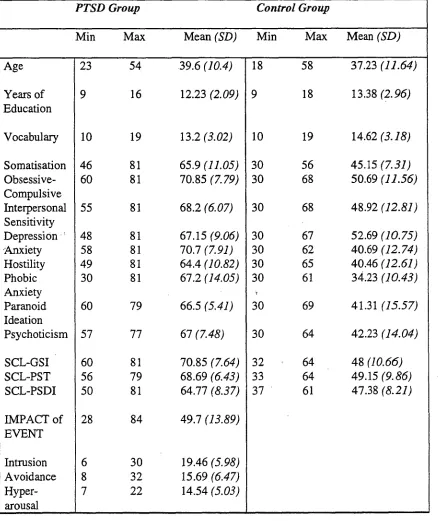
Table 1.
Range and mean (SD) scores for the Control and PTSDGroups for age, sex, years of education, Vocabulary, and the
SCL-90-R and Impact of Event (Revised) scales.
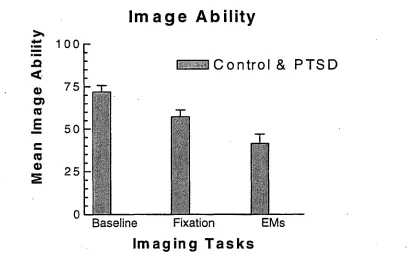
19. Figure
2. PTSD and Control Groups' mean
(St. Error)imaging ability
scores for Baseline Imaging, Imaging + Fixation, and Imaging + EMs.
20. Figure 3.
The combined Groups' mean
(St. Error)imaging ability
scores for Baseline Imaging, Imaging + Fixation, and Imaging + EMs.
21. Figure 4.
The mean
(St, Error)Gain (Eye velocity/ Target velocity)
scores for the PTSD and Control Groups, measured during Baseline
EMs and Imaging + EMs.
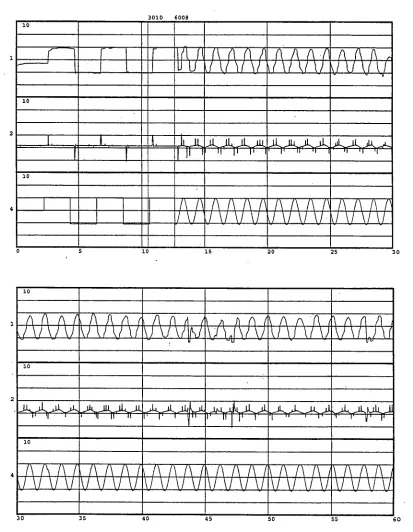
22. Figure 5.
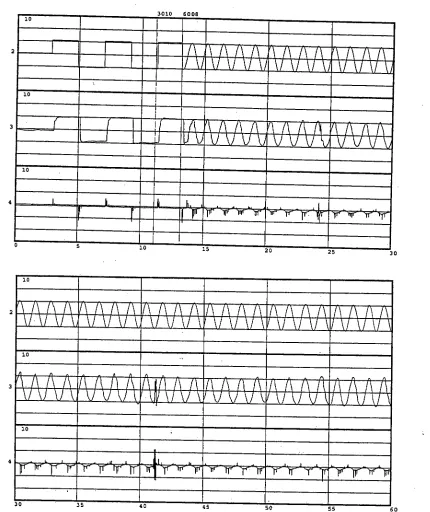
Recording of 60 seconds of eye movements during Baseline
channel 2, and target stimulus signal in channel 3, for Control
participant: identification number 2.
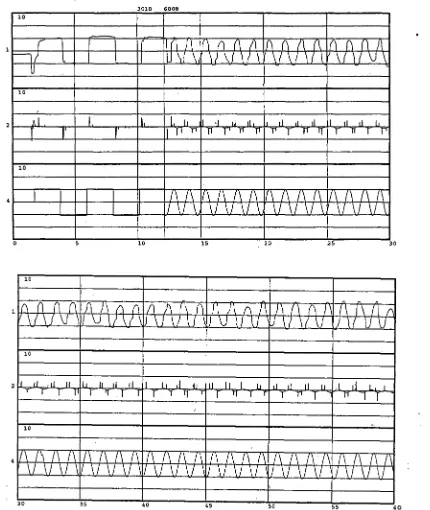
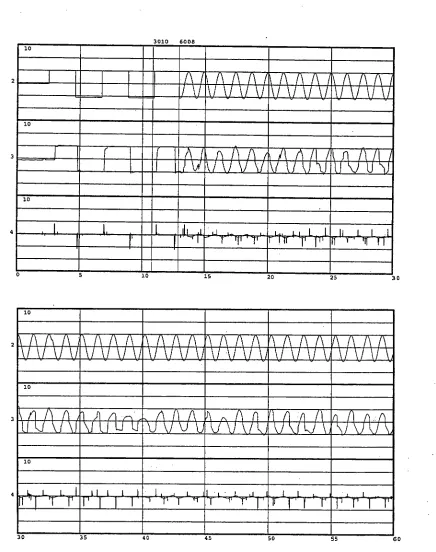
24. Figure
7. Recording of 60 seconds of eye movements during Baseline
EMs task, showing the target stimulus signal in channel 1, eye position
signal in channel 2, and the eye velocity signal in channel 3, for PTSD
Group participant: identification number 9.
25. Figure 8.
Recording of 60 seconds of eye movements during Imaging
+ EMs task, showing target stimulus signal in channel 1, eye position
signal in channel 2, and eye velocity in channel 3, for PTSD group
participant: identification number 9.
26. Figure
9. 30 seconds of eye fixation, with eye position signal in
channel 1, eye velocity signal in channel 2, and target stimulus signal
in channel 3, for Imaging + Fixation, for Control participant:
identification number 2.
26.
Figure 10.30 seconds of eye fixation, with moving stimulus signal in
Imaging + Fixation, and Imaging + EMs.
29.
Table 3.
The range and mean (SD) subjective difficulty scores for thecombined Groups for Baseline EMs, Baseline Imaging, Imaging +
Fixation, and Imaging + EMs.
30.
Table 4.
The range and mean (SD) Average heart rate scores for thecombined Groups for Baseline EMs, Baseline Imaging, Imaging +
Fixation, and Imaging + EMs.
Appendices Page No. Title
45. Appendix 1.
Newspaper advertisement.
46. Appendix 2.
University and Community Mental Health Services
poster.
7. Appendix 3.
Information sheet.
48. Appendix 4.
Consent form
49. Appendix 5.
Imaging Task letter and number characters.
Abstract
Eye Movement Desensitisation and Reprocessing (EMDR) is a treatment for Post Traumatic Stress Disorder (PTSD) which involves the client visualising
traumatic memories, whilst performing rapid eye movements (EMs). The developer of EMDR, Shapiro (1995) proposes that EMs facilitate accelerated information processing and induce relaxation. The aim of the present research was to measure imaging ability and eye movements in four conditions. There were two baseline tasks called Baseline Imaging and Baseline EMs, and two experimental tasks called
Imaging + EMs and Imaging + Fixation. Participants were a group with PTSD and a matched control group. The imaging task was adapted from Logie, Zucco, and Baddely (1990) and involved participants listening to aural instructions for mentally constructing and visualising 3 X 5 matrices of black and white squares which formed number or letter characters.
The eye movement conditions - the Baseline EMs and Imaging + EMs tasks, involved participants tracking a target spot, which moved back and forth at a speed of 44 ° /second and across a distance of 20 ° . The EMs elicited were similar to those in EMDR. These EMs were performed during completion of the imaging task in the Imaging + EMs condition. The Imaging + Fixation task involved the measurement. of imaging ability whilst fixating on a target spot and during which another spot moved horizontally across the screen at a speed of 44 ° /second and across a distance of 20 ° . During each stage of the experiment, participants' average heart rates, perceptions of task difficulty, and subjective anxiety were measured, to investigate whether the EMs induced relaxation.
Eye Movement Desensitisation and Reprocessing (EMDR, Shapiro, 1995) is a
combination of imaginal exposure, cognitive restructuring, and psycho-dynamic
principles for a client-centred protocol, with the addition of rapid eye movements.
EMDR is mainly associated with the treatment of civilian and combat related Post
Traumatic Stress Disorder (PTSD), and has recently had some impressive results
(Marcus, Marquis, & Sakai, 1997; Scheck, Schaeffer, & Gillette, 1998; Carlson,
Rusnak, Chemtob, & Hedlund, 1996; Carlson, Chemtob, Rusnak, Hedlund, &
Muraoka, 1998). EMDR has received support as a 'probably efficacious' treatment
for civilian PTSD, by a task force of the Clinical Division of the American
Psychological Association (APA, 1998). This support was based on the findings of
Wilson, Becker, and Tinker (1995) and Rothbaum (1997), which indicated that
EMDR is a more efficacious PTSD treatment than a waiting list control. EMDR is
considered to induce lasting reductions of anxiety and PTSD symptoms (up to 15
months according to Wilson, Becker, and Tinker, 1997), changes in cognitive
assessment of traumatic memories with improved self appraisal, and cessation of
flashbacks, intrusive thoughts, and sleep disturbances (Shapiro, 1989).
they can be replaced completely with rapidly presented bilateral tactile or auditory
stimuli (Shapiro, 1995, p 67). The EMs sets are repeated until the visualisation of
each distressing detail of the trauma has become significantly less anxiety provoking,
according to the client's self rating on a Subjective Units of Distress (SUDs) scale
(Wolpe, 1982). At this point the client is considered to be desensitised to
trauma-related stimuli. The client is then asked to focus on a self enhancing belief, which he
or she has identified as desirable, again whilst performing sets of rapid eye
movements. These EMs sets are repeated until the client believes the positive
statement, as rated on a Validity of Cognition (VOC) scale (Shapiro, 1989).
The EMs component is based on Shapiro's chance observation, whilst walking
in a park one day in 1987, that her disturbing thoughts were suddenly disappearing
and were not returning without conscious effort. Shapiro scrutinised her actions and
noticed that her disturbing thoughts were coupled with spontaneous, rapid'
back-and-forth eye movements in an upward diagonal direction. Shapiro found that deliberately
making the eye movements had the same effect of reducing the negative charge of her
thoughts. She deduced that the eye movements were saccadic (very brief, high
velocity eye movements, up to 600 ° /second, Armstrong & Vaughan, 1996), and
formulated the initial version of her therapy, Eye Movement Desensitisation (EMD).
EMD only differs from EMDR in terms of a reduced emphasis on bodily tension and
less refined protocols.
Shapiro's description of the origin of EMD has been questioned on the
premise that normal saccadic eye movements appear to be physiologically
undetectable, and are typically triggered by external stimuli (Rosen, 1995). However,
it has been argued that Rosen's conclusion is erroneous due to an incomplete
it is most likely that Shapiro's spontaneous eye movements were indeed saccadic
(Welch, 1996). The EMs elicited in EMD and EMDR are thought to be smooth
pursuit eye movements (the ocular motor system moves the eye smoothly and
continuously at a rate that ideally matches that of the moving target) with some
saccadic eye movements (occasional saccades bring the fovea on to the target to
correct errors of eye position in relation to the moving target), when the therapist's
hand is moving faster than the eye is able to track (Armstrong & Vaughan, 1996).
There are several proposals to explain why repetitive, saccadic eye movements
spontaneously accompanied Shapiro's negative thoughts, and how eye movements
facilitate the treatment effects of EMDR.
It is claimed that the EMs cause the proposed treatment effects of EMDR by
inducing both a 'compelled relaxation response' and accelerated processing of
trauma-related memories, emotions, and beliefs, to achieve resolution (Shapiro, 1995;
Hedstrom, 1991; Wilson, Silver, Covi, & Foster, 1996). These effects are considered
to be manifested in clients' rapidly changing emotions, cognitive insights, and recalled
memories, across single sessions of EMDR (Shapiro, 1995). The purpose of this
study is to investigate the effectiveness of the eye movement component of EMDR in
facilitating relaxation, and information processing in terms of the ability to visualise
an image or event.
Based on observations that psychophysiological arousal is reduced during
EMDR, it is suggested that the EMs induce a 'conditioned' or 'compelled' relaxation
response, by activating unknown physiological mechanisms which in turn activate the
parasympathetic nervous system (Shapiro, 1995; Wilson et al., 1995). Therefore, by
asking the client to visualise and imagine the trauma whilst performing the EMs, the