Application of non-destructive
evaluation techniques to the prediction
of solid-wood suitability of plantation-
grown Eucalyptus nitens logs
Juan Carlos Valencia Baier
Forest Engineer
Submitted in fulfilment of the requirements for the Degree of Master of Science
Declarations
This thesis contains no material which has been accepted for a degree or diploma by
the University or any other institution, except by way of background information and
duly acknowledged in the thesis, and to the best of my knowledge and belief no
material previously published or written by another person except where due
acknowledgement is made in the text of the thesis.
This thesis may be made available for loan and limited copying in accordance with
the Copyright Act 1968.
Where the candidate has co-authored a manuscript in preparation for submission or
submitted for publication, the candidate undertook the research and major writing
presented in this thesis. Co-authors oversaw the research projects and assisted with
text preparation in a supervisory role.
Signed: Date:
02 le,
2cc
Abstract
Non-destructive evaluation measurements of longitudinal growth strain (LGS) and
acoustic wave velocity (A WV) were collected on 22-year-old Eucalyptus nitens trees
from a plantation thinning trial in Tasmania. A total of 81 trees from five residual
stocking treatments including an unthinned control were assessed. LGS was
measured at breast height at four aspects per tree. Standing tree-A WV was determined
at two opposite aspects per tree. Log-A WV was collected on the 5.7 m-long bush-logs
and on 162 lower and upper 2.7 m-long sawlogs. Sawlogs from 41 trees with
diameter over bark (DBHOB) under 43 cm were back-sawn, and those from 40 trees
with DBHOB over 43 cm were quarter-sawn. Wood shrinkage and basic density were
measured on 25x25x40 mm wood blocks cut from wood disks immediately above
the first and second sawlogs of the back-sawn trees at heights of approximately 3m
and 6 m above ground. Three blocks were cut at each height, at radial distances 25%,
50% and 75% from pith to cambium. Linear mixed models and multiple linear
regressions (MLR) were applied to examine: a) effects of stocking, DBHOB and
other factors on LGS, AWV and wood block traits; and b) the ability to predict
sawing traits (log end-splitting; sawn-board distortion, shrinkage and checking
propensity), product recoveries and value; and wood mechanical properties (timber
stiffness, strength and hardness).
Stocking was significantly positively related only to log-A WV. DBHOB was
negatively related to standing tree-A WV and log-A WV, and positively related to log
end-splitting, which was also higher in the upper sawlogs and positively related to
LGS and log-A WV. Measurement aspect affected both LGS and AWV with higher
Basic density increased with stem height and from pith to cambium,'whereas
tangential and radial shrinkage and collapse were lower at the upper sampling point,
while they also increased from pith to cambium. LGS was positively associated with
sawn-board distortion and losses of board volume from end-docking. Standing
tree-A WV, log-A WV and basic density were positively related to wood mechanical
properties. Log-A WV was also positively related to board bow, shrinkage, select
recovery and product value. Levels of shrinkage and collapse in wood-blocks were
related to board shrinkage (positive), internal checking (positive), select recovery
(negative) and product value (negative). Overall LGS, AWV and block traits had a
modest capability to predict sawlog performance, explaining respectively up to 20%,
17% and 6% of additional variance in log end-splitting, timber stiffness, and product
value, in those MLR that already incorporated significant explanatory factors such as
Acknowledgements
I would like to thank my supervisors Dr. Chris Harwood (CSIRO Forest Biosciences,
Hobart), Professor Brad Potts (School of Plant Seience, University of Tasmania) and
Dr Peter Volker (Forestry Tasmania) for their outstanding assistance,
professionalism and friendship, which was certainly the key for achieving my
commitment as student. I would like to extend my thanks to Drs Russell Washusen,
Junli Yang, Geoff Downes and Andrew Morrow (CSIRO Forest Biosciences), Dr.
Matt Wood (Forestry Tasmania), Dr Trevor Innes (Forest Enterprise Australia Ltd)
and Dr Ross Farrell (Timber Research Unit of the University of Tasmania) for their
collaboration in critical phases of my research, and also for their participation as
co-authors of scientific articles in preparation. My MSc research was conducted in the
Cooperative Research Centre for Forestry, with strong support from other research
and technical staff from Forestry Tasmania, CSIRO Forest Bioscience, Hobart, and
the University of Tasmania. Thanks to all of them.
I would like to thank my employer the Forest Institute of Chile (INFOR) for its
financial support to pay the university fees during the first year of my studies and its
support to cover my living cost during all my studies. Also, I acknowledged the
decision made by Dr Roberto Ipinza (former Executive Director of INFOR) to
support my postgraduate studies in Australia. Thanks are also due to the CRC for
Forestry for its complementary financial support during my last year of studies.
To my wife Katia, my sons Juan Carlos and Sebastian and to my mother Alicia, your
love and support are my inspiration. And finally, thanks to Tasmania, Australia for
Table of Contents
Declarations
Abstract II
Acknowledgements IV
Table of contents V
Format of thesis chapters VII
Publications arising from MSc candidature VIII
CHAPTER! 1
General introduction 1
1.1 Sawn timber production from plantation-grown eucalypts: wood quality
limitations and NDE techniques 1
1.1.1 Plantation-grown eucalypts for sawlog production: current progress 1 1.1.2 Wood quality constraints and solid-wood drivers 3 1.1.3 Non-destructive evaluation techniques to assess solid-wood quality
traits 8
1.2 Study background 14
1.2.1 Context and aims 14
1.2.2 Goulds Country silvicultural trial and processing study 16
CHAPTER 2 22
Longitudinal growth strain as a log and wood quality predictor for plantation-
grown Eucalyptus nitens sawlogs 22
2.1 Abstract 22
2.2 Introduction 23
2.3 Materials and methods 27
2.3.1 Non-destructive measurements of longitudinal growth strain at standing
trees 27
2.3.2 Information from a subsequent sawing trial 28
2.4 Statistical analyses 31
2.4.1 Silvicultural effects on longitudinal growth strain of standing trees 31 2.4.2 Relationships between standing tree growth strain and sawing
performance 32
2.5 Results and diseussion 34
2.5.1 Longitudinal growth strain: levels, sources of variation and
relationships 34
2.5.2 Standing tree longitudinal growth strain as predictor of sawlog quality
37
2.5.3 LGS and log end-splitting as predictors of solid-wood traits 45
2.5.4 Application of results 47
2.6 Conclusions 50
CHAPTER 3 51
Predicting Eucalyptus nitens plantation-grown sawlog quality from acoustic wave
velocity and wood shrinkage data 51
• 3.1 Abstract 51
3.2 Introduction • 53
3.3 Materials and methods 57
3.3.2 AWV measurements at bush-logs and sawlogs 58 3.3.3 Wood shrinkage, collapse and wood basic density from small wood-
blocks 59
3.3.4 Information utilized from the sawing trial 61
3.4 Statistical analyses 62
3.4.1 Effects of silvicultural treatments on AWV and wood-blocks traits 63 3.4.2 AWV as a predictor of sawing traits and wood mechanical properties 65 3.4.3 Wood-block traits as predictors of sawing traits and mechanical
properties 67
3.5 Results and discussion' 68
3.5.1 AWV measurements: levels and sources of variations 68 3.5.2 Wood-blocks traits levels and sources of variations 75 3.5.3 Predicting sawing traits and mechanical properties from AWV and
block traits 78
3.5.4 Application of results 90
3.6 Conclusions 93
CHAPTER 4 95
Non-destructive predictors of wood quality for sustaining the value-chain of
plantation-grown eucalypts for sawlog production 95
4.1 Application of NDE wood quality predictors in tree breeding 95 4.2 Application of NDE wood quality predictors in sawlog silviculture 100 4.3 Application of NDE wood quality predictors for stand valuation and log
segregation 101
Format of thesis chapters
Chapter 1 provides a general introduction, with an overview of pertinent literature
and a short background to the current study. Detailed literature reviews are included
in the two experimental chapters of this thesis (Chapters 2 to 3) which have been
written in the format of scientific journal articles. Because Chapters 2 and 3 are
intended for separate publication (see following page), they repeat part of the general
introduction in Chapter 1. Chapter 4 give g a general discussion, synthesizing the
most important findings and identifying those areas in which the research undertaken
can contribute understanding and practical applications. While the abstracts for
Chapters 2 and 3 have been kept in the form in which they will be published, figures
•and tables have been renumbered for this thesis, and the acknowledgements and lists
Publications arising from MSc candidature
Publications submitted and in preparation
Valencia, J, Harwood, C, Washusen, R, Morrow, A, Wood, M, Volker, P.
(submitted) Longitudinal growth strain as a log and wood quality predictor
for plantation-gown Eucalyptus nitens sawlogs. Forest Ecology and
Management.
Valencia, J, Harwood, C, Washusen, R, Morrow, A, Yang, J, Bojadzic, M, limes, T,
Farrell, R. (in preparation) Predicting Eucalyptus nitens plantation-grown
sawlog suitability from acoustic wave velocity and wood shrinkage data.
Research reports
Beadle, CL, Forrester, D, Wood, M, Valencia, J, and Medhurst, J (unpublished)
Effects of silviculture and the environment on the variables that determine
outcomes from eucalypt plantations managed for solid-wood products.
Technical Report 173, 2007. Cooperative Research Centre for Forestry,
Hobart, Australia.
Washusen, R., Morrow, A., Harwood, C., Valencia, JC, Volker, P., Wood, M.,
Inness, T., Ngo, D., Northway, R. (unpublished) Gould's Country E.
nitens spacing trial; solid wood quality and processing performance using
conventional processing strategies. Technical Report 168, 2007.
CHAPTER 1
General introduction
This chapter provides a literature review on non-destructive evaluation (NDE)
techniques relevant for sampling planiation-grown eucalypts for sawlog production
and a background to the research undertaken. More specific literature reviews and
detailed descriptions of the study carried out are both included in chapters 2 and 3,
which report the experimental work undertaken.
1.1 Sawn timber production from plantation-grown eucalypts: wood quality limitations and NDE techniques
1.1.1 Plantation-grown eucalypts for sawlog production: current progress
The total area planted with eucalypt species world-wide has been estimated to reach
over 20 million hectares by 2010 (Keane et al. 2000; Lindenmayer 2002). Nowadays,
nearly two-thirds of eucalypt plantations are established in sub-tropical and tropical
zones of countries such as Brazil, South Africa, Uruguay, China, India and Vietnam,
using E. grandis, E. urophylla and their hybrids as the most important planted
species (Cossalter and Pye-Smith 2003). One-third is established in temperate zones
in countries such as Australia, Chile, Portugal and Spain, using temperate species
Overall, commercial plantation-grown eucalypts have been established as mono
specific stands, managed under unthinned silvicultural regimes in relatively short
rotations (up to 15 years) with the aim of supplying wood fibre for pulp and paper
manufacturing (Cossalter and Pye-Smith 2003; Montagu et al. 2003; Nutto et al.
2006). During the last two decades, a small but increasing area of eucalypt
plantations, of the same species, has been managed by thinning and pruning to
produce appearance and/or structural timber (Baker and Volker 2007; Nolan et al.
2005; Nutto and Touza 2004).
A decline in the availability of sawlogs from traditional native forest sources, a rapid
increase in the planted area of eucalypts and some technical-economic stand level
considerations have been cited as reasons for some growers to shift towards the
establishment and management of eucalyptus plantations for high-value solid and/or
engineered wood products (Flynn 2005; Forrester and Baker 2005; Nolan et al. 2005;
Nutto and Touza 2004). South Africa, Brazil and Argentina have developed some
important knowledge on silviculture, processing and market for high value timber
production from E. grandis and other species well adapted to grow in sub-tropical
and tropical zones (Donnelly and Flynn 2004; Kolln 2000; Malan 2003; Malan
2005; Shield 2004; Verryn et al. 2005). Examples of industrialization of eucalypt
plantation-grown timber are well represented by Lyptus ® in Brazil and Grandis® in
Argentina.
Less development of sawlog silviculture has occurred in temperate eucalypt
plantations to date. The majority of technical knowledge for temperate species has
been developed in Spain on E. globulus (Nutto and Touza 2004; Nutto et al. 2003;
nitens (Baker and Volker 2007; Forrester and Baker 2005; Gerrand et al. 1997a;
Gerrand et al. 1997b; Washusen and limes 2007). Examples of recent
industrialization are lbersilva-Plantation Wood ® in Spain (ENCE 2006) and
EcoAshTM in Australia (Cannon and limes 2007). Recent research efforts on
silviculture and processing; and early industrial processing of E. nitens
plantation-grown timber are also taking place in Chile (INFOR 2004a).
The experience gained in processing plantation-grown eucalypts for high-value
timber worldwide indicate a strong potential for commercial processing (Nutto and
Touza 2004; Touza 2001b; Verryn et al. 2005; Washusen and Innes 2007), provided
there are further improvements in some critical solid-wood quality constraints and
progress in processing and drying technologies.
1.1.2 Wood quality constraints and solid-wood drivers
Despite the promising experiences described, the industrialization of
plantation-grown eucalypts for solid-wood production for both appearance and structural
markets is still at a preliminary stage (Malan 2003; Nolan et al. 2005). Uncertainties
in the market for plantation-grown sawlogs and some financial cost considerations
linked to growing more expensive and longer rotation regimes have resulted in some
level of reluctance among forest growers to undertake more investment in large scale
plantation-grown eucalypts for sawlog. Conversely pulpwood regimes are commonly
seen as a shorter and lower-risk investment (Nolan et al. 2005).
Poor wood quality as a consequence of higher levels of growth stresses, excessive
and variation in strength and hardness is a primary limiting factor (Malan 2003;
Washusen et al. 2004; Yang and Pongracic 2004; Yang and Fife 2003). In addition, wood product quality may be negatively influenced by current silviculture practices
and genetic material, with most plantations grown primarily for pulpwood production
(Nolan et al. 2005; Raymond 2002). The following is list of some solid-wood quality constraints, that have been mentioned to be particularly critical for younger
plantation-grown timber of eucalypts (Armstrong 2003; Lewty et al. 2001; Malan 1995; McKenzie et al. 2003a; Washusen and Innes 2007; Yang etal. 2003):
a) Both green and dead knots and also the pith may be primary grade-limiting
defects for both appearance and structural applications. This is more frequent
when the plantations are grown un-thinned and/or unpruned, and is
particularly important in eucalypts species with limited ability for
self-pruning such as E. nitens, and when plantations are harvested at relatively young age or when the stand has not been pruned to restrict the diameter of
the knotty core.
b) High levels of longitudinal growth stress and its adverse effects on wood
quality when released during harvest and processing. Release of growth
stresses during tree felling and crosscutting of logs can lead to a high
incidence and severity of log end-splitting. Brittle heart associated with high
growth stress may produce weak material in the log core. During sawing
there may be constraints on the application of sawing strategies as a
consequence of growth stresses. High growth stresses may also contribute to
flitch and board deflection (spring, bow and cupping due to stress re-balance),
boards during sawing. These negative consequences may reduce volume
recovery and product value through material loss from board end-docking,
reduced sawn-board length and width and product downgrading. Increased
processing costs and reduced mill economic performance are also likely.
c) Excessive shrinkage and collapse, and their variation
resulting in poor
drying performance, reduced choice of sawing patterns, sawn-board
dimensional instability, rough surfacing, honeycombing and checking,
reduced value of appearance grade sawn-products through a relationship
between shrinkage and checking propensity. Internal and surface checks are
the most serious forms of drying degrade, affecting grade recovery and are
particularly important in limiting the value of plantation-grown
E. nitens.Most eucalypts have a strong tendency to check on the wide faces of back
sawn boards; and internal checking and its severity generally increases with
collapse. Therefore in those cases where check prone eucalypts species such
as
E. nitensare established to produce appearance sawn-timber, the financial
pressure to keep production cost levels low by producing medium sized
back-sawn sawlogs rather quarter-back-sawn logs (which require prolonged rotation age
to reach suitable log sizes for processing) may result in higher checking
incidence and therefore reduced product value per log input.
• d)
Tension wood occurrence and severitydetermining poor drying performance
of solid timber due to the occurrence of abnormal shrinkage; high
longitudinal shrinkage when the tension wood occurs at
thestem periphery
•and surface irregularity, determining downgrade or the need for
Overall,' the size and occurrence Of knots can be overcome using timely pruning
regimes aimed to restrict the defective knotty core (Montagu
et al.2003). Therefore
checking propensity (critical only for appearance solid-wood products) and higher
levels of growth stresses, and board stability may• be considered as the most
important processing and value limiting factors for solid-wood production from
young fast-grown eucalyptus plantation timber (Waugh 2005; Yang and Waugh
2001).
Particularly during the last 10 years several studies carried out worldwide have
started to contribute more understanding to the commercial potential of
plantation-grown eucalypts for solid-wood production. They also have given insights into the
feasibility of improving solid-wood quality constraints by genetic improvement,
enhanced silvicultural practices and processing strategies. There are several
examples of recent studies on processing performance undertaken in temperate
eucalypts growing in Spain, New Zealand and Australia (Brennan
et al.2004; ENCE
2006; INFOR 2004b; McKenzie
et al.'2003a; McKenzie
et al.2003b; Nutto and
Touza 2004; Shelbourne
et al.2002; Washusen and limes 2007; Washusen
et al.2004). In sub-tropical and tropical eucalypt species the research on processing
performance is being undertaken mainly in Brazil, Argentina, Australia and South
Africa for species such as
E. grandisand its hybrids (Aparicio
et al.2005; DPI
Department of Primary Industries and Fisheries 2005; Lima
et al.2002; Lima 2005;
Ven
-
yn
et al.2005). Studies aiming to examine the genetic control of growth stress
related traits have been carried out in
E. dunnii(Henson
et al.2005; Murphy
et al.2005) and
E. grandis(Barros
et al.2002; Padua
et al.2004). Other examples of
similar studies aimed at determining the genetic control of some wood properties
spiral and interlocking grain or sawn board distortion have been carried out in E.
dunnii (Harwood et al. 2005; Henson et al. 2005; Thinley et al. 2005), E. nitens
(Hamilton 2007; Kube and Raymond 2005), E. globulus (Greaves et al. 2004b;
Hamilton et al. 2007), E. grandis (Santos et al. 2004), and E. pilularis (Smith)
(Pelletier et al. 2007). The majority of these studies have found exploitable levels of
genetic control, which is promising for breeding programmes for solid-wood
production. Comparatively less research has been done to date on the effects and
interactions between silviculture practices and critical solid-wood quality traits
(Volker 2007). Some recent studies have given some insight into the effects of
plantation density, thinning intensity, tree size and age on some traits such as wood
density, longitudinal growth strain (LGS), tension wood, log end-splitting and sawn
board distortion in species such as E. grandis (Lima et al. 2006; Lima et al. 2000a;
Trugilho et al. 2007a), E. dunnii (Murphy et al. 2005; Trugilho et al. 2004), E.
globulus (Touza 2001b) and E. nitens (Washusen etal. 2008).
Further progress in improving the value chain for plantation-grown eucalypts relies
on developing an improved understanding of the relationship among genetics,
silviculture and processing with critical solid-wood traits (Volker 2007). In this
context the Wood quality assessment will play a relevant role, particularly the
development of cost-effective and reliable non-destructive evaluation (NDE)
techniques suitable for screening a large number of samples and traits (Raymond
1.1.3 Non-destructive evaluation techniques to assess solid-wood quality traits
The application of NDE techniques to assess wood quality in plantation-grown eucalypts has been well understood and developed for pulpwood silviculture
(Downes et al. 1997; Raymond and Muneri 2001; Raymond et al. 2001). In this case the plantation objective is to produce wood fibre for cellulose. Therefore the
plantations are managed to be profitable producing large amounts of wood volumes
of small-diameter logs as quickly as possible, considering wood basic density, pulp
yield and cellulose content as critical wood quality traits. Consequently, the NDE techniques utilized such as gravimetric assessment of basic density, SilviScanTM and
near-infrared spectroscopy (NIR) has been calibrated to develop reliable predictors of these traits using 12mm wood cores extracted from standing trees or harvested logs
(Evans 2001; Raymond and Muneri 2001; Schimleck et al. 2006)
Plantation-grown eucalypts for solid-wood production must be managed for the
profitable sale of sawlogs suitable for processing into structural and/or appearance
grade products, with residual wood (reject trees and upper logs) sold as pulpwood.
From the silvicultural perspective this requires, in the majority of the cases, the
application of thinning and pruning regimes. These silvicultural practices may have
important effects on solid-wood quality traits, although their impacts have not yet
been well-quantified. From the processor and marketing point of view, the wood
quality requirements of sawlogs, either for appearance and/or structural applications,
may be markedly different. Given the relatively recent history of silviculture and
processing of plantation-grown eucalypt timber, there has been comparatively less
such as acoustic wave Velocity
(A WV)tools; extensometers;
NIRtechnology; X-ray
densitometry, diffractometry; high resolution image analysis and computed
tomography, are now been progressively studied in eucalypts to develop predictors
of raw material suitability and solid-wood product value (Armstrong 2003; Dickson
et al.
2003; Harwood
et al.2005; McConnochie
et al.2004; Raymond
et al.2004;
Yang 2007). The most studied
NDEtechnologies suitable for plantation-grown
eucalyptus for sawlog are:
a) Extensometers to collect longitudinal growth strain (LGS):
several
instruments such as dial, resistance and transducer strain gauges have been
developed to estimate growth stress in standing trees or harvested logs (Yang
etal.
2005). As growth stress is defined by the product between
strainand the
modulus of elasticity (MOE), the extensometers can measure
LGSand
therefore give an indirect estimation of growth stress. If
MOEis known, growth
stress can be calculated. The CIRAD-Foret growth strain gauge is one of the
most commonly used devices to measure
LGSat the wood surface of standing
trees and logs (Cassens and Serrano 2004; Yang
et al.2005). The CIRAD-Foret
growth strain gauge is based on measuring the distance between two reference
points (pins driven into the stem) before and after a hole centred between these
points is drilled. The amount of displacement (separation) of the pins as the
result of the drilling of the hole is registered using a dial gauge and is regarded
as a direct measure of the strain released: the greater the displacement, the
greater the strain (de Fegely 2004 ; Raymond
et ed.2004). The CIRAD-Foret
growth strain gauge has been used with plantation-grown eucalypt species such
as
E. dunniiin Australia (Murphy
et al.2005),
E. grandisand its hybrids in
globulus grown in Australia (Raymond et al. 2004; Yang 2005; Yang et al.
2002) and in E. nitens in Chile (Valdes 2004). Some of these studies have
found significant relationships between LGS and stocking rate (stems ha -1 ); and
also between LGS and tree diameter, but not always giving similar conclusions.
These studies have also found significant relationships among LGS and some
processing traits such as log-end splitting and sawn-board distortion, but have
not always given concrete indications of predictive power or cost involved in
sampling. In addition, the majority of these studies have been carried out on a
small number of trees and also in plantation-grown trees managed without
thinning or pruning regimes.
b) Acoustic wave velocity (A WV) measurements: wood mechanical properties
such as timber stiffness (static modulus of elasticity, MOEs) have traditionally
been determined by the time consuming and expensive bending test on wood
samples which record deflection as load is applied (Carter et al. 2005).
Therefore this method is not suitable to screen large numbers of trees aiming to
select among large populations for breeding improvement or to segregate
timber in an operational way (Dickson et al. 2003). Obtaining samples also
results in the destruction of the standing tree. From previous research, mainly
developed in softwood species (Carter et al. 2005; Carter et al. 2006; Wang et
al. 2005a; Wang et al. 2001), it is well known that the stress acoustic wave
propagation properties of the timber, either measured on standing trees, logs or
sawn-boards, are well correlated with mechanical properties, particularly with
MOEs (Huang et al. 2003). In fact the dynamic modulus of elasticity (MOED)
along the fibre, which is a function of acoustic wave velocity (A WV) and wood
Toulmin and Raymond 2007), and therefore generally also with timber strength
(modulus of rupture,
MOR),due to the moderate correlation between
MDEsand
MOR(Lei
et al.2005; Steele and Cooper 2003).
NDEmethodologies and
acoustics tools have been developed to calculate
MOEDwith the aim of
predicting
MOEsand other related mechanical properties such as
MOR(Huang
et al.
2003).
The transit time-of-flight
(TOF)method, which can be applied in standing
trees, logs or sawn-timber, and the sonic resonance method, which can be
applied in logs and sawn-timber, are the two main
NDEtechniques to measure
AWV
(Carter
et al.2005; Carter
et al.2006).
TOFacoustic tools such as the
FAKOPP
TM
Microsecond Timer, give the transit time of an introduced stress
wave (sound impulse) during its propagation into a wood sample between two
probes (Fakopp 2000). Using the distance between the probes and the stress
wave transit time,
AWVis calculated. In tools using the resonance method such
as DIRECTOR HM200Tm, the stress wave is introduced by hammering at one
end of the specimen (log or board), and it travels along the specimen until it
gets reflected (Fibre-Gen 2007). The reflected wave is measured at the same
end of the specimen as where the wave was launched (Carter
et al.2005; Carter
et al.
2006; Waghom 2006). The resonance method tends to measure the
average velocity of a number of reverberating waves, rather than the time of
arrival of a first wave front as the
TOFdoes. Both techniques have been
successful in relating
AWVmeasurements with
MOEsin natural softwood
forests (Wang
et al.2005a) and in
Pinus radiataD. Don plantations (Lasserre
et al.
2005; Tsehaye
et al.2000).
AWVis now used to assist selection of better
improve structural grade recoveries (Dickson et al. 2004; Grabianowski et al.
2004; Lasserre et al. 2005; Lasserre et al. 2007; Lindstrom et al. 2002). To
date, there are few published studies in which AWV has been related to
mechanical properties in plantation-grown eucalypt timber (Dickson et al.
2003; Henson et al. 2005). These studies in E. dunnii and a study done in E.
nitens and E. globulus (Harwood et al., unpublished), have given some insights
in the capability of AWV to predic MOEs, and also some indications about
genetic variation and heritability in MOEs estimated from AWV. Less progress
has been made in studying .the effects of silvicultural practices (e.g. thinning)
on AWV and MOE s ; and the capability of AWV to reliably predict sawing
performance and value limiting appearance defects.
c) NDE sampling methods for assessing shrinkage and collapse: Variation in
shrinkage and collapse behaviour have been related to drying degrade problems
such as checking (Greaves et al. 2004b; Hamilton 2007; Yang and Fife 2003),
which is a value limiting factor for appearance end-uses, particularly in E.
nitens plantations grown for sawlogs (Shelbourne et al. 2002; Washusen and
Imes 2007). Variations and patterns of wood shrinkage, collapse and basic
density has been non-destructively assessed from fixed-height woo'd cores (12
mm diameter, pith to bark or bark to bark) from standing trees and logs,
information which also has been used to explore the relationships with other
solid-wood traits such as checking propensity. This NDE technique has been
recently applied to support tree breeding programmes in species such as E.
nitens (Hamilton 2007), E. globulus Labill. (Raymond et al., unpublished data),
E. dunnii•Maiden (Harwood et al. 2005) and E. pilularis (Smith) (Pelletier et
and uncertainty remains as to its reliability for the prediction of sawlog quality
in eucalypts (Harwood et al. 2005; Pelletier et al. 2007).
d) SilviScanTM technology and NIR spectroscopy: are promising NDE
techniques for sampling eucalypts for solid-wood production. Using only small
wood samples such as wood cores and wood strips, SilviScanTM has been used
for instance to estimate tension wood occurrence and severity in E. globulus
(Washusen 2002); wood density and density variation in E. nitens (Evans et al.
2000); and wood stiffness and MFA variations in E. globulus, E. nitens and E.
regans (Evans et al. 1999; Yang and Evans 2003); and prediction of wood
tangential shrinkage in E. globulus (Washusen and Evans 2001). The technique
also has been recently used to predict LGS levels using information on
microfibril angle (MFA) and cellulose crystallite width ( W„yst) in E. globulus (Yang et al. 2006). NIR spectral bands of ground wood-meal samples have
been used in E. globulus to estimate LGS (Bailleres et al. 2003), and could be
also used to predict MOEs, MOR and wood density (Schimleck et al. 2003;
Tsuchikawa 2007).
These NDE techniques are now being studied in eucalypts to find reliable solid-wood
quality indicators such as LGS, AWV, MOED, wood basic density (and its variations),
MFA and PI/cow that alone or in conjunction may be able to explain enough variance (predictive power) of critical factors limiting, the value of solid-wood, after
accounting for traditional tree and log information such as tree diameter (D), total
tree height (H) and H/D. Overall, predictive models based on multiple regression
2005; Washu§en and Evans 2001). A comprehensive assessment of potential sawlog
quality indicators for E. globulus has been carried out by Yang (2007).
1.2 Study background
1.2.1 Context and aims
The Master of Science (MSc) by research reported in this thesis was carried out
under the Cooperative Research Centre for Forestry Research Programme 2:
High-value wood resources (CRC Programme 2 hereafter), which aims to increase
profitability and investor confidence in planting and managing eucalypts for
pulpwood, engineered and solid-wood products (CRC for Forestry 2007). One
programme goal is to improve the understanding of the technical and economic
feasibility of utilising plantation-grown eucalypts for solid-wood production. CRC
Programme 2 includes five research projects, and its research project 2.4
"Incorporating wood quality into plantation estate management" was the technical
framework for undertaking this MSc research. One objective of research project 2.4
was to develop effective sampling protocols to describe solid/engineered log value,
for temperate eucalypts species such as Eucalyptus nitens. In this context the current
MSc research was designed to assess the utility of NDE techniques applied on
standing trees and harvested logs for predicting critical solid-wood quality traits from
a full rotation 22-year-old E. nitens plantation, managed as a thinning trial from age
six years. The NDE techniques studied were:
U
N
IV
E
R
S
IT
Y
O
F
TA
S
L
IB
R
A
R
a) peripheral longitudinal growth strain (LGS) measured on standing trees; and
b) acoustic wave velocity (A W'9 measurements on both standing trees and
harvested logs.
A destructive sampling designed to measure wood tangential and radial shrinkage
and collapse. and basic density of small wood-blocks taken from the logs was also implemented.
Linear mixed models and multiple linear regressions (MLR) were applied to explore:
a) sources of variation in each NDE measurement and wood-block trait,
examining the effects of thinning treatment, tree diameter and other
experimental design factors on LGS, AWV and wood-blocks traits; and
b) capability of LGS, AWV and wood-block traits to individually predict: critical
sawing traits such as log end-splitting, sawn-board distortion (bow and spring),
board shrinkage (in thickness and width), board end-splitting and checking
propensity, product recoveries and product value per cubic metre of log input;
and wood mechanical properties such as static modulus of elasticity (MOEs or
timber stiffness); modulus of rupture (MOR or strength); and Janka hardness.
This research aimed to contribute to:
a) improved understanding of the usefulness of NDE techniques in evaluating
b) technical information required for defining future solid-wood NDE
sampling protocols suitable for plantation-grown eucalypt timber.
The application of reliable and cost-effective NDE sampling techniques for
solid-wood production may be a powerful tool for:
a) selecting better genotypes for breeding of trees with favourable wood
quality and processing performance;
b) study of wood properties over time, improving and supporting
silviculture interventions (e.g. thinning regimes) to produce high-value
sawlogs and informing decisions on optimal rotation age;
c) better resource characterization and stand valuation through
sampling regimes that characterise log suitability for different end uses;
and
d) more efficient and profitable processing due to improved log
segregation strategies before processing (allocation of raw material fit
for purpose), better wood quality classification after processing,
improved recoveries of both appearance and structural grade seasoned
sawn products and reduced processing cost.
1.2.2 Goulds Country silvicultural trial and processing study
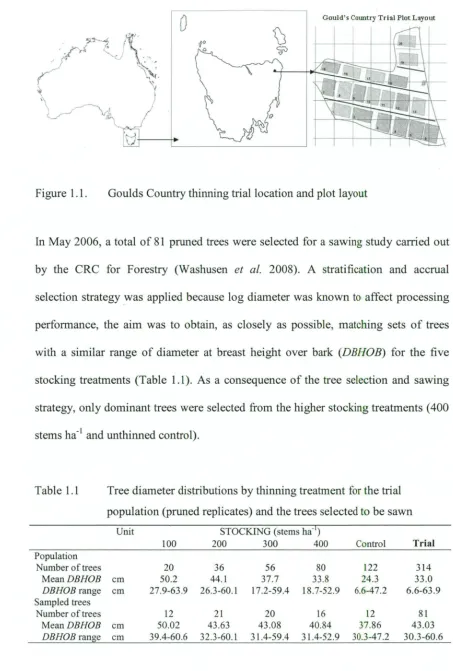
A 22-year-old plantation of E. nitens located at Gould's Country (41005 S, 148°06' E, altitude 120 masl, mean annual rainfall 779 mm) in the northeast of Tasmania,
spacing (1143 trees ha-1) by Forestry Tasmania in 1984, Using seedlings raised'froni the Toorongo Plateau (Victoria) provenance. The trial tested the effects of both
thinning intensity and a single pruning treatment on stand productivity, individual
tree growth and form, and subsequently on processing efficiency and product quality
(Washusen et al. 2008). Four thinning treatments (STOCKING), expressed as stems
ha-I retained, were imposed at age six years: 100, 200, 300, 400 stems ha-1, in addition to an unthinned control treatment, which after natural mortality retained
approximately 750 stems ha-1 at age 22 years. The treatments were applied using a randomized block design with four replicates; two replicates were unpruned and two
replicates were pruned to 6.4 m in a single lift, immediately prior to thinning when
mean dominant height of the stand was 13.8 m. Plot size was 25 m x 40 m (0.1 ha)
and a buffer row surrounding each plot was treated with the same thinning and
pruning treatments. The thinning was executed from below with selection of final
crop trees based on a combination of superior stem form and tree vigour while
ensuring that retained trees in the thinned treatments were not immediately adjacent.
The trial presents one of the first opportunities to study relationships between
thinning intensity and critical solid wood traits in this species. A full discussion of
the stand level responses to pruning and thinning up to and including age 22 years is
given by Wood and Volker (in preparation). Additional information can also be
consulted in Gerrand et al. (1997a), Medhurst and Beadle (2001) and Medhurst et al.
Gould's Country Trial Plot Layout
Figure 1.1. Goulds Country thinning trial location and plot layout
In May 2006, a total of 81 pruned trees were selected for a sawing study carried out
by the CRC for Forestry (Washusen et al. 2008). A stratification and accrual
selection strategy was applied because log diameter was known to affect processing
performance, the aim was to obtain, as closely as possible, matching sets of trees
with a similar range of diameter at breast height over bark (DBHOB) for the five
stocking treatments (Table 1.1). As a consequence of the tree selection and sawing
strategy, only dominant trees were selected from the higher stocking treatments (400
stems ha -I and unthinned control).
Table 1.1 Tree diameter distributions by thinning treatment for the trial population (pruned replicates) and the trees selected to be sawn
Unit STOCKING (stems ha-1)
100 200 300 400 Control Trial
Population
Number of trees 20 36 56 80 122 314
Mean DBHOB CI11 50.2 44.1 37.7 33.8 24.3 33.0
DBHOB range CIII 27.9-63.9 26.3-60.1 17.2-59.4 18.7-52.9 6.6-47.2 6.6-63.9 Sampled trees
Number of trees 12 21 20 16 12 81
Mean DBHOB CM 50.02 43.63 43.08 40.84 37.86 43.03
DBHOB range CI11 39.4-60.6 32.3-60.1 31.4-59.4 31.4-52.9 30.3-47.2 30.3-60.6
After collecting standing tree NDE data, the 81 trees were mechanically felled, cross-
were tagged, their log ends sealed with wax and gang nailed to prevent further
development of any end splits. The bush-logs were transported to a sawmill located
at St Helens, Tasmania where they were cross-cut again, producing a total of 162
sawlogs, each at least 2.7 m in length; thus each tree produced a lower and upper
sawlog (Washusen
et al.2008). Sawlogs from 41 trees with diameter over bark
(DBHOB)
under 43 cm were back-sawn, and those from 40 trees with
DBHOBover
43 cm were quarter-sawn. Sawing strategies aimed to produce 25 mm thick dried
boards while maximizing board width. A central cant from each log was painted on
the southwest (SW) side of the stem and a total of 213 back-sawn and 329
quarter-sawn boards were collected for intensive assessment from within the painted zones
of the cants. Each set of boards provided a sample of boards from the SW side of the
log, whether back-sawn or quarter-sawn. As a result, different sized logs gave
different numbers of boards representative of what could be recovered pith to bark on
the SW aspect (Washusen
et al.2008). The back-sawn boards selected from the
painted cant were pre-dried in a small kiln at the University of Tasmania using a
schedule in which relative humidity was progressively lowered from 90% to 60%
and dry bulb temperature increased from 20 to 25°C over a two-month period. Kiln
air-speed was set at 0.5 m s. Pre-drying was continued until average moisture
content was below 20% as indicated by sample boards and confirmed by using a
resistance moisture meter. The quarter-sawn boards and the remainder of the boards
from the back-sawn logs were initially pre-dried using similar conditions to those
used for the back-sawn boards. Due to the volume of the material for drying some
wood had a period of air-drying prior to reconditioning and final drying. Weighting
of drying stacks was minimal. Once below fibre saturation point all the boards were
considered to be typical of current commercial practice for drying boards sawn from
native eucalypt forest logs in Tasmania.
Several log traits, sawn-board traits, product recoveries and product value
characteristics were measured in this sawing trial, and their values have been
reported in a CRC for Forestry Technical Report (Washusen et al. 2008). From this
sawing study, the following log quality, sawing traits and mechanical properties were
utilized to determine their relationships with the NDE measurements and
wood-blocks traits previously gathered from standing trees and harvested logs:
a) Log end-splitting index: determined at both butt and top log ends, following the
methodology described by Yang et al. (2005) which is detailed in Chapter 2,
b) Sawing traits: flitch and slab distortion (from quarter-sawn material), board bow
and board spring in green and dry condition, presence of surface and internal
checks per board, sawn-board shrinkage in width and thickness, board
splitting extent before and after drying, losses of board volume from
end-docking, total recovery, grade recoveries (select, standard and utility) and product
value per cubic metre of log input,
c) Wood mechanical properties: MOEs, MOR and Janka hardness, which were
determined according to AS/NZS 4063:1992 (Australian/New Zealand Standard
1992), from a subsample of 332 dried boards randomly selected from the
remaining boards generated by the processing trial. This sample strategy was
adopted as a second best option after the intensively assessed boards from the
Specifically chapter 2 details the study aimed to analyse sources of variation of LGS
measured on standing trees in a full rotation E. nitens plantation, exploring its
capability to predict sawlog processing performance. Similarly the experimental
chapter 3 gives the results on the predictive power of acoustic wave velocity data
measured on both standing trees and logs, and shrinkage properties measured on
wood blocks. Chapter 4 is a general discussion, analysing those areas in which the
CHAPTER 2
Longitudinal growth strain as a log and wood quality predictor for
plantation-grown Eucalyptus nitens sawlogs
2.1 Abstract
Longitudinal growth stress was assessed by measuring peripheral longitudinal
growth strain (LGS) on 22-year-old pruned Eucalyptus nitens trees from a plantation
thinning trial in Tasmania. A total of 81 trees selected from five residual stocking
treatments; 100, 200, 300 and 400 stems ha-1, and an unthinned control treatment
.4. ^ICA .11. 1 1 nil Tr!(' vvrno n+
WILLI aUOill 1 JV mcMS 114 kinmatty I vv lia vv aaacaaa.A.L. vvaa CIA
four cardinal directions at breast height on each tree. The effects of stocking
treatment and tree size on LGS and the relationships between LGS and solid-wood
traits from a subsequent processing study were examined. LGS levels were low
relative to other published values for plantation-grown eucalypts and they were not
significantly affected by either stocking level or tree diameter at breast height over
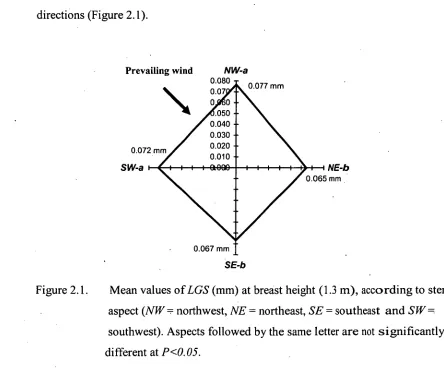
bark (DBHOB). LGS was significantly (P<0.001) higher on the western aspect,
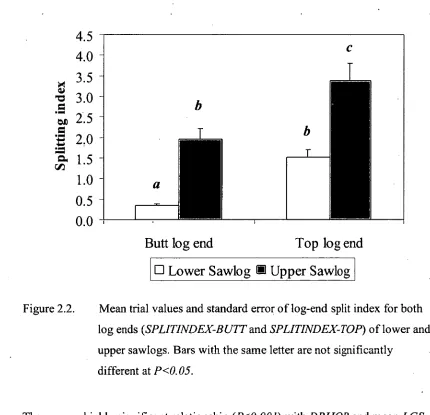
which was the direction of the prevailing wind. An index of log end-splitting
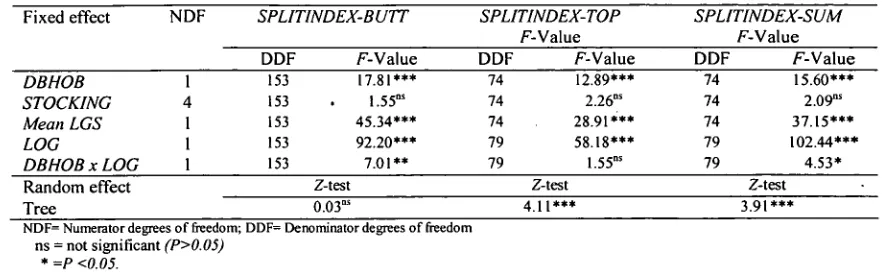
(SPLITINDEX) was not affected by stocking, but was positively related with
DBHOB (P<0.001), log position within stem (P<0.001, higher log end-splitting for
the second, upper sawlog), and positively related with LGS (P<0.001). Overall,
tree-mean LGS explained up to an additional 20% of the variance in SPL1TINDEX after
DBHOB and log position were accounted for in a linear regression model. Tree mean
characteristics including green (P0.001) and dry (P<0.01) board bow, green board
spring (P<0.05), dry board end-splitting (P<0.05), and loss of green board volume
from end-docking (P<0.05). SPLIT1NDEX had a significant positive relationship
with slab distortion (P<0.05), dry bow (P<0.05), green board bow (P<0.01) and dry
board spring (P<0.01), and negative (P<0.05) relationship with total sawn-board
recovery. SPL1TINDEX was also a good indicator of volume losses from docking
board end-splits; the higher the index the higher the timber losses. LGS and
SPLITINDEX were not significantly associated with levels of board shrinkage and
the occurrence of surface and internal checks.
2.2 Introduction
Eucalyptus nitens (Dean and Maiden) Maiden has been extensively planted in
Australia, Chile, New Zealand and South Africa for production of wOod fibre for the
pulp and paper industry. Some plantations are now thinned, pruned and grown on
longer rotations, in order to produce pruned sawlogs suitable for high-value
solid-wood applications (Nolan et al. 2005). The shift to solid-wood products from
plantations is also occurring with other eucalypt species, such as E. grandis and E.
globulus in an attempt to develop new hardwood markets and improve plantation
profitability for grower organizations (Nutto et al. 2006). Nonetheless a global
solid-wood industry based on plantation-grown eucalypt timber is still at an early stage of
development. Poor wood quality as a consequence of growth stresses, excessive
shrinkage and collapse, occurrence of tension wood, checking propensity and
variation in strength and hardness is a primary limiting factor (Chafe 1990; Ilic 1999;
Malan 2003; Washusen and Innes 2007; Washusen et al. 2004; Yang and Pongracic
current silviculture practices and genetic material, with most plantations grown
primarily for pulpwood production (Nolan et al. 2005; Raymond 2002).
In some eucalyptus species, high levels of growth stresses in both standing trees and
harvested logs have been mentioned as an important limitation to solid-wood quality
(Waugh 2005; Yang and Waugh 2001). Growth stresses released during tree felling
and crosscutting logs can lead to log end-splitting. Wood brittleness in the centre
core of the stem (brittle heart) associated with high growth stress may produce weak
material in the log core. During sawing there may be constraints on the application of
sawing strategies as a consequence of growth stresses. High growth stresses may also
contribute to flitch and board deflection, board width and thickness variation, and
increase end-splits in cants and boards during sawing. These consequences of growth
stresses may reduce volume recovery and product value through material loss from
board end-docking, reduced sawn-board length and width and product downgrading.
Consequently, growth stresses have been widely studied since the 1930s (Boyd 1950;
Jacobs 1938; Kubler 1959; Malan 1995; Nicholson 1971 ; Raymond etal. 2004; Touza 2001a; Trugilho etal. 2006; Yang 2005; Yang and Waugh 2001).
Growth stresses are tensile and compressive forces distributed orthotropically in the
longitudinal, tangential and radial directions in the tree stem, held in a natural
balance within standing trees, developed as a result of cumulative self-generated
forces during wood-fibre formation (maturation stresses) and the effects of tree weight and wind (supporting stresses). The longitudinal component of growth stress has been considered the most significant from a solid-wood quality point of view,
because of its greater influence on log processing performance (Jacobs 1938; Kubler
caused by cell maturation and the Modulus of elasticity of the Wood (MOE) (Yang
and Waugh 2001). Growth stress cannot be measured directly, but it can be
calculated from MOE and strain measurements. Assuming MOE to be approximately
constant between and within trees, longitudinal growth strain (LGS), which can be
non-destructively measured at both stem or log surface (Yang et al. 2005), is
regarded as a direct estimator of longitudinal growth stress. When the LGS levels are
high and/or asymmetrically distributed across the stem diameter, or when the tension
to compressive strain gradient from pith to cambium is pronounced, reduced sawlog
processing performance is anticipated (Yang 2005). For instance, peripheral LGS
levels have been found to be significantly positively related to log end-splitting and
sawn board distortion in a 32-year-old E. globulus thinned plantation growth in
Victoria, Australia (Yang and Pongracic 2004), to sawn timber distortion (bow. and
spring) in 23-year-old E. cloeziana plantation (Muneri et al. 1999) and to board bow
and board end-splitting in Liriodendron tulipifera L. plantation (Cassens and Serrano
2004).
Genetic improvement and intra-specific competition management have been
mentioned as potential strategies to minimize negative consequences of higher levels
of LGS on sawlog performance (Murphy et al. 2005; Nutto and Touza 2004;
Raymond et al. 2004). Studies undertaken on E. dunnii (Murphy et al. 2005) and
eucalypt clones (Trugilho et al. 2007a) have demonstrated sufficient genetic
variation and heritability in LGS to suggest that selection and breeding for reduced
LGS could be effective. In 10-year-old E. nitens plantations in Chile significant
differences in LGS values between 3 provenance and 10 families were found (Valdes
2004). Despite the amount of information available so far on the relationship
Lima et al. 2006; Lim d et al. 2000b; Malan 1995;*Wahyudi et al. 2001; Wilkins and
Kitahara 1991a; Wilkins and Kitahara 1991b), uncertainties persist about the
effectiveness of stand density control as a silvicultural practice to control growth
stress levels in standing trees. There are also still doubts about the ability of LGS to
reliably predict solid-wood quality in some fast-gown eucalypt plantation species
such as E. globulus (Raymond et al. 2004) and E. grandis Hill ex Maiden (Lima et
al. 2004; Verryn et al. 2005).
In temperate eucalypts species, a few studies have delivered valuable insights in the
prediction of sawlog suitability of E. globulus plantation-grown timber from standing
tree growth strain measurements, log end-splitting and wood-core information (Yang
2007; Yang 2005) and from shrinkage and collapse measurements to identify check
propensity (Yang and Fife 2003). No similar studies have been carried out in E.
nitens so far, and there have been no studies on LGS in E. nitens grown over a full
sawlog rotation because of the scarcity of mature plantations managed under a
sawlog regime. Consequently, there is limited progress towards identifying reliable
and non-destructive indicators of E. nitens sawlog quality, and also inadequate
understanding of the silvicultural control of growth stress and its consequences in
this species.
Trials of E. nitens grown under sawlog silvicultural regimes by Forestry Tasmania
are now approaching full rotation age (Baker and Volker 2007). In 2006 the
Cooperative Research Centre for Forestry, Australia (CRC for Forestry) conducted a
sawing study on a 22-year-old E. nitens plantation in which a thinning intensity trial
had been imposed, to determine the sawn product recovery and sawlog value using
of the most detailed undertaken to date on plantation E. nitens grown for solid-wood
production, and the first opportunity to study relationships between thinning intensity
and important solid-wood traits in this species. Allied to this sawing study, the ability
of several NDE methods including LGS, acoustic wave velocity and destructive
measurement of shrinkage properties in small wood samples to predict the sawing
performance of plantation-grown Eucalyptus nitens were assessed. Here we report
variation in LGS in standing trees selected from four thinning intensity treatments
and an unthinned control, in a full rotation E. nitens plantation, and its relationship
with sawing traits obtained from a sawing trial, to assess the capability of standing
tree LGS data to predict plantation-grown sawlog performance.
2.3 Materials and methods
2.3.1 Non-destructive measurements of longitudinal growth strain at standing trees
One week before the mechanical harvest, LGS was measured on the 81 selected trees
(Table 1.1), using the CIRAD-Foret strain gauge as described in Yang et al. (2005).
Four measurements per standing tree at breast height (1.3 m) were collected from the
northwest, southwest, northeast and southeast stem aspects, to cover potential
circumferential variation arising from prevailing wind effects and/or tree-crown
asymmetry (de Fegely 2004 ; Touza 2001a). The CIRAD-Foret strain gauge has a
micrometer that measures the longitudinal movement at the wood surface induced by
the release of LGS in the standing tree after a hole centred between two points is
drilled. The displacement (strain or LGS) is regarded as an estimate of the stress
2.3.2 Information from a subsequent sawing trial
Immediately after felling the 81 selected trees at a stump height of 0.2-0.4 m, logs
were cross-cut to produce 81 bush logs at least 5.7 m in length, which were tagged,
their log ends sealed with wax and gang nailed to prevent further development of any
end splits, and debarked. The bush logs were transported to a sawmill located at St
Helens, Tasmania where they were cross-cut again, producing a total of 162 sawlogs,
each at least 2.7 m in length; thus each tree produced a lower and upper sawlog
(Washusen etal. 2007). A log-end split index was measured on each log end of each
.sawlog after removing gang nails. Subsequently the two sawlogs of each tree were
either both back-sawn o'r both quarter-sawn, according to their tree DBHOB class,
with the exception of the upper sawlog of one of the quarter-sawn trees from the 100
stems ha-I treatment, which was discarded because of excessive felling damage. Sawing strategies aimed to produce 25 mm thick dried boards while maximizing
board width. A central cant from each log was marked on the southwest side of the
stem and a total of 213 back-sawn and 329 quarter-sawn boards were collected from
within the marked zones cants for intensive assessment. From this sawing study, the
following log quality and processing variables were analysed to determine their
relationships with standing tree LGS data gathered.
a) Log end splitting index (SPLITINDEX): for each of the 161 sawlogs both
log end-split lengths on the logs ends and extent of the splits along the stem
were recorded after removing gang nails. Using these data, a log end-splitting
index for both log ends, butt and top, was separately calculated for each log
SPLITINDEX =1(SL END)2 /2 Aj(SLsuRFAcE x SL END)k (R MEA N)2 (2.1)
Where:
SPLITINDEX is the log-end split index either on the butt log end
(SPLITINDEX-BUTT) or on the top log-end (SPLITINDEX-TOP), the higher the index the higher the splitting severity.
SLEND the split length on the log end.
SLRIRFACE the split length on the log surface. RmEAN the mean radius of the log end.
The sum of both butt and top log end-splitting indices was then expressed as a total value of log end-splitting per sawlog (SPLITINDEX-SUM).
b) Flitch and slab distortion: collected on two occasions during sawing of each
of the 77 quarter-sawn logs. The distortion was measured to the nearest mm,
in flitches after the logs were halved on the first breakdown saw, measuring
the distortion in each half of the log (the southwest and northeast halves), and
in the form of spring, measured in the centre slab from each half of the log
immediately after it was sawn on the second breakdown saw.
c) Sawn-board distortion: collected on the 542 intensively assessed boards,
both spring and bow in green and dry conditions, measured to the nearest
mm, at the maximum point of distortion.
d) Sawn-board shrinkage: collected on the intensively assessed boards, and
calculated as percent change from green to dry condition in board thickness
and width, at three positions per board: 25%, 50% and 75% of board length.
e) Board end-splitting and losses of green board volume by end-docking: The
length of the longest splits located at both ends of each one of the 542
intensively assessed boards was measured after drying. Using this
to docking end splits after drying was calculated, and expressed as a percent
of green board volume.
fi Checking propensity:
after surface dressing, board docking and mill grading,
the occurrenoe and extent of both surface and internal checking were
measured in each one of the intensively assessed boards. The number and
length of internal checks were measured at two positions per board by
sectioning at 33% and 66% of board length after end-docking. The surface
checks were measured along the board surface area on its better face, to
subsequently calculate a total surface check length per m
2
of board area.
Product recovery:
Total recovery and product grade recoveries per sawlog
were determined using the log volume and the board volumes produced after
surface dressing and docking end-splits, considering three product grades:
Select; Standard (medium feature grade) and Utility (high feature or common
grade), defined according to a modified grading strategy based on mill
grading to meet the requirements of Australian Standard AS2796.1 (Standard
Australia 1999) and a regrading strategy according to CSIRO standards
(Washusen
et al.2007). The sawn-boards were end-docked according to
standard mill procedures, and therefore do not necessarily coincide with the
continuous continuous category category category continuous continuous' continuous' continuous' category continuous continuous' continuous continuous continuous' continuous' category2 category2 continuous' continuous' continuous continuous DBHOB LGS
NE; SE; SW; NW
100; 200; 300; 400; C Lower; Upper SPLITINDEX SPLITINDEX-BUTT SPLIT1NDEX-TOP SPLIT1NDEX-SUM Back-sawn; Quarter-sawn Total recovery Flitch deflection Slab deflection PVPCMLI Bow Spring Zero checks; Otherwise
< 20mm; Otherwise BoardSplit -green / dry
End-dock-vol-green Shrinkage-thickness Shrinkage-width
cm mm 1 to 4 1 to 5 1 or 2 Number Number Number Number 1 or 2
mm mm $/m3 mm mm 1 or 2 1 or 2 mm
2.4 Statistical analyses
Statistical analyses were performed using the SAS statistical program package 9.1
(SAS Institute Inc 2004), and were structured using the following experimental
strata: tree, log (upper/lower sawlog, two sawlogs per tree) and board within log.
Table 2.1 summarizes the stratum positions and the relevant experimental factors,
including the non-destructive measurements and the processing performance variates
examined in the current study.
Table 2.1 Stratum positions of measurements and potential explanatory factors/variables
Stratum Variates/factors Distribution/ Symbol / Unit Transformation Description
Tree Diameter at breast height over bark Peripheral longitudinal growth strain
LGS measurements per tree (ASPECT)
Thinning treatment (STOCKING)
Log Log position within the tree (LOG)
Log end splitting index
Log end splitting index at the butt log end Log end splitting index at the top log end Sum of Butt and Top splitting indices Sawing method (SA WMETH)
Total sawn-board recovery Flitch deflection' (*) Slab deflection (*)
Product value per cubic meter log input Board Bow
Spring
Internal check category Surface check category
Sum of end-split length (both board ends) Losses of volume from end-docking Mean shrinkage in the board thickness Mean shrinkage in the board width C= control unthinned.
(*) Flitch and slab distortion were only measured on quarter sawn material.
Variable square-root transformed to obtain normality before mixed models were fitted.
2
Variable with binomial distribution.
2.4.1 Silvicultural effects on longitudinal growth strain of standing trees
Univariate analyses with linear mixed model were fitted to analyse the impact of
TREE identity on LGS specified as the dependent variable. A mixed model as per
. Equation 2.2 was fitted.
Y = MEAN + DBHOB + STOCKING + DBHOB.STOCKING + ASPECT +
STOCKING.ASPECT + TREE + RESIDUAL. (2.2)
where:
Y is a vector of observations. MEAN is the overall mean.
DBHOB (as a covariate), STOCKING and ASPECT are the tree diameter, stocking treatment and measurement aspect fitted as fixed effects,
respectively.
TREE is an individual tree random effect. RESIDUAL is the vector of residual errors.
A mixed model was fitted by the method of restricted maximum likelihood (REML)
using the SAS MIXED procedure (SAS Institute Inc 2004). The statistical
significance of the fixed effects was tested using the F -value specifying a Type I
(sequential) expected mean squares for model effects. The significance of TREE
identity as a random factor was tested using the Z-test.
2.4.2 Relationships between standing tree growth strain and sawing performance
A similar approach was used to examine the relationship between LGS and the
sawing performance variables under assessment. Univariate mixed models were
fitted as follows to test the factors affecting log end-splitting index:
Y = MEAN + DBHOB + STOCKING+ DBHOB.STOCKING+ LGS + LOG +
(2.3)
+ DBHOB.LOG+ TREE + RESIDUAL