Evaluation of the Lifelong Learning Wales
Record (LLWR) as a Management Information
Tool for Learning Providers
Final Report January 2006
Version: Final Report
Date: January 2006
Prepared for: ELWa
Prepared by: Julie Tolley
Frank Wellgate
John Maher
1 Contents
Final Report January 2006 ...1
1 Contents ...2
2 Executive Summary...4
2 Executive Summary...4
3 Background ...8
4 Aims and Key Outputs ...11
5 The Scope of the Contract ...13
6 Methodology...14
7 LLWR field and datasets- Key Issues for Learning Providers...20
7.1 Cross Sector Responses by Category... 20
7.2 Cross Sector Responses by Priority ... 22
7.3 High Priority Further Education issues ... 25
7.4 High Priority Adult and Community Learning issues ... 26
7.5 High Priority Work-based Learning issues... 26
7.6 Benefits of changes ... 27
8 LLWR Reporting Requirements – Key Issues for Learning Providers ...29
8.1 Cross Sector Evaluation Analysis by Summary Category... 29
8.2 Cross Sector Reporting requirements ... 33
8.2.1 Funding Calculations ... 33
8.2.2 Inspection and Quality ... 33
8.2.3 Added Value ... 35
8.2.4 Reconciliation, Data Checking and Validation Reports ...36
8.3 Benefits to be gained from reports requested ... 37
Appendix 1a Evaluation questionnaire – Fields ...39
Appendix 1b Evaluation Questionnaire – Reporting Requirements ...40
Appendix 2 Consultations undertaken ...42
Appendix 3 Evaluation questionnaire returns ...45
Appendix 4 The LLWR Field and Dataset Evaluation Analysis Spreadsheet ...46
Appendix 5 LLWR Reporting Evaluation Analysis Spreadsheet ...55
5a FE Reporting Responses... 55
5b ACL Reporting Responses ... 56
List of figures:
Figure 1 Number of responses by category ...20
Figure 2 Responses by category provider questionnaire returns only...21
Figure 3 Responses by category by more than 5 providers ...21
Figure 4 Responses by category, high priority ...22
Figure 5 High priority issues> 5 providers ...23
Figure 6 Medium priority issues cross sector ...24
Figure 7 Total response by summary category ...30
Figure 8 FE reporting requirements by summary category ...30
Figure 9 WBL reporting requirements by summary category ...31
Figure 10 ACL reporting requirements by summary category ...31
2 Executive
Summary
Tribal Education was commissioned by Education Learning Wales (ELWa) to
undertake an evaluation of the Lifelong Learning Wales Record (LLWR) between
October and December 2005. Tribal Education has worked with Tribal Technology in
undertaking this evaluation.
Tribal Education was engaged to consult with users of the LLWR in order to identify
the key issues and concerns of providers using the LLWR which they would wish
ELWa to address. Consultation took place through one to one meetings, sector
workshops and through an e-questionnaire.
One hundred and sixty-two evaluation questionnaires were emailed out and
forty-nine evaluation questionnaires were returned from across all sectors including one
from a software house. Twenty-two Adult and Community Learning Organisations
(ACL) and twenty-eight work based learning providers (WBL) attended workshops
and feedback was also taken from visits to six Further Education (FE) Colleges.
Overview reports were submitted by Fforwm (FE) and the Opera User group. In
addition, consultation also took place with officers of ELWa and Estyn.
The evaluation questionnaire return rate was 52% for FE providers, 45% for ACL
providers and 23% for WBL. This led to a revision of the final requirements of the
project, by the steering group, in order to allow further discussion and ensure that
long-lasting change was not recommended without further due consideration of the
responses.
A total of 844 comments were received and analysed on the datasets and fields from
providers across all sectors. These were classified into six categories of response
according to the kind of change being requested or suggested. The greatest number
of these responses related to suggested changes to the configuration of the LLWR
more accurate and/or sensitive to learner and provider needs. When the responses
were filtered to only include those received from 5 or more providers improvement
and re-configuration changes were still the most requested changes.
The single greatest structural change suggested was to merge or link the Learner
Award and Learner Activity datasets. This change was proposed by each of the three
sectors.
Datasets of particular concern to all sectors were those relating to destination data
and Welsh fluency assessment fields. The responses to the field and dataset
requirements were more numerous and specific than the responses regarding
reporting requirements.
For some providers the distinction between the structure and framework of the LLWR
and the structure and framework provided by their software house was unclear. Over
10% of total responses requested changes for which solutions could be provided by
modifications to software. However, for these providers, the current understanding is
that these matters are within the scope of the LLWR. Improving the level of
understanding, across the sectors, of the differing roles and functions may prove
beneficial to ELWa who may also wish to use the responses to have further dialogue
with software providers.
Requests for centralised reports fell into three main areas. Requests focused on
reports to support preparation for inspection and provide data for quality assurance
and development, reports to aid the process of reconciliation and the verification and
checking of data - the availability of an on-line Form C (or the NPFS equivalent) was
widely requested as part of this reconciliation process - and, finally, reports not
currently available on added value areas such as learning distance travelled by the
The disparity in responses between comments on datasets and fields and reports
can, in part, be understood as field and dataset entry are daily operational processes
within provider organisations and a key issue for providers where the returns are
related to funding and resource. However, it also seems to relate to the way in which
providers see and use reports as part of their business process.
The sector consultation workshops offered an insight into the different ways in which
providers respond to and use the LLWR in this respect. Providers have varying
degrees of resource and expertise available to manage the complexity of the LLWR
data. Consequently, larger and better resourced providers have been developing
their own reporting systems around the LLWR. The workshop discussions revealed
significant differences in levels of understanding of how the LLWR data could be
used for business benefit. Many organisations are not using the LLWR to provide
reports they could use to manage their businesses more successfully. Therefore,
when given the opportunity to identify useful reporting requirements, responses were
not specific. This seems to highlight a professional development need around the use
of data as a management tool to improve success and quality of delivery. A focused
set of management reports would enable these organisations to begin to use the
data more meaningfully in operating their business.
By contrast, the needs of managing a large number of learners had provided the
drivers for development in larger organisations. In some organisations managers had
identified and developed reports in the areas of Learner Data Management and
Financial Management. For these organisations a centralised set of reports from the
LLWR could reduce the amount of time and resource they would need to spend on
writing their own reports, if these reports fully met their needs. However, for these
organisations a more streamlined and clearly-defined LLWR is a greater priority.
During the course of the evaluation it was clear that providers want the LLWR and
need the information in it to run their businesses effectively. What they desire from it
is more responsive and transparent data and reports that more closely meet their
warmly welcome improvements to the LLWR if the changes made could recognise
the diversity of the three main sectors, build into the LLWR the appropriate flexibility
and responsiveness required for each sector and do this without fragmenting the
LLWR overall.
Tribal Education and Tribal Technology would like to thank everyone who
participated in the evaluation and consultation process and contributed to the findings
3 Background
Section 40 of the Learning and Skills Act 2000 required ELWa to:
"…establish systems for collecting information, which are designed to secure that its
decisions with regard to education and training are made on a sound basis".
To facilitate this, the Individual Learner Data Programme Steering Group was set up
and chaired by the Director of the Education and Training Department in the Welsh
Assembly Government. This Steering Group oversaw two projects: one relating to
data collection for pre-16 learners, led by the National Assembly, and the other
relating to data collection for post-16 learners, led by ELWa.
One of the initial outputs from the Individual Learner Data Programme was an
Information Management Strategy consisting of 10 objectives. This document was
published in Autumn 2002 and underpins the collection of individualised learner data
in Wales.
ELWa, at its inception in 2001, inherited a series of data collection systems which
were all collecting learner data from the post-16 sector. However, each legacy
system operated differently, collecting different data to different timescales.
Furthermore, where similar data fields were being collected by the systems the data
definitions were often not consistent, and some learning providers had to make
multiple data returns to the different systems for the same learners.
The principal data legacy systems were the:
♦ Individualised Student Record (ISR) for FE providers;
♦ 4 regional Work Based Learning claims systems for WBL providers; ♦ Annual census for Adult Community Learning for LEAs;
♦ STATS1 annual collection for schools.
ELWa's response to consolidating the various data collection arrangements was to
than Higher Education (HE) Institutions and School Sixth Forms. The data collection
system introduced was the LLWR. HE Insitutions and schools were excluded from
the scope of the LLWR as these organisations have significant cohorts of learners
which fall outside of ELWa’s remit (I.e. HE students and pre-16 pupils respectively.
Therefore, to minimize data burdens existing data collection systems in Institutions
and schools were modified to meet ELWa data needs.
ELWa consulted twice with providers and stakeholders in regard to the structure and
content of the LLWR in May and October 2002. The Post-16 Data Advisory Group
was established to provide input into the implementation and roll-out of the LLWR,
and this group contained representatives both from learning providers who submit
data and key stakeholder organisations who make use of the data.
The LLWR system was fully specified by early 2003 and was piloted, together with
provider systems in Spring/Summer 2003, prior to becoming operational in August
2003. For the first year of operation only Further Education institutions (FEIs), and
Local Education Authorities (LEAs) delivering community learning provision, were
required to submit LLWR data. However, WBL providers have been required to
submit data to the LLWR since August 2004, and during the 2003/04 academic year
WBL providers were encouraged to submit LLWR data in parallel to submitting data
to the claims systems (which continued to operate during the year) but this was not a
requirement.
It was recognised that the introduction of the LLWR would require the upgrading of
the Management Information Systems (MIS) operated by many learning providers.
To support this upgrade work ELWa established the MIS Development Programme
which aimed to encourage and support all learning providers in acquiring new MIS
systems, or upgrading existing ones. The Programme made funding available to
providers for some of the software/hardware expenses incurred, and in this way just
under £720,000 was distributed to the provider network between January 2003 and
An evaluation of the Information Management Strategy (IMS) was carried out for
ELWa and reported in June 2005. This current evaluation of the LLWR was set up in
response to issues raised by providers in the IMS evaluation on the burden of data
4
Aims and Key Outputs
The initial aim of the evaluation was to develop further the data collection system and
extend the data reports/reporting systems currently provided by ELWa to assist
providers in submitting accurate data and in managing their business.
Two key outputs were required:
♦ A report which made clear recommendations as to what providers consider to be desirable future developments of the LLWR. The report to contain amendments
both to the structure and content of the LLWR, with particular emphasis on the
ability of LLWR data to underpin ELWa's National Planning and Funding System
(NPFS). The recommendations to be based on discussions with learning
providers, key data users and ELWa staff, and identify the benefits that would be
realised in making the recommended changes as well as any related issues which
could or would arise; and
♦ A functional specification for a data reporting/analysis tool to be developed for use by learning providers and ELWa. The specification to be limited to those reports of
general use to the post-16 provider sector (or a significant subset of this) and not
include provider (or MIS system) specific reporting requirements. The
specification to include user requirements as to the functionality required by a
LLWR reporting tool but it was not expected that this would include details of
technical solutions able to meet the user requirements.
During the course of the project the ELWa steering group refined the project
outcomes in response to the development of the evaluation research and the level of
response to the consultation exercise. The sharpened outcomes for the project were:
♦ To provide ELWa with a report which makes clear the issues experienced by learning providers when collecting and submitting LLWR data. The report should
consider amendments both to the structure and content of the LLWR with
particular emphasis on the ability of LLWR data to underpin ELWa’s National
identify the benefits that would be realised in making the recommended changes
as well as any related issues which could or would arise; and
♦ To provide ELWa with a specification of what report outputs would be beneficial in a centralised data reporting/analysis tool to be developed for use by learning
providers and ELWa. The specification should be limited to those reports which
will be of general use to the post-16 provider sector (or a significant subset of this)
and not include provider (or MIS system) specific reporting requirements. The
specification should include user requirements as to the functionality required by a
LLWR reporting tool but it is not expected that this would include details of
5
The Scope of the Contract
The scope of the contract was limited to the LLWR system and the Further Education
Institutions (FEIs), Local Education Authorities (LEAs) and Work Based Learning
(WBL) providers who use the system. Tribal Education was not expected to consider
data returns made by school sixth forms via the Post-16 PLASC.
Tribal Education was asked to consider those statistical reports (such as
performance and funding statistics) which can be produced centrally from LLWR data
and which would potentially provide the necessary data to assist learning providers : ♦ in improving the quality of their learning provision;
♦ in improving the management of funds provided by ELWa; and/or ♦ in improving the quality of their data submission.
Tribal Education was not expected to recommend data reports which did not comply
with the above criteria, or only did so tangentially and which could be generated from
the providers' own MIS and not centrally by ELWa. Those data reporting
requirements not considered as within the scope of this contract included: ♦ reports which are only of benefit to a small number of providers;
♦ reports which require data other than that submitted to the LLWR; and
♦ reports which relate to business needs other than ELWa funding and performance monitoring.
In terms of the users of the LLWR - data is submitted to the LLWR system by 25 FE
institutions, 22 Local Education Authorities and approximately 115 work-based
learning providers (some of which are managed by, or affiliated to, FEIs or LEAs).
These learning providers vary widely in size from Coleg Gwent with over 10,000
6 Methodology
6.1 Initiation meeting
An initiation meeting was held on 18 November 2005 at which the overall approach
was agreed together with the timescales and outline project implementation plan. A
steering group of ELWa officers was formed, led by the Acting Head of Data and
Analytical Services, and fortnightly meetings agreed. Five Steering Group meetings
took place between November 2005 and January 2006.
6.2 The Consultation Process
A sector-based form of consultation was discussed and agreed to include a
questionnaire-based approach to all providers, supplemented by sector consultation
workshops. Given the timescales involved, these workshops, as far as possible,
utilised provider sector network meetings already established during November 2005.
Community Learning Wales (ACL providers) and Fforwm (FE providers) had network
meetings planned.
Community Learning Wales (ACL providers) invited Tribal to attend an initial meeting
and subsequently set up a working party to take the discussion further. Fforwm
discussed the questionnaire at their meeting and provided Tribal with a written
response and agreed that their members would each return the detailed evaluation
questionnaire.
In addition, due to the size and complexity of FE provider returns, six visits to FE
colleges were organised in order to investigate issues in depth. As well as ensuring
colleges were chosen with a geographical spread, colleges using a range of software
systems were also included.
Work-based learning providers did not have any meetings planned in the timeframe
and, given the large number of providers involved, two opportunities were organised
for work based learning organisations to meet and discuss the evaluation.
Software houses were invited to respond to the questionnaire and attend the
6.3 Questionnaire
Key questions were developed by Tribal in discussion with ELWa officers to form the
basis of a questionnaire to be sent to all users. It was agreed to produce the
questionnaire in two parts:
♦ An analysis of the LLWR and its data fields; and ♦ An analysis of the LLWR reporting requirements.
Key questions in each of these two areas, together with the spreadsheet format for
the questionnaires, were agreed by the Steering Group on 2 November 2005.
Using contact data provided by ELWa, the questionnaire was sent out by Tribal
Education, by e-mail, between November 4th and 8th 2005, with covering letters to
key user groups by sector. Software providers (10) were also invited to respond to
the questionnaire and attend the work-based learning consultation meetings. Copies
of the evaluation questions are provided at Appendix 1.
6.4 Consultation with key stakeholders
By questionnaire
The questionnaire was e-mailed out to all users who were given the opportunity to
return it directly to Tribal Education and follow this up with a telephone response if
they wished to do so. The following number of questionnaires were distributed:
♦ Work based learning providers 115
♦ FE providers 25
♦ Adult Community Learning. 22
The number of questionnaires returned or responses received were:
♦ Work based learning 25 22%
♦ FE providers 13 52%
♦ Adult and Community Learning 10 45%
Via forums/workshops
The opportunity was taken to meet with sector groups either in already timetabled
meetings or via specifically arranged meetings and working parties. The following
consultation meetings took place:
Adult and Community Learning
♦ Community Learning Wales 2 November 2005
♦ Community Learning Wales working party 14 November 2005
Forty-five people attended the Community Learning Wales meeting on 2 November
2005, representing 22 ACL organisations. In addition, Estyn, NIACE and ELWa were
also represented.
Work Based Learning
♦ Bedwas 24 November 2005
♦ St Asaph 29 November 2005
Twenty nine people attended the WBL meeting in Bedwas representing 18 providers
and one software house.
Nineteen people attended the St Asaph meeting representing 10 providers and one
software house. A record of those attending these meetings can be found at
Appendix 2.
FE Provider meetings
The following FE providers were also consulted via in depth interview
Pembrokeshire College Bridgend College
Coleg Menai Yale College
Coleg Gwent Llandrillo College
Inspection Body
ELWa
Meetings with ELWa officers responsible for Funding, Data Analysis and Quality were
held in November 2005.
6.5 Interim report
An interim progress report, setting out emerging issues, was discussed at the
Steering Group meeting on 30 November 2005 and circulated within the Steering
Group for discussion the week beginning 5 December 2005. In the light of responses
received a revision to the initial brief was made and an amended set of outcomes
issued. (See Section 4 above)
6.6 Evaluation results and analysis
Field and dataset evaluation
Tribal Education developed a database tool into which all the responses from the
evaluation questionnaires and the consultation workshops were entered. This
comprehensive database allows a detailed interrogation of the responses by sector,
by priority, and by field. It also details which providers and how many providers raised
the particular data issue. From this database a summary spreadsheet of key issues
by sector was compiled and is presented in Section 7 below.
The issues emerging from the consultation workshops were added to the individual
evaluation returns and a weighting equivalent to 10 providers was given to these
responses as they represented a collective view.
In order to understand the main areas of concern and identify areas for potential
future changes the data responses were also classified into six categories with the
Category Definition
Configuration Improvement in LLWR configuration – e.g. Specifying that a field is only relevant to
WBL
Delete Remove Field
Guidance Guidance or clarification required
Improvement An opportunity for ELWa to improve the LLWR and or its submission
Software Improvement may be gained via software supplier or change in working practice
For some responses it would have been possible to categorise them in more than
one category. Rather than list the same response under more than one category the
approach taken was to include each response in the category which appeared
closest to the intention of the majority of providers who raised the particular concern.
Key issues and high and medium priority requirements of learning providers, in
relation to fields and datasets, were analysed from the data and are summarised in
Section 7.
Reporting Requirements Evaluation
Reporting requirement responses were collated into three sector-specific
spreadsheets plus a spreadsheet for Estyn. Responses from the evaluation were
copied across as received and in the same format as the evaluation questionnaire.
(See Appendix 1b)
Reporting issues raised in workshops were added to the summary sheets. However,
additional weighting was not given to the reporting requests from workshops. As
highlighted in the Executive Summary, the responses on reporting requirements were
less numerous than on datasets and fields and were not always discussed in the
workshop consultations or sector responses. It was, therefore, judged that giving an
additional weighting to these issues would not be helpful.
In order to understand the main areas of concern and identify areas for potential
future changes the responses were analysed into Summary Categories and an
Categories were defined as follows:-
Category Definition
Reconciliation Reports which would help improve the claims process
Funding
Calculations
Reports that providers believe will help reconcile funding data
Added Value Enhancements to existing reports or reports which ELWa could produce which
would enhance management information available to providers
Inspection &
Quality
Reports viewed by providers or Estyn as necessary for inspection and which will
help produce benchmarking data
Software Reports considered to be most appropriately provided by software supplier or own
internal MIS
6.7 Final report
The final report was presented to ELWa, in electronic format and hard copy, in
January 2006 accompanied by a CD containing the database tool, summary and
subsidiary evaluation spreadsheets, notes from the consultation workshops and the
7
LLWR field and datasets- Key Issues for Learning Providers
7.1 Cross Sector Responses by Category
The field and dataset response spreadsheet can be found in Appendix 4.
In total 844 comments were received on the datasets and fields (see Figure 1). When
considered in relation to the six categories assigned to them in the analysis (see 6.6
above), the majority of providers wished to request changes to improve the
configuration of the LLWR (304), followed, in descending order, by suggesting
improvements (201), requesting deletions (152), requiring further guidance (118), and
[image:20.595.117.504.365.616.2]requesting amendments to software (69).
Figure 1 Number of responses by category
Responses by Category (All)
304
152 118
201
69
Configuration
Delete
Guidance
Improvement
Software
When responses from the evaluation questionnaires completed by providers were
considered separately from the workshop responses, the primary requests for
changes concerned configuration (104), deletion (72), guidance (48) and
Figure 2 Responses by category provider questionnaire returns only Responses By Category (Providers Only)
104
72 48
31 19
Configuration
Delete Guidance
Improvement
Software
Datasets and fields receiving comments from more than 5 providers were considered
by category. In total, 713 comments were made. Comments from the workshops
focused on improvements and configuration whilst the evaluation returns focused
primarily on configuration and deletion changes. Overall, comments from more than 5
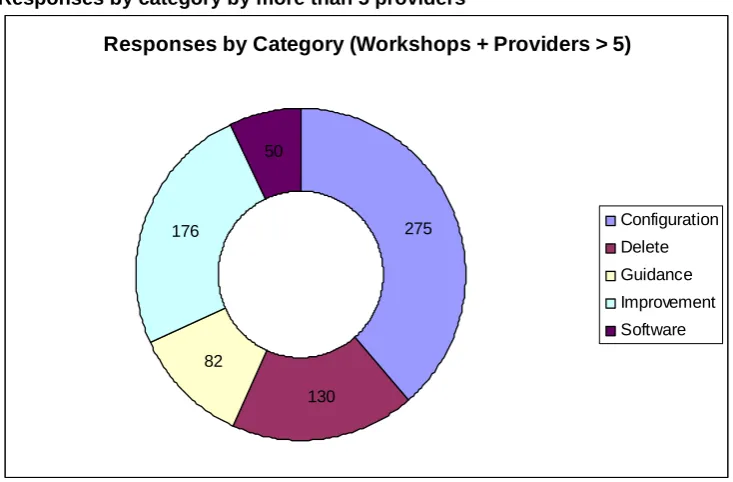
providers concerned configuration of the LLWR (275), requests for improvement
(176), the deletion of fields (130) and improved guidance (82). Some 50 requests
were judged to be software issues. (See figure 3 below)
Figure 3 Responses by category by more than 5 providers
Responses by Category (Workshops + Providers > 5)
275
130 82
176
50
Configuration Delete
Guidance
[image:21.595.128.495.524.765.2]When considering responses from more than 5 providers by sector, the FE and ACL
sectors provided comments primarily relating to configuration issues whilst the WBL
providers comments centred on improvement requests.
7.2 Cross Sector Responses by Priority
A total of 312 requests for changes were designated as high priority. The highest
priority areas for concern were to seek improvement changes (92) before
configuration changes (83), deletion (71) and guidance (35). Requests for software
changes (31) were also a feature. (See Figure 4 below)
Figure 4 Responses by category, high priority
Responses by Category (Workshops + Providers) High Priority Only
83
71
35 92
31
Configuration
Delete
Guidance
Improvement
Software
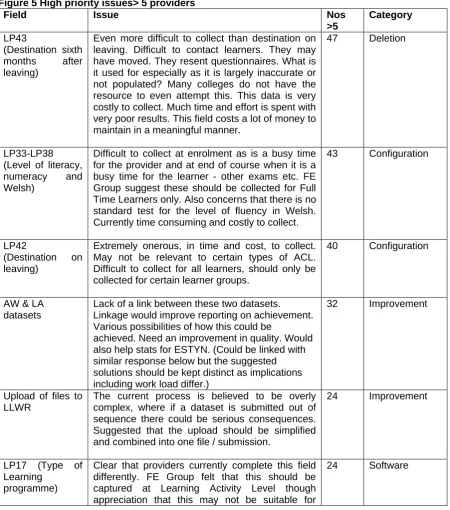
Specific fields mentioned by many providers as a high priority concerned the
collection of destination data, particularly for adult learners. Collection of data at the
end of the programme was difficult but after 6 months was viewed, by most ACL and
WBL providers, as almost impossible. Anecdotal evidence from the workshops
described an incentive scheme for the return of information from the learners after 6
months but rates of return were still very low (15-20%).
The second dataset area of concern related to Welsh fluency assessment fields.
Providers pointed out that there is no standard test for judging Welsh fluency and, as
concerns were expressed about completing these fields where literacy and numeracy
is not part of the taught programme.
The overlap between the Learner Activity and Learner Award dataset was the subject
of much discussion in the WBL and ACL workshops and merger of these two
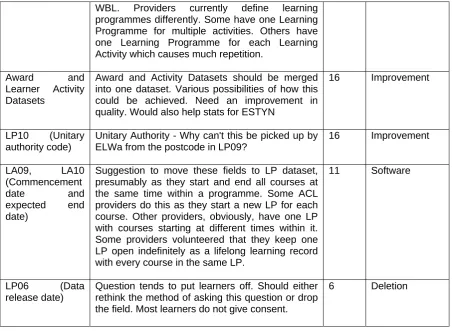
datasets was explicitly suggested by the FE group. This is probably the single most
substantive structural reform request received. The gains in saved data entry time for
[image:23.595.87.538.278.789.2]all users would be significant if this were to take place.
Figure 5 High priority issues> 5 providers
Field Issue Nos
>5
Category
LP43
(Destination sixth months after leaving)
Even more difficult to collect than destination on leaving. Difficult to contact learners. They may have moved. They resent questionnaires. What is it used for especially as it is largely inaccurate or not populated? Many colleges do not have the resource to even attempt this. This data is very costly to collect. Much time and effort is spent with very poor results. This field costs a lot of money to maintain in a meaningful manner.
47 Deletion
LP33-LP38 (Level of literacy, numeracy and Welsh)
Difficult to collect at enrolment as is a busy time for the provider and at end of course when it is a busy time for the learner - other exams etc. FE Group suggest these should be collected for Full Time Learners only. Also concerns that there is no standard test for the level of fluency in Welsh. Currently time consuming and costly to collect.
43 Configuration
LP42
(Destination on leaving)
Extremely onerous, in time and cost, to collect. May not be relevant to certain types of ACL. Difficult to collect for all learners, should only be collected for certain learner groups.
40 Configuration
AW & LA datasets
Lack of a link between these two datasets. Linkage would improve reporting on achievement. Various possibilities of how this could be
achieved. Need an improvement in quality. Would also help stats for ESTYN. (Could be linked with similar response below but the suggested solutions should be kept distinct as implications including work load differ.)
32 Improvement
Upload of files to LLWR
The current process is believed to be overly complex, where if a dataset is submitted out of sequence there could be serious consequences. Suggested that the upload should be simplified and combined into one file / submission.
24 Improvement
LP17 (Type of Learning
programme)
Clear that providers currently complete this field differently. FE Group felt that this should be captured at Learning Activity Level though
WBL. Providers currently define learning programmes differently. Some have one Learning Programme for multiple activities. Others have one Learning Programme for each Learning Activity which causes much repetition.
Award and Learner Activity Datasets
Award and Activity Datasets should be merged into one dataset. Various possibilities of how this could be achieved. Need an improvement in quality. Would also help stats for ESTYN
16 Improvement
LP10 (Unitary authority code)
Unitary Authority - Why can't this be picked up by ELWa from the postcode in LP09?
16 Improvement
LA09, LA10 (Commencement
date and expected end date)
Suggestion to move these fields to LP dataset, presumably as they start and end all courses at the same time within a programme. Some ACL providers do this as they start a new LP for each course. Other providers, obviously, have one LP with courses starting at different times within it. Some providers volunteered that they keep one LP open indefinitely as a lifelong learning record with every course in the same LP.
11 Software
LP06 (Data release date)
Question tends to put learners off. Should either rethink the method of asking this question or drop the field. Most learners do not give consent.
6 Deletion
Medium priority issues comprised many of the rest of the responses and were often
[image:24.595.85.538.87.418.2]sector specific. The major cross sector issues, viewed as medium priority, were:
Figure 6 Medium priority issues cross sector
Field Issue Nos >5 Category
LN20 LN21 (School last attended and year left school)
Very unpopular fields (Answers 19 on LN20 & 9 on LN21). Some felt it hould be completely removed from the LLWR and that it is intrusive and shows a lack of sensitivity toward some of our elderly students. Not felt relevant for ACL Learners. Could this field be removed or only collected within certain age categories (eg. 16-25 age group)?
48 Configuration
LN14 (Surname on 16th birthday)
Many people do not want to give their surname at 16. It is felt intrusive and shows a lack of sensitivity toward some of our elderly students. Not felt to be relevant to ACL. Could this be removed as a field or made only applicable to certain learners?
25 Configuration
LP21, LP22 (Type and level of highest prior qualification)
The LLWR by its very nature collects prior learning achievement from the institution at which the learning achievement occurred. Why, therefore, include this question? Felt not applicable for non-accredited learners. Low
achievers do not wish to answer this question. In some cases the level of prior learning could be defaulted from type of learning. LP21 8 answers, LP22 6 answers.
LP14 (SOC code) FE Group suggest this should only applicable for
WBL. 7 suggestions that this information should be included on the WLAD (although as the field relates to the learner and not the course not clear how this could be achieved).
17 Configuration
LN13 (National insurance
number)
Non WBL learners very reluctant to divulge this important piece of learner data. Personal data should only ask for it when ELWa have need to know. There is a problem when enrolment form covers more than one type of enrolment (e.g. WBL & ACL).
15 Software
LP41 (Reason for termination of LP)
Some felt that completion is difficult to assess if learner completes some activities and withdraws from others. Some providers felt extra categories would make this field more useful.
15 Configuration
7.3 High Priority Further Education issues
The high priorities for FE providers focused on:
♦ Simplifying the upload process into one single file submission;
♦ Merging the Award and Activity datasets into one single dataset thus eliminating current duplication of fields;
♦ Changing the LP fields to make them compatible with FE structure;
♦ Capturing LP17 – type of learning programme data - within the Learning Activity dataset;
♦ Clarifying LP25 – financial support for the learner; and
7.4 High Priority Adult and Community Learning issues
The high priority concerns of ACL providers mirror many of those concerns for other
sectors, particularly those of WBL providers as both sectors deal with adult learners.
ACL high priorities centre on:
♦ Linking the Activity and Award datasets more closely;
♦ A desire to move the LA09 and LA10 fields to the LP dataset;
♦ Capturing LP17 – type of learning programme data - within the Learning Activity
dataset;
♦ Deleting the requirements to complete Welsh fluency fields and literacy and numeracy fields (LP33-LP38) if not relevant to the learning programme e.g. are
not taught or offered as part of the programme; and
♦ Deleting LP42 and LP43 - the collection of destination data.
A strong view also came forward during the workshop consultation process that the
needs of ACL providers were often overlooked. Providers were very keen to stress
that they currently desire more information about the new National Planning and
Funding System. In particular, they wish to receive advance notice of which fields will
be used to determine funding in order that they can plan in advance to collect this
data more thoroughly.
7.5 High Priority Work-based Learning issues
Issues of concern for WBL providers spread across many fields and there is less of a
clear consensus, by the majority, on main issues for all providers. However, the
following issues were highlighted as being of highest priority:
♦ Linking the Learner Award and Activity datasets more closely;
♦ Deleting the requirements to complete Welsh fluency fields and literacy and numeracy fields if not relevant to the learning programme e.g. are not taught or
offered as part of the programme; and
There was also much discussion in the workshops about providing more default
settings in the software and introducing more validation rules to prevent mis-entry of
data and, particularly to prevent providers exiting the programme with mistakes
accepted as correct entries. Both of these latter issues are ones which could be
addressed in discussion with software houses.
7.6 Benefits of changes
If some of the suggested changes are implemented, the benefits described by the
providers will accrue to the learners, to the provider and to ELWa and Estyn. The
main benefits of proposed changes are:
♦ For the learner - a streamlining and simplification of the enrolment process and removal of some of the questions that are regarded as barriers for adult learners
(e.g. regarding age).
♦ For the provider - a more streamlined process combined with reduced data entry
time reducing costs and administrative overheads.
♦ For ELWa and Estyn - quality improvements to the accuracy of data through, for example, more default settings and the potential removal of fields that are
inaccurately filled in or not completed at all because they are regarded by the
learner or the provider as irrelevant (e.g. surname at 16 yrs).
♦ More accurate data and clarification on some fields will introduce greater conformity of practice, allow for the development of meaningful Welsh
performance indicators for benchmarking purposes and give more weight to the
accuracy of data returns for inspections.
Providers themselves desired this greater relevance and accuracy and wished to
utilise the time and resources saved through improvements to:
♦ Spend more time with the learner;
8
LLWR Reporting Requirements – Key Issues for Learning
Providers
8.1 Cross Sector Evaluation Analysis by Summary Category
A summary spreadsheet of responses on reporting requirements can be found at
Appendix 5.
A total of 97 comments were received on reporting requirements. There were
significantly fewer comments than the number received on datasets and fields from
provider questionnaires.(See Figure 7 below)1
In assigning a category to the responses it was recognised that many of the
Inspection and Quality and Reconciliation Reports also add value. Accepting that
most report requests do add value, those that have been placed in the Added Value
category are reports which do not fit into the other categories and which add value
because providers may find it difficult to produce them on their own.
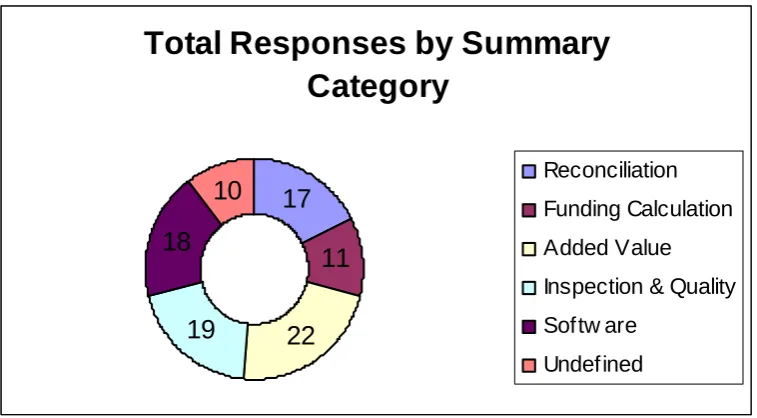
The largest number of responses related to requests for reports to deliver Added
Value for providers (22), followed by requests for reports to support Inspection and
Quality issues (19) and reports which address an expressed need for improved
reconciliation of data (17). A large number of responses requested reports that
should be available to providers via their software provider or their own internal
reporting processes (18). These responses have been identified as a category in the
spreadsheets and are represented in the charts below. However, a discussion of
them does not form part of the analysis in this report as they remain outside the brief
of the review.
1
Figure 7 Total response by summary category
Total Responses by Summary
Category
17
11
22 19
18
10 Reconciliation
Funding Calculation
Added Value
Inspection & Quality
Softw are
Undefined
Further Education provider requests (39) concerned reports relating to Funding
Calculations (e.g. Form Cs for FE Insitutions) (11) and Inspection and Quality issues
[image:30.595.123.502.116.325.2](8). Reconciliation reports were the area of least concern (4). (See Figure 8 below)
Figure 8 FE reporting requirements by summary category
FE Reporting Requirement by Summary Category
4
11
5 8
8 Reconciliation
Funding Calculation
Added Value
Inspection & Quality
Undefined
WBL providers made 26 requests in total with reconciliation reports being of prime
concern (10) followed by Inspection and Quality (6) and Added Value (6). There were
a number of requests (4) which were either related to software issues or were
The workshop discussions confirmed the responses in the questionnaires, with WBL
providers describing their difficulties in reconciling ELWa payments due to the fact
that the ELWa system for WBL payments is not specific about which learning
activities have been funded but rather only identifies which are fundable prior to
[image:31.595.130.494.230.442.2]contract and profiling considerations.
Figure 9 WBL reporting requirements by summary category
WBL Reporting Requirement by Summary Category
10
0 6 6
2
2 Reconciliation
Funding Calculation
Added Value
Inspection & Quality
Softw are
Undefined
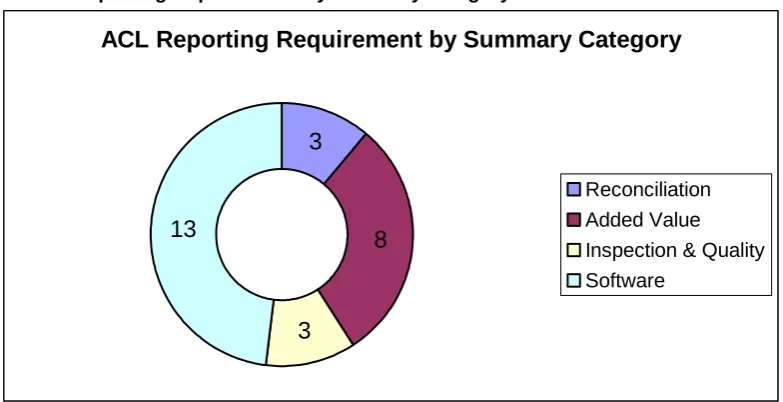
ACL reports are, by their very nature, going to be largely classified as added value
because few reports are currently provided for ACL providers. However, the most
significant numbers of requests for reports (13 out of 27) have been classified as
software issues. (See Figure 10 below)
Figure 10 ACL reporting requirements by summary category
ACL Reporting Requirement by Summary Category
3
8
3 13
[image:31.595.116.508.570.771.2]Since the introduction of the LLWR, Estyn are concerned that they have been unable
to obtain the same level of reports as previously available for FE. This is primarily
due to the quality of the Awards data received and, in particular, the fact that there is
no link between the Activity and Award datasets. This problem was echoed in
discussions with ELWa staff who are, currently, unable to furnish Estyn with reports
that had been available previously under the Individualised Student Record (ISR).
Estyn expressed a desire for a full suite of Inspection and Quality reports2. In addition
to the core reports required for inspection purposes Estyn would also like to see
[image:32.595.120.499.344.534.2]some reports which provide added value (3).
Figure 11 Estyn reporting requirements by summary requirements
Estyn Reporting Requirement by Summary Category
3
2 Added Value
Inspection & Quality
2
8.2 Cross Sector Reporting requirements
Requests that directly relate to improving the central reporting from the LLWR centre
around Funding Calculations, Inspection and Quality, Added Value and
Reconciliation/Data Validation issues. These requests are discussed in more detail
below.
8.2.1 Funding Calculations
Requests for reports concerning funding calculations came from FE providers who
requested an on-line Form C (or NPFS equivalent), accessible by them, with
up-to-date data and with the following features:
♦ The ability to view Form C on line at any time;
♦ A format which allows providers to drill down to individual learners associated with
any line in Form C. This should also show the amount of funding each learner
attracts in order to allow reconciliation between ELWa and the provider;
♦ The ability to view learners excluded from Form C together with reason for exclusion; and
♦ A report to highlight learners not in receipt of funding.
8.2.2 Inspection and Quality
Estyn and providers require access to reports that give both Estyn and the providers
the data that will be used at Inspection. Providers want access to the same validated
reports used by Estyn and would also like access to the reports on an on-going basis
so that they can continually judge themselves against the appropriate quality criteria.
As part of their quality procedures, providers should be continually monitoring their
performance using the criteria defined by Estyn for inspection purposes. Periodic
cross checks between this internal measurement and similar reports derived from the
LLWR collection would help substantiate the quality of delivery and identify, to the
For any provider who does not have access to internal reports, Inspection and
Quality reports from the LLWR would provide much needed feedback on the quality
of their delivery.
The provision of a suite of Inspection and Quality reports would allow a more timely
measurement of performance and alleviate many of the problems associated with
Provider Performance Reviews (PPR).
Inspection and Quality reports in a standard format should cover:
♦ Enrolment ♦ Retention ♦ Achievement ♦ Completion ♦ Attainment ♦ Success
Reporting for the above report categories should be available at both a summary
statistical level and as drill-down reports to learner level as ultimately, at inspection,
individual files will be checked as examples of consistency. It is important, not only
that the numbers add up, but also that the individuals enrolling, achieving, etc are
identifiable within the statistics.
Key Performance Indicators (PIs) were also requested. Providers would like access
to those key PI reports which are used in any judgements made of them e.g. in
Provider Performance Reviews. When questioned more closely about this request in
workshops, many providers claimed little knowledge of which PIs they were being
judged on, therefore, were unable to articulate in detail exactly which reports were
required.
Those providers that did express an opinion were concerned to see the
establishment of national comparators and, for WBL in particular, “NVQ and
Estyn were also interested in “Retention and Drop-out Reports” and “Learners not
progressing to a Higher Level”.
There was a general view amongst most providers that there is a lack of good
benchmarking data for providers in Wales and that the establishment of this for each
skills sector would help improve performance considerably.
8.2.3 Added Value
Providers have indicated that they have a requirement to analyse the demographic
profile of their learners. In order to do this effectively, they require access to some
form of Geographic Information System (GIS). or, as a minimum, access to an
advanced Post Code system that relates their post code to wards, constituencies etc.
In many cases the cost of purchasing this is prohibitive and providers could benefit
from centrally provided information. The types of reports required are:
♦ Geographical distance to learn. How far learners travel in order to reach their learning destination;
♦ Learner population by ward;
♦ Numbers and lists of learners traveling from outside the provider’s ward; ♦ Enrolment, achievement, etc. by Unitary Authority derived from post code.
GIS derived data could also lead to more sophisticated analysis relating to the
equality agenda and widening participation. It would also help in identifying travel
distances and patterns of travel for different types of learner and, in doing so, would
8.2.4 Reconciliation, Data Checking and Validation Reports
A problem raised by WBL providers, both through the responses to the questionnaire
and through the workshops, was the difficulty in reconciling On Programme
Payments (OPP) to individual learners. ELWa provide reports of learners who are
eligible for funding but not those that receive funding. It is unclear whether PIs, such
as “Frameworks Achieved per 100 leavers” should be based on the overall
achievement by the provider or the funded achievement of the provider.
A further issue for WBL providers is the timing of the access to information via
Superstar. Most providers acknowledge that the Superstar reports are useful but they
require the information in a timelier manner. Currently, the funding calculations for
Superstar are only carried out at month end once the period has closed. If they were
automatically recalculated after each submission, then the provider could see the
improvement in their funding performance as they corrected the errors on each
subsequent submission.
WBL providers require the following reports:
♦ Breakdown of OPP by learner – i.e. a report that identifies which learners have received an OPP for the period. This would enable providers to more easily
reconcile payments against learners in their own management systems.
♦ On-line reports equivalent to those in Superstar at present. These need to be available in real-time to enable providers to constantly monitor how they are
performing between period returns.
A number of reports are required to allow providers to validate check that the data
held by ELWa corresponds to the data held within the provider’s own management
information system.
♦ LLWR Verification Report of learners currently in learning.
♦ Invalid records with a meaningful error description, not in html format (perhaps a
♦ A list of all learners that have data quality problems.
Providers would also welcome more user-friendly reports with data represented in
graphs and charts as well as data tables. The development of some method of
importing the output from the LLWR process (accepted and rejected items) together
with output from Superstar into the providers’ own MIS systems would probably be
the most cost effective and beneficial solution to all the questions and requests that
were submitted in this area. The method and feasibility for achieving this falls outside
the scope of this document.
8.3 Benefits to be gained from reports requested
Reports supporting Inspection and Quality have a vital role to play in improving
quality throughout the post-16 sector. Whilst many providers were focused, in their
responses, on Inspection requirements alone, the reports required for Inspection by
Estyn should be a core part of all providers’ strategic planning and quality
processes and embedded into target setting, monitoring, and self-assessment
systems. Providers are as keen as Estyn are to establish relevant and reliable
Welsh benchmarks from the submission of their data and to monitor trends over
time. In this respect, the reporting requirements go hand in hand with the requested
improvements to field and dataset data to improve the accuracy of the data entered.
A second theme from providers focused on requests to improve the availability of
data and make it more transparent. The benefits of this would accrue both to quality
issues as providers could monitor, check and validate data held by ELWa more
regularly. In turn this helps providers prepare for inspection and reconcile data
which is the basis of learner payments and gives providers better knowledge and
control over cashflow and financial planning. The availability and transparency
relating to funding reports (such as Form Cs) was a major part of this theme.
Reports categorised as “Adding Value” show where respondents are concerned to
widen the use of their management information to understand their learners and
Reports and procedures which would help the funding reconciliation cycle by
reducing error rates and thus helping to maximise funding for providers would have
the additional benefit of freeing up resources to allow more emphasis on inspection
and quality management as observed above. Improvement in data submission quality
will help improve all aspects of a provider’s performance.
No. Question LLWR Field Code
Outline Change Response Outcome / Gain Anticipated
Impact if not Implemented
Priority
1 Is further clarity required for any fields within the LLWR guidance with regard to the LLWR user manual and / or the WBL data submission guidance for funding?
LP46 What should be completed here if unable to identify employer SIC
Able to submit accurate data more promptly as currently validation rules reject data with no SIC
Burden on
administration, with danger of inaccurate data merely to circumvent overtight validation rule
Medium
1 Is further clarity required for any fields within the LLWR guidance with regard to the LLWR user manual and / or the WBL data submission guidance for funding?
LA29 and LA32
Further clarity in terms of what to enter in these fields required
Improved
understanding, better quality data
Potential poor data quality
Medium
2 Are there any fields in the datasets that you find difficulty completing and/or finding information? If yes, which ones and why?
LP43 Very difficult and expensive to contact learners on short courses sixth months after leaving learning
Lower administration costs, more money spent on learning
Poor quality data and high admin overheads
Medium
3 Are there any fields that you do not understand the relevance of? Explain why you feel they are unnecessary.
LN13 Not appropriate question for certain types of non-accredited learning
Will help in signing up people for courses
Will deter applicants who consider this information an intrusion on privacy
High
4 Is there data you already collect and would wish to record within the LLWR that may be useful to ELWa or other Central Agencies but you do not have the facility to include?
5 Is there any additional data that would be useful to yourselves especially with regard to any future centralised reporting?
6 Do you have any suggestions to improve the LLWR data submission process?
7 What information from the LLWR currently helps you manage your performance and funding? Is this data that is sent back essential to running your organisation?
8 What additional structures or information within the LLWR would help improve the quality of your performance with regard to both teaching and learning and the management of your funding?
9 Are there any other issues concerning the LLWR not covered by the above?
Appendix 1b
Evaluation Questionnaire – Reporting Requirements
ELWa Reporting Requirements - Guidance Notes
These notes are to be used in conjunction with the ELWa Reporting Requirements spreadsheet.
Field Notes
Report Description Enter a brief description of the report required.
Report Category Select the appropriate category from the dropdown list. If a suitable category is not available please specify an alternative category in the notes field.
LLWR Fields or additional fields to include in the report
Specify the LLWR field or information derived from the LLWR field e.g distance to learn or funding credits, or additional fields which should be included within the body of the report. Additional fields are fields that are not currently available within the LLWR and would benefit your organisation if they were included.
LLWR Fields or additional fields to sort data by Specify the LLWR fields or information derived from the LLWR field or additional fields that should be used to sort the data contained within the report. Additional fields are fields that are not currently available within the LLWR and would benefit your organisation if they were included.
LLWR Fields or additional fields to group data by Specify the LLWR fields or information derived from the LLWR fields or additional fields that should be used to group the data contained in the report. Additional fields are fields that are not currently available within the LLWR and would benefit your organisation if they were included.
LLWR Fields or additional fields to select data by Specify the LLWR fields or information derived from the LLWR fields or additional fields that should be used to select the data that will appear on the report. Additional fields are fields that are not currently available within the LLWR and would benefit your organisation if they were included.
Detail report or Summary report Select whether the report is a detail report (i.e. displaying data about individual records) or a summary report (i.e. aggregating data from individual records)
Frequency of use Select a frequency of use from the dropdown list. If further information on frequency of use is required (e.g. we would use this everyday for a month after our data submission) please enter this in the notes field.
Impact if not implemented What would be the impact on your organisation if the report was not implemented?
Outcome/Gain What would be the potential gain for your organisation if the report was implemented?
Priority Select a priority from the dropdown list.
Appendix 2
Consultations undertaken
LLWR Evaluation Steering Group
David Bailey Acting Head of Data and Analytical Services
Arfon Owen Senior Data Manager
Andrea Melvin Senior Funding Analyst
Scott Clifford Statistical Projects Manager
Consultations held in face to face meetings:
ELWA Officers
David Bailey Acting Head of Data and Analytical Services
Geoff Hicks Senior Funding Policy Manager
Andrea Melvin Senior Funding Analyst
Arfon Owen Senior Data Manager
Phil Lovell Post -16 Analysis Manager
Marian Jebb Senior Quality Manager
Scott Clifford Statistical Projects Manager
Estyn
Elaine Allinson: HMI Adult and Community Learning
Organisations attending consultation meetings
Community Learning Wales
November 2nd meeting
Niace
Anglesey Council Blaenau-Gwent Council Bridgend Council
Carmarthenshire Council Caerphilly Council
Cardiff Council Ceredigion Council Conwy Council Gwynedd Council Denbighshire Council ELWa
Estyn
Flintshire Council
Neath-Port Talbot Council Merthyr Council
Monmouthshire Council Newport Council
Pembrokeshire Council Powys Council
Rhondda-Cynon-Taf Council Swansea Council
Torfaen Council
Vale of Glamorgan Council Wrexham Council
Community Learning Working Group November 14th meeting
Cardiff Council
Carmarthenshire Council
Swansea City Council - Life Long Learning Service Neath & Port Talbot Council
Work-based Learning Providers consulted in workshops in Bedwas and St Asaph
Advisory Management Services
Atlantic College
Cambrian Training Company
Coleg Llysfasi
Coleg Sir Gar
Focal Training Limited
Hyfforddiant Gwynedd Training
Hyfforddiant Mon Training
JTL
Newport and Gwent Chamber of
Commerce
North Wales Training Ltd
NPTCBC Lifelong Learning Services
Pathways Training
Pembrokeshire County Council
Powys Training
Qualtech Services Ltd
RAF St Athan
Rathbone Training
Rhondda Cynon Taf Skills Focus
Swansea College
South Wales Asssessment and Training
Services Ltd
Torfaen County Borough Council
Trisolution
Tydfil Training Consortium Ltd
Vision Training and Recruitment
Welsh College of Horticulture
Wrexham ITEC
UW Bangor
Cognisoft (Software House)
FE Colleges receiving one to one visits
Pembrokeshire College Bridgend College
Coleg Menai Yale College
Appendix 3
Evaluation questionnaire returns
FE Colleges
Barry College Bridgend College Coleg Gwent Coleg Harlech Coleg Llysfasi Deeside College
Coleg Meirion –Dwyfor Coleg Menai
Coleg Sir Gar
Neath Port Talbot College Swansea College
WEA South YMCA Wales
Plus feedback from Fforwm
Adult and Community Learning
Anglesey Council Bridgend Council Caerphilly Council
Carmarthenshire Council Ceredigion Council
Pembrokeshire Council Merthyr Tydfil Council Powys Council
Rhondda Cynon Taf Council Torfaen Council
Plus feedback from Opera user group
Work Based Learning
ACO Training
Arfon Dwyfor Training Ltd
Advisory Management Services Ltd The Cad Centre (UK) Ltd
Coleg Gwent
Welsh College of Horticulture Hyffordiant Gwynedd Training Hyffordiant Mon Training JTL
Learn-Kit Ltd
League Football Education Ltd Coleg Llysfasi
Network Training Services Ltd
Newport & Gwent Centre Chamber of Commerce
North Wales Training Ltd
Pembrokeshire Council Protocol Skills
Rathbone Training
Rhondda Cynon Taf Skills Focus Swansea ITEC
Trisolutions
Training Trust Wales
Vision Training and Recruitment Wrexham ITEC
Yale College
Appendix 4
The LLWR Field and Dataset Evaluation Analysis Spreadsheet
Abbreviations: NINO = National Insurance Number : OPP = On Programme Payment: WLAD = Wales Learning Aims Database
Results across all programmes - Summary V1.0
Dataset & Field Summary of Responses Category Number of Individual Response s Benefits of proposed changes Number of Group Responses (weighted)
Groups Consultant Rating Provider Priority
Resp FE Resp WBL Resp ACL
LN13 (National insurance number)
Non WBL learners very reluctant to divulge this important piece of learner data. Personal data should only ask for it when ELWa have need to know. There is a problem when enrolment form covers more than one type of enrolment (e.g. WBL & ACL).
Configuration 5 Improved data
quality
10 ACL Low Medium 2 2 11
LN14 (Surname on 16th birthday)
Many people do not want to give their surname at 16. It is felt intrusive and shows a lack of sensitivity toward some of our elderly students. Not felt to be relevant to ACL. Could this be removed as a field or made only applicable to certain learners?
Configuration 5 Reduced
likelihood of putting off potential learners.
20 ACL, FE Medium Medium 12 2 11
LN15 (Date of Birth) Date of birth not considered relevant to older especially non-vocational learners. Some older students refuse to disclose. Not relevant to ACL, relevant to WBL and FE
Configuration 1 If not required
for ACL then could omit.
10 ACL Low Low 1 0 10
LN20 LN21 (School last attended and year left school)
Very unpopular fields (Answers 19 on LN20 & 9 on LN21). Some felt it should be completely removed from the LLWR and that it is intrusive and shows a lack of sensitivity toward some of our elderly students. Not felt relevant for ACL Learners. Could this field be removed or only collected within certain age categories (eg. 16-25 age group)?
Configuration 28 Better quality
data. Reduced likelihood of putting off potential learners. Could be a Delete if WBL no longer need it.
20 ACL, FE Medium Medium 25 10 13
LP07 (Mode of Attendance)
List of values is too prescriptive for ACL. Learners may be learning via a mix of modes that mean they could be included in more than one category. Could the list be improved or the field applied at learning activity level rather than learning programme level?
Configuration Better quality
data. Reduce confusion in completion of the field.
10 ACL Medium Medium 0 0 10
LP11(Employment status at start)
Felt not to be relevant for ACL. FE Group suggest that this should only be applicable to WBL only.
Configuration 3 Better quality
data. Reduced administration costs for some providers.
20 ACL, FE Medium Medium 11 1 11
LP13 (Employer postcode)
Difficult to obtain this information. Learners do not complete this field. Mainly colleges running WBL. FE Group suggest WBL only.
Configuration 3 Better quality
data. Reduced administration costs for some providers.