Volume 2010, Article ID 148975,15pages doi:10.1155/2010/148975
Research Article
Fuzzy Goal Programming Procedure to
Bilevel Multiobjective Linear Fractional
Programming Problems
Mahmoud A. Abo-Sinna
1and Ibrahim A. Baky
21Department of Statistics, Faculty of Science, King Abdul Aziz University, Jeddah, Saudi Arabia 2Department of Basic Sciences, Benha Higher Institute of Technology, Benha University,
El-Kalyoubia, Egypt
Correspondence should be addressed to Ibrahim A. Baky,[email protected]
Received 11 July 2009; Accepted 1 February 2010
Academic Editor: Alexander Rosa
Copyrightq2010 M. A. Abo-Sinna and I. A. Baky. This is an open access article distributed under the Creative Commons Attribution License, which permits unrestricted use, distribution, and reproduction in any medium, provided the original work is properly cited.
This paper presents a fuzzy goal programmingFGPprocedure for solving bilevel multiobjective linear fractional programmingBL-MOLFP problems. It makes an extension work of Moitra and Pal2002and Pal et al. 2003. In the proposed procedure, the membership functions for the defined fuzzy goals of the decision makersDMsobjective functions at both levels as well as the membership functions for vector of fuzzy goals of the decision variables controlled by first-level decision maker are developed first in the model formulation of the problem. Then a fuzzy goal programming model to minimize the group regret of degree of satisfactions of both the decision makers is developed to achieve the highest degreeunityof each of the defined membership function goals to the extent possible by minimizing their deviational variables and thereby obtaining the most satisfactory solution for both decision makers. The method of variable change on the under- and over-deviational variables of the membership goals associated with the fuzzy goals of the model is introduced to solve the problem efficiently by using linear goal programmingLGPmethodology. Illustrative numerical example is given to demonstrate the procedure.
1. Introduction
Bi-level mathematical programming BLMP is identified as mathematical programming that solves decentralized planning problems with two decision makers DMs in a two-level or hierarchical organization 1. The basic connect of the BLMP technique is that a
isolation; the second-level DM SLDM the follower decisions are then submitted and modified by the FLDM with consideration of the overall benefit for the organization; the process continued until a satisfactory solution is reached. In other words, although the FLDM independently optimizes its own benefits, the decision may be affected by the reaction of the SLDM. As a consequence, decision deadlock arises frequently and the problem of distribution of proper decision power is encountered in most of the practical decision situations.
Most of the developments on BLMP problems focus on bi-level linear programming 2–5, and many others for bilevel nonlinear programming and bi-level multiobjective
programming2,6–11. A bibliography of references on bi-level programming in both linear
and non-linear cases, which is updated biannually, can be found in12.
The use of the fuzzy set theory13 for decision problems with several conflicting objectives was first introduced by Zimmermann 14. Thereafter, various versions of
fuzzy programming FP have been investigated and widely circulated in literature. In a hierarchical decision making context, it has been realized that each DM should have a motivation to cooperate with other, and a minimum level of satisfaction of the DM at a lower-level must be considered for overall benefit of the organization. The use of the concept of membership function of fuzzy set theory to BLMP problems for satisfactory decisions was first introduced by Lai 15 in 1996. Thereafter, Lai’s satisfactory solution concept was extended by Shih et al. 1 and a supervised search procedure with the use of max-min operator of Bellman and Zadeh 16was proposed. The basic concept of these fuzzy programming FPapproaches is the same as it implies that the SLDM optimizes his/her objective function, taking a goal or preference of the FLDM into consideration. In the decision process, considering the membership functions of the fuzzy goals for the decision variables of the FLDM, the SLDM solves an FP problem with a constraint on an overall satisfactory degree of the FLDM. If the proposed solution is not satisfactory to the FLDM, the solution search is continued by redefining the elicited membership functions until a satisfactory solution is reached17,18.
The main difficulty that arises with the FP approach of Shih et al. is that there is possibility of rejecting the solution again and again by the FLDM and reevaluation of the problem is repeatedly needed to reach the satisfactory decision, where the objectives of the DMs are overconflicting. Even inconsistency between the fuzzy goals of the objectives and the decision variables may arise. This makes the solution process a lengthy one 17, 18. To overcome the above undesirable situation, fuzzy goal programming FGP
technique introduced by Mohamed19is extended in this article to BL-MOLFP problems 17,18,20.
To formulate the FGP Model of the BL-MOLFP problem, the fuzzy goals of the objectives are determined by determining individual optimal solution. The fuzzy goals are then characterized by the associated membership functions which are transformed into fuzzy flexible membership goals by means of introducing over- and underdeviational variables and assigning highest membership valueunityas aspiration level to each of them. To elicit the membership functions of the decision vectors controlled by the FLDM, the optimal solution of the first-level MOLFP problem is separately determined. A relaxation of the FLDM decisions is considered for avoiding decision deadlock.
2. Problem Formulation
Assume that there are two levels in a hierarchy structure with first-level decision maker FLDM and second-level decision maker SLDM. Let the vector of decision variables
x x1, x2 ∈ Rn be partitioned between the two planners. The first-level decision maker
has control over the vectorx1∈Rn1and the second-level decision maker has control over the
vectorx2∈Rn2, wherenn1 n2. Furthermore, assume that
Fix1, x2:Rn1×Rn2−→Rmi, i1,2 2.1
are the first-level and second-level vector objective functions, respectively. So the BL-MOLFP problem of minimization type may be formulated as follows21–24:
1st Level
Min
x1
F1x1, x2 Min x1
f11x1, x2, f12x1, x2, . . . , f1m1x1, x2
, 2.2
wherex2solves
2nd Level
Min
x2
F2x1, x2 Min
x2
f21x1, x2, f22x1, x2, . . . , f2m2x1, x2
2.3
subject to
x∈G
⎧ ⎪ ⎪ ⎨ ⎪ ⎪
⎩x x1, x2∈R
n|A
1x1 A2x2
⎛ ⎜ ⎜ ⎝
≤
≥
⎞ ⎟ ⎟
⎠b, x≥0, b∈Rm
⎫ ⎪ ⎪ ⎬ ⎪ ⎪
⎭/φ, 2.4
where
fijx1, x2
cijx αij dijx βij ,
j1,2, . . . , m1, i1 for FLDM objective functions, j 1,2, . . . , m2, i2 for SLDM objective functions,
2.5
and where
ix1 x11, x21, x31, . . . , x n1
1 , x2 x12, x22, x32, . . . , x n2
2 ,
iiGis the the bi-level convex constraints feasible choice set, iiim1is the number of first-level objective functions,
ivm2is the number of second-level objective functions, vmis the number of the constraints,
viicij,dij∈Rn,dijx βij >0 for all x∈G,
viiiβij, αijare constants.
3. Fuzzy Goal Programming Formulation of BL-MOLFP
In BL-MOLFP problems, if an imprecise aspiration level is assigned to each of the objectives in each level of the BL-MOLFP, then these fuzzy objectives are termed as fuzzy goals. They are characterized by their associated membership functions by defining the tolerance limits for achievement of their aspired levels.
3.1. Construction of Membership Functions
Since the FLDM and the SLDM both are interested of minimizing their own objective functions over the same feasible region defined by the system of constraints2.4, the optimal
solutions of both of them calculated in isolation can be taken as the aspiration levels of their associated fuzzy goals.
Letx11j, x12j; f1minj , j 1,2, . . . , m1andx12j, x22j; f2minj , j 1,2, . . . , m2be the optimal solutions of FLDM and SLDM objective functions, respectively, when calculated in isolation. Letgij ≥fijminbe the aspiration level assigned to theijth objectivefijx1, x2 the subscript ij
means thatj 1,2, . . . , m1wheni1 for FLDM problem, andj1,2, . . . , m2when i2 for
SLDM problem. Also, letx∗ x∗1, x∗2,x∗1 x1∗ 1 , x2
∗
1, . . . , x
∗n 1
1 andx∗2 x1
∗
2, x2
∗
2 , ..., x
∗n 2
2 ,be
the optimal solution of the FLDM MOLFP problem. Then, the fuzzy goals of the decision makers objective functions at both levels and the vector of fuzzy goals of the decision variables controlled by first-level decision maker appear as
fijx1, x2gij, i1,2, j 1,2, . . . , mi, x1 ∼ x
∗
1, 3.1
where “” and “
∼” indicate the fuzziness of the aspiration levels and are to be understood as
“essentially less than” and “essentially equal to”14,25.
It may be noted that the solutions x11j, x12j, j 1,2, . . . , m1, x∗ x∗1, x2∗, and
x21j, x22j, j 1,2, . . . , m2 are usually different because the objectives of FLDM and the
objectives of the SLDM are conflicting in nature. Therefore, it can reasonably be assumed that the values fmxm1 , x2m ≥ fijmin for all 1,2, m 1,2, . . . , mi, and ij /m and
all values greater thanfmu maxfijxm1 , xm2 , i 1,2, j 1,2, . . . , mi,and ij /mare
absolutely unacceptable to the objective functionfmx1, x2.As such,fmu can be considered
as the upper tolerance limitumof the fuzzy goal to the objective functionsfmx1, x2. Then,
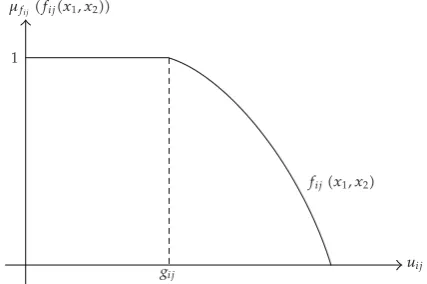
membership functionsμfijfijx1, x2for theijth fuzzy goal can be formulated as inFigure 1:
μfij
fijx1, x2
⎧ ⎪ ⎪ ⎪ ⎪ ⎨ ⎪ ⎪ ⎪ ⎪ ⎩
1, iffij≤gij, uij−fijx1, x2
uij−gij , ifgij ≤fij≤uij, i1,2, j1,2, . . . , mi,
0, iffij≥uij.
1
μfijfijx1, x2
fijx1, x2
[image:5.600.193.407.99.241.2]gij uij
Figure 1:Membership function of minimization-type objective functions.
Following Lai 15 and Shih et al. 1, we include the membership functions for
the fuzzy goals of the decision variables controlled by first-level decision maker, x1
x1
1, x21, x31, . . . , x n1
1 , in the proposed model in this article. To build these membership
functions, the optimal solution x∗ x∗1, x∗2 of the first-level MOLFP problem should be determined first. Following Pal et al. approach26, the optimal solutionx∗ x1∗, x∗2could be obtained. It may be noted that any other approaches for solving MOLFP problems can be used in solving the first-level MOLFP problem27–31. InSection 4, the FGP model of Pal et al.26, for solving the first-level MOLFP problem, is presented to facilitate the achievement
ofx∗ x∗1, x∗2.
Let tLk and tRk, k 1,2, . . . , n1 be the maximum negative and positive tolerance values on the decision vector considered by the FLDM. The tolerance tL
k and tRk are not
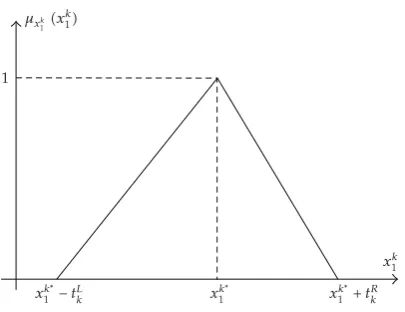
necessarily same. The linear membership functions Figure 2 for the decision vectorx1
x11, x21, x31, . . . , xn1
1 can be formulated as
μxk 1
xk1
⎧ ⎪ ⎪ ⎪ ⎪ ⎪ ⎪ ⎪ ⎪ ⎨ ⎪ ⎪ ⎪ ⎪ ⎪ ⎪ ⎪ ⎪ ⎩
xk1−xk1∗−tLk tLk , ifx
k∗
1 −tLk≤xk1 ≤xk
∗
1 ,
xk1∗ tRk−xk1 tRk , ifx
k∗
1 ≤xk1 ≤xk
∗
1 tRk, k1,2, . . . , n1,
0, if otherwise.
3.3
It may be noted that the decision maker may desire to shift the range ofxk1.Following Pramanik and Roy20, this shift can be achieved.
1
μxk
1x k 1
xk 1
xk∗
1 −tLk x
k∗
1 xk
∗
[image:6.600.200.403.94.250.2]1 tRk
Figure 2:Membership function of decision vectorsxk
1.
3.2. Fuzzy Goal Programming Approach
In fuzzy programming approaches, the highest degree of membership function is 1. So, as in 19, for the defined membership functions in3.2and3.3, the flexible membership goals
with the aspired level 1 can be presented as
μfij
fijx1, x2
d−ij−dij1, i1,2, j 1,2, . . . , mi,
μxk 1
xk1 d−k−dk 1, k1,2, . . . , n1,
3.4
or equivalently as
uij−fijx1, x2 uij−gij
d−ij−dij1, i1,2, j 1,2, . . . , mi,
xk 1 −
xk∗ 1 −tLk
tL k
dL−k −dkL 1, k1,2, . . . , n1,
xk1∗ tRk−x1k tRk d
R−
k −dRk 1, k1,2, . . . , n1,
3.5
where d−k dL−k , dkR−, dk dL
k , dRk , and d−ij, dkL−, dkR−, dij, dkL , dRk ≥ 0 with d−ij ×dij
0, dkL−×dkL 0,anddR−k ×dRk 0 represent the under- and overdeviations, respectively, from the aspired levels.
In conventional GP, the under- and/or overdeviational variables are included in the achievement function for minimizing them and that depend upon the type of the objective functions to be optimized. In this approach, the over-deviational variables for the fuzzy goals of objective functions,dij,and the over-deviational and the underdeviational variables for the fuzzy goals of the decision variables,dL−k , dL
achieve the aspired levels of the fuzzy goals. It may be noted that any under-deviation from a fuzzy goal indicates the full achievement of the membership value26.
It can be easily realized that the membership goals in3.2are inherently nonlinear in nature and this may create computational difficulties in the solution process. To avoid such problems, a linearization procedure is presented in the following section.
The FGP approach to multiobjective programming problems presented by Mohamed 19 is extended here to formulate the FGP approach to bi-level multi-objective linear fractional programming. Therefore, considering the goal achievement problem of the goals at the same priority level, the equivalent fuzzy bilevel multiobjective linear fractional goal programming model of the problem can be presented as
min Z
m1
j1 w1jd1j
n1
k1
wL k
dL k dkL−
wR k
dR k dkR−
m2
j1 w2jd2j
subject to μf1j
f1jx1, x2
d−1j−d2j1, j1,2, . . . , m1,
μf2j
f2jx1, x2
d−2j−d2j1, j1,2, . . . , m2,
μxk 1
xk1 dk−−dk I, k1,2, . . . , n1,
A1x1 A2x2
⎛ ⎜ ⎜ ⎝ ≤ ≥ ⎞ ⎟ ⎟
⎠b, x≥0,
dij−, dij≥0, withd−ij×dij0,
dk−, dk≥0, withd−k×dk0,
3.6
and the above problem can be rewritten as
min Z
m1
j1 w1jd1j
n1
k1
wLkdLk dL−k wRkdRk dR−k m2
j1 w2jd2j
subject to u1j−f1jx1, x2
u1j−g1j d −
1j−d1j1, j1,2, . . . , m1,
u2j−f2jx1, x2 u2j−g2j
d−2j−d2j1, j1,2, . . . , m2,
xk1−xk1∗−tLk tLk d
L−
k −d
L
k 1, k1,2, . . . , n1,
xk∗ 1 tRk
−xk 1
tR k
A1x1 A2x2
⎛ ⎜ ⎜ ⎝
≤
≥
⎞ ⎟ ⎟
⎠b, x≥0,
d−ij, dij ≥0, withd−ij×dij0, i1,2, j 1,2, . . . , mi,
dL−k , dLk ≥0, withdL−k ×dkL 0, k1,2, . . . , n1,
dR−k , dR
k ≥0, with dR−k ×dkR 0, k1,2, . . . , n1.
3.7
3.3. Linearization of Membership Goals
Following Pal et al.26, theijth membership goal in3.5can be presented as
Lijuij−Lijfijx1, x2 d−ij−dij 1, whereLij 1 uij−gij
. 3.8
Introducing the expression offijx1, x2from2.5, the above goal can be presented as
Lij uij−Lij
cijx αij dijx βij
d−ij−dij1
⇒Lijuij
dijx βij
−Lij
cijx αij
d−ijdijx βij
−dijdijx βij
dijx βij
⇒ −Lij
cijx αij
d−ijdijx βij
−dijdijx βij
1−Lijuij
dijx βij
⇒ −Lij
cijx αij
d−ijdijx βij
−dijdijx βij
L/ijdijx βij
, where L/ij 1−Lijuij
⇒−Lijcij−L/ijdijx d−ijdijx βij
−dijdijx βijLijαij L/ijβij
⇒Cijx d−ijdijx βij
−dijdijx βij
Gij,
3.9
where
Cij−Lijcij−L/ijdij, Gij Lijαij L/ijβij. 3.10
Now, using the method of variable change as presented by Kornbluth and Steuer29,
Pal et al.26, and Steuer32, the goal expression in3.9can be linearized as follows. LetD−ij d−ijdijx βij,andDij dijdijx βij; the linear form of the expression in
3.9is obtained as
Cijx D−ij−DijGij 3.11
Now, in making decision, minimization ofdijmeans minimization ofDij dijdijx βij, which is also a non-linear one.
It may be noted that when a membership goal is fully achieved,dij 0 and when its achievement is zero,dij 1 are found in the solution26. So, involvement ofdij ≤ 1 in the solution leads to impose the following constraint to the model of the problem:
Dij dijx βij ≤
1, that is,−dijx Dij ≤βij. 3.12
Here, on the basis of the previous discussion, it may be pointed out that any such constraint corresponding tod−ijdoes not arise in the model formulation26.
Therefore, under the framework of minsum GP, the equivalent proposed FGP model of problem3.7becomes
min Z
m1
j1 w1jD1j
n1
k1
wLkdLk dL−k wRkdRk dR−k m2
j1 w2jD2j
subject to C1jx D1−j−D1jG1j, j 1,2, . . . , m1,
C2jx D2−j−D2jG2j, j 1,2, . . . , m2,
x1k−xk1∗−tLk tLk d
L−
k −dkL 1, k1,2, . . . , n1,
xk∗ 1 tRk
−xk 1
tR k
dR−k −dRk 1, k1,2, . . . , n1,
−dijx Dij ≤βij, i1,2, j1,2, . . . , mi,
A1x1 A2x2
⎛ ⎜ ⎜ ⎝
≤
≥
⎞ ⎟ ⎟
⎠b, x≥0,
D−ij, Dij≥0, i1,2, j 1,2, . . . , mi,
dL−k , dkL ≥0 withdL−k ×dLk 0, k1,2, . . . , n1,
dR−k , dR
k ≥0, withdR−k ×dkR 0, k1,2, . . . , n1,
3.13
where Z represents the fuzzy achievement function consisting of the weighted over-deviational variables Dij of the fuzzy goals gij and the underdeviational and the
over-deviational variablesdL−k , dR−k , dkL ,anddRk , k1,2, . . . , n1for the fuzzy goals of the decision variables x11, x21, x31, . . . , xn1
1 , where the numerical weights wij, wLk, and wkR represent the
To assess the relative importance of the fuzzy goals properly, the weighting scheme suggested by Mohamed19can be used to assign the values towij andw1−.In the present formulation, the values ofw−ijandw1−are determined as
wij 1 uij−gij
, i1,2, j1,2, . . . , mi,
wkL 1
tLk, w R
k
1
tRk, k1,2, . . . , n1,
3.14
The FGP model3.13provides the most satisfactory decision for both the FLDM and the SLDM by achieving the aspired levels of the membership goals to the extent possible in the decision environment. The solution procedure is straightforward and illustrated via the following example.
4. The FGP Model for MOLFP Problems
In this section, the FGP model of Pal et al.26, for solving the first-level MOLFP problem, is
presented here to facilitate the achievement ofx∗ x∗1, x2∗. This solution is used to elicit the
membership functions of the decision vectorsx1 x11, x21, x13, . . . , xn1
1 , that included in the
FGP approach for solving BL-MOLFP problems proposed in this article. The first-level MOLFP problem is
Min F1x1, x2 Minf11x1, x2, f12x1, x2, . . . , f1m1x1, x2
subject to x∈G
⎧ ⎪ ⎪ ⎨ ⎪ ⎪
⎩x x1, x2∈R
n |A1x1 A2x2
⎛ ⎜ ⎜ ⎝
≤
≥
⎞ ⎟ ⎟
⎠b, x≥0, b∈Rm
⎫ ⎪ ⎪ ⎬ ⎪ ⎪
⎭/φ.
4.1
And the FGP model of Pal et al.26is
min Z
m1
j1 w1j D1j
subject to C1jx D1−j−D1jG1j, j 1,2, . . . , m1,
−d1jx D1j≤β1j, j1,2, . . . , m1,
A1x1 A2x2
⎛ ⎜ ⎜ ⎝
≤
≥
⎞ ⎟ ⎟
⎠b, x≥0,
D−1j, D1j≥0, j 1,2, . . . , mi.
5. The FGP Algorithm for BL-MOLFP Problems
Following the above discussion, we can now construct the proposed FGP algorithm for solving the BL-MOLFP problems.
Step 1. Calculate the individual minimum and maximum of each objective function in the
two levels under the given constraints.
Step 2. Set the goals and the upper tolerance limits for all the objective functions in the two
levels.
Step 3. Elicit the membership functions μf1jf1jx1, x2, j 1,2, . . . , m1 for each of the objective functions in the first level.
Step 4. Formulate the Model4.2for the first level MOLFP problem.
Step 5. Solve the Model4.2to getx∗ x∗1, x∗2.
Step 6. Set the maximum negative and positive tolerance values on the decision vectorx1
x11, x21, x31, . . . , xn1
1 ,tLkandtRk, k1,2, . . . , n1.
Step 7. Elicit the membership functionsμxk 1x
k
1for decision vectorx1 x11, x21, x31, . . . , x n1
1 . Step 8. Elicit the membership functions μf2jf2jx1, x2, j 1,2, . . . , m2 for each of the objective functions in the second level.
Step 9. Formulate the Model3.13for the BL-MOLFP problem.
Step 10. Solve the Model3.13to get the satisfactory solution of the BL-MOLFP problem.
6. Numerical Example
To demonstrate proposed FGP procedure, consider the following bi-level multi-objective linear fractional programming problem:
1st Level
Min
x1
f11
x1 x2−1 x1−2x2 1
, f12
2−2x1−x2 x2 4
, 6.1
wherex2solves
2nd Level
Min
x2
f21 − x1 4
−x2 3 , f22
x1−4 x2 1
, f23x1−x2
Table 1:Coefficientsαij,βij,cij, anddijfor the first- and second-level objectives of the BL-MOLFP problem.
f11 f12 f21 f22 f23
αij −1 2 4 −4 0
βij 7 4 3 1 1
cij −1,0 −1,0 −1,0 1,0 −1,0 dij 0,−1 0,−1 0,−1 0,1 0,−1
minGfij −0.143 −1.61 −0.308 −4 0
maxGfij 0.51 0.5 1.3333 0.2667 4
gij 0 −0.5 −0.3 −4 0
uij 0.5 0.5 1.3 0 4
Lij 2 1 0.625 0.25 0.25
L/ij 0 0.5 0.1875 1 0
Cij 2,2 0.5,0.5 0.625, 0.1875 −0.25,−1 −0.25,0.25
Gij −2 4 3.0625 0 0
wij 2 1 1 0.25 0.25
subject to
−x1 4x2≤0,
x1−
1 2x2 ≤4,
x1, x2≥0.
[image:12.600.195.382.525.693.2]6.3
Table 1summarizes the coefficientsαij,βij, cij,and dij for the first- and second-level
objectives of the BL-MOLFP problem. Also, the optimal minimum and maximum separate solutions of these objectives subjected to given constraints. The decided aspiration levels and upper tolerance limits to the objective functions are also mentioned. The valuesLij, L/ij,Cij,Gij
and the weightswijare calculated and also contained in the table.
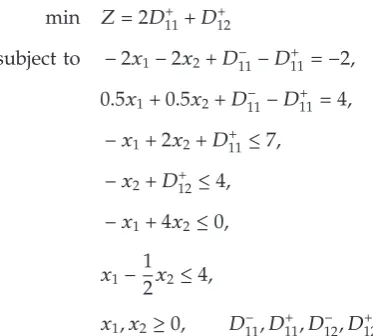
Following the procedure, the FGP model for the first-level multi-objective linear fractional programming problem is obtained as
min Z2D11 D12
subject to −2x1−2x2 D−11−D11−2,
0.5x1 0.5x2 D11− −D11 4,
−x1 2x2 D11≤7,
−x2 D12 ≤4,
−x1 4x2≤0,
x1−
1 2x2≤4,
x1, x2 ≥0, D−11, D11, D−12, D12≥0.
Using the LP-ILP linear and integer programming software program, version 1 for windows, the optimal solution of the problem isx1, x2 0.8,0.2. Let the first level DM
decidex∗10.8 with the negative and positive tolerancetR
1 tL1 0.4.
Then, following the procedure, the proposed FGP model for the bi-level multi-objective linear fractional programming problem is obtained as
min Z2D11 D12 D21 0.25D22 0.25D23 2.5d1L− dL1 2.5d1R− d1R
subject to −2x1−2x2 D11− −D11 −2,
0.5x1 0.5x2 D−11−D11 4,
x1 D21− −D21 4,
−0.25x1−x2 D22− −D220,
−0.25x1 0.25x2 D−23−D230,
−x1 2x2 D11≤7,
−x2 D12≤4,
x2 D21 ≤3,
−x2 D22≤1,
D23≤1,
2.5x1 d1L−−dL1 2,
2.5x1−d1R− dR1 2,
−x1 4x2≤0,
x1−
1 2x2≤4,
x1, x2≥0,
d1L−, dL1 , dR−1 , dR1 ≥0,
D−11, D11, D12−, D12, D−21, D21, D22−, D22, D−23, D23 ≥0.
6.5
The optimal satisfactory of the problem isx1, x2 0.8,0.2with objective functions
valuesf110,f120.048,f211.143,f22−2.667, andf23 0.6, with membership functions
valuesμ11 1, μ120.45, μ21 0.1, μ220.667,andμ23 0.1.
7. Conclusion
to minimize the group regret of degree of satisfactions of both the decision makers is developed to achieve the highest degree unity of each of the defined membership function goals to the extent possible by minimizing their deviational variables and thereby obtaining the most satisfactory solution for both decision makers. The main advantage of the proposed fuzzy goal programming procedure is that the possibility of rejecting the solution again and again by the FLDM and reevaluation of the problem repeatedly, by redefining the elicited membership functions, needed to reach the satisfactory decision does not arise. A linearization process of solving BL-MOLFP problems via minsum FGP is investigated. An illustrative numerical example is given to demonstrate the procedure.
References
1 H. S. Shih, Y. J. Lai, and E. S. Lee, “Fuzzy approach for multi-level programming problems,” Computers
and Operations Research, vol. 23, no. 1, pp. 73–91, 1996.
2 M. A. Abo-Sinna, “Pareto optimality for bilevel programming problem with fuzzy parameters,”
Journal of Operational Research Society of India, vol. 38, no. 4, pp. 372–393, 2001.
3 W. F. Bialas and M. H. Karwan, “Two level linear programming,” Management Science, vol. 30, no. 8, pp. 1004–1020, 1984.
4 O. Ben-Ayed, “Bilevel linear programming,” Computers and Operations Research, vol. 20, no. 5, pp. 485–501, 1993.
5 U. Pyng and S.-F. Lin, “Fining an efficient solution to linear bilevel programming problem: an efficient approach,” Journal of Global Optimization, vol. 8, no. 3, pp. 295–306, 1996.
6 M. A. Abo-Sinna and I. A. Baky, “Interactive balance space approach for solving bilevel multi-objective programming problems,” Advances in Modelling and Analysis B, vol. 49, no. 3-4, pp. 43–62, 2006.
7 M. A. Abo-Sinna and I. A. Baky, “Interactive balance space approach for solving level multi-objective programming problems,” Information Sciences, vol. 177, no. 16, pp. 3397–3410, 2007.
8 M. A. Abo-Sinna and I. A. Baky, “A comparison of two bilevel programming methods in multi-objective programming problems applied to the supply-demand interactions in electronic commerce,” Scientific Bulletin, vol. 40, no. 4, pp. 1189–1213, 2005.
9 M. A. Abo-Sinna, “A bilevel non-linear multi-objective decision making under fuzziness,” Journal of
Operational Research Society of India, vol. 38, no. 5, pp. 484–495, 2001.
10 G. Anandalingam, “A mathematical programming model of the decentralized multi-level systems,”
Journal of Operations Research Society, vol. 39, no. 11, pp. 1021–1033, 1988.
11 X. Shi and H. Xia, “Model and interactive algorithm of bilevel multi-objective with multiple interconnected decision makers,” Journal of Multicriteria Decision Analysis, vol. 10, no. 1, pp. 27–34, 2001.
12 L. N. Vicente and P. H. Calamai, “Bilevel and multilevel programming: a bibliography review,” Journal
of Global Optimization, vol. 5, no. 3, pp. 291–306, 1994.
13 L. A. Zadeh, “Fuzzy sets,” Information and Control, vol. 8, no. 3, pp. 338–353, 1965.
14 H.-J. Zimmermann, “Fuzzy programming and linear programming with several objective functions,”
Fuzzy Sets and Systems, vol. 1, no. 1, pp. 45–55, 1978.
15 Y.-J. Lai, “Hierarchical optimization: a satisfactory solution,” Fuzzy Sets and Systems, vol. 77, no. 3, pp. 321–335, 1996.
16 R. E. Bellman and L. A. Zadeh, “Decision-making in a fuzzy environment,” Management Science, vol. 17, pp. 141–164, 1970.
17 B. N. Moitra and B. B. Pal, “A fuzzy goal programming approach for solving bilevel programming problems,” in Advances in Soft Computing—AFSS, N. R. Pal and M. Sugeno, Eds., vol. 2275 of Lecture
Notes in Computer Science, pp. 91–98, Springer, Berlin, Germany, 2002.
18 B. B. Pal and B. N. Moitra, “A fuzzy goal programming procedure for solving quadratic bilevel programming problems,” International Journal of Intelligent Systems, vol. 18, no. 5, pp. 529–540, 2003.
19 R. H. Mohamed, “The relationship between goal programming and fuzzy programming,” Fuzzy Sets
20 S. Pramanik and T. K. Roy, “Fuzzy goal programming approach to multilevel programming problems,” European Journal of Operational Research, vol. 176, no. 2, pp. 1151–1166, 2007.
21 E. S. Lee and H.-S. Shih, Fuzzy and Multi-Level Decision Making: An Interactive Computational Approach, Springer, London, UK, 2001.
22 M. S. Osman, M. A. Abo-Sinna, A. H. Amer, and O. E. Emam, “Interactive decision-making for three-level multi-objective non-linear programming problem,” in Proceedings of the 38th Annual Conference
on Statistics, Computer Sciences and Operation Research, pp. 95–110, December 2003.
23 M. S. Osman, M. A. Abo-Sinna, A. H. Amer, and O. E. Emam, “A level non-linear multi-objective decision-making under fuzziness,” Applied Mathematics and Computation, vol. 153, no. 1, pp. 239–252, 2004.
24 X. Shi and H. Xia, “Interactive bilevel multi-objective decision making,” Journal of the Operational
Research Society, vol. 48, no. 9, pp. 943–949, 1997.
25 M. Sakawa, Fuzzy Sets and Interactive Multiobjective Optimization, Plenum Press, New York, NY, USA, 1993.
26 B. B. Pal, B. N. Moitra, and U. Maulik, “A goal programming procedure for fuzzy multiobjective linear fractional programming problem,” Fuzzy Sets and Systems, vol. 139, no. 2, pp. 395–405, 2003.
27 D. Dutta, R. N. Tiwari, and J. R. Rao, “Multiple objective linear fractional programming—a fuzzy set theoretic approach,” Fuzzy Sets and Systems, vol. 52, no. 1, pp. 39–45, 1992.
28 J. S. H. Kornbluth and R. E. Steuer, “Multiple objective linear fractional programming,” Management
Science, vol. 27, no. 9, pp. 1024–1039, 1981.
29 J. S. H. Kornbluth and R. E. Steuer, “Goal programming with linear fractional criteria,” European
Journal of Operational Research, vol. 8, no. 1, pp. 58–65, 1981.
30 M. K. Luhandjula, “Fuzzy approaches for multiple objective linear fractional optimization,” Fuzzy
Sets and Systems, vol. 13, no. 1, pp. 11–23, 1984.
31 B. B. Pal and I. Basu, “A goal programming method for solving fractional programming problems via dynamic programming,” Optimization, vol. 35, no. 2, pp. 145–157, 1995.