UNIVERSITY OF SOUTHERN QUEENSLAND
Exploring teaching and cognitive presence in blended
learning: promoting pre-service teachers’ critical thinking
A Dissertation submitted by
Petrea Redmond
Dip. Teach, B.Bus, M.Ed
For the award of
Doctor of Philosophy
i
Abstract
Despite extensive expenditure by universities on technology tools, the impact on
teaching practice and students’ critical thinking remains disappointing to many.
Current research which investigates the impact of teaching presence on cognitive
presence in undergraduate blended learning is scarce.
This study investigated teaching and cognitive presence in blended undergraduate
teacher education courses. Garrison, Anderson, and Archer’s (2000) Community of
Inquiry (CoI) framework has been used as a conceptual framework and as a lens to
investigate critical thinking. A multi-case study was used to identify the impact of
teaching presence on cognitive presence and the promotion of critical thinking. The
mixed methods of data collection and data analysis used surveys, content analysis,
interviews, and document analysis to detect elements of teaching and cognitive
presence and gain insights from participants’ perspectives.
The findings of this study suggest that indicators of cognitive and teaching presence
are found in a variety of spaces within a blended course. The majority of teacher
online discussion contributions were those of direct instruction, even for instructors
who considered themselves constructivist educators. In the online discussion
ii
Certification of Dissertation
I certify that the ideas, experimental work, results, analyses, software and
conclusions reported in this dissertation are entirely my own effort, except where
otherwise acknowledged. I also certify that the work is original and has not been
previously submitted for any other award, except where otherwise acknowledged.
__________________________________
_____________________
Signature of Candidate
Date
ENDORSEMENT
___________________________________
______________________
Associate Professor Peter Albion
Date
___________________________________
_______________________
iii
Acknowledgements
This dissertation is a result of compromise, patience, support, and encouragement of
a number of individuals. I would like to thank Dr Peter Albion for his continual
encouragement and ongoing guidance, insights, and mentorship. Dr Glen Postle,
thank you for your thoughts and views of my dissertation.
I am grateful for the support of my colleagues. Particularly to Alison, Lesley, Chris,
Alice, and Steve who endured my complaints, came with me for writing retreats,
discussed conceptual frameworks, and shared the frustration of Endnote and SPSS
while on their own research journey.
Thank you to those pre-service teachers and teacher educators who enthusiastically
participated in my case studies. I hope that my representation of your work,
thoughts, and dialogue honour the stories of those who participated.
iv
Table of Contents
Abstract ... i
Certification of Dissertation ... ii
Acknowledgements ... iii
Table of Contents ... iv
List of Figures... vi
List of Tables ... vii
CHAPTER 1:INTRODUCTION ... 1
Overview ... 1
Theoretical Perspectives ... 2
Community of Inquiry ... 2
Blended Learning and Teaching ... 4
Critical Thinking ... 4
Research Problem ... 5
Research Questions ... 6
Research Goals ... 6
Research Design ... 8
Significance of Study ... 8
Structure of Thesis ... 9
Definitions ...10
Abbreviations... 11
Chapter Summary ...11
CHAPTER 2:LITERATURE REVIEW ... 13
Overview ...13
Blended Learning and Teaching ...13
Teaching in Higher Education ...18
Teacher Education ... 20
Disconnect ... 21
Engagement and Interaction ... 22
Dialogue ...25
Cognitive Thinking Processes: Critical Thinking and Reflection ...29
Communities of Inquiry...36
Community of Inquiry as a Conceptual Framework ...39
Social Presence ...45
Cognitive Presence ...48
Practical Inquiry ... 49
Reflection as an Element of Cognitive Presence ... 53
Teaching Presence ...56
Research Gaps ...64
Chapter Summary ...66
CHAPTER 3:METHODOLOGY ... 69
Overview ...69
Research Design and Methodology ...69
Setting, Participants and Scope ... 70
Research Questions ... 72
Case Study Methodology ...72
Multiple Case Study ... 73
Mixed Methodology ...74
Role of the Researcher ... 77
Conceptual Framework ...79
Sampling ... 82
Data Collection ...83
Student Experience Survey ... 83
v
Semi-structured Interview with Course Instructors ... 89
Open Ended Initial Interview Questions ... 90
Course Documentation ... 91
Data Analysis and Data Reduction Procedures ...91
Integrity of the Data and Conclusions ...93
Ethical Considerations ...96
Chapter Summary ...96
CHAPTER 4:FINDINGS ... 99
Introduction to Chapter...99
Case A ... 100
Context ... 100
Results ... 100
Summary of Findings ... 115
Case B ... 116
Context ... 116
Results ... 116
Summary of Findings ... 139
Case C ... 140
Context ... 140
Results ... 140
Summary of Findings ... 155
Cross-Case Analysis ... 156
Summary of Findings ... 162
Chapter Summary ... 163
CHAPTER 5:Discussion ... 165
Overview ... 165
Discussion of Findings ... 166
Subsidiary question 1: What is the nature of student cognitive presence in the online discussion element of a blended course? ... 166
Subsidiary question 2: What is the nature of teaching presence in a blended course? ... 168
Subsidiary question 3: What aspects of teaching presence promote cognitive presence? ... 172
Subsidiary question 4: How can teaching presence in the online component of undergraduate blended courses be modified to enhance cognitive presence and the development of critical thinking? ... 176
Subsidiary question 5: How might reflection be positioned within cognitive presence? ... 181
Key research question: In what ways can teaching presence enhance the development of cognitive presence in a blended undergraduate teacher education course? ... 184
Other Research Outcomes and Emergent Themes ... 186
Personal Reflection ... 189
Chapter Summary ... 190
CHAPTER 6:CONCLUSIONS ... 191
Overview ... 191
Conclusions ... 191
Implications ... 193
Limitations of the Study ... 196
Directions for Future Research ... 197
Summary ... 198
References ... 199
Appendices ... 217
vi
[image:8.595.89.525.105.412.2]List of Figures
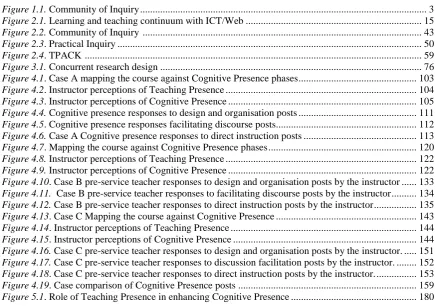
Figure 1.1. Community of Inquiry ... 3
Figure 2.1. Learning and teaching continuum with ICT/Web ... 15
Figure 2.2. Community of Inquiry ... 43
Figure 2.3. Practical Inquiry ... 50
Figure 2.4. TPACK ... 59
Figure 3.1. Concurrent research design ... 76
Figure 4.1. Case A mapping the course against Cognitive Presence phases ... 103
Figure 4.2. Instructor perceptions of Teaching Presence ... 104
Figure 4.3. Instructor perceptions of Cognitive Presence ... 105
Figure 4.4. Cognitive presence responses to design and organisation posts ... 111
Figure 4.5. Cognitive presence responses facilitating discourse posts... 112
Figure 4.6. Case A Cognitive presence responses to direct instruction posts ... 113
Figure 4.7. Mapping the course against Cognitive Presence phases ... 120
Figure 4.8. Instructor perceptions of Teaching Presence ... 122
Figure 4.9. Instructor perceptions of Cognitive Presence ... 122
Figure 4.10. Case B pre-service teacher responses to design and organisation posts by the instructor ... 133
Figure 4.11. Case B pre-service teacher responses to facilitating discourse posts by the instructor ... 134
Figure 4.12. Case B pre-service teacher responses to direct instruction posts by the instructor ... 135
Figure 4.13. Case C Mapping the course against Cognitive Presence ... 143
Figure 4.14. Instructor perceptions of Teaching Presence ... 144
Figure 4.15. Instructor perceptions of Cognitive Presence ... 144
Figure 4.16. Case C pre-service teacher responses to design and organisation posts by the instructor. ... 151
Figure 4.17. Case C pre-service teacher responses to discussion facilitation posts by the instructor. ... 152
Figure 4.18. Case C pre-service teacher responses to direct instruction posts by the instructor. ... 153
Figure 4.19. Case comparison of Cognitive Presence posts ... 159
vii
[image:9.595.99.526.115.556.2]List of Tables
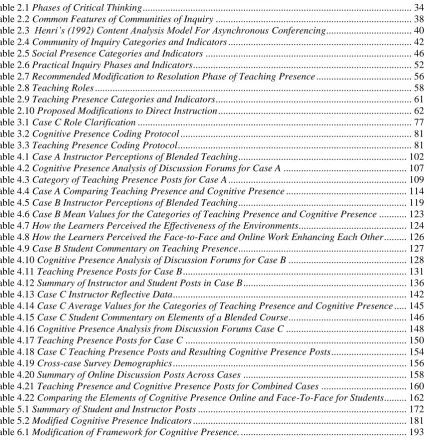
Table 2.1 Phases of Critical Thinking ... 34
Table 2.2 Common Features of Communities of Inquiry ... 38
Table 2.3 Henri’s (1992) Content Analysis Model For Asynchronous Conferencing ... 40
Table 2.4 Community of Inquiry Categories and Indicators ... 42
Table 2.5 Social Presence Categories and Indicators ... 46
Table 2.6 Practical Inquiry Phases and Indicators ... 52
Table 2.7 Recommended Modification to Resolution Phase of Teaching Presence ... 56
Table 2.8 Teaching Roles ... 58
Table 2.9 Teaching Presence Categories and Indicators ... 61
Table 2.10 Proposed Modifications to Direct Instruction ... 62
Table 3.1 Case C Role Clarification ... 77
Table 3.2 Cognitive Presence Coding Protocol ... 81
Table 3.3Teaching Presence Coding Protocol ... 81
Table 4.1 Case A Instructor Perceptions of Blended Teaching... 102
Table 4.2 Cognitive Presence Analysis of Discussion Forums for Case A ... 107
Table 4.3 Category of Teaching Presence Posts for Case A ... 109
Table 4.4 Case A Comparing Teaching Presence and Cognitive Presence ... 114
Table 4.5 Case B Instructor Perceptions of Blended Teaching... 119
Table 4.6 Case B Mean Values for the Categories of Teaching Presence and Cognitive Presence ... 123
Table 4.7 How the Learners Perceived the Effectiveness of the Environments ... 124
Table 4.8 How the Learners Perceived the Face-to-Face and Online Work Enhancing Each Other ... 126
Table 4.9 Case B Student Commentary on Teaching Presence... 127
Table 4.10 Cognitive Presence Analysis of Discussion Forums for Case B ... 128
Table 4.11 Teaching Presence Posts for Case B ... 131
Table 4.12 Summary of Instructor and Student Posts in Case B ... 136
Table 4.13 Case C Instructor Reflective Data ... 142
Table 4.14 Case C Average Values for the Categories of Teaching Presence and Cognitive Presence ... 145
Table 4.15 Case C Student Commentary on Elements of a Blended Course ... 146
Table 4.16 Cognitive Presence Analysis from Discussion Forums Case C ... 148
Table 4.17 Teaching Presence Posts for Case C ... 150
Table 4.18 Case C Teaching Presence Posts and Resulting Cognitive Presence Posts ... 154
Table 4.19 Cross-case Survey Demographics ... 156
Table 4.20 Summary of Online Discussion Posts Across Cases ... 158
Table 4.21 Teaching Presence and Cognitive Presence Posts for Combined Cases ... 160
Table 4.22 Comparing the Elements of Cognitive Presence Online and Face-To-Face for Students ... 162
Table 5.1 Summary of Student and Instructor Posts ... 172
Table 5.2 Modified Cognitive Presence Indicators ... 181