
R E V I E W
Open Access
Malaria
’
s contribution to World War One
–
the
unexpected adversary
Bernard J Brabin
1,2Abstract
Malaria in the First World War was an unexpected adversary. In 1914, the scientific community had access to new knowledge on transmission of malaria parasites and their control, but the military were unprepared, and
underestimated the nature, magnitude and dispersion of this enemy. In summarizing available information for allied and axis military forces, this review contextualizes the challenge posed by malaria, because although data exist across historical, medical and military documents, descriptions are fragmented, often addressing context specific issues. Military malaria surveillance statistics have, therefore, been summarized for all theatres of the War, where available. These indicated that at least 1.5 million solders were infected, with case fatality ranging from 0.2 -5.0%. As more countries became engaged in the War, the problem grew in size, leading to major epidemics in Macedonia, Palestine, Mesopotamia and Italy. Trans-continental passages of parasites and human reservoirs of infection created ideal circumstances for parasite evolution. Details of these epidemics are reviewed, including major epidemics in England and Italy, which developed following home troop evacuations, and disruption of malaria control activities in Italy. Elsewhere, in sub-Saharan Africa many casualties resulted from high malaria exposure combined with minimal control efforts for soldiers considered semi-immune. Prevention activities eventually started but were initially poorly organized and dependent on local enthusiasm and initiative. Nets had to be designed for field use and were fundamental for personal protection. Multiple prevention approaches adopted in different settings and their relative utility are described. Clinical treatment primarily depended on quinine, although efficacy was poor as relapsing
Plasmodium vivaxand recrudescentPlasmodium falciparuminfections were not distinguished and managed appropriately. Reasons for this are discussed and the clinical trial data summarized, as are controversies that arose from attempts at quinine prophylaxis (quininization). In essence, the First World War was a vast experiment in political, demographic, and medical practice which exposed large gaps in knowledge of tropical medicine and unfortunately, of malaria. Research efforts eventually commenced late in the War to address important clinical questions which established a platform for more effective strategies, but in 1918 this relentless foe had outwitted and weakened both allied and axis powers.
Keywords:World War One, Malaria, Quinine
Background
An unexpected adversary in the First World War was malaria. It attacked all combatant armies, with adverse consequences for vast numbers of troops, and devastated large civilian populations as a result of the environmental, civil, and demographic effects of troop dispersions and ac-tivities. The term‘war malaria’describes this paradigm [1], and captures the fact that malaria control in peace-time
differs from that in war. This difference was exagger-ated at the beginning of the First World War because military personnel were unaware that malaria was so widespread through many parts of Western and Eastern Europe (Figure 1). Although historians have recognized that a high proportion of troops died from disease ra-ther than combat [2], malaria has received little em-phasis, such that the subject is frequently not indexed in historical books or referenced in First World War manuscripts.
By 1914, parts of Europe had made considerable pro-gress in malaria control, particularly in Italy and Greece
Correspondence:[email protected]
1Clinical Division, Liverpool School of Tropical Medicine, Pembroke Place, L35QA Liverpool, UK
2Global Child Health Group, Academic Medical Centre, University of Amsterdam, Amsterdam, Netherlands
© 2014 Brabin; licensee BioMed Central. This is an Open Access article distributed under the terms of the Creative Commons Attribution License (http://creativecommons.org/licenses/by/4.0), which permits unrestricted use, distribution, and reproduction in any medium, provided the original work is properly credited. The Creative Commons Public Domain Dedication waiver (http://creativecommons.org/publicdomain/zero/1.0/) applies to the data made available in this article, unless otherwise stated.
BrabinMalaria Journal2014,13:497
[5,6] which was a major achievement considering that, around 1900, the anopheline mosquito cycle was only just becoming accepted, and the important vectors, as well as the developmental cycle in the red cell, were only recently recognized. The damage the War inflicted on the political, social, and economic progress achieved in malaria control lasted until well into the twentieth cen-tury. There are questions as to why the First World War was so conducive to an explosion of malaria, leading to epidemics, conflicts on solutions, and clinical controver-sies on how to manage the basic disease in individual troops in different malaria endemic settings. These is-sues affected all armies as the malaria parasite had no alignment and could be transmitted unseen across the-atres of war. The activities of soldiers aided its progress by increasing mosquito numbers through operational ac-tivities favouring transmission, especially as soldiers tended to burrow underground which is conducive to water–logging and favourable to mosquito breeding. By 1916, as more countries became involved, these effects multiplied creating ideal war conditions for the outbreak of several European malaria epidemics. The conse-quences compromised military planning, logistics, and the battle prospects of combatants, who became increas-ingly ineffective, as well as affecting huge swathes of ci-vilian populations [6]. Re-deployment of non-immune
troops to replace sick troops in malaria-affected war zones enhanced the problem, as did the inability to ef-fectively treat soldiers suffering from malaria. Deploy-ment of large numbers of troops from tropical Africa and India introduced into the European theatre a large human reservoir of infections with new parasite strains carried by semi-immune soldiers. The lack of knowledge of the hepatic stage of development of theP. vivaxmalaria parasite, which was only described in 1948 [7], com-pounded the situation and was instrumental in recurrently ineffective treatments being prescribed, and evacuations of vast numbers of sick troops from combat zones.
Only late in the war was it appreciated that preventive measures were possible. In the interim medical doctors struggled against this clinical adversary. The war docu-mentation on the topic is diverse and has not previously been assimilated. Much reporting on the size of the problem has been anecdotal, due to limitations in sur-veillance statistics. This review aims to summarize avail-able information and contextualize the main aspects in order to establish the nature of this formidable adversary in times of war.
Search strategy
[image:2.595.58.541.89.378.2]and the inter-library loan facilities of the University of Liverpool. Journal references in English, French, German and Italian were searched for the years 1914–1925. The Historical Library Collection of Tropical Medicine at the Liverpool School of Tropical Medicine and the Ronald Ross Archive at the Sydney Jones Library, University of Liverpool, were searched. For recent publications elec-tronic databases were examined for historical context and scientific content. These included PubMed, Scopus, ISI Web of knowledge, the UK Parliamentary Records Re-source, The Guardian newspaper and The Times news-paper Histories of the War. Reference lists from both general medical and historical journals were searched. Lack of appropriate indexing terms in early publications re-stricted the search for articles written before availability of electronic databases. The Official UK volumes published by His Majesty’s Stationary Office on Medical Services, Hy-giene, Pathology, Casualties and Medical Statistics of the War were an important resource and are page referenced, as information on malaria was widely indexed across all volumes [2,8-14] (Figure 2).
Military malaria surveillance statistics 1914–1918
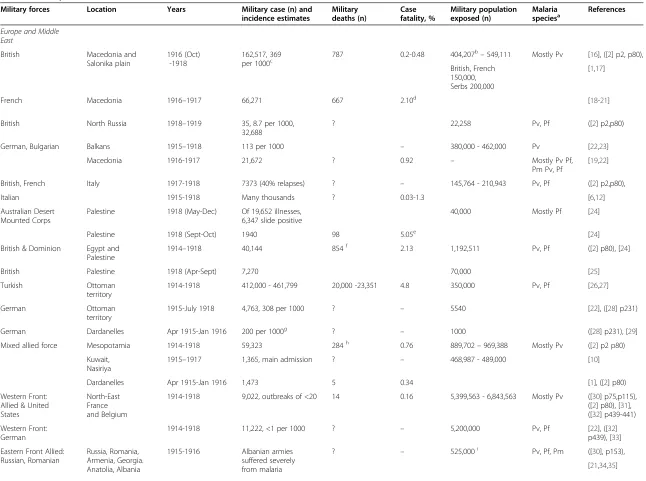
Initially it is necessary to estimate the military popula-tions at risk, and associated malaria related mortality. Central to estimates of malaria exposure risk is infor-mation on troop numbers in the exposed military pop-ulations, which is data largely available in historical references and archives. Officially reported annual strengths of the British Expeditionary Forces in all theatres of the War were published in 1931 [2]. Figures are also available from historical sources that take account of troop movements and re-deployments. Few statistics are avail-able for ‘followers’, or attached military personnel, who were not fighting troops. Table 1 provides information of
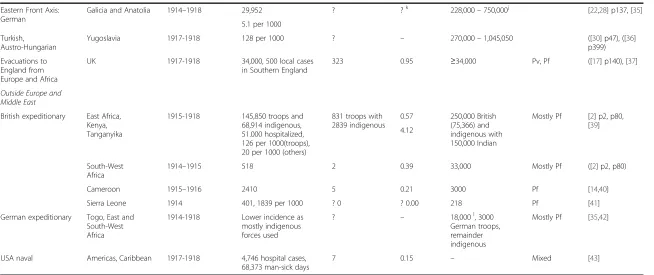
[image:3.595.56.541.536.704.2]military populations exposed for both the allied and axis powers. This includes regional areas of troop locations. Also provided are malaria surveillance case numbers, and malaria incidence estimates per 1,000 troops for the pe-riods specified in the table. When publications included numbers of deaths related to malaria, this information was used to estimate case fatality, which is as a range when sources giving variable mortality estimates were available. Estimates of the approximate military popula-tions exposed are provided taking account of their variable composition. Troop numbers are often provided on an an-nual basis, which would include many of the same troops tallied annually in sequential years. In terms of malaria risk per annum these numbers should be interpreted addi-tively, ie 100,000 men present over four years in a military zone equate to a total of 400,000 persons years malaria risk for the time period of the war. Another problem is that, although reference sources are listed in the table, there are differences in published troop numbers between sources. For this reason ranges of troop numbers are pro-vided. This table is the first compilation of global malaria troop statistics for the First World War. It is divided ac-cording to the regional locations of troops of both allied and axis powers located in Europe and the Middle East, or outside this area in sub-Saharan Africa. In the European theatre there is the Western front in France and Belgium bordering with Germany; the large Eastern Front which stretched across the Austro-Hungarian border with Russia and Romania; a more Southerly front in the Balkan region of Macedonia including borders with Greece, Bulgaria, Albania and Turkey; an Eastern Front of the Ottoman Empire borders in the Middle East including Syria, Palestine, as well as Egypt, and Mesopotamia (modern Iraq). In sub-Saharan Africa locations are listed in East, West and South-West Africa. Allied armies were: Great
Figure 2Official UK Government War Volumes on Medical Services, Hygiene, Pathology, and Medical Statistics.References: [2,8-14]. Volumes on Surgery of the War also published [15].
BrabinMalaria Journal2014,13:497 Page 3 of 22
Europe and Middle East
British Macedonia and
Salonika plain
1916 (Oct) -1918
162,517, 369
per 1000c 787 0.2-0.48 404,207
b
–549,111 Mostly Pv [16], ([2] p2, p80), British, French
150,000, Serbs 200,000
[1,17]
French Macedonia 1916–1917 66,271 667 2.10d [18-21]
British North Russia 1918–1919 35, 8.7 per 1000, 32,688
? 22,258 Pv, Pf ([2] p2,p80)
German, Bulgarian Balkans 1915–1918 113 per 1000 – 380,000 - 462,000 Pv [22,23]
Macedonia 1916-1917 21,672 ? 0.92 – Mostly Pv Pf,
Pm Pv, Pf
[19,22]
British, French Italy 1917-1918 7373 (40% relapses) ? – 145,764 - 210,943 Pv, Pf ([2] p2,p80),
Italian 1915-1918 Many thousands ? 0.03-1.3 [6,12]
Australian Desert Mounted Corps
Palestine 1918 (May-Dec) Of 19,652 illnesses, 6,347 slide positive
40,000 Mostly Pf [24]
Palestine 1918 (Sept-Oct) 1940 98 5.05e [24]
British & Dominion Egypt and Palestine
1914–1918 40,144 854f 2.13 1,192,511 Pv, Pf ([2] p80), [24]
British Palestine 1918 (Apr-Sept) 7,270 70,000 [25]
Turkish Ottoman
territory
1914-1918 412,000 - 461,799 20,000 -23,351 4.8 350,000 Pv, Pf [26,27]
German Ottoman
territory
1915-July 1918 4,763, 308 per 1000 ? – 5540 [22], ([28] p231)
German Dardanelles Apr 1915-Jan 1916 200 per 1000g ? – 1000 ([28] p231), [29]
Mixed allied force Mesopotamia 1914-1918 59,323 284h 0.76 889,702–969,388 Mostly Pv ([2] p2 p80)
Kuwait, Nasiriya
1915–1917 1,365, main admission ? – 468,987 - 489,000 [10]
Dardanelles Apr 1915-Jan 1916 1,473 5 0.34 [1], ([2] p80)
Western Front: Allied & United States
North-East France and Belgium
1914-1918 9,022, outbreaks of <20 14 0.16 5,399,563 - 6,843,563 Mostly Pv ([30] p75,p115), ([2] p80), [31], ([32] p439-441)
Western Front: German
1914-1918 11,222, <1 per 1000 ? – 5,200,000 Pv, Pf [22], ([32]
p439), [33]
Eastern Front Allied: Russian, Romanian
Russia, Romania, Armenia, Georgia. Anatolia, Albania
1915-1916 Albanian armies suffered severely from malaria
? – 525,000i Pv, Pf, Pm ([30], p153),
[21,34,35]
Journal
2014,
13
:497
Page
4
o
f
2
2
rnal.com/co
ntent/13/1/49
[image:4.794.61.707.65.546.2]Table 1 Military malaria surveillance statistics 1914–1918(Continued)
Eastern Front Axis: German
Galicia and Anatolia 1914–1918 29,952 ? ?k 228,000–750,000j [22,28] p137, [35]
5.1 per 1000
Turkish, Austro-Hungarian
Yugoslavia 1917-1918 128 per 1000 ? – 270,000–1,045,050 ([30] p47), ([36]
p399)
Evacuations to England from Europe and Africa
UK 1917-1918 34,000, 500 local cases
in Southern England
323 0.95 ≥34,000 Pv, Pf ([17] p140), [37]
Outside Europe and Middle East
British expeditionary East Africa, Kenya, Tanganyika
1915-1918 145,850 troops and 68,914 indigenous, 51.000 hospitalized, 126 per 1000(troops), 20 per 1000 (others)
831 troops with 2839 indigenous
0.57 250,000 British (75,366) and indigenous with 150,000 Indian
Mostly Pf [2] p2, p80, [39] 4.12
South-West Africa
1914–1915 518 2 0.39 33,000 Mostly Pf ([2] p2, p80)
Cameroon 1915–1916 2410 5 0.21 3000 Pf [14,40]
Sierra Leone 1914 401, 1839 per 1000 ? 0 ? 0.00 218 Pf [41]
German expeditionary Togo, East and South-West Africa
1914-1918 Lower incidence as mostly indigenous forces used
? – 18,000l, 3000
German troops, remainder indigenous
Mostly Pf [35,42]
USA naval Americas, Caribbean 1917-1918 4,746 hospital cases, 68,373 man-sick days
7 0.15 – Mixed [43]
Dashed indicate information not identified, and question mark unknown mortality case numbers.
a
Pv:Plasmodium vivax; Pf:Plasmodium falciparum; Pm:Plasmodium malariae.
b
Estimate includes British, French, Serbian, and Russian troops.
c
13.7% in British troops; 27.4% in Indian troops.
d
Of 100 autopsies of influenza pneumonia, 83 showed definite evidence of previous malaria [19].
e
Estimated from graphic data from all cases in Sept-Oct and deaths reported in October [24].
f
Deaths due toP.falciparuminfections. Confirmed diagnoses in 32 of 67 autopsies; many complicated by dual infection with influenza bronchopneumonia [44].
g
Estimate for German troops only.
h
Deaths for years 1917–1918 only.
i
Brusilov offensive 1915–1916.
j
Russo-Turkish offensive winter 1915–1916.
k
Of 2,873,000 men mobilized on the Turkish side in Ottoman territory, approximately 466,759 died of disease [28].
l
Estimate for East African German forces.
Brabin
Malaria
Journal
2014,
13
:497
Page
5
o
f
2
2
http://ww
w.malariajou
rnal.com/co
ntent/13/1/49
Britain, France, Italy, Russia, Serbia, Romania and Albania. Central axis armies were: Germany, Austro-Hungary, the Ottoman Empire, and Bulgaria.
War-time statistics may be underestimated by health officials as some armies did not keep adequate records, and for several locations there is missing data, especially for mortality, and for civilians who were exposed to many of the same adverse conditions. One previous ap-proximation of the number of allied troops with malaria was 500,000, although the basis for the calculation was unclear [30,37]. Incidence estimates per 1,000 men were available for some, but not all, locations. The sum total of case numbers for the War for the allied troops is 617,150 with 3,865 malaria deaths, which gives a case fa-tality estimate of 0.63%, or slightly more than one in every 200 infected soldiers dying from malaria. For the axis powers these estimates are 562,096, with 23,351 deaths, which gives a much higher malaria case fatality estimate of 4.15%, or more than four deaths for every hundred soldiers with malaria. This difference could re-flect better management practices, and quinine regimens used by the allied forces in cases of severe malaria, or the influence of pre-War prevention measures developed by Ross on malaria control during the War. The table also lists the reported malaria case fatality estimates spe-cific to different campaign areas. These vary between 0.15% - 5.05%. This variation partly arises due to troop composition, as regiments with larger contingents of tropical indigenous troops would be expected to have lower mortality risk due to their acquired immunity. An-other factor is the proportional exposure risk in different areas for P. falciparum malaria compared to P. vivax. This data refers to the direct impact of malaria, but does not account for indirect effects on morbidity and mor-tality. For example soldiers anaemic with chronic mal-aria would succumb more readily following battle injuries or major surgery.
Table 1 indicates evidence for the intensity of malaria in several locations, particularly in Macedonia (present day Greece and environs), The Ottoman Empire (present day Turkey and environs), Mesopotamia (present day Iraq and Iran), Palestine, and East Africa. Malaria was a smaller problem on the Western Front, although the destruction of dykes in Flanders, causing local flooding, led to indigen-ousP. vivaxcases. Prisoners of war returning to Flanders, who were infected in German concentration camps, is also reported [31]. In trenches where both European and African troops were present a small number of P. falciparumcases were reported amongst German troops [33]. In Gallipoli, malaria was never reported as a prom-inent cause of inefficiency, although the coastal area of the peninsula was considered highly malarious.
Malaria had a much greater impact on the Eastern Front involving the Russian, Romanian, and Albanian
Troops, although quantitative information on malaria is not adequately defined for these countries. These armies were probably severely affected, with substantial mal-aria–related mortality [34]. Statistics shown in Table 1 for the German armies were reported by Zieman [22], although these did not provide mortality data, and he in-dicated they were underestimates. The accuracy of esti-mates of troop numbers resident in the Ottoman Front have been questioned [36], and Erickson considered that earlier estimates vastly underestimated the true number of Ottoman casualties from disease as well as combat [28]. By the end of the Brusilov offensive in late summer 1916, the Hapsburg army had officially lost 464,382 men and 10,756 officers, with 350,000 prisoners of war - a loss from which they never recovered. High malaria mortality estimates (23,000 approximately) have been re-ported for Turkish troops [26], but the number of cases and deaths for the army as a whole is difficult to quan-tify with no statistics for prisoners of war who would be likely to receive little in the way of protection from infection.
Underestimation in surveillance statistics is difficult to quantify due to failure to identify low grade or asymp-tomatic infections, which can cause debilitating chronic anaemia without occurrence of febrile episodes. The sta-tistics also do not reflect the occurrence of relapsing vivax infections in soldiers taking low doses of prophy-lactic quinine, or falciparum infections in soldiers from the tropics with partial malaria immunity. Diagnostic misclassification would be expected unless a blood slide was taken, as clinical features of acute malaria have a broad differential diagnosis that includes diarrhoea and pneumonia. Febrile soldiers may also have suffered mixed malarial infections [45]. Autopsies conducted in Palestine by Manson-Bahr confirmed mixed infections with bronchopneumonia and malignant tertian malaria (P. falciparum), with influenza as dual infection. He con-sidered that the mechanisms of early diagnosis and treatment broke down in rapidly advancing troops in malarious areas [44].
black African troops. Of German troops in East Africa who died other than from wounds, 64.2% died from Blackwater Fever between 1914 and 1917. In Macedonia, of 136 cases of Blackwater fever, 36 died (26.5%), and amongst the French, mortality was 30% [12]. It was re-ported less frequently in Togoland and Mesopotamia. In Macedonia, Wenyon considered that hardships, expos-ure and unpreparedness under war conditions explained the high case fatality from malaria in 1916 (1.01%), and that the lower mortality in 1917 and 1918 (0.37% and 0.31% respectively) would have been still further reduced if ordinary peace-time precautions had been available [19]. High mortality was due to life under war-time condi-tions and not any particular feature of the parasite, al-though it followed closely the incidence rate of falciparum malaria. Overall British mortality from malaria in Macedonia was 0.7 per 1,000 troops, while for the French, for the same period (January-June 1918), mortality was ten times higher (6.4%) [19].
Malaria epidemics during the war
A number of basic conditions cause epidemics [47], sometimes separately, or together as in the First World War. These occurred in the regions of Macedonia,
Palestine and Egypt, and in Western Europe following the return of troops to England, Italy and elsewhere. An increase in vectorial capacity due to high production of vector anopheline mosquitos was probably critical. This could have resulted from more breeding places (or de-terioration in larval control), prolonged mosquito sur-vival, or increased man-vector contact. In desert fringe regions rainfall and malaria transmission are often con-nected. The El Nino Southern Climatic Oscillations (ENSO) for the years of 1914–1915 and 1918–1919 may have produced favourable climatic conditions for epi-demic transmission as the impact of ENSO in malaria epidemic prediction is well-established [38]. The ENSO for 1918–1919 was one of the strongest in the twentieth century [48]. The movement of infected persons, as troops migrated from India and sub-Saharan Africa, combined with the immigration of non-immune European soldiers further created ideal conditions for the explosive epidemics which occurred.
The Macedonian epidemic
[image:7.595.61.538.100.378.2]This event was one of the greatest medical surprises of the war with more than a quarter of the half a million al-lied troops immobilized with sickness and equivalent
Table 2 Estimated malaria cases based on size of military forces
Location Perioda(years) Malaria incidence
(per 1000 troops)
Estimated military population
Expected number
of malaria casesb Observed number ofmalaria surveillance cases
British and Dominion forces
Macedonia 3 369 404,207 149,076 162,517
Western Front 4 <1 5,399,563 <5,400 9,022
6,843,563c <6843
East Africa 3 126 250,000 31,500 145,850
North Russia 2 8.7 22,258 194 35
German and Central Powers forces
Balkans 4 113 380,000 42,940 32,688
462,000 55,206 –
Ottoman territory:
- Turkish troops 4 308 350,000 107,800 412,000–461,799
- German troops 2 308 5540 1689 4,763
Dardanelles–German troops 1 200 1000 200 –
Galicia and Anatolia Eastern Front 2 5.1 228,000d 1,163 29,952
750,000e 3,825 –
1,045,050 5,330 –
Yugoslavia 2 128 270,000 34,560 –
Western Front 4 <1 5,200,000 <5,200 11,222
Dashes: information not identified.
a
Approximate duration of exposure.
b
Estimate based on single incident case per soldier, and does not include recurrent episodes or relapses for the same individuals.
c
Expected malaria cases based on two estimates for Western Front troop sizes.
d
Military numbers only for Russo-Turkish offensive winter 1915–1916 [35].
e
Expected malaria cases using estimates for Hapsburg army size of 750,000[46] or 1,045,000 [32].
BrabinMalaria Journal2014,13:497 Page 7 of 22
numbers of Bulgarian and German troops (Table 1). Amongst British troops, peak prevalence patterns were observed seasonally from July to November in 1916 and 1917, and with double peaks between May and November in 1918 (Figure 3). Relapsing vivax cases infected in the previous year may have contributed to the early peak prevalence in 1918, and falciparum malaria may have induced some vivax relapses in the late second peak in 1918 [49]. The species pattern observed amongst French
troops in 1916 showed peak vivax prevalence preceding peak falciparum prevalence by three months (Figure 4) [20]. This was similar to the species pattern seen in British troops in Palestine and Egypt in 1918 [49]. No deaths were reported between January and March 1916, and epidemic peaks in mortality followed corresponding peak prevalence patterns (Figure 3), with mortality peaks in 1916 corresponding to the monthly peak prevalence periods of vivax and falciparum malaria. Mean malaria mortality remained below 2%, with peak mortality of 5.1% in September 1917.
[image:8.595.57.291.213.695.2]The malaria epidemic in Greece resulted in ten allied casualties for every one inflicted by the axis powers [35]. There was no escape from the mosquito under the en-demic conditions in which these armies fought. The sur-prise of the high mortality and the magnitude of the immobilized forces induced Generals to respond to the malaria crisis, which required a greater expenditure on labour to clear mosquito breeding sites. This effort was insufficient as it was not known that mosquitoes could spread beyond about 500 metres from their breeding sites. The main vectors were Anopheles maculipennis and Anopheles superpictus, and the sporozoite rate var-ied between 0.5% and 5.5% [19,50]. The British, French and German armies were virtually immobilized for three years, with a French General telegramming that his army was in hospital with malaria [16,18]. This caused French military authorities to think seriously about the crisis, hugely improved efforts at quinine prophylaxis of troops [18], and rapid evacuation of infected troops. As a result they experienced less malaria than the British. The British introduced the Y management scheme of quinine treatment (15 gr/day x 14 days, then 60 gr/wk x 6 days in optional divided doses; every soldier to keep 60 gr for self-treatment if relapses), which included removal of heavily infected individuals, with 25,000 men evacuated in 1917 [19]. Other measures included every known method of combating the disease including swamp and stream clearance (Figure 5), oiling, treatment of breeding
Figure 3Epidemic pattern of malaria in allied forces in Macedonia 1916–1919.Source: references [10,11]. Horizontal axis in months.
[image:8.595.306.539.573.705.2]places, fumigation, spraying, mosquito proofing and quinine prophylaxis. Despite these efforts, it is doubtful whether any appreciable reduction in infectious episodes occurred [19]. Most of these measures were introduced effectively too late in the campaign, partly due to con-flicting opinions on prioritization, but also delays in obtaining netting and sufficient quantities of quinine [10]. Quinine prophylaxis had been recommended by Ronald Ross, consultant Physician to the Mediterranean Expeditionary Force, but was not favourably reported on by medical officers. Ross visited the area between 26th November 1917 and 18th January 1918, yet surprisingly makes no mention of the epidemic in his memoirs [51]. The area became a large military hospital and the spec-tacular image of a well-equipped army paralysed by mal-aria is a sober reminder of its potential severity.
The Palestine and Mesopotamia epidemic
The epidemic amongst British troops commenced im-mediately after they moved into this malaria endemic area in early 1916, and after the incubation period had passed (Figure 6). Malaria was also introduced into the Sinai region by troops from India, who eventually com-prised about three quarters of troop numbers. It was difficult to locate camps away from highly endemic areas in southern Mesopotamia (modern Iraq.) Cases of marine malaria were reported with higher incidence in ships anchored closer to the shore [53]. Initially cases were mostly caused by P. vivax infection. Malaria be-came more widespread during the campaign with the largest epidemic occurring in 1918, with proportionally moreP. falciparuminfections. The operations of Indian and British forces in 1918 involved campaigns in some of the most malarious areas. Successive advancing
fronts across the whole region continuously placed troops in new transmission areas (Figure 7). The British military failure at the siege of Kut in 1916 (Figure 7), and the over-all military failure of the Turkish army was related to sol-diers being overwhelmed by malaria, although the disabling of soldiers by the disease was not to the same ex-tent as in Macedonia. Accurate returns on malaria were mainly available to the end of September 1918, and the main British military attack then occurred on September 19th [25]. The 1918 epidemic did not commence until temperature averages had risen above 15.5°C in early June, which were climatic conditions favouring mosquito breeding. If the British advance in mid-September had been delayed the successful outcome might have been dif-ferent. Incidence was falling by November, which was con-sidered due to the extent of the anti-malarial measures undertaken earlier in the year [25]. In addition to British and Indian troops, Australian mounted forces also experi-enced epidemic malaria with a high case fatality of 5%, which related to dual infections with P. falciparum mal-aria and influenza (Figure 8) [24]. Australian statistics on their cavalry advance showed that the sick outnumbered the battle wounded by 37:1 [49].
[image:9.595.58.540.88.286.2]A small number of malaria diagnostic stations providing malaria microscopy were established in April 1918, by British and Australian commands, and with specially trained medical officers and orderlies [9]. Rapid diagnosis may have reduced case fatality and helped to check the epidemic in Palestine. Over 111,000 blood smears were examined by the Australian New Zealand Army Corps la-boratory, and of 40,000 slides examined by British diag-nostic stations 28.9% were positive [49,55]. A number of other measures were introduced and by 1918 the extent of anopheline breeding meant there was no time to be lost. Figure 5Draining the marshes to prevent malaria on the Eastern Front.Source: reference [52], published under the Open Government Licence, v 2.0.
BrabinMalaria Journal2014,13:497 Page 9 of 22
Large sums of money were spent on oiling and drainage, with £10,000 for drainage clearance alone [9]. Deep shell holes rapidly fill with water, and British clearance work was hampered by Turkish shelling of working parties. Some tributary origins were within Turkish lines and the British felt that the Turks failed to appreciate that the de-struction of mosquito breeding places by the allies would also be beneficial to their own army as mosquitoes tra-versed front lines [25]. As a consequence, malaria amongst allied troops increased in frequency with further advances
into Turkish positions (Figure 7). The micro-epidemiology of malaria in this varied terrain was challenging, and the operations were difficult and costly to sustain. The full effects of these anti-malarial measures are difficult to assess, and they were introduced late in the cam-paign. The drafting of replacement troops to Palestine from Macedonia introduced an additional human reser-voir for mosquito infection, which reduced benefits achieved from the evacuation of infected troops.
The epidemics in England and Italy
In England between 1900 and 1914 only two cases of malaria had been observed in soldiers who had never been out of the country [56,57]. Following 1914, cases gradually increased reaching epidemic proportions in 1918 (Figure 9). In 1917, Ross had concluded that true indigenous malaria foci had never disappeared from the island of Sheppey on the north Kent coast, where healthy carriers of P. vivax were identified [58]. The Ministry of Health did not station soldiers returning from malarious regions in parts of Kent or Sussex be-cause of concerns about local transmission. The First World War brought the problem of malaria back to England, leading to the last epidemic of malaria in the country and substantially increased local transmission (Figure 9). The problem arose from troops returning from Egypt, Turkey, Macedonia, Italy, West and East Africa. Table 3 shows malaria statistics on reinforcements to the British expeditionary Force arriving in France from Macedonia and Palestine in June 1918 and illustrates the magnitude of the problem [59]. These soldiers brought back infections of P. vivax and P. falciparum malaria to areas which had been free of disease for many years, and many had to be evacuated from France to England for treatment. Soldiers returning from a wide diaspora were admitted with malaria to the London Hospital during 1918 and 1919 (Table 4). Before the end of the war, 34,000 military cases returned to five camps set up in England for their treatment, and 500 locally transmitted infections were identified [60]. In 1919, the Ministry of Health made malaria notification compulsory [30] in order to identify infection foci.
[image:10.595.57.291.86.565.2]In a military camp on the Isle of Sheppey soldiers in training who had never left England contracted malaria, and in one regiment 30 cases occurred. These were lo-cally contracted as An. maculipennis mosquitoes could be found without difficulty in occupied huts [60]. In the ports of Liverpool, London and Bristol, during 1917, more than 500 cases of malignant tertian malaria were introduced mostly from West Africa. The newly com-pleted building of the Liverpool School of Tropical Medicine was nominated for use for hospital treatment of infected soldiers and undertook clinical trials of quin-ine treatment [62,63]. The main source of infection for Figure 6Epidemic pattern of malaria in allied forces in
most naval and military cases, and nearly all civilian cases, which occurred after 1916, was relapsing vivax malaria among returned soldiers [64,65]. Prompt identifi-cation of infection foci, and quarantining infected soldiers and sailors in a small number of dedicated hospitals, en-abled effective epidemic control and limitation of indigen-ous transmission [65].
There was a rise in reported cases in several other European countries due to malaria introduced by return-ing troops [30]. In Vienna, 3717 cases were reported in 1919, and epidemics occurred in Albania and Corsica, although in Germany it was not as serious a problem after the War. There were post-war epidemics in Ukraine and Russia, and an outbreak occurred as far North as Arkhangelsk (‘Archangel’) in the arctic [2,30]. In Russia 360,670 cases were reported in 1919, rising to
[image:11.595.58.540.87.507.2]5,865,828 annual cases in 1924, when incidence reached 446 per 10,000 population with at least 600,000 case fa-talities [30]. In Italy, there was a ferocious epidemic, which devastated the nation in 1917–1918, in which tens of thousands of civilians and soldiers perished (Figure 9) [6]. The Italian Front was as violent as the Western Front, and Snowden reports that the horrors of battle were so great that some soldiers purposefully avoided taking quinine in order to become malaria-infected and be evacuated–a response described as‘malaria defeat-ism’[6]. The large number of evacuated troops and pris-oners of war, collapse of the pre-war Italian malaria campaign, requisitioning of Italian hospitals by Austrian forces, shortages of quinine, and war-time disruption left the Italian population at high risk of malaria infection. In 1917–1918, the epidemic was at its peak and lead to Figure 7Dynamics of troop movements in the Middle East, 1914–1918.Source: adapted from reference [32].
BrabinMalaria Journal2014,13:497 Page 11 of 22
Italy experiencing the worst malaria epidemic of the twentieth century [6]. Almost 50,000 soldiers were repa-triated from highly endemic areas and created an
epi-demic route through to Southern Italy, which
experienced an excess of falciparum infections compared to Northern provinces.
Malaria in sub-Saharan Africa
African expeditionary forces were at high risk forP. fal-ciparuminfection. British and German armies were con-stituted with a majority of indigenous or Indian troops who should have been less susceptible due to their ac-quired immunity [2]. Table 1 gives estimates of the pro-portions of these contingents, and shows that in East Africa, whilst malaria incidence was lower in indigenous and Indian troops, their total malaria mortality was higher as they were a much larger fighting force. Imper-ial troops and supporting bearers serving in East Africa had a death rate that exceeded any other theatre of war [66], and measured up to those in the great European bloodbaths [67]. The medical provisions for the African and Indian troops were poor, and they were exempted from the general order for quinine prophylaxis. The Germans, who were a relatively small force, had a higher ratio of porters to soldiers (7:1) than the allies (4:1), and also high standards of disease prevention. They never-theless reported some deaths from Blackwater Fever from staff receiving one grain quinine daily as self-treatment [68]. Ocean Road Hospital in Dar es Salaam was requisitioned from the Germans by the British at the outbreak of the War and was used for treating British soldiers. Although some attempts at malaria con-trol were introduced in 1914, including sanitary inspec-tions and importation of anti-larval fish [40], General Smuts, who commanded the British forces, may have
been negligent with regard to malaria control offering too little, too late [66,69]. The numerous preventive approaches so carefully developed in Macedonia and Salonika were not attempted, as most reliance was placed on quinine prophylaxis. Quinine supplied to the Army and Navy was below indicated strength due to war profiteering, whereas specimens captured from the Germans (and of German manufacture) produced quin-ine toxicity or cinchonism with much smaller doses. In July 1918, a small outbreak in marines visiting East Africa was attributed to sub-standard prophylaxis due to this problem [70]. Germany subsequently used the re-search station at Amani in Tanganyika (now Tanzania) to produce its own quinine supply. Sub-standard quinine was an important reason for the resurgence of malaria in other regions during and after the War [5,71].
In Cameroon and Sierra Leone in West Africa, smaller numbers troops were deployed compared to East Africa, and few military deaths from malaria were reported [40,41,72]. Malaria incidence was high, despite troops using mosquito nets and quinine prophylaxis, and many troops had repeated admissions with marked anaemia and debility [41]. Expert microscopy and treatment was available. Amongst reinforcements arriving from India to Muscat, on the southern Arabian coast opposite East Africa, 25% had splenomegaly [73]. The extent of infec-tion in these soldiers was not appreciated and many returned to India on account of fever after residence for only a short period in battle zones.
The Pacific region
In Pacific malaria endemic regions, the New Zealanders took German Samoa in August 1914, and the Australians German New Guinea in September [32]. The Japanese oc-cupied the Marshall, Caroline, and Marianas islands the following month. Fighting in these regions, which possibly had the highest malaria vectorial capacity of any war zone, would have resulted in serious malaria-related illness, as their malaria control strategies were similar, or less devel-oped to those used elsewhere. It was known that anophe-lene mosquitoes carried malaria but the identity of the local vectors had not been established [74].
Malaria control approaches
[image:12.595.58.291.89.256.2]The greatest experience of preventive measures was de-rived from activities in Macedonia, and these were ap-plicable to all theatres of the War and could be classified as: drug prophylaxis and treatment, mosquito deterrents, personal protection, or mosquito destruction [11]. New approaches were developed during the War which ad-vanced practical and operational strategies. These are summarized and compared with pre-1914 approaches in Table 5. The lack of pre-war scientific evidence on all of these control strategies was a major restriction. There Figure 8Malaria epidemic ANZAC Mounted Division,
was minimal data available on acquired immunity to mal-aria, as well as controversy in Germany before the War between Erhlich and Bordet on the nature of the immune response to infections [75]. During the War, operational evaluations of some prevention measures were developed, and the most feasible was testing quinine treatment and prophylaxis, as it was more readily controlled, follow-up was realistic, and outcome determinants were easily mea-sured. In view of the extent of the variety of these war-time trials, data on quininization is covered in a separ-ate section. Personal prophylaxis with quinine was
cha-otic with weak understanding of medicines in
management, problems in drug delivery due to night operations, enemy bombs and attacks, and servicemen may also have hidden the drug to exchange for ciga-rettes [76]. The British questioned the use of quinine for prevention and placed more emphasis on prevent-ing contact with mosquitoes. A survey of 129 officers on the utility of quinine by the War Office reported
only four felt it was of definite value, ten of some value, and the remainder of no value [11].
[image:13.595.60.537.89.447.2]Personal anti-mosquito ointments were messy and head nets and gloves were very restrictive especially in active combat (Figure 10). It was actually as important to protect infected men from uninfected mosquitoes as it was the reverse. Environmentally, the need for fre-quent spraying of pyrethrum for mosquito control de-terred its use by German forces although the British army used it occasionally (Lefroy’s fluid) in the First World War [30]. In many areas, the very high density of mosquitoes made it impossible to control the vector. Ex-tensive drainage was impossible in mountain terrain, or when campaigns were highly mobile. Identification of vec-tors gave a sounder basis for control and studies were undertaken on entomological parameters [50]. Notions of integrated control and the mapping of community reser-voirs of infection were emerging and were completed in response to the epidemic in England [60], but remained Figure 9Malaria patterns following troop evacuations in England and Wales 1917–1918, and Italy 1914–1918.Source: references [6] and [60].
BrabinMalaria Journal2014,13:497 Page 13 of 22
notional in other areas. A large compendium of measures was required to tailor to the environment, although this was only really appreciated towards the end of the War. Negligence and scepticism with application of preventive measures were common and contradictory instructions were given by officers [18,77].
Late in the war, at least in Macedonia and Palestine, a considerable effort was placed on net design with the pro-motion of modified bivouac tents for rapid deployment (Figure 11). A small net for use by individual men was considered preferable but these were unavailable and two man tents were used in Macedonia. Reserve net supplies for damaged nets were not included in logistics requests and frequently there were operational short-ages. Mosquito-proof canvas huts could have been adapted on a larger scale.
[image:14.595.59.538.99.442.2]In view of these restrictions, and despite concerns over quinine efficacy, military orders prioritized quinine prophylaxis with the aim to interrupt transmission and eliminate the parasite reservoir. It was recognized that quinine treatment could lessen the severity of an
Table 3 Malaria statistics on reinforcements to British expeditionary Force arriving in France in June 1918 [59]
Regimenta % infected with malaria Casesb(n) Daily sick parade malaria statistics
5th Connaught Rangers 80 82 If regiment ordered to service in forward
area at least 50% unable to comply
5th Royal Irish 75 80 30/650 parasite positivec
2nd Royal Dublin Fusiliers 100 (last 2 years) 175 25% parasite positive
13th Black Watch Scottish 80 573 30/day reported sick with malaria
14th Kings Liverpool 75 146 60-70/day with malaria
5th Inniskillin Fusiliers 75 175 600/824 have had malaria; 30% parasite positive
1st Kings own Yorkshire Light Infantry 70 42 Only 30% of regiment never had malaria
13th Manchester 80 52 Average 4/day relapsing
9th Gloucester 80 – 60-70/day with relapsing malaria
2nd Royal Munster 80 80 Men with acute malaria may not report sick
6th Inniskillin Fusiliers 75 21 110 hospitalized since June 1918
6th Leinster 75 87 480 with malaria since June 1st 1918
5th Royal Irish Fusiliers 75 58 27 reported malaria within 3 days of parade
7th Wiltshire 50 165 Less infected than other Battalions
4th Kings royal rifle corps 70 10 Only 30% not had malaria
2nd Northumberland Fusiliers 80 209 146 hospitalized en route to France with malaria. Average daily sick parade = 60
10th Camerons (Lovat’s scouts) 80 – 57/210 suffering relapses on day of inspection
3rd Royal Fusiliers 70 20 32 hospitalized en route to France
10th Black Watch 80 140 17/42 had malaria in morning sick parade
6th Royal Dublin Fusiliers 80 110 40 with malaria en route to France
12th Lancashire Fusiliers 80 56 33 arrived with malaria
Total Mean 76.7 2281d –
a
Average Regimental strength = 800 men per regiment.
b
Cases with diagnosis confirmed by microscopy.
c
Blood smear positive on microscopy.
d
Mean 15.0% parasite positive ( 2281/15,200, with average regimental strength of 800 men).
Table 4 Malaria cases admitted London General Hospital February 1917–January 1919 [61]
Location of origin
Admissions P.vivax P.falciparum Mixed Pv and Pf
(n) (n) (n) (n)
Salonika 1686 746 82 20
East Africa 1049 496 43 26
India 126 35 2 –
Egypt 86 29 3 –
Palestine 63 11 3 –
Mesopotamia 46 19 – –
West Africa 35 4 2 –
France 48 15 – –
South Africa 25 4 1 –
Italy 25 7 5 –
Singapore 16 4 1 –
North America 11 3 – –
[image:14.595.56.291.516.733.2]infection and shorten the period of early infectivity even though relapses invariably occurred. In the UK, during 1916, the total issue of quinine exceeded 25 tons, or nearly 66 million 5-gr doses [14], and because of supply issues the Government requisitioned all quinine stocks. The average monthly supply in 1917 and 1918 was 5.5
[image:15.595.58.530.99.640.2]tons. The influence of Ross on this strategy was substan-tial [78,89]. Some doctors, however, thought that in re-gions of Macedonia, Albania, and the Tauris Mountains there were different forms of malaria that could not be treated by quinine [76]. This undermined confidence in its use although there could be no dilemma in drug
Table 5 Approaches to malaria control prior to and during World War One
Pre–1914 1914 - 1918
Prevention European theatre & British Dominions[77-79]
British[9-11,13,17,25,30,44,66,73,80-83] French[18,30,84]
- Systematic inspection and notification of cases
- Scientific evidence on control strategy required - Preliminary study of epidemiological conditions [84]
- Protection against mosquito bites (portable nets)
- Specially trained medical officers and orderlies required [44]
- Appropriate housing
- Portable mosquito proof rooms - Availability of malaria diagnostic units with microscopes [9,44]
- Eliminating parasite reservoir
- Protection of hands and feet (boots) - Sanitary sections in field Divisions to supply material for anti-mosquito work [82]
- Small anti-larval measures and measures against adult larva
- Medicinal skin protection (effect transient) - Mosquito brigades (in Palestine) - Quinine treatment and prevention
- Mosquito reduction (fumigation, traps, fish as larvicides, oiling, drainage, screening breeding water, filling pools, piping to prevent leakage)
- Frequent inspections of anti-mosquito work [82]
- Collective mechanical defences
- Detection, isolation and specific treatment of all infected soldiers [79]
- Entomological studies of anopheles species [17] - Bed nets and mosquito protection [84]
- Prevention by treatment - Recognition problem of mistaken diagnoses [44]
- Reduction of negligence and scepticism of preventive measures by authorities [18]
- Personal domestic hygiene - Siting of camps and evacuation of areas [11] - Reduction of contradictory instructions on quinine use to avoid chaotic use of quinine
- Quinine prophylaxis - Instructions on use of mosquito nets and net
design.45Bivouac netted tents [17], (Figure11) - Urine inspection for quinine detection(Tarant’s reagent) to control prophylactic administration of quinine [18]
- Consider public prophylaxis with quinine (if troops contracting infection outside barracks)
- Mosquito-proof canvas huts [17] - Malaria specialists as advisers [84]
-Australian[24,55]
- Repeated measurements (malaria surveys) - Mosquito swats [17] - Malaria diagnostic units with field laboratories [55]
- Keeping troops in non-malarial hill areas [79] - Occasional use of pyrethrum sprays (Lefroy’s fluid) for mosquito control [30]
- Aggressive control of mosquito breeding along front lines [55]
- Imposition of fines for non-cooperation Legislation on engineering work
- Quinine prophylaxis recommended by Ross and Medical Advisory Committee, but unfavourable response from medical officers [10,80]
-German[85]
- High standards of disease prevention
Prevention in German possessions[86,87] - Drainage operations, although impossible in mountainous terrain, or where campaign was highly mobile (eg, Palestine) [25]
- Emphasis on quininization [85]
- Local conditions decided most important activity
- Indian troops exempted from use of mosquito nets on grounds they were unpopular, and they had acquired malarial immunity [66]
- Quininization (simplest and cheapest) - Pamphlets explaining dangers [17]
- Supervised quinine therapy and quinine prophylaxis trusted to exterminate malaria even in very badly infected areas,
- Recruitment blood examination for selection of smear negative candidates (West Indies) [13]
- Environmental mechanical protection - Instruction of medical officers on spleen examination technique of Indian troops [73] - Personal anti-mosquito measures
- Reliance on acquired immunity [87]
BrabinMalaria Journal2014,13:497 Page 15 of 22
choice as no alternative was available. In German and Austrian publications unrestricted prophylaxis was pro-moted and its use was a military order [76].
Because of restrictions on supplies there was increased interest in Germany in manufacturing a synthetic alter-native anti-malarial, although the chemical industry was more committed to developing poison gases [46]. It was only at the end of the War, when Germany was cut-off from the world supply of quinine, that Pamaquin devel-opment was stimulated and achieved by 1925 [71]. Questions of resistance to quinine became topical in view of the frequency of recurrences which lead to con-flict in Germany on the distinction between acquired drug resistance, and drug selection of pre-existing resist-ant strains [76,90].
Quininization
Quinine prophylaxis was defined by Ross as ‘treatment of persons who have not yet shown signs of illness but may possibly become infected’[78], and by Treadgold as ‘regular administration of quinine with a view to prevent the development or recrudescence of clinical malaria’ [80]. The first definition suggests it prevents new infec-tions occurring, whereas the second emphasizes the pre-vention of recurrent infection due to failed primary clearance. This difference encapsulates the confusion and controversy that surrounded quinine treatment and prophylaxis at the time of the First World War. This was fuelled by widely varying practices and published recommendations in dosage and regimens which were mostly empirical, and subsequently were directed by military authorities following quinine trials in the UK, France, Macedonia, and Palestine (Table 6). Often trials did not assess the percentage not infected before prophy-laxis commenced. Results on efficacy were variously re-ported as good or poor by different national authorities. Quinine was widely used by the German troops but data was censored on its evaluation, [68,85,91].
[image:16.595.57.290.87.713.2]Although quinine prophylaxis was often ordered it was not enforced and officers were neglectful [18]. Ross con-sidered that therapeutic efficacy in a war setting related to the level of supervision of intake preferring long-term daily prescription which was difficult to implement. He differed from several other European malariologists in recommending continuous dosage [78]. Quinine parades with supervised observation interrupted activities and falls in attendance were difficult to correct if 100,000
troops were involved [1]. A great amount of preparation was required to make this strategy effective. During the First World War, P. vivax malaria showed a pattern of relapse within two months of initial treatment with a tendency to relapse about 8–10 months later, but it was unknown whether recurrences were recrudescent blood stage infection or derived from a latent tissue stage [101]. Ross later changed his opinion and conceded that some relapses occurred in spite of the most vigorous daily supervision, but disagreed with the French whose approach was to suspend quinine between relapses [89]. Memoranda from the British Ministry of War endea-voured to provide some clarity [10]. Initially orders were given from 1st June 1916 for daily doses of 6 gr quinine to troops in malarial areas following an attack of aria, but as summer progressed, all troops, whether mal-arial or not, were given quinine as there was some evidence it mitigated the severity of an attack. The funda-mental problem related to the knowledge gap concerning the exo-erythrocytic hepatic stage of development of P. vivax.Without this knowledge it was impossible for clini-cians to distinguish between the need for a drug to
[image:17.595.57.540.91.390.2]provide a radical cure ofP. vivax infection which cleared hepatic hypnozoites, from suppressive cure, which would control overt clinical attacks of bothP. vivaxandP. falcip-arum malaria [102]. As a result the war-time data on a large number of clinical trials from centres in the UK aim-ing to evaluate quinine, and routes of its administration, were difficult to interpret [63,94]. This dilemma was cap-tured at a meeting of the Royal Society of Tropical Medi-cine and Hygiene held in London in late 1917 when, following the presentation of trial results by Ross compar-ing treatment regimens, two directly opposcompar-ing opinions were expressed [103]. Sir William Osler emphasized that ‘the man who could not treat malaria successfully with quinine should give up the practice of medicine’, then adding ‘in divided doses’. In contrast, Warrington-Yorke commented that ‘no-one is able to state how quinine should be taken, in which manner, and in what doses’. He considered the results presented by Ross meaningless as all treated cases were not diagnosed following microscopic confirmation of malaria at the time of relapse. In conclu-sion, without definite evidence on efficacy the data was ‘worse than useless, because it misleads other people and Figure 11Alternative military net designs for mosquito protection. (A)Mosquito net with bell tent design as supplied to French soldiers in Salonika, Macedonia (source: The Times History of the War), [88].(B)Bivouac net opened to show interior. The ledges forming beds are dug down to a depth of 9 inches and the trench for feet is dug down to a depth of 18 inches (published with permission of the Royal army Medical Corps Journal), [11].(C)Modified Bivouac net supplied to British soldiers in Macedonia in 1918. The net is intended for two men and is covered by the two bivouac sheets. The front slides up and down the guy rope (published under the Open Government Licence, v 2.0), [19].(D)Same net as in (c) showing alterations to improve protection (published under the Open Government Licence, v 2.0) [11].
BrabinMalaria Journal2014,13:497 Page 17 of 22
so prevents progress’ [103]. Data on the therapeutic value of iron, arsenic and strychnine which were some-times used as adjunct treatments (Table 6) were not systematically assessed. A few small clinical trials that investigated treatment with and without arsenic came to varied conclusions [63,104]. Revised recommendations
called the Y scheme outlined in Table 6 were eventually implemented by the British.
[image:18.595.60.536.99.581.2]There were concerns related to possible effects of quinine in reducing immunity to severe malaria, or ad-vantages if released malarial antigen stimulated immun-ity [105]. Theories on malaria toxins lead some practice
Table 6 British and German military quinine prophylactic and treatment regimens for malaria 1914–1918
Author or source [reference]
Area and subjects
Year Prophylactic dose regimena,b Treatment dose regimen
British
Hehir [79] India 1914 All troops quinine treated not < 4 months –
Wenyon [17] Macedonia 1916 5,10,20,30gr/day tried 30gr/day x 24 days + arsenic + iron
1918
Editorial BMJ [81] No restriction 1916 Large doses needed –
Laveran [92] Macedonia 1917 40gr/day (split dose) x 7.5 months –
Treadgold [80] Macedonia 1917 5-15gr x 2 consecutive days at 1 wk intervals –
Manson [93] No restriction 1917 5gr/day, or 10gr/x2wk, or 15gr x 10th day 5gr x 3 days, or 15gr x1 dose x 1 wk; Iron + arsenic for 8wks; then 5gr/day x 3 months x every Spring x 2 years
Stephens [63] Liverpool evacuated troops
1917 Interrupted courses preferable to continuous. Various doses and scheduling. Arsenic not beneficial, strychnine more beneficial
–
Ross [94] UK special treatment centres
1917 5-60gr/day investigated x 3 wks in various schedules and administration routes. Concluded 60gr/wk reduces relapses to 10% per month
Short and long sterilizing treatments. No difference with administration route
Regulations UK Govt [95]
UK troops 1917 Y scheme: Every soldier to keep 60gr for self-treatment if relapses. Report relapse day or night for blood film and fever check
Y scheme: 15gr/day x 14 days then 60gr/wk x 6 days in optional divided doses
Paisseau [96] Balkans 1917 1-2gr/day x 3 days x 1–2 months Iron + arsenic x 1–2 months
IV adrenaline if rigors 2gr preferred ifP. falciparum
1918
Anderson [97] Macedonia 1917 20-45gr both intensive and interrupted x 1–2 months IV strychnine and adrenaline
1918
Alport [98] Salonika 1917 1-10gr/day continuous; or 35gr/day x 71 days Cerebral malaria: 60-100gr in 12 hours x 3 days IM,IV, rectal
War Govt Medical Services Publication [13]
Conflict zones 1914 10gr x 21 days. Arsenic to reduce anaemia with iron and strychnine (IV if severe). Opium (Warburg’s tincture). Venepuncture to reduce toxaemia (≥1 pint), and replace
with normal salinec
Consider blood transfusion twice fortnightly. Splenectomy in severe anaemia
1918
Germand
Bruns [91] Macedonia 1917 0.3 -0.6 g/day + arsenic. Recommended 1.5–2.0 g/day x 2 weekly x 6–8 wks. Repeat annually for 3 years
–
1918
Kestner [85] Macedonia 1916 0.3 -0.9 g/day –
Romania 1918
Stendel [99] Eastern front 1916 0.3 g alternating days x 6 wks –
Abstracts [100] No restriction 1918 Summaries on quinine studies. Various dosese – a
gr refers to grains of quinine. One grain = 64.8 mg quinine; IM: intra-muscular; IV: Intravenous.
b
The modern treatment regimen is 20 mg/kg loading dose, and then 10 mg/kg x 3 daily x 7 days. This total loading dose in grains for a 75 kg man, equates to 23.1 grains. The maintenance dose equates to 11.6 grains x 3 daily.
c
Needs further investigation.
d
German studies use dose suffix of g (not gr).
e
to use venipuncture to remove the toxic substance, which had echoes of enlightenment blood-letting [13] (Table 6). It is unclear from the government publication mentioning this how frequently it was practised, or at what stage during the War. No really satisfactory result was obtained. No one treatment provided a certain cure and the most effective treatments, and those with mul-tiple intra-muscular quinine injections, were almost more severe than the disease. The use of the maximum tolerated dose instead of the minimum effective dose was preferred in favour of reducing the risk of selecting resistant parasites. Some considered quinine was a useful prophylactic against Blackwater Fever, and it was also used for the treatment of pneumonia [106]. Conversely Treadgold concluded that the severity of malaria in Macedonia was increased in some cases by prior quini-nization. He quoted Celli who claimed quinine prophy-laxis produced some effect, but compared to results of mosquito protection, the results were negligible [80].
Lest we forget
The First World War was a vast uncontrolled experi-ment in politics, military innovation and medical prac-tice. Malaria parasites were unaligned and unexpected adversaries which battered both the victors and the van-quished. Their control would require breaching political barriers as well as improved scientific knowledge and understanding. Medical progress would require much greater insight into experimental method and the com-plex nature of the adversary, the individual, and the
en-vironmental circumstances of war [107]. At the
beginning of the War the extent of the malaria problem was effectively unknown to military planners and as a consequence there were insignificant efforts at contain-ment. Malaria rapidly spread to civilian populations as
well as to the military, creating a complex emergency. In temperate zones, whereP. vivaxwas the dominant para-site, ideal conditions were developing for parasite and mosquito, possibly enhanced by the climatic conditions of the strong 1914–1915 and 1918–1919 El Nino events. The trans-migration of troops and parasites across Europe favoured the spread of new parasite strains, which flour-ished in non-immune host populations of soldiers. Text-book ideal conditions were created for multiple epidemics, which would involve vast numbers of soldiers, from South–East England to the shores of Arabia, from the Arctic to the Mediterranean. Moreover, the statistical esti-mates of the numbers of malaria cases derived in this analysis are likely to be sizable underestimates, not least because malaria surveillance data went un-reported from several war fronts, as did civilian related malarial deaths. Censorship of German data limited information available for axis forces on case numbers, mortality, as well as on their military and medical response.
[image:19.595.56.539.520.716.2]The military and medical response of allied forces was at first limited, perhaps because of perceived greater de-mands for directed military action the response gathered pace in 1916 when it was understood that whole armies could be immobilized by the malaria parasite, defeating military objectives. Medical facilities were required on a very large scale to treat acutely affected and chronically disabled soldiers with recurrent symptoms. In the search for scientific evidence this became an experimental field of medicine with research on drug trials, haematology and immunology, including attempts to culture the mal-aria parasite [108-110]. The priority for an effective treatment was paramount but, in the absence of know-ledge of the exo-erythrocytic developmental stage of P. vivax, these attempts would lack resolution. Not until the late 1920s was it apparent that P. vivaxrecurrences
Figure 12Post-war postcard illustrating combination management of a malaria patient.
BrabinMalaria Journal2014,13:497 Page 19 of 22
followed a different temporal pattern to P. falciparum [101]. Prior to then the treatment response to the two parasitic species was frequently viewed as synonomous. The endeavour to defeat this enemy became controversial despite the efforts of Ross to co-ordinate treatment trials and it was not resolved until years after the War. It is a good example of the failure of the clinical trial approach to resolve treatment practices when the scientific mecha-nisms underlying the disease are unknown. The need for patient care of soldiers was paramount and in response, both in Liverpool and Sierra Leone, the Liverpool School of Tropical Medicine closed its research laboratories and converted them to hospital facilities that could accommo-date clinical trials [62]. Grassi in Italy came out of retire-ment in 1917 to aid the Italian effort to cope with the malaria crisis by running a dispensary and research station [6]. The influence of Ross on prevention guided sanitation efforts and implementation of rapid malaria surveys, which included entomological investigations, which acted as a platform for control activities and aided the allied military effort. The lower reported number of allied com-pared to Turkish malaria deaths in Macedonia probably reflects better allied malaria control strategy. These efforts served to educate soldiers and officers on the malaria problem, which was no longer hidden.
Underlying national and international conflicts influ-enced progress. These varied from opinions on treat-ment such as ‘there are almost as many treatments of malaria as there are people who have written on the sub-ject’[103], to disagreements on ideas for bed net design [17], or more fundamentally, to differences in racial the-ories of immunity to malaria [76]. The culture of com-mand was an umbrella over-riding alternative choices, and recommendations were difficult to reach by Com-mittees whose agendas were broad, and at times imperi-alistic [64,111]. Much credit rests on individual medical officers whose clinical acumen and decision-making was paramount in patient care in rapidly changing local cir-cumstances. Patients could be bewildered by the variety of treatment options as illustrated in this post-war car-toon postcard from sub-Saharan Africa (Figure 12). Al-lied activities become better integrated later in the War as demonstrated by the rapid control of the English out-break. The nationalization of malaria control commenced rapidly after the War in those European countries most af-fected, Greece [5], Italy [6], and Palestine [112], but with little progress in Africa. The disease remains a threat in war zones today [113], and on the Centenary of the First World War, soldiers continue to experience high infection rates in malarious areas in Africa [114-116].
James in his Presidential address to the Royal Society of Tropical Medicine in London concluded that ‘every-one who had actually taken part in efforts to deal with malaria in different parts of the world during the War
came home with the uncomfortable feeling that we knew much less about the disease than we thought we did, and that it might be quite a good plan to sink our pride and to begin again, in all humility, and with greater re-spect and reverence, to try to fathom out some of its mysteries’[117]. A view that is as relevant today.
Competing interests
The author declares that he has no competing interests.
Author’s contributions
I read, wrote and approved the manuscript.
Acknowledgements
I am very grateful for assistance with references to Cath Booth, librarian at the Liverpool School of Tropical Medicine, to Kathryn Barnes at inter-Library loan, to staff at the Ronald Ross Archive at the University of Liverpool, and to Becks Skinner of the Army Medical Services Museum. Dr Loretta Brabin provided helpful discussions on the preparation of this manuscript, and Professor Dennis Shanks kindly provided background information.
Received: 4 December 2014 Accepted: 8 December 2014 Published: 16 December 2014
References
1. Christophers SR:Malaria and War.Trans R Soc Trop Med Hyg1939,33:277–304. 2. Mitchell TJ, Smith GM:History of the Great War based on Official Documents.
Medical Services. Casualties and Medical Statistics of the Great War.London: His Majesty’s Stationary Office; 1931.
3. Simmons JS, Whayne TF, Anderson GW, Horack HM:Global Epidemiology. A Geography of Disease and Sanitation.London: William Heineman Ltd; 1944. 4. Haworth J:The global distribution of malaria and the present control effort.
InMalaria, Principles and Practice of Malariology, volume2.Edited by Wernsdorfer WH, McGregor I. London: Churchill Livingstone; 1988:1379–1420. 5. Tsiamis C, Piperaki ET, Tsakris A:The history of the Greek Anti-Malaria
League and the influence of the Italian School of Malariology.Infez Med 2013,21:60–75.
6. Snowden FM:The First World War and epidemic disease.InThe Conquest of Malaria, Italy, 1900–1962.Edited by Snowden FM. New Haven: Yale University Press; 2006.
7. Shortt HE, Garnham PCC:The pre-erythrocytic development of Plasmodium cynomolgiandPlasmodium vivax.Trans R Soc Trop Med Hyg 1948,41:785–789.
8. Macpherson WG, Leishman WB, Cummins SL:History of the Great War based on Official Documents.InMedical Services, Pathology.London: His Majesty’s Stationary Office; 1923.
9. Macpherson WG:History of the Great War based on Official documents.
InMedical Services General History. Volume III.London: His Majesty’s Stationary Office; 1924:389.
10. Macpherson WG, Mitchell JJ:History of the Great War based on Official Documents.InVolume IV, Medical Services General History, p107.London: His Majesty’s Stationary Office; 1924:264–265.
11. Macpherson WG, Horrocks WH, Beveridge WWO:Prevention of malaria. History of the Great War based on Official Documents.InMedical Services. Hygiene of the War, Volume II.London: His Majesty’s Stationary Office; 1923:214–238.
12. Macpherson WG, Herringham WP, Elliot TR, Balfour A:History of the War based on Official Documents. Medical Services. Diseases of the War, Volume 1. London: His Majesty’s Stationary Office; 1923.
13. Macperson WG, Horrocks WH, Beveridge WWO:A History of the War based on Official Documents, Medical Services, Hygiene of the War, Volume II, p275. London: His Majesty’s Stationary Office; 1923.
14. Macpherson WG:History of the Great War based on Official Documents. Medical Services General History. Volume I.London: His Majesty’s Stationary Office; 1924:179–306.



![Figure 4 Parasite species differentiation in French troops inMacedonia. Source: reference [20]](https://thumb-us.123doks.com/thumbv2/123dok_us/8336343.303891/8.595.57.291.213.695/figure-parasite-species-differentiation-french-inmacedonia-source-reference.webp)
![Figure 5 Draining the marshes to prevent malaria on the Eastern Front. Source: reference [52], published under the Open GovernmentLicence, v 2.0.](https://thumb-us.123doks.com/thumbv2/123dok_us/8336343.303891/9.595.58.540.88.286/figure-draining-marshes-prevent-eastern-reference-published-governmentlicence.webp)
![Figure 6 Epidemic pattern of malaria in allied forces inPalestine 1917 – 1918. Source: references [10,11,54]](https://thumb-us.123doks.com/thumbv2/123dok_us/8336343.303891/10.595.57.291.86.565/figure-epidemic-pattern-malaria-allied-inpalestine-source-references.webp)
![Figure 7 Dynamics of troop movements in the Middle East, 1914–1918. Source: adapted from reference [32].](https://thumb-us.123doks.com/thumbv2/123dok_us/8336343.303891/11.595.58.540.87.507/figure-dynamics-troop-movements-middle-source-adapted-reference.webp)
![Figure 8 Malaria epidemic ANZAC Mounted Division,Sept – Oct 1918. Source: reference [24]](https://thumb-us.123doks.com/thumbv2/123dok_us/8336343.303891/12.595.58.291.89.256/figure-malaria-epidemic-anzac-mounted-division-source-reference.webp)
