Arduino fault tolerant System, Internet of Things (IoT)
*aOluwole K. Bowoto, aBankole I. Oladapo, aPrince A. Nimako, aFrancis T. Omigbodun, bOmonigho A.
Emenuvwe
aSchool of Engineering and Sustainable Development, De Montfort University, Leicester, UK bDepartment of Mechanica/Mechatronicsl EngineeringAhmadu Bello University , Zaria, Nigeria
*Corresponding author, Tel: +44(0)7823823066, E-mail: [email protected]
Abstract
New developments in broadcast technology, such as the ad hoc wireless network and the detection devices that work, enable daily connections to the Internet, commonly referred to as the Internet of Things (IoT). IoT saw this as a support for the development of creative and contextual services and applications. The service can respond to the user's environment and preferences. Finite state machines are recently making waves when the issue of self-controlling systems come into the picture of designs. This research focuses on the design of a fault tolerant system that controls random failures impressed on the network. The method comprises of diodes, Resistors, Optocouplers, ESP8266 WI-FI Module Webpage with button, and two Arduinos which in effect will determine iteratively who to handle a failure at hand modelled as when the button on the webpage is pressed. In this work, a Heartbeat Detection and Monitoring System will be made using Arduino that detect the electrical state using the Pulse Sensor and show the readings in Beats Per Minute on the LED connected a microcontroller. It sends the texts to the server using the Wi-Fi module ESP8266 to signals can be monitored from the monitoring zone via the internet. This is reflected by the declaration of a master state by either of two Arduinos whenever the push button is pressed as observed on the codes. The result obtained from the research shows apparently, the state of the fault tolerance system none power deny of heartbeat condition connected to the LED.
Keyword: ESP8266 WI-FI Module; Signal point of Failure; IoT; Heartbeat Detection
1. INTRODUCTION
The observed so many systems fail for one reason or the other. But it would be noted that most failures leave us with no chance for our usual excuses "Out of our control" as technological development has stretched to it's bound in this century. The degree and causes of most failures when carefully examined, transverses around the following; software reasons, power reasons, design reasons, Carelessness of operators etc. It is still worthy of note that the recent failures which exemplify this subject under discussion and that has motivated this design study to be carried out is the recent Fire disaster that took so many lives in Glenfield [1]. Taking a closer look from a software design point of view, assuming the fridge that caused the large fire had a fault-tolerant system in place, it would have probably shut down the system or sent an instant distressed message via WI-FI (cybersecurity) to the company that will respond accordingly to the situation.
This invention relates to a heart rate measurement device comprising a sensor unit that detects a user’s heart rate, a signal processing unit that receives and processes the signal generated from the sensor and a wireless signal transmitting unit that takes the message from the processing unit and the transfer the word out to the configured device. The sensor unit detects the frequency of change of blood density to derive the heart rate, with precision and efficiency of detection of heart rate, cooperating the technique of wireless transmission, and thus our purpose of promoting accuracy of detection and improving the convenience of use is achieved [2]. One proposed design to avert such failure is the adoption Finite state machine. In this work, a Heartbeat Detection and Monitoring System will be made using Arduino that detect the electrical state using the Pulse Sensor and
show the readings in Beats Per Minute on the LED connected to it (Pin 13). It will also send the texts to the server using the Wi-Fi module ESP8266 so that signals can be monitored from anywhere in the world over the internet. It is an excellent source for displaying the data online, and you can access the data from at any time and any place. The system takes the physical input from the pulse sensor by the button on the ESP8266 WIFI, and then the data is processed by Arduino to count the number of pulses and displaying the output. This is reflected by the declaration of a master state by either of two Arduinos whenever the push button is pressed as observed on the codes. The result obtained from the research shows apparently, the state of the Arduino when the button is when power is denied any of the heartbeat and the condition of the LED (output) whenever the button is pressed.
1.1. Apparatus for the design
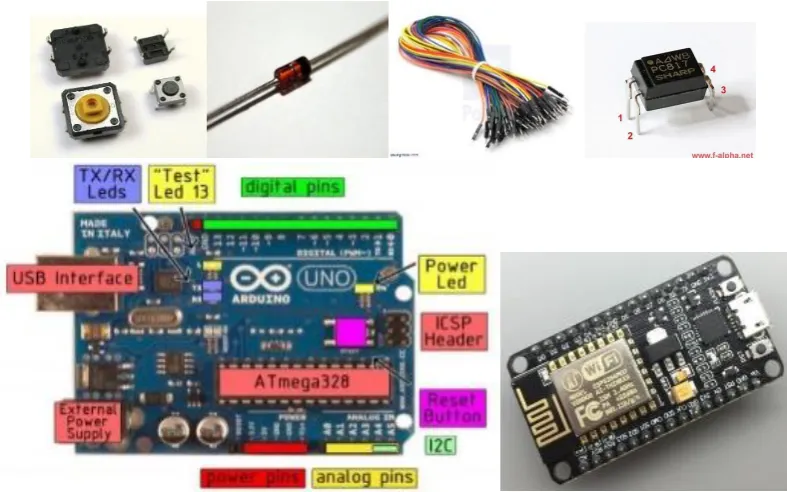
The device used for this research includes ESP8266 WIFI Arduino module, 2 Arduino Uno microcontrollers, Jumper wires, 1 Breadboard, 4 Diodes, 3 Resistors and 2 Optocouplers. The schematic of the design is shown in fig. 2. Below. The Tx of ESP8266 is connected to the Rx of The Arduino board, and the ESP8266 Rx are connected to the Arduino Tx. The ESP8266 is in. The CH_PD pin is connected to 3.3V with a resistance of 10K ohms. The state of the Arduino data is sent to a server using the ESP8266. This data can be now accessed can be edited by the user from anywhere. Table 3 shows the workflow of our step model. The digital pin 8 of both Arduinos are connected to D1 of the Esp8266 module. D3 and D0 are connected via a voltage divider to pin 7 of both Arduino to monitor the heartbeat of the Arduino to ascertain the state of the at any given time. Analogue pin A0 on the Esp8266 module is connected to the led pin via a voltage regulator for monitoring of the heart beats on the serial monitor. Here the bits representing the voltage on the monitor tends to be high when the LED is faulty or disconnected and slightly low when the LED is in good condition. In my design, it is about 834bits when it is in good condition and 1024bits when it is faulty. Lastly, both grounds of the Arduino and that of the Esp8266 module are connected to establish a common ground.
Fig. 1 Component for the system
2. Finite State Machines
used to model simple decision-making processes and systems. The operation of a state machine is twofold: It moves through an ordered sequential state in which the next state is defined by the disposition of the following land, depending on the input condition and current state and It produces outputs based on a transition of the rules. The outputs are generated by relying on the present state and shape of the input to the system.
Finite state machines (FSM) and their variants have been widely used as a fundamental semantic model for several behaviour specification languages. Several test case generation techniques have been developed for hardware and software testing based on FSMs; A general description of these techniques is given in [3-5]. All FSM-based test techniques require basic test templates to meet specific essential validation criteria, such as connectivity and minimality. Recent attempts [5] have been made to extend FSM-based test techniques to SPL, mainly using the delta-oriented approach for SPL modelling. In the publication of this document by the conference [5], we proposed the finite state machines (FSM) with a focus on the essential criteria for the validation of the test model for SPL at the family level. However, the problem of scalability is the main problem of using the FFSM model for large and sophisticated systems. Finding a problem makes expensive model analysis to run and leads to a test model that is difficult to maintain. To improve scalability in modelling, we propose this extension to High-Level Hierarchical State Machines (HFSM) called FFSM. The HFSM model is based on state graphs [6], and its syntax is validated by checking well-formed states and transitions. To define a formal semantics for HFSM and allow its legal analysis, we define a transformation from HFSM to FFSM. A general model of the state machine consists of two other essential elements apart from the inputs and outputs: combinatorial logic and memory (registers). The records can be viewed as the functional blocks that make up the system, while the memory acts as a storage of the different states between transitions [12].
2.1. Finite State Machine Variables of Interest
The input which can be any form of stimulus from the outside world, Often a switch or binary sensor. This affects the state which is described as the current condition of the state machine, and there is a limited amount of rules for a given state machine determined basically by its history. This will provide an output know as the linked to finite state machine states but are not the same, and they depend either on the state only or both state and inputs [14]. An advanced machine basically can be considered a black box, and the inputs and outputs can be defined and modified control variables. Due to many data elements, a great way to identify them in groups shows groups of groups of inputs and outputs [15]. Input signals go to the machine different refresh rates and are synchronised and taken at the same speed before entering the state device. A state only works in the state machine, and the system goes to the next state when the transfer conditions are met. The output of the status device is the value of the assets, loads, and control signal. Control input signal, device status output signal makes prices [16, 17]. For the sake of clarity, the input and output signals are defined by their full name. For example, "Planning Islanding" refers to a planned archiving message from ESP8266 [18]. The state machine should work aa fixed frequency/sampling rate of several milliseconds in seconds. The periodic pulse signal can be used as a start signal to start the state device with a time limit.
2.2. Functions Performed by Finite State Machine.
the needs of the Internet. It offers a completely independent Wi-Fi network with which it can act as host or applications all functions of the Wi-Fi network. This module is installed on an Arduino microcontroller board for Wi-Fi. Functionality [20-21]. Arduino reads the pulse every minute Internal A/D and calculates the heart rate, then update to a server connected to the same network.
2.3. Design calculation
Voltage Divider Calculation to Step down Arduino 5v to 3.3v obtainable from the Esp8266 module.
𝑉𝑜𝑢𝑡 = 𝑉𝑖𝑛 𝑅2 (𝑅1+ 𝑅2)
3.3 = 5 𝑅2
(𝑅1+ 𝑅2)
3.3(𝑅1+ 𝑅2) = 5𝑅2 3.3𝑅1 = (5 – 3.3) 𝑅2 𝑅1
𝑅2 = 1.7
3.3 = 0.52
In this design study, taking 𝑅1= 1𝑘Ω Therefore 𝑅2=
𝑅1
0.52= 1
0.52= 1.92𝑘Ω
Fig. 2. Circuit Diagram of Design
3. Essential semantics of this system
The Esp8266 module does the following in this aspect of the design, which effectively simulates the button. It must monitor the voltage on the LED to be able to ascertain if the LED is “LOW” or “HIGH”. The ESP also follows impulse (Heartbeat) from the Arduino to determine whether the Arduino is powered or not. In this system, the ESP is the single point of failure; if it fails, the entire system is dead.
3.1. Working principle
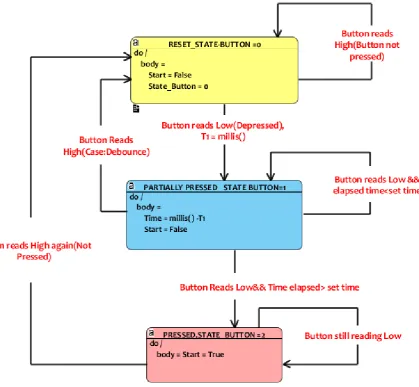
and fault management corresponding to events, fault conditions and other external input signals. The Figures 3a, 3b, 3c and 3d below shows the inside view of the state machine highlighting the operation in the different components. Each algorithm Developed in these figures is implemented in the system state and is defined as Function. The States, as shown for the separate state machines, has two integrated functions: one for regular operation and one for an emergency operation.
3.2. The finite state machine of Arduino module
In this system, the Arduino runs three finite state machines to ensure efficient communication between the ESP8266 Wi-Fi Module and itself. The finite state machines include, the physical signal from the web page also needs to be denounced because it might be noisy sometimes. The Arduino function as the heartbeat, which gives out pulses in the form of voltage to the ESP8266 Wi-Fi Module. In the Wi-Fi module side of things, this heartbeat finite state machine is used to monitor the led voltage at any given time to ascertain whether it is “on”, “off”, or “power outage”.
Fig. 3a. Finite state machine debouncer for the button on the web page
state machine. Because each path transition logic completes other paths, only one track can be enabled, and there is no transition conflict. The emergency mode is not intended to be a priority for safe use for standby. However, when the emergency logic becomes "important", the system automatically switches to a predetermined algorithm in case of emergency.
Fig. 3b Heartbeat of Arduino (c) LED Voltage state of Heartbeat of ESP8266
Fig. 3d. Master-slave finite state machine
At the transitions, as shown in the schematics above, the system will figure out a random number. Hence a timer is set up to aid a check and criteria for navigation in between the different states. In the first state, the inputs to the system will be monitored. If the information = 0 or LOW, it stays in the stay in the state and controls the timer set. In any case, if the timer is more significant than a set threshold time, then the system goes into a failed state. But if the input is equal to 1, it moves to the next state as depicted in fig.2 and remains in this state as long as input equal to 1. In this system, the ESP8266 WIFI MODULE runs two finite state machines to establish stable communication and fault detection between itself and the Arduino. The finite state machines include;
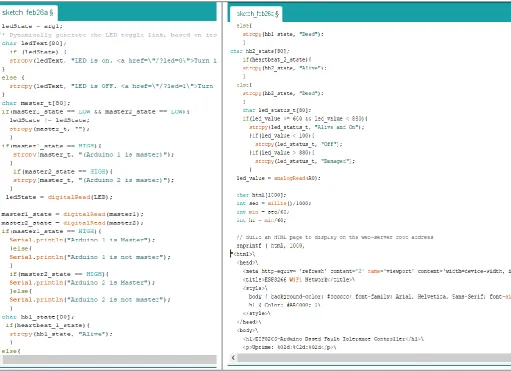
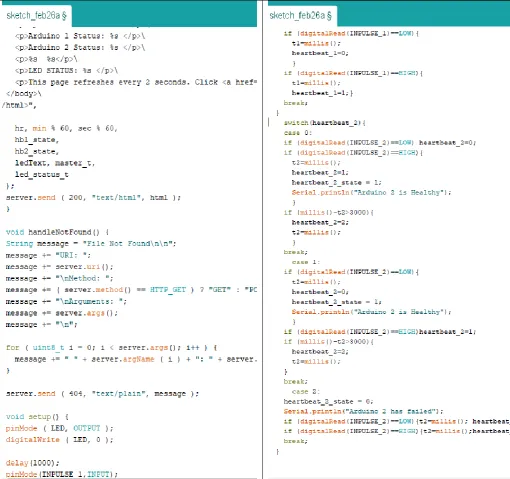
Fig. 4 (c) Arduino code for the button (d) Arduino codes for the LED
4. Result and discussion
Fig.5 The prototype model of the system
Fig.6 Serial Plotter Reading of the LED State of the system (b) Serial Monitor reading of Arduino pulse (Voltage)
5. Conclusions
A fault tolerant system was built, using an Arduino micro-controller to implement a random decision-making system in the advent of failure in any order. Even though the used set-up is relatively simple, it was shown to be able to iteratively decide without any human intervention in any chosen circumstance of reference in which in this case it is the push of a button. The result obtained shows that the aim that the system can be designed to be a fault tolerant system with a single point of failure provides enough facts for an accurate system application. However, one drawback of this current system, and similar methods of this type, in general, is that great care and patience must be taken during testing to test all components that make up the system to ascertain they are all electrically conducting. This necessitates the use of a multimeter to prevent confusion as to where there is a fault when final testing of the final test design is to be done. Further improvement of the system can be made by viewing the signals of the respective component of the order on the serial monitor of the Arduino integrated environment to see which part of the system. It is dormant and might probably inhibit the final design from working accordingly and also introducing fuzzy logic to the model may boost its functionality and application.
REFERENCES
[1]. wiki, “Wikipedia,” Wikipedia incorporation, 10 November 2018. [Online]. Available: https://en.wikipedia.org/wiki/Grenfell_Tower_fire. [Accessed 20 October 2018].
[2]. L. Tae-Soo, H. Joo-Hyun, and C. Myeong-Chan, "Biomedical Digital Assistant for Ubiquitous Healthcare," in Engineering in Medicine and Biology Society, 2007. EMBS 2007. 29th Annual International Conference of the IEEE, 2007, pp. 1790-1793.
[3]. N. H. Mahmood, N. Uyop, N. Zulkarnain, F. K. C. Harun, M. F. Kamarudin, and A. Linoby, "LED indicator for heart rate monitoring system in sport application," in Signal Processing and its Applications, 2011 IEEE 7th International Colloquium on, 2011, pp. 64-66.
[4]. V.A. Baloguna, B.I. Oladapo, A.O.M. Adeoye, J.F. Kayode, S.O. Afolabi, Hysteresis analysis of Thornton (IP6, IP12E and TH5V) magnetic materials through the use of arduino microcontroller, J. Mater. Res. Technol. (2018), http://dx.doi. org/10.1016/j.jmrt.2017.05.018.
[5]. N. S. A. Zulkifli, F. K. C. Harun, and N. S. Azahar, "XBee wireless sensor networks for Heart Rate
Monitoring in sport training," in Biomedical Engineering (ICoBE), 2012 International Conference on, 2012, pp. 441-444.
[6]. A.O.M. Adeoye, J.F. Kayode, B.I. Oladapo, S.O. Afolabi, Experimental analysis and optimization of synthesized magnetic nanoparticles coated with PMAMPC-MNPs for bioengineering application, St. Petersburg Polytech. Univ. J. 3 (4) (2017) 333–338.
[7]. Dave Locke , MQ telemetry transport (mqtt) v3. 1 protocol specification. IBM developer Works Technical Library] , 2010 [online] Available: http://www.ibm.com/developerworks/webservices/library/ws-mqtt/ [8]. M. Panda, P.M. KhilarDistributed self fault diagnosis algorithm for large scale wireless sensor networks
using modified three sigma edit test Ad Hoc Netw., 25 (2015), pp. 170-184
[9]. L. Tae-Soo, H. Joo-Hyun, C. Myeong-Chan Biomedical Digital Assistant for Ubiquitous Healthcare in Engineering in Medicine and Biology Society, 2007. EMBS 2007. 29th Annual International Conference of the IEEE (2007), pp. 1790-1793
[10]. Liou J.J., Tzeng G.-H., Chang H.-C. Airline safety measurement using a hybrid model J. Air Transp. Manage., 13 (2007), pp. 243-249.
[11]. M. Hennessy, R. Milner Algebraic laws for nondeterminism and concurrency J. ACM, 32 (1) (1985), pp. 137-161.
[12]. Bankole. I. Oladapo, S. Abolfazl Zahedi, Surya C. Chaluvadi, Satya S. Bollapalli, Muhammad Ismail. Model design of a superconducting quantum interference device of magnetic field sensors for
magnetocardiography. Biomedical Signal Processing and Control 46 (2018) 116–120
[14]. A.O.M. Adeoye, B.I. Oladapo, A.A. Adekunle, A.J. Olademeji, J.F. Kayode, Design, simulation and implementation of a PID vector control for EHVPMSM for an automobile with hybrid technology, J. Mater. Res. Technol. (2018), http://dx. doi.org/10.1016/j.jmrt.2017.07.005
[15]. N.S.A. Zulkifli, F.K.C. Harun, N.S. Azahar XBee wireless sensor networks for Heart Rate Monitoring in sports training Biomedical Engineering (ICoBE), 2012 International Conference on (2012), pp. 441-444. [16]. W. v. Drongelen, Signal Processing for Neuroscientists (Second Edition), Chicago, IL, USA: Elsevier,
2018.
[17]. B.I. Oladapo, A.O.M. Adeoye, S.O. Oyegoke, S.O. Afolabi, Analysis for distortion of thin-wall milling on machine component and its effect on global warming, Procedia Manuf. 7 (2017) 529–536.
[18]. c. Wires, “Google,” carstool.ru. Available: http://carstool.ru/nabor-tectovix-provodov-dlya-mul-timetra-banan-krokodil. [Accessed 5th May 2019].
[19]. A. Industries, “Google,” Adafruit Industries. Available: https://www.adafruit.com /product/2781. [Accessed 6th May 2019].
[20]. r. Capacitors, “capacitors,”. Available: https://www.radioshack.com/products/radioshack-0-1uf-50v-hi-q-ceramic-disc-capacitor-pk-2. [Accessed 5th May 2019].