City, University of London Institutional Repository
Citation
:
Mergos, P.E. ORCID: 0000-0003-3817-9520 and Sextos, A. (2018). Multi-objective optimum selection of ground motion records with genetic algorithms. Paper presented at the 16th European Conference on Earthquake Engineering- 16ECEE, 18 - 21 June 2018, Thessaloniki, Greece.This is the accepted version of the paper.
This version of the publication may differ from the final published
version.
Permanent repository link:
http://openaccess.city.ac.uk/id/eprint/23068/Link to published version
:
Copyright and reuse:
City Research Online aims to make research
outputs of City, University of London available to a wider audience.
Copyright and Moral Rights remain with the author(s) and/or copyright
holders. URLs from City Research Online may be freely distributed and
linked to.
MULTI-OBJECTIVE OPTIMUM SELECTION OF GROUND MOTION
RECORDS WITH GENETIC ALGORITHMS
Panagiotis MERGOS1, Anastasios SEXTOS2, 3
ABSTRACT
Existing ground motion selection methods for the seismic assessment of structural systems consider only spectral compatibility as selection objective. Other important earthquake parameters such as those related to regional seismicity, local soil conditions, strong ground motion intensity and duration are considered indirectly by setting them as selection constraints. This study presents a new framework for the optimum selection of earthquake ground motions, where more than one objectives are considered explicitly in the selection procedure including objectives that are not directly related to spectral matching. To address the multi-objective nature of the optimization problem examined herein, the weighted sum method is used that supports decision making both in the pre-processing and post-processing phase of the selection procedure. The optimum selections are conducted by the use of a mixed-integer genetic algorithm that is able to track near-global optimal solutions of constrained problems with both discrete and continuous design variables. It is found that proposed methodology is able to select ground motion sets that are both spectrum compatible and representative of the seismic conditions of the structural system under investigation.
Keywords: Selection; Ground motions; Optimum; Multi-objective; Genetic algorithms
1. INTRODUCTION
The need for accurate prediction and control of damage imposed to structures by earthquakes requires the use of advanced structural analysis procedures (Mergos 2016). Clearly, the most accurate procedure for determining seismic demands is the rigorous inelastic response history analysis with step-by-step integration of the equation of motion in the time domain (Fardis 2009). In response history analysis, seismic actions are represented by ground motion records. Previous studies (Katsanos and Sextos 2017) have shown that the selection of earthquake-induced ground motions represents the most significant source of uncertainty in the calculation of seismic demands undermining the reliability of response history analysis. Therefore, efficient methodologies for the appropriate selection of ground motions in seismic assessment and design of structures are essential.
Previous studies dealing with the selection of ground motion focus exclusively on spectral matching in terms of either central values or variability by setting them as selection objectives (Katsanos et al. 2010; Katsanos and Sextos 2017, Moschen et al. 2017). In this manner, other important selection criteria such as those related to the seismology of the region, soil conditions, strong ground motion intensity and duration are treated as secondary by setting selection constraints based on their parameter values in the pre-processing phase.
In this study, a new approach for the selection of earthquake ground motions for seismic assessment and design of structural systems is proposed based on the principles of multi-objective optimization. The method treats as selection objectives not only spectrum compatibility as in previous studies but also a number of selection criteria either of seismological nature or directly related to the local soil conditions as well as strong motion intensity and duration of the ground motions. By treating these criteria explicitly
1Lecturer, City, University of London, London, UK, [email protected] 2Reader, University of Bristol, Bristol, UK, [email protected]
2
as objectives, the selected sets of ground motions can become more representative of regional seismicity and soil conditions as well as of anticipated seismic demands and cumulative damage effects. Furthermore, stringent pre-selection criteria can be relaxed leading to pools of eligible ground motions sufficient to provide satisfactory spectrum compatibility. The proposed method is particularly suitable for scenario-based seismic assessment (FEMA P-58, 2012), where the performance of structures is evaluated assuming that they are subjected to an earthquake scenario consisting of a specific magnitude earthquake occurring at a specific location relative to the structure site.
Optimum selections of ground motions are performed in this study by the use of a genetic algorithm that is able to track near global optimum solutions of constrained problems with both discrete and continuous design variables. Furthermore, the Weighted Sum method is used herein to address the multi-objective optimization problem that supports decision making both in the pre-processing and post-processing phase of the selection of ground motion sets.
2. MULTI-OBJECTIVE GROUND MOTION SELECTION METHODOLOGY
2.1 General
The methodology used herein to select ground motion sets can be divided into three distinct phases: pre-processing; processing and post-processing. Each of the phases are described in detail in the following.
2.2 Pre-processing
As a first step, a target response spectrum must be specified in the pre-processing phase. Furthermore, a number of pre-selection criteria are applied in order to select an appropriate pool of ground motion records from a strong motion database such as the European Strong-motion Database (ESD), the PEER Ground Motion Database (PEER) and others. The main difference of the suggested methodology with respect to others in this procedure is that the pre-selection criteria can be significantly relaxed depending on the adopted selection objectives that will be discussed in the following. In this way, more eligible ground motion records can be employed in the selection procedure increasing the potential for improved spectral compatibility.
The next step in this phase, deals with the setting of the selection objectives. As discussed, in previous research efforts, the selection objectives are typically pre-determined and solely related to spectrum compatibility. However, in the proposed procedure and depending on the nature of the problem of the seismic assessment under investigation, additional selection objectives can be considered related to the seismology of the region, local site conditions as well as strong motion intensity and duration. Setting these objectives will be discussed in greater detail in the processing phase of the ground motions selection procedure.
A final, provisional, step in the pre-processing phase is the selection of appropriate fixed values of the weights of the selection objectives to be used in the weighted sum method described later in the processing phase. This step supports decision making in this early phase of the selection procedure. However, it is not required if a number of different Pareto-front optimal solutions are to be derived as explained in the following.
2.3 Processing
2.3.1 Introduction
3
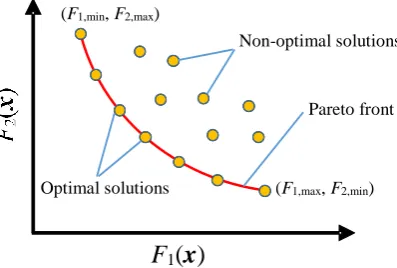
Figure 1. Pareto-optimal solutions
2.3.2 Optimization problem formulation
In a general multi-objective optimization problem, the aim is to minimize a set of p objective functions
Fi(x) (i =1 to p) subject to q number of constraints gj(x) ≤ 0 (j =1 to q). A design solution is represented
by the design vector x, which contains l number of independent design variables xt (t = 1 to l).
The Weighted Sum method is the simplest and most intuitively meaningful means of solving a multi-objective optimization problem (Yang 2014, Messac 2015). In this method, the multi-multi-objective optimization problem is solved as an equivalent single-objective optimization problem, where a combined single objective F(x) should be minimized. F(x) is simply a weighted linear combination of all the individual objective functions Fi(x). Therefore, following the proposed methodology, the
optimization problem, in the simple case of two objectives, is written as:
Minimize: 𝐹(𝒙) = 𝑤1∙ 𝐹1(𝒙) + 𝑤2∙ 𝐹2(𝒙)
Subject to: 𝑔𝑗(𝒙) ≤ 0 (𝑗 = 1 to 𝑞) (1)
𝑤1+ 𝑤2= 1
Where: 𝒙 = (𝑥1, 𝑥2, … , 𝑥𝑙)
In Equation 1, wi (i =1, 2) are the values of the weights corresponding to the individual function
objectives Fi(x).
As discussed, the values of the weights may be fixed in this stage based on decision making in the pre-processing phase. In this case, the optimal solution derived will be a single point of the Pareto-front in the objective solution space as presented in Figure 1 for the case of two selection objectives. By changing the weights gradually from 0 to 1, a series of points Pareto-optimal points is obtained and thereby the Pareto-front is approximated.
Equation 1 is easy to implement when the individual objectives Fi(x) are of similar nature. However, in
the general case where the Fi(x) (i = 1, 2) are of different nature then the selection of their corresponding
weight values wi is not straightforward. In this cases, it is recommended (e.g. Messac 2015) to use a
normalized version of the equivalent single-objective function 𝐹̅(𝒙) given by:
𝐹̅(𝒙) = 𝑤1∙ 𝐹̅1(𝒙) + 𝑤2∙ 𝐹̅2(𝒙) (2)
In Equation 2, 𝐹̅𝑖(𝒙) (i = 1, 2) are the normalized individual objective functions given by Equation 3,
where 𝐹𝑖,𝑚𝑖𝑛 is the minimum value of 𝐹𝑖(𝒙) calculated by setting in the optimization problem of
Equation 1 that 𝐹(𝒙) = 𝐹𝑖(𝒙) and 𝐹𝑖,𝑚𝑎𝑥 is the maximum value of 𝐹𝑖(𝒙) calculated by setting in the
optimization problem of Equation 1 that 𝐹(𝒙) = 𝐹𝑗(𝒙) with j ≠ i. The previous minimum and maximum
values are shown in Figure 1 for clarity.
𝐹̅𝑖(𝒙) =
𝐹𝑖(𝒙)−𝐹𝑖,𝑚𝑖𝑛(𝒙)
𝐹𝑖,𝑚𝑎𝑥(𝒙)−𝐹𝑖,𝑚𝑖𝑛(𝒙) (3)
F
1(
x
)
Optimal solutionsNon-optimal solutions
Pareto front
4
Having established 𝐹̅𝑖(𝒙) optimal values by solving the optimization problem of Equation 1, the
corresponding 𝐹𝑖(𝒙) values are easily retrieved by solving Equation 3. It is noted that the previous can
be easily extended to the general case of more than two selection objectives.
2.3.3 Solution algorithm
The optimization problem of Eq. (3) is solved in this study by the use of the mixed-integer constrained Genetic Algorithm (GA) implemented in MATLAB 2017a (MathWorks 2017). GA (Holland 1970) belong to the class of stochastic, nature-inspired heuristic algorithms. They are based on Darwin’s theory of natural selection and evolution. They can be easily implemented and applied to advanced optimization problems since they don’t require use of gradients of cost or constraints functions. Furthermore, they are able to identify global optima as opposed to local optimum solutions (Yang 2014).
2.3.4 Selection variables
The design variables are the properties of the optimization problem that can change values during the optimization solution. In the selection of suites of ground motion records of size n examined herein, the first n design variables xk (k = 1 to n) are the record serial numbers inside a pool of m eligible records
(1 ≤ n ≤ m). The next n design variables are the corresponding scale factors Sfk (k = 1 + n to 2n).
Therefore, the design vector x can be written as:
𝒙 = (𝑥1, … , 𝑥𝑛, 𝑥𝑛+1, … , 𝑥2𝑛) (4)
In this formulation, the first n design variables (serial numbers) are represented by integer values. The second n variables (scale factors) are represented by positive real numbers. It is noted that this formulation, that allows for variable and different scale factors of the individual ground motion records, is the most general and allows for the maximum solution space in the selection procedure at the expense, occasionally, of more iterations till convergence to the final solution.
2.3.5 Selection constraints
The selection constraints 𝑔𝑗(𝒙) (𝑗 = 1 to 𝑞) represent additional limitations in the selection and scaling
of ground motions procedure that are complementary of the selection criteria in the pre-processing phase. Typically, they represent restrictions securing the reliability of spectral matching that are not explicitly addressed in the pre-processing phase. For example, Eurocode-8, Part-1 (CEN 2004) sets the following spectral matching limitations in the selection of sets of ground motions for the seismic assessment of a structural system with fundamental period T1:
i) The mean of the zero period acceleration values of the scaled individual response spectra should be larger than the zero period acceleration of the target code spectrum.
ii) In the range of periods between 0.2T1 and 2T1, no value of the mean 5% damping elastic
spectrum, calculated from all time histories, should be less than 90% of the corresponding value of the 5% damping of the code elastic response spectrum.
2.3.6 Selection objectives
As discussed, typically, objectives in the selection of ground motions procedure are metrics quantifying the quality of compatibility of the scaled ground motions spectra with the target spectrum. Different metrics are generally used to serve this goal (e.g. Beyer and Bommer 2007). A very common metric that is focussing on mean estimates of structural response is the normalized root-mean-square-error δ between the scaled average spectrum of the set of ground motions and the target spectrum:
𝛿 = √1
𝑁∑ (
𝑆𝑎𝑎𝑣𝑔,𝑠𝑐(𝑇𝑖)−𝑆𝑎𝑡𝑟𝑔(𝑇𝑖)
𝑆𝑎𝑡𝑟𝑔(𝑇𝑖) )
2 𝑁
5
In the above equation, 𝑆𝑎𝑎𝑣𝑔,𝑠𝑐(𝑇𝑖) is the spectral ordinate of the scaled average spectrum at period Ti, 𝑆𝑎𝑡𝑟𝑔(𝑇𝑖) is the ordinate of the target spectrum at the same period and N is the number of period sample
values used within a pre-defined range of periods, where matching is envisaged (e.g. between 0.2T1 and
2T1 according to Eurocode-8, Part-1 (CEN 2004)).
For first time in the present study additional objectives in the optimum selection of ground motions are explicitly considered that are not directly related to spectrum compatibility. These objectives can be directly linked to parameters related to regional seismicity, local site conditions, strong motion intensity and duration that are considered only indirectly in the pre-processing phase. For example, it may be desirable that the selected ground motions have similar magnitude M and/or source-to-site distance R
to the earthquake scenario that dominates the seismic hazard at the site of interest. Furthermore, it can be important that the ground motions are chosen so that they have been recorded on soil profiles with
Vs,30 similar to the soil profile at the site of the structure. In addition, they may be selected to have strong
motion intensity parameters, such as PGA and Sa(T1), and/or strong ground motion duration ts and
number of cycles close to the ones expected at the site of interest.
In all these cases, the selection objective can be to minimize the normalized root-mean-square-error eQ
(Equation 6) between the selected ground motion properties values 𝑄𝑗 (𝑗 = 1 to 𝑛) and the
corresponding target property value of the selection procedure 𝑄𝑡𝑟𝑔, where 𝑄can be M, R, Vs,30, PGA, Sa(T1), ts and any other desirable scalar property.
𝑒𝑄 = √
1 𝑛∑ (
𝑄𝑖−𝑄𝑡𝑟𝑔
𝑄𝑡𝑟𝑔 )
2 𝑛
𝑖=1 (6)
In addition to the previous, another important objective is considered herein to reduce the bias introduced by spectral scaling (e.g. Luco and Bazzuro 2007). According to this objective, the scale factors of the individual spectra should remain as close as possible to one (un-scaled spectra). This objective can be expressed in the same context as the one used in Equation 6, simply, by setting 𝑄𝑖 =
𝑆𝑓𝑖 (𝑖 = 1 𝑡𝑜 𝑛) and 𝑄𝑡𝑟𝑔= 1.
2.4 Post-processing
This last phase of the selection procedure is required only when multi-objective optimum selection is applied without fixing the values of the selection weights in the pre-processing phase. In this case, a number of Pareto-optimal selections is returned by the algorithm and it is up to the engineer to design the most suitable to the goals of the seismic assessment. Elements of engineering judgement and decision theory can be used in the stage.
3. GROUND MOTION SELECTION APPLICATIONS
3.1 Introduction
To illustrate the applicability and efficiency of the proposed methodology, ground motion sets will be selected according to Eurocode 8 – Part 1 (CEN 2004) for the seismic assessment of a structure of ordinary importance with fundamental period T1 = 0.75 s resting on soil profile with Vs,30 = 600 m/s that
is classified as ground type B according to the specifications of EC8- Part 1. The structure is assumed to be located in a region of high seismicity that is dominated by an earthquake scenario of moment magnitude Mw = 6.2 at an epicentral distance of R = 20 km. The motions will be selected for the 10%
probability of exceedance in 50 years seismic hazard level with anticipated PGA = 0.24g.
In this study, all ground motions are taken from the European Strong-motion Database (ESD). Appropriate pre-selection criteria need to be applied to derive ground motions compatible with the conditions of the seismic assessment under investigation. Herein, a number a broad range criteria are used to filter the eligible ground motions. These are: i) Mw > 5.5; ii) R ≥ 10km; iii) Ground type B; iv)
6
184 ground motions with two horizontal components, therefore 368 different ground motion records. From these motions, only the 104 (208 horizontal records) are recorded on soil profiles with known Vs,30.
The latter records are used herein as the basic pool of eligible ground motion records because Vs,30 will
be set as one of the selection objectives.
As a target spectrum, the Type-1 (high seismicity) spectrum of EC8 – Part 1 is used in this study as prescribed for soil class B, PGA = 0.24 g, importance factor γI = 1 (structures of ordinary significance)
and 5% viscous damping.
In the following, the results of the ground motion selections will be presented for different objectives. First, single-objective selections will be presented to act as a reference and verify the reliability of the applied procedure. Next, a number of different multi-objective optimum selections are examined and critical comments are made with regards to the derived optimal solutions.
3.2 Single-objective selections
In this section, selection of sets of 7 ground motions are examined for a single objective, which is to minimize the error δ between the scaled average spectrum of the set of ground motions and the target spectrum as given by Equation 5. EC8-Part 1 (CEN 2004) selection constraints are applied as discussed in the processing phase of the proposed selection procedure. In addition, it is set that the zero period acceleration values of the individual response spectra, after scaling, should be between 0.5 and 2.0 times the corresponding value of the target spectrum to limit excessive variability of the scaled individual spectra.
[image:7.595.82.513.434.598.2]The optimum selections are performed with the use of the mixed-integer GA solution algorithm discussed in the previous. In total, 14 selection variables are used. This counts for 7 integer variables for the serial numbers of the ground motions and 7 real variables for the scale factors. A population size of 100 individuals with 5 elite individuals is used. Each GA run is terminated after 3000 generations. In total, 100 independent runs of the GA are performed. Due to the stochastic nature of the GA algorithm, each run may provide a different selection set and corresponding δ value.
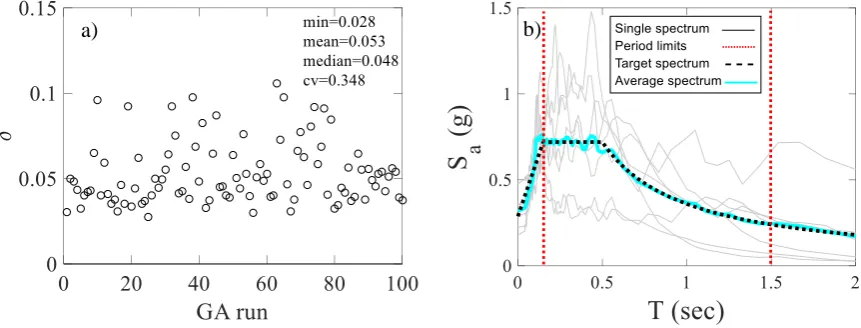
Figure 2. Single-objective ground motion selections using the GA algorithms. a) δ values obtained from different GA runs; b) Spectra of the selected ground motion set
Figure 2a presents the δ values obtained from the 100 independent GA runs. A considerable variation of these values is observed with a coefficient of variation of 0.35. The median value is 0.053 and the minimum 0.028. The latter value was obtained at the 25th run of the algorithm. Therefore, in general, a
sufficient number of independent GA runs is required to get the best solution. However, in this example, it may be observed that even from the 1st run a δ value very close to the minimum is obtained that could
be used to select an alternative set of ground motions. Furthermore, Figure 2b shows the spectra of the set of ground motions with the minimum δ values and how they compare with the target spectrum. It is evident the excellent matching, inside the specified period limits, of the average and the target spectrum which is the single objective of this selection.
7 3.3 Multi-objective selections
3.3.1 Introduction
In this section, selections of sets of 7 ground motions for two objectives are examined. Again, the optimum selections are performed with the use of the mixed-integer GA solution algorithm with 14 independent selection variables. A population size of 100 individuals with 5 elite individuals is used. Each analysis is terminated after 3000 generations. The bi-objective optimum selections are examined by applying the weighted sum method as expressed by Equation 2. In all cases, δ is used as the first selection objective function 𝐹1(𝒙) to represent the quality of spectral matching. Then, a variety of second
objectives 𝐹2(𝒙) is applied to derive the corresponding Pareto-fronts. To serve this goal, Equation 2 is
applied for 5 different values of w1 = 0, 0.25, 0.50, 0.75 and 1.00, whereas w2 is determined as w2 = 1-w1. In this manner, 5 Pareto-front optimal points are derived that can be used to approximate the entire
Pareto-front. In the following, these optimal points are numbered according to their w1 values in
ascending order. In this way, the 1st point (w
1 = 0) corresponds to single-objective optimization for
minimum 𝐹2(𝒙) and the 5th point to the solution for minimum 𝐹1(𝒙). Clearly, as w1 increases more
emphasis is placed on δ with respect to the alternative selection objectives. For each Pareto-front optimal point, 100 independent GA runs are conducted and the solution yielding the minimum 𝐹̅(𝒙)function is selected. In the following, the results obtained for the different 𝐹2(𝒙) objective functions are presented
in detail.
3.3.2 Seismological parameters M, R
The aim here is to present the Pareto-front optimal solutions in terms of δ versus eM, where eM is the
error of the magnitudes of the selected individual ground motions Mw,i with respect to the target value Mw,trg = 6.2 specified by the earthquake scenario under examination. Figure 3a illustrates the derived
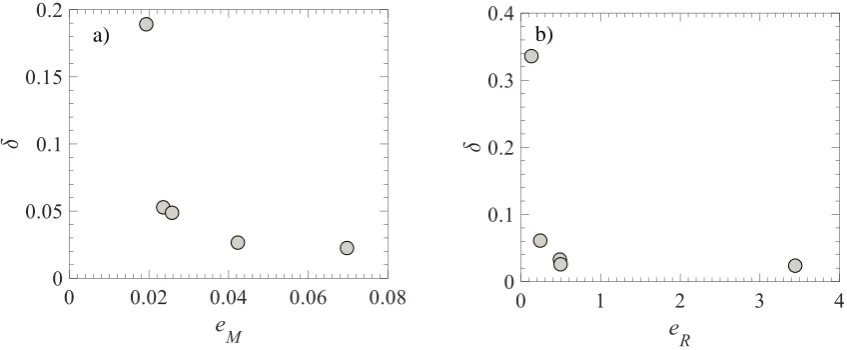
Pareto-optimal points. In this figure, as well as in all similar figures presented later, point serial numbers (1 to 5) increase as moving from the left to the right side. As expected, point 5 exhibits the best solution in terms of spectral matching but with a high error in magnitudes and point 1 the most representative one in terms of earthquake magnitudes but with rather poor spectral matching (δ ≈ 0.19). However, in between, all points 2, 3 and 4 constitute rather attractive solutions. For example, point 4 imperceptibly increases the minimum δ value of point 5 while reduces eM by 70%. Furthermore, points 2 and 3 also
[image:8.595.82.506.516.691.2]represent acceptable solutions in terms of spectral matching (δ ≈ 0.05) with small errors in magnitudes.
Figure 3. Pareto-front optimal solutions: a) δ versus eM; b) δ versus eR
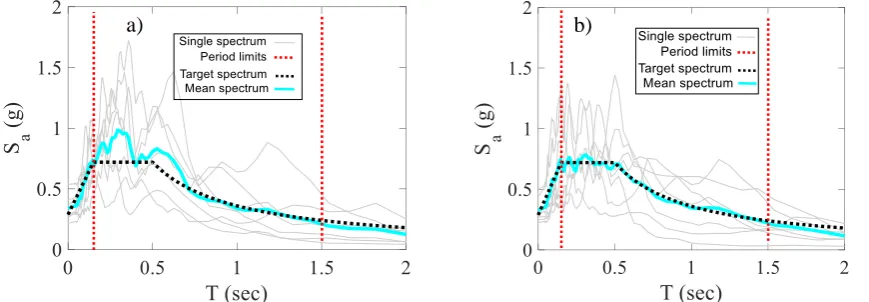
Figure 4 presents the spectral matching attained by the ground motion sets of point 1 and 2. It is shown that point 2 exhibits much better matching of the target and mean spectrum with almost the same eM,
when compared to point 1. Therefore, it would generally be preferable to point 1. At this point, it
8
[image:9.595.77.512.130.281.2]becomes evident the main advantage of the derivation of a range of of Pareto-front solutions in the selection of ground motion sets. It allows for informed selection-making based on the trade-offs between the various selection objectives.
Figure 4. Spectral matching of different δ versus eM Pareto-optimal solutions: a) point 1; b) point 2
Figure 3b presents the δ versus eR Pareto-front optimal solutions, where eR is the error in distances for
the target distance Rtrg = 20km. It can be seen in Fig. 4b, that points 3 and 4 greatly reduce the error in
distances whereas they only marginally influence spectral matching. Therefore, even though R is not strongly related to structural responses (Katsanos et al. 2010), points 3 and 4 could be considered instead of point 5 since they are more representative of the regional seismicity and they provide almost equivalent spectral matching.
3.3.3 Strong motion intensity and duration parameters
In this section, the PGA strong motion intensity measure (IM) is included in the selection procedure. To serve this goal, one of the two objectives is set to minimize the error ePGA of the individual ground
motions with respect to the target PGA = 0.24g. Figure 5a shows the obtained δ versus ePGA
Pareto-optimal solutions. It is clear in this figure that the solution for minimum ePGA yields very poor spectral
matching. On the other side, points 4 and 5 have similar δ values. Therefore, point 4 represents a considerable alternative to point 5.
Strong motion duration may have significant effects on structural response especially of structural systems that exhibit rather poor hysteretic response (Mergos and Beyer 2014). A variety of metrics exist in literature to quantify strong motion duration (Bommer and Martinez-Pereira 1999). Perhaps, the simplest metric is the so-called bracketed duration defined as the total time elapsed between the first and last excursion of a specified level of acceleration αo. In this section, the duration ts,0.02 is used, which
is based on αo = 0.02 g. The anticipated ts,0.02can be directly estimated for the earthquake scenario under
investigation (Mw = 6.2 and R = 20 km) by using attenuation relationships such as the one proposed by
Koutrakis et al. (2008) for the case of Greece. Using this relationship, it is found that the expected ts,0.02
is approximately 9.5 s. To consider the anticipated duration in the selection of ground motions, it is set as one of the two selection objectives to minimize the error ets of the 0.02 g bracketed duration of the
individual ground motions with respect to the target duration ts,trg = 9.5 s. Figure 5b presents the δ versus ets Pareto-optimal solutions. It can be seen that the point 1 leads to high δ values (δ ≈ 0.29) whereas
point 5 drives to rather high error in duration. Therefore, points 2 - 4 could be also considered to be used for the purposes of the seismic assessment.
9
Figure 5. Pareto-front optimal solutions: a) δ versus ePGA; b) δ versus ets
3.3.4 Soil profile parameter Vs,30
It is known that the geotechnical profile affects both the amplitude and duration of strong ground motions as well as their computed response spectra (e.g. Katsanos et al. 2010). Typically, the soil profile is considered in the selection procedure by site classification. In the problem investigated herein, the soil is classified according to EC8 – Part 1 as Type B that represents a rather broad range of Vs,30 values
between 360 m/s to 800 m/s. However, if the actual Vs,30 value at the site of the structure is known
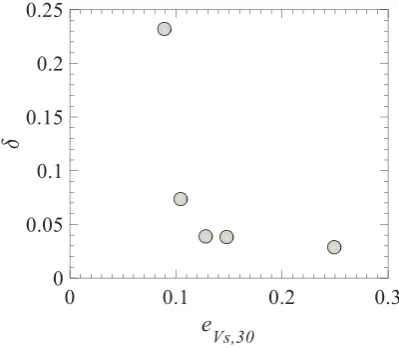
(assumed 600 m/s herein), then it is worthwhile to investigate δ versus eVs,30Pareto-optimal solutions by
setting the known shear wave velocity as the target value. Figure 6 presents the obtained optimal solutions. It is evident that, apart from point 5, points 3 and 4 are good quality solutions since they contain motions recorded in more similar profiles to the site of interest and they only slightly reduce spectral matching with respect to point 5.
Figure 6. δ versus eVs,30 Pareto-front optimal solutions
3.3.5 Scale factors
It has been shown (e.g. Luco and Bazzuro 2007) that the use of excessive scale factors in the selection of ground motions may introduce a bias to structural responses. On the other hand, the use of only un-scaled ground motions may drive to poor spectral matching and in some cases not feasible selection of ground motions sets (Iervolino et al. 2010). To avoid these limit cases, a bi-objective selection approach is proposed herein, where one of the objectives is that the scale factors of the individual ground motions are equal to one (i.e. un-scaled motions). This is easily achieved in the proposed framework of this study by minimizing the error of the scale factors eSf with respect to 1, that is given by Equation 6 by setting
[image:10.595.190.390.448.622.2]10
𝑄𝑖 = 𝑆𝑓𝑖 (𝑖 = 1 𝑡𝑜 𝑛) and 𝑄𝑡𝑟𝑔= 1.
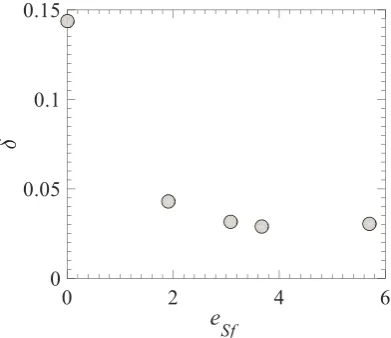
Figure 7 presents the obtained δ versus eSf Pareto-optimal solutions. It is interesting to note in this figure
that point 1 has zero eSf. This is expected since it simply means that the algorithm found an un-scaled
set of ground motions. However, this point is characterized by rather poor spectral matching (δ ≈ 0.15). Therefore, it will be more appropriate to use one of the other Pareto-points that have significantly smaller and generally satisfactory δ values (i.e. δ < 0.05). It is also noteworthy that eSf can be
significantly reduced from 5.8 (point 5) to 1.9 (point 2), decreasing the mean scale factor from 6.2 to 2.9, for very small increase of δ.
Figure 7. δ versus eSf Pareto-front optimal solutions
4. CONCLUSIONS
This study presents a novel approach for the optimum selection of ground motion records to be employed in the seismic assessment of structural systems. This approach uses more selection objectives than just spectral compatibility. The additional selection objectives are related to regional seismicity, local soil conditions, intensity and duration of strong ground motions anticipated at the site of the structural system under investigation. Furthermore, the selection of scale factors near unity (un-scaled spectra) is also treated as independent selection objective to reduce the bias introduced in seismic assessment by using high scale factors.
The derived multi-objective optimization problem is solved as an equivalent single-objective optimization problem by employing the simple and intuitively meaningful Weighted Sum method that supports decision making both in the pre-processing and post-processing phase of the selection of ground motion sets. Then, the optimum selections of ground motions are conducted by the employment of a genetic algorithm that is able to track near global optimum solutions of constrained problems with both discrete and continuous design variables. However, the proposed selection approach can be implemented by employing any other single-objective optimization algorithm addressing constrained optimization problems with mixed design variables.
It is found that the proposed framework is able to select scaled ground motion sets that not only provide excellent spectrum compatibility with a target spectrum, but are also representative of the seismic conditions of the structural system under examination.
5. REFERENCES
Beyer K, Bommer JJ (2007). Selection and scaling of real accelerograms for bi-directional loading: a review of current practice and code provisions. Journal of Earthquake Engineering, 11(1): 13–45.
Bommer J, Martinez-Pereira A (1999). The effective duration of earthquake strong ground motion. Journal of Earthquake Engineering, 3(2): 127–172.
[image:11.595.195.391.189.358.2]11
European Strong-motion database (ESD). http://www.isesd.cv.ic.ac.uk/ESD/ frameset.htm.
Fardis MN (2009). Seismic design, assessment and retrofitting of concrete buildings. Springer, Dordrecht. FEMA P-58 (2012). Next-generation Seismic Performance Assessment for Buildings, Volume 1 – Methodology. Federal Emergency Management Agency, Washington, D.C., USA.
Holland J (1975). Adaptation in natural and artificial systems. University of Michigan Press, Ann Arbor, MI, USA. Iervolino I, Galasso C, Cosenza E (2010). REXEL: computer aided record selection for code-based seismic structural analysis. Bulletin of Earthquake Engineering, 8: 339–362.
Katsanos EI, Sextos AG, Manolis GD (2010). Selection of earthquake ground motion records: A state-of-the-art review from a structural engineering perspective. Soil Dynamics & Earthquake Engineering, 30: 157-169. Katsanos EI, Sextos AG (2017). Structure-specific selection of earthquake ground motions for the reliable design and assessment of structures. Bulletin of Earthquake Engineering, published online.
Koutrakis SI, Karakaisis GP, Hatzidimitriou PM, Koliopoulos PK, Margaris VN (2002). Seismic hazard in Greece based on different ground motion parameters. Journal of Earthquake Engineering, 6(1): 75–109.
Luco N, Bazzuro P (2007). Does amplitude scaling of ground motion records result in biased nonlinear structural drift responses. Earthquake Engineering & Structural Dynamics, 36: 1813-1835.
MathWorks (2017). MATLAB R2017a – Global Optimization Toolbox. The MathWorks Inc, Natick, MA, USA. Mergos PE, Beyer K (2014). Loading protocols for European regions of low to moderate seismicity. Bulletin of Earthquake Engineering, 12: 2507–2530.
Mergos PE (2016). Optimum seismic design of reinforced concrete frames according to Eurocode 8 and fib Model Code 2010. Earthquake Engineering & Structural Dynamics, 46(7): 1181-1201.
Messac A (2015). Optimization in practice with MATLAB for engineering students and professionals. Cambridge University Press, Cambridge, UK.
Moschen L, Medina R, Adam C (2017). A ground motion record selection approach based on multi-objective optimization. Journal of Earthquake Engineering, published online.