Contents lists available at ScienceDirect
European
Journal
of
Operational
Research
journal homepage: www.elsevier.com/locate/ejor
Production,
Manufacturing
and
Logistics
Valid
inequalities
for
two-period
relaxations
of
big-bucket
lot-sizing
problems:
Zero
setup
case
R
Mahdi Doostmohammadi
a, Kerem Akartunalı
b , ∗aSchoolofMathematics,UniversityofEdinburgh,EdinburghEH93FD,UK bDepartmentofManagementScience,UniversityofStrathclyde,GlasgowG40GE,UK
a
r
t
i
c
l
e
i
n
f
o
Articlehistory:
Received27September2016 Accepted8November2017 Availableonline16November2017
Keywords: Production Lot-sizing
Integerprogramming Polyhedralanalysis Validinequalities
a
b
s
t
r
a
c
t
In thispaper, weinvestigate two-periodsubproblems for big-bucket lot-sizing problems, whichhave shownagreatpotentialforobtainingstrongbounds.Inparticular,weinvestigatethespecialcaseofzero setuptimesandidentifytwoimportantmixedintegersetsrepresentingrelaxationsofthesesubproblems. Weanalyzethepolyhedralstructureofthesesets,derivingseveralfamiliesofvalidinequalitiesand pre-sentingtheirfacet-definingconditions.Wethenextendtheseinequalitiesinanovelfashiontothe origi-nalspaceoftwo-periodsubproblems,andalsoproposeanewfamilyofvalidinequalitiesintheoriginal space.Inordertoinvestigatethetruestrengthoftheproposedinequalities,weproposeandimplement exactseparation algorithms,whicharecomputationallytested overabroadrangeoftestproblems.In addition, wedevelop aheuristic framework for separation,inorder toextend computational teststo largerinstances.Thesecomputationalexperimentsindicatetheproposedinequalitiescanbeindeedvery effectiveimprovinglowerboundssubstantially.
© 2017TheAuthor(s).PublishedbyElsevierB.V. ThisisanopenaccessarticleundertheCCBYlicense.(http://creativecommons.org/licenses/by/4.0/)
1. Introduction
The lot-sizing problem aims to determine an optimal produc- tion plan detailing how much to produce and stock in each time period of the planning horizon, given manufacturing system limi- tations such as machine capacities and customer orders/forecasted demand. Due to its strong impact on manufacturing companies’ performance in terms of customer service quality and operating costs, lot-sizing has been a very active research area for many decades with significant attention from researchers as well as prac- titioners. Due to its practical importance and limited knowledge in the literature, we focus in this paper on the multi-item lot-sizing problem with big-bucket capacities, where each resource is shared by multiple items and more than one type of item can be pro- duced in any time period. We study this problem from a theoret- ical perspective, where we analyze a two-period relaxation of this problem and characterize its important properties. Our main con- tributions are (i) several families of new valid inequalities and their
R The research presented in this paper is supported by the EPSRC grant
EP/L000911/1,entitled“Multi-ItemProductionPlanning:Theory,Computationand Practice”.
∗ Correspondingauthor.
E-mail addresses: [email protected] (M. Doostmohammadi), [email protected](K.Akartunalı).
facet-defining properties for the relaxations of the two-period sub- problem, (ii) novel extensions of these inequalities into the original space of the two-period relaxation, as well as new valid inequali- ties for the original space, and (iii) exact separation algorithms de- signed to test the practical strength of the proposed inequalities. We also develop a simple but effective heuristic approach in or- der to extend computational experiments. Our computational re- sults show that the proposed inequalities have great potential to strengthen the lower bounds significantly.
1.1. Literaturereview
Most lot-sizing problems are inherently difficult problems: from the theoretical complexity perspective, even the multi-item prob- lem with a single joint capacity and without setup times is strongly NP-hard ( Chen & Thizy, 1990 ). From a computational per- spective, problems with multiple items and capacities, in particu- lar of industrial scale, remain notoriously difficult to solve to op- timality, often resulting in high duality gaps ( Buschkühl, Sahling, Helber, & Tempelmeier, 2010 ). Therefore, there is a wide spec- trum of research on lot-sizing problems, ranging from practically efficient heuristics (e.g., Federgruen, Meissner, & Tzur, 2007 ) and meta-heuristics (e.g., Jans & Degraeve, 2007 ) to mathematical pro- gramming techniques, which we discuss next in more detail due to their relevance to our study.
https://doi.org/10.1016/j.ejor.2017.11.014
Because of their complexity, most researchers in the mathemat- ical programming community studied special cases of lot-sizing problems, which still provide valuable insights on some inherent structures of more general problems and hence support the so- lution methodologies proposed. The exact approaches most often employed either defining valid inequalities (e.g., Barany, Van Roy, & Wolsey, 1984; Küçükyavuz & Pochet, 2009; Pochet & Wolsey, 1994 ) or extended reformulations (e.g., Eppen & Martin, 1987; Krarup & Bilde, 1977; Pochet & Wolsey, 2010 ) for variants of single-item problem, some of which were also extended to multi-item prob- lems (e.g., Belvaux & Wolsey, 20 0 0 ). There are also few studies us- ing other techniques such as Lagrangian relaxation (e.g., Billington, McClain, & Thomas, 1986 ) and Dantzig–Wolfe decomposition (e.g., Degraeve & Jans, 2007 ). Pochet and Wolsey (2006) provide a thor- ough review of different variants of lot-sizing problems, their com- plexities and solution methods used. Most recently, there have been insightful polyhedral results on multi-level problems, such as the valid inequalities of Zhang, Küçükyavuz, and Yaman (2012) , and the compact formulations of Van Vyve, Wolsey, and Yaman (2014) for small-bucket capacities, i.e., items do not share resources. Despite this extensive literature, the research explicitly investi- gating complications arising from multiple items competing for the limited capacities inherent in big-bucket problems is rather lim- ited, and only few exceptions exist to the best of our knowledge. The polyhedral analysis of a single-period relaxation by Miller, Nemhauser, and Savelsbergh (20 0 0, 20 03) provided us some in- sightful properties of this polyhedron including new valid inequal- ities. The study of Jans and Degraeve (2004) presented various decompositions and indicated that period decompositions provide stronger bounds, which is recently investigated further by the branch-and-cut framework of de Araujo, Reyck, Degraeve, Fragkos, and Jans (2015) resulting in promising computational results with regards to gaps. The work of Van Vyve and Wolsey (2005) ob- tained strong lower bounds, most often stronger than any previ- ous results, by applying approximate extended reformulations only for a small number of periods. The extensive computational study of Akartunalı and Miller (2012) noted the bottleneck in big-bucket problems as the lack of a good understanding of the convex hull of single-machine, multi-period problems. This motivated the novel framework of Akartunalı, Fragkos, Miller, and Wu (2016) , where the smallest such problem, a two-period relaxation, is used to sep- arate all violated inequalities by generating the extreme points of its convex hull, without pre-defining families of inequalities. The computational results of this study have shown great promise to significantly close duality gaps for big-bucket problems in general, which motivated us to study such a two-period relaxation from a polyhedral perspective.
In this paper, we present our work investigating the special case of zero setup times. This does not only enable us to analyt- ically study inherent structures and hence provide useful insights that can be potentially extended to more complicated problems, but also improve our understanding about this multi-item prob- lem with zero setup times that has been actively studied for many years in the lot-sizing literature, e.g., the earlier work of Dixon and Silver (1981) proposed heuristic approaches for this problem, and essentially the motivation for the seminal work of Padberg, van Roy, and Wolsey (1985) stemmed from this problem. From a practical perspective, it is worth noting that setup times are not necessarily zero, however, using zero setup times has been a very effective modelling approach in case of “negligible setup times”, i.e., very low setup times compared to processing times, in or- der to reduce the problem complexity, see, e.g., ( Kuik, Salomon, & van Wassenhove, 1994 ) for a discussion. Negligible setup times can be observed in various manufacturing settings, e.g., assem- bly operations in automobile industry and packing operations in food industry. Moreover, as noted by Olaitan and Geraghty (2013)
technological advances such as agile tooling and material handling make it possible to produce different products on the same set of machines and therefore enable production line designers reduce setup costs significantly. We finally refer the interested reader to the review of Jans and Degraeve (2008) for a thorough discussion about this special case, achievements and open challenges.
In the next section, we present the problem formulation and the two-period relaxation X2PL, originally proposed by Akartunalı
et al. (2016) , and study some of its polyhedral properties, includ- ing the special case with no setup times. In Section 3 , we present two relaxations of X2PL, propose a number of valid inequalities
for these relaxations and discuss their facet-defining properties. Section 4 presents novel extensions of these inequalities into the original space of X2PL, as well as a new family of valid inequalities.
We present exact separation algorithms in Section 5 , and compu- tationally test the strength of the inequalities in Section 6 , which show promising results for their effectiveness. We also develop a simple but effective heuristic separation approach in Section 7 en- abling experimentation with larger instances, where further en- couraging results are obtained. We conclude the paper with a dis- cussion of possible extensions and generalizations. We note that all essential proofs are provided in the Online Supplement due to their lengthy and involved nature.
2. Atwo-periodrelaxationforbig-bucketlot-sizingproblem
Before we define and study the two-period relaxation of inter- est, we first provide the mathematical formulation of the multi- item lot-sizing problem with big-bucket capacities. We let T, I and R denote the sets of time periods, items, and machine (resource) types, respectively. We represent the production, setup, and inven- tory variables for item i in period t by xi
t,yit, and sit, respectively.
min t∈T
i∈I
ftiyit+
t∈T
i∈I
hitsit (1)
s.t.xi
t+sti−1−sti=dit t∈T,i∈I (2)
i∈I
ai
rxit+STriyti
≤Cr
t t∈T,r∈R (3)
xit≤Mityti t∈T,i∈I (4)
y∈
{
0,1}
|T|x|I|;x,s≥0 (5)The objective function (1) minimizes total cost, where fi t and hit
indicate the setup and inventory cost coefficients, respectively. The flow balance constraints (2) ensure that the demand for each item i in period t, denoted by di
t, is satisfied. We note that the model
can be generalized to involve multiple levels (see, e.g., Akartunalı & Miller, 2012 ), however, we omit this for the sake of simplicity. The big-bucket capacity constraints (3) ensure that the capacity Cr
t
of machine r is not exceeded in time period t, where ai r and STri
represent the per unit production time and setup time for item i, respectively. Constraints (4) guarantee that the setup variable is equal to 1 if production occurs, where Mi
t represents the maxi-
mum number of item i that can be produced in period t, which is the minimum of either the remaining cumulative demand or the capacity available. Finally, the integrality and non-negativity con- straints are given by (5) .
2.1. Atwo-periodrelaxation: X 2PL
Akartunalı et al. (2016) , of the multi-item production planning problem with big-bucket capacities, denoted by X2PL.
xi
t≤Mityti i∈I,t=1,2
xi
t≤dtiyit+si i∈I,t=1,2
xi
1+xi2≤di1yi1+di2yi2+si i∈I
xi
1+xi2≤di1+si i∈I
i∈I
aixi t+STiyit
≤Ct t=1,2
x,s≥0,y∈
{
0,1}
2×|I|As we consider a single machine r∈R in this relaxation, we dropped the index r. We note that, for a given time period t, the choice for the “horizon” of this two-period subproblem will be t+
α
withα
=1 ,...,NT−t. An obvious choice forα
would be 1, i.e., t=1 ,2 relate to the periods of t,t+1 . The parameters can be associated with the original problem parameters using the re- lations Mit=M i
t+(t−1)α,Ct =Ctr+(t−1)α, and d
i t =d
i
t+(t−1)α,t+α for all i and t=1 ,2 . We refer the interested reader to Akartunalı et al. (2016) for a detailed discussion of structuring two-period subprob- lems. Next, we note some polyhedral properties of X2PL.
Proposition 1 ( Akartunalı et al. (2016) ) . W.l.o.g., we assume 0 <
Mi
t and ST i<C
t hold
∀
i∈I,t= 1 ,2 . Then, conv
(
X2PL)
isfull-dimensional.
Proposition2. The trivialfacet-defining inequalities forcon
v
(
X2PL)
andtheirfacet-definingconditions(ifany)are:
1. xi
t≥0 ,i∈I,t=1 ,2 .
2. yi
t≤1 ,i∈I,t= 1 ,2 .
3. si≥0, i∈I.
4. xi
t≤Mityit,i∈I,t=1 ,2 .
5. xi t≤d
i ty
i t+s
i,i∈I,t=1 ,2 (ifdi t<M
i t).
6. xi
1+xi2≤d1iyi1+d2iyi2+si,i∈I (ifdit<M i
t,
∀
t∈{
1 ,2}
).7. i∈I
(
aixi t+STiyi
t
)
≤Ct,t=1 ,2 (if for t∈{1, 2}, i∈I(
aiMti+STi
)
≥Ct+
(
akMtk+STk)
,∀
k∈I).We omit the proof for the sake of simplicity of the presentation. Next, we present some non-trivial facets of con
v
(
X2PL)
. W.l.o.g., weassume ai= 1 ,
∀
i∈I in the remainder of the paper since variablescan be scaled as needed.
Proposition3. Fori∈I,
1. ThefollowinginequalityisvalidforX2PL:
xi1+xi2≤d1iyi1+di2+si
Ifdi
t+STi≤Ct,
∀
t∈{
1 ,2}
,itdefinesafacetofconv
(
X2PL)
.2. IfSTi≤C
2,thenthefollowinginequalityisvalidforX2PL:
xi
1+xi2≤
di
1−
C2−STi
yi
1+
C2−STi
+si
If di
1+STi≤C1 and d2i +STi>C2, it is facet-defining for con
v
(
X2PL)
.3. Ifdi
1+STi≤C1,thenthefollowinginequalityisvalidforX2PL:
xi1+xi2≤di1yi1+
di1−
(
C1−STi)
yi2+
(
C1−STi)
−di1
+si
Ifdi
1+STi>C1anddi2+STi≤C2,itdefinesafacetofcon
v
(
X2PL)
.4. If di
1+2 STi≤C1+C2, then the following inequality is valid for X2PL:
xi1+xi2≤
di1−
C2−STi
yi1+
di1−
C1−STi
yi2
+
(
C1−STi)
+C2−STi
−di
1
+si
Ifdi
1+STi>C1anddi2+STi>C2,itdefinesafacetofcon
v
(
X2PL)
.The proof is omitted for the sake of brevity. In this paper, we investigate the special case of zero setups, i.e., STi=0 ,
∀
i∈I.We note that a companion paper ( Akartunalı, Doostmohammadi, & Fragkos, 2017 ) studies the polyhedral properties of the general case of non-zero setups as well as structuring an effective computa- tional framework. In the next section, we establish two relaxations of X2PL and study their polyhedral structures. We first present the
known facet-defining inequalities, and then derive several classes of valid inequalities and establish their facet-defining conditions.
3. Polyhedralanalysisoftherelaxationsof X 2PL
First, we make necessary definitions for the remainder of the paper.
Definition1. For a given t:
• A cover of I for period t is a set Stsuch that
λt
=i∈St dit−Ct>0 .
• For given non-empty sets St⊆I and Tt⊆I
\
St, we define thepar-titionslack as
ξt
=i∈Tt Mi t+
i∈St dit−Ct.
• We define the set S+t of strictlypositivecover/partitionelements as follows:
S+t = i∈St
|
dit>λ
tifSt isacover.
i∈St
|
dit>ξ
tifSt ispartofapartition.
• The positive maximum function as
(
b)
+=max{
b,0}
.First, for a given t, we define the following relaxation, denoted by PIR0, for X2PL, since it is studied in the literature by various re-
searchers.
xi≤Miyi,
∀
i∈I
i∈I
xi≤C
x≥0,y∈
{
0,1}
|I|We dropped here all the t indices as well as for the sake of simplicity. We note that Definition 1 remains valid in the same fashion that we use same definitions for this relaxation with all the t indices as well as dropped.
Next, we present known facet-defining inequalities for PIR0.
Proposition4 (Flow cover inequalities ( Padberg et al., 1985 )) . Let S be a cover, and SMi=C+
λ
. Assume that M=maxi∈SMi>
λ
.Then,
i∈S
xi− i∈S
Mi−
λ
+yi≤C− i∈SMi−
λ
+ (6)is validand defines a facet of con
v
(
PIR0)
. Moreover, for L⊆I\S and Mi=max(
Mi,M)
,theinequality
i∈S∪L
xi− i∈S
Mi−
λ
+yi− i∈LMi−
λ
yi≤C− i∈SMi−
λ
+(7)
is valid and defines a facet of con
v
(
PIR0)
if 0 <M−λ
<Mi≤M,∀
i∈L.In addition to this known relaxation and its facet-defining in- equalities, we present a second relaxation of X2PL for a given t. We
call this as PIR1and study important properties of it in the remain-
der of this section:
xi≤Miyi,
∀
i∈Ixi≤diyi+si,
∀
i∈I
i∈I
x,s≥0,y∈
{
0,1}
|I|Similar to the previous relaxation, we dropped here all the t indices as well as , and Definition 1 remains valid in the same fashion. Since the structure of the set X2PLis quite complex from a
polyhedral perspective, this relaxation of X2PL with a simpler poly-
hedral structure enables us to potentially derive valuable insights on the inherent structure of X2PL. Next, we note some obvious
properties of this polyhedron, including the full dimensionality and trivial facets of con
v
(
PIR1)
. These propositions can be easily provenand therefore, we omit detailed proofs here for the sake of brevity.
Proposition5. dim
(
conv
(
PIR1))
= 3|
I|
.Proposition 6. The following inequalities are the trivial facets of PIR1:
1. xi≥0,
∀
i∈I.2. yi≤1,
∀
i∈I.3. si≥0,
∀
i∈I.4. xi≤Miyi,
∀
i∈I.5. xi≤diyi+siifdi<Mi,
∀
i∈I6.
i∈Ixi≤Cifi∈IMi≥C+Mk,
∀
k∈I.Next, we discuss families of valid inequalities and establish their facet-defining conditions for PIR1.
Proposition 7. LetS be a coverof I. Thenthe followinginequality (called cover inequality )isvalidforPIR1:
i∈S
xi− i∈S
di−
λ
+yi≤ i∈Ssi+C− i∈S
di−
λ
+ (8)Moreover, if K⊆I\S such that Mi≤d¯i holds
∀
i∈K, where d¯= maxi∈Sdi≥λ
and d¯i=max(
di,d¯)
,i∈K, then thefollowinginequal-ity(called item-extended cover inequality )isvalidforPIR1:
i∈S∪K
xi− i∈S
di−
λ
+yi− i∈K ¯di−
λ
yi≤ i∈Ssi+C− i∈S
di−
λ
+(9)
The validity of (8) and (9) can be shown by consid- ering the mixed-integer set
{
i∈I(
xi−si)
≤C,(
xi−si)
≤diyi,y∈{
0 ,1}
|I|}
, which is a single-node flow set without the non-negativity constraints as well as a special relaxation of PIR1, and
then deriving flow covers and extended flow covers from it. Intu- itively speaking, since the items in the cover have a total demand that is strictly exceeding the capacity by
λ
, the cover inequality considers only items from this set that have an individual demand strictly higher than this excess ofλ
, as it is not possible to produce at least one such item to its full demand.Proposition8. Ifdi<Mi
∀
i∈Sand|
S+|
≥2 hold,(8)definesafacet of conv
(
PIR1)
. If, in addition, 0 <d¯−λ
<di≤d¯ holds∀
i∈K, then(9)definesafacetofcon
v
(
PIR1)
.We provide a detailed proof in the Online Supplement.
Proposition9. LetS=∅bea subsetofI, T=I
\
S,and ( T, T) bea partitionofTsuchthatT=∅andξ
≥0 .Thenthefollowinginequality (called partition inequality )isvalidforPIR1:
i∈S∪T
xi+
i∈S
di−
ξ
+1−yi+i∈T
Mi−
ξ
+1−yi≤i∈S
si+C
(10)
We note that if either S=∅ or T=∅, then this reduces to ei- ther flow cover inequalities of Proposition 4 or cover inequalities of Proposition 7 , respectively. The validity can be shown by consid- ering the mixed-integer set
{
i∈S(
xi−si)
+i∈I\Sxi≤C,
(
xi−si)
≤diyi,xi≤Miyi,y∈
{
0 ,1}
|I|}
, which is a single-node flow set with-out the non-negativity constraints as well as a special relaxation of PIR1, and then deriving flow covers from it.
Proposition 10. Let
ξ
>0, and assume that for T+={
i∈T|
Mi>ξ
}
,|
T+|
≥1 holds.Moreover,assumethatdi<Miholds∀
i∈S.Then,(10)definesafacetofcon
v
(
PIR1)
.For the proof, we refer the reader to the Online Supplement.
Proposition11. LetSbeanon-emptysubsetofI, T=I
\
S, ( T, T) be apartitionofT,K⊆Tandξ
≥0 .Wedefinepi=
di :i∈S
Mi :i∈T
andp¯=max i∈S∪Tpi≥
ξ
.Wealsodefinep¯i=max(
Mi, ¯p)
,i∈K.Thenthefollowinginequality (called item-extended partition inequality ) isvalidforPIR1:
i∈S∪T∪K
xi− i∈S
di−
ξ
+yi− i∈TMi−
ξ
+yi− i∈K ¯pi−
ξ
yi≤
i∈S
si+C− i∈S
di−
ξ
+− i∈TMi−
ξ
+ (11)The validity follows by deriving generalized flow covers for the mixed-integer set
{
i∈S(
xi−si)
+i∈I\Sxi≤C,
(
xi−si)
≤diyi,xi≤Miyi,y∈
{
0 ,1}
|I|}
, which is a single-node flow set without the non-negativity constraints as well as a special relaxation of PIR1.
Proposition12. AssumethattheconditionspresentedinProposition 10hold.Moreover,let 0 < ¯p−
ξ
<Mi≤p¯hold∀
i∈K.Then, (11)de-finesafacetofcon
v
(
PIR1)
.For the proof, we refer the reader to the Online Supplement. Example. Let I=
{
1 ,2 ,3}
, and PIR1 defined by:x1≤14y1, x2≤10y2, x3≤11y3
x1≤10y1+s1, x2≤6y2+s2, x3≤8y3+s3
x1+x2+x3≤14
Consider S=
{
1}
and T={
3}
. Henceξ
= 10 +11 −14 = 7 . Then, we can generate a facet-defining partition inequality as follows:x1+x3−
(
10−7)
y1−(
11−7)
y3≤s1+14−3−4⇒x1+x3−3y1−4y3≤s1+7
With S=
{
1}
and T={
3}
, we note p1=10 ,p3= 11 . Hence,¯
p=max i∈S∪Tpi= 11 >
ξ
=7 . Let K={
2}
(and hence p¯2=max
(
11 ,10)
=11 ). Then, we can derive the facet-defining item- extended partition inequality:x1+x2+x3−3y1−
(
11−7)
y2−4y3≤s1+7where bold elements indicate all terms that are additional com- pared to the previous inequality. Using PORTA ( Christof & Lobel, 2009 ), we can identify 6 facet-defining partition inequalities and 3 facet-defining item-extended partition inequalities for this set.
In Section 5 , we describe separation algorithms for these in- equalities. Next, we discuss how we can extend the results of this section to the space of the two-period relaxation of X2PL.
4. Validinequalitiesintheoriginalspaceof X 2PL
We recall the “original” space defined earlier as X2PL. We first
map the inequalities developed for PIR1 in the previous section to
the original space of X2PL, and also define new valid inequalities for
X2PL. Note that all the t indices as well as are introduced here
Corollary 1. Lett∈{1, 2}, and St be a coverof I in periodt. Then
theinequality(mappedfromthecoverinequalityinPIR1)isvalidfor X2PL:
i∈St
xi t+
i∈St
di t−
λ
t +1−yi t
≤
i∈St
si+C
t (12)
We can also extend this inequality as follows.
Proposition 13. Let t, t∈{1, 2}, t=t, and St be a cover of I for
periodt. In addition,assume Lt⊆St. Thenthe following inequality
(called period-extended cover inequality )isvalidforX2PL:
i∈St
xi t+
i∈Lt
xi t+
i∈St
di t−
λ
t +1−yi t
−
i∈Lt
di
tyti≤
i∈St
si+C t
(13)
We omit the proof here, as Proposition 14 covers a more gen- eral case and this is the special case when Kt=∅. Next, we discuss
item-extended cover inequalities and how they can be represented in the original space.
Corollary 2. Let t∈{1, 2} and St be a cover of I for period t. Let
Kt⊆I\St such that Mit≤d¯ti holds
∀
i∈Kt, where d¯t= max i∈St dti≥λ
tandd¯i
t=max
(
d¯t,dti)
.Thenthefollowinginequality(mappedfromtheitem-extendedcoverinequalityinPIR1)isvalidforX2PL:
i∈St∪Kt
xi t+
i∈St
di t−
λ
t +1−yi t
−
i∈Kt
¯di t−
λ
tyi t≤
i∈St
si+C t
(14)
The proof is straightforward as it follows the same logic as Proposition 7 . We can also extend this inequality as follows.
Proposition 14. In addition to the assumptions and definitions of
Corollary2,lett, t∈{1, 2}, t=t, andLt⊆St.Thenthefollowing
in-equality(called item-and-period-extended cover inequality )isvalid forX2PL:
i∈St∪Kt
xit+
i∈Lt
xit+
i∈St
dti−
λ
t+1−yti−
i∈Kt
¯dit−
λ
tyit−
i∈Lt
di
tyti≤
i∈St
si+C
t (15)
For the proof, we refer the reader to the Online Supplement. Next, we discuss the extension of partition inequalities to original space.
Corollary3. Lett∈{1, 2} andStbeanon-emptysubsetofIinperiod
t. LetTt=I
\
St, and(
Tt,Tt)
be a partition of Tt such thatξ
t≥0 .Thenthefollowinginequality (mapped fromthepartition inequality inPIR1)isvalidforX2PL:
i∈St∪Tt
xi t +
i∈St
di
t−
ξ
t+1−yit+
i∈Tt
Mi
t−
ξ
t+1−yit≤
i∈St
si+C
t (16)
The proof is straightforward as it follows a similar logic to the proof of Proposition 9 . We can also extend this inequality as fol- lows.
Proposition 15. In addition to the assumptions and definitions of
Corollary3,letLt ⊆St,wheret, t∈{1, 2} andt=t.Thenthe
follow-inginequality (called period-extended partition inequality )is valid forX2PL:
i∈St∪Tt
xi t+
i∈Lt
xi t+
i∈St
di t−
ξ
t +1−yi t
+
i∈Tt
Mi t−
ξ
t +(
1−yi t)
−
i∈Lt
di
tyit≤
i∈St
si+C
t (17)
We omit the proof as it follows a similar logic to the proof of Propositions 9 and 14 . Next, we discuss item-extended partition in- equalities.
Corollary 4. Lett∈{1, 2}, St=∅be a subset ofI forperiodt, Tt=
I
\
St and(
Tt,Tt)
be a partitionof Tt suchthatξ
t≥0 and Kt⊆Tt.Let
pi t=
di
t :i∈St
Mi
t :i∈Tt
¯
pt=max i∈St ∪Tt pit≥
ξ
t, and p¯it=max(
Mit, ¯pt)
,i∈Kt. Then thein-equality(mappedfromtheitem-extendedpartitioninequalityinPIR1) isvalidforX2PL:
i∈St∪Tt∪Kt
xi t+
i∈St
di
t−
ξ
t+1−yit+
i∈Tt
Mi
t−
ξ
t+1−yti−
i∈Kt
¯pi t−
ξ
tyi t≤
i∈St
si+C
t (18)
The proof is omitted as it follows a similar logic to the proof of Proposition 11 . We can also extend this inequality further as fol- lows.
Proposition 16. In addition to the assumptions and definitions of
Corollary 4, let Lt⊆St, t, t∈{1, 2} and t=t. Then, the following
inequality(called item-and-period-extended partition inequality )is validforX2PL:
i∈St∪Tt∪Kt
xi t+
i∈Lt
xi t+
i∈St
di t−
ξ
t +1−yi t
+
i∈Tt
Mi
t−
ξ
t+1−yit−
i∈Kt
¯pi t−
ξ
tyit−
i∈Lt
di
tyit≤
i∈St
si+C t
(19)
We omit the proof here since it is very similar to the proof of Proposition 15 . Finally, we introduce in the next proposition a new family of valid inequalities that is not derived from any of the in- equalities based on the single-period relaxation.
Proposition17. Fort, t∈{1, 2} andt=t, let
• St⊂I and Tt⊆I
\
St such thatθt
=i∈St dit+i∈Tt Mit−Ct≥0 ,
and
• St⊂I andTt⊆I
\
St suchthatθt
=i∈St dit+i∈T
t M
i t−Ct≥
0 .
Then, the following inequality (called two-period partition in- equality )isvalidforX2PL:
i∈St∪Tt
xi t +
i∈St∪Tt
xi t+
i∈St
di t−
θ
t +1−yi t
+
i∈Tt
(
Mit−
θ
t)
+(
1−yit)
+
i∈St
di
t−
θ
t+1−yit+
i∈T
t
Mi t−
θ
t +1−yi t
≤Ct+Ct+
i∈St∪St
si (20)
5. Separationalgorithmsforrelaxationsandoriginalspace
The purpose of this section is to describe in detail the sepa- ration problems associated with all the families of inequalities de- fined in the previous sections. Since the main purpose of this paper is to investigate the true strength of the cuts generated, we focus on defining exact separation algorithms rather than their compu- tational efficiency. Here, we follow the same structure and order of the previous two sections: we firstly define separation problems associated with families of inequalities defined for the relaxations of the problems, and then for those associated with the original space. In the remainder of this section, we let
(
x¯, ¯y, ¯s)
to represent a fractional solution vector in the associated space that is to be cut off. W.l.o.g., we assume all problem parameters to be integer valued.5.1. Separationintherelaxationspace
We start first with the family of cover inequalities as defined by Eq. (8) . First, we note that we can rewrite these inequalities as follows:
i∈S
xi+
(
di−λ
)
+(
1−yi)
−si≤CSince S must be a cover, for a given value of
λ
>0, we can find the most violated inequality (if any) by solving the following knapsack problem:fλ=max
j∈I
τ
j(
λ
)
wj|
i∈I
diw
i=C+
λ
,w∈{
0,1}
|I|,
where
τ
j(
λ
)
= ¯xj+(
dj−λ
)
+(
1 −y¯j)
−s¯j. If fλ>C, then a violatedcover inequality is identified for the specified
λ
. We note that sinceλ
∈Z+, one can solve this separation problem for any value ofλ
∈[1 ,i∈Idi−C] .
Next, we discuss the separation procedure for the family of item-extended cover inequalities (9) . We first rewrite these in- equalities as follows:
i∈S
xi+
(
di−λ
)
+(
1−yi)
−si+ i∈Kxi−
(
d¯i−λ
)
yi≤CFor a given cover S, if d¯≥
λ
, then we can define the set K as fol- lows:K=
i∈I\
S|
x¯i−(
d¯i−λ
)
y¯i>0,Mi≤d¯iTherefore, one can generate covers using the procedure defined for the cover inequalities, and then heuristically generate the set K. We note that this is a similar approach to the one proposed by Padberg et al. (1985) (p.854) for flow cover inequalities. Finally, we note that such a procedure is applied for the separation of the known inequalities (6) and (7) .
Next, we discuss the separation procedure for the family of par- tition inequalities (10) . First note that we can rewrite these in- equalities as follows:
i∈S
xi+
(
di−ξ
)
+(
1−yi)
−si+ i∈Txi+
(
Mi−ξ
)
+(
1−yi)
≤CFor a given value of
ξ
, we define the following IP for the separa- tion:fξ =max i∈I
¯xi+
(
di−ξ
)
+(
1−y¯i)
−s¯iu i+
i∈I
¯
xi+
(
Mi−ξ
)
+(
1−y¯i)
v
is.t. i∈I
diu i+
i∈I
Mi
v
i=C+ξ
C> i∈I
diu i
ui+
v
i≤1,∀
i∈Iui,
v
i∈{
0,1}
,∀
i∈IHere, ui and
v
i variables indicate whether an item i belongsto set S or T, respectively. The first two constraints ensure that
i∈I
v
i≥1 , i.e., T=∅. A violated inequality is found if fξ>C. Simi-lar to the process for cover inequalities, since
ξ
∈Z+, one can solve this separation problem for any value ofξ
∈[1 ,i∈Imax{
di,Mi}
−C] .
The separation procedure for item-extended partition inequal- ities (11) is similar to the procedure described for item-extended cover inequalities (9) .
5.2.Separationintheoriginalspace
We start this section with the separation of the period- extended cover inequalities in the original space as defined by Eq. (13) . First, we rewrite these inequalities as follows, where St⊆I and
Lt⊆St,t=t:
i∈St
xi
t+
(
dit−λ
t)
+(
1−yti)
−si+
i∈Lt
xi t−dtiyit
≤Ct
For a given t and fixed
λ
t>0, we can solve the separation prob-lem:
max i∈I
¯xi
t+
(
dti−λ
t)
+(
1−y¯it)
−s¯iui+
i∈I
¯
xi t−dity¯it
v
is.t. i∈I
di
tui=Ct+
λ
t;v
i≤ui∀
i∈I; ui,v
i∈{
0,1}
∀
i∈IIf the optimal value of the problem is strictly greater than Ct,
then a violated inequality is identified.
Next, we note that the separation procedures in the original space for the item-and-period-extended cover inequalities (15) , for the period-extended partition inequalities (17) , and for the item- and-period-extended partition inequalities (19) follow a very simi- lar logic to the separation procedures of the period-extended cover inequalities in the original space (13) . Therefore, we omit a de- tailed description here for the sake of brevity.
Finally, we introduce the separation procedure for two-period partition inequalities defined by Eq. (20) . First, we rewrite it as fol- lows:
i∈St
xi t+
di t−
ξ
t +1−yi t
−si
+
i∈Tt
xi t+
Mi
t−
ξ
t+1−yit+
i∈St
xi t+
di t−
ξ
t +1−yi t
−si
+
i∈T
t
xi t+
Mi
t−
ξ
t+1−yit+i∈St∩St
si≤C t+Ct
For a given pair of t, tas well as fixed
ξ
t>0 andξt
>0 values, we can define the following separation problem 2PPI:(
2PPI)
fξt,ξt =max
i∈I
¯ xi t+ di t−ξ
t +1−y¯i t
−s¯i
ui t+
i∈I
¯ xi t+ Mi t−ξ
t +1−y¯i t
v
i t+
i∈I
¯
xi t+
di t−
ξ
t +1−y¯i t
−s¯i
ui t+
i∈I
¯
xi t+
Mi t−
ξ
t +1−y¯i t
v
i t+
i∈I ¯
s.t. i∈I
di
tuti+
i∈I
Mi
t
v
it=Ct+ξ
t
i∈I
di
tuit+
i∈I
Mi
t
v
it=Ct+ξ
tuti+
v
it≤1,∀
i∈Iui
t+
v
it≤1,∀
i∈Izi≤uit,
∀
i∈Izi≤ui t,
∀
i∈Iui
t,
v
it,zi,uit,v
it∈{
0,1}
,∀
i∈IIf fξt ,ξ
t >Ct+Ct holds, then the inequality is violated and
hence the cutting plane is added to the formulation.
6. Computationalresults
In this section, we present numerical results indicating the strength of the various cuts proposed earlier. We note that our primary aim here is not necessarily to build a practically efficient computational framework, which is addressed in a companion pa- per ( Akartunalı et al., 2017 ), but instead to exhaustively gener- ate all violated inequalities by exact separation to measure their practical strength and effectiveness. All the separation algorithms and mathematical models are implemented and executed using the Mosel language of FICO ®Xpress Optimization Suite (Mosel version
3.6.0, Xpress-MP v7.7) on a PC with Intel ®Core i5 3.10 gigahertz
processor and 4 gigabyte RAM, where all possible two-period re- laxations, both consecutive and non-consecutive, were considered. In order to test the effectiveness of the cuts proposed, we have generated 240 random test instances in total, which we describe in detail next. First of all, we note that exact separation is compu- tationally expensive, causing issues with available memory or pro- hibitively long times when the problem size became bigger than
|
T|
=12 and|
I|
= 10 , so that we set the maximum size to these values. We also note that even with this maximum size, computa- tional times can be extensive. On the other hand, we have set the minimum size to|
T|
= 2 and|
I|
=3 , in order to capture the sim- plest problem with the two-period, multi-item structure. We have varied | T| and | I| values with intervals growing exponentially, in order to capture the variety created by the fact that the problem complexity grows exponentially (rather than using equal length in- tervals), resulting in 16 different | T|, | I| combinations. On the other hand, we have considered low, medium and high demand variabil- ity for a good mix of problems, randomly generating dit parame-
ters in the intervals of [10, 20], [10, 40] and [10, 60], respectively. This results in 48 combinations, where for each combination, we have generated 5 test instances. The capacities in each period are generated as a random variable from the interval [0.8 ×| I| ×midt,
1.2 ×| I| ×midt], where midt indicates the median demand in that
interval. Finally, we note that the holding costs hi
t are randomly
generated from the interval [0.1, 1] and the setup costs fi
t takes a
value of {1, 10, 50}, each with probability of 13, in order to generate a good mix of low and high setup cost items (and in between).
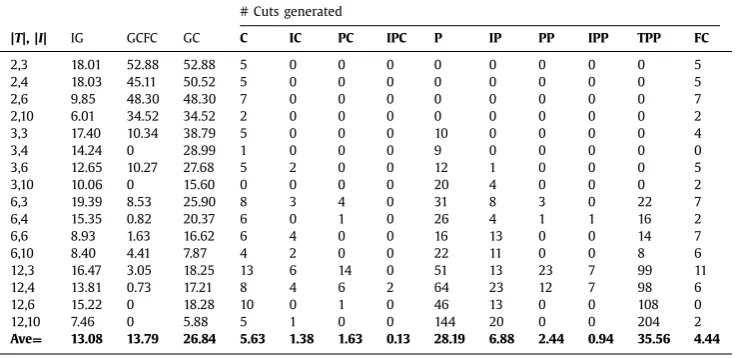
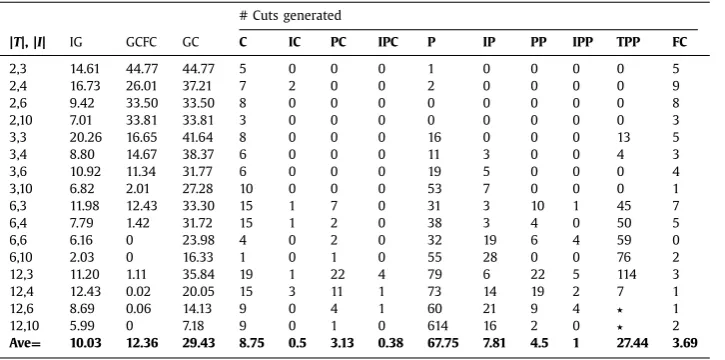
Next, we present the computational results for low, medium and high demand variability, in Tables 1 , 2 and 3 , respectively. Since the exact separation procedures are significantly time- consuming for our proposed inequalities, we generated only one round of violated cuts and added to the formulation. In each ta- ble, the first column indicates the combination | T|, | I|, followed by the columns indicating average Initial Gap, Gap Closed by Flow Cover inequalities only (i.e., only (extended) flow cover inequal- ities are generated), and the percentage Gap Closed for 5 in- stances with all the violated cuts generated. Note that the ini- tial gap is based on the strengthened LP relaxation with all vi- olated ( , S) inequalities added a priori, which are known to
be very effective in practice for multi-item problems, see, e.g., ( Akartunalı & Miller, 2012 ). In the remainder of the tables, the columns indicate the total number of cuts generated of each type for 5 instances, in the following order: Cover (8) , Item-extended Cover (9) , Period-extended Cover (13) , Item-and- Period-extended Cover (15) , Partition (10) , Item-extended Partition (11) , Period- extended Partition (17) , Item-and- Period-extended Partition (19) , Two- Period Partition (20) , and Flow Cover (7) . We note that for biggest instances of di
t∈[10 ,40] ,[10 ,60] , the separation procedure
for two-period partition inequalities took prohibitive times and therefore they were removed from the framework, which are in- dicated by in the tables.
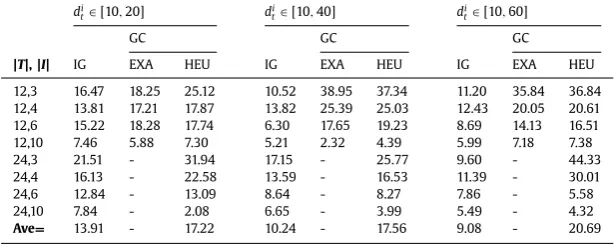
As the results in Tables 1–3 indicate, the cuts can close on av- erage more than 25% of the initial gap. As one could naturally expect, the average gap closed by the cuts deteriorates when ei- ther the number of items or the number of periods is increased, where this deterioration seems more sensitive to the increase in the numbers of items than to the increase in the numbers of peri- ods. When the number of items increases, the problem resembles more the structure of an uncapacitated problem, the convex hull of which can be effectively described by the ( , S) inequalities and hence there is little room for improvement by other cuts. This can be indeed consistently observed from the average initial gaps for all the problems with 10 items. On the other hand, as the number of periods increases, the problem becomes further away from the “ideal” two-period problem, for which these cuts are originally de- rived. However, we note that when all instances with 10 items are taken out, even the average gap closed for the instances with 12 periods is 23.05%, which is a substantial improvement with only one round of added cuts, and also only slightly lower than 24.48%, the average gap closed for the instances with 6 periods and 3/4/6 items. As we will discuss in Section 7 , the experimentation with 24 period problems, albeit using a heuristic approach, indicate similar gap improvements compared to instances with 12 periods.
The results also indicate which types of inequalities are more inherent for different sizes of problems. A small number of cover inequalities seem to close substantial gaps for the 2-period prob- lems almost only on their own, and the number of these inequali- ties do not vary much as the problem size gets bigger. On the other hand, the number of partition inequalities and two-period parti- tion inequalities generated increases significantly as the number of items and periods increase, making both types of inequalities most often generated inequalities in our framework, hence also point- ing to where an computationally efficient framework can focus on. We also note our observation from the computational tests that adding two-period partition inequalities on top of cover and parti- tion inequalities and their variants is not very effective in closing the integrality gap, although this might also be the consequence of a single round of separation. Another interesting aspect the results point at is the fact that the number of item- and period-extended versions of the cuts remain small compared to the “simple” ver- sions of these cuts.
Finally, we make a remark on the effect of the proposed cuts when the demand variability changes. As the tables clearly indi- cate, the cuts (in particular partition inequalities and its variants) are more often violated when the demand variability increases: these are also the instances when our cuts make more of an im- pact for the amount of the gap closed. This makes intuitive sense that partition inequalities are more flexible than covers and hence a higher demand variability will be able to generate more violated inequalities of this type.
7. AHeuristicseparationapproach