1 SE5 Chapter 84- Educating migrant and refugee pupils
Daniela Sime, University of Strathclyde
Introduction
Migration is now a feature of an increasingly globalised world and a central issue for political and public debate. This chapter focuses on the education of young people who have migrated to Scotland from other countries. According to the United Nations, 15 percent of the world’s estimated 232 million migrants are children and young people. Family migration affects children’s education, their relationships and potentially their well-being. Educators need to be
aware of how migration, as a major life event, can affect children’s ability to learn, to ensure provision is adequate and all young people achieve their potential. Access to education is a right for all children, stipulated in the United Nations’ Convention on the Rights of the Child (1989), and migrant children are entitled to education as soon as they arrive. The aim of this chapter is to provide a better understanding of the effects of migration on young people’s everyday experiences, with a focus on how schools can best support them.
Scotland and global migration
Migration is not a new phenomenon, although there has been a recent increase in migration flows worldwide. The majority of migrants are pushed away from their home countries by poverty and conflict and tend to move internally (i.e. from rural to urban areas) or to neighbouring countries. The current refugee crisis has seen millions of Syrians re-settled in neighbouring countries, Turkey, Greece and Jordan. Only a minority of migrants undertake long distance migration. The United States has been for centuries the largest industrialised country attracting migration, although over the last decades, new immigration destinations have emerged. Within Europe, better work opportunities have seen many migrating from East to West. Many countries which traditionally had more emigration are now becoming mainly ‘receiving’ countries and need to adapt to an increasingly diverse population. This is also the
case of Scotland. Migrants’ lives and decisions to settle in another country are often linked to available employment- children play a key role in these decisions (Sime and Fox, 2015 a). Children’s safety and precarious employment opportunities may make parents decide to leave children behind.
2 the perception of migrants as a threat to national identity and social stability. A rise in the anti-immigration sentiment across the United Kingdom was also linked to the Brexit vote. In a context of predominantly anti-migrant attitudes across Europe, the public in Scotland seems less opposed to migrants than in England. Scotland has however a relatively low migrant population (4% against over 10% in England). The Scottish Government has identified immigration as a driver for population and economic growth, advocating policies of attracting migrants and promoting an inclusive and multicultural Scotland (see www.onescotland.org). The Scottish Independence Referendum in 2014 brought to the fore the debates on national identity and what it means to be Scottish (as opposed to, or in addition to, being British). The debates around Scotland’s position in the UK and Europe will continue in the context of Brexit.
Categories of child migrants
In Census 2011, the percentage of foreign-born people residing in Britain was 13.1% (up from 7% in 1983), which represents 7.5 million people- over half have arrived since 2004. In Scotland, the minority ethnic population has doubled from 2% in 2001 to 4% in 2011. These demographic changes have also meant an increase in the number of migrant children in Scotland, and number of children born to recent migrants (the so-called ‘second generation’). Across the UK, there are now over 1 million children with English as an additional language. Children from migrant background should not be considered as one group, because they vary in terms of country of origin, social class, gender, religion, ethnicity and so on. As migration is frequently seen in terms of ethnicity, certain groups become more visible, while others are invisible. White migrants from the old Commonwealth countries such as Australia, Canada and South Africa are one of the largest immigrant groups, rarely mentioned though in media debates on migration. White Europeans have recently attracted media attention in the Brexit debate, although they are all counted under the ‘White-Other’ category in ethnic monitoring exercises, while representing several nationality groups.
The ways in which states categorise different migrant groups impacts not only on individuals’ rights to work and participate fully in society, but also on the ways they are perceived by their communities and their sense of belonging. Most migrants are economic migrants, who come to pursue better work opportunities or careers. Other categories include asylum seekers and groups less ‘visible’ in the media, such as international students, tourists, retirees. Since 1951,
3 of race, religion, nationality, membership in a particular group, or political opinion’. Asylum
seekers are seeking protection under the Convention, and they become refugees once granted this status by countries where they apply for protection. Most countries restrict asylum seekers’ access to work and some public services, on the basis that access to work would act as an incentive for others to make the journey and claim asylum under false pretences. This means that asylum seekers are mostly living in poor quality social housing and on a minimal income, making them vulnerable to poverty and exploitation.
While many children migrate as part of a family group, increasing numbers make perilous journeys across several countries alone. As migration can be expensive, families make tough decisions to send children alone to safety. This category of ‘unaccompanied asylum seeking children’ poses significant challenges for public services. In addition to the significant
emotional and psychological trauma that many experience during their journey, the absence of a family member post-arrival means that the state becomes their corporate parent. There are also issues in terms of access to support and rights. As children, their age entitles them to full access to services such as education, as migrants however, their access to services differs between local authorities. Also, while as children they might receive support, such as access to education, accommodation and healthcare, their entitlements change when they turn 18, meaning that they live with the anxiety of an unknown future and are vulnerable to trafficking and exploitation.
Migrant pupils in Scotland
The counting of migrant pupils is not straight forward. The Summary Statististics for Schools in Scotland (2016), which relies on data submitted by Scottish local authorities and schools, puts the number of pupils who have English as an Additional Language (EAL) at 39,342. For comparison, there were 26,131 EAL pupils in Scotland in 2012, then 29,532 pupils in 2013 and 32,504 in 2014. Scotland has seen thus a significant increase in the number of EAL pupils since 2007 when records began (when only 741 EAL pupils were recorded). The majority of the newly arrived pupils since 2004 are Polish. Ehnolinguistic diversity is clearly a permanent feature of Scotland’s education system and teachers have to support the needs of pupils at
4 The geographic distribution of migrant children across Scotland is also of interest. Pupils’ experiences will be different in cities and rural areas, which may experience less diversity. Families tend to migrate to urban areas, where work opportunities are more readily available, which means that Scotland’s cities are currently reporting the highest numbers of EAL learners.
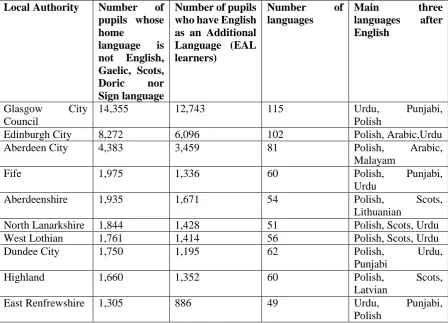
The 10 local authorities with the highest numbers of EAL learners and the top three languages spoken by pupils in each of these are given in Table 1. Not all of these pupils are newly arrived migrant children. The main three languages recorded in each area reflect the successive waves of migration to the UK, with groups who arrived from the old Commonwealth states in previous waves (Urdu, Punjabi, Arabic speakers) and more recently established communities, like Polish or Lithuanian.
Local Authority Number of pupils whose home
language is not English, Gaelic, Scots, Doric nor Sign language
Number of pupils who have English as an Additional Language (EAL learners)
Number of languages
Main three languages after English
Glasgow City Council
14,355 12,743 115 Urdu, Punjabi,
Polish
Edinburgh City 8,272 6,096 102 Polish, Arabic,Urdu
Aberdeen City 4,383 3,459 81 Polish, Arabic,
Malayam
Fife 1,975 1,336 60 Polish, Punjabi,
Urdu
Aberdeenshire 1,935 1,671 54 Polish, Scots,
Lithuanian
North Lanarkshire 1,844 1,428 51 Polish, Scots, Urdu
West Lothian 1,761 1,414 56 Polish, Scots, Urdu
Dundee City 1,750 1,195 62 Polish, Urdu,
Punjabi
Highland 1,660 1,352 60 Polish, Scots,
Latvian
East Renfrewshire 1,305 886 49 Urdu, Punjabi,
Polish
Table 1. Scottish local authorities with the highest number of EAL learners (data from Summary Statistics for Schools in Scotland, December 2016)
Key issues in the education of migrant children and young people
[image:4.595.74.523.287.610.2]5 acknowledge the significant life transition which migrant pupils experience and consider the issues which may impact on their academic and personal development. Family migration clearly has an emotional toll, especially as children are rarely involved in decisions to migrate (Sime and Fox, 2015 a). For young people who migrate alone, the concerns for the safety of the families they left behind and their own future are significant factors, with risks for mental health and emotional well-being.
The migration experience and implications for pupil support
Access to education is a human right stipulated in the United Nations Conventions on the Rights of the Child (1989). The Scottish Government has expressed its commitment to deliver equality of opportunity to all and to ensure that education promotes their safety and well-being. The Standards in Scotland’s Schools Act (2000) expects schools to meet the needs of all pupils and
support them to achieve their full potential. Existing legislation specifies that all children have a right to additional support, if they require it. The Additional Support for Learning (Scotland) Act (2004) provides a broad definition of what may count as additional support- migrant pupils may require support with learning English, but also support in other areas, e.g. disability or emotional support. It is important that language does not act as a barrier and children are adequately assessed, using interpreters whenever needed, to ensure adequate provision is put in place at the earliest opportunity. Schools can adopt several measures to support pupils new to the country to cope with this transition. These may include: a thorough initial assessment which involves the family, providing additional support with language and other curricular areas, a buddying system and a welcoming environment which is reflective of the diverse cultures in the school. Schools are often ‘hubs’ for parents to meet other families and to find out about local services available. Children become facilitators of social capital and social networks for their parents. Their agency in the process is significant (Sime and Fox, 2015 b).
6 As language may be a barrier to communication with families, it is important that teachers and schools are alert to signs of neglect, abuse or exploitation, and follow processes of child protection. Cases such as those of Daniel Pelka, a four-year old Polish boy who died in West Midlands in 2012 from neglect and physical abuse inflicted by his parents show that practitioners need to ensure that child protection procedures are followed and language is not a barrier to children’s safety. Some migrant children may be vulnerable to other risks, such as trafficking and exploitation, female genital mutilation and physical punishment- these may be cultural practices legal in some countries, while they are criminal offences in the UK. Educators need to work with other services to ensure families are aware of approaches to children’s rights to integrity and protection and ensure their safety.
The attainment of migrant pupils
The ASN Act emphasises the support needed for migrant learners’ achievement as it specifies that schools ‘should be proactive in addressing the learning needs, and learning achievement of bilingual learners’ (2004: 27). It recognises the links between the development of literacy in children’s home language and the development of literacy in English, which might mean that
some young people may require additional support to ensure that bilingualism is an asset in education rather than a barrier to academic achievement. Further guidelines to support the learning of bilingual pupils, in line with the four capacities of the Curriculum for Excellence, were developed in a document called Learning in 2(+) Languages (2005). This report recognises that bilingualism is a clear asset with proven cognitive benefits and schools should encourage it and build on family-based learning.
7 While the OECD report acknowledges that the cultural capital and education pupils have acquired in their country of birth are important factors, it states that ‘their performance is even more strongly related to the characteristics of the school systems in their host countries’ (p.2).
The PISA results for migrants from the same country of origin and similar socio-economic backgrounds showed significant differences in scores across destination countries, suggesting that educational policies and mechanisms of support available can make a significant difference to their attainment. The results also show that migrant pupils do better in mathematics and problem solving tests than in reading, suggesting that a minority home language put migrants at disadvantage in standardised tests. In addition to the language penalty, migrant pupils suffer from structural disadvantages in school, with teachers’ attitudes and low expectations of migrant success as key factors (Janta and Harte, 2015).
[image:7.595.68.509.579.778.2]In the UK, the attainment gap of children from an ethnic minority background has been an issue of ongoing concern. In particular, the low attainment of young people from Black Caribbean background, many second generation migrants, and Gypsy Travellers has been highlighted. In England, data on attainment at age 16, using the threshold of achieving 5 or more GCSE passes at A*-C grades, indicates that performance of Traveller of Irish heritage (17.1%) and Gypsy/Roma (11.6%), Black Caribbean (58.6%), Pakistani (61.6%) groups is below that of their White British peers (65.1%). At the same time, the achievement of Bangladeshi (70.6%) and Indian (81%) and Chinese (85.5%) students is higher (DFE, 2015). In Scotland, the latest SCQF level 4-6 data (2015) suggests that Gypsy Travellers are the lowest achievers, with Polish young people slightly behind their White-Scottish peers. The Asian minority ethnic pupils in Scotland are doing better than their White peers (see Table 2).
Table 2: Percentage of school leavers by attainment at SCQF level 4 to 6 by pupil ethnicity, 2014/15 (data from the Scottish Government)
2014/15
1 or more at SCQF level 4
1 or more at SCQF level 5
1 or more at SCQF level 6
White - Scottish 96.3 85.0 59.8
White - Other British 96.0 85.0 60.0
White - Irish 100.0 87.1 54.8
White - Polish 88.8 76.0 42.3
White - Gypsy/Traveller 61.4 40.9 15.9
White - Other 95.7 87.0 63.0
Mixed or multiple ethnic groups 96.5 89.5 68.0
Asian - Indian 98.6 92.1 71.6
Asian - Pakistani 97.9 89.7 71.1
8
Asian - Other1 96.6 90.9 77.7
African/ Black/ Caribbean2 98.9 93.8 74.6
All other categories3 96.3 85.1 62.1
Not Disclosed/Not known 93.0 81.5 53.2
All Leavers 96.2 85.2 60.2
Poverty is directly linked to attainment. It can impact children’s learning, for example through limited access to learning materials or after-school activities, with an increased risk of ill health and developmental problems. Research on migrants’ living conditions post-migration suggests that many tend to settle in poorer neighbourhoods, where housing may be cheaper. Risk factors such exclusion through poor access to educational services and the language barrier can combine in the case of migrants to create multiple disadvantages. While the presence of migrant pupils in schools does not have a negative effect on student performance in these schools, according to PISA analysis, the presence of large numbers of pupils with low educated parents in one school has a far greater negative impact on the overall school achievement. This suggests that educational policies need to concentrate on the distribution of migrant children across schools and across classrooms within schools.
It is also clear that, across Europe, poor educational achievement puts some of migrant pupils at risk of long term underachievement, unemployment and marginalisation. Children from a migrant background are disproportionately represented among early school leavers. However, there are countries (Belgium, Germany, Switzerland) which have combined successful education and social policies to buffer the negative effects of poverty and migration among young people and increase their achievement, according to the 2015 PISA analysis.
Language and literacies diversity, identities and belonging
9 experience as texts. While the focus in schools remains on English language skills, it is important that young people’s competencies in other languages are acknowledged and featured
more prominently in curriculum practices.
Languages, cultures and one’s sense of identity are closely linked. The processes of identity
construction are complex and young migrants navigate several social, cultural and linguistic spaces. If curriculum materials reflect a single, monolingual culture, young people may feel alienated, excluded and uncertain about their place in their new country. Educators may think that their lack of competence in other languages is a barrier to creating an inclusive linguistic and cultural school environment. Research with EAL pupils shows that aspects such as multilingual signage, use of words in other languages in the classroom, encouragement of young people to use other languages between themselves and an interest from staff and pupils in children’s home languages, histories and cultures give a clear message that other identities
matter and are part of the school culture.
In teaching, the use of pupils’ other languages through careful differentiation of curricular activities which do not rely on English support and motivate EAL learners. As shown, formal assessments such as national tests are not equitable to EAL learners and do not always give an accurate assessment of their attainment and may dis-incentivise them to achieve. Teachers must be careful not to take EAL learners’ level of competence in English as an indicator of
attainment in other subject areas. With increasing diversity, new assessment mechanisms are needed, which do not penalise migrant children. Currently, young people in Scotland can take English for Speakers of Other Languages (ESOL) qualifications (National 2-5 and Higher), however few schools offer these qualifications. ESOL Highers are however recognised as entry to Scottish universities. For newly arrived pupils, teachers must also be aware that while young people’s conversational English may develop in a matter of months, they may take several
years to acquire subject-specific jargon and reach full linguistic competence. It is important therefore that their access to curriculum is not impaired by their developing competence in curricular English or writing skills, and teachers must find ways to make curriculum tasks accessible, for example by translating instructions.
10 and loneliness. These are significant risks for young people’s motivation and well-being. Research also shows that schools are places in which young people experience everyday racism, such as name calling or being mocked or laughed at for their accent, misunderstanding of colloquialisms or slang words, clothing or culture-specific customs. Teachers’ own attitudes have also been highlighted by research. Some teachers hold anti-immigrant attitudes, which may interfere with their duties to ensure all learners are treated equitably. It is important that teachers ensure their actions, verbal and non-verbal, indicate they are treating all learners fairly and do not inadvertedly exclude migrant learners. Teachers may inadvertedy send the wrong message, for example, by avoiding to call on pupils thinking they do not have the language competence. The Scottish Government legislates the duty of public services to promote race equality and fairness of opportunities through the Race Equality Framework (2016), which reaffirms the Government’s commitment to race equality, treating individuals as equal and
actively tacking discrimination.
Young people may also feel alienated in their communities- a sense of belonging takes time to develop and depends on young people’s opportunities to know about services available and
make friendships locally. Schools can be instrumental in facilitating young people’s access to networks of support by working with local agencies to increase initiatives for cultural dialogue and inter-ethnic collaborations. Pupils often become brokers for families, who may not know of services available or may be new to English. Factors such as parents’ own education, language competence and social class are key factors in their involvement with schools. Scottish education policy documents refer often to ‘young people’s aspirations’ and parents’
aspirations as closely linked to issues of attainment and school performance. Parental aspirations among migrant groups vary. Parents who show ‘low’ aspirations may have experienced inequalities in their own education, such as the case of Roma, and may think that it is unrealistic for their children to stay in school. It is important that schools find ways to make the curriculum and school structures accessible to migrant families in their children’s learning, as parental involvement is a strong predictor of educational achievement.
Future issues for policy makers and practitioners
11 regulations. This means that in future, schools are likely to see ongoing mobility of young people, uncertainty over their future plans and their families’ decisions to remain in the UK. This raises issues for educators not only in terms of supporting migrant pupils’ attainment, but increasingly in terms of emotional support and the need to ensure that young people are not victims of racism or discrimination in schools or communities, as anti-immigration rhetoric permeates public debates.
Three sets of policies can be implemented for effective support of migrant pupils and to reduce the risks of their low attainment and marginalisation (Nusche, 2009). System level policies refer to structural features of education systems, such as the mechanisms through which migrant families can choose the schools their children attend, how schools monitor children’s progress, issues of resource for schools in areas where migrants settle and policies of selection and assessment. For example, the segregation of migrant children across socio-economic characteristics reduces their probability of continuing to secondary education and increases their risk of underachieving. Educational policies need thus to consider factors such as the geographical distribution of migrants and school catchment areas, choice of schools and ability grouping.In addition to system level policies, school level policies and individual level policies can reduce migrant children’s disadvantage. Individual level policies focus on student characteristics, such as socio-economic background and language proficiency. These can depend on the
level of resource allocated to schools, such as additional funding for individual pupil support. School
level policies shape the school organisation and classroom environments, such as teachers’ attitudes towards migrant children and expectations of them and value given to family-school relationships. With financial austerity, teachers’ ability to provide a supportive curriculum that recognises migrant pupils’ identities, languages and cultures is likely to be affected by inadequate funding to EAL services and ASN provision. Policies of supporting schools with migrant pupils include allocation of additional resources with flexibility on how funds are spent to cater best for pupils’ needs. Funding strategies can either adopt an integrated approach targeting areas of disadvantage where many migrants might live or target the specific needs of migrant pupils, for example through EAL services. Investment in early years, for example, leads to better long term attainment and lower costs in remedial services later on.
Other measures can be taken at school level to reduce the inequity which might impact on migrant pupils’ attainment. Migrant pupils tend to be overrepresented in low ability groups and
12 experiences, which may seem alienating to migrant pupils. The bias in school materials, for example through the absence of migrant experiences or ethnic diversity, can have a negative impact on children’s self-esteem and sense of belonging. It is important that teachers consider these aspects in designing curricular activities and make the curriculum content relevant to all. Teachers also need to be aware of their potentially negative bias towards migrant students, for example through lower expectations or marking bias, when assigning them to lower ability groups or not entering them in exams. Schools need to ensure effective mechanisms for EAL assessment, where teachers use assessment tools that take into account linguistic and cultural differences. Teachers’ awareness of the challenges migration poses to pupils’ ability to learn and well-being can help their practice, by giving them the confidence and knowledge required to identify best support. The fact that migrant pupils are often victims of racism and discrimination means that teachers have a duty to support their integration and fair treatment in school, but also beyond the school gates. This means teachers need to be prepared to tackle issues of racism and discrimination and be more aware of their own actions as potentially discriminatory.
Evidence suggests that migrants are not always aware of support available and schools can signpost families. Apart from funding at school-level, pupils may qualify for additional means-tested support. In addition to ensuring families are aware of entitlements, work with families should focus on addressing their linguistic and cultural needs in order to enable them to engage in their children’s education. This may include making information about the education system available in minority languages, using interpreters when meeting parents or using family liaison officers. Working with parents to build on children’s family-based learning and to ensure parents are enabled to support their children’s learning may require time to build relationships.
13 References
Anderson, C.; Y. Foley; P. Sangster, V. Edwards and N. Rassool (2015) Policy, pedagogy and Pupil Perceptions: EAL in Scotland and England, CEERES. Available at:
http://www.ceres.education.ed.ac.uk/wp-content/uploads/Policy-Pedagogy-and-Pupil-Perceptions-Final-full-report.pdf
Department for Education (2015) GCSE and equivalent attainment by pupil characteristics, Available at: https://www.gov.uk/government/statistics/gcse-and-equivalent-attainment-by-pupil-characteristics-2014
Janta, B. and Harte, E. (2015) Education of migrant children: Education policy responses for the inclusion of migrant children in Europe
Nusche, D. 2009. ‘What Works in Migrant Education? A Review of Evidence and Policy Options.’ OECD Education Working Papers 22, OECD Publishing. Available at:
http://dx.doi.org/10.1787/227131784531
OECD (2015) Helping immigrant students to succeed at school and beyond, Available at:
https://www.oecd.org/education/Helping-immigrant-students-to-succeed-at-school-and-beyond.pdf
www.migrantyouth.org
Sime, D. and Fox, R. (2015 a) Eastern European children’s family and peer relationships after migration, Childhood.
Sime, D. and Fox, R. (2015 b) Migrant children, social capital and access to public services: Transitions, negotiations and complex agencies, Children & Society,