Proceedings of the 49th Annual Meeting of the Association for Computational Linguistics, pages 1045–1054,
A Joint Sequence Translation Model with Integrated Reordering
Nadir Durrani Helmut Schmid Alexander Fraser Institute for Natural Language Processing
University of Stuttgart
{durrani,schmid,fraser}@ims.uni-stuttgart.de
Abstract
We present a novel machine translation model which models translation by a linear sequence of operations. In contrast to the “N-gram” model, this sequence includes not only trans-lation but also reordering operations. Key ideas of our model are (i) a new reordering approach which better restricts the position to which a word or phrase can be moved, and is able to handle short and long distance re-orderings in a unified way, and (ii) a joint sequence model for the translation and re-ordering probabilities which is more flexi-ble than standard phrase-based MT. We ob-serve statistically significant improvements in BLEU over Moses for German-to-English and Spanish-to-English tasks, and comparable re-sults for a French-to-English task.
1 Introduction
We present a novel generative model that explains the translation process as a linear sequence of oper-ations which generate a source and target sentence in parallel. Possible operations are (i) generation of a sequence of source and target words (ii) insertion ofgapsas explicit target positions for reordering op-erations, and (iii) forward and backward jump oper-ations which do the actual reordering. The probabil-ity of a sequence of operations is defined according to an N-gram model, i.e., the probability of an op-eration depends on then−1preceding operations. Since the translation (generation) and reordering op-erations are coupled in a single generative story, the reordering decisions may depend on preceding translation decisions and translation decisions may
depend on preceding reordering decisions. This pro-vides a natural reordering mechanism which is able to deal with local and long-distance reorderings in a consistent way. Our approach can be viewed as an extension of the N-gram SMT approach (Mari˜no et al., 2006) but our model does reordering as an inte-gral part of a generative model.
The paper is organized as follows. Section 2 dis-cusses the relation of our work to phrase-based and the N-gram SMT. Section 3 describes our genera-tive story. Section 4 defines the probability model, which is first presented as a generative model, and then shifted to a discriminative framework. Section 5 provides details on the search strategy. Section 6 explains the training process. Section 7 describes the experimental setup and results. Section 8 gives a few examples illustrating different aspects of our model and Section 9 concludes the paper.
2 Motivation and Previous Work
2.1 Relation of our work to PBSMT
Phrase-based SMT provides a powerful translation mechanism which learns local reorderings, transla-tion of short idioms, and the insertransla-tion and deletransla-tion of words sensitive to local context. However, PBSMT also has some drawbacks. (i) Dependencies across phrases are not directly represented in the translation model. (ii) Discontinuous phrases cannot be used. (iii) The presence of many different equivalent seg-mentations increases the search space.
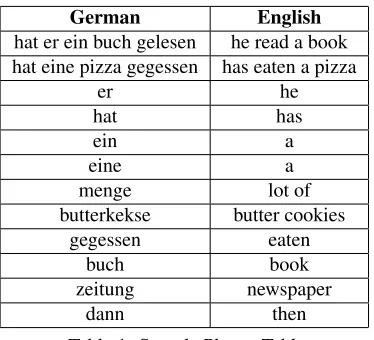
German English
hat er ein buch gelesen he read a book hat eine pizza gegessen has eaten a pizza
er he
hat has
ein a
eine a
menge lot of
butterkekse butter cookies
gegessen eaten
buch book
zeitung newspaper
[image:2.612.92.279.69.239.2]dann then
Table 1: Sample Phrase Table
pendence assumption. A phrase-based system us-ing the phrase table1 shown in Table 1, for exam-ple, correctly translates the German sentence “er hat eine pizza gegessen” to “he has eaten a pizza”, but fails while translating “er hat eine menge but-terkekse gegessen” (see Table 1 for a gloss) which is translated as “he has a lot of butter cookies eaten” unless the language model provides strong enough evidence for a different ordering. The generation of this sentence in our model starts with generating “er – he”, “hat – has”. Then a gap is inserted on the Ger-man side, followed by the generation of “gegessen – eaten”. At this point, the (partial) German and En-glish sentences look as follows:
er hat gegessen he has eaten
We jump back to the gap on the German side and fill it by generating “eine – a” and “pizza – pizza”, for the first example and generating “eine – a”, “menge – lot of”, “butterkekse – butter cookies” for the second example, thus handling both short and long distance reordering in a unified manner. Learning the pattern “hat gegessen – has eaten” helps us to generalize to the second example with unseen context. Notice how the reordering deci-sion is triggered by the translation decideci-sion in our model. The probability of a gap insertion operation after the generation of the auxiliaries “hat – has” will be high because reordering is necessary in order to move the second part of the German verb complex (“gegessen”) to its correct position at the end of the clause. This mechanism better restricts reordering
1The examples given in this section are not taken from the
real data/system, but made-up for the sake of argument.
Figure 1: (a) Known Context (b) Unknown Context
than traditional PBSMT and is able to deal with local and long-distance reorderings in a consistent way.
Another weakness of the traditional phrase-based system is that it can only capitalize on continuous phrases. Given the phrase inventory in Table 1, phrasal MT is able to generate example in Figure 1(a). The information “hat...gelesen – read” is inter-nal to the phrase pair “hat er ein buch gelesen – he read a book”, and is therefore handled conveniently. On the other hand, the phrase table does not have the entry “hat er eine zeitung gelesen – he read a newspaper” (Figure 1(b)). Hence, there is no option but to translate “hat...gelesen” separately, translat-ing “hat” to “has” which is a common translation for “hat” but wrong in the given context. Context-free hierarchical models (Chiang, 2007; Melamed, 2004) have rules like “hat er X gelesen – he read X” to han-dle such cases. Galley and Manning (2010) recently solved this problem for phrasal MT by extracting phrase pairs with source and target-side gaps. Our model can also use tuples with source-side discon-tinuities. The above sentence would be generated by the following sequence of operations: (i) gener-ate “dann – then” (ii) insert a gap (iii) genergener-ate “er – he” (iv) backward jump to the gap (v) generate “hat...[gelesen] – read” (only “hat” and “read” are added to the sentences yet) (vi) jump forward to the right-most source word so far generated (vii) insert a gap (viii) continue the source cept (“gelesen” is in-serted now) (ix) backward jump to the gap (x) gen-erate “ein – a” (xi) gengen-erate “buch – book”.
Figure 2: Pattern From this operation
se-quence, the model learns a pattern (Figure 2) which al-lows it to generalize to the
[image:2.612.346.506.72.146.2]Another problem of phrasal MT is spurious phrasal segmentation. Given a sentence pair and a corresponding word alignment, phrasal MT can learn an arbitrary number of source segmentations. This is problematic during decoding because differ-ent compositions of the same minimal phrasal units are allowed to compete with each other.
2.2 Relation of our work to N-gram SMT
N-gram based SMT is an alternative to hierarchi-cal and non-hierarchihierarchi-cal phrase-based systems. The main difference between phrase-based and N-gram SMT is the extraction procedure of translation units and the statistical modeling of translation context (Crego et al., 2005a). The tuples used in N-gram systems are much smaller translation units than phrases and are extracted in such a way that a unique segmentation of each bilingual sentence pair is pro-duced. This helps N-gram systems to avoid the spurious phrasal segmentation problem. Reorder-ing works by linearization of the source side and tu-ple unfolding (Crego et al., 2005b). The decoder uses word lattices which are built with linguistically motivated re-write rules. This mechanism is further enhanced with an N-gram model of bilingual units built using POS tags (Crego and Yvon, 2010). A drawback of their reordering approach is that search is only performed on a small number of reorderings that are pre-calculated on the source side indepen-dently of the target side. Often, the evidence for the correct ordering is provided by the target-side language model (LM). In the N-gram approach, the LM only plays a role in selecting between the pre-calculated orderings.
Our model is based on the N-gram SMT model, but differs from previous N-gram systems in some important aspects. It uses operation n-grams rather than tuple n-grams. The reordering approach is en-tirely different and considers all possible orderings instead of a small set of pre-calculated orderings. The standard N-gram model heavily relies on POS tags for reordering and is unable to use lexical gers whereas our model exclusively uses lexical trig-gers and no POS information. Linearization and un-folding of the source sentence according to the target sentence enables N-gram systems to handle source-side gaps. We deal with this phenomenon more di-rectly by means of tuples with source-side
discon-tinuities. The most notable feature of our work is that it has a complete generative story of transla-tion which combines translatransla-tion and reordering op-erations into a single operation sequence model.
Like the N-gram model2, our model cannot deal with target-side discontinuities. These are elimi-nated from the training data by a post-editing pro-cess on the alignments (see Section 6). Galley and Manning (2010) found that target-side gaps were not useful in their system and not useful in the hierarchi-cal phrase-based system Joshua (Li et al., 2009).
3 Generative Story
Our generative story is motivated by the complex re-orderings in the German-to-English translation task. The German and English sentences are jointly gen-erated through a sequence of operations. The En-glish words are generated in linear order3 while the German words are generated in parallel with their English translations. Occasionally the trans-lator jumps back on the German side to insert some material at an earlier position. After this is done, it jumps forward again and continues the translation. The backward jumps always end at designated land-ing sites (gaps) which were explicitly inserted be-fore. We use 4translation and 3 reordering opera-tions. Each is briefly discussed below.
Generate (X,Y): X and Y are German and English cepts4 respectively, each with one or more words. Words in X (German) may be consecutive or distinuous, but the words in Y (English) must be con-secutive. This operation causes the words in Y and the first word in X to be added to the English and German strings respectively, that were generated so far. Subsequent words in X are added to a queue to be generated later. All the English words in Y are generated immediately because English is generated in linear order. The generation of the second (and subsequent) German word in a multi-word cept can be delayed by gaps, jumps and the Generate Source Only operation defined below.
Continue Source Cept: The German words added
2
However, Crego and Yvon (2009), in their N-gram system, use split rules to handle target-side gaps and show a slight im-provement on a Chinese-English translation task.
3Generating the English words in order is also what the
de-coder does when translating from German to English.
4A cept is a group of words in one language translated as a
to the queue by the Generate (X,Y) operation are generated by the Continue Source Cept operation. Each Continue Source Cept operation removes one German word from the queue and copies it to the German string. If X contains more than one German word, saynmany, then it requiresntranslation op-erations, an initial Generate (X1...Xn, Y) operation
and n−1 Continue Source Cept operations. For example “hat...gelesen – read” is generated by the operation Generate (hat gelesen, read), which adds “hat” and “read” to the German and English strings and “gelesen” to a queue. A Continue Source Cept operation later removes “gelesen” from the queue and adds it to the German string.
Generate Source Only (X): The string X is added at the current position in the German string. This op-eration is used to generate a German word X with no corresponding English word. It is performed imme-diately after its preceding German word is covered. This is because there is no evidence on the English-side which indicates when to generate X. Generate Source Only (X) helps us learn a source word dele-tion model. It is used during decoding, where a Ger-man word (X) is either translated to some English word(s) by a Generate (X,Y) operation or deleted with a Generate Source Only (X) operation.
Generate Identical: The same word is added at the current position in both the German and En-glish strings. The Generate Identical operation is used during decoding for the translation of unknown words. The probability of this operation is estimated from singleton German words that are translated to an identical string. For example, for a tuple “Port-land – Port“Port-land”, where German “Port“Port-land” was ob-served exactly once during training, we use a Gen-erate Identical operation rather than GenGen-erate (Port-land, Portland).
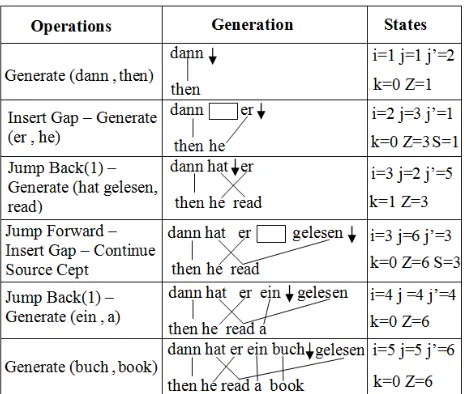
[image:4.612.314.547.71.268.2]We now discuss the set of reordering operations used by the generative story. Reordering has to be performed whenever the German word to be gen-erated next does not immediately follow the previ-ously generated German word. During the genera-tion process, the translator maintains an index which specifies the position after the previously covered German word (j), an index (Z) which specifies the index after the right-most German word covered so far, and an index of the next German word to be cov-ered (j0). The set of reordering operations used in
Table 2: Step-wise Generation of Example 1(a). The ar-row indicates positionj.
generation depends upon these indexes.
Insert Gap:This operation inserts a gap which acts as a place-holder for the skipped words. There can be more than one open gap at a time.
Jump Back (W): This operation lets the translator jump back to an open gap. It takes a parameterW specifying which gap to jump to. Jump Back (1) jumps to the closest gap toZ, Jump Back (2) jumps to the second closest gap toZ, etc. After the back-ward jump the target gap is closed.
Jump Forward: This operation makes the transla-tor jump toZ. It is performed if some already erated German word is between the previously gen-erated word and the word to be gengen-erated next. A Jump Back (W) operation is only allowed at position Z. Therefore, ifj 6=Z, a Jump Forward operation has to be performed prior to a Jump Back operation. Table 2 shows step by step the generation of a German/English sentence pair, the corresponding translation operations, and the respective values of the index variables. A formal algorithm for convert-ing a word-aligned bilconvert-ingual corpus into an opera-tion sequence is presented in Algorithm 1.
4 Model
Our translation model p(F, E) is based on opera-tion N-gram model which integrates translaopera-tion and reordering operations. Given a source string F, a sequence of tuples T = (t1, . . . , tn) as
Algorithm 1Corpus Conversion Algorithm
i Position of current English cept
j Position of current German word
j0 Position of next German word
N Total number of English cepts
fj German word at position j
Ei English cept at position i
Fi Sequence of German words linked toEi
Li Number of German words linked withEi
k Number of already generated German words forEi
aik Position ofkthGerman translation ofEi
Z Position after right-most generated German word
S Position of the first word of a target gap
i:= 0;j:= 0;k:= 0
whilefjis an unaligned worddo
Generate Source Only (fj)
j:=j+ 1
Z :=j
whilei < Ndo j0:=aik
ifj < j0then
iffjwas not generated yetthen
Insert Gap ifj=Zthen
j:=j0 else
Jump Forward ifj0< jthen
ifj < Zandfjwas not generated yetthen
Insert Gap
W :=relative position of target gap
Jump Back (W) j:=S
ifj < j0then Insert Gap j:=j0 ifk= 0then
Generate (Fi, Ei){orGenerate Identical}
else
Continue Source Cept j:=j+ 1;k:=k+ 1
whilefjis an unaligned worddo
Generate Source Only (fj)
j:=j+ 1
ifZ < jthen Z:=j ifk=Lithen
i:=i+ 1;k:= 0 Remarks:
We use cept positions for English (not word positions) because English cepts are composed of consecutive words. German po-sitions are word-based.
The relative position of the target gap is 1 if it is closest toZ, 2 if it is the second closest gap etc.
The operationGenerate Identicalis chosen ifFi=Eiand the overall frequency of the German ceptFiis 1.
generated operation sequenceO = (o1, . . . , oJ)as:
p(F, E)≈
J
Y
j=1
p(oj|oj−m+1...oj−1)
wheremindicates the amount of context used. Our translation model is implemented as an N-gram model of operations using SRILM-Toolkit (Stolcke, 2002) with Kneser-Ney smoothing. We use a 9-gram model (m= 8).
Integrating the language model the search is de-fined as:
ˆ
E = arg max
E pLM(E)p(F, E)
wherepLM(E) is the monolingual language model
andp(F, E)is the translation model. But our trans-lation model is a joint probability model, because of which E is generated twice in the numerator. We add a factor, prior probabilityppr(E), in the
denom-inator, to negate this effect. It is used to marginalize the joint-probability model p(F, E). The search is then redefined as:
ˆ
E= arg max
E pLM(E)
p(F, E)
ppr(E)
Both, the monolingual language and the prior probability model are implemented as standard word-based n-gram models:
px(E)≈ J
Y
j=1
p(wj|wj−m+1, . . . , wj−1)
where m = 4 (5-gram model) for the standard monolingual model (x = LM) and m = 8 (same as the operation model5) for the prior probability model (x=pr).
In order to improve end-to-end accuracy, we in-troduce new features for our model and shift from the generative6model to the standard log-linear ap-proach (Och and Ney, 2004) to tune7 them. We search for a target stringEwhich maximizes a linear combination of feature functions:
5
In decoding, the amount of context used for the prior prob-ability is synchronized with the position of back-off in the op-eration model.
6Our generative model is about 3 BLEU points worse than
the best discriminative results.
7
ˆ
E = arg max
E
J
X
j=1
λjhj(F, E)
where λj is the weight associated with the feature hj(F, E). Other than the 3 features discussed above
(log probabilities of the operation model, monolin-gual language model and prior probability model), we train 8 additional features discussed below: Length Bonus The length bonus feature counts the length of the target sentence in words.
Deletion Penalty Another feature for avoiding too short translations is the deletion penalty. Deleting a source word (Generate Source Only (X)) is a com-mon operation in the generative story. Because there is no corresponding target-side word, the monolin-gual language model score tends to favor this op-eration. The deletion penalty counts the number of deleted source words.
Gap Bonus and Open Gap PenaltyThese features are introduced to guide the reordering decisions. We observe a large amount of reordering in the automat-ically word aligned training text. However, given only the source sentence (and little world knowl-edge), it is not realistic to try to model the reasons for all of this reordering. Therefore we can use a more robust model that reorders less than humans. The gap bonus feature sums to the total number of gaps inserted to produce a target sentence. The open gap penalty feature is a penalty (paid once for each translation operation performed) whose value is the number of open gaps. This penalty controls how quickly gaps are closed.
Distortion and Gap Distance Penalty We have two additional features to control the reordering de-cisions. One of them is similar8 to the distance-based reordering model used by phrasal MT. The other feature is the gap distance penalty which calcu-lates the distance between the first word of a source ceptXand the start of the left-most gap. This cost is paid once for each Generate, Generate Identical and Generate Source Only. For a source cept coverd by indexesX1, . . . , Xn, we get the feature valuegj = X1−S, whereSis the index of the left-most source
word where a gap starts.
8
LetX1, . . . , XnandY1, . . . , Ymrepresent indexes of the source words covered by the tuplestj andtj−1 respectively.
The distance betweentjandtj−1is given asdj=min(|Xk−
Yl| −1)∀Xk∈ {X1, . . . , Xn}and∀Yl∈ {Y1, . . . , Ym}
Lexical Features We also use source-to-target p(e|f) and target-to-source p(f|e) lexical transla-tion probabilities. Our lexical features are standard (Koehn et al., 2003). The estimation is motivated by IBM Model-1. Given a tupleti with source words f =f1, f2, . . . , fn, target wordse=e1, e2, . . . , em
and an alignment abetween the source word posi-tions x = 1, . . . , n and the target word positions y = 1, . . . , m, the lexical feature pw(f|e) is
com-puted as follows:
pw(f|e, a) = n
Y
x=1
1
|{y: (x, y)∈a}| X
∀(x,y)∈a
w(fx|ey)
pw(e|f, a)is computed in the same way.
5 Decoding
Our decoder for the new model performs a stack-based search with a beam-search algorithm similar to that used in Pharoah (Koehn, 2004a). Given an input sentence F, it first extracts a set of match-ing source-side cepts along with their n-best trans-lations to form a tuple inventory. During hypoth-esis expansion, the decoder picks a tuple from the inventory and generates the sequence of operations required for the translation with this tuple in light of the previous hypothesis.9 The sequence of op-erations may include translation (generate, continue source cept etc.) and reordering (gap insertions, jumps) operations. The decoder also calculates the overall cost of the new hypothesis. Recombination is performed on hypotheses having the same cov-erage vector, monolingual language model context, and operation model context. We do histogram-based pruning, maintaining the 500 best hypotheses for each stack.10
9
A hypothesis maintains the index of the last source word covered (j), the position of the right-most source word covered so far (Z), the number of open gaps, the number of gaps so far inserted, the previously generated operations, the generated target string, and the accumulated values of all the features dis-cussed in Section 4.
10
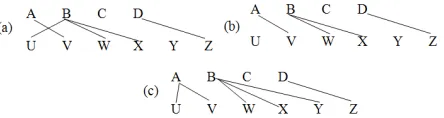
Figure 3: Post-editing of Alignments (a) Initial (b) No Target-Discontinuities (c) Final Alignments
6 Training
Training includes: (i) post-editing of the alignments, (ii) generation of the operation sequence (iii) estima-tion of the n-gram language models.
Our generative story does not handle target-side discontinuities and unaligned target words. There-fore we eliminate them from the training corpus in a 3-step process: If a source word is aligned with mul-tiple target words which are not consecutive, first the link to the least frequent target word is iden-tified, and the group of links containing this word is retained while the others are deleted. The in-tuition here is to keep the alignments containing content words (which are less frequent than func-tional words). The new alignment has no target-side discontinuities anymore, but might still contain unaligned target words. For each unaligned target word, we determine the (left or right) neighbour that it appears more frequently with and align it with the same source word as the neighbour. The result is an alignment without target-side discontinuities and unaligned target words. Figure 3 shows an illustra-tive example of the process. The tuples in Figure 3c are “A – U V”, “B – W X Y”, “C – NULL”, “D – Z”. We apply Algorithm 1 to convert the preprocessed aligned corpus into a sequence of translation opera-tions. The resulting operation corpus contains one sequence of operations per sentence pair.
In the final training step, the three language mod-els are trained using the SRILM Toolkit. The oper-ation model is estimated from the operoper-ation corpus. The prior probability model is estimated from the target side part of the bilingual corpus. The mono-lingual language model is estimated from the target side of the bilingual corpus and additional monolin-gual data.
creasing the Moses stack size from 200 to 1000 does not have a significant effect on translation into English, see (Koehn and Haddow, 2009) and other shared task papers.
7 Experimental Setup
7.1 Data
We evaluated the system on three data sets with German-to-English, Spanish-to-English and French-to-English news translations, respectively. We used data from the 4th version of the Europarl Corpus
and the News Commentary which was made avail-able for the translation task of theFourth Workshop on Statistical Machine Translation.11 We use200K bilingual sentences, composed by concatenating the entire news commentary (≈74K sentences) and Eu-roparl (≈ 126K sentence), for the estimation of the translation model. Word alignments were generated with GIZA++ (Och and Ney, 2003), using the grow-diag-final-and heuristic (Koehn et al., 2005). In or-der to obtain the best alignment quality, the align-ment task is performed on the entire parallel data and not just on the training data we use. All data is low-ercased, and we use the Moses tokenizer and recap-italizer. Our monolingual language model is trained on500K sentences. These comprise300K sentences from the monolingual corpus (news commentary) and200K sentences from the target-side part of the bilingual corpus. The latter part is also used to train the prior probability model. The dev and test sets are news-dev2009a and news-dev2009b which con-tain 1025 and 1026 parallel sentences. The feature weights are tuned with Z-MERT (Zaidan, 2009).
7.2 Results
Baseline: We compare our model to a recent ver-sion of Moses (Koehn et al., 2007) using Koehn’s training scripts and evaluate with BLEU (Papineni et al., 2002). We provide Moses with the same ini-tial alignments as we are using to train our system.12 We use the default parameters for Moses, and a 5-gram English language model (the same as in our system).
We compare two variants of our system. The first system (T wno−rl) applies no hard reordering limit
and uses the distortion and gap distance penalty fea-tures as soft constraints, allowing all possible re-orderings. The second system (T wrl−6) uses no
dis-tortion and gap distance features, but applies a hard constraint which limits reordering to no more than 6
11
http://www.statmt.org/wmt09/translation-task.html
12We tried applying our post-processing to the alignments
Source German Spanish French
Blno−rl 17.41 19.85 19.39
Blrl−6 18.57 21.67 20.84
Twno−rl 18.97 22.17 20.94
Twrl−6 19.03 21.88 20.72
Table 3: This Work(Tw) vs Moses (Bl), no-rl = No Re-ordering Limit, rl-6 = ReRe-ordering limit 6
positions. Specifically, we do not extend hypotheses that are more than 6 words apart from the first word of the left-most gap during decoding. In this exper-iment, we disallowed tuples which were discontin-uous on the source side. We compare our systems with two Moses systems as baseline, one using no reordering limit (Blno−rl) and one using the default
distortion limit of 6 (Blrl−6).
Both of our systems (see Table 3) outperform Moses on the German-to-English and Spanish-to-English tasks and get comparable results for French-to-English. Our best system (T wno−rl), which uses
no hard reordering limit, gives statistically signifi-cant (p < 0.05)13 improvements over Moses (both baselines) for the German-to-English and Spanish-to-English translation task. The results for Moses drop by more than a BLEU point without the re-ordering limit (see Blno−rl in Table 3). All our
results are statistically significant over the baseline Blno−rlfor all the language pairs.
In another experiment, we tested our system also with tuples which were discontinuous on the source side. These gappy translation units neither improved the performance of the system with hard reordering limit (T wrl−6−asg) nor that of the system without
reordering limit (T wno−rl−asg) as Table 4 shows.
In an analysis of the output we found two reasons for this result: (i) Using tuples with source gaps in-creases the list of extracted n-best translation tuples exponentially which makes the search problem even more difficult. Table 5 shows the number of tuples (with and without gaps) extracted when decoding the test file with 10-best translations. (ii) The fu-ture cost14is poorly estimated in case of tuples with gappy source cepts, causing search errors.
In an experiment, we deleted gappy tuples with
13
We used Kevin Gimpel’s implementation of pairwise boot-strap resampling (Koehn, 2004b), 1000 samples.
14
The dynamic programming approach of calculating future cost for bigger spans gives erroneous results when gappy cepts can interleave. Details omitted due to space limitations.
Source German Spanish French
Twno−rl−asg 18.61 21.60 20.59
Twrl−6−asg 18.65 21.40 20.47
Twno−rl−hsg 18.91 21.93 20.87
[image:8.612.74.261.72.135.2]Twrl−6−hsg 19.23 21.79 20.85
Table 4: Our Systems with Gappy Units, asg = All Gappy Units, hsg = Heuristic for pruning Gappy Units
Source German Spanish French
Gaps 965515 1705156 1473798
No-Gaps 256992 313690 343220
Heuristic (hsg) 281618 346993 385869 Table 5: 10-best Translation Options With & Without Gaps and using our Heuristic
a score (future cost estimate) lower than the sum of the best scores of the parts. This heuristic removes many useless discontinuous tuples. We found that results improved (T wno−rl−hsg andT wrl−6−hsg in
Table 4) compared to the version using all gaps (T wno−rl−asg, T wrl−6−asg), and are closer to the
results without discontinuous tuples (T wno−rl and T wrl−6in Table 3).
8 Sample Output
In this section we compare the output of our sys-tems and Moses. Example 1 in Figure 4 shows the powerful reordering mechanism of our model which moves the English verb phrase “do not want to negotiate” to its correct position between the sub-ject “they” and the prepositional phrase “about con-crete figures”. Moses failed to produce the correct word order in this example. Notice that although our model is using smaller translation units “nicht – do not”, “verhandlen – negotiate” and “wollen – want to”, it is able to memorize the phrase transla-tion “nicht verhandlen wollen – do not want to ne-gotiate” as a sequence of translation and reordering operations. It learns the reordering of “verhandlen – negotiate” and “wollen – want to” and also captures dependencies across phrase boundaries.
Example 2 shows how our system without a re-ordering limit moves the English translation “vote” of the German clause-final verb “stimmen” across about 20 English tokens to its correct position be-hind the auxiliary “would”.
Figure 4: Sample Output Sentences
strongly motivates our treatment of source side gaps. The system without gappy units happens to pro-duce the same translation by translating “kehrten” to “returned” and deleting the particle “zur¨uck” (solid lines). This is surprising because the operation for translating “kehrten” to “returned” and for deleting the particle are too far apart to influence each other in an n-gram model. Moses run on the same exam-ple deletes the main verb (“kehrten”), an error that we frequently observed in the output of Moses.
Our last example (Figure 5) shows that our model learns idioms like “meiner Meinung nach – In my opinion ,” and short phrases like “gibt es – there are” showing its ability to memorize these “phrasal” translations, just like Moses.
9 Conclusion
We have presented a new model for statistical MT which can be used as an alternative to phrase-based translation. Similar to N-gram based MT, it addresses three drawbacks of traditional phrasal MT by better handling dependencies across phrase boundaries, using source-side gaps, and solving the phrasal segmentation problem. In contrast to N-gram based MT, our model has a generative story which tightly couples translation and reordering. Furthermore it considers all possible reorderings un-like N-gram systems that perform search only on
Figure 5: Learning Idioms
a limited number of pre-calculated orderings. Our model is able to correctly reorder words across large distances, and it memorizes frequent phrasal translations including their reordering as probable operations sequences. Our system outperformed Moses on standard Spanish-to-English and German-to-English tasks and achieved comparable results for French-to-English. A binary version of the corpus conversion algorithm and the decoder is available.15
Acknowledgments
The authors thank Fabienne Braune and the re-viewers for their comments. Nadir Durrani was funded by the Higher Education Commission (HEC) of Pakistan. Alexander Fraser was funded by Deutsche Forschungsgemeinschaft grant Models of Morphosyntax for Statistical Machine Transla-tion. Helmut Schmid was supported by Deutsche Forschungsgemeinschaft grant SFB 732.
15
References
Peter F. Brown, Stephen A. Della Pietra, Vincent J. Della Pietra, and R. L. Mercer. 1993. The mathematics of statistical machine translation: parameter estimation.
Computational Linguistics, 19(2):263–311.
David Chiang. 2007. Hierarchical phrase-based transla-tion. Computational Linguistics, 33(2):201–228. Josep Maria Crego and Franois Yvon. 2009. Gappy
translation units under left-to-right smt decoding. In
Proceedings of the meeting of the European Associa-tion for Machine TranslaAssocia-tion (EAMT), pages 66–73, Barcelona, Spain.
Josep Maria Crego and Franc¸ois Yvon. 2010. Improv-ing reorderImprov-ing with lImprov-inguistically informed bilImprov-ingual n-grams. In Coling 2010: Posters, pages 197–205, Beijing, China, August. Coling 2010 Organizing Com-mittee.
Josep M. Crego, Marta R. Costa-juss, Jos B. Mario, and Jos A. R. Fonollosa. 2005a. Ngram-based ver-sus phrasebased statistical machine translation. InIn Proceedings of the International Workshop on Spoken Language Technology (IWSLT05, pages 177–184. Josep M. Crego, Jos´e B. Mariˆno, and Adri`a de Gispert.
2005b. Reordered search and unfolding tuples for ngram-based SMT. In Proceedings of the 10th Ma-chine Translation Summit (MT Summit X), pages 283– 289, Phuket, Thailand.
Michel Galley and Christopher D. Manning. 2010. Ac-curate non-hierarchical phrase-based translation. In
Human Language Technologies: The 2010 Annual Conference of the North American Chapter of the As-sociation for Computational Linguistics, pages 966– 974, Los Angeles, California, June. Association for Computational Linguistics.
Philipp Koehn and Barry Haddow. 2009. Edinburgh’s submission to all tracks of the WMT 2009 shared task with reordering and speed improvements to Moses. In Proceedings of the Fourth Workshop on Statistical Machine Translation, pages 160–164, Athens, Greece, March. Association for Computational Linguistics. Philipp Koehn, Franz J. Och, and Daniel Marcu. 2003.
Statistical phrase-based translation. InProceedings of the Human Language Technology and North Ameri-can Association for Computational Linguistics Con-ference, pages 127–133, Edmonton, Canada.
Philipp Koehn, Amittai Axelrod, Alexandra Birch Mayne, Chris Callison-Burch, Miles Osborne, and David Talbot. 2005. Edinburgh system description for the 2005 iwslt speech translation evaluation. In Inter-national Workshop on Spoken Language Translation 2005.
Philipp Koehn, Hieu Hoang, Alexandra Birch, Chris Callison-Burch, Marcello Federico, Nicola Bertoldi,
Brooke Cowan, Wade Shen, Christine Moran, Richard Zens, Chris Dyer, Ondrej Bojar, Alexandra Con-stantin, and Evan Herbst. 2007. Moses: Open source toolkit for statistical machine translation. In Proceed-ings of the 45th Annual Meeting of the Association for Computational Linguistics, Demonstration Program, Prague, Czech Republic.
Philipp Koehn. 2004a. Pharaoh: A beam search decoder for phrase-based statistical machine translation mod-els. InAMTA, pages 115–124.
Philipp Koehn. 2004b. Statistical significance tests for machine translation evaluation. In Dekang Lin and Dekai Wu, editors,Proceedings of EMNLP 2004, pages 388–395, Barcelona, Spain, July. Association for Computational Linguistics.
Zhifei Li, Chris Callison-burch, Chris Dyer, Juri Ganitke-vitch, Sanjeev Khudanpur, Lane Schwartz, Wren N. G. Thornton, Jonathan Weese, and Omar F. Zaidan. 2009. Joshua: An open source toolkit for parsing-based ma-chine translation.
J.B. Mari˜no, R.E. Banchs, J.M. Crego, A. de Gispert, P. Lambert, J.A.R. Fonollosa, and M.R. Costa-juss`a. 2006. N-gram-based machine translation. Computa-tional Linguistics, 32(4):527–549.
I. Dan Melamed. 2004. Statistical machine translation by parsing. InProceedings of the 42nd Annual Meet-ing of the Association for Computational LMeet-inguistics, Barcelona, Spain.
Franz J. Och and Hermann Ney. 2003. A systematic comparison of various statistical alignment models.
Computational Linguistics, 29(1):19–51.
Franz J. Och and Hermann Ney. 2004. The alignment template approach to statistical machine translation.
Computational Linguistics, 30(1):417–449.
Kishore Papineni, Salim Roukos, Todd Ward, and Wei-Jing Zhu. 2002. Bleu: a method for automatic eval-uation of machine translation. InProceedings of the 40th Annual Meeting on Association for Computa-tional Linguistics, ACL ’02, pages 311–318, Morris-town, NJ, USA. Association for Computational Lin-guistics.
Andreas Stolcke. 2002. SRILM - an extensible language modeling toolkit. InIntl. Conf. Spoken Language Pro-cessing, Denver, Colorado.
Omar F. Zaidan. 2009. Z-MERT: A fully configurable open source tool for minimum error rate training of machine translation systems. The Prague Bulletin of Mathematical Linguistics, 91:79–88.