EU Budget Reform Options and the Common Pool Problem
Steffen Osterloh
1, Friedrich Heinemann
2, Philipp Mohl
3Centre for European Economic Research (ZEW)
August 2008
Abstract: There is a consensus in the literature that the expenditure structure of the EU budget is not in line with normative criteria based e.g. on the theory of fiscal federalism. While transfer policies have a large weight policies of a European public good type are neglected. Our contribution explains this inefficient outcome within the framework of a political-economic two-country model adapted from Besley and Coate (2003). The model's modifications integrate crucial features of the EU setting such as income heterogeneity of countries, a GNI dependent revenue formula and the existence of transfer policies in the EU budget besides both local and European public goods. We show that the common pool problem in combination with a budget cap is at the heart of overspending on transfers and underspending on European public goods. On the base of this model we assess different reform options related to the revenue side. We show that the effects of an EU tax depend crucially on the deviation of the specific tax base's redistributive effects from income proportionality. Furthermore, our results point to the advantages of a general but limited correction mechanism.
JEL Classification: D72, F59, H77
Keywords: EU budget, centralisation, political economy
1
Steffen Osterloh (corresponding author): Centre for European Economic Research (ZEW), L7, 1, 68161 Mannheim, Germany; E-mail: [email protected].
2
Friedrich Heinemann: Centre for European Economic Research (ZEW), L7, 1, 68161 Mannheim, Germany; E-mail: [email protected].
3
1 Introduction
Although the current reform debate on the future of the EU budget is characterised by a
variety of views there is a wide consensus that the current expenditure structure of the budget
is not optimal. In particular, the overweight of transfer policies and the neglect of policies of a
European public good type are regularly criticised (a well-known example is the Sapir report;
Sapir et al., 2004).
In our contribution we offer a theoretical explanation for these deficiencies. For this purpose
we adapt the seminal political-economic model by Besley and Coate (2003) who point to the
possible coordination failures in centralised decision making. We extend this model by
integrating important features of the European Union such as income heterogeneity, a GNI
dependent revenue formula and the existence of transfer policies in the EU budget besides
local and European public goods. In this model, the common pool problem is at the heart of
inefficiencies in centralised decision making, as locally elected representatives decide on the
allocation of spending at the central level which is financed out of a common pool, so that it is
largely borne by other jurisdictions. As a consequence, local representatives face incentives to
use their influence in central decision processes for promoting those transfers with an
advantageous distributive effect from their country's position.
In the light of this model we analyse not only how certain characteristics of the status quo
such as a cap on revenues impact on the incentives of local representatives. We also scrutinise
the effects of several reform options which are being debated. In brief, it is shown that the
introduction of a tax directly payable to the European level might even increase the relative
attractiveness of transfers over public goods. By introducing a generalised correction
mechanism a more efficient allocation of expenditures can be reached, shifting resources to
the provision of EU-wide public goods. However, at the same time, this mechanism has a
distorting effect for the ratio of local and European public good. Finally, the concept of a
generalised but limited correction mechanism as proposed by Heinemann et al. (2008) is
demonstrated to have advantageous properties if an appropriate differentiation of policies
included in the correction formula can be achieved.
The remainder of this paper is organised as follows. Section 2 briefly surveys the literature on
explanations given for the current neglect of European public goods in the budget. In section
3, we describe the theoretical literature which is our model's starting point. In section 4, the
model is specified. In section 5, results referring to the status quo of the EU budget are
impact on expenditure policies is discussed on the basis of the model. Finally, section 7
concludes.
2 Explaining the allocation of EU expenditures
The allocation of EU budget expenditures with its focus on transfers has frequently been
criticised. According to the theory of fiscal federalism, the budget of a supranational union
such as the EU should be focussed on the provision of well-specified public goods. The
literature on public good provision in international unions, building on the basic principles of
fiscal federalism (see Oates, 1999), prescribes mainly two criteria which justify the
assignment of tasks and resources to the central level: (a) economies of scale and (b)
externalities. However, a harmonisation of policies might also have a negative effect, as the
heterogeneity of preferences within a union increases with the number of citizens (Alesina,
Angeloni & Etro, 2005; 2001a; 2001b). In their scrutiny of EU activities in different policy
areas, Alesina, Angeloni and Schuhknecht (2005) find a mixed picture regarding the
accordance of normative criteria and actual involvement of the EU: The involvement of the
EU in certain policy areas, such as international trade or the common market, seems to be
perfectly justified. Furthermore, the low involvement in other areas, such as education,
research and culture, is backed by theory due to high preference asymmetries. However,
several inconsistencies can be found such as the heavy EU involvement in agricultural policy
and the existence of those regional funds which mainly favour better-off regions.4 By contrast,
several areas exist where theory would claim a higher involvement than can actually be
observed, such as in certain aspects of international relations or migration issues.
This misbalanced involvement of the EU in the various policy areas is also reflected in the
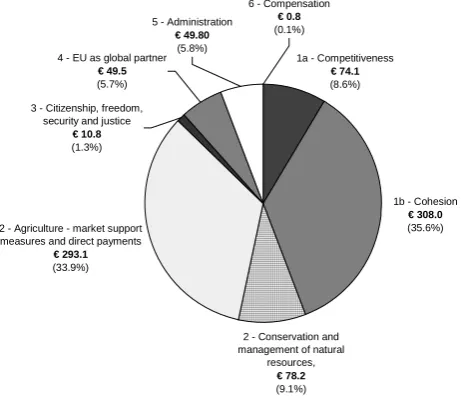
budgetary allocations.5 The structure of the actual expenditure agreed for the period
2007-2013 can be seen in Figure 1. Apparently, two policy areas have dominated the overall
expenditure over the past decades and still prevail: agricultural and structural policies. As it
has frequently been criticised, these expenditures are difficult to justify on theoretical grounds
and their efficiency is frequently doubted. Instead, they are dominated by redistributive
motives (see Tabellini, 2003). These transfers arise as intercountry transfers (cohesion funds),
interindustrial transfers (mainly to agricultural enterprises), or interregional transfers
4
This is the case for the “Regional Competitiveness and Employment Objective”, one of the current objectives of structural spending.
5
(targeting poorer regions). Although the resulting redistributive net transfers are to a great
extent driven by differences in national wealth and thus by the motives of structural policies,
de la Fuente and Domenéch (2001) show that even between countries with similar income
[image:4.595.128.360.212.412.2]levels differences in national net positions can be observed.
Figure 1: Allocation of expenditures of the Financial Perspective 2007-2013 (in bn. €)
4 - EU as global partner
€ 49.5
(5.7%)
5 - Administration
€ 49.80
(5.8%)
6 - Compensation
€ 0.8
(0.1%)
1a - Competitiveness
€ 74.1
(8.6%)
1b - Cohesion
€ 308.0
(35.6%)
2 - Conservation and management of natural
resources,
€ 78.2
(9.1%) 2 - Agriculture - market support
measures and direct payments
€ 293.1
(33.9%) 3 - Citizenship, freedom,
security and justice
€ 10.8
(1.3%)
Source: European Parliament, European Council and European Commission (2006).
Given this budget structure, several authors like Tabellini (2003) or the Sapir commission
(Sapir et al., 2004) have demanded a higher involvement of the EU in those policies which
can be expected to create a European added value. This would imply a shifting of resources
from the mentioned distributive spending to public goods in areas like international affairs,
immigration or security policy (external aid, border controls), as well as R&D and innovation
policies, hence areas, where economies of scale or positive external effects prevail.
As to the explanation of this inconsistency between normative criteria and the status quo
mainly three different approaches can be found in the literature. A first approach regards the
status quo as the outcome of a highly path dependent historical development (see Hix, 2005;
Carruba, 1997; Blankart & Kirchner, 2004). According to this view, the cornerstones of the
present system are the results of political bargaining in the past. Changes mainly occurred due
to the fact that less integrationist countries demanded a compensation for new integration
steps: for instance, the CAP served as a compensation for France in return for the opening of
its market, and the cohesion fund as a compensation for the poorer countries in return for the
countries were successful in this regard whenever there was a credible threat to leave the EU
at that time. All in all, the overall redistribution through the budget is interpreted as a
compensation for those countries with lower or even no benefits from European integration
(Hix, 2005). But even when the reasons underlying the compensations ceased to exist
subsequently, it was hard or even impossible to remove them. Due to the unanimity
requirement in the Council any changes could easily be blocked by the beneficiaries of such
policies, which resulted in a “re-distributive deadlock” (Blankart & Koester, this volume).
A second strand of literature focuses on voting-power explanations. The empirical literature
(Rodden, 2002; Kauppi & Widgrén, 2004; Mattila, 2006) shows that expenditure patterns
favour the smaller member states which are overrepresented in the EU Council as well as in
the Parliament. Smaller countries can use their influence to attract relatively higher returns
from the main expenditure categories, such as CAP, structural funds and internal policies.
However, this literature is only partly capable of explaining the distribution of funds within
the policy areas beyond objective criteria, such as national prosperity or share in agricultural
production, but it does not provide an insight regarding the overall expenditure structure of
the budget.
A third relevant strand of literature is theoretical and devoted to the study of decision making
in multi-layer systems of governments. It deals with the centralisation of activities in
international unions and will be briefly surveyed in the next section. It becomes clear that this
literature has so far not considered an overspending in some policy areas and underspending
in others with respect to the unique institutional characteristics of the EU budget.
3 Related Theoretical Literature
While the early theoretical literature on fiscal federalism based on the seminal work by Oates
(1972) mainly concentrates on the supply of public goods in federal countries, later
contributions also deal with international unions whose purpose is the supply of a limited
scope of public goods (Alesina et al., 2005; 2001a; 2001b). This literature mainly deals with
the endogenous formation of international unions, focussing on their size, composition and
scope. In these models, countries in international unions face a trade-off between the gains
from policy coordination (due to spillovers or economies of scales) and its costs related to the
loss of individual policy making. Then, the optimal formation of an international union might
fail due to an inefficient provision of local public goods by the central level of the union. This
goods between the countries can keep countries with lower preferences away from the
international union in case the countries with higher preferences have the majority of votes, or
it can lead to a larger, but less centralised union. If redistribution takes place within a union,
because the member states differ in their prosperity, an inefficient composition of the union
becomes possible since poor countries may not be allowed to enter (Alesina et al., 2001b). A
decisive feature of these models is the voluntariness of participation in an international union.
Therefore, these approaches take the size of a union as endogenous and mainly concentrate on
the determination of the scope and composition of these unions.
A different explanation for inefficient centralisation was proposed by Besley and Coate
(2003).6 In their model, the size of a union is taken as exogenous and the assumption of a
uniform allocation of public goods is softened. Consequently, inefficient levels of public
expenditures are not caused by different preferences for public goods between the
jurisdictions, but by the potentiality of a non-uniform geographical allocation of the local
public goods. Depending on the applied decision-making rule at the central level, the result
may either be an inefficient geographical allocation of these goods which is biased towards
the jurisdictions whose representatives dominate decision making on the central level, or a
general overprovision of public goods. Obviously, the former result is closely related to the
well-known “common pool problem” of public good provision which is based on the
literature of common choice (e.g., Shepsle & Weingast, 1981). In this public choice approach,
the emphasis is placed on the tendency of central governments to overspend, because local
representatives do not sufficiently internalise the costs borne by other jurisdictions when they
demand for local public goods for their own jurisdiction.
In a similar approach, Lorz and Willmann (2005) focus on the endogenous formation of the
degree of centralisation. By incorporating a continuum of public goods which differ in their
degree of spill-overs and by endogenising the cost sharing, they show that the degree of
public good provision is suboptimal low under strategic delegation, which contradicts the
result of Besley and Coate (2003).
However, these approaches only explain one characteristic of EU spending at a time –
overspending or underspending in some policy areas. Only a recent contribution by Dur and
Roelfsema (2005), in a Besley-Coate-type model, finds an explanation for the coexistence of
under- and overspending. This result is driven by the existence of non-shareable costs of local
public good provision, i.e. costs which are not paid by the central level but by the local
jurisdictions (e.g. environmental policy imposing costs on local industries or multilateral
6
peacekeeping with local casualties). If the share of these non-shareable costs is high (low), the
delegated decision on the central level leads to undersupply (oversupply). The reason is that
with high local costs local policy makers delegate bargaining to “conservatives” with a bias
against spending on public goods. This stands in contrast to the original Besley-Coate result
where the common pool aspect sets incentives to delegate public good lovers and thus leads to
overspending.
However, although this contribution offers helpful insights to understand different degrees of
centralisation of EU policies it still abstracts from institutional features of the European
Union. Hence, in the following model, the focus will be on the integration of important
characteristics of this specific European community of states.
4 The Model
Similar to the approach of Dur and Roelfsema (2005), several basic features of our model are
borrowed from the workhorse model of Besley and Coate (2003). A two-region model is
assumed, indexed by i{1,2}. Both regions are identical in population which has a mass of
unity.
The utility of individual j in country i can be expressed by the following function:
(1) Uij xij ij[ln(g )i ln(g ) ln(G)]i ;
j i
x is consumption of private goods, ij is the preference for public goods, gi is consumption
of a local public good provided in country i, gi is consumption of a local public good
provided in the other country, whereas denotes the spill-over which is assumed to be
(0,1)
and equal for both countries. G denotes the provision of a Union-wide public good
which is provided uniformly to all citizens of the Union; a feature which will be explained
below in greater detail.
The utility for the public goods is strictly increasing and strictly concave and assumed to be
equal for all individuals and both regions. In this regard, the model differs from the
approaches quoted above, as individuals in both countries do not differ in their preferences for
public goods. Instead, they differ in their income. The individual income y is equally ij
countries is denoted as y . The national income im Yi of country i results as the sum of all
individual incomes in that country, so that i ij j
Y
y . In the following, it will be assumed thatcountry 1 has a higher national income, so that, due to the assumption on the distribution of
the incomes, the median income is higher as well, thus,y1m ym2 .
At least in one aspect this model is closer to resembling the traditional approaches of, for
instance, Alesina et al. (2001a), than the political-economic models of Besley and Coate
(2003) or Dur and Roelfsema (2005): We assume that a central decision on the provision of
the local public good implies uniformity in the level of local public goods, so that gi gi. At first glance, this seems to be a strong assumption. In principle, it would be possible for the EU
to enforce a provision of local public goods with differentiated quantities. However, reality
resembles more a uniform provision of this spending category.
One prime example of this category is the “Territorial Cooperation Objective”, one of the
components of structural policies. This fund has a clear local allocation of spending, but is
devoted to transnational and cross-border cooperation. Hence, it creates spill-over effects, so
that it is a good example of a local public good. The allocation of the fixed EU wide amount
for this objective follows a single criterion which is the number of citizens living in border
areas. Therefore, it is not possible to unilaterally increase the spending in one country or
jurisdiction alone. Procedures limiting the freedom of the central level to decide on local
public good provisions exist in many other EU policy areas as well. A further example is the
application of the excellence principle in the Framework Programmes for Research and
Technological Development.
In addition to the existence of a local public good which corresponds to former models, a
supra-regional public good (in our context a “European public good”) is introduced, denoted
as G, whose utility is again increasing and concave. This extension is of crucial importance
since as mentioned above the neglect for European public goods is a central weakness of the
EU budget's status quo so that a meaningful theoretical exposition must include this type of
public good. Two properties differentiate local from European public goods. First, European
public goods are non-excludable and non-rival from the perspective of member countries
whereas local public goods are merely characterised by possible cross-border spillovers but
not by full European non-excludability. Second, the relevant fiscal flows for local public
goods can be attributed to member states, whereas expenditures for European public goods
cannot. This differentiation is relevant for the analysis of reform options due to the different
funds are taken account of in the calculation of country net fiscal flows from the budget
whereas “non-allocated” funds are not. In the model, it is assumed that expenditures for
European public goods are – in contrast to the local public goods and the redistributive
expenditure – entirely booked as “non-allocated” by the EU. This corresponds to the actual
treatment of policy areas such as external policies in the usual net balance statistics.7
The budget constraint of the individual can be expressed as following:
(2) xij (1 )yij 1 1iS i2S2
The private consumption of an individual is financed from two sources: first, from individual
income y minus a proportional income tax, denoted as a rate ij , which is paid to the central level. This setting is similar to Etro and Giarda (2007). The rate is initially assumed to be equal for all individuals and regions, and can therefore be regarded as a “GNI tax” on the
aggregate level. This modelling corresponds to the GNI link of own resources payments in the
current revenue system.
Second, transfers from the central level serve as a further revenue source. As an important
modification to existing models, a share ik of payments from two redistributive policies S , k
k=1,2, allows the individual to finance private goods. This model feature represents targeted
transfer payments from the central level which favour both countries to a different degree.
This adjustment is motivated to depict the characteristics of EU expenditure policy with its
dominant role of agricultural and structural spending. Both policies have negligible
cross-border spill-overs or economies of scale, but mainly serve to transfer money to specific
regions or groups of people. At the same time both spending items have highly different
distributive profiles which largely depend on the size of a country's agricultural sector (for the
Common Agricultural Policy) or the relative wealth of countries (for structural policies). In
this regard, these redistributive goods are different from the local public goods which are
characterised by interjurisdictional spill-overs.
Corresponding to these real life characteristics these payments are modelled as follows: it is
assumed that for both policy areas the distributive pattern is given exogenously, while only
the overall amount of payments in the policy areas is negotiable. This seems to be reasonable
given the institutional setting in the EU, as the national allocation of the spending within the
7
policy areas is largely rule-based. It is assumed that these two categories benefit the two
countries in opposing directions, i.e. the category 1 rather benefits country 1: 1 1
2 1
0 1,
and category 2 is advantageous for country 2: 0 12 22 1. For instance, the national shares
of the expenditure might be determined by the share in agricultural production, the share in
regions with lower than average wealth, or the share in regions with low population density.8
Although these expenditures are usually earmarked in the EU, their treatment in the model as
being purely redistributive payments which benefit all citizens of a country to the same degree
is expedient. As these payments replace national public expenditure, which would be
necessary to offset the beneficiaries if the policies were renationalised, the financing by the
central level gives the national budgets leeway. This enables tax cuts, which are distributed to
all citizens and increase their income which is disposable for consumption. However, as this
implicit redistribution process is full of distortions (administrative costs, fraud, rent-seeking
behaviour), it cannot be assumed that it is a zero sum game. Therefore, a cost term c is
introduced in the budget constraint of the central level.9 Moreover, the central level can
provide the local public good at price p and the European public good at price q. The overall
expenditures have to equal the revenues from the GNI tax, so the budget constraint of the
central level yields:
(3) i i 1 2 1 2 ij
j i
p(g g ) qG S S c(S ) c(S ) (
y );c is strictly increasing and convex: c 0, c 0. In the following, we assume for simplicity that c(S )k 1(S )k 2
2
.
The expenditure of the Union (the two local public goods, the interregional public good and
the redistributive payments) are financed by the sum of the national contributions which are
primarily denoted as a GNI tax as introduced above. This breakdown of the financing of the
Union best reflects the current situation in the EU, where the bulk is financed via GNI
proportional contributions. It should be pointed out that with this allocation, the financing is
not divided 50:50 as assumed in the models described in section 3, unless the incomes of the
median voters are identical which has been excluded above. The share of total contributions
of one country, denoted asi, is calculated as its share in total national income, so that
8
In the following, the mere existence of the opportunity to redistribute payments to small interest groups or regions is taken as exogenous. However, its existence may be explained by lobbying for the provision of these goods. Recent literature indicates that lobbying for regional public goods provision is less costly under centralisation; see Bordignon, Colombo and Galmarini (2005).
9
i i
i i
Y
Y Y
. This ratio is, due to the assumptions on the distribution of the incomes, equal
to the ratio of the median incomes. As it is assumed that country 1 is richer than country 2, the
cost-sharing in the status quo denotes that
1 2 1 2 2 2
1 2
1 1
2pg qG S S (S ) (S )
2 2
Y Y
2
for the two economies.
5 General Analysis
5.1 Social optimum
In a first step, the optimal level of public good provision is presented which can be obtained
by a central planner. This approach is referred to as the “standard approach” by Besley and
Coate (2003: p. 2615). It assumes the existence of a benevolent planner at the central level
who maximises the welfare of the individuals in both regions. As it has been assumed that the
median voter’s preferences for public goods are identical in both regions, the following
function reflects the aggregate welfare:
(4)
S m 1 2
i i
1 1 2 2 2 2
i i
V ((1 ) ln(g ) (1 ) ln(g ) 2 ln(G)) S S
1 1
p(g g ) qG (S (S ) ) (S (S ) )
2 2
The first order conditions give the following optimal allocation of the amount of goods
allocated on the central level, gi, gi,G, S and 1 S : 2
m i i (1 ) g g p , m 2 G q
, S10, S2 0
This reflects the well-known results that the optimal quantity of public goods rises with
increasing spill-overs and preferences for public spending, and decreases in the costs of these
goods, p and q. Moreover, the optimal amount of redistributive payments is zero in the model,
which is straightforward as due to its additional costs any positive provision of these
payments has a negative impact on the aggregate welfare.10
5.2 Decentralised decision making
10
In this second step, the outcome of a decentralised provision of public goods is compared to
the social optimum presented above. Applied to the European Union, this approach reflects
the assignment of the provision of all of the public goods introduced above to the national
level, so that each national government decides individually on its levels of provision.
The result is straightforward and in line with previous findings (see Dur and Roelfsema,
2005). As the spill-overs to the other countries are not entirely internalised in the national
level, an underprovision of public goods is the consequence. The result is
m
i
g p
.
The results regarding the provision of the European public good, however, are ambiguous.
Both countries decide independently over an amount Gi which they want to contribute to the
interregional public good G. Usually, it is assumed that a country behaves strategically and
incorporates the other country’s provision in its decision, and vice versa. This model is similar
to the problem of voluntary provision of public goods (see e.g. Mueller, 2003: p. 18). The
result is a Cournot-Nash equilibrium, which implies the provision of a quantity of less than
the Pareto-optimal quantity, and thus again an underprovision of the public good.
As in the social optimum, the provision of the two distributive goods S and 1 S is likewise 2
zero. Although intranational redistribution would not be excluded in the model, it does not
take place due to the assumption of the uniform distribution of incomes. As a consequence
from this assumption, the median income is equal to the mean income so that the median
voter’s utility would decrease with increased spending for these goods. In case of a skewed
distribution, redistribution via the distributive good would become worthwhile for the median
voter (whose income would then be lower than the mean income), and a positive amount of
both redistributive goods S and 1 S would be provided in the decentralised solution. 2
5.3 Centralised decision making with non-cooperative behaviour
In the following, the outcome of centralisation at the highest level will be modelled according
to a simple political approach as proposed by Besley and Coate (2003). In the approach
applied here, denoted as “non-cooperative” approach, it is assumed that decisions at the
central level are made by a minimum winning coalition (MWC), which implies that the
allocation of expenditures is executed by a coalition which gets at least 50% plus 1 vote of the
representatives. As both jurisdictions are equal in size and voting power, the probability that
each jurisdiction’s representative will be in power is 50%. If he is in power, the representative
central level, while the costs of these policies will be shared between the jurisdictions. Hence,
this cost-sharing rule is responsible for the common-pool problem in this setting, which has an
effect as long as the regional public goods do not exhibit full spill-over effects to the other
jurisdiction. Then, as a result of this non-cooperative model, two main drawbacks emerge: (a)
a misallocation, because the spending mainly takes place in the jurisdiction of the
representative who is in power, and (b) uncertainty, because the allocation of expenditures
will not be known until the formation of the minimum winning coalition.11
This “non-cooperative” political economy approach, as introduced above, is now applied to
the model sketched in the sections before. As citizens in the two jurisdictions differ only with
respect to their income, citizens in both regions delegate the negotiation on the central level to
a representative with median income. In the underlying solution concept, the representatives
of both jurisdictions maximise their utility in the case of being in power, so that the median
voter can expect the highest utility if his representative has control over the central policy.
The maximisation problem of the representative from country i can thus be stated as
following:
(5)
m m 1 1 2 2
i i i i i i i i
1 1 2 2 2 2
V [ln(g ) ln(g ) ln(G)] S S (p(g g ) qG
1 1
(S (S ) ) (S (S ) ))
2 2
First-order conditions give:
m opt i i (1 ) g 2 p and m opt i i G q .
It can be seen that the provision of the local public good corresponds only to the optimal
amount if both countries contribute equal shares to the budget, i.e. i
1 2
, which reflects the
case of both countries having the same income, so that both median incomes are the same. If
this is not the case, as assumed before, the poorer country’s representative chooses a too high
amount of the good, the amount chosen by the richer country’s representative is too low. This
result holds for the European public good as well.
The first-order conditions for the redistributive goods are as follows:
1 1
i i(1 c (S )) 0
2 2
i i(1 c (S )) 0
11
Obviously, for agent 1 only the first equation can have an interior solution. As for the
representative from country i in general ki i for ki, any positive amount of S would k
lead to net returns from the central budget which are smaller than zero, as the share of
contributions he has to pay is in any case higher than the returns from the central level. For S k
with ki, however, the outcome is a positive quantity. Then, the optimal amount
is
k
k i i
i
S
.
At this point, the common pool problem enters the model: due to the existence of a good with
a predetermined payment profile that exclusively favours one country, a higher than optimal
amount of this good is provided because the benefited country has to contribute at a lower
level to its provision than it benefits from it.
Furthermore, the results indicate that a certain degree of fiscal redistribution from the richer to
the poorer regions exists even if the richer region’s representative, agent 1, constitutes the
minimum winning coalition and chooses the policy. As agent 1 always demands a positive
amount of the regional public good g which is uniformly allocated to both regions, but pays a
share larger than one half, he is (in an accounting sense) always a net contributor as long as
this is not overcompensated by a high allocation of S , which will be excluded for simplicity 1
in the following.
Obviously, these results crucially depend on the assumption of a uniform distribution of
incomes. If this were given up, the outcomes may change significantly. If a region had a left
skewed distribution, the median voter would choose an even higher quantity of the
redistributive good which benefits his country, and it might even become profitable for him to
choose a positive amount of the other redistributive good. Both outcomes depend on the
distance of the median voter’s income from the mean income. Moreover, the outcome
regarding the provision of the public goods changes if both countries differ in the skewness of
their income distribution. In case the richer country’s income distribution is much more left
skewed than the poorer ones so that the richer country’s median voter is poorer than the poor
country’s median voter, then the richer country’s representative will even choose a higher
level of public good provision than the poorer country’s one.
Note that in this setting, due to the assumptions made in section 4, inefficiencies do not arise
because of an unequal provision of public goods as in the model by Besley and Coate (2003),
or different preferences between the jurisdictions as, for instance, in Alesina et al. (2005).
Instead, inefficiencies are caused by the way implicit redistribution takes place which enters
leads to non-optimal provision of public goods, even under the assumption of identical
preferences and allocation of the public goods. (2) The existence of goods with predetermined
distribution patterns allows the representatives to pursue non-efficient redistribution to a
certain extent.
These specific arrangements of the model are in line with some observations for the EU
budget discussed above. Redistributive transfer payments are higher than the social optimum,
as it is shown in the model that the provision of these redistributive goods is larger than zero,
while it should be zero in the social optimum. This is the equivalent of the misallocation
outcome as found by Besley and Coate (2003). However, in this first step, it is not possible to
explain the suboptimal low level of the public goods, which can even turn out to be too high
in this approach.
5.4 Budget cap
Having derived the optimal choice of the median voter for the situation where he can decide
on the policy, we proceed by introducing a further stage. In this first stage, the representatives
of both regions might agree on an overall capping of the budget, i.e. they can agree on a
maximum amount which the budget is not allowed to exceed. It is important that this cap
cannot be overruled in the second step.
To fix this cap, both agents maximise their expected utility which arises from the decisions on
the allocation made in the second step. Ex-ante, with a probability of 50%, this allocation is
the allocation the own representative would choose (as determined in section 5.3), or, with a
probability of 50%, it is the allocation the other region’s representative would choose
(denoted in the following with a hat).
Therefore, the expected utility for the representative from region i is ex-ante:
(6)
m m opt opt k k opt opt k k 2
i i i i i
m opt opt k k opt opt k k 2
i i i i
1 1
V [ ((1 ) ln(g ) ln(G )) S (p2g qG (S (S ) )]
2 2
1 ˆ ˆ ˆ ˆ 1 ˆ
ˆ ˆ
[ ((1 ) ln(g ) ln(G )) S (p2g qG (S (S ) )]
2 2
with k=i.
Note that the overall budget of the central level is the sum of all of its expenditures, which is
in case country i’s representative is in power: opt opt opt k 1 k 2
e 2pg qG S (S ) 2
. From the
perspective of the representative from country i, in the first term of equation (6) his optimal
amount for every component. However, the second term’s level of e,ˆeopti , is in any case
suboptimal from the perspective of country i's representative. Replacing the optimal quantities
for the budget components with the amounts obtained in section 5.3, the optimal size of the
overall budget in case country i’s representative is in power yields to:
(7)
2
m k k
opt i i i i
i i
(2 ) 1
e
2
Thus, in case country i‘s representative is in power, the cap has to lie below the expression
given in equation (7) to be binding. In order to disclose which policy-maker would be affected
by the cap, it is important to consider the optimal budget sizes from the representatives’
perspectives.
Deriving (7) for i results in
k m
i i
3 i
(2 )
, which is <0; deriving for k i
yields to
k i 2 i
, which is >0.
Generally, for both regions, a capping of the central budget may serve as an insurance against
a too high allocation of redistributive payments for the case in which the other region’s
representative can choose the policy. This argument becomes most obvious for the richer
country: the optimum level of the budget decreases in the financing sharei as shown above. Therefore, the representative of the richer country 1 could gain from a cap even in the absence
of redistributive payments in favour of country 2, as his demanded level of public goods is
smaller than the level preferred by the representative of the poorer country. Hence, he has an
incentive to enforce ex-ante a capping of the budget at a level emax, with emax eˆopt .
However, the poorer country might gain from the ex-ante commitment as well to restrict the
budget (especially if he is risk averse): the capping of the budget increases his expected utility
if the redistribution to the richer country in case the other country’s representative chooses the
policy is not compensated by the advantages in the event of his own representative being in
power. As the budget size increases in ki , the optimum capping for the poorer country can
even be lower than for the richer country in case 11 is relatively large compared to 2 2 .
However, if the two distribution patterns, 1i and2i, are identical in size (or do not differ too
much), it can be concluded that the representative of the richer country 1 demands a stricter
This approach offers an explanation for the existence of the budget cap in the EU, which has
been introduced in 1988. In the new Financial Perspective 2007-2013, the total level of
spending of the EU budget is capped at 1.048% of the EU’s GNI. Reality also corresponds
with the model insofar as mainly the richer member states stand for a lower level of maximal
expenditure. In fact, in the run-up to the negotiations on the new Financial Perspective, some
of the richest member states (Germany, Austria, Sweden, France, the Netherlands and the
UK) even demanded a cap of the budget at a level of 1% (see Mrak & Rant, this volume).
When this capping below the optimal expenditure levels (eopti ) of both agents is taken as
exogenous and when it is binding, it becomes obvious that in the second stage a suboptimal
low level of public good provision results. Then, the resulting quantities are:
m 2 m 2 2 max k 2 m 2 2
i
i k 2
i
(1 )(( ) q(2 ) ( ) q ((1 2e )( ) ( ) ((2 ) )) g
2pq( )
m 2 m 2 2 max k 2 m 2 2
i 2 k 2
i
(( ) q(2 ) ( ) q ((1 2e )( ) ( ) ((2 ) )) G
q ( )
, which are both increasing
in emax.
However, the ratio of allocation of the two kinds of public goods is independent from the
question who chooses the policy, and it does not depend on the budget cap. This ratio is:
i
g q(1 )
G 2p
. This is in line with intuition, because the ratio of the marginal utilities,
m m i i i V V g G
, is identical for both representatives and it is independent of the financing share
(i).
The resulting quantity for the redistributive good S is: k
m k m 2 m 2 2 max k 2 m 2 2
i i
i m k
i
q ( ) q(2 ) ( ) q ((1 2e )( ) ( ) ((2 ) )) g
q( )
The breakdown between public goods and redistribution depends on several characteristics: as
it has to hold that
m m i i k i V V g S
, the allocation of public goods relative to redistributive
spending increases with increasing spill-overs and public goods’ preferences, and it decreases
with a higher share of participation of the country in the redistributive spending.
For the individual utility maximisation it has yet to hold that the marginal utilities of the
the restriction in form of the overall budget capping at a level emax eopti results in a reduction
of both private and public good provision.
All in all, it has to be noted that this institutional setting of a budget cap has positive and
negative effects. On the one hand, the use of the redistribution channel is restricted by a
capping of the expenditures, which increases the overall welfare. On the other hand, the
provision of the public goods is reduced, and, disregarding the special case of this effect being
overcompensated by the excessively high provision that was initially chosen by the poor
country 2, it becomes suboptimal low.
6 Effects of reform options for the EU financing
In the reform debate, both sides of the budget are often regarded in isolation, so that remedies
for spending inefficiencies are largely expected from measures addressing the expenditure
side. One obvious approach is introducing national co-financing of EU policies which reduces
the countries’ incentive to pursue policies that mainly benefit their own citizens. This finding
also holds in the model-based approach of Dur and Roelfsema (2003), who show that the use
of a central tax and subsidy scheme results in a more efficient outcome.
In this section, it will be shown that the design of the revenue side might have a major impact
on the national incentives on the expenditure side as well. For this purpose, the model
developed above will be employed. In the following, three reform proposals for the revenue
side of the EU budget are introduced, and their consequences on the allocation of the
expenditures are scrutinised. The proposals include the introduction of (i) an EU tax, (ii) a
generalised correction mechanism, and (iii) a generalised limited correction mechanism.
6.1 Introduction of an EU tax
The idea of the introduction of a tax which is directly payable to the EU, the so-called “EU
tax”, is the most far-reaching reform option in the discussion on a reform of the revenue side
of the EU budget. In the past, it has received support from European institutions (see
European Commission, 2004), but also from academics (Cattoir, 2004; Le Cacheux, 2007).12
Regarding its impact on the expenditure structure, one feature of relevance of an EU tax
which is elaborated by Osterloh, Heinemann und Mohl (2008) can be analyzed within the
12
given model: the distribution of national contributions would no longer be proportional to the
national income as it tends to be the case under the current contribution scheme, but would
follow a different pattern. This pattern would critically depend on the tax base. For instance,
the choice of VAT would lead to higher contributions for countries with higher consumption
rates, or a tax on kerosene consumption would put a higher burden on countries with major
airline hubs or with an important share of the tourism industry.
To account for this effect in the model, the assumption of a contribution sharing according to
the national GNI levels can no longer be maintained.13 Instead, the national share of the
contributions is determined by its share in the total base of the respective tax. This implies
that the demand for public expenditures of the median voter, as determined in section 5.3,
deviates from the point of departure if the national share in the tax burden, itax, differs from
GNI shares,i . The following comparative statics are obtained:
opt m
i
2
i i
g (1 )
2 p
and
opt m
i
2
i i
G
p
. This shows that the provision of public goods declines with the share i
that country i has to contribute to the central level spending. If the new allocation pattern due
to the introduction of an EU tax is closer to a 50:50 ratio, the demand for public goods will be
closer to the social optimum; if the gap between the contribution shares widens, the allocated
amount of public goods will become more inefficient.
Comparative statics for the provision of the redistributive spending yields to
k k
i 2
i i
S
.
Again, this is negative, which indicates that it decreases in the share i that country i has to
contribute to the central level spending. Regarding the resulting level of redistributive
spending, S , it is either possible that inefficiencies increase (in case the beneficiary countries k
are disburdened through an EU tax), or it is also possible that they decrease (in case the
beneficiary countries have to spend more for the financing of an EU tax). Therefore, for any
possible redistributive policy k, the outcome depends on the correlation between the change
of the national contributions caused by the tax, taxi i, with the allocation of expenditures
of the respective expenditure category, represented as ki iin the model. If there is a
positive correlation, those countries which benefit from the respective expenditure category
13
would bear a higher burden of the respective tax than those who do not benefit from this
category. Hence, the replacement of national contributions by the respective tax increases the
costs for the beneficiaries. In the model, this results in a lower aggregate demand for the
transfer policies (as well as lower total central spending). A negative correlation denotes that
the redistribution through the respective category becomes even cheaper and increases the
demand for it, which implies a further crowding out of public goods by redistributive
spending under a budget cap.
This correlation can be examined in greater detail for the EU: in Table 1, the correlation
coefficients for the most frequently proposed tax options and the two main spending
categories, common agriculture policy and structural policy, are depicted. The change of the
burden sharing caused by the taxes ( taxi i) is estimated on the basis of the distribution of
the tax bases as calculated in Osterloh et al. (2008). The allocation of spending ( ki i ) of
the two expenditure categories is estimated for the year 2010 by means of a simulation model
as introduced in Heinemann, Mohl and Osterloh (2008).
[image:20.595.66.531.430.519.2]
Table 1: Correlation Coefficients between allocation of expenditure and distributive effect of
EU taxes.
Value added
tax
Cigarettes Alcohol CO2 Fuel
Kero-sene
Foreign exchange transactions
Agriculture -0.05 0.75 0.59 0.66 0.43 -0.30 -0.39
Structural funds 0.12 0.65 0.94 0.75 0.57 -0.21 -0.26
Table 1 indicates that for any expenditure category, the sign and the extent of the correlation
coefficient crucially depend on the selected tax base. For instance, the demand for agricultural
spending would increase if a tax on foreign exchange transactions were introduced, but it
would diminish in the case of a tax on cigarette consumption were chosen. It can be
concluded that according to the model, an EU tax can cause either an increase in redistributive
spending or a decrease.
6.2 Introduction of a Generalised Correction Mechanism
A further reform option is the introduction of a generalised correction mechanism (GCM).
This option was originally proposed by the German Ministry of Finance in 1996, and it is
excessively high burden for single countries by granting correction payments to the negatively
affected countries through a partial reimbursement of their net contributions. The design of
such a mechanism can be regarded as an extension of the existing UK correction mechanism:
the GCM focuses on the net position of a country, which is calculated as the difference
between the country’s payments to the EU, and the EU expenditure which is allocated to the
country. This difference is subject to a threshold a, expressed in % of national GNI. If this
threshold is surpassed, a percentage b of any Euro exceeding this threshold is refunded to the
country. This leads to correction payments for country i according to the following formula:
(8)
1 1 2 2
i i i i i
i 1 1 2 2
i i i i i
0, if Y g S S aY 0
z
b Y g S S aY , else
The financing of this refund takes place in proportion to the national shares in total GNI. To
simplify matters, in the following the refund is designed in such a way that the beneficiary
country is excluded from the financing of its reimbursement,14 so that in the two-country
model automatically results in:zi zi.
As it is assumed above that country 1 is in any case a net contributor, it invariably receives
reimbursement payment from country 2, because the spending allocated to country 1 is lower
than this country’s contributions: g1 1 11S 12S2 1(g1g2 S1 S )2 0. In the simplest
case of a threshold fixed at a level of zero, the following utility function arises for the
representative of country 1 in case he is in power:
(9)
m m 1 1 1 1
1 1 1
1 1 1
1 1
V [ln(g) ln(g) ln(G)] S (p2g qG S c(S )) b( (2g S ) g S )
The demand for the redistributive good S1 yields:
1
1 1
1 1 1 1 1 1
S ( b( )) .
This is smaller than the amount in section 5.3, because 1
1 1
( ) is negative and declines in
the reimbursement rate b, so that the provision of the redistributive good shrinks compared to
the status quo.
The optimal provision of the local public good is now:
m m
1
1 1 2
(1 )
g
2 p 2b( )
. It can be
seen that an increase in the reimbursement rate leads to an increase in the provision of the
local public good.
14
For the poorer country, the utility is now equal to:
(10)
m m 2
2 2 2 2 2 2
2 2 2
1 1
V [ln(g) ln(g) ln(G)] S (p2g qG S c(S ))
b( (2g S ) g S )
The demand for the redistributive good S yields : 2
1
2 2
2 2 2 1 1 2
S ( b( ))
As ( 1 12) is positive, the amount 2
S is smaller than the amount in section 5.3. Again, the
incentive to choose redistributive spending diminishes with an increase in b, as country 2’s
representative internalises the worsening of country 1’s net position for which it has to pay
reimbursements.
For the local public good however, the optimal amount is:
m m
2
2 1 2
(1 )
g
2 p 2b( )
. This is
smaller than the amount in section 5.3. As a consequence, from the point of view of the
representative of country 2, with increasing b the allocation shifts from the provision of the
redistributive and the local public good to the allocation of the European public good. This is
intuitive, as the former goods improve the net position of the poorer country at the expense of
the richer country, and thus increase the reimbursements to the richer country.
Note that, independent from who constitutes the minimum winning coalition and chooses the
policy, the provision of redistributive spending diminishes. The results for the local public
goods are ambiguous: the provision increases compared to the status quo in case country 1’s
representative constitutes the minimum winning coalition, or declines in the other case. All in
all, it can be concluded that given an exogenous capping of the budget exists, as discussed in
section 5.4, the share of the redistributive payments diminishes compared to the public goods,
which implies a shift towards the social optimum. However, the direction of the change of the
ratio of local and European public good remains unclear. In any case, the socially optimal
ratio as shown in section 5.1, where the marginal utility of the two public goods are equal in
the equilibrium, can no longer be attained. Therefore, a misallocation between the two public
goods is the result. Either the local public good provision is too high in terms of the
interregional public good, or it is too low.
If this GCM were applied to the EU, one positive effect is evident: the incentive to attract
redistributive payments diminishes for the net receiver as well as for the net payer. But at the
same time, a misallocation between attributable and not attributable public goods might
emerge.15 In the model, the amount of the expenditures for the European public good G does
15
not have an impact on the correction z, so that in case the net payer constitutes the MWC, it
can be expected that an introduction of a GCM leads to a shift from the local to the European
public good.
6.3 Introduction of a Generalised but Limited Correction Mechanism
Finally, a further cutting-edge correction mechanism will be discussed: the generalised but
limited correction mechanism (GLCM) which was recently introduced in the reform debate
on the own resource system by Heinemann et al. (2008). The central idea of this mechanism is
the same as for the generalised correction mechanism: all countries with an excessive net
position are disburdened through correction payments (hence “generalised”). The difference
to the GCM consists of limiting the expenditure categories which are taken account of in the
calculation of the correction payments. Only the expenditures on some selected policy areas
will be included in the calculation of the net positions that underlie the correction payments
(hence “limited”). Heinemann et al. (2008) explicitly state that expenditures should be
excluded which “can not be allocated to individual countries due to the nature of payments”,
as well as those which “may be identifiable but this payment structure is no sensible proxy for
the share of country benefits from that policy”. A prime example for the second category is
expenditure which has public good properties, so that not only the country where the money is
allocated benefits but other countries as well due to spill-overs.
In the model, this modification of the correction mechanism implies the exclusion of the local
public goods gi from the calculation of the correction payments, as these represent spending
with public good properties. This changes the calculation of the correction payments to the
following formula:
(11)
k k
i
i i
k i i
i
k k
i
i i
k i i
Y
0, if S aY 0
(Y Y )
z
Y
b S aY , else
(Y Y )
The difference in the application of this mechanism compared to the GCM discussed above
becomes obvious: as public good expenditures no longer appear in the calculation of the
reimbursement payments, any interference of the correction mechanism in the decision on the
allocation of public goods is avoided. Consequently, the ratio of the allocated European public
goods and local public goods is optimal under a budget cap, as shown in section 5.4.
At the same time, this mechanism has the same effect on the provision of redistributive
spending as the GCM. It decreases with an increasing reimbursement rate b, exactly as shown
in section 6.2. This property reflects the flexibility of this mechanism, as it allows a variety of
allocations depending on the choice of the reimbursement rate, reflected in the model as the
parameter b. If this parameter is set at the value of zero, the correction mechanism will be
inactive, which resembles to the situation stated in section 5.3. If the parameter b is set at the
value of one, redistribution via the redistributive payments S completely loses its desirability k
for both countries: any difference in favouritism between the two countries in the allocation of
the redistributive good is immediately neutralised through reimbursement payments. In this
case, any representative in power would choose a zero amount of redistributive payments,
which would imply a complete shift to the provision of public goods as indicated in section
5.1. Eventually, if a value of b between zero and one is chosen, an allocation will result which
lies between the non-cooperative solution and the social optimum. Thus, this mechanism has
in common with the GCM that it reduces the incentives to strive for redistributive payments
of both, net receiver and net payer, but in contrast to the GCM, the application of the
mechanism does not distort the decision on the provision of the public goods.
6.4 Intended Redistribution in the Model
With its focus on the efficient provision of public goods, one weakness of the model
presented above is that it does not offer much tolerance for the use of the budget for desired
redistribution from poor to rich countries aside from the lower contribution payments of the
poorer member state. In the real world, redistribution may be intended, for instance, for
political or solidarity reasons, as it is the case in the European Union.
In the light of our model, a first obvious solution for intended redistribution in the EU would
be the use of unconditional transfer payments which reflect the intended degree of
redistribution. A second solution can be found within the GLCM: payment categories with an
intended redistribution pattern can be excluded from the calculation of the reimbursements
within the mechanism. As this is not possible in a GCM, a further disadvantage of this
mechanism becomes obvious: since (intended) redistribution inevitably worsens the budgetary
balance of the net payers, the introduction of a generalised correction mechanism with the aim
would even lead to the inconsistent effect that an increase of cohesion payments would only at
a small part be paid by the richer countries (see Heinemann et al., 2008).
A further more sophisticated mechanism to align the efficient provision of public goods and
redistribution targets in the European budget can be found in de la Fuente and Doménech
(2001). In this approach, the national representatives agree in a first step on the net balances
implying that they fix the degree of redistribution. In a second step, explicit expenditure
programmes are negotiated, and, consequently, differences between the agreed and the actual
degree of redistribution are corrected by lump sum transfers. In this approach, the decision on
redistribution is successfully isolated from the decision on the allocation of expenditures, so
that this approach also shows great promise for avoiding an interference of the common pool
problem interferes with the decision on public good provision.
7 Conclusion
In this paper, a model based on the political economy approach with non-cooperative
legislative behaviour of Besley and Coate (2003) was extended to explain in a first step the
composition of EU expenditures, and in a second step, to identify the possible impact of
reforms of the own resources systems on the allocation of the spending. The model was
modified in order to allow for specific characteristics of the EU budget, such as the existence
of income inequality and the existence of transfer policies with distinct distributive profiles. It
was shown that the interaction of several institutional characteristics, i.e. the inclusion of
targeted spending, the unequal financing by the member states and the capping of the overall
expenditure, can provide an explanation for the bias of the budget towards redistributive
payments and for an underprovision of efficiency-enhancing public goods.
Moreover, three prevailing reform options for the revenue side of the budget were analysed in
this framework. It was shown that, apart from its fiscal consequences, the incentive effects of
these reform options should not be neglected. While an EU tax might reduce the incentives to
attract redistributive spending, it might also have a counterproductive effect depending on the
choice of the tax base and its distributive consequences. A generalised correction mechanism
is regarded as positive in this regard, as it generally implies a shift from redistributive to
public good provision. However, it might distort the provision of different public goods,
depending on whether they are included in the correction mechanism or not. Finally, a
generalised limited correction mechanism has the most promising features, as it also implies a
shift from redistributive spending to public good provision, without distorting the decision on
Concerning promising further research, the next logical step would be an extension of our
model approach towards cooperative behaviour, as it was similarly introduced by Besley and
Coate (2003). This paper is restricted to a non-cooperative legislature, which has the
advantage of clearly demonstrating the different incentives of net payers and net receivers in
the European budget. However, as Dur and Roelfsema (2005) argue, this kind of approach has
certain disadvantages: since a non-cooperative behaviour is ex-ante suboptimal, it is
advantageous for legislations with relatively few representatives (as it is the case in the EU) to
commit to cooperation. This would insure both jurisdictions against the disadvantageous
outcome in case the other jurisdiction’s representative decides on the policy. This allows for a
better insurance than the simple capping of the budget as discussed above. Moreover, the
existing decision rules in the EU, which are often marked by unanimity, speak in favour of a
cooperative legislature.
Independent from these possible extensions, our analysis demonstrates that a thorough
incentive based analysis is indispensable for the assessment of both the status quo and
Literature
Acemoglu, Daron and James A. Robinson (2005), Economic Origins of Dictatorship and
Democracy, Cambridge.
Alesina, Alberto, Ignazio Angeloni and Federico Etro (2005), International Unions, American
Economic Review 95 (3), 602-615.
Alesina, Alberto, Ignazio Angeloni and Federico Etro (2001a), Institutional Rules for
Federations, Harvard Institute of Economic Research Working Paper No. 1940.
Alesina, Alberto, Ignazio Angeloni and Federico Etro (2001b), The Political Economy of
International Unions, Harvard Institute of Economic Research Working Paper No.
1939.
Alesina, Alberto, Ignazio Angeloni and Ludger Schuhknecht (2005), What does the European Union do?, Public Choice 123, 275-319.
Besley, Timothy and Stephen Coate (2003), Centralized Versus Decentralized Provision of Local Public Goods: A Political Economy Approach, Journal of Public Economics 87, 2611-2637.
Besley, Timothy and Stephen Coate (2000), Centralized Versus Decentralized Provision of
Local Public Goods: A Political Economy Approach, CEPR Discussion Paper No.
2495, London.
Blankart, Charles B. and Gerrit B. Koester (forthcoming), Refocusing the EU Budget – An Institutional View, Public Finance and Management.
Blankart, Charles B. and Christian Kirchner (2004), The Deadlock of the EU Budget: An Economic Analysis of Ways In and Ways Out, in: Blankart, Charles B. and Dennis C. Mueller (eds.), A Constitution for the European Union, 109-138, CESifo Seminar Series, MIT Press, Cambridge.
Bordignon, Massimo , Luca Colombo and Umberto Galmarini (2005), Fiscal Federalism and
Lobbying, manuscript.
Bordignon, Massimo, Paolo Manasse and Guido Tabellini (2001), Optimal Regional Redistribution under Asymmetric Information, American Economic Review 91 (3), 709-723.
Carruba, Clifford J. (1997), Net Financial Transfers in the European Union: Who Gets What and Why?, The Journal of Politics 59 (2), 469-496.
Cattoir P. (2004), Tax-Based EU Own Resources: An Assessment, European Commission Taxation Papers, Working Paper No. 1/2004.
De la Fuente, Angel and Rafael Doménech (2001), The Redistributive Effects of the EU Budget: An Analysis and Proposal for Reform, Journal of Common Market Studies 39 (2), 307-330.