DELEGATION OF THE EUROPEAN COMMISSION
TO GUYANA, SURINAME, TRINIDAD & TOBAGO, ARUBA & THE NETHERLANDS ANTILLESCO-OPERATION
BETWEEN
THE EUROPEAN COMMISSION
AND
THE CO-OPERATIVE REPUBLIC OF
GUYANA
JOINT ANNUAL REPORT 2007
Final agreed by NAO and EC delegation
July 22, 2008
Joint Annual Report on the implementation of the ACP-EU Conventions and other co-operation activities.
Table of Contents
1. UPDATE OF THE POLITICAL, ECONOMIC AND SOCIAL SIUATION 1
1.1 1.2 1.3
Update on the political situation Update on the economic situation
Update on the poverty and social situation 2. OVERVIEW OF PAST ON-GOING COOPERATION
1
1
3 4
2.1 Focal sector 1: Rehabilitation of Social & Economic Infrastructure 5 2.1.1 Guyana Sea Defences (8th & 9th EDF)
2.1.2 Low Income Housing Programme (8th EDF) 2.2 Focal Sector 2: Macro-economic support (9th EDF)
2.2.1 Poverty Reduction Budget Support
5
5
6 6 2.3 Projects and Programmes outside the focal sectors (9th EDF) 6 2.3.1 Guyana Micro Projects Programme (9th EDF) 6 2.3.2 Support to the Office of the National Authorising Officer (9th EDF 7
2.3.3 Technical Cooperation Facility 7
2.4 Other Instruments 7
2. 4.1 Sysmin -Linden Economic Advancement Programme (LEAP 7
2.4.2 Sugar Accompanying Measures 8
2.4.3 Financing for Short Term Fluctuations in export Earnings (FLEX) 9
2.5 Regional Cooperation 9
2. 5.1 The Regional Programme in support of the competitiveness
Caribbean Rice Sector (9th EDF 9
2.5.2 The Regional Airports Programme, Phase II (9th EDF) 10
2.5.3 Rum 10
2.5.4 HIV/AIDS
2.6 European Investment Bank
2.7 DIPECHO Projects
3. POLICY COHERENCE FOR DEVELOPMENT 4. EU STRATEGY FOR THE CARIBBEAN
5. DONOR COORDINATION AND HARMONISATION
6. DIALOGUE IN COUNTRY WITH NSAs, LOCAL AUTHORITIES AND NATIONAL PARLIAMENT
1
UPDATE OF THE POLITICAL, ECONOMIC AND SOCIAL SITUATION1.1 Update of the Political Situation
The political scene in Guyana is traditionally characterised by dominance of the two main political parties, respectively the People's Progressive Party and the People's National Congress. The results of the August 2006 general elections gave the Government of the PPP/C an absolute majority in Parliament. The elections did not result in a major change in the political situation as the PPP party has been governing the country since the 1992 elections. The emergence of a new political party, the Alliance for Change Party (AFC), whose leaders come from both dominating parties, has increased to some extent the openness of the political system. As the elections in 2006 were considered by international observers as free and fair, Guyana's political rights rating by the UNHCR improved from 3 to 2, and its status from partly free to free. In general the political situation in Guyana has been stable throughout the whole year of 2007.
Crime and law enforcement issues, however, continue to present significant challenges to the Government and stakeholders and have taxed the resources of security forces. The political climate was very tense between the main dominant parties around this subject. This contributes to the general lack of political support to remove capital punishment from legislation, although executions are not carried out.
Local elections, initially planned for December 2007 have been postponed. These elections have not taken place since 1998. As a consequence, local elected councils are loosing members which are not replaced. Preparation for local elections has been a permanent topic in the parliament and political progress has been made throughout the year. The Task Force on Constitutional Reforms which was established to work on the implementation of the Herdmanson Accord (concluded with intervention by Carter Centre) to bring peace after the riots which followed 2001 elections, became finally operational in May. Operational delays, especially the house-to-house registration of voters, have pushed the election date into 2008. A final election date has not yet been officially announced.
Regarding regional integration, Guyana's relations with states within CARICOM remains solid, despite periodic disagreements; a major one to note being the Government's difficulty to agree on the EPA with CARICOM, finally initialled with the EU in December of 2007. The Government was concerned with the competitiveness of industry within CARICOM. Guyana continues to play an active role in making a reality of the CSME and was the first country to enact legislation in 2007 for the free movement of skills within member states. Guyana continues to hold the agriculture file within the sector councils. The Guyanese President, in 2004, introduced the 'Jagdeo Initiative', which offers Guyana's vast land resources to citizens of CARICOM member states, for investments in agricultural production for the region's benefit.
1.2 Update of the Economic Situation
(2000-2005) of economic stagnation. Economic prospects for 2008 remain positive with an estimated 4.5% growth rate.
The general economic framework continues to improve through prudent macro-economic policy by government. The budget deficit has been diminishing over recent years. From 14% of GDP in 2005, to 11% in 2006, the budget deficit attained 9% in 2007. This positive trend is to be continued in 2008 as government forecasted a 6% deficit for 2008. Revenues have increased over the years and expenditure has overall, remained within the projected limits. Central Government revenues increased in 2007 by 28.6% as a result of improved revenue performance for several categories of tax revenues, including the Value Added Tax introduced in the beginning of the year 2007.
Guyana's external debt has been significantly reduced due to the Inter American Development Bank's (IADB) decision to cancel debts incurred by Guyana with the institution prior to December 31, 2004 (MDRI initiative). As a result, Guyana's stock of external debt fell by 31% and debt service payments by 18%. Although the country's debt sustainability outlook has improved, a moderate debt distress risk remains, in light of its reduced access to concessionalloans following the debt write-off. The government of Guyana is pursuing steps to further obtain debt relief of other donors.
The inflation rate increased significantly to 14.2%, compared to 4.2% for 2006. The sharp increase is mainly due to exponential increases in oil and food prices on the international market, compounded by bad weather locally. Opposition parties have pointed out the introduction of the Value Added Tax (VAT) in January 2007 as another main factor of the rise in inflation. Wage evolution has been moderate over 2007. It is expected that the inflation rate will decline to 6% next year.
In general economic prospects are favourable due to rising world market prices for food and other primary goods like bauxite and gold. The strong Euro is particularly important for the sugar sector which is undergoing an important restructuring. Long-term economic prospects were boosted by the arbitration of the International Tribunal for the Law of the Sea (ITLOS) on the offshore dispute over a potentially oil-rich zone, with Suriname. The ruling of the International Tribunal was accepted by both countries and companies have started test drilling after 7 years of interruption. A first study indicates the possibility of oil production as of 2012.
On the level of the economic sectors growth results are more diverse. During the second half of 2007 sugar production grew by 2. 7% compared to 2006, and rice production declined by 2.9%. The forestry sector also declined significantly (11.1%) as a result of weather related reduced harvesting and reduction of demand by the construction sector. However, the 'other agriculture' sub-sectors attained positive growth of 4.6%; livestock 2% and fisheries 3.2%.
The mining and quarrying sector recorded a strong growth rate of 22.7%, due to a 50% increase in bauxite production and a two-fold increase in the price of gold on the international market. The manufacturing sector showed mixed performance, while engineering and construction activities grew by 5.7%. The service sector continues to show positive growth, increasing by a further 13% during the review period.
applied prior to 2007. A number of basic food items and essential goods were '0' rated for VAT during enactment of the related legislation.
Although the Government of Guyana has initialled the EPA in December 2007, it is still not convinced that this Agreement is in the best interest of CARICOM. Local public consultations will be held in 2008 to guide Guyana's final position on this EPA.
In March 2007, the United Nations Office on Drugs and Crime and the Latin America and Caribbean Region of the World Bank - UNODC-World Bank - released the joint report on 'Crime, Violence and Development' in the Caribbean. The report suggests that the annual national economic growth rate of Guyana could be increased by as much as 1. 7 per cent if the rate of homicide was reduced to the lowest one in the region, for example to that of Costa Rica. Crime rate in Guyana is a factor partially determining emigration.
A joint EU/WB/IDB mission established a draft Integrated Fiduciary Assessment Report which has been submitted to government for comments. A second mission is expected in 2008 to finalise the report and to draft an implementation plan. Preliminary results indicate that progress has been made in recent years although challenges remain.
1.3 Update on the poverty and social situation
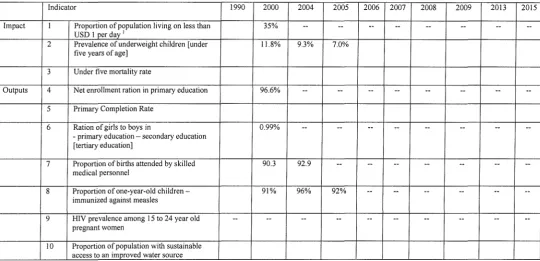
With the help of the UNDP, Guyana has produced a progress report on the status of the Millennium Development Goals (MDGs ), which was made public in 2007. The report states that the country made reasonable progress towards attaining most of the goals, but the pace of progress may be insufficient to meet some of the targets set for 2015.
Slow progress in reducing poverty during 1999-2006, despite a significant increase in social spending, could be attributed to sluggish growth (1% on year average), reflecting political instability, and the impact of external shocks and massive floods. Boosting growth is imperative for poverty reduction.
The most significant progress has been made in reducing hunger, promoting primary education, providing basic amenities to low income households, and empowering women. Progress related to health indicators has been less favourable. The report indicated reducing child mortality (goal 4), improving maternal health (goal 5) and Combating Malaria and other major diseases (goal 6, target 2) as unlikely to be met. All other goals are qualified as 'probably' or 'potentially' to be met by 2015.
The slow down of economic growth for the period 2000-2005 slowed achievements across all sectors. In addition, the actual data system does not allow a close monitoring of progress towards the MDG goals. An upgrade of the statistical system is needed to allow the required monitoring and programming of the lOth EDF, especially the general budget support programme. Two major surveys, the household Income and Expenditure Survey (HIES) and the Multiple Indicator Cluster Survey (MICS), with support of the World Bank, have been concluded and provide a clearer picture. The data of both surveys are analysed by government and conclusions will underpin the second Poverty Reduction Strategy Paper (PRSP). Both surveys as well as their analysis and conclusions by government, have not yet been made public. The second PRSP is expected to be final in 2008.
Migration of valuable skilled personnel continued to constrain desired progress with the MDGs. The continuing migration of skills from Guyana, including university graduates, significantly reduces the pool of local skills available to advance aspects of the MDGs. The main avenue through which Guyana is perusing attainment of the MDGs is the Poverty Reduction Strategy Papers (PRSP). Government's review of the concluded PRSP 1 indicates that there were shortcomings in the attainment of poverty reduction targets. Guyana has embarked on the preparation of PRSP 2, targeted for completion in 2008, which is expected to speed-up the rate of progress towards the achievement of the 2015 MDGs.
2 OVERVIEW OF PAST AND ON-GOING COOPERATION
EU cooperation with Guyana continues to be satisfactory. The programmes being implemented with EC cooperation continue to make good progress. An IMF team, which was recently in Guyana to negotiate a new fund programme, requested the 'EU recipe' for implementation of projects and programmes. Although the implementation goes very well in general, infrastructural projects under the gth and 9th EDF suffered considerable delays in previous years.
The 9th EDF strategy focuses heavily on macro-economic support (poverty reduction) and infrastructure (Sea Defences). In addition, two non-focal sectors received support to a lesser extent, those being the economic actors and the transport sector. The EU conducted a country review of EC/Guyana cooperation for the 1995-2005 period; the final report of this Consultancy has underscored this continuing cordial relationship between the EU and Guyana. The conclusions of the End of Tenn Review (ETR) recommended maintaining the strategy and the 2 focal sectors of the 9th EDF National Indicative Programme (NIP). As suggested by the report, the funds in the A envelope have been increased by 12 million EUR, as a bridging between the 9th and the lOth EDF. In mutual agreement, all funds have been integrated into the macro-economic support component (general budget support to the poverty reduction strategy of Guyana).
Throughout the year, Guyana's 1Oth ED F Country Strategy Paper and National Indicative Programme (CSP/NIP) has been finalised. The allocation proposed for Guyana is €51.0 million, and includes an incentive tranche that is based on the EC's 2006 Governance report on Guyana. The lOth EDF strategy is a prolongation of the 9th EDF, keeping the focal sectors of the 9th EDF (infrastructure; macro-economic support).
Early 2007, the first financial agreement of the sugar accompanying measures programme was signed. After the ending of the sugar protocol, Guyana is one of the few countries that decided to stay in sugar production. On the basis of its "Guyana National Action Plan" to reform the sugar sector, a sugar accompanying measures programme was approved. Guyana was the first country to sign such a programme. The programme has had a good start and 89mio EUR have been allocated for the period 2006-2010.
2.1 Focal sector 1: Rehabilitation of Social & Economic Infrastructure
2.1.1 Guyana Sea Defences (8th & gth EDF)
Completion of the works component of 8th EDF Guyana sea defence programme came to an end with an overall delay of 6 weeks. The works contract, for the rehabilitation of approximately 4 kilometres of sea defences, will be completed by February 2008. The institutional capacity building programme for the Sea and River Defence Division was completed, with one final mission outstanding for 2008 while the socio-economic study, to collect and analyse data relevant to the repair and maintenance of sea defences, will be completed by mid-2008. This study has pioneering character directly involving the population concerned and providing the basis for decision taking with regards to identification of sea defence section to be repaired I reconstructed. Two Financing Agreements, for the 9th EDF Guyana Sea Defence Programme, were finalised during this review period. The design FA of May 2007 (EUR 900.000) facilitated the launching of tender and award of contract for the design tender while the works and institutional support components were being refined. The design team has taken up duty in Guyana by end of 2007 and is expected to deliver designs and tender documents by mid 2008. The second financing agreement was endorsed by the relevant parties in December 2007. A total of Euro 17,918 million has been committed for this programme for works and services. The preliminary findings of the still ongoing impact evaluation have been taken into consideration with respect to weak institutional capacities of the Sea and River Defence Division and the subsequent institutional reform process that has commenced (merger of Works Service Group and Sea and River Defence Division under the Ministry of Public Works). This institutional reform process has been welcomed by the Commission.
2.1.2 Low Income Housing Programme (8th EDF)
Unexpected and unfortunate bottlenecks, mainly in the form of failed works tenders, affected planned progress of this Programme during the initial phase of the project. A rider was signed to the Financial Agreement to extend the programme with three years to allow a full implementation of the financial agreement. The increase in prices and tenders, way above the budget, has impacted the project and by consequence the initial amount of project sites had to be reduced from six to five.
squatter settlement lots in the existing squatter settlements of Cummings Lodge C, Cummings Lodge Y and Sophia D.
The contract for the Westminster scheme was originally scheduled to end by December 2007 but has been extended until mid April 2008. Works contracts for the Glasgow and Cummings Lodge schemes have been awarded. The works tender for Ondemeeming project site is underway and is expected to be awarded during the 1st semester 2008. The Government of Guyana is funding the Sophia 'D' scheme works contract due to shortfalls in the EC allocated budget. The supervision of works will however be done with project funds.
The Community Development Components of the LIHP are focused on providing, recreational and vocational services that are planned and managed as multi-purpose facilities (6 multi-purpose buildings are planned). Once finalised, they will be managed by the respective Community Based Organisations and will serve as a central point for other community activities and training in the areas of environment and sanitation, skills training and capacity development for income generation and incremental maintenance and improvement of other facilities and infrastructure available in the communities. Community groups have been established in all the areas targeted.
2.2 Focal sector 2: Macro-economic support (9th EDF)
2.2.1 Poverty Reduction Budget Support
This is the second focal sector under the 9th EDF EC-CSP. The revised allocation of Euro 23.3 million, was increased by euro 12.1 million, for a total ofEuro 35.4 million, as a result of Guyana's good performance under the original programme, which officially came to an end in December 2006. The performance indicators for this bridging phase have been finalised and the initial tranche (fixed) was requested at the end of 2007. The final variable tranche payment under the original budget support programme was also processed during this review period. The Poverty Reduction Budget Support Programme is well on track.
Technical Assistance to develop a Medium Term Expenditure Framework (MTEF) for four pilot Ministries continued in 2007. Additionally, a consultancy on debt management was concluded, that provided Government with a procedures manual for aid and debt management processes, including an action plan for its implementation. The consultants also held a workshop for key stakeholders on a new financing strategy for the national debt. Technical Assistance also commenced during the last quarter of 2007 to enhance the Government of Guyana's capacity to implement the Paris Declaration on Aid Effectiveness.
2.3. Projects and Programmes outside the focal sectors, 9th EDF
2.3.1 Guyana Micro Projects Programme (91h EDF)
now be fully disbursed by the extended date of August 17, 2008. The funding ceilings for social and educational programmes have already been reached since most communities were inclined to apply for grants related to these areas thus far in the programme. The funding ceiling of 20-25% of grants for rural/interior areas has also been surpassed. The Programme's focus now will be to encourage and approve applications from towns and coastal villages, in the area of employment/income generation.
For the second focal area of this Programme, structured dialogue between civil society and Government, the Contractor recruited a short-term consultant in June 2007 to plan and execute an appropriate and acceptable programme. A number of draft proposals were presented to stakeholders for review but delays in feedback have postponed the implementation. Full implementation of this component under the programme is unlikely.
2.3.2 Support to the Office of the National Authorising Officer (9th EDF)
The NAO Task Force continues to be the essential link between Government and the local EC Delegation that facilitates the resolution of bottleneck to the timely implementation of EU/Guyana programmes and the prevailing cordial relationship. This project will officially end in October 2008. A new NAO support programme has been agreed to for the lOth EDF cycle. The Ministry of Finance has taken full ownership of the current Task Force.
The unit continues to have a good working relationship with other Departments in the Ministry of Finance, PMUs and the Delegation of the European Commission. The external technical assistance aspect of the Financing Agreement was largely completed in 2007. The TA firm, MDF Training & Consultancy, conducted a course on Budgetary Support in October 2007 for local stakeholders, including staff of the Delegation. A final training programme on updated/advanced EU procedures and the delivery of other outstanding work from the TA are scheduled for the first half of 2008.
2.3.3 Technical Cooperation Facility (9th EDF)
Funds under the TCF have been utilised for studies and the third and final programme estimate commenced in April 2007. The Programme Estimate component of the TCF is to facilitate participation of national authorities in training activities and seminars. A new TCF Financing Agreement (drawing on funds from de-commitments of unused programme balances) was signed in August 2007. The main purpose of the TCF II is to cover the cost of feasibility studies for the various programmes under the lOth EDF.
2.4. Other instruments
2. 4.1 Sysmin - Linden Economic Advancement Programme (LEAP)
issues are already well advanced. Additionally, the original design for the Inward Investment Facility (IllS) proved difficult to implement in accordance with EDF grant modalities and has been scrapped. LEAP now acts as a facilitator for businesses wishing to invest in Linden. The funds originally allocated for the IllS will be used to address public works and infrastructure programmes that will enhance the region.
LEAP has commenced planning for the closure of the project and the follow-up administrative entity that may replace it. In this regard a two- day 'retreat' was held in November 2007 to allow stakeholders to give inputs on options for a successor institution to the LEAP. The recommendations emanating from this retreat are currently under discussions. A new business advice expert will join LEAP early in 2008 to coordinate activities to find a successor to LEAP.
Linden Economic Advancement Fund (LEAF)
The problems surrounding the LEAF financial fund, which was put on hold, have been resolved. The EC Delegation agreed to continue to use GUYFLAG/Caricom General Insurance Inc. to manage the LEAF Financial fund. This decision followed the favourable international audit of the fund, which found no fraud with the LEAF, and the amicable resolution of some pending issues. The balance of EC funds (approx. 1,033,000 euros) will be released shortly for the benefit of small businesses in Region 10.
2.4.2 Sugar Accompanying Measures
The Financing Agreement to formalize the initial package of assistance by the EU to Guyana, under the new Sugar Accompanying Measures for ACP States, entered into force on February 28, 2007.
Guyana was allocated Euro 5.663 million for 2006, the year the price cuts commenced.
The allocations for the years 2007-2010 for Guyana were also finalized during this review period and are as follows:
2007: € 27,065,000
2008: € 21,000,000
2009: € 18,000,000
2010: € 18,105,000
The Sector Budget Support mechanism is the selected method through which the EU will transfer this aid to Guyana. For the 2006 allocation, Euro 4.900 million will be disbursed in two tranches, a fixed tranche and a variable tranche. The fixed tranche, amounting to euro 3.270 million, was paid on signing of the Financing Agreement after it was determined that Guyana's management of its public finances was satisfactory, and that implementation of the GNAP was progressing. The variable tranche of euro 1.630 million was officially requested in December 2007.
Provisional Indicators for the period up to 2013, when the new protocol arrangements end, have also been determined.
A social impact assessment of the EU sugar price cut on Guyana was conducted by EU sponsored consultants during the last trimester of 2007. The report of the consultants was rejected by the Government of Guyana for several reasons, being the methodology chosen by the experts as well as the scope of the report which was considered far too wide compared to the initial objective. Government and the EC have ongoing discussions on a suitable social impact indicator for the variable tranche component, which will attract 25% of the proposed EC funding for Guyana.
The NAO is mandated to prepare regular 6-monthly progress reports on the status of implementation of the GNAP, including the payment of tranches. The first progress report was prepared in July 2007, for the GNAP implementation period of January-June 2007.
2.4.3 Financing for Short-term Fluctuations in Export Earnings (FLEX)
The Guyana Government submitted a FLEX application in 2007, on the assumption that additional funds may be made available by theE C. Based on the statistics submitted, the EC Headquarters (DG DEV) allocated 6.13M€.
In the context of the 9th EDF Sunset Clause, this additional fund had to be committed before the end of 2007. The Delegation was requested to prepare in collaboration with the NAO an Action Fiche and submit it HQ before the end of August 2007. It was agreed with the NAO that the entire 6.13M€ will go towards further topping up the 9th EDF GBS programme.
2.5 Regional Co-operation
Guyana continues to benefit from a number of projects implemented under the framework of the Caribbean Regional Indicative Programme (CRIP). Of particular relevance to Guyana are the following programmes:
2. 5.1 Rice - The Regional Programme in support of the Competitiveness of the Caribbean Rice Sector (91h EDF)
This project which is designed to increase the trade competitiveness of rice production, primarily in Guyana and Suriname was approved by the EDF Committee in October 2003, and began operations in mid 2004.
The programme consists of three components, an umbrella work programme on the regional level implemented by Caribbean Rice Association and sub-components now being implemented in Guyana and Suriname.
Technical Assistance: The consulting firm is now providing the required technical assistance following a period of poor delivery.
Water Management: The water management facility entails the construction of 2 sea face sluices and the supply and installation of a drainage pump. Works progressed on schedule in 2007.
Training & Seminars: This component of the programme has always progressed well. The Project Management Unit has conducted several training sessions for stakeholders in regions 2,3,4,5 and 6. More than 1500 stakeholders have been trained to date. The stakeholders were trained in post harvest management, quality control, financial management & accounting, and seed technology.
2.5.2 The Regional Airports Programme, Phase II (91h EDF)
The tender documents for the extension of the Ogle runway to 4000 ft have been prepared to facilitate the launch of this tender and approved by the Delegation in May 2007. However, negotiations between Ogle Airport Inc. (OAI) and Government regarding equity issues are to be concluded before the works are done. These issues were still pending at the end of 2007.
2.5.3 Rum
The European Commission has also given approval for a € 70 Million grant to support rum producers in CARIFORUM Countries. The 4-year project, "Integrated Development Programme for the Caribbean Rum Sector" will assist WISRP A (West Indian Spirits and Rum Producers Association) members to enable the producers to regain markets lost through liberalisation and to create new ones.
2.5.4 HIV/AIDS
In addition, outside the CRIP, at the very end of 2000 the Caribbean component of the all-ACP HIV/AIDS/STDs Programme was initiated with CARICOM as implementing agency. This Programme was designed to help build the capacity of regional institutions to combat the epidemic. Guyana is benefiting directly from several components of this important programme.
2.6 European Investment Bank
At the end of 2007, the EIB portfolio in terms of direct operations amounted to EUR 15.2m with a current outstanding amount ofEUR 6.3m.
A loan to Guyana Power and Light of EUR 20m was signed in 2001, but GPL has since returned to public ownership, and as, inter alia, the EIB loan conditions did not comply with HIPC conditions the loan was cancelled in 2007. A EUR 5m facility for the creation of DFLSA, a private sector bank focusing on SME lending and microfinance operations in Guyana and Suriname and majority owned by Development Finance Limited based in Trinidad and Tobago, is currently under disbursement. In 2007, the Bank continued the discussions with Guysuco to identify possible areas for EIB assistance in the sugar sector.
However, under the revised Cotonou Agreement, EIB is now in a position to meet the HIPC conditionality criteria through interest subsidies and it is currently co-ordination possible action with other donors such as IDB.
Future operations in the financial sector will, as has been the case in recent years, mainly have a region wide focus.
2.7 DIPECHO Projects
The DIPECHO project "Strengthening disaster preparedness and reducing vulnerabilities in flood prone communities of Guyana" is currently under implementation. The project is implemented by Oxfam GB (grant, co-financing) and targets around 25,000 people living in conditions of high risk and vulnerability to recurrent floods along the East Coast Demerara in Region 4 of Guyana. This region was the worst affected during the flooding of 2005 and 2006. In most of the areas, the water level remained between 3 to 5 feet for several days. Most of these villages are under developed, close to conservancy, lack proper drainage system, have flat houses, situated next to draining canal, prone to overtopping of conservancy I canals, affected by unplanned water released from sugar estate, prone to affects of high tide, or affected by inadequate pumping station on drainage to sea.
3 POLICY COHERENCE FOR DEVELOPMENT
The 1oth EDF programming cycle for Guyana for the period 2008-2013 has attributed Euro 51 million to Guyana. The support strategy has 2 focal sectors, Sea Defences/Coastal management and Macro-economic support to the Poverty Reduction Strategy of Guyana. Both focal sectors are a continuation of the focal sectors under the
9th EDF, but the new feature of the lOth EDF cycle will be the emphasis on budget support programme for sea defences/Coastal management in addition to the Macro-economic budget support programme.
Under the non-focal areas, the sum of 3 million euros is allocated for land use planning and each time 1 million EUR for governance, technical assistance and the NAO task force. The governance report (2006) on Guyana was used to increase the initial allocation by euro 11 million, in the form of an incentive tranche.
Sea Defences have been a focal sector throughout the successive EDF programmes in Guyana. These Sea Defences programmes do not only take into account the climate change challenges and the environmental impacts, but support the protection of the whole socio-economic system in Guyana, mainly situated in the low lying coastal areas. This includes the key agricultural sectors like sugar and rice.
Both the sugar and the rice sector are specifically supported by the EU to improve their competitiveness and long-term profitability. The Guyanese economy is up to a large degree dependent on the agriculture sector. With an allocation of 89 million EUR for the period 2006-2010, the sugar programme supports the reform of the sugar sector through the implementation of the Guyana National Action Plan, with particular attention to the mitigation of eventual negative impacts on the workforce/society.
Guyana has made its reservations towards the agreement arguing that it would relieve too much of the development features which have characterised the EU and Caribbean relations for so long.
Crime and law enforcement is an issue in Guyana. Through the macro-economic budget support programme, together with the low-income housing projects, the EU policy focuses on the alleviation of poverty, one ofthe major causes ofthe insecurity situation in Guyana.
As mentioned before, environmental aspects are an essential topic within the Sea Defences programmes. The Delegation is also supporting the implementation of three environmental programmes operated through centralised management: the "Ecological and financial sustainable management of the Guyana Shield eco region" programme, the "Developing alternatives for illegal chainsaw lumbering through multi-stakeholder dialogue in Ghana and Guyana" programme and the "All ACP Agricultural Commodities Programme".
Policy areas of the EU coherence policy for development, which are not covered by an aid programme, are taken up by the Delegation in its policy dialogue with government and in its general role as facilitator. Contacts have been established with the University of Guyana in relation to different education and research programmes like Erasmus Mundus. The delegation facilitated contacts for the European Investment Bank in relation to transport and energy initiatives in Guyana. Policy dialogue is ongoing with the government in relation to security and migration issues (Guyana has one of the highest migration rates in the world).
4. EU STRATEGY FOR THE CARIBBEAN
The EU strategy of the Caribbean focuses on three objectives. The establishment of a political partnership based on shared values (in particular good and effective governance); addressing economic and environmental opportunities and vulnerabilities; promoting social cohesion and combating poverty.
Throughout 2007, the political partnership was further fortified along the implementation of the general budget programme which pays particular attention to good governance of public finances (PFM). New objectives have been agreed with government at the end of 2007. A joint EU/WB/IADB evaluation mission on public finance management (PEF A/IF A study) noted progress in recent years although challenges remain. Addressing these challenges will be the objectives of an implementation plan, to be agreed in 2008. A governance programme was identified as part of the 1 01h EDF, focussing on the strengthening of the democratic process and to avoid political instability that has marked previous elections (except the last general election in 2006). Policy dialogue between the government and the EU delegation has been further strengthened.
long-term profitability of the sugar and rice sectors. Support is also provided to strengthen the disaster preparedness and to reduce vulnerabilities in flood prone communities in Guyana. This project is implemented by the NGO Oxfam, GB.
Alleviation of poverty has been the second focal sector throughout the different EDF cycles. During the programming of the lOth EDF, it has been identified again as a focal sector. The General budget support programme is specifically supporting the national poverty reduction strategy. It focuses primarily on the improvement of the health care and housing situation of low-income households but it also foresees trade related assistance in order to facilitate the implementation of the new CARIFORUM EPA.
5 DONOR COORDINATION AND HARMONISATION
Donor coordination is well organised in Guyana. A number of thematic groups are operational, dealing with issues of relevance to poverty reduction, infrastructure development and governance issues. Each group is chaired by an international donor. The thematic group on National Competitiveness has been fully coordinated by Government. In addition, donors meet separately on a monthly basis to further coordinate actions and policies.
Furthermore, donors involve other donors in their programming exercise, organise regular information sessions concerning new programmes and discussion meetings between all donors are frequent. The EU Delegation is playing an active role in this and the Guyana Country Strategy Paper for the 1oth EDF was established while involving closely the donor community via information and discussion sessions.
Donor meetings are especially useful for exchange of information between government and donors, and among donors. It fosters coordination and harmonisation of government and donors actions. If structural policy dialogue takes place, it is mainly at a bilateral level.
Due to the regular information exchange, donors are coordinating actions, avoiding overlap, building on previous work of other donors and respecting the lead role of a donor in a sector. Nevertheless, donors do not actively seek cooperation by matching or transferring funds. In that respect, the EU has taken the initiative to open discussions with the only EU MS represented in Guyana (UK), to verify all opportunities for a division of labour between both. These discussions are advanced and will be concluded in 2008. In relation to the Paris Declaration, government and donors are committed to implementing the principles of the Paris Declaration. Efforts are ongoing but the donors have the lead role in this process.
6 DIALOGUE IN COUNTRY WITH NSAS, LOCAL AUTHORITIES AND NATIONAL PARLIAMENTS
Non State Actors (NSAs) also actively participated in the implementation of the Guyana Micro Projects Programme during this review period. As part of the GMPP two dialogues between Government and civil society were envisaged to discuss issues of mutual concern. These dialogues are still at the planning stage; at least one should be accomplished before the closure of this Programme in December 2008.
NSAs were regularly consulted during this year's consultancy to review the previous EDF cycles and also during studies related to the new EU sugar protocol arrangements for sugar.
In the preparation of the important second Poverty Reduction Strategy Paper a consultation process with NSA and directly with the population, is ongoing.
7 CONCLUSIONS
The relationship between the Government of Guyana and the Delegation of the European Commission remained cordial during this review period. The existing communication channels have been revised, to accommodate the need for more policy dialogue between government and the EU Delegation. Both parties have pledged to maintain continued cooperation and harmonised relations between Government and the EC in 2008 and beyond.
Guyana seems to have found a new economic growth path after a long period of stagnation during the period 2000-2005. In 2007, a second consecutive year of important economic growth was noted and mid term economic prospects are positive. In addition, the Government of Guyana is applying prudent macro-economic policies to create favourable conditions for the development of the private sector.
The general elections in 2006 were considered free and fair by international observers, and were the first to take place in the absence of violence. The political situation can be considered stable as the governing PPP party (since 1992) has an absolute majority in parliament. Nevertheless, tension between the two main political parties, which reflect the ethnic division in society, can mount, especially over security/crime issues. Local elections, not held since 1998, were postponed due to the slow pace of preparations. Guyana is in favour of the Regional (Caribbean) integration process.
Over recent years, reasonable progress has been made towards attaining most of the Millennium Development Goals, but the pace of progress may be insufficient to meet some of the targets set for 2015, mostly health related. Slow economic growth and a constant high migration rate are main causes. Relevant data availability is a major problem for programming and monitoring of the Poverty Reduction Strategy in Guyana.
Good progress has been made in the implementation of most ongoing EU projects and programmes. Particular obstacles, blocking the implementation of the Micro-projects Programme and the LEAF fund, have been removed. Infrastructural works have going on and measures have been taken in 2007 to avoid further delays. It is specifically worth to acknowledge that the 8th EDF sea defence programme has been successfully brought close to completion after a long period of delays.
The programming of the lOth EDF has been finalised. The focal sectors within the consecutive EDF programmes have been stable over time, being infrastructure (Sea Defences) and Macro-economic support to the Poverty Reduction Strategy of Guyana. Both focal sectors are very much consistent with the objectives of the policy for development coherence and the EU strategy for the Caribbean. Non covered objectives of both strategies are taken up as much as possible in the policy dialogue between the EU delegation and the government.
The exchange of information and coordination of activities between donors is well organised in Guyana. However, further steps are needed to implement a real division of labour, with consequently sharing or transfer of funds between donors. The EU delegation is engaged in discussions with the only represented member state in Guyana, British Government, to fully implement the division of labour principles. Conclusions are expected in 2008.
8. ANNEXES
A) General Annexes:
A. I. Key macro-economic performance indicators
A.2. Key MDG indicators
B) Annexes with a retrospective character: financial situation for:
B. I 9th EDF and any previous EDFs as per closure of the financial year 2 2007
B.2 Sector concentration of the engagements under the 9the EDF
B.3 Regional projects
B.4 EIB projects
B.5 Budget lines
C) Annexes with a prospective character:
C.1 Indicative time table for disbursements of 9th EDF and any previous EDFs (from 2008 onwards)
D) Aid Effectiveness
D .1 EAMR aid effectiveness questionnaire
D.2 donor matrices current and future financial support (2007-2008)
D.3 donor matrices current and future financial support (2009-2013)
D.4 donor matrices on current and future donor roles
ANNEXA1
Selected socio-economic indicators
2003 2004 2005 2006
1.0 NATIONAL ACCOUNTS AGGREGATES
1.1 Growth Rate of Real GOP 1.1 1.6 -1.9 5.1
1.2 GOP at factor cost (US$M) 631.0 652.0 683.0 754.9
1.3 GNP at factor cost (US$M) 588.4 621.1 663.5 698.1
1.4 Per capita GOP (US$) 837.8 862.8 902.9 992.4
1.5 Per capita GNP (US$) 781.2 821.9 875.1 917.7
1.6 Gross National Disposable Income (US$M) 734.3 799.7 930.4 1,019.9
1.7 Private Consumption as % of Gross Domestic Expenditure 44.8 49.2 55.3 48.5
1.8 Public consumption as% of Gross domestic Expenditure 23.7 21.8 20.3 18.0
2.0 EXTERNAL TRADE AND FINANCE (US$M)
2.1. BOP Current Account balance -60.6 -70.0 -157.5 -250.4
2.2 Imports of Goods and Non-Factor Services (G&NFS) -671.7 -754.9 -984.6 -1,130.4
2.3 Exports of Goods and Non-Factor Services (G&NFS) 596.4 688.5 698.9 732.7
2.4 Resource Balance -75.3 -66.4 -285.7 -397.7
2.5 Imports of G&NFS/GDP (%) 106.4 115.8 141.1 149.7
2.7 Exports of (G&NFS/GDP (%) 94.5 105.6 102.3 97.1
2.8 Net International Reserves of Bank of Guyana 176.1 136.6 160.5 221.5
2.9 External Public Debt Outstanding 1,084.5 1,071.1 1,214.6 1,043.2
3.0 PRICES, WAGES & OUTPUT
3.1 Rate of Inflation /& changed in Urban CPI) 4.9 7.2 8.3 4.2
3.2 Public Sector Monthly Minimum Wage in G$ (e.o.p) 22,099.0 23,204.6 24,828.9 26,070.3
3.3 %Growth Rate 5.0 5.0 7.0 5.0
3.4 Electricity Generation (in MWH) 488.9 514.9 528.4 534.6
4.0 POPULATION & VITAL STATISTICS
4.1. Mid-Year Population ('000) 753.2 755.7 758.2 760.7
4.2 Population Growth Rate (e.o.p) 0.3 0.3 0.3 0.3
4.3 Net Migration ('000) N.A. -5.8 -15.2 -9.2
4.4 Visitor Arrivals ('000) 100.9 121.9 116.8 113.5
4.5 Crude Birth Rate (per 1.000 persons) 22.6 21.7 19.6 19.5
4.6 Crude Death Rate (per 1.000 persons) 6.6 6.8 6.9 6.6
4.7 Crude Marriage Rate (per 1.000 persons) 6.4 5.9 4.8 6.1
4.8 Infant Mortality Rate (per 1.000 persons) 17.0 20.7 22.0 15.6
4.9 Under 5 Mortality Rate (per 1.000 persons) 21.2 26.0 26.5 20.3
5.0 HEALTH AND EDUCATION
5.1 Public Expenditure on:
5.1.1 Education as % of National Budget 14.4 15.5 13.7 13.0
5.1.2 Health as % of Natonal Budget 8.9 9.5 7.5 9.0
5.2 Number of Physicians per Ten Thousand Population 4.2 4.2 4.9 4.9
5.3 Number of Nurses per Ten Thousand Population 11.5 12.7 11.6 10.8
5.4 Number of Hospital Beds per Ten Thousand Population 25.0 25.0 24.9 24.1
5.5 Low birth-weight babies (<2500g) as a% of live births 11.9 11.6 11.7 10.8
5.6 Severly malnourised 0.6 1.0 0.6 0.4
5.7 Moderately malnourised 8.8 9.3 7.0 5.9
5.8 Overweight 4.7 5.2 4.7 3.9
6.0 IMMUNISATION COVERAGE
6.1 1 year olds immunized against DPT/(Pentavalent) (%) 90.0 91.0 92.0 93.0
6.2 1 year olds immunized against MMR, Yellow Fever(%) 89.0 88.4 92.0 90.0
6.3 1 year olds Immunized against polio(%) 91.0 91.0 93.0 92.0
6.4 1 year olds Immunized against TB, BCG (%) 95.0 94.0 96.0 96.0
7.0 CRIME
7.1 Reported Serious Crimes 2,941.0 3,450.0 3,270.0 2,756.0
ANNEXA2
Table of indicators for the MDGs
Indicator 1990 2000 2004 2005 2006 2007 2008 2009 2013 2015
Impact 1 Proportion of population living on Jess than 35% -- -- -- -- -- -- --
--USD 1 per day 1
2 Prevalence of underweight children [under 11.8% 9.3% 7.0%
five years of age]
3 Under five mortality rate
Outputs 4 Net enrollment ration in primary education 96.6% -- -- -- -- -- -- --
--5 Primary Completion Rate
6 Ration of girls to boys in 0.99% -- -- -- -- -- -- --
--- primary education --- secondary education [tertiary education]
7 Proportion of births attended by skilled 90.3 92.9 -- -- -- -- -- --
--medical personnel
8 Proportion of one-year-old children- 91% 96% 92% -- -- -- -- --
--immunized against measles
9 HIV prevalence among I 5 to 24 year old -- -- -- -- -- -- -- -- --
--pregnant women
10 Proportion of population with sustainable access to an improved water source
Data sources [ s]
UNDP- MDG report- Guyana 2007
Guyana Statistical Bulletin -April 2007
(Completed by the NAO Taskforce)
1
ERADICATE POVERTY Halve, between 1990 and 2015, the proportion of people whose income is less than one dollar a day ERADICATE HUNGER Halve, between 1990 and 2015, the proportion of people who suffer from hunger
UNIVERSAL PRIMARY EDUCATION Achieve universal primary education by 2015
GENDER EQUALITY Achieve equal access for boys and girls to primary and secondary schooling by 2005 CHILD MORTALITY Reduce under-five mortality by two-thirds by 2015 MATERNAL HEALTH Reduce maternal mortality ratio by three-quarters by 2015
HIV/AIDS Halt and reverse the spread of HIV/AIDS by 2015 MALARIA AND OTHER DISEASES Halt and reverse the prevalence of other diseases by 2015 BASIC AMENITIES Halve the proportion of people without access to safe drinking water and improved sanitation
ENVIRONMENTAL
SUSTAINABILITY Reverse loss of environmental resources by 2015
Status 1; 1;
~ ~
Poverty and Hunger
Universal Primary
Education Gender Equality
Child Mortality
Maternal Health
HIV/AIDS
Malaria Control
Water and Sanitation
Environmental Sustain ability
GOAL KEY AGENCIES TECHNICAL OFFICER
1. Eradicate Extreme Poverty Bureau of Statistics Mr. John Mensah
and Hunger Mr. ian Manifold
2. Achieve Universal Primary Ministry of Education Ms. Evelyn Hamilton
Education Ms. Nicole Warrinna-London
Ms. Janice Clarke Ms. Janice Felix
3. Promote Gender Equality Ministry of Labour and Human Services Ms Yvonne Stephenson
and Empower Women and Social Security Ms. Nalini Narine
Ms. Hymawattie Lagan Ms. Carol Blenman
4. Reduce Child Mortality Ministry of Health Dr. Jennifer Woolford
5. Improve Maternal Health Ministry of Health Dr. Jennifer Woolford
6. Combat HIV, AIDS, Malaria Ministry of Health Dr. Shanti Singh-Anthony
and Other Diseases Dr. Shamdat Persaud
7. Environmental Sustainability EPA Mr. Tim Laing;
Ms Sharifa Razack
GEA Delroy O'Neal,
Mr. Ramesh Lilwah
Ministry of Housing and Water Ms. Debra Montouth- Hollingsworth Guyana Water Inc Mr. Altaf Gafoor
Central Housing and Planning Authority Mr. Christopher Chan Ms. Leticia Ramjag Guyana Forestry Commission Ms. Margo Boyce
8. Global Partnership for Ministry of Foreign Trade and Mr. John Isaacs
Development International Cooperation
Debt Management Division, Mr. Kevin Sears Ministry of Finance
Drafting, Coordination and Final M&E Unit, PRSP Ms. Katherine Marshall
Editing Ms. Elsie Croal
Ms. Fiona Etwaroo Ms. Penelope Parris Ms. Leta DeJonge
Real GOP (factor cost) -2.8 4.2
Nominal GOP (market prices) 1.3 8.2
GOP deflator (factor cost) 4.2 3.8
Real GOP per capita -3.1 3.9
Real Effective Exchange Rate
National accounts
Investment 20.8 20.9 21.0 22.1 31.2 34.2
Private sector 8.0 8.3 6.5 5.7 6.7 7.0
Public sector 14.0 12.6 14.5 16.4 24.5 27.2
National saving 2.8 7.6 12.1 17.5 12.4 11.9
Private sector 3.7 0.8 6.8 7.4 5.1 2.4
Public sector -1.1 6.8 5.3 10.1 7.3 9.5
External current account balance -19.2 -15.2 -11.8 -9.5 -22.6 -26.5
(excl. transfers)
Nonfinancial public sector
Revenue 33.5 32.3 35.0 37.6 37.2 37.5
Expenditure 48.6 46.4 48.4 48.6 60.3 61.1
Current 34.6 33.7 33.9 32.2 35.8 33.9
Capital 14.0 12.6 14.5 16.4 24.5 27.2
Saving -1.4 -1.3 2.3 5.4 1.9 3.6
Overall balance (before grants) -15.4 -13.9 -13.3 -11.0 -24.8 -24.9
Grants (including HIPC relief) 8.4 8.2 4.6 6.5 9.7 8.0
Overall balance (after grants) -7.0 -5.8 -8.7 -4.4 -13.4 -13.6
External sector
Resource Balance (GNFS) -218.0 -224.0
External Current Account Balance -176.0 -218.0
Gross official reserves 275.9 260.7
Months of imports 3.0 3.2
Debt ratios
NPV of external debt-to-export ratio 139.2 70.9 66.6 80.3 91.9
NPV of external debt-to-revenue ratio 376.1 209.5 194.9 217.1 234.1
NPV of external debt-to-GOP ratio 126.0 66.0 66.0 76.7 83.4
Debt-service ratios
Exports of goods and nonfactor services 8.0 8.3 7.2 5.6 3.5 4.9
Cent. government revenue 24.0 23.6 20.6 16.9 9.4 13.1
Memorandum i!ems:
Nominal GOP (G$ billion) 137.7 143.8 154.6 157.4 166.2
Guyana dollar/U.S. dollar (period average) 190.6 193.0 198.3 200.1 202.3
GOP per capita (US$) 965.0 991.0 1041. 1031.0 1082.0
Sources: Ministry of Finance and PCPMU, Office of the President
es in billions of Guyana Dollars
Sources: Guyanese Authorities, IMF Publication (EBS/05/5)
1/ Includes SIMAP, BNTF. IFAD Rural Support Project and other poverty realted programs
2/ Includes severance payments for civil service reform as well as safety net programs tor Lin mine workers in 2003 3/ Includes Housing and Water and Public Sector Reform
4/ This is the definition used in the context of the Enhanced HI PC Completion Point. It excludes housing and water and public sector reform
ANNEXBl
Financial situation for 9th EDF (grants)
Account Date of Loan/ Amount of Payments
AMOUNTTO I
No Title of Project Decision Grant Financing
PREVIOUS 2007 CUMULATIVE
Agreement FIN.ADR./DAG
I
€ € € € '
9.ACP.GUA001 Micro-Projects Programme 17/02/04 G 4,000,000.00 708,981.48 851,428.19 1,560,409.67 39.01
9.ACP.GUA002 Design & Tender Procedure - Guyana Sea Defences 22/12/03 G 178,220.00 151,742.00 - 151,742.00 85.14
9.ACP.GUA003 Institutional Strengthening of the NAO's Office 02/04/04 G 820,000.00 384,306.61 134,600.50 518,907.11 63.28
9.ACP.GUA004 Transport Sector Study 01/04/04 G 900,000.00 748,957.75 140,785.01 889,742.76 98.86
9.ACP.GUA005 Old Technical Cooperation Facility 31/03/04 G 605,400.00 436,480.51 100,353.86 536,834.37 88.67
9.ACP.GUA006 Poverty Reduction Budget Support to Guyana 23/08/04 G 27,000,000.00 11 ,926,572.91 6,884,257.30 18,810,830.21 69.67
9.ACP.GUA007 Poverty Reduction Budget Support to Guyana 23/08/04 G 8,400,000.00 8,400,000.00 - 8,400,000.00 100.00
9.ACP.GUA009 Support to the National & Regional Elections in Guyana 2006 20/03/06 G 940,000.00 740,000.00 182,967.50 922,967.50 98.19
9.ACP.GUA010 91h EDF Sea Defences Infrastructure Design Programme 12/02/07 G 900,000.00 - - -
-9.ACP.GUA011 91h EDF Sea Defences Programme 01/01/07 G 17,018,000.00 - - -
-9.ACP.GUA012 New Technical Cooperation Facility 01/01/07 G 710,000.00 - - -
ANNEX 82
9th EDF sectoral breakdown country: Guyana
Total cumulative commitments as at
PROJECTS EUROPEAN CONSENSUS SECTORS 31.12.07
governance,human rights and
Support to the National and support to economic and institutional
Regional Elections in Guyana reforms Governance 940,000.00
Guyana Sea Defence - Design &
Tender Procedure 178,220.00
Transport Sector Study 900,000.00
Infrastructure, communication and
transport Infrastructure
9th EDF Sea Defences Infrastructure
Design Programme 900,000.00
9th EDF Sea Defence Programme 17,018,000.00
18,996,220.00
Technical Cooperation Facility 1,315,400.00
Support to the NAO's Office Other Other 820,000.00
Micro Projects Programme 4,000,000.00
6,135,400.00
Poverty Reduction Budget Support
to Guyana General Budget Support General Budget Support 35,400,000.00
TOTAL 61,471,620.00
Largest sector Infrastructure +GBS 88.49%
Two largest sectors + GBS 98.47%
Three largest sectors+ GBS 100.00%
percentage of 9th EDF commitments covered by largest sectors of
Level of sector concentration concentration plus GBS
Nr of sectors + GBS to reach 85% of NIP
Sectors (NSA and GBS excluded) 42.41%
ANNEXB3
Financial situation for Regional Project
Account Date of Loan/ Amount of Payments AMOUNT TO
No Title of Project Decision Grant Financing
PREVIOUS 2007 CUMULATIVE FIN.ADR./DAG
Agreement
€ € € €
7.PTN.NEA.027 Dutch Caribbean Promotion in the Europe 10/10/96 G 189,882.45 188,776.21 - 188,776.21 99.42
7.PTN.NEA.028 Dutch Caribbean Promotion in the Europe 10/10/96 G 1,100,037.00 1,100,000.00 - 1 '1 00,000.00 99.99
7.PTN.NEA.029 Foundation for University Chair for Environment & Development 24/06/96 G 265,345.00 222,816.50 - 222,816.50 83.97 7.PTN.NEA.047 Small Enterprise Stimulation Programme (SESNA) 01/1/98 G 6,513,924.80 6,213,847.17 21,180.71 6,235,027.88 95.72
7.PTN.ARU.019 Dutch Caribbean Promotion in the Europe 10/10/96 G 720,372.39 720,372.39 - 720,372.39 100.00
7.PTN.ARU.021 Masters Degree in Nursing 06/08/96 G 110,000.00 81,886.74 - 81,886.74 74.44
7 .PTO.REG.034 Extension Caribbean Regional Tourism Development 15/03/95 G 208,500.00 208,125.71 - 208,125.71 99.82
8.ACP.TPS.018 Support for Regional Cooperation in the Field of HIV/AIDS 13/10/98 G 13,800,000.00 9,692,795.43 2,045,207.23 11 '738,002.66 85.06
8.PTN.NEA.007 Support to the NEA Youth Development 07111/02 G 4,500,000.00 1 '185,325.05 1,293,307.01 2,478,632.06 55.08
9.PTN.NEA.004 Technical Cooperation Facility 22/12/04 G 994,000.00 520,180.50 308,423.18 828,603.68 83.36
9.ACP.RCA.007 Technical Cooperation Facility 16/07/04 G 1 ,863,539.11 1,190,783.55 240,582.81 1,431,366.36 76.81
9.ACP.RCA.012 Caribbean Integration Support Programme 24/11/06 G 37,000,000.00 12,940,724.00 12,940,724.00 34.97
9.ACP.RCA.014 Capacity Building & Institutional Support for the CCJ 01/01/07 G 1,315,000.00 - - -
-9.ACP.RCA.015 Technical Cooperation Facility 2 01/01/07 G 1,000,000.00 - - -
-9.ACP.RCA.024 Standby Facility 01/01/07 G 14,752,478.00 - - -
-Support to the Competitiveness of the Rice Sector in the
9.ACP .RPR.006 Caribbean 10/31/03 G 11 '705,000.00 1,744,081.40 9,805,850.49 11,549,931.89 98.68
9.ACP.RPR.150 FLEX 2006 - Budget Support 23/08/04 G 6,130,000.00
-
--
-9.ACP.RPR.167 Capacity Support for Sustainable Management of Resource 01/01/07 G 1 ,500,000.00 - - -
-9.PTO.REG.011 Strengthening the Integration of the British & Dutch OCTs 01/01/07 G 6,000,000.00 - - -
-9.PTO.REG.014 Global C Envelope & Regional Allocation for Humanitarian 01/01/07 G 22,173,622.54 -
-
--TOTAL 131,841,701.29 23,068,990.65 26,655,293.43 49,724,284.08 37.72
Note:
ANNEXB4
Loans from the European Investment Bank
LOANS FROM THE EUROPEAN INVESTMENT BANK
8.ACP.GUA.011 IPED 11 Loan from EIB 12/22/00 L 500,000.00 41,000.00 - 41,000.00 8.20
8.ACP.GUA.014 Rosehall Water Supply Rehabilitation 12/4/00 L 1 ,400,000.00 1 ,400,000.00 - 1 ,400,000.00 100.00
8.ACP.GUA.012 Power Project* 7/24/01 L 20,000,000.00 - - - 0.00
TOTAL LOANS FROM EIB 21 ,900,000.00 1,441,000.00
-
1,441,000.00 6.58Note:
ANNEXBS
Financial Situation of Budget Line Projects
Decision Date of loan/ Amount of Payments AMOUNT TO
No Title of Project Decision Grant Financing
PREVIOUS 2007 CUMULATIVE FIN.ADR./DAG
Agreement
G € € € €
18530 Accompanying Measures 2006 for Sugar Protocol Countries 28/02/2007 G 5,663,000.00 - 3,530,080.00 3,530,080.00 62.34
G
Indicative timetable for disbursements ANNEXCl
EDF Guyana lndic. 2008 2009 2010
2011 2012
Total 1s 2"a 1St 2"a 1St 2"a 1s' 2"a
1st 2nd
gth-Sea Defences I (Design) €0.9 0.21 0.21 0.21
Sea Defences II €17.0 0.5 4.3 2.2
2.2 2.2 2.2 2.2 1.2
Poverty Reduction Budget Support to € 41.53 6.4 6.6
Guyana
Support to economic actors:
NAO office €0.82 0.13 0.07
Micro-projects Program € 4,0 0.96 0.65
Old TCF €0.605 0.01
NewTCF €0.71 0.16 0.2 0.11 0.01
0.14 0.09
I
Sub-total €65.565 7.87 8.23 4.62 2.21 2.342.29 2.2 2.2 1.2
8th Sea Defences
€20.5 1.4 1.4
low Income Housing € 9.1 1.0 1.2 1.6 1.4
0.5
linden Economic Advancement Programme € 12.5 2.8 1.3 0.9 0.25
Sub-total €42.1 5.2 2.5 3.9 1.65
0.5
TOTAL €107.655 13.07 10.73 8.52 3.86 2.34 2.79 2.2 2.2 2.2 1.2
Note:
ANNEXDl
Annex C of EAMR (Guyana): Questions on the EU Aid Effectiveness targets.
The Commission has to report its performance annually against the four EU targets on aid effectiveness. The data for this will be collected through the EAMR reporting system. You are therefore requested to complete the questions below with specific information as noted so that the current baseline we have from the July 2007 EAMR can be tracked annually. The information will also be important for you to exchange with your government colleagues, NGOs and with other donors, including MS.
Delegations had difficulty completing the questionnaire for the July 2007 EAMR. Following discussions with them the guidance to measure each target has been made more specific, following the revised OECD guidance for the 2008 survey. We hope you find the new elements more helpful. If you would still like further clarifications please contact your desk officer in AIDCO.
Some Delegations will also be completing the OECD survey during Jan-March 08. Your responses below should make it much easier to answer the OECD survey.
Regional offices will have to complete Annex C separately for each country in their region.
Please note that within the strategy that EuropeAid in relation to EU Target 4 - reduce the number of uncoordinated missions by 50%- a number of new points have been prepared:
-Delegations are invited to:
• list dates for HQ missions already planned for the immediate 6 months period and mention if they are not coordinated;
• indicate to HQ what priority missions the Delegations estimate better serves coordination arrangements at local level for the following 6 months period.
The periods for missions, to be used in the January and July EAMR are as follows:
• In the 2008 January EAMR; Delegations list missions agreed for the period March to August 2008 and indicate their priorities for HQ in the period September 2008 to February 2009;
• In the 2008 July EAMR: Delegations list missions agreed for September 2008 to February 2009 and then indicate their priorities for HQ missions in the period March to August 2009.
1. EU Target No 1
Channel 50% of government-to-government assistance through country systems, including by increasing the percentage of our assistance provided through budget support or SWAP arrangements.
2. Introduction
The aim is to collect information that allows us to measure this target. The information that is needed is both the total amount of ODA provided, as well as the extent to which country systems are used in providing this ODA. For these purposes the country systems are defined as covering four main areas: (i) national budget execution procedures; (ii) national financial reporting procedures; (iii) national auditing procedures; and (iv) national procurement systems. By treating each of these four areas as having a 25% weight and dividing by the total amount of ODA provided the information required can be calculated (hence the division by four- see part 4 below). In all cases the necessary information can be collected using the same definitions as those in the OECD/DAC "Definitions and Guidance" (see attached page which includes an extract of definitions relevant to this indicator)
3. Questions and definitions
Question Definition - Response
OECD Ref EUR
How much ODA did you disburse at country level for the Qd2 9,910,082 government sector in FY 2007 (EUR)?
How much ODA disbursed for the government sector in Qd5 4,020,000 FY 2007 used national budget execution procedures
(EUR)?
How much ODA disbursed for the government sector in Qd6 FY 2007 used national financial reporting procedures
(EUR)?
How much ODA disbursed for the government sector in Qd7 FY 2007 used national auditing procedures (EUR)?
How much ODA disbursed for the government sector in Qd9 FY 2007 used national procurement procedures (EUR)?
4. Definition of Indicator
[(Qd5 + Qd6 + Qd7 + Qd9) + 4] + [Qd2] (please calculate and enter as Response 40.56% response%)
5. Additional information
Are there any significant initiatives in your country to promote the use of country systems? If so provide a list and a short description. If not, highlight the constraints to use of country systems (use additional space as needed)
The Government of Guyana has made significant stride in improving the Public Finance system with the help of the European Commission and other donors. The PEF A mission 2007 was positive. This is a joint effort between EU, IDA and the WB.
In 2004 the European Commission and the GoG had signed a Financing Agreement to the tune of 23.3M Euros for General Budget Support. This amount was topped up by 12.1M Euros after the ETR in 2006 and a further top up of 6.13M Euros in 2007 as a result of FLEX. As such, a total of 41.53M Euros went to General Budget Support.
The percentage of the EC support to government sector in 2007 appears to be below 50%, the reality was that Government had requested for the Delegation to deferred the planned payment of the 2007 GBS fixed tranche to 2008. In addition, the Government had also requested for the deferral of the planned 2006 fixed tranche for Sugar which was also planned to be disbursed in 2007.
Under the 101h EDF which covers the period 2008 to 2013, 30.2M Euro will go to General Budget
Support and 14.8M Euros for Sector Support /Sea Defence. In addition, Guyana received 89.8M Euros for the period 2006 to 20 I 0 through the Accompanying Measures for Sugar Protocol Countries.