A STUDY TO ASSESS THE EFFECTIVENESS OF
VIDEO ASSISTED PREOPERATIVE TEACHING Vs
PREOPERATIVE SELF INSTRUCTIONAL BOOKLET ON
POSTOPERATIVE ANXIETY, DEPRESSION AND
PHYSIOLOGICAL PARAMETERS AMONG
PATIENTS SUBJECTED TO CABG,
AT KMCH, COIMBATORE.
Register No. 30104402
A DISSERTATION SUBMITTED TO THE TAMILNADU
Dr.M.G.R.MEDICAL UNIVERSITY, CHENNAI, IN PARTIAL
FULFILMENT OF REQUIREMENT FOR THE DEGREE OF
MASTER OF SCIENCE IN NURSING
CERTIFICATE
This is to certify that the dissertation entitled A STUDY TO ASSESS THE EFFECTIVENESS OF VIDEO ASSISTED PREOPERATIVE TEACHING Vs PREOPERATIVE SELF INSTRUCTIONAL BOOKLET ON POSTOPERATIVE ANXIETY, DEPRESSION AND PHYSIOLOGICAL PARAMETERS AMONG PATIENTS SUBJECTED TO CABG, AT KMCH, COIMBATORE, is submitted to the faculty of Nursing, The Tamilnadu Dr.M.G.R. Medical University, and Chennai by Ms. JINCY GEORGE in partial fulfilment of requirement for the degree of Master of Science in Nursing. It is the Bonafide work done by her and theconclusions are her Own. It is further certified that this project or any part thereof has notformed the basis for award of any degree, diploma or similar titles.
Prof. DR. S. Madhavi, M.Sc (N)., Ph.D.,
Principal & Head of the Department of Medical Surgical Nursing, KMCH College of Nursing,
ACKNOWLEDGEMENT
I will proclaim your greatness, My god and king;
I will thank you forever and ever. Every day I will thank you; I will praise you forever and ever.
(Psalms 145:1-2)
I owe my success to the Almighty for His divine presence, strength, guidance, wisdom and discernment bestowed on me throughout this venture.
Parents are the first teachers in each child’s life and they are the first and
foremost representatives of God in earth and I would like to thank my wonderful
parents Mr.George Paul and Mrs.Elsamma George. Without them I cannot climb any of the steps in my life. Words fail me to express my thanks to them in front of their unconditional love. Their love, support and encouragement kept my spirits high. Their integrity, morals and thoughtfulness will always make me strive to be a better person.
Perfection of work is possible only by the unison of master brains, expertise hands and dedicated hearts of enthusiastic people at the right time. There by it gives me immense pleasure to thank all the contributors who added oil to the glowing lamp of my study from the time of its ignition. Their valuable contributions reflect in the perfection of this masterpiece.
I lend this opportunity to express my sincere and deep gratitude to our
I express my heartfelt thanks to Dr.S.Madhavi,MSc(N).,Ph.D., Principal,KMCH college of Nursing, for her prompt guidance, creative ideas and inspiration, which kindled the burning desire in me to work towards the perfection of my study.
With pleasure, I express my sincere thanks to Dr.N.Rajendiran,M.A., [App.Psy]., Ph.D.,Professor in Psychology, Psychologist,Kovai Medical Center and Hospital, for his enthusiasm valuable suggestions, guidance along with his creativity and attention in detail and critical statistical analysis kept me focused and on tract, resulting in the best outcome of this study.
It is my long felt desire to express my heartiest gratitude to Prof,Dr. V.
Nandakumar, M.S.,M.Ch., M.N.A.M.S.,F.I.A.C.S Chief Cardiothoracic Surgeon, Kovai Medical Center and Hospital, for devoting his attention , time and support, which gave me an impetus to complete this study. It is a matter of fact that without his kind permission, astute observation and meticulous attention, this work could not have been achieved successfully.
It is sheer elegance and luck that a world-acknowledged person has been the guiding spirit behind this dissertation. I wish to express my whole – hearted and humble thanks to Prof.K.Balasubramanian Msc (N), Professor in Medical surgical Nursing Department, KMCH college of Nursing, a benevolent personality, for his intuitive, excellent guidance and granting unlimited access for my research work without any inhibition at all. I honestly thank God for giving him as my adviser
I felt fortunate to express my heartfelt thanks to my class co-ordinator Prof.Mrs.Sivagami, R.M,Vice Principal ,KMCH college of Nursing., for her constant encouragement and valuable suggestions during my thesis work
My deep senses of gratitude are to the dissertation committee members for their judgement, valuable suggestions and healthy criticism.
I extend my heartily thanks to Dr. P. Krishanand, MBBS, Kovai Medical Centre and Hospital who helped me in editing the manuscript of this study patiently and resolve bringing his own special stamp of excellence to the fabric of this study.
I take this opportunity to express my sincere thanks to Mrs. P. Krishanveni RN.(RM) Nursing Supervisor and Mrs. Bindhu ,senior staff nurse Cardiothoracic unit, Kovai Medical Centre and Hospital, for their valuable support, encouragement, suggestions directed towards the success of this study.
The chain of gratitude will not end if I fail to express my merit to Mr.Anoop Joseph,Msc[N].,Lecturer,KMCH College of Nursing who has helped me at times of need to proceed with the study. I would thank him for his great support.
I warmly thank to those talented and dedicated team of Doctors and Nurses in the Cardiothoracic unit, Kovai Medical Centre and Hospital for their confidence in me and for their continuous interest and support throughout my data collection.
I feel a deep sense of gratitude to the Chief-Librarian Mr. Damodharan, Asst.Librarians, and Mr. S. Mohan Kumar, Initial Computer Technologist,
KMCH College of Nursing for the source of Computer searches and articles which made it possible to update the content.
I wish to express my sincere thanks to all the patients and their family members who extended their cooperation throughout the period of study.
I take this opportunity to express my sincere thanks to all my colleagues and friends, for their life time inspiration, never ended support and help. I greatly value their friendship and I thank all others who had extended their support during my thesis work.
I wish to express appreciation and thanks to the professional quality of video editing and manuscript designing work carried out by Mr. Vineeth, Pala, and Mr.Joseph Francis and Varsha printers for their help to bring manuscript and video effectively.
TABLE OF CONTENTS
CHAPTER CONTENTS PAGE NO.
I INTRODUCTION 1-11
NEED FOR THE STUDY 5
STATEMENT OF THE PROBLEM 8 OBJECTIVES OF THE STUDY 9 OPERATIONAL DEFINITIONS 9
HYPOTHESIS 10 ASSUMPTION 10 CONCEPTUAL FRAME WORK 10
II REVIEW OF LITERATURE 13-20
III METHODOLOGY 21-26
RESEARCH DESIGN 21
VARIABLES UNDER THE STUDY 21
SETTING OF THE STUDY 22
POPULATION OF THE STUDY 22
SAMPLE SIZE 22
CRITERIA FOR SAMPLE SELECTION 22 DESCRIPTION OF THE TOOL 23 VALIDITY AND RELIABILITY OF THE TOOL 24
PILOT STUDY 25
PROCEDURE FOR DATA COLLECTION 25
STATISTICAL ANALYSIS 25
IV DATA ANALYSIS AND INTERPRETATION 27-44
V DISCUSSION, SUMMARY,
CONCLUSION,IMPLICATION,
LIMITATIONS AND RECOMMENDATIONS
45-53
LIST OF TABLES
TABLE No
TITLE PAGE NO.
1. Distribution of Subjects According to Their Demographic Profile.
28
2. Comparison of Postoperative Anxiety scores of the subjects in Video Assisted Teaching Group and Self Instructional
Booklet Group
33
3. Comparison of Postoperative Depression scores of the subjects in Video Assisted Teaching Group and Self Instructional Booklet Group
34
4. Comparison of Postoperative Physiological parameters of the subjects in Video Assisted Teaching Group and Self
Instructional Booklet Group.
36
5. Correlation between the Postoperative Anxiety and Depression, Mean arterial pressure of patients subjected to CABG
40
6. Association between Postoperative Anxiety of patients subjected to CABG and age, education.
41
7 Association between Post operative Anxiety of the patients subjected to CABG and their Sex
42
8 Association between Postoperative Depression of patients subjected to CABG and age , education.
43
9 Association between Postoperative Depression score of patients subjected to CABG and their Sex.
LIST OF FIGURES
FIGURENO TITLE
PAGE NO.
1. Conceptual Framework Based on Betty Neuman’s system model.
12
2. Distribution of the subjects in Video Assisted Teaching Group according to their age
30
3. Distribution of the subjects in Self Instructional Booklet Group according to their age
30
4. Distribution of subjects in Video Assisted Teaching Group according to their sex.
31
5. Distribution of subjects in Self Instructional Booklet Group according to their sex.
31
6. Distribution of the subjects according to their nature of work in both the groups.
32
7. Comparison of mean scores of the Postoperative Anxiety and Depression between the subjects in Video Assisted Teaching Group and Self Instructional Booklet Group.
35
8. Comparison of Postoperative Pulse rate of subjects in Video Assisted Teaching Group and Self Instructional Booklet Group
38
9. Comparison of Postoperative period Respiratory rate of subjects Video Assisted Teaching Group and Self Instructional Booklet Group.
38
10. Comparison of Postoperative period Blood pressure of subjects in Video Assisted Teaching Group and Self Instructional Booklet Group
.
LIST OF APPENDICES
SL.NO APPENDIX
A Demographic Profile of the Subjects
B Physiological Variables of the subjects
C Hospital Anxiety Depression Scale( English, Tamil, Malayalam)
D Preoperative Self Instructional Booklet and Video Assisted Teaching (English)
E Photos of Video Assisted Teaching and Self Instructional Booklet
F Copy of permission Letter to conduct the study
G Copy of Letter seeking content validity
H
Certification of content validity
CHAPTER-I
INTRODUCTION
“All the knowledge I posses everyone else can acquire, but my heart is all my own.”
Johann Wolfgang von Goethe Coronary Artery Bypass Graft (CABG) is an acceptable procedure for revascularize the heart. Heart surgery is creating certain emotional and physiological responses in patient especially anxiety and depression for the patient who had surgery for the first time. According to Edelman (1995) it is quite unpleasant for anyone undergoing surgery because medical procedure may provoke anxiety for many reasons.
Patients will react differently to illness and it depends on the attitude of patients towards it. Coronary artery bypass graft surgery is a major surgery which will create anxiety and depression in patients
quickly to threats when the anxiety response is triggered. Totally the cardiac workload is increasing and in other side these actions cause negative effect on health.
The other emotional threat which is experienced by the patient is depression. It results from the long term dependency on drugs, strict life style changes etc. According to American Psychological Association (APA) depression is more than just sadness. People with depression may experience a lack of interest and pleasure in daily activities, significant weight loss or gain, insomnia or excessive sleeping, lack of energy, inability to concentrate, feelings of worthlessness or excessive guilt and recurrent thoughts of death or suicide. In 2003 Mathew stated that depression is present in patients undergoing CABG postoperatively than preoperatively and also if depression is present preoperatively, it is likely to be seen during the postoperative period. And if depression remains in postoperative period it affects the quality of life of patient.
Philip(2011) summarising that depression and cardiac diseases are the top ten causes of an estimated 56 million deaths in the world. The anxiety and depression closely associated with the cardiac surgery outcomes. Depression is prevalent in between 15-20% of the CABG patients.13% of the patient reports depression after the surgery and it results from the stressors of surgery that can produce a reactive type of depression. This study suggest that depression is associated with gender, living alone, lower school education, dyspnoea at rest, previous MI .It showed the symptoms like lack of concentration, loss of appetite, insomnia, fatigue etc.
From the emotional disturbances like anxiety and depression will cause changes in the physiological parameters like increased heart rate, respiration, blood pressure because of the hormonal changes. In 1997 Watkins stated that when the stress response decreased there is a change in the heart rate, respiration and blood pressure. Wong and associates (2001) reported that when there is a reduction in the anxiety a significant reduction in heart rate, respiration and blood pressure can be observed.
In 2000 Salmon reported that anxiety is pervasive in healthcare and illness.
Anxiety is classified into two i.e. outcome anxiety and procedural anxiety. Initially the patient was worried about the results of illness and treatment and later it will relates to the medical procedures. Among these two types of anxiety, procedural anxiety should be taken as an evidence of failure of health care team results from the lack of provision of proper information because it is the fear about the consequences or what is going to happen. In 1980 Gotze and Dahme stated that the anxiety scores are high in patients undergoing surgery with an uncertain outcome.
Joanna (2003) investigated and reported in their study that heart surgery is a factor triggering off specific emotional and physiological responses of a patient. In spite of positive somatic effects of surgery, depression and anxiety can persist or appear for the first time after the operation
In 1997 Duit and associates analysed the quality of life after coronary artery bypass surgery .The study explains that patient got high preoperative anxiety and depression scores were reported in predicting high levels of anxiety and depression after the surgery And it affects the recovery after the coronary artery bypass graft
continue for weeks to months after discharge. And also he supports to have the interventions to assist the patients to prevent all these negative emotions in his study
According to Andrea and colleagues, (2007) the recovery from the surgery is not entirely determined by physical attributes and medical treatment. But social and psychological factors may also influence the process of postoperative and long term recovery. Several studies have shown the importance of psychosocial factors in development of CHD and or worsening of symptoms and survival in the presence of these factors. These factors particularly anxiety, depression and self related health seem to influence the postoperative recovery after the bypass surgery
Douki.,et al. (2011) explaining that anxiety is considered to be a risk factor for surgical outcome, development for the cardiac diseases. The patient who is more anxious is having more postoperative pain and it also influences the quality of life of patient.
Rosenfeldt and associates (2011) done a study on physical conditioning and mental stress reduction-A randomised control trial in patients undergoing cardiac surgery. The study pointing us to the fact that anxiety is a predictor of poor recovery from the cardiac surgery. Depression is more common after the surgery and the anxiety, depression and stress are associated with greater morbidity after the cardiac surgery. Long waiting period for the surgery also will exacerbate anxiety and stress and it affects the physical and social functioning. And also the preoperative anxiety and postoperative depression increases the postoperative readmissions to the hospital. Therefore the preoperative waiting period should include education, encouragement to achieve behavioural changes, regular exercise and relaxation training.
In 2009 Akbarzadeh., et al. found out that the patients who are subjected to CABG is more anxious means, it my increase the mortality and morbidity. The preoperative teaching or reassurance helps to decrease the anxiety
Legaard & Fagermon (2005) have examined the men’s and women’s experience after CABG. The study reported that women are more vulnerable to losing their previous life style and experiencing a reduced ability to perform housework during the first 2 weeks after discharge. The study suggesting to have interventions for the good recovery and also to prevent anxiety, depression.
Towell & Nel,(2010) investigated about preoperative education programme for patients undergoing coronary artery bypass surgery. In this study the preoperative education have been shown to relieve the anxiety and produce better outcome after the surgery.
According to Zhang, et al (2012) the nurse initiated preoperative education on post operative anxiety symptoms and complications after CABG are helpful to improve the clinical outcomes followed by CABG by preventing the significant perioperative complications and postoperative anxiety.
Yi Li Ko and Pi Chu Lin (2011) reported that surgery is a stressful event and patient often experience heightened anxiety and fear. With the intervention there is a significant reduction in anxiety and also this cause reduction in the heart rate and respiratory rate and blood pressure.
Vast literature shown that anxiety and depression have direct negative effect on coronary pathology. Anxiety is a predictor of poor recovery from cardiac surgery. Depression is a common problem after cardiac surgery. Nurses must help patients manage anxiety throughout the CABG because anxiety and depression is distressing for patient and higher levels of anxiety are predictive of poor outcomes. Patient who are more anxious before CABG have more postoperative pain, less long term relief of cardiac signs and symptoms, more readmissions and poor quality of life.
surgical interventions, the psychological wellbeing can be achieved through by many interventions include provision of information, support and stress management or other relaxation techniques. So to achieve comprehensive health preoperative education is essential and it should be given before one or two days before surgery.
NEED FOR THE STUDY
Cardiovascular disease and stroke are the world leading killer disease. Coronary artery disease (CAD) is the common type of cardiovascular disease and accounts for majority of the deaths.
According to WHO heart disease and stroke kills some 17 million people a year, which is almost one third of all deaths globally. CAD kills more than 7.3 million people each year. Most of these deaths are in developing countries. Highest number of deaths from CAD reported in 2002 ie 2,265,824.By 2020,heart disease will become the leading cause of death and disability worldwide, which is the number of fatalities projected to increase over 20 million a year and by 2030 to over 24 million a year.(Atlas of the heart disease and stroke 2004).
Zipes, et al. (2005) reported an estimate of 13,200,000 Americans have coronary artery disease. It accounts for 54% of all deaths in American men and women resulting in more than one in five deaths in US. In 1999 Mathey stated in his study that coronary artery disease is becoming major global health burden. The CAD accounts for nearly half of the total annual deaths, almost 25 million in the world. Every year CAD are responsible for 14 million deaths in the world.
The global burden of diseases study reported that the estimated mortality from CAD in India at 1.6 million in the year 2000.Extrapolation of this estimate shows the current burden of CAD in India to be more than 32 million patients. A conservative estimate indicates that there could be 30 million CAD patients in India of which 14 million are in urban and 16 million are in rural areas. If current trend continues by the year 2020,the burden from CVD in India will surpass other regions of the world.
surgery was first performed in India in 1975.In the mid 1990 some 10,000 bypass surgeries were being performed annually in India. Presently the annual number is about 60,000 according to the industry sources. It is commonly performed procedure worldwide. In bypass surgery the newer technique is doing surgery on beating heart. It makes the surgery less invasive and alleviating the postoperative complications.
Since CABG is a major surgery, anxiety factor always remains one of the major concerns over a period of time. Patient may also experience a drug induced depression due to long term dependency on drugs. Patient feels more tensed and he has lots to ask to the medical team regarding his surgery. A tensed state may lead him to long term sleep deprivation, rather mesmerized. Studies proved that patient is quite interested in various counselling and would also be interested in having good knowledge on post operative treatment regimen and life style modification.
Murphy (2008) stated in ‘European journal of cardiovascular prevention’ that most patients will develop anxiety and depression after the CABG surgery. Black and Jacobs (1997) also added that patient express this by asking questions about surgery. Heart surgery is a factor triggering off specific emotional and physiological responses of a patient. Rymaszewska,J.,in 2003 reported that, in spite of positive somatic effects of surgery, depression and anxiety can persist or appear for the first time after the operation worsening the patient’s psychosocial functioning and quality of life.
Boore (1978) was still more expressive and concluded that the anxiety caused by the illness, hospital admission, surgery will create an impact on homeostasis, which will leads to psychological and physiological distress and this will impede the recovery. She also gave light to the study by telling that providing information preoperatively can improve the postoperative recovery.
having depression after the CABG surgery is at increased risk for getting more heart problems.
Vivian (1998) learnt that patients who underwent bypass surgery expressed their anxiety regarding the cardiopulmonary symptoms in the form of like chest pain, arrhythmias, palpitation and use of medication .In this situation if we are giving prior education it facilitate to decrease the anxiety or absence of anxiety.
Shuldham(2002) reported that patient education is an important element of care for people having a range of investigations and treatments and this education is having a potentially beneficial effect on outcomes. In particular research, and meta-analyses of the studies, has demonstrated the positive effect of pre-operative education on post-operative outcomes in patients having a variety of surgical procedures. Towell, A (2010) states that preoperative educational programmes have been shown to relieve anxiety and produce a better outcome after surgery.
“Patient education is an important independent nursing function” (Kozier.et.al 1991). Teasley (1992) states that the nurse needs to encourage is compliance by carefully explaining what he will experience before, during and after the procedures and this information will reduce the patient’s anxiety.
As the technology advances many methods are there for the effective teaching and learning. Among that many ways the most effective one is Video assisted Teaching, this will provide clear cut idea about the topic. The multisensory approach of this learning technique will help the patient to remember and learn more and more rapidly.
Instructional booklet teaching is a type of direct teaching. It is a flexible method and facilitates more understanding to the patient and they can do the review whenever they want. Booklet and the pictures in the booklet will create an interest and clear understanding. It is one of the most successful methods of teaching. It is the most commonly used method of teaching in patient education.
As the technology advances nurses are giving more importance to patient’s physical symptoms than the psychological problems. But the nurses are responsible for both the physiological and psychological health of the patient. Many studies are showing that the psychological issues are having negative effect on the physical health especially for the cardiac patients. So the investigator desired to enlighten the importance of psychological support by nurses in reducing postoperative anxiety and depression in most effective way. This realization motivated the investigator to determine the effectiveness of Video Assisted Teaching Vs Instructional Booklet Teaching on Postoperative Anxiety, Depression and Physiological parameters among patient subjected to CABG.
In the light of the available evidence which suggests that nurses are not ‘good patient teachers’ the study is made to support the suggestion that patient education should become the responsibility of specialist nurses. In addition, Video Assisted learning (VAL) is proffered as the solution to a number of the problems facing patient educators. VAL is seen as a means of empowering the patient, rather than the nurse to take control, and this is viewed as a positive move in the direction of self-care. The paper concludes by suggesting that VAL might be used with good effect by patients with particular learning difficulties; for example the blind or partially sighted, and people who are illiterate or have a low reading ability.
STATEMENT OF THE PROBLEM
OBJECTIVES
Objectives of the study were to
1. compare the effectiveness of Video assisted Teaching and Instructional Booklet on Post operative Anxiety, Depression and Physiological parameters among patients subjected to CABG.
2. correlate the Postoperative Anxiety and Depression among patients subjected to CABG.
3. associate Postoperative Anxiety, Depression and Physiological parameters with selected Demographic variables.
OPERATIONAL DEFINITION
1.
Preoperative Education
: It is the information regarding CTU environment, doctors, surgery, postoperative care, ventilators, tubings and others by using computer and instructional booklet.2. Anxiety: It is an emotional feeling of fear, worry, uneasiness, dejection during the days followed by surgery and which is measured by Hospital Anxiety Depression Scale and State Trait Anxiety Inventory.
3. Depression: It is more than just sadness. People with depression may experience a lack of interest and pleasure in daily activities, significant weight loss or gain, insomnia or excessive sleeping, lack of energy, inability to concentrate, feelings of worthlessness or excessive guilt and recurrent thoughts of death or suicide.
4. Video Assisted Preoperative Teaching: Teaching the patient regarding the normal functioning of heart, coronary artery disease, management of CAD,CABG and its preoperative and postoperative instruction, lifestyle modifications etc, through the video.
6. Physiological Parameters: This includes heart rate, respiration and blood pressure.
HYPOTHESIS
1. There will be a significant difference between Video Assisted Preoperative Teaching and Preoperative Self Instructional Booklet on reducing the Postoperative Anxiety, Depression and change in Physiological Parameters among patient subjected to CABG.
ASSUMPTIONS
1. Appropriate information and appropriate education may reduce the Anxiety and Depression.
CONCEPTUAL FRAME WORK
The conceptual frame work is based on the Betty Neuman’s systems model(1982).According to this theory it mainly focuses on stress and stress reduction and is primarily concerned with the effects of stress on health. In this theory an individual is considered as a core system. Basic structures encompass the factors or energy sources necessary for client survival; they include factors common to all persons as well as those that are unique to each. These factors include Physiological, Psychological, Sociocultural, Developmental and Spiritual variables. The model consist of basic core structure are concentric circles, which include the lines of resistance and lines of defence. The flexible line of defence is dynamic and can be changed over a shorter period of time. It is considered as a protection for preventing stressors from breaking through the solid line of defence. An individual uses his flexible line of defence against possible reasons to stressors. Normal line of defence represents normal adaptation of the individual.
to affect a person’s normal line of defence. She classifies the stressors as intra personal, interpersonal and extra personal.
Coronary artery disease is the global health burden and coronary artery bypass graft is a major surgery, therefore the patient experience greater stress of the disease process, symptoms manifested, preoperative preparations, surgery, postoperative care, prognosis, misconceptions about their disease condition, lack of knowledge, spiritual distress are the intra personal stressors. The interpersonal stressors are financial burden, family disequilibrium and social rejection. And also the person will experience extra personal stressors such as fear about financial status and incapable of doing work skilfully. The above three stressors will influence the core system, surrounding normal and flexible line of defence resulting in increased level of anxiety, depression.
Betty Neuman also designed nursing process format for the use with her model. The format is having mainly three steps, nursing diagnosis, nursing goals and nursing outcomes. The nursing outcomes are determined by the nursing interventions through primary, secondary and tertiary prevention.
Nursing interventions like Video Assisted Preoperative Teaching and Preoperative Self Instructional Booklet on the disease process, pre and postoperative care, life style modifications, decrease the anxiety, depression.
Intra Personal Stressors
• Heart Disease
• Surgery
• Prognosis
• Sexual Dysfunction
• Illiteracy
• Misconception about
disease
Inter Personal Stressors
• Financial Burden • Family Disequilibrium • Social problem
Extra Personal
Financial Status
Incapable of performing work skilfully. CORE (CLIENT) Nursing Interventions Computer Assisted Teaching Instructional Booklet Teaching
Pre operative teaching on
A. Disease Condition
B. Surgery
C. Preoperative Preparation
D. Post operative Care.
E. Life style Modifications
Reduction in anxiety, depression
[image:23.612.55.762.80.557.2]Prevention of complications
CHAPTER II
REVIEW OF LITERATURE
Review of literature discussed in the following heading 1) Coronary Artery bypass Graft and its implications
2) Studies related to Anxiety and Depression and its interventions for this Anxiety and Depression.
3) Studies related to effect of preoperative teaching on Anxiety, Depression and Physiological parameters.
1) Coronary Artery bypasses Graft and its implications
Coronary artery bypass surgery, also coronary artery bypass graft (CABG pronounced cabbage) surgery, and colloquially heart bypass or bypass surgery is a surgical procedure performed to relieve angina and reduce the risk of death from coronary artery disease. The first coronary artery bypass surgery was performed in the United States on May 2, 1960, at the Albert Einstein college of Medicine-Bronx Municipal Hospital Centre by a team led by Dr. Robert Goetz and the thoracic surgeon, Dr. Michael Rohman with the assistance of Dr. Jordan Haller and Dr. Ronald Dee.
McMurray (2004) conducted a study on the discharge planning for successful recovery for the patients undergone coronary artery bypass graft. The study is saying that almost half of the patient experienced heart surgery as a huge shock and after the surgery adjusting to life was difficult. In that study all participants recommend to strengthen the discharge planning with more accurate information about the surgery and care.
In 2005 Legaard & Fagermon had examined the men’s and women’s experience after CABG. The study reported that women are more vulnerable to losing their previous life style and experiencing a reduced ability to perform housework during the first 2 weeks after discharge. The study concluded with the interventions are needed to assist in recovery and improve the symptom management to prevent sleep, anxiety, depression and pain
Hussain., et.al (2006) explored the patient satisfaction and their expectation of care.The study showed that patients are experienced moderate to low level on satisfaction with nursing care. Patients also felt that nurses were good as they were very regular in routine works but the communication skill was poor. Patients recommended the nurses need to know the factor that influence patient satisfaction.
Duits.,et.al(1997) analysed the quality of life after coronary artery bypass surgery .The study explains that patient got high preoperative anxiety and depression scores were reported in predicting high levels of anxiety and depression after the surgery And it affects the recovery after the coronary artery bypass graft
Tolmie,et al.(2006) elicited the patient’s experience of health and well being after CABG. The findings explained that all the patients improved health and well being after coronary artery bypass graft surgery. But the participants provided insights to improve the understanding of the impact of operation on the patient. The researcher explains that these insights will help them to anticipate the possible needs of future patients and able to develop appropriate intervention for the optimal recovery and health maintenance
Rantanen, et.al (2009) investigated about the Health- related quality of life after coronary artery bypass grafting. The findings revealed that patient quality of life was at its lowest one month after the operation and it improved only with the further follow up. These results directing us to the importance of interventions for the patients undergoing CABG surgery.
Doering,et al.(2002) investigated about the information needed for the patient recovering from the coronary artery bypass graft. The results elicited that more informations are needed for the surgery than they received before and after the surgery. Study saying that the patient’s perceptions of care are an important part of the hospitalization experience after the surgery.
Sendelbach, and colleagues (2006) described that the older patients, Anxious patients and patient with new onset of atrial fibrillation are at risk of getting neurocognitive changes after coronary artery bypass graft surgery and also study suggesting that nursing interventions are needed for the anxiety and depression.
Mckinney and deny (2002) elicited the experience of patients feeling about their transfer from ICU to the ward after CABG surgery. It tells that prior to the transfer, patient accepted the transfer because of the desire to the normalcy, but also feared to go out of ICU .In the post transfer period patient is experiencing mixed feelings regarding the transfer and the patient suffered from the complaints like pain , sleep deprivation which will leads to fear and anxiety.
Keller (1997) cited the experience of coronary artery bypass surgery from the patients perspective. This study told us that the major thought that was there in patients mind following CABG surgery was whether they can achieve the normalcy which includes survival and restoration of health.
2) Studies related to anxiety and depression and interventions for this anxiety and Depression
Douki.,et.al(2011) conducted a study on anxiety before and after coronary artery bypass grafting surgery: relationship with quality of life. The study is explain that anxiety is considered to be a risk factor for surgical outcome, development for the cardiac diseases. The patients who are more anxious are having more postoperative pain and it also influences the quality of life of patient.
Rosenfeldt.,et al(2011) done a study on physical conditioning and mental stress reduction-A randomised control trial in patients undergoing cardiac sugery.The study gives us the information that anxiety is a predictor of poor recovery from the cardiac surgery. Depression is more common after the surgery and the anxiety, depression and stress are associated with greater morbidity after the cardiac surgery. Long waiting period for the surgery also will exacerbate anxiety and stress and it affects the physical and social functioning. And also the preoperative anxiety and postoperative depression increases the postoperative readmissions to the hospital. Therefore the preoperative waiting period should include education, encouragement to achieve behavioural changes, regular exercise and relaxation training.
Akbarzadeh.,et al (2009)states that the patients who are subjected to CABG is more anxious means,it my increase the mortality and morbidity. The preoperative teaching or reassurance helps to decrease the anxiety
Tully.,(2007) conducted a study on anxiety and depression as risk factors for mortality after coronary artery bypass graft surgery. The study revealed that preoperative anxiety symptoms were associated with increased mortality risk.
Koviula., et al. (2001) investigated about the fear and social support in hospital for coronary artery bypass grafting on the day before surgery. The main purpose of the study was the amount of hospital support got by the coronary artery bypass graft surgery patients and its impact on the patient’s feelings of fear anxiety. In this study the tool used was hospital anxiety depression scale. The results expressing that high level social support from the nurses effectively reduce fear and anxiety.
Murphy and colleagues (2008) assessed anxiety and depression after the coronary artery bypass surgery. Main aim of the study was to target the interventions to the patients at risk for the poor outcomes after the surgery and also identify the patients are at risk. In this study the anxiety and depression were measured by hospital anxiety depression scale and the result showing that some patients experienced worsening of depression after bypass graft surgery and the investigator suggesting that interventions can be targeted to the patients at risk
Zhang, et al (2012) investigated the impact of Nurse initiated preoperative education on post operative anxiety symptoms and complications after CABG. The study targeted to improve the clinical outcomes followed by CABG by preventing the significant preoperative complications and postoperative anxiety. Intervention they have given to reduce the post operative anxiety was preoperative education and counselling on postoperative complications and anxiety symptoms. Anxiety symptoms assessed with Zung’s self rating anxiety scale. The study finding showed that there is reduced rate of perioperative anxiety and complications with this education and counselling.
Simpson and Stewart,M (2010) done a systematic review on preoperative predictors of postoperative depression and anxiety in individuals who have undergone coronary artery bypass graft.46 studies were identified in search of electronic data bases. After the appraisal of these studies, it reveals that a symptom of depression and anxiety is exhibited after the CABG surgery. The findings showed that a range of pre operative predictors of postoperative depression and anxiety in CABG patients among these the important are preoperative anxiety and depression.
appear for the first time for the surgery. The main aim of the study was to do overview on the incidence and course of anxiety and depression in patients with CABG. The study explains that high level of preoperative anxiety and depression is a predictor of postoperative psychological outcome. So the preoperative assessments helps to identify the patients at risk for the postoperative anxiety and depression and the counselling and education can be able to reduce these psychological problems.
Szekely., et al (2007) explored the long term effect of anxiety and depression on the outcome of surgery. The result of this study giving the fact like assessment of psychosocial factors especially anxiety would help in identifying the risk of mortality and cardiovascular morbidity after the cardiac surgery. Anxiety is highly correlated with increased mortality and morbidity because negative influence of psychological stressors increases the risk of cardiovascular diseases
Akbarzadeh,., et al. (2009) published a study on the effect of preoperative information and reassurance in decreasing anxiety of patients who are candidate of coronary artery bypass graft surgery. The tool they used as Spilberger anxiety test and the findings explaining that patient with mid anxiety, the anxiety is increased and patient with moderate to severe anxiety, the anxiety level decreased.
Asilioglu, (2004) investigated about the effect of preoperative education on anxiety of cardiac patients. In this study mainly they aimed at to evaluate effect of teaching method in open cardiac patients. This study consist of 100 samples among that 50 were placed in interventional group and 50 were in control group. Samples were assessed by State Trait Anxiety Inventory. The mean of State Trait Anxiety score was high in control group than the interventional group and also all patients in the interventional group stated that they were satisfied with the education.
positively related with the readmission rate after the surgery. The study concludes with patients undergoing CABG surgery is needed to treat for the psychological distress
Freedland,(2009) investigated about the treatment of depression after coronary artery bypass graft surgery. The main aim of the study was to test the efficacy of non pharmacological interventions for depression after the bypass surgery compared with care given usually. They assessed the depression with the Hamilton rating scale for depression. The findings showed that that behaviour therapy and supportive stress management are more effective for treating the depression after the bypass surgery.
Mattera et.al (2009) assessed the health status of the patients with depressive symptoms after the coronary artery bypass graft surgery. The main objective of the study was to evaluate the presence of clinically relevant anxiety and depression in patient before and after CABG and also they evaluated the relationship to age. In this study the sample size was 142 persons who underwent CABG and also they assessed the anxiety and depression by hospital anxiety depression scale. The result showing that there is negative correlation with the age and also higher level of depression are high risk factor for the lack of functional benefits after the CABG.
Burg,(2003) conducted a study on the presurgical depression predicts medical morbidity after coronary artery bypass graft surgery. Here the depression has been related to poor prognosis in patient with coronary artery disease. The main aim of the study was to determine the contribution of presurgical depression to outcome after CABG. The tool they used was Beck depression inventory. The findings concludes that depression is an independent contributor to medical and psychosocial morbidity after CABG.
4) Studies related to effect of preoperative teaching on anxiety and depression.
Towell,A., & Nel,E.(2010) investigated about preoperative education programme for patients undergoing coronary artery bypass surgery. In this study the preoperative study have been shown to relieve the anxiety and produce better outcome after the surgery.
Asilioglu, (2004) did a study on the effect of giving education on preoperative period on anxiety among patients suggested for coronary artery bypass graft surgery. The main aim of the study was to evaluate the effect of preoperative teaching on anxiety level of the patient subjected to coronary artery bypass graft surgery. The sample size was 100 and 50 each in control group and experimental group.They assessed the anxiety by using State Trait Anxiety inventory. In this study they got the result as there was no statistically significant difference in the anxiety kevel but the patients who all are there in the experimental group stated that they were satisfied with the teaching which is given by the investigator
Weert, (2001) did a study on interdisciplinary preoperative patient education in cardiac surgery. In this study the information exchange between the patient and providers were videotaped and analysed. The result showing that there is a gap found in giving educational information and emotional support that is needed to establish effective patient education. This study gives the idea to develop the guidelines needed for the education.
Watson,et.al(2004)conducted a study on impact of preoperative education on pain outcomes after coronary artery bypass graft surgery. The purpose of the study was to evaluate the effect of pre operative education on reduction of pain and on the related activities. So the study concluded that the intervention did not result in a clinically significant improvement in pain management outcomes but it helped to improve the post surgery activities.
was assessed by beck anxiety inventory. In this study patient education was not giving any benefits to the patients
Katz, et.al (2003) conducted a study on psycho educational intervention for the cancer patient proved that educational booklet helps to decrease the psychosocial burden and improved their activities.
Arthur,H.M and Daniels,C.(2000) conducted a study on the effect of preoperative information on the postoperative recovery and functional abilities. The study proved that there is a positive effect on the early recovery phase, quality of life and functional abilities in the experimental group.
Redman (1993) states that patient education is an integral part of the quality patient care especially for the patients with cardiovascular patients.
O’Connor and collegues (1994) was forwarded with a study on enhancing the surgical nurse patient education, development and evaluation of an intervention. The study findings revealed that the patient who received education experienced shortened postoperative hospital stays and also decreased use of sedatives and hypnotics.
CHAPTER III
METHODOLOGY
This chapter deals with research design, variables under study, setting of the study, population of the study, sample size, criteria for selection of the sample, sampling technique, description of the tool validity, reliability, description about the interventions and data collection procedure.
RESEARCH DESIGN
Post Test Only Experimental Design was adopted for this study. E1 X1 O1
R E2 X2 O1
E1 -experimental group-1 received Video assisted Preoperative teaching
E2 -experimental group-2 received Preoperative Self Instructional Booklet.
O1 -post test assessment of Post operative Anxiety, Depression and Physiological
parameters R -randomization
X1 -Video Assisted Preoperative Teaching
X2 - Preoperative Self Instructional Booklet VARIABLES UNDER STUDY
SETTING OF THE STUDY
This study was conducted in Cardiothoracic Unit of Kovai Medical Centre and Hospital Coimbatore. It is a 800 bedded multi speciality hospital. The unit consists with all amenities. Cardiothoracic unit is a 50 bedded unit. On average, the number of CABG performed is about 50-60 per month.
POPULATION
The population for this study was all the patients subjected to CABG.
SAMPLE SIZE
The sample size was 60. Among 30 subjects were in Video Assisted Teaching Group and remaining 30 in Self Instructional Booklet Group.
SAMPLING TECHNIQUE
Non probability convenient sampling technique was used.
SELECTION CRITERIA
The subjects were selected on the basis of following criteria. INCLUSION CRITERIA:
1. Adult patients both male and female subjected to CABG. 2. Both female and male between the age group of 40-70 years.
3. Patient underwent surgery with the aid of heart lung machine or without the aid of heat lung machine
EXCLUSION CRITERIA
1. Patients subjected to emergency CABG 2. Patients admitted for second time for CABG
3. Patient who were diagnosed to have depression or any other psychiatric illness.
4. Patients with either visual or hearing impairment. 5. Patients who were illiterates
6. Patients who were with cognitive impairment
MANIPULATION
Manipulation was done by giving Preoperative education with Video and Preoperative Self Instructional Booklet. After giving education Preoperatively the investigator examined Postoperative Anxiety , Depression and Physiological parameters.
RANDOMIZATION
The 60 subjects were divided into 2 groups by randomization and 30 subjects were there in each group. Randomization was done by lottery method. The investigator prepared 2 lots. The lot written as ‘E1’ was considered as the group
received Video Assisted Preoperative Teaching and the lot ‘E2’ was considered as the
group received Preoperative Self Instructional Booklet. The nursing supervisor in the Cardiothoracic ward asked to take one lot at a time and based on this, patient were assigned to Video Assisted Teaching Group and Self Instructional Booklet Group. DESCRIPTION OF THE TOOL
The instrument consist of three sections. Section-I : Demographic proforma
SECTION-I : DEMOGRAPHIC PROFORMA
Demographic profile included age ,sex, education, nature of work, duration of illness and area of residence.
SECTION-II : HOSPITAL ANXIETY DEPRESSION SCALE.
Hospital Anxiety Depression Scale (HAD) been developed by Zigmond and Snaith (1983).The tool was used to measure the Anxiety and Depression in adults. It is a Self reporting psychometric test. It consists of 14 statements in which 7 statements are to measure the anxiety level and the other statements are to measure the depression level.
SCORING PROCEDURE
HAD is a four point scale. Responses include Yes definitely, Yes sometimes, no not much, no not at all with a score of 0, 1, 2, 3 respectively. The score 11+ indicate higher anxiety or depression.
Score interpreted as No anxiety - 0-7 Borderline case - 8-10 Case - 11+
SECTION –III PHYSIOLOGICAL VARIABLES
Physiological variable includes Pulse, Respiratory rate and Blood pressure in postoperative period.
TESTING OF THE TOOL VALIDITY OF THE TOOL
checked the internal consistency and high correlations were reported in this tool. The investigator translated the tool to Tamil and Malayalam. The Tamil and Malayalam translated tool were validated by 5 experts from the field of nursing, psychology and medicine.
RELIABILITY OF THE TOOL
In 1983 Zigmind and Snaith tested the scale for validity with good results.Severity ratings correlated highly with psychiatric assessments, the r’value was 0.70 for depression and for the anxiety, r=0.74. In 1987 Aylard, Gooding, McKenna & Snaith reported correlation with other depression and anxiety scales ranging from 0.67 to 0.77. The investigator translated the tool to Tamil and Malayalam. Reliability of the translated tool were tested by using test and retest method. The reliability score for Tamil and Malayalam version were 0.78 and 0.81 respectively.
PILOT STUDY.
A pilot study was conducted for a period of one week among 6 patients. Out of that 3 patients were considered as Experimental group and 3 were considered as control group. The pilot study reveals the feasibility and practicability of the study.
DATA COLLECTION PROCEDURE.
The investigator obtained formal permission from the chairman of KMCH , to conduct the study. The investigator got the list of patients posted for surgery and eligible subjects were contacted on the day of admission. A brief description about the study and the purposes were explained to the patient after establishing a good rapport, the investigator collected the demographic data.
teaching were done. Postoperative Anxiety, Depression and Physiological parameters were assessed 3-4 per day.
STATISTICAL ANALYSIS
CHAPTER IV
DATA ANALYSIS AND INTERPRETATION
This chapter deals with analysis of data collected, which is tabulated and presented as follows:-
Section-I : Description of demographic characteristic of the patients subjected to CABG.
Section-II : Comparison of effectiveness of Video Assisted Pre-operative Teaching and Preoperative Self Instructional Booklet on Postoperative Anxiety and Depression.
Section III : Comparison of effectiveness of Video Assisted Pre-operative Teaching and Preoperative Self Instructional Booklet on Physiological
Parameters.
Section-IV : Correlation between the Postoperative Anxiety and Depression, Mean Arterial Pressure of the patients subjected to CABG..
SECTION-I
[image:40.612.123.526.202.670.2]Description of demographic characteristic of the patients subjected to CABG.
Table-1
Distribution of the patients subjected to CABG, according to their demographic characteristics.
SL.NO Characteristics
Video Assisted Teaching Group
N = 30
Self Instructional Booklet Group
N= 30
N % N %
1. Age in Years. a) 40-50 b) 50-60 c) 60-70 6 8 16 20.0 26.7 53.3 7 10 13 23.3 33.3 43.3 2. Sex a) Male b) Female 22 8 73.3 26.7 26 4 86.7 13.3 3. Education a) Primary b) Secondary c) Degree/diploma 6 13 11 20.0 43.3 36.7 9 13 8 30.0 43.3 26.7
4. Nature of Work a) Sedentary b) Moderate c) Heavy 24 6 80 20 20 9 1 66.7 30.0 3.3 6. Duration of Illness
(months) a) Upto 12 b) 13-24
30 100 27 3
90.0 10.0 7. Area of Residence
F th F th igure-2: Dis heir age igure-3: Dis heir age
V
stribution of stribution of 44%S
53%Video As
the subjects the subjectself Instru
sisted Te
in Video As
in Self Instru
23 33
uctional B
20% 27%eaching G
sisted Teachi uctional Book 3% %Booklet G
Group
ing Group acc
F
Figure-4 : D
Figure-5 : Di
Distribution
istribution of 2
V
S
of subjects i
f subjects in 27%
Video Ass
13%
Self Instru
in Video Ass their sex.
Self Instruct sex.
sisted Te
87%
uctional B
sisted Teach
ional Booklet
73%
eaching G
Booklet G
hing Group a
t Group acco
Group
Group
according to
ording to thei Ma Fem
Male Female
[image:43.612.205.403.424.626.2]F gr
igure-6: Dis roups
S
stribution of Sedentary
80%
66.
the subjects .70%
according to Moderate
20% 30%
Vide
Self
o their natur %
eo Assisted
Instructiona
re of work in Heavy 0% 3.3
Teaching Gr
al Boolket Gr
n both the 0%
oup
SECTION-II
Comparison of effectiveness of Video Assisted Preoperative Teaching and
[image:45.612.126.523.224.418.2]Pre operative Self Instructional Booklet on Postoperative Anxiety and Depression.
Table-2
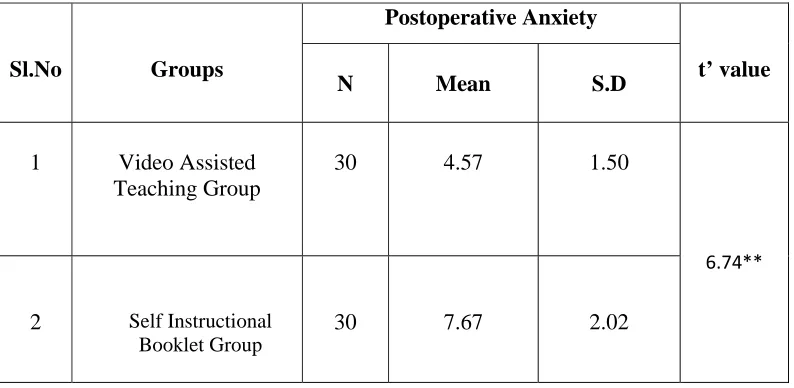
Comparison of Postoperative Anxiety scores of the subjects in Video Assisted Teaching Group and Self Instructional Booklet Group
. Note: **significant at 0.01 level
In Table-2, the obtained t’ value was 6.74 for Postoperative Anxiety of Video Assisted Preoperative Teaching and Preoperative Self Instructional Booklet which was significant at 0.01 level. It was found out that there was a significant difference between Video Assisted Preoperative Teaching and Preoperative Self Instructional Booklet on reducing Postoperative Anxiety. By comparing the mean scores of Video Assisted Preoperative Teaching (
x¯
= 4.57) were had a better impact on reducing the Postoperative Anxiety than Preoperative Self Instructional Booklet (
x¯
= 7.67).
Sl.No Groups
Postoperative Anxiety
t’ value
N Mean S.D
1 Video Assisted Teaching Group
30 4.57 1.50
6.74**
2 Self Instructional Booklet Group
Table- 3
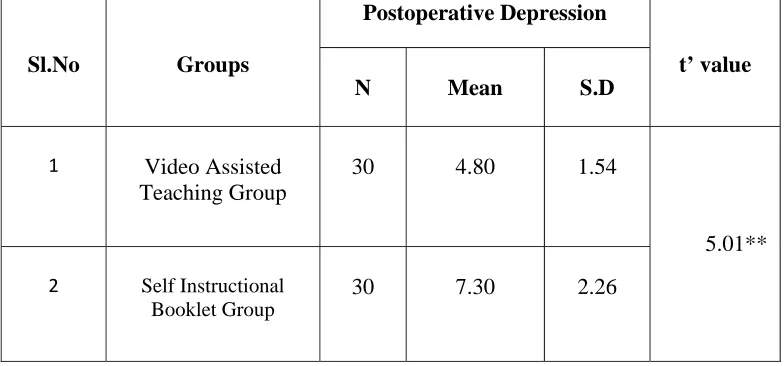
Comparison of Postoperative Depression scores of the subjects in Video Assisted Teaching Group and Self Instructional Booklet Group
Sl.No Groups
Postoperative Depression
t’ value
N Mean S.D
1 Video Assisted Teaching Group
30 4.80 1.54
5.01**
2 Self Instructional Booklet Group
30 7.30 2.26
**significant at 0.01 level
F b G
igure-7: Com etween the s Group
Video
Postoperative Anxiety
and
D
ep
re
ss
ion
Me
an
mparison of subjects in V o Assisted Te 4and
Depr
ession
Mean
mean scores Video Assiste eaching Grou S 4.57 4Hospital Anx
s of the Post ed Teaching up
Self Instruct 4.8
xiety H
toperative An Group and tional Bookle
7.67
Hospital Dep
nxiety and D dSelf Instruct
et Group 7.3
ression
Section III
Comparison of effectiveness of Video Assisted Pre-operative Teaching and Preoperative Self Instructional Booklet on Postoperative Physiological parameters
Table – 4
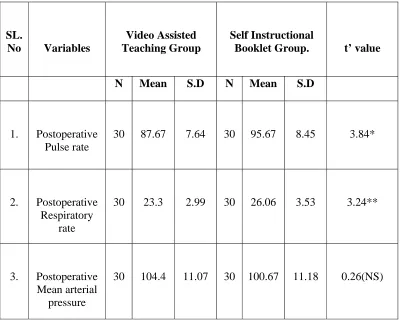
Comparison of Postoperative Physiological parameters of the subjects in Video Assisted Teaching Group and Self Instructional Booklet Group.
[image:48.612.124.524.228.548.2]Note: **significant at <0.01 level.* significant at <0.05 level.
Table-4 The obtained t’ value for Pulse rate in postoperative period of the subjects in Video Assisted Teaching and Self Instructional Booklet Group were 3.84, it was significant at <0.05 level. Hence it reveals that there was a significant difference that exist in the Postoperative period Pulse rate of the subjects in Video Assisted Teaching Group and Self Instructional Booklet Group. By comparing the mean scores, it
SL.
No Variables
Video Assisted Teaching Group
Self Instructional
Booklet Group. t’ value
N Mean S.D N Mean S.D
1. Postoperative Pulse rate
30 87.67 7.64 30 95.67 8.45 3.84*
2. Postoperative Respiratory
rate
30 23.3 2.99 30 26.06 3.53 3.24**
3. Postoperative Mean arterial
pressure
was suggested that the Video Assisted Preoperative Teaching(
x¯
= 87.67) had more influence on Postoperative period Pulse rate than Preoperative Self Instructional Booklet (
x¯
= 95.67) .
The t’ value obtained for the Postoperative period Respiratory rate of the subjects in Video Assisted Teaching and Self Instructional Booklet Group were 3.24 and it was significant at 0.01 level. It states that there was significant differences that exist among Postoperative period Respiratory rate of Video Assisted Preoperative Teaching and Preoperative Self Instructional Booklet. This was explained that Video Assisted Preoperative Teaching (
x¯
= 23.3) had more influence on Postoperative period Respiratory rate than Preoperative Self Instructional Booklet(x¯
=
26.06).
The t’ value of 0.26 obtained between both Video Assisted Teaching Group and Self Instructional Booklet Group on Postoperative period Blood pressure was not significant. Hence it is evident that there was no significant difference in both interventions on Blood pressure in the postoperative period.
F T F A igure-8: Co Teaching Gro igure-9: Com Assisted Teac
Video As
Postoperative period
Pu
lse rate Me
an Vid P o stop erative p eriod Respirato
ry rate Mean
RE
omparison o oup and Self
mparison of ching Group
ssisted Teach
PULS
deo AssistedESPIRATO
of Postopera Instructional Postoperati p and Self In hing Group87.67
SE RATE I
d Teaching G 23.3
ORY RAT
ative Pulse Booklet Gro
ive period R nstructional Bo
Self Inst
IN POSTO
Group Self 3
TE IN POS
rate of sub up
Respiratory ra ooklet Group tructional Bo
OPERATIV
Instructiona
ST-OPERA
bjects in Vi
ate of subjec p.
ooklet Group
95.67
VE PERIO
al Booklet G 26.06
ATIVE PER
ideo Assiste
cts in Video
p
D
roup
RIOD
Figure-10: C A Video A
Postoperative period Bl
d
M
Comparison Assisted Tea Assisted Teac
Blood
pr
es
su
re
Mean
BLOO
of Postopera aching Grou ching Group
104.4
OD PRESS
ative period up and Self In p
Self In
SURE IN P
Blood press nstructional B structional B
POSTOPE
sure of subje Booklet Group Booklet Grou
100.67
ERATIVE P
ects in Video p
up
PERIOD
SECTION-IV
[image:52.612.121.520.214.469.2]Correlation between the Postoperative Anxiety and Depression, Mean arterial pressure of subjects with CABG.
Table -5
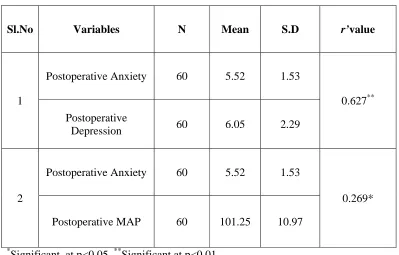
Correlation between the Postoperative Anxiety and Depression, Mean arterial
pressure of patients subjected to CABG.
Sl.No Variables N Mean S.D r’value
1
Postoperative Anxiety 60 5.52 1.53
0.627** Postoperative
Depression 60 6.05 2.29
2
Postoperative Anxiety 60 5.52 1.53
0.269* Postoperative MAP 60 101.25 10.97
*
Significant at p<0.05, **Significant at p<0.01
Table-5 shows that Postoperative Depression, and Postoperative Mean arterial pressure had relationship with Postoperative Anxiety of patients subjected to CABG. To specify in order, Postoperative Anxiety had significant positive relationships with
SECTION-V
[image:53.612.122.520.215.611.2]Association between Postoperative Anxiety and Depression with demographic variables
Table-6
Association between Postoperative Anxiety of patients subjected to CABG and selected demographic variables
N=60
Groups Demographic variables Postoperative Anxiety One way anova ‘F Mean S.D
Video Assisted Teaching Group
Age
0.422 (NS) a) 40-50 5.00 0 .894
b) 50-60 4.25 1.035
c) 60-70 4.69 1.887
Education
1.183 (NS) a) Primary 4.50 1.049 b) Secondary 4.31 1.182 c) Degree/diploma 5.09 2.023
Self Instructional Booklet Group
Age
1.152 (NS)
a) 40-50 6.71 2.360
b) 50-60 8.20 1.398
c) 60-70 7.77 2.204
Education
1.111 (NS) a) Primary 8.33 1.803 b) Secondary 7.69 2.057 c) Degree/diploma 6.88 2.167
there was no significant difference in Postoperative Anxiety among subjects in various age groups and it concluded that age had no impact on Postoperative Anxiety.
The obtained “F” value for the educational level of the subjects in Video Assisted Teaching Group and Self Instructional Booklet Group were 1.183 and 1.111 respectively. The obtained “F” value was not significant at any level and it explains that there was no significant difference in Postoperative Anxiety among subjects there in various educational level. Hence it was concluded that education had no impact on Postoperative Anxiety
Table- 7
Association between Post operative Anxiety of the patients subjected to CABG and their Sex. N=60
In Table-7,The obtained t’ values between males and females in Video Assisted Teaching Group and Self Instructional Booklet Group were 1.240 and 1.443 respectively. These values were not significant at any level. Hence it concluded that there was no influence of sex on Postoperative Anxiety among subjects in both groups
Groups Postoperative Anxiety “t” value
Sex Mean S.D
Video Assisted Teaching Group Male 4.36 1.560 1.240 (NS) Female 5.13 1.246 Self Instructional Booklet Group
Male 7.46 2.083
and it was obvious that there was no relationship found between sex and Postoperative Anxiety.
Table-8
Association between Postoperative Depression of patients subjected to CABG and
selected demographic variables. N=60
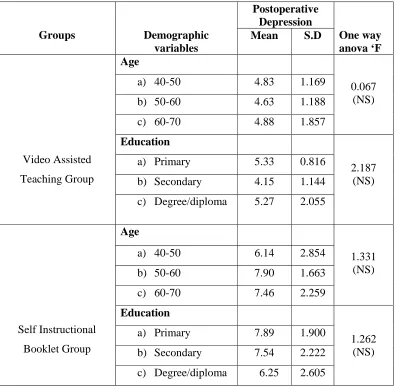
In Table-8, The table shows the “F” value for various age groups of the subjects in Video Assisted Teaching Group and Self Instructional Booklet Group were 0.067 and 1.331 respectively. The obtained “F” values were not significant at any level and it reveals that there was no significant difference in Postoperative
Groups Demographic variables Postoperative Depression One way anova ‘F Mean S.D Video Assisted Teaching Group Age 0.067 (NS)
a) 40-50 4.83 1.169
b) 50-60 4.63 1.188
c) 60-70 4.88 1.857
Education
2.187 (NS) a) Primary 5.33 0.816 b) Secondary 4.15 1.144 c) Degree/diploma 5.27 2.055
Self Instructional Booklet Group
Age
1.331 (NS)
a) 40-50 6.14 2.854
b) 50-60 7.90 1.663
c) 60-70 7.46 2.259
Education
Depression among subjects in both groups of various age groups and it concluded that age had no effect on Postoperative Depression.
[image:56.612.124.519.385.647.2]Regarding education, the obtained “F” value for the educational level of the subjects in Video Assisted Teaching Group and Self Instructional Booklet Group were 2.187 and 1.262 respectively. The obtained “F” value was not significant at any level and it explains that there was no significant differences in Postoperative Depression among subjects in both groups were there in various educational level. Hence it concluded that education had no impact Postoperative Depression.
Table- 9
Association between Postoperative Depression score of patients subjected to CABG and their Sex.
N=60
Group Sex
Postoperative Depression
“t” value Mean
S.D
Video Assisted Teaching Group
Male
4.55 1.535
1.536 (NS) Female
5.50 1.414
Self Instructional Booklet Group
Male
7.15 2.395
0.900(NS) Female
CHAPTER -V
DISCUSSION, SUMMARY, CONCLUSION, IMPLICATIONS,
LIMITATION AND RECOMMENDATIONS.
DISCUSSION
The present study was aimed to evaluate the effectiveness of Video Assisted Preoperative Teaching and Preoperative Self Instructional Booklet on Postoperative Anxiety, Depression and Physiological Parameters among patients subjected to CABG.
To find out the effectiveness of Video Assisted Preoperative Teaching and Preoperative Self Instructional Booklet, the researcher In this study the researcher selected 2 groups, patients in Group-1 received teaching with Computer and in Group-2 received Preoperative Self Instructional booklet. Out of 30 subjects in the Video Assisted Teaching Group, 22(73.3%) were males. Among them 16 (53.3%) were between the age group of 60-70 years, 8(26.7%) were between 50-60 years and 6(20%) between 40-50years.Regarding the education, 13(43.3%) had secondary education, 11(36.7%) had degree or diploma and 6(20.0%) had primary education.
In the Self Instructional Booklet Group, out of 30 subjects 26(86.7%) were males and 4(13.3%) were females. Among them 13 (43.3%) were between the age group of 60-70 years, 10(33.3%) were between 50-60 years and 7(23.3%) between 40-50years.Regarding the education, 13(43.3%) had secondary education, 8(26.7%) had degree or diploma and 9(30.0%) had primary education.
The data were analysed and they were based on the objectives as follows.
The first objective of the study was to compare the effectiveness of Computer Assisted Preoperative Teaching and Preoperative Self Instructional Booklet on the Postoperative Anxiety, Depression and Physiological Variables.