Copyright © 2000, American Society for Microbiology. All Rights Reserved.
Mutations of the Kissing-Loop Dimerization Sequence Influence the
Site Specificity of Murine Leukemia Virus Recombination In Vivo
JACOB GIEHM MIKKELSEN,1ANDERS H. LUND,1MOGENS DUCH,1ANDFINN SKOU PEDERSEN1,2*
Department of Molecular and Structural Biology1and Department of Medical Microbiology
and Immunology,2University of Aarhus, DK-8000 Aarhus, Denmark
Received 9 July 1999/Accepted 6 October 1999
The genetic information of retroviruses is retained within a dimeric RNA genome held together by
inter-molecular RNA-RNA interactions near the 5ⴕ ends. Coencapsidation of retrovirus-derived RNA molecules
allows frequent template switching of the virus-encoded reverse transcriptase during DNA synthesis in newly
infected cells. We have previously shown that template shifts within the 5ⴕleader of murine leukemia viruses
occur preferentially within the kissing stem-loop motif, aciselement crucial for in vitro RNA dimer formation.
By use of a forced recombination approach based on single-cycle transfer of Akv murine leukemia virus-based vectors harboring defective primer binding site sequences, we now report that modifications of the kissing-loop structure, ranging from a deletion of the entire sequence to introduction of a single point mutation in the loop
motif, significantly disturb site specificity of recombination within the highly structured 5ⴕleader region. In
addition, we find that an intact kissing-loop sequence favors optimal RNA encapsidation and vector trans-duction. Our data are consistent with the kissing-loop dimerization model and suggest that a direct intermo-lecular RNA-RNA interaction, here mediated by palindromic loop sequences within the mature genomic RNA dimer, facilitates hotspot template switching during retroviral cDNA synthesis in vivo.
The diploid genome of retroviruses is composed of two full-length viral RNA transcripts linked by intermolecular inter-actions near their 5⬘ ends, as demonstrated by early electron microscopy (41). The primary linkage site, designated the dim-er linkage structure, has been mapped within the 5⬘leader se-quence in a region that colocalizes withciselements consti-tuting the packaging signal (⌿) required for selective RNA encapsidation into assembling virions. The conformation of this region is altered upon dimerization, suggesting that structural changes caused by dimer formation may create an overall ter-tiary structure or lead to the exposure of specific RNA struc-tures that are recognized by virus-encoded proteins during the RNA packaging process (58). Close coupling between the dimer-ization and encapsidation processes is supported also by the find-ing that dimeric RNA can be extracted from virions immedi-ately after budding from the cell surface, indicating that dimer formation occurs prior to virus assembly (21). After virus re-lease, the dimeric genome is converted to a stable and more mature form in a process facilitated by the RNA chaperone activity of the virus-encoded nucleocapsid protein (18, 20).
The matured and structurally rearranged RNA dimer serves as substrate for double-stranded DNA synthesis by reverse transcriptase within the internalized core particle. Reverse transcription is primed by the 3⬘ end of a host cell-derived tRNA molecule annealed to the primer binding site (PBS) (for recent review, see reference 33). Completion of the process requires two consecutive strand transfer reactions during mi-nus- and plus-strand synthesis. It is not known to what extent a specific secondary or tertiary dimer structure is essential for efficient initiation and completion of the process (5, 60). The presence of two genomic RNAs within each virion allows the reverse transcriptase to switch templates during RNA-depen-dent minus-strand DNA synthesis (26, 52) and
DNA-depen-dent plus-strand DNA synthesis (29, 37). Reverse transcrip-tase-mediated recombination can occur only between RNAs copackaged into the same virion (25); at present, however, it is not known whether a physical linkage between copackaged RNAs is required for template switching to occur. In a number of cases, genetic interactions have been found among retroviral genomes harboring pronounced sequence dissimilarities within the combined RNA dimerization and packaging region (28, 62) and among copackaged heterologous RNAs of viral and cel-lular origin (53, 55, 63), suggesting that homology within the primary interaction site is dispensable for generation of recom- binantproviralsequences.Itremainsuncertain,however,wheth-er such hetbinantproviralsequences.Itremainsuncertain,however,wheth-erologous RNAs in rare cases may be packaged as monomers or form heterodimers based on linkages at alterna-tive sites.
Synthetic retrovirus RNA dimerizes spontaneously under appropriate salt and temperature conditions (45, 48, 58), sug-gesting that dimerization is facilitated by direct RNA-RNA interactions. The nucleocapsid moiety of the Gag polyprotein enhances dimer formation in vitro (13, 23, 57) and is thought to play an important role during RNA dimerization in vivo. In vitro dimer formation involves a relatively short sequence within the 5⬘untranslated region (UTR), as shown by thermo-stability studies (48), comparison of antisense DNA oligonu-cleotide accessibility in monomer and dimer RNA (22, 47), chemical modification studies of monomer and dimer RNA (50, 58), and dimerization studies of truncated and internally deleted RNA fragments (22, 30, 47). Such in vitro approaches define for a number of retroviruses a narrow dimerization segment potentially forming a stem-loop structure within the highly structured 5⬘leader sequence (1, 3, 58). Conformational changes of this stem-loop structure are likely to contribute to the dimerization process (22). The dimer-forming stem ex-poses a palindromic loop motif and therefore holds the poten-tial to interact by Watson-Crick base pairing, or loop-loop “kissing,” with a similar loop sequence (40). Deletion of the entire stem-loop and single-base substitutions introduced into the kissing stem-loop structure abolish synthetic RNA dimer-* Corresponding author. Mailing address: Department of Molecular
and Structural Biology, University of Aarhus, C. F. Moellers Alle´, Bldg. 130, DK-8000 Aarhus, Denmark. Phone: 45 89422614. Fax: 45 86196500. E-mail: [email protected].
600
on November 9, 2019 by guest
http://jvi.asm.org/
ization, whereas compensatory changes introduced into the loop or stem restore dimer formation (11, 44). RNA dimeriza-tion triggered by the initial loop-loop recognidimeriza-tion is followed, possibly, by unfolding of the stems and formation of an ex-tended RNA-RNA duplex, representing thus a local antipar-allel linkage of the two RNAs (23) and may be accompanied by intermolecular association of stem-loops elsewhere in the 5⬘ leader (16).
The involvement of the kissing-loop in formation of retro-virus RNA dimers remains to be directly demonstrated in vivo. The kissing-loop sequence is dispensable for virus replication, although reduced replication efficiencies and RNA encapsida-tion defects, possibly reflecting a defect in the level of RNA dimerization, have been reported for mutants harboring severe modifications or more fine-tuned alterations of the kissing-loop (6, 19, 30, 35, 39, 42). Dimeric RNA can be extracted from loop-mutated virions, suggesting that the kissing-loop structure is not essential for dimerization in vivo (6, 9, 24). However, viruses harboring a defective kissing-loop sequence appear to contain less dimeric RNA than wild-type viruses (24, 31). No-tably, the stability of human immunodeficiency virus type 1 (HIV-1) RNA dimers remains unaffected by mutations intro-duced into the kissing-loop (6, 9, 24, 49). This observation possibly reflects that a kissing-loop interaction supposed to initiate dimer formation is resolved at some point after virus assembly and lends support to the idea that alternative and perhaps less stringent linkage sites exist within the RNA dimer (2, 6, 54, 56).
By utilization of a forced recombination approach based on single-cycle transfer of Akv murine leukemia virus (MLV)-derived vectors harboring defective PBS sequences, our previ-ous work has focused on events of template switching within the 5⬘leader region. Transfer of the growing minus strand was found to occur predominantly within a narrow region of the leader sequence coinciding precisely with the kissing-loop dimerization motif (36, 38), which raised the possibility that site specificity of recombination within the 5⬘ leader is gov-erned by RNA secondary structures and specific intermolecu-lar interactions at the junction site. To further assess the role played by the kissing loop in MLV replication and recombina-tion, transduction experiments were performed with vectors harboring deletions and single-base substitutions at the recom-binational hotspot kissing-loop sequence. We conclude from these investigations that an intact kissing-loop sequence is re-quired for optimal vector transduction and RNA encapsidation and furthermore, as determined by forced recombination stud-ies, that even minor modifications of the palindromic loop sequence may disturb site specificity and lead to nonclustered events of template switching. These results support the kissing-loop dimerization model and suggest that a restored interac-tion of palindromic loops within the mature dimer facilitates template switching during reverse transcription.
MATERIALS AND METHODS
Vector construction.Alterations of the kissing-loop dimerization sequence were introduced into Akv MLV-based retroviral vectors harboring either the wild-type proline PBS (PBS-Pro) sequence or a nonfunctional mutated PBS-Umu sequence (36). These vectors, designated PBSProKLwtAkv-neoand PBSUmuKLwtAkv-neo, respectively, contain Akv MLV long terminal repeats (LTRs) as well as the neomycin resistance gene (neo) flanked upstream by the 5⬘
255 bp of the MLV 5⬘leader region and downstream by 480-bp Akv MLV sequences including the 3⬘UTR. Kissing-loop modifications were introduced by two-step PCR-mediated site-directed mutagenesis similar to strategies previously described (32, 36). Briefly, the 5⬘part of the vector was amplified, generating a 769-bp fragment carrying the desired mutations in the kissing-loop sequence. The amplified sequence was subsequently connected by overlap extension and PCR with a downstream PCR fragment harboring the 3⬘part of the leader region and part ofneo. The amplified fragment encompassing the 5⬘LTR, wild-type or
modified PBS, 5⬘UTR, and part ofneowas digested and cloned by standard procedures into the appropriate position of the Akv vector.
The following oligonucleotides were used for introduction of modified kissing stem-loop sequences into PBS-ProKLwtAkv-neoand PBSUmuKLwtAkv-neo
(kissing stem-loop sequence underlined): ON1 (Akv MLV positions 283 to 335 [59]), 5⬘-GAGCCGCCAGATACAGAT(⌬ 16)TACAGAATCAGACGCAGGC-3⬘, introducing a 16-bp deletion of the kissing stem-loop (KL⌬16); ON2 (Akv positions 294 to 332), 5⬘-CCGCCAGATACAGATCTAGTACTAGTACAGAA T-3⬘, introducing a 6-bp deletion of the kissing-loop (KL⌬6); ON3 (Akv positions 302 to 332), 5⬘-CCGCCAGATACAGATCTAGTTAGCAAACTAGT, introduc-ing a sintroduc-ingle-base-pair substitution within the loop motif (KL-TTGCTA); ON4 and ON5 (Akv positions 294 to 332), 5⬘-CCGCCAGATACAGATCTAGTTAG
AGCACTAGTACAGAAT-3⬘ and 5⬘-CCGCCAGATACAGATCTAGTGCTA GCACTAGTACAGAAT-3⬘, introducing a 3-bp substitution (KL-GCTCTA) and an alternative loop sequence (KL-GCTAGC), respectively. Mutations gen-erating loop substitutions are indicated in boldface. ON6 (5⬘-TAGATCTGTAT CTGGCGG-3⬘[matching Akv MLV positions 315 to 332]) was used to PCR amplify downstream sequences, generating a fragment with an 18-bp overlap with fragments harboring kissing-loop modifications. Other primers used in the mutagenesis procedure have been described previously (32).
Cells, transfections, and virus infections.⌿2 (34) and NIH 3T3 cells were grown in Dulbecco modified Eagle medium with Glutamax-1 supplemented with 10% newborn calf serum, 100 U of penicillin per ml, and 100g of streptomycin per ml. Cells were incubated at 37°C in 90% relative humidity and 5.7% CO2.
Ten micrograms of vector plasmid DNA was transfected by calcium phosphate treatment into⌿2 packaging cells seeded at 5⫻103cells per cm2on the day
before transfection. Two days after transfection, G418-containing medium (0.6 mg/ml) was added to select for stably integrated kissing-loop-modified vectors. G418-resistant colonies appearing after 12 days of selection were pooled. Trans-duction efficiencies were determined as follows. Producer cells were seeded at maximum density (ca. 105cells per cm2) and allowed to attach; the medium was
renewed and left on the cells for 1 day. Filtered and serially diluted virus-containing medium was transferred to NIH 3T3 cells (seeded at 5⫻103cells per
cm2the day before infection) in the presence of Polybrene (6g/ml).
G418-containing medium (0.6 mg/ml) was added 2 days after infection, and resistant colonies were counted and individually expanded after 10 days of selection. Obtained titers were normalized for the number of producer cells, as determined immediately after virus harvest. In transduction experiments set up for PCR-based screening for recombinant proviruses, G418-resistant NIH 3T3 colonies appearing on each plate were pooled to allow for screening among a large number of transduction events. For this purpose, virus-containing medium was diluted to obtain 10 to 30 G418-resistant colonies per plate.
Proviral DNA analysis and PCR-based screening for recombinant proviruses.
Genomic DNA from G418-resistant clones and colony pools was prepared as previously described (32). Digestion or sequence analysis of individual trans-duced vector sequences was performed on PCR products encompassing part of the 5⬘LTR, the PBS, the 5⬘UTR, and the upstream part ofneo. The PCR was performed with ON7 (5⬘-TTCATAAGGCTTAGCCAGCTAACTGCAG-3⬘
[matching Akv MLV positions 7838 to 7865 [59]) and ON8 (5⬘-GGCGCCCCT GCGCTGACAGCCGGAACAC-3⬘[matchingneopositions 1656 to 1683 [4]). The resulting PCR product was digested withBstBI, which cleaves specifically within the modified PBS-Umu sequence, and potential recombinants were sequenced with ON9 (5⬘-TCCGAATCGTGGTCTCGCTGATCCTTGG-3⬘[matching po-sitions 69 to 96 within the Akv U5 region [59]) and ON10 (5⬘-CTTCCTTTAG CAGCCCTTGCGC-3⬘, [matchingneopositions 1223 to 1244]).
PCR amplification performed on genomic DNA prepared from colony pools (obtained by pooling of all resistant colonies appearing on single plates) was used to detect among multiple transduced proviruses Akv-MLV-like endogenous vi-rus (MLEV) recombinants that were generated during vector transduction. Screening for 5⬘UTR recombination between Akv and MLEV was performed with aneo-specific primer (ON8) and ON11 (5⬘-GTCTTTCATTTGGAGGTC CCA-3⬘[matching the MLEV-derived glutamine PBS {PBS-Gln}). The resulting PCR product (if any) was sequenced with ON10 and ON11.ON12 (5⬘-GCCCG GGTACCCGTATTC-3⬘) and ON13 (5⬘-GCCCGGGTACCCGTATTC-3⬘), spe-cifically recognizing PBS-Umu and a genetic marker (designated IX) within the MLEV R region (37), respectively, were used to screen for Akv-MLEV recom-binant proviruses that had retained PBS-Umu.
RNA preparation and dot-blot analysis.For RNA dot blot analysis, 20-ml aliquots of virus-containing medium were collected from confluent stably trans-fected⌿2 packaging cells and from NIH 3T3 cells included as a negative control. Two-milliliter aliquots of medium derived from a⌿2 packaging cell line stably transfected with an MLV-derived retroviral vector expressing the hygromycin B resistance gene (hyg) were added to each supernatant sample. Total virion RNA was purified from 12 1.5-ml volumes of supernatant by pelleting virus particles at 4°C for 1 h at 17,000⫻gin a benchtop centrifuge (Heraeus Biofuge 13) followed by guanidinium thiocyanate-phenol-chloroform extraction and subsequent pre-cipitation (8). The number of producer cells was determined for each stably transfected cell line. Cellular RNA extraction was carried out by guanidinium thiocyanate treatment and subsequent precipitation. Virion and cellular RNA was serially diluted and blotted onto a Zetaprobe filter (Bio-Rad), using a dot blot manifold.neoandhyg, vector-specific RNA levels were determined by hybridizations with32P-labeled probes forneoandhyg, respectively. Cellular
VOL. 74, 2000 KISSING-LOOP-MODIFIED MLV VECTOR RECOMBINATION 601
on November 9, 2019 by guest
http://jvi.asm.org/
vector RNA levels were normalized for glyceraldehyde-3-phosphate dehydroge-nase (GAPDH) RNA expression determined by hybridization with a GAPDH-specific probe. Dot blots were quantified with a PhosphorImager SF (Molecular Dynamics), and the relative virion RNA contents (virionneoRNA/cellneo
RNA) were normalized forhygvector RNA level, the number of producer cells, and the cellular level ofneovector RNA relative to GAPDH RNA.
Dot blot assay measurement of NPTII activity.Assays for neomycin phospho-transferase II (NPTII) activity were carried out essentially as described by Platt and Yang (46) and Duch et al. (17). Briefly, for each of the constructs studied, 3.75⫻105G418-resistant⌿2 packaging cells were centrifuged, washed twice
with 200l of phosphate-buffered saline, and resuspended in 100l of 0.135 M Tris-HCl (pH 6.8)–20% glycerol–4 mM dithiothreitol. Crude cell extracts were prepared by submitting cells to four rounds of freeze-thawing and subsequently removal of cell debris by centrifugation. NPTII activities were determined by mixing 20, 10, 5, or 2.5l of the various cell extracts with 200l of 67 mM Tris-HCl (pH 7.1)–42 mM MgCl2–400 mM NH4Cl–40g of kanamycin SO4–2.5
to 10Ci of [␥-32P]ATP per ml. Mixtures, left for 135 min at 27°C, were filtrated
on a dot blot manifold through a filter sandwich composed of nitrocellulose (Schleicher & Schuell), which binds total protein, and phosphocellulose (What-man), which binds positively charged kanamycin phosphate. The amount of phosphorylated kanamycin bound to the phosphocellulose membrane was quan-tified with a PhosphorImager SF (Molecular Dynamics). PhosphorImager scan-ning of the protein dots on the nitrocellulose membrane showed signals with a linear relationship with the amount of cell extract used. Hence, NPTII activities were normalized for the total protein kinase activity in the various cell extracts used as a relative measure for the total protein content.
RESULTS
Reduced replication of kissing-loop-modified vectors.To
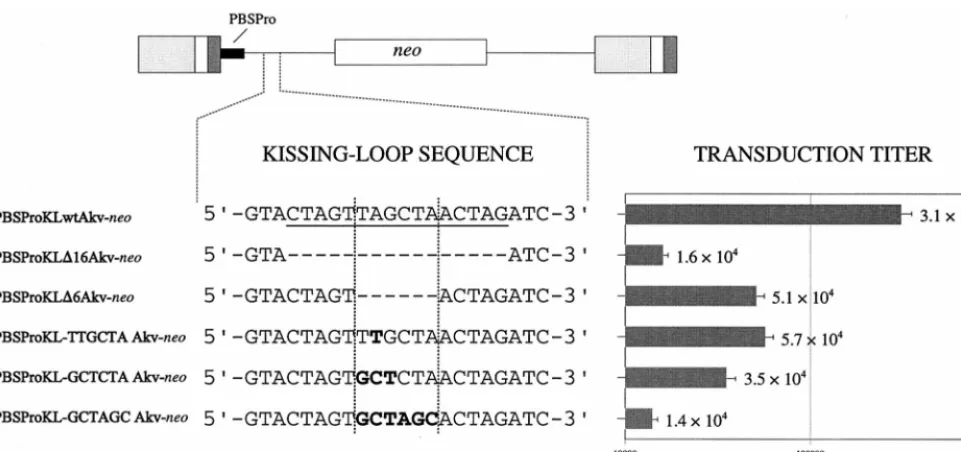
in-vestigate the role played by the kissing stem-loop in MLV replication and recombination, five kissing-loop-modified Akv MLV-derived vectors, carrying theneoselective marker gene, were generated. The kissing stem-loop is composed of a 5-bp RNA duplex stem and a six-nucleotide palindromic loop se-quence (5⬘-UAGCUA-3⬘) is supposed to mediate a direct in-teraction with the kissing-loop palindrome of the copack-aged genomic RNA molecule. Two vectors were designed to harbor a deletion of the entire 16-bp kissing-loop sequence (PBSProKL⌬16) and the 6-bp loop motif (PBSProKL⌬6), whereas nucleotide substitutions were introduced into the loop sequence of the remaining vector mutants (Fig. 1). In
PBSProKL-TTGCTA, the second position of the loop was altered to create a loop sequence which can form only four of six potential Watson-Crick base pairs within the putative loop-loop interaction. In mutant PBSProKL-GCTCTA, the three most 5⬘positions of the palindrome were modified, generating a loop motif unlikely to participate in loop-loop recognition during homodimer formation due to mismatches at all posi-tions at the putative interaction site. In PBSProKL-GCTAGC, the entire loop sequence was replaced by an alternative palin-dromic sequence providing, in theory, perfect base pairing within the potential loop-loop recognition site.
To analyze the effect of introducing deletions and substitu-tions into the kissing-loop sequence, vector transduction effi-ciencies were measured from⌿2 packaging cells (34) stably transfected with the engineered constructs. Viral titers were determined by transferring the virus-containing⌿2 superna-tant to NIH 3T3 target cells followed by G418 selection. As depicted in Fig. 1, titers of kissing-loop-mutated vectors were reduced at most 22-fold compared to the unmodified vector. Hence, average titers ranged from 1.4⫻104for PBSProKL-GCTAGC to 3.1⫻105for the wild-type vector. Titers 19-, 9-, 6-, and 5-fold below the wild-type replication level were ob-tained for PBSProKL⌬16, PBSProKL-GCTCTA, PBSProKL⌬6, and PBSProKL-TTGCTA, respectively.
RNA encapsidation deficiency of kissing-loop-modified
vec-tors.To decipher whether defects in the RNA encapsidation
process account for the observed reduction in viral titers, rel-ative quantities of genomic RNA packaged into⌿2-derived virions were determined for the panel of kissing-loop-modified vectors. The wild-type vector and a⌿-deficient Akv-derived vector (38a) were included in these experiments as positive and negative controls, respectively. Virus-containing supernatant was collected from confluent stably transfected⌿2 producer cell lines and from NIH 3T3 cells included as an additional negative control. RNA extracted from virions and producer cells was serially diluted and analyzed by dot blot analysis (Fig. 2A), and the relative vector RNA content was for each
con-FIG. 1. Transduction efficiencies of kissing-loop-modified vectors. The Akv kissing-loop sequence is shown at the top (underlined). Five kissing-loop-modified vector constructs, shown below the wild-type sequence, were generated. Deleted nucleotide positions are indicated by hyphens. Nucleotide substitutions within the loop motif (framed by broken lines) are indicated by boldface letters. Transduction titers were measured by counting the G418-resistant colonies appearing per milliliter of virus-containing medium transferred from stably transfected⌿2 packaging cells to NIH 3T3 cells. Titers are based on five independent experiments performed with three independent sets of stably transfected cell lines. Standard deviations are indicated by error bars.
on November 9, 2019 by guest
http://jvi.asm.org/
[image:3.612.63.544.72.298.2]struct determined as the level of virusneoRNA relative to the cellular level ofneoRNA.
As evident from the normalized values depicted in Fig. 2B, RNA encapsidation was reduced for all kissing-loop-modified vectors. Packaging efficiencies of kissing-loop mutants thus ranged from 8- to 15-fold below the wild-type level, consistent with the notion that the kissing loop, although perhaps indi-rectly, is part of the MLV packaging signal. Notably, the de-crease in encapsidation of RNA measured for all mutants was found to reasonably mimic the observed replication deficiency, indicating that the effect of introducing mutations into the kissing loop was exerted at the level of RNA packaging in particular. However, it cannot be excluded that packaging de-fects may only partly explain differences in viral titers and that alternative stages of the replication cycle were also affected by the kissing-loop alterations. Therefore, as an attempt to eval-uate whether the introduced kissing-loop deletions and substi-tutions influenced the level of neo production at a posttran-scriptional stage, we used a sensitive dot blot assay to measure the activity of theneo-encoded NPTII in cell extracts prepared from G418-selected packaging cells (17). NPTII activities, nor-malized for the total protein content, were found to be reduced twofold or less in all ⌿2 cell lines harboring kissing-loop-modified proviruses compared to the wild-type level (data not shown). Since the cellular level of vector-derived RNA was higher (approximately twofold) for all mutant-containing cell lines (Fig. 2A, lower panel), the relative NPTII protein/neo RNA ratios were reduced between three- and fourfold in com-parison with the wild type. These results likely reflect that a higher level of kissing-loop-mutatedneo RNA is required to obtain G418 resistance, reflecting that the introduced muta-tions might affect also posttranscriptional events of MLV gene expression.
Forced recombination in PBS- and kissing-loop-modified
vectors. The replication of MLV-derived vectors harboring
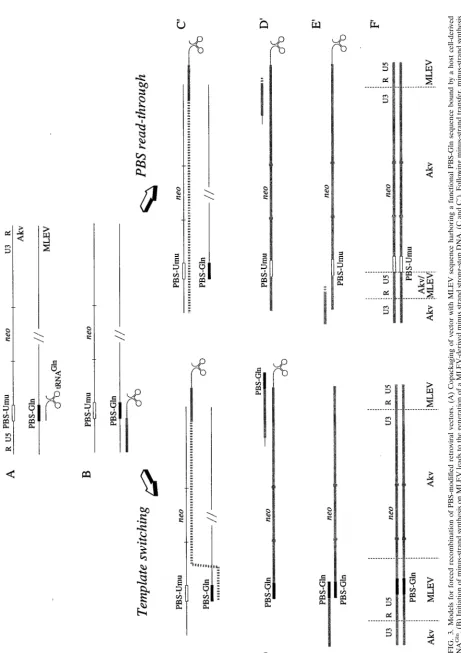
nonsense PBS sequences is strongly restricted (36), and such impaired vectors may thus rely on copackaging with viral se-quences harboring functional PBS sese-quences in order to be reverse transcribed in the early stage of infection. At present, two recombination-based rescue pathways have been identified (Fig. 3); both are based on initiation of minus-strand synthesis from the functional PBS-Gln of MLEV (36, 37). Recombinant proviruses harboring the repaired or the originally mutated PBS sequence are results of 5⬘ UTR template switching and PBS read-through during minus-strand DNA synthesis, respec-tively (Fig. 3F and F⬘).
In case of recombination within the 5⬘ UTR, template switching of nascent minus-strand DNA occurs site preferen-tially within the kissing-loop dimerization sequence (36, 38). Therefore, to further dissect the role played by the kissing-loop structure in recombination, we wanted to test whether muta-tions of the kissing-loop affect the crossover site specificity. For use in recombination studies, the PBS-Pro sequence of all kissing-loop-modified vectors was replaced by a defective PBS-Umu sequence, which does not match the 3⬘end of any known tRNA. In Akv-MLEV heterodimer formation involving the wild-type vector, perfect base pairing between the distinct kissing loops of Akv (5⬘-UAGCUA-3⬘) and MLEV (5⬘-UGG CUA-3⬘) is restored by U (Akv):G (MLEV) base pairing at the genetic marker position LM9 (Fig. 4). In contrast, vector RNAs harboring mutated kissing-loop sequences may possibly differ in their capabilities to form Akv-Akv homodimers and Akv-MLEV heterodimers, respectively. Hence, for the substi-tutions mutants KL-TTGCTA and KL-GCTCTA, only one and three mismatches were introduced into a possible RNA duplex formed with the MLEV kissing loop in Akv-MLEV heterodimers, whereas twice as many mismatches were ex-pected to affect Akv-Akv homodimer formation of these mu-tants. For the remaining mutants, Akv-MLEV heterodimers
FIG. 2. Reduced packaging of kissing-loop-modified RNAs into MLV particles. (A) Dot blot analysis of relative virion and cellular levels of wild-type and kissing-loop-modified vector RNAs. A⌿-deficient vector construct,⌬⌿(⌬183 bp), stably transfected into⌿2 cells and nontransfected NIH 3T3 cells were included as negative controls. Virion RNA was prepared from 20-ml aliquots of virus-containing supernatant collected from stably transfected⌿2 packaging cells. Cellular RNA was prepared from transfected packaging cells following cell counting. RNA was threefold serially diluted and blotted onto a Zetaprobe filter; blots were probed with a randomly primedneoprobe. As an internal control for RNA loss during viral RNA preparation, equal aliquots of virions containinghygvector RNA were added to virions prior to RNA preparation; blots were therefore also probed with ahyg-specific probe (not shown). GAPDH probing was used as an internal control for cellular RNA levels (not shown). (B) Relative virion RNA content normalized for virionhygvector RNA content, the number of producer cells, and the cellular level ofneo
vector relative to GAPDH RNA. Values are based on two independent dot blot experiments, and standard deviations are represented by error bars.
VOL. 74, 2000 KISSING-LOOP-MODIFIED MLV VECTOR RECOMBINATION 603
on November 9, 2019 by guest
http://jvi.asm.org/
FIG.
3.
Models
for
forced
recombination
of
PBS-modified
retroviral
vectors.
(A)
Copackaging
of
vector
with
MLEV
sequence
harboring
a
functional
PBS-Gln
sequence
bound
by
a
host
cell-derived
tRNA
Gln
.(B)
Initiation
of
minus-strand
synthesis
on
MLEV
leads
to
the
generation
of
a
MLEV-derived
minus
strand
strong-stop
DNA.
(C
and
C
⬘
).
Following
minus-strand
transfer,
minus-strand
synthesis
is
continued
through
the
neo
gene.
Template
switching
may
occur
between
neo
and
the
mutated
PBS
(36),
or
the
nascent
reverse
transcriptase
may
read
through
the
mutated
PBS
and
continue
until
reaching
the
5
⬘
terminus
of
the
vector
RNA
(37).
(D
and
D
⬘
)
Generation
of
full-length
and
incomplete
plus-strand
strong-stop
DNAs,
respectively.
(E
and
E
⬘
)
Second-strand
transfer
facilitated
by
complementary
PBS-Gln
sequences
or
by
R-U5
sequences.
(F
and
F
⬘
)
Akv-MLEV
recombinant
proviruses
harboring
repaired
and
originally
mutated
PBS,
respectively.
on November 9, 2019 by guest
http://jvi.asm.org/
[image:5.612.72.533.79.732.2]FIG. 4. 5 ⬘ UTR sequences of PBS-Gln-harboring transduced proviruses resulting from transfer of wild-type and kissing-loop-modified Akv vectors. The sequenc es of individual transduced proviruses were determined by sequence analysis of PCR fragments encompassing the Akv-MLEV chimeric 5 ⬘ UTR. Transduced viral sequences are compared with homologous regions of Akv (top) and MLEV (bottom). Subclones 2.1, 6.7, and 12.3 were derived from individual G418-resistant clones; the remaining sequences (except 2.24-a and -b, derived from the same plate) originate from PCR-base d screenings of colony pools (Table 1) obtained from separate plates and subsequent sequence analysis of resulting PCR products. Nucleotides similar to positions in Akv are indicated by hyphens; deleted nucleotides comp ared to Akv are indicated by colons (:); insertions are indicated by introduction of colons in the Akv sequence. Hatched areas indicate Akv-derived sequences. The asterisk in KL-GCTAGC 12.28 indicates the finding of the two most 5 ⬘ nucleotides of wild-type loop motif, demonstrating that template switching was inaccurate in recombinational repair of this mutant. The transduced proviruses 12.19 and 12.33 were generated by recombination not wi th MLEV but with a related sequence similar to the previously identified clone 621 (12). 605
on November 9, 2019 by guest
http://jvi.asm.org/
involving putative kissing-loop interactions were not likely to form more efficiently than Akv-Akv homodimers.
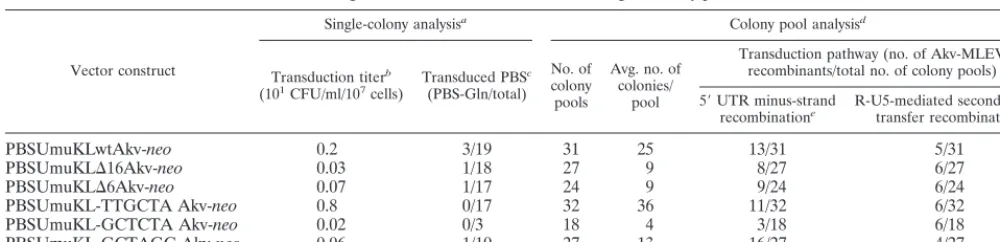
As expected, the replication efficiency of vectors harboring modifications within both the PBS and the kissing-loop region was strongly reduced compared to unmodified vectors (Fig. 1 and Table 1). To test whether rarely transduced proviruses were generated through recombinational patch repair of the PBS, the PBS composition of a total of 84 individually trans-duced proviruses conferring G418 resistance on NIH 3T3 target cells was analyzed. Fragments encompassing the trans-duced PBS were PCR amplified and subsequently digested withBstBI, which cleaves specifically within the PBS-Umu se-quence (data not shown). The majority of the transduced pro-viruses contained the PBS-Umu sequence, revealing a high background of transduction pathways in which the PBS had not been repaired. In 3 of 19 wild-type proviruses and in 3 of 65 kissing-loop-modified vector transfers, the PBS modifica-tion had been replaced by the MLEV-derived PBS-Gln (Table 1). Alternative recombination mechanisms based on PBS read-through (Fig. 3) or hitherto unknown transduction pathways may account for these background transfer events. Notably, this result also suggests that the kissing-loop structure is not essen-tial for recombination with copackaged endogenous viral RNA.
Sequence analysis of transduced recombinant 5ⴕUTRs
de-tected by PCR screening of colony pools. To investigate the
effect on site specificity of template switching within kissing-loop-modified 5⬘UTR sequences, we set out to screen a large number of transduced proviral sequences for Akv-MLEV re-combinants harboring PBS-Gln. For the various kissing-loop-modified constructs, a total of 128 colony pools were generated by pooling of G418-resistant NIH 3T3 colonies obtained on 128 separate plates, each containing on average 4 to 36 colo-nies, depending on the mutant studied (Table 1). Colony pools were screened with primers specifically matching PBS-Gln and sequences within theneogene, and amplicons were reproduc-ibly obtained in 47 of the 128 colony pools for the kissing-loop-modified vectors and in 13 of 31 wild-type colony pools. These findings indicated that each colony pool contained one or less 5⬘ UTR Akv-MLEV recombinant and that recombinant se-quences did not originate from PCR recombination between distinct recombinants within a pool or between transduced vectors and viral sequences endogenous to the target cells. All PCR products were sequenced with primers matching the PBS
and the upstream part ofneoto elucidate the pattern of genetic markers in each recombinant 5⬘ UTR sequence (Fig. 4) and thereby map the site of template shifting in individual repair events.
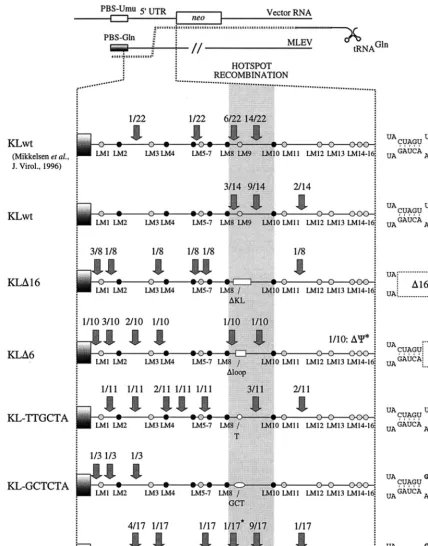
[image:7.612.53.553.92.213.2]The 5⬘UTRs of Akv and MLEV differ at scattered nucleo-tide leader marker (LM) positions dispersed throughout the region. This genetic marker-based division of the recombina-tional target sequence defines a panel of sequence identity win-dows (SIWI to SIWXIII), ranging in size from 6 to 27 nucleo-tides (Fig. 4). For the wild-type vector (referred to as PBS UmuKLwt), 12 of 14 template shifts were mapped within the 12- and 24-nucleotide Akv-MLEV SIWVIII and SIWIX inter-vening markers LM8 and LM10 (Fig. 5), providing indepen-dent confirmation that recombination within the 5⬘ UTR oc-curs site preferentially (36). In PBSUmuKL⌬16, a significant region of the recombinogenic site was removed and the lengths of SIWVIII and SIWIX were reduced to 6 and 15 nucleotides, respectively (Fig. 4). For this vector, all eight registered junction sites were mapped outside the hotspot region, per-haps as a result of reduced lengths of the SIWs flanking the deletion. For PBSUmuKL⌬6, 7 of 10 recombinant proviruses had been generated through template switching events in SIWs close to the PBS. One event was registered within each of the hotspot SIWs SIWVIII and SIWIX. In addition, one provi-rus was found to harbor a deletion of the downstream part of the 5⬘ UTR, indicating that template shifting in this case was not accurate. PBSUmuKL-TTGCTA harbors a single-nu-cleotide substitution exactly at the Akv-MLEV marker posi-tion LM9. Hence, this alteraposi-tion may interfere with funcposi-tions of the kissing-loop but does not change lengths of the flanking SIWs. Interestingly, recombination between this vector and MLEV occurred randomly within the target sequence; only 3 of 11 crossover sites were identified within the hotspot region, whereas the remaining junction sites were mapped within six distinct SIWs upstream and downstream of the kissing-loop domain (Fig. 5). For PBSUmuKL-GCTCTA, none of three identified template shifts had occurred within the kissing-loop region, indicating that function of the kissing-loop was dis-turbed by the nucleotide alterations introduced into the loop motif. PBSUmuKL-GCTAGC harbored an alternative palindromic loop sequence, which did not facilitate optimal kissing-loop function, as determined by virus titer experiments (Fig. 1). The kissing-loop sequence in this vector was therefore TABLE 1. Replication efficiencies of kissing-loop-modified vectors and detection of recombination with MLEV by analysis
of single colonies and PCR-based screening of colony pools
Vector construct
Single-colony analysisa Colony pool analysisd
Transduction titerb
(101CFU/ml/107cells) Transduced PBS c
(PBS-Gln/total) No. of colony pools
Avg. no. of colonies/
pool
Transduction pathway (no. of Akv-MLEV recombinants/total no. of colony pools)
5⬘UTR minus-strand
recombinatione R-U5-mediated second-strandtransfer recombinationf
PBSUmuKLwtAkv-neo 0.2 3/19 31 25 13/31 5/31
PBSUmuKL⌬16Akv-neo 0.03 1/18 27 9 8/27 6/27
PBSUmuKL⌬6Akv-neo 0.07 1/17 24 9 9/24 6/24
PBSUmuKL-TTGCTA Akv-neo 0.8 0/17 32 36 11/32 6/32
PBSUmuKL-GCTCTA Akv-neo 0.02 0/3 18 4 3/18 6/18
PBSUmuKL-GCTAGC Akv-neo 0.06 1/10 27 13 16/27 4/27
aG418-resistant colonies were isolated, individually expanded, and analyzed by PCR amplification, restriction enzyme digestion, and sequencing. bBased on two independent experiments.
cDetection of MLEV-derived PBS-Gln given as number of proviruses harboring PBS-Gln relative to the total number of transduced proviruses analyzed. dPCR-based screening of colony pools obtained by pooling of all G418-resistant colonies obtained on single plates.
eTransduced PBS-Gln originates from recombination with MLEV through template switching within the 5⬘UTR (Fig. 3A). Transduced proviral sequences are given
in Fig. 4.
fTransduction mediated through initial priming on copackaged MLEV RNA, read-through of PBS-Umu during minus-strand synthesis, and subsequent
second-strand transfer facilitated by R-U5 complementarity of plus-second-strand and extended minus-second-strand DNA (Fig. 3B).
on November 9, 2019 by guest
http://jvi.asm.org/
not expected to confer site specificity of recombinational PBS repair. However unexpectedly, more than half of the registered template switching events (10 of 17) had occurred within the hotspot region and predominantly within SIWIX.
[image:8.612.89.517.73.619.2]In summary, these data support the idea that site-specific transfer of nascent minus-strand DNA within the 5⬘UTR is closely related to the structural and functional properties of the kissing loop and to a lesser extent depends on sequence
FIG. 5. Sites of 5⬘UTR template switching from kissing-loop-modified vector RNAs to copackaged MLEV-derived RNA. Arrows point to sites of recombination; ratios indicate number of proviruses with specific Akv-MLEV junction site/total number of proviruses analyzed. The hatched box indicates the hotspot region for recombination of wild-type vectors (between markers LM8 and LM10). Twenty-two previously mapped recombination junction sites identified for the wild-type vector (36) are included for comparison. Hatched dots indicate single nucleotide differences, whereas clusters of differences are indicated by black dots. White boxes (KL⌬16 and KL⌬6) and white ellipses (KL-TTGCTA, KL-GCTCTA, and KL-GCTAGC) indicate kissing-loop deletions and nucleotide substitutions, respectively. Graphic representations of the modified kissing stem-loops are shown at the right.
VOL. 74, 2000 KISSING-LOOP-MODIFIED MLV VECTOR RECOMBINATION 607
on November 9, 2019 by guest
http://jvi.asm.org/
identity within the recombination-prone region of the 5⬘ UTR.
Rescue of modified vectors through R-U5-mediated
second-strand transfer.Deletion of the kissing stem-loop has
previ-ously been claimed to impair second strand-transfer during HIV-1 reverse transcription (42). We therefore examined whether all PBS-modified kissing-loop mutants could be res-cued through a transduction pathway based on mutated PBS read-through and an unconventional R-U5-mediated second-strand transfer (Fig. 3B). Proviruses that originate from this rescue mechanism are characterized by harboring a mutated PBS (PBS-Umu) flanked upstream by MLEV-derived R and U5 sequences (37). Hence, to detect recombination with MLEV, a primer recognizing specifically an MLEV genetic marker in the R region (in the 5⬘LTR) was used together with a PBS-Umu primer in a PCR-based screening of all colony pools. R-U5 recombinants were found with comparable incidences for all vector constructs analyzed (Table 1). Notably, exact ratios defined as recombinants per screened provirus do not directly reflect the recombination rates, as the background level of nonrecombination-based transduction may vary signif-icantly among the kissing-loop mutants. Nevertheless, these observations show that mutations of the kissing loop do not prevent Akv vectors from interacting genetically with endoge-nous viral RNAs outside the 5⬘leader.
DISCUSSION
The 5⬘ leader region of retroviruses consists of a panel of stem-loop structures, some of which are essential for optimal RNA dimerization and packaging, reverse transcription, and translation. Predicted RNA secondary structures have been shown to arrest reverse transcriptase during viral cDNA syn-thesis in vitro (15). Pausing of the polymerase due to secondary structures or reduction of deoxynucleoside triphosphate con-centrations may promote its dissociation and enhance chances of template switching (7, 14, 61). Recombination within the kissing-loop dimerization sequence occurs at both sides of the loop motif (references 36 and 38 and this study); therefore, the hotspot distribution of transfer sites within the 5⬘UTR is not compatible with a model in which the reverse transcriptase is arrested and forced to switch template before traversing a stable intramolecular RNA structure. This view is supported also by the finding that other stem-loops, some longer than the kissing stem-loop, do not promote template switching within the highly structured leader region. To study in more detail the functional properties of the kissing loop, in this study we in-troduced various mutations into the dimerization sequence and examined the recombination preference of the resulting vectors.
Sixty-three individual strand transfer events were analyzed in the present study. For all kissing-loop-modified PBS-im-paired vectors except the vector harboring the GCTAGC pal-indromic sequence, the sites of recombinational patch repair were mapped predominantly upstream from kissing-loop se-quence and found distributed without preference for any spe-cific SIW throughout the 5⬘ UTR. Since most Akv-MLEV chimeric proviruses, generated by template switching in se-quence identity windows near the PBS, harbored the mutated vector-derived kissing-loop sequence, it remained a formal possibility that recombinant proviruses identified after G418 selection were results of a selective bias exerted at the level of marker gene expression. However, since reduced NPTII-to-RNA ratios were measured in all cell lines stably transfected with kissing-loop-modified vector constructs, it seems unlikely that a selective advantage for the recombinant provirus could
be obtained by read-through of the altered kissing-loop se-quence during minus-strand synthesis. Rather, the nonclus-tered site distribution pattern described above may reflect a functional defect in kissing-loop function or for some vectors modified lengths of the SIWs encompassing the kissing-loop sequence, rendering these identity stretches less prone for switching between homologous donor and acceptor templates. In KL-TTGCTA, one position coinciding with the Akv-MLEV marker LM9 was altered. Hence, in this vector the lengths of the flanking SIWVIII and SIWIX were not modi-fied. The pattern of template switching within the 5⬘UTR was markedly altered by this single-base mutation, since 8 of 11 template shifts were mapped outside the hotspot region. There-fore, a specific constitution of vector-MLEV sequence identity within the recombination-prone region is not the primarycis -acting determinant for frequent template shifting within the kissing-loop sequence. Rather, we suggest that a single-nucle-otide substitution within the six-nuclesingle-nucle-otide loop motif disrupts the functional properties of the entire kissing stem-loop and thereby strongly influences strand transfer at the dimerization site. Consistent with this view, the single-base mutation was found to diminish viral replication fivefold and RNA encapsi-dation about eightfold. Removal of the entire stem-loop (39) or insertion of an 18-bp linker sequence within the kissing stem-loop (19) has been found to reduce encapsidation of ge-nomic RNA six- or threefold, respectively, and to inhibit over-all Moloney MLV replication. Detailed mutation studies of the loop motif of the kissing stem-loop have not been carried out in an MLV-based system. Interestingly, however, single-nucle-otide changes within the HIV-1 loop-loop kissing motif have been found to hamper RNA dimerization of synthetic RNAs, suggesting that two mismatches at the putative 6-bp recogni-tion site are disruptive for dimer formarecogni-tion (11, 24, 44). Pro-vided that a changed recombination pattern reflects irregular-ities in Akv-MLEV RNA dimerization, our observations lend credence to the notion that a perfect 6-bp loop-loop interac-tion is essential for optimal funcinterac-tion of the kissing-loop in vivo. Results obtained with deletion mutants (KL⌬16 and KL⌬6) and the three-nucleotide substitution mutant (KL-GCTCTA) confirm that an intact loop sequence is a prerequisite for effi-cient RNA encapsidation and hotspot recombinational repair within the 5⬘UTR, since recombination junction sites for these three mutants were mapped in nonclustered patterns predom-inantly within SIWs upstream from the introduced mutation. Notably, genetic interactions between MLEV and Akv were not blocked by introduced kissing-loop deletions or nucleotide substitutions, supporting the recently reported notion that rates of recombination are unaffected by kissing-loop nonhomology be-tween interacting HIV-1-derived RNAs (51).
Preferred template switching within the kissing-loop dimer-ization site was partly restored in the KL-GCTAGC vector harboring the alternative autocomplementary sequence. Tem-plate shifts during patch repair occurred predominantly with-in SIWIX, which was four nucleotides shorter than the cor-responding wild-type Akv-MLEV window (Fig. 4). This site preference clearly differs from the lack of specificity observed during repair of the KL⌬6 vector, which harbors identical sequence similarity windows within the modified kissing-loop region. Hence, reduced lengths of the SIWs flanking LM9 do not solely explain the altered properties of recombination ob-served for the KL⌬6 vector. The kissing stem-loop in the KL-GCTAGC vector appears to be nonfunctional, as indicated by a 22-fold titer reduction relative to the wild-type level. A sim-ilar reduction was found for the KL⌬16 vector, possibly indi-cating that loloop complementarity is not sufficient for op-timal dimer formation and that a specific loop composition is
on November 9, 2019 by guest
http://jvi.asm.org/
required for its function. This notion finds support in HIV-1 studies, demonstrating that within the context of a retroviral genome a specific loop sequence is required to facilitate opti-mal RNA dimerization (11). However, an alternative possibil-ity is that introduction of the alternative palindrome interferes with leader functions other than the intermolecular kissing-loop interaction and that the altered kissing-loop sequence may in fact support homodimer formation of vector RNA. Regardless of the reasons for the titer reduction of this mutant, it seems unlikely that the modified sequence (5⬘-GCUAGC-3⬘) would facilitate traditional loop kissing with the loop sequence of MLEV (5⬘-UGGCUA-3) during formation of Akv-MLEV het-erodimers, leading to the observed hotspot pattern of template switching. As an alternative explanation, introduction of the palindrome might in the KL-GCTAGC vector lead to the gen-eration of artificial RNA secondary structures within the 5⬘ leader RNA; e.g., as one possibility we note that five of six inserted bases may putatively form base pairs with nucleotides further downstream, perhaps leading to an alternative folding of the RNA. Notably, purely speculative models for such changes suggest that an alternative loop with an eight-nucleotide pal-indromic sequence could be exposed. Such possible structural alterations may disturb normal functions of the region in the KL-GCTAGC vector and could be hypothesized to facilitate an intermolecular interaction with MLEV.
In the present study we have found that an intact kissing-loop sequence is essential for both optimal virus replication and hotspot recombination within the 5⬘leader region, sug-gesting that the panel of introduced mutations interferes with functional properties of the kissing loop and perhaps flanking structures. Retroviruses are highly sensitive to base changes introduced into the multifunctional and dynamic 5⬘ leader region that may possess different conformations of im-portance for functions at various stages of retrovirus replica-tion. Structural rearrangements, perhaps involving both in-tramolecular and intermolecular interactions, are likely to be crucial for efficient reverse transcription in newly infected cells and may also affect RNA binding of Gag and nucleocapsid proteins during genomic RNA encapsidation and early steps of infection.
Impairment of RNA packaging and changes in patterns of template switching may reflect that mutations of the kissing-loop influence (i) intramolecular, (ii) intermolecular RNA-RNA, and/or (iii) RNA-protein interactions, possibly leading to RNA structural and functional defects. The conformation of the dimeric RNA genome is essential for minus-strand DNA transfer in reverse transcription, since a heat-denatured tem-plate does not support generation of extended cDNAs (5). In addition, the viral environment provided by nucleocapsid core architecture appears to have importance for the strand transfer reaction (60), consistent with the notion that exact structural properties of the reverse-transcribed dimer are important for efficient reverse transcription to occur. The kissing-loop se-quence may thus serve an essential role in maintaining a cor-rect structure of the dimer, as indicated by the finding that plus-strand DNA transfer is impaired upon deletion of the entire stem-loop (42). Multiple lines of biochemical evidence support that a direct intermolecular interaction at the kissing loop is crucial for correct dimer formation (22, 30, 40, 43). It remains unclear whether loop-loop kissing is followed by local structural rearrangements, leading to the formation of an ex-tended RNA duplex at the interaction site (22, 43). However, we propose that the proximity of donor and acceptor templates facilitated by loop-loop recognition increases the chance of intermolecular template switching at the dimerization site, in accordance with the finding that intramolecular template shifts
are more efficient than intermolecular template switches and that the reverse transcriptase may therefore tend to reassociate with the template from which it dissociates during minus-strand DNA synthesis (27). Since the HIV-1 kissing stem-loop may serve as an independent low-affinity Gag binding site in vitro (10), we cannot at this stage exclude that kissing-loop alterations may affect not only direct RNA-RNA interactions but also protein binding onto monomeric or dimeric RNA.
In conclusion, we propose that alterations of the kissing loop, ranging from a deletion of the entire sequence to a single point mutation within the loop motif, primarily interfere with intermolecular recognition at the modified site. This would imply that the kissing-loop interaction is maintained within the mature dimer and suggests that the kissing-loop sequence may be one of several genomic interaction points that facilitate RNA dimerization and subsequent encapsidation and which may therefore contribute to an optimal structure of the ge-nome required for early events of retrovirus infection. Our data may hence serve as a first demonstration that direct in-termolecular interactions facilitate template switching during retroviral cDNA synthesis.
ACKNOWLEDGMENTS
This work was supported by the Danish Biotechnology Programme, the Danish Cancer Society, the Danish Natural Sciences and Medical Research Councils, the Karen Elise Jensen Foundation, and contracts Biotech CT95-0100 and Biomed2 CT95-0675 from the European Commission.
REFERENCES
1.Alford, R. L., S. Honda, C. B. Lawrence, and J. W. Belmont.1991. RNA secondary structure analysis of the packaging signal for Moloney murine leukemia virus. Virology183:611–619.
2.Awang, G., and D. Sen.1993. Mode of dimerization of HIV-1 genomic RNA. Biochemistry32:11453–11457.
3.Baudin, F., R. Marquet, C. Isel, J.-L. Darlix, B. Ehresmann, and C. Ehres-mann.1993. Functional sites in the 5⬘region of human immunodeficiency virus type 1 RNA form defined structural domains. J. Mol. Biol.229:382– 397.
4.Beck, E., G. Ludwig, E. A. Auerswald, B. Reiss, and H. Schaller.1982. Nucleotide sequence and exact localization of the neomycin phosphotrans-ferase gene from transposon Tn5. Gene19:327–336.
5.Berkhout, B., A. T. Das, and J. L. B. van Wamel.1998. The native structure of the human immunodeficiency virus type 1 RNA genome is required for the first strand transfer of reverse transcription. Virology249:211–218. 6.Berkhout, B., and J. L. B. van Wamel.1996. Role of the DIS hairpin in
replication of human immunodeficiency virus type 1. J. Virol.70:6723–6732. 7.Buiser, R. G., R. A. Bambara, and P. J. Fay.1993. Pausing by retroviral DNA polymerases promotes strand transfer from internal regions of RNA donor templates to homopolymeric acceptor templates. Biochim. Biophys. Acta
1216:20–30.
8.Chomczynski, P., and N. Sacchi.1987. Single-step method of RNA isolation by acid guanidinium thiocyanate-phenol-chloroform extraction. Anal. Bio-chem.162:156–159.
9.Clever, J. L., and T. G. Parslow.1997. Mutant human immunodeficiency virus type 1 genomes with defects in RNA dimerization and encapsidation. J. Virol.71:3407–3414.
10. Clever, J., C. Sassetti, and T. G. Parslow.1995. RNA secondary structure and binding sites forgaggene products in the 5⬘packaging signal of human immunodeficiency virus type 1. J. Virol.69:2101–2109.
11. Clever, J. L., M. L. Wong, and T. G. Parslow.1996. Requirements for kissing-loop-mediated dimerization of human immunodeficiency virus RNA. J. Vi-rol.70:5902–5908.
12. Colicelli, J., and S. P. Goff.1987. Identification of endogenous retroviral sequences as potential donors for recombinational repair of mutant retrovi-ruses: positions of crossover points. Virology160:518–522.
13. De Rocquigny, H., C. Gabus, A. Vincent, M. C. Fournie-Zaluski, B. Roques, and J.-L. Darlix.1992. Viral RNA annealing activities of human immuno-deficiency virus type 1 nucleocapsid protein require only peptide domains outside the zinc fingers. Proc. Natl. Acad. Sci. USA89:6472–6476. 14. DeStefano, J. J., R. G. Buiser, L. M. Mallaber, P. J. Fay, and R. A. Bambara.
1992. Parameters that influence synthesis and site-specific termination by human immunodeficiency virus reverse transcriptase on RNA and DNA templates. Biochim. Biophys. Acta1131:270–280.
15. DeStefano, J. J., L. M. Mallaber, L. Rodriguez-Rodriguez, P. J. Fay, and
VOL. 74, 2000 KISSING-LOOP-MODIFIED MLV VECTOR RECOMBINATION 609
on November 9, 2019 by guest
http://jvi.asm.org/
R. A. Bambara.1992. Requirements for strand transfer between internal regions of heteropolymer templates by human immunodeficiency virus re-verse transcriptase. J. Virol.66:6370–6378.
16.De Tapia, M., V. Metzler, M. Mougel, B. Ehresmann, and C. Ehresmann.
1998. Dimerization of MoMuLV genomic RNA: redefinition of the role of the palindromic stem-loop H1 (278-303) and new roles for stem-loops H2 (310-352) and H3 (355-374). Biochemistry37:6077–6085.
17.Duch, M., K. Paludan, L. Pedersen, P. Jørgensen, N. O. Kjeldgaard, and F. S. Pedersen.1990. Determination of transient or stableneoexpression levels in mammalian cells. Gene95:285–288.
18. Feng, Y.-X., T. D. Copeland, L. E. Henderson, R. J. Gorelick, W. J. Bosche, J. G. Levin, and A. Rein.1996. HIV-1 nucleocapsid protein induces “matu-ration” of dimeric retroviral RNAin vitro. Proc. Natl. Acad. Sci. USA93:
7577–7581.
19. Fisher, J., and S. P. Goff.1998. Mutational analysis of stem-loops in the RNA packaging signal of the Moloney murine leukemia virus. Virology244:
133–145.
20. Fu, W., R. J. Gorelick, and A. Rein.1994. Characterization of human im-munodeficiency virus type 1 dimeric RNA from wildtype and protease-defective virions. J. Virol.68:5013–5018.
21. Fu, W., and A. Rein.1993. Maturation of dimeric viral RNA of Moloney murine leukemia virus. J. Virol.67:5443–5449.
22. Girard, P.-M., B. Bonnet-Mathonie`re, D. Muriaux, and J. Paoletti.1995. A short autocomplementary sequence in the 5⬘leader region is responsible for dimerization of MoMuLV genomic RNA. Biochemistry34:9785–9794. 23. Girard, P.-M., H. de Rocquigny, B.-P. Roques, and J. Paoletti.1996. A model
of PSI dimerization: destabilization of the C278-G303stem-loop by the
nu-cleocapsid protein (NCp10) of MoMuLV. Biochemistry35:8705–8714. 24. Haddrick, M., A. L. Lear, A. J. Cann, and S. Heaphy.1996. Evidence that a
kissing loop structure facilitates genomic RNA dimerisation in HIV-1. J. Mol. Biol.259:58–68.
25. Hu, W.-S., and H. M. Temin.1990. Genetic consequences of packaging two RNA genomes in one retroviral particle: pseudoploidy and high rate of genetic recombination. Proc. Natl. Acad. Sci. USA87:1556–1560. 26. Hu, W.-S., and H. M. Temin.1990. Retroviral recombination and reverse
transcription. Science250:1227–1233.
27. Hu, W.-S., E. H. Bowman, K. A. Delviks, and V. K. Pathak.1997. Homolo-gous recombination occurs in a distinct retroviral subpopulation and exhibits high negative interference. J. Virol.71:6028–6036.
28. Itin, A., and E. Keshet.1983. Apparent recombinants between virus-like (VL30) and murine leukemia virus-related sequences in mouse DNA. J. Virol.47:178–184.
29. Junghans, R. P., L. R. Boone, and A. M. Skalka.1982. Retroviral DNA H structures: displacement-assimilation model for recombination. Cell30:53– 62.
30. Laughrea, M., and L. Jette´.1996. Kissing-loop model of HIV-1 genome dimerization: HIV-1 RNAs can assume alternative dimeric forms and all sequences upstream and downstream of hairpin 248-271 are dispensable for dimer formation. Biochemistry35:1589–1598.
31. Laughrea, M., L. Jette´, J. Mak, L. Kleiman, C. Liang, and M. A. Wainberg.
1997. Mutations in the kissing-loop hairpin of human immunodeficiency virus type 1 reduce viral infectivity as well as genomic RNA packaging and dimerization. J. Virol.71:3397–3406.
32. Lund, A. H., M. Duch, J. Lovmand, P. Jørgensen, and F. S. Pedersen.1993. Mutated primer binding sites interacting with different tRNAs allow efficient murine leukemia virus replication. J. Virol.67:7125–7130.
33. Mak, J., and L. Kleiman.1997. Primer tRNAs for reverse transcription. J. Virol.71:8087–8095.
34. Mann, R., R. C. Mulligan, and D. Baltimore.1983. Construction of a retro-virus packaging mutant and its use to produce helper-free defective retrovi-rus. Cell33:153–159.
35. McBride, M. S., and A. T. Panganiban.1996. The human immunodeficiency virus type 1 encapsidation site is a multipartite RNA element composed of functional hairpin structures. J. Virol.70:2963–2973.
36. Mikkelsen, J. G., A. H. Lund, K. D. Kristensen, M. Duch, M. S. Sørensen, P. Jørgensen, and F. S. Pedersen.1996. A preferred region for recombinational patch repair in the 5⬘untranslated region of primer binding site-impaired murine leukemia virus vectors. J. Virol.70:1439–1447.
37. Mikkelsen, J. G., A. H. Lund, K. Dybkær, M. Duch, and F. S. Pedersen.1998. Extended minus-strand DNA as template for R-U5-mediated second-strand transfer in recombinational rescue of primer binding site-modified retroviral vectors. J. Virol.72:2519–2525.
38. Mikkelsen, J. G., A. H. Lund, M. Duch, and F. S. Pedersen.1998. Recom-bination in the 5⬘leader of murine leukemia virus is accurate and influenced by sequence identity with a strong bias toward the kissing-loop dimerization domain. J. Virol.72:6967–6978.
38a.Mikkelsen, J. G., A. H. Lund, M. Duch, and F. S. Pedersen.1999. Forced recombination of-modified murine leukaemia virus-based vectors with murine leukaemia virus-like and VL30 murine endogenous retroviruses. J. Gen. Virol.80:2957–2967.
39. Mougel, M., Y. Zhang, and E. Barklis.1996.cis-active structural motifs involved in specific encapsidation of Moloney murine leukemia virus RNA. J. Virol.70:5043–5050.
40. Mujeeb, A., J. L. Clever, T. M. Billeci, T. L. James, and T. G. Parslow.1998. Structure of the dimer initiation complex of HIV-1 genomic RNA. Nat. Struct. Biol.5:432–436.
41. Murti, K. G., M. Bondurant, and A. Tereba.1981. Secondary structural features in the 70S RNAs of Moloney murine leukemia virus and Rous sarcoma viruses as observed by electron microscopy. J. Virol.37:411–419. 42. Paillart, J.-C., L. Berthoux, M. Ottman, J.-L. Darlix, R. Marquet, B.
Ehres-mann, and C. Ehresmann.1996. A dual role of the putative dimerization initiation site of human immunodeficiency virus type 1 in genomic RNA packaging and proviral DNA synthesis. J. Virol.70:8348–8354.
43. Paillart, J.-C., E. Skripkin, B. Ehresmann, C. Ehresmann, and R. Marquet.
1996. A loop-loop “kissing” complex is the essential part of the dimer linkage of genomic HIV-1 RNA. Proc. Natl. Acad. Sci. USA93:5572–5577. 44. Paillart, J.-C., R. Marquet, E. Skripkin, B. Ehresmann, and C. Ehresmann.
1994. Mutational analysis of the bipartite dimer linkage structure of human immunodeficiency virus type 1 genomic RNA. J. Biol. Chem.269:27486– 27493.
45. Paoletti, J., M. Mougel, N. Tounekti, P. M. Girard, C. Ehresmann, and B. Ehresmann.1993. Spontaneous dimerization of retroviral MoMuLV RNA. Biochemie75:681–686.
46. Platt, S. G., and N.-S. Yang.1987. Dot assay for neomycin phosphotrans-ferase activity in crude cell extracts. Anal. Biochem.162:529–535. 47. Prats, A.-C., C. Roy, P. A. Wang, M. Erard, V. Housset, C. Gabus, C.
Paoletti, and J.-L. Darlix.1990.ciselements andtrans-acting factors involved in dimer formation of murine leukemia virus RNA. J. Virol.64:774–783. 48. Roy, C., N. Tounekti, M. Mougel, J.-L. Darlix, C. Paoletti, C. Ehresmann, B.
Ehresmann, and J. Paoletti.1990. An analytical study of the dimerization of
in vitrogenerated RNA of Moloney murine leukemia virus MoMuLV. Nu-cleic Acids Res.18:7287–7292.
49. Sakuragi, J.-I., and A. T. Panganiban.1997. Human immunodeficiency virus type 1 RNA outside the primary encapsidation and dimer linkage region affects RNA dimer stability in vivo. J. Virol.71:3250–3254.
50. Skripkin, E., J.-C. Paillart, R. Marquet, B. Ehresmann, and C. Ehresmann.
1994. Identification of the primary site of the human immunodeficiency virus type 1 RNA dimerizationin vitro. Proc. Natl. Acad. Sci. USA91:4945–4949. 51. St. Louis, D. C., D. Gotte, E. Sanders-Buell, D. W. Ritchey, M. O. Salminen, J. K. Carr, and F. E. McCutchan.1998. Infectious molecular clones with the nonhomologous dimer initiation sequences found in different subtypes of human immunodeficiency virus type 1 can recombine and initiate a spread-ing infection in vitro. J. Virol.72:3991–3998.
52. Stuhlmann, H., and P. Berg.1992. Homologous recombination of copack-aged retrovirus RNAs during reverse transcription. J. Virol.66:2378–2388. 53. Stuhlmann, H., M. Dieckmann, and P. Berg.1990. Transduction of cellular
neomRNA by retrovirus-mediated recombination. J. Virol.64:5783–5796. 54. Sundquist, W. I., and S. Heaphy.1993. Evidence for intrastrand quadruplex
formation in the dimerization of human immunodeficiency virus 1 genomic RNA. Proc. Natl. Acad. Sci. USA90:3393–3397.
55. Swain, A., and J. M. Coffin.1992. Mechanism of transduction by retroviruses. Science255:841–845.
56. Tche´nio, T., and T. Heidmann.1995. The dimerization/packaging sequence is dispensable for both the formation of high-molecular-weight RNA com-plexes within retroviral particles and the synthesis of proviruses of normal structure. J. Virol.69:1079–1084.
57. Torrent, C., T. Bordet, and J.-L. Darlix.1994. Analytical study of rat retro-transposon VL30 RNA dimerizationin vitroand packaging in murine leu-kemia virus. J. Mol. Biol.240:434–444.
58. Tounekti, N., M. Mougel, C. Roy, R. Marquet, J.-L. Darlix, J. Paoletti, B. Ehresmann, and C. Ehresmann.1992. Effect of dimerization on the confor-mation of the encapsidation psi domain of Moloney murine leukemia virus RNA. J. Mol. Biol.223:205–220.
59. Van Beveren, C., J. M. Coffin, and S. Hughes.1985. Nucleotide sequences complemented with functional and structural analysis, p. 790–805.InR. Weiss, N. Teich, H. Varmus, and J. Coffin (ed.), RNA tumor viruses, vol. 2. Cold Spring Harbor Laboratory Press, Cold Spring Harbor, N.Y. 60. van Wamel, J. L. B., and B. Berkhout.1998. The first strand transfer during
HIV-1 reverse transcription can occur either intramolecularly or intermo-lecularly. Virology244:245–251.
61. Wu, W., B. M. Blumberg, P. J. Fay, and R. A. Bambara.1995. Strand transfer mediated by human immunodeficiency virus reverse transcriptasein vitrois promoted by pausing and results in misincorporation. J. Biol. Chem.270:
325–332.
62. Yin, P. D., and W.-S. Hu.1997. RNAs from genetically distinct retroviruses can copackage and exchange genetic information in vivo. J. Virol.71:6237– 6242.
63. Zhang, J., and H. M. Temin.1993. 3⬘junctions of oncogene-virus sequences and the mechanisms for formation of highly oncogenic retroviruses. J. Virol.
67:1747–1751.