Copyright © 2000, American Society for Microbiology. All Rights Reserved.
Human T-Cell Leukemia Virus Type 2 Tax Mutants That Selectively
Abrogate NF
B or CREB/ATF Activation Fail To
Transform Primary Human T Cells
TED M. ROSS,1† MURLI NARAYAN,2ZHI-YU FANG,1ALEX C. MINELLA,1
ANDPATRICK L. GREEN2,3,4*
Department of Microbiology and Immunology, Vanderbilt University School of Medicine, Nashville, Tennessee 37232-2363,1
and Departments of Veterinary Biosciences2and Molecular Virology, Immunology, and Medical Genetics3and Center for
Retrovirus Research and Comprehensive Cancer Center,4The Ohio State University, Columbus, Ohio 43210-1093
Received 27 August 1999/Accepted 14 December 1999
Human T-cell leukemia virus (HTLV) Tax protein has been implicated in the HTLV oncogenic process, primarily due to its pleiotropic effects on cellular genes involved in growth regulation and cell cycle control. To date, several approaches attempting to correlate Tax activation of the CREB/activating transcription factor (ATF) or NFB/Rel transcriptional activation pathway to cellular transformation have yielded conflicting results. In this study, we use a unique HTLV-2 provirus (HTLVc-enh) that replicates by a Tax-independent
mechanism to directly assess the role of Tax transactivation in HTLV-mediated T-lymphocyte transformation. A panel of well-characterizedtax-2mutations is utilized to correlate the respective roles of the CREB/ATF or NFB/Rel signaling pathway. Our results demonstrate that viruses expressingtax-2mutations that selectively abrogate NFB/Rel or CREB/ATF activation display distinct phenotypes but ultimately fail to transform primary human T lymphocytes. One conclusion consistent with our results is that the activation of NFB/Rel provides a critical proliferative signal early in the cellular transformation process, whereas CREB/ATF activation is required to promote the fully transformed state. However, complete understanding will require correlation of Tax domains important in cellular transformation to those Tax domains important in the modulation of gene transcription, cell cycle control, induction of DNA damage, and other undefined activities.
The human T-cell leukemia virus types 1 and 2 (HTLV-1 and HTLV-2) are oncogenic retroviruses associated with hu-man T-cell malignancies and degenerative neurological disor-ders (reviewed in reference 18). HTLV-mediated cellular transformation and disease is a multistep process facilitated by the pleiotropic effects of the viral Tax protein. Tax is a tran-scriptional activator of the HTLV long terminal repeat (LTR) as well as many cellular promoters. Tax interacts with tran-scription factors and/or their regulatory components to acti-vate or modulate several major transcription factor pathways, including the cyclic-AMP response element and activating transcription factor (ATF) binding (CREB/ATF) proteins (1, 6–9, 22, 54, 59, 62), NFB/Rel (10, 24–26, 28, 29, 31, 33, 34, 61), and serum response factor (15, 53). Tax activation of the CREB/ATF pathway is critical for efficient viral gene expres-sion and replication (2, 4, 6, 56, 60, 64).
Tax displays oncogenic potential in several experimental sys-tems and recently has been shown to be essential for HTLV-2-mediated cellular transformation of human T lymphocytes (46). The precise mechanism by which Tax initiates the malig-nant process is unclear but likely involves several points of transcriptional and posttranscriptional disregulation in the in-fected T lymphocyte. To this end, Tax has been shown to activate a number of cellular genes involved in the regulation of cell proliferation, including interleukin-2 (IL-2), IL-3, IL-2 receptor, proliferating cell nuclear antigen, c-fos, c-sis, G-CSF,
and GM-CSF (5, 13, 14, 21, 27, 39, 40, 42, 55, 57). Further-more, Tax interferes with cell cycle control by altering the activity of p53, the mitotic checkpoint regulator MAD1, cyclin D, cyclin-dependent kinase 4 (cdk4) and cdk6, and the cdk inhibitor p16INK4A(23, 30, 36, 38, 41, 47, 52). Complete un-derstanding of the mechanism of T-lymphocyte transformation will require correlation of Tax domains important in modulat-ing gene transcription, cell cycle control, and induction of DNA damage with those required for cellular transformation. A number of mutants in both HTLV-1 Tax (Tax-1) and HTLV-2 Tax (Tax-2) have been described that selectively ab-rogate the ability of Tax to activate transcription through the CREB/ATF or NFB/Rel signaling pathway (45, 48, 49, 58). The major functional regions or domains of Tax important for transactivation by the CREB/ATF or NFB/Rel signaling pathway are similar but not identical in Tax-1 and Tax-2 (45). Several approaches have been used to evaluate the domains of Tax-1 used to immortalize or transform rodent cell lines or primary human T lymphocytes. These analyses have yielded conflicting results as to whether Tax-1 activation of the CREB/ ATF or NFB/Rel pathway correlates with cellular transfor-mation (3, 20, 43, 44, 51). The transforming domains of Tax-2 have yet to be defined, and their elucidation may provide insight into the differential pathogenesis exhibited by HTLV-1 and HTLV-2.
We recently reported the generation and characterization of a chimeric HTLV-2 that replicates by a Tax-independent mechanism (46). The Tax response element (TRE) in the U3 region was replaced with the enhancer (c-enh) from the cyto-megalovirus (CMV) immediate-early promoter. Transcription of the chimeric HTLV-2 (HTLVc-enh) was efficiently directed by this heterologous promoter-enhancer. Also, this unique vi-rus transformed primary human T lymphocytes with an effi-* Corresponding author. Mailing address: Department of
Veteri-nary Biosciences, The Ohio State University, 1925 Coffey Rd., Colum-bus, OH 43210-1093. Phone: (614) 688-4899. Fax: (614) 292-6473. E-mail: [email protected].
† Present address: Yerkes Primate Research Center, Emory Univer-sity, Atlanta, GA 30329.
2655
on November 9, 2019 by guest
http://jvi.asm.org/
ciency similar to that of wild-type HTLV-2 (wtHTLV-2) (46). The functional HTLVc-enh provides the first opportunity to perform ataxmutational analysis in an infectious virus without compromising the ability of the mutant viruses to efficiently replicate. In this study, we examined the effects of select Tax-2 mutants on the ability of HTLV-2 to transform human T lym-phocytes. In our study, transformation is defined as continuous growth in culture in the absence of exogenous IL-2. Our results indicate that viruses expressing tax mutants that selectively abrogate NFB/Rel or CREB/ATF fail to induce IL-2-inde-pendent T-lymphocyte transformation. Our results suggest that activation of NFB/Rel provides a critical proliferative signal early in the cellular transformation process, whereas CREB/ ATF activation promotes sustained cell growth and IL-2-inde-pendent cellular transformation.
MATERIALS AND METHODS
Cells.The 729-6 B-cell line (hereafter called 729) and the human leukemic T-cell line JM4 (55) were maintained in Iscove’s medium (Mediatech Inc.) supplemented with 10% fetal calf serum (FCS), penicillin (100 U/ml), strepto-mycin (100g/ml), and 2 mM glutamine. BJAB cells, a Burkitt’s lymphoma human B-cell line, were maintained in RPMI 1640 medium containing the same supplements. Peripheral blood lymphocytes (PBL) were isolated from the blood of healthy donors by centrifugation over Ficoll-Paque (Pharmacia). Cells were maintained in culture in RPMI 1640 medium supplemented with 20% FCS and antibiotics.
Plasmids.The wt LTR-2-chloramphenicol acetyltransferase (CAT) (wtLTR-CAT) reporter construct and the control vector SV2neo have been described elsewhere (12, 19). The HTLVc-enhproviral clone contains the enhancer (c-enh)
from the CMV immediate-early promoter in place of the TRE in both the 5⬘and 3⬘LTRs and has been previously described (46). Previously characterizedtax-2 mutations (45) are designated by the wt amino acid single-letter code, the position in the Tax protein, followed by the mutated amino acid single-letter code or Term (termination or stop). These mutations were cloned into the HTLVc-enh proviral clone to generate HTLVc-enhF4Term (⌬Tax), HTLV c-enhH3N, HTLVc-enhC29S, HTLVc-enhT113A, HTLVc-enhS130A/L131F, HTLV c-enhY290Term, and HTLVc-enhI319R/L320S.
Transfections and CAT assay.Plasmid DNA was introduced into cells by electroporation as previously described (11). Briefly, cells were washed with phosphate-buffered saline and resuspended (2⫻107cells/ml) in RPMI 1640
medium supplemented with 20% FCS, penicillin (100 U/ml), streptomycin (100 g/ml), and 2 mM glutamine. A total of 5⫻106cells were electroporated with
25g of DNA (900-mF charge; 250-V potential). Cells were transferred to 3 ml of medium and grown at 37°C for 48 h. Permanently transfected cells (stable transfectants) containing the wt or CMV enhancer-containing proviral clones were isolated following incubation in 24-well culture dishes (5⫻105cell/ml) in
medium supplemented with 10% FCS, penicillin (100 U/ml), streptomycin (100 g/ml), 2 mM glutamine, and Geneticin (1.0 mg/ml). Following a 4- to 5-week selection period, viable cells were expanded in culture for further analysis. Permanently transfected cells are designated “729,” followed by the clone with which they were transfected.
Transfections for CAT assays included 5g of wtLTR-CAT, 15g of the proviral DNA clone, and 5g of pCMVGal expression vector. Forty-eight hours posttransfection, cells were harvested and enumerated, and 106cells were
subjected to a-galactosidase (-Gal) colorimetric assay to normalize for trans-fection efficiency. Briefly, cells were lysed by sonication in 60l of 0.25 mM Tris (pH 7.8) and centrifuged for 15 min at 4°C; 30l of extract was incubated for 1 to 5 h at room temperature in 1 mM MgCl2, 50 mM-mercaptoethanol, 66 mM
NaHPO4-Na2PO4, and 0.9 mg ofo-nitrophenyl--D-galactopyranoside per ml.
The reaction was terminated by the addition of Na2CO3, and the absorbance was
quantitated at 410 nm. Extracts were made from the remainder of the cells and lysates, were normalized for transfection efficiency, and were subjected to CAT assays as described elsewhere (17). Percentages of14[C]chloramphenicol
acety-lation were quantified by the Molecular Dynamics Imaging System.
Metabolic labeling and immunoprecipitation.Permanently transfected 729 cell lines were metabolically labeled with [35S]methionine cysteine (Trans-35
S-label, 100 mCi/ml; ICN Biochemicals, Inc.) in methionine-cysteine-free RPMI 1640 medium supplemented with 10% dialyzed FCS. Cells were lysed in radio-immunoprecipitation assay buffer (0.05 M Tris-HCl [pH 8.0], 0.1% sodium do-decyl sulfate [SDS], 1.0% Triton X-100, 0.15 M NaCl, 2.0 mM phenylmethylsul-fonyl fluoride), and lysates were clarified by centrifugation at 100,000⫻g(1 h at 4°C). Clarified extracts were immunoprecipitated with HTLV-2 patient anti-serum containing antibody against p24 Gag in the presence of protein A-Sepha-rose (Pharmacia). Immunoreactive proteins were fractionated by SDS-polyacryl-amide gel electrophoresis and visualized by autoradiography.
Syncytium and transformation assays.Syncytium and transformation assays were performed as previously described (19). Briefly, 729 producer cells (5⫻
105) were irradiated with 10,000 rads and then cocultivated either with 105BJAB
cells or 2⫻106PBL (isolated from the blood of healthy donors by centrifugation
over Ficoll-Paque) in 24-well culture plates. Syncytia were scored in BJAB cocultures 5 to 7 days postplating. Transformed T cells, defined as continuous growth in the absence of IL-2, grew out of PBL cocultures at 7 to 8 weeks postplating. In both cases, the presence of HTLV-2 expression was confirmed by detection of structural Gag protein in the culture supernatant by p19 Gag enzyme-linked immunosorbent assay (ELISA) (Cellular Products, Buffalo, N.Y.) with a detection sensitivity of 25 pg/ml.
RESULTS
Establishment of HTLVc-enhprovirus-expressing cells with
distinct Tax transactivation phenotypes.The chimeric proviral clone, termed HTLVc-enh, contains the CMV enhancer in place of the TRE in both LTRs. Following introduction into human lymphoid cells, this clone produces infectious virus particles that replicate by a Tax-independent mechanism and are capable of infecting and transforming primary human T lymphocytes with an efficiency similar to wt HTLV-2 (46). This unique reagent allowed us to directly determine that Tax is essential for HTLV-2-mediated transformation of primary hu-man T cells (46). We have recently generated and character-ized a panel of Tax-2 mutants identifying regions within the 331-amino-acid protein important for activation of promoters through CREB/ATF or NFB/Rel signaling (45). One of the next critical steps in understanding HTLV pathogenesis as well as providing insight into the origin of other T-cell leukemias and lymphomas is to correlate Tax activation of the CREB/ ATF and NFB/Rel signaling pathways with HTLV-mediated cellular transformation. Therefore, our tax-2 point mutants, which display distinct transactivation phenotypes, were in-serted into the functional HTLVc-enhproviral clone. The Tax transactivation phenotypes of the panel of Tax mutant proviral clones are expected to comprise four distinct groups. These include (i) activation of both CREB/ATF and NFB/Rel (wt Tax and mutant H3N), (ii) activation of NFB/Rel only (tant C29S in the putative zinc binding domain, truncation mu-tant Y290Term, and mumu-tant I319R/L320S, a point mumu-tant sim-ilar to Tax-1 M47 [49]), (iii) activation of CREB/ATF only (mutant S130A/L131F, a point mutant similar to Tax-1 M22 [49]), and (iv) activation of neither CREB/ATF nor NFB/Rel (truncation mutant F4Term and mutant T113A). We first con-firmed the expected transactivation profiles of thetax-2 mu-tants with respect to CREB/ATF and NFB/Rel activation when expressed from the HTLVc-enhproviral clone. The DNA proviral clones were cotransfected with the CREB/ATF-de-pendent reporter plasmid, LTR-2-CAT, or the NFB/Rel-de-pendent reporter plasmid, HIV-B-CAT, into human JM4 T cells, and CAT activity was quantified. The results summarized in Table 1 confirm that the Tax mutants have the expected transactivation activity (45) when expressed from the chimeric HTLVc-enhproviral clone.
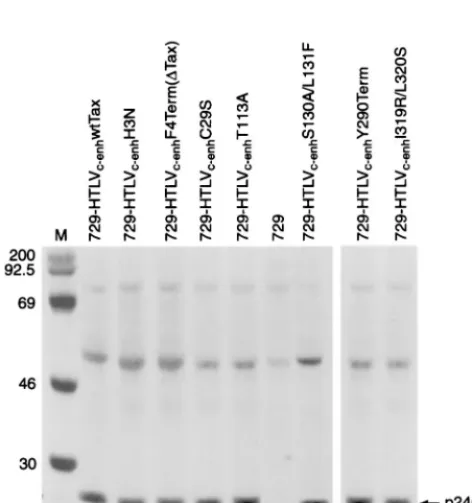
Our next goal was to determine the capacity of HTLVc-enh proviral clones expressing Tax mutants to synthesize viral pro-teins and direct viral replication. To this end, permanent 729 B-cell transfectants expressing wt Tax and mutant Tax HTLV c-enhproviral clones were isolated and further characterized. To monitor the production of viral proteins in these transfectants, cells were metabolically labeled, and lysates were subjected to immunoprecipitation (anti-p24Gag) and SDS-polyacrylamide gel electrophoresis analysis. Each of the transfectants chosen for this study produced similar levels of p24 Gag capsid protein (Fig. 1). Although each of thetaxgene mutations was designed to maintain the integrity of the overlappingrexgene reading frame, the efficient expression of Gag protein confirms that Rex is fully functional. In addition, each transfectant was
on November 9, 2019 by guest
http://jvi.asm.org/
shown to contain full-length proviral genomes as assessed by PCR and Southern blotting (data not shown).
To assess whether the various transfectants continued to express Tax with the expected transactivation phenotype, cell clones were transfected with LTR-2-CAT or HIV-B-CAT,
[image:3.612.52.293.83.224.2]and CAT activity was measured. The results, summarized in Table 2, indicate that the proviruses continue to display the expected Tax mutant transactivation phenotypes.
Infection and replication by HTLVc-enh-expressing Tax
mu-tants.To evaluate the capacity of the chimeric mutant viruses to produce infectious progeny virions, the transfectants were irradiated and cocultured with the human B-cell line BJAB. Productive infection of BJAB cells by HTLV-2 results in rapid induction of syncytia with cytopathicity (19, 46). Figure 2 shows the results of a representative assay comparing syncytium for-mation between irradiated uninfected 729 cells or irradiated 729-HTLVc-enhF4Term(⌬Tax) cells upon coculture with BJAB cells. Cocultivation of all 729-HTLVc-enhtaxmutant cell clones with BJAB cells resulted in syncytium formation (Table 2). To TABLE 1. Phenotypic analysis of HTLVc-enhtaxmutant clonesa
Proviral plasmid
% Chloroamphenicol acetylation by reporter plasmid
pU3R-1-CAT (HTLV-1
LTR)
LTR-2-CAT (HTLV-2
LTR)
HIV-B-CAT (HIV-
B-TATA)
Vector ⬍5 ⬍5 ⬍5
HTLVc-enh(wtTax) 100 100 100
HTLVc-enhH3N 92 75 105
HTLVc-enhC29S ⬍5 ⬍5 73
HTLVc-enhT113A ⬍5 ⬍5 ⬍5
HTLVc-enhS130A/L131F 59 79 ⬍5
HTLVc-enhF4Term(⌬Tax) ⬍5 ⬍5 ⬍5
HTLVc-enhY290Term ⬍5 ⬍5 57
HTLVc-enhI319R/L320S ⬍5 ⬍5 121
aJM4 T cells were cotransfected by electroporation with 5g of the indicated
CAT reporter plasmid (pU3R-1-CAT, LTR-2-CAT, or HIV-B-CAT), 5g pCMVGal, and 15g of the indicated HTLVc-enhproviral plasmid encoding wt
or mutant forms of Tax-2 or SV2neo vector control. After 48 h of growth, cells were harvested, normalized for transfection efficiency (-Gal activity), and as-sayed for CAT activity. The numbers represent percent chloramphenicol acety-lation values averaged over three independent experiments and normalized to the value for HTLVc-enh(wtTax) (100%).
FIG. 1. Immunoprecipitation of [35S]methionine-cysteine-labeled
729-HTLVc-enhproducer cells. 729 cells (uninfected B-cell line) and 729 viral
[image:3.612.311.551.90.242.2]pro-ducer cell lines expressing viruses with various Tax mutants, as indicated, were metabolically labeled and cell lysates were prepared. Transfectant cell lysates were normalized by scintillation counting of trichloroacetic acid precipitates, and equivalent amounts were immunoprecipitated with human antiserum directed against the HTLV-2 p24 Gag capsid protein (CA). The sizes (in kilodaltons, indicated on the left) were determined by comparison to protein markers (Am-ersham) (lane M). Regardless of the Tax transactivation phenotype, each pro-ducer cell line expresses similar levels of p24 Gag capsid.
TABLE 2. Phenotype of virus expressed from permanent transfectants
Cell line
% Chloroamphenicol
acetylationa Syncytium
induction in BJAB cellsc
LTR-2-CAT (HTLV-2
LTR)
HIV-B-CAT (HIV-
B-TATA)
729 (uninfected) ⬍5 ⬍5 ⫺
729-wtHTLV NDb NDb ⫹(100)
729-HTLVc-enh(wtTax) 100 100 ⫹(100)
729-HTLVc-enhH3N 80 102 ⫹(100)
729-HTLVc-enhF4Term(⌬Tax) ⬍5 ⬍5 ⫹(100)
729-HTLVc-enhC29S ⬍5 79 ⫹(100)
729-HTLVc-enhT113A ⬍5 ⬍5 ⫹(100)
729-HTLVc-enhS130A/L131F 81 ⬍5 ⫹(100)
729-HTLVc-enhY290Term ⬍5 56 ⫹(100)
729-HTLVc-enhI319R/L320S ⬍5 125 ⫹(100) aPermanently transfected 729 cells were cotransfected by electroporation with
5g of the indicated CAT reporter plasmid (LTR-2-CAT or HIV-B-CAT) and 5g of pCMVGal. After 48 h of growth, cells were harvested, lysates were made and normalized for transfection efficiency (-Gal activity), and cells were assayed for CAT activity. The numbers represent percent chloramphenicol acet-ylation values averaged over three independent experiments and normalized to the value for 729-HTLVc-enh(wtTax) (100%).
bND, not determined.
cPermanently transfected 729 cells were irradiated with 10,000 rads, and serial
10-fold dilutions of irradiated cells were incubated with 5⫻105BJAB cells in
[image:3.612.57.293.392.643.2]24-well culture plates. Cells were fed twice a week with RPMI-1640 supple-mented with 20% FCS and antibiotics. Cultures were scored positive (⫹) or negative (⫺) for syncytia at 3 to 7 days postplating. Numbers in parentheses indicate the minimum number of 729 producer cells required for syncytium induction following coculture with 5⫻105BJAB cells.
FIG. 2. A representative HTLVc-enhsyncytium induction assay in BJAB cells.
A total of 5⫻105uninfected 729 cells or a representative stable transfectant,
729-HTLVc-enhF4Term(⌬Tax), were irradiated with 10,000 rads and cocultured
with 105BJAB cells. Syncytia were scored in BJAB cell cocultures
microscopi-cally 3 to 5 days postplating. Cells were photographed 3 days postplating.
on November 9, 2019 by guest
http://jvi.asm.org/
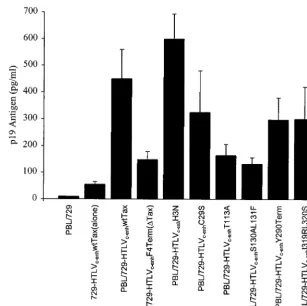
[image:3.612.314.549.555.683.2]address the efficiency at which the viruses replicate and induce syncytia, 10-fold serial dilutions of irradiated producer cells were cocultured with BJAB cells. Syncytia were induced with as few as 100 irradiated producer cells (Table 2), and there was no apparent difference in the time course of syncytium induc-tion by either thetaxwild-type ortaxmutant HTLVc-enh(data not shown). BJAB cells cocultured with 100 irradiated pro-ducer cells expressing the HTLVc-enhTax mutants exhibit sim-ilar levels of Gag protein in the culture supernatant, as as-sessed by p19 Gag ELISA at 7 days postcoculture (Fig. 3). Taken together, these results demonstrate that HTLVc-enh rep-licates and spreads with similar efficiency regardless oftaxor mutanttaxgenes.
Transformation of human T cells by HTLVc-enh-expressing
Tax mutants.Experiments were next performed to determine which Tax mutant phenotypes are required for HTLV-2-me-diated transformation of primary human T lymphocytes. A typical transformation assay included irradiated 729 producer cells harboring either wtHTLV-2, HTLVc-enhwtTax, or HTLVc-enhmutantTax-2 proviral clones and freshly isolated human PBL in 24-well plates. In an attempt to provide an environment similar to that which occurs in vivo, the PBL were not previously activated with phytohemagglutinin and IL-2, nor did the media contain exogenous IL-2. Cell number and via-bility were monitored at approximately weekly intervals in or-der to follow cellular proliferation as a result of viral infection. Viral replication was confirmed by p19 Gag ELISA of culture supernatant at 3 weeks postcocultivation, a time point at which
HTLV productively infected PBL would be expected to pro-duce viral particles (as measured by p19 Gag), whereas particle production from residual irradiated viral producer cells would be expected to be low (Fig. 4). These results indicate that each virus, regardless of the Tax transactivation phenotype, is capa-ble of productively infecting PBL. Therefore, Tax is not nec-essary for HTLVc-enhinfection of PBL.
Multiple transformation assays were performed and estab-lished four distinct growth patterns, and a representative assay is presented in Fig. 5. Pattern 1 is represented by the negative control and presents the growth of PBL cocultured with irra-diated uninfected 729 cells (Mock). A rapid decrease in viable cells was observed, and no viable cultures are produced. Pat-tern 2 is represented by wtHTLV-2, PBL/729-HTLVc-enhwtTax, and PBL/729-HTLVc-enhH3N cocultures, in which the characteristic transformation process is observed. Initially, there was a slight decrease in cell number, followed by a rapid expansion of cells for the duration of the assay. Flow cytometric analysis determined that these cells were primarily CD8⫹ T cells (46 and data not shown). The expression of
[image:4.612.144.457.76.382.2]HTLV-2 was confirmed by the detection of p24Gag capsid protein in HTLVc-enhwtTax-transformed cells (46) and HTLVc-enhH3N mutant-transformed cells (data not shown). IL-2 was not added to the culture media, indicating that via-bility and growth of transformed cells is not dependent on exogenous IL-2. However, transformed cells did respond to exogenous IL-2 and the capacity to efficiently establish viable FIG. 3. p19 Gag expression in BJAB cells. Permanently transfected 729 cells or mock 729 cells were irradiated with 10,000 rads, and 100 cells were cocultivated with 5⫻105BJAB cells in 24-well culture plates. Syncytia were microscopically visible in BJAB cocultures 5 days postplating. At day 7, viral particle production was estimated in the culture supernatants by p19 Gag antigen ELISA. The error bars indicate the standard deviation from three replicate wells. 729-HTLVc-enh wtTax(a-lone), day 7 supernatant from 100 irradiated producer cells alone or without BJAB cells (the amount of p19 Gag detected in this sample was⬍25 pg/ml).
on November 9, 2019 by guest
http://jvi.asm.org/
IL-2-independent T-cell lines could be enhanced by providing IL-2 at 5 to 6 weeks following coculture (data not shown).
Pattern 3 is distinct and slightly shifted from the negative control and is represented by PBL/729-HTLVc-enhF4Term (⌬Tax), PBL/729-HTLVc-enhS130A/L131F, and PBL/729-HTLVc-enhT113A cocultures. A progressive loss of viable cells over time was seen, and by 36 days postcoculture, no viable cells remained. The slight positive shift of this curve compared to the negative control is attributed to the presence of repli-cating virus (Fig. 4); HTLV particles have been shown to be mitogenic for primary T cells (16, 63). The observation that HTLVc-enhS130A/L131F fails to transform cells and displays a growth-inducing phenotype similar to HTLVc-enhF4Term (⌬Tax), which makes no Tax, suggests that Tax activation of the NFB/Rel signaling pathway correlates with an initial phase of the cellular transformation process.
Pattern 4 is represented by PBL/729-HTLVc-enhC29S, PBL/ 729-HTLVc-enhY290Term, and PBL/729-HTLVc-enhI319R/ L320S cocultures; each virus encodes a distinct Tax mutant that maintains NFB/Rel activation but is abrogated in CREB/ ATF activation. Within the first 2 weeks postcoculture, a de-cline in cell number is observed that is similar to that in wtHTLV-2, HTLVc-enhwtTax, or HTLVc-enhH3N infection. Although these cells remain viable for up to 2 months post-coculture, they never enter an expansion phase, and at approx-imately 70 days postcoculture no viable cells remain. Consis-tent with the phenotype of wtHTLV-2-infected cells, flow cytometric analysis at 50 days postcoculture determined that these cells were primarily CD8⫹T-cells (data not shown). The
simplest interpretation is that sustained viability of the cells is
attributed to Tax activation of NFB/Rel and is consistent with the reciprocal failure of HTLVc-enhS130A/L131F to induce cell proliferation. Addition of IL-2 to the cultures at day 50 failed to result in immortalization or sustain cell proliferation (data not shown). These in vitro transformation assays of the wt and seven tax mutant HTLVc-enh viruses are consistent with the conclusion that Tax transactivation of NFB/Rel correlates with cell proliferation and the initiation of the transformation process and that CREB/ATF signaling pathway promotes sus-tained cell growth and IL-2-independent cellular transforma-tion.
DISCUSSION
[image:5.612.146.453.71.377.2]In this study, seventaxmutants were analyzed in the context of a replication-competent HTLV provirus. The ultimate goal was to directly correlate the role of Tax activation of the CREB/ATF or NFB/Rel signaling pathway with HTLV-me-diated T-lymphocyte transformation. This is the first investiga-tion into the role of Tax-2 activainvestiga-tion of NFB/Rel and CREB/ ATF pathways in the transformation process. Our approach makes use of a well-characterized HTLV-2 (HTLVc-enh) pro-virus that replicates by a Tax-independent mechanism. This unique virus eliminates the variation that independenttax mu-tations may have on viral transcription and replication effi-ciency. Our results indicate that Tax-2 mutant viruses that selectively abrogate NFB/Rel or CREB/ATF fail to induce long-term growth of IL-2-independent T lymphocytes. Our results with HTLVc-enhS130A/L131F are consistent with the hypothesis that Tax activation of NFB/Rel provides an early FIG. 4. p19 Gag expression in infected PBL. Cell supernatants were obtained at day 21, as described in the legend to Fig. 5. Viral particle production was estimated in the culture supernatant by p19 Gag antigen ELISA. The error bars indicate the standard deviation from three replicate wells. To control for particle production from 729 producer cells (background), culture supernatant from 106irradiated cells, designated 729-HTLV
c-enhwtTax cells(alone), was measured after 3 weeks in culture.
on November 9, 2019 by guest
http://jvi.asm.org/
proliferative signal to HTLV-infected cells that is absolutely critical for the initiation of cell growth and the transformation process. One can equate this early step with maintaining cell growth and viability in culture by activating cellular growth genes, including IL-2 and IL-2 receptor genes. This hypothesis is supported further by the growth of primary cells infected with HTLVc-enhC29S, HTLVc-enhY290Term, and HTLVc-enh I319R/L320S. These viruses, which encode a mutant Tax pro-tein that activates NFB/Rel but not CREB/ATF, facilitate cell viability for up to 2 months. However, the capacity of Tax to activate CREB/ATF is also critical to the transformation pro-cess, since PBL infected with these HTLVc-enhTax mutants fail to exhibit the transformation profile observed with wt Tax-expressing virus. Although activation of both the NFB/Rel and CREB/ATF pathways are implicated in the in vitro trans-formation process, we cannot rule out the possible contribu-tion of other mechanisms critical for Tax transformacontribu-tion.
The role of CREB/ATF or NFB/Rel pathways in Tax-1-mediated transformation has been previously studied using several different experimental systems, and the results have been controversial. One study indicated that Tax-1 activation of NFB/Rel was dispensable but that activation of the CREB/ ATF pathway was critical for the morphological transforma-tion of Rat-2 cells (50). Two similar studies using Rat-1 cells implicated the NFB/Rel pathway in the morphological trans-formation process (32, 58). Studies using various delivery sys-tems investigated the ability of Tax-1 mutants to immortalize primary human peripheral blood mononuclear cells (PBMCs), again with inconclusive results. One study using retroviral vec-tors indicated that Tax-1 activation of NFB/Rel is sufficient to promote the growth response of PBL to IL-2. However, clonal expansion of CD4⫹T cells required activation of the CREB/
ATF pathway (3). Another study indicated that a Tax-1 variant
incapable of activating NFB/Rel when expressed from a her-pesvirus saimiri vector retained its immortalizing potential for primary human T cells (44). A more recent study has examined the role of Tax-1 in immortalization or transformation of PBMCs in the context of a full-length HTLV-1 (43). Their results indicated that the activation of the NFB/Rel pathway by Tax-1 correlates with IL-2-dependent immortalization of PBMCs and that CREB/ATF activation was dispensable. It is likely that these conflicting observations may be due to sub-stantial differences in experimental systems used or the Tax-1 mutations characterized.
[image:6.612.120.485.74.300.2]Our study, distinct in approach and use of HTLV-2, more closely resembles the HTLV-1 immortalization report by Robek and Ratner (43) because both utilize full-length provi-ruses and primary human cells as transformation targets. Both attempt to mimic natural infection in vivo, but there are several major differences. First, we use irradiated virus producer cells, not transfection, to efficiently infect PBL. Second, the PBL are not previously activated with phytohemagglutinin and IL-2, nor is the culture media supplemented with exogenous IL-2. Therefore, the endpoint for our assay is IL-2-independent cell growth, not IL-2-dependent immortalization. Lastly, the func-tional HTLVc-enhreplicates by a Tax-independent mechanism. Thus,taxmutations do not have a compromising effect on viral gene transcription and the ability of the mutant viruses to efficiently replicate. Our results are in agreement with Robek and Ratner in that NFB/Rel activation directly correlates with cellular transformation. However, the importance of Tax activation of the CREB/ATF pathway in the transformation process cannot be directly compared because of differences between our systems. Our results indicate that CREB/ATF activation correlates with the emergence of fully transformed cells that proliferate independently of IL-2. This possibility was FIG. 5. Growth curve of HTLVc-enhT-lymphocyte transformation assay. Human PBL were isolated by Ficoll-Paque and cocultivated with irradiated (10,000 rads) 729 virus producer cells (described in Table 2) or 729 uninfected control cells. PBL (2⫻106) were cocultured with irradiated donor cells (106) in 24-well plates. Cells were fed once per week with RPMI 1640 supplemented with 20% FCS. Cell viability was determined by trypan blue exclusion staining at 0, 5, 14, 21, 28, 36, 43, 53, and 70 days postcocultivation. Four distinct growth patterns were observed. The mean and standard deviation was determined from three independent samples of each coculture: pattern 1 contains PBL/729 negative control (Mock) coculture; pattern 2 contains PBL/729-HTLVc-enhF4Term(⌬Tax), PBL/729-HTLVc-enhT113A, and PBL/729-HTLVc-enhS130A/L131F cocultures showing the critical importance of NFB/Rel activation; pattern 3 contains PBL/729-HTLVc-enhC29S, PBL/729-HTLVc-enhY290Term, and PBL/729-HTLVc-enhI320R/L320S cocultures showing the requirement for activation of CREB/ATF in addition to NFB/Rel; and pattern 4 contains PBL/729-wtHTLV-2, PBL/729-HTLVc-enhwtTax, and PBL/729-HTLVc-enhH3N or fully transformed cells.
on November 9, 2019 by guest
http://jvi.asm.org/
not addressed in previous IL-2-dependent immortalization as-says.
HTLV-1 and HTLV-2 have distinct pathogenic properties but transform primary human T lymphocytes with similar ef-ficiencies. These distinct pathogenic properties may be attrib-utable to differences in Tax-1- and Tax-2-mediated transfor-mation. The major functional regions or domains of Tax that are important for transactivation by the CREB/ATF or NFB/ Rel signaling pathway are similar but not identical in Tax-1 and Tax-2 (45). In addition, HTLV-1-transformed cells are associ-ated with the constitutive activation of the Jak/STAT pathway, whereas in HTLV-2-transformed cells Jak/STAT is not acti-vated, suggesting that the mechanism of in vitro transforma-tion is different (35, 37).
A complete understanding of the mechanism of T-lympho-cyte transformation will require correlation of Tax domains important in cellular transformation with those domains im-portant in modulating gene transcription, cell cycle control, induction of DNA damage, and other undefined modes of action (7, 23, 30, 36, 38, 41, 47, 52). The HTLV-2 experimental system described in this study as well as the similar HTLV-1 system in development are useful for the dissection of Tax domains in the transformation process. Future comparisons between HTLV-1 and HTLV-2 will be critical for our under-standing of the pathogenesis of HTLV infection.
ACKNOWLEDGMENTS
We thank Kathleen Boris-Lawrie and Michael Lairmore for critical comments.
This work is supported by grants from the National Institutes of Health (CA77556) and the Leukemia Society of America. P.L.G. is a scholar of the Leukemia Society of America.
REFERENCES
1.Adya, N., and C.-Z. Giam.1995. Distinct regions in human T-lymphotropic virus type 1 Tax mediate interactions with activator protein CREB and basal transcription factors. J. Virol.69:1834–1841.
2.Adya, N., L.-J. Zhao, W. Huang, I. Boros, and C.-Z. Giam.1994. Expansion of CREB’s DNA recognition specificity by Tax results from interaction with Ala-Ala-Arg at positions 282–284 near the conserved DNA-binding domain of CREB. Proc. Natl. Acad. Sci. USA91:5642–5646.
3.Akagi, T., H. Ono, H. Nyunoya, and K. Shimotohno.1997. Characterization of peripheral blood T-lymphocytes transduced with HTLV-I Tax mutants with different trans-activating phenotypes. Oncogene14:2071–2078. 4.Anderson, M. G., and W. S. Dynan.1994. Quantitative studies of the effect
of HTLV-1 Tax protein on CREB protein-DNA binding. Nucleic Acids Res.
22:3194–3201.
5.Ballard, D. W., E. Bohnlein, J. W. Lowenthal, Y. Wano, B. R. Franza, and W. C. Greene.1988. HTLV-I tax induces cellular proteins that activate the B element in the IL-2 receptor␣gene. Science241:1652–1655. 6.Bantignies, F., R. Rousset, C. Desbois, and P. Jalinot.1996. Genetic
char-acterization of transactivation of the human T-cell leukemia virus type 1 promoter: binding of Tax to Tax-responsive element 1 is mediated by the cyclic AMP-responsive members of the CREB/ATF family of transcription factors. Mol. Cell. Biol.16:2174–2182.
7.Bex, F., M. J. Yin, A. Burny, and R. B. Gaynor.1998. Differential transcrip-tional activation by human T-cell leukemia virus type 1 Tax mutants is mediated by distinct interactions with CREB binding protein and p300. Cell
18:2392–2405.
8.Bodor, J., W. Walker, E. Flemington, A. L. Spetz, and J. F. Habener.1995. Modulation of Tax and PKA-mediated expression of HTLV-1 promoter via cAMP response element binding and modulator proteins CREB and CREM. FEBS Lett.377:413–418.
9.Brauweiler, A., P. Garl, A. A. Franklin, H. A. Giebler, and J. K. Nyborg.
1995. A molecular mechanism for human T-cell leukemia virus latency and Tax transactivation. J. Biol. Chem.270:12814–12822.
10. Brockman, J. A., D. C. Scherer, T. A. McKinsey, S. M. Hall, X. Qi, W. Lee, and D. W. Ballard.1995. Coupling of a signal response domain in IB␣to multiple pathways for NF-B activation. Mol. Cell. Biol.15:2809–2818. 11. Cann, A. J., Y. Koyanagi, and I. S. Y. Chen.1988. High efficiency transfection
of primary human lymphocytes and studies of gene expression. Oncogene
3:123–128.
12. Chen, I. Y., J. McLaughlin, J. C. Gasson, S. C. Clark, and D. W. Golde.1983. Molecular characterization of genome of a novel human T-cell leukaemia virus. Nature305:502–505.
13. Cross, S. L., M. B. Feinberg, J. B. Wolf, N. J. Holbrook, F. Wong-Staal, and W. J. Leonard.1987. Regulation of the human interleukin-2 receptor alpha promoter: activation of a nonfunctional promoter by the transactivator gene of HTLV-I. Cell49:47–56.
14. Fujii, M., I. Sassone-Corsi, and I. M. Verma.1988. c-fos promoter trans-activation by the tax 1 protein of human T-cell leukemia virus type I. Proc. Natl. Acad. Sci. USA85:8526–8530.
15. Fujii, M., H. Tsuchiya, T. Chuhjo, T. Akizawa, and M. Seiki.1992. Interac-tion of HTLV-1 Tax1 with p67SRF causes the aberrant inducInterac-tion of cellular immediate early genes through CArG boxes. Genes Dev.6:2006–2076. 16. Gazzolo, L., and M. Duc Dodon.1987. Direct activation of resting T
lym-phocytes by human T-lymphotropic virus type I. Nature326:714–717. 17. Gorman, C. M., L. F. Moffat, and B. H. Howard.1982. Recombinant
ge-nomes which express chloramphenicol acetyltransferase in mammalian cells. Mol. Cell. Biol.2:1044–1051.
18. Green, P. L., and I. S. Y. Chen.1994. Molecular features of the human T-cell leukemia virus: mechanisms of transformation and leukemogenicity, p. 227– 311.InJ. A. Levy (ed.), The Retroviridae, vol. 3. Plenum Press, New York, N.Y.
19. Green, P. L., T. M. Ross, I. S. Y. Chen, and S. Pettiford.1995. Human T-cell leukemia virus type II nucleotide sequences betweenenvand the last exon of tax/rexare not required for viral replication or cellular transformation. J. Vi-rol.69:387–394.
20. Iwanaga, Y., T. Tsukahara, T. Ohashi, Y. Tanaka, M. Arai, M. Nakamura, K. Ohtani, Y. Koya, M. Kannagi, N. Yamamoto, and M. Fujii.1999. Human T-cell leukemia virus type 1 Tax protein abrogates interleukin-2 dependence in a mouse T-cell line. J. Virol.73:1271–1277.
21. Jeang, K.-T., R. Chiu, E. Santos, and S.-J. Kim.1991. Induction of the HTLV-I LTR by Jun occurs through the Tax-responsive 21-bp elements. Virology181:218–227.
22. Jeang, K.-T., I. Boros, J. Brady, M. Radonovich, and G. Khoury.1988. Characterization of cellular factors that interact with the human T-cell leu-kemia virus type I p40x-responsive 21-base-pair sequence. J. Virol.62:4499– 4509.
23. Jin, D. Y., F. Spencer, and K. T. Jeang.1998. Human T-cell leukemia virus type 1 oncoprotein Tax targets the human mitotic checkpoint protein MAD1. Cell93:1–20.
24. Jin, D.-Y., V. Giordano, K. V. Kilber, H. Nakano, and K.-T. Jeang.1999. Role of adapter function in oncoprotein-mediated activation of NFB: HTLV-1 Tax interacts directly with IB kinase␥. J. Biol. Chem.274:17402– 17405.
25. Kanno, T., K. Borwn, G. Franzoso, and U. Siebenlist.1994. Kinetic analysis of human T-cell leukemia virus type I Tax-mediated activation of NF-B. Mol. Cell. Biol.14:6443–6451.
26. Lacoste, J., L. Cohen, and J. Hiscott.1991. NF-B activity in T cells stably expressing the Tax protein of human T cell lymphotropic virus type I. Vi-rology184:553–562.
27. Leung, K., and G. J. Nabel.1988. HTLV-I transactivator induces interleu-kin-2 receptor expression through an NFB-like factor. Nature333:776–778. 28. Li, C.-C. H., F. W. Ruscetti, N. Rice, E. Chen, N.-S. Yang, J. Mikovits, and D. L. Longo.1993. Differential expression of Rel family members in human T-cell leukemia virus type I-infected cells: transcriptional activation of c-rel by Tax protein. J. Virol.67:4205–4213.
29. Lindholm, P., S. Marriott, S. Gitlin, C. Bohan, and J. Brady.1991. Induction of nuclear factor NF-B DNA binding activity after exposure of lymphoid cells to soluble Tax1protein. New Biol.2:1034–1043.
30. Low, K. G., L. F. Dorner, D. B. Fernando, J. Grossman, K. T. Jeang, and M. J. Comb.1997. Human T-cell leukemia virus type I Tax releases cell cycle arrest induced by p16INK4a. J. Virol.71:1956–1962.
31. Maggirwar, S. B., E. Harhaj, and S.-C. Sun.1995. Activation of NF-B/Rel by Tax involves degradation of IB␣and is blocked by a proteasome inhib-itor. Oncogene11:993–998.
32. Matsumoto, K., H. Shibata, J.-I. Fujisawa, H. Inoue, A. Hakura, T. Tsuka-hara, and M. Fujji.1997. Human T-cell leukemia virus type 1 Tax protein transforms rat fibroblasts via two distinct pathways. J. Virol.71:4445–4451. 33. McKinsey, T. A., J. A. Brockman, D. C. Scherer, S. W. Al-Murrani, P. L. Green, and D. W. Ballard.1996. Inactivation of IB by human T-cell leukemia virus type 1 Tax: a potential mechanism for constitutive induction of NF-B. Mol. Cell. Biol.16:2083–2090.
34. Mercurio, F., H. Zhu, B. W. Murray, A. Shevchenko, B. L. Bennett, J. Li, D. B. Young, M. Barbosa, M. Mann, A. Manning, and A. Rao.1997. IKK-1 and IKK-2: cytokine-activated IB kinases essential for NFB activation. Science278:860–866.
35. Migione, T.-S., J.-X. Lin, A. Cereseto, J. C. Mulloy, J. J. O’Shea, G. Franchini, and W. J. Leonard. 1995. Constitutively activated Jak-STAT pathway in T-cells transformed with HTLV-1. Science269:79–81. 36. Mulloy, J. C., T. Kislyakova, A. Cereseto, L. Casareto, A. LoMonico, J.
Fullen, M. V. Lorenzi, A. Cara, C. Nicot, C.-Z. Giam, and G. Franchini.1998. Human T-lymphotropic/leukemia virus type 1 Tax abrogates p53-induced cell cycle arrest and apoptosis through its CREB/ATF functional domain. J. Virol.72:8852–8860.
37. Mulloy, J. C., T.-S. Migione, T. M. Ross, N. Ton, P. L. Green, W. J. Leonard,
on November 9, 2019 by guest
http://jvi.asm.org/
and G. Franchini.1998. Human and simian T-cell leukemia viruses type 2 (HTLV-2 and STLV-2pan-p) transform T-cells independently of Jak/STAT activation. J. Virol.72:4408–4412.
38.Neuveut, C., K. G. Low, F. Maldarelli, I. Schmitt, F. Majone, R. Grassmann, and K. T. Jeang.1998. Human T-cell leukemia virus type 1 Tax and cell cycle progression: role of cyclin D-cdk and p110Rb. Mol. Cell. Biol.18:3620–3632. 39. Nimer, S. D.1991. Tax responsiveness of the GM-CSF promoter is mediated by mitogen-inducible sequences other than kappa B. New Biol.3:997–1004. 40. Nimer, S. D., J. C. Gasson, K. Hu, I. Smallberg, I. S. Y. Chen, and J. D. Rosenblatt.1989. Activation of the GM-CSF promoter by HTLV-I and HTLV-II tax proteins. Oncogene4:671–676.
41. Pise-Masison, C. A., K. S. Choi, M. Radonovich, J. Dittmer, S. J. Kim, and J. N. Brady.1998. Inhibition of p53 transactivation function by the human T-cell lymphotropic virus type 1 Tax protein. J. Virol.72:1165–1170. 42. Ressler, S., G. F. Morris, and S. J. Marriott.1997. Human T-cell leukemia
virus type 1 Tax transactivates the human proliferating cell nuclear antigen promoter. J. Virol.71:1181–1190.
43. Robek, M. D., and L. Ratner.1999. Immortalization of CD4⫹and CD8⫹
T-lymphocytes by human T-cell leukemia virus type 1 Tax mutants expressed in a functional molecular clone. J. Virol.73:4856–4865.
44. Rosin, R., C. Koch, I. Schmitt, O. J. Semmes, K.-T. Jeang, and R. Grass-mann.1998. A human T-cell leukemia virus Tax variant incapable of acti-vating NFB retains its immortalizing potential for primary T-lymphocytes. J. Biol. Chem.273:6698–6703.
45. Ross, T. M., A. C. Minella, Z. Y. Fang, S. M. Pettiford, and P. L. Green.1997. Mutational analysis of the human T-cell leukemia virus type 2 Tax. J. Virol.
71:8912–8917.
46. Ross, T. M., S. M. Pettiford, and P. L. Green.1996. Thetaxgene of human T-cell leukemia virus type 2 is essential for transformation of human T lymphocytes. J. Virol.70:5194–5202.
47. Schmitt, I., O. Rosin, P. Rohwer, M. Gossen, and R. Grassmann.1998. Stimulation of cyclin-dependent kinase activity and G1- to S-phase transition
in human lymphocytes by the human T-cell leukemia/lymphotropic virus type 1 tax protein. J. Virol.72:633–640.
48.Semmes, O. J., and K.-T. Jeang.1992. Mutational analysis of human T-cell leukemia virus type I Tax: region necessary for function determined with 47 mutant proteins. J. Virol.66:7183–7192.
49. Smith, M. R., and W. C. Greene.1990. Identification of HTLV-I tax trans-activator mutants exhibiting novel transcriptional phenotypes. Genes Dev.
4:1875–1885.
50. Smith, M. R., and W. C. Greene.1991. Molecular biology of the type I human T-cell leukemia virus (HTLV-I) and adult T-cell leukemia. J. Clin. Investig.87:761–766.
51. Smith, M. R., and W. C. Greene.1991. Type I human T-cell leukemia virus Tax protein transforms rat fibroblasts through the cyclic adenosine mono-phosphate response element binding protein/activating transcription factor
pathway. J. Clin. Investig.88:1038–1042.
52. Suzuki, T., S. Kitao, H. Matsushima, and M. Yoshida.1996. HTLV-1 Tax protein interacts with cyclin-dependent kinase inhibitor p16INK4A and counteracts its inhibitory activity towards CDK4. EMBO J.15:1807–1814. 53. Suzuki, T., H. Hirai, J. Fujisawa, T. Fujita, and M. Yoshida.1993. A
trans-activator Tax of human T-cell leukemia virus type 1 binds to NF-B p50 and serum response factor (SRF) and associates with enhancer DNAs of the NFB site and CArG box. Oncogene8:2391–2397.
54. Tie, F., N. Adya, W. C. Greene, and C.-Z. Giam.1996. Interaction of the human T-lymphotropic virus type 1 Tax dimer with CREB and the viral 21-base-pair repeat. J. Virol.70:8368–8374.
55. Trejo, S. R., W. E. Fah, and L. Ratner.1996. c-sis/PDGF-B promoter trans-activator by the Tax protein of the human T-cell leukemia virus type 1. J. Biol. Chem.271:14584–14590.
56. Wagner, S., and M. R. Green.1993. HTLV-I Tax protein stimulation of DNA binding of bZIP proteins by enhancing dimerization. Science262:395– 399.
57. Wano, Y., M. Feinberg, J. B. Hosking, H. Bogerd, and W. C. Greene.1988. Stable expression of thetaxgene of type I human T-cell leukemia virus in human T cells activates specific cellular genes involved in growth. Proc. Natl. Acad. Sci. USA85:9733–9737.
58. Yamaoka, S., H. Inoue, M. Sakurai, T. Sugiyama, M. Hazama, T. Yamada, and M. Hatanaka.1996. Constitutive activation of NF-B is essential for transformation of rat fibroblasts by the human T-cell leukemia virus type 1 Tax protein. EMBO J.15:873–887.
59. Yin, M. J., and R. B. Gaynor.1996. Complex formation between CREB and Tax enhances the binding affinity of CREB for the human T-cell leukemia virus type 1 21-base-pair repeats. Mol. Cell. Biol.16:3156–3168.
60. Yin, M. J., E. Paulssen, J. Seeler, and R. B. Gaynor.1995. Chimeric proteins composed of Jun and CREB define domains required for interaction with the human T-cell leukemia virus type 1 Tax protein. J. Virol.69:6209–6218. 61. Yin, M.-J., L. B. Christerson, Y. Yamamoto, Y.-T. Kwak, S. Xu, F. Mercurio, M. Barbosa, M. H. Cobb, and R. B. Gaynor.1998. HTLV-1 Tax protein binds to MEKK1 to stimulate IB kinase activity and NFB activation. Cell93:
875–884.
62. Yin, M.-J., E. J. Paulssen, J. S. Seeler, and R. B. Gaynor.1995. Protein domains involved in both in vivo and in vitro interactions between human T-cell leukemia virus type I Tax and CREB. J. Virol.69:3420–3432. 63. Zack, J. A., A. J. Cann, J. P. Lugo, and I. S. Y. Chen.1988. AIDS virus
production from infected peripheral blood T cells following HTLV-I-in-duced mitogenic stimulation. Science240:1026–1029.
64. Zhao, L.-J., and C.-Z. Giam.1992. Human T-cell lymphotrophic virus type I (HTLV-I) transcriptional activator, Tax, enhances CREB binding to the HTLV-I 21 base-pair repeats by protein-protein interactions. Proc. Natl. Acad. Sci. USA89:7070–7074.