overview and outlook
.
White Rose Research Online URL for this paper:
http://eprints.whiterose.ac.uk/133293/
Version: Accepted Version
Article:
Hopfgartner, F. orcid.org/0000-0003-0380-6088, Hanbury, A., Muller, H. et al. (13 more
authors) (2018) Evaluation-as-a-service for the computational sciences: overview and
outlook. ACM Journal of Data and Information Quality, 10 (4). 15. ISSN 1936-1955
https://doi.org/10.1145/3239570
© ACM, 2018. This is the author's version of the work. It is posted here by permission of
ACM for your personal use. Not for redistribution. The definitive version was published in
Journal of Data and Information Quality, 10 (4), November 2018
http://doi.acm.org/10.1145/3239570
[email protected] https://eprints.whiterose.ac.uk/ Reuse
Items deposited in White Rose Research Online are protected by copyright, with all rights reserved unless indicated otherwise. They may be downloaded and/or printed for private study, or other acts as permitted by national copyright laws. The publisher or other rights holders may allow further reproduction and re-use of the full text version. This is indicated by the licence information on the White Rose Research Online record for the item.
Takedown
If you consider content in White Rose Research Online to be in breach of UK law, please notify us by
Evaluation-as-a-Service for the Computational Sciences:
Overview and Outlook
FRANK HOPFGARTNER,
University of SheieldALLAN HANBURY,
TU Wien, Complexity Science Hub ViennaHENNING MÜLLER and IVAN EGGEL,
University of Applied Sciences Western Switzerland (HES-SO)KRISZTIAN BALOG,
University of StavangerTORBEN BRODT,
plista GmbHGORDON V. CORMACK and JIMMY LIN,
University of WaterlooJAYASHREE KALPATHY-CRAMER,
Athinoula A. Martinos Center for Biomedical Imaging at Mas-sachusetts General Hospital and Harvard Medical SchoolNORIKO KANDO,
National Institute of InformaticsMAKOTO P. KATO,
Kyoto UniversityANASTASIA KRITHARA,
National Center for Scientiic Research łDemokritosžTIM GOLLUB,
Bauhaus-Universität WeimarMARTIN POTTHAST,
Leipzig UniversityEVELYNE VIEGAS,
Microsoft ResearchSIMON MERCER,
Independent ConsultantEvaluation in empirical computer science is essential to show progress and assess technologies developed. Several research domains such as information retrieval have long relied on systematic evaluation to measure progress: here, the Cranield paradigm of creating shared test collections, deining search tasks, and collecting ground truth for these tasks has persisted up until now. In recent years, however, several new challenges have emerged that do not it this paradigm very well: extremely large data sets, conidential data sets as found in the medical domain, and rapidly changing data sets as often encountered in industry. Crowdsourcing has also changed the way in which industry approaches problem-solving with companies now organizing challenges and handing out monetary awards to incentivize people to work on their challenges, particularly in the ield of machine learning.
This paper is based on discussions at a workshop on Evaluation-as-a-Service (EaaS). EaaS is the paradigm of not providing data sets to participants and have them work on the data locally, but keeping the data central and allowing access via Application Programming Interfaces (API), Virtual Machines (VM) or other possibilities to ship executables. The objectives of this paper are to summarize and compare the current approaches and consolidate the experiences of these approaches to outline the next steps of EaaS, particularly towards sustainable research infrastructures.
The paper summarizes several existing approaches to EaaS and analyzes their usage scenarios and also the advantages and disadvantages. The many factors inluencing EaaS are summarized, and the environment in terms of motivations for the various stakeholders, from funding agencies to challenge organizers, researchers and participants, to industry interested in supplying real-world problems for which they require solutions.
We acknowledge inancial support by the European Science Foundation via its Research Network Program łEvaluating Information Access Systemsž (ELIAS) and by the European Commission via the FP7 project VISCERAL (318068). Permission to make digital or hard copies of all or part of this work for personal or classroom use is granted without fee provided that copies are not made or distributed for proit or commercial advantage and that copies bear this notice and the full citation on the irst page. Copyrights for components of this work owned by others than ACM must be honored. Abstracting with credit is permitted. To copy otherwise, or republish, to post on servers or to redistribute to lists, requires prior speciic permission and/or a fee. Request permissions from [email protected].
© 2018 Association for Computing Machinery. 1936-1955/2018/7-ART1 $15.00
EaaS solves many problems of the current research environment, where data sets are often not accessible to many researchers. Executables of published tools are equally often not available making the reproducibility of results impossible. EaaS on the other hand creates reusable/citable data sets as well as available executables. Many challenges remain but such a framework for research can also foster more collaboration between researchers, potentially increasing the speed of obtaining research results.
CCS Concepts: ·Information systems→Data management systems;Information systems applications;
Information retrieval;
Additional Key Words and Phrases: evaluation-as-a-service, benchmarking, information access systems ACM Reference format:
Frank Hopfgartner, Allan Hanbury, Henning Müller, Ivan Eggel, Krisztian Balog, Torben Brodt, Gordon V. Cor-mack, Jimmy Lin, Jayashree Kalpathy-Cramer, Noriko Kando, Makoto P. Kato, Anastasia Krithara, Tim Gollub, Martin Potthast, Evelyne Viegas, and Simon Mercer. 2018. Evaluation-as-a-Service for the Computational Sciences: Overview and Outlook.ACM J. Data Inform. Quality1, 1, Article 1 (July 2018),32pages.
https://doi.org/0000001.0000001
1 INTRODUCTION
One of the most important aspects of scientiic work is the evaluation of research questions or research hypotheses that allows us to assess the merits or limitations of new ideas. In areas of computer science such as Machine Learning (ML) and Information Retrieval (IR), evaluation often focuses around the question of how well a developed algorithm performs. Given the manifold scenarios in which algorithms can be employed, some of the main challenges are to perform evaluations that are not only transparent enough so that experiments can be reproduced by third parties, but also allow for a direct comparison with state-of-the-art algorithms or strong baselines. In the computational sciences, this challenge has been addressed by evaluation campaigns that release shared data sets consisting of data, tasks, associated ground truth, and other resources such as toolkits or additional metadata. Using these resources, interested researchers can develop algorithms or systems, perform their experiments locally and submit the results to the organisers of the campaigns who can then evaluate the performance using standardized evaluation metrics [Spärck Jones and van Rijsbergen 1975]. Given the requirement to share resources to enable such co-ordinated evaluation eforts, the tasks are also referred to as shared evaluation tasks.
In the IR research community, this structured evaluation methodology is sometimes referred to as Cranield evaluation paradigm as it was irst trialled in the 1960's by researchers of the Cranield College of Aeronautics [Richmond 1963]. A more descriptive name for the concept is, however,
Data-to-Algorithms(DtA) paradigm. The DtA paradigm requires participants to submit the output of their algorithms when run on a pre-published test data set (a so-called łrunž). There are regular academic evaluation campaigns such as the Text REtrieval Conference (TREC) [Voorhees and Harman 2005], Conference and Labs of the Evaluation Forum (CLEF) [Ferro and Silvello 2014], and the NTCIR (NII Test Collection for IR Systems) [Kudo 2010] that employ the DtA paradigm for speciic research challenges in the ield of IR. In the area of machine learning and computer vision, the series of PASCAL Challenges [Quiñonero-Candela et al. 2006] from 2005±2013 are well known. Similar initiatives (see e.g., [Light and Börner 2013;Thomee et al. 2016]) exist in other domains such as multimedia and web science. Similarly, in a non-academic setting, various commercial platforms exist that rely on the DtA paradigm. Popular examples include the data science competition platforms Kaggle1and TopCoder2where participants have to download data
and submit the results of their computations. Another example is The Dream Challenges3which ofers competitions to solve biomedical challenges. An open source solution machine learning challenge is crowdAI4, maintained by the Digital Epidemiology Lab at EPFL in Switzerland.
Although the DtA paradigm is the de-facto standard evaluation approach in the computational sciences, it has several shortcomings, including a complete lack of reproducibility of the shared task, and the necessity to publish test data sets prematurely, albeit sans ground truth [Harman 1992]. Further, as Kaggle speciically acknowledges on their website: łWhile we are sympathetic to the fact that not everyone has access to a stellar broadband connection, the plumbing needed to move data is an unavoidable part of practicing data science.ž5. Notwithstanding these shortcomings,
the organizers of shared tasks frequently employ run submission for its minimal organizational overhead. Criticisms of this paradigm have discussed the need for continuous evaluation and not only linked to a competition and also component evaluation, which is important to better understand the performance linked to the many components of a system in a complex way [Hanbury and Müller 2010]. We argue that in several cases, the DtA approach of distributing data is just not practical, because the data may be:
• Huge ± For obtaining real world evaluation results, the evaluation needs to be performed
on realistic amounts of data. In the case of web search, this could be Petabytes.6The
cur-rently most common approach of sending data on hard disks through the postal service or distribution via download has its limitations.
• Non-distributable ± It is often not allowed to distribute data due to privacy, terms of service, or
commercial sensitivity of the data. Privacy is an important concern for personal medical data. Even though the law often allows the distribution of anonymized medical data, large-scale anonymization can only be accomplished automatically and data owners usually do not trust it [Safran et al. 2007]. The Twitter Terms of Service7forbid redistribution of tweets, while query logs are not made available for researchers after the debacle surrounding the release of the AOL search logs in 2006 [Arrington 2006]. Distribution of company documents for the evaluation of enterprise search are not permitted due to the commercial sensitivity of the data [Kruschwitz and Hall 2017].
• Real-time ± Companies working on real-time data, for example recommender systems, are
often not interested in evaluation results obtained on static historical data, in particular if these data have to be anonymized to allow distribution, as these results are too far removed from their operative requirements that require real-time data access [Levy 2013].
In this paper, we explore an alternative evaluation methodology for the computational sciences based on the so-calledAlgorithms-to-Data paradigm(AtD) in which the data are all stored on a (central) computational infrastructure, and can only be accessed on this infrastructure [Hanbury et al. 2012;Müller et al. 2016]. We argue that evaluation campaigns that employ the AtD paradigm could require participants to either upload their algorithms, e.g., embedded in a Virtual Machine (VM) to a centralized infrastructure where they can be run on the provided data, or gain access to the data via an API. This does not only ease the burden of downloading vast amount of data but can also avoid access to sensitive data, as only the algorithms and not the developers need to see the data. Similar to the concept of shared evaluation campaigns, we refer to this type of evaluation asEvaluation-as-a-Service(EaaS) as the main emphasis is on ofering a complete
3http://dreamchallenges.org/ 4http://www.crowdai.org
5https://www.kaggle.com/wiki/ANoteOnTorrents, visited on 28/08/2017
6For example, the Common Crawl data set which is available athttp://commoncrawl.org/currently consists of petabytes of data.
computational infrastructure that serves as eco system for the evaluation rather than sharing data sets and evaluation protocols only. By tackling the above hurdles, we argue that EaaS can have a strong impact on empirical evaluation in the computational sciences in general, and further ofers new opportunities for fruitful collaboration of academia and industry.
The main contributions of this paper are as follows:
• We deine EaaS as a novel and impactful evaluation methodology and discuss its strengths
and limitations.
• We discuss the main challenges that need to be addressed when ofering EaaS.
• We provide a detailed survey on evaluation initiatives in the computational sciences that
ofer some form of EaaS.
The paper is structured as follows. We irst motivate EaaS as a novel evaluation methodology in Section2. In Section3, we survey existing campaigns that already employ EaaS, or components thereof, for the evaluation of diferent tasks. This includes an introduction of the diferent use cases, followed by an overview of technologies used, and inally a discussion on various shortcomings. In Section4we then relect on these initiatives and identify aspects to consider in the next steps toward implementing EaaS fully. Section5concludes this work.
2 MOTIVATION
As explained in the introduction, an established evaluation method in the computational sciences is to rely on shared resources (i.e., data sets or software) that are provided as part of an evaluation campaign. Such evaluation is based on the DtA paradigm which requires participants to download these resources and then run their experiments on their own IT infrastructure. As evidenced by the large numbers of papers that have been published in the past few years at top-tier conferences such as ACM SIGIR, ICML, or SIGKDD, this method has been the de-facto evaluation standard for research on computational sciences. However, despite its success, the approach does not come without caveats. As mentioned before, the main drawbacks include the challenges of sharing large-scale data sets, limitations due to the sensitive nature of data sets, and the emerging need to process streamed data in real-time. In the context of IR, Hawking [Hawking 2015] points out that these limitations already reduce the share of non-industrial research presented at the leading IR conference SIGIR. Further, as [Hanbury and Müller 2010] discuss, the DtA paradigm does not provide solutions for continuous evaluation, and it cannot easily be employed when ground truth data is not available. In the computational sciences in general, little focus has been directed toward the reproducibility of experimental results, raising questions about their reliability [Freire and Silva 2012]. There is currently work underway to counter this situation, ranging from presenting the case for open computer programs [Ince et al. 2012], through creating infrastructures to allow reproducible computational research [Freire and Silva 2012] to considerations about the legal licensing and copyright frameworks for computational research [Stodden 2009]. Given these limitations, parties with access to large IT infrastructure and large user bases have moved away from this paradigm and now increasingly perform online testing to evaluate their algorithms and systems. For a detailed introduction to online evaluation of information retrieval systems, we refer to [Hofmann et al. 2016]. While online evaluation is a viable option for entities whose services create large user traic, who have access to appropriate resources, and can process data with manageable legal limitations, there are only limited chances for researchers who do not have access to these resources.
and science as a whole can get beneit from the EaaS paradigm as well, as all projects funded can become comparable and data are not limited to a small group that can use them but can be shared virtually for the analysis with a large number of research groups. This can lead to generally better science that is more reproducible and where more time can be taken for the large data creation as more people can work together instead of creating many small data sets.
In order to shed more light on the application of EaaS as novel evaluation methodology, we irst outline in Section2.1two scenarios that depict a vision on how EaaS can be implemented. Further, in Section2.2we outline the beneits for all stakeholders involved to illustrate the potentials of EaaS. Our motivation is that it should be ensured that the beneits signiicantly outweigh the eforts for everyone involved as this will be an essential requirement for the successful implementation and operation of EaaS.
2.1 EaaS Vision
Below, two scenarios describe situations in which EaaS is employed for the evaluation of diferent algorithms. The two scenarios are derived from two evaluation campaigns that have implemented the EaaS paradigm. A more detailed overview of these, and more, campaigns is provided in Section3.
Scenario 1:Company Xprovides a blog entry recommendation service based on a user proile and a user click history.Company Xwishes to improve its recom-mendation algorithms, and decides to make this challenge open to all through the EaaS paradigm, thereby increasing the size of the pool of highly-qualiied people from which the solution can come. Participants submit their proposed recommender systems as executables installed on VMs, where the parameters such as maximum response time are strictly speciied. Thanks to the use of a standardised VM exchange format, the participation overhead is reduced, as the same VM images can be submitted to participate in any EaaS campaign. Upon submission of the VMs, standardized tests are automatically run to ensure that the systems satisfy the speciied parameters, and any shortcomings are reported back to the participant. Once a system satisies all parameters, it is randomly assigned requests for recommendation and is evaluated based on the clicks by end users of theCompany Xrecommendation service on the links returned. A well-designed experimental protocol ensures that links suggested by the sub-mitted recommender systems are shown often enough to obtain statistically signiicant results for all participants, and participants are sent results in the form of performance metric values linked to a permanent identiier that are ready to be inserted directly into a publication.Company Xgets information on how well the performance of their recommender system compares to the state of the art, and can contact the teams having the best performance to discuss potential technology transfer.
collection of biomedical literature and of facts that are already known toCompany Yare placed in protected form on an EaaS infrastructure, and some examples of these data are made public. People participate by submitting VMs containing their executable software to the EaaS infrastructure, where the VMs are sandboxed and the executables are run on the data. The standardised VM exchange format reduces the overhead for participants. Once the VM has run and produced results, it is destroyed (to ensure privacy of the data), while the outputs of the executables remain available forCompany Yand the evaluation metric values are returned to the participant who submitted the VM. Participants can choose to make these metric values public, and receive a Digital Object Identiier allowing these results to be referred to in a publication. Visual analytics software on the EaaS infrastruc-ture allows participants a detailed analysis of the performance of their algorithms and a comparison to other publicly available results.Company Ycan examine combinations of the outputs of the submitted software of the two parts of the challenge to ind the optimal combination, have experts examine newly extracted facts or predictions to evaluate their relevance (increasing the size of the ground truth), and contact the participants having the best performing submissions to negotiate terms for the further use and development of their techniques.
2.2 Benefits
After getting an introduction to the EaaS paradigm in the previous section, in this section we now highlight how participants and other stakeholders, such as campaign organizers or companies who employ the EaaS paradigm can beneit from this. The remainder of this section is structured as follows. We irst highlight the advantages of these stakeholders in Section2.2.1. Section2.2.2then sheds some light on the simplicity and cost-efectiveness of EaaS. Beneits of reproducibility and cooperation are discussed in Sections2.2.3and2.2.4.
2.2.1 Advantages.Looking at academia and industry as stakeholders, one of the main advantages to both sides is that the EaaS paradigm should bridge the gap between the two sides, allowing more straightforward cooperation. This would in particular counter the commonly perceived view that scientists working in industry have access to larger amounts of more interesting data than those working in academia [Huberman 2012;Markof 2012]. The EaaS paradigm beneits researchers in academia because it gives them access to industry data and to quickly publish results, but caters to industry because there is no necessity to release the data in any uncontrolled way, as the data can remain behind a irewall on company servers. By employing EaaS on sensitive data such as medical data or other material that can not easily be shared (e.g., copyright material, enterprise search data, etc.), new opportunities for wider research on such sensitive topics can be supported. At the same time, EaaS allows access to data sets that would be too big to be shared and that a single research group or a small group could not easily assemble and treat. Thinking of the evaluation of approaches using real users, the EaaS paradigm also allows researchers in academia to evaluate methods using real-time data and under realistic conditions as common in industry [Kohavi et al. 2012], which again brings beneits to companies owning the data, as they get results on dynamic data currently of interest to them, rather than on static data from months or years back (the sort of data that could be considered less commercially interesting and hence more suitable to release to researchers in the traditional way).
with their log iles, they get the possibility to access the best performing techniques, to get a clear idea of techniques, their performance and their stability based on the work of participants, which can also lead to new ideas or projects based on real data. At the same time, they can position themselves as leaders in the ield, shape the task of many scientists by inluencing research directions that tailor their needs, increase their visibility in the community, and even attract talented professionals who are interested in working on their use cases. As example, we point to one of the EaaS initiatives, presented in Section3.2.6, in which a commercial provider of news and ad recommendations ofered an EaaS platform that allowed for benchmarking of recommendation algorithms in the live system of the provider. Following the start of the initiative, the company received a number of job applications that directly referred to the evaluation campaign. Moreover, by interacting with the participants, the company could learn of innovative ideas on how to address their recommendation task. Finally, by allowing participants to benchmark the performance of their ideas in a live system, the company could save expensive development time.
For researchers in academia, beyond the obvious beneits of access to large amounts of interesting data linked to challenges of commercial relevance, there are also potential beneits in terms of increased reputation for organizers and participants. This would be particularly true for those EaaS instances that become accepted as benchmarks in a scientiic area rather than one-of competitions. In a fully developed EaaS infrastructure, participants could also have access to technical beneits, such as an interface for performing visual analytics of the experimental results and potentially even a service to semi-automatically write the experimental section of a scientiic paper. Potentially, submissions could also be automatically encapsulated as services to be made available on a demo webpage, thereby also increasing the visibility of the participants' work.
Both academia and industry can take advantage of the capability inherent in submitting VMs containing functioning services, namely the running of automated ensemble approaches. It is well known that ensembles of classiiers can often perform better than a single classiier [Dietterich 2000] Ð the EaaS paradigm makes it straightforward to test multiple combinations of classiiers in various ensemble approaches to obtain new scientiic insight as well as better performing classiiers. An example study exploiting an EaaS infrastructure for ensemble learning is provided by [Lommatzsch 2014].
Finally, EaaS instances can be used as part of university courses on Data Science. As studies (e.g., [Ortiz-Repiso et al. 2018]) indicate, there is a growing need to give students experience with working on real challenges on huge amounts of data, instead of the łtoy problemsž that are generally part of their course work. This brings a beneit to industry by ensuring that university graduates entering the Data Science job market are better qualiied for the work that they will have to do. Such EaaS instances could, for example, be combined with a Massive Open Online Course (MOOC). First eforts to establish EaaS campaigns as a resource for learning and teaching are outlined by [Hopfgartner et al. 2016].
2.2.2 Simplicity and Cost-Efectiveness.The beneits of EaaS should signiicantly outweigh the efort required from all stakeholders. While the previous section concentrated on making the beneits explicit, this section focuses on how the efort can be reduced.
the challenge, including steps such as designing an efective evaluation protocol and selecting the most suitable metrics for the task.
The efort required for participants must also be reduced. An efective way of doing this is to use a common VM format that can be executed on all EaaS infrastructures. This means that participants could have prepared VMs containing their algorithms, and can submit them easily to a benchmark or competition on any EaaS infrastructure, avoiding the need to spend time in adapting the code to multiple cloud architectures. Where possible, standardisation of other aspects of a submission, such as data formats, could also lower participation overheads.
2.2.3 Reproducibility.The drawbacks of publishing papers containing the results of experiments done only on proprietary data that is not available to other researchers to ensure reproducibility of results has been widely discussed (e.g., in [Callan and Mofat 2012]). Fuhr [Fuhr 2017] even argues that despite the use of shared data sets that eliminates some of these drawbacks, reproducibility is still one of the main challenges in the ield of IR evaluation. As he points out, methods have become so complex that a detailed description of all components and settings is sheer impossible. He therefore argues for sharing implementations of algorithms, e.g., on publicly accessible repositories. The EaaS paradigm can contribute to increasing reproducibility of results through making available not only data and associated tasks in the long term but also a library of executable algorithms that have been applied to solving the tasks on the data, and the results that have been produced by these algorithms.
The availability of these resources should contribute to addressing an observed practice in computer science of comparing new algorithms to weak baselines [Armstrong et al. 2009]. It should also ensure access to results using a large palette of metrics, so that all aspects of the performance of an approach can be examined. This can include execution time info (eiciency), as every approach is evaluated on the same infrastructure.
Further contributions toward reproducibility can also be expected. As the data set is stored centrally, mechanisms can be put in place to collect additional ground truth for a task over time. Crowd-sourcing, either among competitors or among a wider group of people, could be used to obtain this additional ground truth [Foncubierta-Rodríguez and Müller 2012]. Whenever the ground truth available has expanded signiicantly, all approaches already submitted for a task could be re-evaluated automatically using the expanded ground truth, which then becomes the standard for future submissions. Through the use of a publishing approach such as executable papers, it can be ensured that the latest results for a published approach are always available.
The AtD paradigm provides us with the means to distribute data in the form of a constant data stream. In fact, real-time data analysis is emerging as the new łholy grailž of (big data) analytics [Marz and Warren 2015], as an increasing number of use cases emerge that deal with streamed data. Given the luctuating nature of streamed data, evaluation of computational methods that analyse such data can lack reproducibility [Ferro et al. 2016]. EaaS initiatives that incorporate streamed data can address this by introducing version management controls that allow to reconstruct data at a particular time and version.
The EaaS setup also allows research that is not easily possible today for academic researchers. An example is the development of new performance metrics better adapted to modelling speciic tasks. With such studies currently being dominated by industry-based researchers (see e.g., Lalmas et al.'s work on user engagement metrics at Yahoo! [Lalmas and Hong 2018]), EaaS allows researchers developing new metrics to experiment at a large scale on how the use of a new performance metric afects the ranking of submitted approaches in comparison to existing metrics.
complementary skills to solve them, the insight provided by EaaS results into how diferent types of approaches perform could assist in efective team formation. This also means that participating teams have the possibility to concentrate on the aspect of the task for which they feel most qualiied, and collaborate with other participants (either explicitly or through re-use of their approaches) to cover those aspects of the task for which they have lower expertise.
The demand for further cooperation between academia and industry is increasingly being pushed by major research funding agencies. For example, the European Commission's most recent research funding framework8, Horizon 2020, emphasizes the need to support innovation, and to deliver
solutions to end users. Similar funding schemes also exist on national levels, e.g., the Knowledge Transfer Partnership9(KTP) scheme in the United Kingdom or the ZIM10scheme in Germany.
3 EXISTING EAAS INITIATIVES
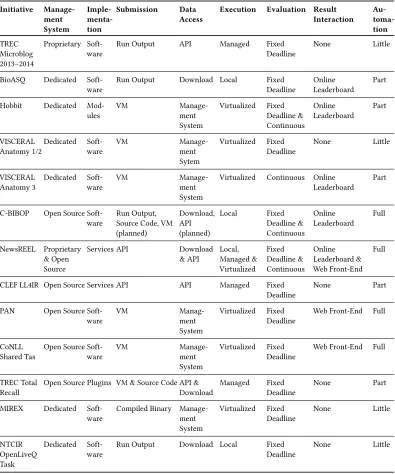
After discussing the beneits of the EaaS paradigm for the evaluation in the computational sciences in the previous section, this section provides further details on currently existing initiatives that have employed this paradigm. As it will become apparent, these initiatives have been established independently of each other and address diferent use cases. In order to ease comparison of these campaigns, Section3.1irst highlights key features of these initiatives. A detailed introduction of the use cases of these initiatives is then provided in Section3.2. Section3.3discusses some of the technologies used to facilitate EaaS for these initiatives. Finally, shortcomings are discussed in Section3.4.
3.1 Key Features
Given the diferent demands and requirements posed by the individual EaaS use cases, it comes with no surprise that organizers of these initiatives have opted for diferent solutions to run their campaigns. Consequently, the EaaS initiatives that are introduced in the next section difer signiicantly from each other. Despite their diferences, each initiative had to come up with solutions for the following core characteristics of EaaS. In the remainder of this section, we briely introduce these key aspects. A more detailed discussion of these challenges is provided in Section4.1.
First of all, all initiatives require a Management System that serves as the technical backbone of the individual campaigns. The range goes from fully open sourced systems to proprietary closed systems. Moreover, diferent levels of implementation eforts are required for participants to join the individual EaaS initiatives. In some cases, participants have complete freedom of choice on what programming language or platform they want to use. Other initiatives provide plugins in diferent languages that participants can use.
Diferent methods on how participants can get access to the data are employed. Possibilities include downloading the data using the traditional DtA approach, or methods following the AtD paradigm that requires users interacting with an API, or accessing data stored on the cloud via a VM or a Docker11container on the cloud. The type of access provided also has a direct impact on where the participants' solutions are executed. While some initiatives allow participants to run their algorithms on their local machines, others require them to run them in virtualized environments, or let the organizers execute it. The execution type also has a direct impact on how participants have to submit their solutions or results. Possibilities are by uploading result iles in a speciied format, by interacting with an API, or by submitting code installed on a VM.
8http://ec.europa.eu/research/ 9http://ktp.innovateuk.org/ 10https://www.zim-bmwi.de/
A key question is also how the results are evaluated. Some initiatives allow for continuous evaluation with results submitted at any time. Others, however, deine a ixed deadline for result submission. Related to this, all EaaS initiatives provide some sort of feedback that allows their participants to interact with the evaluation results, e.g. visual analytics functionalities for result comparison.
Finally, one of the main requirements for the operation of successful software initiatives is the provision of technical supports. The EaaS initiatives provide technical support to diferent degrees.
3.2 Initiative Use Cases
In what follows, more information on the existing initiatives is given.
3.2.1 TREC Microblog Task. The TREC Microblog tracks began in 2011 to explore search tasks and evaluation methodologies for information seeking behaviors in microblogging environments such as Twitter. TREC 2015 marked the ifth iteration of the track. For the last four years, the core task had been temporally-anchored ad hoc retrieval, where the putative user model was as follows: łAt timeT, give me the most relevant tweets about an information need expressed as queryQ.ž Since its inception, the track has had to contend with challenges related to data distribution, since Twitter's terms of service prohibit redistribution of tweets. For TREC 2011 and 2012 [Ounis et al. 2011], the track organizers devised a solution following the DtA paradigm whereby theidsof the tweets were distributed, rather than the tweets themselves. Given these ids and a downloader program (also developed by the track organizers), a participant could łrecreatež the collection [McCreadie et al. 2012]. This approach adequately addressed the no-redistribution issue, but was not scalable as participants in the end had to recreate the collection locally. TREC 2013 [Lin and Efron 2013] implemented an entirely diferent solution, which was to provide an API through which participants could complete the evaluation task. Employing the AtD paradigm, the organizers gathered a collection of tweets centrally, but all access to the collection was mediated through the API, such that the participants could not directly interact with the raw collection. The search API itself was built using Thrift12and the Lucene search engine13, which are both widely-adopted open-source tools. A nice side-efect of the API approach is that common infrastructure promotes reproducibility [Rao et al. 2015] and sharing of open-source software components. An overview of the underlying technology, the TREC Total Recall Management System, is given in Section3.3.5.
3.2.2 BioASQ.The FP7 BioASQ project14aimed to push research towards highly precise
biomed-ical information access systems by establishing a series of evaluation campaigns in which systems from teams around the world compete [Tsatsaronis et al. 2015]. One of the main motivations for these campaigns was to ensures that the biomedical experts of the future can rely on software tools to identify, process and present the fragments of the huge space of biomedical resources that address their personal questions. Two main tasks were ofered by BioASQ. In Task A systems were required to automatically assign MeSH (Medical Subject Headings) terms to biomedical articles, thus assisting the indexing of biomedical literature. This task used the EaaS paradigm to include participating systems directly in the indexing process of the National Library of Medicine (NLM) Ð Systems participating in the task were given newly published MEDLINE articles, before the NLM curators had assigned MeSH terms to them. The systems assigned MeSH terms to the documents, which were then compared against the terms assigned by the NLM curators. Task B focused on
obtaining precise and comprehensible answers to biomedical questions. The systems that partici-pated in Task B were given English questions written by biomedical experts that relected real-life information needs. For each question, the systems were required to return relevant articles, snippets of the articles, concepts from designated ontologies, RDF triples from Linked Life Data, an ‘exact' answer (e.g., a disease or symptom), and a paragraph-sized summary answer [Tsatsaronis et al. 2015]. In 2016, a new task was introduced, namely the łFunding Information Extraction From Biomedical Literaturež, where the participants were asked to extract grant information of new PubMed documents, from full text available in PubMed Central. They had to respond to each test article with grant ids and grant agencies mentioned in the article's full text. Annotations from PubMed were used to evaluate the information extraction performance of participating systems. The data provided can be downloaded by the participants, who can run their softwares and upload their results. The evaluation in the irst task is dynamic, as soon as the NLM curators publish annotated articles in PubMed.
3.2.3 HOBBIT.The H2020 project HOBBIT15aims at abolishing the barriers in the adoption and deployment of Big Linked Data, by providing companies with open benchmarking reports that allow them to assess the itness of existing solutions for their purposes. Big Data is one of the key assets of the future [Manyika et al. 2011]. However, the cost and efort required for introducing Big Data technology in a value chain is signiicant. Achieving this goal demands: 1) the deployment of benchmarks on data that relects reality within realistic settings, 2) the provision of corresponding industry-relevant key performance indicators and 3) the computation of comparable results on standardized hardware. HOBBIT aims to address these tasks by employing the EaaS paradigm to achieve the following goals: 1) deine benchmarks for domains of industrial relevance in Europe that make use of Big Linked Data, 2) determine the key performance indicators for processing Big Linked Data by collaborating with stakeholders from industry and research, 3) create an open benchmarking platform to evaluate the performance of state-of-the-art systems on standardized hardware and 4) organize yearly evaluation campaigns, using the platform and the industry-deined KPIs. The participants are granted access to a VM where they can implement their approach. The evaluation is done by the challenge organizers. The HOBBIT management system is described further in Section3.3.6.
3.2.4 VISCERAL.The FP7 project VISCERAL16organized a series of benchmarks on the
process-ing of large-scale 3D radiology image data [Langs et al. 2012]. The tasks included the segmentation of organs in the images (VISCERAL Anatomy), the detection of lesions (VISCERAL Detection) and the retrieval of similar cases including images and semantic terms as queries (VISCERAL Retrieval). Implementing the AtD approach, VISCERAL Anatomy used a cloud-based evaluation approach, where all data are stored in the cloud. Upon registration, participants were assigned VMs on which to install their software and access to a storage container containing the training data. For the test phase, access to the VMs was blocked for the participants while the organizers ran the executables in the VMs on a diferent storage container containing the test data. The use of the cloud also facilitates the creation of ground truth. AGold Corpusof manually segmented organs was created by radiologists, with the process managed by an Annotation Management System. This system sends tickets to radiologists hired as annotators with instructions on the organ to segment in a speciic volume, and tracks the annotation progress, allowing the process to run eiciently. It also manages a quality control process by which the manual segmentations are controlled by other radiologists and corrections can be requested. The executables submitted by participants are also
used in collaboration with the participants to run the algorithms on additional non-annotated data sets with the goal to use label fusion and create more ground truth for training by fusing the output of all participant approaches. The ground truth created in this way is called theSilver Corpus[Krenn et al. 2015]. It is not of the same quality as the Gold Corpus, but was shown to be better than the best participant submission.
3.2.5 C-BIBOP.The Cloud-based Image Biomarker Optimization Platform (C-BIBOP)17is being developed as a technical resource for the cancer research community in the United States to support the development and assessment of quantitative imaging biomarkers. Lesion segmentation is a critical step in the development and also the use of imaging biomarkers in cancer and the two are organized as challenges in the system. Another task that is organized as part of C-BIBOP requires the analysis of Magnetic Resonance Imaging (MRI) to identify biomarkers that best correlate with clinical outcomes. C-BIBOP is being developed and used to support reproducible science by allowing researchers to compare the performance of their image analysis algorithms that are co-located with large medical imaging data sets. The size of the data sets as well as the concerns about the sensitive nature of the data has highlighted the need for a cloud-based solution to run the data analysis. EaaS using Docker containers for the code allows the challenge organizers to customize the evaluation methods for the clinical questions being addressed. C-BIBOP is run using the CodaLab platform18
that was adapted for its needs and to run Docker containers directly on the Azure cloud. CodaLab is introduced in Section3.3.3.
3.2.6 NewsREEL.The News REcommendation Evaluation Lab (NewsREEL)19was a
campaign-style evaluation lab that was irst organized as a news recommender challenge held in conjunction with ACM RecSys 2013, and then from 2014 ± 2017 as a campaign-style evaluation lab at CLEF. NewsREEL focused on the application scenario of plista GmbH20, a company that provides a recommendation service for online publishers. Whenever a user requests an article from one of their customers' web portals, plista recommends in real-time similar articles that the user might be interested in. NewsREEL consists of two separate tasks that follow diferent evaluation paradigms. Implementing the more traditional DtA paradigm, a static data set [Kille et al. 2013] was made available for download that consists of historic transactions between plista and their customers, i.e., the users' requests for articles on publishers' web portals, a list of provided recommendations, users' clicks on these recommendations, as well as content updates on these portals. Besides, the open source tool Idomaar [Scriminaci et al. 2016] was made available which allowed participants to łreplayž this historic data set, hence creating an artiicial data stream. Participating teams were expected to present their results at the annual CLEF conference.
Implementing the AtD paradigm, participants were asked to provide recommendations in real-time for actual users. For this, participants' solutions were embedded in plista's operational system. Whenever a user requests an article from one of their customers' web portals, plista recommends similar articles that the user might be interested in. In NewsREEL, plista outsourced this recom-mendation task for a selected subset of their customers to participants. The Open Recomrecom-mendation Platform (ORP) [Brodt and Hopfgartner 2014], further introduced in Section3.3.2, handled commu-nication between the participants and plista by providing an API that allowed participants to gain access to the dynamic data stream. ORP was also used to measure the performance of participants' algorithms. The selected performance metric was the click-through rate, i.e., the ratio between the number of requested recommendations and the number of recommendations that users clicked
17http://cbibop.org/
on. While ORP allows for continuous evaluation, in the context of CLEF, various ixed evaluation periods, of several weeks duration each, were deined during which the performance of participants' algorithms were measured and compared to a baseline run [Hopfgartner et al. 2014].
3.2.7 CLEF Living Labs for Information Retrieval.Living Labs for Information Retrieval (LL4IR)21
was an efort similar to NewsREEL. Organized as campaign-style evaluation lab at CLEF 2015, the activity focused on retrieval as opposed to recommendation. LL4IR provided a benchmarking platform where researchers could gain access to privileged commercial data (click and query logs) and could evaluate their ranking systems in a live setting, with real users, in their natural task environments. The lab focused on three speciic use-cases that employ EaaS: product search (on an e-commerce site), local domain search (on a university website), and web search (through a major commercial web search engine). A key idea to removing the harsh requirement of providing rankings in real-time for query requests was to focus on head queries [Balog et al. 2014]. Participants could produce rankings for each query oline and upload these to the commercial provider. The commercial provider then interleaved a given participant's ranked list with their own ranking, and presented the user with the interleaved result list. Finally, feedback was made available to participants to facilitate improved oline ranking generation. Data exchange between live systems and participants was orchestrated by a web-based API.
3.2.8 PAN Shared Task Series on Digital Text Forensics.PAN is a network for the digital text foren-sics [Stamatatos et al. 2015].22It ofers researchers and practitioners a forum to study technologies
tailored to the analysis of text originality, authorship, and trustworthiness. Applications of these technologies are found within law enforcement, intelligence, but also marketing and potentially within information retrieval [Potthast et al. 2016a]. Given the sensitive nature of such technologies, and their ethical implications, it is important to study them as transparently as possible, so that the general public has a chance of following up on, and discussing their capabilities in order to make informed decisions about them. It must be conceded, though, that all of these technologies are still in their infancy, and despite the fact that they are used in practice, their itness has recently been called into question by successful attempts at attacking them, lipping on average 50% of true positive decisions to false negative ones [Potthast et al. 2016b]. Therefore, PAN's main goal is to foster progress in this area by organizing evaluation tasks and creating benchmarks for selected tasks from this domain. An important goal of PAN over the past years has been to establish evaluation campaigns that are reproducible, so that future evaluations within and without PAN can be done in comparison to the state-of-the-art. To attain true reproducibility in a shared task competition, however, it is necessary to allow for exchanging all of its building blocks, including software, data, and performance measures at any time. Neither of them can be assumed ixed forever, so that once someone proposes, for instance, a new data set, it should be possible to re-evaluate all existing software on this new data set. This insight informed PAN's move to adopt the EaaS paradigm for all of its shared tasks since 2012. For a management system, PAN employs the open source TIRA23 platform (see Section3.3.1), where software, data sets, and performance measures can be deployed in the cloud, and where the software solving a given task can be remotely executed. Participants are asked to implement software and to deploy binaries within VMs hosted by TIRA, which are then submitted for virtualized execution and evaluation. The software binaries within the VMs are remote-controled by TIRA, feeding them the test data in a way so that participants do not gain
21http://living-labs.net/
22http://pan.webis.de/, łPANž used to be an acronym for łPlagiarism Analysis, Authorship Identiication, and Near-Duplicate Detectionž, but now it is just a name.
direct access, ensuring a blind evaluation. Participants only have access to training data which can be downloaded for local model formation. Evaluations are conducted within phases with strict deadlines, whereas results are returned in moderated form via TIRA's web front-ends.
3.2.9 CoNLL Shared Task.The Conference on Natural Language Learning (CoNLL)24organized by the ACL Special Interest Group on Natural Language Learning (SIGNLL)25has been an early
adopter of shared task evaluations in the natural language processing community. Since 1999, the conference has organized annual shared tasks on various important problems of natural language learning as a regular part of the conference program. Some of the evaluation resources that have been developed for these shared tasks are widely used today [van Erp et al. 2016]. However, the software that has been developed for these shared tasks throughout the years has not been collected by the shared task organizers but remains with their participants. In time, the chances of being able to obtain certain pieces of software decrease rapidly, since the researchers responsible move on in their careers and may no longer be available. This has been recognized as a major limitation to the reproducibility of CoNLL's shared tasks, so that SIGNLL has decided to adopt the EaaS paradigm as of 2015, ofering it to the organizers as means to improve reproducibility, which has been picked up ever since [Xue et al. 2015,2016;Zeman et al. 2017].26For a management system, CoNLL employs the TIRA experimentation platform (see Section3.3.1), where the evaluation data sets and performance measures for the shared task have been deployed, and participants have been invited to deploy their software into TIRA's VMs. The evaluation procedures are the same as for the aforementioned PAN initiative, so that we omit a detailed discussion here for brevity. At the time of writing, more than 100 teams have submitted software to the shared tasks, demonstrating the transition of CoNLL's shared task to the EaaS paradigm as implemented by TIRA did not cause participation rates to decrease. Moreover, it also showed that TIRA can scale as the latest shared task involved data sets in more than 40 languages and hardware requirements for individual participants up to 190 GB of RAM, 18 CPUs, and more than a terabyte of disk space [Zeman et al. 2017].
3.2.10 TREC Total Recall Track. The principal purpose of the Total Recall Track 2015 was to evaluate, through a controlled simulation, methods to achieve very high recall ± as close as practicable to 100% ± with a human assessor in the loop. Motivating application domains include legal eDiscovery [Grossman and Cormack 2014], systematic reviews for meta-analysis in evidence-based medicine [Lefebvre et al. 2008], and the creation of fully labeled test collections for information retrieval evaluation [Cormack and Lynam 2005]. A secondary ± but important ± purpose was to develop a sandboxed virtual test environment within which information retrieval systems may be tested while preventing the disclosure of sensitive test data to participants. At the same time, this EaaS test environment operates as a black box, afording the participants' conidence that their proprietary systems cannot easily be reverse engineered.
The task to be solved was:
Given a topic description (like those used for ad-hoc and web tasks), identify the documents in a corpus, one at a time, such that, as nearly as possible, all relevant documents are identiied before all non-relevant documents. Immediately after each document is identiied, its ground-truth relevance or non-relevance is disclosed.
Data sets, topics, and automated relevance assessments were all provided by a Web server supplied by the Total Recall Track. Participants were required to implement either a fully automated or semi-automated (łmanualž) process to download the data sets and topics, and submit documents for
24http://ifarm.nl/signll/conll/ 25http://ifarm.nl/signll/
assessment to the Web server, which rendered a relevance assessment for each submitted document in real time. Thus, participants were tasked with identifying documents for review, while the Web server simulated the role of a human-in-the-loop assessor. Rank-based and set-based evaluation measures were calculated based on the order in which documents were presented to the Web server for assessment, as well as the set of documents that had been presented to the Web server at the time the participant declared that a łreasonablež result had been achieved. Particular emphasis was placed on achieving high recall while reviewing the minimum possible number of documents.
3.2.11 MIREX. The Music Information Retrieval Evaluation eXchange (MIREX) is a community-based framework for the formal evaluation of Music Information Retrieval (MIR) systems and algorithms [Hu et al. 2015], which has been running annually since 2005. This evaluation campaign has the diiculty that distributing the music recordings on which the evaluation tasks are run is not permitted due to copyright. To compensate for this limitation, the AtD and EaaS paradigms are employed as participants are required to upload executable iles that carry out the tasks that are evaluated, and these executables are run on a single repository of music iles. An online submission system supports the submission process. Running the executables on the repository of music iles is done manually by the principal organizer of MIREX Ð to facilitate this, participants must adhere to a speciication for calling the executable, and must provide details on software/architecture dependencies and other coniguration details.
3.2.12 NTCIR OpenLiveQ Task.The NTCIR-13 OpenLiveQ task is one of the core tasks organized within the NTCIR project, and aims to provide an open live test environment of Yahoo Japan Corporation's community question-answering service (Yahoo! Chiebukuro27) for question retrieval systems [Kato et al. 2017]. The task was simply deined as follows: given a query and a set of questions with their answers, return a ranked list of questions. Submitted runs were evaluated in two ways: oline evaluation using the DtA paradigm computed evaluation metrics for ad-hoc retrieval (e.g. normalized discounted cummulative gain and expected reciprocal rank) based on relevance judgment on questions, while online evaluation employing the AtD paradigm estimated the quality of each ranked list of questions based on clicks from real users. Participants of the OpenLiveQ task could submit multiple runs and obtain the oline evaluation result right after the submission. Only the best run from each participating team could proceed to the online evaluation. Interleaving was used in the OpenLiveQ online evaluation, in which the OpenLiveQ organizers merged multiple ranked lists from participating teams into a single ranked list, and recorded clicks on the interleaved result to compute the score of each run.
3.3 EaaS Technologies
This section contains descriptions of a selection of EaaS tools that are either available as a running service and have been used by multiple evaluation campaigns or challenges, or for which the source code has been made available.
3.3.1 TIRA. The TIRA web service implements a management system to support shared task organizers with accepting software submissions [Gollub et al. 2012]. TIRA automates this process so that it imposes as little overhead as possible on organizers and participants. The system has been in active use from the start: since 2012, TIRA is employed for the PAN shared task series on digital text forensics [Potthast et al. 2014], and as of 2015, TIRA hosts the annual shared task of the CoNLL conference [Xue et al. 2015,2016;Zeman et al. 2017]. TIRA's technology stack relies primarily on a combination of low-level (LXC, Docker) and high-level (hypervisor) virtualization technology, server-side control software, and a Web front-end that allows for the remote management of shared
tasks. TIRA distributes VMs across several TIRA hosts, which are remote-controlled by a master server. Every VM is accessible from the outside by participants via SSH and remote desktop, and both Linux and Windows are supported as guest operating systems. This allows for a variety of development environments, so that participants in a shared task can directly work as they usually would. TIRA employs AtD, i.e., it hosts the data sets used in a shared task, split into training data sets and test data sets. The former are publicly visible to participants, including ground truth data, whereas the latter are accessible only to participant software in a secure execution environment that protects the test data sets from leaking to participants. Before executing the software on a test data set, TIRA clones its VM into the secure execution environment, where Internet access is disabled. After the software successfully executed on the test data set, its output is copied, whereas the cloned virtual machine is deleted to prevent any potentially private iles on its virtual hard disk from exiting the execution environment. In this way, participants in a shared task can execute their software on the shared task's test data sets, whereas its organizers need not worry about the data leaking. TIRA also enables the use of proprietary and sensitive data as evaluation data. Finally, TIRA hosts a special purpose virtual machine for each shared task, where the organizer deploys software for performance measurement. The output of participant software that was executed on a training data set or a test data set is fed directly into the performance measurement software at the click of a button. The results are displayed on a dedicated web page for the shared task on TIRA's web front-end.
3.3.2 Open Recommendation Platform (ORP) and Idomaar.As described in Section3.2.6, News-REEL allows for the evaluation of news recommender algorithms by either łreplayingž a news recommendation situation using a static data set, or by providing access to a live data stream of user requests for news articles [Kille et al. 2017]. While the łreplayž task can be seen as a traditional shared evaluation task that implements the DtA paradigm, the latter task implements the EaaS paradigm.
The key component for enabling EaaS is the proprietary Open Recommendation Platform (ORP) [Brodt and Hopfgartner 2014] that participants can reach via a Web front-end and an API. After registering an account on the platform, participants need to provide a server address (and port number) and activate their account. ORP then starts broadcasting item updates, event notiications and recommendation requests, hence sending a constant data stream [Kille et al. 2013] to participants for processing. Event notiications are the actual user interactions, i.e., user visits, referred to as impressions, to one of the news portals that rely on the plista service, or clicks to one of the recommended articles. The item updates include information about the creation of new pages on the content providers' server and it allows participants to provide content-based recommendations. Expected responses to the recommendation requests are related news articles from the same content provider, which are then provided as recommendations to the visitors of the page.
ORP provides a Web front-end that consists of ive diferent tabs, namely dashboard, statistics, debugging, leaderboard, and documentation. The dashboard allows users to set up their server and activate individual algorithms. The statistics page visualizes the performance of the registered algorithms, hence providing visual feedback of the EaaS. The online leaderboard page shows the overall performance of all teams that were currently participating in the challenge. This required full automation of the evaluation procedure.
The łreplayž task that implemented the DtA paradigm relied on the open source tool Idomaar28
as management system. Idomaar is an evaluation framework that simulates live data streams, hence bringing oline evaluation closer to online A/B testing. In other words, It further supports measuring performances of stream-based and set-based recommendation algorithms with respect to precision-related and technical aspects [Scriminaci et al. 2016]. In the context of CLEF, Idomaar allowed to mimic the work low of the EaaS scenario introduced above. In order to join the łreplayž task, participants were irst asked to download a historic data set of transactions as created by ORP and then employ Idomaar locally to łreplayž this data stream. Given that the management system only took over the role of creating a simulated data stream, participants had the freedom to develop solutions using their preferred programming language.
3.3.3 CodaLab.The CodaLab platform29is an ongoing open source development project30with
the goal of minimizing duplication of efort between research groups and making research truly reproducible. Sharing data sets and evaluation scripts reduces time spent on setting up experiments, and CodaLab also encourages the unrestricted sharing of algorithms between researchers, stream-lining access to new tools and techniques. CodaLab is a cloud-based platform powered by Microsoft Azure, allowing researchers to write executable programs and make them available in CodaLab Worksheets31and via an online community created around sharing and execution of versioned
components. The availability of such components enables the community to re-evaluate data and algorithms in future scenarios.
In addition to worksheets CodaLab also supports EaaS Competitions32, in which a community of researchers evaluate a common data set using diferent algorithms. Competitions require each algorithm to submit output for evaluation ± but at the discretion of the competitors, CodaLab may also be used to make the algorithms themselves available to other researchers and these may be made available for use in Worksheets. Competitions may therefore increase the range of algorithms available to other users of CodaLab.
Extensive documentation on how to participate in a competition or creating a competition can be found in the GitHub repository.33 While the medical image analysis community were early
adopters of CodaLab Competitions, the platform has been developed and embraced by the broader scientiic community in machine learning, computer vision, human language technologies, to name a few, as can be seen on CodaLab Competitions.34
3.3.4 OpenML.OpenML35is a platform that allows machine learning researchers to share data, code and results (e.g., models, predictions, and evaluations) [Vanschoren et al. 2013]. The types of objects that OpenML currently handles are data, tasks, lows and runs.Datacan be uploaded
28https://github.com/crowdrec/idomaar 29http://www.codalab.org/
30https://github.com/codalab/codalab-competitions/wiki/Project_About_CodaLab 31https://worksheets.codalab.org/
to the platform or linked to by a URL.Tasksdescribe what should be done with a data set, and include additional information such as training/test splits and what needs to be returned. Tasks can be of various types such as machine learning, clustering and regression.Flowsare algorithms, worklows, or scripts for solving tasks, andRunsare applications of lows on tasks. Runs contain all information necessary to make the experiment reproducible, including data, lows, and parameter settings. All objects are searchable on the OpenML platform.
3.3.5 TREC Total Recall Management System.The TREC 2015 Total Recall Track used three modes of participation: łPracticež participation, łAt Homež participation, and łSandboxž participa-tion. Practice and At Home participations were done using the open Web: participants ran their own systems and connected to the Web server at a public address. Employing the DtA paradigm, the Practice collections were available for several weeks prior to the At Home collections; the At Home collections were available for oicial runs throughout July and August 2015 (and continue to be available for unoicial runs).
Sandbox runs were conducted entirely on a Web-isolated platform hosting the data collection, hence implementing the AtD paradigm. To participate in the Sandbox task, participants were required to encapsulate ± as a VM ± a fully autonomous solution that contacts the Web server and conducts the task without human intervention. The only feedback available to participants as part of EaaS consisted of summary evaluation measures showing the number of relevant documents identiied, as a function of the total number of documents identiied to the Web server for review. To aid participants in the Practice, At Home, and Sandbox tasks, as well as to provide a baseline for comparison, a Baseline Model Implementation (BMI) was made available to participants.36BMI
was run on all the collections, and summary results were supplied to participants for their own runs, as well as the BMI runs.
3.3.6 HOBBIT Platform. The HOBBIT evaluation platform is a distributed FAIR benchmarking platform for the Linked Data lifecycle. This means that the platform was designed to provide means to benchmark any step of the linked data lifecycle. This includes generation and acquisition, analytics and processing, storage and curation as well as visualization and services. Moreover, it is developed to ensure that benchmarking results can be found, accessed, integrated and reused easily (FAIR principles). It is the irst distributed benchmarking platform for Linked big data. It is an open source evaluation platform that can be downloaded37and executed locally. In addition,
an online instance of the platform38is provided for a) running public challenges and b) making
sure that even people without the required infrastructure are able to run the benchmarks they are interested in. The HOBBIT benchmarking platform ensures that:
• The benchmarks are easy to use.
• New benchmarks can be easily created and added to the platform by third parties. • The evaluation can be scaled up to large data sets and on distributed architectures.
• The publishing and analysis of the results of diferent systems can be carried out in a uniform
manner across the diferent benchmarks.
The irst version of the platform was released in February 2017. It ofered the main features of an evaluation platform and has been further enhanced over time, leading to the second version that was released in February 2018. The latter focuses on the usability of the platform as well as its support for additional features that can be used by the benchmark implementations (e.g.,
shared volumes or hardware statistics). The execution is virtualized and the evaluation is performed partially automatically. The results are announced in the online leaderboard of the challenge.
3.4 Shortcomings
Besides all the advantages mentioned before, there are also a few entry barriers and problems for participants in competitions that employ the EaaS paradigm. In particular, we identiied the following shortcomings:
• Participants need to reinstall the full software stack if VMs are used, so this is harder than
running tools locally; even though using Docker. could reduce this problem, as software can be moved more easily between local machines and the evaluation infrastructure;
• If participants are of big and well known groups in the ield then poor performance can hurt
their reputation and for this reason some groups only participate in challenges that they feel have a very high chance to have very good results;
• Some software tools frequently used for research such as MatLab usually require access to
license servers so if the evaluations are run in a totally closed environment this can mean that the software might not run properly or additional adaptations are necessary;
• Participants in VISCERAL mentioned to feel a loss of control if they do not feel the data (or
have it locally) as this is what most people are used to and it allows to quickly check the data visually and the irst results; this obviously does not scale to big data;
• Errors on the test data could be diferent from errors on the training data and this might only
become visible after the end of a competition run and limit performance for potentially good techniques, which is also related to the control loss;
• Sustainability is a problem as well for cloud or local infrastructure and installing everything
for one single run of a competition might not be worth the efort but if it remains reusable then the efort might be worthwhile. In fact, as a survey amongst participants of the NewsREEL campaign revealed, the initial eforts required to set-up participation in the campaign were identiied as a burden, when compared to traditional shared evaluation tasks that follow the DtA paradigm. Moreover, updates to the API and the release of a new data set caused some frustration amongst participants since it required changes to their own source code [Lommatzsch et al. 2017]. Nevertheless, as the survey revealed, the majority of participants appreciated the advantages of NewsREEL as EaaS, since it allowed them to learn new skillsets. Concluding from this feedback, we argue that signiicant eforts should be made into setting up stable and consistent EaaS to guarantee a sustainable service.
• VMs may not be suiciently powerful, or do not have speciic hardware such as GPUs
available that some participants need for their algorithms to run well. For very large data sets the software tools are increasingly adapted to speciic hardware for eiciency reasons ± this becomes a problem if standard hardware in the cloud is being used and emulating speciic hardware does not always work well.
Also the campaign organizers have to deal with potential problems:
• When work is done on conidential data the organizers need to make all security provisions
and they may be held responsible for any shortcoming in the security infrastructure;
• Manual feedback for participants is costly (mails etc.), but it can be necessary if problems
occur that could not be visible on the training data to make sure that no participant feels disadvantaged in the evaluation, particularly if price money is involved;
• Legal questions can arise that are diferent from standard benchmarks, for example, when