Int. J. Electrochem. Sci., 6 (2011) 3902 - 3912
International Journal of
ELECTROCHEMICAL
SCIENCE
www.electrochemsci.org
Amperometric Determination of 4-Nitrophenol at Multi-Walled
Carbon Nanotube-Poly(Diphenylamine) Composite Modified
Glassy Carbon Electrode
Yan-Ling Yang, Binesh Unnikrishnan, Shen-Ming Chen*
Electroanalysis and Bioelectrochemistry Lab, Department of Chemical Engineering and
Biotechnology, National Taipei University of Technology, No. 1, Section 3, Chung-Hsiao East Road, Taipei 106, Taiwan, ROC
*
E-mail: [email protected]
Received: 30 June 2011 / Accepted: 9 August 2011 / Published: 1 September 2011
In this work we report the fabrication of multi-walled carbon naontube-poly(diphenylamine) (MWCNT-PDPA) composite film modified glassy carbon electrode (GCE) and its application for the electrochemical reduction of 4-nitrophenol (4-NP). Diphenylamine (DPA) was polymerized on the MWCNT modified GCE by cyclic voltammetry (CV) in 5 M H2SO4. The surface morphology of
MWCNT-PDPA was studied using Scanning Electron Microscopy (SEM). The interfacial electron transfer phenomenon at the modified electrode was studied using electrochemical impedance spectroscopy (EIS). 4-NP showed a well defined reduction peak at – 0.71 V (vs. Ag/AgCl electrode) at the MWCNT-PDPA modified GCE. The MWCNT-PDPA composite film showed good electrocatalytic behavior towards the reduction of (4-NP) in pH 7. The MWCNT in MWCNT-PDPA film enhanced the reduction peak current by several times. The peak current increased linearly with 4-NP concentration. The amperometric determination of 4-4-NP at the composite film modified electrode showed linear range from 8.9 x 10⁻⁶ M to 1.43 x 10⁻³ M. These results show that the proposed composite film modified electrode may be developed for potential application in real sample analysis.
Keywords: 4-nitrophenol, multi-walled carbon nanotube, diphenylamine, cyclic voltammetry, amperometry
1. INTRODUCTION
carcinogenic and recalcitrant properties [2]. Therefore it is very important to develop efficient methods for the determination of 4-NP in environment. Many electrochemical methods have been used for the determination of 4-NP due to their low cost, high sensitivity and fast results. Cyclic voltammetry [3-7] have been an effective tool for the study of electrochemical reduction and determination of 4-NP and various electrodes. Determination of 4-NP by electrochemical reduction and oxidation process by SWV [8, 9] and DPV [10, 11] have shown high sensitivity and good linearity.
Carbon nanotubes (CNT) have been extensively used in electrode modification for electrochemical studies, due to their high specific surface area, excellent structural, electronic and mechanical properties. In many cases CNT is used after pretreatment or functionalization. Previous reports show that electrodes modified with pretreated CNT exhibit very good catalytic activity towards the electrochemical oxidation of substances like phenolic compounds [12-14] alkaloids [15] etc. The fouling of the electrode surface is one of the problems faced in the electrocatalysis of phenolic compounds. Another problem is that the nitro phenols undergo oxidation at higher potentials around +1.0 V which destabilizes the matrix easily. Therefore, CNTs are modified with conducting polymers or other electroactive substances for improving sensitivity and the linear range of detection [16]. Poly (diphenylamine) (PDPA) is a conducting polymer similar to aniline in structure, but has some differences in properties. Diphenylamine (DPA) can be polymerized by CV [17-19] and pulse potentiostatic method [20]. Baibarac et al. [21] synthesized polydiphenylamine/single walled carbon nanotube (PDPA/SWNT) composites by CV and a detailed mechanism of electrochemical polymerization has been reported. In this work, we report the application of MWCNT-PDPA film modified GCE for the cathodic determination of 4-NP by cyclic voltammetry and by amperometry in pH 7.
2. EXPERIMENTAL
2.1 Apparatus
The cyclic voltammetric experiments were conducted on CHI 611A electrochemical workstation. A conventional three electrode system was used for cyclic voltammetry (CV) with GCE modified with MWCNT, PDPA and MWCNT-PDPA as working electrodes, a thin Pt wire as counter electrode and Ag/AgCl (sat. KCl) as reference electrode. EIS measurements were performed using IM6ex ZAHNER (Kroanch, Germany). SEM was performed using a Hitachi S-3000 H Scanning Electron Microscope. The amperometric experiments were performed using CHI 750 potentiostat with analytical rotator AFMSRX (PINE Instruments, USA).
2.2 Reagents and materials
Na2HPO4 and NaH2PO4 in doubly distilled deionized water to get a pH of 7. Inert atmosphere was set
by passing N2 over the solution during experiment. All the experiments were conducted at 25ºC ±2.
2.3 Preparation of MWCNT-PDPA composite modified electrode
As purchased MWCNT was hydrophobic in nature and could not produce a stable and homogeneous dispersion in aqueous media. MWCNT was pretreated and functionalized by following the procedures reported earlier [22, 23]. 150 mg of MWCNT was heated at 350ºC for 2 h and cooled to room temperature. Then it was ultrasonicated for 4 h in concentrated HCl to remove impurities like amorphous carbon and metal catalysts.
It was filtered and washed thoroughly with deionized water until the pH of the washing was 7. The filtered MWCNT was dried at 100ºC. Carboxylation of the MWCNT was done by sonicating the pretreated MWCNT in a mixture of sulfuric acid and nitric acid in 3:1 ratio for 6 h. It was then washed several times with deionized water until the washing was neutral. GCE was polished using 0.05 μm alumina slurry and Buehler polishing cloth. To fabricate the MWCNT-PDPA modified electrodes, 1 mg of the functionalized MWCNT was dispersed into 1mL of doubly distilled deionized water by ultrasonication for 30 minutes. A well dispersed homogeneous solution of MWCNT was obtained. 3 μL of MWCNT dispersion was drop casted onto the well polished GCE and dried. Electropolymerization of DPA was done on MWCNT-GCE by continuous cycling in a three electrode system by cyclic voltammetry.
3. RESULTS AND DISCUSSIONS
3.1 Electropolymerization of DPA
Fig. 1 shows the cyclic voltammogram of the electropolymerization of DPA on MWCNT-GCE. CV was recorded by continuous potential cycling for 20 cycles in the range of – 0.1 to 1.0 V vs. Ag/AgCl (sat KCl) at a scan rate of 0.1 Vs–1 in 5 M H2SO4 containing 1 x 10⁻³ M monomer
concentration. The continuous growth of PDPA exhibits two redox processes. The first oxidation peak appears at 0.59 V and the second one appears at 0.76 V during the anodic scan. The oxidation peak at 0.59 V is due to the removal of one electron from the amino group to form a positively charged N, N´-diphenylbenzidine type ion radical (DPA+•) [24]. Then, a removal of proton from two such monomer radicals dimerizes to form a dimer of DPA.
Figure 1. Electropolymerization of DPA on GCE for 20 cycles in N2 saturated 5 M H2SO4 containing
1x 10⁻³ mol L–1 monomer concentration in the potential range of –0.1 to 1.0 V. Scan rate: 0.1Vs–1. Inner to outer are cycle 1 to 20.
3.2 Electrochemical behavior of MWCNT-PDPA film
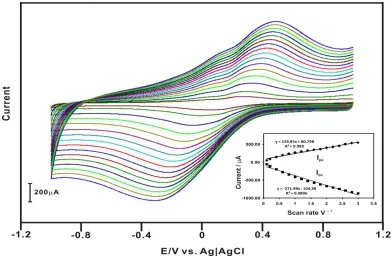
Figure 2. Cyclic voltammograms recorded at MWCNT- PDPA/GCE in N2 saturated 0.1 M PBS (pH
[image:4.596.126.471.68.329.2] [image:4.596.102.494.454.711.2]
The electrochemical behavior of the deposited PDPA on MWCNT-PDPA was studied by CV. The MWCNT-PDPA/GCE was washed and dried. Then it was transferred to N2 saturated 0.1M PBS
(pH 7). Cyclic voltammograms were recorded at various scan rates in the potential range –0.1 to 1.0 V. DPA would generate electroactive sites during the electropolymerization process [24]. The CV responses of GCE/MWCNT-PDPA at different scan rates are shown in fig.2. Both Ipc and Ipa increase
linearly with the scan rate.
The linear dependence of Ipc and Ipa with the scan rate is given in the inset of fig.2. This result
shows that MWCNT-DPA composite film has electroactive sites and shows the redox peaks in pH 7. The redox peak potentials shift significantly with the increase in scan rates. That is, the peak potential separation, ∆Ep depends on the scan rate. These results show that the redox couple exhibited by the
MWCNT-PDPA film is not reversible and surface confined. The film exhibits good linear relationship between Ipc and Ipa in such a wide range of scan rate from 0.1 Vs–1 to 3 Vs–1. This indicates the good
stability of the film in pH 7.
3.3 Surface morphological characterization of various films using SEM
Fig. 3 shows the SEM images of MWCNT, PDPA, MWCNT-PDPA films coated on indium tin oxide electrodes (ITO) with same experimental conditions as mentioned in section 3.1.
[image:5.596.195.400.407.740.2]
The images show different surface morphology among the various films. Fig.3 (a) shows the uniform distribution of MWCNT on the ITO surface. Fig.3 (b) shows the PDPA globules distributed over the ITO surface. The PDPA formed on the surface is not a continuous uniform thin film. This is in accordance the previous report by Comisso et al. [26] for electropolymerization of PDPA homopolymer. However, it can be seen that the PDPA film a lot of cavity like structures. It is reported earlier that continuous film of PDPA cannot be prepared by cyclic voltammetry [27]. This could be due to the solubility of the oligomers from the electrode surface. Fig. 3 c) shows the SEM image of MWCNT-PDPA composite film on ITO surface.
3.4 EIS studies of different films
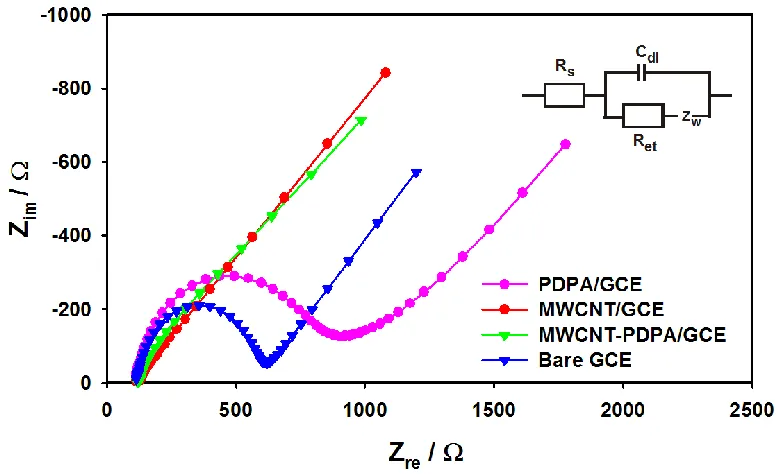
Conducting polymers, polyelectrolytes, surfactants, nanomaterials or semiconducting materials coated on the electrode surface change the double layer capacitance and interfacial electron transfer resistance of the corresponding electrode. Impedance spectroscopy can reveal the interfacial changes due to the surface modification of electrodes [28].The electrochemical impedance properties of the bare GCE, MWCNT, PDPA, MWCNT-PDPA modified GCE were recorded in 5 mM Fe(CN)6
3-/Fe(CN)64- in PBS and are represented as Nyquist plot (Zim vs. Zre) in fig.4. The inset of fig. 4 shows
the Randles equivalence circuit model used to fit the experimental data. Where Rs is the electrolyte
resistance, Ret is charge transfer resistance, Cdl is double layer capacitance and Zw is Warburg
impedance. The semicircle appeared in the Nyquist plot indicates the parallel combination of Ret and
Cdl resulting from electrode impedance [29]. The semicircles obtained at lower frequency represent a
diffusion limited electron transfer process and those at higher frequency represent a charge transfer limited process. The Nyquist plot of various films obtained from EIS measurements are given in fig. 4.
Figure 4. EIS of bare, MWCNT, PDPA, MWCNT-PDPA modified GCE in 5mM Fe(CN)6
[image:6.596.103.492.491.728.2]
Bare GCE and PDPA-GCE exhibit a semicircle at lower frequency region showing significant resistance towards the electron transfer process at the electrode surface. Whereas, MWCNT and MWCNT-PDPA modified GCE exhibit a very small semicircle region indicating very low impedance of the films. The low impedance of these two films is due to the high conducting nature of MWCNT. Also, it indicates that the PDPA deposited over the MWCNT and GCE surface does not hinder the transfer of electrons.
3.5 Electrochemical behavior of 4-NP at various electrodes
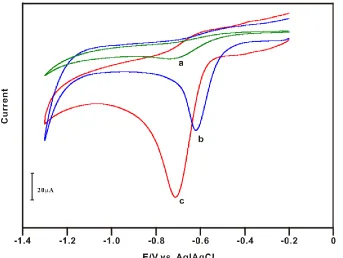
The electrochemical behaviour of 4-NP at various electrodes in the potential range – 0.2 to – 1.3 V in 0.1 M PBS (pH 7) is shown in fig. 5. At bare GCE (curve a) 4-NP undergoes an irreversible reduction at – 0.942 V with respect to Ag/AgCl (sat. KCl) with a cathodic peak current (Ipc) of 1.39 x
10–5 A. The cathodic peak is due to the reduction of the nitryl group of the Nitrophenol to form 4-hydroxylaminophenol by a 4e–/4H+ transfer electrochemical reduction process [30-32]. 2-nitrophenol also undergoes electrochemical reduction by a similar mechanism [33].
Figure 5. Cyclic voltammograms of 5.46 x 10⁻⁴ M 4-NP at different electrodes in 0.1M PBS (pH 7) at the scan rate of 0.1Vs–1. a) bare GCE, b) MWCNT/GCE, c) MWCNT-PDPA/GCE.
At CNT/GCE (curve b), the cathodic peak potential (Epc) appears at – 0.619 V with Ipc of 5.9 x
10–5 A. Compared to bare GCE, the peak potential is shifted positively by 0.322 V and the current is increased by 4.24 times. At MWCNT-PDPA/GCE, the reduction peak appears at – 0.711V with Ipc
[image:7.596.130.473.369.627.2]
irreversible reduction of 4-NP at MWCNT-PDPA/GCE is shown in scheme 1. The significant increase in peak current indicates the electrocatalytic activity of the composite film.
Scheme 1. Reduction of 4-NP at MWCNT-PDPA/GCE in 0.1M PBS (pH 7)
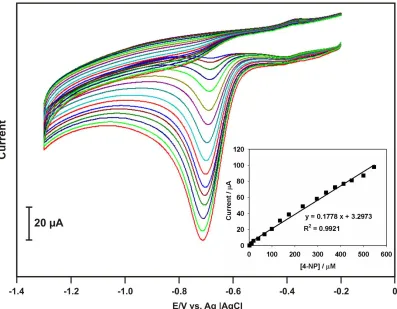
Figure 6. Cyclic voltammograms obtained for various concentrations of 4-NP at MWCNT/PDPA modified GCE in 0.1M PBS pH 7 in the potential range – 0.2 to – 1.3 V. Scan rate: 0.1 Vs–1. Concentration range - inner to outer: 1.99, 11.9, 40.3, 67.1, 99.1, 135, 173.5, 234.3, 336, 375, 412.4, 448.1, 499.5, 545.8 µM. The inset is the linear dependence of Ipc on the 4-NP
concentration.
The cyclic voltammetric response of various concentrations of 4-NP is given in fig.6. Ipc
[image:8.596.101.498.285.594.2]
linear increase of Ipc fits the equation Ipc (µA) = 0.1778 C (µM) + 3.2973, regression coefficient (R2) =
3.2973. The linear response shows the stability and promising electrocatalytic application of the proposed film. Above the linear range, the poor response of the electrode may be due to the increase in concentration of the products formed during the electrochemical reduction at the electrode surface. Hence, we employed hydrodynamic amperometry to improve the linear range of the film. Amperometric response of the film is discussed in detail in section 3.6
3.6 Amperometric determination of phenol at GCE/MWCNT-PDPA
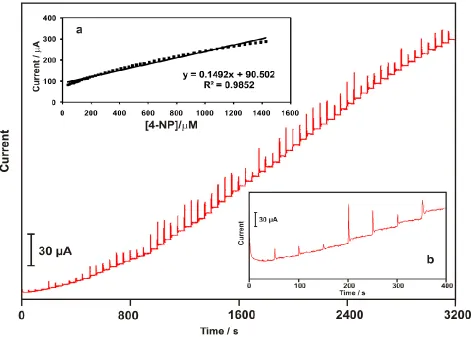
Rotating disc electrode is a hydrodynamic electrochemical technique which involves the convective mass transport of reactants and products at the electrode surface, when the electrode is rotated at a specific speed [34]. The amperometric response of 4-NP at MWCNT-PDPA modified rotating disc GCE is show in fig. 7. The RDE surface area was 0.236 cm2.The experiment was conducted in N2 saturated 0.1M PBS (pH 7) at an applied potential of – 0.71 V with a rotation rate of
1200 RPM. 1 x 10⁻² M 4-NP solution in PBS (pH 7) was added at regular intervals of time. Electrocatalytic reduction of 4-NP occurs at RDE in a totally mass transfer controlled condition.
Figure 7. Amperometric i-t curve of 4-NP at MWCNT/PDPA modified rotating disc GCE in the applied potential of –0.71 V for the addition of 4.9 x 10⁻⁷ to 1.6 x 10⁻³ M 4-NP in N2 saturated
[image:9.596.63.534.372.709.2]
of current on 4-NP concentration. Inset “b” is the enlarged view of amperometric response for the addition of 4.9 x 10⁻⁷ to 3.9 x 10⁻⁶ M 4-NP.
For every addition of 4-NP, a quick response was observed and the reduction current increases linearly up to 3200 s which is equal to 1.573 x 10⁻³ M 4-NP. The response time is 5 s. Inset (a) of fig. 7 shows the linear dependence of the current on the concentration of 4-NP in the linear range. The linear dependence of the amperometric response on concentration fits the equation I (µA) = 0.1492 C (µM) + 90.502, regression coefficient (R2) = 0.9852. The film shows the linear range of detection of 4-NP from 8.9 µM to 1.5 mM 4-NP. The sensitivity of the film towards the reduction of 4-NP is 0.6322 μA μmol–1cm–2. This shows the stability of the proposed electrode and the efficient amperometric response which could be applied for real sample analysis.
4. CONCLUSION
In this study, we reported the fabrication of MWCNT-PDPA composite modified GCE and its application for electrochemical reduction of 4-NP in pH 7. DPA was successfully electropolymerized onto MWCNT modified GCE by cyclic voltammetry in 5 M H2SO4. The surface morphology of PDPA
and MWCNT-PDPA films were characterized by SEM. The study shows PDPA is formed as polymer globules on the surface of the electrode and not as a continuous smooth film. The MWCNT-PDPA composite film enhanced the reduction peak current of 4-NP by 7.27 times than that of bare GCE. The amperometric determination studies showed that the composite film has quick response and a very good linear range.
ACKNOWLEDGEMENT
This work was supported by the National Science Council of the Taiwan (ROC).
References
1. M. Trapido and J. Kallas, Environ. Technol., 21 (2000) 799.
2. V. Uberoi and S. K. Bhattacharya, Water Environ. Res., 69 (1997)146
3. W. Sun, M. X. Yang, Q. Jiang and K. Jiao, Chin. Chem. Lett., 19 (2008) 1156. 4. L. Q. Luo, X. L . Zoua, Y. P. Ding and Q. S. Wu, Sens. Actuators, B, 135 (2008) 61. 5. J. Chen, G. Yang, M. Chen and W. Li, Russ. J. Electrochem., 45 (2009) 1287.
6. Z. Liu, J. Du, C. Qiu, L. Huang, H. Ma, D. Shen and Y. Ding, Electrochem. Commun., 11 (2009)1365.
7. J. Fischer, L. Vanourkova, A. Danhel, V. Vyskocil, K. Cizek, J. Barek, K. Peckova, B. Yosypchuk and T. Navratil, Int. J. Electrochem. Sci., 2 (2007) 226.
8. V. de A. Pedrosa, L. Codognoto and L. A. Avaca, J. Braz. Chem. Soc., 14 (2003) 530. 9. E. A. Hutton, B. Ogorevc and M. R. Smyth, Electroanal., 16 (2004) 1616.
10. Z. G. Hua, T. Y. Ting., L. M. Chuan, L. Y. Zhu, X. Xiao-E, Chinese J. Chem., 25 (2007) 1445. 11. H Yin, Y. Zhou, S. Ai, X. Liu, L. Zhu and L. Lu, Microchim. Acta,169 (2010) 87.
13. Z. Wang, S. Li and Q. Lv, Sens. Actuators B, 127 (2007) 420.
14. Y. Umasankar, A. P. Prakash and. S. M. Chen. Anal. Biochem., 411 (2011) 71. 15. S. F. Wang and Q. Xu, Anal. Lett., 38 (2005) 657.
16. Y. Umasankar, T. Y. Huang, S. M. Chen, Anal. Biochem., 408 (2011) 297. 17. L. Wang and V. Cammarata, Thin Solid Films, 284 (1996) 297.
18. A. Bagheri, M. R. Nateghi and A. Massoumi, Synth. Met., 97 (1998) 85.
19. P. Santhosh, K. M. Manesh, K. P. Lee and A. I. Gopalan, Electroanal., 18 (2006) 894.
20. V. Rajendran, A. Gopalan, T. Vasudevan, and T. C. Wen, J. Electrochem. Soc., 147 (2000) 3014. 21. M. Baibaraca, I. Baltog, S. Lefrant, P. G. Romero, Mater. Sci. Eng., B, 176 (2011) 110.
22. D. R. S. Jeykumari, S. Ramaprabhu and S. S. Narayanan, Carbon, 45 (2007)1340.28
23. H. Su, R. Yuan, Y. Chai, Y. Zhuo, C. Hong, Z. Liu and X. Yang, Electrochim. Acta, 54 (2009) 4149.
24. P. Santhosh, C. Sivakumara, A. Gopalan; T. Vasudevana and T. C. Wen, Int. J. Polym. Anal. Charact., 10 (2005) 341.
25. M. S. Wu, T. C. Wen and A. Gopalan, J. Electrochem. Soc., 148 (2001) D65.
26. N. Comisso, S. Daolio, G. Zotti, S. Zecchin, R. Salmaso, and G. Mengoli, J. Electroanal. Chem., 255 (1988) 9. 255: 97.
27. D. Ragupathy, A. I. Gopalan and K. P. Lee. Microchim. Acta, 166 (2009) 303. 28. E. Katz and I. Willner, Electroanal., 15 (2003) 913.
29. H. O. Finklea, D. A. Snider and J. Fedyk., Langmuir, 9 (1993) 3660.
30. L. Q. Luo, X. L. Zoua, Y. P. Ding and Q. S. Wu , Sens. Actuators, B, 135 (2008) 61. 31. F. C. Moraes, S. T.e Tanimoto, G. R. S. Banda, S. A. S. Machado and L. H. Mascaro,
Electroanal., 21 (2009) 1091.
32. M. A. E. Mhammedi, M. Achak, M. Bakasse and A. Chtaini, J. Hazard. Mater., 163 (2009) 323. 33. T. Ndlovu, O. A. Arotiba, R. W. Krause, B. B. Mamba, Int. J. Electrochem. Sci., 5 (2010) 1179. 34. A. J. Bard and L. R. Faulkner, Electrochemical Methods Fundamentals and Applications, 2nd ed.,
John Wiley & Sons, Inc, (2001) 331.