Accelerated degrees
in Higher Education
Case study report
March 2017
Contents
List of tables 4
Executive Summary 5
Teaching provision at the case study institutions 5
The market for accelerated degrees 6
Design and delivery of accelerated degree courses 7
Benefits 8
Challenges and barriers 9
Reflections on accelerated degrees and the wider higher education landscape 10
Chapter 1: Introduction 11
Research context 11
Research aims 12
Methodology 13
Case study selection 13
Case study approach 13
Overview of case study institutions 16
Institution 1 16
Institution 2 16
Institution 3 16
Institution 4 16
Institution 5 17
Institution 6 17
Institution 7 17
Report structure 18
Chapter 2: Teaching provision at the case study institutions 19
Standard provision and flexible learning 19
Provision of accelerated degrees 20
Motivations for offering accelerated degrees 22
Chapter 3: The market for accelerated degrees 24
Awareness of accelerated degrees 24
Market research 25
Students attracted to accelerated degrees 26
Promoting accelerated degrees 28
Future plans for accelerated degree courses 29
Chapter 4: Design and delivery of accelerated degree courses 31
Design and delivery 31
Transferring 35
Chapter 5: Benefits 37
Benefits for the institution and staff 37
Benefits for students and employers 38
Chapter 6: Challenges and barriers 42
Challenges relating to practical issues 42
Challenges relating to finance 44
Challenges relating to awareness and student recruitment 46
Lessons learned 48
Chapter 7: Reflections on accelerated degrees and the wider higher education
landscape 50
Appendix 1: Research brief for case study participants 52 Exploration of accelerated degrees: Alternative, flexible and innovative modes of
study 52
Appendix 2: Discussion guide for staff 55
Appendix 3: Discussion guide for students 63
List of tables
Table 1: Case study participants by role for the total sample 14
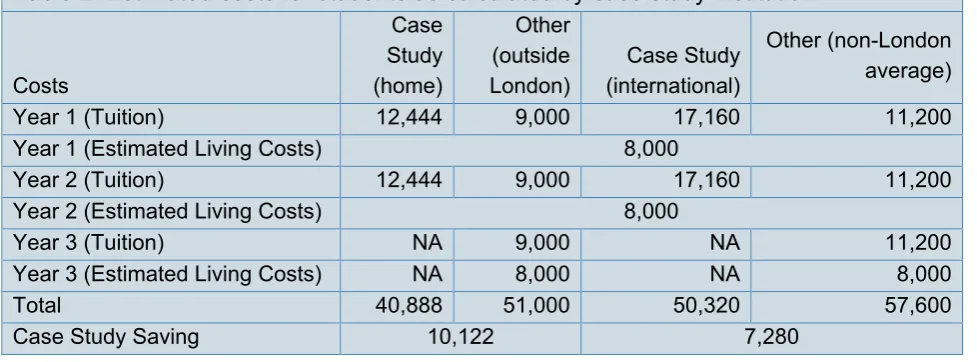
Table 2: Estimated costs for students as calculated by case study institution 39
Executive Summary
The Institute for Employment Studies (IES) was commissioned by the Department for Business, Innovation and Skills (BIS) to undertake a literature review and a series of case studies. Since the report was commissioned responsibility for higher education policy has transferred to the Department for Education (DfE). The case studies aimed to complement the literature review by presenting a picture of how accelerated degrees were currently being delivered and identify examples of good practice.
Between April and August 2016, six full case studies and one mini case study were undertaken with Higher Education Institutions (HEIs) in England that offered either accelerated degrees or flexible study at undergraduate bachelor’s level.
The case studies were conducted using qualitative research methods: in-depth
interviews, joint interviews and focus groups with a range of staff; and, in some cases, focus groups or interviews with students.
Teaching provision at the case study institutions
There was much variation between the case study institutions and their teaching provision, but some general trends were identified.
For the majority of the case study institutions, accelerated degrees constituted a small minority of the undergraduate courses that they offered: most of the case study
institutions delivered ten or fewer accelerated degrees. However for one institution, accelerated bachelor’s degrees constituted their standard mode of delivery for undergraduate courses, and another case study institution did not deliver any
accelerated degrees but delivered a high proportion of flexible and alternate modes of study.
There appeared to be no ‘standard’ term in the sector for describing accelerated degrees: most of the case study institutions referred to accelerated degrees as ‘fast-track’ degrees and some referred to them as ‘accelerated’, and during interviews or in longer marketing text, they were quite often referred to as ‘two year degrees’ or ‘two year fast-track’ etc. All of the full case studies were involved with flexible and alternate modes of learning to some extent such as part-time study, blended learning, distance learning, and work-based learning. Indeed, many emphasised their ‘history’ of engaging with flexible
learning. Staff at several institutions linked flexible and alternate modes of study with their institution’s commitment to widening participation by increasing routes and modes of access to higher education.
There was a strong focus on vocational subjects in the accelerated degrees offered, with subjects including management, education, law, and journalism. A couple of institutions offered humanities subjects but this was less common and could incorporate vocational
elements such as education-based placements. The case study institutions tended not to offer accelerated degrees in science subjects and staff expressed the opinion that it may be more difficult to ‘accelerate’ science subjects.
The number of students on accelerated degree courses in the case study institutions were relatively small. Class size varied between one student and 40, but intakes of between 10 and 20 were more typical. There was large variation in the total number of students participating in accelerated degrees at each institution, ranging from 12 to 1,000 students. Half of the case study institutions reported total cohorts of 12 to 30 students.
The case study institutions varied in the length of time they had been delivering accelerated degrees. Most institutions had started delivering accelerated degrees between two and ten years ago but one had been delivering accelerated bachelor’s degrees for several decades.
The most common underlying motivation for creating accelerated degrees appeared to be to increase student recruitment or to gain a competitive advantage. Most case study institutions felt that accelerated degrees complemented the flexible and alternate modes of study they already offered and some also felt they were well suited to a vocational emphasis.
Staff thought that accelerated degrees would attract or facilitate different types of
students to participate in undergraduate courses. It was felt that by reducing the number of years for which a student needed to pay, and thus reducing the overall tuition costs of an undergraduate degree, it might make it easier for those from a widening participation background to access higher education. Some felt that the reduced timespan might also attract career-changers or people with existing experience of work who might want to get into the workforce quickly and be more used to working throughout the year and/or be less interested in the social aspects of a traditional three-year degree.
The market for accelerated degrees
Staff and students felt that there was low general awareness of accelerated degrees among students and prospective students. Staff felt that awareness among employers was also low, and some students reported needing to explain what they were in
interviews with employers or other HEIs.
Case study institutions used a range of market research approaches before launching accelerated degrees from desk research through to focus groups and surveys. Most institutions had used desk or qualitative research.
Student characteristics varied widely across institutions and courses, but there were some patterns.
• All case study institutions reported some level of young mature student participation i.e. people in their early- to mid-twenties.
• Case study institutions described accelerated degree students as focused, highly motivated and keen to progress, with some HEIs reporting that they attracted better performing students than was typical for their institution.
Some case study institutions did not promote accelerated degrees separately but included these in their general promotion of undergraduate courses, which some staff found frustrating. However, some institutions reported that marketing to mature students could be difficult and expensive – these were a key target market for many of the
courses. Other institutions undertook specific promotional activities for accelerated degrees. These messages often focused on accessing the workplace faster rather than the potential cost savings.
Most case study institutions reported that they would continue to offer accelerated degree courses if they continued to attract sustainable numbers of students.
Design and delivery of accelerated degree courses
Most case study institutions used a three-term structure to the academic year for their accelerated courses differing from the two term structure used for their traditional undergraduate degrees. The third term was ‘slotted’ into the traditional summer periods in order to incorporate six terms of study into two years. In most cases, accelerated courses were based on three-year equivalent ‘parent’ degrees offered by the university, and accelerated and traditional students often shared some lectures. However, some accelerated degree courses were bespoke and no teaching was shared. One institution used a four-term approach to the academic year and delivered most of its undergraduate teaching through the accelerated degree model.
Modes of teaching used during the summer terms varied widely across the case study institutions. Only one institution maintained a traditional approach of lectures and seminars. Most case study institutions employed blended learning, where students attended university for two to seven weeks of classroom-based learning at the beginning of the summer term, with the remainder of the term being delivered through online or distance learning. Several case study institutions used work-based learning as a compulsory element of their accelerated degrees, often via placements. The overall design of an accelerated degree was sometimes quite innovative compared to the institutions’ typical delivery.
Most case study institutions allowed students to transfer from the accelerated degree onto an equivalent three-year degree. Staff felt that this was an essential safety net but noted that some successful students transferred for other reasons as well. Some
institutions allowed students on traditional degrees to transfer onto accelerated degrees. Transfers in either direction usually occurred after the second term of the first year.
Benefits
Benefits experienced by staff and institutions:
• Staff in many case study institutions felt that accelerated degrees attracted ‘stronger’ students than their typical intake. Students were highly motivated and committed and this translated to positive outcomes. However, staff acknowledged that this could be a result of selection at the recruitment stage - applicants were vetted carefully to recruit students that the institution felt could ‘cope’ with the demands of accelerated study.
• Some staff felt that accelerated degrees helped an institution to stand out and were a ‘premium’ product. One institution had initially charged higher fees for its accelerated degrees (£9,000 instead of £8,500) but then later increased all undergraduate fees to the maximum fee level.
Benefits experienced by students:
• A key benefit highlighted by both staff and students were the reduced costs of an accelerated degree where students pay two years’ of tuition fees rather than three. This was also seen as a benefit for employers funding an employee’s study.
• Staff and students felt one benefit was entering the labour market faster compared with traditional undergraduate degrees. One young mature student saw it as an opportunity to catch-up with their peers. Staff and students suggested an
accelerated degree could be combined with a master’s degree or vocational qualification.
• Staff and students felt that the small cohorts typical on accelerated degrees increased the amount of contact time between staff and students and facilitated a more interactive learning environment. They were also felt to benefit relationships between students. Both staff and students felt that accelerated degree students formed more cohesive and supportive groups.
• Staff felt that accelerated degrees helped students learn to work under pressure and manage workload, helping prepare them for work or further intensive study. Students shared this view.
• Accelerated degrees at the case study institutions often had a vocational focus and many involved placements. Staff felt this helped with gaining employment and students reported that the vocational aspects of their courses were important to them.
Challenges and barriers
Challenges related to practical issues of delivering accelerated degrees:
• Many staff highlighted the impact that the shorter time-scales of accelerated degrees had on the time available for marking and moderation. Students needed to receive feedback and grades on time in order to progress on their course. Marking to tight deadlines and trying to fit with exam board timing caused increased stress for staff.
• The pace and relatively inflexible structure of accelerated degrees could also cause challenges for students. Staff noted that students had less time for
placements or part-time jobs and tight scheduling meant that sometimes students had fewer or no subject module options compared with students on equivalent three-year courses.
• Another challenge regarding the pace of accelerated degrees was the perception that they were too difficult or stressful. Two institutions identified this concern in their market research exercises. However, accelerated degree students reported that, though they had to work hard, their course was manageable.
• Staff and students identified issues around access to support and facilities. Out of term opening hours and staff annual leave or conferences meant that students’ access was limited at certain times of the year. Some students also felt they
lacked some aspects of peer support as by their second year there were no longer students above them to provide advice.
• Staff also noted that universities earned less money per degree for an accelerated degree compared with a traditional degree as they could only charge standard fees for two years rather than three. Some staff felt that universities should be allowed to charge higher fees for accelerated degrees.
• Opinions were mixed as to whether there were increased costs from accelerated degrees. Some staff felt that there were no real extra costs as they used existing staff and facilities, but some staff believed there were opportunity costs involved such as loss of income from renting accommodation to students instead of utilising these facilities to host conferences.
• Staff at all institutions were concerned with the general lack of awareness
surrounding accelerated degrees, which was seen as a barrier to the expansion of accelerated degrees. It was felt that low awareness among schools, colleges and careers advisors meant potential students did not receive advice or information about them. Staff reported that some students and schools/colleges did not realise they had the same value as a traditional three-year degree. Some students
reported having to explain what an aceelerated degree involved to employers and other HEIs during interviews.
• Staff emphasised the need to recruit students with sufficient motivation, resilience and ability to cope with accelerated study. Most case study institutions interviewed all their accelerated degree applicants, but most still experienced some degree of student drop out. Interviewing was also felt to be important as some applicants may have come to higher education through alternate routes. Institutions felt able to interview all applicants as cohorts were small but this would be more
challenging with larger numbers of applicants.
Reflections on accelerated degrees and the wider higher
education landscape
Overall staff were positive about accelerated degrees. Most were highly engaged and enthusiastic about the accelerated courses offered and enjoyed teaching the highly motivated students. Many felt that accelerated degrees addressed a gap in the market and offered a new alternative route into higher education.
Some staff felt that the government could play a larger role in the promotion of accelerated degrees, both through raising awareness amongst students and by reassuring employers of the parity between two- and three-year degree courses. One staff member highlighted that the government had been very successful in raising
awareness surrounding apprenticeships. Some students also suggested that options for two year degrees could be clearer in UCAS.
Some staff felt that targeted financial advice for students, possibly from Student Finance England, could be beneficial and several students suggested that larger student loans for accelerated degree courses would be helpful as there was less opportunity to work alongside study.
Most staff felt that there was potential for growth in accelerated degrees in the future and that recent increases in fees had been a significant factor in making them a more
attractive option. They thought that the number of accelerated degrees offered could be increased but felt that increasing cohort sizes too much could lead to unmanageable workloads for staff. However, it was also felt that care needed to be taken in choosing a subject and format that was appropriate to or benefitted from the accelerated model.
Chapter 1: Introduction
The Institute for Employment Studies (IES) was commissioned by the Department for Business, Innovation and Skills (BIS) to undertake a literature review and a series of case studies. Since the report was commissioned responsibility for higher education policy has transferred to the Department for Education (DfE). The literature review aimed to provide the Department with a comprehensive picture of the existing evidence-base on accelerated degrees as a non-traditional and flexible mode of study delivery in higher education (HE). The case studies aimed to complement the literature review by presenting a picture of how accelerated degrees were currently being delivered and identify examples of good practice.
Research context
Over the past 20 years HE has changed radically in a number of key ways:
• in the way it is funded, moving towards a student loan-backed system with repayment thresholds based on graduate earnings;
• in the volume and profile of those participating in HE, both increasing and widening participation; and
• in the way it is delivered, in terms of study mode, speed of delivery and place of delivery.
All of these factors are inter-related as students are making investment decisions about HE and so want more choice about how, what and where they learn. At the same time, the sector is coping with a larger and more diverse group of students, yet still needs to deliver a satisfying and beneficial experience (against an increasing array of key
performance indicators (KPIs)). The traditional image of HE taking place in large lecture halls, small seminar rooms and laboratories, in a small number of institutions and with programmes in the main spread over three years (with students devoting all their time to their studies or being a student for 30 weeks in each year) and leading to a bachelor’s degree is now being challenged.
The policy drive in higher education for many years and across various administrations has been for diversity in delivery and increased student choice. We now have workplace or work-based learning, HE in Further Educaiton (FE), non-publicly funded providers, for-profit providers, Trans-National Education (TNE), distance learning and elearning (from MOOCs, which tend to be free of charge, through to more blended learning), part-time study, sub-degree or other undergraduate qualifications, higher level and degree
apprenticeships, and accelerated degrees. These are all forms for increasing flexibility in
HE, providing flexibility in how, where, when and at what pace learning occurs (Outram, 20111).
Some of these alternative methods of study, learning delivery and engagement are faring better than others. There are significant concerns in the sector about the health of part-time study. For example, the recent Universities UK report (20152) exploring patterns and
trends in HE reports that part-time student numbers continue to fall and now make up just 25 per cent of the student body and the numbers taking other undergraduate
programmes also continues to fall. DfE are particularly interested in accelerated degrees (a particular focus of the Government’s manifesto), the take up and contexts for these forms of flexible delivery, the attitudes to these, and the issues involved in offering them. It should be noted that these are not exclusive forms of flexible delivery and indeed accelerated degrees could be delivered using other flexibilities including blended learning.
Research aims
The main aim of the case study element of the research was to use qualitative research to conduct a series of case studies of institutions which deliver accelerated bachelor’s degrees or other flexible learning to explore what current delivery of accelerated degrees looks like and to identify examples of good practice. This would inform and enrich the findings of the literature review on accelerated degrees. More specifically, the case study research aimed to add depth and examples of current practice relating to:
• perceptions and experience of the current market for accelerated degrees – to explore what demand there is for accelerated degrees, what type of student is attracted to accelerated degrees and whether this has changed over time; • design and delivery of accelerated degrees – to explore how institutions deliver
accelerated degrees, how this fits alongside any three year delivery and how flexible and alternate modes of learning can be incorporated;
• beneficial outcomes – to explore any perceived benefits for institutions, students, staff and employers and whether there have been unexpected benefits;
• challenges and barriers – to explore any perceived challenges for institutions, students, staff and employers and any barriers experienced; and
1 Outram, S. (2011). Final Evaluation of the HEFCE-funded Flexible Learning Pathfinder Projects, The
Higher Education Academy
2 UUK (2015). Patterns and Trends in UK Higher Education, Universities UK
• good practice – to identify good practice in accelerated degrees. These may include: examples of delivery that are perceived to be particularly effective or innovative, approaches used to resolve challenges in delivering accelerated degrees and examples of courses that have met a need in the education market. The case studies sought to identify and synthesise a range of experiences, stakeholder views and delivery approaches to accelerated degrees to identify common themes and highlight good practice. It also sought to illustrate how accelerated degrees fit into the current higher education provision landscape and potential scope for how this may be developed in the future.
Methodology
In addition to a literature review reviewing evidence and policy around accelerated
degrees in the UK and internationally, a series of case studies were carried out to identify good practice and successful delivery of flexible learning. Between April and August 2016, six full case studies and one mini case study were undertaken with Higher Education Institutions (HEIs) in England that offered either accelerated degrees or flexible study at undergraduate bachelor’s level.
Case study selection
Good practice case studies were selected in collaboration with HE analysts at BIS to explore institutional good practice, examples of flexible modes of study delivery and, in particular, delivery of accelerated degrees at undergraduate bachelor’s level. The seven case studies were selected to represent a range of experiences and contexts from the following factors:
• number of accelerated degree courses offered
• number of students studying for accelerated degrees • subjects offered as accelerated degrees
• number of years the institution has been offering accelerated degree courses • type of institution (publicly or non-publicly funded)
• characteristics of students at that institution
Case study approach
The case studies were conducted using qualitative research methods. For the full case studies, the core element comprised in-depth interviews, joint interviews and focus groups with a range of staff including: senior management, academic staff, business development staff and staff supporting students. The mini case study comprised one
interview with a senior staff member involved in designing, developing and delivering an accelerated degree course. Staff interviewees were asked about:
• flexible learning provision at the case study institution;
• provision of accelerated bachelor’s degrees;
• reasons for the institution offering this provision;
• the market for accelerated degrees;
• design and structure of accelerated degrees;
• benefits and challenges of offering these degrees;
• students experiences of accelerated degrees; and
• their own experience of involvement with accelerated degrees.
In a number of case studies, interviews and focus groups were also conducted with students who were participating in an accelerated bachelor’s degree exploring their experiences of studying for an accelerated degree, factors influencing decision-making around choosing their course, perceptions around accelerated degrees and future plans. Discussion guides used for staff and students can be found in appendices two and three respectively.
The research was not designed to be an audit of provision but an exploration of how flexible learning and accelerated degrees are currently delivered in England and to identify any examples of good practice and any challenges or barriers to offering or studying for accelerated degrees and thus update the literature on accelerated degrees in England. Most qualitative information was collected in face-to-face interviews or focus groups during fieldwork visits to the institutions; any remaining information was collected through telephone interviews and group discussions via Skype. Information about
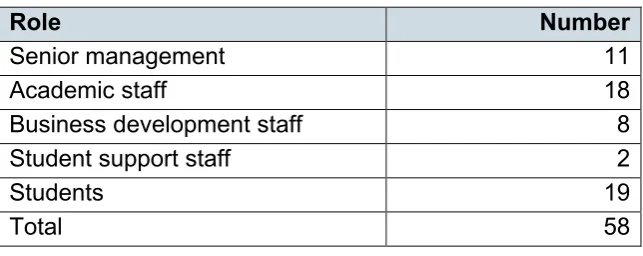
[image:14.595.134.456.543.671.2]participants across all case studies by role is summarised in the table below.
Table 1: Case study participants by role for the total sample
Role Number
Senior management 11
Academic staff 18
Business development staff 8
Student support staff 2
Students 19
Total 58
A qualitative approach ensured that the greatest possible diversity of viewpoints and key HE characteristics would be reflected. However, it should be noted that, unlike large scale survey research, findings from qualitative research cannot be interpreted as being
statistically representative of all HEIs and colleges in England, or be used to describe the numbers and proportions of institutions or staff delivering accelerated degrees or the number of students participating in them. Instead qualitative research provides depth of insight. It gives a detailed understanding of how individual institutions deliver accelerated degrees and what factors influenced the creation, design and delivery of these courses, as well as identifying examples of good practice and challenges or barriers to delivery of accelerated degrees.
In England, around 20 publicly funded institutions and five non-publicly funded institutions were identified during this study as offering accelerated bachelor’s degrees. An overview of accelerated degree provision in the UK and overseas is provided in the accompanying literature review. In this study IES undertook full case studies with five publicly funded universities and one non-publicly funded university, as well as one mini case study with a sixth publicly funded university. The case studies were selected to represent a range of experience of delivery of accelerated degrees in terms of how many accelerated degrees are offered, how long the institution has offered this provision, institution type, and course subjects offered. The selected case study institutions offered a range of subjects
including vocational subjects, such as management, education, journalism and finance and accounting, humanities subjects, such as English and history and some science courses, such as sports sciences and psychology. An overview with profiles of the case study institutions is presented in the following section.
The shortlisted case studies were sent an invitation to participate in the research from the Head of Higher Education Analysis at BIS and a research briefing describing the aims and format of the research. This letter (sent in October 2015 or April 2016) set out what the research involved, introduced the research team and asked for a named contact. The research team then followed up and worked closely with the institution liaison to identify the most relevant individuals to speak with and to arrange the interviews and group discussions at the most convenient times for interviewees and arrange for suitable venues. The case studies involved visits of one day. A topic guide was developed in partnership with BIS colleagues and was used flexibly with individual participants based on their role in the institution and their experience. With interviewees’ permission, the discussions were recorded in order to supplement the notes made by the lead researcher for each case study.
Analysis of the case study findings used a content analysis technique against a framework of themes developed using the analytical framework and sub-themes
identified in the literature review. Findings were organised and summarised using these themes with anonymised quotes provided to illustrate and illuminate key points. In addition to this, examples of good practice have been identified and, where permission has been given, these examples are presented throughout this report with details identifying the relevant institution. Participating institutions have also received a brief case study write-up for their institution which can be used internally for course or policy development.
Overview of case study institutions
Six full case studies and one mini case study explored good practice at seven higher education institutions. Quotes or findings from these institutions have been anonymised in the report except where institutions have explicitly given permission to be identified for specific examples of good practice. However, some basic information is provided in the following institution profiles in order to provide some context for the findings.
Institution 1
Institution 1 is a post-1992 university. The institution offers several accelerated bachelor’s degrees in vocational subjects. The accelerated degrees have been running for around two years, and are part of the Higher Education Funding Council for England (HEFCE) Pathfinder Pilots. There are up to 100 students at the institution studying for an
accelerated degree. There are around 16,000 students at the institution in total. The institution places importance on their widening participation agenda and a large amount of their teaching is delivered via online or part-time study. The institution has a dedicated department delivering online learning, including international and distance learning, and over 3,000 students study this way.
Institution 2
Institution 2 is a post-1992 university. The institution offers one accelerated degree combining two subjects and with a vocational emphasis. In total, around 30 students at the institution were studying on the accelerated degree course. The overall student population at the institution was 4,000. The institution offers some flexible learning with a number of part-time courses and one of their master’s degree programmes is delivered through blended learning.
Institution 3
Institution 3 is a pre-1992 university and was established in the latter half of the 20th
century. The institution does not currently offer any accelerated bachelor degrees but specialises in flexible learning, both in terms of time and alternate modes of delivery. There were up to 200,000 students at the institution. Over 60 per cent of students entered the university through widening access routes and many were mature students. Most students studied part-time.
Institution 4
Institution 4 is a post-1992 university. The institution offers three accelerated bachelor’s degrees. All of these courses are in vocational subjects. These degrees have been running for around three years. Current student numbers are small with one or two
students on each course as they are piloting these courses but they plan to increase numbers over time. Fewer than a dozen students in total at the institution were studying for accelerated degrees at the institution. There are around 11,000 students at the institution. The institution is committed to a widening participation agenda and offers some alternative and flexible modes of study.
Institution 5
Institution 5 is a post-1992 university. The institution offers eight accelerated bachelor’s degrees. Most of these courses are in vocational subjects except for one humanities subject. The institution has offered accelerated degrees for around ten years and was involved in the Flexible Learning Pathfinder programme. Around 200 students overall were studying for accelerated bachelor’s degrees at the institution. The institution identified as a ‘widening participation’ institution (as 50 per cent of students come from postcodes classified in this category) offered some alternative and flexible modes of study.
Institution 6
Institution 6 is a pre-1992 non-publicly funded university and was established in the latter half of the 20th century. The majority of its undergraduate bachelor’s degrees are offered
as two year accelerated degrees and this has been the dominant model for several decades. These accelerated degrees include vocational, humanities and science
subjects. Accelerated bachelor’s degree courses comprise up to 40 students each cohort year. Of the around 2,000 students at the institution, around 1,000 study at
undergraduate level. Undergraduate courses are delivered almost exclusively using the accelerated degree model. Around a third of students at the institution are non-EU international students. The institution offers relatively limited provision in terms of
alternate and flexible learning provision beyond accelerated degrees; a small proportion of students study part-time.
Institution 7
Institution 7 is a post-1992 public university. They offer one accelerated bachelor’s degree in a vocational subject. This degree has been running for eight years. Student numbers on the degree courses have been in the range of 12 to 18. At the time of fieldwork, there were 20 students participating in the accelerated degree course across both years of study. The total number of students at the institution is around 8,000. The institution is committed to a widening participation agenda and offers some flexible learning.
Report structure
This report draws together experiences and perceptions regarding accelerated degree provision at seven case study institutions to present a picture of current delivery and to identify examples of good practice.
• Chapter 2 presents an overview of learning provision at the case study institutions including information about courses types, teaching modes, organisation of
teaching, an overview of accelerated degree provision and institutional motivations for offering accelerated degrees.
• Chapter 3 describes case study institutions’ experiences and perceptions around the market for accelerated degrees and how institutions have engaged with this. This includes: awareness of accelerated degrees, market research undertaken by institutions, characteristics of students attracted to accelerated degrees, how institutions promote them and changes in the market for accelerated degrees both observed and expected.
• Chapter 4 provides an overview of how the case study institutions have
approached the design and delivery of accelerated degrees and present examples of current practice. This chapter covers: considerations around design, how
different accelerated degrees courses are delivered and approaches to student transfer between accelerated and non-accelerated courses.
• Chapter 5 explores perceived benefits of accelerated degrees reported by
interviewees at case study institutions. This includes benefits for institutions, staff and students.
• Chapter 6 explores challenges and perceived barriers in delivery accelerated degrees reported by interviewees at case study institutions. This includes challenges and barriers for institutions, staff and students.
• Chapter 7 explores attitudes and opinions around the future development of accelerated degrees, what may affect this and topics around accelerated degrees and flexible learning where more information or research would be beneficial.
Chapter 2: Teaching provision at the case study
institutions
This chapter provides an overview of the teaching provision delivered across the case study institutions. First, it explores how accelerated degrees fit into the portfolio of teaching offered by institutions with regards to traditional undergraduate provision, flexible and alternate learning and organisation of teaching delivery. It then presents a picture of accelerated degree provision across the case study institutions in terms of the number of courses offered, subjects and cohort size. Finally, institutional motivations for offering accelerated degrees are explored identifying key themes.
Standard provision and flexible learning
For the majority of the case study institutions, accelerated degrees constituted a small minority of the undergraduate courses that they offered: most of the case study
institutions delivered ten or fewer accelerated degrees. However for one institution, accelerated bachelor’s degrees constituted their standard mode of delivery for
undergraduate courses and another case study institution did not deliver any accelerated degrees but delivered a high proportion of flexible and alternate modes of study. It is worth noting that there appeared to be no ‘standard’ term in the sector for describing accelerated degrees: most of the case study institutions referred to accelerated degrees as ‘fast-track’ degrees and some referred to them as ‘accelerated’, and during interviews or in longer marketing text, they were quite often referred to as ‘two year degrees’ or ‘two year fast-track’ etc.
As reflects the number of accelerated degrees offered by the case study institutions, most organised their academic year following the traditional model of undergraduate teaching with a long summer holiday: most used a three term system although some referred to the first two teaching terms as semesters. More atypical arrangements
included: an institution where the academic year comprised four terms and holidays were relatively reduced, and another institution with two main teaching terms where if students chose to take modules in both teaching terms this could lead to reduced holiday and possible overlap between the terms.
All of the full case studies were involved with flexible and alternate modes of learning to some extent such as part-time study, blended learning, distance learning and work-based learning. Indeed, many emphasised their ‘history’ of engaging with flexible learning, including one institution which had participated in the Accelerated Degree Pathfinders and the Accelerated and Intensive Routes to Study (AIRS) and another institution
specialised in offering flexible and alternate modes of study. Institutions tended to regard flexible and alternate modes of study as strongly linked with their institution’s commitment to widening participation by increasing routes and modes of access to higher education.
In terms of their wider engagement in flexible delivery:
• Part-time: Nearly all of the institutions referred to part-time learning. Some reported that they had a lot of part-time learners, although one reported that this had decreased somewhat as part-time study has decreased in the sector overall. Others reported some part-time provision; one institution described offering ‘quite a few’ degrees as part-time but felt that they were not ‘well-supported’ in terms of student numbers, and another described limited provision available in only one ‘school’ of the institution.
• Distance learning: Several institutions supported some degree of distance learning. A couple of institutions delivered significant amounts of their teaching through distance learning and another had developed courses for people in the armed forces where delivery was entirely online. However, one case study
institution noted that their distance learning provision was mostly at master’s level and that there was little provision at undergraduate level.
• Blended learning: Several institutions reported offering blended learning, including one institution which had a department dedicated to online and flexible learning provision. However, another clarified that blended learning was mostly used for master’s degrees and only ‘a little bit’ at undergraduate level and they appeared to have little distance learning provision at either undergraduate or master’s levels. • Linkage to the workplace: Several institutions described incorporating work-based
learning into their courses as part of their alternate study offer and nearly all institutions gave examples of incorporating placements into either their
accelerated degrees or their standard courses. Some offered work-based learning on some of their courses such as the opportunity for students to choose a work-based learning project instead of a final year dissertation or similar. However, one institution purposely did not include placements in their accelerated degree
courses because they expected to recruit individuals who already had significant experience in the workplace. Use of placements and work-based learning during accelerated degrees is discussed in more detail in chapter four.
Provision of accelerated degrees
For most of the institutions included in the case studies, their main undergraduate offer was traditional three-year degrees and accelerated degrees comprised a very small minority of their offer. Most of the case study institutions were running eight or fewer accelerated degrees, including two institutions which were only running one accelerated degree course. However, for one case study institution, most of their undergraduate degrees were delivered as accelerated degrees and this was their standard offer. Another institution did not offer accelerated degrees but offered flexible timescales for study in other ways.
There was a strong focus on vocational subjects in the accelerated degrees offered:
• half of the case study institutions had included some kind of management course in their accelerated degree offer and one institution offered management degrees exclusively;
• Education-based degrees were offered by two of the institutions;
• Law was offered by three of the institutions involved in the case study, and journalism was offered by two institutions; and
• a couple of institutions offered humanities subjects but this was less common and, in the case of one institution, their accelerated humanities degree offer (English) incorporated vocational elements such as education-based placements.
Most of case study institutions did not offer any accelerated degrees in science subjects and many staff interviewees expressed the opinion that it may be more difficult to
‘accelerate’ science subjects. One interviewee reported how colleagues from the
mathematics department had emphasised that, for some modules, it was important that students understood one module before starting the next and so they were unsure whether this would be possible in a compressed degree.
The number of students on accelerated degree courses were relatively small for all case study institutions. The largest reported class size among our samples was 40 students per course but this was at an institution whose main undergraduate degree offer was accelerated study. Another institution reported that their largest accelerated degree class comprised 22 students, but other institutions reported typical course intakes of between 10 and 20 students. One institution reported case numbers of one to two students per course but explained this was because they were currently in a pilot stage and planned to gradually increase this over time and were considering expanding to two to four students for the next intake. There was a large range of variation in the total number of students participating in accelerated degrees across the case study institutions. Several
institutions reported relatively small cohorts with 12 to 31 students, a couple of institutions reported around 100 to 200 students and another reported around 1,000 students as accelerated degrees were their standard undergraduate offer. Furthermore, one case study institution did not offer accelerated degrees and specialised in other forms of flexible study.
The institutions in the case study included a wide range of experience in terms of how long they had been delivering accelerated degrees. Some institutions had recently started delivering accelerated degrees two to three years ago and one of these
institutions considered their courses to be at a pilot stage and still under development. Some were more experienced; one had started offering several accelerated degree courses four years ago but only one course was still running; and others had started offering accelerated degrees eight to ten years ago alongside their standard
undergraduate provision in some subjects - these tended to have been involved in the Pathfinder pilots for accelerated degrees. However, one institution had long-standing experience in offering accelerated degrees and had been delivering accelerated bachelor’s degrees for several decades.
For some institutions, there had been changes in the number and subjects of accelerated degrees offered since these had been introduced at their institution and changes or fluctuations in the student numbers over time. For example, one institution had initially offered two accelerated degrees comprising education with a subject specialism and two degrees in the area of management. However, the management degrees did not receive the interest expected and one of the education degrees with a subject specialism did not sustain student numbers over time so that now the institution offers only one accelerated degree which has continued to attract sustainable numbers. A couple of institutions reported that students numbers for their accelerated Law degree appeared to be falling, although the institution for whom two year degrees were their standard offer did not report this issue. In contrast, one interviewee felt that some of the accelerated courses had ‘become part of the mainstream’ for their institution e.g. Accountancy and Finance. Staff at one institution speculated that declining course numbers may have been caused by: ‘soaking up’ the latent local demand for a course; increased competition from other providers or courses; and a lack of marketing promoting the course. Several interviewees felt that demand for accelerated degrees was subject specific: ‘What we have found is that some areas are more popular than others and I think some of that is about how it relates from industry and the teaching.’
Motivations for offering accelerated degrees
Among the case studies, the most common underlying motivation for creating accelerated degrees appeared to be to increase student recruitment or to gain a
competitive advantage. Most of the institutions felt that accelerated degrees fit well with flexible and alternate modes of study already offered by that institution and, for one institution that offered accelerated degrees as their standard mode of undergraduate study, accelerated study was a key selling point. One institution with experience
delivering part-time, distance, blended and work-based learning described accelerated degrees as ‘just another option’, whereas another felt that it actively built on their strengths and experience as an institution: ‘Being a new university there were lots of reasons why the courses would fit and also the vocational nuances that we offer’.
Some institutions also felt that accelerated degrees fit well with an emphasis on vocational subjects: ‘We thought there was a match between having an accelerated programme and the topics that we deliver’. This is presumably because, for institutions where the traditional three-year model of undergraduate study is dominant, the issue of how to deliver ‘additional’ teaching throughout the year presents an opportunity to
consider alternate modes of study with less reliance on classroom-based learning such as work-based learning during placements.
Leeds Trinity University described how the decision to create an accelerated degree had been motivated by changes in the teacher training landscape and a review of the department’s portfolio of courses. It was felt that, with the increase of initial teacher training delivered by schools, an education-based accelerated undergraduate degree with a subject specialism would provide the opportunity for motivated individuals to complete an undergraduate degree and PGCE in three years instead of the typical four years. Furthermore, it was felt that by combining education with a specialist subject, the accelerated degree would draw upon the strengths and reputations of two departments.
By increasing the flexible and alternate modes of study on offer, it was thought that accelerated degrees would attract or facilitate different types of students to participate in undergraduate courses. Some institutions felt that by reducing the overall tuition costs of an undergraduate degree, by reducing the number of years that a student needed to pay for, they might make it easier for those from a widening participation background to access higher education. Some institutions felt that the reduced timespan might attract career changers or people with existing experience of work who might want to get into the workforce quickly and be more used to working throughout the year or be less interested in the social aspects of a traditional three-year degree. For these reasons, some institutions thought that accelerated degrees might attract more mature students who were considering higher education.
The Open University, which does not currently offer accelerated degrees, felt that they would consider these if there were demand from students or potential students.
‘Flexible access’ to higher education was considered a key aim of the institution by staff interviewed - the institution delivered a high proportion of flexible learning and a high proportion of its students came from widening participation backgrounds. However, staff interviewed from the institution were concerned as to whether the intensity of study required in accelerated degrees was suited to the needs of students from widening participation backgrounds.
Chapter 3: The market for accelerated degrees
This chapter explores institutional experiences and perceptions around the market for accelerated degrees. This includes awareness of accelerated degrees among students, potential students and employers and findings from market research undertaken by case study institutions regarding accelerated degrees. It provides an overview of the
characteristics of students undertaking accelerated degree courses at the case study institutions and whether this has changed over time, as well as exploring how case study institutions have promoted accelerated degree courses. A further section explores staff perceptions around how the market for accelerated degrees may change in future and whether case study institutions would be likely to continue to offer them in future.
Awareness of accelerated degrees
Staff at several case study institutions felt that awareness of accelerated degrees among students and prospective students was generally low. This viewpoint was echoed by students themselves as illustrated by the example below.
Students at one case study institution reported having low awareness of accelerated degrees before commencing their current study and many felt it was difficult to find information about them: ‘Unless you look for it on UCAS, you wouldn’t find it’. They also felt that other students at their institution probably weren’t very aware of them either. Several students reported that they had been attracted to the course content and then discovered that the course structure was over two years rather than the traditional three – the course had been created as an accelerated degree and there was no three year version offered by the institution. One student reported that they hadn’t realised the course was accelerated until they received the paperwork for the degree: ‘when you’re signing up to uni, it’s not made clear that it’s done how it’s done.’ However, other students felt that this had been made very clear to them.
Only one case study institution reported high awareness of accelerated degrees but this was their main undergraduate study model and they acknowledged that this was
probably not representative of the wider UK context. Another case study institution which did not offer accelerated degrees at this time reported that they were unaware of demand from their students or potential students for this form of study.
Similarly, staff from several case study institutions felt that, in general, awareness of accelerated degrees among employers was also low. Students at one institution, who were in the process of applying for PGCE courses at universities or school-based teacher training, reported that interviewers were often not aware of accelerated degrees: ‘We did have to explain it at interview, on interviews I felt we got questioned, like ‘What is your degree? How does it work?’ Nobody really knew what it was.’. Staff from the case study
institution where most undergraduate provision was accelerated felt that awareness of and views on accelerated degrees by professional bodies varied by sector and market but felt that this was changing positively. The Business school felt that employers viewed them positively and could see the benefits of quicker study and that some employers felt that studying at this intensity with less holiday breaks meant students were more job-ready. However, the institution noted that there were issues at an international level as some countries did not acknowledge two year degrees, most commonly countries in south east Asia.
Market research
Case study institutions were asked whether their institution had undertaken any market research, either prior to or after creating their accelerated degrees, to explore topics such as: demand for accelerated degrees, characteristics of those who might be attracted to them, existing accelerated degree provision and how this was delivered and what other learning provision was competing for this market.
Many of the case study institutions described market research about accelerated degrees that their institution had undertaken or was currently in the process of undertaking. There was a range of approaches taken across the institutions. Some had undertaken desk research looking at existing provision of accelerated degrees for similar courses or at competitor institutions. Several had used qualitative approaches such as focus groups, interviews and speaking with students, employers or prospective students at open days, industry fairs and other events. A couple of institutions had used surveys to explore attitudes to accelerated degrees by personal characteristics such as age.
Derby University reported how staff had attended industry fairs in order to meet with both employers and potential students to elicit feedback about potential accelerated degrees. They found that feedback from employers and students was mostly positive: ‘We met a lot of potential students that, you know, really wanted to study in HE but can’t commit to three years and they wanted to look at doing it another way.’ Although during this market research staff found that there was limited awareness of accelerated
degrees and that some students were concerned about the pace of learning required.
There were other examples of research undertaken:
• One institution reported doing some desk-based market research focused on looking at other universities, other two year degrees, viability and who the competitors would be. One staff member felt that if she were asked to do this exercise now she would have undertaken considerably more analysis as she feels there is a great deal more data available now.
• Staff at another institution reported that they weren’t aware of any market research having been conducted by their institution but that they were aware of other
accelerated degrees and other existing research on accelerated degrees. • A staff member at one institution which was currently considering introducing an
accelerated degree course described research that the institution had commissioned which was currently out in the field comprising ‘quite a comprehensive questionnaire which covers not just the question of the
accelerated degree in computing but more widely about combinations of different type of degrees’. The survey was targeted at professors, students, alumni and people who had registered interest in computing at the institution.
At Staffordshire University, which offered several accelerated degrees, most course leaders for accelerated degrees described also undertaking their own market research. One course leader clarified that ‘It wasn’t just whether it was marketable; it was whether it actually worked, whether a student could do this in two years.’ Several course leaders found in their research that there was little awareness of accelerated degrees but that many students reacted positively to the concept. In one case, focus groups were
conducted with potential students of different ages and abilities. Fast-track courses had the highest appeal for mature students aged 30–40 but were less popular amongst younger students: high achieving A-level students wanted to enjoy university life and invest their time studying over three years; less academically able students felt
intimidated – it ‘scared them to death.’ On the whole, however, feedback was positive.
Students attracted to accelerated degrees
There was a great deal of variation in the characteristics of students participating in accelerated degrees at the case study institutions. This variation occurred both between institutions and between accelerated degree courses within one institution. However, there were some patterns in terms of age, domicile, motivation and perceived quality of student.
As indicated by their market research, but also based on their own perceptions, staff in several of the institutions expected accelerated degrees to attract mature students or career changers. Looking across the case study institutions and indeed across courses within a single institution, a more complex picture emerges in terms of student
characteristics. At one case study institution, one course was expected to attract mature students but students have been predominantly 18–19 years of age, whereas another course expected to attract school or college leavers and has attracted mature students. All case study institutions that deliver accelerated degrees reported some level of young mature participation i.e. people in their early to mid-twenties. Several of the institutions described course intakes comprising students of a wide range of ages up to mature
students in their forties or fifties. One interviewee helpfully classified students
participating in their accelerated degree course into three types: ‘high flyers’ from school, those aged 21 who may have started one degree but were not sure what they wanted to do and are now more focused and mature students who want a qualification to progress in their careers, such as those returning from paternity leave.
Some of the institutions noted how students recruited to their accelerated degree courses may not have traditional qualifications such as A-levels and that students may not have entered the course via traditional routes such as UCAS. Other institutions reported that they attracted international students to their accelerated degrees, Indeed one institution had a high proportion of international students and described countries in south and south-east Asia as an important recruitment area for them. All case studies that delivered accelerated degrees, however, described students studying for these degrees as
focused, highly motivated and keen to progress. Interviewees often described them as strong students or a higher calibre of student: ‘these are good students, they up the game of the whole group, and they have a positive effect on retention, chivvying them along’. Some institutions felt that they were able to attract better performing students than would typically apply to their institution and felt that these students were attracted by the accelerated aspect of the course.
Several institutions had expected accelerated degrees to appeal to mature students and career changers in particular, because they saw it as an alternative to part-time study, as providing another ‘opportunity’. It was felt that for those who could afford to take two years out of the workplace, accelerated degrees offered a way to get into a new career quicker. Similarly, some believed accelerated degrees provided an appealing alternative for those who were less interested in the ‘traditional student experience’, such as mature students. Many of the case study institutions offered accelerated degrees in vocational subjects and a couple suggested that degree apprenticeships could also attract those who were keen to get into the workplace quicker and reduce the cost of a higher education qualification. One interviewee expressed concern that accelerated degrees could ‘get lost in the noise’ around apprenticeships.
None of the case study institutions that delivered accelerated degrees described particular changes in their student demographics over time. However, as noted above, the size of accelerated degree cohorts were quite small (one to 40 students) and many of the case study institutions had only been delivering them for a few years, so interviewees often found it hard to say whether there had been any meaningful changes in the
characteristics of students attending their courses. In contrast, the case study institution which did not offer accelerated degrees but did deliver a high proportion of flexible and alternate modes of study has observed a change in their student body over the last few years, so that the average age of a student was now 28 years when previously it had
been 35. This could suggest an increased interest in flexible and alternate modes of studies from younger students.
Promoting accelerated degrees
At several case study institutions, staff reported that accelerated degrees were not promoted separately and were included within general promotion of undergraduate courses, such as in prospectuses, on the institution website, during open days and possibly on social media. The notable exception was the institution which had
accelerated degrees as their standard mode of delivery for undergraduate courses - their main website included information about the shorter courses and how these could be combined with a postgraduate qualification. Staff in some case study institutions thought accelerated degrees might be mentioned during visits to schools and colleges - one course leader described having a student recruitment officer for their school and college visits but other accelerated degree courses at the same institution did not report using this promotion method.
Some staff expressed frustration that marketing at their institution for accelerated
degrees was limited: ‘[the marketing] doesn’t segregate the fast-track at all; it doesn’t sell it as a niche product or differentiate it.’ One interviewee contrasted marketing and
awareness of accelerated degrees with apprenticeships: ‘Lots of young people are aware of apprenticeships but I don’t think other flexible ways to study are very well known’. However, some institutions highlighted the issue that marketing to mature students could be difficult and expensive and mature students were a presumed key target market for many of the accelerated degrees. One interviewee explained that the institution typically purchased digital marketing aimed at the 17-20 age range and that to target mature students ‘because it’s twenty-one plus, it’s such a huge range it’s quite expensive’.
Leeds Trinity University developed a whole marketing strategy when they launched their first accelerated degree courses. The new degrees were highlighted at the beginning of their prospectus and a further two page spread mapped out how
accelerated degree course terms mapped onto the traditional academic year and the three-year model of delivery. The approach taken was out of a concern from the marketing team that people might not understand accelerated degrees and the credit system used. The institution also published a press release and spoke about
accelerated degrees in their ‘high-end corporate literature’. One staff member reported ‘we made a big deal of them’. In addition, the institution sponsors an award in a relevant field and uses this vehicle to promote related accelerated degrees as they feel this is the relevant target audience. They have also produced case studies of students who have completed the course to use in marketing materials, arguing that ‘they can really tell the story about the two year degrees and where they take you’.
Gloucestershire University felt that it was important when promoting accelerated degrees not to place the emphasis on the reduced costs compared with a traditional three-year degree - “this is the wrong way to go about it”. Instead, the institution
presents the accelerated degree as “the opportunity to enter work earlier”. Interviewees felt that this message was better for targeting the mature or career changing audience who they believed would be attracted to and benefit from an accelerated degree. A further concern was that applicants attracted by cost savings may not be prepared for or suited to the intensity on accelerated study.
Future plans for accelerated degree courses
Most case study institutions reported that they would continue to offer accelerated degree courses if they continued to attract sustainable numbers of students. One interviewee specified, in addition, that an accelerated degree would also need to continue to complement the portfolio of courses offered.
Interviewees across the case studies gave their views on the factors that could influence demand (and also the provision of) accelerated degrees.
• One interviewee felt that ‘the market was changing’ and that the sector was ‘waking up’ to flexible study. However, none of the case study institutions made any predictions of great changes in the market for accelerated degrees.
• Another interviewee wondered whether their institution needed to consider doing more to attract students with BTEC qualifications in response to what she saw as the ‘rise in BTECs’. Another interviewee felt that there was possibly potential for additional accelerated degrees combining education and a specialist subject which could lead on to a PGCE.
• Interviewees at one institution wondered whether accelerated degrees could have potential for employers who wanted to support an employee’s professional
development and felt confident that they had the potential to appeal to ‘non-traditional students and students who haven’t considered going to university before’.
• One institution, which did not already offer accelerated degrees, felt that they would possibly consider these in the context of recognising prior learning and if there were demand from students as part of expanding their flexible offer. They acknowledged that the market for full-time study at their institution was expanding and that the average age of a student was becoming younger but felt that
accelerated degree courses would be challenging for their model of delivery.
Interviewees at one institution believed that increases in tuition fees and living costs meant that costs for a traditional three-year degree were becoming similar to the cost of an accelerated degree at a non-publicly funded university and that an accelerated degree at a non-publicly funded institution was becoming a more viable and ‘competitive’ option. As a result of this, they felt that accelerated degrees were beneficial to students because there were fewer years of fees and a quick entrance into the workforce. However, they believed that accelerated degrees would probably not become the dominant mode of study because public universities could only charge two years’ worth of fees and have a cap on student numbers which would be a concern for them. They also felt that the traditional three-year degree was deep rooted in UK culture. Interviewees thought that there could be interest in accelerated degrees from the Government in terms of flexible learning, but one employee felt that a key factor would need to be an agreement between the Government and universities to fill any funding gaps and that universities would need substantial support to change to two year degrees as the dominant mode of study. It was also felt that maintenance grants would need to be reviewed to equalise these across different types of universities.
Chapter 4: Design and delivery of accelerated degree
courses
This chapter explores the different approaches to designing and delivering accelerated degrees among the case study institutions and identifies common themes and
experiences, as well as presenting examples from the case study institutions. This includes course structure, teaching modes and, where relevant, transfer between accelerated and traditional three-year programmes. Please note that discussion of practical challenges in the design and delivery of accelerated degrees and lessons learned are included in Chapter Six which explores challenges and barriers to delivering accelerated degrees.
The case studies allowed deeper insight into how accelerated degrees work in practice. It became apparent that there were many differences as well as similarities across
institutions. This facilitated an understanding of accelerated courses in relation to the traditional three-year undergraduate course and highlighted the practical issues associated with running accelerated degree courses. This was particularly salient in cases when accelerated courses were based on existing traditional ‘parent’ courses, as the structure of both accelerated and traditional degrees often involved significant overlap; hence similar student experiences.
Design and delivery
The design and delivery of accelerated degrees varied across institutions, although there were some notable similarities, for example, in terms of structure of the academic year. Almost all institutions presented a three-term structure to the academic year for their accelerated courses. These institutions’ traditional three-year degree courses tended to be based on a two-term structure; hence, the two terms from the third year of a traditional (three-year) degree were ‘slotted’ into the summer months of years one and two of the accelerated degree. Accelerated courses did not necessarily involve learning at a faster pace, but utilised the summer months when traditional degree students usually have a long break. Overall, students on both accelerated and traditional programmes completed six terms during the course of their degrees but accelerated students studied during the summer to complete their degrees within a shorter time frame. In general, accelerated courses were based on three-year equivalent ‘parent’ d