Line Engineering
.
White Rose Research Online URL for this paper:
http://eprints.whiterose.ac.uk/130928/
Version: Accepted Version
Proceedings Paper:
De Oliveira, André Luiz, Braga, Rosana T. V., Masiero, Paulo C. et al. (3 more authors)
(2018) Variability Management in Safety-Critical Software Product Line Engineering. In:
International Conference on Software Reuse. .
[email protected] https://eprints.whiterose.ac.uk/ Reuse
Items deposited in White Rose Research Online are protected by copyright, with all rights reserved unless indicated otherwise. They may be downloaded and/or printed for private study, or other acts as permitted by national copyright laws. The publisher or other rights holders may allow further reproduction and re-use of the full text version. This is indicated by the licence information on the White Rose Research Online record for the item.
Takedown
If you consider content in White Rose Research Online to be in breach of UK law, please notify us by
product line engineering
A. L. de Oliveira1, R. T. V. Braga2, P. C. Masiero2, Y. Papadopoulos3,I. Habli4, T. Kelly4
1
Federal University of Juiz de Fora, Juiz de Fora, Brazil
2
University of São Paulo, São Carlos, Brazil
3
University of Hull, Hull, United Kingdom
4
University of York, York, United Kingdom
[email protected],{rtvb,masiero}@icmc.usp.br, [email protected],{ibrahim.habli,tim.kelly}@york.ac.uk
Abstract. Safety-critical systems developed upon SPLE approach have to address
safe-ty standards, which establish guidance for analyzing and demonstrating dependabilisafe-ty properties of the system at different levels of abstraction. However, the adoption of an SPLE approach for developing safety-critical systems demands the integration of safety engineering into SPLE processes. Thus, variability management in both system design and dependability analysis should be considered through SPLE life-cycle. Variation in design and context may impact on dependability properties during Hazard Analysis and Risk Assessment (HARA), allocation of functional and non-functional safety require-ments, and component fault analysis. This paper presents DEPendable-SPLE, a based approach that extends traditional SPLE methods, to support variability model-ing/management in dependability analysis. The approach is illustrated in a case study from the aerospace domain. As a result, the approach enabled efficient management of the impact of design and context variations on HARA and component fault modeling.
Keywords: Variability management, safety-critical systems, dependability.
1
Introduction
reliabil-ity, availabilreliabil-ity, integrreliabil-ity, and safety, their potential causes, and measures to avoid or minimize their effects.
In safety-critical SPLE, dependability analysis should be performed aware of the impact of variation in the design and usage context on dependability properties to enable the systematic reuse of both architectural design and dependability information. Variation in the system de-sign and usage context may raise different hazards, with different causes, and different risk that they may pose for the overall safety. As dependability properties may change according to the selection of product variants and their context, variability in dependability modeling should also be managed in safety-critical SPLE. Thus, mapping links between context and design variations and their realization in the dependability analysis, i.e., Hazard Analysis and Risk Assessment (HARA), and component fault modeling, should be defined in the SPL variability model. Existing variability management techniques [1, 15, 17, 32, 33, 34] provide support for managing variation at requirements, architecture, components, source code, and test cases. However, these techniques were not originally designed/or used to support variabil-ity management in dependabilvariabil-ity models developed with the support of compositional analy-sis techniques, e.g., OSATE AADL [6], HiP-HOPS [30], and CHESS [27].
and their relationships. Section 3 presents the DEPendable-SPLE approach to support varia-bility management in dependavaria-bility analysis, and its application in a realistic aerospace SPL. Sections 4 and 5 detail related work, conclusion, and future work.
2
Product and Usage Context Variation and their Impact
Variability in safety-critical SPLs can be: system (product) or contextual variability [17]. System variability can occur in: capability, operating environment, domain technology, im-plementation technique, or quality attribute features [19, 24]. Capability comprises features regarding end-user visible characteristics. Operating environment comprises features associat-ed with the target environment where a given software product is operatassociat-ed. Domain technolo-gy relates to features representing specific domain techniques or tools that can be used to implement the SPL assets. Implementation techniques are features regarding specific imple-mentation strategies, e.g., redundant or non-redundant control system architectures in the avionics domain. Quality attribute refers to features that the SPL products must address such as usability, maintainability, and data integrity checking. Usage context features relate to where and how the SPL is used. Such classification has been considered through this paper. Combinations among these features act as key driver during safety-critical SPL design, de-pendability analysis/modeling, and product derivation/instantiation. Such multi-perspective features and combinations among them have a direct influence in SPL architectural decisions and dependability analysis aimed at safety certification. The following subsections presents the Tiriba Flight Control SPL, used through this paper, and an analysis of the impact of varia-tion in product and usage context features on the SPL design and dependability analysis. Such analysis, which is one of the contributions of this paper, was performed by analyzing the fol-lowing system architectures and their respective dependability models: aircraft braking system [11], door controller [25], Tiriba UAV [33], and automotive braking system [29] product lines. Their architecture models were specified in AADL and Simulink, and their dependabil-ity models were specified in AADL/Error Annex, and HiP-HOPS analysis techniques.
2.1 Tiriba Flight Control Product Line
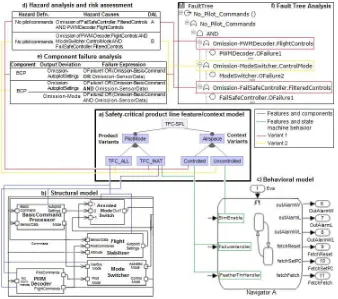
environmental conditions captured by pressure sensors. Assisted Pilot, Autonomous Pilot, and Autopilot can be combined into several different ways, allowing seven different flight control variants. TFC product variants can operate in a range of different contexts defined by combin-ing Airspace, Application, and UAV Size variation points [2]. The composition of pilot mode and usage context variants leads to 84 different TFC variants. Since it would be prohibitive considering all these variants to perform dependability analysis, only TFC manual and auton-omous (TFC-MAT) and all pilot modes (TFC-ALL) product variants, Controlled and Uncon-trolled airspace context variants, illustrated in Fig. 1a, were considered through this paper.
[image:5.595.130.468.382.681.2]TFC-SPL architecture comprises 4 subsystems and 14 components, which are composed by 252 model elements and subcomponents. An excerpt of the TFC SysML main block dia-gram is shown in Fig. 1b. Mode Switch encapsulates the pilot mode variation point, whilst Command Switch encapsulates the variation point inherent to the source from the pilot com-mands, e.g., manual pilot subsystem, sent to the UAV. Basic Command Processor (BCP) and its ports represent the realization of the Autonomous pilot mode. PWM Decoder output port connected to Command Switch block represents the realization of the Manual Pilot mode in the design. The realization of Autopilot is given by: Autopilot subsystem, PWMDecod-er.FlightControls output connected to FlightStabilizer and CommandSwitch model elements, and FlightStabilizer.AutopilotSettings output port connected to AssistedModeSwitch. Finally, ModeSwitcher.ControlMode output port connected to AssistedModeSwitch and Com-mandSwitch elements represent the realization of the Assisted Pilot mode.
2.2 The Impact of Variation on SPL Design
Interactions among usage context features define constraints that may impact on design deci-sions aiming safety certification, in which different design choices must be taken according to the targeted context. In both non-critical and safety-critical SPLs, variation points and their variants defined in a feature model have a directly impact on the derivation of variant-specific structural/architectural and behavioral models. In the development of safety-critical systems, the system architecture is often expressed in data-flow oriented models, and the system behav-ior is expressed in Finite State Machines (FSMs). In data-flow oriented architectural models, structural variability can be found in systems, subsystems, components, their ports and con-nections via flows from input to output ports, which may change according to the targeted usage context. For example, considering the TFC-SPL [33], developed upon Simulink model blocks, the selection of TFC-MAT variant from Pilot Mode variation point (Fig. 1a) implies in the selection of PWM Decoder and Basic Command Processor components, their ports and connections (Fig. 1b) during the product derivation process.
The realization of TFC-MAT and other product variants in the structural model are high-lighted in Fig. 1 with blue lines linking features (Fig. 1a) to their realization in architectural components and their ports (Fig. 1b). It is important to highlight that variation in the usage context combined with variation in product features, and isolated variation in the usage con-text may also impact on the derivation of variant-specific structural and behavioral models. For example, considering the TFC-SPL, the selection of Pilot Mode product and Airspace usage context variants impacts on the derivation of redundant or non-redundant components in a variant-specific architecture model. Still in TFC-SPL, product features associated with assisted, autopilot, autonomous, and manual pilot modes, i.e., all pilot modes (TFC-ALL) product variant (Fig. 1a), are materialized in the architecture by all Tiriba flight control com-ponents, their ports and connections (Fig. 1b). Architectural variation inherent to TFC-MAT and TFC-ALL variants and usage context variation can be further propagated throughout Tiriba mission controller behavioral model expressed in a FSM (Fig. 1c).
Variation in FSMs can be found in Tiriba UAV optional mission-related features [33]. Variability in the selection of these features was specified in a FSM that defines the Tiriba mission controller using a mechanism of transitions conditioned to variables that define varia-bility, as illustrated in Fig. 1c. Thus, when Entry Segment Simulation is selected, a simulation is performed whenever the UAV starts a new mission segment (Fig. 1c), in order to find out the suitable approach to switch between two mission segments. When Feather Threshold feature is selected, the UAV route is adjusted whenever the aircraft deviates more than a cer-tain limit from the planned mission route, i.e., correction start state transition in the FSM [33]. Finally, when Failure Handler is selected, the UAV is able to return to specific positions where a picture was not captured during the mission [33]. The activation/deactivation of mis-sion controller features are defined by alternative flows with Boolean conditional variables (Fig. 1c), which allow enabling/disabling flows and FSM states according to the selected product/context variants. Thus, for each mission-related feature, there is a variable whose value defines which FSM states and transitions will take place in the final product. SimEnable is a Boolean variable that controls the activation/deactivation of the behavior related to the Entry Segment Simulation. When this feature selected, this variable is set with true value. The same is valid for selection/deselection of Failure Handler and Feather Threshold features.
Usage context features may have influence in the selection of product features that impact on the FSMs, changing the system behavior. Thus, when uncontrolled airspace context and TFC-ALL variants are chosen, SimEnable variable is set true activating the transition to the Simulating state in a variant-specific mission controller FSM. When controlled airspace con-text and TFC-MAT variants are selected, Feather Threshold and Failure Handler variables are set true, activating the correction start and good simulation state transitions.
2.3 The Impact of Variation on SPL Dependability Analysis
Variability in HARA. During hazard analysis, different hazards and hazard causes can
emerge according to the targeted product and usage context variants. Fig. 1d shows an exam-ple of variation in Tiriba SPL hazard analysis and risk assessment. The causes for no pilot commands hazard are omission failures in FailSafeController and PWMDecoder component outputs when TFC-MAT product and controlled airspace usage context variants are chosen (Fig. 1a). On the other hand, omission failures in FailSafeController, ModeSwitcher, and PWMDecoder component outputs are the causes for the occurrence of the same hazard when TFC-ALL variant and uncontrolled airspace context are selected. In risk assessment, variation can be found in probabilistic criteria, e.g., likelihood and severity in SAE ARP 4754A avion-ics standard, used to classify the risk posed by each system hazard for the overall safety. In Tiriba SPL risk assessment, different risk probability and severity were assigned to no pilot commands hazard, according to the targeted product and usage context variants. Thus, the probability of occurrence of an omission of pilot commands, i.e., no pilot commands hazard, is 10-9 per hour of operation, with a catastrophic severity when TFC-MAT product and con-trolled airspace usage context variants are chosen. On the other hand, the probability of occur-rence of this hazard is 10-7 per hour of operation with a hazardous severity when TFC-ALL product and uncontrolled airspace context variants are chosen.
Variability in the Allocation of Safety Requirements and Integrity Levels. Still in
HARA, after classifying the risk posed by each identified hazard and contributing component failure mode, variation can be found in the allocation of functional safety requirements and Safety Integrity Levels (SILs) to mitigate the effects of system or component failures on the overall safety. Variation in functional safety requirements can be found in architectural deci-sions that must be taken to eliminate or minimizing the effects of a system or component failure, which might change according to the targeted product and usage context variants. For example, in the Tiriba UAV product line, the control system architecture can be Redundant when controlled airspace usage context is chosen. A non-redundant architecture can be adopted when the UAV is intended to operate in an uncontrolled airspace [2].
the decomposition of SILs allocated to hazards throughout contributing failures modes and components. Variation in SIL decomposition, which can be performed with automated tool support [30], is outside the scope of this paper. It is important to highlight that when develop-ing reusable components, all variability aspects of a component should be considered from the initial stages of the SPL lifecycle, and the most stringent SIL assigned to that component in different contexts should be assigned to that component to ensure its safety usage across the SPL. Thus, product and contextual variability will not change the mitigation mechanisms for that component in specific product variants.
Variability in Component Failure Modeling. In the safety lifecycle, component failure
modeling is intended to identify how components contribute to the occurrence of potential system-level failures identified during hazard analysis. Variation in component failure model-ing can be found in component output deviations that contribute in some way for the occur-rence of system failures, which might change from a targeted product/context variant to an-other. Different input deviations, internal failures, or combinations among them (named fail-ure expression), which contribute to the occurrence of a given output deviation, may also be raised in different product/context variants. Variation in the design, i.e., in architecture and behavior models, may also impact on how component failures propagate throughout other components. Thus, output deviations of a given component may be propagated throughout different components according to the chosen product/context variants. Different prod-uct/context variants lead to different connections among components, via their ports, so it may change the way in which failures are propagated throughout the system architecture.
Variation in HARA can be propagated throughout how components contribute to the oc-currence of system hazards. Tiriba Basic Command Processor (BCP) component failure modeling, shown in Fig. 1e, illustrates examples of variation in output deviations and combi-nations among component failures leading to output deviations in two different prod-uct/context variants. Omission-autopilotSettings output deviation may be raised when TFC-MAT product and controlled airspace context variants are chosen, whilst one additional out-put deviation, i.e., omission-mode, can also be raised when TFC-ALL product and uncon-trolled airspace context variants are chosen. Such variation can also be propagated throughout the causes that lead to the occurrence of a given component output deviation. The causes of an output deviation can be stated in a failure expression using logical operators (AND, OR, NOT) that describe how combinations among internal and input failures of a component may lead to the occurrence of an output deviation. Such variation can be found in the causes of the Omission-autopilotSettings output in both product variants. An internal omission failure in BCP component or an omission in both BCP inputs can raise an Omission-autopilotSettings output in TFC-ALL variant. Conversely, an internal omission failure in BCP or an omission failure in one of its inputs may raise an Omission-autopilotSettings in TFC-MAT variant.
table from different product variants [5, 28, 29, 32]. Thus, variation in hazard causes can be evidenced in the structure of a fault tree as illustrated in Fig. 1f, in which PWMDecoder and FailSafeController component output deviations are top-level failures of no pilot commands fault tree when TFC-MAT variant is chosen. On the other hand, an output deviation in ModeSwitcher component together with other two aforementioned output deviations, are the top-level failures of no pilot commands fault tree when TFC-ALL product variant is chosen. Finally, variation in HARA, allocation of safety requirements, component failure modeling, fault trees and FMEA results are propagated throughout the structure of a variant-specific assurance case. An assurance case is a defensible, comprehensive, and justifiable argument supported by a body evidence which demonstrate that the system acceptably safe to operate in a particular context [22]. Assurance case is recommended by standards for certifying safety-critical systems in both automotive [18] and aerospace [10] domains. The analysis of the im-pact of product and context variants in assurance case is outside the scope of this paper.
3
DEPendable-SPLE
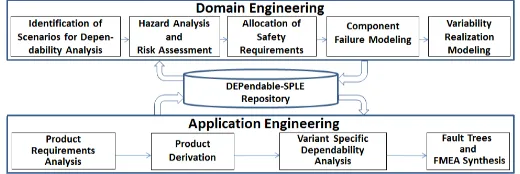
Interactions among product and usage context features can be used to establish safety certifi-cation criteria that might impact on SPL architectural decisions and dependability analysis. This section presents DEPendable-SPLE, a model-based approach that extends traditional SPLE methods, with support for HARA, allocation of safety requirements and component failure modeling dependability-related activities, variability modeling/management in both SPL domain and application engineering phases as illustrated in Fig. 2. In domain engineer-ing, four steps related to dependability analysis and variability realization modeling were defined. The last step extends the variability modeling step, established in conventional SPLE methods, by considering feature realization in the dependability model. This is intended to support the systematic reuse of dependability information in SPL application engineering.
[image:10.595.167.427.593.680.2]In SPL application engineering, the following steps were defined: product requirements analysis (i.e., product feature modeling), product derivation, which extends conventional SPLE product derivation process by linking features to their realization in the dependability model, and dependable-related activities: product dependability analysis, and fault trees and FMEA synthesis required to achieve the systematic reuse of dependability information, reduc-ing product safety certification effort and costs. Compositional dependability analysis [6, 27, 30] and variability management techniques [1, 32, 33, 34] can be used to support DEPenda-ble-SPLE dependability analysis and variability management steps, both in domain and appli-cation engineering. DEPendable-SPLE is applicable independently from the underlying vari-ability management and compositional dependvari-ability analysis techniques. It should be used together with traditional SPLE methods [4, 19, 23] for developing dependable safety-critical SPL architectures. The steps shown in Fig. 2 are described and illustrated, by considering TFC
-MAT and TFC-ALL product variants from TFC-SPL, in the following.
3.1 DEPendable-SPLE: Domain Engineering
In the first step, dependability analysis scenarios are defined from the analysis of interactions among product and usage context features. After scoping SPL dependability analysis to a set of targeted scenarios, HARA, allocation of safety requirements, and component failure model-ing dependability-related steps are performed iteratively and incrementally for each scenario. Finally, features are linked to their realization in architecture and dependability models during safety-critical SPL variability realization modeling.
Identification of Candidate Scenarios for SPL Dependability Analysis. Inputs: the
fea-ture model containing the specification of product and usage context feafea-tures and their interac-tions, SPL structural and behavioral models, and analyst’s domain knowledge. Purpose: iden-tifying, from the analysis of interactions among product and usage context features, variants (scenarios) relevant for the stakeholders, by combining features that may be considered to guide SPL dependability analysis. The identification of scenarios encompasses the following tasks: i) to identify combinations among product features, which represent system functions and their interactions in structural and behavioral models, to derive product variants; ii) for each identified product variant, combinations among features are analyzed to establish poten-tial usage contexts in which the given product variant can operate; and finally, iii) by combin-ing the identified product/context variants, different scenarios can be derived. For example, from the analysis of TFC-SPL product/context variants, a range of candidate scenarios can be derived. Scenarios might support safety analysts in extracting the required domain knowledge to perform SPL dependability analysis. However, since it would be prohibitive performing
such analysis covering all product/context variants, the analyst’s domain knowledge, and rel e-vant product variants for the stakeholders can be used as criteria to assess candidate scenarios to perform dependability analysis [3, 28, 29]. Outputs: combinations among product and usage context variants relevant for the stakeholders. In TFC-SPL, the TFC-MAT/Controlled and TFC-ALL/Uncontrolled scenarios were considered to perform dependability analysis.
Hazard Analysis and Risk Assessment. Inputs: targeted scenario relevant for the
pilot commands can emerge in a TFC variant whenever both pilot modes, e.g., manual pilot and autopilot, are omitting their outputs. An incorrect value for pilot commands can emerge when all pilot modes provide wrong flight commands, e.g., wrong coordinates.
Allocation of Safety Requirements. Inputs: HARA results. Purpose: From the analysis of
HARA results, functional safety requirements and SILs are allocated aimed at eliminating or minimizing hazard effects on the overall safety. SILs should be allocated to each identified hazard according to their risk classification. Moreover, SILs allocated to system hazards can be further decomposed throughout contributing components and their failure modes. Such decomposition can be performed with automated support of SIL decomposition genetic/meta-heuristic algorithms [30]. Finally, allocation of functional safety requirements aims at identify-ing system functions that can be added to the system architecture for eliminatidentify-ing or minimiz-ing the impact of a hazard or a component failure on the overall safety. Redundancy is an example of functional safety requirement. When a new functional safety requirement is added to the SPL architecture, dependability analysis should be performed again to evaluate the im-pact of the newer functionality on the overall safety in the context of the targeted scenarios. Output: system functions added to the system architecture, and a set of SILs assigned to miti-gate hazards and component failures. In TFC-SPL, DALs from different stringencies were assigned to hazards in different TFC variants (Fig. 1d), as described in Section 2.3.
Component Failure Modeling. Inputs: SPL architecture model and HARA results.
development process. Finally, different component failure data lead to different fault propaga-tions, i.e., combinations of component failures leading to hazards. Such variation is then prop-agated throughout fault trees and FMEA. In order to support the systematic reuse of the TFC-SPL dependability model, the impact of design and usage context variations on dependability information is managed during the variability modeling.
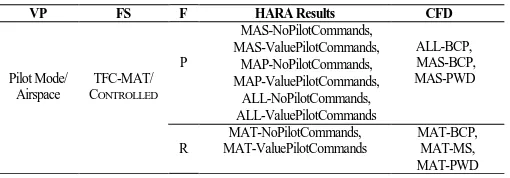
[image:13.595.172.427.607.696.2]Variability Realization Modeling. Inputs: SPL feature, architectural, behavioral, and de-pendability models. Purpose: This step expands the variability modeling step defined in tradi-tional SPLE methods [4, 23], aimed at establishing mappings between features to their realiza-tion in the architecture, to enable variability management in the dependability model. Thus, in this step, mappings linking product/context features to their realization in architectural, behav-ioral, and dependability models are defined. It can be performed with the support of exten-sions from existing variant management techniques. This step encompasses the following tasks: i) specification of design and dependable-related variation points and their variants from the analysis of product/context features, and scenarios used to guide dependability analysis; ii) mapping design variants to their realization in the SPL architecture by: defining model ele-ments to be included/excluded when design variants are chosen/resolved during product deri-vation; and finally, iii) mapping dependable-related variants to their realization in the depend-ability model by: linking each scenario considered during dependdepend-ability analysis to the corre-sponding HARA, risk assessment, allocation of safety requirements, and failure data associat-ed with each variant-specific component. Output: The end of this step yields a variability model, which links features to their realization in both architecture and dependability models. TFC-SPL feature and variability models were specified with the support of BVR toolset and BVR AADL Error Annex adapter. Details about how to configure a BVR variability model for a given SPL can be found elsewhere [34]. BVR fragment substitutions were defined to show how variability in the TFC-SPL AADL architecture and Error Annex models are solved when TFC-MAT/Controlled and TFC-ALL/Uncontrolled structural and dependable-related variants are chosen. Table 1 illustrates placement and replacement fragments, and fragment substitutions associated with TFC-MAT/Controlled airspace dependable-related variant. The acronyms in table columns respectively represent: variation point (VP), fragment substitution (FS), fragment type (F), and component failure data (CFD). An excerpt of mappings linking dependable-related variants to their realization in the dependability model, defined in the TFC-SPL variability model, is shown in Table 1. So, when TFC-MAT variant and its context are selected, as defined in a placement fragment, HARA results and component failure data associated with other TFC variants are removed from the dependability model. On the other hand, as specified in the replacement fragment, TFC-MAT related HARA results and compo-nent failure data are included in the final dependability model. Later, TFC-MAT related frag-ment substitution is created by combining both placefrag-ment/replacefrag-ment fragfrag-ments. The final TFC-SPL variability model comprises 8 fragment substitutions, 2 placements, and 8 replace-
Table 1. Pilot model/usage context variant and its realization in the dependability model.
VP FS F HARA Results CFD
Pilot Mode/ Airspace
TFC-MAT/ CONTROLLED
P
MAS-NoPilotCommands, ALL-BCP, MAS-BCP, MAS-PWD MAS-ValuePilotCommands,
MAP-NoPilotCommands, MAP-ValuePilotCommands,
ALL-NoPilotCommands, ALL-ValuePilotCommands
R
MAT-NoPilotCommands, MAT-ValuePilotCommands
ment fragments. Four fragments substitutions are associated with structural variability, and four fragment substitutions are associated with variability in the dependability model.
3.2 DEPendable-SPLE: Application Engineering
Product Requirements Analysis. Input: SPL feature model. Purpose: In this step,
architec-tural and dependable-related variants, defined in the SPL feature model, which addresses product-specific requirements, are chosen. Output: product feature model. Product
Deriva-tion. Inputs: SPL feature and augmented variability models, product feature model, and SPL
assets, in this case, architecture, behavioral, and dependability models. Purpose: Variability specified in SPL architecture/dependability models are solved with the support of a variability management tool, and a product variant is then derived. Whereas the available variant man-agement techniques do not provide native support for managing variability in the dependabil-ity model, in this paper, BVR toolset [34] was adapted to enable support for variabildependabil-ity man-agement in AADL Error Annex dependability models. The BVR adapter extends OSATE AADL model editor to enable BVR communicating with OSATE model editors to manage variability in AADL structural/behavioral/dependability models. Since BVR is built upon Eclipse Modeling Framework [9], the adapter was implemented as an Eclipse-based plugin. Due to page limitation, BVR AADL extension is not discussed in this paper. During TFC-SPL product derivation, for each product variant, the following artefacts were input to BVR: TFC-SPL feature model, an instance model, variability model, and SPL AADL/Error Annex structural/dependability models. Outputs: Variant-specific AADL/Error Annex models. Vari-ability management in TFC-SPL enabled the systematic reuse of almost 100% of dependabil-ity information, produced during domain engineering, in the derivation of each TFC variant.
Variant-Specific Dependability Analysis. Inputs: product feature model, product archi-tectural and behavioral models, analyst’s domain knowledge. Purpose: After product deriva-tion, variant-specific dependability analysis can be performed by following the steps defined in domain engineering. Such analysis focuses on identifying the impact of variant-specific system functions, added to the reused product architecture model, on the overall system safe-ty. When variant-specific system functions are added to the SPL architecture, its correspond-ing dependability information should be added to the SPL repository. Outputs: Enhanced product architecture and dependability models, and in some cases, feedback to the SPL pro-cess, enhancing SPL architecture and dependability models. Fault Trees and FMEA
Syn-thesis. Inputs: The reused variant-specific architecture model, enhanced with specific
hazards in each TFC variant. Variation in fault trees and FMEA are further propagated throughout assurance cases, which can be generated from these assets with the support of model-based techniques [16]. The application of DEPendable-SPLE steps enabled the sys-tematic analysis of the impact of variation in TFC-SPL product/context features in both SPL design and dependability analysis. Such analysis increased the precision of dependability analysis information produced in domain engineering, and enabled the systematic reuse of dependable-related information early on the SPL safety lifecycle, in comparison with conven-tional SPLE methods, which emphasize the analysis of the impact of product/context variation only on the SPL design, and reuse of development artefacts.
4
Related Work
Research on variability management in dependability assets is split into extensions of tradi-tional safety analysis techniques, e.g., FTA and FMEA, to suite SPLE processes [5, 12, 26], and model-based techniques [7, 20, 21, 32]. The most notable work in the first category is the extension of software FTA (SFTA) to address the impact of SPL variation on dependability analysis [5, 12]. In such approach, each leaf node of a SFTA is labeled with the commonality or variability associated with that leaf node. This approach is built upon a technique for devel-oping a product line SFTA in domain engineering, and a pruning technique for reusing SFTA in application engineering. Product Line SFTA was later extended to integrate SFTA results with state-based models [26]. Such extension allows mapping SFTA leaf nodes into compo-nents, and modeling the behavior of each component in a state chart. PL-SFTA and its exten-sion consider FTA as a reusable asset. However, FTA can be automatically generated from dependability information produced in domain engineering, e.g., HARA and component failure modeling. Thus, variability management in dependability properties earlier on FTA and FMEA synthesis, as presented in this paper, enables the systematic reuse of dependability information, and traceability of dependable-related variation throughout SPL safety life-cycle.
In the second category, Schulze et al. [32] have proposed an approach, by integrating commercial Medini ISO 26262 safety analysis and pure::variants tools, to support variability management in functional safety-related assets, which was evaluated in an automotive case study. Their approach is based on a referencing model, which maps problem-domain features with artefacts in the solution space, in this case, requirements, FTA, and safety goals. Schulze et al. approach was further extended with a process for model-based change impact analysis of variability into automotive functional safety [20]. This process combines variability manage-ment techniques with safety engineering and software configuration managemanage-ment activities to achieve a complete safety assessment. This process supports change impact analysis in the following scenarios: when a specific variant shows undesired behavior and it needs to be fixed, in cases where an innovative function requires an extension of an existing system function, and the function behavior is changed and it should be analyzed, and when a newer optional func-tion is developed. In the same way as Schulze et al approach and its extension, our approach is built upon a variability model, linking problem-domain context and product features with artefacts from the solution space, e.g., components and their failure data. Although Schulze et al. [32] approach provides support for variability management in functional safety assets, they
good and efficient solution for variability/change management in functional safety. Kaßmeyer et al. [21] presented a systematic model-based approach integrated with the change impact analysis approach [20]. Kaßmeyer et al. tool-supported approach combines requirements en-gineering and architectural design, safety analysis, and variant management tools, allowing seamless safety engineering across product variants by representing safety artefacts in a ho-mogeneous UML-compliant model notation. In their approach, HARA and component fault modeling is performed by annotating the UML model in the same way as DEPendable-SPLE approach. As part of Kaßmeyer et al. approach, Domis et al. [7] have extended Component Integrated Component Fault Trees (C2FT) technique with variation points and integrated it with UML via a profile into Enterprise Architect tool. Although Kaßmeyer et al. [21] ap-proach and its extension [7] also provides a good solution for variant management in function-al safety; it is dependent upon specific commercifunction-al tools. On the other hand, DEPendable-SPLE can be applied independently of the underlying tooling support.
5
Conclusion
This paper has presented DEPendable-SPLE model-based approach to support variant man-agement in dependability analysis. Such approach enables the systematic reuse of SPL archi-tecture and dependability models in application engineering. DEPendable-SPLE is applicable independently from the underlying variant management and dependability analysis tech-niques. In this paper, the approach was applied with the support of OSATE AADL & Error Annex architectural modeling and compositional dependability analysis tool, BVR toolset, and OSATE AADL BVR adapter. This adapter was developed by the authors to enable BVR managing variability in AADL architectural/dependability models. These tools were used to support dependability analysis and variant management steps for the TFC-SPL. DEPendable-SPLE supports the analysis of the impact of design and context variations on dependability analysis. Thus, Tiriba product/context variants were linked to their realization in architecture and dependability models. Further, multiple variant-specific architecture/dependability models were automatically generated during product derivation with the support of BVR tool. The systematic reuse of the dependability model is achieved early on SPL safety process. DE-Pendable-SPLE enabled the systematic reuse of almost 100% of TFC dependability infor-mation, produced in domain engineering, in the derivation of each one of the four TFC prod-uct variants. It contributed to reduce the effort and costs in performing dependability analysis for a specific product variant. With the support of compositional techniques, in this case, OSATE AADL, FTAs and FMEA were generated from the reused AADL architec-ture/dependability models. This paper also presented an analysis of the impact of de-sign/context variations on architecture and dependability analysis. Further work on this topic is focused in detailing how variability in AADL architecture/error models is specified and managed. Further work also intends to investigate the impact of design/context variations on SIL allocation and development processes of safety-critical SPLs. Finally, we also intend to investigate the usage of model-driven techniques to generate variant-specific assurance cases, and the potential of SIL decomposition techniques in supporting SPL architectural decisions.
Acknowledgments. CNPq grant number: 152693-2011-4, and CAPES research agencies.
References
2. Braga, R. T. V., Trindade Jr., O., Branco, K. R. L. J. C., Lee, J. Incorporating certification in feature modelling of an unmanned aerial vehicle product line. In: Proc. of the 16th SPLC, 1–10, (2012).
3. Braga, R. T. V., Trindade Jr., O., Branco, K. R. L. J. C., Neris, L.O., Lee, J. Adapting a software product line engi-neering process for certifying safety critical embedded systems. In Proc. 31st SAFECOMP, 352-363, (2012). 4. Braga, R. T. V., Branco, K. R. L. J. C, Trindade Jr., O., Masiero, P.C. The ProLiCES approach to develop product
lines for safety-critical embedded system and its application to the unmanned aerial vehicles domain. CLEI Elec-tronic Journal, v. 15, n.2, 1-12, (2012).
5. Dehlinger, J., Lutz, R. Software fault tree analysis for product lines. In Proc. of the 8th IEEE HASE, USA, (2004). 6. Delange, J., Feiler, P. Architecture fault modeling with the AADL error-model annex. In Proc. of the 40th
EUROMICRO, Verona, 361-368, (2014).
7. Domis, D., Adler, R. Becker, M. Integrating variability and safety analysis models using commercial UML-based tools. In Proc. of the 19thSPLC, ACM, USA, 225-234, (2015).
8. Dordowsky, F., Bridges, R., Tschope, H., Implementing a software product line for a complex avionics system. In Proc. of the 15th Int. SPLC, IEEE, 241-250, (2011).
9. ECLIPSE. 2016. Eclipse Modeling Framework Project. Available on-line: http://www.eclipse.org/modeling/emf. 10. EUROCAE. 2010. ARP4754A - guidelines for development of civil aircraft and systems, EUROCAE. 11. EUROCAE. Aircraft wheel braking system. Available: https://github.com/osate/examples/tree /master/ARP4761 12. Feng, Q., Lutz, R. Bi-directional safety analysis of product lines. Journal of Sys. and Sw,v.78,n.2, 111-127, (2005). 13. Gómez, C., Peter, L., Sutor, A. Variability management of safety and reliability models: an intermediate model
towards systematic reuse of component fault trees. In Proc. 29th SAFECOMP, Springer, v. 6351, 28-40, (2010). 14. Habli, I., Kelly, T., Hopkins, I. Challenges of establishing a software product line for an aerospace engine
monitor-ing system. In Proc. of the 11th SPLC, IEEE, Japan, 193-202, (2007).
15. Haugen, O., Moller-Pedersen, B., Oldevik, J., Olsen, G. K., Svendsen, A. Adding standardized variability to do-main specific languages. In Proc. of the 12th Int. Software Product Line Conf., IEEE, 139-148, (2008).
16. Hawkins, R., Habli, I., Kolovos, D., Paige, R., Kelly, T., Weaving an assurance case from design: a model-based approach. In Proc. of the 16th HASE, Daytona Beach, IEEE, p.110-117, (2015).
17. Heuer, A., Pohl, K. Structuring variability in the context of embedded systems during software engineering. In: Proc. of the 8th Workshop on Variability Modelling of Software-intensive Systems, ACM, (2014).
18. ISO. 2011. ISO 26262: road vehicles functional safety.
19. Kang, K. C., Kim, S., Lee, J., Kim, K., Jounghyun Kim, G., Shin, E. Form: A feature-oriented reuse method with domain-specific reference architectures. Annals of Software Eng., v. 5, 143–168, (1998).
20. Käßmeyer, M., Schulze, M., Schurius, M. A process to support a systematic change impact analysis of variability and safety in automotive functions. In Proc. of the 19th SPLC, ACM, NY, USA, 235-244, (2015).
21. Käßmeyer, M., Moncada, D. S. V., Schurius, M. Evaluation of a systematic approach in variant management for safety-critical systems development. In Proc.13thInt.Conf. Embedded and Ubiquitous Comp., IEEE, 35-43, (2015).
22. Kelly, T., MCdermid, J., Safety case construction and reuse using patterns. In: Proc. of the 16th SAFECOMP, Springer-London, LNCS, p. 55–69, (1997).
23. Krueger, C. Variation management for software production lines. In: Proc. 2nd SPLC, v.2379, 37-48,(2002).
24. Lee, K., Kang, K. C. Usage context as key driver for feature selection. In Proc. 14th SPLC, v.6287, 32–46p, (2010).
25. Leveson, N. Door control system. Available on-line: https://github.com/osate/examples/tree/master/Train 26. Liu, J., Dehlinger, J., Lutz, R. Safety analysis of software product lines using stated modeling. Journal of Systems
and Software, v. 80, n. 11, 1879-1892, (2007).
27. Mazzini, S., Favaro, J., Puri, S., Baracchi, L. CHESS: an open source methodology and toolset for the develop-ment of critical systems. In Join Proceedings of EduSymp, pp. 59-66 (2016).
28. Oliveira, A. L., Braga, R., Masiero, P. C., Papadopoulos, Y., Habli, I., Kelly, T. Model-based safety analysis of software product lines. International Journal of Embedded Systems, Inderscience Publishers, (2016).
29. Oliveira, A. L., Braga, R. T. B., Masiero, P. C., Papadopoulos, Y., Habli, I., Kelly, T. A model-based approach to support the automatic safety analysis of multiple product line products. In Proc. of the 4th Brazilian Symp. on
Computing Systems Eng., Brazil, IEEE, 7-12, (2014).
30. Papadopoulos, Y., Walker, M., Parker, D., Rüde, E., Hamann. Engineering failure analysis and design optimiza-tion with HIP-HOPS. Journal of Eng. Failure Analysis, v.18, i.2, 590-608, (2011).
31. RTCA. DO-178C software considerations in airborne systems and equipment certification, (2012).
32. Schulze, M., Mauersberger, J., Beuche, D. Functional safety and variability: can it be brought together? In Proc. of the 17th Int. SPLC, ACM, NY, USA, 236-243, (2013).
33. Steiner, E. M., Masiero, P. C., Bonifácio, R. Managing SPL variabilities in UAV Simulink models with Pure::variants and Hephaestus. CLEI Electronic Journal, v. 16, n.1, 1-16, (2013).