UNIVERSITI TEKNIKAL MALAYSIA MELAKA
DEVELOPMENT OF AUTOMATIC FIRE EXTINGUISHER
SYSTEM
This report is submitted in accordance with the requirement of the Universiti Teknikal Malaysia Melaka (UTeM) for the Bachelor of Electrical Engineering
Technology (Industrial Power) with Honours.
By
MUHAMMAD QAMARUL ARIFIN BIN ROSMAN B071410177
930213-01-5769
DECLARATION
I hereby, declared this report entitled Development of Automatic Fire Extinguisher System is the results of my own research except as cited in references.
Signature : ………..
Author’s Name : MUHAMMAD QAMARUL ARIFIN BIN ROSMAN
APPROVAL
This report is submitted to the Faculty of Engineering Technology of UTeM as a partial fulfillment of the requirements for the degree of Bachelor of Electrical Engineering Technology (Industrial Power) with Honours. The member of the supervisory is as follow:
i
ABSTRAK
ii
ABSTRACT
iii
DEDICATION
iv
ACKNOWLEDGEMENT
Alhamdulillah, I would like to thanks to Allah S.W.T, the Most Merciful, and all praises to Allah for His blessing in completing this project. I would also like to show appreciation to my supervisor Mr. Mohd Yunos Bin Ali for his support, consultation and professional cooperation.
Special thanks to all other University Technical Malaysia Malacca panels and staff members that may help upon for consultation.
v
TABLE OF CONTENT
Abstrak i
Abstract ii
Dedication iii
Acknowledgement iv
Table of Content v
List of Tables viii
List of Figures ix
List Abbreviations, Symbols and Nomenclatures xi
CHAPTER 1: INTRODUCTION 1
1.0 Introduction 1
1.1 Project Background 1
1.2 Objective of Project 3
1.3 Problem Statement 3
1.4 Scope of Project 5
CHAPTER 2: LITERATURE REVIEW 6
2.0 Introduction 6
2.1 Approach Safety Laboratory in school 9
2.2 Fire Protection and Prevention 9
2.3 Fire Extinguisher 10
2.4 Fire Extinguisher Robot 12
vi
2.10 The group of chemicals 17
CHAPTER 3: METHODOLOGY 20
3.0 Introduction 20
3.1 Flow chart project 21
3.2 Operation of project 22
3.3 Temperature sensor analysis 23
3.3.1 Contact temperature sensor 23
3.3.2 Temperature sensor circuit specification 23
3.3.3 Advantage of temperature sensor 24
3.3.4 Flowchart temperature sensor 24
3.4 Motor power window 25
3.4.1 Method 26
3.4.1.1 Test Rig for Low Voltage Power Window DC Motor 26
3.4.1.2 Secondary sources 26
3.5 Sealed Lead Acid Battery 27
3.6 MQ2 Sensor- Based Smoke Detector 28
3.7 LCD module 29
3.8 Microcontroller 31
3.8.1 PIC16F877A 31
3.9 Project design 32
CHAPTER 4: RESULTS AND DISCUSSION 34
4.0 Introduction 34
4.1 Results for heat sensor (LM35) 34
4.1.1 Simulation and experiment data for heat sensor (LM35) 34
4.2 Results for motor power window (Saga) 39
vii
CHAPTER 5: CONCLUSION AND FUTURE WORK 43
5.0 Introduction 43
5.1 Summary of research 43
5.2 Achievement of Research Objective 44
5.3 Significant of Research 44
5.4 Suggestion for Future Work 44
REFERENCES 46
viii
LIST OF TABLES
2.1 Cause of fire accident in laboratory 8
2.2 Class of fire and firefighting 11
2.3 How to use a fire extinguisher 12
2.4 Potentially resulting in heat generation, a strong reaction 17 2.5 Potentially resulting in the release of toxic substances in case of fire
or explosion 18
2.6 The potential to cause a fire or explosion, the generation of hydrogen gas
Flammable 18
2.7 Potentially resulting in a fire, explosion or heat generation, generation
flammable toxic gas 18
2.8 Potentially causing fires, explosions or strong reaction 19 2.9 Potentially resulting in the generation of hydrogen cyanide or hydrogen
Sulphide toxic 19
2.10 Potentially causing fires, explosions or strong reaction 19 3.1 MQ series sensors and target gas of detection 28
3.2 The mechanical dimension 1602A LCD module 30
3.3 Advantage and disadvantage of microcontroller 31
3.4 Specification of PIC16F877A 32
4.1 Results of the simulation sensor (LM35) 35
4.2 Results of the experiment heat sensor (LM35) 36
4.3 Data of motor power window (saga) 40
ix
LIST OF FIGURES
1.1 Newspapers wrote about the Fire and Rescue Malaysia being
extinguish the fire at a chemical laboratory UiTM, Shah Alam 2
1.2 News about the fire at chemical laboratory 4
1.3 Shows the position of fire extinguisher 4
2.1 Operation Schematic diagram 7
2.2 Percentage of breakdown of root causes in chemical reaction fire casualties 8
2.3 Fire triangle reaction 10
2.4 The overview home security for firefighting robot 14
2.5 Structure of the system 15 2.6 Structure of Automatic Extinguishing System 17 3.1 Flow chart of the project 21 3.2 Flow chart operation of project 22 3.3 The flow chart of the temperature sensor circuit 24 3.4 The sensor temperature LM35 25
3.5 K-Chart for squeeze and sweep Application 25
3.6 Low voltage power window DC motor 26
3.7 Sealed Lead Acid Battery (12V 9AH) 27
3.8 Module sensor MQ2 29
3.9 LCD 1602A QAPASS module 30 3.10 PIC16F877A Microcontroller 32 3.11 3D dimension view 33
x 4.1 Equation voltage out of the heat sensor (LM35) 36
4.2 Simulation heat sensor (LM35) using Proteus software 37
4.3 Voltage for the temperature of heat sensor (LM35) 38
4.4 Time for the temperature of heat sensor (LM35) 39
4.5 The value of Voltage, Current, Power, Speed and time for motor power
window (saga) 40
4.6 Concentration of smoke sensor (MQ-2) gas concentration vs. time 42 4.7 Simulation of heat detector (LM35) and smoke detector (MQ-2) at normal
xi
LIST OF ABBREVIATIONS, SYMBOLS AND
NOMENCLATURE
V - Voltage (volt)
S - Second (sec)
PPM - part- per million
LCD - liquid crystal display
PIC - peripheral interface controller
IC - Integrated circuit
OP-Amp - Operational amplifier
CHAPTER 1
INTRODUCTION
1.0 Introduction
In this chapter will explain the introduction of the project consist of project background, objective of project, problem statement and scope of project.
1.1 Project background
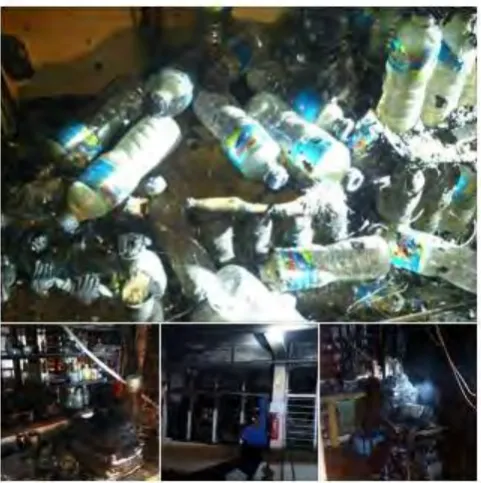
According to fire statistics 2013 in Malaysia, released by the Fire and Rescue Department of Malaysia, displays that fire statistics by the laboratory of building in Malaysia for the year 2013 fifteen cases. According to newspaper reports the Utusan Malaysia newspaper reported a fire in a chemical laboratory Chemical Laboratory building Laboratory Research Management Institute (RMI) in Universiti Teknologi Mara (UiTM) Shah Alam, was declared a protected area for all individuals and unsafe to use due to the fire. The number of cases is a real concern because it involves the lives of individuals.
2 Figure 1.1: Newspapers wrote about the Fire and Rescue Malaysia being put out fire
at a chemical laboratory UiTM, Shah Alam.
3 upon in this incident shows that the system of fire protection equipment that should be installed in the laboratory is feared may not function properly. Therefore, the authorities should have thought of a solution to increase the effectiveness of fire protection equipment in every laboratory chemicals.
1.2 Objective of Project
There are three objectives of final year project that need to achieve:
1) To design a fire extinguisher system that involves a wide range of chemical in chemical laboratory.
2) To increase application fire extinguisher to be more effective.
3) To detect time reaction of gas concentration in ambient temperature, environment and area.
1.3 Problem Statement
4 Figure 1.2: News about the fire at chemical laboratory
Figure 1.3 shows an view of the state of fire extinguishers are placed on the walls give the impression that the use of the manual is not giving effect to the specific use in chemical laboratories as a result of several factors that can effect anyone who helped to extinguish the fire.
[image:18.595.153.487.537.705.2]5
1.4 Scope of Project
6
CHAPTER 2
LITERATURE REVIEW
2.0 Introduction
The most effective way to prevent such damage by fire is preliminary extinguishing. Preliminary extinguishing is extinguishing a fire in 2 minutes from the time the fire has occurred. By extinguishing the fire before it spreads, damage is drastically reduced. In addition, the activity of fire engine is also reduced. Therefore, initial extinguishing is an efficient way of fire extinguish. There is a great difference in damage between the cases preliminary extinguishing is performed and the other cases. The systems for performing extinguishing already exists. For example, the home fire alarm is low in price and installable in any house.
However, it doesn't have an extinguishing function. Additionally, when it worked and the alarm was raised, fire may become so big that it is not at initially extinguish stage. For more examples, sprinkler has high fire extinguishing ability, but it sprinkles a large amount of water all over the area. Owing to its way to extinguish, the area is soaked with water even it succeeded in extinguishing the fire, hence electronic equipment like computers can break down. To take advantage of initial extinguish, we need a system that detects fire in the initial stage and extinguishes the detected fire properly.
7 multiple fire sources was difficult. Therefore, we improved the system so that it can detect fire properly for multiple fire sources.(Takahashi & Kitazono, n.d.)
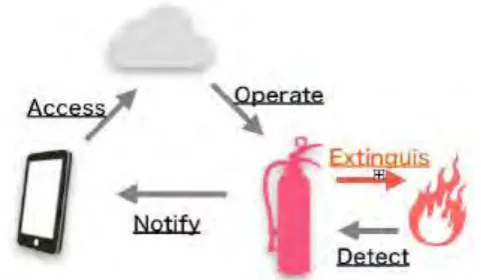
Figure 2.1: Operation Schematic diagram
The operation schematic diagram of the system is shown in Figure 2.1. First, if a fire occurs, fire detection system detects the breaking out of the fire. Then, a notification is sent to the user, and the user accesses the website for fire fighting via device user owns such as smartphone, tablet or any device which has a web browser. If the user makes sure that fire has actually occurred and presses the extinguishing button on the website, the system makes the fire extinguisher work. The causes of laboratory accidents are usually very complex. Root cause analysis (RCA) provides a structural way, with regard to a particular event, to help investigators systematically identify root causes. However, they also need a way to estimate the impact of each cause and human corrective action for policy making. The analytic hierarchy process (AHP), proposed by Saat, is a well-recognized multi-criteria tool designed for dealing with complex decision-making problems.(Shih, Horng, & Lee, 2016)
8 and fires caused by nature disaster. Chemical reaction fires are the most frequent type of fire, with 64 cases, and static electricity fires are the second, with 27 cases.
Table 2.1: Cause of fire accident in laboratory. Laboratory Chemical
reaction electricity Static Equipment failure Operational error disaster Nature Others Total
Chemical 54 13 6 14 1 7 95
Physical 3 10 2 5 0 4 24
[image:22.595.174.466.326.581.2]Biological 7 4 2 5 0 2 20
Figure 2.2: Percentage of breakdown of root causes in chemical reaction fire casualties.
9
2.1 Approach Safety Laboratory in school
Laboratory safety in schools should be emphasized as existing education system encourages students to conduct scientific experiments in school laboratories. The Ministry of Education (MOE) has published guidelines on the Management and Safety of School Laboratory (PKMSS) and incorporated elements of laboratory safety into science textbook and practical. Nonetheless, these documents did not offer a comprehensive approach that can be easily memorized by the students. Hence by analysing relevant documents, this study offers a systematic approach that encompasses important components of laboratory safety, in order to make it more comprehensive and easily memorized by the students. The basis to develop the approach is based on the 3R approach (reduce, reuse and recycle). The laboratory safety approach developed in this study is known as 5P (Procedures, Safety Equipment, Handling Experiment, Chemical Waste Management and Emergency Response Plan). Perhaps the 5P approach can be adopted by stakeholders in the future and then enhance school laboratory safety in Malaysia.(Nur Liyana Ali, Goh Choo Ta, Sharifah Zarina Syed Zakaria, Mazlin Mokhtar, 2014).
2.2 Fire Protection and Prevention
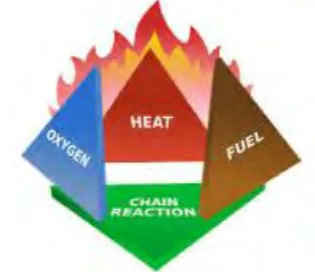
10 Figure 2.3: Fire triangle reaction
2.3 Fire Extinguisher
1. Security measures to avoid accidents:
i. Systematic inspection of wiring in the lab routinely in laboratories as a precaution.
ii. Ensure systems, fire extinguishers and fire hydrants can always be used in good condition.
2. Prepare a safety plan or emergency exit during a fire at the Central Laboratory Complex.
3. Affix a poster on a fire extinguisher which contains how to use a fire extinguisher.
4. Fire extinguishers labelled by symbols or use a standard letter for each class of fire can be extinguished.