EUROPEAN COMMISSION
WORKING
NOTES
1995
CAP Working Notes- 1995 • • • • • • • • • • • • • • • • • • • • • • • • • • • • • • • • • • • • • • • • • IIIII I88S 1m & %. <;·< ''" .··
WINE
1995
edition
EUROPEAN COMMISSION
Directorate-General for Agriculture
Reports, publications, studies and documentation
Contact person : Graphics:
Thierry CLEMENT Maxime ONIDI
130 rue de Ia Loi, B -1049 Brussels
Fax: + 32.2.2957540
CAP Working Notes - 1995
·'~' ,::o '-"'' lSI: 1$8$ l$lll Ill 8888 . . Ill 8888 . . 8888 . . 8888 • • • • • • • • • • • • • • • • • • • • • • • • • • • • • • • • •
Cataloguing data can be found at the end of this publication
Luxembourg: Office for Official Publications of the European Communities, 1996
ISBN 92-827-Q036-4
CONTENTS
Introduction
Description of the mechanisms of the common market organization
The situation of the markets
Council price decisions
Statistical tables
Page
5
7
15
19
INTRODUCTION
The information in this document is arranged in three parts:
the "analysis" part describes the market situation and the mechanisms of the market organization in the product;
the "statistics" part gives most of the tables appearing for the product in the annual report on the agricultural situation in the European Union;
the Council decisions on the agricultural prices provide a vital illustration of the Community's policy in this sector.
*
DESCRIPTION OF THE MECHANISMS
OF THE COMMON MARKET ORGANIZATION*
In Regulation No 24 of 4 April 1962 the Council made provision for the progressive establishment of a wine market organization. The basic regulation finally adopted is Regulation (EEC) No 822/87, as last amended by Regulations (EEC) No 1891/94 and (EC) No 3290/94.
It covers the following products:
grape juice and must, with or without added sugar;
grape must, in fermentation or with fermentation arrested; wine of fresh grapes;
fresh grapes other than table grapes;
wine vinegar;
other (piquette, wine lees, grape marc).
The marketing year runs from 1 September to 31 August.
Expenditure in this sector relates only to table wine. It varies quite considerably from one year to the next owing to fluctuations in production. In normal years it accounts for between 2.5 and 5.5% of the EAGGF Guarantee total. It accounted for 4.5'X, of EAGGF Guarantee expenditure in 1993.
1.
Economic background
After a large harvest in 1992 the 1993 and 1994 wine harvests were small. Production of table wine in 1993/94 is estimated at about 93 million hl (EUR 12), and the figure for 1994/95 is likely to be around 86 million hl. For 1995/96, th~~ estimated expenditure requirement for the 1996 financial year corresponds to 101 million hl (EUR 15), which may be regarded as a normal level of production. The two preeeding marketing years cannot be used as reference years for forecasts as their low yields make them atypical. It should be noted that Austria as a new Member State is contributing to the increase in output.
Community consumption of table wine continues to show a slight downward trend. Human consumption in 1994/95 is estimated at about 72 million hl (EUR 12) and industrial uses are put at some 3. 6 million hl. As far as trade is concerned, the Community is a net exporter. The trade balance is around 3 million hl.
Even if the structural surplus which characterises the sector and which led to the Commission's proposal for a reform of the common market organization still exists, it was camouflaged in 1994/95 by a harvest that was, due to exceptional climatic conditions, clearly a deficit one. Therefore, distillation measures, the main instrument for disposing of the surplus, have been limited to the preventive distillation of 5 million hl whereby the EAGGF only pays the distillation aids and does not cover the cost of taking-over of the alcohol.
The Commission has pursued its policy of disposing of the stocks of alcohol in the fuel sector.
The level of stocks of alcohol for sale had been reduced to 1.6 million hl on 31 December 1994.
Operation of the stabilizer
To tackle the structural imbalance on the market in wine, agricultural stabilizers have been implemented in accordance with the guidelines laid down by the Brussels European Council on 11 and 12 February 1988. These measures relate to the abandonment of vineyards (grubbing) and reinforcement of the system of compulsory distillation to the detriment of other types of distillation (see point 2.3.5.), leading to a substantial decrease in support (prices) for surplus wine. The aims of this package of measures are to reduce wine-growing potential between 1988 and 1996 by abandoning a potential of some 40 million hl and, parallel to this, discouraging high yields to make up for the expected fall in demand. The Commission is also reducing optional intervention measures by stages. It has, accordingly, not granted restorage aid for table wines since 1988 and no longer intends to apply this costly measure. It has also abolished distillation under the special price support measures for long-term storage contract holders with effect from 1991/92.
Reform of the sector
Given that the recovery of the market has not produced the desired results, the Commisison has made thorough proposals for a reform of the sector.
2.
Operation of the market
2.1. The types of table wine
For the purposes of the price system, table wines are divided into several types:
(a) Red table wines:
Type R I: red table wine, other than of type R III, of an actual alcoholic strength by volume of not less than 10% vol and not more than 12% vol;
Type R II: red table wine, other than of type R III, of an actual alcoholic strength by volume of not less than 12.5% vol and not more than 15% vol;
Type R III: red table wine obtained from vine varieties of the Portugieser type.
(b) White table wines:
Type A I: white table wine, other than of types A II and A III, of an actual alcoholic strength by volume of not less than 10% vol and not more than 13% vol;
Type A II: white table wine obtained from vine varieties of the Sylvaner type or of the Muller-Thurgau type;
Type A III: white table wine obtained from vine varieties of the Riesling type.
2.2. Price arrangements
Each year the Council fixes a guide price for each type of table wine.
The guide price is fixed at a level which ensures a fair income for producers, on the basis of the average of prices recorded during the two preceding marketing years and the trend of prices during the current marketing year.
The activating price is the threshold for activating the intervention mechanism and corresponds, for each type of table wine, to 92% of the guide price.
The Commission establishes two types of price:
(b) Reference price: Every year the Commission fixes a reference price for a number of products. This is calculated on the basis of the guide price and acts as protection at the Community frontier since it represents the minimum entry price of imported wines.
2.3. Specific market instruments
2.3.1. Import and export arrangements
There is no restriction on imports from non-member countries, which pay customs duties according to the alcoholic strength of the products. If the reference price is not reached, a countervailing charge is applied, unless special agreements have been made with non-member countries under which they comply with the reference price.
Refunds may be paid to facilitate exports. They may vary according to intended use/destination.
2. 3. 2. Private storage aid for table wine and grape must (Article 32 of Regulation (EEC) No 822/87)
The aim is to freeze existing supplies on the market for a certain period by encouraging winegrowers to store their products in return for aid:
There are two possibilities for concluding private storage contracts:
Long-term contracts:
These contracts may be concluded for wine whenever, at the beginning of the marketing year, supplies available exceed foreseeable requirements by at least four months.
As regards musts, such contracts may be concluded when long-term storage for wines is decided on. Aid is conditional on the conclusion of storage contracts valid for a period of nine months for wine. The contracts for table wine must be concluded between 16 December and 15 February.
Four-month contracts, supplementing long-term contracts (Article 42): This possibility is available when long-term contracts expire whenever market prices fail to match the activating price for three successive weeks. This facility may be combined with the distillation supplementary to long-term storage contracts (price support guarantee), but the Commission is no longer making use of this measure.
2. 3. 3. Re-storage aid (Article 34)
This assists winegrowers carrying heavy stocks to clear their cellars before harvesting begins, by storing the available wine elsewhere. This aid is optional. It is a management measure for which the Commission ts responsible and which it has not implemented for several years.
2.3.4. Aid for the use of must (Articles 45 and 46a)
This aid is intended to improve the competitive position of must produced in the Community. It is granted for:
the production of grape juice from grape must and from concentrated grape must,
the production of 'British', 'Irish' and 'home-made' wines from grape must and from concentrated grape must,
the use of concentrated grape must to enrich certain wines.
The amount of the aid is fixed annually before 31 August for the following wine year. Part of it is used for the organization of promotional campaigns for grape juice. Aid was also established for the use of concentrated grape must in livestock feeding, but the Commission has taken no action on this. The amount of the aid may not be more than that paid for preventive distillation.
2. 3. 5. Distillation
In the case of all distillation reserved for producers there is a guaranteed minimum purchase price for the wine delivered to distillers. Where a distiller supplies proof that the minimum price has been paid, he receives aid to dispose of the alcohol produced or, in the case of compulsory distillation, he may deliver his alcohol to an intervention agency, which then receives financial compensation for taking over the alcohol.
2.3. 5 .1. Voluntary distillation
- Distillation supplementary to long-term storage contracts (price support guarantee, Article 42)
The aim is to guarantee winegrowers that their wine will not be disposed of at a price below the activating price provided that they have concluded long-term storage contracts.
If it is observed at the end of the marketing year that representative market prices have failed to match the activating price for at least three successive weeks, wines under long-term contracts or some of such wines may be distilled at a price close to the activating price valid when the storage contracts were concluded. A maximum of 18o/o of production may be distilled. This type of distillation has been abolished as from the 1991192 marketing year.
- Preventive distillation (Article 38)
The Commission may introduce preventive distillation at the start of each wine year, at 65% of the guide price for each type of wine.
- Support distillation (Article 41)
Producers of table wine receive a minimum guaranteed price of 82% of the guide price for each type of wine.
The quantities to be distilled may not exceed 6.2 million hl without the Council's authorization.
In order to maintain the guaranteed price, appropriate measures other than distillation may be resorted to.
2.3.5.2. Compulsory distillation
- Compulsory distillation of the by-products of winemaking (Article 35)
These compulsory distillation measures are intended to prevent the overpressing of mares and lees and the marketing of inferior-quality wines with a low natural alcohol content.
- Compulsory distillation of wines other than table wines (Article 36)
This distillation measure applies to surplus wine in the Cognac area, to wines made from table grapes or from grapes for drying, etc.
- Compulsory distillation of table wines (Article 39)
This is decided upon by the Commission:
(a) when the availabilities recorded at the beginning of the wine year exceed normal utilization by more than four months; or
(b) when production exceeds normal utilization by more than 9%;
or
(c) when the weighted average of the representative prices of all types of table wine at the beginning of a wine year is below 82% of the guide price.
In practice these conditions are always met.
The total quantity to be distilled is shared among the various production regions of the Community, grouped by Member State, on the basis of the difference recorded between production in the region during the wine year in question and 85% of the average production in that region for 1981/82, 1982/83 and 1983/1984. Each producer legally so obliged distills a certain quantity according to his yield, taking into account the different yields in the various production regions of the Community.
The quantities delivered for preventive distillation by a given producer may be deducted from the quantities to be delivered for compulsory distillation by that producer. Producers who have permanently abandoned an area used for the production of table wine also qualify for exemption from the obligation laid down in Article 39 when the decrease in wine-growing potential is at least 20%.
Article
B1-160
B1-161
B1-162
B1-163
B1-164
B1-165
2. 3. 6. Marketing of alcohol offered for intervention
For wine delivered for Community distillation, distillers are eligible for aid to help market the alcohol produced. In cases of compulsory distillation, distillers may either receive aid or, as happens in practice, deliver the alcohol produced to a Community intervention agency.
The marketing of alcohol taken over by the intervention agencies must not disturb the Community market in alcohol and spirituous beverages. If necessary, the alcohol will be marketed in other sectors, in particular the fuel sector.
The Commission has pursued the disposal programme launched in 1990. Alcohol has been sold mainly to the Caribbean and Central America to be used, after processing, as fuel in the USA. In 1995, alcohol to be used as fuel has also been sold to Brazil.
2.3. 7. Permanent abandonment premiums in respect of areas under vines (Regulation (EEC) No 1442/88)
The aim is to reduce vine-growing potential. All areas under vines are eligible. The amount of the premiums varies, according to yield, type of cultivation and variety from ECU 1 449 to 12 317 /ha.
Trend of appropriations·
(ECU)
Heading Appropriation Appropriation
1995 1996
Refunds on products of the vine- 71 000 000 55 000 000 growing sector
Intervention for products of the vine- 236 000 000 420 000 000 growing sector
Taking over of alcohol from 205 000 000 178 000 000 compulsory distillation
Aid for the use of must 139 000 000 131 000 000
Permanent abandonment premiums 385 000 000 297 000 000 in respect of areas under vines
Promotion of consumption 8 000 000 11 000 000
TOTAL OF CHAPTER B1-16 (Products of the 1 044 000 000 1 092 000 000 vine-growing sector)
For 1995, amounts refer to approved appropriations; for 1996, requested appropriations.
THE SITUATION OF THE MARKETS*
The European Union is the leading wine economy in the world with, on average, 60% of world production and 55% of world consumption. The other main producers are, in descending order of production, the United States, the former Soviet Union, Argentina, the countries of eastern Europe taken together (Bulgaria, Hungary, Romania, the former Yugoslavia, the Czech Republic and the Slovak Republic) and South Africa.
Taking imports and exports together, international trade in wine accounts for around 31% of world production, which is around 270 million hectolitres (1991-93 average). With annual consumption at around 227 million hectolitres (1991-93 average), the world surplus can thus be put at 4 7 million hectolitres, of which two thirds is the responsibility of the Union. The latter's structural surplus is mainly sent for distillation.
In 1994 the Union's outward trade with non-member countries fell: 11 748 000 hectolitres were exported as against 12 552 000 hectolitres in 1993. Spain (2 439 000 hectolitres), Italy (3 824 000 hectolitres) and France (3 251 000 hectolitres) are the main exporters, and the most important trade partners are the EFTA countries (25%), the United States (19%) and Canada (7%). It should be noted that the volume of wine exported in 1994 was, however, higher than that in the years immediately preceding 1993.
Imports of wine to the Union rose slightly in 1994 (3% up on 1993 levels), reaching 2 738 000 hectolitres. The main importers are Germany and the United Kingdom with 35% and 44% of Community imports respectively. The countries of eastern Europe are the chief suppliers (32.5% of the wine imported by the Union). The market share of Australian wine is improving rapidly thanks to increasing exports to the Union (17.5%), while around 8% of wine imported from non-member countries comes from the United States.
The Union's production during the 1994/95 wine year has been calculated (provisionally) at 151 million hectolitres for all wines (table wine, quality wines produced in specified regions and other wine), down on the 1993/94 harvest of 159 million hectolitres, while 1995/96 production is estimated at 15 5 million hectolitres. The guide prices for table wine of types AI, RI and RII were maintained at 3.17 "old" ecus/%/vol/hl and rose to 3.828 from 1 February 1995 following the application of the monetary coefficient. Table wine prices varied considerably according to the region in which they were produced, ranging from 57% to 1 06o/o of the guide prices.
Direct human consumption of wine appears to be relatively stable in relation to the previous wine years (127 million hectolitres), as does industrial use for the production of vermouth and vinegar (3.7 million hectolitres).
Stocks with producers and traders totalled 1 08 million hectolitres at the beginning of the year. At the end of the year they appeared to have fallen considerably to around 100 million hectolitres.
Substantially reduced production ( 151 million hectolitres and considerably reduced stocks -108 million hectolitres - at the beginning of the year) meant that in 1994/95 recourse to compulsory distillation and support distillation could be avoided. Only preventive distillation was decided on, for 5.5 million hectolitres (as against around 10 million hectolitres in the previous year).
From 22 December 1994 to 15 February 1995, long-term storage contracts (nine months) accounted for 5 908 704 hectolitres (table wine: 4 668 631; must: 998 948; concentrated and rectified must: 241 125), as against 9 823 330 hectolitres in the preceding year. Producers were allowed to apply for withdrawal of up to 90% of the quantities under contract, the aid then being paid for the actual period of storage.
The low production levels of the last three wine years (including 1995/96) and the fact that from 1988 to 1994 grubbing up in exchange for premiums (the permanent abandonment of wine-growing areas) amounted to 460 000 hectares has made it possible to achieve a relatively balanced situation. Nevertheless, this balance is delicate, since it has been caused principally by natural phenomena such as drought and other extreme weather conditions in some wine-growing regions.
The Commission has submitted to the Council a proposal for the reform of the common organization of the market in wine with the aim of achieving a more sustainable balance on the market. Considering that the low production levels are very recent and, so far, it is difficult to establish whether recent trends in wine-growing potential are likely to substantially alter the basic data, the Commission proposal, submitted to the Council on 11 May 1994, remains a starting point for discussion.
Wine
(mil#onhl)----~---~---~---~
Production - Consumption
---
Human consumption(million
hi)---~Distillation (1)
30
20
10
87/88 88/89 89/90 90/91 91/92 92/93 93/94 94/95
Source: European Commission, DG for Agriculture.
(1) : Compulsory and optional distillation (Portugal excluded 1979-91)
COUNCIL PRICE DECISIONS
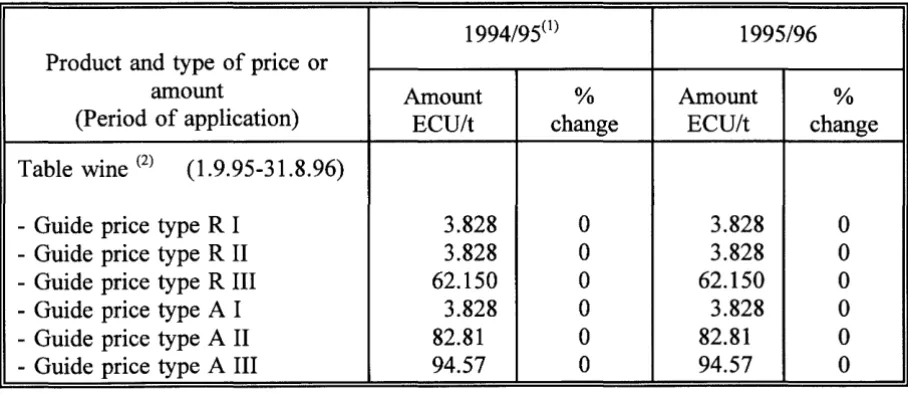
The Council decided that the guide prices should remain unchanged for the 1995/96 marketing year.
Pending the establishment of the new market organization for wine, it was decided that certain time limits set by regulations be extended for the 1995/96 marketing year, concerning:
the submission of reports on:
sulphur dioxide content of wines, sparkling wines and liqueur wines;
arrangements whereby producer groups can be regarded as producers for the purposes of compulsory distillation contracts;
the relationship between structural measures and compulsory distillation;
the laying down of rules for calculating the quantities to be distilled for each production region (uniform percentage and reference year) authorised following the Dublin compromise, but deferred until 31 August 1994, and the derogation granted for compulsory distillation to be applied according to special rules in Greece;
the trial period for certain deacidification practices, which has reached its expiry date;
the period (already extended last year until 31 August 1994) during which a proportion of the aid for juice production from grape must can be assigned to the promotion of grape juice.
Implementation of the vineyard register has been delayed in several Member States. The Commission is proposing, under the reform of the market organization, to set up a simplified register. The existing provisions must therefore be adjusted so that the vineyard register can be launched on a simplified basis or further progress be made thereon in the Member States concerned. The implementation of the vineyard register has, therefore, been authorized up to 31 December 1996. 50% of the costs are financed by the Community. Those Member States, however, whose vineyard register is only partially implemented (but at an advanced level) are authorized to complete it. In these cases Community financing is limited to its costs incurred in the drawing up of the graphical reference base for the areas concerned.
(1)
(2)
Price decisions in ecus
1994/95(l) 1995/96 Product and type of price or
amount Amount % Amount %
(Period of application) ECU/t change ECU/t change
Table wine <2) (1.9.95-31.8.96)
- Guide price type R I 3.828 0 3.828 0 - Guide price type R II 3.828 0 3.828 0 - Guide price type R III 62.150 0 62.150 0 - Guide price type A I 3.828 0 3.828 0 - Guide price type A II 82.81 0 82.81 0 - Guide price type A III 94.57 0 94.57 0
The 1994/95 amounts have been multiplied by 1.207509 for comparison purposes, in order to take account of the new agri-monetary system.
R I, R II and A I in ECU/%/hl. R III, A II and A III in ECU/hl.
[image:20.581.68.522.83.280.2]STATISTICAL TABLES.
Supply balance - wine EUR 15(2)
1 000 hi %TAV
1990/91 1991/92 1992/93 1993/94 1993/94 1992/93
1 2 3 4 5 6
1. Total wme
Usable production 187182 160650 197676 163913 -17,1
Change in stocks 684 12452 3681 -14751 -500,7
Imports 3371 3324 3298 3497 6,0
Exports 8876 8525 9592 12688 32,3
lntra-EU trade 26405 26335 25503 29107 14,1
Internal uses: 176592 163566 181003 164541 -9,1
losses - production 23 529 944 906 -4,0
-marketing 42 236 566 266 -53,0
processing 42555 34748 50476 34736 -31,2
human consumption 132582 127554 129016 128633 -0,3 Human consumption (1/head) 38,7 37,3 37,7 37,1 -1,6
Self-sufficiency(%) 123,8 112,0 133,0 113,0 -15,0
2. Quality wines produced in specified regions (Total):
Usable production 56755 49416 59099 54507 -7,8
Internal uses 51690 45550 49271 52625 6,8
3. Table wines (total):
Usable production 111238 101205 117385 93922 -20,0 Internal uses of which: 106734 102184 108527 96543 -11,0
- human consumption 75057 73710 71443 71466 0,0
- Community distillation (1) 26066 24430 32878 21242 -35,4
Sources: Eurostat and European Commission, Directorate-General for Agriculture.
(1) Excluding distillation for the production of wine spirits bearing a designation of origin and national distillation operations. (2) EUR 12.
CAP Working Notes -1995 ···~·-~'
European Commission
WINE
Luxembourg: Office for Official Publications of the European Communities
1996-22 p.- 21 x 29.7 em
Venta • Salg • Verkauf • nwA()at:l<; • Sales • Vente • Vendita • Verkoop • Venda • Myynti • Forsaljning
BELGIQUE I BELGIE
Moniteur beige/ Belgisch Staatsblad
Rue de Louva1n 42/Leuvenseweg 42 B-1 000 Bruxelles/B-1 000 Brussel Tel. (02) 512 00 26
Fax (02) 511 01 84
Jean De Lannoy
Avenue du Roi 202/Koningslaan 202 B-1 060 Bruxelles/B-1 060 Brussel Tel (02) 538 51 69
Fax (02) 538 08 41
Autres distnbuteurs/ Ovenge verkooppunten:
Librairie europeenne/ Europese boekhandel Rue de Ia Loi 244/Wetstraat 244 B-1 040 Bruxelles/B-1 040 Brussel Tel. (02) 231 04 35
Fax (02) 735 08 60
Document delivery:
Credoc
Rue de Ia Montagne 34/Bergstraat 34 Bolte 11/Bus 11
B-1 000 Bruxelles/B-1 000 Brussel Tel. (02) 511 69 41
Fax (02) 513 31 95
DANMARK
J. H. Schultz Information AIS Herstedvang 10-12 DK-2620 Albertslund Til. 43 63 23 00 Fax (Sales) 43 63 19 69 Fax (Management) 43 63 19 49
DEUTSCHLAND
Bundesanzeiger Verlag Postfach 10 05 34 D-50445 Koln Tel. (02 21) 20 29-0 Fax (02 21) 2 02 92 78
GREECE/EIIi\At.A
G.C. Eleftheroudakis SA International Bookstore Nikis Street 4 GR-10563 Athens Tel. (01) 322 63 23 Fax 323 98 21
ESPANA
Mundi-Prensa Libros, SA Castello, 37
E-28001 Madrid Tel. (91) 431 33 99 (L1bros)
431 32 22 (Suscnpc1ones) 435 36 37 (D1reCC16n) Fax (91) 575 39 98
Boletin Oficial del Estado Trafalgar, 27-29 E-28071 Madrid Tel. (91) 538 22 95 Fax (91) 538 23 49
Sucursal:
Libreria lnternacional AEDOS ConseJO de C1ento, 391 E-08009 Barcelona Tel. (93) 488 34 92 Fax (93) 487 76 59
Libreria de Ia Generalitat de Catalunya
Rambla dels Estudis, 118 (Palau Moja) E-08002 Barcelona
Tel (93) 302 68 35 Tel. (93) 302 64 62 Fax (93) 302 12 99
FRANCE
Journal officiel Service des publications des Communautes europeennes 26, rue Desa1x
F-75727 Paris Cedex 15 Tel. (1) 40 58 77 o1/31 Fax (1) 40 58 77 00
IRELAND
Government Supplies Agency 4-5 Harcourt Road
Dublin 2 Tel. (1) 66 13 111 Fax (1) 47 52 760
IT ALIA
Licosa SpA V1a Duca d1 Calabria 1/1 Casella postale 552 1-50125 F1renze Tel (055) 64 54 15 Fax 64 12 57
GRAN~DUCHtDELUXEMBOURG
Messageries du livre 5, rue Raiffeisen L-2411 Luxembourg Tel. 40 10 20 Fax 49 06 61
NEDERLAND
SOU Servicecentrum Uitgeverijen Postbus 20014
2500 EA 's-Gravenhage Tel. (070) 37 89 880 Fax (070) 37 89 783
OSTERREICH
Manz'sche
Verlags-und Universitiitsbuchhandlung Kohlmarkt 16
A-1014 W1en Tel. (1) 531 610 Fax (1) 531 61-181
Document delivery: Wirtschaftskammer W1edner Hauptstral3e A-1045 Wien Tel. (0222) 50105-4356 Fax (0222) 50206-297
PORTUGAL
lmprensa Nacional- Casada Moeda, EP Rua Marques Sa da Bandeira, 16-A P-1 099 Lisboa Codex
Tel (01) 353 03 99 Fax (01) 353 02 94/384 01 32
Distribuidora de Livros Bertrand, Ld.8
Grupo Bertrand, SA Rua das Terras dos Vales, 4-A Apartado 37
P-2700 Amadora Codex Tel. (01) 49 59 050 Fax 49 60 255
SUOM 1/FI NLAND
Akateeminen Kirjakauppa Akadern1ska Bokhandeln
Pohjoisesplanadi 39 I Norra esplanaden 39
PL I PB 128
FIN-00101 Helsinki I Helsingfors Tel. (90) 121 4322
Fax (90) 121 44 35
SVERIGE
BTJ AB Traktorvagen 11 Box 200 S-221 00 Lund Tel. (046) 18 00 00 Fax (046) 18 01 25
UNITED KINGDOM
HMSO Books (Agency section) HMSO Publications Centre 51 Nine Elms Lane London SW8 5DR Tel. (0171) 873 9090 Fax (0171) 873 8463
ICELAND
BOKABUD LARUSAR BLONDAL Sk61av6rdustig, 2 IS-101 Reykjavik Tel. 551 56 50 Fax 552 55 60
NORGE
NIC Info a/s Boks 6512 Etterstad 0606 Oslo Tel. (22) 57 33 34 Fax (22) 68 19 01
SCHWEIZ/SUISSE/SVIZZERA
OSEC
Stampfenbachstrar3e 85 CH-8035 Zurich Tel (01) 365 54 49 Fax (01) 365 54 11
BALGARIJA
Europress Klassica BK Ltd 66, bd V1tosha
BG-1463 Sofia Tei./Fax (2) 52 74 75
CESKA REPUBLIKA
NISCR Havelkova 22 CZ-130 00 Praha 3 Tei./Fax (2) 24 22 94 33
HRVATSKA
Media trade P. Hatza 1 HR-41 00 Zagreb Tei./Fax (041) 43 03 92
MAGYARORSZAG
Euro-lnfo-Service Europa Haz Marg1tsziget H-1138 Budapest
Tei./Fax (1) 111 60 61, (1) 111 62 16
POLSKA
Business Foundation ul. Krucza 38/42 PL-00-512 Warszawa Tel. (2) 621 99 93, 628 28 82 International Fax&Phone (0-39) 12 00 77
ROMANIA
Euromedia
65, Strada Dion1s1e Lupu R0-70184 Bucuresti Tei./Fax 1-31 29 646
RUSSIA
CCEC
9,60-letiya Oktyabrya Avenue 117312 Moscow
Tei./Fax (095) 135 52 27
SLOVAKIA
Slovak Technical Library Nam. slobody 19 SL0-812 23 Bratislava 1 Tel. (7) 52 204 52 Fax (7) 52 957 85
CYPRUS
Cyprus Chamber of Commerce and Industry
Chamber Building 38 Gnvas Dhigenis Ave 3 Delig1org1s Street PO Box 1455 NICOSia
Tel. (2) 44 95 00, 46 23 12 Fax (2) 36 10 44
MALTA
Miller Distributors Ltd P0Box25
Malta International Airport LOA 05 Malta Tel. 664488 Fax676799 TURKIYE Pres AS Dunya lnfotel TR-80050 Tunel-lstanbul Tel. (1) 251 91 90/251 96 96 Fax (1) 251 91 97
ISRAEL
Roy International 17, Shimon Hatarss1 Street P 0 B 13056
61130Te1Aviv Tel. (3) 546 14 23 Fax (3) 546 14 42
Sub-agent for the Palestinian Authonty:
INDEX Information Services PO Box 19502
Jeru£alem Tel. (2) 27 16 34 Fax (2) 27 12 19
EGYPT/ MIDDLE EAST
Middle East Observer 41 Sherif St Cairo
Tel/Fax (2) 393 97 32
UNITED STATES OF AMERICA/ CANADA
UNIPUB
4611-F Assembly Dnve Lanham, MD 20706-4391 Tel. Toll Free (800) 274 48 88 Fax (301) 459 00 56
CANADA
Subscnpt1ons only Un1quement abonnements Renouf Publishing Co. Ltd 1294 Algoma Road Ottawa, Ontario K1 B 3W8 Tel. (613) 741 43 33 Fax (613) 741 54 39
AUSTRALIA
Hunter Publications 58A G1pps Street Collingwood Victoria 3066 Tel. (3) 9417 53 61 Fax (3) 9419 71 54
JAPAN
Procurement Services Int. (PSI-Japan) Kyoku Dome Postal Code 102 Tokyo Koj1mach1 Post Off1ce Tel. (03) 32 34 69 21 Fax (03) 32 34 69 15
Sub-agent:
Kinokuniya Company Ltd Journal Department PO Box 55 Chitose Tokyo 156 Tel (03) 34 39-0124
SOUTH and EAST ASIA
Legal Library Services Ltd Orchard
PO Box 0523 Singapore 9123 Tel. 243 24 98 Fax 243 24 79
SOUTH AFRICA
Satto
5th Floor, Export House Cnr Maude & West Streets Sandton 2146
Tel. (011) 883-3737 Fax (011) 883-6569
ANDERE lANDER OTHER COUNTRIES AUTRES PAYS
Office des publications officielles des Communautes europeennes 2, rue Merc1er
L-2985 Luxembourg Tel. 29 29-1
Telex PUBOF LU 1324 b Fax 48 85 73,48 68 17
0
c..u
0
:r:
I
z
<
b
b
0(J)
I m