Beth gained a Bachelor of Science (Env ironmental) and Honours degree from Monash University in 1999. Since then she has worked on a wide range of fisheries and ecosystems based projects in southeastern Australia and worldwide.
tr1 n 0
-0 (1Q-·
n ~
-Newly acquired· incomplP.te catalogue
record
"Ecological interactions between
alone, urchins, and benthic habitat in
a temperate reef ecosystem:
implications for ecosystems based
management"
''Ecological interactions between
abalone, urchins, and benthic
habitat in a temperate reef
ecosystem: implications for
ecosystems based management''
By
Elisabeth Marijke Anne Saskia Strain BSc (Environmental) Hons, Monash University
Submitted in fulfilment of the requirements for the Degree of Doctor of Philosophy in Quantitative Marine Science
(A joint CSIRO & UT AS PhD program)
(Y\orri � "\ht,�'i!> S 1""P-f\ I rJ PhO
'2..010 Declarations
Statement of Originality
This thesis contains no material that has been accepted for a degree or diploma by the University or any other institutions. To the best of my knowledge this thesis contains no material previously published or written by another person, except where due acknowledgement is made in the text.
Date:
2D.
0\. lOElisabeth Marijke Anne Saskia Strain
Statement of Authority of Access
This thesis may be made available for loan and limited copying in accordance with the Copyright Act 1968.
Signed: Date:
2o.
01. 10Elisabeth Marijke Anne Saskia Strain
II
I thank the various institutes that supported my PhD research including the School of Zoology, University of Tasmania (UTAS), Tasmanian Fisheries and Aquaculture Institute (TAFI) and theVTAS and Commonwealth Marine and Atmospheric Research Quantitative Marine Science Program.
I thank my primary supervisor Craig Johnson for his advice, support, generosity with grant money, and encouragement throughout my PhD. I am also grateful to my co-supervisors Craig Mundy and Nie Bax for theirinput throughoutmy PhD.
I am much indebt tomy partner Russell Thomson for his statistical prowess, patience with programming, proof reading skills and general support.
The large field effort involvedin this project would not have been possible without a host of volunteers. Special thanks to, Robert Bloomfield, Bob Connell, Michael Davis, Ryan Downie, Richard Holmes, David Sinn, Cameron Veal. Thanks also to Anne-Elise, Amy, B2, Bella, Collette, Dave, Giles, Gedgar, Jemina, Jess, Jo, Jon, Luisa, Mani, Matt, Michaela, Penny, Regina, Sarah, Scoresby, Scott, Simon G, Simon T, Spoon, Sue, Tim, Tobs, Todd.
Statement of co-author contributions
Chapters 2-7 of the thesis have been prepared as a series of manuscripts for publication in peer reviewed journals. Please see the title of each chapter for further details. In all cases the design and implementation of the research, data analysis, interpretation and preparation of the manuscript was the responsibility of the candidate in consultation with supervisors and other contributors. The contributions of each author are outlined below.
Chapter 2: Prof. Craig Johnson contributed conceptual and practical knowledge about the ecological interactions between urchins and abalone. Dr. Russell Thomson contributed statistical expertise to undertake the Marklov chain modelling.
Chapter 3: Prof. Craig Johnson contributed conceptual and practical knowledge about the ecological interactions between urchins and abalone.
Chapter 4: Prof. Craig Johnson contributed conceptual and practical knowledge about urchin and abalone ecology and the dynamics of temperate rocky reefs.
Chapter 5: Prof. Craig Johnson contributed conceptual and practical knowledge about abalone ecology and the dynamics of temperate reef ecosystems
Chapter 6: Prof. Craig Johnson contributed conceptual and practical knowledge about abalone ecology and the dynamics of temperate reef ecosystems
ABSTRACT
The Tasmanian blacklip abalone (Haliotis rubra) fishery supplies -25% of the world market and, with a value of -AUD$120 M p.a., is the State's most valuable fishery. Fishing pressure is intense and management has been based on 'single-species' methods. However, with clear recognition that the fishery depends on the ecosystem that supports it, there is growing demand for a broader ecosystems based management approach (EBM). This thesis examined the ecological interactions between H. rubra and the invasive urchin ( Centrostephanus rodgersii), and whether fishing of H. rubra leads to a shift in the benthic community structure to a habitat configuration that becomes less favourable for abalone.
Previous surveys demonstrated a negative relationship between densities of C. rodgersii and H. rubra. We used manipulative experiments to examine the effect of competition on behaviour, movement, growth, and survival. Removals of H. rubra had no detectable effect on C. rodgersii, so there is no evidence that fishing of abalone contributed to the urchin invasion success. In contrast, introducing C. rodgersii to intact algal beds caused H. rubra to flee and seek shelter in cryptic microhabitats, and reduced their growth and survival rates, all of which would negatively impact on the abalone fishery. H. rubra only ventured into small C. rodgersii barrens after urchins were removed and these areas revegetated. This suggests that lack food and/or loss of biogenic habitat structure explain the absence of abalone on barrens. The combined research suggests that EBM of C. rodgersii to optimise the H. rubra fishery requires complete removal of urchins and regrowth of barrens.
CHAPTER 1: GENERAL INTRODUCTION
Globally, many commercial fisheries are in decline (Jackson et al. 2001, Pauly et al. 2002, Myers & Worm 2003, Scheffer et al. 2005). Major anthropogenic stressors include global climate change (Walther et al. 2002), invasive species (Carlton & Geller 1993), fishing (Jackson et al. 2003, Myers & Worm 2003), pollution, nutrients, (Islam & Tanaka 2003), and habitat loss (Lotze et al. 2006). These stressors can result in declines in species abundances, and alter the ecological interactions between species, and their environment (Scheffer & Carpenter 2003, Folke et al. 2004, Hughes et al. 2005). With the increasing risk of multiple anthropogenic stresses there is an unprecedented risk of a dramatic shift in species composition, known as catastrophic, phase or regime shifts, which are often long lasting and difficult to reverse (Scheffer & Carpenter 2003, Folke et al. 2004, Hughes et al. 2005). Hence, scientists and managers have an urgent need to understand the ecological interactions between species and their environment that support or undermine the systems resilience to human impacts (Hughes et al. 2005, Mangel & Levin 2005).
Regime shifts in temperate rocky reef ecosystem
Chapter 1: General Introduction Ecosystems based management of abalone fisheries
Abalone are herbivorous macro-invertebrates, that are primarily located in the intertidal and subtidal areas of temperate rocky reef ecosystems (Shepherd 1973, Shepherd et al. 2001). Abalone fisheries have traditionally focused on single-species based management strategies (Shepherd et al. 2001, Jenkins 2004). However, with growing awareness that abalone both affect and depend on the dynamics of the rocky reef ecosystems that support them, there is impetus to develop and apply ecosystem based management (EBM) strategies to abalone fisheries to complement the established practises based on single species (Jenkins 2004, Shepherd et al. 2001). This approach requires a good understanding of the interactions between abalone and other components of the temperate rocky reef ecosystem, to manage the systems resilience to human impacts.
The case study: Blacklip abalone
Blacklip abalone (Haliotis rubra) is a large and abundant macro-invertebrate, found across a wide range of habitats and wave exposures in southeast Australia (Shepherd 1973). In Tasmania, this species supplies -25% of the world market and, with a value of -AUD$120 M p.a., is the State's most valuable fishery. (Jenkins 2004). EBM of this fishery requires a good understanding of the ecological interactions between H. rubra and other species and their environment. Here we investigate the ecological interactions between H. rubra and the invasive long spined urchin ( Centrostephanus rodgersii) and the effects of fishing on benthic habitat structure.
Interactions between H. rubra and C. rodgersii
between these 2 herbivores in intact algal beds, before any commencement of destructive urchin grazing, is not well understood (Andrew & Underwood 1992, Andrew et al. 1998, Johnson et al. 2005). Assessing the effects of interspecific competition between C. rodgersii and H. rubra in intact algal beds is important to understand the mechanism behind the successful establishment of this urchin and the eventual exclusion of the abalone.
The range expansion of C. rodgersii into Tasmania is predicted to have major negative impacts on local biodiversity, biogenic habitat and the interactions between native species (Edgar et al. 2004, Johnson et al. 2005, Ling 2008). In New South Wales, large scale removals of C. rodgersii resulted in overgrowth of extensive barrens by filamentous and foliose algae and sessile invertebrates, with concomitant increases in the densities of H. rubra (Andrew et al. 1998). These results suggest that C. rodgersii has a negative impact on populations of H. rubra, although the mechanisms remain unclear. Understanding the direct and indirect impacts of C. rodgersii on H. rubra is important for developing EBM strategies.
Effects of intensive fishing H. rubra on benthic habitat structure
Intensive fishing of marine consumers can result in a catastrophic shift between alternative stable states (Jackson et al. 2003, Myers & Worm 2003). Anecdotal evidence from abalone fishers and researchers alike suggests that sustained depletion of H. rubra can lead to a shift in benthic structure from habitat characterised by encrusting red algae (ERA), that is non-calcareous red algae (NERA) and non geniculate coralline algae (NCA), to a community dominated by sessile invertebrates, filamentous algae, and a matrix of sediment interspersed with filamentous algae. If H. rubra plays an important role in maintaining community dominated by ERA to the exclusion of the filamentous algae, sessile invertebrates and sediment matrix, then a substantial reduction in abalone biomass as a result of fishing may lead to a change in both ecosystem structure and function (Shepherd et al. 2001, Jenkins 2004).
Chapter 1: General Introduction phycobiliprotiens obtained through feeding on ERA also aids camouflage, and ostensibly providing protection from predators during this critical early life history phase (Shepherd & Turner 1985, Kitting 1997). The relationship between H. rubra and ERA could be characterized as a positive feedback loop; encrusting red algae promote settlement, growth and survivorship of abalone while abalone grazing promotes ERA. Thus, intensive fishing of H, rubra could result in a regime shift to an alternative stable state which then becomes unsuitable for abalone populations.
Thesis structure
This thesis examines the ecological interactions between abalone and urchins and benthic habitat. The thesis begins by exploring interactions between H. rubra and C. rodgersii in intact algal beds, and barrens habitat. We examine whether fishing of H. rubra results in a shift in benthic habitat structure which then becomes unsuitable for abalone populations. We then review the processes leading to, and implications of regime shifts, for EBM of abalone fisheries. The thesis has been developed as a series of manuscripts for publication, and thus each data chapter represents a stand-alone manuscript. Consequently, some repetitions in the introductions of several chapters was unavoidable.
Chapter 2, 3 & 4 examines the nature and effects of interactions between H. rubra and C. rodgersii. Chapter 2 assesses the effects and relative magnitude of intra- and interspecific competition on abalone and urchin behaviour, movement patterns, and local abundances in open plots, in intact algal beds. Chapter 3 quantifies the effects and relative magnitude of intra-and interspecific competition of food on abalone intra-and urchin body condition, reproduction, and survival in experimental enclosures in intact algal beds. Chapter 4 investigates the direct and indirect impacts of C. rodgersii on the distribution and abundances of adult and juvenile H. rubra and H. erythrogramma in barrens using a removal experiment
Chapter 1: General Introduction red algae (Peyssonnelia spp. and Hildenbrandia spp., NERA) and non-geniculate coralline algae (NCA) by filamentous and foliose algae and sessile invertebrates and accumulated sediment and experimental transplants to determine whether any shift in habitat characteristics subsequently affects the distribution and abundance of adult abalone.
In Chapter 7 we review our results in the context of published research to provide an overview of the direct and indirect interactions between abalone and other components of the temperate rocky reef ecosystem, and their implications for EBM strategies.
REFERENCES
Andrew NL, Underwood AJ (1992) Associations and density of urchins and abalone on shallow subtidal reefs in southern New South Wales. Marine and Freshwater Research 43: 154 7-1559
Andrew NL, Worthington DG, Brett PA, Bentley N R, Chick C, Blount C (1998) Interactions between the abalone fishery and urchins in New South Wales. Final Report Series No.12, NSW fisheries, Sydney
Beisner, BE, Haydon DT, Cuddington K (2003) Alternative stable states in ecology. Frontiers in Ecology and the Environment 1:376-382
Carlton JT, Geller JB (1993) Ecological roulette: the global transport of non-indigenous marine organisms. Science 261:78-82
Chapman ARO, Johnson CT (1990). Disturbance and organization of macroalgal assemblages in the Northwest Atlantic. Hydrobiologia 192:77-121
Daume S, Brand-Gardner S, Woelkerling WJ (1999) Preferential settlement of abalone larvae: diatom films vs. non-geniculate coralline red algae. Aquaculture 174:243-254
Edgar GJ (1997) Australian marine life. Reed books, Kew, Victoria
Edgar GJ, Barrett SN, Morton A, Samson RC (2004) Effects of algal canopy clearance on plant, fish and macroinverebrate communities on eastern Tasmanian reefs. Journal of Experimental Marine Biology and Ecology 312:67-87
Chapter 1: General Introduction management. Annual Review of Ecology, Evolution and Systematics 35:557-581
Hughes TP, Bellwood DR, Folke C, Steneck RS, Wilson J (2005) New paradigms for supporting the resilience of marine ecosystems. Trends in Ecology and Evolution 20(7):380-386
Gordon HR, Cook PA (2004) World abalone fisheries and aquaculture update: supply and market dynamics. Journal of Shellfish Research 23(4):935-939
Islam S, Tanaka M (2003) Impacts of pollution on coast and marine ecosystems including coast and marine fisheries and approach for management: a review and synthesis. Marine Pollution Bulletin. 48:624-649. Jackson JBC, Kirby MX, Berger HW, Bjorndal KA, Botsford LW, Bourque BJ, Bradbury RH, Cooke R, Erlandson J, Estes JA, Hughes TP, Kidwell S, Lange CB, Lenihan HS, Pandolfi JM, Peterson CH, Steneck RS, Tegner MJ, Warner RR (2001) Historical overfishing and the recent collapse of coastal ecosystems. Proceedings of the National Academy of Science U.S.A. 293(5530):629 - 637
Jenkins GP (2004) The ecosystems effects of fishing abalone: a review. Marine and Freshwater Research 55(6):545-552
Johnson C, Ling S, Ross J, Scoresby S, Miller K (2005) Establishment of the long-spined urchin (Centrostephanus rodgersii) in Tasmania: first assessment of the potential threats to fisheries. Final report, Fisheries Research Development Corporation, Hobart, Tasmania
Kitting CL (1997) Feeding effects of postlarval red abalone, Haliotis rufescens (Mollusca: Gastropoda) on encrusting coralline algae. Molluscan Research 18:183-196
Levin SA, Lubchenco J (2008) Resilience, robustness and marine ecosystem-based management. Bioscience 58:27-32
Ling SD (2008) Range expansion of a habitat-modifying species leads to loss of taxonomic diversity: a new and impoverished reef state. Oecologia:156:883-894
Ling SD, Johnson CR, Ridgway K., Hobday A.J, Haddon M (2009) Climate driven range extension of a urchin: inferring future trend by analysis of recent population dynamics. Global Change Biology 15:719-731
Chapter 1: General Introduction Mangel M, Levin PS. (2005) Regime, phase and paradigm shifts: making community ecology the basic science for fisheries. Philosophical Transactions of the Royal Society of London Biological Sciences 360:95-105 Morse ANC, Morse DE (1984) Recruitment and metamophosis of Haliotis larvae induced by molecules uniquely available at the surfaces of crustose red algae. Journal of Experimental Marine Biology and Ecology 75(3):191-215
Myers RA, Worm B (2003) Rapid worldwide depletion of predatory fish communities. Nature 423(6937):280-283
Pauly DV, Christensen S, Guenette S, Pitcher TJ, Sumaila UR, Walters R, Watson R, Zeller D (2002) Towards sustainability in world fisheries. Nature 418:689-695
Ridgway K. (2007) Long-term trend and decadal variability of the southward penetration of the East Australian Current. Geophysical Research Letters 34:L13613
Scheffer MS, Carpenter JA, Foley C, Folke CB, Walker B (2001) Catastrophic shifts in ecosystems. Nature 413:591-596
Scheffer M, Carpenter SR (2003) Catastrophic regime shifts in ecosystems: linking theory to observation. Trends Ecology and Evolution 18(12):648-656 Scheffer M, Carpenter S (2005) Cascading effects of overfishing marine systems. Trends in Ecology and Evolution 20:579-581
Schroder A.L, Persson L, de Roos AM (2005) Direct experimental evidence for alternative stable states:a review. Oikos 110:3-19
Shepherd SA (1973) Studies on southern Australian abalone (genus Haliotis). I. The ecology of five sympatric species. Marine and Freshwater Research 24:217-257
Shepherd SA, Turner JA (1985) Studies on southern Australian abalone (genus Haliotis). VI. Habitat preference, abundance and predators of juveniles. Journal of Experimental Marine Biology and Ecology 93(3):285-298
Shepherd SA, Rodda KR, Vargas KM (2001) A chronicle of collapse in two abalone stocks with proposals for precautionary management. Journal of Shellfish Research 20:843-856
Chapter 1: General Introduction Tegner, MJ, Dayton PK (2000) Ecosystem effects of fishing in kelp communities. ICES Journal of Marine Science 57(3):579-589
CHAPTER 2: EFFECTS OF CLIMATE INDUCED RANGE EXPANDING URCHIN ON COMMERCIALLY FISHED ABALONE
ABSTRACT
Global climate change has resulted in the southerly range expansion of the barrens-forming urchin (Centrostephanus rodgersii) into Tasmania, Australia. Surveys on the southeast coast of Australia have shown a negative relationship between densities of C. rodgersii and H. rubra at several spatial scales, suggesting negative interactions. We used an experimental framework to examine the effects of interspecific competition on C. rodgersii and intra- and interspecific competition on H. rubra, behaviour, movement and local abundances, in intact algal beds. Manipulations of H. rubra densities had no detectable effects on C. rodgersii behavioural transitions, movement patterns or resightability. In contrast, additions of C. rodgersii or extra H. rubra to plots, resulted in fewer abalone remaining exposed and an increase in the proportion of sheltering and mobile abalone and the mean net distance moved by abalone relative to controls. Additions of C. rodgersii to plots also lead to a decline in the resightability of H. rubra, relative to controls. There were no detectable effects of the translocation procedures on the resightability of C. rodgersii or the tagging procedures on the resightability of H. rubra. There were also no detectable differences in the numbers of predators (Jasus edwardsii and fishes) between treatments. Our results suggest that there are asymmetrical competitive interactions between C. rodgersii and H. rubra. The introduction of C. rodgersii to intact algal beds causes H. rubra to flee and seek shelter in cryptic microhabitat which will potentially negatively impact on their accessibility and productivity for the abalone fishery, while the presence of the abalone has no detectable effect on the urchin. This framework could be used to understand impacts of other climate induced range expanding species on other native species.
Chapter 2: Interactions between urchins and abalone in algal beds INTRODUCTION
Global climate change is leading to the redistribution of many non-- indigenous marine species with the potential to modify biogenic habitat
(Ling 2008), alter the interactions between native species (Smith 2005). and result in declines in local biodiversity (Firth et al. 2009). Competitive interactions between non-indigenous and native species can influence invasion success (Baltz & Moyle 1993) and negatively impact on native species (Byers 2000 a b, Bohn & Amundsen 2001, Jensen et al. 2002). The paucity of information about competitive interactions between many non-indigenous and native species limits our understanding any potential impacts of range expansion on marine ecosystems, and hinders efforts to prioritise management responses (Carlton 1992).
Driven by increased poleward penetration of the East Australian Current (Ridgway 2007) the long spined urchin ( Centrostephanus rodgersii) has undergone a southerly range expansion from New South Wales and was first recorded in mainland Tasmanian waters in 1978 (Edgar 1997, Johnson et al. 2005, Ling et al. 2009). This urchin is well known for its ability to overgraze productive and diverse algal beds, and maintain bare rock barrens habitat (Fletcher 1987, Johnson et al. 2005, Ling 2008). C. rodgersii barrens are becoming more widespread along the east coast of Tasmania, and do not support viable fisheries of blacklip abalone Haliotis rubra (Andrew & Underwood 1992, Andrew et al. 1998, Johnson et al. 2005). Whereas much of the research on the impacts of C. rodgersii on H. rubra has focused on barrens habitat the nature of interactions between these 2 herbivores before any commencement of the destructive grazing is not well understood. Assessing the effects of interspecific interactions between C, rodgersii and H. rubra in intact algal beds could be important for understanding the factors leading to the successful establishment of the urchin and the eventual exclusion of abalone.
2005), New Zealand (Naylor & Gerring 2001), and California (Karpov et al. 1998). Hypotheses to explain negative associations between C. rodgersii and H. rubra include competition for food (Shepherd 1973, Strain & Johnson 2009, Chapter 3) and shelter (Andrew et al. 1998), and losses to predators as a result of competitive displacement from shelter (Lowry & Pearce 1973). However the effects of competitive between C. rodgersii and H. rubra in intact algal beds have not been tested.
Separating the effects and relative magnitude of intra- and interspecific competition between C. rodgersii and H. rubra may have important implications for the large scale dynamics of these reef systems and the fisheries they support. If C. rodgersii is the superior competitor in interactions with H. rubra, then the establishment of this urchin may have a negative impact on the abundances of abalone and/or their accessibility to fisheries. Alternatively, if H. rubra is the superior competitor in interactions with C. rodgersii, then fishing of abalone may lead to an increase in the distribution and abundance of the urchin with a concomitant increase in the risk of barrens formation. Broader scale effects on system dynamics may also arise if competition affects levels of aggression, avoidance behaviours and dispersal, or stimulates the use of a wider variety of food and habitats (Branch 1975, Byers 2000a), or affects the risk of predation to realise complex interactions between competition and predation (lribarne et al. 1994). However, the effects of competition on behavioural and movement responses are rarely explored because of sampling and analysis difficulties, especially in detecting impacts (Byers 2000b, Lusseau 2003).
We used experimental additions of urchins and removals of abalone to test the effects of (i) interspecific interactions between C. rodgersii and H. rubra, (ii) intraspecific interactions in H. rubra, (iii) the translocation procedures on C. rodgersii and (iv) the tagging procedures on H. rubra, behavioural transitions, movement patterns and local abundances of urchins and abalone in intact algal beds.
MATERIALS AND METHODS Site characteristics
Chapter 2: Interactions between urchins and abalone in algal beds ranging from urchin barrens patches to areas dominated by diverse stands of canopy-forming algal with well-developed understorey.
B. The Lanterns A Maria Island
[image:19.489.119.386.70.319.2]147.57 0£ 148.02 "E
Figure 1. Map of the east coast of Tasmania, Australia, showing the locations, the Lanterns and Magistrate's Point, Maria Island of the study sites.
We tested the effects of interspecific competition between Centrostephanus rodgersii and Haliotis rubra at Magistrate's Point, in the Maria Island marine reserve, to avoid confounding with any effects of fishing abalone. The reserve supports high densities of H. rubra, but very low densities of C. rodgersii, relative to the surrounding fished areas (Edgar & Barrett 1999). The site is characterised by a gently sloping rocky substratum to a depth of -11 m and is moderately sheltered from all but south-westerly swells (Edgar 1984).
habitat. The site is moderately exposed to easterly swells which, although infrequent, can be large (Edgar 1984)
At both sites the distribution, abundances, and size range of C. rodgersii and H. rubra were determined from a sample of 20, 3x3 m quadrats, positioned randomly in 3-13 m water. The mean abundance and size range of C. rodgersii was 18 individuals per 9 m2 (+/- 0.98 SE), with test diameter ranging between 90-125 mm. The mean abundances and size range of H. rubra was 25 individuals per 9 m2 ( +/- 0.95 SE), with shell length ranging between 90-190 mm. Animals were measured using vernier callipers. All experiments were conducted in 7-11 m waters where the distribution of C. rodgersii and H. rubra overlapped.
Experimental design
Experimental manipulations were conducted in 3x3 m open plots. All plots were marked with 5 star pickets, 1 in each corner and 1 in the centre of the plot. Initial assessments were undertaken by eye to ensure that the cover of the substratum (large boulders, small boulders, and sand) algae (brown, green, red) and sessile invertebrates and the density of benthic invertebrates (urchins and gastropods) were broadly consistent between plots, at Magistrate's Point and the Lanterns.
Tagging C. rodgersii and H. rubra
Chapter 2: Interactions between urchins and abalone in algal beds into cages, where they were held for 1 week before being transferred randomly into plots. In the experiment at the Lanterns, tagged C. rodgersii were kept out of water in the boat for the amount of time before being released into plots.
Experimental manipulations
We used a series of experimental manipulations (n=3) to test the effects of interspecific competition and the translocation procedures on C. rodgersii and the effects of intra- and interspecific competition and the tagging procedure on H. rubra (Table 1 & 2).
Experiment 1: Effect of interspecific competition
To test the effect of interspecific competition on the behavioural transitions, movement patterns and resightability of C. rodgersii and H. rubra in winter of 2005, the following treatments were applied to plots at Magistrate's Point. Treatment l:lx ambient density C. rodgersii were added randomly to plots where all H. rubra had been removed (lUOA)
Treatment 2: lx ambient density C. rodgersii were added randomly to plots with lx ambient density of H. rubra (lAlU)
Treatment 3: lx ambient density of H. rubra (IA)
The assessments took place immediately prior to, and 1 day, 1 week, 2 weeks and 4 weeks after manipulations. Because there were no detectable effects of interspecific competition on C. rodgersii, subsequent experiments focused on testing the effect of intra- and interspecific competition on H. rubra
Experiment 2: Effects of intra- and interspecific competition
To test the effects of intra- and interspecific competition on the behavioural transitions, movement patterns and resightability of H. rubra in summer of 2006, the following treatments were applied to plots at Magistrate's Point. Treatment 1: lx ambient density of tagged H. rubra (lA)
Treatment 2:2x ambient density of tagged H. rubra (lAlA)
Table 1. Centrostephanus rodgersii and Haliotis rubra. Treatments involving manipulations of C. rodgersii and H. rubra densities in 9 m2 open plots. Ambient densities of C. rodgersii (1 U) and H. rubra (lA) were -18 urchins and - 25 abalone.
Treatment Manipulation
Experiment 1: Effect of interspecific competition on C. rodgersii and H. rubra
1 UOA lx ambient density of C. rodgersii where all H. rubra were removed lAl U lx ambient density of H. rubra with lx ambient density of C.
rodgersii
lA lx ambient density of H. rubra
Experiment 2: Effect of intraspecific and interspecific competition on
H. rubra
lA lx ambient density of tagged H. rubra lAlA 2x ambient density of tagged H. rubra
lAl U lx ambient density of H. rubra with Ix ambient density of C. rodgersii
Experiment 3: Effect of translocation procedures on C. rodgersii
1 lx ambient density of untagged and undisturbed C. rodgersii were left in plots at the Lanterns
2 lx ambient density of tagged C. rodgersii replaced back into the same positions and plots they were collected at the Lanterns
3 lx ambient density of tagged C. rodgersii placed in random positions into the same plots they were collected at the Lanterns 4 lx ambient density of C. rodgersii were placed randomly into new
plots at the Lanterns
5 lx ambient density of C. rodgersii were placed randomly into new plots at Magistrate's Point
Experiment 4: Effect of tagging on H. rubra
1 Ix ambient density of tagged H. rubra
Chapter 2: Interactions between urchins and abalone in algal beds
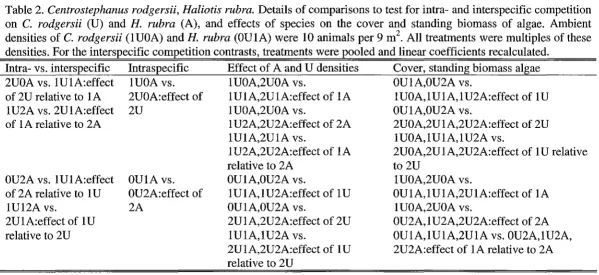
Table 2. Centrostephanus rodgersii and Haliotis rubra. Details of the planned comparisons to test the effect of interspecific competition and translocation procedures on resightability and movement patterns of C. rodgersii and the effect of intra- and interspecific competition, and the tagging procedure on the resightability and movement patterns of H. rubra. Ambient densities of C. rodgersii (IU) and H. rubra (IA) were -I8 urchins and -25 abalone.
Comparisons Rationale
Experiment 1: Effect of interspecific competition on C. rodgersii and H. rubra
IUOA vs. IAIU Effect of interspecific competition on C. rodgersii behaviour and movement day I, week I, 2, 4 IAI U vs. IA Effect of interspecific competition on H. rubra behaviour and movement day I, week I, 2, 4 Experiment 2: Effect of intra- and interspecific competition on H. rubra
IAIA vs. IAIA Effect of intraspecific competition on resightability of H. rubra weeks I-3 vs. 4-6, I-3 vs. 7-9 IAI U vs. IA Effect of interspecific competition on resightability of H. rubra weeks I-3 vs. 4-6, I-3 vs. 7-9
IAIA vs. IAI U Effect of interspecific competition relative to intra- competition on resightability of H. rubra weeks 4-6 IA vs. IAIA Effect of intraspecific competition on movement patterns of H. rubra week 4, 5, 6
IA vs. IAI U Effect of interspecific competition on movement patterns of H. rubra week 4, 5, 6
IAIA vs. IAI U Effect of intra- versus interspecific competition on movement patterns of H. rubra week 4, 5, 6 Experiment 3: Effect of translocation procedures on C. rodgersii
I vs. 2 Effect of Tagging of C. rodgersii
2 vs. 3 Effect of changing C. rodgersii position in the plot
3 vs. 4 Effect of transferring C. rodgersii into new plots at the Lanterns
4 vs. 5 Effect of transferring C. rodgersii into new plots at the Magistrate's Point Experiment 4: Effect of tagging procedure on H. rubra
Extra H. rubra for treatment 2 were collected approximately 100 m away from the site, tagged with orange crayon (which lasted the duration of the experiment) and placed randomly into plots. We did not monitor the responses of the extra abalone throughout the experiment. The assessments took place immediately prior to manipulations and then weekly for 9 weeks. In this experiment, weeks 1 to 3 were preceding treatment, weeks 4 to 6 were during treatment (i.e. with added C. rodgersii or extra H. rubra), and weeks 7 to 9 were after the cessation of the treatment (when added C. rodgersii and extra H. rubra had been removed), however distances moved by H. rubra were only measured during weeks 4 to 6.
Experiment 3: Effects of the translocation procedures on C. rodgersii To test the effect of interspecific competition on C. rodgersii, it was necessary to translocate urchins from the Lanterns to Magistrate's Point. To test effect of the translocation procedures on the resightability of C. rodgersii, in winter of 2005, the following treatments were applied to plots at the Lanterns and Magistrate's Point.
Treatment 1: lx ambient density of untagged and unmanipulated C. rodgersii were left in plots at the Lanterns
Treatment 2: lx ambient density of tagged C. rodgersii were placed back into the same positions and plots where they were collected at the Lanterns Treatment 3: lx ambient density of tagged C. rodgersii were placed in random positions into the same plots where they were collected at the Lanterns
Treatment 4: Ix ambient density of tagged C. rodgersii were placed randomly into new plots at the Lanterns
Treatment 5: Ix ambient density of C. rodgersii were placed randomly into new plots at Magistrate's Point
The assessments took place immediately prior to, and I day, I week, 2 weeks and 4 weeks after manipulations.
Effects of tagging procedure on H. rubra
To test the effects of the tagging procedure on the resightability of H. rubra, in the winter of 2005, the following treatments were applied to plots at Magistrate's Point.
Chapter 2: Interactions between urchins and abalone in algal beds The assessments took place immediately prior to, and 1 day, 1 week, 2 weeks and 4 weeks after manipulations.
Response variables
For all experiments, the number and identity of predators (fishes and rock lobsters) in the area inside each 3x3 m plot and 1 m outside the plot were recorded. We then searched the area inside the plots (for tagged and untagged C. rodgersii and H. rubra) and 1 m area outside the plot (for tagged abalone and urchins) for 1 hour. We recorded the identity and total number of all tagged C. rodgersii and H. rubra (including dead animals) inside and 1 m outside the plot and the number of untagged C. rodgersii and H. rubra inside the plot. In the experiments designed to test the effect of interspecific competition on C. rodgersii and the effects of intra- and interspecific competition on H. rubra, microhabitat use by urchins and abalone, inside each plot was recorded as either, exposed (out in the open) or sheltered (in a crevice, or under a rock, or sitting vertically against or under a rock). Animals 1 m outside the plots were recorded as being outside and tagged animals that were not relocated were classified as lost. The position of individual C. rodgersii and H. rubra inside plots was determined by triangulation based on the distances to the 2 nearest star pickets, and noting which picket was on the right hand side. Movement of C. rodgersii and H. rubra was described by their change in position on consecutive visits to plots.
Data analysis Resightability
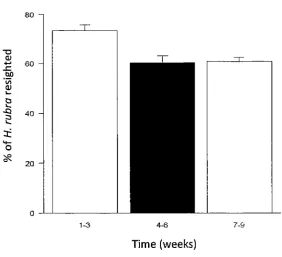
The effect of interspecific competition and the translocation procedures on the percentage of C. rodgersii and the effects of intra- and interspecific competition and the tagging procedures on the percentage of H. rubra resighted through time were analysed with 2-way univariate repeated measures ANOVA. We used the Greenhouse-Geisser adjusted degrees of freedom when data did not meet the assumption of sphericity.
competition on H. rubra, the model included the main effects of treatment (fixed, 3 levels=lA, lAlA, lAl U) and time (random, 9 levels=weeks 1 to 9).
To test the effect of the translocation procedures on C. rodgersii, the model included the main effects of treatment (fixed, 5 levels=5 treatments) and time (random, 4 levels=l day, and 1, 2 and 4 weeks). To test the effect of the tagging procedures on H. rubra, the model included the main effect of treatment (fixed, 2 levels=2 treatments) and time (random, 4 levels=l day and 1, 2, and 4 weeks).
Behavioural transitions
The effect of interspecific competition on C. rodgersii and intra- and interspecific competition on H. rubra behavioural transitions (the probability of changing from one behavioural state to another) were analysed using Markov chain modelling (Markov 1971, Lusseau 2003). Markov chains quantify the dependence of behaviour on preceding behaviour. There are several degrees of dependence, if sequenced behaviours are independent they are described by a zero-order Markov chain. If a particular behaviour depends only on the behaviour immediately preceding it, then a first-order Markov chain is fitted, and so on. Here we used a first-order Markov chain to model the time dependence of behaviour, while retaining a relatively simple analytical design. We tested between the zero- and first-order chains for the control animals using a
x2
likelihood ratio test.Chapter 2: Interactions between urchins and abalone in algal beds To test the assumption that the behaviour in the control animals remained the same over time, we included time in the model.
A/
likelihood ratio test was used to test between models with and without time.Transition probabilities (through time) were then determined for C. rodgersii and H. rubra from the regression coefficients of the log-linear model, using the following transformation:
k=(E,L,O,S)
where i is the preceding behaviour,} is succeeding behaviour (i and} could include any of the four behavioural states).
/Ju
is the coefficient for the ith behaviour of the outcome variable and jth behaviour of the dependent variable, and Pij is the transition probability from i to j in the Markov chain. Each behavioural transition is equivalent to the proportion of time that the specific behaviour was observed. The effect of interspecific competition on C. rodgersii and intra- and interspecific competition on H. rubra behaviour-transition probability matrices were tested using ax2
likelihood ratio test. A proportions test was used to test for the effect of treatments on specific behavioural transitions.Movement patterns
Distances moved by individual C. rodgersii and H. rubra could not be assumed to be independent through time. These data were summed through time, for each plot. The effects of interspecific competition on C. rodgersii and intra- and interspecific competition on H. rubra mean distanced moved were analysed with a I-way fixed factor Kruskal-Wallis test (see resightability section for model details).
To obtain a measure of the error inherent in the methods used for determining distances moved by C. rodgersii and H. rubra, distances between the 8 pairs of reference markers were measured ten times (mean=0.1 m, SE=+/-0.012 m). There was high precision in our measurements of distances moved by C. rodgersii and H. rubra.
2). This graph demonstrated that the majority of animals moved distances 0-0.6 m, although some moved much greater distances. Thereafter, we labelled animals that moved :S0.4 m homing (61.35% C. rodgersii and 77.74% H. rubra), and those that moved >0.4 m were deemed mobile (38.65% C. rodgersii and 22.26% H. rubra). We also tested other definitions of homing (:S0.2 m and :S0.6 m) and mobile (>0.2 m and 0.6 m) C. rodgersii and H. rubra, which had no effect on our biological conclusions.
a C. rodgersii 6
5 4 3 2
1
0
> 0.0 0.4 0.8 1.2 1 6 2.0 2.4 2.8 3.2 36 4.0 4.4
u c::
Q)
:::I
C" Q) ...
u.. b H. rubra
6
0.0 OA 0.8 1.2 1.6 2.0 2 4 2.8 3.2 3.6 4·_0 4.4 Distance (m)
Figure 2. Centrostephanus rodgersii and Haliotis rubra. Frequency plots of distances (m) moved by (a) C. rodgersii and (b) H. rubra. Bar widths are 0.05 m. The continuous line shows the probability function that describes best the distribution of the data.
Chapter 2: Interactions between urchins and abalone in algal beds were followed by 2x3 G-tests. To compensate for increased type I error and low numbers, Williams's corrections (q) were applied in all G-tests.
Predators
It could not be assumed that predator densities were independent through time. The densities of southern rock lobster (Jasus edwardsii) and fish (Pictilabrus laticlavius, Notolabrus tetricus, Notolabrus fucicola and Latridopsis forsteri) were summed through time, for each plot. The differences in the densities of predators between treatments were analysed using 1-way ANOVAs (see above resightability section for model details).
For all parametric ANOVAs, the relationship between the standard deviation and means of the densities was used to determine the appropriate transformation to stabilise variances. Transformed data were checked for both normality (using normal probability plots) and homoscedasticity. Transformations are expressed in terms of the raw dependent variable, Y. For repeated measure ANOV As, the Mauchly' s test of sphericity was also used to test the correlation structure.
For all analyses where significant differences were found, planned comparisons were conducted between treatments (Table 2). Where comparison sets were non-orthogonal, the significance level was adjusted using Todd & Keough (1994). All statistical analyses and graphics were undertaken using R.
RESULTS
Percentage resighted
Table 3. Centrostephanus rodgersii. Results of 2-way repeated measures ANOVA testing the effect of interspecific competition and translocation procedures on the percentage of C. rodgersii resighted at Magistrate's Point, Maria Island and the Lanterns. Significant p-values are indicated in bold print: p <0.05.
Sources of variation df Interspecific competition
Treatment 1
Error 4
Time 4
Treatment x Time 4
Error 16
Translocation procedure
Treatment 3
Error 8
Time 3
Treatment x Time 12
Error 24
MS 1.5 11.84 15.278 0.167 1.222 454.39 144.676 103.414 57.756 F 0.127 12.5 0.136 3.141 1.791 p 0.74 0.003 0.936 0.087 0.109
Chapter 2: Interactions between urchins and abalone in algal beds
Table 4. Haliotis rubra. Results of 2-way repeated measures ANOV A testing the effect of intra- and interspecific competition and tagging on the percentage of H. rubra resighted. Significant p-values are shown in bold print: p<0.05 main analysis and p<0.0125 planned comparisons testing the effect of interspecific competition, p<0.007 planned comparisons testing the effect of intra- and interspecific competition (a adjusted using Todd & Keough (1994)).
Factors df MS F p Comparisons F p
Interspecific competition
Treatment 1 1539.4
Error 4 83.206
Time 2.082 304.872
Treatment x Time 2.082 179.839
Error 8.328 59.055
Intra- and interspecific competition
Treatment 2 1386.289
Error 6 460.569
Time 2.958 1509.364
Treatment x Time 5.915 398.702
Error 17.746 98.141
Tagging procedure Treatment
Error Time
Treatment x Time Error 1 4 1.89 1.89 7.598 45.594 59.865 221.668 66.365 67.349 18.501 5.163 3.045 3.010 15.380 4.063 0.762 3.291 0.985 0.013 0.034 0.101 0.124 <2e·16 0.01 0.432 0.0.95 0.412
lA vs.lAIU dayl IA vs.IAIU week 1 lA vs.IAIU week 2 lA vs.IAIU week4
lA weeks 1-3 vs. weeks 4-6 lA weeks 1-3 vs. weeks 7-9 lAl U weeks 1-3 vs. weeks 4-6 lAlU weeks 1-3 vs. weeks 7-9 lAlA weeks 1-3 vs. weeks 4-6 lAlA weeks 1-3 vs. weeks 7-9 lAl U weeks 4-6 vs. weeks 4-6
2.99 0.159 40.913 0.003 15.814 0.01 10.61 0.01
80 70 ""O
Cl)
+-' 60
...c:: tl.O
'Vi
Cl) 50 ...
e
..Q
40
2
:i:
'+- 30
0
'#. 20
10 0
0 7 14 28
Time (days)
[image:32.485.83.378.97.350.2]Chapter 2: Interactions between urchins and abalone in algal beds
"'C Q)
+..o 60
...c::
b.O 'Vi Q) ....
e
..Q 40
:::s
...
:c:
'+-0
'*'
201-3 4-6 7-9
Time (weeks)
[image:33.484.98.381.90.347.2]Behavioural transitions
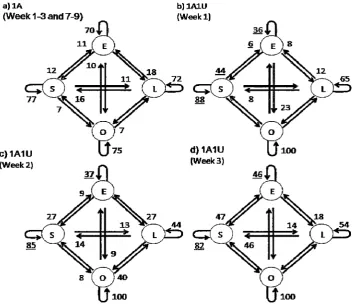
Divers spent 99 hours underwater monitoring the behaviour of 54 C. rodgersii and 495 H. rubra. In the control plots, H. rubra behaviour remained very consistent through time. Additions of C. rodgersii resulted in immediate, significant and consistent changes to H. rubra behaviour. In contrast, additions of extra abalone resulted in slower and inconsistent changes to H. rubra behaviour.
Transitions in the behavioural states of C. rodgersii (X224, 981=13.l, p=0.97) and H. rubra (interspecific competition experiment, x233,1179=43.0, p=0.11 and intra- and interspecific competition experiment x2s.m2=0.78, p=0.85) in control treatments were stable over time and first-order transitions provided more information than zero-order chains (interspecific competition experiment, urchins, X29,1179=108.5, p<2e-16 and abalone x\1212=534.4, p<2e-16, and intra- and interspecific competition experiment abalone,
X260,1ns=378.7, p<2e-16).
There were no detectable effects of interspecific competition on C. rodgersii behavioural transitions (X21s, 931=8.71, p=0.67). In contrast, addition of C. rodgersii or extra abalone lead to changes in H. rubra behavioural transitions in both experiments (interspecific competition experiment, X212,
2412=21.3, p=8e-5, intra- and interspecific competition experiment additions of urchins x\ 927=17.68, p=5e-4 and extra abalone x\ 813=14.138, p=8e-4).
Chapter 2: Interactions between urchins and abalone inalgal beds In the interspecific competition experiment, the probability of H. rubra remaining sheltering increased from 78% to 97% within a day of adding C. rodgersiito plots and then remained consistently higher than the control plots with no urchins. In theintra-and interspecificcompetition experiment, the probability that H. rubraremained sheltering increased from 78% to 88% within a week of adding C. rodgersiiand then remained consistently high.
Increasing thedensity of abalone inplots changed threeH. rubrabehavioural transitions (Figure 6). The likelihood of abalone remaining exposed decreased, while the likelihood of remaining sheltering and moving from
~ lost increased. One week after extra conspecifics were added to
plots the probability of H. rubraremaining sheltered dropped from 86% to 65% and remained consistently low throughout the experiment while the probability of H. rubrachanging from ~ lost increased to from
Chapter 2: Interactions between urchins and abalone in algal beds
a)lA
(Week 1-3 and 7-9) b)lAlU (Week1)
c)1A1U (Week2)
d) 1A1U (Week3)
[image:37.485.75.431.57.365.2]Movement patterns
There were no detectable effects of interspecific competition on the mean net distances moved by C. rodgersii
(,f
1,9=239.11, p=0.56). In contrast, both intra- and interspecific competition resulted in a significant increase in the mean net distance moved by H. rubra (interspecific competition experiment,i
1.9s1=11.176, p=Se-4 and intra- and interspecific competition experiment,i
2•981=55.36, p=9e-13). There was no detectable difference in the effects of intra- and interspecific competition on mean the net distances moved by H.?
rubra {X1,981=1.183, p=0.277, <Xact1ustect=0.017).
Chapter 2: Interactions between urchins and abalone in algal beds
a
lA
7060 50 40 30
e
20..Q 10
2
0:i:: 7 14 28
'+-0
c:
0 :;::; ....
b
lAlU
00.. 0 70 .... 0.. 60
50 40 30 20 10 0
1 7 14 28
Time (days)
[image:39.486.117.381.83.358.2]a
lA
6050 40 30 20 10 0
4 5 6
e
...0
2
:r:
6050
'+- 40
0
c:: 30
0 20 ·.;; ... 10 0 0
0. 4
0 5 6
...
0.. 60 50 40 30 20 10 0
4 5 6
Time (weeks)
[image:40.486.86.368.78.390.2]Chapter 2: Interactions between urchins and abalone in algal beds
Table 5. Haliotis rubra. Result of log-linear models testing the effect of interspecific and intra- and interspecific competition on the proportion of homing (:S0.4m) and mobile (2:0.4m) abalone in experiments at Magistrate's Point, Maria Island. Significant p-values are shown in bold print: p<0.05 are significant for the main analysis and p <0.0125 are significant comparisons testing the effect of interspecific competition and p <0.005 are significant comparisons testing the effect of intra- and interspecific competition (ex. ad"usted usin Todd & Keough (1994)).
Factors df Log likelihood p Comparisons Log likelihood p
Interspecific competition
Treatment
Intra- and interspecific competition
Treatment
1 15.865 0.027
2 69.732 0.001
lA vs.lAlU day 1 lA vs.lAlU week 1 lA vs.lAlU week 2 IA vs.IAIU week 4
IA vs. IAIU week 4 IA vs. IAI U week 5 lA vs. I Al U week 6 lA vs. lAlA week 4 IA vs. lAlA week 5 lA vs. lA week 6 lAIA vs. lAlA week 4 IAIA vs. IAI U week 5 lAIA vs. IAIU week 6
2.314 0.128
5.746 0.01
6.541 0.01
6.9I7 0.008
10.3I 0.002
8.846 0.002
I5.685 7e"5
5.79 O.OI
10.134 0.001
16.964 3e·5
0.136 0.713
0.07 0.8
Chapter 2: Interactions between urchins and abalone in algal beds Predators
The number of predators associated with the experimental plots remained consistently low throughout the experiments. There were no detectable differences in the total predator densities in the C. rodgersii translocation experiment (F5,48=0.9, p=0.41), the H. rubra tagging experiment (F1,28=1.92, p=0.3), the experiment testing the effects of interspecific competition on C. rodgersii and H. rubra {F2,2s=0.38, p=0.68), or in the experiment testing the effects of intra- and interspecific competition on H. rubra (F2,24=0.87, p=0.43). Similarly, there were no detectable differences among treatments in the densities of Jasus edwardsii or total fishes in the C. rodgersii translocation experiment (F5.48=3.l, p=0.06 and Fs.4s.=0.l, p=0.91, respectively), H. rubra tagging experiment (F1,2s=l.31, p=0.37 and F1,28=0.15, p=0.71), experiment testing the effects of interspecific competition on C. rodgersii and H. rubra (F2, 2s=0.82, p=0.45 and F2,28=0.08, p=0.93), or in the experiment testing the effects of intraspecific and interspecific competition on H. rubra (F2,24=2.9, p=0.08 and F2,24=0.9,
p=0.42 respectively).
DISCUSSION
Climate change has the potential to alter competitive interactions between non-indigenous and native species (Walter et al. 2002 Firth et al. 2009). We examined competitive interactions between the non-indigenous urchin Centrostephanus rodgersii and the commercially fished abalone Haliotis rubra. Previous studies have examined interactions between these 2 herbivores (Shepherd 1973, Andrew et al. 1998, Strain & Johnson 2009, Chapter 3), but this is the first field study to experimentally test the effects of interspecific competition on C. rodgersii and H. rubra behaviour, movement and local abundances, in intact algal beds. There was strong evidence for asymmetrical interspecific competitive interactions between C. rodgersii and H. rubra, prior to any destructive grazing by the urchin.
Effects of interspecific competition on C. rodgersii
Chapter 2: Interactions between urchins and abalone in algal beds procedures on the resightability of the urchin. Assuming that abalone do not negatively affect juvenile urchins, which are largely cryptic and restricted to deeper crevices in the reef (Johnson et al. 2005), we find no evidence to suggest that removal of H. rubra through intensive fishing will influence the establishment and/or activity of C. rodgersii. In contrast, both intra- and interspecific competition negatively impacted on H. rubra behaviour transitions and movement patterns.
Effects of intra- and interspecific competition on H. rubra
Intra- and interspecific competition negatively impacted on H. rubra behavioural transitions. Abalone can move into the open to feed on drift algae and graze on the substratum however, some individuals feed on drift algae in cryptic shelter. In the control plots 75% of H. rubra remained exposed. However when C. rodgersii or extra abalone were added to plots, this proportion was halved, within 1 week of the experimental manipulations. Research in aquaculture tanks demonstrated that juvenile and adult abalone, stocked in at high densities spent less time out in the open feeding resulting in declines in individual total wet weight relative to controls with lower densities of abalone (Momma 1980, Huchette et al. 2003). This research suggests intra- and interspecific competition will negatively impact on H. rubra feeding behaviour, which could resulted in declines in growth in the wild.
Additions of C. rodgersii and extra abalone negatively impacted on H. rubra movement patterns. Abalone can be largely sedentary during the day (Shepherd 1973) when they occupy particular homescars or remain in cryptic shelter (Momma & Sato 1969, Shepherd 1973), and this behaviour was reflected in the high proportion of homing H. rubra (individuals that moved <0.4 m) in control plots. An increase in the density of competitors resulted in an increase in the both the proportion of mobile abalone (individuals that moved distances 2:0.4 m) and the mean net distance moved by abalone, within 1 week of the experimental manipulations. These changes in H .rubra movement patterns are likely to result in an increased risk of predation and a decreased time spent feeding (Momma & Sato 1969, Shepherd 1973, Branch 1975, Byers 2000b).
Relative effects of intra and interspecific competition on H. rubra
in assessing whether the climate induced range expansion of non-indigenous species will affect the distribution and abundance of native species (Byers 2000b, Firth et al. 2009). If intraspecific competition is stronger than interspecific competition, then coexistence can occur, but if the converse is true, the inferior competitor may be excluded (Bohn & Amundsen 2001, Byers 2000a).
The relative magnitude of intra- and interspecific competition on H. rubra differed depending on which response variable was considered. We found the effects of intra- and interspecific competition on H. rubra movement patterns were similar. In contrast, inter- rather than intraspecific competition had a stronger and more consistent impact on H. rubra behaviour transitions and resightability. These results suggest inter- rather than intraspecific competition is likely to have a stronger effect on H. rubra.
The negative impacts of C. rodgersii on H. rubra could be linked to interference competition for resources or to the presence of the urchin (Shepherd 1973, Andrew & Underwood 1992, Andrew et al. 1998, Strain & Johnson 2009, Chapter 3). Although not measured quantitatively, we frequently observed C. rodgersii and H. rubra juxtaposed, but with the abalone more cryptic than the urchin (Strain pers. obs., Worthington pers. comm.). C. rodgersii was often positioned at the opening of a rock or crevice while an adjacent H. rubra were positioned underneath a rock or at the back of a crevice. This behaviour could have limited abalone access to food or preferred habitat. Previous research has demonstrated abalone move in response to shortages of algae (Shepherd 1973) and homescars (Tarr et al. 1995). Our study suggests the introduction of C. rodgersii to plots could limit the availability of resources, resulting in H. rubra changing their behaviour, moving to new areas and declines in their resightability through time.
Effect of predators on H. rubra
Chapter 2: Interactions between urchins and abalone in algal beds introducing extra abalone or C. rodgersii to plots, alters H. rubra risk of predation.
Impacts of C. rodgersii on H. rubra fisheries
The climate induced range expansion of C. rodgersii will negatively impact on the behaviour, movement and abundances of H. rubra, on the east coast of Tasmania. We demonstrated that the inclusion of C. rodgersii into intact algal beds causes H. rubra to seek shelter in cryptic habitat and flee, resulting in declines in their local abundances. The effects of C. rodgersii on H. rubra were consistent between seasons and through time. There were no detectable effects of the tagging procedure on H. rubra. These kinds of shifts in H. rubra behavior and movement will reduce the likelihood of abalone detection by fishers. We speculate that abalone growth will also be reduced because in the presence of the urchin, H. rubra will spend more time in cryptic habitat without readily available food. Previous research demonstrates that, the establishment of C. rodgersii at a site, will negatively impact on the body condition and survival of H. rubra. Clearly the continued expansion of C. rodgersii into Tasmania will negatively affect the abalone fishery productivity, prior to any destructive grazing.
Conclusions
Experimental research into the nature and effects of interactions between global climate induced range expanding non-indigenous species and native species is rare (Smith 2005, Firth et al. 2009, Ling 2009). Our study revealed the range expansion of key habitat modifying species is likely to have major negative impacts on valuable commercially fished native, through competition. The framework we proposed which included field-based experimental manipulations and Marklov chain modelling, may be widely applicable to the difficult task of predicting the impacts of other range expanding species on native species behaviour, movement, and local abundances. These results are important for predicting and managing the impacts of climate induced range expansions on commercially fished native species.
REFERENCES
Andrew NL, Underwood AJ (1992) Associations and density of urchins and abalone on shallow subtidal reefs in southern New South Wales. Marine and Freshwater Research 43:1 547-1559
Andrew NL, Worthington DG, Brett PA, Bentley N R, Chick C, Blount C (1998) Interactions between the abalone fishery and urchins in New South Wales. Final Report Series No.12, NSW fisheries, Sydney Baltz DM, Moyle PB (1993) Invasion resistance to introduced species by a
native assemblage of California stream fishes. Ecological Applications 3:246-255
Bohn T, Amundsen PA (2001) The competitive edge of an invading specialist. Ecology 82:2150-2163
Byers JE (2000a) Competition between two estuarine snails: implications for invasions of exotic species. Ecology 81: 1225-1239
Byers JE (2000b) Effects of body size and resource availability on dispersal in a native and non-native estuarine snail. Journal of Experimental Marine Biology and Ecology 248:135-150
Branch, G. M. (1975) Mechanisms reducing intraspecific competition in Patella spp: migration, differentiation, and territorial behaviour. Journal of Animal Ecology 44:575-600
Carlton JT (1992) Introduced marine and estuarine mollusks of North America: an end-of-the-20th _centuary perspective. Journal of Shellfish Research 11:489-505
Edgar GJ (1984) General features of the ecology and biogeography of Tasmanian subtidal rocky shore communities. Papers and Proceeding of the Royal Society of Tasmania 118:173-186
Edgar GJ (1997) Australian marine life. Reed books, Kew, Victoria
Edgar GJ Barrett NS (1999) Effects of the declaration of marine reserves on Tasmanian reef fishes, invertebrates and plants. Journal of Experimental Marine Biology and Ecology 242:107-144
Firth LB, Crowe TP, Moore P, Thompson RC, Hawkins SJ (2009) Predicting impacts of climate-induced range expansion: an experimental framework and a test involving key grazers on temperate rocky shores. Global Change Biology 15:1413-1421
Chapter 2: Interactions between urchins and abalone in algal beds Huchette SMH, Koh CS, Day RW (2003) The effects of density on the behaviour and growth of juvenile blacklip abalone (Haliotis rubra). Aquaculture 11:411-428
Iribarne 0, Fernandez M, Armstrong D (1994) "Does space competition regulate density of juvenile dungeness crab Cancer magister Dana in sheltered habitats?" Journal of Experimental Marine Biology and Ecology 183:259-271
Jensen GC, McDonald SP, Armstrong DA (2002) East meets west: competitive interactions between green crab Carcinus maenas, and native and introduced shore crab Hemigrapusus spp. Marine Ecology Progress Series 225:251-262
Johnson C, Ling S, Ross J, Scoresby S, Miller K (2005) Establishment of the long-spined urchin (Centrostephanus rodgersii) in Tasmania: first assessment of the potential threats to fisheries. Final report, Fisheries Research Development Corporation, Hobart, Tasmania
Karpov KA, Tegner MJ, Rodgers-Bennett L, Kalvass P, Taniguchi IK (1998) Interactions among red abalone and reserve sites of northern California implications of competition to management. Journal Shellfish Research 20:743-753
Ling SD (2008) Range expansion of a habitat-modifying species leads to loss of taxonomic diversity: a new and impoverished reef state. Oecologia 156:883-894.
Ling SD, Johnson CR, Ridgway K., Hobday A.J, Haddon M (2009) Climate driven range extension of a urchin: inferring future trend by analysis of recent population dynamics. Global Change Biology 15:719-731 Lowry LF, Pearse JS (1973) Abalones and urchins in an area inhabited by
sea otters. Marine Biology 23(3):1432-1793
Markov A (1971) Extension of the limit theorems of probability theory to a sum of variables connected in a chain. In: Dynamic Probabilistic Systems, volume 1: Markov Chains. (ed. Howard R.) John Wiley and Sons, London.
Momma H (1980) On the abalone behaviour under the influence of predator. Seibutsugaska Kenkyu 16:60-69