256 | P a g e
COMPARATIVE ANALYSIS OF P/PI/PID
CONTROLLERS FOR pH NEUTRALIZATION PROCESS
1
Chandra Shekhar,
2Nidhi Yadav
1,2Chemical Engineering Department DCRUST Murthal, (India)
ABSTRACT
pH Neutralization process is very important in waste water treatment, pharmaceuticals, food production plant etc. The control of pH is very important in the chemical industry, poses a more difficult problem because of inherent nonlinearities and frequently changing process dynamics. Controlling of pH in neutral region is an important process as small change in input gives the huge change in the output of the process.In this paper P/PI/PID controllers are designed using different tuning methods like Zeigler-Nicolson method (Z-L)[5], Cohen-Coan method (C-C)[4], Tayrus-Luyben method (T-L)[3], Marlin method[6][9], Smith et al. method[6][9] and Branica et al. method[6][9]. Theperformance analysis of P/PI/PID controllers is done in Neutral region by keeping set point 7, which gives best condition for controller system. Result seeing of every method by particular separate graph and then for comparison a common graph construct of process response of pH system.
Keywords: Dead Time, Ph, P Controller, PI Controller, PID Controller, Tuning.
I. INTRODUCTION
Most of chemical and biological processes have pH control loops. pH control play an important role for product
quality as well as environmental compliance. The extraordinary range ability and sensitivity of pH as a
concentration measurement poses exceptional challenges in many aspects of pH design and implementation.
Wastewater neutralization plays an important part in a wastewater treatment process. It provides the optimum
condition of environment for microorganism activity between pH 6.5 and 7.5 and the right water discharge to the
public sewage as mandated by the Department of Environment of between pH 5 and 9 (Environmental Quality Act,
1974). Wastewater of pH below 4.5 and above 9 may greatly reduce the activity of the microorganisms which treat
the water and may not support their life at all.
Since last of years, Hydrogen chloride (HCL) acid was used in wastewater treatment facilities to control alkalinity.
HCL acid can be difficult to apply and control. Correcting the pH of alkaline wastewater is usually required either
for discharge to sewer, in preparation to further biological, physical/chemical treatment or direct discharge to the
environment. Strong acids such as hydrochloric acid have traditionally been used to neutralize alkaline waste
257 | P a g e
dynamic equation for pH neutralization process inContinuous Stirred Tank Reactors was done by McAvoy in 1972.In developing a pH neutralization process,two points have been emerged that describes the nonlinearity of the
process. First, material balance in terms of hydrogen and hydroxyl ion concentrations, and Second,material balance
is performed on all atomic species and all additional equilibrium relationships.
In this paper comparison of P/PI/PID controllers tuning methods, Ziegler-Nicolson (1942) method [5], Cohen-Coan
method(1953)[4], Tayrus-Luyben method (1958)[3], and Marlin method (1995)[6][9], Smith et al.
method(1997)[6][9],Branica et al. method (2002)[6][9]have been done using MATLAB. For finding the best
controller tuning method which gives better and higher stability for the process system.
There after a tidy mathematical modeling of pH neutralization tank system [1] [8]. We find a first order stable
system transfer function. The transfer function model of the system obtained from the open-loop response.
Considered example, (S.S.Ram-B.Meenakhshipriya, 2016) [6] [9]
0.5005
0.276
( )
3.2
1
se
G s
s
By comparing standard FOPDT system get,
P
K
=
0.276,
=
3.2,
=
0.5005II.GENERALISED FORM OF CONTROLLERS
[7]
P controller is designated by,
P
G(s)=K
PI controller is designated by,
P I
1
G(s)=K (1+
)
τ s
PID controller is designated by,
P D
I
1
G(s)=K (1+
+τ s)
τ s
Where,KP=Proportional Gain, τI=Integral action,τD=Derivative action.
258 | P a g e
C G R
-
Fig.1 A Classical Feedback Diagram
III. SIMULATIONS
All simulations in this paper were performed using MATLAB 4.0 (control system design and simulation software)
(Shahian & Hassul, 1993)[2]. There example considerpH neutralization system for studying the controllers tuning
methods and result of each method is shown below separately, comparison of each method given in graph in form
output of the process. Unit step change are consider for regulatory problems.
Example,
The Following process considered ((S.S.Ram-B.Meenakhshipriya, 2016)[6][9],
-0.5005s
0.276e G(s)=
3.2s+1 (Step input of magnitude 7 at t=50, 100 sec given for the process)
Table given below show the Controllers parameters value calculated by different methods,
For P controller,
S.No. Method KC
1 Ziegler – Nicolson 20.5
2 Cohen-Coan 24.37
Table 1
For PI controller,
S.No. Method KC τI
1 Ziegler – Nicolson 18.636 1.667
2 Cohen-Coan 21.15 1.2574
3 Tayrus-Luyben 12.8125 4.4
Table 2
For PID controller,
S.No. Method KC τI τD
1 Ziegler – Nicolson 24.1176 1 0.25
2 Cohen-Coan 34.1018 1.1567 0.17697
259 | P a g e
3 Tayrus-Luyben 18.6364 4.4 0.3174
4 Marlin 2.355 1.38 1.1786
5 Smith et al. 2.316 1.3831 1.707
6 Branica et al. 2.66 1.8621 2.912
Table 3
IV. ROBUSTNESS ANALYSIS
For P Controller,
S.No. Method IAE ISE ITAE
1 Ziegler – Nicolson 56.95 88.95 1316
2 Cohen-Coan 24.37 77.94 1136
Table 3
For PI Controller,
S.No. Method IAE ISE ITAE
1 Ziegler – Nicolson 16.16 39.81 133.8
2 Cohen-Coan 20.65 42.82 239.3
3 Tayrus-Luyben 8.401 42.19 8.148
Table 4
For PID Controller,
S.No. Method IAE ISE ITAE
1 Ziegler-Nicolson 27.32 44.87 539.1
2 Cohen-Coan 33.7 75.33 557.4
3 Tayrus-Luyben 8.058 36.59 11.17
4 Marlin 26.15 107.4 96.54
5 Smith et al. 26.79 101.3 117.7
6 Branica et al. 27.16 110.1 106.8
Table 5
V. SIMULATION RESULTS
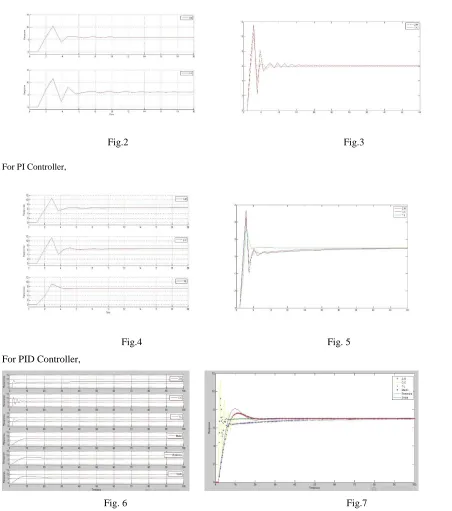
Figure 2 and 3 shows controller performance of P controller by each considered method and comparison of these
260 | P a g e
Figure 4 and 5 shows controller performance of PI controller by each considered method and comparison of thesemethod for pH system.
Figure 6 and 7 shows controller performance of PID controller by each considered method and comparison of these
method for pH system.
For P Controller,
Fig.2 Fig.3
For PI Controller,
Fig.4 Fig. 5
For PID Controller,
261 | P a g e
Time Domain Analysis [10],Controller P Controller PI Controller PID Controller
Method Z-N C-C Z-N C-C T-L Z-N C-C T-L Marlin Smith Branica
Rise Time 2.27 1.9 2.32 2.2 2.65 2.06 1.85 2.231 8 8 6.46
Settling
time
9.25 11.25 50 74.75 14.25 84.75 83.75 19.75 29.74 38.25 34.25
VI. RESULTS AND DISCUSSION
For controller tuning parameters are calculated, any one parameters is changed controller response is also changed,
optimum values of these parameters are aim to give the better response for the process. Here P/PI/PID controllers
are designed by different methods and time domain analysis shows the rise and settling time of the controller for the
process. Controller with minimum rise and settling time are shows good response and better stability for the process
to achieve desired response.
VII. CONCLUSION
P/PI/PID controllers are designed for pH neutralization system by different controller tuning methods. All methods
are worked in direction of settling the process variable to a desired set value. In P controller IAE, ISE and ITAE are
very minimum by Cohen and Coan method as compared to other controller tuning methods,this controller shows
stability but not attained proper desired value.In PI controller IAE, ISE and ITAE are very minimum by Tayrus and
Luyben method as compared to other controller tuning methods, this controller shows stability but more oscillation
in response to attain desired value. In PID controller IAE, ISE and ITAE are very minimum by Tayrus and Luyben
method as compared to other controller tuning methods. This controller shows good stability and robustness for the
process without taking more oscillation to attain desired value.
VIII. ACKNOWLEDGEMENT
The authors is very thankful to TEQUIP-II, funds available in university for providing financial support in
presenting this paper.
REFERENCES
1. McAvoy TJ, Hsu E, Lowenthals S. Dynamics of pH in controlled stirred tank reactor. Industrial Engineering Chemistry Process Design and Development. 1972; 11(1):68–70.
2. Shahian, B., & Hassul, M., Control system design using MATLAB. Englewood Cli!s,1993,NJ: Prentice Hall.
262 | P a g e
4. Seborg, Edgar, Mellichap, Doyle,Process Dynamics and control; 2011; Edition 3rd page no. 223-225. 5. Donald R. Coughanour,Process System Analysis and Control; 1991; Edition 2nd page no. 54.6. S.Sakthiya Ram, D. Dinesh Kumar and B.Meenakshipriya, Designing of PID controllers for pH Neutralization process, Indian Journal of Science and Technology, 2016;vol. 9(12).
7. O’Dwyer A. Handbook of PI and PID Controller Tuning Rules.2006; 2nd edition, World Scientific Singapore.
8. Ibrehem AS. Mathematical model for neutralization system in Stirred tank Reactor. Bulletin of Chemical Reaction Engineering Catalysis. 2011:6(11):47–52.
9. Sakthiya Ram S, Dinesh Kumar D, Meenakshipriya B. Designing of Controllers for pH Neutralization Process. International Journal for Research in Applied Science and Engineering Technology. 2015; 3(12):164–9.