A Framework to Evaluate the Impact of ICT
Usage on Collaborative Product Development
Performance in Manufacturing Firms
A thesis presented in partial fulfilment of the requirements
for the degree of
Doctor of Philosophy
in
Engineering
at Massey University, Auckland,
New Zealand.
C. W. Chathurani Silva
2017
Dedication
To my beloved
Mother
i
A
BSTRACTManufacturers are increasingly adopting collaborative product development (CPD) to achieve competitive advantage through joint synergies. Information and communication technology (ICT) is the major enabler of communication, collaboration, product designing, development, knowledge and information management, project management, and market research activities involved in CPD. Most ICT implementations incur a significant cost for firms, thus a deeper understanding of the impact of ICT usage on CPD performance would be immensely useful for managing ICT resources effectively in innovation programmes. However, existing evidence for the direct relationships between ICT usage and performance dimensions are counterintuitive (negative or insignificant). Not considering the different aspects of ICT usage was identified as a key reason for the lack of strong empirical evidence. Furthermore, the impact of ICT usage on collaboration-based product development performance and indirect impact through this collaboration performance on new product performance, as well as moderating effects of project characteristics on the direct and indirect ICT impact have largely been ignored in the literature. Therefore, drawing on relational resource-based view and organizational information processing theory, this study develops and utilizes a model including multidimensional ICT usage and CPD
performance measurements, and possible moderating project characteristics, for better
evaluating the impact of ICT usage on CPD performance.
Initially, product development professionals from manufacturing firms and knowledgeable managers from ICT vendor firms were interviewed for a preliminary qualitative evaluation of the suggested model with industry perspectives. In addition, a quantitative investigation of secondary data obtained from the PDMA’s (Product Development and Management Association) 2012 comparative performance assessment study was conducted prior to the main survey in order to assess the significance of the proposed model with a different source of data. In the final main quantitative study, data collected from 244 CPD projects via an online global survey were used to test the research hypotheses.
iii
A
CKNOWLEDGEMENTSCompletion of this doctoral thesis would not have been possible without the support of the kind people around me, to only some of whom it is possible to give a particular mention here.
First of all, I would like to express the deepest gratitude to my supervisor, Dr Sanjay Mathrani for his expert guidance, encouragement, valuable time, criticism, and correction to the thesis from the beginning up to the end of the writing. Without his vital support, timely wisdom, and advice, my thesis would not have been completed successfully. The expert advice, support, encouragement, time, and effort of my co-supervisor, Dr Nihal Jayamaha, have been invaluable throughout my study, for which I am extremely grateful. It is also acknowledged that my supervisors were the second and third authors of my publications related to the study.
I am very much indebted to the anonymous referees who reviewed the journal articles and conference papers based on my doctoral study and the conference attendees who posed important questions related to my research. All of their comments were absolutely constructive in this study.
I would extend my sincere gratitude to the University of Sri Jayewardenepura, for granting me study leave to complete this PhD and to the NCAS (National Centre for Advanced Studies in Humanities & Social Sciences) and the HETC (Higher Education for the Twenty-first Century) Project of Ministry of Higher Education, Sri Lanka for the financial assistance provided.
I would also acknowledge the financial, academic, and technical support of the School of Engineering and Advanced Technology in Massey University and its staff. The library and computer facilities of the University have been indispensable.
I am most grateful to all the managers who participated in the interviews and the product development professionals who responded to the survey, for their valuable time and generous support in providing me with data and other information, all of which has made a substantial contribution to the outcomes of my study.
I would like to place on record my sincere thanks to the Product Development and Management Association Research Foundation for providing me with the data collected in the 2012 comparative performance assessment study.
In addition, I would thank Mr Martin Watson, the professional English reviewer for his untiring support and patience in proofreading, and his suggestions regarding amendments.
Finally, I would like to express a special appreciation to my beloved husband, Sampath, who was always there as my support in those moments when there was no one to help me, and to my son, Vikum and daughter, Mindulie, for their love and patience during a really tough period of their lives.
v
T
ABLE OFC
ONTENTSAbstract ... i
Acknowledgements ...iii
List of Abbreviations ... xiii
List of Figures...xv
List of Tables ... xvii
List of Publications ... xix
1. INTRODUCTION... 1
1.1 Introduction... 1
1.2 Background to the Study ... 2
1.2.1 Research questions ... 5
1.3 Aim and Purpose of the Study ... 6
1.3.1 Theoretical basis and methodology ... 7
1.4 Significance of the Research... 9
1.5 Research Framework ... 11
1.6 Organization of the Chapters ... 12
2. PRODUCT DEVELOPMENT AND COLLABORATION... 15
2.1 Introduction... 15
2.2 Product Development Stages ... 15
2.2.1 Conceptualization phase ... 15
2.2.2 Product development phase... 16
2.2.3 Commercialization phase ... 16
2.3 Product Development Strategies ... 17
2.3.1 Concurrent engineering ... 17
2.3.2 Lean product development ... 18
2.3.3 Agile product development ... 20
2.3.4 CPD compared to other product development strategies ... 21
2.4 Collaborative Product Development ... 22
vi
2.4.1.1 Supplier collaboration ... 24
2.4.1.2 Customer collaboration ... 26
2.4.1.3 Collaborations with other external parties ... 28
2.4.2 Internal collaborations ... 28
2.4.3 Drivers of collaborative product development performance ... 32
2.4.3.1 Market orientation ... 33
2.4.3.2 Supportive innovative climate... 34
2.4.3.3 Senior management commitment ... 35
2.4.3.4 Strategy... 35
2.4.3.5 Trust ... 36
2.4.3.6 Collaborative competence ... 36
2.4.3.7 Frequent communication and information sharing ... 37
2.5 Summary ... 38
3. LITERATURE REVIEW OF RELATED WORKS... 39
3.1 Introduction... 39
3.2 Use of ICT Tools in Collaborative Product Development ... 39
3.2.1 Communication and collaboration ICT ... 40
3.2.1.1 E-mail... 40
3.2.1.2 Instant messaging ... 41
3.2.1.3 Web meetings ... 41
3.2.1.4 Video conferencing... 42
3.2.1.5 Groupware ... 42
3.2.1.6 Weblogs ... 42
3.2.2 Product design and development tools ... 43
3.2.2.1 Idea management software ... 43
3.2.2.2 Computer-aided design (CAD) and collaborative CAD ... 43
3.2.2.3 Rapid/virtual prototyping and simulation software ... 44
3.2.3 Knowledge and information management tools ... 45
3.2.3.1 Product data management (PDM) systems ... 45
3.2.3.2 Knowledge management systems ... 46
3.2.4 Project management tools ... 46
3.2.4.1 Project scheduling and tracking software ... 46
vii
3.2.4.3 Product lifecycle management (PLM) systems ... 47
3.2.5 Market research and analysis tools ... 48
3.2.5.1 Online market research tools... 48
3.2.5.2 Secondary data ... 49
3.2.5.3 Statistical software ... 49
3.3 The Impact of ICT usage on CPD Performance... 52
3.3.1 The impact of ICT usage on collaboration outcomes of CPD projects ... 53
3.3.2 The impact of ICT usage on new product quality ... 55
3.3.3 The impact of ICT usage on commercial success of a new product ... 57
3.3.4 The impact of ICT usage on time performance of a new product ... 58
3.5 Summary ... 60
4. CONCEPTUAL MODEL AND METHODOLOGY... 61
4.1 Introduction... 61
4.2 Developing a Conceptual Model to Evaluate the Impact of ICT Usage on CPD Performance ... 61
4.2.1 ICT usage ... 62
4.2.1.1 Frequency of ICT use... 63
4.2.1.2 Proficiency of ICT use ... 64
4.2.1.3 Intensity of ICT use ... 64
4.2.2 CPD performance... 65
4.2.3 Project characteristics representing the information processing requirement of CPD projects ... 67
4.2.3.1 Project uncertainty ... 68
4.2.3.2 Project complexity ... 68
4.2.3.3 Project urgency ... 69
4.2.4 Theoretical basis of the conceptual research model... 70
4.2.4.1 Relational resource-based view (RRBV) ... 70
4.2.4.2 Organizational information processing theory (OIPT) ... 72
4.2.5 The conceptual research model ... 74
4.2.5.1 Significance of the model ... 75
4.3 Research Paradigm ... 76
viii
4.3.2 Constructivism ... 78
4.3.3 Critical theory ... 78
4.3.4 Participatory worldview... 79
4.3.5 Paradigmatic stance of the study... 79
4.4 Research Design ... 81
4.4.1 Strategy of the research design ... 82
4.4.2 The mixed methods design of the research ... 82
4.5 Qualitative Study ... 84
4.5.1 Data collection and sampling ... 85
4.5.2 Validity and reliability ... 86
4.5.3 Data analysis... 87
4.6 Quantitative Studies ... 88
4.6.1 Use of secondary data... 89
4.6.2 The survey... 91
4.6.2.1 Population and the sample ... 91
4.6.2.2 Planning the online survey... 91
4.6.3 Validity of quantitative studies ... 93
4.6.3.1 Statistical conclusion validity ... 93
4.6.3.2 Internal validity ... 93
4.6.3.3 Construct validity ... 94
4.6.3.4 External validity ... 95
4.6.4 Instrument validation... 95
4.6.4.1 Face and content validity ... 95
4.6.4.2 Internal consistency reliability ... 96
4.6.5 Data analysis and interpretation... 96
4.6.5.1 Hierarchical multiple regression analysis ... 97
4.6.5.2 Partial least squares structural equation modeling (PLS-SEM) ... 98
4.7 Ethical Considerations ...100
4.8 Summary ...101
5. PRELIMINARY QUALITATIVE STUDY...105
ix
5.2 Methodology ...107
5.2.1 Sample selection ...107
5.2.1.1 M1...108
5.2.1.2 M2...110
5.2.1.3 M3...111
5.2.1.4 M4...112
5.2.1.5 M5...113
5.2.1.6 V1 ...114
5.2.1.7 V2 ...115
5.2.1.8 V3 ...115
5.2.1.9 V4 ...116
5.2.2 Collection of data ...117
5.2.3 Validity and reliability ...119
5.2.4 Data analysis...119
5.3 Results and Discussion...121
5.3.1 Selection and use of ICT for CPD programmes ...121
5.3.2 Dimensions of ICT usage...124
5.3.2.1 Frequency of ICT use...125
5.3.2.2 Proficiency of ICT use ...127
5.3.2.3 Intensity of ICT use ...129
5.3.3 Information processing requirement of CPD projects ...134
5.3.3.1 Complexity and uncertainty of a CPD project ...134
5.3.3.2 Project urgency ...136
5.3.4 Outcomes of using ICT tools in CPD projects ...139
5.3.4.1 Positive outcomes of ICT usage ...139
5.3.4.2 Barriers to the effective use of ICT in CPD programmes ...145
5.4 Conclusions and Implications for the Quantitative Study ...151
5.4.1 Improvements in the finalized research model...153
5.4.2 Limitations of the study ...154
6. PRELIMINARY QUANTITATIVE STUDY...155
6.1 Introduction...155
x
6.2.1 Theoretical basis of the study ...157
6.2.1.1 Organizational information processing theory ...157
6.2.1.2 Relational resource-based view ...158
6.2.2 The impact of ICT tools on NPD performance ...159
6.2.2.1 Market research and analysis ICT tools ...159
6.2.2.2 Product design and development ICT tools ...161
6.2.2.3 Product data, project, and portfolio management ICT tools ...163
6.2.2.4 Communication and collaboration ICT tools ...165
6.3 Methodology ...166
6.3.1 Secondary data and the sample ...166
6.3.2 Measures ...169
6.3.2.1 Common method bias ...170
6.3.3 Sample size requirements ...171
6.4 Results ...171
6.4.1 ICT usage based on technology base and primary product type ...174
6.4.2 Regression analysis ...175
6.5 Discussion and Conclusions ...179
6.5.1 Theoretical implications ...184
6.5.2 Limitations and suggestions for the final research phase ...185
7. DEVELOPMENT OF HYPOTHESES AND SURVEY INSTRUMENT...187
7.1 Introduction...187
7.2 Development of Hypothesis...187
7.2.1 Direct and indirect impact of ICT usage on CPD performance...188
7.2.2 Moderating effect of project complexity ...193
7.2.3 Moderating effect of project uncertainty ...197
7.3 Measurement Instrument Development ...201
7.4 The Survey...209
7.4.1 Sample of the study ...209
7.4.2 Common method bias ...212
xi
7.5.1 Content validity ...215
7.5.2 Reliability...215
7.5.3 Construct validity ...218
7.6 Summary ...219
8 RESULTS AND DISCUSSION OF PRIMARY DATA ANALYSIS...221
8.1 Introduction...221
8.2 Descriptive Statistics...221
8.3 Adequacy of the Sample...229
8.4 Path Analysis ...230
8.4.1 Direct and indirect impact of ICT usage ...231
8.4.2 Effects of individual ICT usage components ...236
8.4.3 Moderating effects of project complexity and uncertainty ...238
8.4.3.1 Multiple group comparison for moderating effects ...238
8.4.3.2 Product-indicator approach for testing moderating effects...241
8.4.3.3 Strength of moderating effects ...243
8.4.4 Performance of the structural model ...247
8.5 Discussion...249
8.6 Summary ...254
9. CONCLUSIONS...255
9.1 Introduction...255
9.2 Empirical Findings...255
9.2.1 Findings on research question 1...256
9.2.2 Findings on research question 2...259
9.2.3 Findings on research question 3...260
9.3 Contribution to Theory...261
9.3.1 The use of ICT in collaborative product development projects...262
9.3.2 Improved ICT usage measurement and better evaluation of ICT impact on CPD performance ...263
9.3.3 Moderating effect of project characteristics ...264
xii
9.4 Managerial Implications ...266
9.4.1 Using ICT for increasing performance of CPD projects ...266
9.4.2 Use of ICT in CPD projects with different information processing requirements....268
9.4.3 Additional implications and recommendations ...269
9.5 Limitations of the Study ...270
9.6 Suggestions for Future Research ...271
REFERENCES...273
APPENDICES...291
Appendix 4.1: Low risk notification...291
Appendix 5.1: E-mail invitation to the interview participants...292
Appendix 5.2: Information sheet of the qualitative preliminary study ...293
Appendix 5.3: Interview questions ...294
Appendix 6.1: Questionnaire items and codes (Secondary data) ...296
Appendix 7.1: E-mail invitation for the survey ...298
Appendix 7.2: Online questionnaire ...299
xiii
L
IST OFA
BBREVIATIONSCAD Computer aided design
CAE Computer aided engineering
CE Concurrent engineering
CPAS Comparative performance assessment study
CPD Collaborative product development
ICT Information and communication technology
IS Information systems
NPD New product development
OIPT Organizational information processing theory
PD Product development
PDM Product data management
PDMA Product development and management association
PLM Product lifecycle management
PLS Partial least square
PPM Project and portfolio management
RRBV Relational resource-based view
xv
L
IST OFF
IGURESFigure 1.1: Research framework ... 11
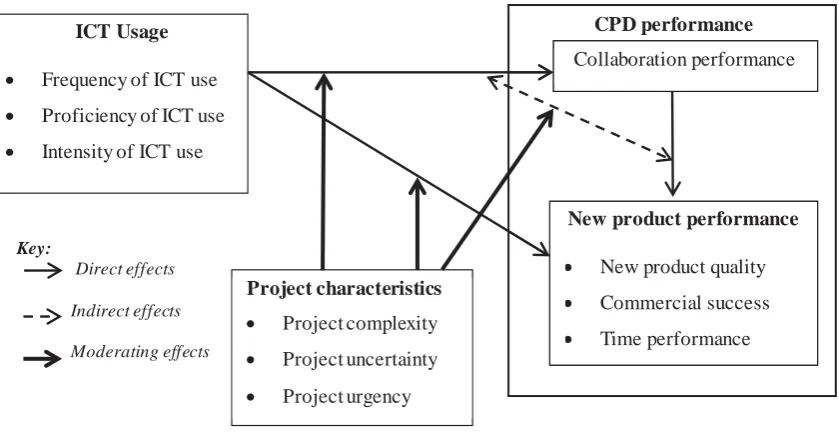
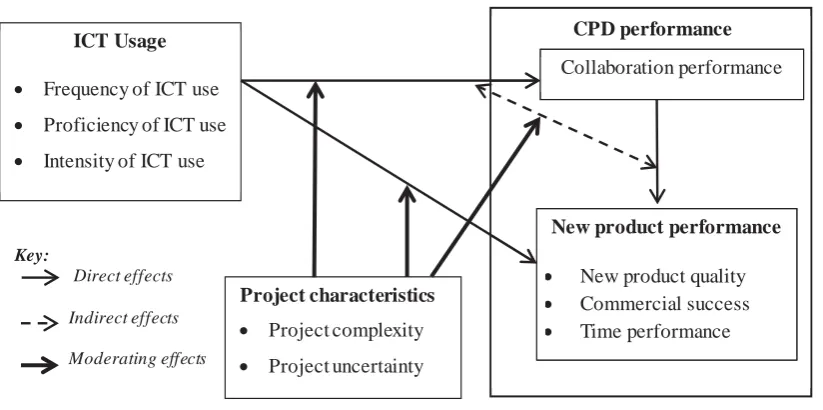
Figure 4.1: Initial conceptual model for the impact of ICT usage on CPD performance... 74
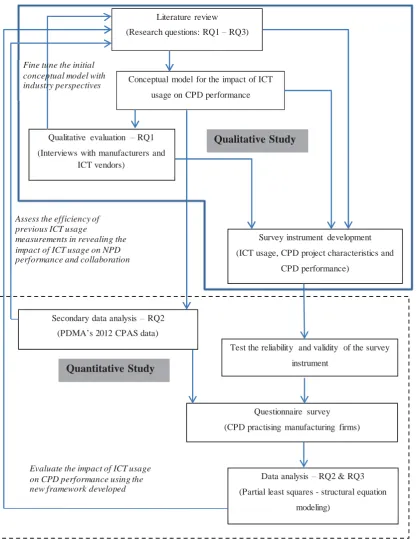
Figure 4.2: Research design ... 83
Figure 4.3: Mediator analysis... 97
Figure 4.4: The effects tested in the PLS path analysis...100
Figure 5.1: Research framework for the preliminary study ...120
Figure 5.2: Finalized framework for evaluating the impact of ICT usage on CPD performance ...153
Figure 6.1. Research model for the impact of ICT tools on overall NPD performance ...166
Figure 6.2. Interval plot of the usage of ICT tools by technology base ...174
Figure 6.3. Interval plot of the usage of ICT tools by primary product type ...175
Figure 7.1: Conceptual research model and hypotheses ...201
Figure 7.2: Industry composition of the sample ...211
Figure 7.3: Region and function of the respondents ...212
Figure 8.1: Average frequency, proficiency, and intensity of ICT use by organization size...222
Figure 8.2: Standard deviations of ICT usage components ...223
Figure 8.3: Average frequency, proficiency, and intensity of ICT usage by industry [n=244] .224 Figure 8.4: The direct effect model (excluding collaboration performance ...232
Figure 8.5: Full path model...233
Figure 8.6: Path model excluding the moderating effect of project complexity ...244
xvii
L
IST OFT
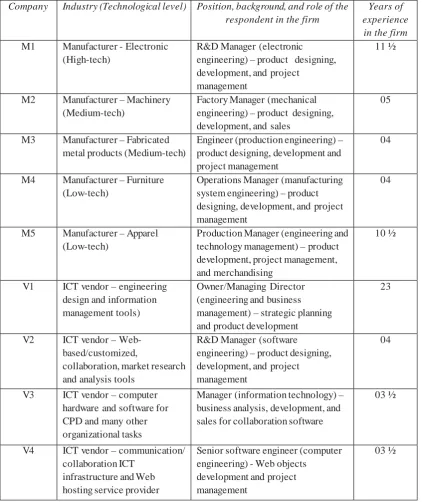
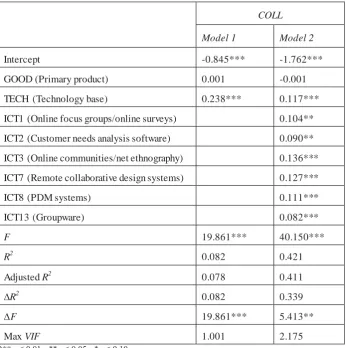
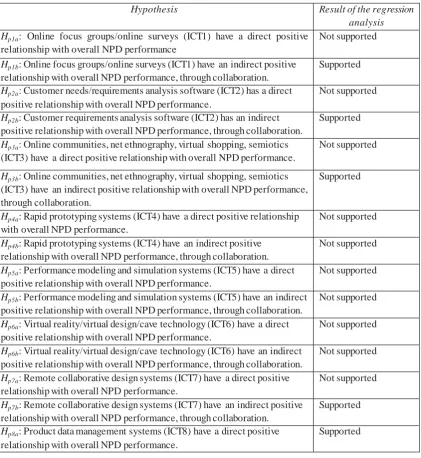
ABLESTable 2.1: Benefits and risks of different types of collaborations in product development ... 31 Table 3.1: Types of ICT tools used in collaborative product development ... 51 Table 4.1: Methods applied throughout the study ...102 Table 5.1: Details of the sample ...118 Table 5.2: Key findings on selection and use of ICT tools in manufacturing firms ...124 Table 5.3: ICT usage dimensions based on industry perspectives and literature evidence ...132 Table 5.4: CPD project characteristics representing the information processing requirement ..138 Table 5.5: Positive outcomes expected from ICT use in collaborative product development ...143 Table 5.6: Barriers to the effective use of ICT tools in CPD projects ...150 Table 6.1: Country distribution of the sample...167 Table 6.2: Industry distribution of the sample (secondary) ...168 Table 6.3: Composition of the sample (secondary) based on technology base and primary product...168 Table 6.4: Principal component analysis 1 ...169 Table 6.5: Principal component analysis 2 ...170 Table 6.6: Descriptive statistics and Pearson correlations of the variables ...173 Table 6.7. Hierarchical regression model estimation for overall NPD performance ...176 Table 6.8: Hierarchical regression model estimation for NPD collaboration ...177 Table 6.9: Results of the hypothesis tests (preliminary quantitative study) ...178 Table 6.10: Descriptive statistics of ICT use in firms with high/low overall NPD performance ...182 Table 7.1: Hypotheses of the main study ...200 Table 7.2: Measurement instrument for evaluating the impact of ICT usage on CPD
xviii
Table 8.5: Sample size requirements ...230 Table 8.6: Sobel mediation test results...234 Table 8.7 Results of the hypothesis tests (direct and indirect effects) ...235 Table 8.8 Indirect effects of frequency, proficiency, and intensity of ICT use...236 Table 8.9 Correlations between ICT usage items and CPD performance dimensions...237 Table 8.10: Grouping based on medians of latent constructs for project characteristics ...239 Table 8.11: Multiple group comparison for the moderating effect of project complexity ...240 Table 8.12: Multiple group comparison for the moderating effect of project uncertainty ...240 Table 8.13: Results of the moderator analysis (product-indicator approach) ...242 Table 8.14: Strength of the moderating effect of project complexity ...245 Table 8.15: Strength of the moderating effect of project uncertainty ...245 Table 8.16: Structural model evaluation ...248
xix
L
IST OFP
UBLICATIONS1. Silva, C., Mathrani, S., Jayamaha, N., (2016). The Impact of ICT Usage on Collaborative
Product Innovation Performance. International Journal of Innovation Management, 20(5).
2. Silva, C., Mathrani, S., & Jayamaha, N. (2014). The role of ICT in collaborative product
development: A conceptual model based on information processing theory. International
Journal of Innovation, Management and Technology, 5(1), 43-49.
3. Silva, C., Mathrani, S., Jayamaha, N. (March, 2016). The Impact of ICT Usage on
Collaborative Product Development Performance: A Conceptual Model and Industry
Perspective. Proceedings of the 2016 International Conference on Industrial Engineering
and Operations Management, Kuala Lumpur, Malaysia.
4. Silva, C., Mathrani, S., Jayamaha, N., (Dec., 2015). The Impact of ICT Usage on
Collaborative Product Innovation Performance. Proceedings of the ISPIM (International
Society for Professional Innovation Management) Innovation Summit, Brisbane, Australia.
5. Silva, C., Mathrani, S., Jayamaha, N., (Nov., 2015). Testing Moderating Effects with
Higher-order Constructs in PLS. Presented atJoint Conference of the NZ Statistical
Association and Operations Research Society of NZ. Christchurch, New Zealand.
6. Silva, C., Mathrani, S., Jayamaha, N., (Dec., 2014). The Impact of IT Usage on
Collaborative New Product Development Performance. Proceedings of the 25th
Australasian Conference on Information Systems. Auckland, New Zealand.
7. Silva, C., Mathrani, S., Jayamaha, N., (Nov., 2014). FIMIX-PLS Approach for Organization
Classification in Innovation Management Research. Presented atJoint Conference of the NZ
Statistical Association and Operations Research Society of NZ. Wellington, New Zealand.
8. Silva, C., Mathrani, S., & Jayamaha, N. (Mar., 2014). The role of ICT in collaborative
product development: A conceptual model based on information processing theory.
Presented at Journal Conference on Innovation Management and Technology. Penang,
Malaysia.
9. Silva, C., Mathrani, S., & Jayamaha, N. (Jul., 2013). A framework to evaluate the impact of
ICT usage on collaborative product development performance. Proceedings of the 4th
1
1. Introduction
1.1
I
NTRODUCTIONInnovation has become a necessity for existence in today’s industrial business
environment. The success of manufacturing companies mainly depends upon their
ability to introduce new or improved products to the market speedily and at a relatively
low cost. Organizations are keen to identify appropriate structural mechanisms and
strategies to facilitate the generation of successful new products. Promising ideas and
the expertise required to develop new products may be present with a company’s
stakeholders such as suppliers, customers, competitors, or staff. Developing new or
improved products by joining complementary resources and experience of one or more
external (e.g. suppliers and customers) and/or internal partners (cross-functional teams)
with mutual goals is known as collaborative product development (CPD) (Büyüközkan
& Arsenyan, 2012).
Information and communication technologies (ICTs), including tools for face-to-face
communication, provide the key media for processing required information and
facilitating communication between CPD partners &XUúHX 6FKDON :HVVHO
Montoya, Massey, Hung, & Crisp, 2009). Real time communication, concurrent
operations, and increased information access facilitated by intensive use of ICT help
firms to overcome social, technical and organizational barriers against CPD (Boutellier,
Gassmann, Macho, & Roux, 1998; Swink, 2006). However, the increased use of ICT
tools incurs significant costs to companies. The effectiveness of using ICT tools in CPD
projects may vary depending on the requirement for processing information, determined
by the characteristics of the projects. However, access to product-related information
sometimes leads to issues such as leakage of proprietary knowledge and loss of control
over the product development process (Hoecht & Trott, 2006; Littler, Leverick, &
Bruce, 1995). Therefore, adjusting the extent of communication and exchanging
information via ICTs based on the requirements of CPD are vital for project success
while these are quite challenging (Boutellier et al., 1998; Hoegl, 2005).
ICT impact on project performance can be direct as well as indirect through
collaboration or collaboration outcomes such as knowledge-sharing (Banker, Bardhan,
2
previous studies in relation to: evaluating the impact of ICT usage or degree of using
ICT tools on a new product’s quality, time performance, and commercial success, and
understanding the factors mediating and moderating these effects. Uncovering a detailed
picture of the impact of ICT usage on collaborative product development performance
could fill in existing gaps in the literature. Therefore, this study adopts more informative
ICT usage evaluation criteria, broad CPD performance outcomes, and project
characteristics that could moderate the association between ICT usage and CPD
performance. The study uses qualitative (interviews) and quantitative (secondary and
primary) data to explore the current context of using ICT in CPD projects and to
examine the direct, indirect, and moderated impact of ICT usage on CPD performance.
1.2
B
ACKGROUND TO THES
TUDYCollaboration may occur at any of the product development stages, namely,
conceptualization, development, and commercialization. Conceptualization is the stage
where a series of strategic planning and analysing activities are carried out in order to
finalize the conceptual design. These concepts are transformed into physical products in
the development stage (Song, Thieme, & Xie, 1998). After testing the physical usability
of the new product via prototypes, it is tested for manufacturing feasibility. Products
passing all design and development stages successfully are then launched or introduced
to the market in the commercialization stage. CPD enables firms to bring valuable
technological and market knowledge to the new product from various sources including
product or collaborative experts (Littler et al., 1995; Parker 2000). Therefore, CPD
becomes a process in which firms gain benefits such as high quality, shorter times to
market, and low cost to manufacturers (Mathrani & Liu, 2015; Swink, 2006).
Firms integrate or collaborate with external partners (e.g. suppliers, customers) and
internal cross-functional teams at varying levels depending on organizational,
environmental, or project-related factors. However, firms possessing differing levels of
ability to collaborate with external and internal parties realize different levels of project
and market performance (Mishra & Shah, 2009). At any level of collaboration,
communication between partners and exchange of quality and timely information are
vital for determining the degree of collaborative competence (Paulraj, Lado, & Chen,
2008; Sivadas & Dwyer, 2000). Face-to-face communication has been recognized as the
3
(Badrinarayanan & Arnett, 2008). However, as the number of virtually involved
partners increases, CPD teams find less opportunity to meet face-to-face and tend to rely
largely on information and communication technologies (Dube & Pare, 2004;
Lockwood, Montoya, & Massey, 2013). ICT allows integrating more partners in CPD
projects through efficient processing and communication of large volumes of
information. Therefore, particularly in dispersed CPD projects, ICT becomes the main
platform for communication, knowledge transfer, and work synchronization.
Rapid developments in ICT make the collaborative product development processes
more complex to manage. As a result, technical (e.g. Lee, 2012; Luh, Pan, & Chu, 2011;
Sun, Fan, Shen, & Xiao, 2012) and methodological (Arsenyan & Büyüközkan, 2012;
Camarinha-Matos, Afsarmanesh, Galeano, & Molina, 2009) advancements to existing
ICT in support of CPD are increasingly evident. However, heavy dependence on ICT
itself may also cause some issues such as difficulty to change patterns of use (Montoya
et al., 2009) and unnecessary leakage of commercially sensitive information (Hoecht &
Trott, 2006). Past research has evaluated the usage of different ICT tools in
collaborative product development projects (e.g. de Grosbois, Kumar, & Kumar, 2012;
Markham & Lee, 2013). Some of these studies explored ICT usage based on the
characteristics of CPD projects (e.g. Corso & Paolucci, 2001; de Grosbois et al., 2012).
Very little research has focused on evaluating the frequency (Montoya et al., 2009) and
proficiency (Chen, Tsou, & Huang, 2009) of ICT use and utilization of the
functionalities of the tools (Kern & Kersten, 2007) in CPD programmes. However, the
criteria of manufacturers for selecting ICT tools for CPD programmes, the importance
of different ICT usage aspects (e.g. frequency, proficiency, and intensity), the positive
outcomes of using ICT in CPD, and the barriers to achieving these outcomes have not
been sufficiently explored in the literature.
The impact of ICT usage on CPD project performance has been discussed previously in
product innovation research. Most of the studies focused on the impact of one (Banker,
Bardhan, & Asdemir, 2006) or several individual ICT tools (Durmusoglu & Barczak,
2011; Peng, Heim, & Mallick, 2014) while very few discussed overall ICT usage
(Barczak, Sultan, & Hultink, 2007). Research on the ICT-CPD performance relationship
has mainly evaluated the direct effect of ICT usage on final project success associated
with quality, financial, or time performance (e.g. Barczak et al., 2007; Durmusoglu &
4
performance aspects (e.g. speed-to-market). Operationalizing ICT usage as the number
of tools used in a project (or a project phase) is a major inadequacy found in most
empirical investigations (e.g. Barczak et al., 2007; Durmusoglu & Barczak, 2011). The
fundamental reason seems to be the difficulty of estimating the actual usage of different
ICT tools in a selected CPD project or phase. Fichman (2001) emphasized that
multidimensional measurement of ICT usage leads to a clearer exploration of the role of
these tools in innovation. Some researchers have suggested the use of additional
dimensions of ICT usage such as communication frequency and proficiency of use in
order to reveal a more detailed picture of the effect of ICT on project performance
(Durmusoglu & Barczak, 2011; Thomas, 2013). Recently, Kawakami, Barczak, and
Durmusoglu (2015) uncovered a positive effect of frequency of ICT use on NPD task
proficiency which in turn improves NPD performance.
Research suggesting both a direct and an indirect impact of ICT usage on new product
performance is rare to find in the literature. For example, Banker et al. (2006) found that
PLM systems have an indirect impact on project performance through collaboration. In
a study, Peng et al. (2014) found that communication and collaboration tools such as
e-mail and groupware and product data and knowledge management tools do not
significantly support collaboration between partners, while project management tools
support this in low complex projects. However, these researchers did not examine the
ICT usage-CPD performance association or the mediating effect of collaboration.
Thomas (2013) found that e-mail supports knowledge exchange in CPD, which in turn
increases project performance, to a greater extent than rich communication media such
as video conferencing and Web meetings. Although knowledge exchange is a basic
element of collaboration, no study focusing on the direct ICT impact on the
collaboration process performance comprising all of its key elements (e.g.
knowledge/information sharing, benefits sharing, risks sharing, and trust creation)
(Büyüközkan & Arsenyan, 2012; Camarinha-Matos et al., 2009) or indirect impact
through all these elements on new product performance was found in the literature.
Essentially, CPD performance representing the degree of success in achieving both
collaboration performance and new product performance has not been adequately
addressed in previous research focusing on the impact of ICT usage.
Since ICT tools incur substantial costs to companies and intensive use of these tools
5
meet the information processing requirements of CPD projects would be worthwhile.
Recent research has highlighted the need to investigate factors moderating the
effectiveness of ICT usage, which may help in the proper management of ICT in CPD
programmes (Durmusoglu & Barczak, 2011; Thomas, 2013). Project characteristics
such as complexity, uncertainty, and urgency represent the degree of the information
processing requirement in CPD projects (Heim, Mallick, & Peng, 2012; Peng et al.,
2014; Veldhuizen, Hultink, & Griffin, 2006). However, very few studies addressing the
relationship between ICT usage and CPD performance have examined the moderating
effect of such project characteristics on this association. For example, Peng et al. (2014)
studied the moderating effect of project complexity on the association between several
ICT tools and NPD collaboration. Their study revealed that the associations are
relatively strong when products are large, and weak when the project is novel and the
interdependence of tasks is high. However, no empirical evidence for the moderating
effects on the direct association between ICT usage and new product performance
dimensions (e.g. quality, time, and financial success) or indirect association through
collaboration-based performance was found.
In conclusion, four major gaps were identified in the existing literature. Prior studies
addressing the impact of ICT usage on CPD performance have (1) not sufficiently
explored the importance of multidimensional aspects of overall ICT usage in improving
CPD programmes in manufacturing firms; (2) not incorporated CPD performance
reflecting both final project performance and collaboration performance; (3) observed
several inconclusive evidence for the association between ICT usage and CPD
performance aspects; (4) paid little attention to the moderating effect of project
characteristics on the direct and indirect associations between ICT usage and new
product outcomes resulting from collaboration outcomes.
1.2.1 Research questions
In order to fill the gaps identified in the review of background literature, the following
research questions were formulated to be answered in this study:
(1) How do manufacturing firms manage ICT usage in terms of frequency, proficiency,
and intensity, for improving their collaborative product development activities?
6
(3) Do the project characteristics representing the information processing requirement
in CPD projects significantly moderate the relationship between ICT usage and CPD
performance?
These research questions have been addressed in different phases of the research as
explained in section 1.3.1.
1.3
A
IM ANDP
URPOSE OF THES
TUDYThe primary objective of this study is to explore a comprehensive view of the impact of
ICT usage on collaborative product development performance. Little empirical evidence
available in respect of the direct effect of ICT usage on project outcomes (Barczak et
al., 2007; Kawakami et al., 2015) and collaboration (Peng et al., 2014), and the indirect
effect through collaboration (Banker et al., 2006) on project outcomes are the main
reasons for this investigation. Several scholars have suggested the importance of
adopting a multi-dimensional ICT usage measurement for better revealing ICT impact
(Chen et al., 2009; Durmusoglu & Barczak, 2011; Fichman, 2001). Therefore, this study
incorporates three dimensions of ICT usage (frequency, proficiency, and intensity of
use) and collaborative product development performance as a means to attain the above
objective. In addition to the performance criteria used in previous studies (quality, time,
and/or commercial success) (e.g. Barczak et al., 2007; Durmusoglu & Barczak, 2011;
Kawakami et al., 2015), this study incorporates collaboration performance that reflects
the degree of achieving inter-firm relational-based outcomes of CPD (Büyüközkan &
Arsenyan, 2012; Cousins & Lawson, 2007) rather than NPD collaboration (Banker et
al., 2006; Peng et al., 2014). Hence, the CPD performance defined in this study
represents the degree to which a product development project achieved its new product
performance in terms of quality, commercial success, and time as well as collaboration
performance.
Furthermore, the study aims to uncover the moderating effect of project characteristics
on the relationship between ICT usage and collaborative product development
performance. Previously, researchers have highlighted the need for understanding how
the impact of ICT usage on the performance of product development projects varies
based on factors that affect the information processing requirement of the projects (e.g.
Thomas, 2013). Understanding these effects in relation to different dimensions of CPD
7
success of collaborative product development projects. However, existing knowledge on
such moderating effects is extremely poor (e.g. Peng et al., 2014).
The theoretical support for achieving the research objectives and the methodology
adopted in each research phase are briefly explained in the following section.
1.3.1 Theoretical basis and methodology
CPD is a business activity that involves several networked firms aiming for the success
of a collective product innovation effort. The relational resource-based view (RRBV)
argues that collaborative firms can achieve competitive advantage through
relation-specific assets, effective governance, knowledge-sharing routines, and complementary
resources and capabilities. It stimulates understanding that the intangible resources such
as knowledge and trust shared by collaborative firms support achieving a sustainable
competitive advantage (Dyer & Singh, 1998; Lavie, 2006). Drawing on this theory, the
current study suggests that the effective use of ICT positively impacts on both product
development and the collaboration processes of CPD and helps manufacturing firms to
improve both tangible (e.g. profits) and intangible (e.g. knowledge-sharing) CPD
outcomes. The RRBV supports theorizing both the direct and indirect effects of ICT
usage on new product performance, through collaboration performance.
According to the organizational information processing theory (OIPT), the information
processing capability of a firm needs the right balance with the information processing
requirement of the tasks performed by the firm, in order to achieve higher
organizational performance (Daft & Lengel, 1986; Galbraith, 1984). Since ICT is the
key means for communication, collaboration, and product development in CPD, its
usage in terms of frequency, proficiency, and intensity reflects the information
processing capability of firms undertaking CPD projects. A CPD project’s information
requirement may depend on the degree of complexity, uncertainty, and urgency of the
project. Therefore, drawing on OIPT, this study argues that ICT usage has varied effects
on CPD performance for different levels of project characteristics that represent the
information processing requirement of the projects.
First, the study developed and utilized a model for evaluating the impact of ICT usage
on CPD performance based on RRBV, OIPT, and reviews of the literature. Second, it
8
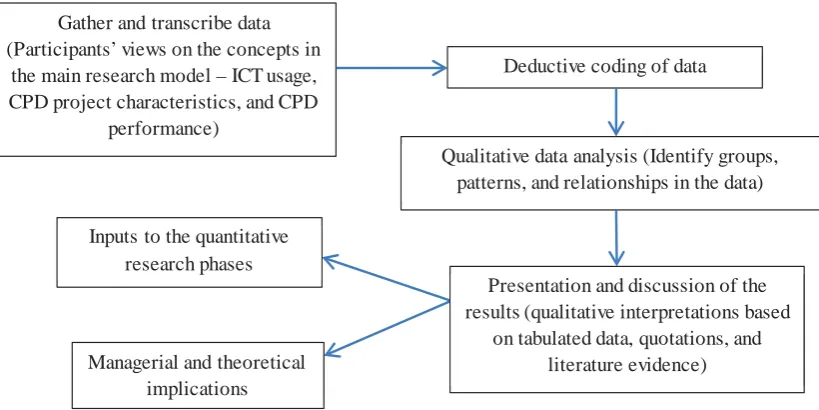
analysed the data using directed qualitative content analysis. The findings offered
industrial evidence for the effectiveness of managing ICT usage in improving CPD
programmes, and identified barriers to the effective use of ICT in CPD. This answered
the first research question and helped the examining and fine-tuning of the initial
conceptual model which contained several new constructs (e.g. collaboration
performance and intensity of ICT use) with practitioners’ perspectives.
Next, secondary data obtained from the 2012 NPD best practices survey (i.e.
Comparative Performance Assessment Study or CPAS) conducted by the Product
Development and Management Association (PDMA) were analysed using the
hierarchical multiple regression approach. This preliminary study answered the second
research question and evaluated the impact of ICT usage, with a different source of data.
This analysis was important for studying the capability of previously used ICT
measurement criteria in revealing the impact of ICT usage and to justify the importance
of a multi-dimensional measurement (frequency, proficiency, and intensity of ICT use)
proposed in the present study. In the final stage, an online survey on globally operated
CPD projects was conducted to investigate the conceptualized direct, indirect, and
moderated effects of ICT usage on CPD performance. The empirical data were analysed
using partial least square structural equation modeling (PLS-SEM), and the results were
discussed providing deeper insights into the impact of ICT usage on CPD performance.
This answered the second and third research questions concerning all direct, indirect
and moderated effects of ICT usage on collaborative product development performance.
In summary, the main stages of the study and the key methods adopted in each stage are
as follows.
1. Preliminary qualitative study for exploring the industrial perspective on the
initial conceptual research model and finalizing it for evaluation in the final
quantitative research phase. Methods – interviews (data collection) and directed
qualitative content analysis (data analysis).
2. Preliminary quantitative study for an initial evaluation of the impact of ICT
usage on CPD performance and for identifying industry sector(s) to be focused
upon in the main questionnaire survey. Methods – secondary data from
PDMA’s 2012 CPAS (data collection) and hierarchical regression (data
9
3. Main survey for evaluating the impact of ICT usage on CPD performance and
moderating effects of project characteristics on this impact. Methods – online
survey (data collection) and PLS-based structural equation modeling (data
analysis).
1.4
S
IGNIFICANCE OF THER
ESEARCHThis research significantly contributes to the extension of theory and the understanding
of CPD practitioners towards using ICT tools for improving the performance of
collaborative product development projects. Adopting the RRBV and OIPT for
evaluating the impact of ICT usage on collaborative product development performance
extends these theories while reflecting their usefulness in studying technology-related
themes in contemporary business environments. Since the study followed a mixed
methods approach including preliminary qualitative data evaluation prior to the main
quantitative study improves the practical validity of the theoretical model investigated
and the findings. The use of secondary data obtained from a proper source (PDMA
Research Foundation) effectively demonstrates the usefulness of the informative ICT
usage measurement and CPD performance (adopted in the primary survey) for
uncovering the impact of ICT usage with increased accuracy. Use of appropriate
theoretical perspectives, different methodologies and sources of data, and suitable
reliability and validity procedures, establishes the rigour of the research and increases
the generalizability of the findings.
Empirical evidence for the impact of ICT usage in terms of frequency, proficiency, and
intensity extend the literature on the impact of ICT usage on CPD performance (e.g.
Barczak et al., 2007; Durmusoglu & Barczak, 2011; Kawakami et al., 2015). This adds
new knowledge on the value of different aspects of ICT usage in manufacturing sector’s
CPD projects. Revealing the direct and indirect effects of overall ICT usage on new
product performance (quality, time, and commercial success) through collaboration
performance extends prior studies (Peng et al., 2014) addressing the impact of several
ICT tools on PD collaboration. The investigated moderating effects of project
characteristics on the relationship between overall ICT usage and CPD performance
significantly extend existing literature on the direct and indirect effects of individual
ICT tools on PD performance (Banker et al., 2006; Thomas, 2013), and contribute to the
10
Improved understanding of the ICT impact on new product quality, commercial success,
and time performance inform CPD practitioners about the ability of ICT tools to offer
required facilities for achieving a project’s performance objectives. Effects related to the
impact on collaboration performance leads to exploration of the value of ICT in
realizing intangible CPD outcomes such as knowledge-sharing and trust creation, which
are also important in order to reach higher project performance. In addition, positive
outcomes of ICT usage and barriers for the effective use of ICT in manufacturing
collaborative product development projects provide insights to practitioners, which will
11
1.5
R
ESEARCHF
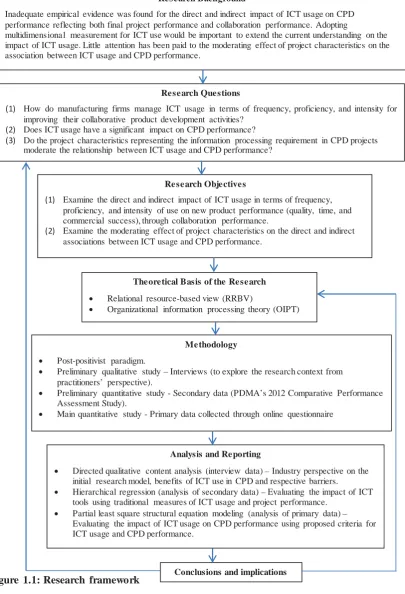
RAMEWORKFigure 1.1 illustrates the research framework or outline of the study including all the
[image:36.595.124.530.156.751.2]key steps followed by the research.
Figure 1.1: Research framework
Research Background
Inadequate empirical evidence was found for the direct and indirect impact of ICT usage on CPD performance reflecting both final project performance and collaboration performance. Adopting
multidimensional measurement for ICT use would be important to extend the current understanding on the impact of ICT usage. Little attention has been paid to the moderating effect of project characteristics on the association between ICT usage and CPD performance.
Research Questions
(1) How do manufacturing firms manage ICT usage in terms of frequency, proficiency, and intensity for
improving their collaborative product development activities?
(2) Does ICT usage have a significant impact on CPD performance?
(3) Do the project characteristics representing the information processing requirement in CPD projects
moderate the relationship between ICT usage and CPD performance?
Research Objectives
(1) Examine the direct and indirect impact of ICT usage in terms of frequency,
proficiency, and intensity of use on new product performance (quality, time, and commercial success), through collaboration performance.
(2) Examine the moderating effect of project characteristics on the direct and indirect
associations between ICT usage and CPD performance.
Theoretical Basis of the Research
x Relational resource-based view (RRBV)
x Organizational information processing theory (OIPT)
Methodology
x Post-positivist paradigm.
x Preliminary qualitative study – Interviews (to explore the research context from
practitioners’ perspective).
x Preliminary quantitative study - Secondary data (PDMA’s 2012 Comparative Performance
Assessment Study).
x Main quantitative study - Primary data collected through online questionnaire
Analysis and Reporting
x Directed qualitative content analysis (interview data) – Industry perspective on the
initial research model, benefits of ICT use in CPD and respective barriers.
x Hierarchical regression (analysis of secondary data) – Evaluating the impact of ICT
tools using traditional measures of ICT usage and project performance.
x Partial least square structural equation modeling (analysis of primary data) –
Evaluating the impact of ICT usage on CPD performance using proposed criteria for ICT usage and CPD performance.
12
1.6
O
RGANIZATION OF THEC
HAPTERSThe rest of the chapters in the thesis are organised as follows.
Chapter 2 (Product Development and Collaboration) presents a broad review of
background literature related to collaborative product development and related concepts.
Stages of product the development process, PD strategies including collaborative
product development, and drivers of CPD performance are discussed.
Chapter 3 (Literature Review of Related works) reviews background literature related
to the specific area of study. Based on the existing literature for the impact of ICT usage
on collaborative product development performance, it identifies the key gaps to be
addressed in the study.
Chapter 4 (Conceptual Model and Methodology)describes the research model and the
complete methodology applied throughout the study. First, it develops an initial
conceptual model for understanding the impact of ICT usage on collaborative product
development performance. Next, the research paradigm, research design, the specific
methodologies followed in qualitative and quantitative phases of the research, and
justifications for selecting the methods, are explained. This includes relevant technical
details on the procedures, strategies, and techniques used in selection of the samples,
data collections, and data analyses.
Chapter 5 (Preliminary Qualitative Study) presents the qualitative study conducted
prior to the main quantitative study (survey). First, it explains the importance of
answering the first research question through a qualitative investigation. Second, the
chapter briefly explains the methodology followed in the qualitative study including
introductions to the firms selected. Next, the findings of the study are presented,
discussed, and compared with relevant literature. Finally, a simplified version of the
conceptual research model (to be tested in the final quantitative research phase) is
presented along with conclusions and limitations of the study.
Chapter 6 (Preliminary Quantitative Study) presents the quantitative study conducted
based on the secondary data obtained from the PDMA’s 2012 comparative performance
assessment study. First, it presents the research model (which has the same theoretical
basis as the main study) and hypotheses of the preliminary study. Second, the
13
explained. Next, results of the data analysis are presented followed by a detailed
discussion. This analysis partially addresses the second research question of the study
based on availability of data in the secondary source. In the last section, theoretical
implications and limitations of the preliminary quantitative study and suggestions for
the final research phase are explained.
Chapter 7 (Development of Hypotheses and Survey Instrument)includes details about
operationalization of the constructs of the conceptual model (the finalized model in the
qualitative preliminary study), development of the hypotheses, structure of the sample
obtained, and validation of the survey instrument.
Chapter 8 (Results and Discussion of Primary Data Analysis) presents results of the
statistical analysis on primary data collected by the online survey. First, it presents
descriptive statistics on the survey variables and their respective interpretations. Then,
results of the PLS analysis performed for testing the hypotheses developed in Chapter 7
are presented followed by a discussion including possible explanations for the
relationships revealed. This main quantitative research phase addresses the second and
third research questions of the study.
Chapter 9 (Conclusions) presents the overall conclusions of the study mainly based on the findings of the preliminary qualitative and final quantitative (survey) research
phases that address the research questions with the central research model developed in
the study. In addition, the theoretical contribution and managerial implications of the
findings are presented. Finally, the chapter discusses the limitations of the study and
15
2. Product Development and Collaboration
2.1
I
NTRODUCTIONThis review provides the broad background literature related to the area of study. First,
this chapter introduces the product development process and the activities involved in
the major phases of the process. Second, it describes prominent strategies including
CPD deployed by manufacturing firms in their new product development projects. This
review highlights how CPD enables the practising of the principles of other strategies in
product development, such as concurrent engineering and agile product development.
Next, the chapter elaborates on the collaborative product development concept, the main
focus of the study. Finally, this chapter identifies the drivers of CPD performance,
namely, market orientation, supportive innovative climate, senior management
commitment, strategy, trust, collaborative competence, and information sharing, and
highlights the importance of ICT in information sharing.
2.2
P
RODUCTD
EVELOPMENTS
TAGESThe product development (PD) process comprises various planning, assessment, and
development activities associated with introducing a new or improved product to the
market. The following sections broadly describe the activities involved in the key stages
of the process – idea generation or conceptualization, product development, and
commercialization.
2.2.1 Conceptualization phase
The period before the actual development of a product occurs is the conceptualization or
pre-development phase. All PD activities, from opportunity identification to concept
definition, are covered in this stage. It includes front-end activities, namely: initial
screening, preliminary market assessment, preliminary technical assessment, the
detailed market study, market research, the voice of customer research, and the business
and financial analysis (Cooper, 2013). Due to potential market, technological,
environmental uncertainties and decision making complexities, this phase has been
identified as the fuzzy front end (Achiche, Appio, McAloone, & Di Minin, 2012;
Barczak, Hultink, & Sultan, 2008; Reid & De Brentani, 2004). Sound predevelopment
16
development process and ensures a high likelihood of success with the new product
(Cooper, 2013).
2.2.2 Product development phase
The actual development of the physical product or implementation of the development
plan prepared in the predevelopment phase is carried out in this stage (Cooper, 2001). In
addition to the technical work, parallel marketing and operational activities are also
undertaken. After developing the lab-tested physical prototype of the product, external
validation of the product and project is carried out in order to ensure the consistency of
the developed product with the original definition specified in the previous stage. A
strong tendency to integrate with internal cross-functional teams and external partners
such as suppliers and customers is observed during this stage due to the requirement of
finalizing product, process, and information systems decisions (Bonaccorsi & Lipparini,
'XUPXúR÷OX %DUF]DN3HWHUVHQ+DQGILHOG 5DJDW] .
2.2.3 Commercialization phase
Launch or commercialization is the stage where the new product is made available to
the market and is the penultimate stage in the NPD process, followed only by the
post-launch evaluation (Hart & Tzokas, 2010). A well-integrated, properly targeted post-launch is
extremely important to earn profits on the new product (Cooper, 2013). The quality in
product availability, pricing, promotions, advertising, and product distribution
determine the quality of product launch phase that is critical for the final performance of
the new product (Song, Song, & Benedetto, 2011). Product launch strategy and the
timing of the launch have been largely discussed in the literature (Calantone &
Benedetto, 2012; Talke & Hultink, 2010). According to Hultink, Griffin, Hart, and
Robben (1997), the proper combination of strategic and tactical product launch
decisions is important for increasing new product performance. Collaborative
decision-making starting from the early product development phases is a highly significant
strategic activity for successful commercialization (Di Benedetto, 1999; Snow,
17
2.3
P
RODUCTD
EVELOPMENTS
TRATEGIESAll models structuring the product development process directly or indirectly underlie
the concept that proper management of the product development process is a key to
increasing an organization’s innovation profits. Since the innovative capability of
manufacturers is substantially responsible for their business success, organizations
nowadays search, experiment, and practise various strategies for new product
development. Concurrent engineering (CE), lean product development (LPD), agile
product development, and collaborative product development are such strategies.
2.3.1 Concurrent engineering
Typically, the main concern of product designers is to increase products’ performance
and functionality without giving much consideration to process design and/or
manufacturing constraints. Conventional sequential performance of product
development activities does not allow manufacturing organizations to avoid this
problem (Jo, Parsaei, & Sullivan, 1993; Parsaei & Sullivan, 2012). Concurrent
engineering (CE) integrates engineering activities involved in designing products and
related processes. These activities are performed in parallel rather than in sequence and,
therefore, CE is also called simultaneous engineering. A number of scholars have
stressed the importance of adopting the CE concept in NPD (e.g. Hambali, Sapuan,
Ismail, Nukman, & Karim, 2009; Lawson & Karandikar, 1994; Suk-Ki &
Schniederjans, 2000). CE supports reducing new products’ uncertainty caused by
technology and market changes (Koufteros, Vonderembse, & Doll, 2001; Meybodi,
2013). It is a significant strategy which enables new products to reach the market in less
time through reduced development lead time (Smith & Eppinger, 1998; Wu, Kefan,
Gang, & Ping, 2010). As a result of the parallel completion of tasks, CE raises
productivity and minimizes waste in the design and production processes. Valle and
Vázquez-Bustelo (2009) found that the effectiveness of the CE practices depends on the
context of the NPD project. According to their study, CE provides better NPD results in
terms of development time and quality when it is applied in incremental innovations
rather than radical innovations. Effective communication and systematic involvement of
customers, suppliers, distributors, and powerful information infrastructure, as well as
18
product development and manufacturing is carried out in different sites that are often
geographically dispersed across countries (Abdalla, 1999).
Set-based concurrent engineering (SBCE) is the strategy used by Toyota which has
become the most successful in creating shortest development and manufacturing cycle
times in the vehicle industry (Khan et al., 2011; Sobek, Ward, & Liker, 1999). In
traditional point-based CE, a solution point in the solution space is modified until it
meets the design objectives. The success of this method largely depends on the
goodness of the initially selected solution. In contrast, SBCE begins with broadly
considering sets of possible solutions and gradually narrows these possibilities to
converge on a final solution. Relative to point-based CE, SBCE takes more time in the
early stages to define solutions but less time for converging on a final solution.
According to Al-Ashaab et al. (2013), SBCE provides the following advantages over
the traditional approach: less rework in later design stages, opportunity to select the best
out of all alternative solutions falling within the intersection of all functions involved,
and reduced risk of failure.
The engineering philosophy has recently been shifted from CE to collaborative
engineering where no single company has all the necessary knowledge for completely
designing and manufacturing competitive new products in-house. Achieving different
objectives of participant designers is possible with novel methodologies used in
collaborative engineering (Inoue, Nahm, Tanaka, & Ishikawa, 2013). A computer-based
approach is relatively more powerful and efficient than a team-based approach for
implementing CE practices, especially when collaborative team members are physically
dispersed (Parsaei & Sullivan, 2012). Advanced ICT tools have been developed to
ensure effective sharing of information and coordination in collaborative engineering.
While ICT plays a vital role in creating competitive advantage in product development
by exchanging information across design experts, CE mainly relies on human
interactions within and across design teams.
2.3.2 Lean product development
Developing more innovative new products while consuming fewer resources leads to
more profitability from new products in companies through reduced product
development costs. The application of lean concepts such as waste minimization and
19
addition, lean product development (LPD) principles and methods could provide the
means for improving knowledge transfer in product development (Lindlöf, Söderberg,
& Persson, 2012). This means making knowledge gained from the failures and
successes of previous projects readily available and accessible. Toyota, a world famous
lean practitioner, is highly successful in the transfer of product development knowledge
(Kennedy & Ward, 2003). However, practising LPD requires a proper pre-analysis of
types and causes of wastes. The most well-known reasons for product development
waste are – (1) weak planning and leadership of PD programmes, (2) lack of frequent
and compressive coordination and poor communication among internal and external
partners, (3) no utilization of the legacy of knowledge and not learning from past
mistakes, (4) excessive conservatism, bureaucracy, and compartmentalization, (5)
non-optimal use of human resources, (6) traditional focus on point designs, (7) use of
obsolete 2D drawings instead of selectively accessible 3D data, and (8) push-based
rather than pull-based specifications and requirements (Oppenheim, 2004).
According to Karlsson and Åhlström (1996), CPD characteristics such as supplier
involvement and cross-functional integration are frequently observed in lean product
development. LPD also has a strong customer focus, which makes it possible to have
high customer perceived value when a new product is being developed (Gautam &
Singh, 2008). Some scholars have introduced several new models and frameworks to
support the implementation of lean principles in product development. These recent
developments promote LPD in the manufacturing industry where there were relatively
fewer well-established LPD methodologies available. For example, Rossi, Taisch, and
Terzi (2012) developed a five-steps methodology which allows for continuous NPD
process improvement. These steps are: (1) waste identification and evaluation, (2) waste
prioritization, (3) sub-process current analysis (4) sub-process criticalities analysis, and
(5) corrective active implementation. Soares, Bastos, Gavazzo, Pereira, and Baptista
(2013) presented a reference model for lean implementation in product and process
development. Supportive organizational management, respect for people, continuous
improvement, clear, accurate and timely information flow, and value created by reduced
cost and lead time are the main components of this model. The multilevel LPD system
design framework developed by Letens, Farris, and Aken (2011) captures key LPD
20
2.3.3 Agile product development
Agility in product development ensures flexibility of the processes to modify products
as a response to changing customer needs or to improved technical solutions being
introduced (Smith, 2007). Applications of agile methods to product development
evolved mainly to quickly adopt changing customer requirements in the software
industry (e.g. Agile Manifesto, 2001). However, compared to NPD in general
manufacturing, software product development has less rework cost due to less
involvement of physical parts assembly and prototypes. According to Kettunen (2009),
this difference changes the applicability of agile principles even in embedded software
product development (e.g. where the software is a component of the final physical
product). Additionally, product design principles such as modularity and customization
in agile manufacturing are directly applicable in new software product development
agility improvement frameworks. Agile development is different from the traditional
sequential waterfall approach of software product development1 because of adapting incremental, iterative work cadences (Agile Methodology, 2008). Application of these
methods allows introducing more customized new products within a shorter
development time. Since the requirements are analysed throughout the project lifecycle,
it reduces the development cost as well. Although, agile product development concepts
are more popular in the software industry where customer-required changes are easily
adaptable during development, manufacturing sector applications to improve quality are
increasingly being introduced. For example, in a study on the pump manufacturing
industry, Vinodh et al. (2009) emphasized that, in implementing agile product
development, technology-related strategies such as CAD (computer-aided design) and
rapid prototyping are more powerful than management-related strategies such as total
quality management and 5S (a popular Japanese workplace organization method).
Thomke and Reinertsen (1998) proposed three important strategies to introduce
development flexibility required to adopt agile product development. These comprise –
(1) adopting flexible technologies (for fast and low cost design iterations), (2)
modifying management processes, and (3) leveraging design architecture (e.g. modular
designs, reduced interdependent modules). Gunasekaran (1999) presented a framework
to develop agile manufacturing systems along four major dimensions – strategies,
1