ENERGY EFFICIENCY ANALYSIS FOR THE LABORATORY COMPLEX
LEE JIA YI
ENERGY EFFICIENCY ANALYSIS FOR THE LABORATORY COMPLEX
LEE JIA YI
A report is submitted
in fulfillment of the requirements for the degree of Bachelor of Mechanical Engineering (with Honours).
Faculty of Mechanical Engineering
UNIVERSITI TEKNIKAL MALAYSIA MELAKA
DECLARATION
I declare that this project report entitled “Energy Efficiency Analysis for the Laboratory Complex” is the result of my own research except as cited in the references. This project report has not been accepted for any degree and is not concurrently submitted in candidature of any other degree.
Signature : ... Author : LEE JIA YI
Date : ...
APPROVAL
I hereby declare that I have read this project report and in my opinion this report is sufficient in terms of scope and quality for the award of the Bachelor of Mechanical Engineering (With Honours).
DEDICATION
i
ABSTRACT
ii
ABSTRAK
iii
ACKNOWLEDGEMENTS
First and foremost, I would like to express my greatest gratitude to my supervisor, Dr. Tee Boon Tuan from Faculty of Mechanical Engineering Universiti Teknikal Malaysia Melaka (UTeM) for his guidance and assistance towards completion of this project report. His supervision, enthusiastic helps and guidance in this report greatly enhance me to do every task successfully.
Secondly, I would like to express my gratitude to Encik Mohd Faisal bin Adam, chargeman from UTeM development department, Encik Zainal bin Hj.Mahdi, assistant engineer from UTeM development department, Encik Rashdan bin Seman, assistant engineer manager from Mechanical Engineering Laboratory Complex, Encik Asjufri bin Muhajir, assistant engineer from Air Conditioning Workshop, Encik Habirafidi bin Ramly, assistant engineer from Welding Workshop and Encik Mohd Hairi bin Md Rahim, assistant engineer from Machine Workshop for their assistance and efforts in the data collection and data measurement.
iv
TABLE OF CONTENTS
PAGE
DECLARATION APPROVAL
DEDICATION
ABSTRACT i
ABSTRAK ii
ACKNOWLEDGEMENTS iii
TABLE OF CONTENTS iv
LIST OF TABLES ix
LIST OF FIGURES xi
LIST OF APPENDICES xiii
LIST OF ABBEREVATIONS xiv
LIST OF SYMBOLS xvi
CHAPTER
1 INTRODUCTION
1.1 Background 1
1.2 Problem Statement 4
1.3 Objective 5
1.4 Scope 5
1.5 Importance of the research 5
2 LITERATURE REVIEW
2.1 Introduction 6
2.2 Energy Profile in Malaysia 6
2.3 Energy Policy in Malaysia 7
2.4 Energy Saving Activities 9
2.5 Energy Audit 11
v
2.5.2 Energy Diagnosis 13
2.5.3 Investment Grade Audit (IGA) 13
2.5.4 General Procedure for Energy Audit 14
2.6 Lighting system 16
2.7 HVAC system 17
2.7.1 Split Unit 18
2.7.2 Centralised Air Conditioning System 19 2.7.3 Packaged Air Conditioning System 20
2.8 MS 1525:2014 22
2.9 British Standard 8207:1985 26
2.10 British Standard 15217:2007 26
2.11 Energy Audit by Previous Researchers 28
2.11.1 An Approach to Energy Saving and Cost 28 of Energy Reduction Using an Improved
Efficient Technology by Abubakar, Abba, Jamilu (2015)
2.11.1.1 Methodology 28
2.11.1.2 Results and Discussion 30
2.11.1.3 Conclusion 33
2.11.2 A Study on the Potential of Cost and 33 Energy – A Survey at Playford Building,
University of South Australia by Ramli, Imrah, Joefferie and Mohammad (2011)
2.11.2.1 Methodology 34 2.11.2.2 Results and Discussion 35 2.11.2.3 Conclusion 35 2.11.3 Energy Audit of an Industry by Mukesh, 35 Chatterji and Lini (2014)
vi
2.11.4.1 Methodology 38 2.11.4.2 Results and Discussion 39 2.11.4.3 Conclusion 39 2.11.5 Energy Methodology in an Organization 40 and Commercial Utility – A Case Study
by VinothKumar, Kamalakannan, Kumar (2013)
2.11.5.1 Methodology 40 2.11.5.2 Results and Discussion 41 2.11.5.3 Conclusion 41 2.11.6 Comparison of Results from 42 Previous Researchers
3 METHODOLOGY
3.1 Introduction 44
3.2 Building Description 44
3.3 Energy Audit 47
3.3.1 Preliminary Audit 47
3.3.1.1 Welding Workshop 49 3.3.1.2 Machine Workshop 53 3.3.1.3 Formula for Calculation of Power 57 Consumption
3.3.2 Utility Analysis 57
3.3.3 Retrofit Analysis 59
3.4 Case Study Flow Chart 59
4 PRELIMINARY DATA AND RESULT
4.1 Introduction 61
4.2 MS 1525:2014 61
4.3 Power Consumption of Workshop 63
4.4 Energy Consumption for Laboratory Building in 64 2016 (kWh)
4.4.1 Monthly Energy Consumption for 64 Laboratory Building in 2016 (kWh)
vii Building In 2016
4.4.3 Maximum Demand for Laboratory 66 Building During 2016
4.4.4 Main Energy Consumption for Laboratory 68 Building in 2016 (kWh)
4.4.4.1 Estimation of Power Consumption 70 4.5 Daily Energy Consumption for Laboratory Building (Wh) 71 4.6 Power Consumption Performance for Laboratory 73 Building (W)
4.7 Power Consumption Performance for Laboratory 75 Building at 12/02/2018
4.8 Power Factor for Mechanical Engineering Laboratory 76 4.9 Thermal Comfort and Power Consumption of 77 Welding Workshop
4.9.1 Thermal Comfort of Welding Workshop 77 4.9.2 Checklist of Welding Workshop 78 4.9.3 Estimation of Power Consumption 79 4.9.4 Exact Power Consumption 81 4.9.4.1 Power Consumption of Welding Workshop 81 4.9.4.2 Power Consumption of Equipment 82 4.9.4.3 Comparison of Estimated Power 83 Consumption and Exact Power
Consumption
4.9.4.4 Efficiency of Equipment 84 4.9.4.5 Exact Power Consumption 85 4.10 Thermal Comfort and Power Consumption of Machine 87 Workshop
viii
4.10.4.3 Comparison of Estimated Power 92 Consumption and Exact Power
Consumption
4.10.4.4 Efficiency of Equipment 93 4.10.4.5 Exact Power Consumption 94
4.11 Discussion 96
4.12 Retrofit Analysis 96
5 CONCLUSION AND RECOMMENDATIONS 102
REFERENCES 104
ix
LIST OF TABLES
TABLE TITLE PAGE
2.1 Recommended average illuminance levels and maximum 22 allowable power
2.2 Standard rating temperatures 25
2.3 Parameters with reduced or neutralized impacts 27 2.4 Comparison of Results from Previous Researchers 42
3.1 Checklist of Welding Workshop 50
3.2 Checklist of Machine Workshop 53
4.1 Efficiency Class Definition for 4-Pole Motors at motor class IE2 62
4.2 Checklist of CAD Studio 69
4.3 Estimation of Power Consumption of CAD Studio 70 4.4 Thermal Comfort of Welding Workshop 78
4.5 Checklist of Welding Workshop 79
4.6 Estimation of Power Consumption of Welding Workshop 80 4.7 Power Consumption of Welding Workshop 81 4.8 Comparison of Estimated Power Consumption and Exact 83 Power Consumption
4.9 Motor efficiency of equipment in Welding Workshop 84 4.10 Exact Power Consumption of Welding Workshop 85 4.11 Thermal Comfort of Machine Workshop 87
4.12 Checklist of Machine Workshop 88
x
xi
LIST OF FIGURES
FIGURE TITLE PAGE
1.1 Rough Sketch of HVAC system 2
1.2 UTeM Mechanical Engineering Laboratory Complex 4
2.1 Electricity Consumption (ktoe) in Malaysia 2015 7
2.2 No of Energy Conservation Activity Implemented In 2015 10
2.3 kWh Saving Per Activity Implemented In 2015 11
2.4 Summation of the energy management process 12
2.5 Energy Audit Summary for Industrial Facilities 15
2.6 Principle of Air Conditioning System 17
2.7 Split Unit 19
2.8 Centralised Air Conditioning System 20
2.9 Packaged Air Conditioning System in second arrangement 21
2.10 Analysis of energy consumption characteristics of existing equipment 31
2.11 Analysis of energy consumption characteristics of proposed equipment 31
2.12 Energy efficiency measures for air conditioner, projector and 33
lighting lamps 3.1 UTeM Mechanical Engineering Laboratory Complex 44
3.2 Welding Workshop 45
3.3 Machine Workshop 45
3.4 Plan Layout 46
3.5 Electricity Bill Example 48
3.6 Specification of Arc Welding Machine 49
3.7 Metal Halide High Bay 50
3.8 T8 Fluorescent 50
xii
3.10 Arc Welding Machine 51
3.11 TIG Welding Machine 51
3.12 Blower Motor 52
3.13 Mechanical Power Shearing Machine 52
3.14 Conventional Vertical Milling Machine 53
3.15 Conventional Lathe Machine 54
3.16 Computer 54
3.17 CNC Lathe Machine 54
3.18 CNC Milling Machine 55
3.19 Hydraulic Press Brake 55
3.20 Air Cond 55
3.21 T8 Fluorescent 56
3.22 Drill Press 56
3.23 Chauvin Arnoux C.A 8435 58
3.24 Measurement using two Chauvin Arnoux C.A 8435 58
3.25 Main Circuit of Laboratory Building 58
3.26 Recordings of energy meter 58
3.27 Digital Clamp Meter 59
3.28 Flow Chart 60
4.1 Monthly Energy Consumption for Laboratory in 2016(Kwh) 64
4.2 Monthly Electricity Bill for Laboratory in 2016(RM) 64
4.3 Maximum Demand for Laboratory Building during 2016 (kW) 67
4.4 Charges for the Maximum Demand In Laboratory Building during 68
2016 (RM) 4.5 Daily Energy Consumption for Laboratory Building Part I 71
4.6 Daily Energy Consumption for Laboratory Building Part II 72
4.7 Power Consumption Performance for Laboratory Building Part I 73
4.8 Power Consumption Performance for Laboratory Building Part II 74
4.9 Power Consumption Performance for Laboratory Building at 75
12/02/2018 4.10 Power Factor for Mechanical Engineering Laboratory Part I 76
xiii
LIST OF APPENDICES
APPENDIX TITLE PAGE
A1 Gantt chart of PSM 1 108
A2 Gantt chart of PSM 2 109
xiv
LIST OF ABBEREVATIONS
ABBREVIATION DESCRIPTION
ACMV Air Conditioning and Mechanical Ventilation
AHU Air Handling Unit
ASHRAE American Society of Heating, Refrigerating and Air- Conditioning Engineers
AUD Australia Dollar
C1 medium voltage category
CAD Computer-Aided Design
CAE Computer-Aided Engineering
CAM Computer-Aided Manufacturing
CFL Compact Fluorescent Lamp
CNC Computer Numerical Control
CO2 Carbon Dioxide
CRT Cathode Ray tube
ECM Energy Conservation Measures
EFFECTS Efficient Energy & Thermal Management Systems Research Group
ENCON Energy Conservation Opportunities
HVAC Heating, ventilation and air conditioning
xv
IE2 High Efficiency
IE3 Premium Efficiency
IGA Energy diagnosis and investment grade audit ISO International Organization of Standardization KeTTHA Ministry Of Energy, Green Technology and Water
LCD Liquid Crystal Display
LED Light-emitting diode
MEPS Minimum Energy Performance Standards
MIG Metal Inert Gas
PF Power Factor
RM Ringgit Malaysia
ROI Return of investment
RPM Rotation per minute
SESB Sabah Electricity Supply Berhad
SESCO Sarawak Electricity Supply Corporation
TNB Tenaga Nasional Berhad
UTeM Universiti Teknikal Malaysia Melaka
VSD Variable Speed Drive
xvi
LIST OF SYMBOLS
SYMBOLS DESCRIPTION
% Percentage
0C Degrees Celsius
V Volt
A Ampere
h Hour
kg CO2/kWh kilogram of carbon dioxide per kilo-Watt-hour
kW kilo-Watt
kWh kilo-Watt-hour
kW/day kilo-Watt per day
kW/month kilo-Watt per month kWh/year kilo-Watt-hour per year
kVA kilo-Volt-Ampere
kVAR kilo-Volt-Ampere Reactive
m/s meter per second
1 CHAPTER 1
INTRODUCTION
1.1Background
Energy efficiency is getting to be core in the world’s energy policies since the attainability of all the energy policy’s imperatives – reducing energy bills, decarbonisation, air pollution, energy security, and energy access are closely related to strong energy efficiency policy. Therefore, energy audit which is used to check the energy usage and minimize the wastage of energy is getting popular. (IEA, 2011) The process of energy audit has been divided into few steps which are analysis of the building and its utility data including study of the installed equipment and analysis of energy bills, survey on the utilities’ real operating conditions, understand the building behaviour, evaluate the energy conservation measures and estimate the energy saving potential. (Stefano et al., 2013) Normally the energy performance indicator of school building will be operational profile, physical characteristics and total energy consumption which have included energy efficiency to compare energy levels between supply and demand, energy used for lighting (W/m2), energy used for air conditioning(TR/100 m2), annual energy consumption and total energy per unit area (kWh/m2/year).
2
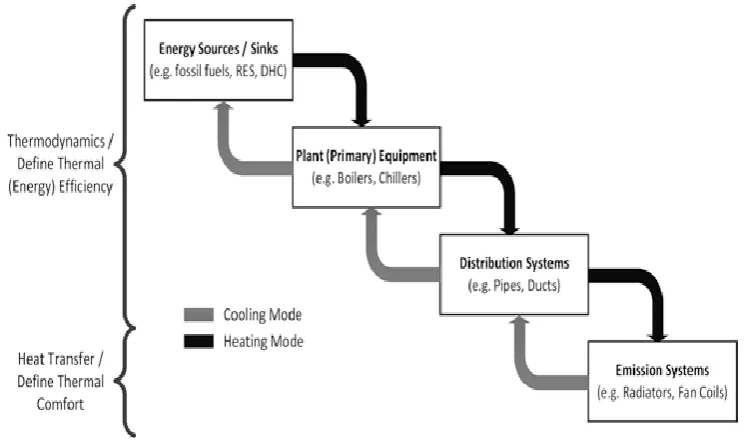
[image:23.595.118.491.456.676.2]electrical energy is used in HVAC system of the building and 25% of electrical energy is used in the lighting system. (Karam et al., 2016) Most of the academic building in Asia country would have an older cooling system like split units which are controlled using thermostat by the staff daily. (Sofia et al., 2016) HVAC system which is a distribution system, equipment or terminal to provide air-conditioning to a building has included ventilation and space cooling. All the air conditioning system should be installed according to the Thermal Environmental Conditions for Human Occupancy, ASHRAE Standard. The comfort cooling has a recommended design dry bulb temperature in the range of 23℃ to 26℃, 0.15m/s to 0.50m/s of recommended air movement and 55% - 77% of recommended design relative humidity, while the lowest service illuminance for working interiors in a building is set to be 200 Lux. (STANDARD MALAYSIA, 2007) The common lights that used in a building are T5 and T8 fluorescent lights followings the Standard for Lighting Design of Buildings.(He Hua et.al, 2009) The power of lighting that used usually ranges from 50W to 80W. (Sofia et al., 2016)
3
Besides that, energy audit is important to determine the energy usage during peak hours and non-peak hours in order to figure out the methods to reduce energy usage in an efficient way since Peninsular Malaysia the only one electric utility, Tenaga Nasional Berhad (TNB) has charged for the electricity usage according to peak period and non-peak period besides from the categories such as commercial category, industry category, mining category and specific agriculture. The peak period is from 8am to 10pm and the non-peak period is from 10pm to 8am.
In this case, UTeM Mechanical Engineering Laboratory Complex which is operating during weekdays has been selected to undergo energy audit. UTeM is a Malaysia public university which is established on 1 December 2000 with 7 faculties and variety of facilities such as sport complex, health centre, library, cafeteria and laboratories. It consists of UTeM Centre for Advanced Research on Energy to undergo research on energy and policy within the context of economic and environmental sustainability which supports the Energy Policy 1979. One of the research group, Efficient Energy & Thermal Management Systems (EFFECTS) Research Group is targeted to promote and conduct research in the areas of efficient energy and thermal management systems which pursue high energy efficiency and low carbon footprint in all the UTeM buildings.