Studying learning and innovation
networks – a conceptual and
methodological framework
Heidrun Moschitz, Robert Home
Heidrun Moschitz
Research Institute of Organic Agriculture Department Socio-economics
Ackerstrasse 5070 Frick Switzerland
E-mail: [email protected]
Robert Home
Research Institute of Organic Agriculture Department Socio-economics
Ackerstrasse 5070 Frick Switzerland
Abstract
This paper outlines the main concepts and methodology that the SOLINSA project uses in its study of learning and innovation networks. This project aims to identify barriers to the development of Learning and Innovation Networks for sustainable agriculture (LINSA). In such networks, social learning processes take place, and knowledge about sustainable agriculture is co-produced by connecting between the different frames and social worlds of the stakeholders with the help of boundary objects. Studying such processes at the interface between different knowledge spheres of research, policy and practice requires a specific methodology. A transdisciplinary reflective learning methodology addresses the complex question of understanding learning and innovation. The paper highlights the challenges of this approach that involves stakeholders already in the phase of defining the research objectives and strategies. Results from a first round of application of the conceptual and methodological framework will be presented and discussed.
Introduction
The traditional view of innovation in agricultural contexts has been that it is linear, with
agricultural research and development generating technologies that are transferred by extension services to agricultural producers for subsequent adoption (Leeuwis and Van den Ban 2004; Knickel et al. 2009). There are three underlying assumptions: a) Innovation is by definition ‘good’, generating growth in productivity and improving market competitiveness: both of which are crucial for progress; b) Official science is the only legitimate source of knowledge and driver of
innovation; c) The views, needs, and knowledge of innovation end users need not be taken into consideration (Dosi 1988). Accordingly, the formal Agricultural Knowledge System (AKS), defined as the ‘triangle’ of agricultural research, education and extension (advisory service)
establishments (Rivera and Sulaiman 2009), developed; the agricultural sector was well defined with clear goals.
This linear view of innovation in agriculture has been criticised for generating uneven impact on different sectors of a pluralistic society, for the neglect of societal actors as contributors to
As a result of these criticisms, the linear view is being replaced by systems approaches (e.g., Röling and Engel 1991; Hall et al. 2003; Sumberg and Reece 2004; Knickel et al 2009). As far as agriculture is concerned, the thinking has shifted towards including farmers as important actors in the Agricultural Knowledge and Information Systems (AKIS). The AKIS concept is used to analyse the gradual transformation, involvement of new actors and progression of new initiatives in the AKS (EU SCAR 2012). For specific innovation processes, these actors form flexible and dynamic innovation networks which have been referred to as ‘innovation coalitions’ (Biggs & Smith 1998), ‘innovation configurations’ (Engel, 1995), or ‘public-private partnerships’ (Spielman & Von Grebmer 2006; Hall 2006). In these networks, AKS actors are not the dominant providers of knowledge and information, but co-produce knowledge with many other stakeholders (Bruckmeyer and Tovey 2008; Schneider et al., 2009) and joint learning and negotiation takes place to shape an innovation (Leeuwis and Van den Ban 2004).
The networks which support the introduction of innovation in the AKS can be considered to be ‘Learning and Innovation Networks for Sustainable Agriculture’ (LINSA), the overarching concept on which this article will elaborate. We define LINSA as networks of producers, users, experts, CSOs, local administrations, formal AKS components, SMEs that create mutual engagement around sustainability goals in agriculture and rural development, and to this purpose they co-produce new knowledge by creating conditions for communication, share resources, cooperate on common initiatives. Yet, it should be stressed that this definition is not a static one, but will most likely change with the research on them.
Concepts for studying learning and innovation networks
Within the overarching concept of LINSA we can find different conceptual elements that together are instrumental to understanding the processes of learning and innovation for sustainable agriculture: social learning, knowledge sharing, and boundary work.
Social Learning
Learning, can be defined as a change in the state of the mind which broadens the capacity of action of an actor in the world. ‘Social Learning’ is defined as “the process of iterative reflection that occurs when we share our experiences, ideas and environments with others” (Oreszczyn et al. 2010).
Learning is linked to an outside/inside dynamic both at individual and at collective/organization level, and looking at this dynamic it is possible to distinguish between learning in the sense of absorbing existing knowledge from others and learning in the sense of discovery or invention (Nooteboom 2006). In his discussion about ‘Communities of Practice’, Wenger (1998) stipulates that on the one hand learning occurs as progressive process of knowledge convergence inside an organizational space (absorbing existing knowledge). On the other hand learning occurs as exposure to new information and thence the need to interact with the outside (knowledge as invention or discovery). As Schneider et al. (2009) point out social learning is based on a philosophy of participatory processes of social change. This means integrating the knowledge of different people, which, in the case of sustainable agriculture, include farmers, scientists, advisors and other experts. Similarly, Brown (2008) describes an ideal system of collective social learning as one that respects the different cultures of knowledge, such as individual, local, specialised, organisational, and holistic knowledge.
Co-creation of knowledge and knowledge sharing
Davenport and Prusak (1998) define knowledge as
In a post-modern society, knowledge creation should be conceived of as a process of co-production of knowledge between academics and non-academics (see e.g. Funtowicz and Ravetz 1994; Gibbons et al. 1995; Nowotny et al 2001; Steyaert et al. 2007). Here, the spiralling process of conversion between tacit and explicit knowledge as described by Nonaka et al. (2001) become relevant. According to these authors, explicit knowledge can be expressed in words and be transferred in the form of data, or scientific manuals. By contrast, tacit knowledge is highly personal and difficult to formalise, which makes it difficult to communicate. It is deeply rooted in the actions and experiences of individuals, and in their values or emotions. Co-production of knowledge will only happen if the different actors are able to cut across their different spheres of knowledge. Roux et al. (2006) conceptualize a ‘knowledge interface’ as a space where different knowledge cultures can meet, communicate, share knowledge, and collectively create new knowledge. They conclude that this requires a change of view of knowledge as a “thing” that can be transferred to one of a “process of relating” that involves careful negotiation of meaning among the partners. As Star and Griesemar (1989) stipulate, negotiation occurs over objects that connect different social worlds. These objects are characterised by interpretive flexibility, so that they allow communication even when people participating have very different goals, opinions, worldviews. They are named boundary objects.
Boundary objects
A number of agricultural innovation studies already explicitly refer to the importance of creating boundary objects (Schneider et al. 2009; Goldberger 2008; Klerkx et al. 2010; Bos 2009; Jakku and Thornburn 2010). They are formed in intermediary spaces where actors from different backgrounds, contexts, and frames meet and can take the forms of (i) Artefacts: Such as tools, documents or models; (ii) Discourses: Common language that allows people to communicate and negotiate meanings across boundaries; (iii) Processes: Shared processes, including explicit routines and procedures that allow people to coordinate their actions across boundaries. (Wenger 1998, 2000).
new forms of collaboration, and argue that the elements and processes involved need more attention to understand better social learning processes.
Methodology
The requirement to transcend different spheres of knowledge and the gap between theory and practice suggests the value of a transdisciplinary methodology. The defining feature of transdisciplinarity is the inclusion of non-scientific stakeholders in defining research objectives and strategies, while staying within the framework of scientific inquiry (Pohl and Hirsch Hadorn, 2007). To meet the challenge of meaningful and successful collaboration between researchers and stakeholders, participatory action research appears appropriate.
Participatory action research
Action research was pioneered by Lewin (1958) and is centred around three fundaments: the problem, the stakeholder, and what action the stakeholder will undertake to solve the problem. The philosophy behind the approach is that the stakeholder and the researcher collaborate to identify and rank specific problems, devise methods for finding their real causes, and develop plans for coping with them realistically and practically (Bradford and Burke 2005).
Scientific method, in the form of data collection and analysis of results, does however remain an integral part of the process so appropriate tools should be selected to enable the participatory action research approach. The primary aim when conducting action research is to establish an ongoing, reflexive mechanism for maintaining and enhancing the effectiveness of the network (the LINSA) by providing the system with practical and useful tools for self-analysis and self-renewal (Bradford and Burke 2005).
The reflective learning methodology in SOLINSA: a dynamic research and learning agenda
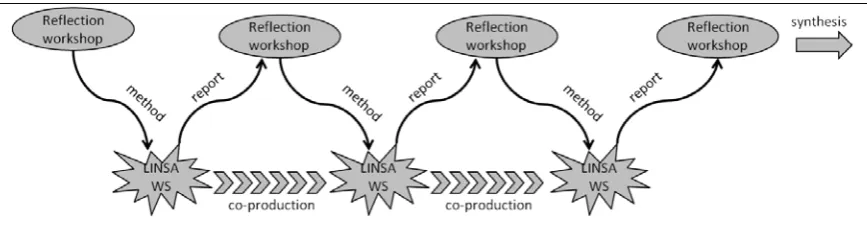
The adaptation of a suitable participatory action research methodology in the SOLINSA project faces a number of challenges. First and foremost it has to be suitable to analyse social learning processes in networks (LINSAs). What is more, the research takes place Europe-wide, so the methodology has to comfort different socio-cultural backgrounds and contexts. The third challenge combines the two already mentioned: it is about bringing together the different research experiences from the countries and combining them into an overall understanding of social learning processes for innovation in European sustainable agriculture. Figure 1 illustrates the reflective learning methodology set up in SOLINSA, implementing a dynamic research and learning agenda.
[image:7.595.81.515.304.426.2]LINSA: Learning and Innovation Network for Sustainable Agriculture; WS: workshop
Figure 1: Reflective Learning Methodology in SOLINSA
Experiences
At the time of writing this paper, the research process in SOLINSA has progressed from two initial researchers’ reflective workshops to one learning workshop each with the LINSAs, and the results of these have been discussed in a third reflective workshop among the researchers. In the following, this process is described in more detail, and we reflect on our first experiences.
In a first workshop, the researchers developed and discussed the core concepts as well as the methodological approach of the project, including methods to be used in the workshops with LINSAs. In a second workshop, the researchers agreed on the selection criteria for the LINSAs to be studied, and the LINSAs (in total 17) were finally selected. These fall into one of three groups: consumer oriented network, non-food oriented network, and purely agricultural networks or networks for sustainable land use. A set of descriptive characteristics was derived, and cases selected for maximum variety according to these characteristics. These characteristics include scale, origin and function (market; pluralistic; non market), strength of links with the AKS, level of learning (imposed; co-learning), the degree of integration (alone; networks; communities), the level of innovation (incremental; radical), governance, temporality, and efficiency and effectiveness of support. An initial set of analytical questions to address in the workshops with the LINSAs were collated on the basis of past research and collective thinking. A research plan was developed to ensure commonality within the consortium, document progress, enable learning from each other, and ensure a commitment to the goals of the project. Then the first round of interaction and workshops with the LINSA took place, focussing on understanding the socio-cultural context in which they operate, i.e. the social environment in which social learning takes place. The outcomes were reported to the research consortium. These reports contained first results regarding the analytical questions, and a reflection on the methods applied in the workshops. As a result, the methods for the LINSA workshops are refined, and the dynamic research agenda is further developed.
Dynamics in the research agenda
structures, the LINSAs range from homogeneous through to extremely diverse. One exception to the straight forwardness of the collection of descriptive data is the possible existence of implicit governance structures, such as power brokers within the network. Identifying hidden agendas and background governance structures, and helping to find methods to solve the (sometimes underlying) tensions have been identified and included in dynamic research agendas for further consideration.
Following the dynamic research agenda logic helped to deal with the variety of data that still needs to be brought together for a comparative analysis. A common template was developed to structure the response to the analytical questions and identify emergent issues. However, as the research path in participatory research is largely participant driven, another issue that arose was the timing of the responses when questions and issues were addressed. In the third reflection workshop, the researchers therefore re-structured the common template in a way to give more time for answering the more demanding analytical questions, while defining shorter time periods to address others. In this way, comparison of results can take place in a structured stepwise way.
Usefulness of concepts
Outlook
From a first round of application, the reflective learning methodology set up in SOLINSA is a promising approach. It provides space for reflection and is flexible, both necessary features as there is no ‘one size fits all’ method for understanding how LINSAs can best be supported. Since it is participant driven, the participatory action research methodology, particularly when applied using the dynamic research agenda method, ensures that the outcomes are relevant for the participants, who are in many cases those who are expected to implement these outcomes.
In the LINSA workshops, social learning processes are being analysed, and some of the concepts involved have already been verified. Nevertheless, at this stage we can conclude that co-creation of knowledge between researchers and stakeholders remains a challenge for the process. The requirement of a participant driven research agenda effectively removes baselines against which the success of the collaboration, i.e. essentially the co-creation of knowledge can be evaluated. While the researchers have recorded their perceptions of the stakeholder – researcher interactions, the challenge remains to integrate the stakeholders’ views in the assessment of success. The double role of the researcher as a scientist and facilitator of the LINSA workshop makes this requirement even more demanding. It will take time, thoughtful methods, and further reflection – the process has just begun.
Acknowledgements
We would like to thank several persons who jointly developed the conceptual framework of SOLINSA, of which parts are presented in this short paper: Gianluca Brunori, Giaime Berti, Laurens Klerkx, Talis Tisenkopfs, Dirk Roep, Dominique Barjolle, Nigel Curry, James Kirwan, Damian Maye, Julie Ingram.
References
Biggs, S., and Smith, G. (1998). Beyond methodologies: Coalition-building for participatory technology development. World Development, 26(2), 239-248.
Bos, B. (2009). Concepts and objects as boundary objects for sustainable animal husbandry. Anticipating regime transformations by design Paper presented at KSI conference 2009, June 4-6, Amsterdam, Netherlands.
Bradford, D.L., Burke, W.W. (2005). Reinventing Organization Development. San Francisco: Pfeiffer.
Brown, V.A. (2008). A collective social learning pattern. EuroPLoP Workshop, Kloster Irsee, Bavaria. July 9-13, 2008
Bruckmeier, K. and Tovey, H. (2008), Knowledge in Sustainable Rural Development: From Forms of Knowledge to Knowledge Processes. Sociologia Ruralis, 48(3) pp. 313–329.
Connell, N.A.D. (2001). Evaluating Soft OR: Some Reflections on an Apparently ‘Unsuccessful’ Implementation Using a Soft Systems Methodology (SSM) Based Approach. Journal of the Operational Research Society, 52, 150-160.
Davenport, T.H. and Prusak, L. (1998). Working knowledge: how organizations manage what they know. Harvard Business School Press, Boston, Massachussetts. USA.
Dosi G. (1988) Sources, procedures, and microeconomic effects of innovation. Journal of economic literature, vol XXVI, pp. 1120 ‐1 1 7 1
Engel, P.G.H. (1995). Facilitating innovation: An action-oriented approach and participatory methodology to improve innovative social practice in agriculture. Wageningen University
Entwistle, V., Buchan, H., Coulter, A. and Jadad, A. (1999). Towards Constructive Innovation and Rigorous Evaluation: A New Series on Methods for Promoting and Evaluating Participation. Health Expectations, 2, pp. 75-77.
Funtowicz, S.O. and Ravetz, J.R. (1994). The worth of a songbird – ecological economics as a post-normal science. Ecological Economics 10(3) pp. 197-207
Gibbons, M., Limoges, C., Nowotny, H. (1995). The new production of knowledge: the dynamics of science and research in contemporary societies. Sage, London.
Goldberger, J. (2008). Non-governmental organizations, strategic bridge building, and the “scientization” of organic agriculture in Kenya. Agriculture and Human Values, 25(2), 271-289.
Hall, A. (2006). Public-private partnerships in an agricultural system of innovation: concepts and challenges. International Journal of Technology Management and Sustainable Development 5(1), 3-20.
Hall, A., Rasheed Sulaiman, V., Clark, N., & Yoganand, B. (2003). From measuring impact to learning institutional lessons: an innovation systems perspective on improving the management of international agricultural research Agricultural Systems, 78(2), 213-241.
Jakku, E., & Thorburn, P. J. (2010). A conceptual framework for guiding the participatory development of agricultural decision support systems. Agricultural Systems, 103(9), 675-682.
Klerkx, L., Aarts, N., Leeuwis, C. (2010). Adaptive management in agricultural innovation systems: the interaction between innovation networks and their environment. Agricultural Systems, Volume 103, Number 6, pp. 390-400.
Knickel, K., Brunori, G., Rand, S., & Proost, J. (2009). Towards a Better Conceptual Framework for Innovation Processes in Agriculture and Rural Development: From Linear Models to Systemic Approaches. Journal of Agricultural Education and Extension, 15(2), 131-146.
Leeuwis, C. with v. d. Ban, A. (2004). Communication for rural innovation : rethinking agricultural extension. Oxford Blackwell Science.
Lewin, K. (1958). Group Decision and Social Change. New York: Holt, Rinehart and Winston. p. 201.
Meeting of the International Society for the Systems Sciences. Tokyo Institute of Technology, Tokyo, Japan -- August 5th - 10th 2007. ISSN: 1999-6918
Nonaka, I., Konno, N., Toyama, R. (2001). Emergence of „Ba“. A conceptual framework for the continuous and self-transcending process of knowledge creation. In Nonaka, I. (ed.) Knowledge emergence. Social technical, and evolutionary dimensions of knowledge creation. Oxford University Press, New York, pp. 13-29.
Nooteboom (2006). Cognitive distance in and between COP’s and firms: where do exploitation and exploration take place, and how are they connected?, Paper for DIME workshop on Communities of Practice, Durham, 27-28 October 2006
Nowotny, H., Gibbons, M., Scott, P. (2001). Re-thinking science: knowledge and the public in an age of uncertainty. Polity, Cambridge.
Oreszczyn S., Lane A., Carr S. (2010). The role of networks of practice and webs of influencers on farmers’ engagement with and learning about agricultural innovations, Journal of Rural Studies, Volume 26, Issue 4, pp. 404-417
Pohl, C. and Hirsch Hadorn, G. 2007, Principles for Designing Transdisciplinary Research - proposed by the Swiss Academies of Arts and Sciences. München: oekom Verlag.
Rivera, W., & Sulaiman, R. V. (2009). Extension: object of reform, engine for innovation. Outlook on Agriculture, 38(3) pp. 267-273.
Röling, N. G., & Engel, P. G. H. (1991). IT from a knowledge system perspective: concepts and issues. Paper presented at the European Seminar on Knowledge Management and Information Technology, Wageningen.
Romm, N.R.A. (1996). Inquiry-and-Intervention in Systems Planning: Probing Methodological Rationalities. World Futures, 47, 25-36.
Rowe, G. and Frewer, L.J. (2000). Public Participation Methods: A Framework for Evaluation. Science, Technology & Human Values, 25, 3-29.
Schneider F., Fry P., Ledermann T., Rist, S. (2009). Social Learning Processes in Swiss Soil Protection—The “From Farmer - To Farmer” Project. Human Ecology, Volume 37, Number 4, pp. 475-489.
Sieber, R. (2006). Public Participation Geographic Information Systems: A Literature Review and Framework. Annals of the Association of American Geographers, 96, 491-507.
Spielman, D., & von Grebmer, K. (2006). Public–Private Partnerships in International Agricultural Research: An Analysis of Constraints. The Journal of Technology Transfer, 31(2), 291-300.
Star S.L., Griesemer J.R. (1989). Institutional Ecology, 'Translations' and Boundary Objects: Amateurs and Professionals in Berkeley's Museum of Vertebrate Zoology, Social Studies of Science, Volume 19, Number 3, pp. 387-420.
Steyaert, P., Barman, M., Billaud, J.P., Brives, H., Hubert, B., Ollivier, G., Roche, B. (2007). The role of knowledge and research in facilitating social learning among stakeholders in natural resources management in the French atlantic coastal wetlands. Environmental Science & Policy 10(6) pp. 537-550.
Sumberg, J., & Reece, D. (2004). Agricultural research through a new product development lens. Experimental Agriculture, 40(03), 295 ‐3 1 4 .
Wenger E. (1998). Communities of Practice. Learning, Meaning and Identity, Cambridge University Press, Cambridge.
Wenger E. (2000). Communities of Practice and Social Learning Systems, Organization, Volume 7, Number 2, pp. 225-246.