ascilite 2012
__________________________________________________________________________________________
Designing evaluation and research into educational
initiatives: the Global Perspectives Program
We describe the planning for evaluation research using a curriculum initiative project as a case study. The project was to design a generic Global Perspectives (GP) learning program to embed in first year units of study offered by the Faculty of Health Science. The pilot phase of the GP program delivery was used to explore and define an educational evaluation research (EER) plan that addresses, 1) the GP program design; 2) its implementation and ongoing refinement and, 3) the management of the project. The GP program is presented from an e-learning design
perspective and its EER plan is based on the design framework in (Phillips, McNaught et al. 2012). The paper provides a high level view of the EER plan for the GP program over each stage of the design life cycle and for the evaluation of project management. The paper discusses the rationale for an EER plan, the book as a guide for research and practice in evaluating e-learning and the relationship of the GP program to learning, teaching and leading for the future.
Keywords: e-learning program evaluation, project-management evaluation, evaluation research design
Introduction
The focus of this paper is the design of a systematic plan for educational evaluation and research (EER) aligned with the design, delivery and management of a curriculum initiative: to teach a generic graduate attribute to first year students. The Global Perspectives (GP) program is designed to support first year Faculty of Health Science (FHS) students from the University of Tasmania (UTAS) to learn and demonstrate the ‘Global Perspective’ or ‘cultural competence’ graduate attribute. The context of the EER plan is nationally regulated higher education and a future environment where evidence of quality learning experiences and learning outcomes are expected with, “Course and discipline-specific skills and knowledge, as well as the generic skills developed through higher education will be considered by TEQSA when reviewing learning standards” (Tertiary Education Quality and Standards Agency 2011, p.7). It presents the plan for evaluating and researching the design, implementation and improvement of the GP program. The intended outcomes are evidence-based improvements to the GP program design and a reliable and valid evidence base for demonstrating learning outcomes and usefulness of resources. The tight integration of educational evaluation and research informing the ongoing design and re-design of a learning program increases confidence that students are equipped for future roles in a global society.
The paper begins with the policy and strategic environment driving the project. It provides an introduction to the concept of graduate attributes, and the ‘global perspective’ (or ‘cultural competence’) attribute. Cultural
competence was identified as a critical attribute for FHS graduates training for clinical professions. The GP program built on prior curriculum initiatives, directed at students unfamiliar with Australian culture, to prepare them for clinical professional experience placements and interactions with clients. The expanded vision for the future is the GP program as a compulsory, assessable component of curriculum to ensure, “Cultural competence for life-long learning and work in a global society” for all students. The paper presents the GP program from the perspective of e-learning design and describes the rationale for developing an EER plan based on (Phillips, McNaught et al. 2012). The paper presents the EER plan, developed in the context of the 2012 Ascilite mentoring program, and comments on the book as a guide for research and practice in evaluating e-learning.
21st century learning environments and UTAS
Increasingly, universities are providing blended learning environments to support flexible access to learning opportunities for students. UTAS is a multi-campus university and the FHS provides a number of courses fully online and in blended delivery mode to students at the Hobart, Launceston, Cradle Coast and Sydney campuses. However ensuring high-quality learning experiences in an online environment requires strong pedagogical design as well as good technical design of e-learning artefacts and environments. UTAS has adopted a Technology Enhanced Learning and Teaching Action Plan (CALT 2011), invested in a new Learning
ascilite 2012
__________________________________________________________________________________________
Educational Evaluation and Research
E-learning evaluation is a complex mixture of evaluation and research requiring a systematic and planned approach to ensure rigor and relevance (Phillips, McNaught et al. 2012). It benefits from a mixed methods, or hybrid, approach because, “‘appropriate’ assessment of curricular innovations is an argument that includes diverse kinds of scientific evidence, as well as the theoretical rationale and the social significance of the innovation” (Ruhe and Boudreau 2011, 188). Benefits of designed evaluation include opportunities to improve program design; communication between project team members; identifying additional/alternative types of data to collect, reviewing evaluation procedures, and preventing misunderstandings including with those with oversight of the project (Sanders and Nafziger 2011[1976]).
Phillips et al (2012) argue for, “an evaluation framework and a scaffolded approach to the design of an e-learning research study” (2012, p.13). The authors provide a holistic, systematic and planned approach to educational evaluation and research which, “explicitly maps evaluation-research activities to the design-and-development cycle of an e-learning artefact, and applies across many, if not all, of those design-and-development phases” (2012, p.87). The book distinguishes four interrelated, and potentially concurrent, evaluation-research activities: baseline analysis, design evaluation, formative evaluation and effectiveness research with project management evaluation as a separate, related, activity. Project management evaluation is about the conduct of an e-learning project, primarily formative and concerned with processes although summative elements, for example in reporting to funding bodies (Phillips, McNaught et al. 2012).
Graduate Capabilities and Cultural Competence
Graduate capabilities are also referred to as competencies, generic skills, graduate attributes and 21st century skills. These are the skills required to be successful knowledge workers and citizens, and they combine with subject-based knowledge to produce the ‘expertise’ of a graduate (Bransford, Brown et al. 1999). Allan (1996) distinguishes between personal transferable outcomes (acting independently, working with others, using information technology, communicating effectively, organisational skills, etc.) and generic academic outcomes, (making use of information, thinking critically, analysing, synthesising). A further distinction is between these personal skills and abilities, and complex interwoven aspects of human ability, which are difficult to explicitly teach or assess in traditional university experiences (e.g. Independent and lifelong learning, Ethics, Social justice) (Barrie 2005).
The UTAS Global Perspective graduate attribute is, “Graduates will be able to demonstrate a global perspective and inter-cultural competence in their professional lives” (CALT 2001). Graduate attributes must be integrated into curriculum and evaluation/quality assurance processes, as well as support students, “in the development, assessment and documentation of the achievement of graduate attributes throughout their study” (CALT n.d.). The global mobility of graduates and multi-cultural demographic of most countries means that the ability to relate effectively and appropriately with colleagues, clients, and the community at large is a critically important attribute wherever a graduate chooses to work.
Education design for ‘Cultural Competence’: the Global Perspectives program
Background
The Global Perspective attribute was explicitly taught in a support program developed in the School of Nursing & Midwifery (SNM) (Spratt and Sondermeyer 2006). This program included workshops and tutorial discussions designed to prepare Culturally and Linguistically Diverse (CALD) students unfamiliar with Australian culture for clinical professional experience placement. The learning objective was to equip target students to interpret and respond in culturally appropriate ways to clients seeking health care services. Sondermeyer and Van den Berg (2005) suggested that a program for all students and teaching staff would significantly improve this ‘deficit’ model. In 2011, a faculty-wide project was established to leverage expertise in the SNM and extend the program to teach and assess cultural competence for all students, regardless of cultural background. It represents a significant shift in both target student cohort and intended scale of engagement.
Baseline analysis
ascilite 2012
__________________________________________________________________________________________
rapidly changing global society. Capability in cultural competence, including intercultural awareness and communication skills, will determine the extent to which graduate health professionals succeed in practice environments in Australia and in other countries (Sondermeyer, van den Berg et al. 2005).
To avoid a ‘deficit’ model of supporting targeted students (Sondermeyer, van den Berg et al. 2005) or a ‘tokenistic’ approach to cultural competence, the first decision was to design a learning environment that could embed global perspective into core curriculum to enrich the learning experience of all students and staff. Thus the GP program is discipline-agnostic and can be embedded in any first year unit of University study.
A review of the literature on “cultural competence” (and equivalent concepts) identified four major components which informed the working definition of cultural competence used to frame the learning design:
An ability to communicate/interact effectively and appropriately with people of different cultures, comprising four components:
a) AWARENESS of one’s own cultural worldview; b) ATTITUDE towards cultural differences;
c) KNOWLEDGE and ACCEPTANCE of different cultural practices and worldviews; d) SKILLS (including COMMUNICATION).
Four learning objectives were derived from this definition:
1. Student identifies awareness of his/her own worldview in the context of other worldviews; 2. Student demonstrates a respectful attitude towards cultural differences;
3. Student demonstrates recognition and acceptance of different cultural practices;
4. Student uses communication effectively and appropriately to enhance intercultural understanding.
These learning objectives are embedded in the core elements of the GP program and were the criteria for deciding content, structure, learning processes (including sequencing) and supporting resources.
[image:3.595.77.483.636.762.2]GP Program Design
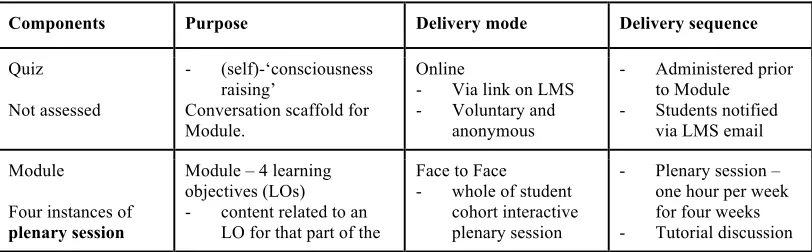
Table 1 sets out the components of the GP program as it was developed 2011-2012. The learning design is structured around three elements: an online Quiz, a face-to-face teaching Module and, for students who are required to participate in clinical Professional Experience Placement, a Workshop component.
The Module is delivered via a “plenary session” and “tutorial discussion” sequenced over four weeks with each week aligned to a Leaning Objective. It is designed to fit within the traditional structure for a Unit and utilises the timetabled lecture and tutorial slots. The learning design assumes a Minimum Online Presence on the UTAS LMS. Each plenary session is a highly interactive lecture, scaffolded by a PowerPoint presentation, which is recorded and uploaded to the Unit presence on the LMS. Additional resources are provided on the LMS
including journal articles, recorded interviews and video clips that relate to each part of the Module. The tutorial discussions include reflective exercises, paired and group discussion, and focus on supporting students to apply the concepts delivered in the plenary session to their personal and professional/disciplinary context. The Quiz is designed to provide students an opportunity to respond to a number of questions and scenarios for which a variety of responses or interpretations of ‘what is going on’ are possible. It is administered in the week before the first plenary session via a link on the LMS. It also provides a shared experience for students to use to respond to questions in the plenary session and begin discussions in the tutorial.
Table 1: Global Perspectives program
Components Purpose Delivery mode Delivery sequence
Quiz
Not assessed
- (self)-‘consciousness
raising’
Conversation scaffold for Module.
Online
- Via link on LMS
- Voluntary and
anonymous
- Administered prior
to Module
- Students notified
via LMS email
Module
Four instances of
plenary session
Module – 4 learning objectives (LOs)
- content related to an
LO for that part of the
Face to Face
- whole of student
cohort interactive plenary session
- Plenary session –
one hour per week for four weeks
ascilite 2012
__________________________________________________________________________________________
(with follow-on
tutorial discussion
Assessed
- Exam
Module
- discussion and
exercises to consolidate and apply the LO to personal and professional practice
- small group tutorial
discussion (25 max) Online via Unit LMS
- plenary session
recorded and uploaded to LMS.
– one hour per week for four weeks
Workshop
- Component of a
compulsory two hour PEP workshop
Preparation for students’ Professional Experience Placement
Face to Face
- GP content for
workshop is 30 min
- Delivered in
following semester
The lifecycle of the Global Perspectives program
The concept of ‘life cycle’ for an e-learning artefact or environment is grounded in the inescapably ‘designed’ nature of learning in online environments; it is also a scaffold for the evaluation research framework presented in (Phillips, McNaught et al. 2012), Figure 8.1, p. 119. The development cycle of an e-learning artefact or environment has four phases: analysing the requirements, specifying design, development and implementation and each phase in the life cycle suggests a focus for evaluation and research (Phillips, McNaught et al. 2012).
The focus, or unit of analysis, for e-learning evaluation tends to be the design of an artefact (which will later be embedded into a learning environment). However, the orientation of the GP program design is curricular, not artefactual; thus some of its design phases do not neatly align with the phases in (Phillips et al 2012). The GP program, in its current form, is a learning environment that is delivered in blended mode. Face-to face teaching and peer interactions are assumed critical to the development of students’ cultural competence capability.
The project plan compasses three phases of activity: pilot implementation (phase one, Semester 1, 2012), implementation (phase two, Semester 2, 2012) and faculty-wide roll-out (phase three, 2013). Phase one was preceded by an extended period of research and consultation to produce the GP program design (phase 0). The GP program, in its final form, will be housed in an online environment from which a variety of learning and teaching resources will be available for downloading and embedding in any Unit of study. This implies an additional design activity beyond the current project plan (phase four, 2014): the GP program, and
documentation to guide teaching and learning practice, for use in contexts not supported by the project team.
Phase 0 – GP program design (to solve the problem of how to build cultural competence)
The requirements analysis and initial design for the GP program took place during late 2011 up to May 2012. Initial inputs to the GP program design (see Table 1) included: Sondermeyer’s workshop design; definitions, learning objectives and learning designs sourced from a range of literature in the cultural competence and internationalisation domains and the collective experience and knowledge of project team members. A three day consultation with Dr Darla Deardorff, Dec 2011, provided expert information and advice based on current scholarship and practice of educating students in ‘cultural competence’. A key learning design decision from the consultation was to first establish learning objectives for the assessment of cultural competence and apply them to the Quiz and Module components of the GP program (Table 1). The next step was designing learning activities for the learning objectives. Working parties were formed to develop the Quiz, Module and Workshop elements of the GP program. Working parties presented their learning designs to the project team for discussion and the team decisions on what should be added or changed incorporated into the learning design.
Phase one – pilot implementation
The pilot implementation of the program was delivered in the last five weeks of Semester one, 2012 to approximately 500 first year Bachelor of Nursing students enrolled in CNA116 Introduction to Nursing. The pilot implementation was used to trial data collection tools and to develop the preliminary EER plan to guide the evaluation of the GP program.
Phase two – implementation
ascilite 2012
__________________________________________________________________________________________
it in a Unit in phase three. Work began on a fully online version of the GP program for distance students.
Phase three – FHS roll-out
In phase three, semester 1, 2013, the revised, predominantly face-to-face GP program will be embedded in a Unit taken by all first year medical students; an online version will be embedded in a Unit undertaken by first year Bachelor of Paramedic Practice students. Other Schools in the Faculty will also have opportunity to embed the GP program in their first year Units. Preliminary design for a GP program for embedding in second and third year Units will begin.
Phase four – GP program available onlinefor embedding in first year Units.
In addition to the planned rollout of the GP program for all first year courses in Faculty Health Science Schools, it is envisaged that both face-to-face and online versions of the GP program will be made available for Unit Coordinators to embed within Units in other Schools and disciplines across UTAS. The design of the GP program, as developed in phases one to three, assumes the project team members either deliver the program or provide hands on support and training to those who embed the GP program in their Unit. Phase four will initiate a significant shift in the design focus: to the GP program as a standalone online resource that can be
downloaded, embedded in a Unit, and delivered without support by the project team.
Planning and implementing Educational Evaluation and Research
EER plan principles and foundations
The EER plan for the project has two foci: evaluation of the project (plan, structure, processes) and evaluation research of the project output – the GP program. The project evaluation is discussed first, summarised in Table 2. The GP program evaluation is presented in the following section and summarised in Table 3.
The broad aim of the EER plan is to conduct formative and summative evaluation of the GP program design and implementation. Particular goals are to:
• evaluate the process and outcomes of the project in order to make recommendations for the management
and design of future educational projects;
• improve the educational design of the GP program;
• evaluate the effectiveness and impact of the GP program on student engagement and student learning; • evaluate the staff experience of delivering the GP program;
• determine if, and to what extent, the GP program produces a ‘cultural shift’ in participating students and
staff members.
The project structure includes an EER working party whose remit is to design the EER plan and to support project team members, individually or in groups, to engage in a program of educational evaluation and scholarly research aligned with the plan. The EER plan includes: overarching research questions, data collection
instruments, data analysis methods and suggested publication and reporting targets. Some of these elements are not yet fully developed; most will change and adapt over time as the project progresses.
The EER plan is based on the evaluation-research process in (Figure 7.1, Phillips et al 2012) and uses the planning tools it provides for managing the change in focus required over time as a design-based learning project evolves to a mature system. Table 3 maps the phases of the project to the e-learning life-cycle and identifies the evaluation-research elements for each stage.
Project Management Evaluation
ascilite 2012
__________________________________________________________________________________________
[image:6.595.74.526.151.407.2]
and holistic approach to EER. This suggests a further research question, What is the impact of designing and planning educational evaluation research into the project? A formative and summative evaluation process will also used to evaluate the effectiveness and impact of designing and planning educational evaluation research into an (e)-learning project.
Table 2: Project Evaluation
Elements Characteristics Evaluate (Phillips et al 2012, ch.10)
Project plan Objectives
Major tasks Timeframe Budget
Formative Process Evaluation
• How effective are the project
structure and processes and how can they be improved?
• To what extent are project outputs
meeting stakeholder needs? Summative Outcomes Evaluation
• To what extent was the project
implemented as planned and funded?
• What was the overall success of
the project, including its impact on stakeholders, and how can the process be improved? Formative evaluation of EER
• What is the impact of designing
and planning educational evaluation research into the project?
External formative evaluation
• External consultant - design
• ‘Critical Friend’ – EER plan
Project structure Project leader
Project manager
Working parties (Quiz, Module, Workshop design; Evaluation)
Project team (fluid membership)
Project processes Project team meetings and email communication
Working party meetings and report back Deliver and reflect
Observation of delivery and debrief Reflection and planning workshop Training workshops to deliver GP program
Project personnel Team membership
- members from all Schools in the FHS
- invited members from Student Support Services
FHS resources
- project manager
- academic support (EER plan and implementation)
GP Program: Educational Evaluation and Research (EER) plan
The development and implementation of the GP program is planned over five phases: 0: Design; one: pilot implementation; two: implementation; three: FHS roll-out and four: online version for embedding in Units. The EER plan for the GP program covers phases one through three with indicative comments for phase four.
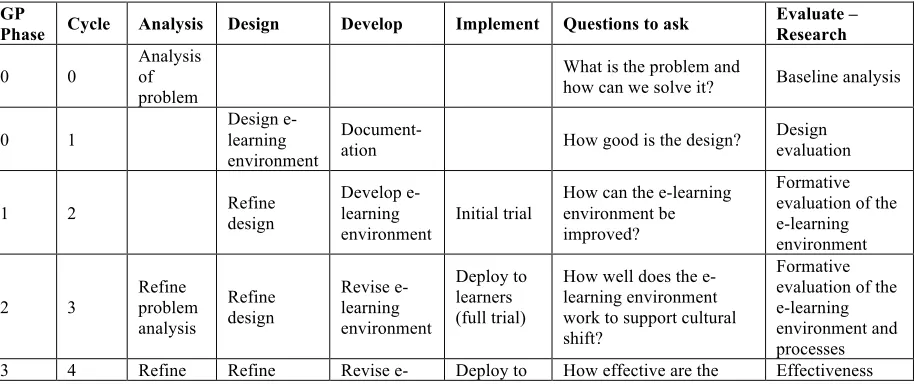
[image:6.595.72.529.574.767.2]Table 3 is based on the assumption that evaluation and research goals need to align with different life cycle stages of a learning design. Research goals and broad research questions for each phase of the GP program were selected by mapping the development and implementation phases to the life cycle phases of an e-learning project in (Phillips, McNaught et al. 2012); identifying type of activities (analysis, design, develop, implement) and EER questions for the evaluation research focus appropriate for that phase.
Table 3: GP program life cycle: adaptation of Tables 8.1 & 8.2 (Phillips, McNaught et al. 2012)
GP
Phase Cycle Analysis Design Develop Implement Questions to ask Evaluate – Research
0 0
Analysis of problem
What is the problem and
how can we solve it? Baseline analysis
0 1
Design e-learning environment
Document-ation How good is the design?
Design evaluation
1 2 Refine design Develop e-learning
environment
Initial trial How can the e-learning environment be
improved?
Formative evaluation of the e-learning environment
2 3
Refine problem analysis Refine design Revise e-learning environment Deploy to learners (full trial)
How well does the e-learning environment work to support cultural shift?
Formative evaluation of the e-learning environment and processes
ascilite 2012
__________________________________________________________________________________________
problem
analysis design learning environment learners learning processes in generating ‘cultural shift’
in students?
What is the impact on students’ capabilities in managing cultural diversity?
research into learning processes and outcomes
4 5
In phase four, the GP program will be designed as an online teaching resource with accompanying teaching training materials to support delivery. This will begin a new design phase and the EER focus will return to the characteristics of phase 0, cycle 0 for the GP program.
EER phase 0 – baseline analysis and design evaluation
The focus of design activity in phase 0 was analysis of the problem, How to build cultural competence in first year students? The focus of EER during this phase was research to identify potential design solutions and to evaluate their potential as a learning environment. An external consultant provided advice and guidance on the learning objectives for the GP program. Once a coherent design was formulated, the focus shifted to the evaluation question, How good is the design?
The method for evaluating Quiz and Module designs was that working parties would present their proposed designs for review and discussion by the project team. The criteria for evaluation were: 1) content alignment with the Learning Objectives and 2) impact on learners of Quiz and Module learning design.
Several iterations of team-based discussion resulted in significant design changes to the Module and Quiz.
The Module was trialled with two cohorts of students from another institution. Feedback forms, with questions on the content and delivery experience, were collected from participants. The data was analysed by the Module working party to identify design aspects that needed changing. The Quiz design was trialled by the 20 plus members of the project team and the design evolved significantly. Its planned purpose of ‘diagnostic tool’ to measure the impact of the program on students was changed to a ‘consciousness raising’ and ‘fun’ activity for students to participate in, and as a prompt for tutorial discussions.
EER phase one – design evaluation and formative evaluation of the e-learning environment
Phase one and phase 0 overlap in terms of life cycle. The broad research question for phase one was, How good is the design? and subsequently, How can the design be improved?
EER for these phases was evaluation for improving the GP program design. The project team monitored student comments about the GP program on the LMS blog for the Unit. The UTAS Student Evaluation Teaching and Learning (SETL) Unit survey included questions specifically about the GP program embedded in the Unit. This data was used to evaluate the pilot delivery of the GP program. The analysis of student comments and SETL data was done by working parties who then proposed design changes to the project team for discussion and approval. Members of the project team attended the Module plenary sessions and tutorial discussions as
observers. Additional data included: project meeting minutes (recording post-observation feedback), observation field notes, and emailed feedback comments.
At the conclusion of phase one, the GP program was evaluated from both student and staff perspectives and revised and refined for phase two delivery. During phase one, the EER working party developed a diagnostic tool for measuring the GP program’s impact (or ‘cultural shift’ in knowledge, skills, capabilities) on individual students.The My Perspective questionnaire was trialled in phase two and evaluated for validity and usefulness.
EER Phase two – formative evaluation of the e-learning environment
The focus of phase two was the design of the GP program as a learning environment. The broad research questions for phase two were, 1) Does the learning environment work as intended? and 2) How can it be improved?
Phase two data collection added student focus groups and student assessment items as data sets. To determine effectiveness and ‘impact’ on student learning from the GP program a long-term plan was initiated to develop, trial and validate a diagnostic tool to answer the question, How well does the GP program as learning
ascilite 2012
__________________________________________________________________________________________
explicitly aligned to the GP program learning objectives and capable of establishing a baseline of ‘cultural competence’ for first year students and to validly assess the effectiveness and impact of the GP program.
During phase two, the Nursing students participated in a Professional Experience Placement Workshop. This workshop incorporated a 30-minute component designed by the GP program Workshop working party to revisit and apply the learning objectives of the GP program to practice in a clinical setting. As for the Module and Quiz, the Workshop is evaluated from a design perspective, How good is the design and how can it be improved? Student feedback data from the Workshop and post-PEP focus groups will be analysed to identify and trial specific research questions and data collection methods to measure the impact of the GP program on students’ cultural competence capabilities in clinical professional experience placement settings.
The literature review was updated and focused on ‘cultural competence’ as a construct and scholarship and practice in tertiary education learning design. At the conclusion of phase two, analysis of data (student and staff perspectives) was conducted from an educational evaluation perspective. Data was interpreted within the framework of learning design principles synthesised from the literature review. The various data collection methods and data sets were also interrogated to assess their ability to establish a baseline of student knowledge, skills and capability in cultural competence and to measure cultural shift in response to achieving the learning objectives of the GP program.
EER Phase three – formative evaluation of the e-learning environment and processes and effectiveness research into learning processes and outcomes
The GP program design will ultimately be finalised for large-scale delivery in phase three. In this phase, the focus of the EER plan is researchinghow learners engage with the GP program as a learning environment. The broad research questions identified for phase three are: 1) How well does the GP program as a learning environment support learning? 2) How effective are the learning processes in generating ‘cultural shift’ in students? and 3) What is the impact on students’ capabilities in managing cultural diversity when on Professional Experience Placement (PEP)?
On the basis of the pilot implementation (phase one) and implementation (phase two), the EER working party will develop or identify a range of instruments to facilitate and guide ongoing evaluation of the GP program. The design and content of additional data collection instruments (for example survey/questionnaire, student focus groups, interviews) will be decided based on the data analysis and outcomes from phases one and two of the project. Standardised questions for students to evaluate the GP program, as embedded in their Unit, will enable summative evaluation of the Quiz, Module and Workshop design and the effectiveness of delivery from student perspective for each Unit. The My perspective questionnaire and cultural competence diagnostic tool will be evaluated for validity in establishing a baseline and in determining if the intended learning outcomes / objectives have been demonstrated by a measurable cultural shift in students’ capabilities.
Phase three will test the sustainability of the GP program’s design: Is the GP program design sufficiently clear and robust to be delivered independently of the project team? and How effective are the training and teaching resources provided? A feature of the GP program is the requirement for skill in a highly interactive teaching style for delivering the plenary sessions, in contrast to ‘lectures’ whereby teachers talk and students listen, and skill in facilitating tutorial discussions of sensitive topics that can produce strong emotions. Hence the GP program design will include teaching materials and training for academics intending to embed the program in a first year Unit.
The EER working party will oversee and monitor any evaluation and research projects that are proposed by members of the project team who wish to investigate specific aspects of the GP program as it is implemented during phase three.
EER Phase four – effectiveness research into learning processes and outcomes (mature GP program) and baseline analysis and design evaluation (GP program as online resource)
ascilite 2012
__________________________________________________________________________________________
Evaluation-research activities for the GP program as an online resource will be framed by e-learning design principles explicated in relevant literature on e-learning best practice. The baseline analysis of the problem, How to build cultural competence in first year students? will be adapted to include teacher and learner characteristics for an online delivery mode. The focus of EER during this phase will be to identify potential design solutions and evaluate their potential as a learning environment. Once a coherent design is formulated, the focus will shift to the evaluation question, How good is the design?
Guidance for research and practice in evaluating e-learning
This paper had its genesis in Ascilite’s community mentoring program. The intended outcome specified in the mentoring agreement between the first author and mentor, Phillips, was for the novice researcher in e-learning to develop skills in EER and to apply the evaluation research framework provided by (Phillips, McNaught et al. 2012) to a project involving e-learning design.
This section is a short account of (Phillips, McNaught et al. 2012) as a guide for research and practice when evaluating e-learning. The context of this account is the project effort thus far to design and evaluate the GP program as well as plan for future evaluation and research activities. The book presents a strong case for, “an evaluation framework and a scaffolded approach to the design of an e-learning research study” (p.13). A proposal to develop an EER plan for the GP program argument resonated strongly with the primary
stakeholders, the project team, who were concerned to ensure an evidence base for improving the GP program design and for establishing its impact and effectiveness on student learners.
The book sets out a holistic, systematic and planned approach to educational evaluation and research. It is holistic in that it takes into account the different goals of educational evaluation (judgment and decisions to improve design) and research (understanding what is going on in the learning environment). It also guides EER planning to take into account the design-and-development cycle of an e-learning artefact or learning
environment: life-cycle stage in design affects what research goals, and therefore what research questions, are appropriate.
Two key concepts key to the process of ‘doing’ an EER plan are the following:
“… the challenge with evaluation research occurs most often early on in the process - in deciding on the direction of the study (what questions are to be asked), instantiating the direction into a clear methodology and then planning the specific details” (Phillips, McNaught et al. 2012: 111).
“design evaluation is not a one-off activity. While it is clearly a major activity at the beginning of the e-learning life cycle, the design needs to be revisited after each cycle of design, development and implementation. Evaluation data at each stage will inform a revised design for the learning environment. Each new design should be subjected to a design evaluation, which may require a new round of peer review or expert judgment.” (p.123).
The process diagram for evaluation-research (Fig. 7.1, p. 104) was followed to design the EER plan. There were several challenging aspects to this process, which benefitted from the mentoring relationship and access to specific advice on how to map the guiding principles and techniques in the book to the messy reality of the project. The perennial ‘problem’ of tacit knowledge articulated by Michael Polanyi, remains,
Common experience also tells us that in teaching we rely on an intellectual effort of the learner for recognizing that which we are conveying to him. … the intellectual effort to find out how it is done. … our teaching relies on the capacity of the learner to discover for himself a considerable part of that which we are trying to impart to him, and to this extent we are imparting to him something that we cannot tell, and which he, in his turn, then knows and cannot tell (Polanyi 1969).
ascilite 2012
__________________________________________________________________________________________
evidenced by the capacity to do what has been learned.
The project team is culturally diverse, geographically dispersed and multi-disciplinary. The unifying vision is to contribute to the development of students’ ‘cultural competence for life-long learning and work in a global society’, so they can, in future personal and professional lives, fruitfully and effectively interact with people of diverse culture-based perspectives and practices.
The project team culture reflects this vision, fostering collaborative design effort and inclusiveness. Individual members are variously interested in evaluation and research activities and this suggested the need for a mechanism to produce, and then manage, a coherent and strategic plan of evaluation and research work. The formative evaluation of the project management processes confirmed the effectiveness of a ‘working party’ model for developing the Quiz, Module and Workshop elements of the GP program design. This model was applied to the task of EER design. The EER working party has developed the plan to date and will be
responsible for its implementation. Its remit is to facilitate and document the evaluation research effort arising from the project and ensure formative evaluation of the EER plan, recommending improvements. Additionally, data collection methods and data sets trialled in the early phases of the GP program life cycle (phase one and two) could not be analysed to establish to what extent students acquire the ‘global perspective’ or ‘cultural competence’ graduate attribute through the GP program. This reinforced the need to design a diagnostic tool to measure ‘cultural shift’ with a view to having a validated tool ready for the mature educational design.
The result of the EER planning effort is a comprehensive plan that addresses the educational design, project management and scholarship. The current version includes research questions that are suitable and relevant to each of the life cycle phases of the GP program as its design is developed over time. The EER plan has been embedded in the project plan and will provide a framework to guide the ongoing quality assurance process for the GP program and a scaffold for developing research questions and methods so that as the GP program enters the maturity phase of its life cycle and questions of ‘impact’ and ‘effectiveness’ can be addressed.
References
Allan, J. (1996). "Learning Outcomes in Higher Education." Studies in Higher Education21(1): 93-108. Barrie, S. (2005) "Rethinking Generic Graduate Attributes." HERDSA News27.
Bransford, J. D., Brown, A. L., et al., Eds. (1999). Executive Summary of How People Learn, National Academy Press.
CALT. (2001, 8th June 2012). "Policy on Generic Attributes of Graduates at the University of Tasmania." from http://www.utas.edu.au/__data/assets/pdf_file/0003/214662/Generic-‐Attributes-‐of-‐
Graduates.pdf.
CALT. (n.d., 8th June 2012). "Developing generic graduate attributes & tracking their acquisition at UTAS." from http://www.teaching-‐
learning.utas.edu.au/__data/assets/pdf_file/0005/1103/GA_developing_and_tracking.pdf.
Phillips, R., McNaught, C., et al. (2012). Evaluating e-learning: guiding research and practice. New York, Routledge.
Polanyi, M. (1969). "On Body and Mind." The New Scholasticism43(2): 195-204.
Ruhe, V. and Boudreau, J. D. (2011). "Curricular Innovation in an Undergraduate Medical Program: What Is "Appropriate" Assessment?" Educational Assessment, Evaluation and Accountability23(3): 187-200. Sanders, J. R. and Nafziger, D. N. (2011[1976]). "A Basis for Determining the Adequacy of Evaluation
Designs." Journal of MultiDisciplinary Evaluation7(15): 44-78.
Sondermeyer, J., van den Berg, K., et al. (2005) "Making nursing education culturally competent: moving beyond the deficit model." International Conference on Critical Discourse Analysis: Theory into Research, 669-676.
Spratt, C. and Sondermeyer, J. (2006). Developing the academic capability of undergraduate CALD nursing Students: Final (unpublished) report for the PVC (Teaching And Learning) Internationalisation Committee, Faculty of Health Science, University of Tasmania.
Tertiary Education Quality and Standards Agency (2011) "Developing a framework for teaching and learning standards in Australian higher edcuation and the role of TEQSA: a discussion paper."
UTAS. (2012). "Learning and Teaching." Policies, Procedures and Guidelines - by Category, 2012, from
http://www.utas.edu.au/governance-‐legal/policy/by-‐category.
ascilite 2012
__________________________________________________________________________________________
Jo-Anne Kelder, [email protected]
Please cite as: Kelder, J. (2012) Designing evaluation and research into educational initiatives: the Global Perspectives Program
Copyright © 2012 Jo-Anne Kelder, Juliet Sondermeyer, Rob Phillips, Anne Rothwell.