ABSTRACT
Research
Based on a paper presented at AFAC19 – the annual conference of AFAC andthe Bushfire and Natural Hazards CRC.
New human capabilities
in emergency and crisis
management:
from
non-technical skills to
creativity
Associate Professor Benjamin Brooks
1,2, Dr Steve Curnin
1,2,
Associate Professor Christine Owen
1,2and Jason Boldeman
3 1. University of Tasmania, Hobart, Tasmania.2. Bushfire and Natural Hazards cooperative Research Centre, Melbourne, Victoria.
3. Seqwater, Ipswich, Queensland.
Submitted: 8 August 2019. Accepted: 12 September 2019.
Introduction
When the 9-11 Commission handed down its final report, they identified the set of failures associated with the event. They wrote: ‘We believe the 9-11 attacks revealed four kinds of failures: in imagination, policy, capabilities, and management’ (National Commission on Terrorist Attacks upon the United States 2004, p.339). This was not the first, nor the last report following a major event to indicate the need for different ways of thinking for preparing and responding to such unprecedented events. The Royal Commission into the Black Saturday Bushfires in Victoria noted that ‘the state-level emergency management arrangements still faltered because of confusion about responsibilities and accountabilities and some important deficiencies of leadership’ (Victorian Bushfires Royal Commission 2010, p.8). Arguably, one of these failures in leadership was a failure to recognise and respond to the magnitude of the event; a similar failure of imagination identified in the 9-11 Commission report but with respect to a natural disaster.
In a report published in 1993, a year after Hurricane Andrew hit Florida, the United States General Accounting Office wrote:
The response to Hurricane Andrew raised doubts about whether FEMA is capable of responding to catastrophic disasters and whether it had learned any lessons from previous disasters. One could simply substitute Katrina for Andrew, and unfortunately, the same conclusions would be valid today. And that is very disturbing.
(Committee for Homeland Security and Governmental Affairs 2006, p.2).
The committee investigated why local, state and federal agencies were not able to work together as one cohesive unit.
The excuse that we have heard from some government officials throughout this investigation has been that Katrina was an unforeseeable
ultra-catastrophe. While Katrina was, indeed, the worst natural disaster in our country in modern times, it had been anticipated for years and was specifically forecast for days.
capital’s imagination and of the social imagination more broadly’ (p.1). Imagination, it seems, is – or at least should be, an important component of emergency and crisis response and recovery regardless of the industry or the origin of the event itself.
In recent times, one of the most significant changes in capability has been for emergency services
organisations to embrace opportunities to ‘build agility’. This is particularly important when facing non-routine and novel events. Contributing to this, previous research (Brooks et al. 2016) has explored cognition in the
context of decision-making, developing training and aide memoires to support personnel in areas such as the management of cognitive biases and maintenance of situational awareness. The research supporting this work identified other problems related to developing options analysis and predicting consequences for out-of-scale events. This has led research end users to question how they can prepare future leaders for the new norm. For human factors research to adapt and remain relevant in this changing environment, the simple answer is: we need to build new human capabilities.
The future will demand that leaders think outside the box and use higher cognitive skills such as creativity and divergent thinking to address failures of imagination. Processes in creativity include thinking skills that are conducive to taking new perspectives on problems, pivoting among different ideas, thinking broadly and making unusual associations. These will be required to ride the wave of change. However, it is not enough to explore creativity solely from the perspective of a single sector. Emergency and crisis management necessitates a joint capability that transcends the public, private and not-for-profit sectors. Importantly, it is the managerial function charged with creating the frameworks within which communities can reduce vulnerability to hazards and cope with disasters (FEMA 2007). This differs to crisis management, which is organisationally focused and can have a material impact on an organisation’s shareholder value, reputation, ability to deliver services to the community and, potentially, the viability of the organisation. Both require input from the highest levels to respond to and manage the actual and potential ramifications. Thus, emergency and crisis management are intrinsically linked. Society requires a collaborative, tri-sector approach to solve ‘wicked’ problems. We need to understand how to enhance creativity and if it differs between sectors. If it does differ, how can the positive and creative attributes be transferred between sectors so they can learn from each other? This paper explores these challenges and seeks to answer two key questions: How creative do emergency and crisis management personnel need to be, and can they be trained to be more creative?
Background
One of the most highly cited guides to understanding non-technical skills (Flin, O’Connor & Crichton 2008) identified a generic set of seven non-technical skills categories for higher-risk occupations, namely situation awareness, decision-making, communication, teamwork, leadership, managing stress and coping with fatigue. Two of these skills are centred on managing cognition (situational awareness and decision-making), three are social (communication, leadership and teamwork) and the final two relate to wellbeing (managing stress and fatigue). Managing these skills has led to training approaches such as Crew Resource Management in aviation and Bridge Resource Management for commercial shipping.
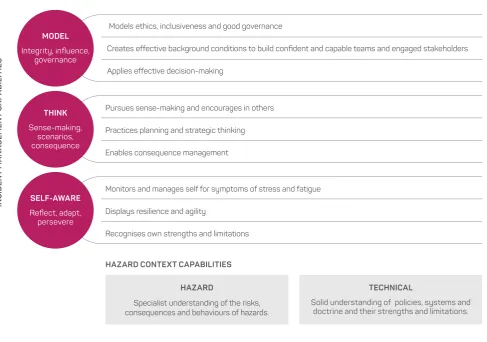
Emergency and crisis management arrangements in Australia and New Zealand have facilitated an industry-wide approach to adopting similar standards relevant to the sector. An emergency and crisis management professionalisation scheme was based on the three core capabilities developed using an evidence-based approach (Owen et al. 2016) and are shown in Figure 1. A review of the key components by Owen and colleagues (2018) revealed significant alignment and prominent additions. The key cognitive skills identified in other domains are present (decision-making, situational awareness), the social skills are included (background conditions for teams, encouraging others) as are the skills associated with thinking and wellbeing. Where this approach departs from, and potentially improves on, non-technical skills is with respect to individual ‘qualities’ or values (i.e. ‘modelling ethics and inclusiveness’ and ‘recognises own strengths and limitations’). The inclusion of these more ‘personal’ skills reflects the challenges of working in incident management and the exposure to the major consequences of incidents on a regular basis. Assistant Commissioner Rob McNeil during Australia’s SAR deployment to Fukushima. In highly novel
Research
Hayes and Omodei (2011) identified the competencies required for wildfire Incident Management Team members, and Butler, Honey and Cohen-Hatton (2019) built a set of behavioural markers for United Kingdom Fire and Rescue Service incident commanders. This includes the articulation of a set of skills that are human-centric and non-technical. However, the typical emergency and crisis management response to providing professional development for non-technical skills has been piece-meal at best. While the Australasian Inter-Service Incident Management System (AIIMS) includes basic human-factor modules, this is not as coherent a response as the Crew Resource Management or Bridge Resource Management programs. AIIMS was developed for a particular segment of emergency and crisis management (e.g. natural hazards) and does not include other sectors involved in emergency and crisis management such as police, local governments, the critical infrastructure sector and environment agencies. The response should not be limited to training. Non-technical skills assessment needs to be embedded in operations as part of assurance activities to
demonstrate the system is operating as intended. There is still significant work to do in emergency and crisis management to develop and maintain non-technical skills and to operate in complex teams during response and recovery stages.
Improvements to extended non-technical skills are unlikely to be sufficient, especially if the incident being managed increases in scale and novelty and becomes a disaster or an organisational crisis. Under these circumstances, new skills that support human performance are likely to be related to creativity.
Creativity
Research on creativity has its origins in psychology (Guilford 1950). Subsequent research identified the traits of creativity and the creative process (Hennessey 2010). This early work concentrated specifically
on the individual and understanding the nature of their creativity, with an emphasis on identifying the component parts that should be included (Torrance 1966). Later, empirical research started exploring why some groups are more effective than others. This research focused on creativity as an outcome of teamwork (Hackman & Morris 1975). Researchers referred to creativity as an outcome product or a service that was conducted by research teams within an organisational environment (Amabile et al. 1996). In organisational contexts, creative solutions may be expressed in both tangible and intangible forms such as strategies and ideas (Oldham & Cummings 1996; Woodman, Sawyer & Griffin 1993). This marks a shift
HAZARD
Specialist understanding of the risks, consequences and behaviours of hazards.
TECHNICAL
Solid understanding of policies, systems and doctrine and their strengths and limitations. Models ethics, inclusiveness and good governance
Creates effective background conditions to build confident and capable teams and engaged stakeholders
Applies effective decision-making
Pursues sense-making and encourages in others
Practices planning and strategic thinking
Enables consequence management
Monitors and manages self for symptoms of stress and fatigue
Displays resilience and agility
Recognises own strengths and limitations
MODEL
Integrity, influence, governance
THINK
Sense-making, scenarios, consequence
SELF-AWARE
Reflect, adapt, persevere
IN
C
ID
ENT
M
A
N
A
G
EM
ENT
CA
P
A
B
ILI
TI
ES
CORE INCIDENT MANAGEMENT CAPABILITIES
[image:3.595.63.551.79.421.2]HAZARD CONTEXT CAPABILITIES
can be defined as the development of novel and useful ideas in any domain (Amabile et al. 1996).
Team creativity
The foundations of contemporary creativity theory in the context of organisations is underpinned by two main theoretical frameworks. These are the interactionist model (Woodman, Sawyer & Griffin 1993) and the componential model (Amabile 1988, Amabile et al. 1996). The Woodman, Sawyer and Griffin (1993) interactionist model identifies the various social and organisational influences on creativity and separates these into three levels: individual, group and organisation. At the individual level, elements of creativity include personality, creative behaviour, cognitive abilities, intrinsic motivation and knowledge. At the group level, creativity is affected by the composition, characteristics and processes of the group. Both the individual and group levels are influenced by social and contextual features. At the organisation level, creativity is dependent on the individual and the composition of individuals in a group as well as the structural elements of the organisation, including communication and information arrangements (Woodman, Sawyer & Griffin 1993).
The componential model of creativity associates
individual creativity to the social and contextual features of the organisation (Amabile 1988). Therefore, creativity within organisations tends to develop novel and useful solutions by virtue of an individual’s creativity (Amabile 1983, Staw 2009). Complementing this, group and team creativity is a collection of individual work undertaken interdependently on a collective task (Woodman, Sawyer & Griffin 1993, Zhou & Shalley 2008). Therefore, team creativity is a function of aggregated individual creativity and of team creativity-relevant processes, which include goal setting, participation in team problem-solving and synthesising ideas (Taggar 2002). Notably, team creativity relies on the individual’s creative ideas that derive from knowledge repositories and cognitive abilities as well as on the team’s capabilities to recognise and apply such ideas (Baer et al. 2008). Amabile and Pratt (2016) posit that creativity is reliant on individuals and teams generating novel ideas and that the two are, therefore, intrinsically linked. Consequently, individual and team creativity in the componential model require three distinct yet complementary components to be creative, being:
• skills in the task
• creativity-relevant processes
• an intrinsic motivation to do the task (Amabile 1988, Amabile & Pratt 2016, van Knippenberg & Hirst 2015). Individuals and teams require cognitive skills to be creative, but to maintain creativity they also have to be intrinsically motivated (Amabile et al. 1996, Hon 2011). Intrinsic motivation safeguards against distractions and
risks that encourages radical creativity (Amabile et al.
1996). Radical creativity can be defined as generating completely novel paradigms as opposed to incremental creativity that involves expanding on or making improvements to current paradigms (Audia & Goncalo 2007, Gilson & Madjar 2011, Unsworth 2001).
The basis for creative performance includes the individual’s expertise and factual knowledge and their technical skills for doing work and advancing their knowledge (Amabile 1988, Amabile & Pratt 2016). The creativity of an individual in a team requires the basic resources at the organisational level (Amabile & Pratt 2016; Woodman, Sawyer & Griffin 1993). Therefore, teams require adequate resources from the organisation to aid creativity. This comprises of sufficient
infrastructure within and external to the organisation and access to necessary information (Amabile & Pratt 2016). An important organisational characteristic when fostering a creative environment is allowing the time for teams to explore creative solutions and implement those solutions effectively (Lawson 2001). Given the complex nature of most problems facing contemporary organisations, there may be a requirement for skills in multiple domains for the most novel and useful ideas (Amabile & Pratt 2016).
The componential model of creativity includes
creativity-relevant processes, or the skills required for creative thinking (Amabile 1988, Amabile et al. 1996). Creativity-relevant processes include cognitive styles, perceptual styles and thinking skills. These attributes allow individuals and teams to take new perspectives on problems, think broadly and pivot among ideas. Creativity requires the generation of ideas that are divergent, but this does not necessarily lead to generating a lot of ideas (Amabile 1988, Audia & Goncalo 2007). When an individual’s or a team’s thinking is narrowly focused on the refinement of an existing non-creative idea, this may not result in the generation of divergent ideas. Conversely, once an individual or team has generated a creative idea, future creative efforts may be framed from the perspective of the initial idea (Audia & Goncalo 2007).
Important elements in any creativity-relevant process is the ability to think divergently and to refine the creative ideas for the selection of solutions. This requires convergent thinking (Sowden, Pringle & Gabora 2015). To foster creativity needs a harmonious relationship between divergent and convergent thinking. Consequently, it is important that individuals and teams recognise when to decouple from divergent thinking and switch to convergent thinking (Sowden, Pringle & Gabora 2015). Managing extremely divergent ideas that assist making unusual associations may be risky (Amabile & Pratt 2016, Audia & Goncalo 2007). In addition,
Research
& Farh 2009). Novelty and value are critical features of creativity-relevant processes. However, although they are complementary, they are separate skills and both must be present for creativity to occur in decision-making (Sommer & Pearson 2007).
Linking creativity and
decision-making
A creative decision is defined as:
…a decision that is both a novel contribution and of value to a decision context. A novel decision is unusual, uncommon, unconventional or unique from past decisions and reflects responses to new or unique choices for solving a problem in a crisis. In regard to crisis management, a valuable or effective decision occurs when potential crises are averted or when key stakeholders believe that the short- and long-term successes of crisis management efforts have outweighed the failures.
(Sommer & Pearson 2007, p.1236).
Sommer and Pearson (2007) argue that novelty and value are complementary but separate characteristics and both must be present for creativity to occur. Solutions that are of high-value but not novel have presumably already been evaluated and either implemented or discarded. This is why individuals or teams might need to come up with other creative solutions.
Divergent thinking
Much of what is understood about creativity, particularly in how it is measured, comes from studying divergent thinking. The backbone of creativity assessment is divergent thinking (Kaufman, Plucker & Baer 2008) that can be defined as cognitive thought that leads in various directions. This suggests that it does not converge on one correct answer but diverges to a range of possible answers. Four aspects of divergent thinking are frequently measured, which is more complex than Sommer and Pearson’s (2007) articulation of creativity in decision-making:
1. Fluency – the number of responses to a particular stimulus.
2. Originality – the uniqueness of the responses. 3. Flexibility – the number and uniqueness of the
categories of response, adapting and changing the meaning, use or interpretation of something. 4. Elaboration – extending or adding detail to the
responses.
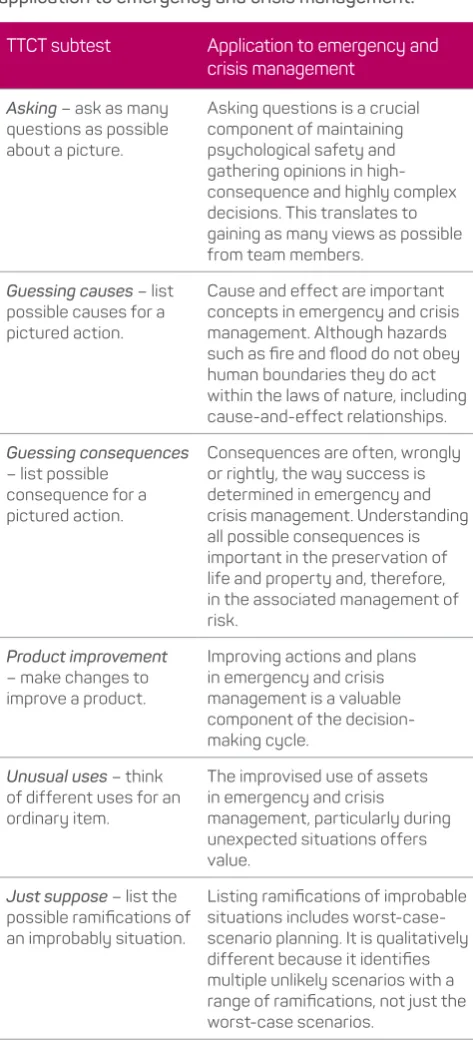
The dominant test of divergent thinking is the Torrance Tests of Creative Thinking (TTCT) that is ‘by far the most commonly used test of divergent thinking and continues to enjoy widespread international use’ (Kaufman, Plucker & Baer 2008, p.25). Table 1 lists the various tests
within the TTCT and shows how associated skills and knowledge might be functionally valuable in emergency and crisis management.
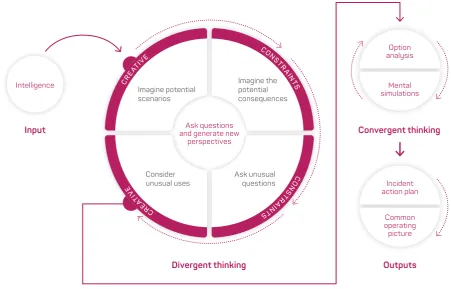
[image:5.595.314.551.90.612.2]Using these elements to create a model of divergent thinking linked to the products of managing an incident, disaster or crisis, shows there is significant benefit from divergent thinking. Asking questions is important in building situational awareness and supporting a ‘common operating picture’. Many elements contribute to developing options and integrating them within an Incident Action Plan (causes, consequences, different uses of assets and improbable situations and Table 1: Categories of creativity in the Torrance Test and application to emergency and crisis management.
TTCT subtest Application to emergency and crisis management
Asking – ask as many questions as possible about a picture.
Asking questions is a crucial component of maintaining psychological safety and gathering opinions in high-consequence and highly complex decisions. This translates to gaining as many views as possible from team members.
Guessing causes – list possible causes for a pictured action.
Cause and effect are important concepts in emergency and crisis management. Although hazards such as fire and flood do not obey human boundaries they do act within the laws of nature, including cause-and-effect relationships.
Guessing consequences
– list possible consequence for a pictured action.
Consequences are often, wrongly or rightly, the way success is determined in emergency and crisis management. Understanding all possible consequences is important in the preservation of life and property and, therefore, in the associated management of risk.
Product improvement
– make changes to improve a product.
Improving actions and plans in emergency and crisis management is a valuable component of the decision-making cycle.
Unusual uses – think of different uses for an ordinary item.
The improvised use of assets in emergency and crisis management, particularly during unexpected situations offers value.
Just suppose – list the possible ramifications of an improbably situation.
ramifications). Monitoring risk and revision of the plan improves activities and processes.
This study revealed a tenfold increase in creative output when emergency and crisis management personnel were given a set of constraints (resources and context) in which to think divergently (Curnin & Brooks, forthcoming). Rosso (2014) identified that some theorists find that creative individuals and teams can benefit from constraints. A study by Medeiros Partlow and Mumford (2014) asked participants to develop advertising campaign materials. The study found that task objective constraints resulted in better creative problem-solving when participants were motivated. However, imposition of multiple constraints led to poorer creative problem-solving. This suggests there is still work required to understand how constraints support or impede creativity.
In the context of emergency and crisis management, creativity can be bound by several constraints. These include hierarchical structures, standard operating procedures, bureaucratic expectations and legal prescription that influence the creative process. However, these is a move away from prescriptive standard operating procedures during non-routine events within some emergency services agencies. For example, the Tasmania Fire Service provides six operational priorities for leaders to consider when bushfires are uncontrolled (Tasmanian Government 2013). These options are not sequential in nature and allow personnel to consider multiple options simultaneously due to the interconnected nature of
priorities. This type of approach is consistent with the elements associated with divergent thinking. Nevertheless, it remains to be seen if the sector and importantly, commissions of inquiry that predominantly favour a traditional decision-making method, will accept this creative approach.
When a team has considered the creative constraints and has thought divergently to produce creative output, they then must hone it in order to make it fit-for-purpose. This process is the change from divergent to convergent thinking. Convergent thinking is a deliberate process that involves screening, selecting, evaluating and refining options. In emergency and crisis management this could include performing these deliberate tasks for the best- and worst-case scenarios, the most likely scenario or anything in-between.
Finally, the team should perform a ‘reality test’ on the preferred option(s) to establish feasibility. This is akin to the mental simulation identified in the Recognition Primed Decision-Making Model (Zsambok & Klein 1997). It is also necessary to work within the management system, informing the Common Operating Picture and developing the products the systems required, such as Options Analyses and the Incident Action Plan.
Conclusion
[image:6.595.60.512.79.368.2]There is still significant work required in emergency and crisis management to develop and maintain what might be described as ‘foundational’ non-technical skills during Figure 2: A method to develop creative solutions in disasters and crises.
Convergent thinking Input
Outputs Intelligence
Ask questions and generate new
perspectives Imagine potential
scenarios
Imagine the potential consequences
Ask unusual questions Consider
unusual uses
C
REA
TIVE
CR EA TI VE
CO NS
TR AIN
TS
C O N ST
RA
IN TS
analysis
Mental simulations
Common operating picture Incident action plan
Research
response and recovery phases. Skills include cognitive, social and wellbeing skills as well as ethical or value-based competencies. As the ‘new norm’ includes larger, more complex, multi-hazard and multi-jurisdictional incidents, the skills associated with creativity might be added to this group. While the ‘norm’ might be new, an old example by Weick (1993) can demonstrate the challenges to building creative skills in emergency and crisis management:
On 5 August 1949, a wildfire overran sixteen firefighters in Mann Gulch on the Helena National Forest in Montana in the United States. Only three survived the supervisor and two members of an eighteen-person ‘smokejumper’ crew that had parachuted into a small valley or gulch near the fire. These deaths were a shocking loss to the firefighters’ families and friends. The tragedy was also a severe blow to the Forest Service, which had not experienced a fatality during a decade of ‘smoke-jumping’ and was extremely proud of its elite firefighters. Repercussions from this incident were severe and long lasting (Rothermel, 1993). In his seminal study of the Mann Gulch fire, Weick (1993) notes:
‘Dodge’s invention of burning a hole in a fire should not have happened. It should not have happened because there is good evidence that when people are put under pressure, they regress to their most habituated ways of responding. This is what we see in the 15 people who reject Dodge’s order to join him and who resort instead to flight, a more overlearned tendency. What we do not expect under life-threatening pressure is creativity’.
(Weick 1993, p.638–639).
Equally, other disasters highlight this challenge. They also indicate why any form of divergent thinking needs to be brought back to reality by convergence with the key systems and products of incident response and recovery.
The CRC project associated with this research has explored the skills associated with divergent thinking. It was clear that each of the six divergent thinking sub-skills had a role in emergency and crisis management decision-making. The challenges include identifying when creativity is required, how to use constraints to enhance creativity and other challenges related to previous training, risk aversion and organisational cultures that stipulate compliance. Workshops conducted with participants from across emergency and crisis management in this area produced the comment:
I’ve spent my whole career learning how to operate within this system, but now you want me to think outside it? I’m up for the challenge, but it’s going to take more than a workshop to achieve the outcome.
The work continues.
References
Amabile TM 1988, A Model of Creativity and Innovation in Organizations. Research in Organizational Behavior, vol. 10, no. 1, pp.123–167.
Amabile TM, Conti R, Coon H, Lazenby J & Herron M 1996,
Assessing the Work Environment for Creativity. Academy of Management Journal, vol. 39, no. 5, pp.1154–1184.
Amabile TM & Pratt MG 2016, The dynamic componential model of creativity and innovation in organizations: Making progress, making meaning. Research in Organizational Behavior, vol. 36, pp.157–183. doi.org/10.1016/j.riob.2016.10.001
Audia PG & Goncalo JA 2007, Past Success and Creativity over Time: A Study of Inventors in the Hard Disk Drive Industry. Management Science, vol. 53, no. 1, pp.1–15. doi.org/10.1287/mnsc. l060.0593
Baer M, Oldham GR, Jacobsohn GC & Hollingshead AB 2008, The Personality Composition of Teams and Creativity: The Moderating Role of Team Creative Confidence. Team Personality Composition and Creativity, vol. 42, no. 4, pp.255–282.
Brooks B, Curnin S, Bearman C, Owen C, Rainbird S 2016, An assessment of the opportunities to improve strategic decision-making in emergency and disaster management, Australian Journal of Emergency Management, vol. 1, no. 4, pp.38–43.
Committee on Homeland Security and Governmental Affairs 2006,
Hurricane Katrina: Recommendations for Reform. U.S.Government Printing Office, Washington DC.
Butler PC, Honey RC & Cohen-Hatton SR 2019, Development of a behavioural marker system for incident command in the UK fire and rescue service: THINCS. Cognition, Technology and Work. doi.10.1007/s10111-019-00539-6
Flin R, O’Connor P & Crichton M 2008, Safety at the sharp end: A guide to non-technical skills. Aldershot: Ashgate.
Gilson LL & Madjar N 2011, Radical and Incremental Creativity: Antecedents and Processes. Psychology of Aesthetics, Creativity, and the Arts, vol. 5, no. 1, pp.21–28. doi.org/10.1037/a0017863
Gong Y, Huang JC & Farh J-L 2009, Employee learning orientation, transformational leadership, and employee creativity: The mediating role of employee creative self-efficacy. Academy of Management Journal, vol. 52, no. 4, pp.765–778. doi.org/10.5465/ AMJ.2009.43670890
Guilford JP 1950, Creativity. American Psychologist, vol. 5, no. 9, pp.444–454.
Hackman JR & Morris CG 1975, Group tasks, group interaction process, and group performance effectiveness: A review and proposed integration. In L. Beckowitz (Ed.), Advances in experimental social psychology, vol. 8, pp. 7–101. New York: Academic Press.
Haiven M 2010, The Financial Crisis as a Crisis of Imagination. Cultural Logic, vol. 17, pp.1–23. doi.org/10.14288/clogic.v17i0.191526
Hayes P & Omodei MM 2011, Managing emergencies: Key competencies for incident management teams. The Australian and New Zealand Journal of Organisational Psychology, vol. 4, pp.1–10.
Hennessey BA 2010, The creativity-motivation connection. In C. Kaufman & R. J. Sternberg (Eds.), The Cambridge Handbook of Creativity, pp.342–365. New York: Cambridge University Press.
Hon AHY 2011, Enhancing employee creativity in the Chinese context: The mediating role of employee self-concordance. International Journal of Hospitality Management, vol. 30, no. 2, pp.375–384. doi.org/10.1016/j.ijhm.2010.06.002
Medeiros K, Partlow P & Mumford M 2014, Not too much, not too little: The influence of constraints on creative problem solving. Psychology of Aesthetics, Creativity, and the Arts, vol. 8, no. 2, pp.198–210.
National Commission on Terrorist Attacks upon the United States 2004, The 9-11 Commission report: final report of the National Commission on Terrorist Attacks upon the United States. At: http:// govinfo.library.unt.edu/911/report/911Report.pdf.
Oldham GR & Cummings A 1996, Employee Creativity: Personal and Contextual Factors at Work. The Academy of Management Journal, vol. 39, no. 3, pp.607–634.
Owen C, Hayes P, Brooks B, Scott C & Conway G 2016, Supporting evidence for the Emergency Management Professionalisation Scheme: Core incident management capabilities. Melbourne: Australasian Fire and Emergency Service Authorities Council.
Owen C, Hayes P, Brooks B, Scott C & Conway G 2018, Evidence to support incident management team capability. Australian Journal of Emergency Management, vol. 33, no.3, pp.44–49.
Rosso B 2014, Creativity and Constraints: Exploring the Role of Constraints in the Creative Processes of Research and Development Teams. Organization Studies, vol. 35, no. 4, pp.551–585.
Shalley CE & Perry-Smith JE 2001, Effects of social-psychological factors on creative performance: The role of informational
and controlling expected evaluation and modeling experience. Organizational Behavior and Human Decision Processes, vol. 84, no. 1, pp.1–22.
Sommer A & Pearson CM 2007, Antecedents of creative decision making in organizational crisis: A team-based simulation. Technological Forecasting and Social Change, vol. 74, no. 8, pp.1234– 1251. doi.org/10.1016/j.techfore.2006.10.006
Sowden PT, Pringle A & Gabora L 2015, The shifting sands of creative thinking: Connections to dual process theory. Thinking & Reasoning, vol. 21, no. 1, pp.40–60. doi.org/10.1080/13546783.2014 .885464
Staw BM 2009, Is Group Creativity Really An Oxymoron? Some Thoughts on Bridging the Cohesion? In E. A. Mannix, M. A. Neale, & J. A. Goncalo (Eds.), Research on Managing Groups and Teams, vol. 12, pp.311–323. Bingley: UK: Emerald Books. doi.org/10.1108/ S1534-0856(2009)0000012006
Taggar S 2002, Individual Creativity and Group Ability to Utilize Individual Creative Resources: A Multilevel Model Author: Simon Taggar Source: The Academy of Management Journal, vol. 45, no. 2. pp.315–330. doi.org/10.2307/3069349
Tasmanian Government 2013, Tasmanian Bushfires Inquiry – Volume 2 – Appendix E4: Explanation of Tasmanian Fire Services 6 Operational Priorities when bushfires are burning out of control. Tasmanian Government Press, Hobart.
Torrance EP 1966, The Torrance Tests of Creative Thinking-Norms-Technical Manual Research Edition-Verbal Tests, Forms Aand B-Figural Tests, Forms A and B. Princeton, New Jersey: Personnel Press.
Unsworth K 2001, Unpacking Creativity. The Academy of Management Review, vol. 26, no. 2, pp.289–297.
van Knippenberg D & Hirst G 2015, A cross-level perspective on creativity at work: Person-in-situation interactions. In J. Zhou, M. A. Hitt & C. Shalley (Eds.), The Oxford Handbook of Creativity, Innovation and Entrepreneurship, pp.225–244. Oxford Library of Psychology.
Weick K E 1993, The Collapse of Sensemaking in Organizations: The Mann Gulch Disaster. Administrative Science Quarterly, vol. 38, no. 4, p.628. doi.org/10.2307/2393339
Woodman RW, Sawyer JE & Griffin RW 1993, Toward a Theory of Organizational Creativity. The Academy of Management Review, vol. 18, no. 2, pp.293–321.
Zhou J & Shalley CE 2008, Handbook of organizational creativity. Hillsdale, NJ: Lawrence Erlbaum Associates.
Zsambok C & Klein G 1997, Naturalistic Decision Making. Psychology Press, New York.
About the authors
Associate Professor Benjamin Brooks is a human factors researcher and Senior Research Fellow in the Australian Maritime College at the University of Tasmania.
Dr Steve Curnin studies the human factors of disaster resilience and how we can improve management of these events at the University of Tasmania.
Associate Professor Christine Owen is an
organisational behaviour and learning researcher at the University of Tasmania.
Jason Bolderman is an Incident and Security Manager at Seqwater and his work includes