Genetic-Algorithmic Optimisation for School-Allocation Mechanisms
A Study of Amsterdam’s Student to High-School Allocation ProblemMSc Thesis
(Afstudeerscriptie)
written by
Philip W.B. Michgelsen
(born May 30th, 1990 in Enschede, The Netherlands)
under the supervision of Prof. Dr. Jan van Eijck, and submitted to the Board of Examiners in partial fulfillment of the requirements for the degree of
MSc in Logic
at theUniversiteit van Amsterdam.
Date of the public defense: Members of the Thesis Committee: July 5th, 2016 Dr. A. Baltag
Prof. Dr. J. van Eijck Prof. Dr. B. van der Klaauw Dr. C. Schaffner
Foreword
Abstract
In the municipality of Amsterdam, students who graduated from primary school, are allocated to high schools through a school-allocation mechanism. In recent years, different school-allocation mechanism have been used and all have been criticised by the public. This thesis investigates the school-allocation mechanisms that have been used in Amsterdam, from a mathematical point of view, and aims to make it mathematically clear and formal what properties a school-allocation mechanism must have, according to the municipality of Amster-dam’s policy makers, and what properties the used allocations mechanisms actually have. Furthermore, this thesis aims to explore if a genetic-algorithmic optimisation method can help in the design of a new school-allocation mechanism, which can outperform the school-school-allocation mechanisms used in Amsterdam. The two most important formal properties desired of school-allocation mechanisms by policy makers, are Pareto consistency and strategy proofness. A school-allocation mechanism is Pareto consistent if it only produces Pareto-optimal allocations. In addition, other conditions are posed by Amsterdam’s policy makers, which determine, given two Pareto-optimal allocations, which is considered to be better. With these additional conditions, an objective fitness function can be given, which determines which Pareto-optimal allocation is fittest. The existence of a particular school-allocation mechanism, the Permutation Allocation Mechanism, which is able to produce all Pareto-optimal allocations for some given school market, makes it then possible to find the fittest Pareto-optimal school allocation by using a genetic-algorithmic optimisation method. This thesis shows that the so obtained genetic-algorithmic optimised school-allocation mechanism is expected to statistically outperform its not-optimised counterpart.
Acknowledgments
Contents
1 Introduction 1
2 Background 2
2.1 Dutch School System . . . 2
2.2 Amsterdam High Schools . . . 4
2.3 School-Allocation Mechanisms in Amsterdam . . . 6
2.4 Deferred Acceptance in Amsterdam . . . 8
2.5 Looking Ahead . . . 10
3 School Allocations 11 3.1 School Allocations . . . 11
3.2 Student Preferences . . . 12
3.3 School Markets . . . 14
3.4 Priorities . . . 14
3.5 Properties of Allocations . . . 15
4 School-Allocation Mechanisms 19 4.1 Mechanisms . . . 19
4.1.1 Permutation Allocation Mechanism . . . 20
4.1.2 Boston Allocation Mechanism . . . 23
4.1.3 Deferred Acceptance School-Allocation Mechanisms . . . 27
4.2 Strategic Questions . . . 32
4.2.1 Strategy Proofness . . . 32
4.2.2 Strategic Investigations of School-Allocation Mechanisms . . . 34
4.3 Simulations with Mechanisms . . . 36
4.4 Mechanisms for Amsterdam . . . 38
5 Genetic Optimisation 40 5.1 Optimisation . . . 40
5.2 Genetic Algorithms . . . 40
5.3 Reproduction . . . 43
5.4 Genetic Optimisation of School Allocations . . . 45
5.4.1 Organisms and Chromosomes . . . 45
5.4.2 Fitness Function and Reproduction . . . 46
5.4.3 Chromosome Manipulation: Crossover and Mutation . . . 47
5.4.4 GOPAM . . . 49
5.5 Simulations with the GOPAM . . . 51
5.6 Genetic-Algorithmic Optimisation for Allocation Mechanisms . . . 52
7 Appendix: Computational Implementations 57
7.1 Haskell . . . 57
7.1.1 Imported Modules and Introduced Types . . . 57
7.1.2 General Help Functions . . . 57
7.2 School Allocation Mechanisms . . . 59
7.2.1 Permutation Allocation Mechanism . . . 59
7.2.2 Boston Allocation Mechanism . . . 60
7.2.3 Deferred Acceptance . . . 61
7.3 GOPAM . . . 62
7.3.1 Help Functions . . . 62
7.3.2 The GOPAM . . . 63
Chapter 1
Introduction
In recent years, in the municipality of Amsterdam, students who graduated from primary schools, were allo-cated to high schools through a school-allocation mechanism. The mechanism used for this alloallo-cated students to high schools based on preference lists handed in by students using a deferred acceptance school-allocation mechanism. The first deferred acceptance mechanism used was severely criticized, because it resulted in Pareto-inefficient school allocations. An allocation Ais Pareto inefficient, if there exists some allocationA′
in which some students are assigned a school which they prefer over the school assigned to them inA, and no student is assigned a school inA′, which the student likes less than the school assigned inA. In particular, it meant that the allocation, produced by the school-allocation mechanism in Amsterdam, gave students rational trade options: in the final allocation some students could, by switching places, both be better off, based on their handed-in preference list. Such school swaps were not allowed, since they would render the allocation mechanism not strategy proof. In a strategy-proof allocation mechanism, the dominant strategy for students is to reveal their true school preferences. Strategy proofness was an important motivation of the representative body of Amsterdam’s high schools and the municipality of Amsterdam, for choosing the Deferred Acceptance school-allocation algorithm.
In this theses different known school-allocation mechanisms will be investigated from a mathematical point of view. The Amsterdam school-allocation problem of allocating primary school students to high schools accord-ing to handed-in preference lists, will be taken as the point of departure. All school-allocation mechanisms investigated in this thesis are mechanisms that closely resemble mechanisms that have been used in Amster-dam to allocate students to high schools. The goal of this thesis is twofold. First, this thesis aims to make it mathematically clear and formal what properties the Amsterdam policy makers wish a school-allocation mechanism to have and what specific properties allocations produced by the different known mechanism ac-tually have. Second, this thesis aims to explore if a genetic-algorithmic optimisation method can help in the design of a new school-allocation mechanism, which can outperform the known school-allocation mechanisms. It is the hope of the author that (i) this thesis enables policy makers to choose a school-allocation mechanism best suited for the specific problems of Amsterdam, and that (ii) this thesis shines light on a new innovative approach to school-allocation mechanisms by using genetic algorithms to optimise known school-allocation mechanisms.
Chapter 2
Background
2.1
Dutch School System
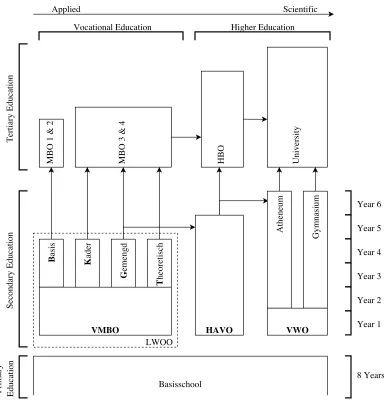
The Netherlands educational system is divided into three ‘horizontal’ levels: primary, secondary and tertiary education. The three horizontal education levels consist of different ‘tiers’, which range from a more applied to a more scientific orientation. The primary school level consists of only one tier, which is called ‘basisschool’. The secondary school level consists of three tiers VMBO, HAVO and VWO, where both the VMBO and VWO tiers are further subdivided into different programs (again ranging from a more applied to a more scientific focus). Furthermore, VMBO students have the possibility to follow their education with extra aid called LWOO (NL: leerwegondersteuenend onderwijs).1 The tertiary education level consists of vocational educa-tion (MBO) and higher educaeduca-tion (HBO and University). All schools in the secondary educaeduca-tion level will be called ‘high schools’ in the following. Figure 2.1 below gives a schematic overview of the Dutch school system. In the Netherlands there is compulsory education. TheCompulsory Education Act of 1969, requires students to be enrolled in a registered school from the age of 5 for at least 12 school years or until the end of the school year in which the student turns 16. After this period, students who do not have obtained a diploma for HAVO, VWO or MBO two and higher, will have to follow education until they have done so, or until they turn 18. This means that in The Netherlands there is de facto compulsory education until the age of 18.2 Since primary school normally takes eight years and students usually are five years old in the first year, all students who attend ‘basisschool’ will subsequently attend secondary education.
Every student, upon leaving primary school, receives an official school recommendation (NL: schooladvies), composed by the teaching staff, which dictates for which secondary education the student may apply.3 Stu-dents then apply themselves for some secondary school and educational program, that is in line with the school recommendation. Students are allowed to apply for more applied programs than advised, but may not apply to more more scientific programs than recommended in the official recommendation. Secondary schools are obliged, barring some rare exceptions, to accept the applying students, if the application is in accordance with the school recommendation.4 Since some schools are very popular and school capacities
are limited, schools have to fairly decide which students to enrol and which not. To help this decision pro-cess school-allocation mechanisms have been introduced, either by schools individually (e.g. lotteries) or by schools collectively (e.g. matching mechanisms).
1For students with special educational needs for which the before mentioned secondary education tiers (also with extra aid)
are too demanding, there exists a special form of secondary education: praktijkonderwijs. In the following, due to the very limited size and special nature of this form of education, we will not regardpraktijkonderwijsas secondary education.
2Article 3 and 4a of the Compulsory Education Act of 1969 (NL: Leerplichtwet 1969).
3There is no legal bound on the number of tiers that may be advised by the teaching staff to some student, although the
PO-raad and VO-raad (the representative bodies of respectively primary and secondary schools) claim that no more than two tiers or programs can be advised.
4Article 2 sub 1, in conjunction with, article 3 sub 2, of the Organisational Decision on the Law on Secondary Education
Figure 2.1: Schematic Representation of the Dutch School System
This problem is known (in Amsterdam) as the capacity problem. It is important to stress again, that this capacity problem by no means implies that some students will not be able to follow secondary education in the educational tier of their liking within an acceptable distance from their home. If in the following there is any reference to a capacity problem it is meant that more students prefer to enrol at some particular high school than it can offer seats.
2.2
Amsterdam High Schools
This thesis investigates school-allocation mechanisms that have been used or may be used in the municipality of Amsterdam. To better understand the need for a good school-allocation mechanism in Amsterdam, it is important to first clarify the present situation of secondary education in Amsterdam.
In the City of Amsterdam, the local government, the municipality of Amsterdam, and the the representative body of all high schools and vocational education institutions in Amsterdam, the OSVO, agree on further legislation on the transfer from primary education to secondary education in the City of Amsterdam, every year, in a document called the ‘Core Procedure Transfer Primary Education Secondary Education’ (NL: kernprocedure Overstap PO-VO).5 The regulations found in the Core Procedure include regulations on, the
official school recommendations, application to high schools, the school-allocation mechanism, providence of information on high schools, and, priorities for students for specific high schools.
The Core Procedure only allows one or twosuccessivesecondary education tiers from the enumeration below, as a school recommendation (baring some rare exceptions)6
1. VMBO-B (possibly with LWOO); 2. VMBO-K (possibly with LWOO); 3. VMBO-T (possibly with LWOO); 4. HAVO;
5. VWO;
However, the Core Procedure does not allow VMBO-T to be recommended in combination with VMBO-K.7
This means that in the City of Amsterdam students can have a school recommendation, ‘VMBO-T or HAVO,’ but not ‘VMBO-T or VWO,’ or, ‘VMBO-B or VMBO-T.’ At the end of the seventh class of primary school,8 students will be given a preliminary school recommendation; in January of the eighth class the definite official school recommendation will be given, by at least two staff members of the primary school in question, where at least one is the teacher of the eighth class.9
Each prospective high-school student, after having received information on all available schools (and their capacity), officially applies to one high school (approximately mid March of the final year of primary school). The student does this by setting up astrictpreference list of high schools, where the student puts the school (s)he prefers the most ‘highest’ (first) on the preference list. The school that is most preferred is the school where the student legally and de facto applies. This school checks if the preference list is in accordance with the high-school recommendation and if so inputs the preference list in the school-allocation mechanism.10
If some student cannot be placed, by the school-allocation mechanism at the most preferred school, then the mechanism will try to allocate the student at some other school mentioned on the preference list, in
5OSVO & Gemeente Amsterdam (2015).
6Also the recommendations ‘praktijkonderwijs’, ‘extra year of language education,’ ‘in between special provision,’ ‘special
education,’ ‘high-school preparatory class for international students,’ are allowed (cf. OSVO & Gemeente Amsterdam (2015): p. 9.).
7OSVO & Gemeente Amsterdam (2015): p. 9.
8The seventh class of primary school is internationally sometimes called the ‘fifth grade’; it is normally the seventh year of
primary school, where students are 10 to 11 years old. 9OSVO & Gemeente Amsterdam (2015): p. 10.
accordance with the order on the preference list. Prospective high-school students are urged to make the preference list as long as possible, such as to prevent that the student cannot be allocated at all to some school on his preference list. If a student cannot be placed by the mechanism, the student will be contacted by the proper authorities informing the student of this fact. All students who have not been allocated or that do not agree with the school that they are allocated to, will again go through a school-allocation mechanism, which will allocate them to some school that still has seats left, based on a new preference list over the schools that still have seats left.11 Limited by very strict legal boundaries it is allowed for schools to make use of
some priority rules for students. Examples of such priority rules are: ‘every student who applied and who has siblings already enrolled, will be granted priority,’ ‘students applying, who have attended primary schools operating under a similar educational philosophy will be granted priority,’ ’students applying whose parents are employees will be granted priority.’ Students can only make use of some priority if they place the school offering the priority highest on their preference list;12 if they do so, then they will be guaranteed a seat at
that school if and only if there are enough seats to place all priority students.13 Furthermore, compelling social or medical reasons can justify the use of the so called ‘hardship clause’ (NL: hardheidsclausule), which is a legal exception that can guarantee students a seat at some high school.
In recent years, 2013 to 2016, 7000 to 8000 students needed to be allocated to some high school.14 In 2015, the year of the test data used in this thesis, there where 53 high schools, which together offer 135 application possibilities. A high school can offer multiple application possibilities, because it can offer multiple education tiers (e.g. VMBO-T, HAVO, VWO, etc.), special tracks (e.g. music, art, dance, etc.), and combinations of tiers (e.g. HAVO/VWO class, VMBO-T/HAVO class). The application possibilities for combinations of tiers are allowed for the first years of the secondary education such that students which cannot decide between two education tiers, have the opportunity to postpone their tier decision.
Nota Bene: In the following each application possibility will be regarded as a separate high school.
In 2015 of the approximately 8000 students, one quarter had a VWO school recommendation, another quarter a HAVO or HAVO/VWO school recommendation, and the other half a school recommendation for at least one type of VMBO.15 Based on 2015 students’ preference lists, there were 25 schools (19%) for which there were more students who placed the school highest on their preference list than the school had seats available. The latter means that the ratio of available seats of some school xdivided by the number of students who place school xhighest on their preference list, the capacity indicator, was greater than one for 25 schools. There were 7 HAVO, 8 VMBO and 10 VWO high schools that had a capacity indicator greater than one in 2015. The most extreme cases were: IJburg College 1 VMBO-K, with a capacity indicator of 4.7 (47 highest preferences for 10 seats), Spinoza Lyceum HAVO, with a capacity indicator of 3.4 (199 highest preferences for 58 seats), and Spinoza Lyceum VMBO-T Art Track (NL: kunstklas), with a capacity indicator of 2.8 (156 highest preferences for 56 seats).16 Note that the capacity indicator tells something about the actual
popularity of some school, since the preference lists that were handed in by students in 2015 were made under knowledge of the fact that handing in preference lists reflecting the true preferences was a dominant strategy for the school-allocation mechanism in use then; that is, no student could be hurt by handing in his or her actual true preferences.
11OSVO & Gemeente Amsterdam (2015): §4.1 in conjunction with§6.2.
12In 2015 students could also make use of their priority for schools not placed highest on their preference list, but students
were only allowed to use one priority (OSVO & Gemeente Amsterdam (2014): p. 31 (§4.1), p. 35 (§5.1), p. 36 (§5.6), p. 28 (§5.8)).
13OSVO & Gemeente Amsterdam (2015): §4.3 in conjunction with p. 32.; Gautier et al. (2016): p. 14.
14Numbers of 2013 to 2015 from Gautier et al. (2015), p.4; numbers of 2016 published by the municipality of Amsterdam on
their website on secondary education, URL:https://www.amsterdam.nl/onderwijs-jeugd/voortgezet-onderwijs/, retrieved 14 June 2016.
15Gautier et al. (2015): p. 3.
2.3
School-Allocation Mechanisms in Amsterdam
The history of school-allocations mechanisms in Amsterdam can be described by identifying four periods (in chronological order): (i) the pre-lotteries period, (ii) the desynchronized lotteries period, (iii) the synchronized lotteries period, and (iv) the deferred-acceptance matching period. In the pre-lotteries period, no lotteries to fairly decide which student applications to accept were organised by high schools yet, because there was no capacity problem. In the first years that high schools faced more applications than they had seats available, two strategies were used by high schools to fairly decide which students to accept: they either organised a lottery, or accepted students based on time of application. The introduction of these decision mechanisms marked the beginning of the desynchronized lotteries period. Both decision mechanisms made high schools push the date of the decision on which students to accept forward each year. To overcome this, the municipality of Amsterdam and the representative body of high schools in Amsterdam, the OSVO, introduced, in 2005, strict rules for this decision process. These rules can be briefly summarised as follows:
1. each student was only allowed to apply to one school between set dates (by the OSVO);
2. high schools had to accept students based on a fair lottery, organised at a time set by the OSVO. All students who were unfortunate in the first round of lotteries could in a next similar round apply for the schools that at that time still had seats left. In this second round, students could again only apply for one school, but high schools were now allowed to either organise a fair lottery (at a set time) or to base the decision on the time of application. Students who were unfortunate twice would then be allocated by the representative body, at some high school that still had seats available, while considering the specific wishes and needs of the student.17 The introduction of these strict rules marked the beginning of the synchronized
lottery phase, and the system introduced by the municipality of Amsterdam and the OSVO can be seen as a variant of the Boston school-allocation mechanism (BAM). The BAM can be briefly described as follows:18
0. Students hand in a preference list over (all) secondary schools;
1. Each school decides by a fair lottery which students, who listed the school as their first choice, to accept.
k. Each school, with seats still available, decides by a fair lottery who of the students, who listed it as theirk-th choice, to accept.
Thek-th round is repeated, until each student is assigned a seat. An important difference between the BAM and the system used in Amsterdam in the synchronized lotteries phase, is that students are not obliged to hand in a complete preference list over all high schools in advance, but are allowed to apply for one school (for which they want to participate in the lottery) at each stage. This means that students in the Amsterdam case can hand in their preferences adaptively, based on the outcomes of earlier rounds. The introduction of strict regulations for the high-school admissions was the introduction of the first real school-allocation mechanism in Amsterdam. From that point on, there was a uniform system in place to allocate students to high schools, that in principle could have been executed by one single interactive computer program. Hence, if in the following there is a reference to school-allocation mechanisms in Amsterdam, the Amsterdam Boston variant, discussed above, will be understood as a member of this collection.
In 2012 four researchers from the Department for Research, Information and Statistics for the municipality of Amsterdam, conducted a study on what parents saw as their ‘ideal school’, which schools parents preferred for their children, their opinions on the city’s plan for new schools and on the school-allocation mechanism (i.e. the Boston variant).19 It was found that many parents found the synchronized lotteries stressful and that most parents preferred a school-allocation mechanism where a preference list over high schools can be handed in before the allocation mechanism started. Furthermore, 6 out of 10 parents indicated that they would prefer to hand in a school preference list with the three schools most preferred by their child, ordered in order of preference; almost no parent supported the city’s plan to request students to hand in preference
17OSVO & Gemeente Amsterdam (2013): §§4.1-2, 6.3, pp. 41-44, 64.
18Abdulkadiro˘glu et al. (2005): p. 369; De Haan et al. 2015: pp. 5-6.
lists of a minimal length of 15.20 The study also showed that 8 out of 10 parents found the process of the synchronized lotteries clear.21 In the same study, the researchers also found that in the year 2011, a school year in the synchronized lotteries phase, only 6% of students where unfortunate in the first round. Further-more, they found that there were no significant differences in school performances between the first-round fortunate and unfortunate students. Moreover, of the unfortunate students almost all indicated that they were equally pleased with their life as the fortunate students.22
The municipality of Amsterdam and the representative body of high schools, OSVO, decided, based on the 2012 study, to introduce a new school-allocation mechanism in 2015: a deferred acceptance school-allocation mechanism. The choice for the Deferred acceptance school-allocation mechanism was mainly based on the following two reasons:
1. it allowed students to hand in one preference list of high schools in advance;
2. handing in a preference list according to the true preferences over high schools, is a (weakly) dominant strategy in deferred acceptance school-allocations mechanisms.
Deferred acceptance school-allocations mechanism match students to high schools according to preferences of the students over high schoolsandpreferences of the high schools over students. Since in the Dutch school system high schools are obliged to accept all applying students (barring some rare exceptions) preferences of high schools over students are not allowed in a similar way as students have preferences over high schools. However, in the Amsterdam system, some students have priorities for certain schools, and these priorities can be seen as preferences of high schools over students (e.g. suppose two studentss ands′both want to go to schoola, and studentshas a priority for schoolaands′not, then this can be modelled by saying that school
a prefers sover s′). Nevertheless, there are not enough priorities to create lengthy preference lists for the high schools, which deferred acceptance mechanisms need to function well. Therefore, preference lists of high schools over students are artificially augmented. The augmenting of school preferences can then be carried out by single or multiple tie-break. The distinction between multiple tie-breaking and single tie-breaking deferred acceptance school-allocation mechanisms lies in the following:
multiple tie-breaking: every high school’s preference list is randomly augmented by an individual lottery;
single tie-breaking: one lottery determines the augmentation of each high school’s preference list
If school priorities are incorporated in high schools’ preference lists, then both under multiple and single tie-breaking not all high-school preference lists are identical, but under single tie-breaking all high-school preference lists are very similar. If school priorities are not incorporated in the high schools’ preference lists and the preference lists are thus randomly generated, then under single tie-breaking all high schools’ preference lists are identical, whereas under multiple tie-breaking this is not necessarily the case. The assign-ment of artificial preference lists over students to high schools, in the deferred acceptance school-allocation mechanisms, is where a ‘lottery element’ is incorporated in the allocation mechanisms. Based on the prefer-ence lists of the two parties (students and high schools) a deferred acceptance mechanism matches students to schools to create a high-school allocation. In 2015 the multiple tie-breaking deferred acceptance school allocation mechanism (DA-MTB) was used,23 whereas in 2016 the single tie-breaking deferred acceptance
school-allocation mechanism (DA-STB) was used; in both cases priorities were incorporated in the high schools’ preferences.24 In Chapter 3 (Theorem 4.19) it will be shown that deferred acceptance with single tie breaking, with no priorities incorporated in high school’s preferences, is equivalent to the permutation school-allocation mechanism (PAM) which is an implementation of the random serial dictatorship school-school-allocation mechanism (RSD).
20Cohen et al. (2012): pp. 46-48.
21Cohen et al. (2012): p. 44.
22Cohen et al. (2012): p. 45.
23OSVO & Gemeente Amsterdam (2014): p. 44.
2.4
Deferred Acceptance in Amsterdam
The first use of a deferred acceptance mechanism marked the beginning of the contemporary deferred accept-ing matchaccept-ing period. In 2015 the DA-MTB was used to allocate 7510 students.25 At that time, there were 9846 seats available at 53 schools, where schools, in this case, can contain multiple application possibilities (i.e. including all educational tiers offered by some the high school). There was a shortage of 998 seats to place all students at the school they preferred most. In the final allocation produced by the DA-MTB, 74% of the students were allocated to the school they preferred most26 and 95% of the students were allocated to
a school students placed in the top three of their preference list.27
The outcome of the 2015 allocation was severely criticized, because parents claimed to have been promised that 99.9% of the students would be allocated to a school students placed number one, two of three in their preference list.28 Furthermore, parents complained that the outcome of the allocation wasPareto inefficient, which means that there were pairs of students, who would, by swapping allocated schools, both be allocated to a school they preferred more. The two criticisms led to a judicial process initiated by the parents against the municipality of Amsterdam and the representative body of high schools (OSVO) before the court of Amsterdam. The aim of the lawsuit was to force the OSVO to allocate students who had been allocated to a school sixth or lower on their preference list, to a school higher on their preference list and to allow students to swap schools.29 Both requests were rejected by the court, because (i) the court did not agree that the OSVO had led parents to believe that 99.9% of the students would be allocated to a school in their top three,30 and (ii) swapping of assigned schools could not be allowed, because it may create a market for
school seats,31 it would cease to give all students equal opportunities,32 and it would render the mechanism
not strategy proof in future use.33
Interestingly, the court ruling gives insight in why the representative body of schools (OSVO) and the mu-nicipality of Amsterdam explicitly opted for astrategy-proof school-allocation mechanism (which all deferred acceptance variants are from the perspective of the students). In strategy-proof school-allocations mecha-nisms, no student can be hurt by handing in a preference list, which reflects his or her actual true high-school preferences. The arguments to opt for a strategy-proof school-allocation mechanism, noted in the court rul-ing, are (i) it reduces the number of people who hand in preference lists that do not reflect true preferences,34 (ii) it gives policy makers insight into the true preferences of students, which allows them to adjust school policy to actual needs,35and (iii) it facilitates communication, because parents and students can be genuinely instructed to hand in their true preferences, since this can never be in their own disadvantage.36
In the same month as the court proceeding, the OSVO requested a research company to conduct a satisfac-tion survey on the DA-MTB under parents, students, high-school staff and primary school staff. The study showed that 77% of the participating parents was pleased or very pleased about the DA-MTB-produced allocation. Furthermore, it became clear that 76% of the participating parents found it acceptable if their child would be allocated to a school in its ‘top three’.37 However, the study also showed that 53% of the
1143 participating parents and about half of the participating students, found it hard to identify 10 schools in order of preference. Moreover, even though 86% of the participating students were aware that it was beneficial to list as many schools as possible in their preference list, only 13% succeeded in enlisting at least
25Gautier et al. (2015): p. 4.
26Gautier et al. (2015): p. 19.
27Panel Inzicht (2015): p. 7.
28Rechtbank Amsterdam (2015): §3.3.
29Rechtbank Amsterdam (2015): §3.1.
30Rechtbank Amsterdam (2015): §4.6.
31Rechtbank Amsterdam (2015): §4.8.
32Rechtbank Amsterdam (2015): §4.8.
33Rechtbank Amsterdam (2015): §4.9.
34Rechtbank Amsterdam (2015): §4.5.
35Rechtbank Amsterdam (2015): §4.5.
36Rechtbank Amsterdam (2015): §2.7; Gautier et al. (2015b): pp. 4-5.
10 schools.38 In the first weeks of the school year, when students had enrolled in their assigned schools, the research company also assessed student satisfaction. Of students allocated to a school they ranked first or second on their preference list, 95% were pleased with the final allocation; the same was true for 50% of the students allocated to their third choice or lower. Nonetheless, 75% of the participating students allocated to a third choice or lower likes going to school at their allocated school, versus 91% for students allocated at their first or second choice.39 Another important finding of the study was that 51% of the participating par-ents found the school allocation process as a whole (school choice, application and allocation) not transparent. In 2015, in a written reply to the criticisms and the survey on the school-allocation mechanism, the munici-pality official for education Simone Kukenheim,40 expressed her disappointment in the decision for aPareto
inefficient school-allocation mechanism.41 Furthermore, she indicated five ‘starting points’, which should be
taken into account by the decision for any school-allocation mechanism:42
1. students and parents should be, to the highest possible degree, able to control to which schools the student will be allocated;
2. a school-allocation mechanism in which more students are assigned their highest preferred school, should be favoured over other allocation mechanisms; students should onlynot be allocated to their highest preferred school, if it is not possible to allocate all students who prefer that school highest to that school;
3. the final allocation should not give students any reason to want to switch seats among each other; 4. the workings of the allocation mechanism should be clear to parents, students and schools and must be
transparent;
5. the allocation mechanism should provide the final allocation within a couple of weeks.
In short, this means that the municipality of Amsterdam finds any school-allocation mechanism sufficient (1) if it respects preferences of students, (2) if it tries to place as much students as possible on their highest preferred school, (3) if it is Pareto consistent,43and (4) if it is comprehensible and (5) fast. Starting points 2, 3 and 5 can be safely translated into a mathematical setting. In fact, it can be demonstrated mathematically that the DA-STB, under certain conditions, satisfies starting points 3 and 5, and, to a certain degree, also 2. Since the DA-STB was adopted in some form, after this statement of the municipality official, it can be concluded that the authorities deem the DA-STB used in Amsterdam, to satisfy starting points 1 and 4. This conclusion gives a point of reference to determine if other school-allocation mechanisms satisfy these starting points 1 and 4.
In 2016 the DA-STB was used to allocate 7453 students. There were 10196 seats available, at 62 schools, where schools, in this case, can contain multiple application possibilities (i.e. including all educational tiers offered by some the high school). There was a shortage of almost a thousand seats to place all students at the school they preferred most. In the final allocation 83.66% of the students was placed at the school of their highest preference (for 2015 DA-MTB only 74%) and 95.23% was allocated a seat in a school in their top three.44 Because it is expected under DA-STB that some students will be placed at a school very low
on their preference list, students and parents were advised to hand in longer preference lists than previously, when the DA-MTB was used. The length of the preference lists was 7.72 on average (this was 5.25 in 2015 for DA-MTB), for VWO students this was 11.19 (this was 6.7 for DA-MTB).45 The DA-STB was unable to allocate 37 students (0.005%) of which 11 students (30% of 37) had only one school on their preference list, 18 students (49% of 37) had less than four schools, and 9 students (19% of 37) ten or more schools. Students
38Panel Inzicht (2015): p. 29.
39Panel Inzicht (2015): p. 34.
40A political appointment in the executive branch of the municipal government (NL: Wethouder Onderwijs).
41Kukenheim (2015): pp. 2-3.
42Kukenheim (2015): pp. 3-4.
43N.B. a school-allocation mechanism that produces Pareto-optimal allocations is called Pareto consistent.
44OSVO (2016); Gautier et al. (2016): p. 15.
with a VWO school recommendation were overrepresented among the not-allocated students (49% of 37).46 The representative body of high schools organised another ‘run’ of DA-STB for all students who were not allocated or unhappy with their assignment. These students could hand in a new preference list over schools that (by now) still had seats available. 21 of the 37 not-allocated students and 46 previously allocated stu-dents participated in this second round. All stustu-dents participating in this second round were allocated to the school of their first choice (in theirnew preference list over still available schools).47
In 2016, 1020 students (14%) had placed a school for which they were offered priority, highest on their preference list (in comparison, in 2015, when the DA-MTB was used, 811 students (11%) placed a school for which they were offered priority highest). In the specific DA-STB adopted in Amsterdam, students could only use their priority if they placed the school for which they had a priority highest on their preference list; in the DA-MTB, used the year before, students were allowed to use their priority (only one) for a school on any place in their preference list. In 2016, there were some schools, for which more students were offered priority than the school had seats available; which students were accepted by that school was then decided by the single tie break.48
2.5
Looking Ahead
At the time of writing this thesis, no satisfaction survey has yet been conducted on the DA-STB, used in 2016. There is a satisfaction survey planned and its results will be presented to the city council of Ams-terdam in September 2016.49 Before the publication of these results, it is hard to say how pleased parents, students, high-school staff and primary school staff are with the mechanism and the allocation produced by the mechanism. The mechanism still led to some very unfortunate students’ high-school assignments and as it required longer preference lists to be handed in, it will thus be very interesting to see how parents and students have experienced this year’s allocation process.
In the following the different school-allocation mechanisms used in Amsterdam will be discussed from a math-ematical point of view. Each mechanism will be explained and investigated for the mathmath-ematical properties desired by policy makers (and society). Some of these mechanisms will be treated in the form in which they have been used in Amsterdam and others will be treated more generally. For the mathematical investigation of school-allocation mechanisms, ‘school allocation’ needs to be mathematically translated. In the next chap-ter, Chapter 3, all formal concepts needed to formally discuss the different school-allocation mechanisms will be introduced. In Chapter 4, it will be shown what kind of allocations the different mechanisms produce and what the game-theoretic consequences of different mechanisms are.
In light of the ‘starting points’ given by the municipality official for education, a new approach to school-allocation mechanisms will be presented in Chapter 5. It will be explored if usinggenetic-algorithmic optimi-sation could help in providing a school-allocation mechanism which satisfies more of the desired properties than the other discussed school-allocation mechanisms. The benefit of using a genetic optimisation method is that afitness function needs to be introduced, which determines which allocations will ‘survive’, and will thus be produced by a genetic-algorithmic optimised school-allocation mechanism. The political wishes for school allocations can be incorporated into and formally captured by this fitness function, which makes a genetic-algorithmic optimised school-allocation mechanism a very legitimate school-allocation mechanism.
46The DA-STB is unable to place some student if all schools on the preference list of the students have no seats left at the
stage of mechanism where it is allocating the student (cf. Kukenheim (2016): p. 2.; Theorem 4.19). 47OSVO (2016); OSVO (2016); Gautier et al. (2016): p. 11.
48Gautier et al. (2016): p. 14.
Chapter 3
School Allocations
3.1
School Allocations
The Amsterdam school choice case can be formally described as an allocation problem between two disjoint sets of agents: students applying for Amsterdam’s high schools and the high schools of Amsterdam. The particularities of the Amsterdam case will only be mentioned in this formal treatment of the problem when strictly necessary. Consequently, in the following no longer will be referred to the actual students applying for high schools in Amsterdam, but to a finite set ofnstudentsS = {s1, s2, ..., sn}, where eachsidenotes a student
applying to go to high schoolhi from a finite set ofmhigh schoolsH = {h1, h2, . . . , hm}, where we associate
a capacity (or quota)1chto each high school; the set containing all such capacities composes a function from high schools to positive integers greater than zero, s.t. C ∶ H →Z>0andC = ⟨(h1, ch1),(h2, ch2), ...,(hm, chm)⟩. These capacities indicate the maximum number of students who can be allocated to some high school from H. Since all students rightfully applying for high schools in Amsterdam have a right to receive secondary education, the objective is to produce an allocation such that each student is matched to some high school from which it will receive its secondary education in which no high school is assigned more students than for which it has seats. The following definition captures the concept of an allocation mathematically.
Definition 3.1 (Allocation)Let S andHbe two finite disjoints sets and let C ∶ H →Z>0 be a function
from H to positive integers greater than zero, s.t. for each h∈ Hthere is some positive integer greater than zero C(h) =ch denoting the capacity ofh. An allocation Aof elements ofS to elements of His a function A∶ S → H, such that for allh∈ H: ∣{s∈ S∣A(s) =h}∣ ≤ C(h).
The disjoint sets of agents underlying an allocation are also called parties. The following example clarifies the mathematical understanding of a school allocation:
Example 3.2Say that there are two high schools a andb, s.t. a has capacity 1 and b has capacity 2. Furthermore, assume that there are three students, student 1, 2 and 3. Formally this givesS = {1,2,3}, H = {a, b}, and C = {(a,1),(b,2)}. A possible allocation, given these students and high schools could be
A = {(1, a),(2, b),(3, b)}, which captures the allocation in which student 1 is assigned to school a and students 2 and 3 are assigned to school b. Since no school is assigned more students than its capacity, the setsS andHare disjoint and finite, Ais an allocation according to Definition 3.1.
3.2
Student Preferences
In the Amsterdam case, the goal is to produce allocations that respect the preferences of students over high schools. Consequently, to each student s ∈ S a list is associated capturing these preferences. Before the formal treatment of these preferences via lists can be introduced, it is important to make some remarks about modelling school preferences. Preference lists aim to represent how a student would choose among different alternatives when faced with a choice. If some student sprefers school hoverh′, this is meant to represent the fact that, if student s were faced with a choice from a set of high schools which to attend,
s would never chooseh′, if hwas available as a choice as well. If, however, student s would choose either one in the foregoing situation, it is said that sisindifferent betweenhandh′.2 With this understanding of
preferences in mind, three further assumptions on preferences will be made, namely that preference lists are (i)total, (ii)transitive, and (iii)strict. The first two assumptions are customary in economics and attempt to capture rationality. A preference list istotal, when all schools mentioned in the preference lists can be compared, that is, for every two schoolshandh′mentioned in the preference list, the student is able to say which school he likes more or that he is indifferent between the two. A preference list istransitive, if for all triples of schoolsh, h′, h′′, it holds that, if schoolhis preferred overh′andh′is preferred overh′′, than school
his preferred over schoolh′′.3 A preference list isstrict if for every two schools mentioned in the preference list, the student is not indifferent. Another example of a total, transitive, strict ordering is the list of positive integers from 0, 1, 2, onwards. The modelling of preferences adopted here is called an ordinal modelling of preferences, which means students have a first choice, second choice, third choice, etc. Furthermore, it is not necessary for every high school hfromHto occur in some preference list. 4 The adoption of such a model
of preferences to capture the Amsterdam case is justified on the following three grounds:
1. the 2012 study of the research department of the municipality of Amsterdam suggested that parents wanted students to be able to hand in preferences as ordinal preference lists;5
2. ordinal preference list are able to capture ‘incomplete preference lists’, that is, preference lists in which students do not have to indicate in which order they preferall high schools, but only which high schools they prefer most (this incomplete preference list was the preference list format in use in Amsterdam in 2015 and 2016);
3. there is no empirical data of preference lists with indifferences nor of cardinal preference lists available, hence allowing such preference list would make it impossible to critically test new suggested allocation mechanisms.
In the foregoing it was announced that the preference lists of students will be formally modelled as mathemat-icallists. To introduce the formal understanding of preference lists, the mathematical notion of apermutation needs to be introduced first.
Definition 3.3 (Permutation) Let A be some finite set with cardinality n. Let ΠA= {π∣π∶n→A},
that is,ΠA is the set of functions fromntoA(N.B.nis an ordinal, i.e. n= {0,1,2, ..., n−1}). LetΠA
be the set of permutations of A s.t. every π∈ΠA is some permutation of A. A permutation π is called
a random permutation of Aif some πis chosen uniform from ΠA, this is denoted byπ← r ΠA.
Permutations are intuitively best understood as orderings of sets, e.g. ⟨1,3,2⟩ is a permutation of the set {1,2,3}. Permutations are understood as functions, viz. bijections, such that it is possible to refer to thei-th element of some permutation and vice versa. Letπbe the permutation⟨1,3,2⟩of the set{1,2,3}; formallyπis then a specific bijection from{0,1,2}to{1,2,3}, namely the function (i.e. set of pairs){(0,1),(1,3),(2,2)}; with this representation it is possible to denote the first element of πbyπ(0)and to denote the position of 3 inπas π−1(3), which is 1. With Definition 3.3 a definition oflistscan be given:
2Roth & Sotomayor (1990): pp. 17-18.
3Roth & Sotomayor (1990): pp. 18-19.
4Manlove (2013): p. 1.
Definition 3.4(List)The surjectionA⃗∶m→Ais alist, if there exists some finite setAwith cardinality
n and finite ordinalm s.t. m≥n. Some operations on lists: Let A⃗ andB⃗ be lists with cardinality resp.
n andm,
Translation: Tδ(A) = {(a+δ, b) ∣ (a, b) ∈A};
Concatenation: A⃗+ + ⃗B= ⃗A∪Tn( ⃗B);
Add (an element): a∶ Ð→A =Ð→{a} ∪T1(Ð→A); Tail of a list: τ(Ð→A) =T−1({(i, a) ∈ Ð→A∣i>0}); k Initial Segment: ι(k,Ð→A) = {(j, a) ∈ Ð→A ∣j<k}
Nota Bene: (i) Tδ( ⃗A) is a function, but not a list if δ >0; (ii) A⃗+ + ⃗B is a list; (iii) a∶ Ð→A is a list. Notation: to stress that some object is a list, an arrow will be written over it; furthermore, angle brackets (or ‘chevrons’) are used to give a list as an ordering of elements, e.g. ⟨a1, a2, a3⟩is a list (representation)
of {a1, a2, a3} and formally is the set{(0, a1),(1, a2),(2, a3)}.
From the above definition it follows that all permutations are lists, but not that all lists are permutations.
Example 3.5LetA= {1,2,3}, thenπ= ⟨1,2,3⟩is a list (or ‘list representation’ ofA) and a permutation of A, but Ð→A′ = ⟨1,1,2⟩ is a list based on A′ = {1,2} ⊆ A, but not a permutation of A′ (nor of A). Furthermore note that we have: Ð→
A′= ⟨1,1,2⟩ = {(0,1),(1,1),(1,2)}.
Some important remarks on lists. First, note thatA⃗(i)denotes the(i+1)-th element of the listA⃗and that Ð→A−1(a)gives the position (or ‘index’) ofainÐ→A. Second, note that thetranslationoperation from Definition
3.3 is an operation on sets of pairs (functions) and is only used to define the operations on lists and is not used anywhere else. Third, note that operation of concatenation can be intuitively understood as simply concatenating two lists to make one longer lists, e.g. ⟨1,2⟩ + +⟨2,1⟩ = ⟨1,2,2,1⟩. Fourth, note that adding an element always adds an element at the beginning of the list, e.g. a∶ ⟨b⟩ = ⟨a, b⟩, ifaneeds to be added to the end of⟨b⟩,⟨b⟩ + +⟨a⟩will do. Fifth, the tail of some list⟨a1, a2, ..., an⟩is just⟨a2, ..., an⟩s.t. the latter is still
a list. Sixth, akinitial segment of some listÐ→A is the list of the firstkitems ofÐ→A; any initial segmentÐ→A′of some list Ð→A is akinitial segment for somek≤ ∣Ð→A∣. Seventh, note that the empty set∅, is also a list; it is is usually calledthe empty list and is sometimes denoted by⟨⟩. Seventh, observe that,Ð→A+ +⟨⟩ = Ð→A = ⟨⟩ + +Ð→A
and a∶ ⟨⟩ = ⟨a⟩ =Ð→{a} = {(0, a)}. With lists explained, the formal understanding of preference lists can be introduced:
Definition 3.6 (Preference List) Let A and B be two finite disjoints sets. Let ΠB be the set of all
permutations of B. Apreference listPa of some a∈AoverB is an initial segment of someπ∈ΠB.
In the following a preference list will be calledcompleteif it is a permutation of the other party. Furthermore, given some preference list Ps of some students that contains elements hand h′ from the other party, the
relation ‘sprefershoverh′’ will be denoted byh>sh′. Note, that ifh>sh′, thenPs−1(h) <Ps−1(h′). That
Example 3.7 LetH = {a, b, c}andS = {1,2,3}, with C = {(a,1),(b,2),(c,1)}. Furthermore, say
P1= ⟨a, b, c⟩; P2= ⟨b, a, c⟩; P3= ⟨b, c⟩.
Then the preference lists of students 1 and 2 (i.e. resp. P1 andP2) are complete and the preference list
of student 3 is incomplete. Furthermore, student 1 has school a on preference position 1, school b on preference position 2 and school con preference position 3, whereas student 3 has no preference position 3. Moreover, student 2 his first choice is b, his second choice is aand so on; the ‘top 2’ of student 2 is ⟨b, a⟩.
3.3
School Markets
The study of allocations between two parties that respects preferences of one of the parties or of both parties, originally belongs to economics. In particular, finding suitable allocations is studied in a sub field of microeconomics called market design, where the theory on ‘suitable allocations’ is denoted by ‘matching theory’. Matching theorists are mainly concerned with applying game-theoretic techniques, to formalize economic properties of allocations, such that ‘market failures’ can be prevented. The origin of ‘matching theory’ in economics, explains why the single concept to capture all concepts introduced in this section before, is called a ‘schoolmarket’:6
Definition 3.8(School Market)Given a finite set ofnstudentsS, a finite set ofmhigh schoolsH, a
ca-pacity assignmentC ∶ H →Z>0and a preference profile of the studentsP = {Ps∣Ps is the preference list of students∈
S}, the quadruple (4-tuple),M = (S,H,C,P) is called a school market iff the sum of all capacities is at least the cardinality ofS.
Observe that a school-allocation problem, as the Amsterdam case, is only referred to as a market, if and only if all student are able to receive secondary education somewhere. The problem is therefore not, if or how the students can get secondary education, butwhere.
3.4
Priorities
In Amsterdam there have been different rules regarding priorities. Priorities are rights that some students can obtain to be admitted to some high schools. Priorities are only allowed within very strict legal boundaries and can only be used in some exceptional cases. Examples of such priority rules are: ‘every student who applied and who has siblings already enrolled will be granted priority,’ ‘students applying who have attended primary schools operating under a similar educational philosophy will be granted priority,’ ’students applying whose parents are employees will be granted priority.’ Before 2016 it was possible for students to apply to some high school via a priority, even if this school was not placed highest on their preference list; nowadays this is no longer permitted. Students can only use their priority right if they place the school for which they have such a right highest on their preference list. The priority right then guarantees students a seat on the respective high school if and only if the number of students with priorities for that high school does not exceed the capacity of that high school. If the latter is the case, then a lottery decides which students will be guaranteed seats.7
The priorities in Amsterdam form nosystem of priorities, that is, there is no order over priorities such that some priorities weigh heavier than others.8 About 14% of the students used a priority right in 2016, by
6Manlove (2013): p. 8.
7OSVO & Gemeente Amsterdam (2015): §4.3 in conjunction with p. 32.; Gautier et al. (2016): p. 14.
placing a school for which they had a priority, highest on their preference list. Priorities can be formalised by regarding them as preferences of high schools over students. That is, a high school h will be said to prefer student s over s′ if student s is offered priority for h and s′ is not; if both are offered priority or both not, then school his said to be indifferent on sand s′. The number of priorities in Amsterdam is so low, and the system of priorities so simple, that the preference lists for high schools over students, obtained by incorporating priorities, are very ‘indifferent’. The latter will lead to new problems, namely to decide upon which tie-breaking rules to use. Tie-breaking rules decide which student to favour if only some can be assigned to some school h to which all students want to be assigned and on which his indifferent. In the contemporary rules for priorities in Amsterdam, this issue can be circumvented, since priorities can be dealt with, before the allocation mechanisms come in to play. That is, first all students with priority rights will be allocated according to their priorities. Then, a school-allocation mechanism is used on the remaining school market, that is the market that only contains students not yet assigned (i.e. students who did not use priorities and students who were eliminated by lottery for their priority school) with properly adjusted capacities. The school-allocation problem regarding the so obtained school market, is the school-allocation problem on which this thesis focusses. In the following priorities are therefore neglected. There is thus no need for a discussion on which tie-breaking rule to use, nor do school-allocation mechanisms that cannot cope with priorities need to be dismissed, since the Amsterdam school-allocation problem can be regarded as a school-allocation problem in which there are no priorities.
3.5
Properties of Allocations
As indicated earlier, finding allocations is not just to find some matching between two disjoint parties, but to find matchings that satisfy certain conditions. In the Amsterdam case, some of the conditions which a school allocation must satisfy can be taken from the written reply to the criticisms on the DA-MTB produced allo-cation of 2015. In her reply, the municipality official for eduction Simone Kukenheim, indicated five ‘starting points’ which should be taken into account in the design of a (new) school-allocation mechanism for the Am-sterdam school case. These ‘starting points’ suggest which mathematical properties the AmAm-sterdam school allocation should have. The ‘starting points’ can be summarized as follows, the school-allocation mechanism (1) should respect preferences of the students, (2) should try to place as much students as possible on their first choice, (3) should not give rise to reasonable trading options between students, and (4) it should be comprehensible and (5) fast.9 As indicated in the previous chapter (cf. Section 2.4) starting points 2, 3 and
5 allow a mathematical translation, however only 3 has a univocal translation, viz. Pareto optimality. An allocationAis Pareto optimal, if there cannot be some allocationA′, such that inA′some students are better off than inA, whereas no students inA′ are worse off than inA. It is however non trivial that the concept ofPareto optimality translates the third starting point ofno reasonable trade options. In this section it will be argued, why this concept, and not the more direct translation of pair-wise Pareto efficiency is a formal translation of the third starting point of the municipality official.
An allocation ispair-wise Pareto efficient if there are no pairs of students who want to switch schools. This can be expressed by the condition that there cannot be two students s and s′ s.t. s prefers the school to whichs′is assigned over the school to which he is assigned and vice versa.
Definition 3.9 (Pair-wise Pareto-Efficient Allocations) Let A∶ S → H be some allocation between two finite disjoint sets S andH. The allocation A is pair-wise Pareto efficient iff:
∀s, s′∈ S ∶A(s) <sA(s′) ⇒A(s′) >s′A(s)
Intuitively, some allocation is pair-wise Pareto efficient, if for every student, for every school on his or her preference list, there is no student which is assigned a school that the student prefers over its present assigned school, is willing to switch with the student in question. Although pair-wise Pareto efficiency is a desirable property for school allocations, the property by itself does not capture everything the municipality of Amsterdam wants for its school allocations. Consider the following example:
Example 3.10 Let S = {1,2} and let H = {a, b, c}, such that all high schools have capacity 1. Say we have the following preference lists:
P1= ⟨a, b, c⟩; P2= ⟨a, c, b⟩.
Consider the allocation A= {(1, b),(2, c)}. Now student 1 and 2 do not want to switch, that is,A(1) >1
A(2)and A(2) >2A(1), hence A is pair-wise Pareto efficient. Note, however, that allocation A could
be ‘improved’ to some allocation A′ by assigning school ato either 1 or 2, consider the allocation A′=
{(1, a),(2, c)}. In allocationA′, student 1 has preference position 1 and student 2 has preference position 2, whereas under Aboth students had preference position 2.
From the above example it is clear that it is possible to ‘improve’ pair-wise Pareto-efficient allocations, such that no student is assigned a lower preference position, whereas some student is assigned a higher preference position. If the latter is possible, then the allocation isnot Pareto optimal. A closer look at Example 3.10 suggests that it might be wise to not only desire pair-wise Pareto-efficient allocations, but also saturated allocations. An allocation is saturated if all schools which students prefer over the school they are assigned to have reached their full capacity.
Definition 3.11 (Saturated Allocations) Let A∶ S → H be some allocation between two finite disjoint sets. Let C ∶ H →Z>0 be the capacities of all h∈ H. The allocationA is saturatediff:
∀s∈ S ∀h∈ H ∶h>sA(s) ⇒ ∣@(h)∣ =ch,
with ch the capacity of hand@(h) = {s∈ S ∣A(s) =h}.
Intuitivelysaturated school allocations are such that it is not the case that some (popular) high school has seats left, but students who want to go there, are not allocated to that school, but to some other school. The following example will demonstrate, that although pair-wise Pareto-efficient saturated allocations fulfil important conditions that the municipality of Amsterdam desires, they still allow objective ‘improvement’:
Example 3.12Let S = {1,2,3} and letH = {a, b, c}, such that all high schools have capacity 1. Say we have the following preference lists:
P1= ⟨b, a, c⟩; P2= ⟨c, b, a⟩; P3= ⟨a, c, b⟩;
Consider the allocation A = {(1, a),(2, b),(3, c)}. Note that A is pair-wise Pareto efficient, since (i) student 1 and 2 do not want to switch places, because 2 doesn’t want to, (ii) student 1 and 3 do not want to switch, because 1 does not want to, and (iii) student 2 and 3 do not want to switch, because 3 does not want to. Furthermore,A is saturated, because all schools have reached their full capacity. Now consider allocationA′= {(1, b),(2, c),(3, a)}, in this allocation all students are assigned their first choice, whereas under A they all were assigned their second choice. This means that there exist an allocation, namely
A′, in which some students are better off (viz. all students) and no students are worse off. Hence, A
The example above illustrates that pair-wise Pareto efficiency only tells something about pair-wise trades of school seats from which both students benefit, and that the impossibility of such pair-wise trades does not imply the impossibility of trade cycles that benefit all students in the cycle. If a trade cycle that benefits all participants is possible in some allocation, then it cannot be that the allocation is Pareto optimal. In other words, if some allocation is Pareto optimal then such trade cycles are impossible (the contrapositive of the former statement). With these insights, a formal definition of Pareto optimality can be given:
Definition 3.13 (Pareto-Optimal Allocations) Let A ∶ X → Y be some allocation between two finite disjoint sets. The allocation Ais Pareto optimal iff there is no allocation A′∶X→Y s.t.
(i) ∃x∈X∶A(x) <A′(x); (ii) ∀x∈X∶A(x) ≤A′(x).
Note that the allocationA′from Example 3.12 is a Pareto-optimal allocation. Furthermore, with the concept of Pareto optimality now formalised, the previous examples (Examples 3.10 and 3.12) establish the following two propositions:
Proposition 3.14 If some allocation is pair-wise Pareto efficient, then it is not necessarily Pareto optimal.
Proposition 3.15 If some allocation is saturated and pair-wise Pareto efficient, then it is not necessarily Pareto optimal.
The above propositions suggest that Pareto optimality is a stronger property than the combined property of pair-wise Pareto efficiency and saturatedness. This suggestion is correct, since if some allocation is Pareto optimal, then it is impossible that there can be two students who, if they switch, they are both better off (otherwise the allocation wasnot Pareto optimal). Furthermore, if some allocation is Pareto optimal, then it is impossible that it is not saturated, since a trivial ‘improvement’ of the allocation would just be to assign the students for which the school that they prefer over their present assigned high school, to that more preferred school. The foregoing implies that every Pareto-optimal allocation is pair-wise Pareto efficient and saturated.
Proposition 3.16 Every Pareto-optimal allocation is pair-wise Pareto efficient and saturated.
The municipality official suggested that a suitable allocation for the Amsterdam school choice case did not allow any reasonable trading options for students. From the above it is clear, that it does not suffices to only allow no pairwise trading options, nor to only allow saturated pair-wise Pareto-efficient allocations, to capture this idea. The stronger notion of Pareto-optimality does capture this idea, and, furthermore, implies that there are no finite trading cycles possible either. The notion of Pareto optimality is also found in the literature as an important ‘optimality criterion’ for one-sided one-to-many matchings (as the Amsterdam school case) and it is regarded by economists as a “minimal requirement for any ‘reasonable’ solution” to these kind of matching problems.10 In the following we will denote the set of Pareto-optimal allocations for some school marketMbyP AROP TM.
The other two ‘starting points’ of the municipality official that allow mathematical translation were the mechanism should respect preferences of the students and should try to place as much students as possible on their first choice. The first of these two is not univocal: different mechanisms ‘respect’ the preferences of students in different ways. To decide whether a system ‘respects’ student preferences can therefore be explained in different ways. For example, one understanding could be ‘handing true preferences is a dominant strategy’, another ‘the full top n of a student is accounted for by the mechanism’. This condition will be
treated when different known mechanisms are discussed and when strategic questions are investigated. The other ‘starting point’ mentioned in the opening paragraph, ofthe more students are assigned their first choice, the better, is also not univocal; the words of the municipality official “I advocate a system in which more students are assigned their first choice”, can be explained in multiple ways. Three possible understandings are:
1. I advocate a system in which the more students are assigned their first choice the better;
2. I advocate a system in which students should onlynot be allocated to their highest preferred school, if it is not possible to allocate all students who prefer that school highest to that school;
3. I advocate a system in which more students are assigned their first choice,than under DA-MTB allo-cations.
The second understanding is based on an example that the official gives prior to the cited standpoint, which is the following: “on 28 schools students are eliminated by lottery, whereas on 14 of these schools the number of students who indicated it as their first choice was higher than the capacity”.
Example 3.12 clearly demonstrated, that it is not sufficient to demand pair-wise Pareto-efficient allocation (even combined with saturatedness) for all of the three above understandings, since in Example 3.12, all three students could be assigned their first choice, but assigning all of them their second choice still yields a pair-wise Pareto-efficient and saturated allocation. In spite of the fact that Pareto-optimality captures many of the desired properties of allocations (pair-wise Pareto efficiency, saturatedness, no trade cycles) allocations which are Pareto optimal do not necessarily assign as much students to their highest preferred school as possible. Consider the following example:
Example 3.17 LetS = {1,2,3,4} and letH = {a, b, c}, s.t. schoolahas capacity 2 and all other schools have capacity 1. Say we have the following preference lists:
P1= ⟨a, b, c⟩; P2= ⟨a, b, c⟩;
P3= ⟨b, a, c⟩; P4= ⟨b, a, c⟩.
Let A= {(1, c),(2, a),(3, a),(4, b)}be some allocation that is produced by assigning students the highest preferred still available school in the following order, first student 4, than 3, than 2, than 1. Then allocation A is Pareto optimal (result established in next section; Theorem 4.5). Observe that also the allocation A′= {(1, a),(2, a),(3, c),(4, b)}is possible. InA′three students are assigned their first choice (viz. students 1,2 and4), whereas inA only two students are assigned their first choice (viz. students2 and 4). Futhermore, under A′ all students who preferred school athe most are now assigned to school
a, which was not the case under A.
The above example demonstrates that Pareto-optimal allocations do not necessarily satisfy the second starting point (in the first and second understanding) of the municipality official. Note, however, that bothAandA′
are Pareto-optimal allocations.11 The example shows that Pareto optimality can satisfy two of the ‘starting
points’, but does not necessarily do so. To produce allocations which always satisfy the wishes of the policy makers, more than Pareto-optimality should thus be demanded. Note that Pareto optimality should nevertheless always be demanded to let the allocation satisfy the municipality official’s third ‘starting point’. Furthermore, observe that it can never be the case that among the allocations that assign the most students to their first choice, there is no Pareto-optimal allocation. Example 3.17 thus shows that Pareto-optimality is a necessary property for allocations to have, but it is not a sufficient property. In the following section the allocations mechanisms occurring in Amsterdam’s school-allocation history will be treated (i.a. DA-STB, DA-MTB, Boston Allocation Mechanism). For all the treated mechanisms it will be shown which properties, discussed in this section, the allocations, produced by the treated mechanisms, have, and furthermore, if the allocations satisfy the municipality official’s recommendations.