REVIEW
Importance of Fc-mediated functions
of anti-HIV-1 broadly neutralizing antibodies
Matthew S. Parsons
1*, Amy W. Chung
1and Stephen J. Kent
1,2,3*Abstract
Anti-HIV-1 broadly neutralizing antibodies (BnAbs) exhibit an impressive capacity to protect against chimeric SIV-HIV (SSIV-HIV) challenges in macaques and potently reduce viremia in both SSIV-HIV-infected macaques and SIV-HIV-1-infected humans. There is a body of evidence suggesting Fc-mediated functions of anti-HIV-1 binding antibodies are impor-tant in protecting from infection and controlling viremia. The degree to which the efficacy of BnAbs is assisted by Fc-mediated functions is of great interest. Challenge experiments with the older generation BnAb b12 showed that mutating the Fc region to abrogate Fcγ receptor binding reduced protective efficacy in macaques. Similar data have been generated with newer BnAbs using murine models of HIV-1. In addition, the degree to which therapeutically administered BnAbs reduce viremia suggests that elimination of infected cells through Fc-mediated functions may contribute to their efficacy. Fc-mediated functions that eliminate infected cells may be particularly important for challenge systems involving cell-associated virus. Herein we review data regarding the importance of Fc-mediated functions of BnAbs in mediating protective immunity and control of viremia.
Keywords: HIV-1, ADCC, Broadly neutralizing antibodies
© The Author(s) 2018. This article is distributed under the terms of the Creative Commons Attribution 4.0 International License (http://creat iveco mmons .org/licen ses/by/4.0/), which permits unrestricted use, distribution, and reproduction in any medium, provided you give appropriate credit to the original author(s) and the source, provide a link to the Creative Commons license, and indicate if changes were made. The Creative Commons Public Domain Dedication waiver (http://creat iveco mmons .org/ publi cdoma in/zero/1.0/) applies to the data made available in this article, unless otherwise stated.
Introduction
An HIV-1 vaccine is urgently needed, and new technolo-gies to control HIV-1 infection in the absence of lifelong antiretroviral drug therapy are being actively pursued. Many highly potent neutralizing antibodies that neu-tralize broad arrays of HIV-1 isolates, termed broadly neutralizing antibodies (BnAbs), have been isolated in recent years [1]. Passive transfer of these antibodies reli-ably protects macaques from exposure to cell free chi-meric Simian-Human Immunodeficiency Virus (SHIV) and reduces viremia in SHIV-infected macaques and HIV-1-infected humans [2–12]. Passive transfer of the BnAb VRC01 is currently under evaluation for its poten-tial to protect humans from HIV-1 (NCT02716675 and NCT02568215).
Coincident with this exciting work on BnAbs, there is a growing body of literature on the importance of Fc-mediated functions of HIV-1 antibodies. Fc-Fc-mediated
functions of non-neutralizing antibodies appeared to be important in the modest protective efficacy of the RV144 HIV-1 vaccine regimen [13–15]. Fc-mediated functions of HIV-1 antibodies generally correlate with slow HIV-1 disease progression and can force viral escape [16–19].
More potent Fc-mediated functions of BnAbs should theoretically enhance their efficacy and there is some evi-dence that this is the case [20]. This might be particularly important when HIV-1 is transmitted in the context of infected cells, which may partially evade neutralization by BnAbs. This review summarizes data on the impor-tance of Fc-mediated functions of BnAbs.
Diversity of Fc‑mediated functionality of isolated BnAbs
The breadth of viral recognition and much of the anti-viral potency of BnAbs is derived from the recognition of key viral epitopes by BnAb paratopes that prevent the infection of cellular targets through viral neutraliza-tion. Importantly, BnAbs have the potential to mediate a diverse array of additional non-neutralizing functions through ligation of the Fc portion of the antigen-bound antibody by components of the complement system or
Open Access
*Correspondence: [email protected]; [email protected]
1 Department of Microbiology and Immunology, The University
of Melbourne, at the Peter Doherty Institute for Infection and Immunity, Victoria, Australia
effector cells expressing Fc receptors (FcR). Indeed, HIV-1-infected cells bound by BnAbs can be targeted by FcR-expressing effector cells, such as natural killer (NK) cells, for elimination by antibody-dependent cellular cytotoxic-ity (ADCC) [21–23]. As well as cytolysis of infected cells opsonized by BnAbs, effector cells recognizing BnAb-coated target cells can become stimulated to produce soluble factors, such as beta chemokines, that can inhibit viral spread. The combination of ADCC, neutralization and effector cell derived soluble inhibitors of viral spread has been termed antibody-dependent cell-mediated viral inhibition (ADCVI), and this response can be mediated by BnAbs [24, 25]. Additionally, FcR-expressing phago-cytic effector cells, such as monocytes, can eliminate BnAb-coated virions through an antibody-dependent uptake process, termed antibody-dependent phagocyto-sis (ADP) [26]. Lastly, infected cells coated by BnAbs can be targeted for elimination by the process of antibody-dependent complement-mediated lysis (ADCML) [22]. It should be noted that further diversity in these processes is introduced by the differential responsiveness of effec-tor cells at different stages of ontogeny and differentia-tion, as well as polymorphisms in FcR that adjust effector cell responsiveness to antibody-coated target cells. Lastly, diversity in Fc-dependent non-neutralizing functions is driven by the differential capacity of individual BnAbs to trigger these functions.
Much research into the Fc-dependent functions of BnAbs has focused on ADCC. Indeed, several independ-ent studies have assessed the capacity of panels of anti-bodies (including BnAbs) to trigger NK cell-mediated ADCC of target cells infected with diverse viral isolates [21–23]. Although these studies have revealed that the observed ADCC is highly dependent on the antibody and virus combination studied, several general characteristics of ADCC have been elucidated. It has now been demon-strated that: (1) the degree of antibody binding to target cells correlates with the susceptibility of the target cell to ADCC [21–23]; (2) the ability of the antibody to neu-tralize a virus isolate associates with the capacity of the antibody to trigger ADCC of target cells infected with the same isolate [21, 23]; and (3) combinations of antibod-ies trigger potent ADCC [21, 22]. It should be noted that exceptions to these generalizations have been reported. In particular, it has been reported that the 2G12 and 2F5 BnAbs trigger poor ADCC despite binding to infected cells [23]. Although the reasons for the reduced ADCC function of these two BnAbs have not been determined, roles for NK cell accessibility to 2F5 and the Fab swapped variable region of 2G12 have been proposed [23]. Impor-tantly, some investigators have observed ADCC by 2F5 recognizing infected target cells [27], and 2G12 in mono-meric and dimono-meric formats has been reported to induce
ADCC [28, 29]. This suggests that the ADCC capacity of some BnAbs is highly context dependent, and this is an area for future research.
In addition to ADCC, recent research has also dem-onstrated BnAbs to bind to FcRs involved in ADP and to have the capacity to trigger phagocytosis of viral particles. Factors influencing BnAb ADP were recently investigated by Tay et al. [26]. These investigators employed the CD4 binding site specific CH31 BnAb to determine the effect of antibody isotype and IgG subclass on phagocytic activ-ity. Primary monocytes were employed as effector cells and demonstrated to uptake viral particles opsonized by IgG1, monomeric IgA1 and monomeric IgA2 versions of CH31. Interestingly, IgG1 was a more potent inducer of viral particle uptake than IgA1 or IgA2. Next, the rela-tive capacities of IgG1 and IgG3 to trigger ADP of viral particles by primary monocytes were assessed. The IgG3 version of CH31 was a more potent inducer of ADP than IgG1. This phenomenon of more potent ADP by IgG3 was shown to not be a result of enhanced antigen binding, and enhanced ADP of IgG3 compared to IgG1 was demonstrated for two additional BnAbs (CH27 and CH28) and non-broadly neutralizing antibodies directed to different epitopes.
As well as FcR binding, several BnAbs have now been screened for their capacity to trigger lysis of infected cells in a complement-dependent manner [22]. Furthermore, mutants of a CD4 binding site BnAb, b12, have been gen-erated to exhibit different patterns of complement bind-ing [30]. Passive immunization of these b12 mutants in macaques prior to mucosal SHIV challenge revealed no role for complement in b12-conferred protection from infection [5]. It remains undetermined if this observa-tion extends to BnAbs other than b12. The capacity of a panel of antibodies (including BnAbs) to trigger ADCML of HIV-1-infected target cells was recently investigated by Mujib et al. [22]. An array of ADCML capacities was noted within the antibody panel. Although not statisti-cally significant, a trend was noted between the level of antibody binding to infected cells and the ADCML observed.
live-attenuated vaccine-conferred protection from infec-tion [32]. It is thought that this interacfrom infec-tion prevents/ diminishes the recruitment of target cells for SIV infec-tion to the site of exposure. The importance of FcγRIIb for BnAb conferred protection from mucosal viral chal-lenges in macaques has not yet been investigated.
Role of Fc‑dependent functions in efficacy of BnAbs against cell free virus in vivo
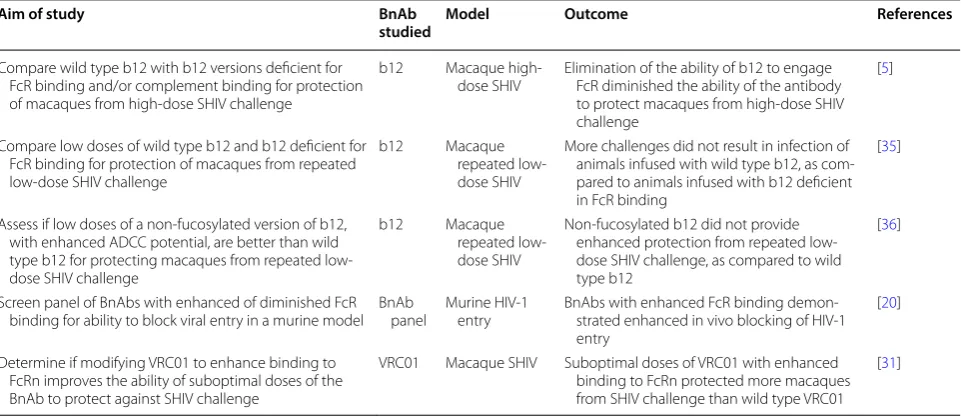
A collection of studies demonstrate that BnAbs admin-istered passively or through gene transfer using adeno-associated viral vectors protect against in vivo challenge with cell free virus in animal models of HIV-1 infection [5–8, 10, 12, 20, 31, 33–36]. While these studies clearly highlight the prophylactic capacity of BnAbs, only a few of the reports incorporated experiments to assess the potential mechanisms of BnAb-conferred protection (Table 1) [5, 20, 31, 35, 36]. Such experiments are impor-tant to gauge if neutralization function is sufficient, or if BnAbs need to trigger additional non-neutralizing func-tions through their Fc porfunc-tions to protect against HIV-1 exposure.
Hessell et al. initially evaluated the involvement of non-neutralizing Fc-dependent functions in BnAb conferred protection from in vivo cell free virus challenge [5]. For this purpose the authors utilized a previously developed panel of variants of the CD4 binding site BnAb, b12 [30]. These variants included the b12 wild type (b12 WT), a version mutated to diminish FcγR and complement bind-ing (b12 LALA), and a version only exhibitbind-ing dimin-ished complement binding (b12 KA). Each of these b12 variants, or human IgG1 isotype control, were passively
administered intravenously to rhesus macaques prior to vaginal challenge with high-dose cell free SHIVSF162P3. While all four animals receiving the isotype control were infected following challenge, animals receiving b12 WT and b12 KA exhibited similar robust levels of protection from infection (i.e. 8/9 animals protected in each group). Animals receiving the b12 LALA were less likely to be protected from challenge than animals receiving the b12 WT or b12 KA antibodies (i.e. 5/9 animals protected). These results imply that neutralization is often sufficient for protection from cell free virus challenge, but protec-tion is optimized if BnAbs can trigger addiprotec-tional non-neutralizing effector cell functions through effector cells expressing FcγRs.
Following their observation of lower efficacy of b12 LALA than b12 WT in protecting against high-dose cell free virus challenge, Hessell et al. evaluated the potential role of non-neutralizing functions of b12 for protection of macaques from repeated low-dose cell free SHIVSF162P3 challenge [35]. Animals were injected once weekly with low doses of b12 WT or b12 LALA and challenged twice weekly with low-dose virus. Animals inoculated with either b12 WT or b12 LALA required more chal-lenges prior to becoming infected than animals admin-istered isotype control prior to challenge. Although both b12 WT and b12 LALA provided protection compared to isotype control, protection conferred by b12 LALA appeared suboptimal as compared to b12 WT. Indeed, nearly twice as many challenges did not result in infec-tion for b12 WT animals than b12 LALA animals (i.e. 104 vs. 61). These observations largely reflected the
Table 1 Role for Fc‑dependent BnAb functions for protection from cell free virus in vivo
Aim of study BnAb
studied Model Outcome References
Compare wild type b12 with b12 versions deficient for FcR binding and/or complement binding for protection of macaques from high-dose SHIV challenge
b12 Macaque
high-dose SHIV Elimination of the ability of b12 to engage FcR diminished the ability of the antibody to protect macaques from high-dose SHIV challenge
[5]
Compare low doses of wild type b12 and b12 deficient for FcR binding for protection of macaques from repeated low-dose SHIV challenge
b12 Macaque
repeated low-dose SHIV
More challenges did not result in infection of animals infused with wild type b12, as com-pared to animals infused with b12 deficient in FcR binding
[35]
Assess if low doses of a non-fucosylated version of b12, with enhanced ADCC potential, are better than wild type b12 for protecting macaques from repeated low-dose SHIV challenge
b12 Macaque repeated low-dose SHIV
Non-fucosylated b12 did not provide enhanced protection from repeated low-dose SHIV challenge, as compared to wild type b12
[36]
Screen panel of BnAbs with enhanced of diminished FcR
binding for ability to block viral entry in a murine model BnAb panel Murine HIV-1 entry BnAbs with enhanced FcR binding demon-strated enhanced in vivo blocking of HIV-1 entry
[20]
Determine if modifying VRC01 to enhance binding to FcRn improves the ability of suboptimal doses of the BnAb to protect against SHIV challenge
VRC01 Macaque SHIV Suboptimal doses of VRC01 with enhanced binding to FcRn protected more macaques from SHIV challenge than wild type VRC01
[image:3.595.58.539.102.311.2]relative patterns of protection conferred by b12 WT and b12 LALA following high-dose viral challenge [5].
The major implication of the two studies assessing the relative protective efficacy of b12 variants with different FcγR binding potential is that neutralization is often suf-ficient for protection from infection with cell free virus. It is possible that neutralization might fail to be suffi-cient for protection when too large of a number of cells are infected following challenge. In these situations non-neutralizing Fc-dependent functions of BnAbs could be required to purge infected cells through ADCC or elimi-nate the virions produced by infected cells by ADP. The potential contribution of ADCC to protection conferred by b12 was evaluated by Moldt et al., who compared the relative protection from repeated low-dose SHIVSF162P3 challenge conferred by b12 WT to a non-fucosylated version of b12 (NFb12) [36]. Despite exhibiting higher binding to human and rhesus macaque FcγRIIIa and mediating higher ADCC of HIV-1-infected cells, the NFb12 antibody did not confer enhanced protection from cell free viral challenge as compared to b12 WT. These results might reflect the importance of Fc-depend-ent functions other than ADCC in the protection con-ferred by BnAbs.
Until recently much of the research into the role of non-neutralizing Fc-dependent functions for BnAb-con-ferred protection from in vivo cell free virus challenge was conducted using the b12 BnAb. Since the isolation of b12 numerous anti-HIV-1 BnAbs have been isolated and demonstrated to exhibit enhanced neutralization breadth and potency [1]. The role of Fc-dependent func-tions in the protective efficacy of some of these BnAbs has been evaluated in mouse models of HIV-1 entry [20]. Inhibition of HIV-1 entry can be assessed in luciferase reporter mice by infusing adenovirus encoding HIV-1 receptor and co-receptor (i.e. CD4 and CCR5), infusing anti-HIV-1 or control antibodies, challenging with HIV-1 pseudovirus and full-body imaging. Employing this sys-tem Bournozos et al. [20] demonstrated that BnAbs with murine IgG2a Fc, which confers preferential binding to activating FcγRs, were better able to inhibit HIV-1 entry than BnAbs expressing wild type murine IgG1 or an IgG1 variant with diminished binding to FcγR. Reliance on Fc-dependent functions for optimal in vivo efficacy was observed for a panel of antibodies, suggesting Fc-depend-ent functions are important independFc-depend-ent of the viral epitope targeted by the antibody. That this observation reflected FcγR engagement by antibodies is suggested by the absence of differences in efficacy between antibody variants in mice lacking FcγR expression. Lastly, it is important to note that the authors modified their mouse model by engineering mice to express human FcγRs. This allowed an assessment of the role of Fc-dependent
functions for BnAbs expressing human Fc in preventing viral entry. Employing wild type BnAb, as well as versions engineered to exhibit deficient or enhanced FcγR bind-ing, the authors observed evidence for a role for human Fc/FcγR interactions in inhibition of in vivo viral entry. Cumulatively, these observations are largely supportive of the role for Fc/FcγR interactions in BnAb-conferred protection observed in macaques. The results from the murine experiments suggest that the role for Fc-depend-ent anti-viral functions of BnAbs for optimal protection extends beyond the b12 BnAb and might be a generaliz-able phenomenon.
Lastly, it should be noted that in addition to trigger-ing anti-viral effector functions, interactions between BnAbs and FcRs are important for sustaining antibody concentrations and antibody transport. Indeed, anti-body binding to the FcRn is important for homeostasis and antibody transport to mucosal surfaces. As such, the VRC01 antibody was recently mutated to enhance bind-ing to the FcRn [31]. The resultbind-ing VRC01-LS antibody exhibited increased in vitro transcytosis, a 2.5-fold longer in vivo serum half-life in rhesus macaques and a tendency to accumulate in macaque rectal tissues through FcRn binding. Lastly, suboptimal concentrations of VRC01-LS provided enhanced protection against rectal SHIVBaLP4 challenge, as compared to VRC01 WT (i.e. 7/12 vs. 2/12 animals protected from infection). These results highlight that Fc/FcR interactions are an important determinant of BnAb-conferred protection, even if the interaction does not directly stimulate anti-viral functions.
Utility of BnAbs for control of cell–cell virus transmission in vitro
Much evidence highlights the potential utility of BnAbs for preventing HIV-1 infection. A potential caveat for utilizing BnAbs to prevent HIV-1 infection is the pres-ence of cell-associated virus within infectious bodily fluids, such as semen [37]. Cell-associated virus has long been proposed as a mechanism of transmission of HIV-1—the so-called “Trojan Horse” hypothesis [38, 39]. In macaques, cell-associated SIV is highly effi-cient at initiating infection, more so than cell free virus [40]. In humans, there are limited data based on virus sequencing that cell-associated virus may initiate a pro-portion of HIV-1 infections [41].
cell free virus [42–51]. These divergent results likely reflect the utilization of different in vitro experimen-tal systems. Nevertheless, decreased efficacy a BnAbs against cell-associated virus has been reported in terms of both higher 50% inhibitory concentrations (IC50) and incomplete neutralization [45]. Importantly, the abil-ity of BnAbs to prevent cell-to-cell spread is dependent on the virus/antibody combination [47]. Furthermore, combinations of BnAbs may be more efficient than sin-gle antibodies [44].
BnAb control of cell‑associated challenge in vivo We recently developed a cell-associated SHIVSF162P3 infection model in pigtail macaques [52]. The model was adapted from a previously published cell-associ-ated SIV model that used splenocytes from infected macaque donors to initiate infection [53]. Passive trans-fer of the BnAb PGT121 protected 6/6 pigtail macaques from an intravenous cell free SHIVSF162P3 challenge but only 3/6 macaques from an intravenous cell-associated SHIVSF162P3 challenge. However, the lack of efficacy in two macaques challenged with the cell-associated SHIVSF162P3 appeared due to low levels of BnAb admin-istered. Interestingly, one macaque had no viremia until eight weeks post challenge with cell-associated SHIVSF162P3. It appeared that the SHIVSF162P3 lay dor-mant, possibly existing as cell-associated virus in tissues, and only emerged when the passively transferred BnAb waned to low levels. Whether this anecdote will repre-sent a common mode of evading strategies to control HIV-1 with BnAbs is unknown. We recently suggested that, given the capacity of HIV-1 to remain latent under ART for decades, HIV-1 could remain suppressed by BnAbs for years until the antibodies (whether delivered passively or induced by vaccination) wane to sub thera-peutic levels [54]. This has implications for the long-term follow up of BnAb based clinical trials.
The use of BnAbs for HIV‑1 therapy and cure: role of Fc‑dependent responses
Following the isolation of first generation BnAbs there was much interest in their potential for therapeutic utili-zation. In an early study in hu-PBL-SCID mice, Poignard et al. observed limited utility of first generation BnAbs in mice infected with HIV-1JR-CSF or HIV-1SF162 [55]. Indeed, monotherapy with the CD4 binding site BnAb, b12, did not significantly decrease plasma viral loads in mice infected with either virus, as compared to control animals. Furthermore, several viral isolates derived from animals treated with b12 developed resistance to the
BnAb. Similarly, treatment of mice infected with HIV-1JR-CSF with a cocktail of BnAbs (i.e. b12, 2G12 and 2F5) achieved unsatisfactory results. Temporary decreases in viral load were noted, but were followed by viral rebound and escape from one or all three BnAbs.
Trials of first generation BnAbs as therapeutics in HIV-1-infected humans also revealed transient therapeu-tic benefits followed by viral escape from BnAb. Trkola et al. administered a BnAb cocktail (i.e. 2G12, 2F5 and 4E10) to eight individuals with chronic HIV-1 infection and six individuals with acute HIV-1 infection one day before cessation of ART [56]. Trial participants received 13 BnAb injections over 11 weeks. Two of eight chroni-cally infected donors exhibited a delay in viral rebound, as compared to historical data of the same individu-als undergoing a treatment interruption in the absence of BnAb therapy. The acutely infected BnAb-treated participants exhibited a significant time delay prior to viral rebound as compared to a control group of acutely infected individuals undergoing treatment interrup-tion in the absence of BnAb treatment (median 8 weeks vs. 3.75 weeks). The therapeutic benefits of the BnAb cocktail appeared to be primarily driven by 2G12, as viral rebound was accompanied by resistance to 2G12 in 12/14 trial participants. Mehandru et al. reported similar results in another trial assessing the therapeutic poten-tial of the BnAb cocktail of 2G12, 2F5 and 4E10 [57]. As observed by Trkola et al. [56], these investigators noted that BnAb therapy slowed viral rebound following treat-ment interruption, as compared to historical controls. Furthermore, loss of viral control was associated with resistance to 2G12.
the development of viral escape mutants [2, 11]. Further-more, therapeutic administration of BnAbs to macaques during acute SHIV infection might facilitate the develop-ment of autologous antiviral immunity, thus conferring prolonged control of viral replication [9].
In addition to animal studies, next generation BnAbs have also been screened as therapeutics in HIV-1-in-fected humans [3, 4, 60]. Monotherapy with 3BNC117 and 10-1074 results in transient control of viremia, and 3BNC117 can delay viral rebound following treatment interruption. As noted in animal studies, viral resist-ance to BnAbs can develop in humans undergoing monotherapy.
As well as data highlighting the capacity of BnAbs to control viremia, several studies using murine models, as well as modelling of data from a human clinical trial, sug-gest a role for FcγRs in the therapeutic benefits conferred by BnAbs. A role for BnAb interactions with FcγR for con-trolling viremia in infected animals was demonstrated by Bournazos et al. [20]. Humanized mice infected with HIV-1 were treated with a cocktail of BnAbs (i.e. 3BNC117, PG16 and 10-1074) modified either to not interact with FcγR (FcRnull) or to exhibit enhanced binding to activating FcγR. A quicker and sustained control of viremia was observed in animals treated with the antibody cocktail containing anti-bodies designed to more strongly interact with activating FcγR. Halper-Stromberg et al. demonstrated that treatment of HIV-1-infected humanized mice with a BnAb cocktail (i.e. 10-1074, PG16 and 3BNC117) 4 days post infection reduced the establishment of a latent reservoir, as exhib-ited by a lack of viral rebound in a proportion of animals after waning of therapeutic BnAbs [61]. A rendition of this experiment using FcRnull versions of the BnAbs suggested a role for FcγR interactions in the observed interference with the establishment of a latent reservoir. Significantly more mice had rebounded viremia by 44 days post treatment with FcRnull versions of the BnAbs than those treated with wild type BnAbs capable of interacting with FcγR. Lastly, Lu et al. assessed the rate of viral load decline in HIV-1-in-fected humans treated with 3BNC117 [62]. Modelling sug-gested that the rate of decline in viremia was too rapid to be explained by neutralization of free virus alone. Indeed, the analysis suggested that non-neutralizing antibody effec-tor functions, such as those involved in eliminating infected cells, were involved in the therapeutic benefits conferred by the antibody. Furthermore, the ability of BnAbs to eliminate human cells infected with the HIV-1YU2 laboratory strain or isolates derived from HIV-1-infected patients was demon-strated in vivo in mice. The elimination of infected cells was demonstrated to be dependent on FcγR-mediated recogni-tion of antibody, as infected cells were not eliminated by FcRnull BnAbs and in vivo blocking of FcγRs prevented the elimination of infected cells.
Diversity of Effector cells, FcγRs and antibody isotypes: potential influence on BnAb efficacy While the BnAb paratope dictates neutralization breadth and potency, accumulating evidence indicates that Fc-dependent functions might be required for BnAbs to optimally protect from infection, suppress viral load and/ or clear infected cells [5, 20, 61, 62]. These Fc-dependent functions might include ADCC, ADP, complement acti-vation, effector cell release of cytokines, chemokines or enzymes, inhibition of transcytosis and mucus trapping. An antibody’s Fc functional capacity can be modulated through multiple small biophysical differences of the Fc region [63], including the isotype (e.g., IgG, IgA, IgM, IgE, IgD), subclass (e.g., IgG1-4, IgA1, IgA2) [64], allotype [65, 66] and glycosylation of the Fc heavy chain [67, 68].
In humans, there are three distinct classes of Fcγ recep-tors: FcγRI, FcγRII (FcγRIIa, FcγRIIb, and FcγRIIc), and FcγRIII (FcγRIIIa and FcγRIIIb), which bind to different IgG subclasses with varying affinity, and can cause either activation or inhibition of the effector cell [64]. These FcγRs are expressed on a wide variety of innate immune cells including NK cells, monocytes, macrophages, den-dritic cells, eosinophils, basophils and neutrophils. NK cells almost exclusively express the activating FcγRIIIa and are the effector cells most commonly associated with ADCC [69]. Macrophages, neutrophils, eosinophils, basophils and dendritic cells all express a more diverse range of FcγRs on their surfaces (both activating and inhibitory) and can mediate various effector functions, including ADCC, phagocytosis and trogocytosis (i.e., the exchange of cellular membrane fragments between effec-tor and target cells) [70–72].
Human FcγRs are diverse. A range of FcγR polymor-phisms have been identified, some of which have greater Fc binding affinity and are associated with enhanced Fc effector function capacity. For example, FcγRIIa has two common polymorphisms—H131 and R131. The FcγRIIa H131 polymorphism, which is commonly associated with enhanced ADP, is also related to HIV-1 disease progres-sion status [73, 74]. The FcγRIIIa is also known to exhibit polymorphisms at position 158–V158 and F158. The high affinity FcγRIIIa V158 polymorphism, is associated with enhanced ADCC functionality and with better outcomes for cancer monoclonal therapeutics [75, 76]. Surprisingly, the FcγRIIIa V158 polymorphism might associate with HIV-1 disease progression [77] and associates with the risk of infection in recipients of the VAX004 vaccine [78].
infection. While abrogation of the Fc-dependent activity of BnAb b12 through introduction of the LALA mutation decreased the protective efficacy of the BnAb [5], a non-fucosylated version of b12, which exhibited an enhanced ability to bind to FcγRIIIa and trigger ADCC, did not confer any additional protection from repeated low-dose viral challenge [36]. These data suggest that engagement of FcγRIIIa and the triggering of ADCC activity are likely not essential to achieve in vivo BnAb-conferred pro-tection from viral challenge. Alternatively, BnAbs that trigger a wide range of Fc-dependent functions or ‘poly-functional’ Fc activity may be optimal. Indeed, several studies suggest that polyfunctional non-neutralizing Fc-dependent functions of HIV-1 binding antibodies can contribute to enhanced viral control and protection from infection [79–82]. Furthermore, the presence of antibod-ies with Fc polyfunctionality may contribute to the devel-opment of BnAbs. Richardson et al. recently observed that individuals that develop BnAbs have higher Fc poly-functionality and increased subclass diversity [83].
It is important to note that studies have also assessed the effect of modifying the isotypes of BnAbs, especially to IgA, with varying results [84–88]. Isotype switching of 2F5 from IgG1 to IgA2 improved epitope affinity and improved inhibition of HIV-1 transcytosis [84]. In con-trast, other studies have reported 2F5 IgA or 2F5 IgM variants to provide inferior protection against HIV-1 compared to 2F5 IgG [85, 86]. Indeed, 2F5 IgM failed to inhibit HIV-1 transcytosis [85], while 2F5 IgA failed to neutralize HIV-1 infection of PBMC [86]. In con-trast, 2F5 IgG protected against HIV-1 infection in vitro and intravenous administration of 2F5 IgG protected macaques from intravaginal viral challenge [86]. Impor-tantly, intravenous administration of 2F5 Fab exhibited no protection, emphasizing the importance of the Fc region of the 2F5 BnAb for protection. An additional study modified the V3 neutralizing antibody HGN194 from IgG1 to dimeric IgA1 and dimeric IgA2. The result-ing antibodies exhibited similar neutralization potencies, but HGN194 dimeric IgA1 provided the best protection in vivo against intrarectal viral challenge. Protection was correlated with in vitro measurements of inhibition of viral transcytosis and virion capture [87]. Lastly, neu-tralizing CH31 IgG antibodies exhibited enhanced pro-tection against intrarectal viral challenge in macaques compared to monomeric, dimeric or secretory IgA2 vari-ants [88]. Clearly, these studies indicate that the isotype of BnAbs can contribute significantly to protection from mucosal viral challenge, but the contribution of isotype might be epitope specific and too few studies have been conducted to determine how the antibody isotype con-tributes mechanistically to protection. Similar to IgG, IgA can engage its Fcα receptor that is present on the
surfaces of monocytes, macrophages and neutrophils to mediate phagocytosis, respiratory burst, and the release of various cytokines and inflammatory mediators [89]. The potential of Fc/FcR interactions between IgA and Fcα receptor is an area of research that has not yet been fully explored in terms of its potential for combatting HIV -1.
Potential importance of diverse human NK cell functionality on BnAb efficacy
In addition to polymorphisms in FcγRs, several addi-tional variables might potentially impact the ability of effector cells to utilize BnAbs to mediate Fc-dependent functions. NK cells and the impact of the processes of education and differentiation on their functional poten-tial best represent this.
Diversity in the capacity of NK cells to respond to stimuli is introduced through the process of NK cell education [90]. During the education process NK cells scan the self-environment for constitutively expressed ligands to their activating and inhibitory receptors. The receptors involved in this process include activating and inhibitory killer immunoglobulin-like receptors (KIR), which recognize classical major histocompatibility com-plex class I (MHC-I or HLA-I) molecules [91], and the inhibitory NKG2A receptor, which recognizes the non-classical HLA-E [92]. In general, education tunes the potential responsiveness of an NK cell in a manner that maintains self-tolerance, conferring functional capac-ity to cells expressing inhibitory receptors that recognize self-ligands [93–95] and reducing the functional capac-ity of cells expressing activating receptors that recognize self-ligands [96]. Several studies have now demonstrated that education determines the responsiveness of NK cells to direct stimulation with HLA-I-devoid target cells [93, 94], as well as FcγR-dependent stimulation of NK cells with antibody-coated target cells [93, 95].
differences in ADCC were noted between the two groups, leading the investigators to suggest that NK cell education may not be important for determining anti-HIV-1 ADCC capacity. Alternatively, it is possible that NK cells edu-cated through inhibitory receptor/ligand combinations other than KIR3DL1/HLA-Bw4 conferred compensatory NK cell education in the individuals lacking this receptor/ ligand combination. We recently attempted to evaluate the relative contributions of educated and non-educated NK cells within PBMC to anti-HIV-1 ADCC [99]. Briefly, PBMC were stained with fluorochrome-conjugated anti-bodies to identify cells expressing inhibitory receptors that would educate NK cells, given the donor’s HLA-I profile. Stained cells were FACs sorted as a population enriched for educated NK cells (i.e. education+ PBMC) and unstained cells were sorted as a population lacking educated NK cells (i.e. education− PBMC). Utilizing cell numbers reflecting the frequency of each population of cells within total PBMC, we evaluated the relative ability of each cell population to kill gp120-coated target cells in the presence of anti-HIV-1 antibodies. We observed robust ADCC mediated by total PBMC that was recap-tured by the sorted education+ PBMC. In contrast, the sorted education− PBMC mediated little-to-no ADCC, and were significantly less cytotoxic than either the whole PBMC or the education+ PBMC population.
While our data imply that educated NK cells are the primary mediators of anti-HIV-1 ADCC within PBMC, it is important to note that these data were collected using gp120-coated target cells and with polyclonal antibody mixtures. Future experiments are needed to determine if education has a similar impact on the capacity of NK cells to utilize BnAbs to mediate anti-HIV-1 ADCC. Fur-thermore, it would be ideal to conduct these experiments with autologous HIV-1-infected target cells, which pre-sent viral envelope in physiological conformations and amounts. The implementation of autologous infected cells will also address the role of autologous HLA-I in inhibiting anti-HIV-1 ADCC, and how downregulation of HLA-I by HIV-1 nef influences the ability of self-HLA-I to inhibit anti-Hself-HLA-IV-1 ADCC [102].
In addition to education, the relative responsive-ness of an NK cell to antibody-dependent stimulation is determined by the stage of differentiation of the cell. NK cells differentiate in a defined pattern, proceeding from CD56bright to CD56dim before gaining expression of the CD57 differentiation marker [103]. Throughout this process NK cells gain expression of KIRs and FcγRIIIa and become more cytotoxic. Additionally, differentiated CD56dimCD57+ NK cells exhibit more robust responses through FcγRIIIa following stimulation with anti-recep-tor antibody or anti-viral antibody-coated target cells expressing HIV-1 antigens [100, 104].
Importantly, viral infections appear to influence the NK cell differentiation process. Indeed, individu-als infected with human cytomegalovirus (HCMV) exhibit expansions of differentiated CD56dimCD57+ NK cells that also express the activating NKG2C recep-tor, which recognizes the non-classical HLA-E mol-ecule [92, 105]. These NK cells exhibit robust function through FcγRIIIa [106]. Furthermore, these differenti-ated NK cells degranulate following ligation of NKG2C [105]. Interestingly, CD56dimCD57+NKG2C+ NK cells have been noted to occur in HIV-1-infected individuals in a HCMV-dependent manner [107]. The frequency of these cells in HIV-1-infected donors, however, appears to be exaggerated compared to HCMV-infected HIV-1-un-infected donors. Further research is required to deter-mine the anti-HIV-1 antibody-dependent functions of CD56dimCD57+NKG2C+ NK cells. It will be interesting to determine if these cells can confer enhanced anti-viral benefits in individuals receiving BnAbs for the purposes of therapy or cure.
Lastly, the ability of NK cells to mediate Fc-dependent functions is influenced by virus-induced alterations on target cells. Much has been published on the ability of HIV-1 nef and vpu to downregulate CD4 on infected cells, prevent exposure of CD4-induced epitopes on viral envelope and facilitate the evasion of ADCC mediated by polyclonal patient-derived ADCC antibod-ies that predominantly recognize CD4-induced enve-lope epitopes [108, 109]. This phenomenon is less of a problem for BnAb-mediated ADCC, as BnAbs tend to recognize HIV-1 envelope in its native CD4-unbound trimeric state. In addition to downregulating CD4, HIV-1 nef can downregulate the expression of ligands for the activating NKG2D NK cell receptor, which can serve as a co-receptor for anti-HIV-1 ADCC [110–112]. Furthermore, HIV-1 vpu can downregulate cellular tetherin, which plays an essential role is concentrat-ing virus at the cellular membrane. Downregulation of tetherin decreases the amount of viral antigen available on the surface of infected cells and is a means of evad-ing anti-HIV-1 ADCC [113]. The potential for HIV-1 accessory proteins to influence ADCC readouts high-lights the importance of carefully selecting viruses and assays that most closely portray the in vivo situation in which the antibody in question will be immersed [112, 114].
Conclusions
the context of exposure to cell-associated virus, where virus may evade neutralization by BnAbs. Newer gen-eration BnAbs have higher potency and are potential tools for preventing and controlling HIV-1 infection. Additional work characterizing the in vivo importance of Fc-mediated functions of newer generation BnAbs is needed.
Authors’ contributions
All authors contributed to the writing of the manuscript. All authors approved the manuscript for final publication.
Author details
1 Department of Microbiology and Immunology, The University of Melbourne,
at the Peter Doherty Institute for Infection and Immunity, Victoria, Australia.
2 ARC Centre of Excellence in Convergent Bio-Nano Science and Technology,
The University of Melbourne, Victoria, Australia. 3 Melbourne Sexual Health
Centre, Alfred Hospital, Monash University Central Clinical School, Victoria, Australia.
Competing interests
The authors declare that they have no competing interests.
Availability of data and material
Not applicable.
Consent for publication
Not applicable.
Ethics approval and consent to participate
Not applicable.
Funding
Australian National Health and Medical Research Council Grant # 1052979.
Publisher’s Note
Springer Nature remains neutral with regard to jurisdictional claims in pub-lished maps and institutional affiliations.
Received: 14 May 2018 Accepted: 9 August 2018
References
1. McCoy LE, Burton DR. Identification and specificity of broadly neutral-izing antibodies against HIV. Immunol Rev. 2017;275:11–20.
2. Barouch DH, Whitney JB, Moldt B, Klein F, Oliveira TY, Liu J, Stephenson KE, Chang HW, Shekhar K, Gupta S, et al. Therapeutic efficacy of potent neutralizing HIV-1-specific monoclonal antibodies in SHIV-infected rhesus monkeys. Nature. 2013;503:224–8.
3. Caskey M, Klein F, Lorenzi JC, Seaman MS, West AP Jr, Buckley N, Kremer G, Nogueira L, Braunschweig M, Scheid JF, et al. Viraemia suppressed in HIV-1-infected humans by broadly neutralizing antibody 3BNC117. Nature. 2015;522:487–91.
4. Caskey M, Schoofs T, Gruell H, Settler A, Karagounis T, Kreider EF, Murrell B, Pfeifer N, Nogueira L, Oliveira TY, et al. Antibody 10-1074 suppresses viremia in HIV-1-infected individuals. Nat Med. 2017;23:185–91. 5. Hessell AJ, Hangartner L, Hunter M, Havenith CE, Beurskens FJ, Bakker
JM, Lanigan CM, Landucci G, Forthal DN, Parren PW, et al. Fc receptor but not complement binding is important in antibody protection against HIV. Nature. 2007;449:101–4.
6. Hessell AJ, Rakasz EG, Poignard P, Hangartner L, Landucci G, Forthal DN, Koff WC, Watkins DI, Burton DR. Broadly neutralizing human anti-HIV antibody 2G12 is effective in protection against mucosal SHIV challenge even at low serum neutralizing titers. PLoS Pathog. 2009;5:e1000433.
7. Moldt B, Rakasz EG, Schultz N, Chan-Hui PY, Swiderek K, Weisgrau KL, Piaskowski SM, Bergman Z, Watkins DI, Poignard P, Burton DR. Highly potent HIV-specific antibody neutralization in vitro translates into effec-tive protection against mucosal SHIV challenge in vivo. Proc Natl Acad Sci U S A. 2012;109:18921–5.
8. Moog C, Dereuddre-Bosquet N, Teillaud JL, Biedma ME, Holl V, Van Ham G, Heyndrickx L, Van Dorsselaer A, Katinger D, Vcelar B, et al. Protective effect of vaginal application of neutralizing and nonneutralizing inhibi-tory antibodies against vaginal SHIV challenge in macaques. Mucosal Immunol. 2014;7:46–56.
9. Nishimura Y, Gautam R, Chun TW, Sadjadpour R, Foulds KE, Shin-gai M, Klein F, Gazumyan A, Golijanin J, Donaldson M, et al. Early antibody therapy can induce long-lasting immunity to SHIV. Nature. 2017;543:559–63.
10. Parren PW, Marx PA, Hessell AJ, Luckay A, Harouse J, Cheng-Mayer C, Moore JP, Burton DR. Antibody protects macaques against vaginal challenge with a pathogenic R5 simian/human immunodeficiency virus at serum levels giving complete neutralization in vitro. J Virol. 2001;75:8340–7.
11. Shingai M, Nishimura Y, Klein F, Mouquet H, Donau OK, Plishka R, Buckler-White A, Seaman M, Piatak M Jr, Lifson JD, et al. Antibody-mediated immunotherapy of macaques chronically infected with SHIV suppresses viraemia. Nature. 2013;503:277–80.
12. Veazey RS, Shattock RJ, Pope M, Kirijan JC, Jones J, Hu Q, Ketas T, Marx PA, Klasse PJ, Burton DR, Moore JP. Prevention of virus transmission to macaque monkeys by a vaginally applied monoclonal antibody to HIV-1 gp120. Nat Med. 2003;9:343–6.
13. Haynes BF, Gilbert PB, McElrath MJ, Zolla-Pazner S, Tomaras GD, Alam SM, Evans DT, Montefiori DC, Karnasuta C, Sutthent R, et al. Immune-correlates analysis of an HIV-1 vaccine efficacy trial. N Engl J Med. 2012;366:1275–86.
14. Rerks-Ngarm S, Pitisuttithum P, Nitayaphan S, Kaewkungwal J, Chiu J, Paris R, Premsri N, Namwat C, de Souza M, Adams E, et al. Vaccination with ALVAC and AIDSVAX to prevent HIV-1 infection in Thailand. N Engl J Med. 2009;361:2209–20.
15. Tomaras GD, Ferrari G, Shen X, Alam SM, Liao HX, Pollara J, Bonsignori M, Moody MA, Fong Y, Chen X, et al. Vaccine-induced plasma IgA specific for the C1 region of the HIV-1 envelope blocks binding and effector function of IgG. Proc Natl Acad Sci U S A. 2013;110:9019–24. 16. Chung AW, Isitman G, Navis M, Kramski M, Center RJ, Kent SJ, Stratov I.
Immune escape from HIV-specific antibody-dependent cellular cyto-toxicity (ADCC) pressure. Proc Natl Acad Sci U S A. 2011;108:7505–10. 17. Horwitz JA, Bar-On Y, Lu CL, Fera D, Lockhart AAK, Lorenzi JCC, Nogueira
L, Golijanin J, Scheid JF, Seaman MS, et al. Non-neutralizing antibodies alter the course of HIV-1 infection in vivo. Cell. 2017;170:637–648.e10. 18. Lambotte O, Ferrari G, Moog C, Yates NL, Liao HX, Parks RJ, Hicks CB,
Owzar K, Tomaras GD, Montefiori DC, et al. Heterogeneous neutralizing antibody and antibody-dependent cell cytotoxicity responses in HIV-1 elite controllers. AIDS. 2009;23:897–906.
19. Wren LH, Chung AW, Isitman G, Kelleher AD, Parsons MS, Amin J, Cooper DA, Asc investigators, Stratov I, Navis M, Kent SJ. Specific antibody-dependent cellular cytotoxicity responses associated with slow progression of HIV infection. Immunology. 2013;138:116–123 20. Bournazos S, Klein F, Pietzsch J, Seaman MS, Nussenzweig MC, Ravetch
JV. Broadly neutralizing anti-HIV-1 antibodies require Fc effector func-tions for in vivo activity. Cell. 2014;158:1243–53.
21. Bruel T, Guivel-Benhassine F, Amraoui S, Malbec M, Richard L, Bourdic K, Donahue DA, Lorin V, Casartelli N, Noel N, et al. Elimination of HIV-1-infected cells by broadly neutralizing antibodies. Nat Commun. 2016;7:10844.
22. Mujib S, Liu J, Rahman A, Schwartz JA, Bonner P, Yue FY, Ostrowski MA. Comprehensive cross-clade characterization of antibody-mediated rec-ognition, complement-mediated lysis, and cell-mediated cytotoxicity of HIV-1 envelope-specific antibodies toward eradication of the HIV-1 reservoir. J Virol. 2017;91:e00634–17.
23. von Bredow B, Arias JF, Heyer LN, Moldt B, Le K, Robinson JE, Zolla-Pazner S, Burton DR, Evans DT. Comparison of Antibody-dependent cell-mediated cytotoxicity and virus neutralization by HIV-1 Env-specific monoclonal antibodies. J Virol. 2016;90:6127–39.
of HIV type 1 in the presence of natural-killer effector cells. J Virol. 2001;75:6953–61.
25. Moldt B, Schultz N, Dunlop DC, Alpert MD, Harvey JD, Evans DT, Poignard P, Hessell AJ, Burton DR. A panel of IgG1 b12 variants with selectively diminished or enhanced affinity for Fcgamma receptors to define the role of effector functions in protection against HIV. J Virol. 2011;85:10572–81.
26. Tay MZ, Liu P, Williams LD, McRaven MD, Sawant S, Gurley TC, Xu TT, Dennison SM, Liao HX, Chenine AL, et al. Antibody-mediated internali-zation of infectious HIV-1 virions differs among antibody isotypes and subclasses. PLoS Pathog. 2016;12:e1005817.
27. Tudor D, Bomsel M. The broadly neutralizing HIV-1 IgG 2F5 elicits gp41-specific antibody-dependent cell cytotoxicity in a FcgammaRI-dependent manner. AIDS. 2011;25:751–9.
28. Klein JS, Webster A, Gnanapragasam PN, Galimidi RP, Bjorkman PJ. A dimeric form of the HIV-1 antibody 2G12 elicits potent antibody-dependent cellular cytotoxicity. AIDS. 2010;24:1633–40. 29. Trkola A, Purtscher M, Muster T, Ballaun C, Buchacher A, Sullivan N,
Srinivasan K, Sodroski J, Moore JP, Katinger H. Human monoclonal antibody 2G12 defines a distinctive neutralization epitope on the gp120 glycoprotein of human immunodeficiency virus type 1. J Virol. 1996;70:1100–8.
30. Hezareh M, Hessell AJ, Jensen RC, van de Winkel JG, Parren PW. Effec-tor function activities of a panel of mutants of a broadly neutralizing antibody against human immunodeficiency virus type 1. J Virol. 2001;75:12161–8.
31. Ko SY, Pegu A, Rudicell RS, Yang ZY, Joyce MG, Chen X, Wang K, Bao S, Kraemer TD, Rath T, et al. Enhanced neonatal Fc receptor func-tion improves protecfunc-tion against primate SHIV infecfunc-tion. Nature. 2014;514:642–5.
32. Smith AJ, Wietgrefe SW, Shang L, Reilly CS, Southern PJ, Perkey KE, Duan L, Kohler H, Muller S, Robinson J, et al. Live simian immunodeficiency virus vaccine correlate of protection: immune complex-inhibitory Fc receptor interactions that reduce target cell availability. J Immunol. 2014;193:3126–33.
33. Gardner MR, Kattenhorn LM, Kondur HR, von Schaewen M, Dorfman T, Chiang JJ, Haworth KG, Decker JM, Alpert MD, Bailey CC, et al. AAV-expressed eCD4-Ig provides durable protection from multiple SHIV challenges. Nature. 2015;519:87–91.
34. Saunders KO, Wang L, Joyce MG, Yang ZY, Balazs AB, Cheng C, Ko SY, Kong WP, Rudicell RS, Georgiev IS, et al. Broadly neutralizing human immunodeficiency virus type 1 antibody gene transfer protects nonhu-man primates from mucosal simian-hunonhu-man immunodeficiency virus infection. J Virol. 2015;89:8334–45.
35. Hessell AJ, Poignard P, Hunter M, Hangartner L, Tehrani DM, Bleeker WK, Parren PW, Marx PA, Burton DR. Effective, low-titer antibody protection against low-dose repeated mucosal SHIV challenge in macaques. Nat Med. 2009;15:951–4.
36. Moldt B, Shibata-Koyama M, Rakasz EG, Schultz N, Kanda Y, Dunlop DC, Finstad SL, Jin C, Landucci G, Alpert MD, et al. A nonfucosylated variant of the anti-HIV-1 monoclonal antibody b12 has enhanced FcgammaRI-IIa-mediated antiviral activity in vitro but does not improve protection against mucosal SHIV challenge in macaques. J Virol. 2012;86:6189–96. 37. Ho DD, Schooley RT, Rota TR, Kaplan JC, Flynn T, Salahuddin SZ, Gonda
MA, Hirsch MS. HTLV-III in the semen and blood of a healthy homo-sexual man. Science. 1984;226:451–3.
38. Anderson DJ, Politch JA, Nadolski AM, Blaskewicz CD, Pudney J, Mayer KH. Targeting Trojan Horse leukocytes for HIV prevention. AIDS. 2010;24:163–87.
39. Anderson DJ, Yunis EJ. “Trojan Horse” leukocytes in AIDS. N Engl J Med. 1983;309:984–5.
40. Kolodkin-Gal D, Hulot SL, Korioth-Schmitz B, Gombos RB, Zheng Y, Owuor J, Lifton MA, Ayeni C, Najarian RM, Yeh WW, et al. Efficiency of cell-free and cell-associated virus in mucosal transmission of human immunodeficiency virus type 1 and simian immunodeficiency virus. J Virol. 2013;87:13589–97.
41. Zhu T, Wang N, Carr A, Nam DS, Moor-Jankowski R, Cooper DA, Ho DD. Genetic characterization of human immunodeficiency virus type 1 in blood and genital secretions: evidence for viral compartmentalization and selection during sexual transmission. J Virol. 1996;70:3098–107.
42. Abela IA, Berlinger L, Schanz M, Reynell L, Gunthard HF, Rusert P, Trkola A. Cell-cell transmission enables HIV-1 to evade inhibition by potent CD4bs directed antibodies. PLoS Pathog. 2012;8:e1002634. 43. Duncan CJ, Williams JP, Schiffner T, Gartner K, Ochsenbauer C, Kappes
J, Russell RA, Frater J, Sattentau QJ. High-multiplicity HIV-1 infection and neutralizing antibody evasion mediated by the macrophage-T cell virological synapse. J Virol. 2014;88:2025–34.
44. Gombos RB, Kolodkin-Gal D, Eslamizar L, Owuor JO, Mazzola E, Gon-zalez AM, Korioth-Schmitz B, Gelman RS, Montefiori DC, Haynes BF, Schmitz JE. Inhibitory effect of individual or combinations of broadly neutralizing antibodies and antiviral reagents against free and cell-to-cell HIV-1 transmission. J Virol. 2015;89:7813–28.
45. Li H, Zony C, Chen P, Chen BK. Reduced Potency and incomplete neutralization of broadly neutralizing antibodies against cell-to-cell transmission of HIV-1 with transmitted founder Envs. J Virol. 2017;91:e02425–16.
46. Malbec M, Porrot F, Rua R, Horwitz J, Klein F, Halper-Stromberg A, Scheid JF, Eden C, Mouquet H, Nussenzweig MC, Schwartz O. Broadly neutral-izing antibodies that inhibit HIV-1 cell to cell transmission. J Exp Med. 2013;210:2813–21.
47. Reh L, Magnus C, Schanz M, Weber J, Uhr T, Rusert P, Trkola A. Capacity of broadly neutralizing antibodies to inhibit HIV-1 cell-cell transmission is strain- and epitope-dependent. PLoS Pathog. 2015;11:e1004966. 48. Schiffner T, Sattentau QJ, Duncan CJ. Cell-to-cell spread of HIV-1 and
evasion of neutralizing antibodies. Vaccine. 2013;31:5789–97. 49. Martin N, Welsch S, Jolly C, Briggs JA, Vaux D, Sattentau QJ. Virological
synapse-mediated spread of human immunodeficiency virus type 1 between T cells is sensitive to entry inhibition. J Virol. 2010;84:3516–27. 50. Massanella M, Puigdomenech I, Cabrera C, Fernandez-Figueras MT,
Aucher A, Gaibelet G, Hudrisier D, Garcia E, Bofill M, Clotet B, Blanco J. Antigp41 antibodies fail to block early events of virological synapses but inhibit HIV spread between T cells. AIDS. 2009;23:183–8. 51. McCoy LE, Groppelli E, Blanchetot C, de Haard H, Verrips T, Rutten L,
Weiss RA, Jolly C. Neutralisation of HIV-1 cell-cell spread by human and llama antibodies. Retrovirology. 2014;11:83.
52. Parsons MS, Lloyd SB, Lee WS, Kristensen AB, Amarasena T, Center RJ, Keele BF, Lifson JD, LaBranche CC, Montefiori D, et al. Partial efficacy of a broadly neutralizing antibody against cell-associated SHIV infection. Sci Transl Med. 2017;9:eaaf1483.
53. Salle B, Brochard P, Bourry O, Mannioui A, Andrieu T, Prevot S, Dejucq-Rainsford N, Dereuddre-Bosquet N, Le Grand R. Infection of macaques after vaginal exposure to cell-associated simian immunodeficiency virus. J Infect Dis. 2010;202:337–44.
54. Parsons MS, Cromer D, Davenport MP, Kent SJ. HIV reactivation after partial protection by neutralizing antibodies. Trends Immunol. 2018;39:359–66.
55. Poignard P, Sabbe R, Picchio GR, Wang M, Gulizia RJ, Katinger H, Par-ren PW, Mosier DE, Burton DR. Neutralizing antibodies have limited effects on the control of established HIV-1 infection in vivo. Immunity. 1999;10:431–8.
56. Trkola A, Kuster H, Rusert P, Joos B, Fischer M, Leemann C, Manrique A, Huber M, Rehr M, Oxenius A, et al. Delay of HIV-1 rebound after cessation of antiretroviral therapy through passive transfer of human neutralizing antibodies. Nat Med. 2005;11:615–22.
57. Mehandru S, Vcelar B, Wrin T, Stiegler G, Joos B, Mohri H, Boden D, Galovich J, Tenner-Racz K, Racz P, et al. Adjunctive passive immuno-therapy in human immunodeficiency virus type 1-infected individuals treated with antiviral therapy during acute and early infection. J Virol. 2007;81:11016–31.
58. Klein F, Halper-Stromberg A, Horwitz JA, Gruell H, Scheid JF, Bournazos S, Mouquet H, Spatz LA, Diskin R, Abadir A, et al. HIV therapy by a com-bination of broadly neutralizing antibodies in humanized mice. Nature. 2012;492:118–22.
59. Horwitz JA, Halper-Stromberg A, Mouquet H, Gitlin AD, Tretiakova A, Eisenreich TR, Malbec M, Gravemann S, Billerbeck E, Dorner M, et al. HIV-1 suppression and durable control by combining single broadly neutralizing antibodies and antiretroviral drugs in humanized mice. Proc Natl Acad Sci U S A. 2013;110:16538–43.
3BNC117 suppresses viral rebound in humans during treatment inter-ruption. Nature. 2016;535:556–60.
61. Halper-Stromberg A, Lu CL, Klein F, Horwitz JA, Bournazos S, Nogueira L, Eisenreich TR, Liu C, Gazumyan A, Schaefer U, et al. Broadly neutral-izing antibodies and viral inducers decrease rebound from HIV-1 latent reservoirs in humanized mice. Cell. 2014;158:989–99.
62. Lu CL, Murakowski DK, Bournazos S, Schoofs T, Sarkar D, Halper-Stromb-erg A, Horwitz JA, Nogueira L, Golijanin J, Gazumyan A, et al. Enhanced clearance of HIV-1-infected cells by broadly neutralizing antibodies against HIV-1 in vivo. Science. 2016;352:1001–4.
63. Chung AW, Alter G. Dissecting the antibody constant region protective immune parameters in HIV infection. Future Virol. 2014;9:397–414. 64. Hogarth PM, Pietersz GA. Fc receptor-targeted therapies for the
treatment of inflammation, cancer and beyond. Nat Rev Drug Discov. 2012;11:311–31.
65. Moraru M, Black LE, Muntasell A, Portero F, Lopez-Botet M, Reyburn HT, Pandey JP, Vilches C. NK cell and Ig interplay in defense against herpes simplex virus type 1: epistatic interaction of CD16A and IgG1 allotypes of variable affinities modulates antibody-dependent cellular cytotoxicity and susceptibility to clinical reactivation. J Immunol. 2015;195:1676–84.
66. Vidarsson G, Dekkers G, Rispens T. IgG subclasses and allotypes: from structure to effector functions. Front Immunol. 2014;5:520. 67. Shields RL, Lai J, Keck R, O’Connell LY, Hong K, Meng YG, Weikert SH,
Presta LG. Lack of fucose on human IgG1 N-linked oligosaccharide improves binding to human Fcgamma RIII and antibody-dependent cellular toxicity. J Biol Chem. 2002;277:26733–40.
68. Chung AW, Crispin M, Pritchard L, Robinson H, Gorny MK, Yu X, Bailey-Kellogg C, Ackerman ME, Scanlan C, Zolla-Pazner S, Alter G. Identifica-tion of antibody glycosylaIdentifica-tion structures that predict monoclonal antibody Fc-effector function. AIDS. 2014;28:2523–30.
69. Ahmad A, Menezes J. Antibody-dependent cellular cytotoxicity in HIV infections. Faseb J. 1996;10:258–66.
70. Kramski M, Schorcht A, Johnston AP, Lichtfuss GF, Jegaskanda S, De Rose R, Stratov I, Kelleher AD, French MA, Center RJ, et al. Role of monocytes in mediating HIV-specific antibody-dependent cellular cytotoxicity. J Immunol Methods. 2012;384:51–61.
71. Worley MJ, Fei K, Lopez-Denman AJ, Kelleher AD, Kent SJ, Chung AW. Neutrophils mediate HIV-specific antibody-dependent phagocytosis and ADCC. J Immunol Methods. 2018;457:41–52.
72. Tjiam MC, Sariputra L, Armitage JD, Taylor JP, Kelleher AD, Tan DB, Lee S, Fernandez S, French MA. Control of early HIV-1 infection associates with plasmacytoid dendritic cell-reactive opsonophagocytic IgG antibodies to HIV-1 p24. AIDS. 2016;30:2757–65.
73. Forthal DN, Landucci G, Bream J, Jacobson LP, Phan TB, Montoya B. FcgammaRIIa genotype predicts progression of HIV infection. J Immu-nol. 2007;179:7916–23.
74. Sanders LA, Feldman RG, Voorhorst-Ogink MM, de Haas M, Rijkers GT, Capel PJ, Zegers BJ, van de Winkel JG. Human immunoglobulin G (IgG) Fc receptor IIA (CD32) polymorphism and IgG2-mediated bacterial phagocytosis by neutrophils. Infect Immun. 1995;63:73–81. 75. Wang W, Erbe AK, Hank JA, Morris ZS, Sondel PM. NK cell-mediated
antibody-dependent cellular cytotoxicity in cancer immunotherapy. Front Immunol. 2015;6:368.
76. Cartron G, Dacheux L, Salles G, Solal-Celigny P, Bardos P, Colombat P, Watier H. Therapeutic activity of humanized anti-CD20 monoclonal antibody and polymorphism in IgG Fc receptor FcgammaRIIIa gene. Blood. 2002;99:754–8.
77. Poonia B, Kijak GH, Pauza CD. High affinity allele for the gene of FCGR3A is risk factor for HIV infection and progression. PLoS ONE. 2010;5:e15562.
78. Forthal DN, Gabriel EE, Wang A, Landucci G, Phan TB. Association of Fcgamma receptor IIIa genotype with the rate of HIV infection after gp120 vaccination. Blood. 2012;120:2836–42.
79. Ackerman ME, Mikhailova A, Brown EP, Dowell KG, Walker BD, Bailey-Kellogg C, Suscovich TJ, Alter G. Polyfunctional HIV-specific antibody responses are associated with spontaneous HIV control. PLoS Pathog. 2016;12:e1005315.
80. Chung AW, Ghebremichael M, Robinson H, Brown E, Choi I, Lane S, Dugast AS, Schoen MK, Rolland M, Suscovich TJ, et al. Polyfunctional
Fc-effector profiles mediated by IgG subclass selection distinguish RV144 and VAX003 vaccines. Sci Transl Med. 2014;6:228ra38. 81. Chung AW, Kumar MP, Arnold KB, Yu WH, Schoen MK, Dunphy LJ,
Suscovich TJ, Frahm N, Linde C, Mahan AE, et al. Dissecting polyclonal vaccine-induced humoral immunity against HIV using systems serol-ogy. Cell. 2015;163:988–98.
82. Barouch DH, Alter G, Broge T, Linde C, Ackerman ME, Brown EP, Borducchi EN, Smith KM, Nkolola JP, Liu J, et al. Protective efficacy of adenovirus-protein vaccines against SIV challenges in rhesus mon-keys. Science. 2015;349:320–4.
83. Richardson SI, Chung AW, Natarajan H, Mabvakure B, Mkhize NN, Garrett N, Abdool Karim S, Moore PL, Ackerman ME, Alter G, Morris L. HIV-specific Fc effector function early in infection predicts the development of broadly neutralizing antibodies. PLoS Pathog. 2018;14:e1006987.
84. Tudor D, Yu H, Maupetit J, Drillet AS, Bouceba T, Schwartz-Cornil I, Lopalco L, Tuffery P, Bomsel M. Isotype modulates epitope specificity, affinity, and antiviral activities of anti-HIV-1 human broadly neutral-izing 2F5 antibody. Proc Natl Acad Sci U S A. 2012;109:12680–5. 85. Shen R, Drelichman ER, Bimczok D, Ochsenbauer C, Kappes JC, Cannon JA, Tudor D, Bomsel M, Smythies LE, Smith PD. GP41-specific antibody blocks cell-free HIV type 1 transcytosis through human rectal mucosa and model colonic epithelium. J Immunol. 2010;184:3648–55.
86. Klein K, Veazey RS, Warrier R, Hraber P, Doyle-Meyers LA, Buffa V, Liao HX, Haynes BF, Shaw GM, Shattock RJ. Neutralizing IgG at the portal of infection mediates protection against vaginal simian/human immuno-deficiency virus challenge. J Virol. 2013;87:11604–16.
87. Watkins JD, Sholukh AM, Mukhtar MM, Siddappa NB, Lakhashe SK, Kim M, Reinherz EL, Gupta S, Forthal DN, Sattentau QJ, et al. Anti-HIV IgA iso-types: differential virion capture and inhibition of transcytosis are linked to prevention of mucosal R5 SHIV transmission. AIDS. 2013;27:F13–20. 88. Astronomo RD, Santra S, Ballweber-Fleming L, Westerberg KG, Mach L,
Hensley-McBain T, Sutherland L, Mildenberg B, Morton G, Yates NL, et al. Neutralization Takes precedence over IgG or IgA Isotype-related func-tions in mucosal HIV-1 antibody-mediated protection. EBioMedicine. 2016;14:97–111.
89. Lopez E, Shattock R, Kent SJ, Chung AW. The multi-faceted nature of immunoglobulin A and its complex role in HIV. AIDS Res Hum Retrovi-ruses. 2018. https ://doi.org/10.1089/AID.2018.0099.
90. Boudreau JE, Hsu KC. Natural killer cell education and the response to infection and cancer therapy: stay tuned. Trends Immunol. 2018;39:222–39.
91. Williams AP, Bateman AR, Khakoo SI. Hanging in the balance. KIR and their role in disease. Mol Interv. 2005;5:226–40.
92. Braud VM, Allan DS, O’Callaghan CA, Soderstrom K, D’Andrea A, Ogg GS, Lazetic S, Young NT, Bell JI, Phillips JH, et al. HLA-E binds to natural killer cell receptors CD94/NKG2A, B and C. Nature. 1998;391:795–9. 93. Anfossi N, Andre P, Guia S, Falk CS, Roetynck S, Stewart CA, Breso V,
Frassati C, Reviron D, Middleton D, et al. Human NK cell education by inhibitory receptors for MHC class I. Immunity. 2006;25:331–42. 94. Kim S, Sunwoo JB, Yang L, Choi T, Song YJ, French AR, Vlahiotis A,
Pic-cirillo JF, Cella M, Colonna M, et al. HLA alleles determine differences in human natural killer cell responsiveness and potency. Proc Natl Acad Sci U S A. 2008;105:3053–8.
95. Parsons MS, Zipperlen K, Gallant M, Grant M. Killer cell immunoglob-ulin-like receptor 3DL1 licenses CD16-mediated effector functions of natural killer cells. J Leukoc Biol. 2010;88:905–12.
96. Fauriat C, Ivarsson MA, Ljunggren HG, Malmberg KJ, Michaelsson J. Edu-cation of human natural killer cells by activating killer cell immunoglob-ulin-like receptors. Blood. 2010;115:1166–74.
97. Gooneratne SL, Center RJ, Kent SJ, Parsons MS. Functional advantage of educated KIR2DL1(+) natural killer cells for anti-HIV-1 antibody-dependent activation. Clin Exp Immunol. 2016;184:101–9.
98. Gooneratne SL, Richard J, Lee WS, Finzi A, Kent SJ, Parsons MS. Slaying the Trojan horse: natural killer cells exhibit robust anti-HIV-1 antibody-dependent activation and cytolysis against allogeneic T cells. J Virol. 2015;89:97–109.
•fast, convenient online submission
•
thorough peer review by experienced researchers in your field
• rapid publication on acceptance
• support for research data, including large and complex data types
•
gold Open Access which fosters wider collaboration and increased citations maximum visibility for your research: over 100M website views per year
•
At BMC, research is always in progress.
Learn more biomedcentral.com/submissions
Ready to submit your research? Choose BMC and benefit from:
100. Parsons MS, Loh L, Gooneratne S, Center RJ, Kent SJ. Role of education and differentiation in determining the potential of natural killer cells to respond to antibody-dependent stimulation. AIDS. 2014;28:2781–6. 101. Isitman G, Lisovsky I, Tremblay-McLean A, Parsons MS, Shoukry NH,
Wainberg MA, Bruneau J, Bernard NF. Natural killer cell education does not affect the magnitude of granzyme B delivery to target cells by antibody-dependent cellular cytotoxicity. AIDS. 2015;29:1433–43. 102. Cohen GB, Gandhi RT, Davis DM, Mandelboim O, Chen BK, Strominger
JL, Baltimore D. The selective downregulation of class I major histocom-patibility complex proteins by HIV-1 protects HIV-infected cells from NK cells. Immunity. 1999;10:661–71.
103. Solana R, Tarazona R, Gayoso I, Lesur O, Dupuis G, Fulop T. Innate immu-nosenescence: effect of aging on cells and receptors of the innate immune system in humans. Semin Immunol. 2012;24:331–41. 104. Lopez-Verges S, Milush JM, Pandey S, York VA, Arakawa-Hoyt J, Pircher
H, Norris PJ, Nixon DF, Lanier LL. CD57 defines a functionally distinct population of mature NK cells in the human CD56dimCD16 + NK-cell subset. Blood. 2010;116:3865–74.
105. Lopez-Verges S, Milush JM, Schwartz BS, Pando MJ, Jarjoura J, York VA, Houchins JP, Miller S, Kang SM, Norris PJ, et al. Expansion of a unique CD57(+)NKG2Chi natural killer cell subset during acute human cyto-megalovirus infection. Proc Natl Acad Sci U S A. 2011;108:14725–32. 106. Wu Z, Sinzger C, Frascaroli G, Reichel J, Bayer C, Wang L, Schirmbeck R,
Mertens T. Human cytomegalovirus-induced NKG2C(hi) CD57(hi) natu-ral killer cells are effectors dependent on humonatu-ral antivinatu-ral immunity. J Virol. 2013;87:7717–25.
107. Heath J, Newhook N, Comeau E, Gallant M, Fudge N, Grant M. NKG2C(+)CD57(+) natural killer cell expansion parallels cytomegalo-virus-specific CD8(+) T cell evolution towards senescence. J Immunol Res. 2016;2016:7470124.
108. Veillette M, Coutu M, Richard J, Batraville LA, Dagher O, Bernard N, Trem-blay C, Kaufmann DE, Roger M, Finzi A. The HIV-1 gp120 CD4-bound conformation is preferentially targeted by antibody-dependent cellular cytotoxicity-mediating antibodies in sera from HIV-1-infected individu-als. J Virol. 2015;89:545–51.
109. Veillette M, Richard J, Pazgier M, Lewis GK, Parsons MS, Finzi A. Role of HIV-1 envelope glycoproteins conformation and accessory proteins on ADCC responses. Curr HIV Res. 2016;14:9–23.
110. Alsahafi N, Richard J, Prevost J, Coutu M, Brassard N, Parsons MS, Kaufmann DE, Brockman M, Finzi A. Impaired downregulation of NKG2D ligands by Nef proteins from elite controllers sensitizes HIV-1-infected cells to antibody-dependent cellular cytotoxicity. J Virol. 2017;91:e00109–17.
111. Parsons MS, Richard J, Lee WS, Vanderven H, Grant MD, Finzi A, Kent SJ. NKG2D acts as a co-receptor for natural killer cell-mediated anti-HIV-1 antibody-dependent cellular cytotoxicity. AIDS Res Hum Retroviruses. 2016;32:1089–96.
112. Prevost J, Richard J, Medjahed H, Alexander A, Jones J, Kappes JC, Ochsenbauer C, Finzi A. Incomplete downregulation of CD4 expres-sion affects HIV-1 Env conformation and ADCC responses. J Virol. 2018;92:e00484–18.
113. Arias JF, Heyer LN, von Bredow B, Weisgrau KL, Moldt B, Burton DR, Rakasz EG, Evans DT. Tetherin antagonism by Vpu protects HIV-infected cells from antibody-dependent cell-mediated cytotoxicity. Proc Natl Acad Sci U S A. 2014;111:6425–30.