Rochester Institute of Technology
RIT Scholar Works
Theses
Thesis/Dissertation Collections
1-10-1994
The Floral ploy "pieced, painted, printed"
Shannon Pfaff
Follow this and additional works at:
http://scholarworks.rit.edu/theses
This Thesis is brought to you for free and open access by the Thesis/Dissertation Collections at RIT Scholar Works. It has been accepted for inclusion
in Theses by an authorized administrator of RIT Scholar Works. For more information, please contact
Recommended Citation
ROCHESTER INSTITUTE OF
TECHNOLOGY
A
Thesis Submitted
to the
Faculty
ofThe College
ofimaging
Arts
andSciences
in
Candidacy
for
the
Degree
ofMASTER
OF FINE
ARTS
The Floral
Ploy
"Pieced, Painted,
Printed"by
Shannon R. Pfaff
APPROVALS
Advisor:
Date:
-?
~/--+-...,L--Mr. Donald Bujnowski
~I
vi
,
Associate A
Date:
~
--t---""'--T--r-"---r
Associate Advisor:
Ms. Gabrielle Peters
Date:
3
If
/f
t(
,
.
Department Chair:
Mr. Michael White
Date:
3/ztl/9f
I,
, hereby grant permission to the Wallace
Memorial Library of RIT to reproduce my thesis in whole or in part.
Any
reproduction will not be for commerCial use or profit.
Shannon R. Pfaff
4
Washington Street
P.O.
Box 545
Trumansburg, NY 14886
TABLE OF
CONTENTS
LIST
OF ILLUSTRATIONS
/VARTIST
STATEMENT
viPREFACE
viiCHAPTER ONE
A
SCIENTIFIC
APPROACH
1
CHAPTER TWO
A VISUAL APPROACH
8
CHAPTER
THREE
A
CREATIVE
APPROACH
18
CONCLUSION
39
ENDNOTES
40
SELECTED BIBLIOGRAPHY
43
LIST
OF ILLUSTRATIONS
Figure
Page
1
.Grey
Matter,
illustration from
The
Human Brain
9
2.
Cerebellum,
Illustration from
Neurophilosophy
9
3.
Delta
Waves,
illustration from The Human Brain
10
4.
Nissal
Stain,
illustration from
Neurophilosophy
10
5.
Golgi
Stain,
illustration from The Human Brain
10
6.
Neuron,
illustration from
Neurophilosophy
11
7.
Blood
Vessel,
illustration from
Neurophilosophy
12
8.
Cerebellum,
illustration from
Neurophilosophy
13
9.
Ventricles,
illustration from
Neurophilosophy
14
10.
Limbic
System,
illustration from
The
Human Brain
15
11.
Final
Design,
"the
spark"20
12.
Final
Design,
"of
murk andmenace"
22
13.
Final
Design,
"birthmother"23
14.
Final
Design,
"the
building"25
15.
Final
Design,
"floral
consciousness"26
16.
From
the
Earth, "the
spark"29
1 7.
From
theEarth,
(detail)
30
18.
Reptilian
Recognition,
"of
murk andmenace"
31
19.
Reptilian
Recognition,
(detail)
32
20.
Going Mammalian,
"birthmother"33
21
.Going Mammalian,
(detail)
34
22.
Man's Shelter Game, "the
building"35
23.
Man's Shelter Game,
(detail)
36
24.
Stage One,
"floral
consciousness"37
ARTIST
STATEMENT
The Floral
Ploy
"Pieced,
Painted,
Printed"The
purpose ofthis thesis
is
totake
a complex concept and redefineit
visually.The
theory
ofbrain
evolutionhas
been,
and will continueto
be
in
debate
both scientifically
and spiritually.Since
the
brain,
orthe mind,
is
the
center ofthought, it
seemsfitting
that
a searchfor
unity
begin here.
Art
andscience,
art andreligion,
science andreligion,
are not at opposite ends.Reason
andemotion,
instinct
andintellect,
power andsurrender,
can come together and existin harmony.
It is
the goal of this thesis to explorehow,
throughexamining
theinner
workings of thebrain,
there canbe
a paththat touches
on alllife's
cross-roads.The
human
brain,
when taken out ofcontext,
is
aflower ready
to
bloom.
The
mechanics of thebrain
appear tobe
rootsleading
the
thinkerto
the
source.Some
elementshave
not changed sincethe
first
being
steppedout of
the water,
othershave
developed far beyond
our warm-blooded ancestors.To
movetoward
now,
alook
mustbe
casttoward the
remaining
half
ofthe
world.The
organizational,
energy seeking
plantkingdom,
withits
uniqueability
to adapt,
has many lessons
to teach.As
opposed tosearching
theheavens for
answersto
life
onearth,
it
seems morefitting
that
knowledge
andunderstanding be
gainedfrom
our true surroundings.PREFACE
The idea
of problemsolving is
the
beginning
ofany
undertaking.There
mustfirst
existthe
desire
to understand and grapple with anunanswered riddle.
A foothold in
a conceptis
enoughto
provideinspiration
which then manifests
itself into
a set goal.When it
comes tothe
issue
ofcreating
visualart, the
processis
the
same.The
artist requires a viewpointby
whichimages
canbe
produced andthus
communicateto the
audiencethe
chosen topic.The
topic of thisthesis,
asbriefly
defined in
the artist statement,is
not
only
tovisually
establish alink between
the physical properties ofthe
human
brain
andthe theories
behind brain
evolution,
but
alsoto
cometo
terms
withthe
principles of a scientific evaluation ofthe
philosophical viewson
the
brain
asit
relatesto
the
spirit of mankind.The
originalinspiration behind
"The
Floral
Ploy" camefrom
a passagein
afictional
workby
Tom Robbins
entitledJitterbug
Perfume.
However,
it
is
the
goal ofthis thesis
to supportthe
preliminary ideas in
that
passagewith research
by
othertheorists
which provide a scientificfoundation
for
the
principles
behind brain
evolution andits
relationship
to
spirituality.It
is
necessary
to
examinehow
others equatethe
actualmake-up
ofthe
brain
withthat
ofthe
logical
and emotionalfunctions
ofthe
brain.
In
other words,
by briefly
securing
examplesfrom
other modernthinkers,
it
willbe
easierto
showhow
there
literally
exists a commonthread
between
science and
religion,
andhence
willjustify
the
networkby
whichthe
artwork was created.
CHAPTER
ONE
A
SCIENTIFIC
APPROACH
In
orderto
begin
to
understandhow Tom
Robbins'
passage
inspired
the
creation ofthe artwork,
it is
crucialto
provide excerpts of that passage.Therefore,
asummary
ofRobbins'
theory
willbe
statedin
the
following
paragraphs.
Also it
willbe
shownhow
afictional
writer cameup
withthis
theory
by
means of previous researchdone
by
the
neurophysicist,Paul
MacLean.
In
Robbins' passagehe describes
thetheory
ofbrain
evolutionin
three
stages:the
reptilianstage,
representedby
thediencephalon,
orforebrain,
encompasses a"consciousness
[that]
is
cold, aggressive,
selfpreseving, angry, greedy,
andparanoid."1, the
mammalianstage,represented
by
the
mesencephalon ormidbrain,
characterizes"warmth,
generosity,
loyalty,
love
. . .joy,
grief,
humor,
pride, competition,
intellectual
curiosity,
and appreciation of art andmusic."2, the
third,
being
the
floral
stage,
is physically described
as"the
telencephalon,
whoseprinciple part
is
the
neocortex."3If
the reptilebrain
equates with cold andthe
mammalbrain
withwarmth,
thenthe
neocortex equates withlight
. . .because
the third
brain is
afloral
brain
andflowers
extractenergy from
light.4As
obscure asthis
might seem,Robbins
usesPaul
MacLean's
research as a
basis for
this
concept."Paul MacLean
wasthe
first
neurophysicist
to
point outthat
we stillcarry
a reptilianbrain-functional
andintact-around in
our skulls today."5In
otherthat:
"The
reptilebrain
is
not an abstractconcept,
it is
anatomically
real."6Paul
D. MacLean
is
the
head
ofthe
Laboratory
for Brain Evolution
andBehavior
atthe
National
Institutes
for Mental Health
nearWashington,
DC.
Building
onthe
earlier work ofJames
W.
Papez,
MacLean
has
identified
three
distinct
evolutionary
stagesin
the
development
ofthe
human
brain.7MacLean
believes
that:"there
is
anancient,
basically
reptilianbrain
..
located
at and nearthe
top
ofthe
brain
stem,"8 which canbe
found
in
both
prehistoric reptiles as well asthe
reptiles and amphibians of today."Encircling
[the
reptilianbrain]
is
the
old mammalianbrain consisting
ofthe
limbic
system."9The
third
brain,
whichRobbins
associates withfloral
consciousness,
is
whatMacLean defines
asthe
"new
mammalianbrain
orneocortex."10
When
it
comesto
function
or representation ofthe
psychologicalinterpretations
ofthese
brain
stages,
Robbins is
notfar
offfrom
the
theories
introduced
by
MacLean.
The
olderbrains
seeminvolved
in
the
ancestrallore
ofthe species,
i.e.
hierarchies
ofdominance-submission,
sexualcourt-ship
anddisplay,
follow-my-leader
rituals,
massmigration,
ganging
up
onthe
weak and
the new,
defending
territory,
hunting, hoarding,
bonding,
nesting, greeting,
flocking
and playing.The
neocortex,
in
contrast,
seems more adept at
learning
new waysto
cope and adapt.11However,
in
regard to the principlesbehind
the
idea
offloral
consciousness, this
is
whereMacLean
stops andRobbins
begins.
It is
theconcept of
adaptation,
especially
to the environment, that
Tom
Robbins'flower
theory
is
most associated with.The
analogy
ofthe
human brain
to
that
ofthe
flower
is,
asRobbins
statesthe
purpose ofbrain
evolution.In
away,
Robbins
expands onMacLean's
theory
by
pointing
outhow
the
The
wholebrain
is described
in
science as abulb.
The
neurons of whichit is
composedhave dendrites:
roots andbranches.
The
cerebellum consists of a
large
mass ofclosely
packedfolia,
which arebundles
of nerve cellsdescribed
in
the
literature
asleaflike.
Not
only
do
the
individual
neuronsclosely
resemble plants orflowers,
the
brain
itself
looks like
abotanical
specimen.It
has
a stem and a crownthat
unfolds,
in
embryonicgrowth,
muchin
the
manner of a petaledrose.12
Further
explanation showshow
the
neocortexbehaves like
aflower.
For
instance,
neuromelain,
producedby
nervefibers in
the
telencephalon"absorbs
light
andhas
the
capacity
to
convertlight into
otherforms
ofenergy."13
Morever,
Robbins
postulatesthat
"as
our neocortex comesinto
full
use,
we . . . will practice akind
ofphotosynthesis."14
Robbins
believes
that
during
deep
sleep,
notdream
sleep, the
unconscious acts as adata
processor,
but
for
nowthis
is only
part-time work.In
the
future,
when webecome
more efficient atgathering quality
information
and whenfloral
consciousnessbecomes
dominant,
wewill
probably sleep longer
hours
anddream
hardly
at all.15In
essence, this
phase"has definite
spiritual overtones."16Once
the
link between
the true
science andthe
floral
postulatehas been
establishedit
is
time to
considerhow
this
evolutionary
stage reflects on mankind andhis
relationship to
the world aroundhim.
In
other words, wheredoes
this
leave
mankind when
it
comes to spirituality?What is
the point,
soto
speak?Is it
possible
to
build
aframework
on whichto
movetoward?
What
exactly is
floral
consciousness andhow does
it fit in
withthe
big
picture?Tom Robbins believes
that
religion was astep
toward this
last
evolutionary
stage.Robbins
statesthat:
"Christ's
mission wasto
preparethe
way for
floral
consciousness."17 Jesus'words of
love
andforgiveness
performs an
identical
function."18The intent
ofboth
prophets wasto
pavea path
that
wouldeventually
be
ableto
guide mankindthrough
the
mammalian phase and
into
athe
period of enlightenment.Christ
andBuddha
cameinto
our psyches notto
deliver
usfrom
evilbut
to
deliver
usfrom
mammalian consciousness.The
good versusevil plot
has
alwaysbeen bogus.
The
drama unfolding in
the
universe-in our pysches-is not good against evil
but
new againstold,
or,
moreprecisely,
destined
against obsolete.19This is
aninteresting
notion.The image
of"Uroborus,
the
selfdevouring
snake of paradox,"20is brought
to mind.
Death
andrebirth, the
"conception
of acircle, cycle, mandala,
ameeting
ofAlpha
and Omega"21is,
in
truth,
more acurate thanGod
andthe
Devil. In
fact,
these
ideas have
been
aroundbefore Christ.
However,
Christ
andBuddha "were
merely
fulfilling
their
mytho-evolutionary
roles."22People
need
heros.
The
psychewants
to
have
a role model.This is
the
way
mankind evolves.So
althoughmany believe in
the
words ofChrist,
it
mightbe
time
to alsoinclude
scienceand nature
into
the
general scheme.Quite
possibly
this
type
ofphilosophy
can
be
labeled
as aflower way
of thinking.The
introduction
of scienceexemplifies religion
by
giving it
newdirection.
In
this
thesis,
religion,
nothaving
to
do
with organizedreligion,
is
used
loosely
to
describe
meaning,
orfaith,
or a set ofbeliefs
that
can notbe
described
by
technology
and existsonly
within theindividual.
It is
characterized
by
spirituality
andtypifies the
way
mankindfeels
toward the
things
in life
not tangible.It is
the
unity
of whichholds
togetherfree
flowing
energy both in
thebody
andin
the
mind.It is
the
goalto
find
awholeness
in
that
whichis
knowledge
andthat
whichis
belief.
In
orderto
truly
tie
in
this
so-called emotive/religousphilosophy
within
coming
to
a well-roundedconclusion,
it is
necessary
to
briefly
look
into
the
research andtheories
of other modernthinkers,
namely
Carl G. Jung.
Although
Jung
is
notdirectly
involved
in
the
concept of afloral
consciousness,
he is
one ofthe
forefathers
of neurophilosophy.Having
afundamental background
ofJung's
theories
willbe helpful in understanding
this
connection of science and religon.The
purpose ofthis
glimpseinto
Jung's beliefs
is
mainly
to
realizethat the
ideas
and principlesbehind floral
consciousness are not
that
abstract.Mankind
has been
trying
to
juggle
technology
andspirituality for many
years.The
aim ofthe
modernthinker,
like every human
being
is
to cometo
terms withthe
soul.Carl
Gustav
Jung
"never
subscribedto the
supposition ofhis
age,
that
science and religon were incompatible,"23in
fact
quitethe
contrary.Jung
believed
that
the new generation of western culture was"overly
dominant in
its
thinking
function.
Technological
manhad
gainedthe
wholeworld and
lost his
soul."24Jung's
goal wasto
try
to
reclaimthe
religiousaspect of man
by
utilizing
the sciences ofthe
day.
He
theorized that the
psyche could
be
rounded outby
uncovering
the
knowledge
that
lay
buried
in
the
unconscious.Jung's
concept of the unconscious . . . was a personalunconscious of
dimmed
memories and repressedmaterials,
acollective unconscious at
a. deeper
level,
evidencedby
emotionsand visions
erupting from its depth
and afathomless
partbeyond.
By
collective unconscious
Jung
meant'the
inherited possibility
ofphysical
functioning.
..namely...thebrain
structure'.25
Jung
postulatedthat the
unconscious cameinto
the
consciousby
way
of symbol and metaphor.He
believed
that
"we
musthave
somearchetypal
inner
model andbe
guidedby
the
wisdom ofthe
ages."26It is
aspirit . . .
synchronicity."27
This is
evidentin
mankind'sdesire
to
existwithin and
beyond his
own world.As
the
minddevelops it
craves"achievement
ofinsight,
wholeness and spiritual depth."28Carl
G.
Jung
stated
that:
In
the
fullness
of maturationthere
can risethe
self whichis
both
a nuclear elementintegrating
the
pysche andthe
totality
ofthat
pysche.
It
reconciles allthe
variousfaces
ofthe
mind and representsthe
self-realizationthat the
kingdom
ofGod
is
within you.29Jung
is
not,
ofcourse, the
only
one whoincorporates
science andreligion
into
the
workings ofthe
human brain.
M.
Scott
Peck,
M.D.,
authorof
The Road Less Traveled,
works onJung's
theories
anddefines
"the
goalof spirithual growth
to
be
the attainment of godhoodby
the
consciousself."30
Likewise,
other modernthinkers
empathize withthe
needto
unify
science and religion
in
orderto
further
the
understanding
ofthe
human
brain.
Immanuel
Kant,
"the
foremost
thinker ofEnlightenment
and one ofthe
great philosphers of all time,"31believed
that
"a
scientifictheory
ofmemory
would go along
way
toward
explaining how
we representthe
world internally."32
Larry
Dossey, M.D.,
author ofRecovering
the
Soul.
believes
that there
is
"nonlocal" mindthat
does
not existin
time
or space.Dossey
supposesthat
"science
and religionhave
nothad
the
final
word onthe
nature of consciousness andits
connection to the soul."33Henry
Margenau,
a well-knownphysicist,
cameup
withthe term
"Universal
Mind"after
discovering
that
"oneness does
exist atthe
mostbasic levels
of nature."34Lastly,
Patricia Smith
Churchland
certainly
believes
in
arelatedness
between
science and religion.After
first earning
adegree
in
philosophy, she
decided
it
wasnecessary
to
also earn adegree
in
in her book
entitled,
Neurophilosphy.
It
seemsimpossible
to
completely draw
a a common threadbetween
science and
religion,
simply due
to thedefinition
of the words.They
seemnot
to
be
tied
but
woveninto
alabyrinth
which embodies the conceptin its
entirety.
The
mainthing
to
rememberis
notto
evaluate thedifferences but
to evaluate
the
similarites.In
otherwords,
in
terms of thisthesis, it is
the
point to examine
how
philosophy/religion givesmeaning
to
thebrain/science
and vise versa.
The
concept ofsimply making
ananalogy
between
the physicalproperties of
the
brain
and the physical properties of aflower is dim
withoutthe
idea
that the
floral
part represents enlightenment.Thus,
this gives valueto
the
theory.Without
value, the pictures areflat.
"The
Floral
Ploy",
andit's intentions
to make sense ofscience,
religion,
and art can notbe
expressedany
further,
because if
oneis
lost
the
others will
fold.
Without
thesciences,
it is impossible
todiscuss
the
individual
parts of thebrain,
especially
asthey
relate tothe
visualimages.
Without
the religion,
it
is impossible
todiscuss
meaning,
or unity, orfunction
on a wholisticlevel.
Without
art thereis
no vehicle with which toCHAPTER TWO
A
VISUAL
APPROACH
If
the
human
mindis
to
be
conceived as a whole as wellas
parts,
we need notjust
wordsto
convey
parts,
but
patterns,
pictures and schematato
convey
the
whole.Charles Hampden-Turner,
Maps
ofthe
Mind
When
it
comesto
approaching
the
visualaspect, the
objectives seemsomewhat clear.
The
artist must godirectly
to
thesource, the
brain.
However,
in
orderto
choosethe
rightinformation,
afundamental knowledge
of
how
the
brain
works mustbe
attained.Almost
anyone canimagine grey
matter,
but it
requires more complex patterns and a more complexcomprehension of
the
function
ofthose pattern, that
allows an artistto
communicate with
the
viewer.The first step in organizing
the searchfor
visual tools wasin
the
separation of what could
be
foreground
and what couldbe background.
In
this case,
background
wasthe
initial
goal.In design terms,
it
wasthe
search
for
patterns and textures.The
patternshad
to
be graphically balanced
as well asappealing
to
the
function.
Grey
matter,for
purposes statedearlier,
wasthe
mostobvious and therefore
became
an anchor on thelist.
Grey
matter,
or moreaccurately
put, the
cerebralcortex,
"is
covered withdeep
grooves,
whichactually
are folds."35This
was chosen notonly for
its
interesting
physicalcharacteristics
but
alsofor
its
function
which actslike
a net andintegrates
signals conducted
by
various cells.Figure
1.Grey
Matter,
The
HumanBrain
A
secondfolded
patternin
the
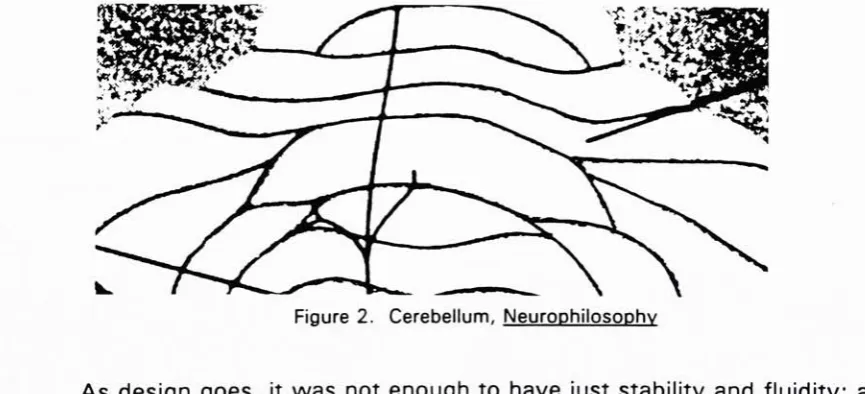
brain is
the cerebellum,
or"little
brain".
As
viewedfrom
below,
its
folds
arelong
and curvacious.It is
asofter more
fluid
pattern.The
cerebellumlooks
morelike overlapping folds
as opposed
to
the
somewhat rigidfolds
ofthe
grey
matter.The
smallerbrain
alsois
interesting
because
it
plays animportant
rolein
exercizing
movement as
it
relatesto the
body.
Figure
2.
Cerebellum,
Neurophilosophy
As design
goes,
it
was not enoughto
have
just
stability
andfluidity;
atexture
with apparentenergy
and gesture was needed.For
this, brain
waves were selected.
There
weretwo
reasonsfor
the
actual representation [image:17.541.74.454.62.248.2] [image:17.541.52.485.408.605.2]format.
The
peaks and valleys arethe
most varied.The
second reasonbeing,
andcoincidently
so, that
they
arethe
waves ofdeep
sleep.Deep
sleep is
the
point atwhich,
according
to
Tom
Robbins,
the
brain
[image:18.541.68.489.50.337.2]photosynthesizes
information.
Figure 3. Delta
Waves,
The Human BrainLastly,
two
staining
methods wereincorporated
as pattern/textureinto
the
dialogue
ofthe
background.
These staining
methods, the
Golgi
andthe
Nissal,
were createdto
hightlight
neurons and cells.The
Nissal
method,
consisting
of adot-like
pattern"stains
the
cells of all neurons."36Whereas
the
Golgi
method"address[es]
the
question ofthe
structural relationsbetween
neurons."37The Golgi
methodis
characterizedby
its
resemblance [image:18.541.69.489.503.678.2]to
roots orbranches.
Figure 4.
NissalStain,
Neurophilosophy
Figure 5.
Golgi
Stain,
The Human Brain
After
the
preliminary
tools
whereestablished,
thus
creating
workabledesign
elements,
afew basic
descisions
neededto
be
made.For
example,
what will
be
the
foreground?
What
canbe
usedto
try
and communicate evolution?What
resources are availableto
create symbolismin
the
three
stages?
What,
if
anything,
wouldit
have
to
do
withflowers?
Five has
always seemedlike
a well-roundednumber,
probably for
alot
ofreasons,
but
for
this
projectit
wasbecause five
elements make astatement
that
is
neithertoo
brief
nortoo
verbose.Three
focuses
too
muchon
singularity
and sevenfocuses
too
much on anonymity.Even
numbersare always ruled out
because
they
aretoo
completeto
ask questions.Basically
speaking,
five
main elements were required tosatisfy
the work athand.
Therefore,
it
wasback
tothe
brain.
Another
look
had
tobe
takenin
order
to
find foreground.
Both
the
idea
of evolution and offloral
propertieshad
to
integrated.
Each
elementhad
to
symbolize a stagein
the
evolutionand yet still retain similar characteristics
in
orderto
convey
wholeness and [image:19.541.55.487.459.648.2]unity.
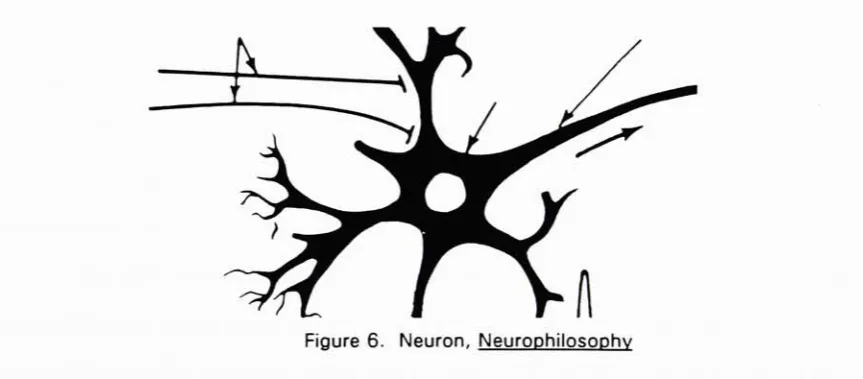
Figure 6.
Neuron,
Neurophilosophy
The first
symbol wasthe
very
easiestto
find.
The
neuronis
the
mostprimary
element.It
virtually looks
like
a spark.It
also resembles aflower in
full bloom.
The first
symbolis
the
finest
connectionbetween
the
art and [image:20.541.52.444.95.325.2]the
theory
ofbrain
evolutionaccording
to
Robbins.
Figure 7.
Blood
Vessel,
Neurophilosophy
The
second symbol was alittle
moredifficult
to
choose.Reptilian
consciousness connotes
symplicity,
among
otherthings,
and requires aprimordial elongation
in design.
However,
the
second symbolhad
to
relateto the
first.
It has
oftenbeen
notedthat
blood
vesselshave
a certainbranch-like
quality.One
illustration
ofthe
blood
vessels,
within closeproximity
to the
forebrain,
showsthe
arch ofthe
aorta.This
arch appearspouch or seed-like,
sprouting from it
are twolong
arms.This
pod-typeelement,
oncethe
artisticlicence had been
usedto
merge the archinto
aclosed
form,
was almostidentical
tothe
onefound
withinthe
neuron.A
match
had
been
found,
a commonelement;
andthus this
seed shapeanticipated
the three
final
symbols.The
third
symbolhad
to
representthe
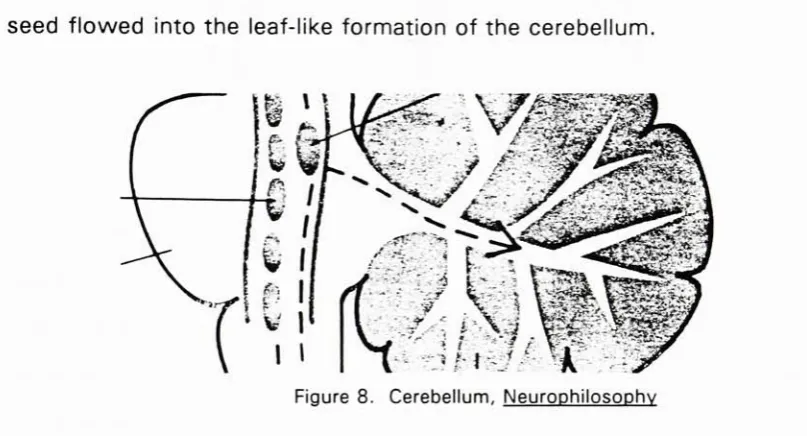
mammalian consciousness.The
cerebellum, or small
brain
is
notonly
a part ofthe
mesencephalon ormammalian
brain,
but
also when cut throughthe
center resemblesleaf-like
shapes.
This
symbol requiredthe
mostinterpretation
and manipulation.Taking
into
considerationthe
connectionbetween
the two
prior symbols,there
was a needto
incorporate
the
seed shape.Going
under theassumption
that there
exists ajoining
withthe
brain
stem allowedfor
thecreation of a seed shape.
The
third
symbol wasdesigned
asif
the
attachment
to the
brain
stem was a crosssection;
andhence,
thedesired
seed
flowed into
the
leaf-like formation
ofthe
cerebellum. [image:21.541.52.456.167.385.2]m
Figure 8.
Cerebellum,
Neurophilosophy
The
fourth
symbol actssomething like
abridge between
the
beginnings
ofthe
mammalianstage,
whichbegan
solong
ago,
andthe
advanced technological state of mankind
adapting
tohis
environment.It
represents
how
mankind,
as opposed tosimply
mammalin
general,
has
the
ability
to
provide structuresin
and ofhis life.
In
otherwords,
it
typifies
protection and comfort.
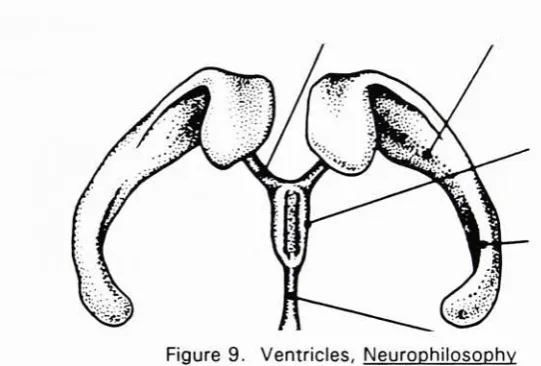
By
way
offunction
as well as thesymmetry
ofdesign,
the
ventriclesin
the
brain
provided a suitablefourth
symbol.The
function
ofthe
ventricles,"cavities filled
with cerebrospinalfluid,
. . .bathe
the
brain
withinthe
protective sheath of dura."38The design
ofthe
ventricle system also
happens
to
appearwing-like,
which enhancesthe
idea
of protection.
Moreover,
the
structure suitedthe
specifications.Two lateral
ventricles arch out and connect
to
athird
ventricle whichtakes the
form
ofa seed
by
means ofits
opening.Figure 9.
Ventricles,
Neurophilosophy
Now
that the
majority
ofthe
symbolshad been
chosen and wereworking
withinthe
setparameters,
thelast
symbolhad
to
be
executed.The
fifth in
the
series plays animportant
rolebecause it is
the
conclusion of thestatement,
however,
the
statementis
open ended.Floral
consciousnessis
still a
theory,
agoal,
orsomething
to
strivefor.
The
floral
stageis
associated withthe
neocortex.Unfortunately
the
neocortex
has
nodistinct
shape other thanthat
ofthe
grey
matteracting
like
acap
overthe
lower
brain
systems.This
meantthat the
fifth
symbolhad
to
be discovered
elsewhere.The
shape chosenactually
camefrom
thelimbic
system.The limbic
systeminvolves many
partsbut
when seentogether
form
a sidewaystulip
or abud
that
has
been
layed
down.
The
limbic
system,
although part ofthe
primalbrain,
is
"involve[d]
in memory
and emotion."39
This
systemis
alsolinked
to the
olfactory
bulb,
whichis
avital part of
the
idea
ofattaining
afloral
consciousness.According
to
Tom
Robbins,
"the
'smell brain'-the memory
area ofthe
brain
activatedby
the
olfactory
nerve-and the'light brain'-the
neocortex-arekeys
tothe
mysticstate."40
Another
reasonfor using
the
limbic
system wasthe
nature ofthe
composition.
The
limbic
system curvesin
onits
self and attachesto the
basal
ganglion whichhas
a "lentiform--'lens-shaped'~ball."41This
was aperfect applicant
for
the
seed shape.Figure
10.Limbic
System,
The
Human BrainOnly
slightliberties
were taken whendesigning
the
symbolsfor
the
artwork.
Each
symbol maintainsintegrity.
However,
it
wasnecessary,
for
aesthetic
purposes, to
execute some manipulation.For
example,
eachsymbol
had
to
have balance.
When
taking
elements out of contextit is
essential to
re-configure,
however
meagerit
mightbe.
Balance
wasestablished,
in
this case,
by
the
variation ofline
weight andlength.
It is
afact
that the
symbolsalone,
viewed afterhaving
been
removedfrom
the source,
do
notnecessarily look
or seemlike brain
parts.This is
fine,
andis
somewhatthe
point.It
is
significantonly
to
have
had
their
design
comedirectly
from
the
brain.
In
otherwords,
theirauthenticity
survives
because
it is
true.In
additionto
that,
the
symbolsbest
retain theirfloral
characteristics when notthought
of as simpledissections,
but
areviewed as whole units
that
came togetherto
create abouquet
of abstractedrepresentation.
Before
finalized design
couldbe
made,
it was crucialto
decide
how
[image:23.541.59.408.137.303.2]the
art pieces weregoing
to
be
puttogether.
An understanding
ofhow
the
medium of
fiber
wasgoing
to
be
usedto
carry
the chosen elements wasrequired.
Silk fabric
has
traits that
lend
themselves
wellto
colorization andsurface application.
Consequently,
silk wasdecided
uponto
be
the
mainingredient.
Silk
canbe dyed
to createany
color andis
a perfect receptaclefor
screen printed pattern.When it
comesto the
technology
ofassemblage,
it is better
to
discuss it
here,
so as not tohinder any
conversation about thefinal images.
Therefore,
adescription in
the
abstract ofthe techniques
used shallbe
discussed
here.
After
the
silkhad been dyed
to the correct colorin
the givenpalette,
it
was then screen printedusing black
prociondye
mixed with algenate.Onto
this treated silk,
pre-cut pattern pieces made offusable
interfacing,
were adhered
by
means ofheat.
The
silk was then cutdown
andhemmed
around
the
shapes.Each
shape was a piecein
the whole,
and waspredetermined through
design.
Once
the
individual
pieces weremade,
they
were"painted"
with an
airbrush.
The airbrushing
was usedto
createboth internal subtlety
and anexternal
hard
edge.The
pieces without pattern were treated with gradatedcolor effects throughout the surface, and all the pieces were sharpened
by
utilizing
ablack
airbrushline soley
around the contours.Lastly,
these pieceshad
to
be
put together.This
wasdone
by
using
paper-backed
fusible
web.This fusible
web acts muchlike
sheets ofdry
glue
that
adherethe
pieces notonly
to
each otherbut
alsoto the
backing.
Therefore,
the
pieces allowedthemselves to
be
mounted atthe
sametime
they
werebeing
assembled.Again,
by
using heat
the
entire artwork wasin
a sense
laminated.
The
very final
touches
consisted ofcutting
outthe
piecesfrom
the
carpet
backing
that
was used as afoundation
andcording
the edges withhand-dyed
black
rope.The cording
was also attachedby
means ofhot
glue.
At
this point,
the artwork was almost complete.The last step
was todecide
on away
tohang
them onthe
wall.The
solutioninvolved
strips ofvelcro secured
to the
back
ofthe
artwork and strips ofthe
velcro matesecured
to
wooden sticks which were then capable ofbeing
nailedto the
wall.
CHAPTER
THREE
A
CREATIVE
APPROACH
The basic designs
for
the
artwork owe much tothe
modernistic phaseof
Art
Deco.
"Deco's
modernistic phase was alsogreatly influenced
by
the
radical art movements such as
De
Stijl,
Futurism,
theBauhaus
andConstructivism."42
This
canbe
seenby
noticing how
shapeis
treated.In
the
Deco
movement"shapes
were either geometricabstracts,
... orgreatly
stylized natural forms."43
The design
of"The Floral
Ploy" utilizesboth
ofthese
characteristics.The majority
ofthe
background is
composed oflarge
geometric shapes and
the
symbols epitomize stylized naturalforms.
Another
correlationbetween
thedesigns
andArt
Deco lies in
the
useof
the
patterns andthe
coloration.In
"The
Floral
Ploy"there
is
alimited
number of
textures
or patterns as well as alimited
palette.Also,
many
ofthe
basic
shapes usedin
the
composition appear over and over.Therefore
there
exists alot
of repetition.Another
important
feature
ofArt Deco is
a powerful sense ofrhythm,
with
many
patternsexploiting
theeffects,
both
accidental anddeliberate,
achievedby
the
juxtaposition
and repetition of colors andshapes.
Color
contrasts[were]
oftenbold
and sometimesdynamic,
.. . with considerable use of
both
primaries and complementaries.At
the
sametime,
interesting
results were often producedby
the
carefuluse of graduated or
balanced
tones of the same or similar colours.44Although
Deco
played a partin
the
inspiration for
the
construction ofthe
designs,
function
andmeaning
were crucial.Much
ofthe
use ofrepetition
is
due
to the
theory
that the
brain
retains allits
stages.Nothing
is
ever
lost,
it is
just built
upon.Each function is
asimportant
now asit
everwas.
This is
the
primary
reasonfor
the
use ofrepeating
pattern and shapein
"The Floral Ploy".
However,
before going
directly
tothe
discussion
on theindividual
pieces of
art,
it
wouldbe
benefical
to
mentiontwo
otherfeatures:
size andtitles.
Size
is
essentialfor dual
reasons.Number
one,
the nature of themedium,
being
fabric,
allowsitself
to
be
usedin large
amounts.Screen
printing,
asit
relatesto technique
ormedium,
alsofactors in
with theidea
of abundance.
In
additionto
that,
the
second reasonhas
todo
withthe
purpose of communication.
Although
the
theory
may be
somewhatobscure, the
statement requires the audience to view the artwork on alarge
scale.
That
is why
the
first,
third,
andfifth
artworks are65"x57".
The
second and
fourth,
because
they
act asbridges,
are75"x52".
Furthermore,
the titles
require some recognition.Since
the statement,
or
theory, is essentially
astory
ofevolution,
it
wasimportant
tobring
this
across
by
means of titling.In
orderto
let it
read,
so tospeak,
each artwork was giventwo
names.They
read asfollows: From
theEarth,
"the
spark";Reptilian
Recognition,
"of
murk and menace";Going
Mammalian,
"birth
mother";
Man's Shelter
Game,
"the
building"; Stage One,
"floral
consciousness".
Both have
equal significancebut
the
second orsurname,
for
reasons ofbrievity,
willbe
the
name referredto
in
the
proceeding
pages.The first
artwork,"the
spark",is exactly
that.Its function is
to
be
the
Big
Bang.
It
is,
in
essence, thebeginning
because it
incorporates
the
neuron as
its
symbol.Aside from that,
the
first
art work establishesguidelines
for
the
remaining four.
More
precisely, the
first
artwork setsup
a modelthat
helps
to
design
the
rest.The preliminary
rule ofthumb
is
that
there are
four
mainshapes,
excluding
the symbol,
in
each ofthe
five
artworks.
The first
artwork,
for
instance,
establishes what willbe
refered toas
the
"common
shape";
whichin
the
case of"the
spark"is
patterned withthe
grey
matter.The
"common
shape"works not
only
as aunifying
element,
because it is found
in
all ofthe artworks,
but
alsobecause
it hints
on
the
idea
ofopposing
forces.
It does
this
by having
an angle and afree
flowing
side.It has both
geometric and organicform.
This is
relevantbecause
ofthe
concept of yin and yang, which"have
cometo
standfor
twocomplimentary
principles,
alternating in
space andtime,
throughout the
myriad
forms
of nature,"45 structure and chaos.Figure
1 1.Final
Design,
"the
spark"
After
the"common
shape"was
introduced,
the
remaining
shapeswere affected
mainly
by
the
aesthetics ofdesign.
The
placement ofthese
shapes relies
both
ondesign
principles as well asfunction
ofthe
intended
[image:28.541.53.466.264.633.2]visual
dialogue.
For example,
"the
spark",by
way
ofcomposition,
is
stacked
from
the
left
corner and explodesdown
toward the
lower
right witha predomiance of
this
sparkidea
createdby
the
black
neuron symbol placeddirectly
on a square oflight
color.The
compositionis further
enhancedby
the
fact
that the
artworkis
not containedin
the
traditional rectangularformat,
andthus
allowed to retain the outline of abstract shape.Notice
how
the
bottom
shape zigzags outward.The
messageis
evenfurther
strenghtenedby
the
use of color andpattern.
The
"common
shape",
as statedpreviously,
is
silver andtextured
with
the
grey
matter,
which alsoto
adegree,
resembles stone or rock.The
second
pattern,
delta
waves,
is
engagedin
thezigzagging
rust shape.The
color and pattern are
both
reminicent of afiery
explosion.The balance
of allthis
activity
rests onthe
"white-hot" square andthe
serenity
ofthe
deep
blue,
representing
space.The
secondartwork,
"of
murk and menace", represents theearly
reptilian stage.
Shape
is
setup
something like
a turtle's shell.Hard
shapes,
compounded with the arms of the
symbol,
arch overthe
softer underbelly.The
underbelly
is
composed ofthe
solidbrown,
whichholds
thedelicate
seed part of
the symbol,
as well asbeing
composed withthe
free
flowing
contour of
the
cerebellum patterened"common
shape".In
additionto the
shell
concept, the
composition also promotesthe
idea
of aggressionthrough
the
use ofthe
elongatedsharp
edgesfound in
the
contour ofthe
artwork asa whole.
The
patterns chosenfor
this
piece also represent aspects ofthis
evolutionary
stage.The
cerebellum patternis
soft andsupple,
like
that
ofan underbelly.
In
fact,
it
rippleslike
ajellyfish.
This is
especially
true
because
of thedirection
thatthe
curvilinearline is
moving.It
undulateslenghtwise
as opposedto
seeming like
a waveby
moving
horizontally.
The
second
pattern, the
Golgi staining is
usedto
evoke theimage
of plantlife;
in
this
case,
roots or perhaps seaweed.It
alsolooks
slightly
confused andtangled,
attributedto the
contrastbetween
the
intricacy
ofblack
texture
onthe
yellow shape whereit
was placed.Figure
12.Final
Design,
"of murkandmenace"
The coloring implores
that
whichis
living
amongstthe
earth.There is
a
heavy
use ofbrown
andgreen,
complimentedby
yellow andblue.
Even
the
placement and use of greenimplies lower level foliage
because
ofthe
horizontal
shape allocatedfor
the
containment ofthat
color.The
yellow,
although
decorated
andthus
hazed,
acts asthe
sun principle.Without light
there
wouldbe
nohope.
The blue is
for
the
coldblooded
body
ofthe
reptilian and the
brown
is
thebed in
whichit lies.
Quite
the
oppositefrom
the
reptilianphase,
warmth andnurturing
[image:30.541.60.486.160.487.2]prevail
in
the
mammalian stage.The
third artwork,
"birthmother".
is
the
epitome of
sympathy
and pro-creation.The
"common
shape"typifies
this
concept
because
ofits
solid tenderflesh-like
color as well asfor its function
as a
backdrop
to
the two
shapes placed ontop
ofit.
The
two shapes act aswalls of a womb and are
impregnated
withthe
symbol.The
compositionalarrangement of "birthmother"
is
alsoextremely
centralized.The
contour ofthe
artwork as a wholeis
enhancedby
the
silver petalshape,
showing itself
three times
aroundthe
mainimage.
This
givesthe
design
a certaintype
ofstability,
whichis
acute tothe
conceptthat there
must exist a wholeness [image:31.541.53.481.273.626.2]before
the
desire
todivide
can take place.Figure 13. Final
Design,
"birthmother"The
patternsfor
"birthmother"
also
depict
the
mammalian womb.The
patterns areintroduced in
the
protectivewalls,
due
to the
fact
that this
is
wherethe
exchangetakes
place.The
delta
waves representthe
energy
given off
from
motherto
child.They
arefound
in
the
bottom
shape,
illustrating
the
first
connection,
orthe
initial
transfer
ofbrainwaves.
This
being
the
primary
sign of selfhood.The
top
shapeimplies
sustenance.The
Nissal
stain givesthe
impression
ofbeing
engulfedin
nourishing
cellbodies.
The
colorbehind
the
patternsfurther
embedsthe
principles ofthe
walls.
The delta
waves move on a rustbackground
andthe
Nissal
stainfloats
over mulberry.The
center ofthe
wombis
champagne.The
silveracts as a soft sheath.
The
colorization ofthis
artworkis especially
notablein
its
utilitarian use of warm and cool.The
successbeing
that the transition
of color supports a
mild,
less
tense
vision ofsupply
anddemand.
The
silverand champagne work as
buffers
for
the
strong
links between
the
black
symbol and
the
more concentrated uses of rust and mulberry.The fourth
artworkfunctions
as abridge
that
spans the world ofmankind.
There is
a refined sense of order and structurein
thiscomposition.
Technology
found its way into
"the
building".
The
axialplacement of
the
navy blue
wedge actslike
an anchorto
the symbolicseed,
while
simultaneously
working
as a counterbalancefor
the
farther
reaching
limbs
ofthe
symbol.Behind
the
blue
lies
mankind's nest.This
shaperepresent
home,
concealedfrom
the
back
by
land
and trees.The
"common
shape",
orin
this casethe
land,
positionsitself
withits
angledown
andits
free
flowing
line
rolling
onthe
horizon.
Securing
all ofthis
is
the
job
ofthe
last
shape.This
shapedepicts
the
highest level
of plantform,
the
trees.This
shape also moonlights asthe
determining
contour edge of artworkin its
entirety.
The
contouris
a series ofsteps,
eithergoing
up
orgoing down.
This
design
supportsthe
many
challengesthat
mankindhas
to
face
andconquer.
Some
ofthe
mostdifficult
onesbeing
right outsidehis
back
door.
Figure
14. FinalDesign,
"the building"Once
againthe
use oftexture
strenghtensthe
intended
statement.The
grey
matter,
whichin
"the
building"
seems more
like
shells, pebbles,
ormarble, than
like
ordinary
stone or rock asit did
in
the
first
artwork,
is
prompted
to
characterize refined elements of construction.This is mainly
due
to
thefact
that pinkis
used as afoundation
color,
but
there also existsrefined construction
in
the
design
ofthe
pattern whichhas
a notch andgroove quality.
Likewise,
the second pattern promotes constructionby
means of natural growth.
The
Golgi
stainis
used onthe
dark
green,
whichas stated earlier
illustrates
the
trees.However,
as opposedto the
verticaldirection
ofthe
Golgi
stain as seenin
"of
murk and mence",in
"the
building"
the
branches
move outward.This direction
creates theidea
oflevels
orhierarches
of plantforms.
Adding
colorto
these shapes wasbasically
takenfrom
the
most [image:33.541.57.487.39.375.2]direct
translation.
Land
andtrees
arebrown
andgreen,
respectively.The
pinkish color
is
reminicient ofthe nest,
structuredby
the
use of pattern.The
blue,
however,
is essentially
aestheticin
behavior.
Due
to the
centralplacement of
the
shapethat
encompassesthe color,
it
wasnecessary
to
chose
something
cool.The
axisfor
mankindis
not always asloud
asit
might sometimes
be
consideredto
be.
The blue
can alsobe
interpreted
as [image:34.541.63.459.228.529.2]the
shade orthe night,
whichby
definition
is
the
lack
ofdirect
sun.Figure 15.
FinalDesign,
"floral consciousness"The last
artwork createdfor
"The
Floral
Ploy"
is
actually
speaking
about a
beginning.
It is
the
part ofthe
evolutionthat
casts alook
toward.
This
artwork represents an awareness.Floral
consciousnessis
the
theory
as well as the namesake of the work.
It is
theimage
most associated withflowers.
Therefore,
the
composition enhancesthis
thought.The
overlapping
placement
ofthe
shapeshas
an open quality.The
complementary
shapesof
rust
and green create a "V" aroundthe
bulb
ofthe
symbol.The gap is
then
filled
withthe
introduction
ofthe
"common
shape".Since
the
majority
of
the
"common
shape"is
exposed,
it
resembles a plane on whichthe
pattern can
then
be
strewn.The
flower
characteristics arebest
seenin
the
petal
like
contours ofthe
last
shape.This
equally helps in
the
final
outlineof
the
artwork.The
patterns usedin
"floral
consciousness"are
likewise
representational of
the
flower.
The
Nissal
stainis
spread overthe
"common
shape"
like
grain on afield
of sun.It
dots
the
full
surface ofthe
plane.Furthermore,
it is
the pollenation of patternthat
maintains an equilibriumbetween
the
size and color ofthis
particular shape.The
cerebellumpattern,
on
the
otherhand,
is
situated onthe
slope ofthe
green shape.This
texture
emphasizes
foliage.
The
directional quality
ofthe
cerebellum patternis
usedto
depict
the
sensualfolds
of aleaf
moving
outwardfrom
its
connectionto
the
stem.The
colors usedin
thelast
artworkare,
as much asanything,
aculmination of
the
previous colors used.The
artworkincorporates
the
mostvaried combination of
complementary
colors.The
yellow works as ahighlight;
andthe
rustis both
a petal color and atie
in
to the
blood
ofmankind.
The
green works as a coolfoundation
for
the two
warmershapes,
as well asdoubling
for
the
representation offoliage.
The
petalshape
is mulberry
and works to augmentthe
idea
offlower.
The
purplishtone
ofmulberry
adds warmth and graceto
"floral
consciousness".The
five
artworks,
andhence
the
five
statementsthey
communicateare complete
in
their singularity.Each
part ofthe
creationis
anindividual
thought.
So
although"The
Floral
Ploy"
has
anunderlying
meaning
ofunity,
it is
not vitalto
viewthem together.
They
canbe
seen as chapters orpassages.
Sometimes it is
notnecessary
to
readthe
wholebook.
Sometimes it is
possibleto
understandthe
characters withoutknowing
theirfull
rolein
the
plot.Likewise,
with regardsto the
audience andthe
fundamental
knowledge
ofneurology,
it is
not essentialto
have
these two
componentsput
together.
In
otherwords, the
artisticintegrity
ofusing
the
human brain
as a visual source
is
notdependent
onhaving
the
viewerinformed
onthis
topic.
Visual
truth
rests onthe
assumptionthat the
design
characteristicswill speak
for
themselves.
The
audience caninterprete
them
asthey
like.
The
realjudge
of good artworkis
not whether people can pick outrepresentational
objects,
but is
subject to whether or not the artisthas
fulfilled
the
predetermined goals.That is
the
way
art, science,
and evenreligion
behave;
the
appreciationis
intrinsic,
the
restis
opinion.a
CD
3
O)
CO
o
c o 'c o o o 0) az c CD
Q CD
CO
CD
D) U.
CD
C o
'c
a o
o
Q
CD
a:
OT
3
CD
o
E
JZ
J2
O C
'o
a
6
CN
3
CD
D
C
'o
CN
CD
i_
D)
CD
.C
CN CN
3
u.
CD o
CD CN
3 O)
CD
C O
CD
a
CD
*-CN
3 O)
CD T3
CD C
O
CD D CO
CO
LO CM
3 D)
CONCLUSION
By
means ofhindsight,
it
canbe determined
that
a connection wasmade
between
the
theory
offloral
consciousness andthe
visualimages
ofthat theory.
The
use of the physicalbrain
as a sourceis
the plateau of thisconcept.
However,
the
originalanalogy
can notbe
claimed,
the creditfor
that
goesto
Tom Robbins.
The
artist,
in
this case,
canonly
concludethat
after much research and
examination, the
brain is
notonly
aflower
withthe
desire
to
bloom,
but
alsosomething
of asyncronism,
moving logic
andemotion,
andlinking
science and religion.It is virtually imposs