R E S E A R C H
Open Access
Larval nutrition differentially affects adult fitness
and
Plasmodium
development in the malaria
vectors
Anopheles gambiae
and
Anopheles stephensi
Willem Takken
1*, Renate C Smallegange
1,2, Antoine J Vigneau
3,4, Valerie Johnston
3, Margaret Brown
3,5,
A Jenny Mordue-Luntz
3and Peter F Billingsley
3,6Abstract
Background:Mosquito fitness is determined largely by body size and nutritional reserves.Plasmodiuminfections in the mosquito and resultant transmission of malaria parasites might be compromised by the vector’s nutritional status. We studied the effects of nutritional stress and malaria parasite infections on transmission fitness of Anophelesmosquitoes.
Methods:Larvae ofAnopheles gambiae sensu strictoandAn. stephensiwere reared at constant density but with nutritionally low and high diets. Fitness of adult mosquitoes resulting from each dietary class was assessed by measuring body size and lipid, protein and glycogen content. The size of the first blood meal was estimated by protein analysis. Mosquitoes of each dietary class were fed upon aPlasmodium yoelii nigeriensis-infected mouse, and parasite infections were determined 5 d after the infectious blood meal by dissection of the midguts and by counting oocysts. The impact ofPlasmodiuminfections on gonotrophic development was established by dissection. Results:Mosquitoes raised under low and high diets emerged as adults of different size classes comparable betweenAn. gambiaeandAn. stephensi. In both species low-diet females contained less protein, lipid and glycogen upon emergence than high-diet mosquitoes. The quantity of larval diet impacted strongly upon adult blood feeding and reproductive success. The prevalence and intensity ofP. yoelii nigeriensisinfections were reduced in low-diet mosquitoes of both species, butP. yoelii nigeriensisimpacted negatively only on low-diet, small-sizedAn. gambiae considering survival and egg maturation. There was no measurable fitness effect ofP. yoelii nigeriensisonAn. stephensi. Conclusions:Under the experimental conditions, small-sizedAn. gambiaeexpressed high mortality, possibly caused by Plasmodiuminfections, the species showing distinct physiological concessions when nutrionally challenged in contrast to well-fed, larger siblings. Conversely,An. stephensiwas a robust, successful vector regardless of its nutrional status upon emergence. The data suggest that small-sizedAn. gambiae, therefore, would contribute little to malaria transmission, whereas this size effect would not affectAn. stephensi.
Keywords:Anopheles gambiae sensu stricto,Anopheles stephensi, Mosquito,Plasmodium yoelii nigeriensis, Blood-feeding, Body size, Fitness
* Correspondence:[email protected] 1
Laboratory of Entomology, Wageningen University, PO Box 8031, 6700, EH Wageningen, The Netherlands
Full list of author information is available at the end of the article
Background
Lifetime fitness of adult female mosquitoes is influenced strongly by nutrition during larval development, the availability and quality of blood meals, and ambient conditions. Larval nutrition determines metabolic reserves and the size of adult mosquitoes upon emergence [1-3] and superimposed on body size, the number of eggs is largely governed by the size of the preceding blood meal [4]. Anopheline larvae that develop in overcrowded condi-tions or suffer nutritional stress result in adult mosquitoes that may require two or more blood meals before they can initiate oogenesis and lay eggs [2]. These pre-gravid mosquitoes [5] feed soon after emergence and are likely to return for a blood meal the next day. This state is common in natural populations of Anopheles gambiae, with as many as 70% of the females emerging as pre-gravid adults [5]. However, the pre-pre-gravid condition is less common in other anophelines, perhaps with the exception ofAn. funestus[1,6].
Malarial parasites are often considered detrimental to survival and gonotrophic development in anophelines (reviewed by [7,8] and [9]). It is inferred that responses initiated by the female mosquito following an infec-tious blood meal negatively affect survival and vitello-genin deposition in the oocytes [10,11]. However, while
Plasmodium-infected mosquitoes may exhibit reduced
longevity and fecundity, the interaction of these effects with fitness upon emergence (i.e. viable reproductive output) remain unexplored [12,13].
Here we investigate the effects of larval nutrition upon adult characteristics on emergence of An. gambiae and
An. stephensi. We also examine the effects of different larval nutritional regimes on mosquitoes uninfected or infected with the rodent malaria parasite, Plasmodium yoelii nigeriensis. We demonstrate that the two mosquito species have differing ecophysiological strategies and show that malaria transmission is possibly severely compro-mised in nutritionally deficientAn. gambiae.
Methods Mosquitoes
Anopheles gambiae sensu stricto (Suakoko strain) and
An. stephensi(SDA500) were kept at 27°C, 80% RH, and 12 h scotophase, with 30 min dusk and dawn periods. Larvae were raised in 2.5 L of tapwater (22 x 34 cm sur-face area, 3.3 cm depth) and fed powdered Tetramin® fishfood (Tetrawerke, Melle, Germany) daily. Pupae were placed in 30 cm3gauze cages for adult emergence. Adult males and females were kept together and provided with 8% fructose ad libitum. For colony maintenance, female mosquitoes were blood-fed on a human arm (An. gambiae) or an anaesthetised mouse (An. stephensi) twice per week. Eggs were collected on moist filter paper and transferred to larval trays for hatching.
For experiments, 200 newly emerged larvae were placed each in a tray and fed 0.1 mg (low diet) or 0.3 mg (high diet) powdered Tetramin® fish food per larva per day. All pupae were collected daily and placed in emer-gence cages. To ensure all females were mated, 6–7 d old males from the main colony were added to females (1:1 ratio) on the day of emergence.
Mosquito size
Adult mosquitoes <24 h old were killed by freezing, placed in small glass vials and dried for 48 h at 40°C. Mosquitoes were weighed (±0.001 mg) in a Cahn elec-trobalance, then one wing of each mosquito glued onto a slide, and its length from the distal end of the alula to the tip, excluding the fringe scales, was measured with an ocular micrometer (±0.03 mm).
Metabolic reservoirs and blood meal uptake
Metabolic reserves were measured within 6 h of emer-gence. Glycogen and lipids were determined according to [1,14,15] and protein measured with the Bio-Rad Pro-tein Quantitation Assay kit using Pierce’s bicinchoninic acid and bovine serum albumin as a standard [16]. For quantification of blood meal size, 5 day-old female mos-quitoes were fed to repletion on a healthy, anaesthetised mouse, immobilised immediately on ice, and protein determined in individual midguts after dissection [17]. Means were compared by t-test [18] unless otherwise indicated.
Mosquito infections withPlasmodium
MF1 mice were infected withPlasmodium yoelii nigeriensis
[19] by i.p. injection of 5 μL infected blood. Mice were checked microscopically on day 4 p.i. for the presence of parasites and exflagellating gametocytes. If exflagellations were observed, experimental mosquitoes were fed upon the anaesthetised mice.
Paired groups of approximately 30 3-day old females of low- and high-diet mosquitoes of the same species were fed simultaneously to repletion on one infected mouse. Fed mosquitoes were maintained as above for five days, cold-immobilised and midguts examined for oocysts after mercurochrome staining [20]. Prevalence is defined as the proportion of mosquitoes infected with
Plasmodium; intensity of infection is defined as the geo-metric mean number of oocysts per mosquito.
Ovarian development
Mosquitoes of both diet regimens that had fully engorged on uninfected and Plasmodium-infected mice were dis-sected in physiological saline 3 days after the blood meal. Ovaries were examined at 400x magnification under a dis-secting microscope. Development of ovaries was scored
Takkenet al. Parasites & Vectors2013,6:345 Page 2 of 10
according to [21], and the number of developing eggs in each ovary, if applicable, was counted.
Statistical analysis
The effects of larval diet on adult body size and meta-bolic reserves were analysed with a Generalized Linear Model (GLM; Genstat, release 6.1). Two-sided t-probabilities were calculated to test pairwise differences between means. Effects were considered to be significant at p < 0.05. GLMs were also used to examine the effect of body size on blood-meal uptake, and the effect of body size and Plasmodium
infections on gonotrophic development. All possible two-way interactions were examined. The effect of body size on mosquito survival and on the proportion of oocyst-infected mosquitoes were analysed by GLM using a binomial distribution [20]. The number of oocysts per mosquito within a group were log-transformed and analysed as Poisson-distributed data, and GLM used to investigate the effect of body size on oocyst infections [18,22].
Ethics statement
All animal work described in this paper was approved by the University of Aberdeen ethical review committee and was performed under an approved United Kingdom Home Office project licence (Licence Number PPL 60 2810).
No human subjects were asked to participate in this study and ethical clearance was not required. Although mosquitoes were fed upon a human arm, this was per-formed only by the first author as a standard routine method for mosquito maintenance.
Results
Wing length, dry weight and metabolic reserves
As the study focused on the blood meal uptake and
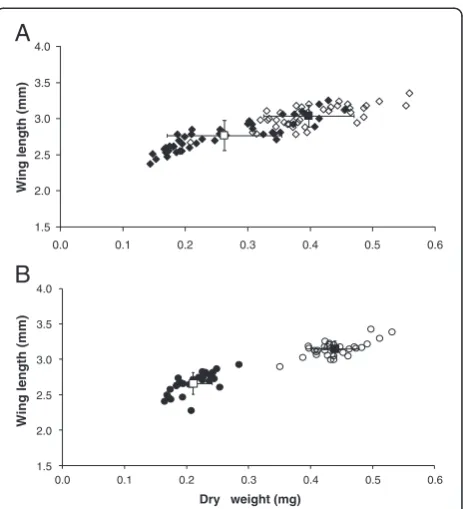
Plasmodiuminfection, only female mosquitoes were ana-lysed. The low and high larval diets produced significantly different size classes of mosquitoes (p < 0.001). Mean wing lengths for low and high diet An. gambiae were 2.77 ± 0.03 mm (n = 55) and 3.03 ± 0.02 mm (n = 48), and for
An. stephensi were 2.66 ± 0.03 mm (n = 32) and 3.15 ± 0.02 mm (n = 35), respectively. The low dietAn. gambiae
(range 2.37-3.25 mm) included a number of individuals with dry weights and wing lengths comparable to those seen in the high-diet group (range 2.67-3.35 mm) and there was a poorer demarcation between low- and high-diet groups in this species (Figure 1).
Low-diet mosquitoes of both species had significantly less protein, lipid and glycogen upon emergence than high-diet individuals (p < 0.001) (Figure 2A-C). Cor-rected for dry body weight, the high-diet mosquitoes had proportionally significantly (p < 0.05 for all compari-sons) more protein, lipid and glycogen reserves than the low-diet ones (Figure 2D). Blood ingestion per female in-creased significantly in high-diet mosquitoes (p < 0.001)
from 0.344 to 0.405 mg protein /midgut inAn. gambiae
and from 0.359 to 0.548 mg protein/midgut in An. stephensi. While the increase in blood uptake between high- and low-diets groups was greater in An. stephensi
than in An. gambiae, the relative increase was approxi-mately 1.2-fold in both species (Figure 2E).
Plasmodiuminfections and survival
We were able to obtain infection rates ofP. y. nigeriensis
much more comparable to those seen in the field for
P. falciparum than usually reported in studies of murine malaria transmission [20,23]. Only 24% of the low-diet
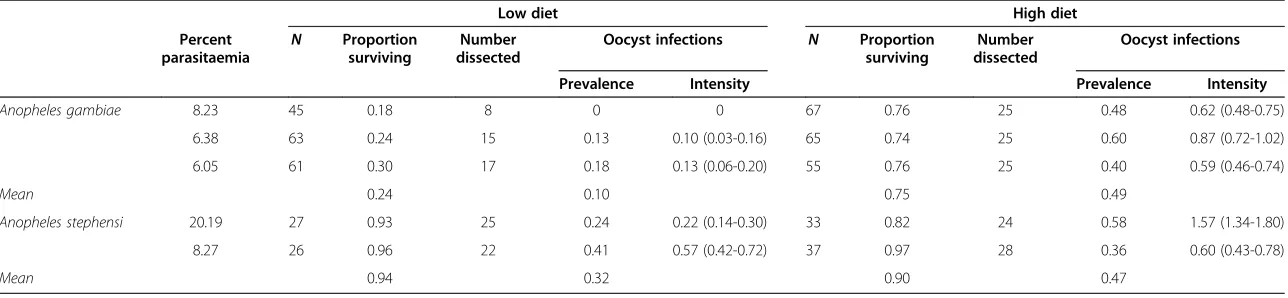
An. gambiaegiven an infectious blood meal survived the 5 days until oocysts developed (Table 1). The mean oocyst prevalence of this group was 0.10 and the mean intensity ranged from 0 to 0.18 oocysts per mosquito. Of the high-diet An. gambiae, 75% survived 5 days after feed-ing. The mean oocyst prevalence was significantly higher (p < 0.001) at 0.49 and the mean intensities ranged from 0.59-0.87 oocysts per mosquito (p < 0.005 compared to low diet). Survival rates of low-diet An. gambiae were significantly lower than of the high-diet group (p < 0.001). There was no significant correlation of oocyst infections with body size but uninfected females were significantly smaller than mosquitoes infected with one (p = 0.01) or more (p = 0.001) oocysts (Figure 3A).
Mean survival rates of An. stephensi were ≥90% re-gardless of larval diet. Mean oocyst prevalence increased
1.5 2.0 2.5 3.0 3.5 4.0
0.0 0.1 0.2 0.3 0.4 0.5 0.6
Wing length (mm)
1.5 2.0 2.5 3.0 3.5 4.0
0.0 0.1 0.2 0.3 0.4 0.5 0.6
Wing length (mm)
Dry weight (mg)
A
[image:3.595.307.539.86.341.2]B
from 0.32 in the low-diet mosquitoes to 0.47 in the high-diet group and the intensity of infections simi-larly increased (Table 1). The oocyst intensities in An.
stephensi were higher than in An. gambiae in both
size classes. There was no difference in mean wing length of uninfected or infectedAn. stephensi(Figure 3B).
Plasmodiuminfections and gonotrophic development
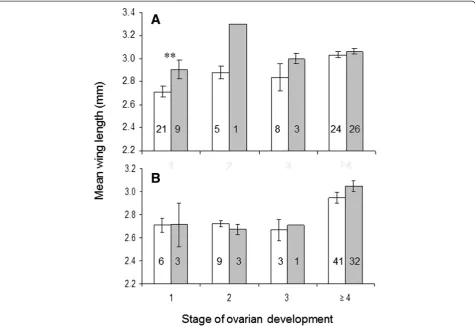
Parasite infections had little effect on ovarian development in both mosquito species. High-diet, larger mosquitoes, both uninfected or infected, matured eggs more success-fully than individuals raised on the low diet (p < 0.01), except in infected An. gambiae (Figure 4). Parasite in-fections had a greater effect on gonotrophic develop-ment in An. gambiae than in An. stephensi, as the proportion of infected femaleAn. gambiaewith reduced gonotrophic development (Christophers stages I-II) was larger than that of uninfected females (stage I: p = 008; stage II: p = 0.036). Plasmodium-infected, low-diet An. gambiaedid not initiate oogenesis, while uninfected and infected rich-diet females were at similar stages of ovarian development 5 days after the infectious blood meal. In
An. stephensithere was no effect ofP. yoeliiinfection on ovarian development in both size classes (Figure 5).
Discussion
The nutritional status of larvae ofAn. gambiae and An. stephensi is manifested as differences in body size and reserves of protein, lipid and glycogen in teneral adults. Nutritionally-stressedAn. gambiaeemerge as small individ-uals that die within 48 h following emergence if deprived of a carbohydrate source [2,24]. Well-fed individuals survive longer. Upon emergence, the fitness of mosquitoes is related directly to size, and in our study the quantity of larval food and not larval density caused these ef-fects. Nutritionally-deprived larvae required 2–3 more days to reach pupation than the nutritionally well-fed siblings (data not shown). Both species responded in a similar fashion to the different larval diets, although in
[image:4.595.58.292.85.652.2]An. gambiae there was a gradient of adult size so that low-diet and high-diet size classes were not as distinct as those inAn. stephensi. This may be because the more competitive larvae of An. gambiae were able to ingest more food to the detriment of their siblings or due to
Figure 2Effect inAnopheles gambiae(left) andAnopheles stephensi(right) of larval diet regime on total body reserves of protein (A) (n = 10 per treatment), lipid (B) (n = 30) and glycogen (C) (n = 10), on their relative proportion (D) upon emergence (means from A-C calculated as a proportion of dry weight, n = 28-48), and on blood meal size (E) (n = 10 except in low-dietAn. gambiae, where n = 5).White background, low diet; grey background, high diet. In(D), vertical shading is glycogen, stippled shading is lipid and diagonal shading is protein. Error bars represent SEM.
Takkenet al. Parasites & Vectors2013,6:345 Page 4 of 10
Table 1 Effect of body size onPlasmodium yoelii nigeriensisdevelopment inAnopheles gambiaeandAn. stephensiraised on different larval nutritional quantities
Low diet High diet
Percent parasitaemia
N Proportion
surviving
Number dissected
Oocyst infections N Proportion
surviving
Number dissected
Oocyst infections
Prevalence Intensity Prevalence Intensity
Anopheles gambiae 8.23 45 0.18 8 0 0 67 0.76 25 0.48 0.62 (0.48-0.75)
6.38 63 0.24 15 0.13 0.10 (0.03-0.16) 65 0.74 25 0.60 0.87 (0.72-1.02) 6.05 61 0.30 17 0.18 0.13 (0.06-0.20) 55 0.76 25 0.40 0.59 (0.46-0.74)
Mean 0.24 0.10 0.75 0.49
Anopheles stephensi 20.19 27 0.93 25 0.24 0.22 (0.14-0.30) 33 0.82 24 0.58 1.57 (1.34-1.80)
8.27 26 0.96 22 0.41 0.57 (0.42-0.72) 37 0.97 28 0.36 0.60 (0.43-0.78)
Mean 0.94 0.32 0.90 0.47
N–number of mosquitoes that took an infectious blood meal.
Parasites
&
Vectors
2013,
6
:345
Page
5
o
f
1
0
vectors.co
m/content/6/1
cannibalism [25]. Alternatively, at the larval density chosen for this study, density-dependent effects may already have been present inAn. gambiaeand not inAn. stephensi[26]. Okech et al. [13] demonstrated the importance of nutri-ents from natural breeding sites on body size of An. gambiae. Although the nutrients used in their study were different from those in the present study, the data corrob-orate our findings about nutritionally-deprived mosquitoes. Mosquito body size affects reproduction and survival, with larger mosquitoes producing more eggs during their lifetime than their smaller counterparts [1,27,28]. This is the case for both An. gambiaeand An. stephensi
as the gonotrophic development of the low-diet class of mosquitoes was much reduced compared with that of the high-diet class. The proportion of low-diet females entering a pre-gravid stage was greater than in the high-diet group, in which such a physiological condition was low or absent. Pre-gravid behaviour of wildAn. gambiae
is well documented [5,12,29], the proportion of adults in this condition varying seasonally, possibly depending on conditions in larval habitats. As we demonstrate in the present work, this may profoundly affect the ability of the mosquitoes to transmit malaria parasites. No such pre-gravid physiology was observed inAn. stephensi.
Although we expected that the low diet would prefer-entially compromise lipid storage [1,30], the deposition
of protein, lipid and glycogen were all affected. Hence, low-diet mosquitoes not only started adult life as small individuals, but were also severely compromised nutri-tionally; this is manifested in a higher mortality rate in both laboratory [2,24] and field [12] studies. The need for blood meals to aid adult nutrition rather than just reproduction is thus important. Additional protein re-quired by small adults for survival must be derived from vertebrate blood, as the insects have limited protein re-serves upon emergence [2,31]. Conversely, nutritionally-rich larval diets are multiply beneficial; with increased body size and reserves, female mosquitoes not only live longer but ingest larger blood meals, complete ovarian development more successfully (this paper) and compete better for males [32,33].
The biological interaction between nutritional status andPlasmodiuminfections is intriguing. In a large mos-quito, uptake of a larger infectious blood meal will result in more parasites entering the mosquito midgut [34]. This could be harmful as higher death rates of large mosquitoes has been attributed to increased oocyst load that in turn competed for nutritional resources [35] or induction of a damaging immune response [36]. Our study is in agreement with the findings of Okech et al.
[image:6.595.57.541.88.378.2][13] that body size affects the number of parasites that develop into oocysts. As a general rule, small mosquitoes
Figure 3Size ofAnopheles gambiae(A) andAnopheles stephensi(B) mosquitoes infected at different intensities by oocysts of
Plasmodium yoelii nigeriensis.Differently coloured bars represent replicates ± SEM. Sample sizes are shown within the bars.
Takkenet al. Parasites & Vectors2013,6:345 Page 6 of 10
developed fewer oocysts than their larger siblings. Although it is tempting to relate this observation to the smaller quantity of blood ingested by smaller females, this is clearly not the sole explanation. InAn. stephensi, a 1.3-fold increase in blood meal size from low- to high-diet groups was accompanied by a similar 1.5-fold increase in prevalence and a modest 2.8-fold increase in mean oocyst intensity. Thus, in this species, differences in blood meal size probably account for all the differences in oocyst rates from the same infectious blood source. In stark contrast, the increase in blood meal size from low- to high-diet
An. gambiaeresulted in an approximately 5-fold increase in prevalence and 9-fold increase in mean intensity. Clearly the differences in blood meal size cannot alone account for the differences in oocyst infections.
Many more gametocytes are ingested during a blood meal than can be accounted for as oocysts [37,38]. The likely candidates for modulating infections are compo-nents of the mosquito immune response [39-41]. Indeed, oxidative stress of the mosquito contributes greatly to the ‘infectious physiological background’ into which the
gametocytes are placed during feeding [42,43]. The dra-matic differences in infection rates between low- and high-diet mosquitoes suggest that defensive mechanisms against ookinetes may be stimulated by the low diet, and when parasites are ingested by these mosquitoes, they either overload the already burdened stress responses to kill the mosquito or are killed by it. In contrast, large mosquitoes are less stressed upon emergence and consequently can maintain low-level infections without necessarily triggering the immune response or com-promising their own survival. Such a model would favour the maintenance of highly responsive and biologically expensive immune genes in the population at low fre-quencies because while most of the small, stressed mos-quitoes will die young, those that do survive may still contribute one or two batches of eggs to the population. Our results suggest that parasites effected a greater mortality on the mosquitoes in nutritionally-compromised
An. gambiaethan in well-fed ones. In this group, although we did not study the mortality of uninfected mosqui-toes, Lambrechtset al. [44] report a significant
[image:7.595.62.538.89.415.2]effected mortality inAn. stephensibyP. yoelii. Similarly, Dawes et al. [9] report a density-dependent effect of
P. berghei ookinetes in An. stephensi. Other reasons could be the small blood meal size or the absence of a critical factor for the oocyst. In a recent field study, in-vestigating the effect of natural Plasmodium infections on wild An. gambiae and An. arabiensis, mosquitoes with larger body size produced more eggs but sporozoite infection did not affect egg production, which corrobo-rates our findings [45]. As with our study, small-sized individuals may not have been noticed as they died early in the infection process possibly due to reduced fitness [35]. From this we conclude that mosquito fitness contrib-uted to the higher survival rate of well-fed An. gambiae. Plasmodium yoelii nigeriensis had only a small effect on
An. stephensiof both size classes, which may be attributed to the relatively low oocyst load of infected mosquitoes.
Parasite infections had only a negligible effect on the gonotrophic development in both species, in contrast to previous demonstrations of P. y. nigeriensis negatively affecting fecundity ofAn. stephensi[19,44,46]. However, occyst intensities in the present study were <1, whereas much greater oocyst burdens were used previously. It is therefore possible that oocyst load directly affects mos-quito fitness and that the densities observed in our study were below the threshold for negative effects to occur. The above-mentioned studies added para-aminobenzoic
acid (PABA) to sugar water as an extra nutritional source following a Plasmodium-infected blood meal. PABA may have affected the infectiousness of the parasites, leading to relatively high oocyst intensities, which are unusual in wild mosquitoes [20,23]. Natural densities ofP. falciparum
oocysts typically average 0.25-3 oocysts per mosquito (range = 0–60) [20,47-49] and this strong skew in favour of no infections and low densities may serve as a natural mechanism or trade-off, regulating mosquito fitness in response to Plasmodium. With low oocyst densities there was no effect ofP. y. nigeriensis on ovarian devel-opment in An. stephensi; body size was the only factor determining fecundity. Hopwoodet al. [50] reported sig-nificant apoptosis and ovarian resorption inAn. stephensi
as a result of Plasmodiuminfection. We did not observe negative effects of parasite infections on ovarian develop-ment, possibly because the oocyst intensities were lower or because we had not added antibiotics and para-aminobenzoic acid to the adult sugar source. In An. gambiae the parasites affected the small-sized mosqui-toes: mortality of infected mosquitoes increased and ovarian development was stopped. However, because so few low-diet mosquitoes survived the oocyst incubation time (n = 4), the results are equivocal and further exam-ination is required. Gonotrophic development of large females of An. gambiae was unaffected by parasite in-fections. It is possible that in previous studies the com-bination of large-sized mosquitoes and high parasite densities may have obscured any influence of diet, en-vironment or parasite on mosquito fitness [51].
These studies emphasise the important differences in the physiological adaptations to nutritional stress of two closely-related mosquito species. Under identical condi-tions, both species respond to dietary quantity and avail-ability by altering their body size and nutrional reserves. However, while An. gambiaefitness is severely compro-mised by the low-diet, small and largeAn. stephensi are of comparable fitness in the short period of study. The reasons for this are unknown, but may result from the disproportionately poor lipid storage in smallAn. gambiae, conferring poor fitness.
[image:8.595.58.292.89.344.2]The low infection rates and low impact of the parasite on high-diet mosquitoes may more closely reflect nat-ural interactions between malaria and mosquitoes. Mos-quito fitness is regulated in the larval stages by density dependence and environment [12], and in the adult stages by climate and the availability of blood sources, carbohy-drate resources and oviposition sites [2,52,53]. Parasite infections may have important fitness consequences for the vector [7,54], and the scale of these consequences will be controlled by the vector and parasite interaction. The evolutionary co-adaptation of parasite and vector will eventually determine the success of transmission, and from our results it appears that a propensity for low
Figure 5Effect of a single blood meal to repletion and
Plasmodium yoelii nigeriensisinfection on gonotrophic development inAnopheles gambiae(A) andAnopheles stephensi
(B) fed low and high diets.
Takkenet al. Parasites & Vectors2013,6:345 Page 8 of 10
parasite infections may be the best adaptive strategy for this interaction.
Conclusions
The nutritional status ofAn. gambiaeand An. stephensi
upon emergence had different outcomes uponPlasmodium
infections. Nutritionally-compromised females ofAn. gam-biae died early in adult life, had a lower prevalence of
Plasmodiuminfection and developed significantly fewer oocysts than well-fed females. In contrast, the nutri-tional status of An. stephensi had no effect on survival over the period of study nor on Plasmodium develop-ment. In both mosquito species poor nutrition but not
Plasmodiuminfection inhibited ovarian development.
Competing interests
The authors declare that they have no competing interests.
Authors’contributions
Conceived and designed the experiments: WT PFB JM-L. Performed the experiments: WT AJV VJ MB. Analyzed data: WT RCS PFB. Wrote the paper: WT and PFB. All authors read and approved the final version of the manuscript.
Acknowledgements
We thank Kevin McKenzie for assistance with wing length measurements and Louise Swan for dissections and other laboratory assistance.
Author details
1Laboratory of Entomology, Wageningen University, PO Box 8031, 6700, EH
Wageningen, The Netherlands.2Current address: Wageningen Academic Publishers, PO Box 220, 6700, AE Wageningen, The Netherlands.3School of
Biological Sciences, University of Aberdeen, Tillydrone Avenue, Aberdeen AB24 2TZ, Scotland UK.4Current address: 18 Jasmine Court, CB1 8BG
Cambridge, UK.5Current address: School of Pharmacy, Robert Gordon University, Schoolhill, Aberdeen AB10 1FR, UK.6Current address: Sanaria Inc,
9800 Medical Center Drive, Rockville, MD 20850, USA.
Received: 19 December 2012 Accepted: 4 December 2013 Published: 10 December 2013
References
1. Briegel H:Fecundity, metabolism, and body size in Anopheles (Diptera: Culicidae), Vectors of Malaria.J Med Entomol1990,27:839–850.
2. Takken W, Klowden MJ, Chambers GM:Effect of body size on host seeking and blood meal utilization inAnopheles gambiaesensu stricto (Diptera: Culicidae): the disadvantage of being small.J Med Entomol1998,35:639–645. 3. Ng’habi KR, Huho BJ, Nkwengulila G, Killeen GF, Knols BGJ, Ferguson HM:
Sexual selection in mosquito swarms: may the best man lose?Anim Behav 2008,76:105–112.
4. Hurd H:Interactions between parasites and insects vectors.Mem Inst Oswaldo Cruz1994,89(Suppl 2):27–30.
5. Gillies MT:The recognition of age-groups within populations ofAnopheles gambiaeby the pre-gravid rate and the sporozoite rate.Ann Trop Med Parasitol1954,48:58–74.
6. Gillies MT:The pre-gravid phase of ovarian development inAnopheles funestus.Ann Trop Med Parasit1955,49:320–325.
7. Hurd H:Manipulation of medically important insect vectors by their parasites.Annu Rev Entomol2003,48:141–161.
8. Rivero A, Ferguson HM:The energetic budget ofAnopheles stephensi
infected withPlasmodium chabaudi: is energy depletion a mechanism for virulence?Proc R Soc Lond Ser B-Biol Sci2003,270:1365–1371. 9. Dawes EJ, Churcher TS, Zhuang S, Sinden RE, Basáñez MF:Anopheles
mortality is both age- andPlasmodium-density dependent: implications for malaria transmission.Malar J2009,8:228.
10. Hurd H, Hogg JC, Renshaw M:Interactions between bloodfeeding, fecundity and infection in mosquitoes.Parasitol Today1995,11:411–416.
11. Hogg JC, Carwardine S, Hurd H:The effect ofPlasmodium yoelii nigeriensis
infection on ovarian protein accumulation byAnopheles stephensi.
Parasitol Res1997,83:374–379.
12. Lyimo EO, Takken W:Effects of adult body size on fecundity and the pregravid rate ofAnopheles gambiaefemales in Tanzania.
Med Vet Entomol1993,7:328–332.
13. Okech BA, Gouagna LC, Yan G, Githure JI, Beier JC:Larval habitats of
Anopheles gambiaes.s. (Diptera: Culicidae) influences vector competence toPlasmodium falciparumparasites.Malar J2007,6:50.
14. Van Händel E:Rapid determination of glycogen and sugars in mosquitoes.J Am Mosq Control Assoc1985,1:299–301. 15. Van Händel E:Rapid determination of total lipids in mosquitoes.
J Am Mosq Control Assoc1985,1:302–304.
16. Billingsley PF, Hecker H:Blood digestion in the mosquito,Anopheles stephensiListon (Diptera: Culicidae): activity and distribution of trypsin, aminopeptidase, and alpha-glucosidase in the midgut.J Med Entomol 1991,28:865–871.
17. Billingsley PF, Hodivala KJ, Winger LA, Sinden RE:Detection of mature malaria infections in live mosquitoes.Trans R Soc Trop Med Hyg1991, 85:450–453.
18. Sokal RR, Rohlf FJ:Biometry: the Principles and the Practice of Statistics in Biological Research.3rd edition. New York: WH Freeman and Company; 1998. 19. Hogg JC, Hurd H:Malaria-induced reduction of fecundity during the first
gonotrophic cycle ofAnopheles stephensimosquitoes.Med Vet Entomol 1995,9:176–180.
20. Billingsley PF, Medley GF, Charlwood D, Sinden RE:Relationship between prevalence and intensity ofPlasmodium falciparuminfection in natural populations ofAnophelesmosquitos.Am J Trop Med Hyg1994,51:260–270. 21. Christophers SR:The development of the egg follicle in anophelines.
Paludism1911,2:73–78.
22. Oude Voshaar JH:Statistiek voor Onderzoekers. Met voorbeelden uit de Landbouw en Milieuwetenschappen.The Netherlands: Wageningen Pers, Wageningen; 1994.
23. Medley GF, Sinden RE, Fleck S, Billingsley PF, Tirawanchai N, Rodriguez MH: Heterogeneity in patterns of malarial oocyst infections in the mosquito vector.Parasitology1993,106:441–449.
24. Foster WA, Takken W:Nectar-related vs. human-related volatiles: behavioural response and choice by female and maleAnopheles gambiae(Diptera: Culicidae) between emergence and first feeding.Bull Entomol Res2004, 94:145–157.
25. Koenraadt CJM, Takken W:Cannibalism and predation among larvae of theAnopheles gambiaecomplex.Med Vet Entomol2003,17:61–66. 26. Lyimo EO, Takken W, Koella JC:Effect of rearing temperature and larval
density on larval survival, age at pupation and adult size ofAnopheles gambiae.Entomol Exp Appl1992,63:265–271.
27. Steinwascher K:Relationship between pupal mass and adult survivorship and fecundity forAedes aegypti.Environ Entomol1982,11:150–153. 28. Packer MJ, Corbet P:Size variation and reproductive success of female
Aedes punctor(Diptera: Culicidae).Ecol Entomol1989,14:297–309. 29. Charlwood JD, Smith T, Billingsley FF, Takken W, Lyimo EOK, Meuwissen JHET:
Survival and infection probabilities of anthropophagie anophelines from an area of high prevalence ofPlasmodium falciparumin humans.Bull Entomol Res1997,87:445–453.
30. Briegel H:Physiological bases of mosquito ecology.J Vector Ecol2003, 28:1–11.
31. Harrington LC, Edman JD, Scott TW:Why do femaleAedes aegypti
(Diptera: Culicidae) feed preferentially and frequently on human blood?
J Med Entomol2001,38:411–422.
32. Okanda FM, Dao A, Njiru BN, Arija J, Akelo HA, Toure Y, Odulaja A, Beier JC, Githure JI, Yan G,et al:Behavioural determinants of gene flow in malaria vector populations:Anopheles gambiaemales select large females as mates.Malar J2002,1:10.
33. Ponlawat A, Harrington LC:Factors associated with male mating success of the dengue vector mosquito,Aedes aegypti.Am J Trop Med Hyg2009, 80:395–400.
34. Pichon G, Awono-Ambene HP, Robert V:High heterogeneity in the number ofPlasmodium falciparumgametocytes in the bloodmeal of mosquitoes fed on the same host.Parasitology2000,121:115–120.
35. Lyimo EO, Koella JC:Relationship between body size of adultAnopheles gambiaes.l. and infection with malaria parasitePlasmodium falciparum.
36. Barillas Mury C, Kumar S:Plasmodium-mosquito interactions: a tale of dangerous liaisons.Cell Microbiol2005,7:1539–1545.
37. Alavi Y, Arai M, Mendoza J, Tufet-Bayona M, Sinha R, Fowler K, Billker O, Franke-Fayard B, Janse CJ, Waters A,et al:The dynamics of interactions betweenPlasmodiumand the mosquito: a study of the infectivity of
Plasmodium bergheiandPlasmodium gallinaceum, and their transmission byAnopheles stephensi,Anopheles gambiaeandAedes aegypti.Int J Parasit 2003,33:933–943.
38. Alavi Y, Arai M, Mendoza J, Tufet-Bayona M, Sinha R, Fowler K, Billker O, Franke-Fayard B, Janse CJ, Waters A,et al:Corrigendum to: the dynamics of interactions betweenPlasmodiumand the mosquito: a study of the infectivity ofPlasmodium bergheiandPlasmodium gallinaceum, and their transmission byAnopheles stephensi,Anopheles gambiaeandAedes aegypti(vol 33, pg 933, 2003).Int J Parasit2004,34:245–247.
39. Cirimotich CM, Dong Y, Garver LS, Sim S, Dimopoulos G:Mosquito immune defenses againstPlasmodiuminfection.Dev Comp Immunol2010, 34:387–395.
40. Dimopoulos G, Muller HM, Levashina EA, Kafatos FC:Innate immune defense against malaria infection in the mosquito.Curr Opin Immunol 2001,13:79–88.
41. Mendes AM, Schlegelmilch T, Cohuet A, Awono-Ambene P, De Iorio M, Fontenille D, Morlais I, Christophides GK, Kafatos FC, Vlachou D:Conserved mosquito/parasite interactions affect development ofPlasmodium falciparum
in Africa.PLoS Path2008,4:e1000069.
42. Christophides GK, Zdobnov E, Barillas-Mury C, Birney E, Blandin S, Blass C, Brey PT, Collins FH, Danielli A, Dimopoulos G,et al:Immunity-related genes and gene families inAnopheles gambiae.Science2002,298:159–165. 43. Drexler AL, Vodovotz Y, Luckhart S:Plasmodium development in the mosquito: biology bottlenecks and opportunities for mathematical modeling.Trends Parasitol2008,24:333–336.
44. Lambrechts L, Chavatte JM, Snounou G, Koella JC:Environmental influence on the genetic basis of mosquito resistance to malaria parasites.
P Roy Soc B-Biol Sci2006,273:1501–1506.
45. Yaro AS, Toure AM, Guindo A, Coulibaly MB, Dao A, Diallo M, Traore SF: Reproductive success inAnopheles arabiensisand the M and S molecular forms ofAnopheles gambiae: do natural sporozoite infection and body size matter?Acta Trop2012,122:87–93.
46. Ahmed AM, Maingon RD, Taylor PJ, Hurd H:The effects of infection with
Plasmodium yoelii nigeriensison the reproductive fitness of the mosquito
Anopheles gambiae.Invertebr Reprod Dev1999,36:217–222.
47. Taylor LH:Infection rates in, and the number ofPlasmodium falciparum
genotypes carried byAnophelesmosquitoes in Tanzania.Ann Trop Med Parasitol1999,93:659–662.
48. Pringle G:A quantitative study of naturally-acquired malaria infections in
Anopheles gambiaeandAnopheles funestusin a highly malarious area of East Africa.Trans R Soc Trop Med Hyg1966,60:626–632.
49. Haji H, Smith T, Charlwood JD, Meuwissen JH:Absence of relationships between selected human factors and natural infectivity ofPlasmodium falciparumto mosquitoes in an area of high transmission.
Parasitology1996,113:425–431.
50. Hopwood JA, Ahmed AM, Polwart A, Williams GT, Hurd H:Malaria-induced apoptosis in mosquito ovaries: a mechanism to control vector egg production.J Exp Biol2001,204:2773–2780.
51. Ferguson HM, Read AF:Why is the effect of malaria parasites on mosquito survival still unresolved?Trends Parasitol2002,18:256–260. 52. Straif SC, Beier JC:Effects of sugar availability on the blood-feeding behavior
ofAnopheles gambiae(Diptera: Culicidae).J Med Entomol1996,33:608–612. 53. Okech BA, Gouagna LC, Killeen GF, Knols BG, Kabiru EW, Beier JC, Yan G,
Githure JI:Influence of sugar availability and indoor microclimate on survival ofAnopheles gambiae(Diptera: Culicidae) under semifield conditions in western Kenya.J Med Entomol2003,40:657–663. 54. Anderson RA, Knols BG, Koella JC:Plasmodium falciparumsporozoites
increase feeding-associated mortality of their mosquito hostsAnopheles gambiaes.l.Parasitology2000,120:329–333.
doi:10.1186/1756-3305-6-345
Cite this article as:Takkenet al.:Larval nutrition differentially affects adult fitness andPlasmodiumdevelopment in the malaria vectorsAnopheles gambiaeandAnopheles stephensi.Parasites & Vectors20136:345.
Submit your next manuscript to BioMed Central and take full advantage of:
• Convenient online submission
• Thorough peer review
• No space constraints or color figure charges
• Immediate publication on acceptance
• Inclusion in PubMed, CAS, Scopus and Google Scholar
• Research which is freely available for redistribution
Submit your manuscript at www.biomedcentral.com/submit
Takkenet al. Parasites & Vectors2013,6:345 Page 10 of 10