City, University of London Institutional Repository
Citation
:
El-Kheir Mohamed, E.K.A. (1997). A conceptual framework for internal auditing : an empirical examination of the perception and practice of internal auditing - Egypt as a field of study. (Unpublished Doctoral thesis, City University London)This is the accepted version of the paper.
This version of the publication may differ from the final published
version.
Permanent repository link: http://openaccess.city.ac.uk/8272/
Link to published version
:
Copyright and reuse:
City Research Online aims to make research
outputs of City, University of London available to a wider audience.
Copyright and Moral Rights remain with the author(s) and/or copyright
holders. URLs from City Research Online may be freely distributed and
linked to.
City University
1 3 '
I
I.ibrir, Inforrriation Ser'ices II 1 lllD ID IIIllI
Ill llII DIDIllI
1I Frobisher Crescent
i'
2i( tDjc
3 8008 00276 1426
A CONCEPTUAL FRAMEWORK FOR INTERNAL AUDITING:
AN EMPIRICAL EXAMINATION OF THE PERCEPTION AND PRACTICE
OF INTERNAL AUDITING - EGYPT AS A FIELD OF STUDY
Thesis submitted by:
Ehab Kamel Aboul-El-Kheir Mohamed BCom MSc MIIA FTIA
for the degree of:
Doctor of Philosophy
to:
The City University
London, England
Research conducted at:
Centre For Internal Auditing
Department of Accounting and Finance
City University Business School
Frobisher Crescent, Barbican Centre,
London EC2Y 8HB
England, UK
JUNE 1997
TABLE OF CONTENTS VOLUME I
Page
LIST OF TABLES 8
LIST OF EXHIBITS 13
LIST OF APPENDICES 14
ACKNOWLEDGEMENTS 15
DECLARATION 16
ABSTRACT 17
LIST OF ABBREVIATIONS 18
CHAPTER ONE
INTRODUCTION 19-28
1.1 The nature of the research 19
1.2 Research objectives 20
1.3 Significance of the research 23
1.4 Research hypotheses 26
1.4.1 Hypotheses related to the perception of internal audit 26
1.4.2 Hypotheses related to the practice of internal audit 26
1.5 Research Methodology 26
1.5.1 Library research 26
1.5.2 Fieldwork 27
1.5.3 Data analysis 28
CHAPTER TWO
AUDITING: ITS NATURE, OBJECTIVES, AND TYPES 29-52
2.1 Financial auditing 34
2.2 Performance auditing 36
2.3 Operational auditing 37
2.4 Management auditing 39
2.5 Efficiency auditing 43
53-1 14 53 64 71 75 75 79 81 83 85 89 96 97 98 102 111 113 115-187 116 119 122 123 123 123 124 127 131 140 140 140 146 151 152 153 157 157 160 160 163 CHAPTER THREE
AUDITING IN EGYPT & THE UK
3.1 A historical background
3.2 Overview of internal auditing in Egypt 3.3 Overview of internal auditing in the UK
3.4 The structure of auditing and financial control in the public sector in Egypt 3.4.1 The role of the ministry of finance
3.4.2 The role of the central auditing organisation
3.4.2.1 The GAO and independence 3.4.2.2 The GAO reporting procedures
3.4.2.3 The central department for following up plans implementation. and performance evaluation
3.5 The national audit office
3.5.1 The NAO and VFM audit 3.5.2 The NAO reporting procedures
3.6 Similarities and differences between the CAO and NAO
3.7 The audit commission for local authorities in England and Wales
3.8 The commission for local Authority accounts in Scotland Summary & Conclusion
CHAPTER FOUR
A CONCEPTUAL FRAMEWORK FOR INTERNAL AUDITING
4.1 Classification of auditing research 4.2 What is a conceptual framework?
4.2.1 The components of a conceptual framework 4.3 A conceptual framework for internal auditing
4.3.1 Conceptual component
4.3.1.1 Definition of internal auditing 4.3.1.2 Objectives of internal auditing 4.3.1.3 Scope of internal auditing 4.3.1.4 Common concepts
4.3.2 Operational component
4.3.2.1 Performance of audit work 4.3.2.1.1 Planning audit work 4.3.2.1.2 Field work
4.3.2.1.3 Reporting findings and recommendations 4.3.2.1.4 Following up audit recommendations 4.3.2.2 Audit measures
4.3.3 Organisational component
4.3.3.1 General organisational structure
4.3.3.2 Organisational structure of the internal audit department 4.3.3.2.1 Organisazional status
188-200 188 191 191 195 195 196 200 2rn-233 204 216 232
4.3.3.2.4 Establishing the department's rules, policies, 169 plans, and procedures
4.3.3.2.5 Relations with others 170
4.3.4 External component 175
4.3.4.1 The relationship with external auditors 175
4.3.4.2 Environmental responsibilities of internal auditing 180
Summary & Conclusion
CHAPTER FIVE
RESEARCH HYPOTHESES AND METHODOLOGY
5.1 Research hypotheses 5.2 Research methodology
5.2.1 Data collection 5.2.2 Subjects 5.2.3 Pilot testing 5.2.4 Sample plan
5.3 Data analysis
CHAPTER SIX
A PRELIMINARY ANALYSiS OF THE RESEARCH DATA
6.1 Perception response
6.2 Practice response Summary & Conclusion
185
TABLE OF CONTENTS VOLUME II
Page
LIST OF TABLES 5
LIST OF APPENDICES 9
LIST OF ABBREVIATIONS 10
CHAPTER SEVEN
SIGNIFICANT INTER-SECTOR DIFFERENCES IN THE PERCEPTION 11-78
OF INTERNAL AUDIT
7.1 Perceptual differences on the different elements of the conceptual framework 13 7.1.1 Significant inter-sector mann-whitney differences for individual groups 13 7.1.2 Significant inter-sector t-test differences for individual groups 16 7.1.3 Significant inter-sector anova differences for individual groups 20 7.1.4 Significant inter-sector mann-whitney differences for all respondents 23
7.1.5 Significant inter-sector t-test differences for all respondents 23 7.1.6 Significant inter-sector anova differences for all respondents 24
7.2 Implications of the univariate analysis 27 7.3 Perceptual differences on the different components of the conceptual 33
framework
7.3.1 Significant manova differences between the two groups of internal 33 auditors
7.3.2 Significant manova differences between the two groups of senior 40 internal auditors
7.3.3 Significant manova differences between the two groups of chief 45
internal auditors
7.3.4 Significant manova differences between all respondents in the public 51
sector vs. All respondents in the private sector
7.4 Implications of the multivariate analysis 56
7.4.1 The conceptual component 56
7.4.2 The operational component 59
7.4.3 The organisational component 63
7.4.4 The external component 68
7.4.5 The overall perception 69
Summary & Conclusion
CHAPTER EIGHT
SIGNIFICANT INTRA-SECTOR DIFFERENCES IN THE PERCEPTION OF INTERNAL AUDIT
8.1 Public sector - Perceptual differences on the different elements of the conceptual framework
8.1.1 Significant nitre-auditor mann-whitney and t-test differences between internal auditors and senior internal auditors
8.1.2 Significant inter-auditor mann-whitney and t-test differences between internal auditors and chief internal auditors
71
79-172
8.1.4 Significant inter-auditor mann-whitney and t-test differences between 83 the three different levels of internal auditors
8.2 Public sector - Perceptual differences on the different components of the 91 conceptual framework
8.2.1 Significant inter-auditor manova and t-test differences between 92 internal auditors and senior internal auditors
8.2.2 Significant inter-auditor manova and t-test differences between 97 internal auditors and chief internal auditors
8.2.3 Significant inter-auditor manova and t-test differences between 102 senior internal auditors and chief internal auditors
8.2.4 Significant inter-auditor manova and t-lest differences between 106 the three different levels of internal auditors
8.3 Private sector - Perceptual differences on the different elements of the 109 conceptual framework
8.3.1 Significant inter-auditor mann-whitney and t-test differences between 109 internal auditors and senior internal auditors
8.3.2 Significant inter-auditor mann-whitney and t-test differences between 111 internal auditors and chief internal auditors
8.3.3 Significant inter-auditor mann-whitney and t-test differences between 112 senior internal auditors and chief internal auditors
8.3.4 Significant inter-auditor mann-whitney and t-test differences between 113 the three different levels of internal auditors
8.4 Private sector - Perceptual differences on the different components of the 120 conceptual framework
8.4.1 Significant inter-auditor manova and t-test differences between 120 internal auditors and senior internal auditors
8.4.2 Significant inter-auditor manova and t-test differences between 125 internal auditors and chief internal auditors
8.4.3 Significant inter-auditor manova and t-test differences between 129 senior internal auditors and chief internal auditors
8.4.4 Significant inter-auditor manova and t-test differences between 134 the three different levels of internal auditors
8.5 All respondents - Perceptual differences on the different elements of the 137 conceptual framework
8.5.1 Significant inter-auditor mann-whitney and t-test differences between 137 internal auditors and senior internal auditors
8.5.2 Significant inter-auditor mann-whitney and t-test differences between 138 internal auditors and chief internal auditors
8.5.3 Significant inter-auditor mann-whitney and t-test differences between 138 senior internal auditors and chief internal auditors
8.5.4 Significant inter-auditor mann-whitney and t-test differences between 139 the three different levels of internal auditors
8.6 All respondents - Perceptual differences on the different components of the 146 conceptual framework
8.6.1 Significant inter-auditor manova and t-test differences between 146 internal auditors and senior internal auditors
8.6.2 Significant inter-auditor manova and t-test differences between 150 internal auditors and chief internal auditors
8.7 The implications of the significant differences on the different elements of the conceptual framework
8.8 The implications of the significant differences on the different components of the conceptual framework
Summary & Conclusion
CHAPTER NINE
INTER-SECTOR DIFFERENCES IN THE PRACTICE OF INTERNAL AUDIT
9.1 Differences on the elements of the conceptual framework
9.1.1 Significant mann-whitney & t-test differences between the two groups of internal auditors from the public and private sectors
9.1.2 Significant mann-whitney & t-test differences between the two groups of senior internal auditors from the public and private sectors
9.1.3 Significant mann-whitney & t-test differences between the two groups of chief internal auditors from the public and private sectors
9.1.4 Significant mann-whitney & t-test differences between all respondent from the public and private sectors
9.1.5 Significant anova differences between the public and private sectors
9.2 The implications of the results of the univariate analysis 9.3 Differences on the components of the conceptual framework
9.3.1 Significant manova differences between the two groups of internal auditors from the public and private sectors 9.3.2 Significant manova differences between the two groups
of senior internal auditors from the public and private sectors 9.3.3 Significant manova differences between the two groups
of chief internal auditors from the public and private sectors 9.3.4 Significant manova differences between all respondents
from the public and private sectors
9.4 The implications of the results of the multivariate analysis Summary & Conclusion
CHAPTER TEN
10. SUMMARY & CONCLUSIONS
10.1 Significant findings of the research
10.2 Constraints to the implementation of modern internal auditing in Egypt 10.3 Recommendations of the research
10.4 Limitations of the research 10.4 Suggestion for future research
LIST OF TABLES VOLUME I
Table No. Table Title
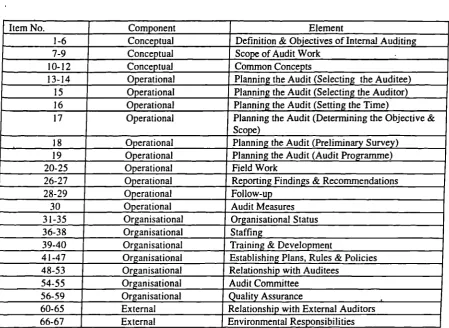
5.1 Structure of Items Included in the Perception Questionnaire
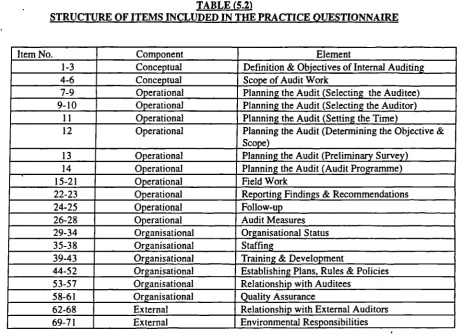
5.2 Structure of Items Included in the Practice Questionnaire
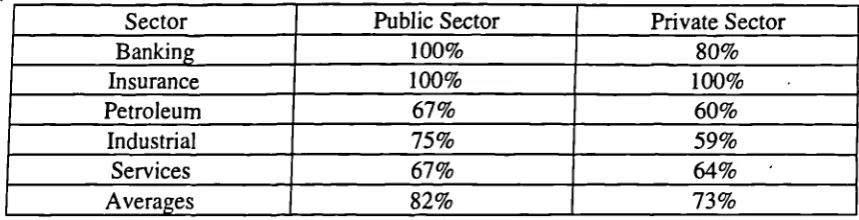
5.3 Sample Response Rate
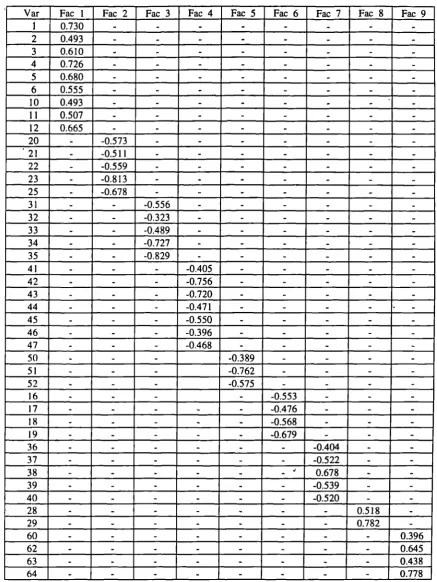
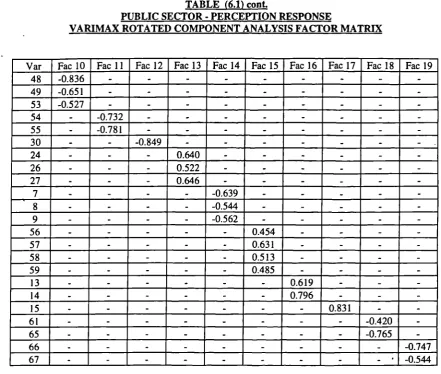
5.4 Number of Respondents to the Research Questionnaires 6.1 Public Sector - Perception Response
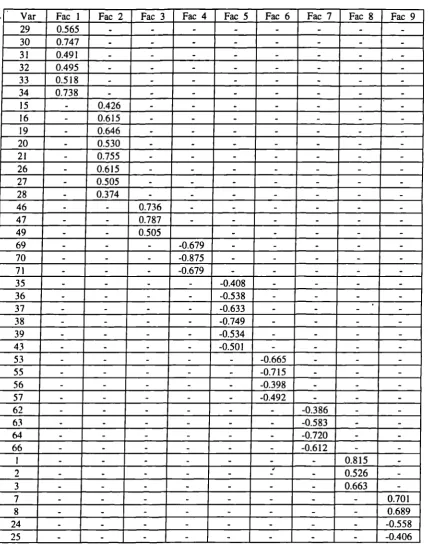
VARIMAX Rotated Component Analysis Factor Matrix
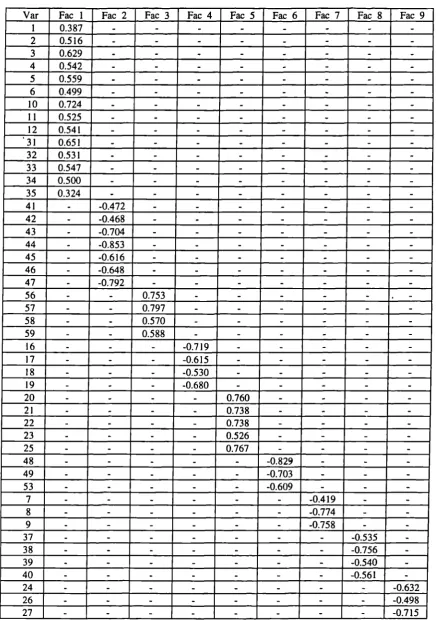
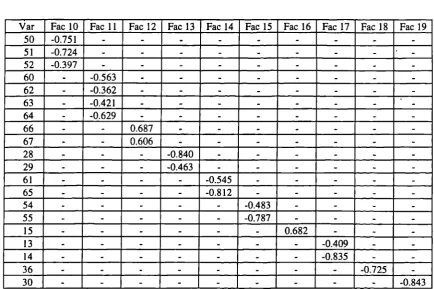
6.2 Private Sector - Perception Response
VARIIvIAX Rotated Component Analysis Factor Matrix
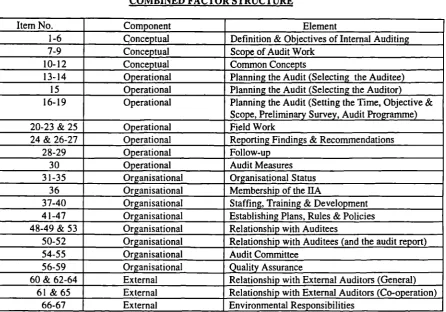
6.3 Perception Questionnaire Combined Factor Structure
6.4 Public Sector - Practice Response
VARIMAX Rotated Component Analysis Factor Matrix
6.5 Private Sector - Practice Response
VARIMAX Rotated Component Analysis Factor Matrix
6.6 Practice Questionnaire Combined Factor Structure
6.7 All Sectors - Perception Response
VARIMAX Rotated Component Analysis Factor Matrix
6.8 All Sectors - Practice Response
VARIMAX Rotated Component Analysis Factor Matrix
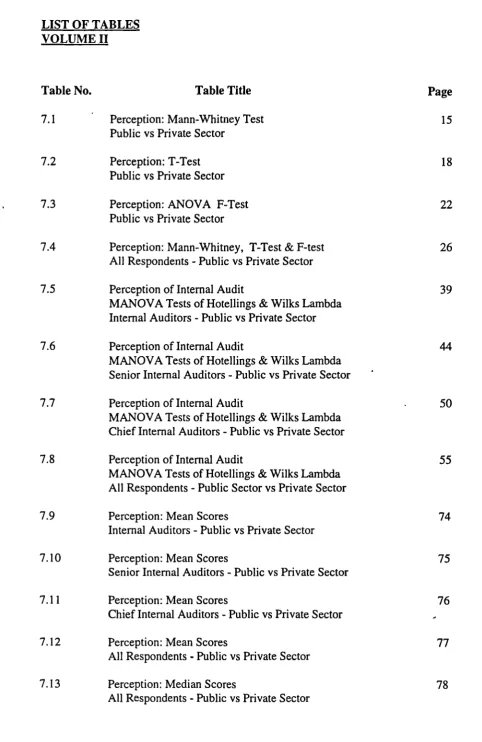
LIST OF TABLES VOLUME II
Table No. Table Title Page
7.1 Perception: Mann-Whitney Test 15
Public vs Private Sector
7.2 Perception: T-Test 18
Public vs Private Sector
7.3 Perception: ANOVA F-Test 22
Public vs Private Sector
7.4 Perception: Mann-Whitney, T-Test & F-test 26 All Respondents - Public vs Private Sector
7.5 Perception of Internal Audit 39
MANOVA Tests of Hotellings & Wilks Lambda Internal Auditors - Public vs Private Sector
7.6 Perception of Internal Audit 44
MANOVA Tests of Hotellings & Wilks Lambda Senior Internal Auditors - Public vs Private Sector
7.7 Perception of Internal Audit . 50
MANOVA Tests of Hotellings & Wilks Lambda Chief Internal Auditors - Public vs Private Sector
7.8 Perception of Internal Audit 55
MANOVA Tests of Hotellings & Wilks Lambda All Respondents - Public Sector vs Private Sector
7.9 Perception: Mean Scores 74
Internal Auditors - Public vs Private Sector
7.10 Perception: Mean Scores 75
Senior Internal Auditors - Public vs Private Sector
7.11 Perception: Mean Scores 76
Chief Internal Auditors - Public vs Private Sector
7.12 Perception: Mean Scores 77
All Respondents - Public vs Private Sector
8.1 Perception - Public Sector 86 T-Test & Mann-Whitney Test
Internal Auditors vs Senior Internal Auditors
8.2 Perception - Public Sector 87
T-Test & Mann-Whitney Test
Internal Auditors vs Chief Internal Auditors
8.3 Perception - Public Sector 88
T-Test & Mann-Whitney Test
Senior Internal Auditors vs Chief Internal Auditors
8.4 Perception - Public Sector 89
ANOVA with Scheffe All Three Levels
8.5 Perception: Public Sector 96
MAN OVA Tests of Hotellings & Wilks Lambda Internal Auditors vs Senior Internal Auditors
8.6 Perception: Public Sector 101
MANOVA Tests of Hotellings & Wilks Lambda Internal Auditors vs Chief Internal Auditors
8.7 Perception: Public Sector 105
MANOVA Tests of Hotellings & Wilks Lambda Senior Internal Auditors vs Chief Internal Auditors
8.8 Perception: Public Sector 108
MANOVA Tests of Hotellings & Wilks Lambda Across All Three Levels
8.9 Perception - Private Sector 115
T-Test & Mann-Whitney Test
Internal Auditors vs Senior Internal Auditors
8.10 Perception - Private Sector 116
T-Test & Mann-Whitney Test
Internal Auditors vs Chief Internal Auditors
8.11 Perception - Private Sector 117
T-Test & Mann-Whitney Test
Senior Internal Auditors vs Chief Internal Auditors
8.12 Perception - Private Sector 118
8.13 Perception: Private Sector 124 MAN OVA Tests of Hotellings & Wilks Lambda
Internal Auditors vs Senior Internal Auditors
8.14 Perception: Private Sector 128
MANOVA Tests of Hotellings & Wilks Lambda Internal Auditors vs Chief Internal Auditors
8.15 Perception: Private Sector 133
MAN OVA Tests of Hotellings & Wilks Lambda Senior Internal Auditors vs Chief Internal Auditors
8.16 Perception: Private Sector 136
MANOVA Tests of Hotellings & Wilks Lambda Across All Three Levels
8.17 Perception - All Respondents 141
1-Test & Mann-Whitney Test
Internal Auditors vs Senior Internal Auditors
8.18 Perception - All Respondents 142
T-Test & Mann-Whitney Test
Internal Auditors vs Chief Internal Auditors
8.19 Perception - All Respondents . 143
T-Test & Mann-Whitney Test
Senior Internal Auditors vs Chief Internal Auditors
8.20 Perception - All Respondents 144
ANOVA with Scheffe All Three Levels
8.21 Perception: All Respondents 149
MANOVA Tests of Hotellings & Wilks Lambda Internal Auditors vs Senior Internal Auditors
8.22 Perception: All Respondents 153
MANOVA Tests of Hotellings & Wilks Lambda Internal Auditors vs Chief Internal Auditors
8.23 Perception: All Respondents 157
MANOVA Tests of Hotellings & Wilks Lambda Senior Internal Auditors vs Chief Internal Auditors
8.24 Perception: All Respondents 160
9.1 Practice: T-test & Mann-Whitney Test 180 Internal Auditors - Public vs Private Sector
9.2 Practice: 1-test & Mann-Whitney Test 181
Senior Internal Auditors - Public vs Private Sector
9.3 Practice: T-test & Mann-Whitney Test 182
Chief Internal Auditors - Public vs Private Sector
9.4 Practice: 1-test & Mann-Whitney Test 183
All Respondents - Public vs Private Sector
9.5 Practice: ANOVA F-test 184
Public vs Private Sector
9.6 Practice of Internal Audit 192
MANOVA Tests of Hotellings & Wilks Lambda Internal Auditors - Public vs Private Sector
9.7 Practice of Internal Audit 197
MANOVA Tests of Hotellings & Wilks Lambda Senior Internal Auditors - Public vs Private Sector
9.8 Practice of Internal Audit 202
MANOVA Tests of Hotellings & Wilks Lambda Chief Internal Auditors - Public vs Private Sector
9.9 Practice of Internal Audit 207
MANOVA Tests of Hotellings & Wilks Lambda All Respondents - Public Sector vs Private Sector
9.10 Practice: Mean Scores 217
Internal Auditors - Public vs Private Sector
9.11 Practice: Mean Scores 218
Senior Internal Auditors - Public vs Private Sector
I
9.12 Practice: Mean Scores 219
Chief Internal Auditors - Public vs Private Sector
9.13 Practice: Mean Scores 220
LIST OF EXHIBITS VOLUME I
Exhibit No. 3.1
3.2
3.3
4.1
4.2
4.3
4.4
Exhibit Title
Organisation Structure of the NAO
Audit Commission - Proposed VFM Projects
Organisation Structure of the Audit commission
Ideal Positioning of Internal Auditing
The Structure of the Internal Audit Department
The Meaning of the '4Es'
A Conceptual Framework for Internal Auditing
Page 94
109
110
162
168
184
187
LIST OF APPENDICES
Appendix A: 1 - The Perception Questionnaire (Arabic)
Appendix A:2 - The Practice Questionnaire (Arabic)
Appendix B - The Covering Letter (Arabic)
Appendix C: 1 - The Perception Questionnaire (English)
ACKNOWLEDGEMENTS
While writing this thesis and carrying out the underlying research, I have received help,
guidance and helpful criticism from many kind persons. To all these persons I convey
my sincere thanks and admit my deep debt. Chief among them is my supervisor,
Professor G. Selim whose supervision, guidance, advice, encouragement and
understanding brought my goal within reach. To him goes more than I can ever
acknowledge here.
I am grateful to all members of staff at the City University Business School. I
acknowledge with gratitude their co-operation and assistance.
I am also very thankful to all those who completed the research questionnaires and the
institutions from which they came. Without their help, it would not have been possible
to gain many insights revealed in the thesis.
Finally, I gratefully and humbly acknowledge the continued encouragement and
immense support I have received from my parents, sister and all my friends when
writing this thesis. To my parents I owe everythiiig I have achieved.
While I have benefited greatly from the wisdom of many, I hold myself exclusively
DECLARATION
I grant powers of discretion to the University Librarian to allow this thesis to be
copied in whole or in part without further reference to me. This permission covers
only single copies made for study purposes, subject to normal conditions of
ABSTRACT
The need for a conceptual framework for auditing to guide the development of auditing standards and practice on a consistent and theoretically sound basis has been recognised by many practitioners and academicians. This need seems to be even stronger in the case of internal auditing.
Thus, one major objective of the research is to take a step towards developing a widely accepted conceptual model that encompass the different concepts, identify the main objectives, define the functions, and explain the different interrelationships that exist within internal auditing. This follows a rigorous review of literature and
theoretical background to set the research terms.
It is imperative that the attempt to develop the model should be accompanied by empirical study concerned with its applicability. Thus, the model is then used to examine how internal auditors working in developing countries perceive internal auditing. As well as, examining the standard of practice of internal auditing in developing countries.
Two questionnaires are developed and used as the research instruments. The first questionnaire is used to collect data on the perception of internal auditing, and the second is used to collect data on the practice of internal auditing. Factor analysis is then applied to data collected to explore the relationship between the different statements included in the questionnaires.
The empirical chapters consider: significant perceptual differences between different levels of internal auditors; significant perceptual differences between internal auditors working in the public and private sectors; significant differences in the practice of internal auditing between public and private sectors.
Main findings indicate that: the perception of internal auditing is significantly
AAA ACB AICPA C&AG CAO E&AD EGOP EICA FASB GAO ICAEW hA NAO SAO UK
LIST OF ABBREVIATIONS USED
USA
VFM
American Accounting Association
Accounting Control Boards
American Institute of Certified Public accountants
Comptroller and Auditor General
Central Auditing Organisation (Egypt)
Exchequer and Audit Department
Egyptian General Organisation of Petroleum
Egyptian Institute of Chartered Accountants
Financial Accounting Standards Board
General Accounting Office (USA)
Institute of chartered Accountants in England and
Wales
Institute of Internal Auditors
National Audit Office (UK)
State Auditing Office
The United Kingdom of Great Britain and Northern
Ireland
United States of America
CHAPTER ONE
1. INTRODUCTION
This chapter is devoted to providing a brief description of the nature and main
objectives of the research, the research problems, research methodology,
research findings and recommendations.
1.1 The Nature of the Research
Research in international accounting and auditing could be placed in three
categories: descriptive which provide information about the current state of
the art of auditing; conceptual which develop a model or framework to
examine the existing system; and hypothesis-testing in which Fypothesis
describing what should exist are developed, [Jaggi,1973]. When one looks at
the literature it becomes apparent that there is little research on the idea of a
conceptual framework for auditing generally and internal auditing in
particular.
The problem of insufficient research in auditing was highlighted in a study by
Needles [1989]. In this study Needles reviewed the literature for the 10-year
period between 1978-1987 covering periodicals throughout the world. The
study found that the amount of auditing research is very small though the real
problem lies in the quality of the few research that exist; Needles found that
seems to have hardly changed since Needles conducted his study as my
research reviewed all the major periodicals in accounting and auditing with
little success. Furthermore, a research was carried throughout the publications
of major universities to review the doctorate projects in auditing. This
research concluded, as with previous findings, that the number of doctorate
projects on auditing is very small when compared with research on accounting
matters. Also, the research revealed that even within accounting research the
area of conceptual framework has attracted a very small amount of interest, if
any.
Therefore, it was apparent that there is a dire need for research on the idea of
a conceptual framework of internal auditing, with the research combining the
three different categories stated by Jaggi. This involves a descrjptive approach
in describing the current state of auditing. Then a conceptual approach is
followed in developing a conceptual framework for internal auditing, and in the
final stage a hypothesis-testing approach is followed in examining whether the
perception and practice of internal auditing conform with the conceptual
framework.
1.2 Research Objectives
The practice of auditing goes back more than five thousands years to the times
of ancient Egyptians and over the years it has developed to become an
internal auditing has been striving to reach the full professional status enjoyed
by external auditing. However, achieving this full profession status requires
development both in the practice of internal auditing as well as development in
the theoretical body of knowledge that supports this practice.
Unfortunately, few studies were carried out to investigate the theoretical
background of internal auditing and the relationship between the theory and the
practice of internal auditing, in this case in developed countries. So no doubt
that the situation in developing countries is much worse. Therefore, this
research is mainly attempting to focus on the concept of developing a
conceptual framework for internal auditing and then test the way this
framework is perceived by internal auditors. The research does not restrict
itself only to studying perception of internal audit but also exariines the
practice of internal auditin in organisations from both the public and private
sectors. This study is unique in that the empirical part of the research is carried
out using organisations and internal auditors working in a developing country,
namely Egypt. This is one of the first studies that concerns itself with
investigating internal auditing in developing countries. The importance of such
studies stems from the fact that if internal 'audit is to be considered an
international profession it must have an international body of knowledge and
standards that could be applied anywhere in the world. Also, there must be
common agreement among the practitioners of internal auditing as to what is
Thus the objectives of this research could be stated as follows:
1) To provide a comprehensive review of the different terminologies used
to describe the different types of auditing and to determine what is
really meant by internal and any other type of auditing.
2) To determine the current state of auditing in Egypt and compare it with
the practice of auditing in the UK which represents the state of auditing
in developed countries.
This study pays extra attention to the purpose and scope of public
sector auditing between the two countries and identifies the factors that
contribute to the similarities and differences between the developed and
developing countries.
3) To study the different concepts that contribute to understanding the
meaning and objectives of internal auditing and the different factors
that govern it. This will also include tracing the different aspects of
internal auditing and how these different factors come together to form
the model that could be applicable anywhere. In doing so, the main
objective of this section would be to form a conceptual framework for
internal auditing. However, it should be noted that this
4) To undertake field work, mainly in Egypt, for the purpose of finding
how internal auditors perceive the different aspects of the internal audit
profession. Also, the research aims to examine whether the perception
of internal auditing would vary according to the sector in which internal
auditors are working
5) To ascertain the standard of the practice of internal auditing in
organisations from both the public and private sectors and examine the
differences in the practice of internal auditing between the two sectors.
And to determine whether the concept of the modern internal audit is
put into practice in organisations working in Egypt,
and to attest whether the practice of internal auditng differs
significantly according to the nature of ownership of the rn organisation.
6) To draw up conclusions and implications for the practice of internal
auditing in developing countries as well as the implications for the
internal audit profession.
1.3 Significance of the Study
In the past few years, due to economic conditions, organisations from all
sectors have come under great pressure to cut their costs in order to be able to
compete in an increasingly competitive environment. In view of this, internal
audit becomes crucial as it can help organisations become cost effective in two
amount of resources that might otherwise be wasted; second, as the fees
charged by external auditors gets higher it is crucial that organisations should
have an effective internal audit function which could be relied upon by external
auditors and therefore help save time and money spent on the audit process.
This comes at a time when the internal audit strives to reach the full profession
status it deserves. However, as research has revealed, few academic studies
have been undertaken in order to support the global development of the
internal audit profession. This lack of research is particularly in a dire state in
developing counties. This should not be ignored as the international market
becomes more and more open and interlinked to the degree that almost all
countries are affected by what happens worldwide. Multinational companies
now operate in most developing countries and it is imperative tlat these
companies should be assured of a high and similar standard of internal auditing
everywhere. Also, the accounts of these companies are often subjected to
examinations by external auditors in developed countries. These auditors
should be able to rely on the work of internal auditors knowing that the
standards and concepts of internal auditing are the same worldwide. More
imprtantly the internal audit serves the orgánisation as a whole and top
executives of organisations in particular need to have full confidence in the
work of internal auditors in the affiliated firms, whether in developed and
This highlights the need to draw a conceptual model for internal audit that
could be accepted both in developed and developing countries. The study also
provides a picture of the perception and practice of the internal audit in one
developing country in an attempt to pave the way for more understanding and
co-operation between practitioners of the profession worldwide. This should
help those responsible for the advancement of the profession in their efforts to
promote globally accepted standards for internal auditing.
The study is also significant in being the first study that has been conducted
using a conceptual model that is mainly based on the experience of developed
countries in trying to assess the state of internal auditing in developing
countries.
It is important to note that a global standard of internal auditing could not be
established by legislation. The only way forward seems to be for people within
internal auditing to research and investigate ways of development through
reasoning and intellectual persuasion. This research merely aims to open the
door for further discussion as to ways of developing standards for the
1.4 Research Hypotheses
The research hypotheses fall under two categories:
1.4.1 Hypotheses related to the perception of internal auditing
I) The way internal auditors perceive the internal audit profession
is influenced by the nature of ownership in the organisation
they are working in.
2) The way internal auditors perceive the internal audit profession
is influenced by the experience and level of internal auditors.
1.4.2 Hypotheses related to the practice of internal auditing
1) The practice of internal auditing in the public sector differs
significantly from the practice of internal auditing in the private
sector.
1.5 Research Methodology
1.5.1 Library research
This involves researching the theoittical background behind the
development of the different types of auditing and their nature, scope
and objectives. Particular attention would then be focused on the
modern concept of internal auditing, this entails a review of the
carried out in the hope of providing the researcher with the required
characteristics to construct a conceptual model for internal audit.
This phase also involves examining the current state of auditing in
Egypt and an attempt would be made to draw comparisons with the
state of auditing in a developed country, namely the UK. This would
be done through investigating some government documents and
legislation that affects the auditing profession.
1.5.2 Field work
This phase consists of collecting the necessary data. This would be
done mainly through two questionnaires especially designed for this
study as well as some personal interviews that the researcher conducted
with internal auditors from all levels in both sectors in Egypt. With the
questionnaires, the primary aim of the first one is to explore the
perception of internal auditors as held by different levels of internal
auditors from the two sectors. The main aim of the second
questionnaire is to gather data necessary to assess the state of the
practice of internal auditing in orgahisations working in Egypt.
Meanwhile, the interviews held would be very useful in helping the
research exploring the views of internal auditors of the state of their
profession, and throw light on aspects that could not be included in the
that they gave the researcher the opportunity to observes on first hand
the practice of internal audit in the organisations concerned.
1.5.3 Data analysis
Different statistical techniques would be performed on the data
collected to test the hypotheses. These would include factor analysis,
parametric and non-parametric tests, one way analysis of variance, and
multivariate analysis of variance as well as computing the mean and
median scores. The computer analysis of the research data would be
performed using the following packages: the Statistical Package for
CHAPTER TWO
2. AUDITING : ITS NATURE, OBJECTIVES AND TYPES
When writing about any topic the area covered needs to be defined. Thus, a
definition is needed for the term auditing. However, as Mautz once stated
"definitions are seldom helpful unless they are simple and easily understood,
however an audit itself is neither simple nor easily understood" [Mautz, 1964:
1]. This problem of finding a definition which generally defines auditing is not
new to the auditing environment which enjoys a great deal of controversies,
but the source of much of these controversies is What is auditing? This
question seems to be the most fundamental and pervasive auditing issue. This
very same question was the first to be tackled in the PMM Moiiograph. The
monograph
asks : "What is the basic function of auditing in society ?" [McMickle, 1978:
119].
John C. Burton and A. Clarence Sampson also stated at the 1974 Symposium
on Auditing Research that: I
The first problem that needs to be considered is a definitional one.
What is auditing "Whatever definition of auditing is agreed
upon, it seems desirable that there be a better articulation of what an
-audit really is. There are widely varying perceptions today as
Little is found in literature concerning the basic and main issue of finding a
theory to encompass the broad range of issues and concerns of auditing. The
first to tackle this area was made in 1961 by Mautz and Sharaf, with the
publication of their Philosophy of Auditing, in which they mentioned that "for
years auditing has been so busy getting itself established and accepted that it
has had little time for inspection. But as it becomes more and more mature,
this excuse becomes less and less valid. There is indeed something
incongruous about a profession with no visible support in the form of a
comprehensive and integrated structure of theory. We need a philosophy of
auditing" [Mautz and Sharaf, 1985: 5]. However, they admit that their book is
not the long awaited remedy needed to solve all the problems confronted.
Instead they see it as "...an introductory work only. Here is undertaken no
more than an investigation into the possibility and nature of such a theory.
Progress always comes slowly and we will be content if we can do no more
than point the direction" [Mautz and Sharaf, 1985: 4]. The hopes of Mautz
and Sharaf of arousing interest and seeing more research into the structure and
theory of auditing have not been fulfilled yet.
Anderson, Giese and Booker [1970: 524] commented on the progress of
auditing since the publication of The Philosophy of Auditing as follows:
Despite the long history and growth of auditing, the basic nature of
this human process has never been treated explicitly. The single
incomprehensible literature. In their Philosophy of Auditing, Mautz
and Sharaf attempt the development of a theory of auditing.
Regrettably, this work has not produced the scholarly inquiry which
the authors hoped would follow from it.
The need for more research was again emphasised by Frederick L. Neumann in
1972. He stated that "....our goal must be . . ..to incorporate results of primary
induction into an explanatory theory covering a wide range of inquiry. Limited,
specific research have their value. Theoretical research, however, is the more
general and more widely applicable. I, therefore, believe it is essential for
reasonable progress" [Neumann, 1972: 113]. In the same year, the American
Accounting Association made the second major contribution to auditing by
publishing its Statement of Basic Auditing Concepts. One of the conclusions
of this study was that "pioneer work has been done by Mautz and Sharaf in an
effort to identify the postulates of auditing. Continuing research should be
undertaken by the auditing profession to identify the rules, definitions, and
postulates necessary to the auditing process" [AAA, 1972: 48].
But the question still to be answered is : His a theory of auditing been
developed ? Does this theory cover all aspects of auditing? In his study on the
nature and objectives of auditing Peter McMickle [1978: 34] made the
following remarks : "The Philosophy of Auditing and a Statement of Basic
Auditing Concepts represent the only serious attempts to date to present a
have significantly contributed to the study of auditing. However, both studies
examine the nature of auditing from the perspective of the public auditor.
They are not, therefore, satisfactory rationalisations of internal and
governmental auditing. What is still needed is a more general statement of
auditing theory .... a framework of concepts that encompasses and rationalises
all branches of contemporary auditing". McMickle's study is one of few
studies devoted to the theoretical aspect of auditing, in which he tried to
answer the ever important question: What is auditing? Considering all the
difficulties surrounding the topic the study is seen as one of the most
comprehensive so far. Even though the study might not have fulfilled all
expetations, its objectives and the time available to the author should be taken
into account. More research is still needed in the area.
Although the purpose of this research is not to examine the theory of auditing,
the previous paragraphs were necessary to explain the difficulties confronted in
trying to define auditing. In the following paragraphs general definitions of the
term 'auditing' will be discussed before going on and discussing the types and
objectives of auditing. In a later phase classification of different types of
auditing would be inevitable. However, for the next few paragraphs a broad
definitions will be looked for in the literature and this type of definitions is
rarely found.
they point out that "auditing is analytical, critical, investigative .... and has its
roots not in accounting which it reviews, but in logic on which it leans heavily
for ideas and methods" [Mautz and Sharaf, 1985: 14].
In the Statement of Basic Auditing Concepts the following definition was given
"auditing is a systematic process of objectively obtaining and evaluating
evidence regarding assertions about economic actions and events to ascertain
the degree of correspondence between those assertions and established criteria
and communicating the results to interested users" [AAA, 1972: 2].
A brief, simple definition is provided by Schandle [1978: 2-3]. He defines
auditing as "a human evaluation process to establish the adherence to certain
norms, resulting in an opinion".
These definitions are as much as one can get for a general broad definition of
auditing, and one has to be satisfied with them as a starting point for going on
and discussing the different types of auditing and their objectives and scope.
Speaking about the different types of auditing the reader in the field of auditing
will be faced with the great number of objettives that have been used to
describe the scope of auditing, which have been wrongly used as definitions for
• Financial Audit • Management Audit • Performance Audit • Programme Audit • Operational Audit • Expanded Scope Audit • Depth Audit
• Functional Audit • Mission Audit • Responsibility Audit • Broad scope Audit • Compliance Audit • Efficiency Audit • Fidelity Audit
• Comprehensive Audit • Fiscal Audit
• Quality Audit • Results Audit
• Organisational Audit • Project Audit
• Accomplishment Audit • Enterprise Audit • Variable Scope Audit • Total Audit
• Status Audit
• Extended Scope Audit • Substantive Audit
These are only some of the many terms used to describe audits of various
scope. Some of these terms are more commonly used than others and most of
these terms unite together to refer to one of the main types of auditing. In the
following paragraphs a brief explanation of how some of the above terms are
viewed is given.
2.1 Financial Auditing
As the most dominant type of auditing, most of the material in the literature
concerns financial auditing, having established its professional bodies way
ahead of the other types. This is the work carried out by the external auditors
with the main aim of attesting the fairness and truth of the financial statements
and, because of this it is sometimes called independent auditing and the people
A simple definition of financial auditing is provided by Sawyer [1988: 4] as
"the analyses of the economic activity of an entity as mentioned and reported
by accounting methods".
A more comprehensive definition is given by Mautz [1964: 3] who describes
the role of financial auditing as " ... to establish the reliability or unreliability of
the financial statements and supporting accounting records of a company or
institution, ... and to discover whether or not the financial statements do
actually portray the financial position and the results of operations of the
company or institution under examination".
Perhaps the most comprehensive definition, though, is the one given by the
American Accounting Association Committee on Basic Auditing Concepts and
mentioned earlier as one of the broad definitions of auditing. But some writers
such as Sawyer believe that it thrusts toward financial or accounting matters.
However, one of the clearest explanations of the role of financial auditing is
given by the American Institute of Certified Public Accountants [AICPA,
1973]. It gives the main objective of financial auditing as:
"the objective of the ordinary exathination of financial statements by
the independent auditor is the expression of an opinion on the fairness
with which they present financial position, results of operations, and
changes in financial position in conformity with generally accepted
2.2 Performance Auditing
The report of a study group known as the "Little Hoover Commission", which
was established in Michigan in 1950 and 1951 as a result of the first Hoover
Commission report of 1949, contained the following comment:
Because the appropriation process involves the determination of
policy, it is necessary that the legislature hold the executive
responsible for not only the honest expenditure of all public
money in accordance with policies prescribed by law. This is
known as an operational audit or performance audit, and it too
should be undertaken by a staff responsible to the legislature.
[Knighton, 1967: 14]
The recommendation of this commission then was " ... strengthefling the
legislature's means for effective control, particularly through establishment of a
legislative auditor general to be appointed by and responsible to the legislature
(whose responsibility it would be) to undertake performance as well as fiscal
audits of all state agencies" [Knighton, 1967: 14-15].
It would appear that this was the first time the term 'performance audit' was
used, and there are some who feel it was coined from the term 'performance
budget' used by the first Hoover Commission in 1949. [Knighton, 1967: 15]
audit activities that go beyond financial and compliance boundaries into the
area of operational evaluation...and can take an inductive or deductive
approach, or both".
2.3 Operational Auditing
The concept of operational auditing began to materalise during the 1950s due
to the expansion in internal auditing in the private sector. Kent had used the
term 'operations auditing' in 1948. [Mcmickle, 1978 53] Then the term was
popularised by Frederic E. Mints [1954] through an article in The Internal
Auditor. Mints has since stated:
My usage of the term was first planned during a brainstorming session
which Mr. Kent and I held during the summer of 1953 in preparation
for a talk on the subject. We considered a number of alternative titles
and decided 'operational' had the most ear-appeal. I have subsequently
had some regrets on this choice. [Dooley, 1963: 13]
Cadmus [1964: 5] supports this idea that operational auditing originated from
internal auditing. He proposes that operational audits represent an application
of the internal auditor's talents to the operational controls of the organisation,
and he states that "we do not consider or propose that there should be any
separate and different classification of employee called an operational auditor".
However, other writers such as Lennis Knighton [1973: 42-44] prefer to
'performance auditing'. He indicates that "the concept of performance
auditing includes compliance auditing, operational auditing, and programme
auditing". Knighton believes that these three terms might not be all performed
at one time, but a true performance audit programme must encompasses all of
them.
But what is really meant by the term operational auditing and what is scope of
its coverage? One of the clearest answer to this question is provided by
Sawyer [1988: 4] as he defines operational auditing as "the comprehensive
review of unit activities, systems, and controls within an enterprise to reach
economic, efficiency, effectiveness or other objectives". Earlier Joseph
Dodwell [1966: 45] stated that "the primary objective of operational auditing is
to identify those areas in which cost reduction, operating improv.ement or
increased profitability can be the initiation or modification of administrative and
operational controls or policy directives or by related corrective action". And
Norgaad [1972: 25] states that "operational auditing is concerned with the
examination and evaluation of management and its operational controls, and is
made with purpose of formulating recommendations that will lead to increased
operating efficiency".
For a more comprehensive consideration, though in the government arena,
Kingwood views operational auditing to concern itself with (1) financial and
efficiently and economically; and (3) whether programmes are achieving the
results set down in the legislation. [Jadallah, 1979: 42]
2.4 Management Auditing
"Just what is Management Auditing ?" asks Sawyer [1973: 10], before
unravelling the question in the following citation:
There is a good deal of question as to what management auditing is. Is
it an audit of management? Some people say positively that it is. Is it
an audit by managers? Others just as positively take that view. Is it an
audit for managers? There is a large body of practitioners that like
that definition. And if you ask them which managers- executive middle,
or line - you will get three answers to that question too.
However, there seems to be a very little in the literature to support the idea of
a management audit by managers, only in the case of a very small business
where the manager is his \ her own auditor. The real argument is whether
management audit is audit of management or auditfor management. Each of
these views is supported by several authorsin the literature.
The term 'management audit' is believed to have been coined by T.G Rose
[1932] in a book published in London with the same title. The audit that Rose
mentioned in his book was basically a questionnaire-type interview designed to
stating that Rose" ... brings forward an individual idea of an interesting
original kind, the idea that management of an undertaking might be made
subject to periodical expert investigation from outside analogous to the audit
of its financial accounts". [McMickle,1978: 47]
Then, in 1940, The Metropolitan Life Insurance Company provided a more
comprehensive approach in its Outline for a Management Audit. [MU, 1940]
The approach used was previously developed for policyholder companies. It
enlarged upon Rose's early work but pursued a similar outline. This work was
followed several years later in 1948 by Howard G. Benedict's Yardsticks of
Management. Benedict developed a questionnaire of nine divisions and many
subdivisions attempting to evaluate management by means of weighted
factorial analysis. [Benedict, 1948]
Those earliest writings considered management audit to be audit of
management rather than audit for management. But this approach did not gain
interest till the 1950s when the term management audit was used by Jackson
Martindell, President of the American Institute of Management. His use of the
term related to company evaluation that wa similar to, but more
comprehensive than, the Rose, Metropolitan, and Benedict audits. [Martindell,
1950]
organisations such as Standard Cash Register, Toledo Edison, Statler Hotels,
and General Electric. They also published, for a short while, a periodical
entitled Management Audit. [McMickle, 1978: 55]
During that time one of the most significant works on management auditing
appeared in 1959 when William P. Leonard published The Management Audit:
An Appraisal of Management Methods and Performance. As with previous
literature Leonard's work follows the deductive checklist or questionnaire
approach. [Leonard, 1962]
Supporting this idea of audit of management, John Buckley [1966: 45] states
that "essentially management services denote activities that provide assistance
to management, while management audits describe activities related to the
appraisal of management". His view is supported by Campfield [1971: 29-30]
who agrees that "if the modern management auditor is concerned with the
substance of management planing and control .... he must ultimately appraise
the overall efficiency of management itself'.
Despite these previous views, the idea that tnanagement auditing is auditing for
management enjoys more support in the literature. In this sense George
Gustfson [1970: 41] writes "it cannot be stressed too often that the most
important single process in management- type auditing is developing findings
which are significant, accurate and objective ... in order that a constructive
Another example is William P. Leonard's view. He sets the primary objective
of management audit as " .... to reveal defects or irregularities in any of the
elements examined in that portion of the organisation that is under study and to
indicate possible improvements" [Leonard, 1962: 93].
But Sawyer [1988: 31] partially agrees with Leonard's view and states that
"...management-oriented (internal) auditors can improve the ability of the
managers to manage by pointing out the fundamental violation and by
counseling the managers on how to correct it". He adds " ....
management-oriented auditing is not restricted to exploring the causes of deficiencies. It is
used whenever managers and boards call on (internal) auditors for special
services within their competence: (1) to examine the basis for loflg-range
decisions; (2) to evaluate the management of proposed acquisition; (3) to
present to a legislature the need for new legislation; (4) to assess the
effectiveness of company-wide systems, policies, and procedures. These are
but a few uses for management-oriented auditing. The field is open-ended.
Wherever management consulting is needed, management-oriented auditors
can provide a useful service". Sawyer evefi prefers to use the term
'management-oriented audit' rather than 'management audit' to avoid giving
the implication that it is an audit of management. However, some writers state
that it depends on how the auditor approaches the work and his/her attitude.
management (audit of management) or assisting management ( audit for
management )".
2.5 Efficiency Auditing
Normanton [1966] defined efficiency auditing saying "it examines official
structure, duties and performance, something in a similar way but at all levels
including the highest. At other times it goes beyond the traditional field of
'O&M'; it looks at a piece of administrative activity from a detached viewpoint
and asks itself whether what is being done makes sense. It is not a confidential
servant but a constitutional critic with a constructive mission. By the use of
publicity it widens the debate upon matters which effect the careers of many
thousands. It provides parliaments, governments, and civil servant themselves
with access to information which otherwise is not systematically,gathered by
anybody. Efficiency audit can and does co-exist and co-operate effectively
with departmental organisation study groups, which supplement its work on
their own level. But for the strongest reasons of both organisation and
methods, such groups are internal and dependent, the audit external and
independent, and these positions are forever incompatible. There is therefore
no real problem competition between O&M and efficiency audit, but rather one
of co-operation".
2.6 Internal Auditing
Internal auditing was developing in industry during the early years of the
became widely utilised. In 1941, the first significant text on internal auditing
was published - Internal Auditing by Victor Z. Brink et a!. This publication
served as a catalyst to bring together in that same year the 24 founders of the
Institute of Internal Auditors. [Cadmus, 1960: 28]
World War II resulted in an increase in the demand for better control, which
helped both the profession and the institute to grow rapidly. The second half
of this century saw the continuing expansion of internal auditing in the private
sector. This expansion was matched with similar expansion in the membership
of the Institute of Internal Auditors, from 24 members in 1941 to almost 3000
in 1951, almost 6000 in 1965, 12,000 in 1975 and currently in excess of
55,000. [Chambers, Selim and Vinten, 1988: 3] The institute currently has chapters in over 100 different countries worldwide. Membership of this body
in the UK is approximately 4000 (1997).
As Brink, Cashin and Witt [1973] once stated there is no better way to begin
writing about internal auditing than to turn to the Institute of Internal Auditors,
the professional association of internal auditors. In the institute's Statement of
Responsibilities of the Internal Auditing [11A, 1995], the nature of internal
auditing described as "Internal auditing is an independent appraisal activity
established within an organisation to examine and evaluate its activities as a
service to the organisation. The objective of internal auditing is to assist
recommendations, counsel, and information concerning the activities reviewed.
The audit objectives includes promoting effective control at reasonable cost.
The members of the organisation assisted by internal auditing include those in
management and the board of directors".
This definition of the nature of internal auditing is one the simplest definitions
to be found. The importance of emphasising that it is a service to the
organisation is given by Brink et al as follows: "First of all there is the indicated
coverage of all operational activities of the employer organisation, without
limitation to accounting and financial activities, and secondly, there is a clear
statement of the end objective of service to the organisation. Thus there is a
definite management orientation at a broad operational level" [Brink, Cashin
and Witt, 1973: 3-4].
Also, the definition makes it clear that internal audit in itself is a control, a
unique type of control which is concerned with measurement and evaluation of
the effectiveness of other controls.
However, some writers such as Sawyer [1996] see the statement as an
introduction more than a definition. He adds that "... it tells little about what
internal auditing includes. It gives no indication of what internal auditors are
responsible for. It is far too general to serve as a definition of an entire
for a definition that embodies the broad, unrestricted scope of professional
internal auditing". Sawyer then gives this definition as follows:
Internal auditing is a systematic, objective appraisal by internal auditors
of the diverse operations and controls within an organisation to
determine whether: (1) financial and operating information is accurate
and reliable; (2) risks to the enterprise are identified and minimised; (3)
external regulations and acceptable internal policies and procedures are
followed; (4) satisfactory standards are met; (5) resources are used efficiently; and (6) the organisation's objectives are effectively achieved
- all for the purpose of assisting members of the organisation in the
discharge of their responsibilities. [Sawyer, 1996: 6-7]
Sawyer's definition gives more than an explanation of the nature pf internal
auditing, it relates the internal auditor's role and purpose, beside identifying
opportunities and responsibilities. It promotes for a broad
management-oriented approach. Yet it still matches the objectives and scope of internal
auditing as given in the Statement of Responsibilities of Internal Auditing.
The scope of internal auditing encompassesthe examination and evaluation of
the adequacy and effectiveness of the organisation's system of internal control
and quality of performance in carrying out assigned responsibilities. The scope
Reviewing the reliability and integrity of financial and operating
information and the means used to identify, measure, classify, and
report such information.
Reviewing the systems established to ensure compliance with
procedures, laws, and regulations which could have a significant
impact on operations and reports, and determining whether the
organisation is in compliance.
1
Reviewing the means of safeguarding assets and, as appropriate,
verifying the existence of such assets.
Appraising the economy and efficiency with which resources are
employed.
Reviewing operations or programmes to ascertain whether results are
consistent with established objectives and goals and whether the
operations or programmes are being carried out as planned.
I
2.7 Governmental Auditing
Governmental auditing was the predominant type of auditing during the earliest
times of ancient civilisations where auditors were appointed by, represented,
and reported to some higher authority that an auditee was accountable to. At
mainly to preventfraudulent acts. Then during the nineteenth century public
auditing came into existence and quickly became the dominant field of auditing.
[McMickle, 1978: 65]
Governmental auditing came into focus again in the 1940s and 1950s, with
expanded scope. A significant work in this direction was the work of the
previously mentioned Hoover Commission. This expanded scope is implicitly
put forward by the American General Accounting Office (GAO) in a
monograph entitled Statement for Audit of Governmental Organisations,
Programs, Activities & Functions. It states that "the term audit may be used
to describe not only work done by accountants in examining financial reports
but also work done in reviewing (a) compliance with applicable laws and
regulations, (b) efficiency and economy of operations, and (c) effectiveness in
achieving programme results" [GAO, 1972: 3].
The GAO then elaborates and explains the three elements of this expanded
scope as follows:
1) Financial compliance - determines (a) whether the financial statements of
an audited entity present fairly the financial position and the results of financial
operations in accordance with generally accepted accounting principles, and
(b) whether the entity has complied with laws and regulations that may have a
2) Economy and efficiency - determines (a) whether the entity is managing and utilising its resources economically and efficiently, (b) the causes of
inefficiencies or uneconomical practices, and (c) whether the entity has
complied with laws and regulations concerning matters of economy and
efficiency.
3) Programme results - determines (a) whether the desired results or other
authorising body are being achieved, and (b) whether the entity has considered
alternatives that might yield desired results at a lower cost.
But one might still ask "what is the difference between governmental and
internal auditing ?" The fact is that both seem to have almost the same scope,
at least theoretically, with the difference in the parties they serve. Internal
auditors work in private or public organisations as a service to this
organisation, while governmental auditors are employed by governments to
audit public enterprises as a service to governments, in that they act as external
auditors to the organisations audited. Both of them contemplate a broad scope
audit that goes beyond financial attestation to encompass reviews of the
management function. I
Yet the question about the differences, the scope or nature can be applied on
all the previously stated types of audit. Peter McMickle [1978:651
- What is the difference, if any, between operational, management,
or performance audits?
- What is the exact scope or nature of expanded scope audits?
- Do operational and performance audits include or exclude
financial and compliance matters?
Lawerence Sawyer [1973: 10], cuts through the confusion caused by such
proliferation of terminology by stating, "I have decided to toss the term
operational auditing, performance auditing, functional auditing, comprehensive
auditing and the like". Instead he replaces them with "modem internal
auditing" which he simply defines as "doing what the company president would
do if he had the time and if he knew how".
However, this study is not concerned with building theories regarding the
different concepts of auditing. The main terminology and concept which will
be used in the rest of this study are: (1) External auditing - by which I mean the
work done by the external auditors to attest as to the fairness and truth in
representing financial positions; (2) Internal auditing - this term is used to refer
to auditing in its broadest scope which inclutle performance, operational,
management auditing. . . etc., i.e. what Sawyer refers to as modem internal
auditing. This a more useful division of the environment of auditing because it
is representative of the way auditors view themselves and organise