City, University of London Institutional Repository
Citation
: Wissmann, Jens (2012). Chord Sequence patterns in OWL. (Unpublished
Doctoral thesis, City University London)
This is the unspecified version of the paper.
This version of the publication may differ from the final published
version.
Permanent repository link:
http://openaccess.city.ac.uk/1306/
Link to published version
:
Copyright and reuse:
City Research Online aims to make research
outputs of City, University of London available to a wider audience.
Copyright and Moral Rights remain with the author(s) and/or copyright
holders. URLs from City Research Online may be freely distributed and
linked to.
IN OWL
MUSIC REPRESENTATION AND REASONING
WITH DESCRIPTION LOGICS FOR THE SEMANTIC WEB
JENS SEBASTIAN WISSMANN
A THESIS SUBMITTED FOR THE DEGREE DOCTOR OF PHILOSOPHY
Contents
List of Figures . . . viii
List of Tables . . . ix
List of Definitions . . . xi
Acknowledgements . . . xiii
Declaration . . . xv
Abstract . . . xvii
1 Introduction 1 1.1 Motivation . . . 1
1.2 Research Questions and Objectives . . . 2
1.3 Method . . . 3
1.4 Scope . . . 4
1.5 Outline . . . 5
I
Foundations and Literature Review
7
2 Knowledge Representation in the Semantic Web 11 2.1 Knowledge Representation and Reasoning . . . 112.1.1 Scope of Knowledge Representation . . . 11
2.1.2 Ontologies . . . 12
2.2 Building blocks of the Semantic Web . . . 12
2.3 Resource Description Framework RDF . . . 13
2.3.1 Serialisation . . . 14
2.3.2 RDF Semantics . . . 15
2.4 Linked data . . . 16
2.5 Summary . . . 18
3 Description Logics 19 3.1 Description Logic Syntax . . . 19
3.2 Standard Reasoning Services . . . 23
3.3 Characteristics of Description Logics . . . 24
3.4 Tableaux Calculi . . . 26
3.5 Summary . . . 26
4 OWL Web Ontology Language 29 4.1 Language Profiles . . . 29
4.2 Modelling in the context of open world assumption . . . 31
4.3 Extensions to OWL . . . 31
4.3.2 Graph-shaped descriptions . . . 35
4.4 Non-standard Reasoning Services . . . 36
4.4.1 Module Extraction . . . 36
4.4.2 Justifications . . . 37
4.4.3 Reductions . . . 37
4.4.4 Learning DL concepts . . . 38
4.5 Querying . . . 38
4.5.1 Relational Queries . . . 39
4.6 Summary . . . 40
5 Representation of Sequences 41 5.1 Sequence Representation in RDF . . . 41
5.1.1 rdf:List andrdf:Seq . . . 41
5.1.2 N-ary Predicates . . . 42
5.2 Suffix Trees . . . 42
5.3 OWLList . . . 43
5.4 Ordered List Ontology . . . 46
5.5 Representation of Time . . . 47
5.6 Summary . . . 49
6 Music representation 51 6.1 OMRAS2 Music Ontology . . . 52
6.2 Harmony OWL . . . 52
6.3 Chord Symbols and Chord Sequences . . . 54
6.4 Harmonic Analysis . . . 54
6.5 Harmonic Structure . . . 55
6.6 Higher Structural Levels . . . 55
6.7 Grammars for Automatic Harmonic Analysis . . . 56
6.8 Summary . . . 57
II
Modelling
59
7 Musical Entities and Simultaneities 63 7.1 Notes . . . 637.1.1 Pitch and Pitch Class . . . 64
7.1.2 Pitch Classes . . . 65
7.2 Pitch Type Relationships . . . 66
7.3 Intervals . . . 67
7.3.1 Expressible pitch range . . . 67
7.3.2 Minor, Diminished, and Augmented Intervals . . 68
7.4 Simultaneities . . . 68
7.5 Chords . . . 68
7.5.1 Chord Subsumption . . . 69
7.6 Summary . . . 69
8 Sequential Patterns 71 8.1 Modelling sequences in OWL . . . 71
8.2 Approach to definingSEQconstructs . . . 73
8.4 Sequence Instances . . . 74
8.5 Sequence construction and Pattern Labelling . . . 76
8.6 Separation of sequential structure and containment . . . 77
8.7 Repetition . . . 78
8.8 Number Restrictions . . . 79
8.8.1 Number Restriction of Successiveγ-Components 79 8.8.2 Number Restriction of Distributedγ-Components 80 8.8.3 Number Restrictions inα-pattern . . . 80
8.9 Sequence Definition . . . 80
8.10 Pattern Subsumption . . . 81
8.11 Concatenation of Sequential Patterns . . . 86
8.12 Summary . . . 88
9 Examples of combining SEQ and MEO 91 9.1 Musical Forms . . . 91
9.2 Conceptual Graphs . . . 92
9.3 Summary . . . 95
10 Grammars as SEQ Patterns 97 10.1 Formal Grammars . . . 97
10.2 Grammars for Chord Sequences . . . 100
10.3 Desirable transformation properties . . . 101
10.4 Transformations of Productions . . . 101
10.4.1 Variable-free productions . . . 102
10.4.2 Non-recursive productions . . . 102
10.5 Algorithm . . . 105
10.6 Transformability . . . 108
10.7 Optimisation of concept size . . . 109
10.8 Summary . . . 109
11 API for MEO/SEQ 111 11.1 Summary . . . 113
III
Evaluation and Applications
115
12 Profiling of SEQ Retrieval and Classification 119 12.1 Theoretical Considerations . . . 11912.1.1 Worst-Case Complexity . . . 119
12.1.2 Effects of set-based DL Semantics . . . 120
12.2 Performance tests . . . 120
12.2.1 Performance of Instance Retrieval . . . 121
12.3 Optimisations . . . 122
12.3.1 Precomputing assertions and reasoning w.r.t. a simplified the TBox . . . 122
12.4 Summary . . . 123
13 Data Integration 125 13.1 Structural Integration . . . 126
13.1.1 9GDB Corpus . . . 126
13.2.1 Isophonics Beatles Corpus . . . 127
13.2.2 A binding ontology for OMRAS 2 Chord Ontology127 13.2.3 Representation of Chord Ontology Four-Chord Patterns . . . 128
13.3 Summary . . . 130
14 Subsumption of Discovered Feature Patterns 131 14.1 Representation of Feature Set Patterns . . . 131
14.2 Translation of Feature Set Patterns . . . 132
14.3 Maximally General Distinctive Chord Patterns . . . 132
14.4 Subsumption of Distinctive Pattern . . . 133
14.5 Summary . . . 136
15 Harmonic Analysis with Grammars 137 15.1 Hybrid harmonic analysis . . . 137
15.1.1 Implementation . . . 138
15.2 Harmonic analysis usingSEQgrammar patterns . . . 140
15.2.1 Musical background . . . 140
15.2.2 SEQand grammar representation . . . 141
15.2.3 Association of the bVII7 chord with the Bebop style . . . 142
15.2.4 Role of the bVII7 chord: Formalisation . . . 144
15.2.5 Role of the bVII7 chord: Results . . . 145
15.3 Summary . . . 148
16 Federated queries 151 16.1 Experimental setup . . . 151
16.1.1 Harmonic Patterns . . . 152
16.1.2 Query . . . 153
16.1.3 Data quality issues . . . 153
16.1.4 Reasoning Support . . . 155
16.2 Results . . . 155
16.3 Summary . . . 156
IV
Conclusion
159
17 Summary and Discussion 161
18 Future Work and Reflections 167
V
Appendix
169
OWL Constructs and Semantics 171
Namespaces and Expressivity of Ontologies 175
References 177
List of Figures
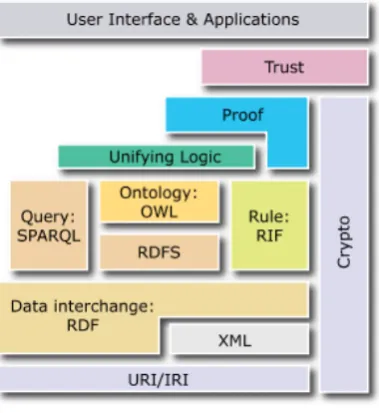
2.1 Overview of Semantic Web standards . . . 13
2.2 An example of an RDF graph . . . 14
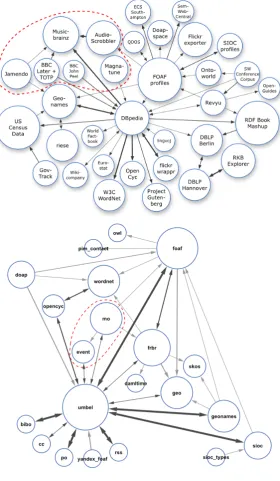
2.3 Linked Open Data . . . 17
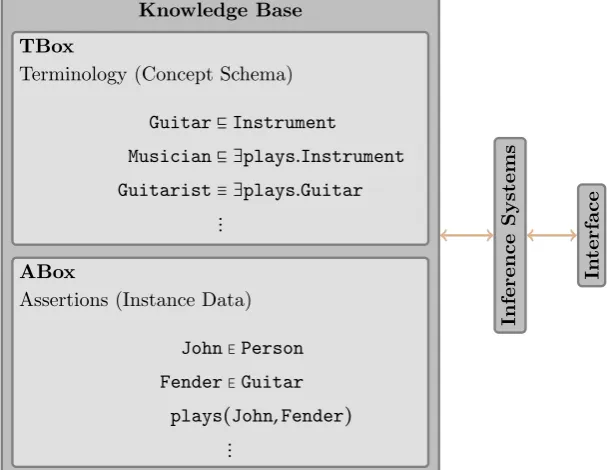
3.1 Architecture of a simple DL system . . . 21
4.1 Relationships between DLs and other KR formalisms . . 32
4.2 A conceptual model that requires graph relationships . . 36
5.1 Suffix tree representation of a string . . . 43
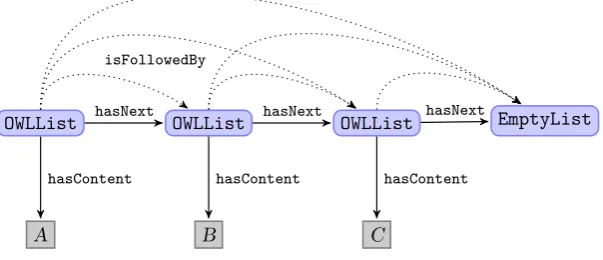
5.2 Example of a pattern expressed as OWLList . . . 43
5.3 Allen’s Interval Relationships . . . 49
6.1 Brief overview of Music Representations . . . 51
6.2 Example Harmonic Analysis by a DCG . . . 57
7.1 Accidentals . . . 64
7.2 Subsumption lattice for pitches . . . 66
7.3 Subsumptions between interval relations . . . 67
7.4 Pitch range of a piano. . . 67
7.5 Chromatic and diatonic half step . . . 68
7.6 Pattern for representing simultaneities . . . 68
7.7 Chord Extensions . . . 69
8.1 Structure of an example sequential pattern . . . 72
8.2 Effect of different starting constructs on type-classifications 77 9.1 Chart of tonal progressions . . . 91
9.2 Conceptual Graph for two voices singing in harmony . . 93
9.3 Rule for the harmonious resolution of a dissonance . . . 94
10.1 Relationship between grammars andSEQpatterns . . . 108
12.1 Instance retrieval times . . . 121
12.2 Instance retrieval times . . . 122
13.1 Overview of data sets and ontologies. . . 125
13.2 Mapping from OMRAS2 Music Ontology toSEQ . . . . 128
14.2 Example patterns and instances found with viewpoint
learning . . . 134
14.3 Subsumption of discovered sequence patterns . . . 135
15.1 Example Harmonic Analysis by a DCG . . . 138
15.2 Example Annotation of the cadence Dm7, G7, Cj . . . . 139
16.1 Setup of federated query infrastructure . . . 152
16.2 Average pattern count by year . . . 156
16.3 Average pattern count by artist . . . 156
16.4 Average pattern count by album . . . 157
List of Tables
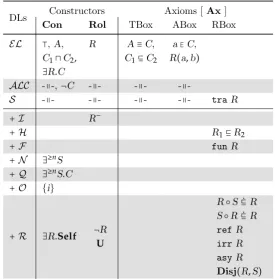
3.1 Overview of common DLs and their constructs . . . 23
3.2 Tableau expansion rules forALC . . . 26
5.1 Axiomatisation of the OWLList concept . . . 44
5.2 Summary of OWLList constructs . . . 45
5.3 Ordered List Ontology . . . 46
6.1 Summary of the OMRAS2 Chord Ontology in DL notation 53 6.2 Example OMRAS2 Chord Description in DL notation . 53 8.1 Summary ofSEQconstructs . . . 89
10.1 Notational conventions for types of grammatical symbols 98 12.1 Complexity of satisfiability checking in OWL fragments 119 13.1 Number of chord sequences per genre and subgenre. . . . 126
13.2 Beginning of “How Insensitive” in the 9GDB format . . . 126
13.3 EBNF grammar for 9GDB chord sequences . . . 127
13.4 Extensions in the 9GDB corpus . . . 127
14.1 Example of a instance sequence for viewpoint learning . 131 15.1 Frequencies of A: bVII7 chords, B:[bVII7] ⊳ [bIII] pro-gressions, and C: IVm chords in 4 sub-corpora of the 9GDB. . . 143
15.2 Matching frequencies of grammars a) b) c) variants A and B in 4 sub-corpora of the 9GDB. . . 147
15.3 Matching frequencies of grammars a) b) c) restricted to IVm preceding bVII7 in 4 sub-corpora of the 9GDB. . . 148
15.4 Matching frequencies of grammars c) restricted to IIm preceding bVII7 in 4 sub-corpora of the 9GDB. . . 148
16.1 Root movement patterns . . . 153
16.2 Federated query in SPARQL . . . 154
18.1 DL axioms . . . 171
18.2 Common Description Logics and their constructs . . . . 171
18.3 Common Description Logics (continued) . . . 172
List of Definitions
1 RDF Abstract Syntax . . . 14
2 Syntax ofALC concepts . . . 19
3 Semantics ofALC . . . 21
4 Concept Closure . . . 31
5 Disjoint Union . . . 31
6 Property Closure . . . 31
7 Identity Role . . . 34
8 Restricted Role Subsumption . . . 34
9 Concept Product (Rudolph et al., 2008) . . . 35
10 Module . . . 36
11 Justification . . . 37
12 Redundancy . . . 37
13 Least Common Subsumer . . . 38
14 Semantics of basic SPARQL . . . 39
15 Content Restriction . . . 73
16 Succession . . . 74
17 Initial and Terminal Component . . . 74
18 Successor Assertion . . . 74
19 Content Assertion . . . 75
20 Content Properties Assertion . . . 75
21 Sequence Assertion . . . 75
22 One or more C . . . 78
23 None or more C . . . 78
24 Successiveγ Minimal Number Restriction . . . 79
25 Successiveγ Exact Number Restriction . . . 79
26 Successiveγ Maximal Number Restriction . . . 79
27 FollowingγMinimal Number Restriction . . . 80
28 FollowingγExact Number Restriction . . . 80
29 FollowingγMaximal Number Restriction . . . 80
30 Exact Distributed Cardinality inα . . . 80
31 Maximal Distributed Cardinality inα . . . 80
32 α-subsumption . . . 84
33 γ-subsumption . . . 84
34 Inverse construction . . . 84
35 Disjunctive Normal Form . . . 87
36 Sequence Concatenation . . . 88
37 Concept Product Subsumption . . . 95
38 Unrestricted Grammar (Type 0) . . . 97
40 Context-sensitive Grammar (Type 1) . . . 99
41 Context-free Grammar (Type 2) . . . 99
42 Regular Grammar (Type 3) . . . 99
43 Linear Grammars . . . 99
44 Safe Concatenability . . . 103
Acknowledgements
First and foremost, I like to thank my supervisor Dr. Tillman Weyde who from the beginning encouraged and guided my journey into Mu-sic Informatics. I am infinitely grateful for his sustained support, en-couragement and considerable help throughout in the process of this research without which this thesis would not have been possible.
I’m deeply grateful to Prof. Darrell Conklin whose faculty to quickly understand my ideas and abstract the essential concepts has been im-pressive. His advise and insightful comments were invaluable in fo-cusing this research and building the foundations which allowed me to progress this work.
I like to thank Prof. David De Roure and Dr. Andrew MacFarlane for their thorough review of this work and the many suggestions that helped to improve this thesis significantly.
I thank City University for supporting my work with a scholarship during my time in London.
I wish to thank all former colleagues from City University, and in particular from the Music Informatics research group, Mathieu Berg-eron, Kerstin Neubarth, Aline Honingh and Ruben Hillewaere, for in-spiring thought exchanges in work sessions, reading group meetings and retreats. Additional thanks to Mathieu for sharing and reflecting my visions and for being a faithful companion in the London adventure. I wish to thank all colleagues and former colleagues at “Seman-tic Karlsruhe” for providing such an inspiring and enjoyable atmo-sphere. The unique environment that made this possible has largely been shaped and maintained by the efforts of Prof. Dr. Rudi Studer on the large scale and within FZI by Dr. Andreas Abecker, PD Dr. Cathe-rina Burghart and Dr. Valentin Zacharias. I am sincerely grateful to them. I like to thank Heiko Haller for introducing me to this envi-ronment and for continuous inspiration in bridging the semantic gap. Particular, I’d like to thank the Theseus team, Veli Bicer, J¨urgen Bock, Eugenie Giesbrecht, Stephan Grimm, Joachim Kleb, Michael Schneider and Tuvshintur Tserendorj for stimulating discussions and collabora-tions. Thanks also to Sebastian Rudolph for the many little tricks that helped me to put logic into practise.
Declaration
Abstract
This thesis addresses the representation of and reasoning on musical knowledge in the Semantic Web. The Semantic Web is an evolving extension of the World Wide Web that aims at describing information that is distributed on the web in a machine-processable form. Exist-ing approaches to modellExist-ing musical knowledge in the context of the Semantic Web have focused on metadata. The description of musical content and reasoning as well as integration of content descriptions and metadata are yet open challenges. This thesis discusses the possibili-ties of representing musical knowledge in the Web Ontology Language (OWL) focusing on chord sequence representation and presents and evaluates a newly developed solution.
The solution consists of two main components. Ontological mod-elling patterns for musical entities such as notes and chords are in-troduced in the (MEO) ontology. A sequence pattern language and ontology (SEQ) has been developed that can express patterns in a form resembling regular expressions. AsMEOandSEQpatterns both rewrite to OWL they can be combined freely. Reasoning tasks such as instance classification, retrieval and pattern subsumption are then executable by standard Semantic Web reasoners. The expressiveness ofSEQhas been studied, in particular in relation to grammars.
The complexity of reasoning onSEQpatterns has been studied the-oretically and empirically, and optimisation methods have been devel-oped. There is still great potential for improvement if specific reasoning algorithms were developed to exploit the sequential structure, but the development of such algorithms is outside the scope of this thesis.
1
Introduction
1.1
Motivation
This thesis addresses the representation of and reasoning on musical knowledge in the Semantic Web. The Semantic Web is an evolving extension of the World Wide Web (the Web) that aims at describ-ing information on the web in machine-processable form (Berners-Lee et al., 2001). Formal ontologies play a key role in this effort. They are used to describe concepts of a domain and their relationships and allow inferences on them. In the multimedia domain, ontology-based semantic annotations enable many new applications such as content-based querying and automatic media management (Stamou and Kol-lias, 2005). However, the application of semantic technologies to the musical domain is still in its beginnings and there are many non-trivial challenges (Celma et al., 2006). Computational music representations can roughly be categorised into audio representations (e.g. waveforms, MP3), symbolic abstractions (e.g. score models, MIDI) and metadata (e.g. editorial information). Several efforts have addressed the repre-sentation of audio descriptors (Hunter, 2001; Tummarello et al., 2004) and of musical metadata (Raimond et al., 2007; Raimond, 2009). How-ever, the work on symbolic music representation and musical structures is still in its early stages (Ibbotson, 2009).
which has been explored by linking corpora to data from the Web. Musicologists are often interested in questions such as ”In which pieces does this progression occur?”, ”Does this pattern occur in pieces of a specific style?”, ”Which progressions have the Beatles used in dif-ferent creative periods?”, ”Is this pattern a subtype a more general pattern?”, ”Which chord variants does Charlie Parker use in his II V I progressions?”. Answering these questions requires a language to ex-press patterns, means for pattern-based analysis and retrieval from a corpus or corpora, means to relate pattern and metadata as well as means to compare patterns. The techniques developed in this work provide these means for the case of chord sequences. The Semantic Web approach offers further possibilities. Musicologists are often faced with the laborious task to collect and prepare the data necessary for their experiments. Using the Semantic Web platform potentially eases this burden as researcher can access and contribute to a shared pool of chord sequences, patterns and metadata. The growth of music data in the web of linked data makes this scenario not unlikely. MEO/SEQ can act as a shared ontology that can be combined together with al-ready available music metadata ontologies in this scenario.
Additionally, the techniques for expressing and evaluating sequential patterns can be of use for knowledge engineers in other domains such as Bioinformatics.
1.2
Research Questions and Objectives
The Semantic Web comprises a set of currently quickly evolving stan-dards and practices, among which the Description Logic based OWL is the main standard for knowledge representation and reasoning. Yet there is little work on whether and how this technology can be used to represent musical knowledge and to solve musical queries using De-scription Logic inferences. The research question underlying this thesis is:
How can musical knowledge be represented in the Web Ontology Lan-guage and how can queries and reasoning be applied to musical and musicological tasks?
Answering this question requires a careful analysis of what musical knowledge is and what the requirements for a music information system are. We focus here on chord sequences as a starting point, as these are a common abstraction of musical structure. As OWL does not provide native constructs for representing temporal or sequential order, a necessary sub-goal is the representation of order of musical elements. Further, the representation should allow expressing different levels of musical abstractions such as harmony and notes.
“Chord patternC in piece P1 was originally conceived by artist A in
pieceP2.”), and the system should run efficiently to support reasonable
sizes of datasets and patterns.
Based on these considerations the following objectives will be inves-tigated in this thesis:
1. To provide an overview of the state of the art in music representation on the Semantic Web.
2. To develop ontologies that allow expressing chord sequence pat-terns and that support musicological queries and inferences on the Semantic Web.
(a) To define constructs for musical entities that allow defining chords and capturing their subsumption relationships.
(b) To define constructs for sequential relationships that can capture the subsumption relationships.
(c) To define constructs to express harmonic grammatical structures and techniques to enable automatic harmonic analysis
(d) To develop techniques for linking structural and metadata de-scriptions.
(e) To develop an API to support software development based on results 2a–2d.
3. To demonstrate how the developed ontologies allow integration of different conceptualizations of corpora and description.
4. To demonstrate how harmonic analysis can be conducted automat-ically with Semantic Web technology.
5. To demonstrate how the developed ontologies in combination with Semantic Web techniques enable new query possibilities for musi-cologists, especially with respect to federated queries over multiple data sources and different kinds of musical information.
1.3
Method
The main approach employed in this thesis is the logical modelling of musical structures, especially chord sequence patterns, in OWL-DL. The developed model is applied to a set of modelling and reasoning applications to provide a proof of concept and empirical results on their feasibility.
It follows that reasoning support for the formalism is available. This in-cludes for example instance classification that is useful for retrieval and subsumption checking which is useful for analytical purposes. Parts of the results have been published in Wissmann et al. (2010). A music object language (MEO) is also provided.
Second, musical domain knowledge is modelled focusing on chords and chord sequences. By establishing translations from other represen-tations it is established that SEQcan express characteristic musical patterns with the added benefit of reusing the patterns in Semantic Web queries. One task has been the translation of viewpoint repre-sentation for distinctive chord patterns (Conklin, 2010) and for Chord Ontology patterns (Mauch et al., 2007; Anglade and Dixon, 2008). As the translations lead to different conceptualisations of the respective approaches inSEQontologies, the question arises of whether these con-ceptualisations can be combined to become inter-operable. An initial
binding ontology has been discussed that describes mappings between
central concepts in the ontologies. It has been shown that certain mappings cannot be directly expressed in OWL.
Third, an investigation into using grammars with SEQ/MEO has been conducted. Grammars are a powerful formalism that has fre-quently been used to model musical chord progressions. However, the limited expressiveness of OWL-DL does not allow a full modelling of context-free grammars. The limits of modelling grammars inSEQhave been investigated and a translation of a grammar into a SEQpattern within these limits has been developed and tested on a grammar for Jazz chord progressions (Weyde, 1994). The alternative approaches of a hybrid system for using grammars has also been explored (Weyde and Wissmann, 2007).
Fourth, APIs and tools for working with SEQ/MEO knowledge bases, queries and grammars have been implemented in Java. These tools and the ontologies have been used in several application scenarios.
1.4
Scope
Musically, the focus of the presented work is on representing chords and their sequential progression. The discussed sequential patterns can capture harmonic structures. Rhythm and melody are mostly omitted. It is shown how automatic classification of patterns that are characteristic for musical genres is possible with Semantic Web reasoning techniques and how these can be used in query scenarios.
Ontologically, the patterns are expressed using the Web Ontology Language OWL-DL, a decidable fragment of first order logic. It is not intended to move beyond the scope of this representation language in this work, i.e. by devising extensions of the underlying Description Logic.
1.5
Outline
In Part I the foundations of knowledge representation with Semantic Web technologies and Description Logics are introduced and topics in music representation are reviewed.
Part II of this thesis describes the main modelling work. First, in chapter 7, modelling constructs for musical entities such as notes and chords are described. As musical patterns have a sequential character, in chapter 8 representational means for sequential patterns in OWL are provided. Here the focus is on developing a formalism that resem-bles regular expressions in expressivity and syntax. Special attention is given to issues of pattern subsumption (section 8.10) and concate-nation (section 8.11). Grammar formalisms are a well-known means of modelling harmonic structure. In chapter 10 we describe a trans-formation procedure from grammars into SEQpatterns. Expressivity and limitations of the translation are discussed. Part II is concluded by chapter 11, which introduces an API forMEO/SEQ.
In Part III the complexity of reasoning on SEQis addressed the-oretically and empirically with current OWL reasoners. The use of MEO/SEQ is evaluated for representing patterns learnt from data and studying their subsumption relations. Another application is the use of grammars, where a hybrid and a pure Semantic Web approach are tested. Also, a Linked Data scenario has been realised linking the Beatles chord data to metadata from DBpedia.
Finally, Part IV discusses the overall results, directions for future work and reflections of the author.
Note. The author is referred to as ’we’ in the thesis, but this does
Part I
Foundations and
In this part necessary technical foundations and relevant literature in the areas of Semantic Web and music knowledge representation are presented.
At the beginning, the Semantic Web approach to knowledge repre-sentation is introduced (cf. chapter 2) focusing on the reprerepre-sentation of knowledge graphs in RDF and their application in creating linked data on the world wide web. Ontologies are seen as a key ingredi-ent in this approach that allows logical description of knowledge and enables reasoning services. The foundations of ontological modelling in Description Logics (DLs) are given in the following (cf. chapter 3) and the web ontology language OWL that is based on DLs is presented (cf. chapter 4). These means of modelling and reasoning will be applied in the design of ontologies for musical structures in Part II.
As the Semantic Web approach is geared towards the description of static knowledge it does not directly provide means to represent temporal or sequential structures that naturally arise in music repre-sentation. In chapter 5 several existing approaches are surveyed and discussed. Notably, OWLList is presented in detail as it motivates the SEQapproach in chapter 8.
2
Knowledge Representation in the Semantic Web
The work presented in this thesis relates to a number of subject areas, which will be reviewed in this chapter. First an overview of knowl-edge representation techniques in the Semantic Web is given. Then approaches to representing temporal and sequential knowledge with these techniques are discussed, and existing approaches to music rep-resentation are described.
2.1
Knowledge Representation and Reasoning
Knowledge representation (KR) and reasoning is an area of artificial intelligence that has the fundamental goal of representing knowledge in a manner that facilitates automatic inferencing.
2.1.1
Scope of Knowledge Representation
Davis et al. (1993) outlines that computational knowledge representa-tion can be best understood in terms of five important and distinctive roles that a representation plays, each of which places different and, at times, conflicting demands on the properties a representation should have.
Surrogate A knowledge representation acts a surrogate, i.e. a
substi-tute for the thing itself that is to be represented, used to enable an entity to determine consequences by thinking rather than acting, i.e. by reasoning about the world rather than taking action in it.
Ontological Commitment Second, KR is a set of ontological
commit-ments, i.e., an answer to the question: In what terms should I think about the world?
Theory of Intelligent Reasoning Third, KRs can be seen as
(fragmen-tary) theories of intelligent reasoning, expressed in terms of three components: the representation’s fundamental conception of intel-ligent reasoning, the set of inferences the representation sanctions, and the set of inferences it recommends.
Medium of Efficient Computation Fourth, KR is a medium for
Medium of Human Expression Fifth, KR is a medium of human ex-pression, i.e., a language in which we say things about the world.
The requirements of these applications can diverge. Therefore, to-day there is no single unified knowledge representation language or mechanism but many languages with individual trade-offs. This is also the case in music knowledge representation. For example, Mathemati-cal Music Theory (e.g. Mazzola, 2003) focuses on ontologiMathemati-cal commit-ment and partially aims at providing a medium for human expression. Cognitive models such as the cognitive model for rhythm and melody segmentation by Weyde (2005) act as surrogates that are used to for-mulate and test hypotheses about the real world phenomena, in this case music perception.
2.1.2
Ontologies
The word ontology1 originally refers to a subfield of philosophy or 1from Greek: O
ντoλoγια“study of being”
metaphysics that studies the nature of being. More concretely, this often involves the question of what entities can be said to exist, and how such entities can be grouped, related within a hierarchy, and sub-divided according to similarities and differences. The outcome of such ontological research, i.e. a description of the world is also called an ontology.
In Computer Science and Information Science, representations of the world are needed in many applications, e.g. for description of the knowledge of an artificial agent. Here, the concept of an ontology has been adapted in a more pragmatic sense, defining ontologies as formal descriptions of some entities of a domain of interest that are useful for reasoning tasks such as inference of new knowledge or checking the concepts for consistency.
The modern usage was coined by ? who defined the notion of an ontology as an “explicit specification of a conceptualisation”. Borst (1997) gives an extended definition of an ontology as a “formal specifi-cation of a shared conceptualisation”. This definition additionally re-quired that the conceptualisation should express a shared view. Also, such conceptualisation should be expressed in a formal (i.e. machine readable) format. Studer et al. (1998) merged these two definitions stating that “an ontology is a formal,explicit specification of a shared
conceptualisation”.
2.2
Building blocks of the Semantic Web
The Semantic Web is an ongoing activity to provide a common frame-work to describe share and reuse data on the World Wide Web. It comprises a set of design principles, collaborative working groups, and a variety of enabling technologies. The development is coordinated by the World Wide Web consortium (W3C).2The W3C has recommended 2
http://www.w3.org/2001/sw/
Figure 2.1: The latest “layercake” di-agram of Semantic Web standards, retrieved from http://www.w3.org/ 2001/sw/30.09.2008
The bottom layers can be seen as syntactical layers that standardise data structures and referencing using Universal Resource Identifiers (URIs) and the data interchange format XML (eXtensible Markup Language).
The next layer adds a way of making statements about resources (RDF) in a graph-like format. Such knowledge graphs can be given a formal semantics using the RDF-Schema language (RDFS) or the more expressive Web Ontology Language (OWL) allowing for more intelligent machine-processing.
Further layers that are still in the process of development add rule reasoning (SWRL, RIF). The work on Logic and Proof layers is still heavily under investigation. This is also the case for the Trust layer, which is supposed to involve human judgement to estimate the quality of knowledge distributed on the Semantic Web.
In the following, we will focus on an introduction to the standards RDF (cf. Section 2.3) and OWL (cf. Section 4). XML and XML-Schema play a minor role for the task of semantic interpretation that is discussed in this work. It will, however, be relevant at some occasions, as currently most of the relevant multimedia representation standards (e.g. MPEG-7 or MPEG-SMR) are described as structured documents using XML-Schema rather than described with semantic descriptions. A basic knowledge of XML and XML-Schema will be assumed. For further reference see the XML specifications3or one of the many good 3
http://www.w3.org/XML/
introductions available on the web.4 4e.g. http://www.w3schools.com/ xml/
2.3
Resource Description Framework RDF
The Resource Description Framework RDF is the foundation for
knowl-edge representation within the Semantic Web.5 Following the tradition 5RDF is specified in a series of
documents accessible viahttp: //www.w3.org/RDF/.
Language-Layer
Ontology-Layer
Instance-Layer
(Literals)
ex:JSBach ex:PreludeNo1
mo:composer
"Bach"^^xs:string
foaf:surname
http://www.example.com/prelude1.mp3 mo:download mo:Composer
mo:composer
mo:Composition rdfs:range
rdfs:domain
rdf:type rdf:type
rdfs:Class
rdf:type rdf:Property
rdfs:subClassO f rdfs:subClassO f
Figure 2.2: An example of an RDF graph
Definition 1 (RDF Abstract Syntax). Knowledge is
repre-sented using RDF Graphs, sets of statements in the form of triples
of information resources. An RDF triple is a tuple
(s,p,o) ∈ (U∪B) × U × (U∪B∪L)
whereU is a set of explicit identifiers denoted using URIs (cf.
Net-work Working Group, 2005), B is a set of anonymous identifiers
called blank nodes, and L a set of literals. The components s, p,
and o of an RDF triple are conventionally referred to as subject,
predicateand object.
An RDF-graphG is a set of triples
G = {t1, . . . ,tn∣ti∈ T }
whereT is the set of all possible triples.
Figure 2.2 shows an example of an RDF graph.
2.3.1
Serialisation
RDF can be serialised in different formats. Common formats are:
RDF/XML For web delivery an XML serialisation (RDF/XML) is
commonly used, as this format also can be embedded in other XML based documents such as web pages (XHTML). A popular example is the description of newsfeeds using RSS, that combine XHTML-styled text with RDF metadata such as publication date or author-ship.
Turtle For documentation purposes, a more easily readable plain text
serialisation calledTurtle is widely used.
Some technical concepts that appear in most syntaxes are
QNames. URIs are where the namespace-prefix ns is defined in an @prefix annotation.
either given full within brackets (http://...) or as qname of the form ns:name,
Blank node identifiers use an underscore as prefix ( :id ).
Literals are given in quotes. There exist a number of syntactic short-cuts, for example “;” to introduce another predicate and object for the same subject. URIs are normally understood as being composed of a namespace and name (QNAME), written ns:name.
Example 2.1 (Metadata in RDF Turtle) The following RDF turtle fragment describes meta data on Bach’s Kunst der Fuge and a performance of it:
@prefix dc: <http://purl.org/dc/elements/1.1/>.
@prefix mo: <http://purl.org/ontology/mo/>.
@prefix foaf: <http://xmlns.com/foaf/0.1/>.
@prefix inst: <http://instrument.org/>.
@prefix xsd: <http://www.w3.org/2001/XMLSchema#>.
ex:kunstderfuge
a mo:Score;
dc:title "Die Kunst der Fuge, composer’s score";
mo:published_as ex:publication1.
ex:publication1 dc:date "1751"^^xsd:year.
ex:emersonperf a mo:Performance;
mo:performer ex:emersonquartet;
mo:instrument [ inst:violin, inst:violin,
inst:viola, inst:cello ];
mo:performance_of bach:kunstderfuge.
(modified example from http: // www. musicontology. com/)
2.3.2
RDF Semantics
RDF Schema (RDFS)6 provides vocabulary to specify RDF vocabu- 6W3C Recommendation: http: //www.w3.org/TR/rdf-schema/
The head of the rule comprises of one or more consequences, each of which represents in its turn an RDF statement. The consequences may not contain free variables, i.e. such that are not used within the body of the rule. The consequences may contain blank nodes.
Example 2.2 (Axiomatisation of subclass in RDFS) In the RDFS semantics the following rule (“rdfs9”) propagates superclass membership to a resource:
u rdfs:subClassOf x
v rdf:type u => v rdf:type x
RDFS entailment is the only reasoning task supported by the RDFS semantics. It is the process of entailment of one (target) RDF graph from another (source) RDF graph by means of the set of rules that define the semantics of RDFS. In other words, it is the process of applying the entailment rules to RDF graphs in order to infer new triples, which can be regarded as a logical consequence of the initial (source) graph. The newly inferred triples can be denoted asinferred
closure of the source graph. Determining whether a specific statement
can be inferred from an RDF graph, therefore means to check if it is a member of its inferred closure.
2.4
Linked data
In recent years the amount of data available on the web in RDF format has been continuously increasing. For example, as for November 2008
the Semantic search engine Sindice7 indexes over 10 billion triples. 7seehttp://sindice.com/
Though the quantity does not necessarily say something about the quality of the information, it is interesting as research is challenged to
deal with such amounts of data8, for example in the design of reasoning 8see
http://challenge. semanticweb.org/
methods.
Figure 2.3: Data sets published in the Linking Open Data community project (top) and their underlying ontologies (bottom). Music related data sets and ontologies are encircled with a red-dashed line. Retrieved from http://linkeddata.org/
2.5
Summary
The W3C has developed standards for knowledge representation on the Semantic Web. The resource description framework (RDF) plays a central role as it allows expressing knowledge as graphs of relational data that can be published and interlinked on the web. The web ontology language OWL provides a way of adding logical descriptions to RDF data and enables reasoning on the data. The continuously growing web of linked data (LOD) in RDF already contains a large set of editorial data about music.
In this thesis additional primitives for musical objects and struc-tures are developed that can be used to express chord sequences and chord sequence patterns in OWL, deploy them as RDF and perform musicological queries on them (cf. chapter 16). Notably, the RDF and LOD based approach has the benefit of enabling seamless combination of new and existing information in queries. RDF notation will mainly be used in the context of web deployment and web queries. OWL no-tation will be used for knowledge modelling as it more directly reflects the logical relationships and can be serialized to RDF.
3
Description Logics
Description logics (DLs) are a family of knowledge representation lan-guages, which can be used to represent the terminological knowledge of an application domain in a structured and formally well understood way. DLs have been applied in many domains, such as medical infor-matics, software engineering, configuration of technical systems, nat-ural language processing, databases, and web-based information
sys-tems.1 The name Description Logic refers, on the one hand, toconcept 1For details on these and other
applications, see Baader et al. (2003, Part III).
descriptions used to describe a domain, and on the other hand, to the
logic-based semantics of DLs. They originated from research in
se-mantic networks (Quillian, 1967) and frame systems (Minsky, 1981), and efforts to give these a formal basis (Woods, 1975; Brachman, 1977; Hayes, 1977, 1979).
3.1
Description Logic Syntax
Description Logics formalise the vocabulary of a domain in terms of
individuals, concepts, androles. They provide logical constructs that can be used to formally describe the relationship between the vocab-ulary. The “Handbook of Description Logics” (Baader et al., 2003) discusses several Description Logics that provide different sets of con-structs. Many DLs such as the Web Ontology language OWL DL take the basic Attribute Language with Complements (ALC) that was introduced by Schmidt-Schauß and Smolka (1991) as starting point and extend it with further constructs. We will now discuss ALC as a representative.
Concepts in ALC have the following form:
C,D→A∣ ⊺ ∣
´¹¹¹¹¹¹¹¹¹¹¹¸¹¹¹¹¹¹¹¹¹¹¹
atomic concepts
∣C⊓D∣C⊔D∣ ¬C
´¹¹¹¹¹¹¹¹¹¹¹¹¹¹¹¹¹¹¹¹¹¹¹¹¹¹¹¹¹¹¹¹¹¹¹¹¹¹¹¹¹¹¹¹¹¹¹¹¹¹¸¹¹¹¹¹¹¹¹¹¹¹¹¹¹¹¹¹¹¹¹¹¹¹¹¹¹¹¹¹¹¹¹¹¹¹¹¹¹¹¹¹¹¹¹¹¹¹¹¹¹
boolean constructs
∣ ∀R.C∣ ∃R.C
´¹¹¹¹¹¹¹¹¹¹¹¹¹¹¹¹¹¹¹¹¹¹¹¹¹¹¹¹¹¹¸¹¹¹¹¹¹¹¹¹¹¹¹¹¹¹¹¹¹¹¹¹¹¹¹¹¹¹¹¹
role restrictions
More formally, concepts are recursively defined as follows.
Definition 2 (Syntax of ALC concepts). LetNI,NCandNRbe
disjunct sets of individual names, concept names and role names.
Then the set of ALC-concept descriptions is defined inductively as
follows:
1. Each atomic concept nameA∈NCis anALC-concept description.
2. The most general concept ⊺ and the unsatisfiable concept are
3. IfC, D are ALC-concept descriptions, then the concept
conjunc-tionC⊓D, the concept disjunctionC⊔D and the concept negation
¬Care alsoALC-concept descriptions.
4. IfCis anALC-concept description andR∈NR, then the
existen-tial role restriction ∃R.C and universal role restriction ∀R.C are
alsoALC-concept descriptions.
Concepts can be used to build definitions or state facts of the form
A≡C (concept definition)
C⊑D (concept inclusion)
a ∃ C (concept assertion)
R(a,b) (role assertion) In Appendix V a comprehensive list of further constructs that are available in the more expressive Description Logic OWL is given.
As a simple example, consider the following descriptions:
Musician≡ ∃performed.Music⊔ ∃wrote.Music
Composer≡ ∃wrote.Music
These axioms define a musician as someone who performed or wrote music, and a composer as someone who wrote music. Boolean con-structs and property restrictions are used to form expressions. As DLs have first order logic semantics we can think of these as complement, intersection and union of sets (of instances). Quantification on roles allows to define properties of the concept, e.g. that for an instance that
is a Composerthere exists a propertywrotewith the rangeMusic.
OWL Reasoners provide certain standard reasoning services. For example, by subsumption reasoning a reasoner can infer that all com-posers are necessarily musicians (Composer⊑ Musician). In fact all subsumption problems in DLs are decidable, i.e. we can do this for any two concept descriptions. So the main challenge is to capture the interesting aspects of a terminology as DL axioms, whereas the reasoning is done automatically.
A further reasoner task is classification. Consider the facts
wrote(mozart,magic flute),
wrote(shakespeare,hamlet),
magic flute ∃ Music,
shakespeare ∃ ∀wrote.Literature
Here, for example, Mozart will be classified as composer and musi-cian. Shakespeare will not be classified as musician as he just wrote literature.
Knowledge Base. In DL systems information is stored in a
usually divided into into aterminological part (TBox) andassertional
part (ABox) (see Figure 3.1). The TBox describes the terminology by relating concepts and roles. The TBox contains all the concept and role definitions, and also contains all the axioms of our logical theory (e.g. “A father is a Man with a Child”). The axioms of a TBox can be divided into definitions that can be used to state that a concept
Cis equivalent to another conceptD(C≡D), and subsumptions that can be used to state that a concept C is a subclass of the conceptD
(C⊑D). The ABox contains all the assertions (also called facts) of the logic theory. An assertion is used to express a property of an individual of the domain (for example Composer(Bach)). An assertion can also assert a role, e.g. hasComposed(Bach,PreludeNo1).
Knowledge Base
TBox
Terminology (Concept Schema)
Guitar⊑Instrument
Musician⊑ ∃plays.Instrument
Guitarist≡ ∃plays.Guitar
⋮
ABox
Assertions (Instance Data)
John ∃ Person
Fender ∃ Guitar
plays(John,Fender)
⋮
In
fer
en
ce
S
y
s
tems
In
ter
[image:40.595.70.374.261.496.2]face
Figure 3.1: Architecture of a simple DL system
Definition 3 (Semantics ofALC). The semantics of ALC is
given by an interpretations I = ⟨∆I,⋅I⟩ where ∆I is a non-empty
set, every concept Ais mapped by the interpretation function⋅I to a
set AI ⊆ ∆I and every role name R is mapped to a binary relation
RI⊆∆I×∆I. This function is extended to arbitrary concepts:
⊺I=∆I (most general concept)
I= ∅ (unsatisfiable concept)
(C⊓D)I=CI∩DI (conjunction)
(C⊔D)I=CI∪DI (disjunction)
(¬C)I=∆I∖CI (negation)
(∃R.C)I= {a∣ ∃b.(a,b) ∈RI∧b∈CI} (existential quantification)
The semantics of the interpretation function is extended to axioms such that
(A≡C)I if AI =CI (concept definition)
(C⊑D)I if CI⊆DI (concept inclusion)
(a ∃ C)
I
if aI ∈CI (concept assertion)
(R(a,b))I if (aI
,bI) ∈RI (role assertion)
Let KB = (T,A)be a knowledge base. I is a model of the knowledge
base iffI is a model of the TBox andI is a model of the ABox, i.e.
I ⊧ K iffI ⊧ T andI ⊧ A
where the interpretation of the TBox is defined as
I ⊧C⊑D iff CI⊆DI
I ⊧ T iff I ⊧αfor every axiom α∈ T
and the interpretation of the ABox is defined as
I ⊧a ∃ C iff aI∈CI
I ⊧ (a,b) ∃ R iff (aI,bI) ∈RI
I ⊧ A iff I ⊧α for every axiom α∈ A
DLs such asALCcan be seen as decidable subsets of first-order logic (FOL). Though FOL could (and is) also be used directly as means of knowledge representation, not all FOL reasoning task are decidable which is an obstacle for the implementation of automatic reasoners. The development of DLs has thus started from using decidable subsets of FOL and has been driven by the desire to push the expressivity bounds of these knowledge representation formalisms while still main-tainingdecidability andimplementability. DLs have been continuously extended to include more expressive constructs while still guarantee-ing the decidability of the language. DLs are named accordguarantee-ing to the constructs they provide to describe entities (see Table 3.1).
Entailment. Inference with OWL ontologies builds on the notion of
logical consequence, and we writeO ⊧α to mean that an ontologyO
logicallyentails an axiomα, andO ⊧ {α1, . . . ,αn}to express entailment
of several axioms.
Signature. Thesignature of an ontologyO, denoted by Σ(O), is the
set of all individual, concept and role names occurring inO, and thus, its vocabulary.
Deductive Closure. Thedeductive closureof an ontologyO, denoted⟨O⟩,
is the set{α∣ O ⊧α}of all DL axiomsαthat are logical consequences
DLs Constructors Axioms [ Ax]
Con Rol TBox ABox RBox
EL ⊺,A, R A≡C, a ∃ C,
C1⊓C2, C1⊑C2 R(a,b)
∃R.C
ALC -∥-,¬C -∥- -∥- -∥
-S -∥- -∥- -∥- -∥- traR
+ I R−
+ H R1⊑R2
+ F funR
+ N ∃≥nS
+ Q ∃≥nS.C
+ O {i}
+ R ∃R.Self ¬R U
R○S⊑˙ R S○R⊑˙ R
refR
irrR
asyR
[image:42.595.80.356.80.360.2]Disj(R,S)
Table 3.1: Overview of common DLs and their constructs
(adapted from Horrocks and Sattler (2005) and extended with constructs from Horrocks et al. (2006))
3.2
Standard Reasoning Services
A knowledge representation system based on DLs is able to perform specific kinds of reasoning. The purpose of a knowledge representation system goes beyond storing concept definitions and assertions. A DL knowledge base has semantics that makes it equivalent to a set of ax-ioms in first-order predicate logic. Thus, like any other set of axax-ioms, it containsimplicit knowledgethat can be made explicit through infer-ences. For this purpose, several existing DL reasoners can be used such as Pellet (Sirin et al., 2007), FaCT++ (Tsarkov and Horrocks, 2006), and RACER (Haarslev and M¨oller, 2003). They are typically based on tableau calculi (Baader et al., 2003, Chapter 2). DL reasoning services can be distinguished between services for the TBox and services for the ABox.
For a TBoxT standard reasoning services are:
Satisfiability. This task verifies that a concept C is satisfiable with
respect toT, i.e. there exists a modelIofTsuch thatCI is nonempty.
In this case we say also that I is a model ofC.
Subsumption. This task verfies that a concept C is subsumed by a
concept Dwith respect to T, i.e. CI⊆DI for every modelI ofT. In
this case we writeC⊑TDor T⊧C⊑D.
Equivalence. This task verifies that two conceptsCandDare
equiv-alent with respect toT, i.e. CI =DI for every modelI ofT. In this
Disjointness. This task verifies that two conceptsCandDaredisjoint
with respect to T, i.e. CI∩DI= ∅for every modelI of T.
For an ABox Astandard reasoning services are:
Consistency. This task verifies that an ABox is consistent with
re-spect to a given TBox.
Instance Checking. This tasks verifies if a given individual x belongs
to a particular concept C, i.e. A⊧C(x).
Instance Retrieval. This tasks returns the extension of a given
con-cept C, that is, the set of individuals belonging to C.
3.3
Characteristics of Description Logics
In the design of DLs and OWL choices and trade-offs have been made that define the scope of the language. In the following we summarise a few fundamental notions.
Decidability. A logical language is called decidable if there is an effec-tive procedure that given a theory can check the validity of an arbitrary formula. Famously, G¨odel proved that there is no such procedure for FOL. FOL reasoners therefore cannot guarantee to find an answer to a given problem and heavily depend on heuristics. The expressivity of most Description Logics and especially OWL DL are restricted such that decidability is guaranteed and reasoning procedure can always find an answer.
Soundness and Completeness. Consequence is a central concept of
logical languages. It describes that a logical statement follows from other sentences in the language. Two kinds of consequence relation-ships are distinguished. Deductive consequence, denoted Γ⊢ S, indi-cates that a sentence Scan be deduced from a (possibly empty) class of sentences Γ of the given language. Semantic consequence, denoted
Γ⊧S, means thatSis true in every model ofΓ. Soundness means that all deducible sentences are also valid with respect to the semantics. Completeness means that consequences that follow from the semantic can be deduced.
Γ⊢S
soundness ⇑ ⇓ completeness
Γ⊧S
Monotonicity. Like FOL, Description Logics are monotonic.
Open World Assumption. Most Description Logics and in particu-lar OWL use the open world assumption (OWA), i.e. the assump-tion that the truth-value of a statement is independent of whether or not it is known by any observer to be true. It is the opposite of the
closed world assumption (CWA) which holds that any statement that
is not known to be true is false. For example, consider the knowledge base containing the single statement “Bach is a composer.”. If we ask whether “Beethoven is a composer”, OWA based reasoning procedures will answer “unknown” as failure to derive a fact does not imply the opposite. On the hand CWA based reasoning procedures (as common in database languages such as SQL) will answer answer “no”. Due to the non-monotonic nature of the closed-world assumption and the ambiguities about what closing should actually mean, in Description Logic inference systems usually there is no support for the closed-world assumption.
Unique Name Assumption. Standard DLs and OWL do not assume
unique names, i.e. two individual names could signify the same indi-vidual if not stated otherwise.
Tree Model Property. Like modal logics, most DLs enjoy some form of
tree model property (Gr¨adel, 2001; Vardi, 1997), that is, every satisfi-able concept or knowledge base has a model whose relational structure is tree shaped. This is not to say that it does not have other, non-tree shaped models, yet it tells us that we can concentrate on tree-shaped ones in algorithms to decide satisfiability. In contrast, function-free Horn rules are decidable because they lack existential quantification (and thus full negation) and therefore can be said to have a (very) small model property: a satisfiable set of such rules has a model whose elements all occur explicitly (i.e., as individual names) in the rule set. The relational structure of models, however, cannot be restricted.
Restriction vs. Constraint Semantics. The Description Logics used in
the present research model knowledge in terms of restrictions. Restric-tions are very similar to constraints as both terms refer to some aspects of a property, such as the cardinality or the range of the property. How-ever, their logical behaviour is different. As constraint systems have found application in music informatics research (see Anders, 2007) it is useful to discuss the difference of the two methods.
From a logical point of view, a restriction applied to a class definition can be seen as a first-order formula. Thus, a restriction restricts the number of models of a logical theory. Restrictions are thus an integral part of the logical theory. For an ontology O and a restriction r, let M be the set of models of O and MO∪r be the set of models of O ∪r, then MO ⊇ MO∪r. Let ⟨O⟩ be the set of consequences of O
and ⟨O ∪r⟩ be the set of consequences of O ∪r, then ⟨O⟩ ⊆ ⟨O ∪r⟩. Thus, restrictions allow to infer additional information, because they increase the number of consequences.
in-terpretation of the logical theory. Constraints are not part of the logical theory and thus they do not increase the number of consequences of the theory. For ontologyOand constraintc, ifO /
⊧
cwe say that the constraint is violated. However, since we don’t seecas part of the the-ory, it does not affect the set of consequences. In summary, constraints do not allow to infer additional information, instead, they can be used to check the knowledge base with respect to certain conditions.3.4
Tableaux Calculi
One prominent reasoning method to compute concept subsumption for DLs are semantic tableaux. Tableaux algorithms build models for concept descriptions. Subsumption can be tested by checking the (un)satisfiability of the negated concept descriptions. E.g. C⊑ D is satisfiable iffC⊓¬Dis unsatisfiable. To check this a tableaux algorithm tries to build a tree-like model for the input concept by applying the rules given in Table 3.2.
Note that the reasoning approach is based on set-theoretic opera-tions. Therefore, though we can express and reason about sequential patterns, it cannot be expected that this order is taken into account when the tableaux is expanded.
⊓-rule: if 1. C1⊓C2∈ L(x),xis not blocked, and 2. {C1,C2} /⊆ L(x)
then setL(x) = L(x) ∪ {C1,C2}
⊔-rule: if 1. C1⊔C2∈ L(x), x is not blocked, and 2. {C1,C2} ∩ L(x) = ∅
then setL(x) = L(x) ∪ {C} for someC∈ {C1,C2}
∃-rule: if 1. ∃R.C∈ L(x), xis not blocked, and 2. x has noR-successory withC∈ L(y), then create a new nodey
withL(⟨x,y⟩) = {R}andL(y) = {C}
∀-rule: if 1. ∀R.C∈ L(x),xis not blocked, and
2. there is anR-successor yof xwithC/∈ L(y), then setL(y) = L(y) ∪ {C}
⊑-rule: if 1. C1⊑C2∈ T,xis not blocked, and 2. C2⊔¬˙C1/∈ L(x)
then setL(x) = L(x) ∪ {C2⊔¬˙C1}
Table 3.2: Tableau expansion rules for
ALC
3.5
Summary
Section 3.3 described characteristics of DLs that determine their modelling style, computational properties and (limits of) expressivity. A tableaux algorithm was presented in section 3.4 as the most common reasoning paradigm for DLs. The characteristics of DLs and DL rea-soning mechanisms are introduced as reference for the later discussion and evaluation.
4
OWL Web Ontology Language
OWL is the second development of a standard for semantic metadata by the W3C. RDFS was the first W3C approach for modelling on-tologies and has been widely adopted in the community of practice. However, concerns have been raised as to what extent it is a good basis for more sophisticated reasoning tasks. It has been shown that reasoning in RDFS is in some cases undecidable (ter Horst, 2005), and thus modifications, extensions and alternatives have been proposed as the basis for the further development of automatic reasoning within the Semantic Web.
Currently, attention has focused on usingDescription Logics (DLs) as a basis for ontological modelling. They have been used as formal basis for the Web Ontology Language (OWL), the currently recom-mended modelling standard within the Semantic Web.
This has led to very expressive DLs such as SHOIN, the logic underlying the Web Ontology Language (OWL), SHOIQ, and more recently SROIQ (Horrocks et al., 2006) which is the basis for the standardisation of OWL2. On the other hand, more light-weight DLs for which most common reasoning problems can be implemented in (sub)polynomial time have also been sought, leading, e.g., to the tractable DLEL++(Baader et al., 2005).
4.1
Language Profiles
Often applications vary in their reasoning requirements. For exam-ple, in a bibliographic search scenarios speed of query answering might be more important than expressivity while in medical diagnosis one is often interested in accuracy and thus expressive modelling while reasoning performance is secondary. The OWL standard therefore dif-ferentiates between sub-languages called profiles that make different trade-offs regarding performance, expressivity and decidability.
The current OWL 1.0 language specification purposefully defines three different OWL sub-languages: Lite, DL, and OWL-Full. Each of the sub-languages has different usage limitations and has different expressive power.
OWL Lite is based on the model theoretic semantics of the DLSHIF(D)
and a decidable subset of RDFS. It is a decidable and traceable sub-set of FOL.
thus becoming a larger but still decidable fragment of FOL, trading more expressivity for less tractability. The provided constructs are:
{A,⊺,R,R+,
C⊓D,C⊔D,¬C,∃R.C,∀R.C
´¹¹¹¹¹¹¹¹¹¹¹¹¹¹¹¹¹¹¹¹¹¹¹¹¹¹¹¹¹¹¹¹¹¹¹¹¹¹¹¹¹¹¹¹¹¹¹¹¹¹¹¹¹¹¹¹¹¹¹¹¹¹¹¹¹¹¹¹¹¹¹¹¹¹¹¹¹¹¹¹¹¹¹¹¹¹¹¹¹¹¹¹¹¹¹¹¹¹¹¹¹¹¹¹¹¹¹¹¹¹¹¹¹¹¹¸¹¹¹¹¹¹¹¹¹¹¹¹¹¹¹¹¹¹¹¹¹¹¹¹¹¹¹¹¹¹¹¹¹¹¹¹¹¹¹¹¹¹¹¹¹¹¹¹¹¹¹¹¹¹¹¹¹¹¹¹¹¹¹¹¹¹¹¹¹¹¹¹¹¹¹¹¹¹¹¹¹¹¹¹¹¹¹¹¹¹¹¹¹¹¹¹¹¹¹¹¹¹¹¹¹¹¹¹¹¹¹¹¹¹
S
,R⊑S
±
H
,{i1, . . . ,in}
´¹¹¹¹¹¹¹¹¹¹¹¹¹¹¹¹¹¹¹¹¹¹¸¹¹¹¹¹¹¹¹¹¹¹¹¹¹¹¹¹¹¹¹¹¹
O
,R−1
°
I
,∃≥nR,∃≤nR}
´¹¹¹¹¹¹¹¹¹¹¹¹¹¹¹¹¹¹¹¹¹¹¹¹¹¹¸¹¹¹¹¹¹¹¹¹¹¹¹¹¹¹¹¹¹¹¹¹¹¹¹¹¹
N
OWL Full extends full RDFS and includes OWL DL. It is however
not a DL any more but based on the axiomatic semantics of RDFS leading to an undecidable subset of FOL.
OWL 2 defines three different profiles:
OWL 2 EL enables polynomial time algorithms for all the standard
reasoning tasks; it is particularly suitable for applications where very large ontologies are needed, and where expressive power can be traded for performance guarantees.
OWL 2 QL enables conjunctive queries to be answered in LogSpace
(more precisely, AC0) using standard relational database technol-ogy; it is particularly suitable for applications where relatively lightweight ontologies are used to organise large numbers of individ-uals and where it is useful or necessary to access the data directly via relational queries (e.g., SQL).
OWL 2 RL enables the implementation of polynomial time reasoning
algorithms using rule-extended database technologies operating di-rectly on RDF triples; it is particularly suitable for applications where relatively lightweight ontologies are used to organise large numbers of individuals and where it is useful or necessary to oper-ate directly on data in the form of RDF triples.
OWL2 DL is based on the logicSROIQ(D+)which is all of OWL DL
plus qualified number restrictions, local reflexivity for simple proper-ties; reflexive, irreflexive, and anti-symmetric flags for simple prop-erties; disjointness of simple propprop-erties; and regular property inclu-sion axioms:
R⊑S,R○S,U,∃R.Self
´¹¹¹¹¹¹¹¹¹¹¹¹¹¹¹¹¹¹¹¹¹¹¹¹¹¹¹¹¹¹¹¹¹¹¹¹¹¹¹¹¹¹¹¹¹¹¹¹¹¹¹¹¹¹¹¹¹¹¹¹¹¹¹¹¹¸¹¹¹¹¹¹¹¹¹¹¹¹¹¹¹¹¹¹¹¹¹¹¹¹¹¹¹¹¹¹¹¹¹¹¹¹¹¹¹¹¹¹¹¹¹¹¹¹¹¹¹¹¹¹¹¹¹¹¹¹¹¹¹¹
R
,∃≤nR.C,∃≥nR.C
´¹¹¹¹¹¹¹¹¹¹¹¹¹¹¹¹¹¹¹¹¹¹¹¹¹¹¹¹¹¹¹¹¹¹¹¹¸¹¹¹¹¹¹¹¹¹¹¹¹¹¹¹¹¹¹¹¹¹¹¹¹¹¹¹¹¹¹¹¹¹¹¹
Q
Also, OWL is integrated with other web standards.
XML Datatypes. OWL allows ontologies to use concrete domains
us-ing simple built-in datatypes from XML Schema. XML Schema has a
rich set of basic data types1 including various numeric types, strings, 1seehttp://www.w3.org/TR/ xmlschema-2/#built-in-datatypes
and date-time types. It also has several mechanisms for creating new types out of the base types, e.g. defining an integer interval as a new data type that extends the built-in integer type.
4.2
Modelling in the context of open world assumption
In the context of the open world assumption (cf. paragraph 3.3) lack of knowledge of a fact does not immediately imply knowledge of the negation of a fact. One common pattern to restrict the possible models as needed areclosure axioms (as e.g. discussed in Rector et al., 2004) that close off the possibility of further additions for a given property.
In the following we will introduce notation for common patterns to avoid unnecessary verbose axiomatisation in the later discussion.
Definition 4 (Concept Closure). A concept closure expresses
that a conceptC is always one of the conceptsDi
C⊑ ⊔Di
Concept union is based on classical disjunction and therefore not exclusive. For example, the genre definition Genre ⊑ Pop⊔Rock⊔
Classic would also allow genres that are Pop and Classic at the
same time. One common way to avoid this is the use ofdisjoint union
in the concept definition to locally forbid concept intersection.
Definition 5 (Disjoint Union). The (pairwise) disjoint union of a set of conceptsC1, . . . ,Cn is the concept expression
3C1, . . . ,Cn∶= ⊔ 1≤i≤n
(Ci⊓ ⊓
j≠i
¬Cj)
Using this construct we can redefine Genre concept as Genre ⊑
2Pop,Rock,Classic. This definition disallows any intersection ofPop,
Rock and Classicwithin the context of Genre. A further possibility
is to disallow such intersections globally by assertingclass disjointness axioms.
Closure axioms can be used to express a finite choice.
Definition 6 (Property Closure).
C⊑ ∀R.⊔Di
4.3
Extensions to OWL
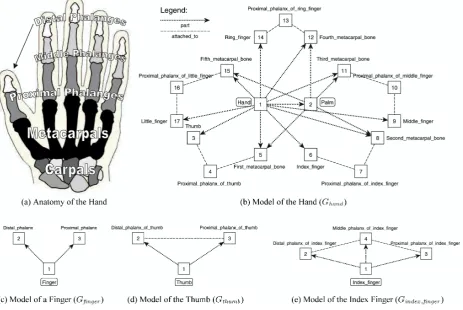
most DLs that concepts can only describe tree-shaped models. DLs and OWL allow only very limited forms of graph relationships as the addition of constructs to describe graph relationships easily lead to undecidability. Yet, as musical objects are highly structured we will often want to express graph relationships. In the following therefore we will discuss the possibilities of OWL2 and then discuss extensions of OWL that have been found useful in the context of this work to provide additional constructs for graph relationships.
4.3.1
Rules
Rule-based formalisms as found in logic programming (e.g. Prolog) or deductive databases (e.g. Datalog) are popular paradigm of knowl-edge representation. In our context, rules are interesting because rule systems have also been used for music analysis and generation (e.g. Schaffer and McGee, 1998). Like for DLs, there is a large body of work on expressivity and complexity of rule languages (Dantsin et al., 2001). Many decidable and tractable formalisms are known.
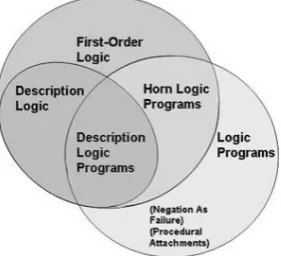
[image:51.595.153.294.421.549.2]The integration of DL formalism with rule formalisms is an on-going project within the Semantic Web. Several proposals have been made, though not standardized. An idea underlying many of these approaches is that as OWL has a first-order semantics it is straight-forward to combine OWL with first-order Horn-logic rules (Horrocks and Patel-Schneider, 2004).
Figure 4.1: Relationships between DLs and other KR formalisms
The Semantic Web Rule Language SWRL2 is a proposed rule ex- 2http://www.w3.org/Submission/SWRL/
tension to OWL that follows the union approach. SWRL rules are implications of conjunctions with unary predicates, binary predicates and constants corresponding to OWL concepts, role names and indi-viduals. SWRL further has a library of built-in predicates and allows user-defined predicates, e.g. to allow arithmetic tests:
Piece(?p) ∧composed(?p, ?year) ∧swrlb:greaterThan(?year, 1600)
∧swrlb:lesserThan(?year, 1760) ⇒BaroquePiece(?p)