Title: Evaluation ofspa-typing of methicillin-resistant
Staphylococcus aureususing high-resolution melting analysis Author: Waleed Mazi Vartul Sangal Gunnar Sandstorm Amir Saeed Jun Yu
PII: S1201-9712(15)00109-5
DOI: http://dx.doi.org/doi:10.1016/j.ijid.2015.05.002
Reference: IJID 2328
To appear in: International Journal of Infectious Diseases Received date: 3-4-2015
Revised date: 3-5-2015 Accepted date: 6-5-2015
Please cite this article as: Mazi W, Sangal V, Sandstorm G, Saeed A, Yu J, Evaluation of spa-typing of methicillin-resistant Staphylococcus aureus using high-resolution melting analysis, International Journal of Infectious Diseases (2015), http://dx.doi.org/10.1016/j.ijid.2015.05.002
Accepted Manuscript
Evaluation of spa-typing of methicillin-resistant Staphylococcus aureus using high-resolution melting analysis
Running title: HRM spa-typing of MRSA
Waleed Mazi a, b, *, Vartul Sangal c, Gunnar Sandstorm a, Amir Saeed a, d, Jun Yu e
a
Department of Laboratory Medicine, Division of Clinical Microbiology, Karolinska
Institutet, Karolinska University Hospital, Huddinge, SE- 141 86 Stockholm, Sweden
b
Infection Prevention and Control Department, King Abdul Aziz Specialist Hospital, Taif,
Saudi Arabia
c
Faculty of Health and Life Sciences, Northumbria University, Newcastle upon Tyne – NE1
8ST, United Kingdom
d
University of Medical Sciences & Technology, Department of Microbiology, P.O. Box 12810, Khartoum, Sudan
e
Strathclyde Institute of Pharmacy and Biomedical Sciences, University of Strathclyde,
Glasgow, United Kingdom
* Correspondence: Waleed Mazi, Department of Laboratory Medicine, Division of Clinical Microbiology, Karolinska Institutet, Karolinska University Hospital, Huddinge, SE- 141 86
Accepted Manuscript
Summary
Objective
spa-typing of methicillin-resistant Staphylococcus aureus (MRSA) has been widely used in
clinical diagnostics and epidemiological studies. We aimed to evaluate high-resolution
melting (HRM) as a rapid and cost effective method, to replace DNA-sequencing, for spa
-typing in a global collection of 50 MRSA isolates.
Methods
The polymorphic X region of spa gene was amplified by colony PCR using SensiMix™
HRM kit and melting temperature (Tm) and melting curves of the amplicons was analyzed in
close tubes using a Rotor-Gene 6000 instrument.
Results
Fifteen out of nineteen spa-types each had distinct Tm, which was sufficient to
unambiguously type each of these spa-types. The remaining 4 spa-types cannot be separated
by Tm alone: t008 and t2770 shared Tm(80.3oC) and t021 and t311 shared Tm (80.0oC). But,
they can be separated based on the shapes of their melting curves. There are discrepancies
between ours and previous studies, suggesting that standardization reminds a challenge for
cross references.
Conclusion
HRM-spa-typing is reproducible, simple, rapid and cost-effective. t037 is prevalent in Brazil
and Sudan while diverse spa-types are found in Scotland and Saudi Arabia. Standardization is
required for cross-references between labs globally.
Accepted Manuscript
Highlights
DNA-sequencing and application of BioNumarics software have identified 19spa-types
in 50 isolates in a global MRSA collection. t037 is prevalent in Brazil and Sudan while
diverse spa-types are found in Scotland and Saudi Arabia.
DNA-sequencing based typing is time consuming and expensive, license for BioNumarics
software alone costs ~ £6000 GBP for 3 years.
Fifteen out of 19 spa-types are unambiguously identified by HRM. This procedure is
rapid, 2 hour per run for 72 samples, and cost effective than DNA sequencing.
spa-types with shared Tm can be distinguished by the shapes of the melting curve, which
requires expertise training.
There are discrepancies in Tm values for a few spa-types from 3 studies in 3 independent
laboratories, which highlight the need for optimization and standardization for cross
Accepted Manuscript
Introduction
Methicillin-resistant Staphylococcus aureus (MRSA) remains to be a major cause of
infections in community and healthcare settings that imposes significant threat to the public
health (1, 2). Molecular typing methods are vital in rapidly identification of the prevalent
strains which is important for active surveillance and controlling the spread of the disease.
The polymorphic region of the gene encoding staphylococcal protein A (spa) has been found
to be highly discriminatory that is useful in investigating both the local and global
epidemiology of S. aureus (3-9). The complexity and high running cost of PCR-sequencing
have limited to perform in developing countries (10). Recently, high-resolution melting
(HRM) based spa-typing has been described as a rapid and cost effective method for
genotyping locally predominant isolates (10, 11). To test the accuracy and reliability of HRM
based spa-typing, we have analyzed a global collection of 50 MRSA isolates and
demonstrated that HRM can accurately spa-type majority of these isolates.
Material and Methods
MRSA isolates
We randomly selected 50 clinical MRSA isolates from Scotland (n=22), Brazil (n=13), Sudan
(n=3) and Saudi Arabia (n=12) between 2005 and 2012. All isolates were cultured and
identified as Staphylococcus aureus as described previously (12). Methicillin resistance
phenotype was confirmed according to the British Society for Antimicrobial Chemotherapy
(BSAC) standards using Vitek2 system (Biomerieux, USA). An isolate was considered as
methicillin resistance when the minimal inhibitory concentration (MIC) breakpoint of oxacilin
Accepted Manuscript
DNA-sequencing for spa-typingThe polymorphic regions of the spa gene were amplified and sequenced for all isolates, as
previously described (5, 14). The sequence data were analyzed using spa-typing plugin in
BioNumerics v.5.1 (Applied Maths).
HRM analysis for spa-typing
The polymorphic X region of spa gene was amplified in a Rotor-Gene 6000 instrument
(Qiagen) by colony PCR using SensiMix™ HRM kit (Bioline) as previously described by
Shopsin B. et al (3) . In brief, 20 μl PCR reaction was set up, containing 0.8 µl Eva-Green, 10
µl SensiMix™, 1 µl of each primer (100µM; 1095- forward
5`-AGACGATCCTTCGGTGAGC-3`and 1517 reverse
5`-GCTTTTGCAATGTCATTTACTG-3`) and 20 ng of the template DNA and programmed as following: a hold at 95°C for 10 min
followed by 35 cycles of 95°C for 20s, 56°C for 20s and 72°C for 22s. The high-resolution
melting of the amplicons was performed between 70–95°C with a stepwise increase of
0.05°C. The melting temperatures (Tm) were determined by the negative derivative of
decreased fluorescence over increased temperature (df/dt), using the proprietary software
(version 1.7.34). The sharpes of the melting curves are veiwed with the same software.
Results and Discussion
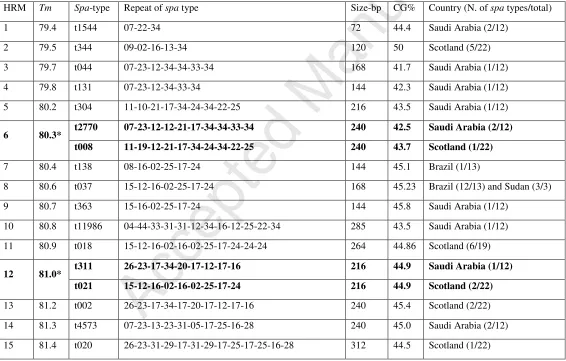
By use of DNA-sequencing and spa-typing plugin in BioNumerics, 19 spa-types were
identified among the 50 isolates. The spa-type t037 was the major spa-type that was prevalent
among Brazilian (12/13 isolates) and Sudanese isolates (3/3 isolates). Scottish and Saudi
Arabian isolates were quite diverse; eight spa-types were observed among 22 isolates from
Scotland and 9 spa-types among 12 isolates from Saudi Arabia (Table 1).
All the 50 isolates were then subjected to HRM analysis; 15 out of 19 spa-types each had
Accepted Manuscript
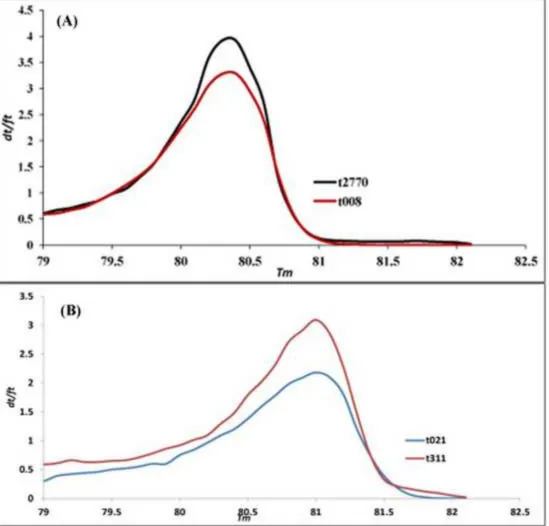
within a spa-type was highly homogenous. However, despite the difference in the GC contentbetween t008 and t2770 (43.7 mol% and 41.5 mol%, respectively), these spa-types shared the
same Tm (80.3°C; Fig. 2A). Similarly, t021 and t311 could not be separated from each other;
they shared a Tm of 80.70°C probably due to the fact that they have same 44.9 mol% of the
GC content (Fig. 2B). These results are in agreement with Stephens et al. (11) where two spa
-types could not be separated from each other, based on their Tm. It has been suggested that
shapes of the melting curves are also important in determining the spa-types (11, 15, 16) and
we have also noticed minor variations in the shapes of melting curves between t008 & t2770,
and t021 & t311 (Fig. 2A and B). These variations in the shape of melting curves were
reproducible but a bit complex for un-experienced users to confidently predict the correct spa
-types which highlights the challenge in optimizing HRM based spa-typing for the growing
number of spa-types of MRSA.
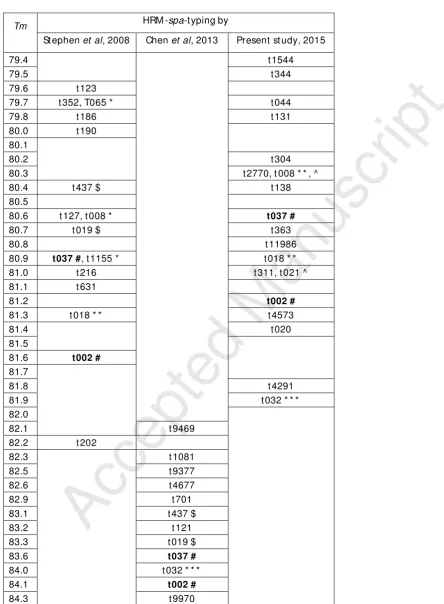
We also noticed some discrepancies in the Tm values between this study and previous
investigations by Chen, et al and Stephens et al, (10, 11); (Table 2). The Tm values for t037
were 80.9, 83.6, 80.6; and for t002 were 81.6, 84.1, 81.2; according to Stephens et al. (11),
Chen et al. (10) and this study, respectively. Stephens et al. used Platinum SYBR-Green
qPCR Super Mix-UDG (Life Technologies) on a Rotor Gene 6000 instrument (Qiagen) and
we have used SensiMix™ HRM (Bioline) mix with Eva-Green dye on a Rotor Gene 6000
instrument (Qiagen) (11). Chen et al. used LightCycler 480 HRM Master Mix containing
ResoLight dye on a LightCyclerNano real-time PCR system (Roche) (10). The Tm values
both for t037 and t002 were relatively close between this study and Stephens et al., than Chen
et al., suggesting the same instrument might provide similar Tm values for a spa-type and
minor variations may have been caused by different reaction mixes that contained different
Accepted Manuscript
were observed for additional spa-types (Table 2). Therefore, different instruments andreagents (dye in the reaction mix) may result in discrepancies in the Tm values of a spa-type.
Taken all together, we conclude that HRM- Spa typing is useful due to its reproducibility,
simplicity, rapid and low cost. Standadization is needed for laboratory screening of
Staphylococcus aureus spa-typing globally. For extension of its application to all spa-types
and cross references among laboratories worldwide, it is necessary to standardize and
optimize the experimental conditions in each of the laboratories.
Acknowledgement
We thank Ian Gould, Wanderley Dias da Silveira Musab Makram Nour Alla Eltigani, Reda
Kahn and Abdullah Asseeri for kindly supplying the MRSA strains. Waleed Mazi is
supported by Royal Saudi Arabia Scholarship.
Conflict of interest
We wish to confirm that there are no known conflicts of interest associated with this
publication and there has been no significant financial support for this work that could have
Accepted Manuscript
References:
1. Lucet J.C., Chevret S., Durand-Zaleski I., Chastang C., Regnier B., Multicenter Study
G. Prevalence and risk factors for carriage of methicillin-resistant Staphylococcus aureus at admission
to the intensive care unit: results of a multicenter study. Arch. Intern. Med.2003, 163 :181-8.
2. Matheson A., Christie P., Stari T., Kavanagh K., Gould I.M., Masterton R., Reilly J.S.
Nasal swab screening for methicillin-resistant Staphylococcus aureus--how well does it perform? A
cross-sectional study. Infect. Control. Hosp. Epidemiol. 2012, 33:803-8.
3. Shopsin B., Gomez M., Montgomery S.O., Smith D.H., Waddington M., Dodge D.E.,
Bost D.A., Riehman M., Naidich S., Kreiswirth B. N. Evaluation of protein A gene polymorphic
region DNA sequencing for typing of Staphylococcus aureus strains. J. Clin. Microbiol. 1999,
37:3556-63.
4. Tang Y.W., Waddington M.G., Smith D.H., Manahan J.M., Kohner P.C., Highsmith
L.M., Li H., Cockerili III F.R., Thompson R.L., Montgomery S.O., Persing D.H.(2000) Comparison of
protein A gene sequencing with pulsed-field gel electrophoresis and epidemiologic data for molecular
typing of methicillin-resistant Staphylococcus aureus. J. Clin. Microbiol. 2000, 38:1347-51.
5. Harmsen D., Claus H., Witte W., Rothganger J., Claus H., Turnwald D., Vogel U.
(2003) Typing of methicillin-resistant Staphylococcus aureus in a university hospital setting by using
novel software for spa repeat determination and database management. J. Clin. Microbiol. 2003,
41:5442-8.
6. Koreen L., Ramaswamy S.V., Graviss E.A., Naidich S., Musser J.M., Kreiswirth B.N.
Spatyping method for discriminating among Staphylococcus aureus isolates: implications for use of a
single marker to detect genetic micro- and macrovariation. J. Clin. Microbiol. 2004, 42:792-9.
7. Malachowa N., Sabat A., Gniadkowski M., Krzyszton-Russjan J., Empel J.,
Miedzobrodzki J.,Kosowska-Shick K., Appelbaum P. C., Hryniewicz W. (2005) Comparison of
multiple-locus variable-number tandem-repeat analysis with pulsed-field gel electrophoresis, spa
typing, and multilocus sequence typing for clonal characterization of Staphylococcus aureus isolates.
Accepted Manuscript
8. Grundmann H., Aanensen D.M., van den Wijngaard C.C., Spratt B.G., Harmsen D.,Friedrich A.W., the European Staphylococcal Reference Laboratory Working Group.(2010)
Geographic distribution of Staphylococcus aureus causing invasive infections in Europe: a
molecular-epidemiological analysis. PLoS medicine. 2010, 7:e1000215.
9. Sabat A.J., Budimir A., Nashev D., Sa-Leao R., van Dijl J., Laurent F., Grundmann H.,
Friedrich A.W., on behalf of the ESCMID Study Group of Epidemiological Markers (ESGEM).
Overview of molecular typing methods for outbreak detection and epidemiological surveillance. Euro
surveillance: bulletin Europeen sur les maladies transmissibles = European communicable disease
bulletin. 2013, 18:20380.
10. Chen J.H., Cheng V.C., Chan J.F., She K.K., Yan M.K., Yau M.C., , Kwan G.S., Yam
W.C., Yuen K.Y. The use of high-resolution melting analysis for rapid spa typing on
methicillin-resistant Staphylococcus aureus clinical isolates. J. Microbiol. Methods. 2013, 92:99-102.
11. Stephens A.J., Inman-Bamber J., Giffard P.M., Huygens F. High-resolution melting analysis of the
spa repeat region of Staphylococcus aureus. Clin. Chem. 2008, 54:432-6.
12. P. R. Murray EJB, J. H. Jorgenson, M. A.M. Pfaller, R. H. Yolken. Manual of clinical
microbiology.2003, 8th edition ed: ASM Press.
13. Andrews J.M., Howe R.A., Testing BWPoS. BSAC standardized disc susceptibility
testing method (version 10). J. Antimicrob. Chemother. 2011, 66:2726-57.
14. Sangal V., Girvan E.K., Jadhav S., Lawes T., Robb A., Vali L., Edwards G.F., Yu J.,
Gould I.M. Impacts of a long-term programme of active surveillance and chlorhexidine baths on the
clinical and molecular epidemiology of meticillin-resistant Staphylococcus aureus (MRSA) in an
Intensive Care Unit in Scotland. Int. J. Antimicrob. Agents. 2012, 40:323-31.
15. Ririe K.M., Rasmussen R.P., Wittwer C.T. Product differentiation by analysis of DNA
melting curves during the polymerase chain reaction. Anal. Biochem. 1997, 245:154-60.
16. Wittwer C.T., Reed G.H., Gundry C.N., Vandersteen J.G., Pryor R.J. High-resolution
genotyping by amplicon melting analysis using LCGreen. [1] Lucet, J.C., Chevret, S.,
methicillin-Accepted Manuscript
resistant Staphylococcus aureus at admission to the intensive care unit: results of amulticenter study. Arch. Intern. Med., 163 ,181-188.
[2] Matheson, A., Christie, P., Stari, T., Kavanagh, K., et al., 2012. Nasal swab screening for
methicillin-resistant Staphylococcus aureus--how well does it perform? A cross-sectional
study. Infect. Control. Hosp. Epidemiol., 33, 803-808.
[3] Shopsin, B., Gomez, M., Montgomery, S.O., Smith D.H., et al., 1999. Evaluation of
protein A gene polymorphic region DNA sequencing for typing of Staphylococcus aureus
strains. J. Clin. Microbiol., 37, 3556-3563.
[4] Tang, Y.W., Waddington, M.G., Smith, D.H., Manahan, J.M., et al., 2000. Comparison of
protein A gene sequencing with pulsed-field gel electrophoresis and epidemiologic data for
molecular typing of methicillin-resistant Staphylococcus aureus. J. Clin. Microbiol., 38,
1347-1351.
[5] Harmsen, D., Claus, H., Witte, W., Rothganger, J., et al., 2003. Typing of
methicillin-resistant Staphylococcus aureus in a university hospital setting by using novel software for
spa repeat determination and database management. J. Clin. Microbiol., 41, 5442-5448.
[6] Koreen, L., Ramaswamy, S.V., Graviss, E.A., Naidich, S., et al., 2004. Spa typing method
for discriminating among Staphylococcus aureus isolates: implications for use of a single
marker to detect genetic micro- and macrovariation. J. Clin. Microbiol., 42, 792-799.
[7] Malachowa, N., Sabat, A., Gniadkowski, M., Krzyszton-Russjan, J., et al., 2005.
Comparison of multiple-locus variable-number tandem-repeat analysis with pulsed-field gel
electrophoresis, spa typing, and multilocus sequence typing for clonal characterization of
Staphylococcus aureus isolates. J. Clin. Microbiol., 43, 3095-3100.
[8] Stephens, A.J., Inman-Bamber, J., Giffard, P.M., Huygens, F., 2008. High-resolution
Accepted Manuscript
[9] Chen, J.H., Cheng, V.C., Chan, J.F., She, K.K., et al., 2013. The use of high-resolutionmelting analysis for rapid spa typing on methicillin-resistant Staphylococcus aureus clinical
isolates. J. Microbiol. Methods., 92, 99-102.
[10] Murray, P., Jorgenson, J., Pfaller, M., Yolken, R., 2003. Manual of clinical
microbiology. 8th edition ed: ASM Press.
[11] Andrews, J.M., Howe, R.A., Testing, B., 2011. BSAC standardized disc susceptibility
testing method (version 10). J. Antimicrob. Chemother., 66, 2726-2757.
[12] Sangal, V., Girvan, E.K., Jadhav, S., Lawes, T., et al., 2012. Impacts of a long-term
programme of active surveillance and chlorhexidine baths on the clinical and molecular
epidemiology of meticillin-resistant Staphylococcus aureus (MRSA) in an Intensive Care
Unit in Scotland. Int. J. Antimicrob. Agents., 40, 23-31.
[13] Ririe, K.M., Rasmussen, R.P., Wittwer, C.T., 1997. Product differentiation by analysis
of DNA melting curves during the polymerase chain reaction. Anal. Biochem. 254, 154-60.
[14] Wittwer, C.T., Reed, G.H., Gundry, C.N., Vandersteen, J.G., et al., 2003.
High-resolution genotyping by amplicon melting analysis using LCGreen. Clin. Chem. 2003,
Accepted Manuscript
Figure legends:
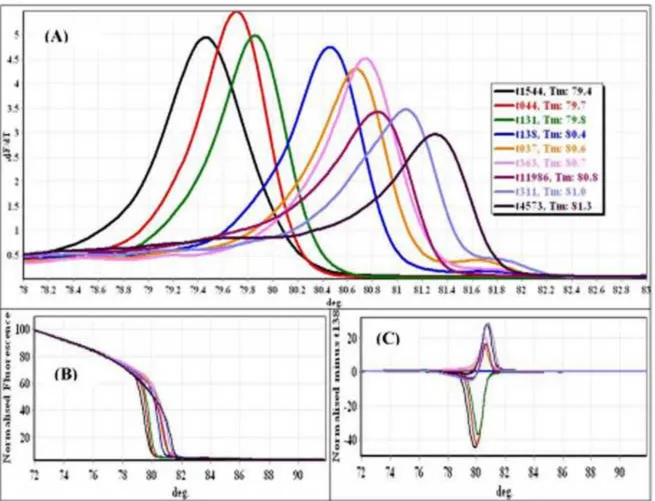
Figure 1: Comparison of different spa polymorphic region X HRM curves obtained from MRSA isolates. (A) Negative derivative of florescence over temperature (df/dt) plots
displaying distinguishable HRM profiles. (B) Normalization data curve depicts the decreasing
fluorescence vs increasing temperature. (C) Difference graph demonstrating the accurate
reproduction of 8 spa HRM profiles in a run experiment.
Figure 2: Melting curves shapes allowed assignments of spa-types share same Tm. (A) characteristics of melting curve shapes for t2770 and t008 respectively; they had identical Tm
80.3. (B) Characteristics of melting curve shapes of t021 and t311 respectively; they had
Accepted Manuscript
Table 2: Com parison of Tm obt ained from t hree independent st udies
HRM -spa-t yping by
Tm
St ephen et al, 2008 Chen et al, 2013 Present st udy, 2015
79.4 t 1544
79.5 t 344
79.6 t 123
79.7 t 352, T065 * t 044
79.8 t 186 t 131
80.0 t 190
80.1
80.2 t 304
80.3 t 2770, t 008 * * , ^
80.4 t 437 $ t 138
80.5
80.6 t 127, t 008 * t037 #
80.7 t 019 $ t 363
80.8 t 11986
80.9 t037 #, t 1155 * t 018 * *
81.0 t 216 t 311, t 021 ^
81.1 t 631
81.2 t002 #
81.3 t 018 * * t 4573
81.4 t 020
81.5
81.6 t002 #
81.7
81.8 t 4291
81.9 t 032 * * *
82.0
82.1 t 9469
82.2 t 202
82.3 t 1081
82.5 t 9377
82.6 t 4677
82.9 t 701
83.1 t 437 $
83.2 t 121
83.3 t 019 $
83.6 t037 #
84.0 t 032 * * *
84.1 t002 #
84.3 t 9970
* Tm cannot dist inguish spa-t ypes in St ephen et al st udy.
Accepted Manuscript
$ Tm discrepancy of spa t ypes bet w een St ephen et al and Chen et al st udies. # Tm discrepancy in t he t hree st udies (t ext in Bold).
Accepted Manuscript
Table 1: HRM and spa-sequence types of the 50 MRSA isolates, and the frequencies in countries of origins.HRM Tm Spa-type Repeat of spa type Size-bp CG% Country (N. of spa types/total)
1 79.4 t1544 07-22-34 72 44.4 Saudi Arabia (2/12)
2 79.5 t344 09-02-16-13-34 120 50 Scotland (5/22)
3 79.7 t044 07-23-12-34-34-33-34 168 41.7 Saudi Arabia (1/12)
4 79.8 t131 07-23-12-34-33-34 144 42.3 Saudi Arabia (1/12)
5 80.2 t304 11-10-21-17-34-24-34-22-25 216 43.5 Saudi Arabia (1/12)
6 80.3* t2770 07-23-12-12-21-17-34-34-33-34 240 42.5 Saudi Arabia (2/12) t008 11-19-12-21-17-34-24-34-22-25 240 43.7 Scotland (1/22)
7 80.4 t138 08-16-02-25-17-24 144 45.1 Brazil (1/13)
8 80.6 t037 15-12-16-02-25-17-24 168 45.23 Brazil (12/13) and Sudan (3/3)
9 80.7 t363 15-16-02-25-17-24 144 45.8 Saudi Arabia (1/12)
10 80.8 t11986 04-44-33-31-31-12-34-16-12-25-22-34 285 43.5 Saudi Arabia (1/12)
11 80.9 t018 15-12-16-02-16-02-25-17-24-24-24 264 44.86 Scotland (6/19)
12 81.0* t311 26-23-17-34-20-17-12-17-16 216 44.9 Saudi Arabia (1/12) t021 15-12-16-02-16-02-25-17-24 216 44.9 Scotland (2/22)
13 81.2 t002 26-23-17-34-17-20-17-12-17-16 240 45.4 Scotland (2/22)
14 81.3 t4573 07-23-13-23-31-05-17-25-16-28 240 45.0 Saudi Arabia (2/12)