0095-1137/07/$08.00
⫹
0
doi:10.1128/JCM.01082-07
Copyright © 2007, American Society for Microbiology. All Rights Reserved.
Comparison of Single- and Multilocus Sequence Typing and Toxin
Gene Profiling for Characterization of Methicillin-Resistant
Staphylococcus aureus
䌤
Yongwei Cai,
1,2Fanrong Kong,
1Qinning Wang,
1Zhongsheng Tong,
1,3Vitali Sintchenko,
1Xianyu Zeng,
3and Gwendolyn L. Gilbert
1*
Centre for Infectious Diseases and Microbiology (CIDM), Institute of Clinical Pathology and Medical Research (ICPMR), Westmead,
New South Wales, Australia
1; Department of Dermatology, Hangzhou Third People’s Hospital, Hangzhou, Zhejiang Province,
People’s Republic of China
2; and Research Laboratory for Infectious Skin Diseases, Department of
Dermatology, Wuhan First Hospital, Wuhan 430022, People’s Republic of China
3Received 28 May 2007/Returned for modification 2 August 2007/Accepted 15 August 2007
We compared three novel methicillin-resistant
Staphylococcus aureus
(MRSA) genotyping methods with
multilocus sequence typing (MLST) and
spa
typing to assess their utility for routine strain typing. The new
methods were
femA
and
nuc
sequence typing and toxin gene profiling (TGP), using a multiplex-PCR-based
reverse line blot assay to detect 13 pyrogenic superantigen and exfoliative toxin genes. Forty-two
well-charac-terized MRSA strains, representing 15 MLSTs or 9 clonal clusters (CCs), were genotyped by all methods.
Twenty-two
spa
, nine
femA
, and seven
nuc
sequence types were identified. The
femA
sequence types correlated
exactly with CCs;
nuc
sequences types were less discriminatory but generally correlated well with
femA
types
and CCs. Ten isolates contained none of 13 toxin genes; TGPs of the remainder comprised 1 to 5 toxin genes.
The combination of
spa
typing and TGPs identified 26 genotypes among the 42 strains studied. A combination
of two or three rapid, inexpensive genotyping methods could potentially provide rapid MRSA strain typing as
well as useful information about clonal origin and virulence.
Methicillin-resistant
Staphylococcus aureus
(MRSA)
genotyp-ing is used to study its evolution and epidemiology and to assist in
infection control (39). Different typing methods provide different
information. Multilocus sequence typing (MLST) reveals slowly
accumulating changes in conserved genes that reflect
long-term evolutionary changes and can identify global spread of
the relatively small number of successful clones (13). It has
limited discriminatory power and is unsuitable for outbreak
investigation, whereas pulsed-field gel electrophoresis is highly
discriminatory and can identify recent changes. It is most
widely used for outbreak investigation and infection control (9,
28). Both methods are relatively expensive and slow, and a
number of rapid, inexpensive typing methods, based on
se-quence or length polymorphisms of variable genes or loci, have
been described that are objective and relatively inexpensive.
These include
coa
(41) and
spa
(38) sequence typing and the
multilocus variable number tandem repeat assay (12, 29).
spa
typing, which depends on differences in the number and
sequence of tandem repeats in region X of the protein A gene
(44), is discriminatory, rapid, inexpensive, and objective (25,
37, 41). The development of a shareable web-based database
(www.spaServer.Ridom.de) (15) and the utility of
spa
typing
for early-warning systems (31) have contributed to the rapid
uptake of MRSA
spa
typing by diagnostic and public health
laboratories.
In this study, we investigated the potential utility of two
additional
S. aureus
gene polymorphisms for strain typing,
namely,
femA
, one of several genes involved in the synthesis of
the branched-peptide structure of
S. aureus
peptidoglycan (4),
and
nuc
, which encodes an extracellular thermostable nuclease
of
S. aureus
(5). Both are species-specific
S. aureus
genes; they
have been widely used as PCR targets for identification (21),
but their polymorphisms have not been widely investigated
(14).
S. aureus
produces numerous toxins, including enterotoxins
or pyrogenic superantigens and exfoliative toxins, some of
which are encoded by genes carried on staphylococcal
patho-genicity islands and associated with certain clonal complexes
(CCs), whereas genes encoding others, such as the
Panton-Valentine leucocidin (PVL), are carried on bacteriophages and
readily transferred between different lineages (26, 27). This
suggests that a toxin gene profile (TGP) could help identify
S.
aureus
CCs as well as providing information about virulence.
Various molecular methods have been described for studying
the distribution of staphylococcal toxins (2, 10).
We used 42 well-characterized MRSA strains to compare
sequence polymorphisms of
femA
and
nuc
and TGPs, based on
a multiplex PCR-based reverse line blot assay (mPCR/RLB)
(22), with two established typing methods—namely,
spa
typing
and MLST—to determine their potential utility for MRSA
genotyping.
MATERIALS AND METHODS
S. aureusisolates.We used 42 well-characterized reference and clinical S. aureusisolates in this study, as shown in Table 1, including 35 from various parts of Australia, provided by Philip Giffard, Cooperative Research Centre for Di-agnostics, Queensland University of Technology, Brisbane, and Graeme Nimmo,
* Corresponding author. Mailing address: Centre for Infectious
Dis-eases and Microbiology (CIDM), Institute of Clinical Pathology and
Medical Research (ICPMR), Westmead Hospital, Darcy Road,
West-mead, New South Wales 2145, Australia. Phone: (612) 9845 6255. Fax:
(612) 9893 8659. E-mail: [email protected].
䌤
Published ahead of print on 22 August 2007.
3302
on May 16, 2020 by guest
http://jcm.asm.org/
Queensland Health Pathology Services, Princess Alexandra Hospital, Brisbane, Australia. Some have been used in several previous studies (40). Seven strains were provided by Herminia de Lencastre, Instituto de Tecnologia Quı´mica e
Biolo´gica, Universidade Nova de Lisboa, Oeiras, Portugal, and also have been
used in previous studies (33, 34) Two of these strains (MW2 and COL) have been
fully sequenced (26). MLST andSCCmectyping results were provided by the
donors of the strains (33, 34, 40).
DNA extraction.DNA extraction was performed as described previously (23).
Toxin gene detection.A well-established mPCR/RLB protocol developed in
[image:2.585.48.540.80.508.2]our laboratory (22) was used to detect 13Staphylococcus aureustoxin genes.
TABLE 1. Genotypes and
spa
types of 42 well-characterized methicillin-resistant
S. aureus
isolates used in this study
Strain GenBank
accession no.a
Definedspa
lengthb spatypec spaprofilec Clonal typed,e
Sources of Australian
isolatesh
B827549
EF094508
134
t1784
07-34-33-13
ST
⬃
1-SCCmec-new
QHPS
HU25
gEF094528
182
t138
08-16-02-25-17-24
ST239-SCCmec-IIIA
HDG2
gEF094527
182
t421
15-12-16-02-25-17
ST239-SCCmec-IIIB
K704540
fEF094525
206
t037
15-12-16-02-25-17-24
ST
⬃
239-SCCmec-III
QHPS
K711532
f⫽
EF094525
206
t037
15-12-16-02-25-17-24
ST
⬃
239-SCCmec-III
QHPS
AH13
f⫽
EF094525
206
t037
15-12-16-02-25-17-24
ST239-SCCmec-IIIA
AGAR
RDH81
f⫽
EF094525
206
t037
15-12-16-02-25-17-24
ST239-SCCmec-IIIA
AGAR
AH1
f⫽
EF094525
206
t037
15-12-16-02-25-17-24
ST128-SCCmec-IIIA
AGAR
RPAH 18
f⫽
EF094525
206
t037
15-12-16-02-25-17-24
ST239-SCCmec-III
AGAR
RPAH15
f⫽
EF094525
206
t037
15-12-16-02-25-17-24
ST239-SCCmec-III
AGAR
ANS46
g⫽
EF094525
206
t037
15-12-16-02-25-17-24
ST239-SCCmec-III
PC8
fEF094507
206
t127
07-23-21-16-34-33-13
ST1-SCCmec-IV
AGAR
F
H43
f⫽
EF094507
206
t127
07-23-21-16-34-33-13
ST
⬃
1-SCCmec-IV
AGAR
SJOG 30
f⫽
EF094507
206
t127
07-23-21-16-34-33-13
ST1-SCCmec-IV
AGAR
RPH 85
f⫽
EF094507
206
t127
07-23-21-16-34-33-13
ST
⬃
1-SCCmec-IV
AGAR
SN39
f⫽
EF094507
206
t127
07-23-21-16-34-33-13
ST
⬃
1-SCCmec-new
AGAR
RHH58
f⫽
EF094507
206
t127
07-23-21-16-34-33-13
ST
⬃
1-SCCmec-IV
AGAR
RHH10
f⫽
EF094507
206
t127
07-23-21-16-34-33-13
ST
⬃
1-SCCmec-IV
AGAR
FH53
f⫽
EF094507
206
t127
07-23-21-16-34-33-13
ST
⬃
1-SCCmec-I
AGAR
RPH2
fEF094510
206
t190
11-17-34-24-34-22-25
ST8-SCCmec-new
AGAR
PAH 58
fEF094514
230
t019
08-16-02-16-02-25-17-24
ST30-SCCmec-IV
AGAR
PAH 1
f⫽
EF094514
230
t019
08-16-02-16-02-25-17-24
ST30-SCCmec-IV
AGAR
MW2
gEF094526
230
t128
07-23-23-21-16-34-33-13
ST1-SCCmec-IV
RBH98
fEF094522
230
t202
11-17-23-17-17-16-16-25
ST93-SCCmec-IV
AGAR
13792-4492
f⫽
EF094522
230
t202
11-17-23-17-17-16-16-25
ST
⬃
93-SCCmec-IV
QHPS
IP01M1081
fEF094523
230
t216
04-20-17-20-17-31-16-34
ST59-SCCmec-IV
QHPS
14176-5710
fEF094524
230
t1959
c15-21-12-16-02-25-17-16
ST
⬃
239-SCCmec-III
QHPS
B8-10
fEF094509
230
t711
04-21-17-34-24-34-22-25
ST
⬃
8-SCCmec-IV
QHPS
J710566
fEF094516
254
t065
09-02-16-34-13-17-34-16-34
ST45-SCCmec-V
QHPS
RPH 74
fEF094517
254
t123
09-02-16-34-13-16-34-16-34
ST45-SCCmec-V
AGAR
IP01M2046
fEF094519
254
t1958
c08-21-17-13-13-new-34-33-34
ST78-SCCmec-IV
QHPS
E804531
fEF094518
278
t002
26-23-17-34-17-20-17-12-17-16
ST5-SCCmec-IV
QHPS
CH97
f⫽
EF094518
278
t002
26-23-17-34-17-20-17-12-17-16
ST73-SCCmec-IV
AGAR
BK2464
g⫽
EF094518
278
t002
26-23-17-34-17-20-17-12-17-16
ST5-SCCmec-II
IMVS 67
fEF094511
278
t008
11-19-12-21-17-34-24-34-22-25
ST8-SCCmec-V
AGAR
COL
g⫽
EF094511
278
t008
11-19-12-21-17-34-24-34-22-25
ST250-SCCmec-I
DEN2988
g⫽
EF094511
278
t008
11-19-12-21-17-34-24-34-22-25
ST8-SCCmec-IVA
F829549
fEF094521
278
t186
07-12-21-17-13-13-34-34-33-34
ST88-SCCmec-IV
QHPS
C801535
fEF094520
278
t325
07-12-21-17-34-13-34-34-33-34
ST88-SCCmec-new
QHPS
E822485
fEF094515
302
t018
15-12-16-02-16-02-25-17-24-24-24
ST36-SCCmec-II
QHPS
CH69
fEF094513
326
t1963
c26-23-13-17-31-29-17-25-17-25-16-28
ST
⬃
22-SCCmec-IV
AGAR
CH16
fEF094512
422
t032
26-23-23-13-23-31-29-17-31-29-17-25-17-25-16-28
ST22-SCCmec-IV
AGAR
a
The relevantspasequences have been submitted to GenBank; other strains with identicalspasequences are indicated by “⫽” and the accession no. for the
corresponding submitted GenBank sequence.
b
Definedspalengths are the distances from the start and end points, equal to 1156 and 1481 in GenBank sequence J01786, which correlates with the start and end
point of the suggested 5⬘and 3⬘signature sequences (www.spaServer.Ridom.de). The full repetitive region sequence length can be calculated by adding together the
lengths of sequences of individual repeats.
c
After comparison withspadatabase (www.spaServer.Ridom.de) and GenBank sequences, three newspatypes sequences were identified and submitted to thespa
database (www.spaServer.Ridom.de). Please refer to thespadatabase forspatype and profile nomenclature.
d
ST, MLST; SCCmec, staphylococcal cassette chromosomemec. Information provided by strain donors; ST⬃, single nucleotide polymorphism type as described by
Huygens et al. (18) using the computer program Minimum SNPs to compare with existing MLST data (17).
e
Clonal type refers to the combination of ST and SCCmectype.
f
Thirty-five Australian strains were provided by Philip Giffard, Cooperative Research Centre for Diagnostics, Queensland University of Technology, Brisbane, Australia, and Graeme Nimmo, Queensland Health Pathology Services, Princess Alexandra Hospital, Brisbane, and have been used in several previous studies (17, 18, 40).
g
Seven isolates were provided by Herminia de Lencastre, Instituto de Tecnologia Quı´mica e Biolo´gica, Universidade Nova de Lisboa, Oeiras, Portugal, and have
been used in several previous studies (33, 34);spatypes identified in this study were identical with those previously reported for these strains (de Lencastre, personal
communication).
h
QHPS, Queensland Health Pathology Service (isolates from various diagnostic laboratories in Queensland); AGAR, Australian Group on Antibiotic Resistance (isolates from a study of community MRSA in Australia) (6).
on May 16, 2020 by guest
http://jcm.asm.org/
Target genes, primer and probe sequences, physical characteristics, and lo-cations within selected GenBank sequences are shown in Table 2. All primers and probes had similar physical characteristics to allow simultaneous ampli-fication and hybridization, respectively, in a multiplex reaction (22). Two gene-specific PCR primer pairs and two gene-specific probes were designed
for each of 13 toxin genes. All primers were 5⬘end biotinylated to allow
detection of hybridization with a streptavidin peroxidase substrate. The
probes were labeled with a 5⬘-end amine group to facilitate covalent linkage
to the nylon membrane and to allow membranes to be stripped and reused
repeatedly (22). Each multiplex reaction includednucprimers as the positive
control forS. aureusand for quality control of DNA extraction and mPCR/
RLB. All primers and probes were synthesized by Sigma-Aldrich (Sydney, Australia).
The mPCR/RLB was performed as previously described (22) with the
follow-ing modifications: each 25-l reaction mixture contained 0.5 U Hotstar Taq
polymerase (QIAGEN, Melbourne, Australia), and the mPCR annealing tem-perature was optimized to 55°C.
Sequencing, sequence analysis, and phylogenetic tree.femA,nuc, andspaPCR primers were based on the published GenBank sequences using BioManager (http://biomanager.angis.org.au/). Sequencing was performed as described pre-viously (24). For most targets, outer primers were used for amplification and inner primers for sequencing (Table 3).
Thespatypes were defined by reference to the shareable web-based database
(www.spaServer.Ridom.de) (15). Allsparepeat regions were submitted to the
database, andspatypes were assigned by the database by combining the
[image:3.585.47.540.82.535.2]se-quences of all repeat regions.
TABLE 2. Primers and probes used in mPCR/RLB for detection of 13 toxin genes
Primer/probea Target T
m°Cb
GenBank accession
no. Primer/probe sequence (5⬘–3⬘)
c Referencesd
nucSb nuc 65.68 V01281 511GCG ATT GAT GGT GAT ACG GTT531 7
nucAp nuc 61.36 V01281 558CAT TGG TTG ACC TTT GTA CAT TAA535 This study
nucSp nuc 61.06 V01281 745GAT GGA AAA ATG GTA AAC GAA G766 This study
nucAb nuc 69.12 V01281 789AGC CAA GCC TTG ACG AAC TAA AGC766 7
seaSb sea 64.05 M18970 487CCT TTG GAA ACG GTT AAA ACG507 3
seaSp sea 68.83 M18970 531GGA GTT GGA TCT TCA AGC AAG ACG554 3
seaAp sea 63.87 M18970 613TCT GAA CCT TCC CAT CAA AAA C592 3
seaAb sea 62.91 M18970 691TTGA ATA CTG TCC TTG AGC ACC670 43
sebSb seb 64.82 M11118 634TCG CAT CAA ACT GAC AAA CG653 3
sebSp seb 61.1 M11118 662GTAT GTA TGG TGG TGT AAC TGA GC685 43
sebAp seb 60.06 M11118 831CA CCA AAT AGT GAC GAG TTA GG810 43
sebAb seb 60.4 M11118 924CAT GTC ATA CCA AAA GCT ATT CTC901 3
secSb sec 62.5 X05815 664G CTC AAG AAC TAG ACA TAA AAG CTA GG690 3
secSp sec 63.13 X05815 772AAC GG(/a)C AAT ACT TTT TGG TAT GAT795 3
secAp sec 61.4 X05815 885CTT CAC A(/t)CT TTT AGA ATC AAC CG863 43
secAb sec 60.4 X05815 935TCA AAA TCG GAT TAA CAT TAT CC913 3
sedSb sed 60.2 M28521 332CTA GTT TGG TAA TAT CTC CTT TAA ACG358 3
sedSp sed 64.91 M28521 360TAA AGC CAA TGA AAA CAT TGA TTC A384 3
sedAp sed 60.85 M28521 491CTT TTA TTT TCT CCT ATT ATT GG ATTTTT463 30
sedAb sed 61.9 M28521 653CAA TTA ATG CTA TAT CTT ATA GGG TAA ACA TC622 3
seeSb see 63.41 M21319 424C GAT TGA CCG AAG AAA AAA AAG445 30
seeSp see 60.2 M21319 479CTA CAG TAC CTA TAG ATA AAG TTA AAA CAA GC510 3
seeAp see 66.87 M21319 613TTT GCA CCT TAC CGC CAA AG594 3
seeAb see 60.38 M21319 659TAA CTT ACC GTG GAC CCT TC640 3
segSb seg 66.14 AF064773 229CAA CCC/T GAT CCT AAA TTA GAC GAA C253 2
segSp seg 63.09 AF064773 285GGG AAC TAT GGG T(/a)AA TGT AAT GAA TC310 2
segAp seg 62.61 AF064773 338CTT CCT TCA ACA GGT GGA GAC318 2
segAb seg 62.91 AF064773 485/401GGA ACG CCA AAA ATG TCT ACT T464/379 35
sehSb seh 60.86 U11702 407TTA GAA ATC AAG GTG ATA GTG GC429 2
sehSp seh 61.25 U11702 454ACT GCT GAT TTA GCT CAG AAG TTT A478 2
sehAp seh 60.1 U11702 575AGT GTT GTA CCT CCA TAT AGA C ATTC550 35
sehAb seh 60.47 U11702 641TTT TGA ATA CCA TCT ACC CAA AC619 2
seiSb sei 63.01 AY158703 396G GCC ACT TTA TCA GGA CAA TAC TT419 2
seiSp sei 61.91 AY158703 656A CA C(a)TG GTA AAG GC(t)A AAG AAT ATG679 2
seiAp sei 62.26 AY158703 726AAA ACT TAC AGG CAG TCC ATC TC704 2
seiAb sei 58.23 AY158703 818AAT TAT CAT TAG TTA CTA TCT ACA TAT GAT ATT TC784 35
etaSb eta 61.39 M17347 374CTA GTG CAT TTG TTA TTC AAG ACG397 3
etaSp eta 69.51 M17347 414CCA TGC AAA AGC AGA AGT TTC AGC437 3
etaAp eta 60.67 M17347 492TGC A(/g)TT GAC ACC ATA GTA CTT ATT C468 This study
etaAb eta 62.72 M17347 794AAT GCT AAA TCA ACA CCT GC AC773 30
etbSb etb 61.26 M17348 190TAC CAC CTA ATA CCC TAA TAA TCC AA215 3
etbSp etb 61.37 M17348 286GAG ACA GTG CAT TAA ATG AAT AAC TTT312 3
etbAp etb 62.41 M17348 539GAT TTC TTC TGC GCT GTA TTC TT517 This study
etbAb etb 61.16 M17348 609C ATT ATC CGT AAT GTG TGT ATAAA GC584 43
etdSb etd 61.75 AB057421 5963GCT CGG ATA CCC TTA TAA CTT TTC5986 This study
etdSp etd 62.2 AB057421 6055CTG AGT CGG GAA ATT CTG G6073 43
etdAp etd 61.47 AB057421 6120CAA CAT GAA TAC CA0A CTA ACT CTC C6096 This study
etdAb etd 61.88 AB057421 6259CAT TAC TAA TGA GAC TGT AAT TCA GCT CT6231 This study
tsstSb tsst-1 65.22 J02615 348AAG CCA ACA TAC TAG CGA AGG AAC371 3
tsstSp tsst-1 60.5 J02615 394GGC GTT ACA AAT ACT GAA AAA TTA C418 30
tsstAp tsst-1 64.36 J02615 495ATC GAA CTT TGG CCC(/a) ATA CTT T474 3
tsstAb tsst-1 61.03 J02615 556GTA TTT GAG TTA GCT GAT GAC GAA533 43
pvlSb pvl 65.29 X72700 2651TTT TAG GCT CAA GAC AAA GCA AC2673 This study
pvlAp pvl 65.3 X72700 2731TAC CTC TGG ATA ACA CTG GCA TTT T2707 11
pvlSp pvl 61.76 X72700 2733CTT CAA TCC AGA ATT TAT TGG TGT2756 11
pvlAb pvl 65.8 X72700 2783TTT GCA GCG TTT TGT TTT CG2764 11
aS, sense; A, antisense; b, biotin labeled (all the primers were biotin labeled at the 5⬘end); p, probe (all the probes were 5⬘end C6 amine labeled).
bT
mvalues were provided by the primer synthesizer (Sigma-Aldrich).
cBoldface numbers represent the numbered base positions at which primer/probe sequences start and finish (starting at point “1” of the corresponding GenBank
sequence). Underlined portions indicate modifications of published primer/probe sequences. The bases in parenthesis represent sequences with polymorphisms compared with GenBank sequences or our own sequencing results (for five probes with heterogeneous hybridization).
dPrimers and probes were used as previously published (some with modification) except, as indicated, those designed for this study.
on May 16, 2020 by guest
http://jcm.asm.org/
Data obtained from different typing methods were recorded and stored in an Access file, which was imported into the BioNumerics software program (Applied Maths) with appropriate formatting. A phylogenetic tree was gen-erated by using the categorical coefficient and clustered by the Ward algo-rithm.
Calculation of index of diversity.Simpson’s index of diversity was calculated for each individual genotyping method and for combinations of methods, as described by Hunter and Gaston (16).
Nucleotide sequence accession numbers.The nearly full-length sequences (see
[image:4.585.44.542.81.197.2]below) of selectedfemAandnucgenes and partialspasequences were deposited
[image:4.585.134.452.313.707.2]FIG. 1. Relatedness of 42 MRSA strains between different typing methods.
*, strains CH 69, IPO1M2046, and 14176-5710 belonged tospa
types
t1963, t1958, and t1959, respectively, which have not been previously deposited in the database.
TABLE 3. Primers used for PCR sequencing of
nuc,
femA, and
spa
genes
Primer Target Tm(°C)
GenBank
accession no. Primer sequence (5⬘–3⬘)
c
nucS1a nuc 60.3 V01281 226ATGACAGAATACTTATTAAGTGCTGG251
nucS2b nuc 60.6 V01281 232GAATACTTATTAAGTGCTGGCATATG257
nucA1b nuc 63.9 V01281 908TGACCTGAATCAGCGTTGTC889
nucA2a nuc 63.7 V01281 912TTATTGACCTGAATCAGCGTTG891
femAS1a femA 64.1 X17688 577ATGAAATTAATTAACGAGAGACAAATAGGAG607
femAS2b femA 65.4 X17688 591CGAGAGACAAATAGGAGTAATGATAATGAAG621
femAA0b femA 67.3 X17688 1868CTGTCTTTAACTTTTTTAAGTGCGGTATATGC1837
femAAa femA 68.3 X17688 1878CTAAAAAATTCTGTCTTTAACTTTTTTAAGTGCGG1844
spaSa spa 71.7 J01786 1077CTT CAT CCA AAG CCT TAA AGA CGA TCC TTC1106
spaAa spa 71.4 J01786 1543CAA TTT TGTCAG CAG TAG TGC CGT TTG1517
spaSEQb spa 71.9 J01786 1540TTT TGTCAG CAG TAG TGC CGT TTG CT1515
aFor most targets, outer primers were used for amplification and, less commonly, for sequencing.
bInner primers were mainly used for sequencing, since they gave better results.
cBoldface numbers represent the numbered base positions at which primer sequences start and finish (starting at point “1” of the corresponding GenBank sequence).
on May 16, 2020 by guest
http://jcm.asm.org/
in GenBank with the following accession numbers: forfemA, DQ103589 and
DQ352456 to DQ352463; for nuc, DQ507377 to DQ507382; and for spa,
EF094507 to EF094528. EightS. aureusgenome sequences were used for
refer-ence: AJ938182 (RF122), NC_002952 (MRSA252), AF144661 (Staphylococcus
aureussubsp.anaerobius), NC_002745(N315), NC_002758 (Mu50), NC_003923 (MW2), NC_002951 (COL), and NC_002953 (MSSA476).
RESULTS AND DISCUSSION
Sequence polymorphisms of
femA
and
nuc
.
Nine
femA
se-quence types with lengths of approximately 1,215 bp were
identified, of which five were newly identified and four had
been previously deposited in GenBank. A total of 39
polymor-phism sites were found among those sequences. Seven
nuc
sequence types of approximately 700 bp were identified, with
28 polymorphisms sites. Four sequence types had not been
previously identified.
spa
types and TGPs.
Twenty-two
spa
types were identified,
and sequences of each new type were submitted to GenBank
with accession numbers shown in Table 1. Nineteen of the
spa
types were already recorded in the
spa
database (www
.spaServer.Ridom.de) (15), and three were new types, first
identified in Australian strains (Table 1; Fig. 1). There were 14
different TGPs (Fig. 1 and 2).
Comparison of MLST,
femA
and
nuc
sequence types,
spa
types, and TGPs.
MLST are based on sequences of seven
housekeeping genes (http://www.mlst.net/). Isolates with
iden-tical sequences for all seven genes are considered to be clonal
and those with five or six matching genes to belong to the same
CC (27). There were 15 MLST and nine CCs among the 42
strains studied (Table 1). The latter correlated exactly with
fem
A sequence types, suggesting that
fem
A sequencing may be
a useful “shorthand” single-locus surrogate for MLST (Fig. 1).
In future, informative single nucleotide polymorphisms in the
femA
sequence may be able to predict
femA
type and CC. One
of the candidate methods is rolling-circle amplification, which
has been used successfully in our laboratory (42).
There were seven
nuc
sequence types, which were therefore
less informative. One sequence type was represented among
three
femA
sequence types (and corresponding CCs).
The relationships between MLST and TGP varied (Fig. 1).
No toxin genes were found in 10 isolates belonging to four
sequence types (STs) (ST-8, -78, -88, and -239). One to five
toxin genes were found in various combinations in the
remain-ing isolates. Some STs included more than one TGP, e.g., ST-5,
-22, -45, and -239 each included isolates with two different
TGPs, which reflects the ability of mobile genetic elements on
which toxin genes are carried to transfer laterally between
clones.
[image:5.585.136.449.67.300.2]However, some toxin genes are transferred vertically within
specific CCs (32, 36). For example, all 10 ST-1 isolates (but
none belonging to other STs) contained
sea
and
seh
;
sea
alone
was found in another eight isolates belonging to CC 8/239.
seg
and
sei
, which are part of the enterotoxin gene complex (
egc
),
were always present together, in 10 isolates spread among four
CCs (ST-5/73, -22, -45, and -30/36). This is consistent with a
previous report that
egc
is preferentially distributed among
CCs 5 and 30/36 (19). In addition, we identified mutations in
regions of
seg
and
sei
probes in isolates belonging to CC 30/36.
The Panton-Valentine leukocidin gene (
pvl
) was identified,
with a variety of other toxin genes (depending on ST/CC), in
eight isolates belonging to ST-1 (three isolates), ST-93 (two
isolates), or CC 30/36 (three isolates); seven of eight
PVL-containing isolates belonged to SCC
mec
type IV, which is
generally associated with community-acquired MRSA. PVL is
associated with necrotic skin and soft tissue lesions and, more
FIG. 2. The 13 toxin gene profiles of the 41 strains. Lanes 1 to 42 show results for the following isolates, in order (see Table 1): FH43, SJOG
30, RPH85, B827549, SN39, RHH58, RHH10, FH53, B8-10, RPH2, IMVS67, CH16, CH69, PAH58, PAH1, E822485, J710566, RPH74, E804531,
CH97, IP01M2046, C801535, F829549, RBH98, 13792-4492, IP01M1081, 14176-5710, K704540, K711532, AH13, RDH81, AH1, RPAH18,
RPAH15, COL, MW2, DEN2988, BK2464, HDG2, HU25, a control strain, and ANS46.
on May 16, 2020 by guest
http://jcm.asm.org/
recently, with life-threatening necrotizing pneumonia and
sep-sis due to community-acquired MRSA (8, 44).
There were 22
spa
types among the 42 strains tested. When
combined with TGP, some
spa
types were further subdivided,
making a total of 26 genotypes. For example, isolates
belong-ing to
spa
type t002 contained two TGPs (
seg-sei
and
sed-seg-sei
), and those belonging to t008 contained three (
sea
,
seb
, and
none). The combination of these two methods thus provides a
high level of discrimination, using relatively inexpensive, rapid
methods.
Comparison of discriminatory powers of each genotyping
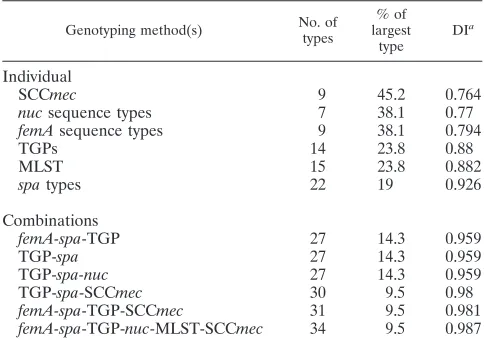
method and various combinations (Table 4) showed that
spa
typing is the most discriminatory. The addition of TGPs alone
or TGP plus SCC
mec
typing increases the discriminatory
power, but there is little additional increase from additional
femA
or
nuc
sequence typing.
Significance of sequence polymorphisms.
These results
in-dicate that
femA
and to some extent
nuc
sequence types
cor-relate closely with MLST in this set of MRSA isolates,
sug-gesting that these genes evolve at a rate similar to that of
housekeeping genes within CCs (20, 27).
spa
types were more
discriminatory for strain typing but correlated less well with
MLST or CCs.
Significant sequence variation in
femA
and
nuc
also has
potential implications for their use as species-specific PCR
targets for identification of
S. aureus.
The possibility of
muta-tions needs to be considered in the design of probes and
primers to avoid false-negative or inaccurate quantitative PCR
results. Our results show that some mutations occurred in the
region of primers used as species-specific primers (1).
There were significant sequence polymorphisms in
femA
and
nuc
genes, which have not been previously well studied, which
has potential implications for their use as species-specific PCR
targets for identification of
S. aureus
. Both correlated well with
each other, and
femA
sequence types correlated with MLST/
CCs. TGPs provide useful information about potential
viru-lence and the evolutionary history of
S. aureus
strains and can
increase the discriminatory power of
femA
and
spa
sequence
typing. Prospective testing of unselected clinical isolates will be
needed to adequately determine the optimal combination of
methods for MRSA surveillance.
ACKNOWLEDGMENTS
We sincerely thank the following colleagues for allowing us to study
their isolates: Herminia de Lencastre, Philip Giffard, and Graeme
Nimmo.
Fanrong Kong, Qinning Wang, and Yongwei Cai made similar
con-tributions to this work and so would be seen as co-first authors.
REFERENCES
1.Alarcon, B., B. Vicedo, and R. Aznar. 2006. PCR-based procedures for
detection and quantification ofStaphylococcus aureusand their application
in food. J. Appl. Microbiol.100:352–364.
2.Becker, K., A. W. Friedrich, G. Lubritz, M. Weilert, G. Peters, and C. von Eiff.2003. Prevalence of genes encoding pyrogenic toxin superantigens and
exfoliative toxins among strains ofStaphylococcus aureusisolated from blood
and nasal specimens. J. Clin. Microbiol.41:1434–1439.
3.Becker, K., R. Roth, and G. Peters.1998. Rapid and specific detection of
toxigenicStaphylococcus aureus: use of two multiplex PCR enzyme
immu-noassays for amplification and hybridization of staphylococcal enterotoxin genes, exfoliative toxin genes, and toxic shock syndrome toxin 1 gene. J. Clin.
Microbiol.36:2548–2553.
4.Berger-Bachi, B., and S. Rohrer.2002. Factors influencing methicillin
resis-tance in staphylococci. Arch. Microbiol.178:165–171.
5.Brakstad, O. G., K. Aasbakk, and J. A. Maeland.1992. Detection of Staph-ylococcus aureusby polymerase chain reaction amplification of thenucgene.
J. Clin. Microbiol.30:1654–1660.
6.Coombs, G. W., G. R. Nimmo, J. M. Bell, F. Huygens, F. G. O’Brien, M. J. Malkowski, J. C. Pearson, A. J. Stephens, and P. M. Giffard.2004. Genetic
diversity among community methicillin-resistant Staphylococcus aureus
strains causing outpatient infections in Australia. J. Clin. Microbiol.42:4735–
4743.
7.Costa, A. M., I. Kay, and S. Palladino.2005. Rapid detection ofmecAand
nucgenes in staphylococci by real-time multiplex polymerase chain reaction.
Diagn. Microbiol. Infect. Dis.51:13–17.
8.Denis, O., A. Deplano, H. De Beenhouwer, M. Hallin, G. Huysmans, M. G. Garrino, Y. Glupczynski, X. Malaviolle, A. Vergison, and M. J. Struelens.
2005. Polyclonal emergence and importation of community-acquired
methi-cillin-resistantStaphylococcus aureusstrains harbouring Panton-Valentine
leucocidin genes in Belgium. J. Antimicrob. Chemother.56:1103–1106.
9.Deplano, A., R. De Mendonca, R. De Ryck, and M. J. Struelens.2006.
External quality assessment of molecular typing ofStaphylococcus aureus
isolates by a network of laboratories. J. Clin. Microbiol.44:3236–3244.
10.Ferry, T., D. Thomas, A. L. Genestier, M. Bes, G. Lina, F. Vandenesch, and J. Etienne.2005. Comparative prevalence of superantigen genes in Staphy-lococcus aureusisolates causing sepsis with and without septic shock. Clin.
Infect. Dis.41:771–777.
11.Francois, P., G. Renzi, D. Pittet, M. Bento, D. Lew, S. Harbarth, P. Vaudaux, and J. Schrenzel.2004. A novel multiplex real-time PCR assay for rapid
typing of major staphylococcal cassette chromosomemecelements. J. Clin.
Microbiol.42:3309–3312.
12.Gilbert, F. B., A. Fromageau, L. Gelineau, and B. Poutrel.2006.
Differen-tiation of bovineStaphylococcus aureus isolates by use of polymorphic
tan-dem repeat typing. Vet. Microbiol.117:297–303.
13.Gomes, A. R., S. Vinga, M. Zavolan, and H. de Lencastre.2005. Analysis of the genetic variability of virulence-related loci in epidemic clones of
methi-cillin-resistantStaphylococcus aureus. Antimicrob. Agents Chemother.49:
366–379.
14.Hamels, S., J. L. Gala, S. Dufour, P. Vannuffel, N. Zammatteo, and J. Remacle.2001. Consensus PCR and microarray for diagnosis of the genus
Staphylococcus, species, and methicillin resistance. BioTechniques31:1364– 1366, 1368, 1370–1372.
15.Harmsen, D., H. Claus, W. Witte, J. Rothganger, H. Claus, D. Turnwald, and U. Vogel.2003. Typing of methicillin-resistantStaphylococcus aureusin a
university hospital setting by using novel software forsparepeat
determina-tion and database management. J. Clin. Microbiol.41:5442–5448.
16.Hunter, P. R., and M. A. Gaston.1988. Numerical index of the discrimina-tory ability of typing systems: an application of Simpson’s index of diversity.
J. Clin. Microbiol.26:2465–2466.
17.Huygens, F., J. Inman-Bamber, G. R. Nimmo, W. Munckhof, J. Schoon-eveldt, B. Harrison, J. A. McMahon, and P. M. Giffard.2006.Staphylococcus aureusgenotyping using novel real-time PCR formats. J. Clin. Microbiol.
44:3712–3719.
18.Huygens, F., A. J. Stephens, G. R. Nimmo, and P. M. Giffard.2004.mecA
locus diversity in methicillin-resistantStaphylococcus aureusisolates in
Bris-TABLE 4. Comparison of discriminatory powers of each genotyping
method and various combinations of methods for 42 MRSA
strains using Simpson index of diversity
Genotyping method(s) No. of
types % of largest type DIa
Individual
SCCmec
9
45.2
0.764
nuc
sequence types
7
38.1
0.77
femA
sequence types
9
38.1
0.794
TGPs
14
23.8
0.88
MLST
15
23.8
0.882
spa
types
22
19
0.926
Combinations
femA-spa-TGP
27
14.3
0.959
TGP-spa
27
14.3
0.959
TGP-spa-nuc
27
14.3
0.959
TGP-spa-SCCmec
30
9.5
0.98
femA-spa-TGP-SCCmec
31
9.5
0.981
femA-spa-TGP-nuc-MLST-SCCmec
34
9.5
0.987
a
DI, Simpson index, calculated according to the method of Hunter and Gas-ton (16).
on May 16, 2020 by guest
http://jcm.asm.org/
[image:6.585.42.284.99.271.2]bane, Australia, and the development of a novel diagnostic procedure for the
Western Samoan phage pattern clone. J. Clin. Microbiol.42:1947–1955.
19.Jarraud, S., G. Cozon, F. Vandenesch, M. Bes, J. Etienne, and G. Lina.1999. Involvement of enterotoxins G and I in staphylococcal toxic shock syndrome
and staphylococcal scarlet fever. J. Clin. Microbiol.37:2446–2449.
20.Jarraud, S., C. Mougel, J. Thioulouse, G. Lina, H. Meugnier, F. Forey, X. Nesme, J. Etienne, and F. Vandenesch.2002. Relationships between Staph-ylococcus aureusgenetic background, virulence factors,agrgroups (alleles),
and human disease. Infect. Immun.70:631–641.
21.Kizaki, M., Y. Kobayashi, and Y. Ikeda.1994. Rapid and sensitive detection
of thefemAgene in staphylococci by enzymatic detection of polymerase
chain reaction (ED-PCR): comparison with standard PCR analysis. J. Hosp.
Infect.28:287–295.
22.Kong, F., and G. L. Gilbert.2006. Multiplex PCR-based reverse line blot hybridization assay (mPCR/RLB)—a practical epidemiological and
diagnos-tic tool. Nat. Protoc.1:2668–2680.
23.Kong, F., S. Gowan, D. Martin, G. James, and G. L. Gilbert.2002. Molecular profiles of group B streptococcal surface protein antigen genes: relationship
to molecular serotypes. J. Clin. Microbiol.40:620–626.
24.Kong, F., S. Gowan, D. Martin, G. James, and G. L. Gilbert.2002. Serotype identification of group B streptococci by PCR and sequencing. J. Clin.
Microbiol.40:216–226.
25.Koreen, L., S. V. Ramaswamy, E. A. Graviss, S. Naidich, J. M. Musser, and B. N. Kreiswirth.2004.spatyping method for discriminating among Staph-ylococcus aureusisolates: implications for use of a single marker to detect
genetic micro- and macrovariation. J. Clin. Microbiol.42:792–799.
26.Lindsay, J. A., and M. T. Holden.2004.Staphylococcus aureus: superbug,
super genome? Trends Microbiol.12:378–385.
27.Lindsay, J. A., C. E. Moore, N. P. Day, S. J. Peacock, A. A. Witney, R. A. Stabler, S. E. Husain, P. D. Butcher, and J. Hinds.2006. Microarrays reveal
that each of the ten dominant lineages ofStaphylococcus aureushas a unique
combination of surface-associated and regulatory genes. J. Bacteriol.188:
669–676.
28.Macfarlane, L., J. Walker, R. Borrow, B. A. Oppenheim, and A. J. Fox.1999. Improved recognition of MRSA case clusters by the application of molecular
subtyping using pulsed-field gel electrophoresis. J. Hosp. Infect.41:29–37.
29.Malachowa, N., A. Sabat, M. Gniadkowski, J. Krzyszton-Russjan, J. Empel, J. Miedzobrodzki, K. Kosowska-Shick, P. C. Appelbaum, and W. Hryniewicz.
2005. Comparison of multiple-locus variable-number tandem-repeat analysis
with pulsed-field gel electrophoresis,spatyping, and multilocus sequence typing
for clonal characterization ofStaphylococcus aureusisolates. J. Clin. Microbiol.
43:3095–3100.
30.Mehrotra, M., G. Wang, and W. M. Johnson.2000. Multiplex PCR for
detection of genes forStaphylococcus aureusenterotoxins, exfoliative toxins,
toxic shock syndrome toxin 1, and methicillin resistance. J. Clin. Microbiol.
38:1032–1035.
31.Mellmann, A., A. W. Friedrich, N. Rosenkotter, J. Rothganger, H. Karch, R. Reintjes, and D. Harmsen.2006. Automated DNA sequence-based early
warning system for the detection of methicillin-resistantStaphylococcus
au-reusoutbreaks. PLoS Med.3:e33.
32.Moore, P. C., and J. A. Lindsay.2001. Genetic variation among hospital
isolates of methicillin-sensitiveStaphylococcus aureus: evidence for
horizon-tal transfer of virulence genes. J. Clin. Microbiol.39:2760–2767.
33.Oliveira, D. C., and H. de Lencastre.2002. Multiplex PCR strategy for rapid
identification of structural types and variants of themecelement in
methi-cillin-resistantStaphylococcus aureus. Antimicrob. Agents Chemother.46:
2155–2161.
34.Oliveira, D. C., C. Milheirico, S. Vinga, and H. de Lencastre.2006.
Assess-ment of allelic variation in theccrABlocus in methicillin-resistant
Staphylo-coccus aureusclones. J. Antimicrob. Chemother.58:23–30.
35.Omoe, K., M. Ishikawa, Y. Shimoda, D. L. Hu, S. Ueda, and K. Shinagawa.
2002. Detection ofseg, seh, andseigenes inStaphylococcus aureusisolates
and determination of the enterotoxin productivities of S. aureusisolates
harboringseg,seh, orseigenes. J. Clin. Microbiol.40:857–862.
36.Peacock, S. J., G. D. de Silva, A. Justice, A. Cowland, C. E. Moore, C. G. Winearls, and N. P. Day.2002. Comparison of multilocus sequence typing
and pulsed-field gel electrophoresis as tools for typingStaphylococcus aureus
isolates in a microepidemiological setting. J. Clin. Microbiol.40:3764–3770.
37.Ruppitsch, W., A. Indra, A. Stoger, B. Mayer, S. Stadlbauer, G. Wewalka, and F. Allerberger.2006. Classifyingspatypes in complexes improves
inter-pretation of typing results for methicillin-resistantStaphylococcus aureus.
J. Clin. Microbiol.44:2442–2448.
38.Shopsin, B., M. Gomez, S. O. Montgomery, D. H. Smith, M. Waddington, D. E. Dodge, D. A. Bost, M. Riehman, S. Naidich, and B. N. Kreiswirth.1999. Evaluation of protein A gene polymorphic region DNA sequencing for
typing ofStaphylococcus aureusstrains. J. Clin. Microbiol.37:3556–3563.
39.Shukla, S. K., M. E. Stemper, S. V. Ramaswamy, J. M. Conradt, R. Reich, E. A. Graviss, and K. D. Reed.2004. Molecular characteristics of nosocomial
and native American community-associated methicillin-resistant
Staphylo-coccus aureusclones from rural Wisconsin. J. Clin. Microbiol.42:3752–3757. 40.Stephens, A. J., F. Huygens, J. Inman-Bamber, E. P. Price, G. R. Nimmo, J. Schooneveldt, W. Munckhof, and P. M. Giffard.2006. Methicillin-resistant
Staphylococcus aureus genotyping using a small set of polymorphisms.
J. Med. Microbiol.55:43–51.
41.Tang, Y. W., M. G. Waddington, D. H. Smith, J. M. Manahan, P. C. Kohner, L. M. Highsmith, H. Li, F. R. Cockerill III, R. L. Thompson, S. O. Mont-gomery, and D. H. Persing.2000. Comparison of protein A gene sequencing with pulsed-field gel electrophoresis and epidemiologic data for molecular
typing of methicillin-resistantStaphylococcus aureus. J. Clin. Microbiol.38:
1347–1351.
42.Tong, Z., F. Kong, B. Wang, X. Zeng, and G. L. Gilbert.2007. A practical
method for subtyping ofStreptococcus agalactiae serotype III, of human
origin, using rolling circle amplification. J. Microbiol. Methods70:39–44.
43.Yamaguchi, T., K. Nishifuji, M. Sasaki, Y. Fudaba, M. Aepfelbacher, T. Takata, M. Ohara, H. Komatsuzawa, M. Amagai, and M. Sugai.2002.
Identification of theStaphylococcus aureus etdpathogenicity island which
encodes a novel exfoliative toxin, ETD, and EDIN-B. Infect. Immun.70:
5835–5845.
44.Yamasaki, O., T. Yamaguchi, M. Sugai, C. Chapuis-Cellier, F. Arnaud, F. Vandenesch, J. Etienne, and G. Lina.2005. Clinical manifestations of staph-ylococcal scalded-skin syndrome depend on serotypes of exfoliative toxins.
J. Clin. Microbiol.43:1890–1893.