City, University of London Institutional Repository
Citation
: Baden-Fuller, C. (1990). Introduction. In: Managing Excess Capacity. (pp. 3-17).
Wiley. ISBN 0631172130
This is the accepted version of the paper.
This version of the publication may differ from the final published
version.
Permanent repository link:
http://openaccess.city.ac.uk/4961/
Link to published version
:
Copyright and reuse:
City Research Online aims to make research
outputs of City, University of London available to a wider audience.
Copyright and Moral Rights remain with the author(s) and/or copyright
holders. URLs from City Research Online may be freely distributed and
linked to.
City Research Online:
http://openaccess.city.ac.uk/
[email protected]
1.
Introduction
C. W. F. BADEN-FULLER
During the 1960s, many believed that the Western world had entered a golden age from which recessions such as those of the 1930s had been banished for ever. These beliefs were shattered by the events of the late 1970s and early 1980s: from 1973 to 1985, Western European and North American industry experienced the severest recession of the post-war period. Numerous writers on macroeconomics have examined unemploy- ment, stagnation in output and slow growth in productivity; but the major concern of firms and their managers was the mounting excess capacity. Rising excess capacity was a key indicator pointing to inefficiency, declining competitiveness and the possibility of financial collapse for many Western firms.
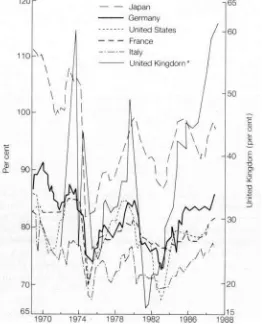
The size and pervasiveness of the problem are revealed by figures on capacity utilization for manufacturing industry as a whole for several major OECD countries. We see from the data in figure 1.1 that capacity utilization was declining in the early 1970s, reaching a low at the end of 1975. (Since different countries use different measures of capacity utilization, we should compare the changes for each country over time, not the levels across countries.) The recovery of the late 1970s was a false dawn as capacity utilization declined again in the 1980s reaching an all-time low around 1983, before recovery took hold again. Japan was an exception; its capacity utilization figures vary more wildly (reflecting scale differences) but it did not suffer as much in the mid-1980s as in the mid-1970s. Many argue that the recovery of the Western economies is not yet certain as slow growth, high levels of unemployment and excess capacity persist. Furthermore, excess capacity is now appearing in many service sectors such as banking.
Figure 1.1 Capacity utilization in manufacturing industry, for selected major OECD countries, 1970-1988
*Firms operating at full capacity Source: OECD,
[image:3.595.156.418.172.496.2]Evidence, much of it international in scope, is an important feature of this book. Six of the authors choose an industry setting for discussion of excess capacity: Bower describes the world bulk chemicals industry; Shaw and Simpson, European man-made fibres; Foroutan, European bulk steel; Baden-Fuller, UK steel castings; Grant, UK cutlery; and Bianchi and Volpato, European automobiles. Three of the papers use more broadly based evidence: Harrigan uses a wide sample of US firms to draw out her themes; Daems, a wide sample of European industries; Lorange and Nelson, a small sample of US and European firms. But in all the chapters the evidence is used to underpin the development of new ideas and advance theoretical understanding. Ghemawat and Nalebuff are the only authors to write their paper in a wholly formal and theoretical style, yet they too examine the relationship between firm behaviour and industrial policy.
This opening chapter outlines some of the conceptual themes which run through the individual papers. It begins by considering the measurement of excess capacity and why some firms might wish to create it. Then it tackles the meaty questions of central concern - how did unintended excess capacity arise and how was it resolved?
Intended or Unintended Excess Capacity
Throughout this book, the writers are concerned with unintended excess capacity, that is, with unanticipated falling capacity utilization over time. Moreover, it is dynamic changes rather than static measures which are of relevance to firms. This emphasis on measuring changes avoids some data problems: changes in capacity utilization are more easily measured and compared between firms and between industries than are absolute levels.2
Of course not all excess capacity is unplanned; variable demand, lumpy investment and strategic action to modify the power of competitors are all reasons why some firms plan excess capacity. If demand varies by time of day - as in electricity generation; by time of year - as in the usage of agricultural machinery; or in a cyclical pattern - as in commodity indus- tries, managers may hold excess capacity in off-peak periods to cope with anticipated peaks. A cyclical industry will show falling capacity utilization in the downturn of the cycle; providing the anticipated upturn occurs there is no inefficiency or crisis. Profitability and prices may also move with the cycle - high prices at the peak generating sufficient profits to compensate for the lower profits in the troughs.
To deter entry, incumbent firms may build or increase excess capacity. The implied threat is to flood the market after a new entrant appears, destroying the entrant’s profitability. Although this strategy may involve investment in plant which may never be used and although the actual flooding of the market after an entrant appears can also hurt the incumbent firms, given the right conditions such excess capacity can improve the incumbent’s profitability. There is a substantial literature on the effective- ness but social undesirability of this kind of excess capacity.3 Another reason for excess capacity is where investment is lumpy in the sense that the smallest increments to plant are a large percentage of the total market. In order to avoid shortages and gaps for entrants, existing firms may build plant in anticipation of demand changes.4
contrast to that used to cope with fluctuations in demand, or to effect entry deterrence, our excess capacity did not lead to profits for the firms but rather to financial distress and, in extreme cases, bankruptcy and total failure.
Causes of Unintended Excess Capacity
How did managers allow their firms to suffer from unintended excess capacity? Using the chemicals, steel and fibres industries as examples, Bower, Foroutan, Baden-Fuller, and Shaw and Simpson point to over- optimistic demand forecasts for the 1970s and 1980s based on the high growth years of the 1960s.5
Despite an evident slow-down in growth in the early 1970s, initially the optimistic forecasts of the late 1960s were carried forward with only gradual adjustment. Managers saw the early 1970s as a temporary rest or lull before a period of faster growth where economies ‘caught up’. This kind of forecast soon became discredited. The next and more persistent forecasts were of the same temporary lull followed by more moderate growth than before. In retrospect, the astonishing feature of the late 1970s and early 1980s was the strength of this kind of optimism. Few managers realized that there might be no upward growth in the foreseeable future and that there could be a prolonged recession.
Optimistic demand forecasts were only part of the cause of excess capacity; they were compounded by new building and capacity extension which exceeded even the over-optimistic forecasts. With the benefit of hindsight these massive investments seem wholly unjustified, but at the time managers believed that capacity had to be increased to pre-empt competi- tors and capture expected demand growth for years to come, for it was also believed by firms that increasing market share was the key to increasing profitability.6 This belief was reinforced by the evidence that the larger-scale newer plants had lower unit costs for any given rate of output. Managers therefore built new capacity, expecting to gain a relative advantage against existing and potential competition but paying little regard to the adverse effect of the new investment on the overall supply and demand balance and on average levels of industry profitability.7 Paradoxically, the first signs of the recession and the early price wars spurred some firms to advance rather than retard these building plans.
In other industries, particularly automobiles, over-optimistic forecasting, competitor races and low wage-cost competition were only part of the problem; as Bianchi and Volpato explain, managers were ignoring some radical changes taking place in the composition of demand, in technology, and in their interaction. On the technology side, some firms, principally located in Japan, discovered that there were great opportunities for reducing costs through adopting new production and delivery technology. One such development was ‘just-in-time’, and writers elsewhere have detailed how these systems and other process improvements can reduce costs without significantly altering plant scale; moreover they can be applied effectively in medium-sized plant.9 Most of the literature documents these systems in the Japanese context, but examples also exist in Europe.10
On the consumption side, it was not the lack of demand but its fragmentation and changes which caused problems for firms. For cars, Bianchi and Volpato describe how reliability, small size and performance became the more valued features and how fashion and local tastes were causing European demand to fragment. Elsewhere, others document simi- lar effects for textile clothing, domestic appliances and even for producer products such as pumps."
Traditionally designed plants, even those recently constructed, were often unsuitable in serving the newly shaped markets because their output was of uncertain quality, their product designs were outdated, and the whole production system was inflexible and unable to adapt rapidly. In contrast, the new production systems could supply newer, more suitable products. They had additional advantages, too, for improving product quality had the sometimes surprising effect of lowering costs - in automo- biles in the 1970s this was one of the sources of the Japanese cost advantages.12
Thus, it is alleged, in several industries those who adopted the new technologies were gaining a double-edged weapon: low cost with greater flexibility. Traditional firms who had failed to appreciate these changes found themselves with ‘excess capacity’, and in such cases managers often cited insufficiency of customer demand as the cause of their problem, whereas in fact it was lack of appreciation of a new competitive environ- ment.
The Key Issues
cartels, were counter-productive, sometimes resulting in more efficient firms quitting the industry leaving the less efficient behind; and, as Grant explains, even the ‘free market’ did not provide an ideal solution.
Falling Demand and Excess Capacity
As Harrigan points out, where the cause of excess capacity is an insuffi- ciency of demand or an overbuilding of capacity (rather than a failure to recognize a new set of competitive rules) there are several responses: a firm could await the revival of demand, encourage other firms to adjust their capacity, undertake internal restructuring of its own operations (including quitting) or some combination of the three.
The question of demand revival has been touched on and it has been noted that in many industries no immediate revival took place and that participants took a long time to accept that recovery was not imminent. However, revising demand forecasts downwards did not lead to immediate action by the firms because many believed or hoped that the burden of adjustment would be borne by others. Realizing that if one firm retires capacity, all the other players in that industry gain, a dangerous ‘game’ arose where each firm waited for a rival to quit.
The Competitor Game
Central to excess capacity - and one of the major reasons why it persists - is the belief by firms that others will act first. So long as all competitors within an industry hold such a view there will be paralysis and deadlock. Management beliefs about competitor behaviour may be reinforced by outsiders such as banks, shareholders and governments whose interests, as we explain later, may lie in delaying adjustment. The problems caused by deadlock are so crucial that there is considerable value in formalizing the ‘game’ as it reveals significant insights. Here I use the typical ‘game theory’ exposition adopted by economists.
its rival has a superior position or when the losses precipitate financial collapse and change of management.
Such a simple game can be expanded to encompass many players and many time periods. Ghemawat and Nalebuff, and Foroutan formally show in expanded models that delayed adjustment is likely.13 Such models offer a plausible explanation for persistent excess capacity in oligopolistic Euro- pean industries.
[image:8.595.162.418.288.426.2]A stays A quits
Figure 1.2 Payoff matrix for two firms considering quitting in a duopolistic industry
The Government Game
Quality of Adjustment
‘Oligopolistic games’ may cause additional problems. The quality of adjustment may be poor - the larger or more efficient plants and firms may retire early and the smaller or inefficient firms may hang on longer. If we go back to our simple game, the best collective solution for the two firms is for B to quit and allow A to stay. However, if both stay firm B stands to lose less in absolute amount than firm A, and if B and A are equally resourced B may credibly threaten A by saying it will stay regardless of ,4’s actions. If A ‘Oligopolistic games’ may cause additional problems. The quality of adjustment may be poor - the larger or more efficient plants and firms may retire early and the smaller or inefficient firms may hang on longer. If we go back to our simple game, the best collective solution for the two firms is for B to quit and allow A to stay. However, if both stay firm B stands to lose less in absolute amount than firm A, and if B and A are equally resourced B may credibly threaten A by saying it will stay regardless of ,4’s actions. If Abelieves B's threat, A will leave, which is socially inefficient. Ghemawat and Nalebuff carefully model such a game explaining the private and social losses under robust conditions.15 Baden-Fuller’s description of steel castings shows that such games are played out in practice.
Cartels and Collective Action
be able to extract some money from the other players to implement the decision. In complex industries involving many players, the negotiations went on for a long time and the freezing process resulted in firms postponing closure decisions for years.
A second problem arose in the negotiations themselves. The governments had no mechanism to force agreement, and everyone came to realize that a meeting around a table does not always result in a meeting of minds. The Lazard scheme for steel castings (Baden-Fuller) took many months to reach agreement, the European fibres cartel (Shaw and Simpson) several years and the European steel cartel (Foroutan) more than a decade. Even when agreement was reached, it was realized that there was often no institutional mechanism to ensure that the plan was carried out. The Italians repeatedly failed to close fibre plants as they promised; only in the steel schemes were solid enforcement mechanisms available.
Accepting the Need for Individual Action
Bower argues that as long as all players in the industry believed that excess capacity was someone else’s fault, no serious resolution was possible. The industry could only cross the watershed and move towards reconstruction when each firm recognized that first it had to put its own house in order. Whilst large meetings of all firms in the industry were usually a hindrance, bilateral deals sometimes helped when they were between parties which knew they had a mutual interest in reducing capacity, and were certain they could trust each other to keep promises.
Lorange and Nelson go further than Bower, arguing that the problem stemmed from earlier periods of success. Those firms which found it most difficult to change were frequently those who were most successful in an earlier period. During periods of success organizations may become flabby in ways such as keeping and promoting incompetent staff, adopting more cumbersome procedures and allowing fuzzy goals to emerge, all of which make subsequent adjustment more difficult. As a result these organizations systematically and effectively filter out ‘bad news’ making it doubly difficult to take the initiative. The views of Bower and of Lorange and Nelson are given support elsewhere in this book; other authors note that reductions in excess capacity were usually achieved only after the major players had taken a lead, and this could only occur once major firms ignored the competitive ‘game’ and faced up to the reality of failure in their own strategies.
Barriers to Internal Adjustment
irrelevant. Grant and Baden-Fuller document these effects in cutlery and steel castings, but they are also important in other industries. To make matters worse, European laws restrict the ability of firms to abandon their assets and lay off their workforce; assets need to be dismantled, ugly or dangerous sites need to be cleaned up and the workforce given substantial severance payments. In many of our industries closure was, and still is, an investment decision with substantial cash outflows and these provided a further barrier to adjustment.
Firms governed by the profit motive realized that closure was not ‘profitable’, i.e. sensible, unless the discounted cash flow of the project was positive. A facility may earn accounting losses and experience cash losses and yet it may still be ‘profitable’ to avoid closure because the present cost of closure more than outweighs the future losses from not closing. The further the economy went into recession, the greater the current abandon- ment cost and thus the greater the incentive to preserve excess capacity. These realizations provided an important obstacle to those firms wishing to take the initiative. There were other obstacles too; in the large, diversified firms where plant closure did not necessarily result in dissolution of the firm as a whole, top management’s realization that closure had to take place needed hard selling inside the orgnization. Business unit managers believed that closure would force them out of a job for a long period of time - perhaps for life. Unless the top managers were able to promise work elsewhere, there was a strong motivation for more junior managers to subvert the unpleasant decision. Moreover, because closure was not just an abandonment but involved complex site clean-up and recovery of some assets (to provide the cash to fulfil other obligations) closure was not an action which could be undertaken by senior management alone; all managers and workers needed to be involved. Boards of directors voting to close plants sometimes found their desires frustrated by unwilling managers and workers.
In undiversified firms, where plant closure often meant destruction of the firm, the problems were even greater. It was not just junior managers who perceived a lack of opportunities - senior managers also faced the same problem. For everyone, plant closure meant loss of job and social status with little chance of future employment. No wonder many hung on to the bitter end, as Grant’s careful analysis of closures in the UK cutlery industry vividly illustrates. The human factor, uncomplicated by competitor be- haviour, provides an obvious explanation. Managers resisting closure sometimes found an unexpected ally in their shareholders who also wished to stay in business. The shareholder incentive was strongest when the book value of the firm was positive, but the abandonment value of the firm was zero or negative.17 Remaining in operation could not yield less for the shareholders, whereas the costs of staying open were borne by creditors - particularly the banks and governments - who were unable or unwilling to force the managers to take the ‘sensible’ decisions. Of course, not all managers and shareholders adopted this approach. Some saw that they could not easily avoid the consequences of failure, and others believed that there were opportunities for regeneration.
Changing Dynamics of Competition and Excess Capacity
Earlier in this chapter we noted that excess capacity may be caused by changes in the dynamics of competition. The world demand for many goods such as cars, textiles and appliances, although cyclical, has expanded through the last 20 years, and the problem facing Western firms in many industries was not an absence of total demand, but a failure to serve domestic markets and export effectively. In many industries excess capacity was the consequence of misplaced investment in the wrong kind of capacity. This view challenges the game-theoretic explanation of the cause of excess capacity advanced earlier.
The essay by Bianchi and Volpato is particularly important in this context. They argue that the European automobile market has changed and that the traditional recipe of large-scale plants producing homogeneous product, so effective in the 1960s, was inappropriate in the late 1970s and early 1980s. Consumer tastes were changing, demanding more variety, and technology convergence was eroding the cost advantage of large-scale inflexible systems over smaller-scale flexible systems. Firms which were able to embrace the newer technologies were able to serve the customer with the new variety. There was an additional advantage: the newer systems produced better-quality products, rejects were less common and overall costs were also reduced. The industry experienced some firms making profits with little excess capacity, at the same time as others made losses with much excess capacity: the first group were those which had changed and the second group were those which had not.
Automobiles were not the only sector experiencing the simultaneous features of excess capacity among some firms and success among others; the same pattern was noticeable in specialist steel, cutlery, textiles and appliances. Foroutan ascribes the success of mini-mills in the steel industry to their approach, wholly different from that of the traditional producers: the mini-mills emphasized small-scale plants and small lot capability.18 Grant notes the success of Richardson in the cutlery industry, and elsewhere Grant and Baden-Fuller describe how Richardson’s success was based on new ways of configuring production processes and in providing more variety to the customer.19 The success of the Scottish and Italian knitwear industry and of firms like Hotpoint in appliances has been ascribed by Baden-Fuller and others to similar factors.20
The Book
Critical readers may see this book as a savage indictment of the quality of European and Western management, and to some extent they would be correct. Over-optimisim, competitor games, intergovernmental games and battles within firms slowed down the process of adjustment and com- pounded the substantial adjustment difficulties caused by the huge costs and technical difficulties in closing capacity. In many industries, firms took an inordinately long time to recognize that past investment in plant and delivery capability were outdated or inappropriate for the changing tech- nology and markets. To make matters worse, when adjustment came it was often wrong: the wrong plants closed in the sense that those which closed were not the least efficient.
Governments, however, appear in an even worse light, as the careful analysis in this volume shows. Even well-intentioned policy makers who acted in good faith believing they were promoting economic efficiency are shown to have produced adverse effects in steel (Foroutan), steel castings (Baden-Fuller) and fibres (Shaw and Simpson). Their interventions have frequently had the effect of delaying the adjustment process and, more seriously, causing the quality of the adjustment to be inferior. The real recovery only came when management realized that new responses were necessary to conquer declining competitiveness.
Notes
1 The relationship between excess capacity and adjustment of the labour force has received considerable attention: see for instance B. Bluestone and B. Harrison, The Deindustrialization of America (Basic Books, New York, 1982). 2 Absolute measures differ according to whether we ask an engineer or a
manager. Engineers refer to rated capacity based on notions of machine capability and normal wear and tear, but a manager looks to profitability. In one firm, a manager may run the plant more slowly than engineering capacity allows because demand is not strong enough, and make losses. In another industry, for different machines ‘notional full capacity’ measured by engineers may not be attained, yet a firm may be profitable. It is not sensible to describe both situations as ‘excess capacity’ when the first is clearly undesirable but the second desirable. Measuring changes in excess capacity avoids some of this kind of measurement difficulty, and it focuses on the crucial issue of dynamics. Measuring changes does not eliminate other measurement difficulties. For example, when plant which is profitable and useful in one period becomes ‘obsolete’ in the next period due to technological shifts, it should not be counted as part of excess capacity. (The authors in this book are aware of this and other measurement difficulties and, where possible and appropriate, make the necessary corrections.)
3 For a formal treatment see, for example, A. M. Spence, ‘Entry Capacity, Investment and Oligopolistic Pricing’, Bell Journal of Economics, 1977, vol. 8, pp. 534-44. 4 See B. C. Eaton and R. Lipsey, ‘Exit Barriers are Entry Barriers: Durability of
Capital as Barrier to Entry’, Bell Journal of Economics, 1980, vol. 11, pp. 721-9. 5 The evidence in the essays in this book is supported by other work by the writers,
Foroutan, ‘The EEC Steel Industry and the mid-1970s Crisis: Some Aspects of Trade Policy’, PhD dissertation, London School of Economics, 1986; C. W. F. Baden-Fuller, ‘The Economics of Closure and the Case of the UK Steel Castings Industry’, Economic Journal, 1989, vol. 99(4). R. W. Shaw and S. A. Shaw, ‘Excess Capacity and Rationalization in the West European Synthetic Fibres Industry’, Journal of Industrial Economics, vol. 32(2), December 1983, pp. 149-66.
6 The writings of the Boston Consulting Group, which stressed a positive relationship between market share and profitability, were widely accepted.
7 As any simple economics book shows, an increase in supply without any change in demand leads to lower prices and profitability for all in the industry.
8 See also R. M. Grant and S. Downing, Industry Adjustment, Business Strategy and Firm Performance in the UK Cutlery Industry, Centre for Business Strategy, London Business School, 1985.
9 For a discussion of some of the broader issues, see R. H. Hayes and S. C. Wheelwright, Restoring our Competitive Edge: Competing through Manufactur- ing (Wiley, London, 1984).
10 J. M. Stopford and C. W. F. Baden-Fuller, ‘Regional Level Competition in a Mature Industry: The Case of European Domestic Appliances’, Journal of Common Market Studies, 1987, vol. 26, no. 2, pp. 173-92, describe how some medium-sized plants in the European domestic appliance industry improved productivity to become three times more productive than their larger counter- parts by adopting simple expedients such as using pre-painted steel rather than painting the appliance box after it was made.
11 See Stopford and Baden-Fuller, ‘Regional Level Competition in a Mature Industry’; J. F. Porac, H. Thomas and C. W. F. Baden-Fuller, ‘Competitive Groups as Cognitive Communities: The Case of the Scottish Knitwear Manu- facturers', Journal of Management Studies, July 1989, vol. 26(4), pp. 397-416.
12 See especially W. J. Abernathy, K. B. Clark and A. M. Kantrow, Industrial Renaissance (Basic Books, New York, 1983).
13 See especially P. Ghemawat and B. Nalebuff, ‘Exit’, Rand Journal of Eco- nomics, 1985, vol. 16, no. 2, pp. 184-94.
14 Bluestone and Harrison, The Deindustrialization of America, vividly describe some of the effects of plant closures on local states.
15 Ghemawat and Nalebuff,‘Exit’.
16 The US Sherman Act and Article 85 of the Treaty of Rome proscribe collusion. On occasion, European governments have ignored these laws. Ghemawat and Nalebuff analyse the welfare implications of various government actions, including promoting collusion, in chapter 3 of this volume.
17 See C. W. F. Baden-Fuller and R. Hill, ‘Industry Strategies for Alleviating Excess Capacity: The Case of the Lazard Scheme for UK Steel Castings’, mimeo, Centre for Business Strategy, London Business School, 1984.
18 Foroutan, ‘The EEC Steel Industry and the mid-1970s Crisis’.
19 R. M. Grant and C. W. F. Baden-Fuller, The Richardson Sheffield Story, Case Series